
CSE 20 DISCRETE MATH Fall 2020 http cseweb
CSE 20 DISCRETE MATH Fall 2020 http: //cseweb. ucsd. edu/classes/fa 20/cse 20 -a/
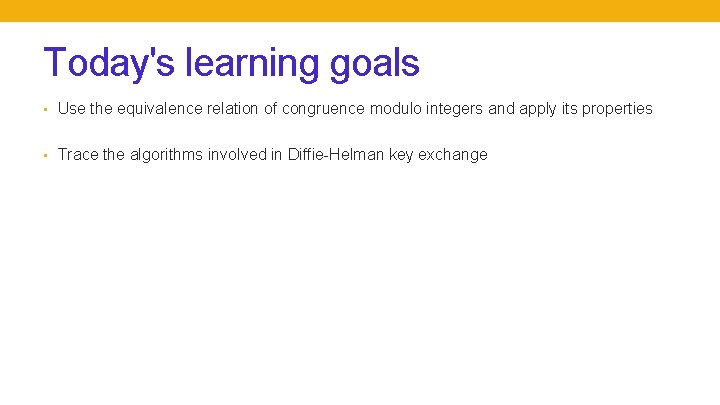
Today's learning goals • Use the equivalence relation of congruence modulo integers and apply its properties • Trace the algorithms involved in Diffie-Helman key exchange
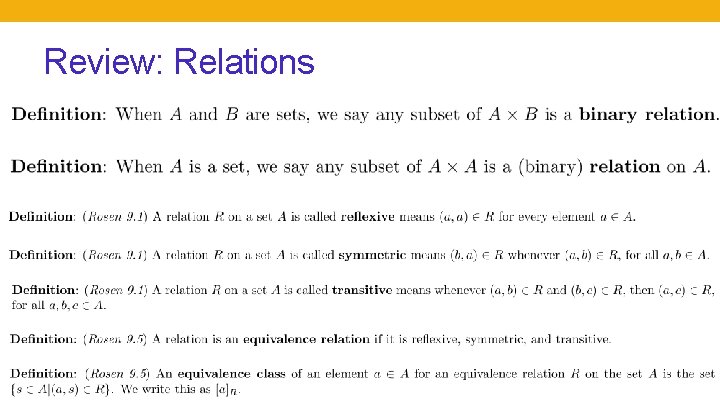
Review: Relations
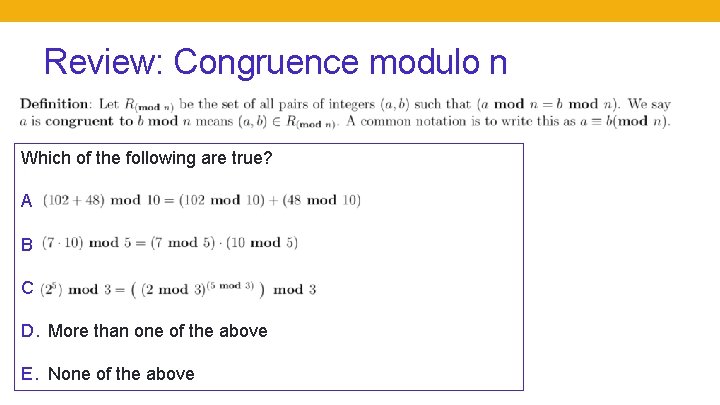
Review: Congruence modulo n Which of the following are true? A. B. C. D. More than one of the above E. None of the above
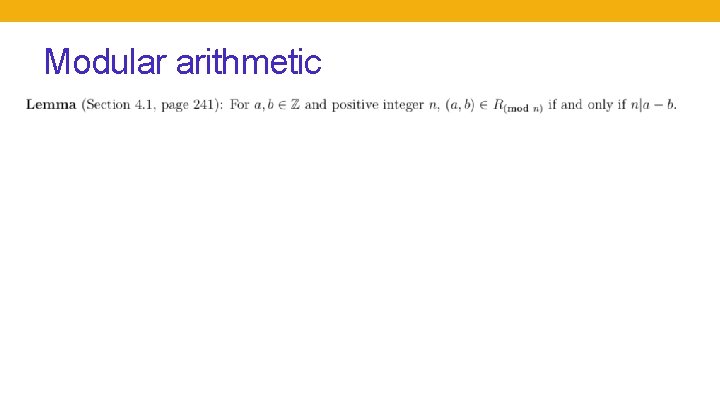
Modular arithmetic
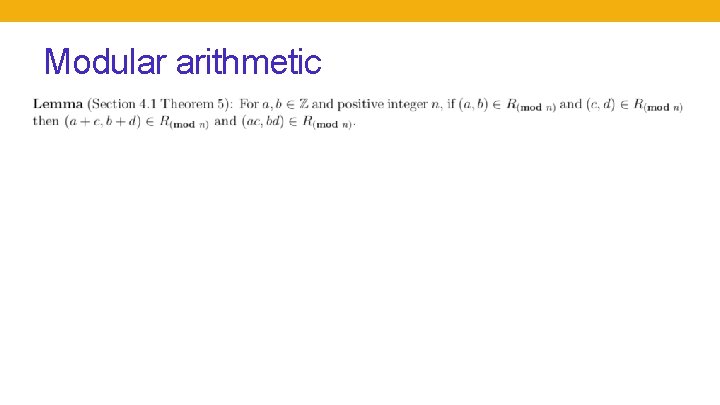
Modular arithmetic
Application: Cryptography How do parties communicate private key securely across insecure channel? • Caesar cipher: need to agree on shift • AES: private key, needs to be generated for each session
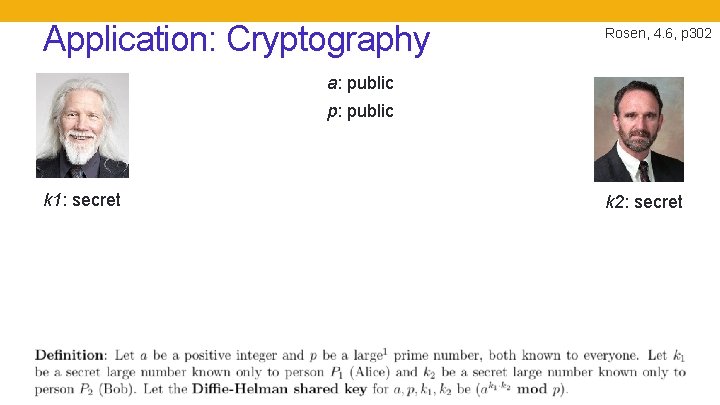
Application: Cryptography Rosen, 4. 6, p 302 a: public p: public k 1: secret k 2: secret
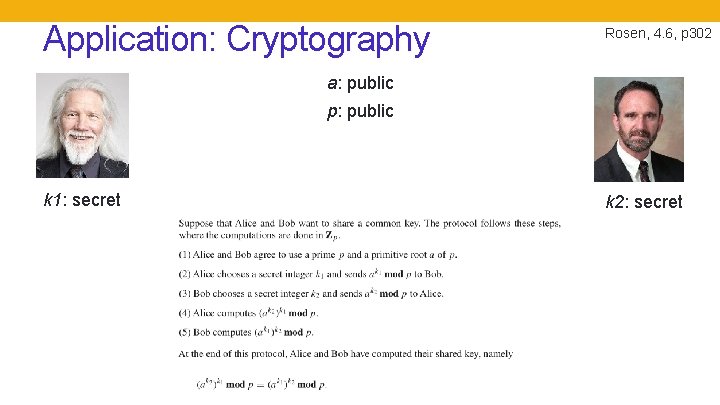
Application: Cryptography Rosen, 4. 6, p 302 a: public p: public k 1: secret k 2: secret
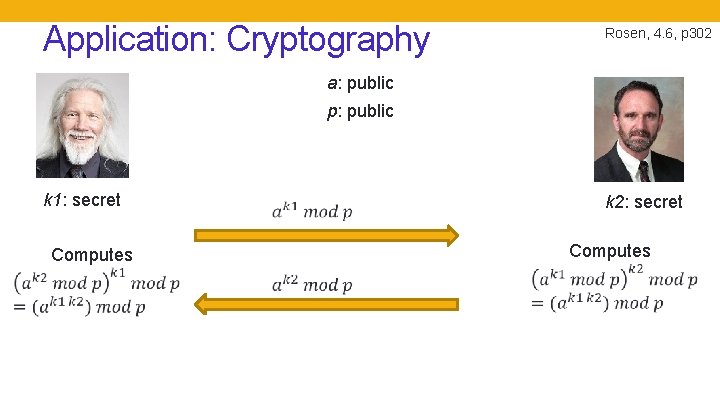
Application: Cryptography Rosen, 4. 6, p 302 a: public p: public k 1: secret Computes k 2: secret Computes
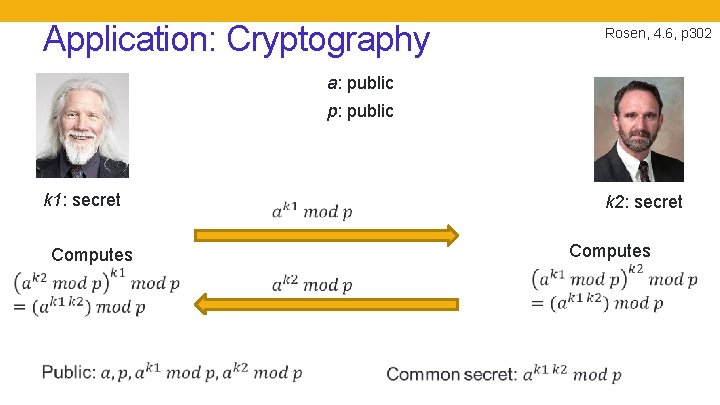
Application: Cryptography Rosen, 4. 6, p 302 a: public p: public k 1: secret Computes k 2: secret Computes
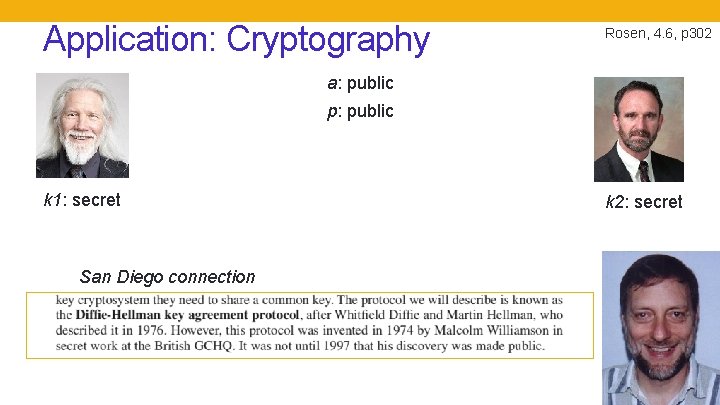
Application: Cryptography Rosen, 4. 6, p 302 a: public p: public k 1: secret San Diego connection k 2: secret
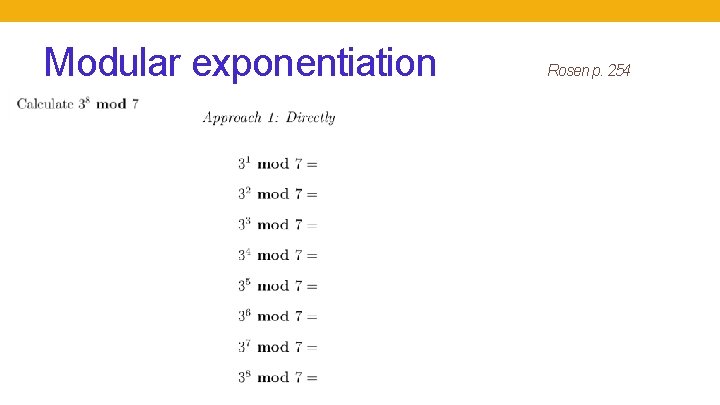
Modular exponentiation Rosen p. 254
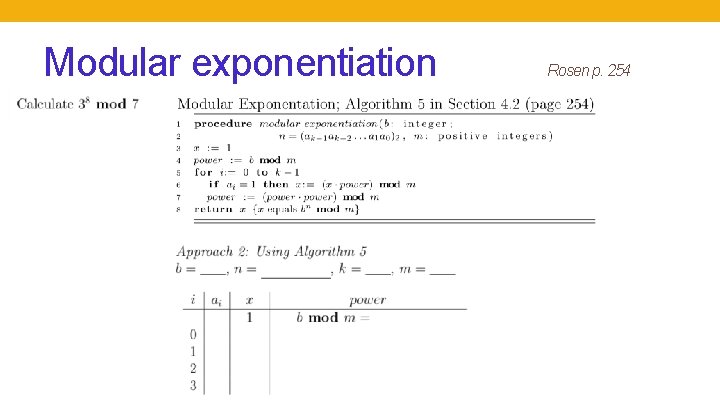
Modular exponentiation Rosen p. 254
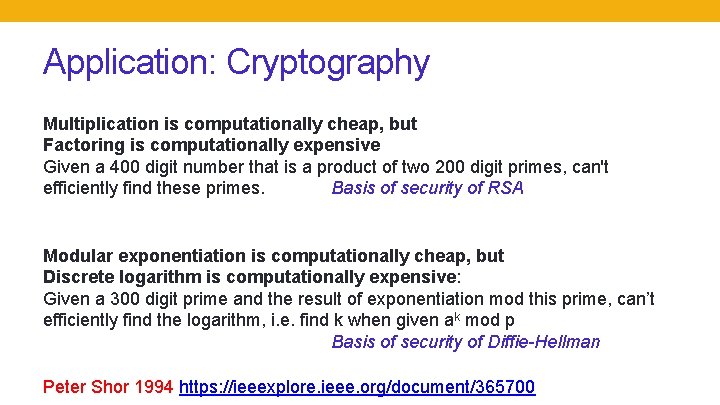
Application: Cryptography Multiplication is computationally cheap, but Factoring is computationally expensive Given a 400 digit number that is a product of two 200 digit primes, can't efficiently find these primes. Basis of security of RSA Modular exponentiation is computationally cheap, but Discrete logarithm is computationally expensive: Given a 300 digit prime and the result of exponentiation mod this prime, can’t efficiently find the logarithm, i. e. find k when given ak mod p Basis of security of Diffie-Hellman Peter Shor 1994 https: //ieeexplore. ieee. org/document/365700
- Slides: 15