
CSE 160 Lecture 15 Introduction to Threads Synchronization
![A Simple Example: Array Summation int array_sum(int n, int data[]) { int mid; int](https://slidetodoc.com/presentation_image_h2/c83ebda237719952988f07f650e3ea78/image-22.jpg "A Simple Example: Array Summation int array_sum(int n, int data[]) { int mid; int")
- Slides: 26
CSE 160 - Lecture 15 Introduction to Threads, Synchronization and Mutual Exclusion
Heavyweight Processes • Complete stand-alone programs – Code segment – Data Segment • Static data – Heap • Malloc’ed data – Stack – Registers
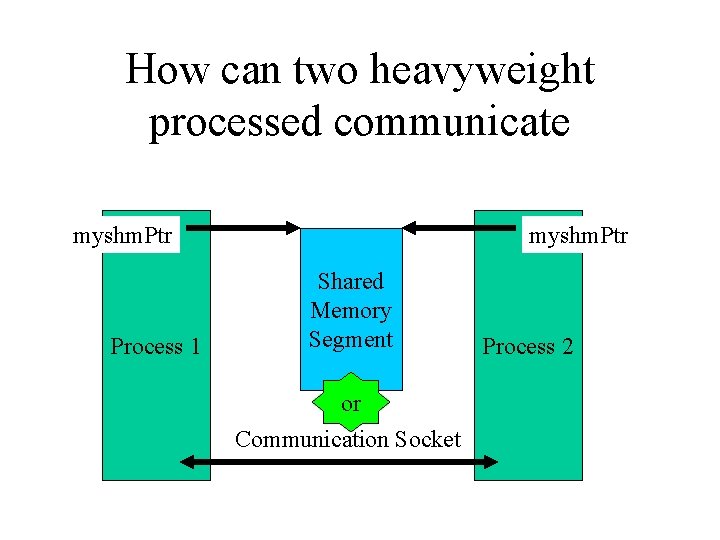
How can two heavyweight processed communicate myshm. Ptr Process 1 myshm. Ptr Shared Memory Segment or Communication Socket Process 2
Shared Memory Segment • Only a single cpu or multiprocessor shared memory • A “named” segment of memory that processes attach to – shmat() function call for Unix • Processes are given pointers to the beginning of the shared memory segment – Structure of the segment contents are not specified
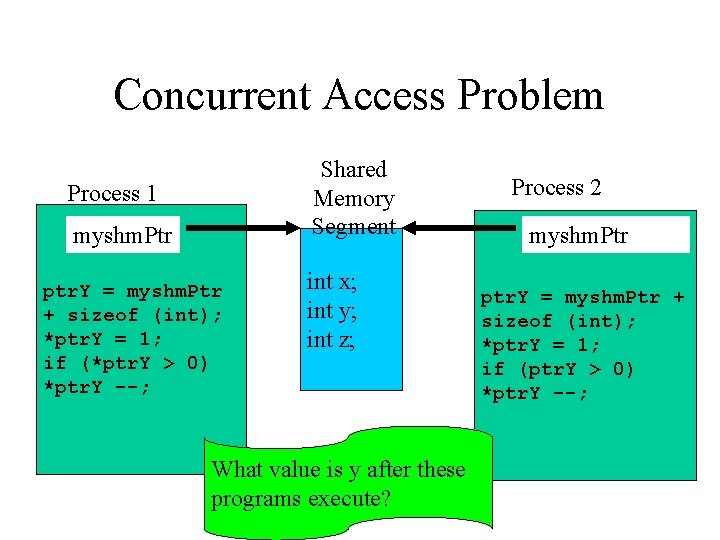
Concurrent Access Problem Shared Memory Segment Process 1 myshm. Ptr ptr. Y = myshm. Ptr + sizeof (int); *ptr. Y = 1; if (*ptr. Y > 0) *ptr. Y --; int x; int y; int z; What value is y after these programs execute? Process 2 myshm. Ptr ptr. Y = myshm. Ptr + sizeof (int); *ptr. Y = 1; if (ptr. Y > 0) *ptr. Y --;
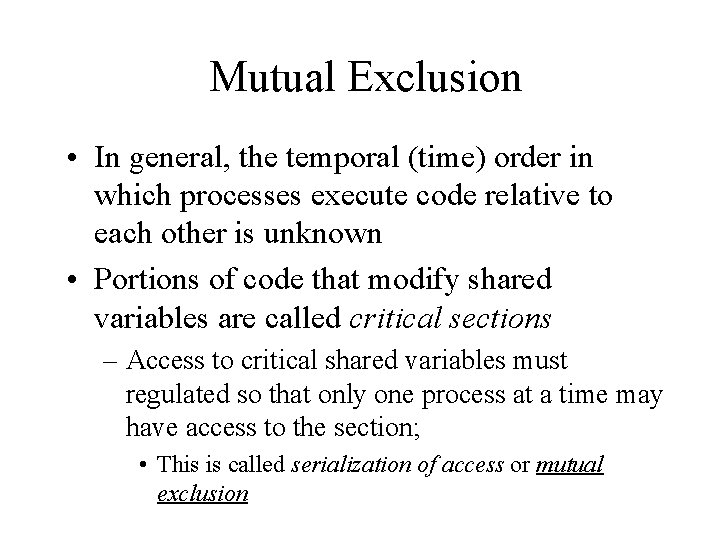
Mutual Exclusion • In general, the temporal (time) order in which processes execute code relative to each other is unknown • Portions of code that modify shared variables are called critical sections – Access to critical shared variables must regulated so that only one process at a time may have access to the section; • This is called serialization of access or mutual exclusion
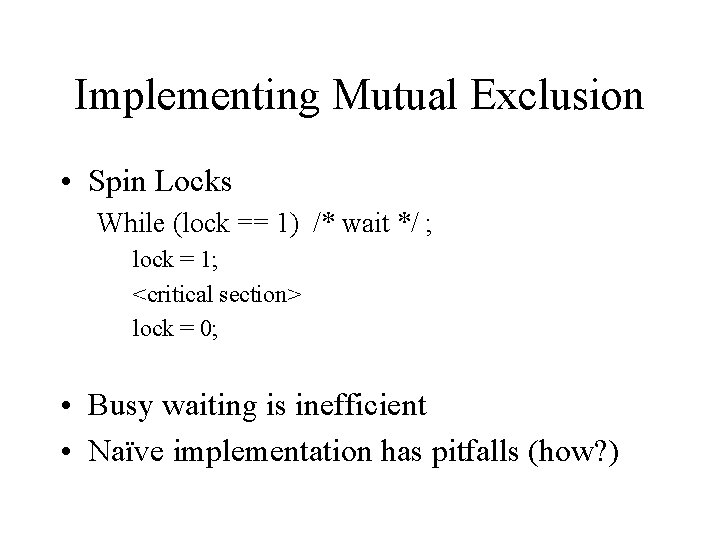
Implementing Mutual Exclusion • Spin Locks While (lock == 1) /* wait */ ; lock = 1; <critical section> lock = 0; • Busy waiting is inefficient • Naïve implementation has pitfalls (how? )
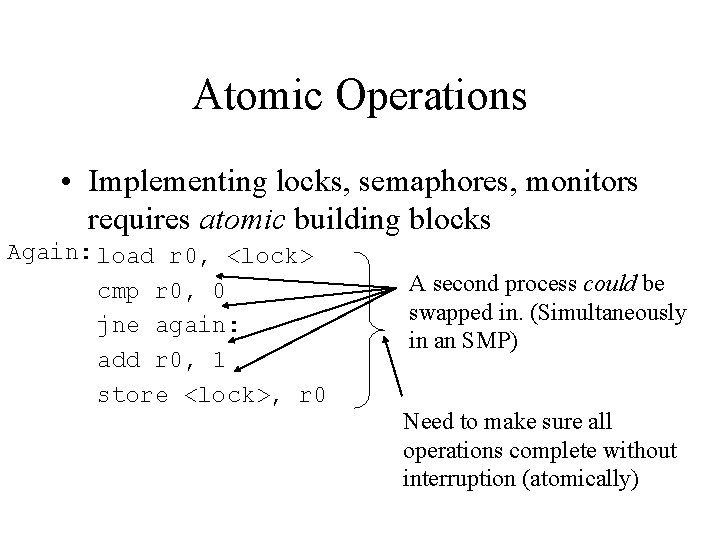
Atomic Operations • Implementing locks, semaphores, monitors requires atomic building blocks Again: load r 0, <lock> cmp r 0, 0 jne again: add r 0, 1 store <lock>, r 0 A second process could be swapped in. (Simultaneously in an SMP) Need to make sure all operations complete without interruption (atomically)
Test and Set • CPU designers recognize this need and have special hardware instructions – test and set • test for zero, set if not zero – fetch and increment • fetch location and add one
Semaphores • Introduced by Dijkstra. – Give a higher-level test and set semantic • Two operations P and V. – P(semaphore) : if > 0, decrement semaphore, otherwise, wait – V(semaphore): increment semaphore by one – Semaphore initialized > 0 • Provides the functionality needed to implement mutual exclusion • Standard OS construct – semget(), semctl(), semop() system calls
More Mutual Exclusion • Monitors – Higher-level than Semaphores making them less prone to error – To gain access to shared resource, programs must always go through the monitor. • Condition variables – Gain access to a resource, when a particular condition occurs (more later).
Threads • For SMP, could always use heavyweight processes – Performance penalties – More burden on the programmer to manage shared structures (“pointer hell”) • Threads allow concurrency within a single process – Lighter-weight access
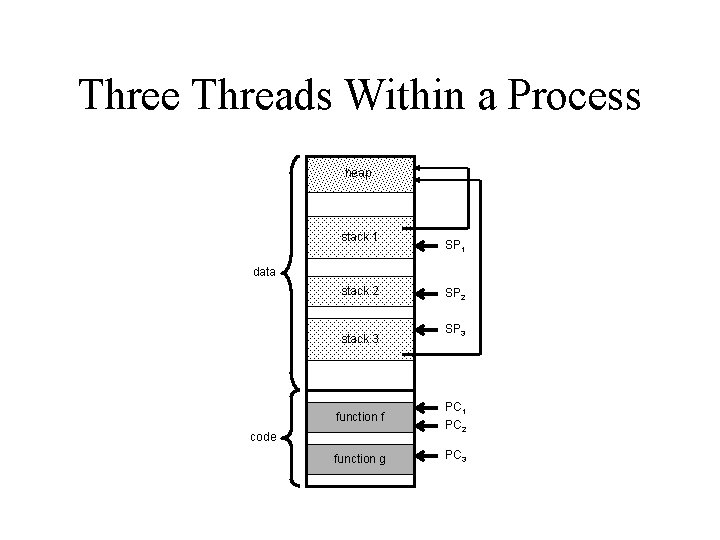
Processes and Threads • • • Process includes address space. Thread is program counter and stack pointer. Process may have many threads. All the threads share the same address space. Processes are heavyweight, threads are lightweight. Processes/threads need not map one-to-one onto processors.
Three Threads Within a Process heap stack 1 SP 1 data stack 2 stack 3 SP 2 SP 3 function f PC 1 PC 2 function g PC 3 code
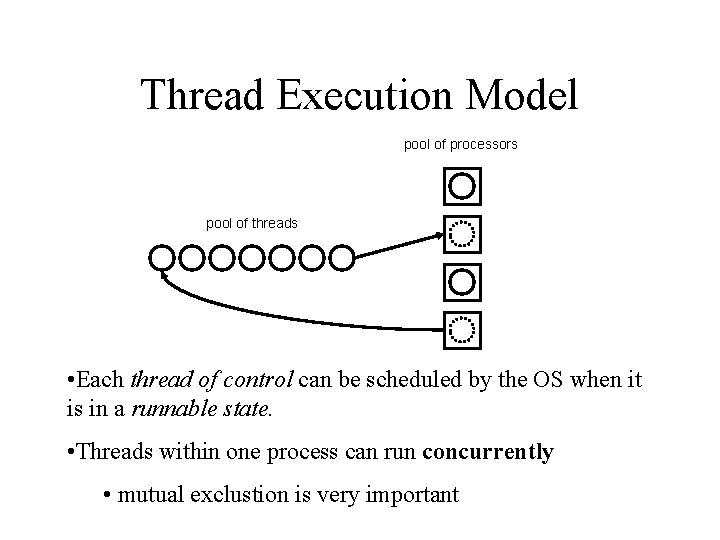
Thread Execution Model pool of processors pool of threads • Each thread of control can be scheduled by the OS when it is in a runnable state. • Threads within one process can run concurrently • mutual exclustion is very important
Thread Execution Model: Key Points • • Pool of processors, pool of threads. Threads are peers. Dynamic thread creation. Can support many more threads than processors. Threads dynamically switch between processors. Threads share access to memory. Synchronization needed between threads.
Why Use Threads? • Representing Concurrent Entities – – Concurrency is part of the problem specification. Examples: systems programming and user interfaces. Single or multiple processors. This kind of multithreaded programming is difficult. • Multiprocessing for Performance – Concurrency is under programmer’s control. – Programs could be written sequentially. – This kind of multithreaded programming should be easier.
Commercial Thread Libraries • Win 32 threads (Windows NT and Windows 95). • Pthreads (POSIX Thread Interface). (SGI IRIX, Sun Solaris, HP-UX, IBM AIX, Linux, etc. ). • Solaris threads (Sun. OS 5. x). • All designed primarily for systems programming.
Example: Pthreads • POSIX Threads – available on many platforms • Thread Management: pthread_create(), pthread_join(), pthread_exit(), pthread_kill(), pthread_cancel() • Mutexes: pthread_mutex_create(), pthread_mutex_init(), pthread_mutex_lock(), pthread_mutex_unlock(), pthread_mutux_trylock() • Events: pthread_cond_init(), pthread_cond_wait(), pthread_cond_timedwait(), pthread_cond_signal() • Scheduling: pthread_setschedparam(), pthread_attr_setschedpolicy()
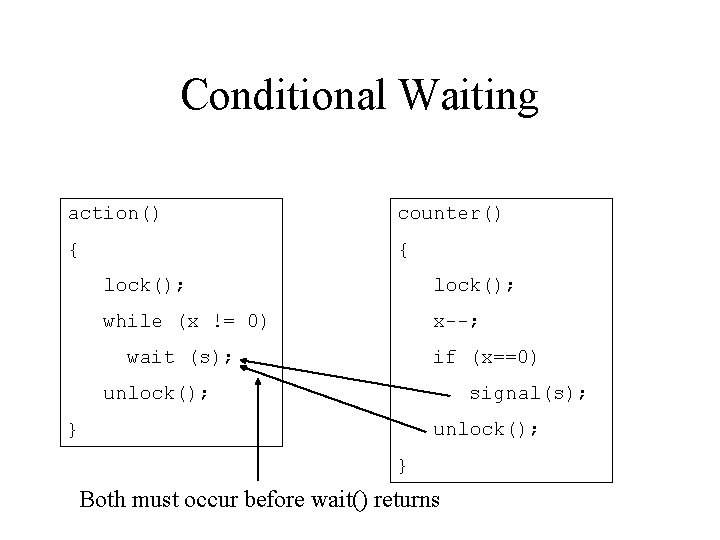
Condition Variables • Would like to be “woken up” when a particular condition occurs – Calling pthread_cond_wait(mutex) releases exclusive access to a mutex. Thread sleeps. – When condition is signalled, thread wakes up and given access back to the mutex
Conditional Waiting action() counter() { { lock(); while (x != 0) x--; wait (s); if (x==0) unlock(); signal(s); } unlock(); } Both must occur before wait() returns
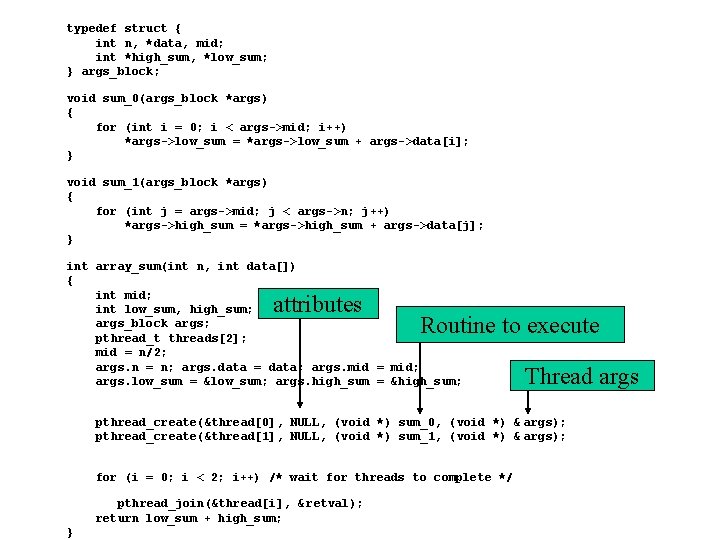
A Simple Example: Array Summation int array_sum(int n, int data[]) { int mid; int low_sum, high_sum; mid = n/2; low_sum = 0; high_sum = 0; #pragma multithreadable { for (int i = 0; i < mid; i++) low_sum = low_sum + data[i]; for (int j = mid; j < n; j++) high_sum = high_sum + data[j]; } return low_sum + high_sum; }
typedef struct { int n, *data, mid; int *high_sum, *low_sum; } args_block; void sum_0(args_block *args) { for (int i = 0; i < args->mid; i++) *args->low_sum = *args->low_sum + args->data[i]; } void sum_1(args_block *args) { for (int j = args->mid; j < args->n; j++) *args->high_sum = *args->high_sum + args->data[j]; } int array_sum(int n, int data[]) { int mid; int low_sum, high_sum; args_block args; pthread_t threads[2]; mid = n/2; args. n = n; args. data = data; args. mid = mid; args. low_sum = &low_sum; args. high_sum = &high_sum; attributes Routine to execute Thread args pthread_create(&thread[0], NULL, (void *) sum_0, (void *) & args); pthread_create(&thread[1], NULL, (void *) sum_1, (void *) & args); for (i = 0; i < 2; i++) /* wait for threads to complete */ pthread_join(&thread[i], &retval); return low_sum + high_sum; }
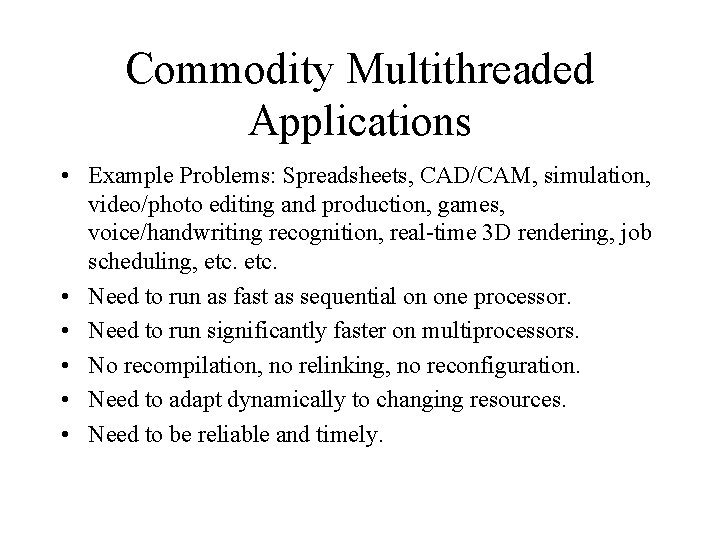
Commodity Multithreaded Applications • Example Problems: Spreadsheets, CAD/CAM, simulation, video/photo editing and production, games, voice/handwriting recognition, real-time 3 D rendering, job scheduling, etc. • Need to run as fast as sequential on one processor. • Need to run significantly faster on multiprocessors. • No recompilation, no relinking, no reconfiguration. • Need to adapt dynamically to changing resources. • Need to be reliable and timely.
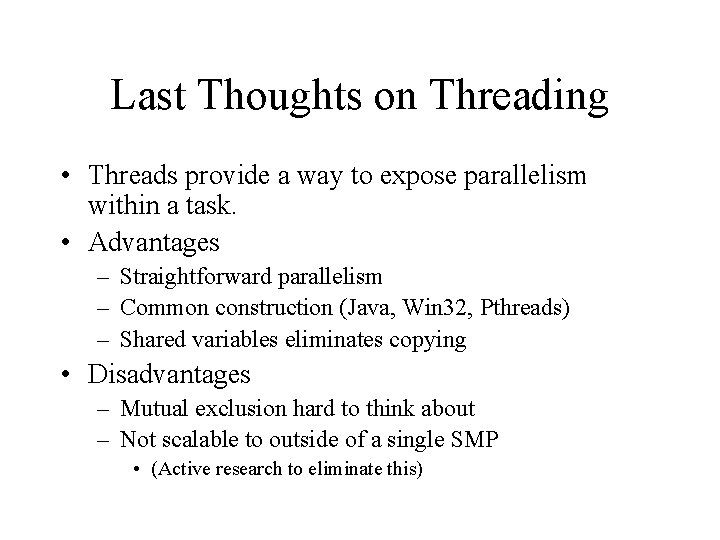
Last Thoughts on Threading • Threads provide a way to expose parallelism within a task. • Advantages – Straightforward parallelism – Common construction (Java, Win 32, Pthreads) – Shared variables eliminates copying • Disadvantages – Mutual exclusion hard to think about – Not scalable to outside of a single SMP • (Active research to eliminate this)
An Aside: Automatic Parallelization ? • Write a sequential program. • Compiler transforms sequential program into efficient parallel (multithreaded) program • A very very difficult problem. • Decades of work on this problem. • Some success with some regular scientific programs. • Not a general solution (and probably never will be). • Not applicable to large, irregular, dynamic programs. • Compilers must overuse locking to insure correctness • Compilers need help determining what code blocks can operate independently Open. MP directives