
CSE 143 Lecture 9 Recursion slides created by
CSE 143 Lecture 9 Recursion slides created by Alyssa Harding http: //www. cs. washington. edu/143/
Recursion • Iteration: a programming technique in which you describe actions to be repeated using a loop • Recursion: a programming technique in which you describe actions to be repeated using a method that calls itself • Both approaches can be used to solve many of the same problems – Some problems are easier solved iteratively – Some problems are easier solved recursively 2
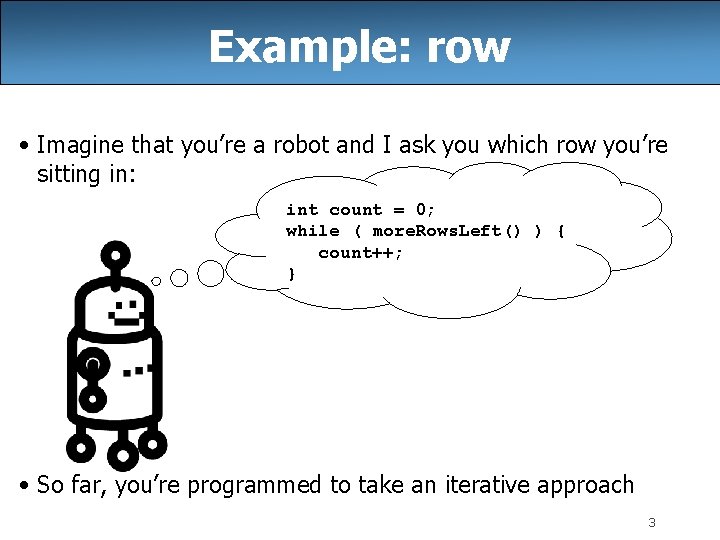
Example: row • Imagine that you’re a robot and I ask you which row you’re sitting in: int count = 0; while ( more. Rows. Left() ) { count++; } • So far, you’re programmed to take an iterative approach 3

Example: row • What if you’re a robot who can’t see well? What row AM I in? …Do more rows exist? …Do I exist? …What is the meaning of life? 4
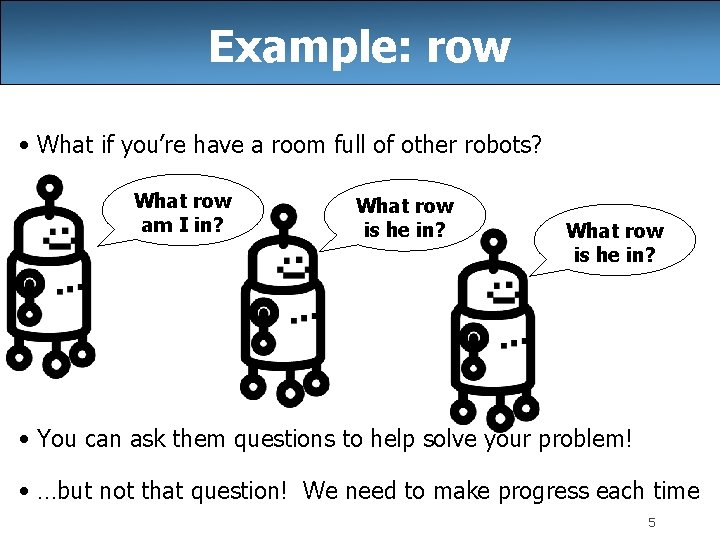
Example: row • What if you’re have a room full of other robots? What row am I in? What row is he in? • You can ask them questions to help solve your problem! • …but not that question! We need to make progress each time 5
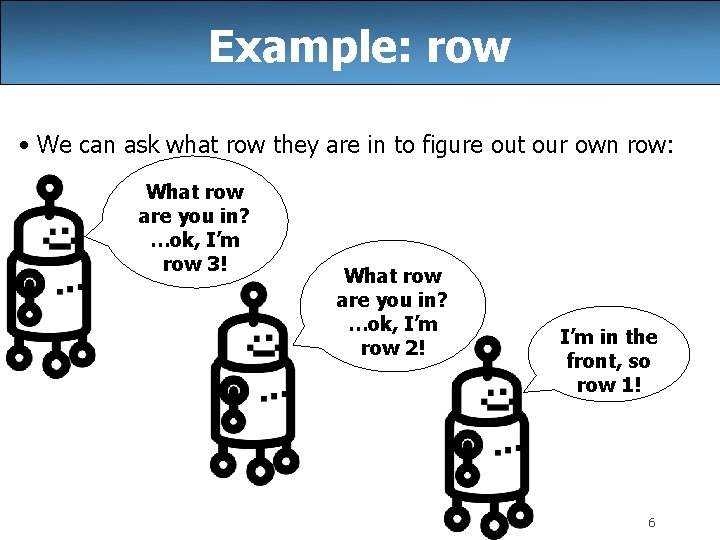
Example: row • We can ask what row they are in to figure out our own row: What row are you in? …ok, I’m row 3! What row are you in? …ok, I’m row 2! I’m in the front, so row 1! 6
Case analysis • Iteratively, we think of the loop bounds • Recursively, we think of the cases • Base case: – Easiest, simplest case where we know exactly what work to do – Example: “If I’m in the front row, I’m in row 1. ” • Recursive case: – We do a little bit of work and ask someone else a simpler version of the same question – Example: “Otherwise, I ask the person in front of me what row they are in and add 1!” 7
Case analysis • Key questions to ask: • Identifying the base case: – What is the easiest case? – When do I know that I’m done? • Working out the recursive case: – What’s a small bit of work that I can do? – What progress can I make towards my goal? – Is there a repeated pattern? 8
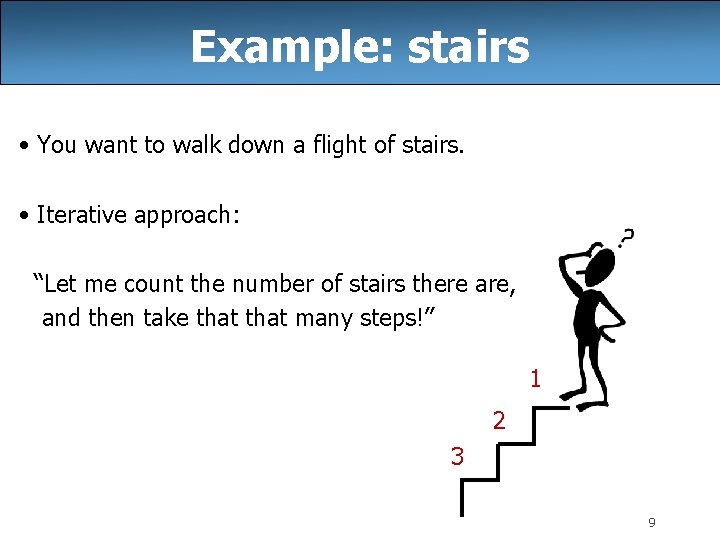
Example: stairs • You want to walk down a flight of stairs. • Iterative approach: “Let me count the number of stairs there are, and then take that many steps!” 1 2 3 9
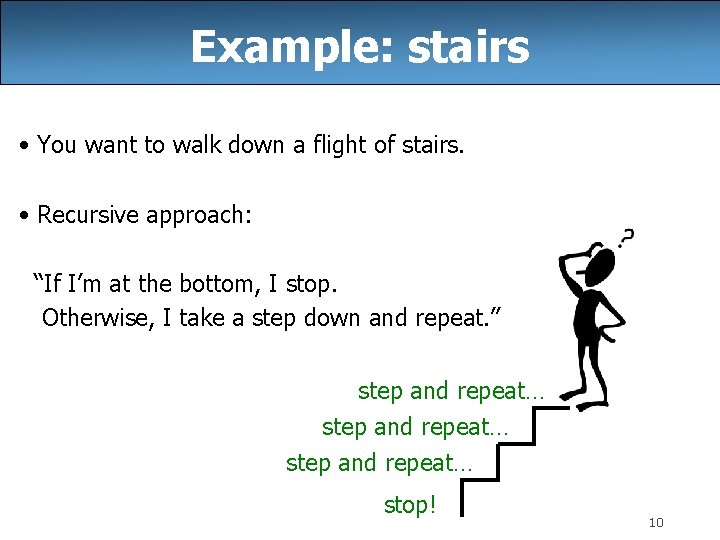
Example: stairs • You want to walk down a flight of stairs. • Recursive approach: “If I’m at the bottom, I stop. Otherwise, I take a step down and repeat. ” step and repeat… stop! 10
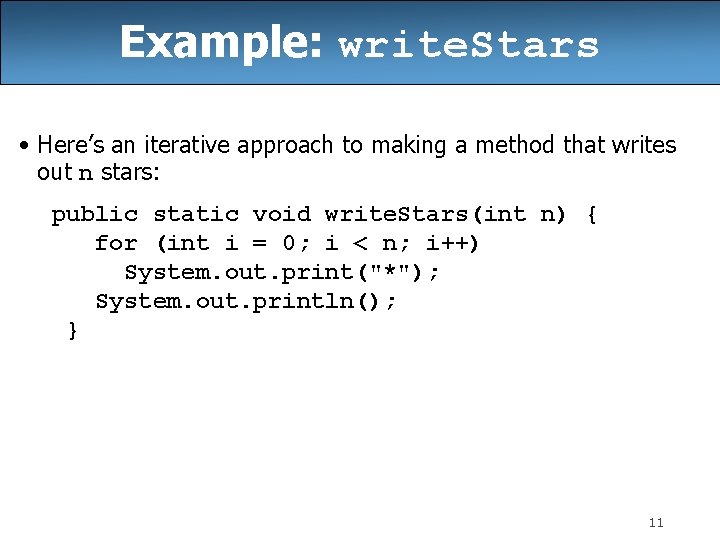
Example: write. Stars • Here’s an iterative approach to making a method that writes out n stars: public static void write. Stars(int n) { for (int i = 0; i < n; i++) System. out. print("*"); System. out. println(); } 11
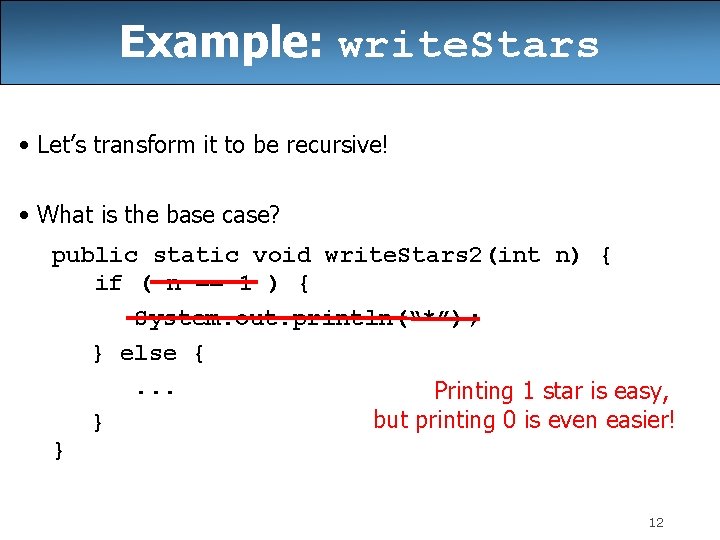
Example: write. Stars • Let’s transform it to be recursive! • What is the base case? public static void write. Stars 2(int n) { if ( n == 1 ) { System. out. println(“*”); } else {. . . Printing 1 star is easy, but printing 0 is even easier! } } 12
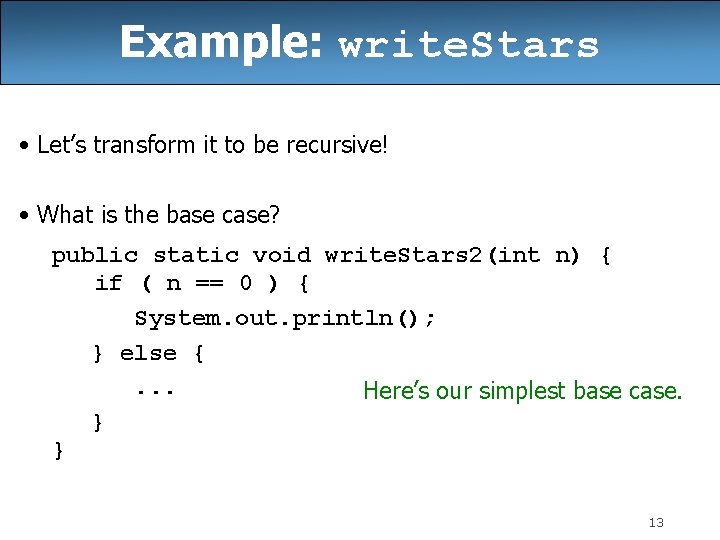
Example: write. Stars • Let’s transform it to be recursive! • What is the base case? public static void write. Stars 2(int n) { if ( n == 0 ) { System. out. println(); } else {. . . Here’s our simplest base case. } } 13

Example: write. Stars • Let’s transform it to be recursive! • What is the recursive case? public static void write. Stars 2(int n) { if ( n == 0 ) { System. out. println(); } else { for (int i = 0; i < n; i++ ) { System. out. println(“*”); } We’re a lazy robot! We just want to } make a small amount of progress. } 14

Example: write. Stars • Let’s transform it to be recursive! • What is the recursive case? public static void write. Stars 2(int n) { if ( n == 0 ) { System. out. println(); We make a little progress… } else { } System. out. println(“*”); write. Stars 2(n – 1); We ask another robot to do the rest. } We have to trust that we’re writing the method well! 15
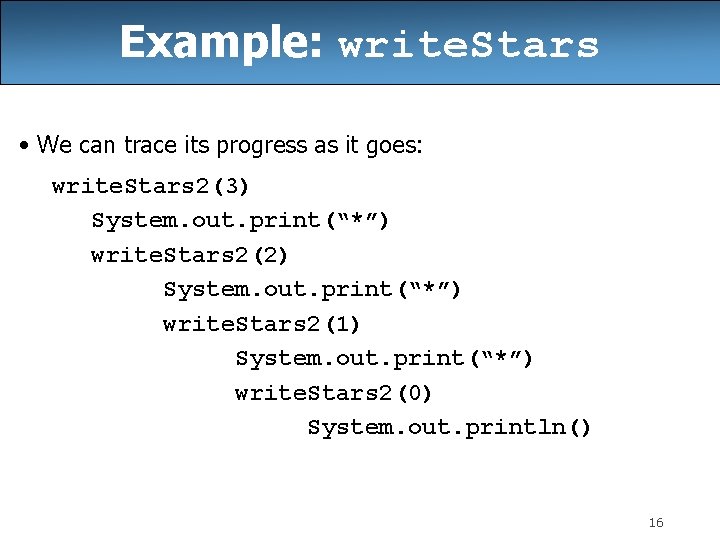
Example: write. Stars • We can trace its progress as it goes: write. Stars 2(3) System. out. print(“*”) write. Stars 2(2) System. out. print(“*”) write. Stars 2(1) System. out. print(“*”) write. Stars 2(0) System. out. println() 16
Example: reverse • Now we’ll look at a problem that’s hard to solve iteratively, but easier with recursion • Given a Scanner as input, print the lines in reverse • How would you solve this iteratively? – Loop while there are more lines – Requires additional storage, like a List or a Stack 17
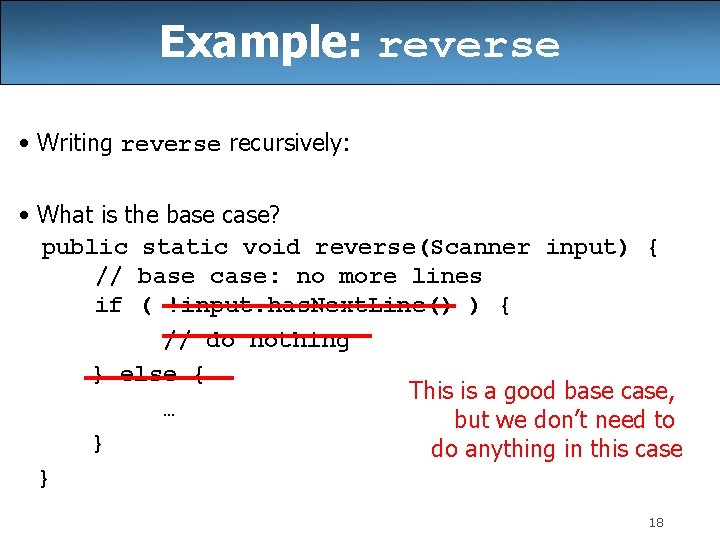
Example: reverse • Writing reverse recursively: • What is the base case? public static void reverse(Scanner input) { // base case: no more lines if ( !input. has. Next. Line() ) { // do nothing } else { This is a good base case, … but we don’t need to } do anything in this case } 18
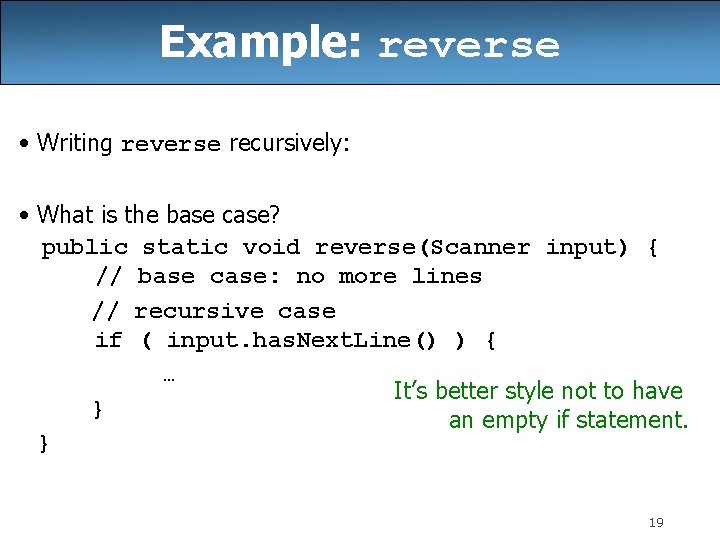
Example: reverse • Writing reverse recursively: • What is the base case? public static void reverse(Scanner input) { // base case: no more lines // recursive case if ( input. has. Next. Line() ) { … It’s better style not to have } an empty if statement. } 19
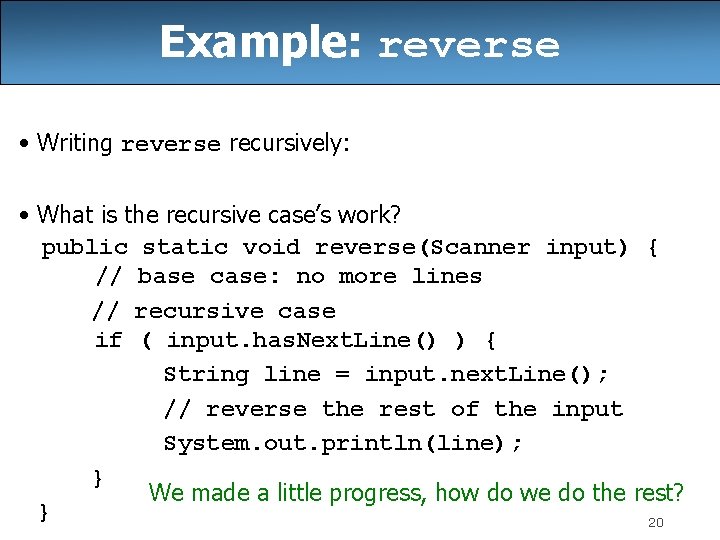
Example: reverse • Writing reverse recursively: • What is the recursive case’s work? public static void reverse(Scanner input) { // base case: no more lines // recursive case if ( input. has. Next. Line() ) { String line = input. next. Line(); // reverse the rest of the input System. out. println(line); } We made a little progress, how do we do the rest? } 20
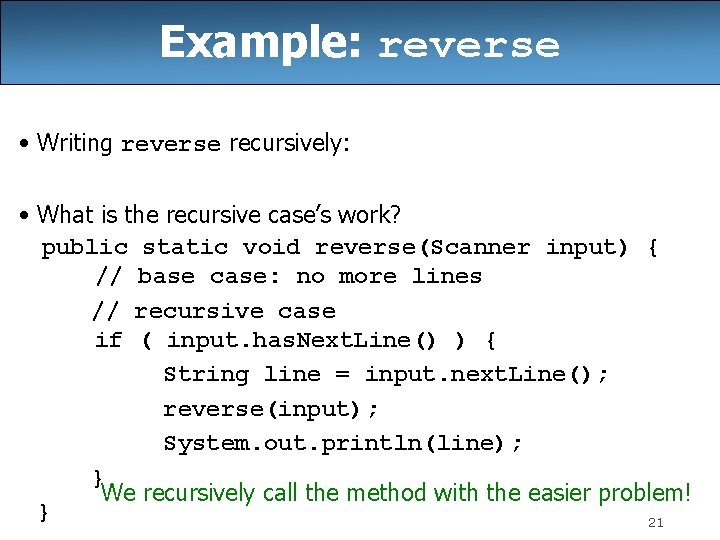
Example: reverse • Writing reverse recursively: • What is the recursive case’s work? public static void reverse(Scanner input) { // base case: no more lines // recursive case if ( input. has. Next. Line() ) { String line = input. next. Line(); reverse(input); System. out. println(line); } We recursively call the method with the easier problem! } 21
![Example: reverse public static void main (String[] args) { Scanner input =void reverse(Scanner input)](http://slidetodoc.com/presentation_image_h2/80bb66be14cfcb8a958a0e8ff0e2a28c/image-22.jpg "Example: reverse public static void main (String[] args) { Scanner input =void reverse(Scanner input)")
Example: reverse public static void main (String[] args) { Scanner input =void reverse(Scanner input) { public static if ( input. has. Next. Line() ) { new Scanner(new public static void. File("recursion. txt")); reverse(Scanner input) { reverse(input); line = input. next. Line(); // student if. String ( input. has. Next. Line() ) { public static void reverse(Scanner input) { } reverse(input); line = input. next. Line(); // that if. String ( input. has. Next. Line() ) { public static void reverse(Scanner input) { System. out. println(line); reverse(input); line = input. next. Line(); // loves if. String ( input. has. Next. Line() ) { public static void reverse(Scanner input) { } System. out. println(line); reverse(input); String line = input. next. Line(); // recursion if ( input. has. Next. Line() ) { // false! } } System. out. println(line); reverse(input); String line = input. next. Line(); } } System. out. println(line); reverse(input); } } System. out. println(line); } } Input: Output: } student that loves recursion loves that student 22
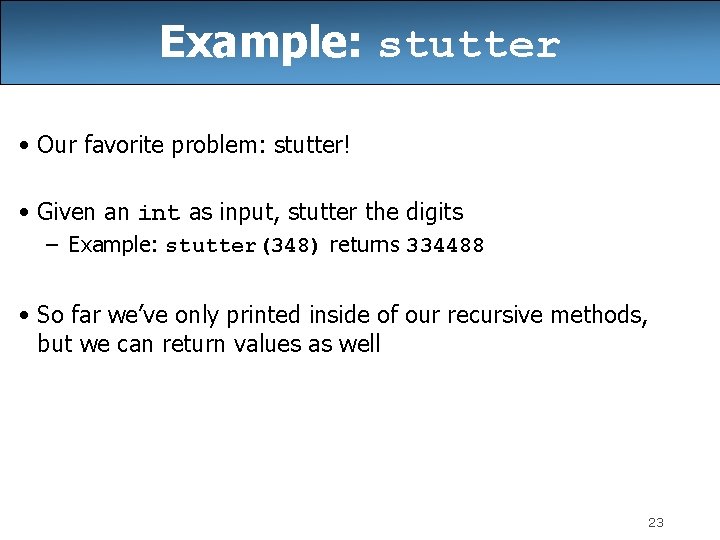
Example: stutter • Our favorite problem: stutter! • Given an int as input, stutter the digits – Example: stutter(348) returns 334488 • So far we’ve only printed inside of our recursive methods, but we can return values as well 23
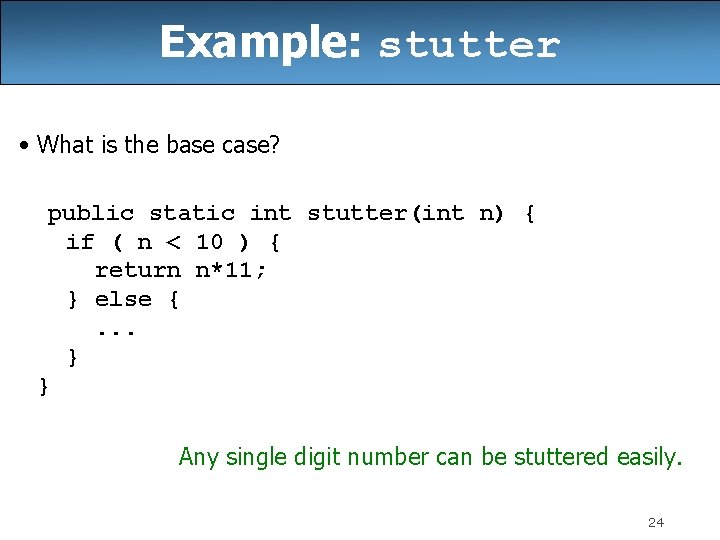
Example: stutter • What is the base case? public static int stutter(int n) { if ( n < 10 ) { return n*11; } else {. . . } } Any single digit number can be stuttered easily. 24
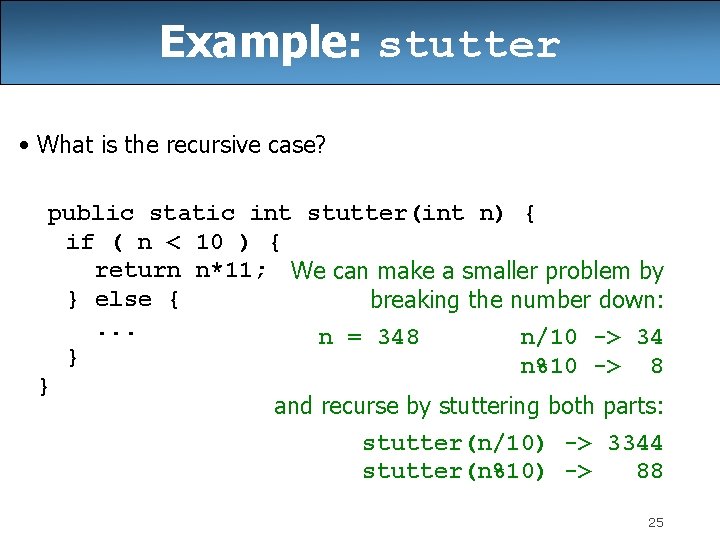
Example: stutter • What is the recursive case? public static int stutter(int n) { if ( n < 10 ) { return n*11; We can make a smaller problem by } else { breaking the number down: . . . n = 348 n/10 -> 34 } n%10 -> 8 } and recurse by stuttering both parts: stutter(n/10) -> 3344 stutter(n%10) -> 88 25
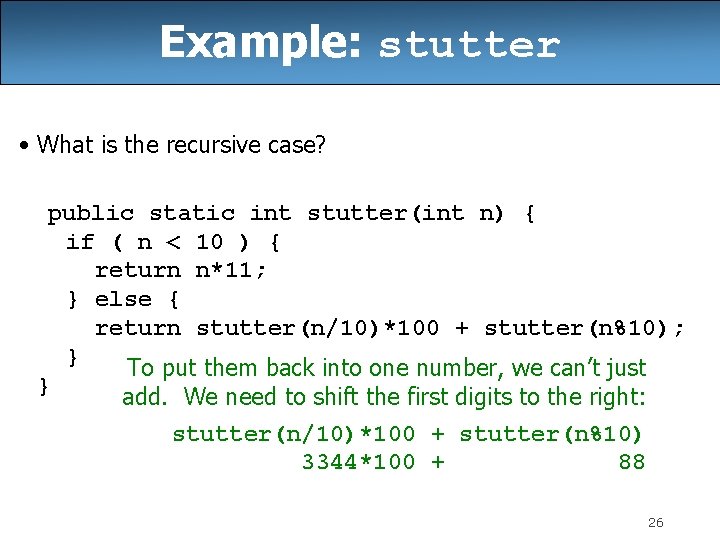
Example: stutter • What is the recursive case? public static int stutter(int n) { if ( n < 10 ) { return n*11; } else { return stutter(n/10)*100 + stutter(n%10); } To put them back into one number, we can’t just } add. We need to shift the first digits to the right: stutter(n/10)*100 + stutter(n%10) 3344*100 + 88 26
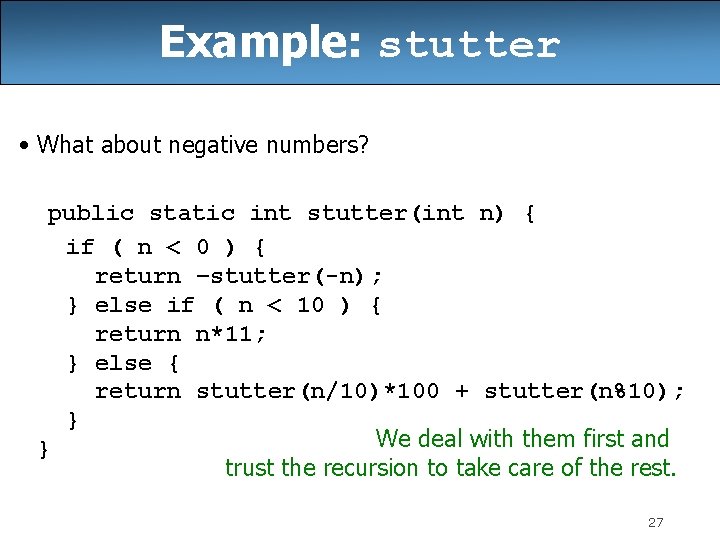
Example: stutter • What about negative numbers? public static int stutter(int n) { if ( n < 0 ) { return –stutter(-n); } else if ( n < 10 ) { return n*11; } else { return stutter(n/10)*100 + stutter(n%10); } We deal with them first and } trust the recursion to take care of the rest. 27
- Slides: 27