
CSE 143 Lecture 25 Set ADT implementation hashing
- Slides: 20
CSE 143 Lecture 25 Set ADT implementation; hashing read 11. 2 slides created by Marty Stepp http: //www. cs. washington. edu/143/
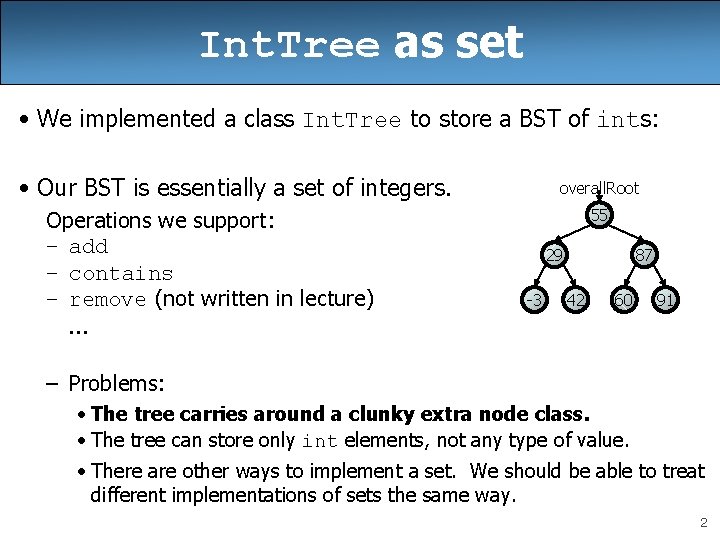
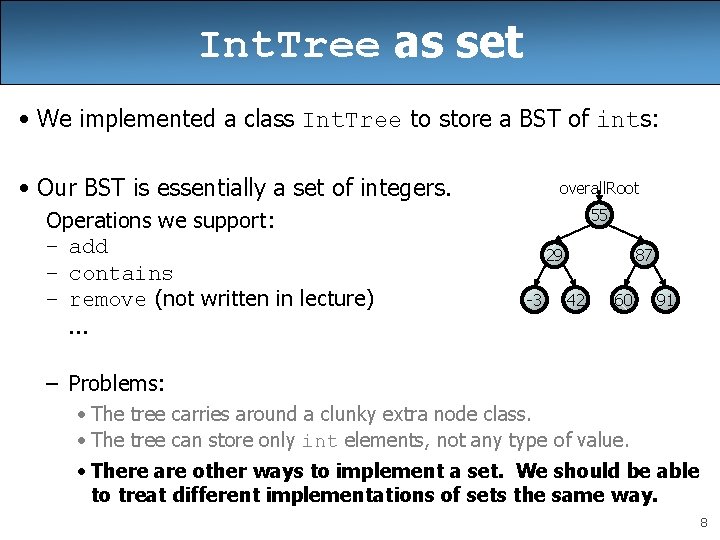
Int. Tree as set • We implemented a class Int. Tree to store a BST of ints: • Our BST is essentially a set of integers. Operations we support: – add – contains – remove (not written in lecture). . . overall. Root 55 29 -3 87 42 60 91 – Problems: • The tree carries around a clunky extra node class. • The tree can store only int elements, not any type of value. • There are other ways to implement a set. We should be able to treat different implementations of sets the same way. 2
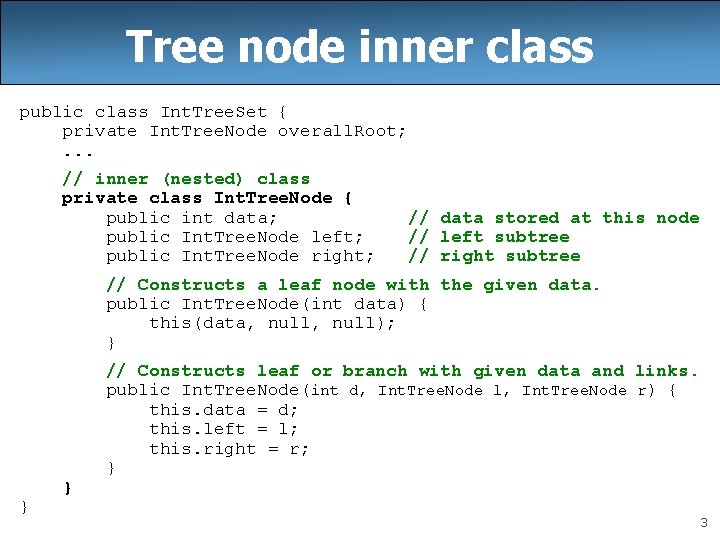
Tree node inner class public class Int. Tree. Set { private Int. Tree. Node overall. Root; . . . // inner (nested) class private class Int. Tree. Node { public int data; public Int. Tree. Node left; public Int. Tree. Node right; // data stored at this node // left subtree // right subtree // Constructs a leaf node with the given data. public Int. Tree. Node(int data) { this(data, null); } } } // Constructs leaf or branch with given data and links. public Int. Tree. Node(int d, Int. Tree. Node l, Int. Tree. Node r) { this. data = d; this. left = l; this. right = r; } 3
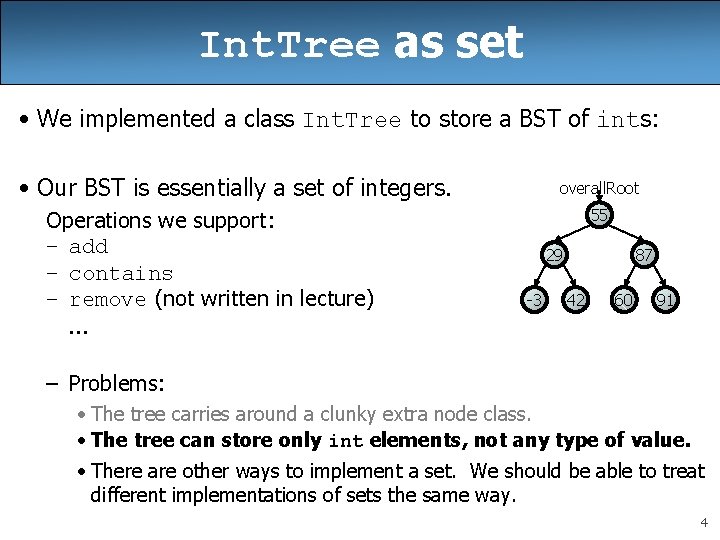
Int. Tree as set • We implemented a class Int. Tree to store a BST of ints: • Our BST is essentially a set of integers. Operations we support: – add – contains – remove (not written in lecture). . . overall. Root 55 29 -3 87 42 60 91 – Problems: • The tree carries around a clunky extra node class. • The tree can store only int elements, not any type of value. • There are other ways to implement a set. We should be able to treat different implementations of sets the same way. 4
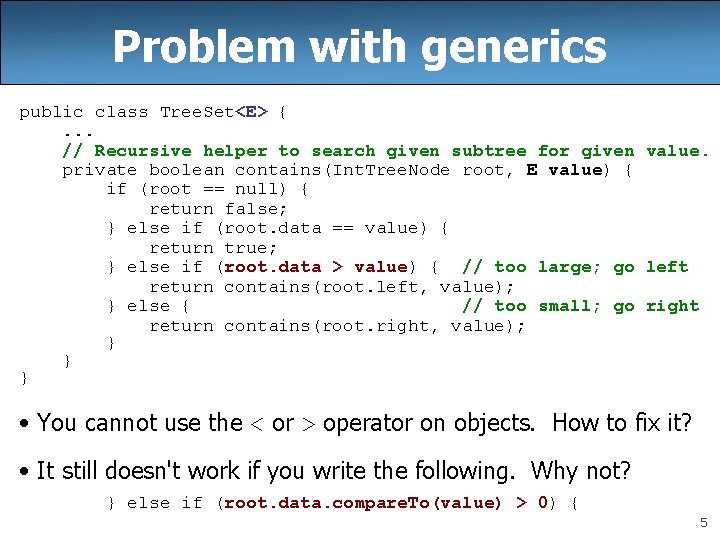
Problem with generics public class Tree. Set<E> {. . . // Recursive helper to search given subtree for given value. private boolean contains(Int. Tree. Node root, E value) { if (root == null) { return false; } else if (root. data == value) { return true; } else if (root. data > value) { // too large; go left return contains(root. left, value); } else { // too small; go right return contains(root. right, value); } } } • You cannot use the < or > operator on objects. How to fix it? • It still doesn't work if you write the following. Why not? } else if (root. data. compare. To(value) > 0) { 5
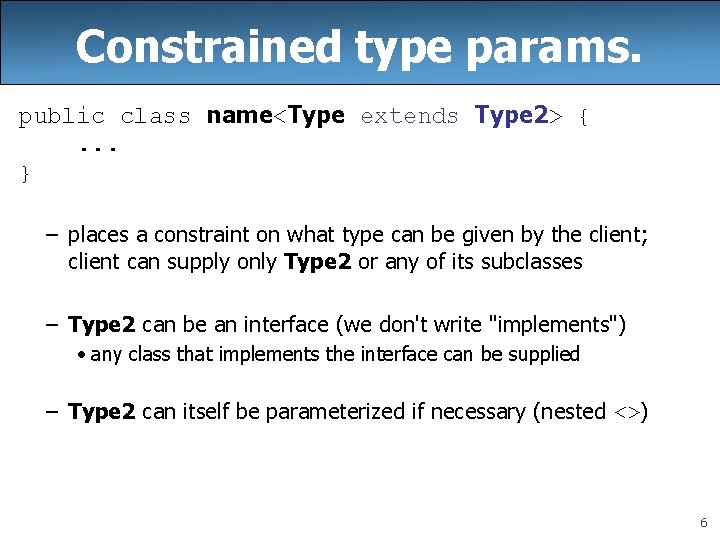
Constrained type params. public class name<Type extends Type 2> {. . . } – places a constraint on what type can be given by the client; client can supply only Type 2 or any of its subclasses – Type 2 can be an interface (we don't write "implements") • any class that implements the interface can be supplied – Type 2 can itself be parameterized if necessary (nested <>) 6
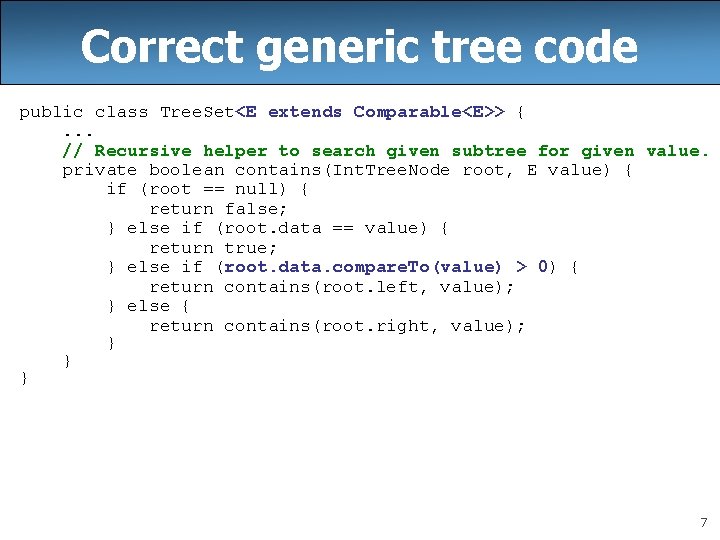
Correct generic tree code public class Tree. Set<E extends Comparable<E>> {. . . // Recursive helper to search given subtree for given value. private boolean contains(Int. Tree. Node root, E value) { if (root == null) { return false; } else if (root. data == value) { return true; } else if (root. data. compare. To(value) > 0) { return contains(root. left, value); } else { return contains(root. right, value); } } } 7
Int. Tree as set • We implemented a class Int. Tree to store a BST of ints: • Our BST is essentially a set of integers. Operations we support: – add – contains – remove (not written in lecture). . . overall. Root 55 29 -3 87 42 60 91 – Problems: • The tree carries around a clunky extra node class. • The tree can store only int elements, not any type of value. • There are other ways to implement a set. We should be able to treat different implementations of sets the same way. 8
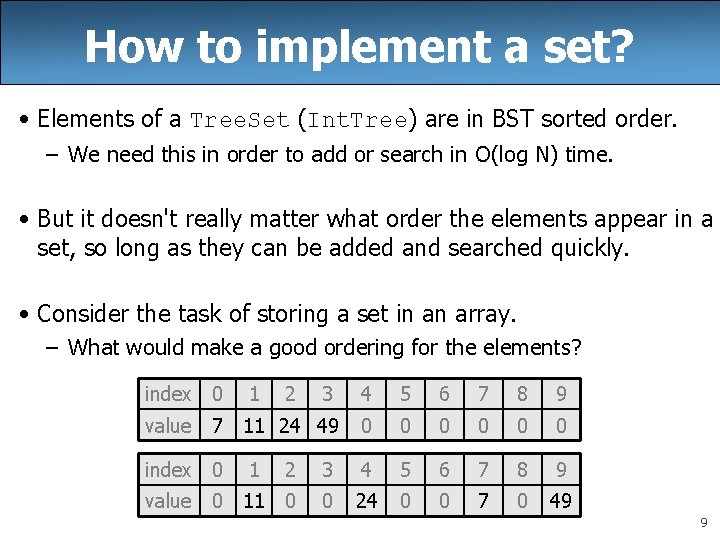
How to implement a set? • Elements of a Tree. Set (Int. Tree) are in BST sorted order. – We need this in order to add or search in O(log N) time. • But it doesn't really matter what order the elements appear in a set, so long as they can be added and searched quickly. • Consider the task of storing a set in an array. – What would make a good ordering for the elements? index 0 value 3 4 5 6 7 8 9 7 11 24 49 0 0 0 index 0 value 1 1 2 2 3 4 5 6 7 8 9 0 11 0 0 24 0 0 7 0 49 9
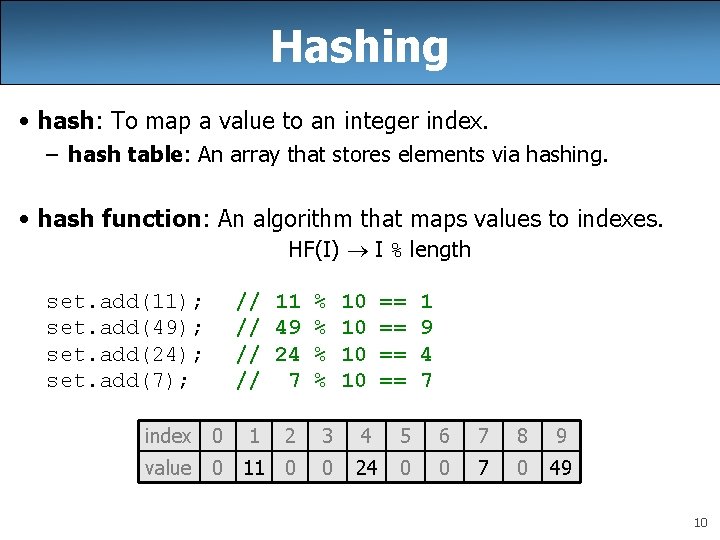
Hashing • hash: To map a value to an integer index. – hash table: An array that stores elements via hashing. • hash function: An algorithm that maps values to indexes. HF(I) I % length set. add(11); set. add(49); set. add(24); set. add(7); // 11 % 10 == // 49 % 10 == // 24 % 10 == // 7 % 10 == index 0 value 1 1 9 4 7 2 3 4 5 6 7 8 9 0 11 0 0 24 0 0 7 0 49 10
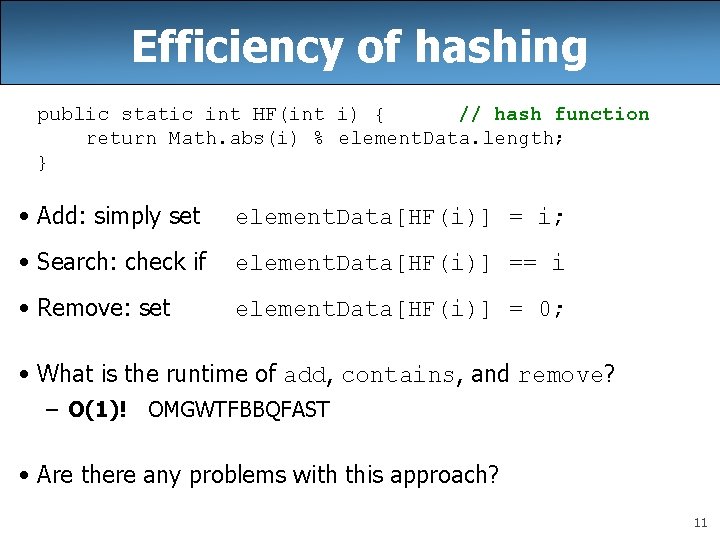
Efficiency of hashing public static int HF(int i) { // hash function return Math. abs(i) % element. Data. length; } • Add: simply set element. Data[HF(i)] = i; • Search: check if element. Data[HF(i)] == i • Remove: set element. Data[HF(i)] = 0; • What is the runtime of add, contains, and remove? – O(1)! OMGWTFBBQFAST • Are there any problems with this approach? 11
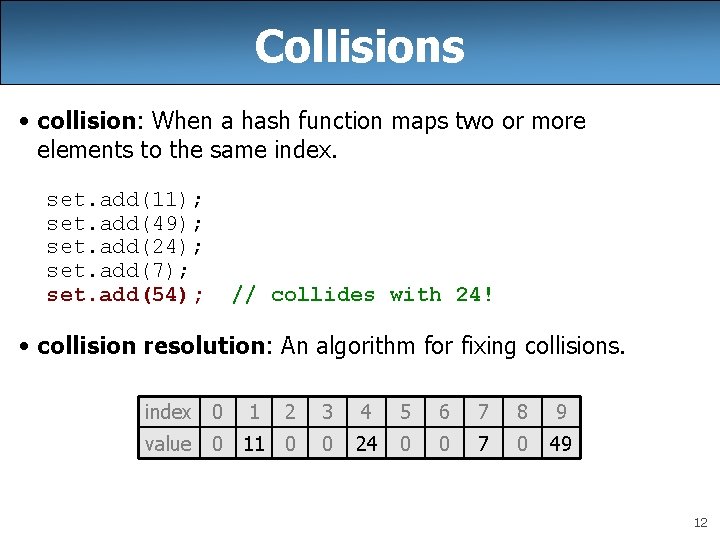
Collisions • collision: When a hash function maps two or more elements to the same index. set. add(11); set. add(49); set. add(24); set. add(7); set. add(54); // collides with 24! • collision resolution: An algorithm for fixing collisions. index 0 value 1 2 3 4 5 6 7 8 9 0 11 0 0 24 0 0 7 0 49 12
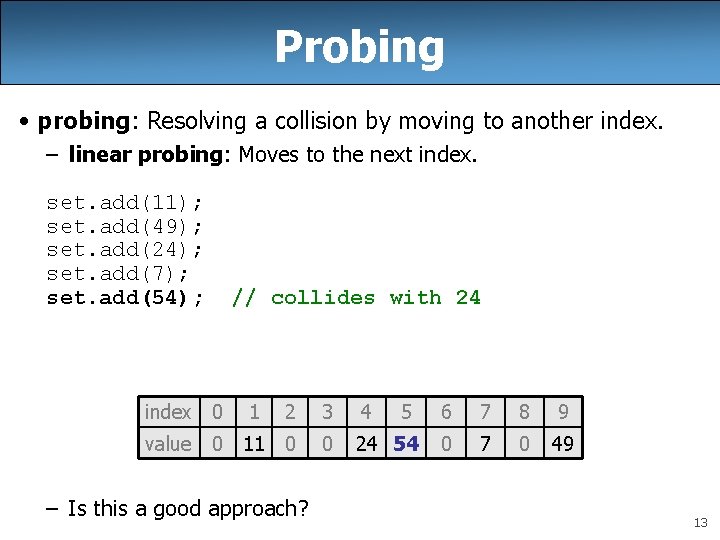
Probing • probing: Resolving a collision by moving to another index. – linear probing: Moves to the next index. set. add(11); set. add(49); set. add(24); set. add(7); set. add(54); // collides with 24 index 0 value 1 2 3 4 0 11 0 0 24 54 – Is this a good approach? 5 6 7 8 9 0 7 0 49 13
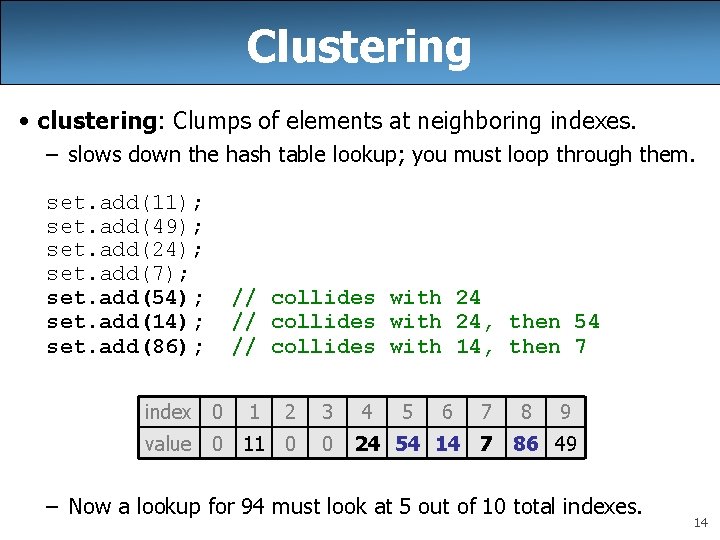
Clustering • clustering: Clumps of elements at neighboring indexes. – slows down the hash table lookup; you must loop through them. set. add(11); set. add(49); set. add(24); set. add(7); set. add(54); set. add(14); set. add(86); // collides with 24, then 54 // collides with 14, then 7 index 0 value 1 2 3 0 11 0 0 4 5 6 24 54 14 7 7 8 9 86 49 – Now a lookup for 94 must look at 5 out of 10 total indexes. 14
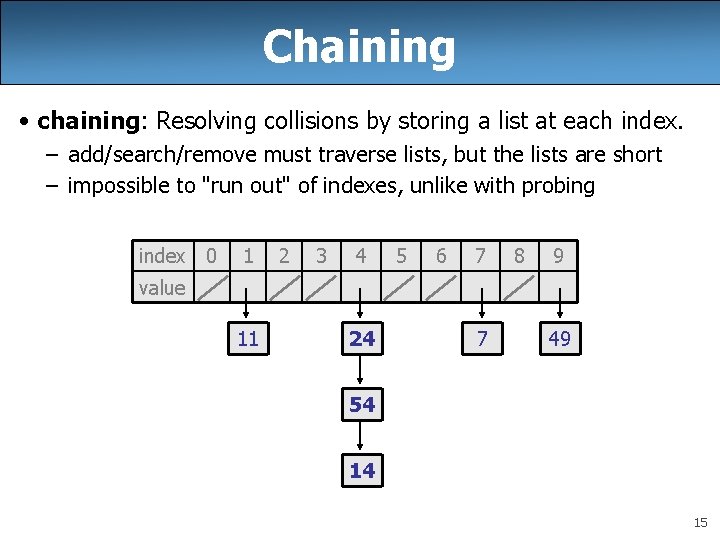
Chaining • chaining: Resolving collisions by storing a list at each index. – add/search/remove must traverse lists, but the lists are short – impossible to "run out" of indexes, unlike with probing index 0 1 2 3 4 5 6 7 8 9 value 11 24 7 49 54 14 15
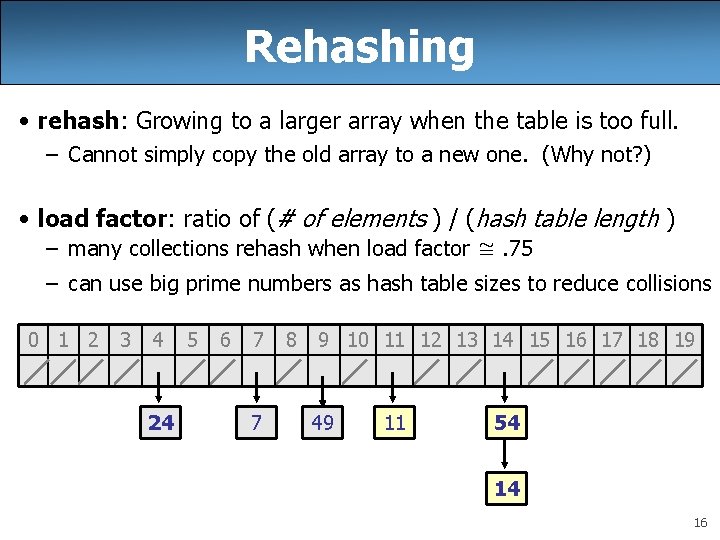
Rehashing • rehash: Growing to a larger array when the table is too full. – Cannot simply copy the old array to a new one. (Why not? ) • load factor: ratio of (# of elements ) / (hash table length ) – many collections rehash when load factor ≅. 75 – can use big prime numbers as hash table sizes to reduce collisions 0 1 2 3 4 24 5 6 7 7 8 9 10 11 12 13 14 15 16 17 18 19 49 11 54 14 16
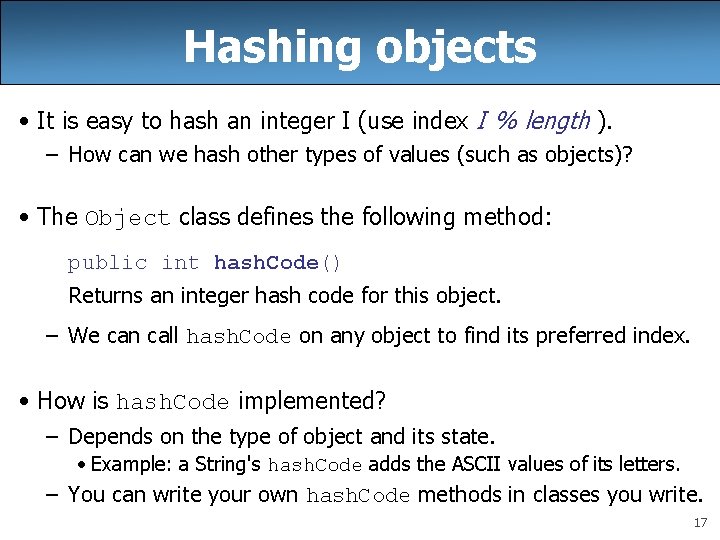
Hashing objects • It is easy to hash an integer I (use index I % length ). – How can we hash other types of values (such as objects)? • The Object class defines the following method: public int hash. Code() Returns an integer hash code for this object. – We can call hash. Code on any object to find its preferred index. • How is hash. Code implemented? – Depends on the type of object and its state. • Example: a String's hash. Code adds the ASCII values of its letters. – You can write your own hash. Code methods in classes you write. 17
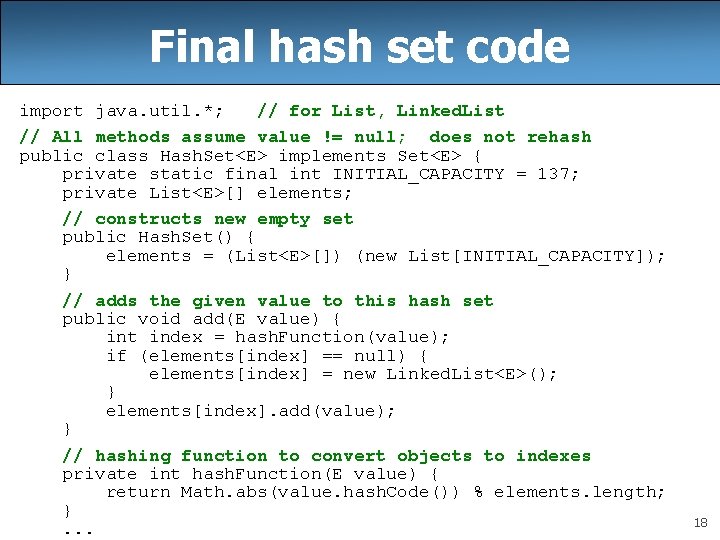
Final hash set code import java. util. *; // for List, Linked. List // All methods assume value != null; does not rehash public class Hash. Set<E> implements Set<E> { private static final int INITIAL_CAPACITY = 137; private List<E>[] elements; // constructs new empty set public Hash. Set() { elements = (List<E>[]) (new List[INITIAL_CAPACITY]); } // adds the given value to this hash set public void add(E value) { int index = hash. Function(value); if (elements[index] == null) { elements[index] = new Linked. List<E>(); } elements[index]. add(value); } // hashing function to convert objects to indexes private int hash. Function(E value) { return Math. abs(value. hash. Code()) % elements. length; }. . . 18
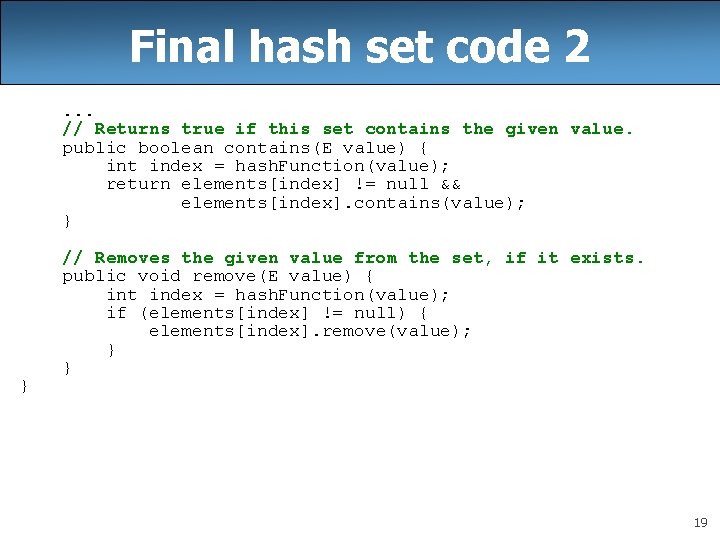
Final hash set code 2. . . // Returns true if this set contains the given value. public boolean contains(E value) { int index = hash. Function(value); return elements[index] != null && elements[index]. contains(value); } } // Removes the given value from the set, if it exists. public void remove(E value) { int index = hash. Function(value); if (elements[index] != null) { elements[index]. remove(value); } } 19
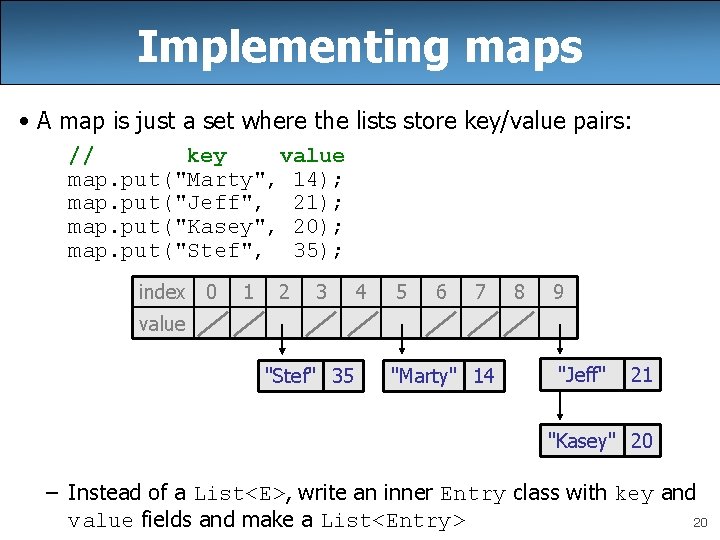
Implementing maps • A map is just a set where the lists store key/value pairs: // key value map. put("Marty", 14); map. put("Jeff", 21); map. put("Kasey", 20); map. put("Stef", 35); index 0 1 2 3 4 5 6 7 8 9 value "Stef" 35 "Marty" 14 "Jeff" 21 "Kasey" 20 – Instead of a List<E>, write an inner Entry class with key and value fields and make a List<Entry> 20