
CSE 143 Lecture 24 Inheritance and the Object
CSE 143 Lecture 24 Inheritance and the Object class; Polymorphism read 9. 2 - 9. 4 slides created by Marty Stepp, Hélène Martin, and Ethan Apter http: //www. cs. washington. edu/143/
Recall: Inheritance • inheritance: Forming new classes based on existing ones. – superclass: Parent class being extended. – subclass: Child class that inherits behavior from superclass. • gets a copy of every field and method from superclass • override: To replace a superclass's method by writing a new version of that method in a subclass. public class Lawyer extends Employee { // overrides get. Salary in Employee; a raise! public double get. Salary() { return 55000. 00; } } 2
The super keyword super. method(parameters) super(parameters); – Subclasses can call overridden methods/constructors with super public class Lawyer extends Employee { private boolean passed. Bar. Exam; public Lawyer(int vacation. Days, boolean bar) { super(vacation. Days * 2); this. passed. Bar. Exam = bar; } } public double get. Salary() { double base. Salary = super. get. Salary(); return base. Salary + 5000. 00; // $5 K raise }. . . 3
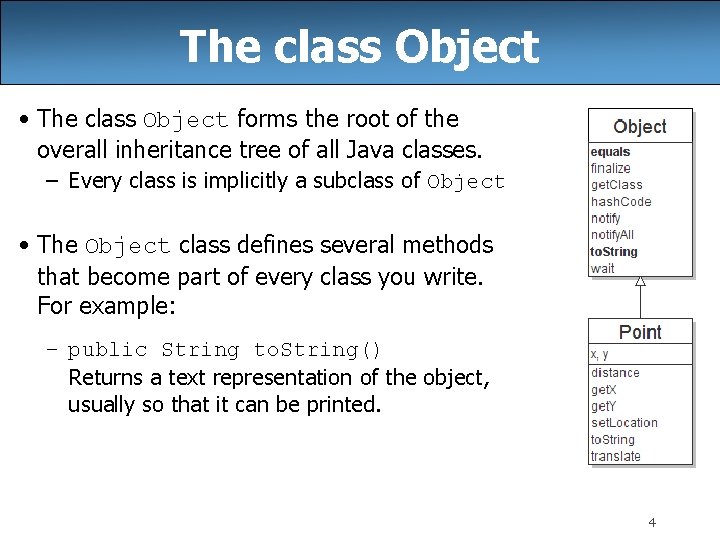
The class Object • The class Object forms the root of the overall inheritance tree of all Java classes. – Every class is implicitly a subclass of Object • The Object class defines several methods that become part of every class you write. For example: – public String to. String() Returns a text representation of the object, usually so that it can be printed. 4
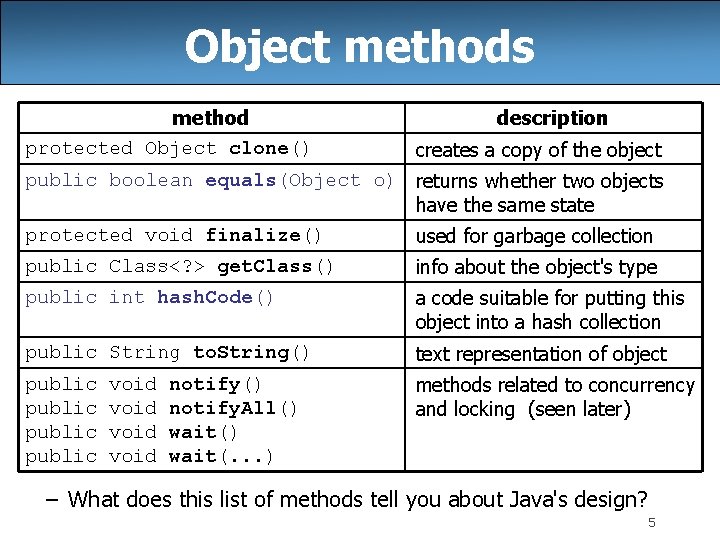
Object methods method protected Object clone() description creates a copy of the object public boolean equals(Object o) returns whether two objects have the same state protected void finalize() used for garbage collection public Class<? > get. Class() info about the object's type public int hash. Code() a code suitable for putting this object into a hash collection public String to. String() text representation of object public methods related to concurrency and locking (seen later) void notify() notify. All() wait(. . . ) – What does this list of methods tell you about Java's design? 5
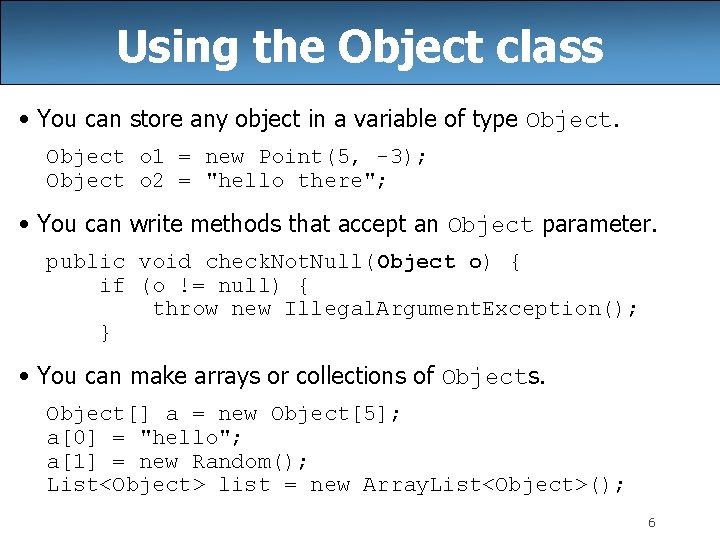
Using the Object class • You can store any object in a variable of type Object o 1 = new Point(5, -3); Object o 2 = "hello there"; • You can write methods that accept an Object parameter. public void check. Not. Null(Object o) { if (o != null) { throw new Illegal. Argument. Exception(); } • You can make arrays or collections of Objects. Object[] a = new Object[5]; a[0] = "hello"; a[1] = new Random(); List<Object> list = new Array. List<Object>(); 6
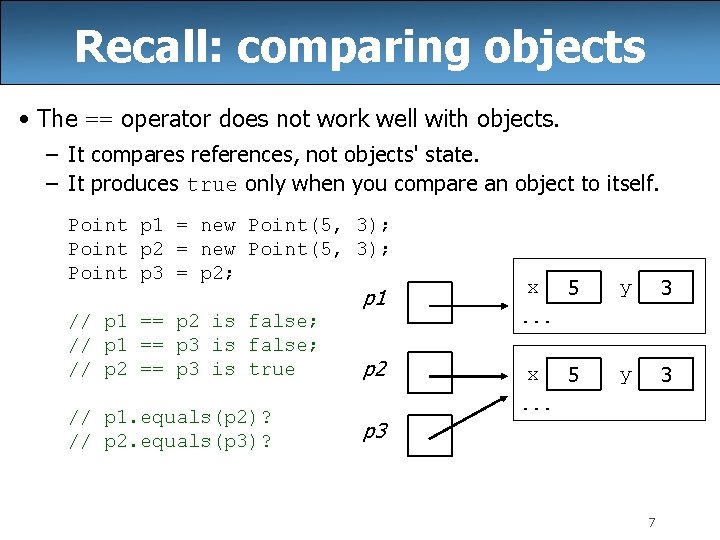
Recall: comparing objects • The == operator does not work well with objects. – It compares references, not objects' state. – It produces true only when you compare an object to itself. Point p 1 = new Point(5, 3); Point p 2 = new Point(5, 3); Point p 3 = p 2; p 1 // p 1 == p 2 is false; // p 1 == p 3 is false; // p 2 == p 3 is true // p 1. equals(p 2)? // p 2. equals(p 3)? p 2 x 5 y 3 . . . x. . . p 3 7
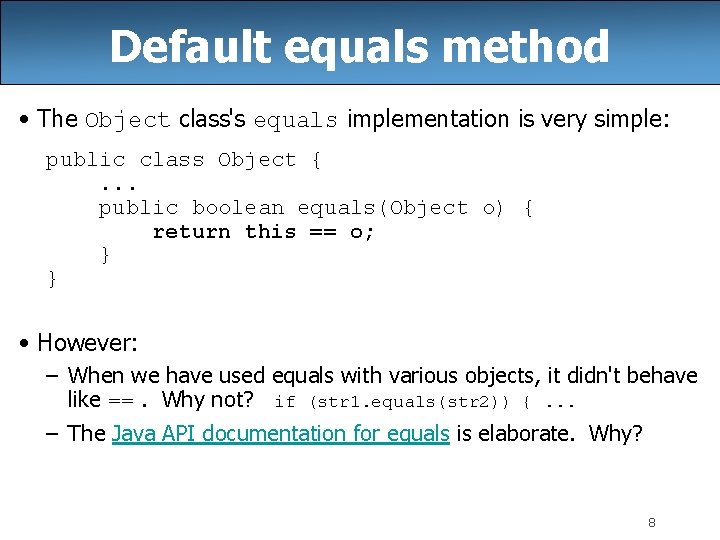
Default equals method • The Object class's equals implementation is very simple: public class Object {. . . public boolean equals(Object o) { return this == o; } } • However: – When we have used equals with various objects, it didn't behave like ==. Why not? if (str 1. equals(str 2)) {. . . – The Java API documentation for equals is elaborate. Why? 8
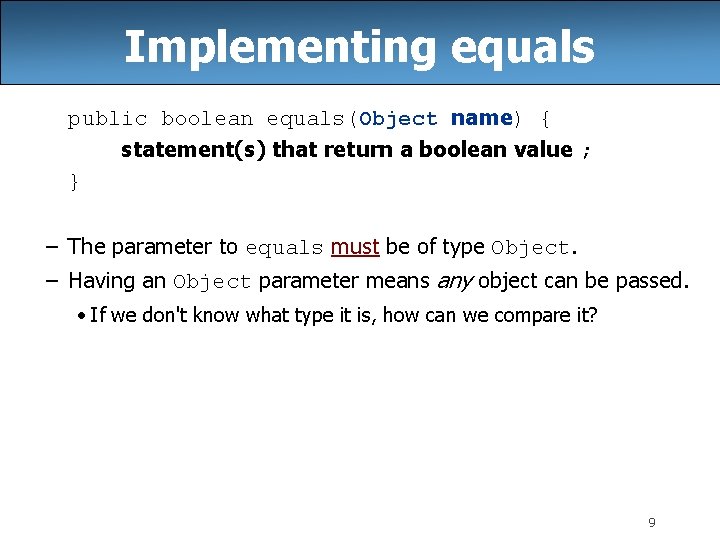
Implementing equals public boolean equals(Object name) { statement(s) that return a boolean value ; } – The parameter to equals must be of type Object. – Having an Object parameter means any object can be passed. • If we don't know what type it is, how can we compare it? 9
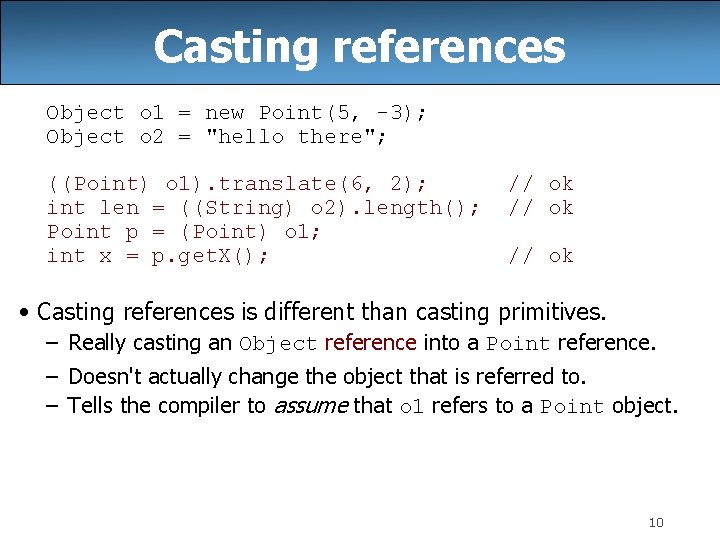
Casting references Object o 1 = new Point(5, -3); Object o 2 = "hello there"; ((Point) o 1). translate(6, 2); int len = ((String) o 2). length(); Point p = (Point) o 1; int x = p. get. X(); // ok • Casting references is different than casting primitives. – Really casting an Object reference into a Point reference. – Doesn't actually change the object that is referred to. – Tells the compiler to assume that o 1 refers to a Point object. 10
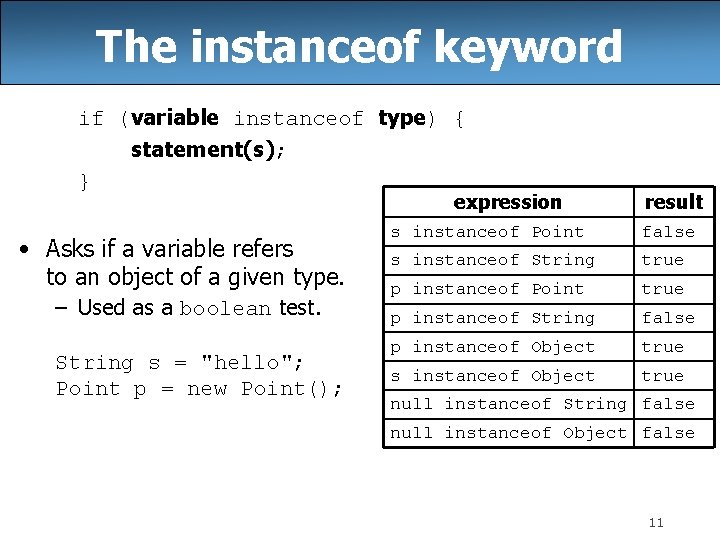
The instanceof keyword if (variable instanceof type) { statement(s); } expression • Asks if a variable refers to an object of a given type. – Used as a boolean test. String s = "hello"; Point p = new Point(); result s instanceof Point false s instanceof String true p instanceof Point true p instanceof String false p instanceof Object true s instanceof Object true null instanceof String false null instanceof Object false 11
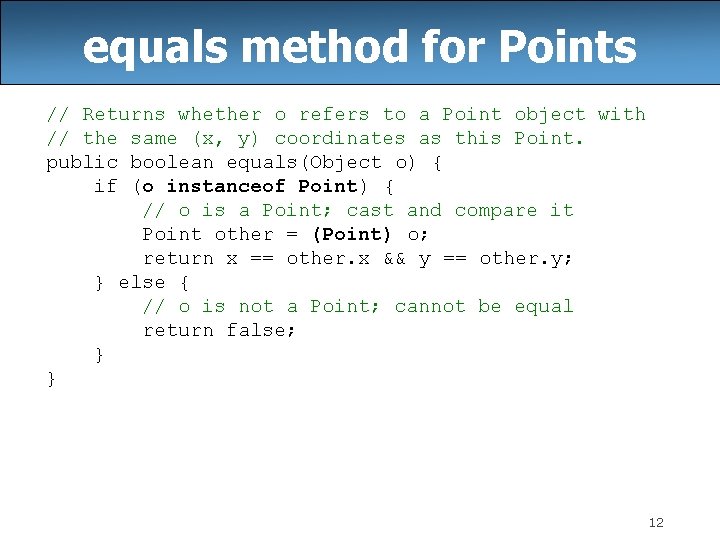
equals method for Points // Returns whether o refers to a Point object with // the same (x, y) coordinates as this Point. public boolean equals(Object o) { if (o instanceof Point) { // o is a Point; cast and compare it Point other = (Point) o; return x == other. x && y == other. y; } else { // o is not a Point; cannot be equal return false; } } 12
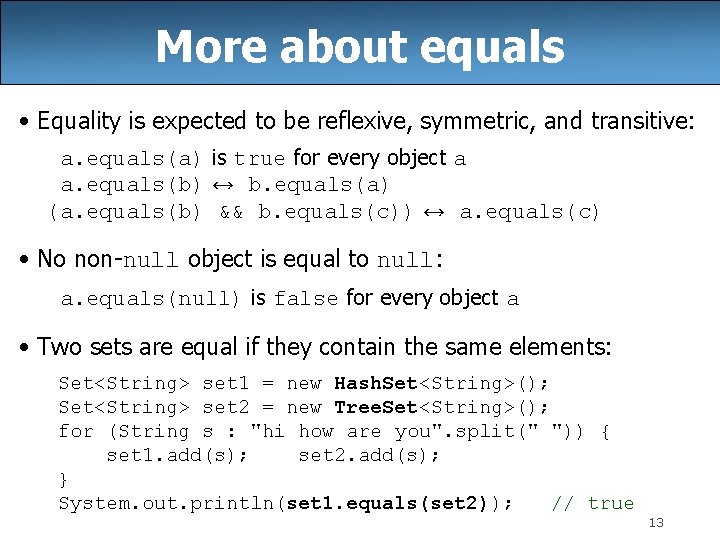
More about equals • Equality is expected to be reflexive, symmetric, and transitive: a. equals(a) is true for every object a a. equals(b) ↔ b. equals(a) (a. equals(b) && b. equals(c)) ↔ a. equals(c) • No non-null object is equal to null: a. equals(null) is false for every object a • Two sets are equal if they contain the same elements: Set<String> set 1 = new Hash. Set<String>(); Set<String> set 2 = new Tree. Set<String>(); for (String s : "hi how are you". split(" ")) { set 1. add(s); set 2. add(s); } System. out. println(set 1. equals(set 2)); // true 13
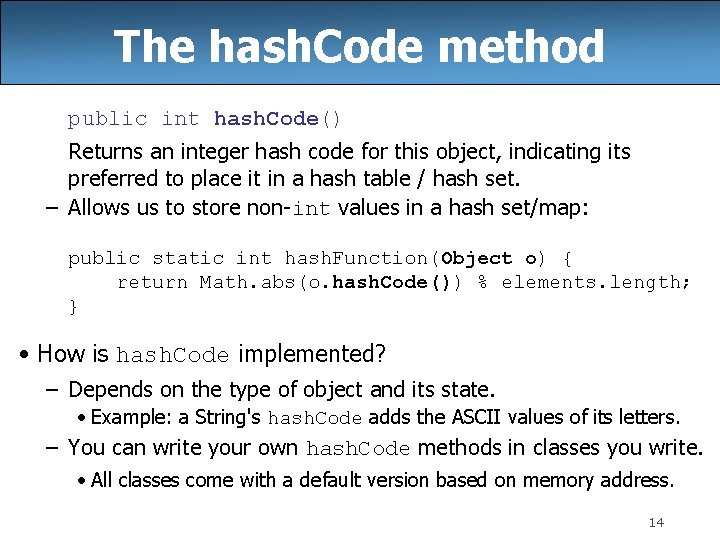
The hash. Code method public int hash. Code() Returns an integer hash code for this object, indicating its preferred to place it in a hash table / hash set. – Allows us to store non-int values in a hash set/map: public static int hash. Function(Object o) { return Math. abs(o. hash. Code()) % elements. length; } • How is hash. Code implemented? – Depends on the type of object and its state. • Example: a String's hash. Code adds the ASCII values of its letters. – You can write your own hash. Code methods in classes you write. • All classes come with a default version based on memory address. 14
Polymorphism 15

Polymorphism • polymorphism: Ability for the same code to be used with different types of objects and behave differently with each. • A variable or parameter of type T can refer to any subclass of T. Employee ed = new Lawyer(); Object otto = new Secretary(); – When a method is called on ed, it behaves as a Lawyer. – You can call any Employee methods on ed. You can call any Object methods on otto. • You can not call any Lawyer-only methods on ed (e. g. sue). You can not call any Employee methods on otto (e. g. get. Hours). 16
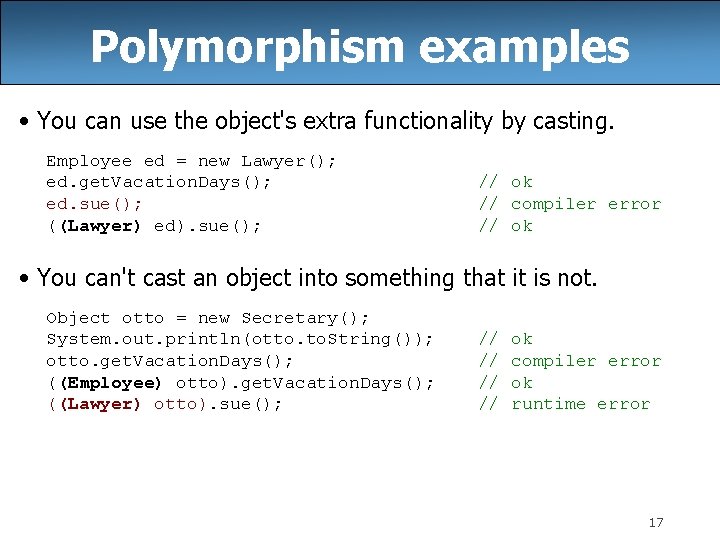
Polymorphism examples • You can use the object's extra functionality by casting. Employee ed = new Lawyer(); ed. get. Vacation. Days(); ed. sue(); ((Lawyer) ed). sue(); // ok // compiler error // ok • You can't cast an object into something that it is not. Object otto = new Secretary(); System. out. println(otto. String()); otto. get. Vacation. Days(); ((Employee) otto). get. Vacation. Days(); ((Lawyer) otto). sue(); // // ok compiler error ok runtime error 17
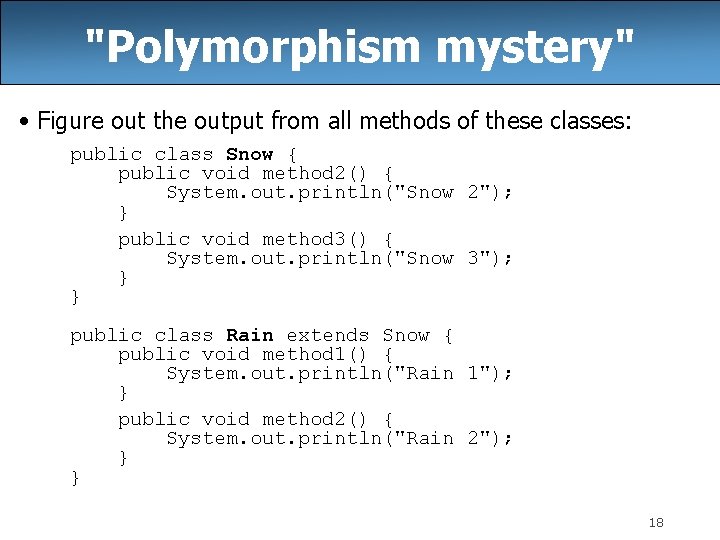
"Polymorphism mystery" • Figure out the output from all methods of these classes: public class Snow { public void method 2() { System. out. println("Snow 2"); } public void method 3() { System. out. println("Snow 3"); } } public class Rain extends Snow { public void method 1() { System. out. println("Rain 1"); } public void method 2() { System. out. println("Rain 2"); } } 18
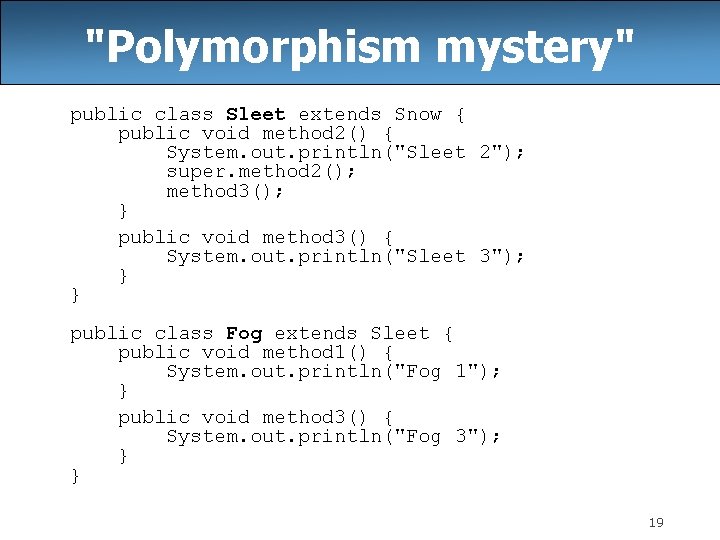
"Polymorphism mystery" public class Sleet extends Snow { public void method 2() { System. out. println("Sleet 2"); super. method 2(); method 3(); } public void method 3() { System. out. println("Sleet 3"); } } public class Fog extends Sleet { public void method 1() { System. out. println("Fog 1"); } public void method 3() { System. out. println("Fog 3"); } } 19
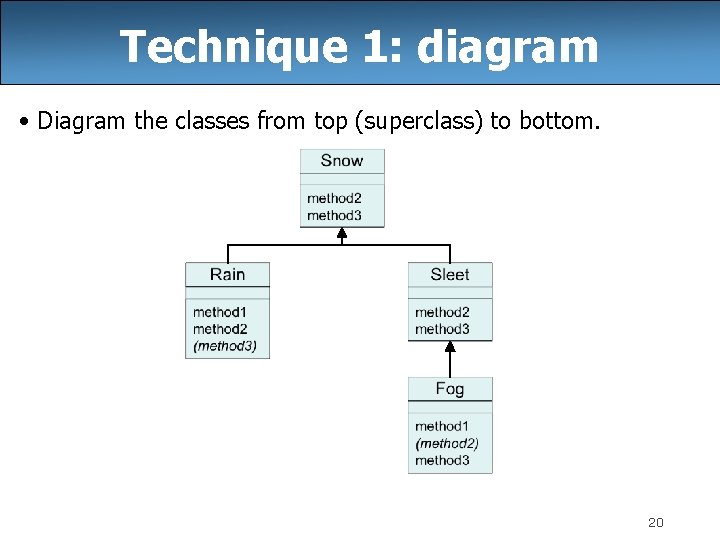
Technique 1: diagram • Diagram the classes from top (superclass) to bottom. 20
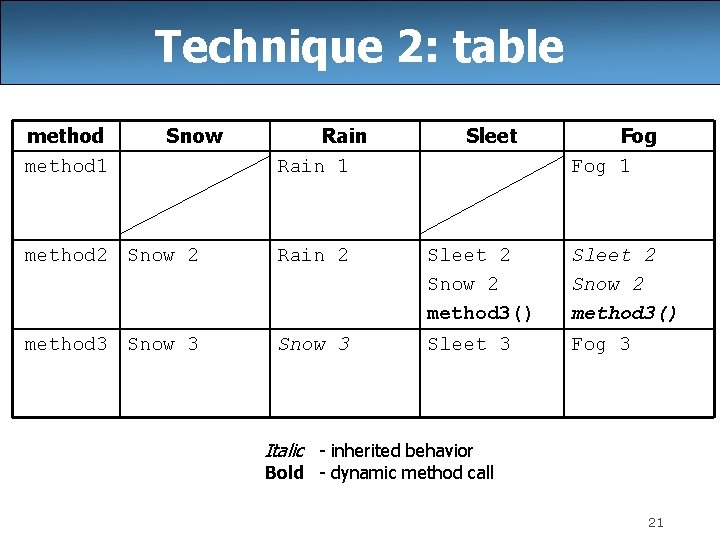
Technique 2: table method 1 Snow Rain 1 Sleet Fog 1 method 2 Snow 2 Rain 2 Sleet 2 Snow 2 method 3() method 3 Snow 3 Sleet 3 Fog 3 Italic - inherited behavior Bold - dynamic method call 21
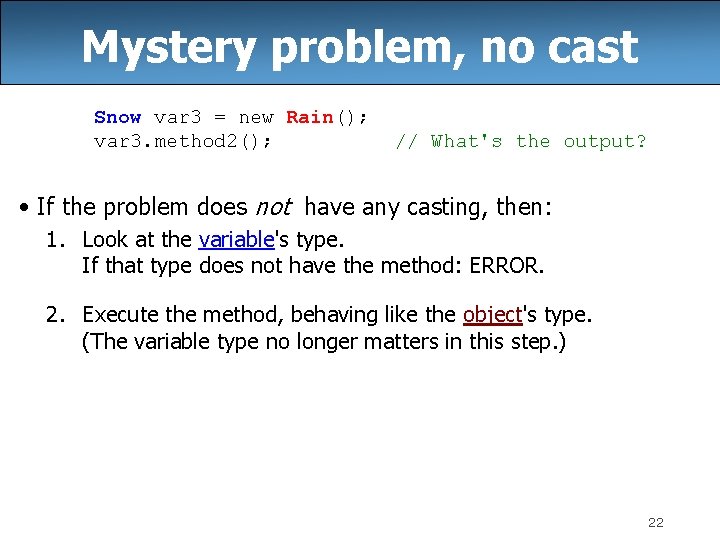
Mystery problem, no cast Snow var 3 = new Rain(); var 3. method 2(); // What's the output? • If the problem does not have any casting, then: 1. Look at the variable's type. If that type does not have the method: ERROR. 2. Execute the method, behaving like the object's type. (The variable type no longer matters in this step. ) 22
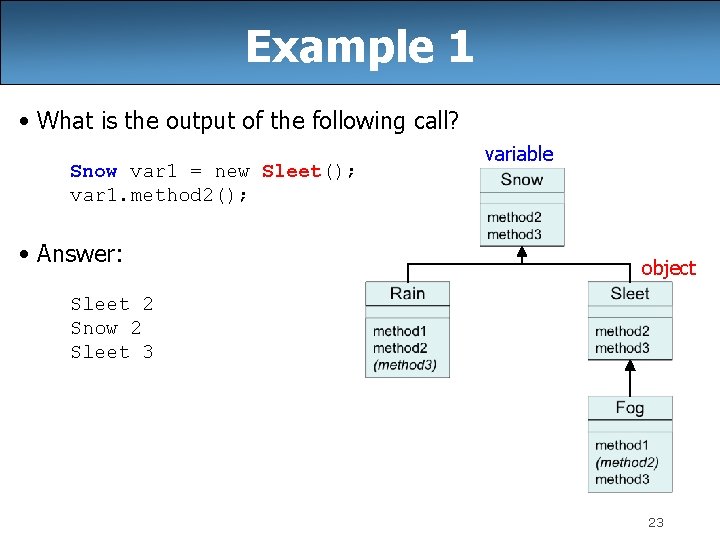
Example 1 • What is the output of the following call? Snow var 1 = new Sleet(); var 1. method 2(); • Answer: variable object Sleet 2 Snow 2 Sleet 3 23
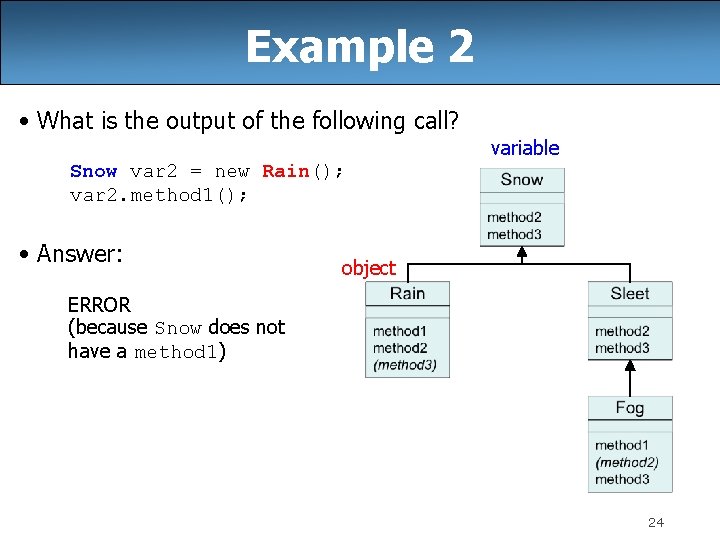
Example 2 • What is the output of the following call? variable Snow var 2 = new Rain(); var 2. method 1(); • Answer: object ERROR (because Snow does not have a method 1) 24
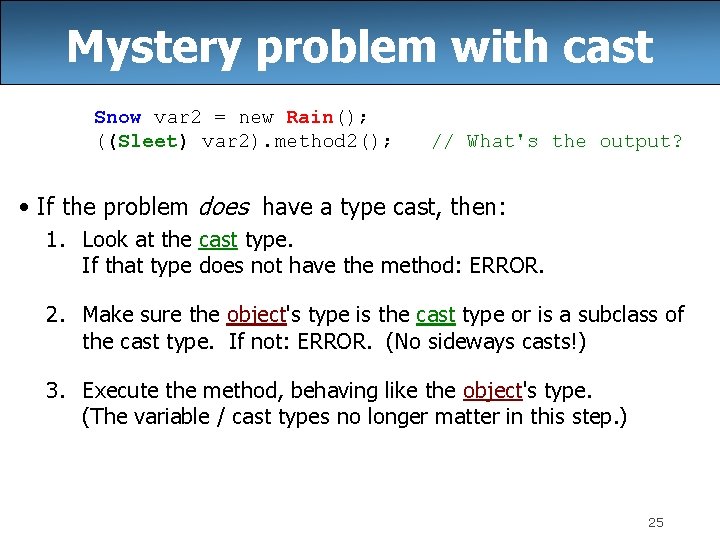
Mystery problem with cast Snow var 2 = new Rain(); ((Sleet) var 2). method 2(); // What's the output? • If the problem does have a type cast, then: 1. Look at the cast type. If that type does not have the method: ERROR. 2. Make sure the object's type is the cast type or is a subclass of the cast type. If not: ERROR. (No sideways casts!) 3. Execute the method, behaving like the object's type. (The variable / cast types no longer matter in this step. ) 25
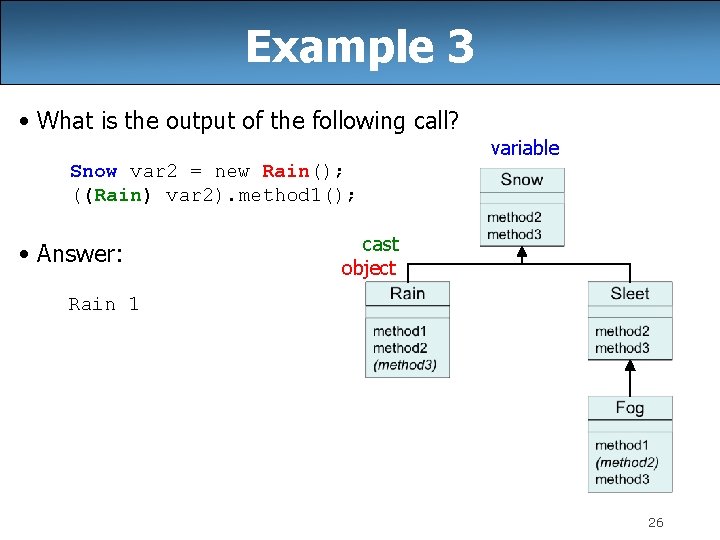
Example 3 • What is the output of the following call? variable Snow var 2 = new Rain(); ((Rain) var 2). method 1(); • Answer: cast object Rain 1 26
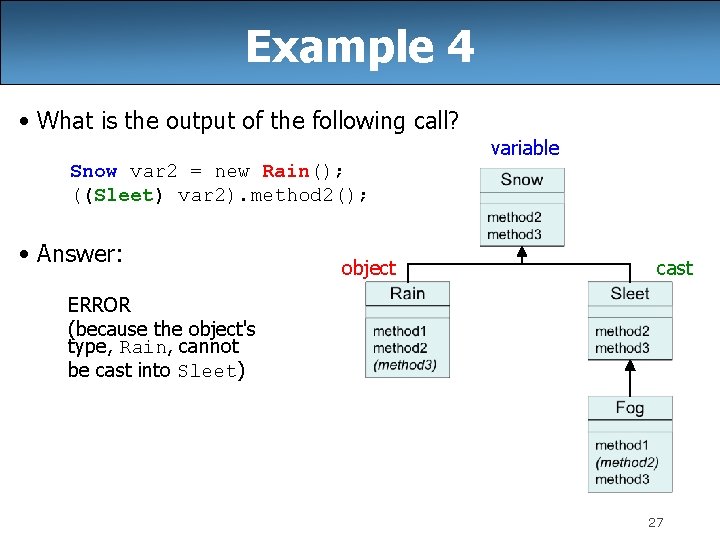
Example 4 • What is the output of the following call? variable Snow var 2 = new Rain(); ((Sleet) var 2). method 2(); • Answer: object cast ERROR (because the object's type, Rain, cannot be cast into Sleet) 27
- Slides: 27