
CSE 143 Lecture 23 Polymorphism the Object class
CSE 143 Lecture 23 Polymorphism; the Object class read 9. 2 - 9. 3 slides created by Marty Stepp and Ethan Apter http: //www. cs. washington. edu/143/

Polymorphism • polymorphism: Ability for the same code to be used with different types of objects and behave differently with each. – System. out. println can print any type of object. • Each one displays in its own way on the console. – A Scanner can read data from any kind of Input. Stream. – Every kind of Output. Stream can write data, though they might write this to different kinds of sources. 2
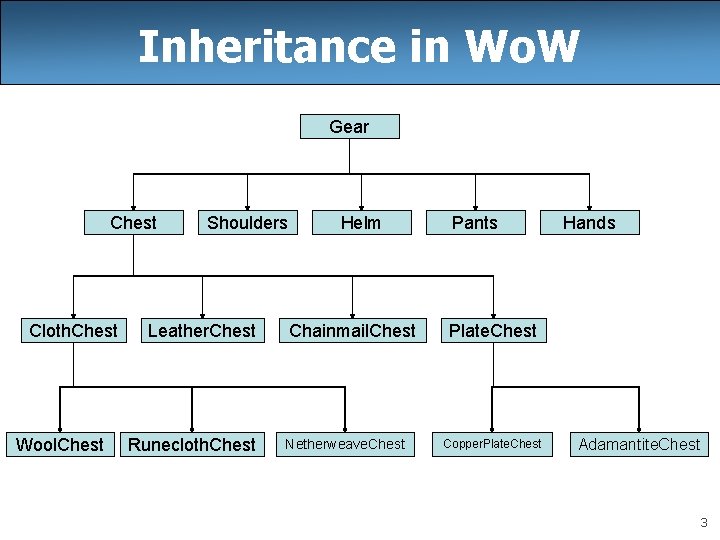
Inheritance in Wo. W Gear Chest Cloth. Chest Wool. Chest Shoulders Leather. Chest Runecloth. Chest Helm Chainmail. Chest Netherweave. Chest Pants Hands Plate. Chest Copper. Plate. Chest Adamantite. Chest 3
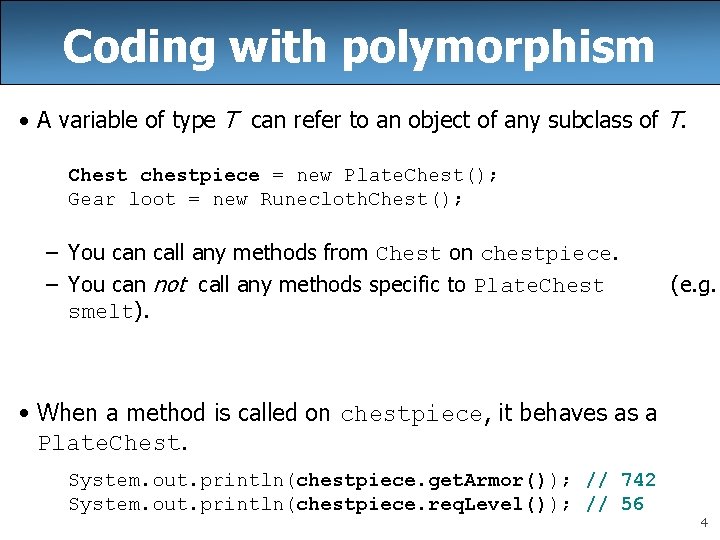
Coding with polymorphism • A variable of type T can refer to an object of any subclass of T. Chest chestpiece = new Plate. Chest(); Gear loot = new Runecloth. Chest(); – You can call any methods from Chest on chestpiece. – You can not call any methods specific to Plate. Chest smelt). (e. g. • When a method is called on chestpiece, it behaves as a Plate. Chest. System. out. println(chestpiece. get. Armor()); // 742 System. out. println(chestpiece. req. Level()); // 56 4
![Polymorphism/parameters public class Gear. Main { public static void main(String[] args) { Plate. Chest](http://slidetodoc.com/presentation_image_h2/cb6aa1050b805792a6641fbec74d5fc8/image-5.jpg "Polymorphism/parameters public class Gear. Main { public static void main(String[] args) { Plate. Chest")
Polymorphism/parameters public class Gear. Main { public static void main(String[] args) { Plate. Chest plate = new Plate. Chest(); Copper. Chest copper = new Copper. Plate. Chest(); print. Info. Plate(plate); print. Info. Copper(copper); } public static void print. Info. Plate(Plate. Chest loot) { System. out. println(”armor = " + loot. get. Armor()); System. out. println(”required level = " + loot. req. Level()); System. out. println(”soulbinds = " + loot. can. Soul. Bind()); System. out. println(); } public static void print. Info. Copper(Copper. Plate. Chest loot) { System. out. println(”armor = " + loot. get. Armor()); System. out. println(”required level = " + loot. req. Level()); System. out. println(”soulbinds = " + loot. can. Soul. Bind()); System. out. println(); } } 5

Polymorphism/parameters • You can pass any subtype of a parameter's type. public class Gear. Main { public static void main(String[] args) { Plate. Chest plate = new Plate. Chest(); Copper. Chest copper = new Copper. Plate. Chest(); print. Info(plate); print. Info(copper); } } public static void print. Info(Gear loot) { System. out. println(”armor = " + loot. get. Armor()); System. out. println(”required level = " + loot. req. Level()); System. out. println(”soulbinds = " + loot. can. Soul. Bind()); System. out. println(); } OUTPUT: armor = 100 required level = 10 soulbinds = false armor = 110 required level = 14 soulbinds = true 6
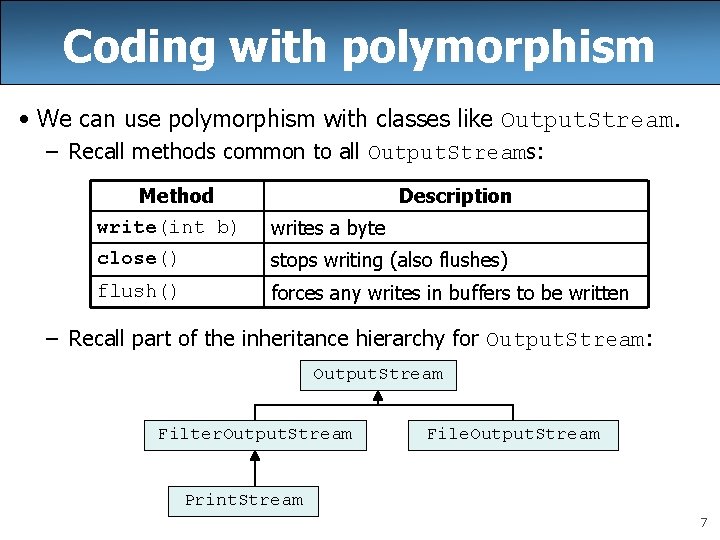
Coding with polymorphism • We can use polymorphism with classes like Output. Stream. – Recall methods common to all Output. Streams: Method write(int b) Description writes a byte close() stops writing (also flushes) flush() forces any writes in buffers to be written – Recall part of the inheritance hierarchy for Output. Stream: Output. Stream Filter. Output. Stream File. Output. Stream Print. Stream 7
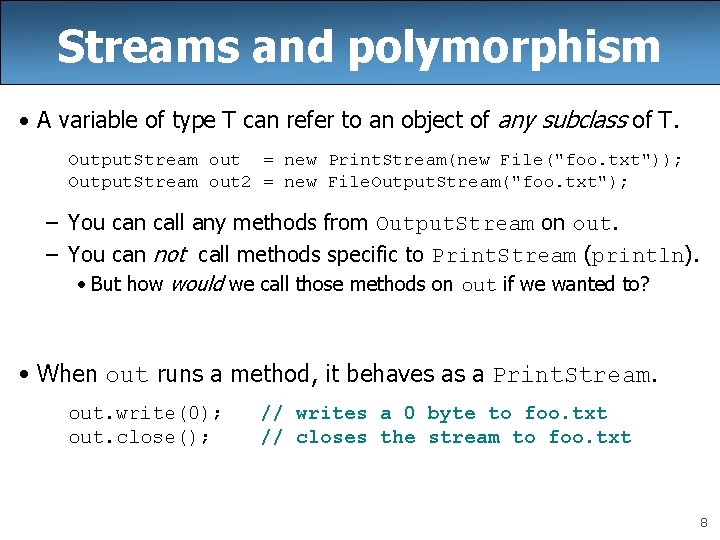
Streams and polymorphism • A variable of type T can refer to an object of any subclass of T. Output. Stream out = new Print. Stream(new File("foo. txt")); Output. Stream out 2 = new File. Output. Stream("foo. txt"); – You can call any methods from Output. Stream on out. – You can not call methods specific to Print. Stream (println). • But how would we call those methods on out if we wanted to? • When out runs a method, it behaves as a Print. Stream. out. write(0); out. close(); // writes a 0 byte to foo. txt // closes the stream to foo. txt 8

Type-casting objects • To use the object’s behavior we can cast Output. Stream out = new Print. Stream(new File("foo. txt")); ((Print. Stream) out). println("Hi!"); • Casting objects is different than casting primitives. – We're casting an Output. Stream reference into a Print. Stream reference. – We're promising the compiler that out refers to a Print. Stream object. 9

Polymorphism examples • You can use the object's extra functionality by casting. Output. Stream out = new Print. Stream(new File("foo. txt")); out. write(0); // ok out. println("hello"); // compiler error ((Print. Stream) out). println("hello"); // ok out. close(); // ok • You can't cast an object into something that it is not. Such code might compile, but it will crash at runtime. Output. Stream out 2 = new File. Output. Stream("foo. txt"); out 2. write(0); // ok out 2. println("hello"); // compiler error ((Print. Stream) out 2). println("hello"); // runtime exception 10

Polymorphism mystery • 4 -5 classes with inheritance relationships are shown. • A client program calls methods on objects of each class. – Some questions involve type-casting. – Some lines of code are illegal and produce errors. • You must read the code and determine its output or errors. – For output, you must be precise – For errors, you need only say that an error occurred (not identify what kind of error occurred) • We always place such a question on our final exams! 11

Polymorphism mystery • Steps to solving polymorphism mystery problems: 1. Look at the variable type. (If there is a cast, look at the casted variable type. ) If the variable type does not have the requested method the compiler will report an error. 2. If there was a cast, make sure the casted variable type is compatible with the object type (i. e. ensure the object type is a subclass of the variable type). If they are not compatible, a runtime error (Class. Cast. Exception) will occur. 3. Execute the method in question, behaving like the object type. (The variable type and casted variable type no longer matter. ) 12

Exercise • Assume that the following classes have been declared: public class Gear { public int get. Armor() { return 10; } } public void print() { System. out. println("Gear"); } public class Chest extends Gear { public int get. Armor() { return 15 + super. get. Armor(); } } public void print() { System. out. print("Chest: "); System. out. println(get. Armor()); } 13
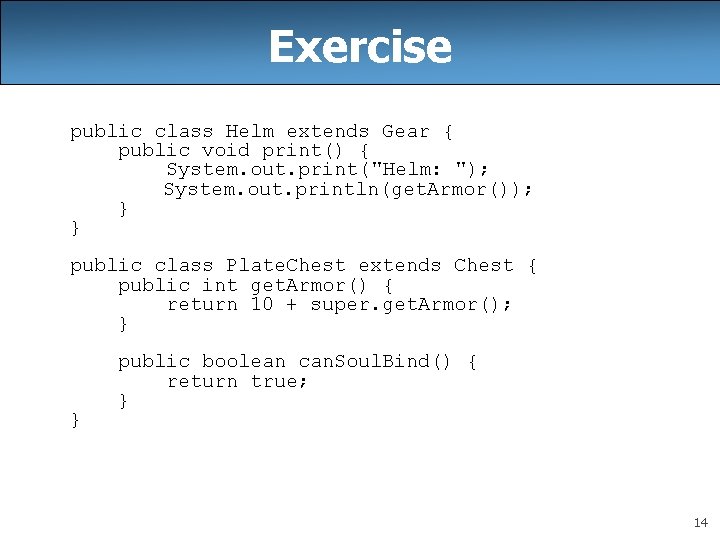
Exercise public class Helm extends Gear { public void print() { System. out. print("Helm: "); System. out. println(get. Armor()); } } public class Plate. Chest extends Chest { public int get. Armor() { return 10 + super. get. Armor(); } } public boolean can. Soul. Bind() { return true; } 14

Exercise What happens when the following examples are executed? • Example 1: Helm var 1 = new Helm(); var 1. get. Armor(); • Example 2: Helm var 2 = new Helm(); var 2. print(); • Example 3: Chest var 3 = new Chest(); var 3. get. Armor(); 15
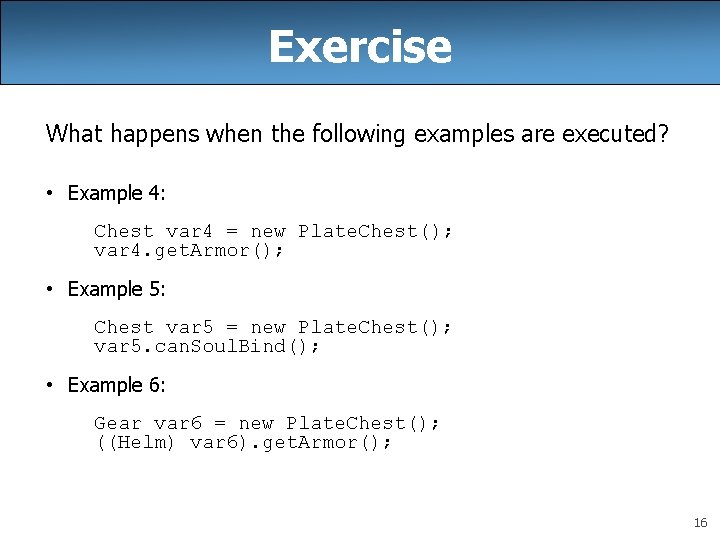
Exercise What happens when the following examples are executed? • Example 4: Chest var 4 = new Plate. Chest(); var 4. get. Armor(); • Example 5: Chest var 5 = new Plate. Chest(); var 5. can. Soul. Bind(); • Example 6: Gear var 6 = new Plate. Chest(); ((Helm) var 6). get. Armor(); 16
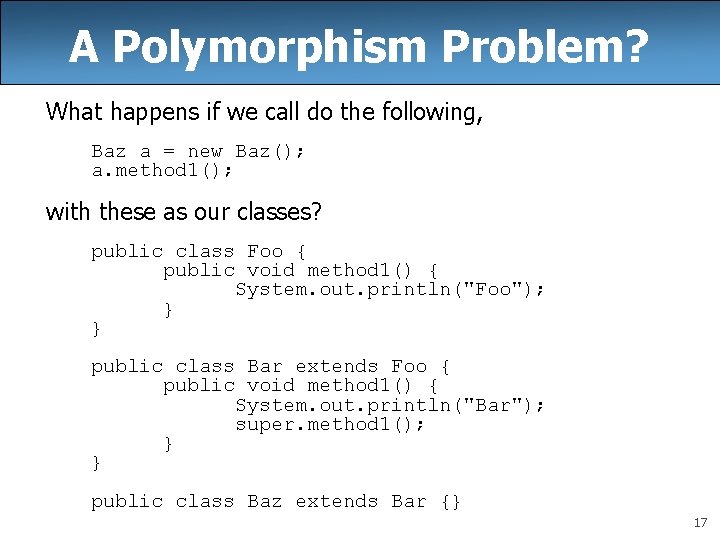
A Polymorphism Problem? What happens if we call do the following, Baz a = new Baz(); a. method 1(); with these as our classes? public class Foo { public void method 1() { System. out. println("Foo"); } } public class Bar extends Foo { public void method 1() { System. out. println("Bar"); super. method 1(); } } public class Baz extends Bar {} 17
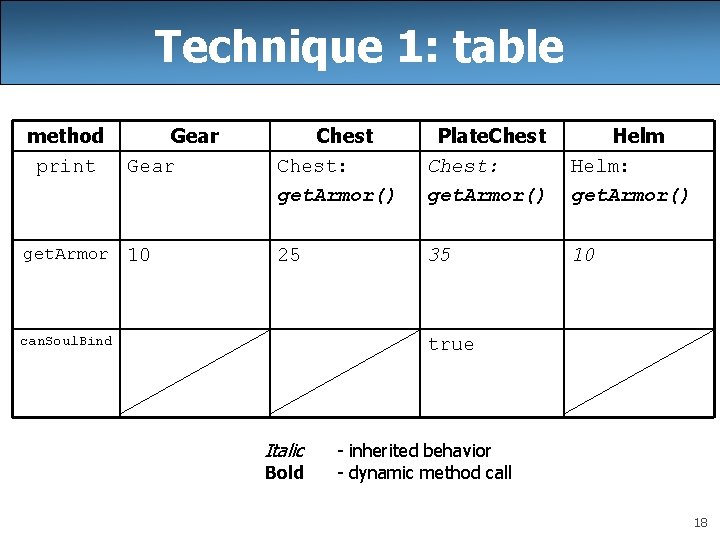
Technique 1: table method print Gear Chest: get. Armor() Plate. Chest: get. Armor() Helm: get. Armor() get. Armor 10 25 35 10 can. Soul. Bind true Italic Bold - inherited behavior - dynamic method call 18
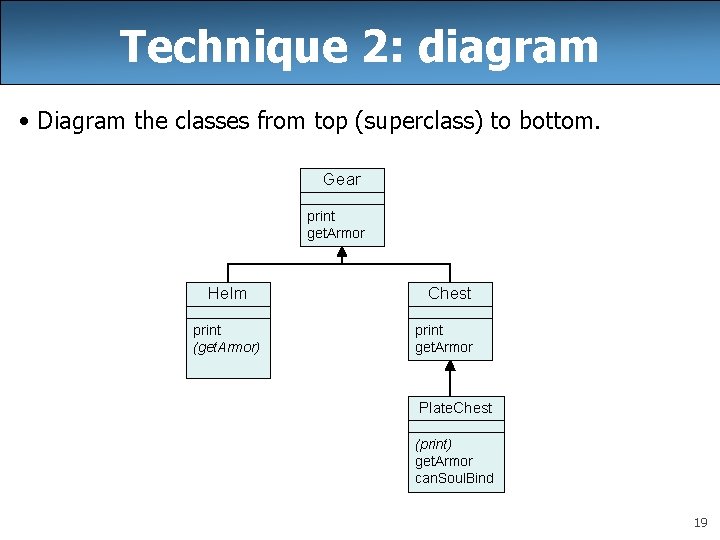
Technique 2: diagram • Diagram the classes from top (superclass) to bottom. Gear print get. Armor Helm print (get. Armor) Chest print get. Armor Plate. Chest (print) get. Armor can. Soul. Bind 19
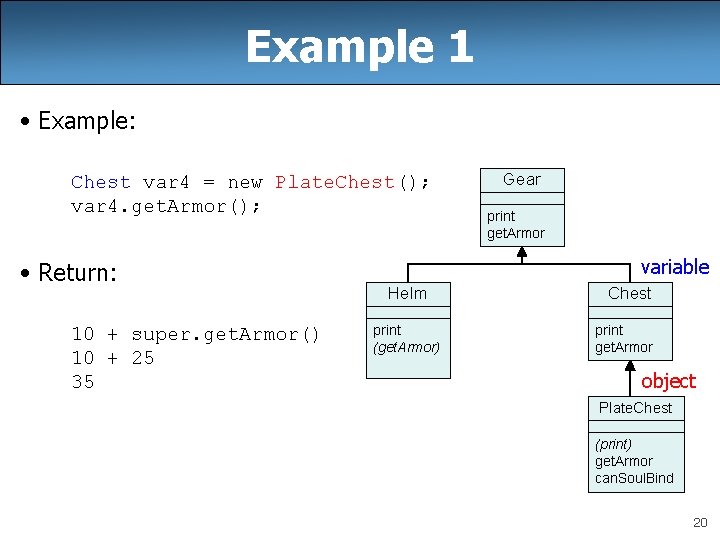
Example 1 • Example: Chest var 4 = new Plate. Chest(); var 4. get. Armor(); • Return: 10 + super. get. Armor() 10 + 25 35 Gear print get. Armor variable Helm print (get. Armor) Chest print get. Armor object Plate. Chest (print) get. Armor can. Soul. Bind 20
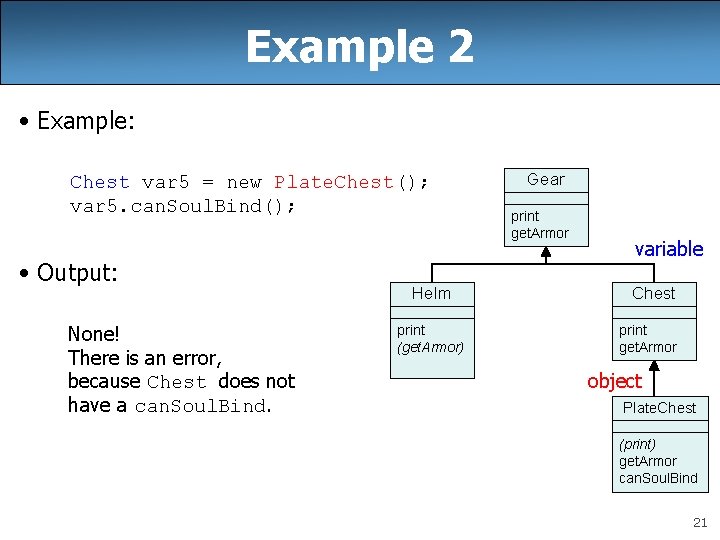
Example 2 • Example: Chest var 5 = new Plate. Chest(); var 5. can. Soul. Bind(); • Output: None! There is an error, because Chest does not have a can. Soul. Bind. Helm print (get. Armor) Gear print get. Armor variable Chest print get. Armor object Plate. Chest (print) get. Armor can. Soul. Bind 21
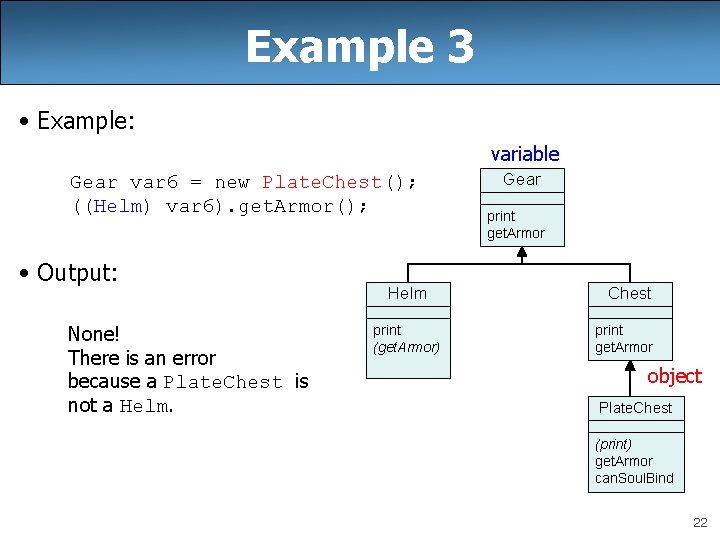
Example 3 • Example: variable Gear var 6 = new Plate. Chest(); ((Helm) var 6). get. Armor(); • Output: None! There is an error because a Plate. Chest is not a Helm print (get. Armor) Gear print get. Armor Chest print get. Armor object Plate. Chest (print) get. Armor can. Soul. Bind 22
The Object class read 9. 3 23
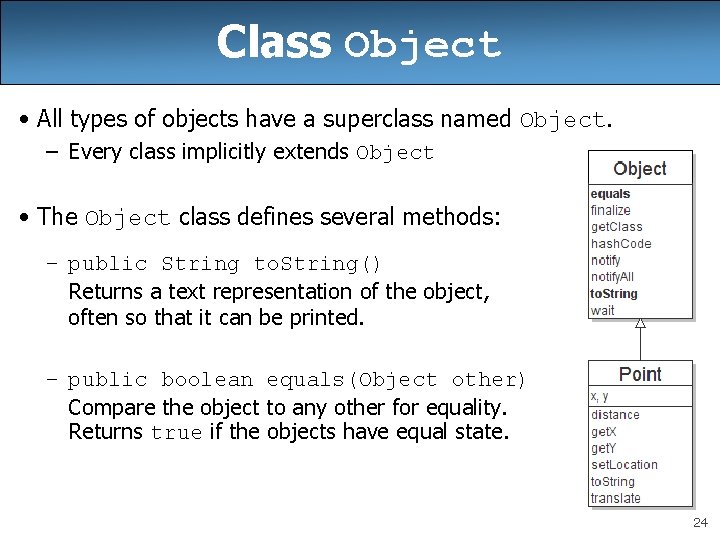
Class Object • All types of objects have a superclass named Object. – Every class implicitly extends Object • The Object class defines several methods: – public String to. String() Returns a text representation of the object, often so that it can be printed. – public boolean equals(Object other) Compare the object to any other for equality. Returns true if the objects have equal state. 24
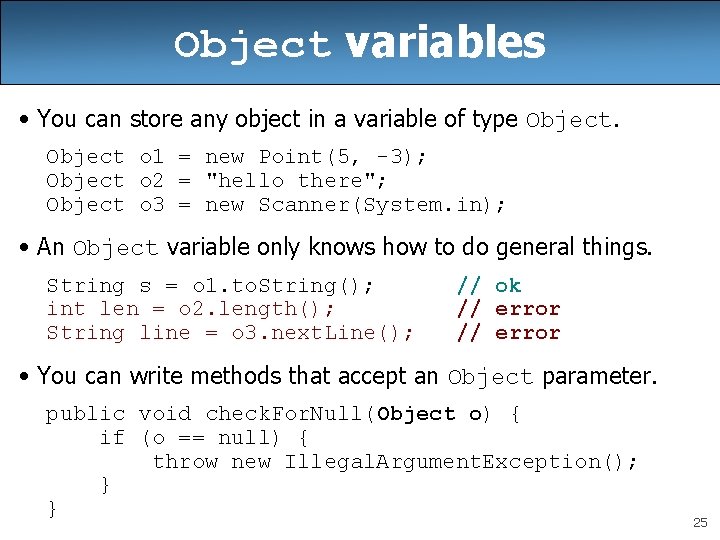
Object variables • You can store any object in a variable of type Object o 1 = new Point(5, -3); Object o 2 = "hello there"; Object o 3 = new Scanner(System. in); • An Object variable only knows how to do general things. String s = o 1. to. String(); int len = o 2. length(); String line = o 3. next. Line(); // ok // error • You can write methods that accept an Object parameter. public void check. For. Null(Object o) { if (o == null) { throw new Illegal. Argument. Exception(); } } 25
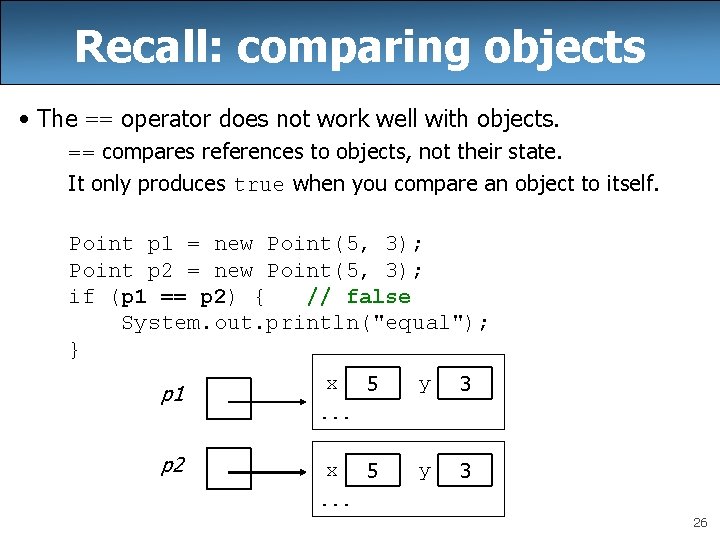
Recall: comparing objects • The == operator does not work well with objects. == compares references to objects, not their state. It only produces true when you compare an object to itself. Point p 1 = new Point(5, 3); Point p 2 = new Point(5, 3); if (p 1 == p 2) { // false System. out. println("equal"); } p 1 p 2 x 5 y 3 . . . x. . . 26
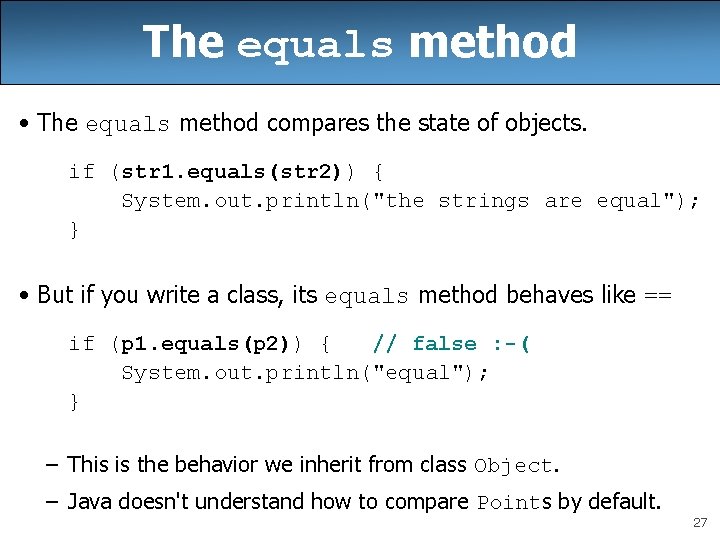
The equals method • The equals method compares the state of objects. if (str 1. equals(str 2)) { System. out. println("the strings are equal"); } • But if you write a class, its equals method behaves like == if (p 1. equals(p 2)) { // false : -( System. out. println("equal"); } – This is the behavior we inherit from class Object. – Java doesn't understand how to compare Points by default. 27
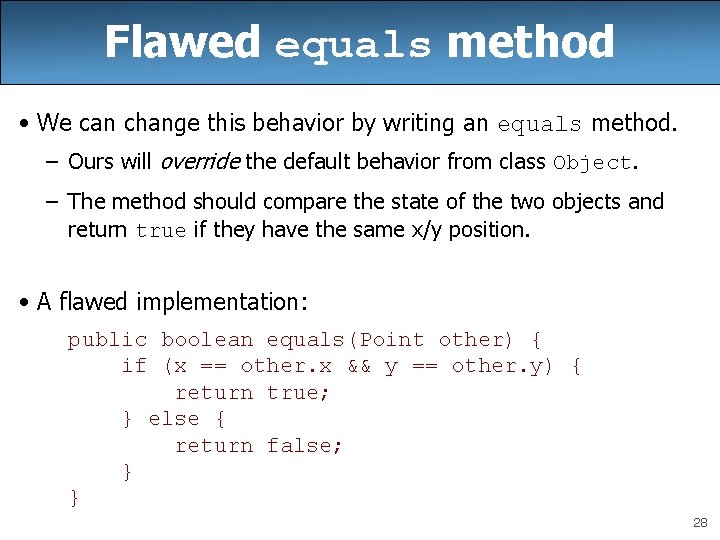
Flawed equals method • We can change this behavior by writing an equals method. – Ours will override the default behavior from class Object. – The method should compare the state of the two objects and return true if they have the same x/y position. • A flawed implementation: public boolean equals(Point other) { if (x == other. x && y == other. y) { return true; } else { return false; } } 28
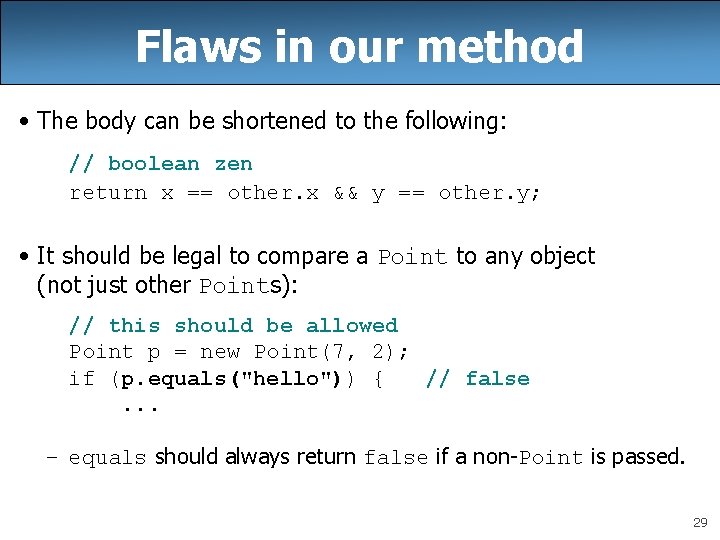
Flaws in our method • The body can be shortened to the following: // boolean zen return x == other. x && y == other. y; • It should be legal to compare a Point to any object (not just other Points): // this should be allowed Point p = new Point(7, 2); if (p. equals("hello")) { // false. . . – equals should always return false if a non-Point is passed. 29
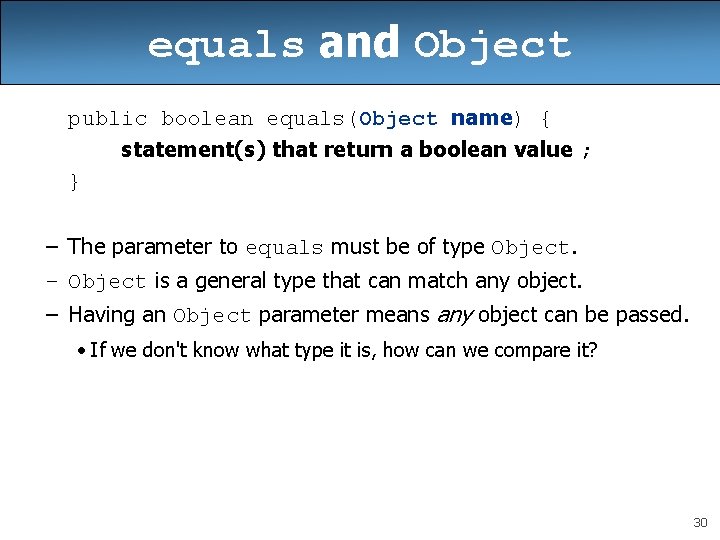
equals and Object public boolean equals(Object name) { statement(s) that return a boolean value ; } – The parameter to equals must be of type Object. – Object is a general type that can match any object. – Having an Object parameter means any object can be passed. • If we don't know what type it is, how can we compare it? 30
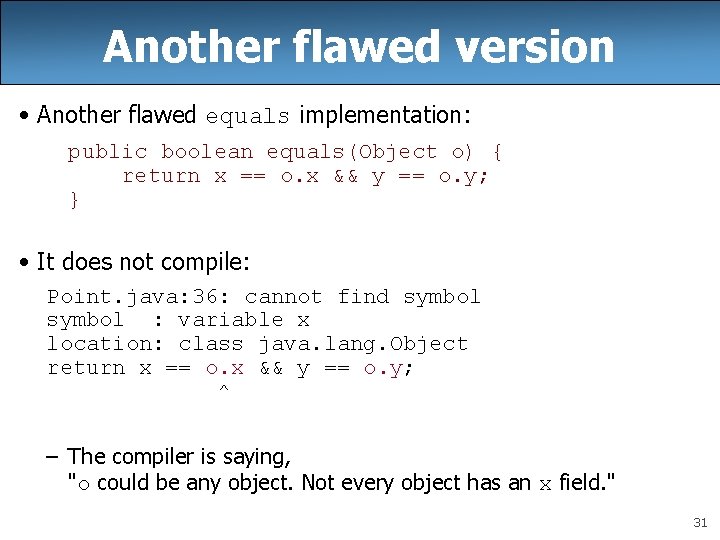
Another flawed version • Another flawed equals implementation: public boolean equals(Object o) { return x == o. x && y == o. y; } • It does not compile: Point. java: 36: cannot find symbol : variable x location: class java. lang. Object return x == o. x && y == o. y; ^ – The compiler is saying, "o could be any object. Not every object has an x field. " 31
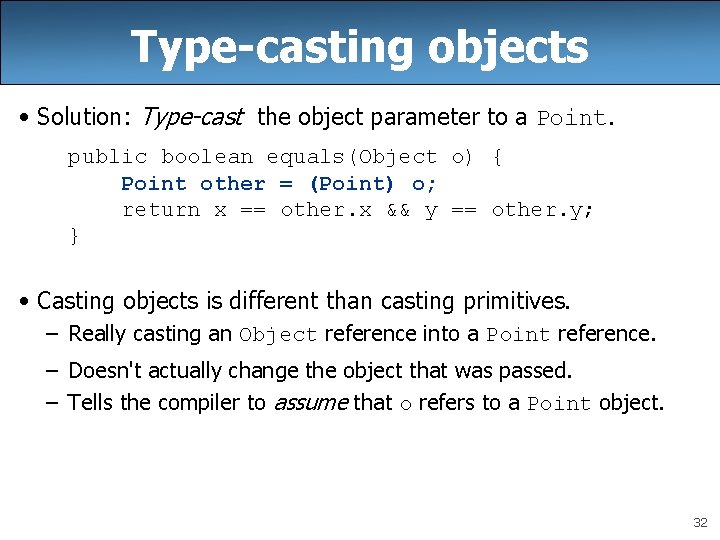
Type-casting objects • Solution: Type-cast the object parameter to a Point. public boolean equals(Object o) { Point other = (Point) o; return x == other. x && y == other. y; } • Casting objects is different than casting primitives. – Really casting an Object reference into a Point reference. – Doesn't actually change the object that was passed. – Tells the compiler to assume that o refers to a Point object. 32
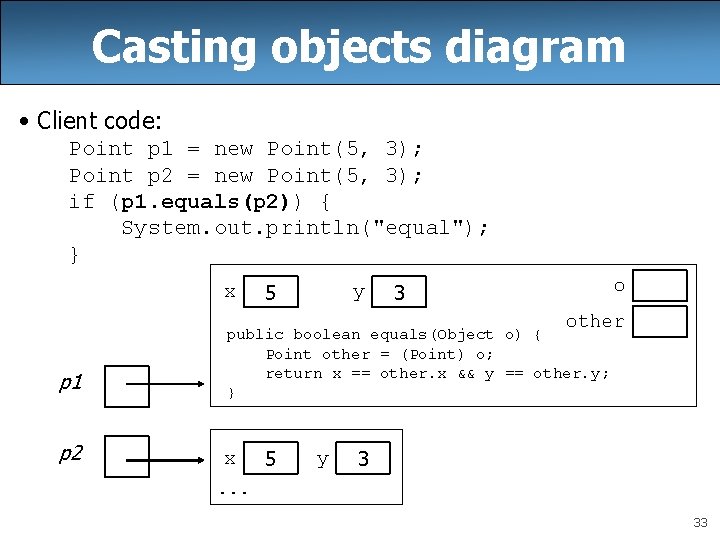
Casting objects diagram • Client code: Point p 1 = new Point(5, 3); Point p 2 = new Point(5, 3); if (p 1. equals(p 2)) { System. out. println("equal"); } x 5 y o 3 other p 1 public boolean equals(Object o) { Point other = (Point) o; return x == other. x && y == other. y; } p 2 x 5 y 3 . . . 33
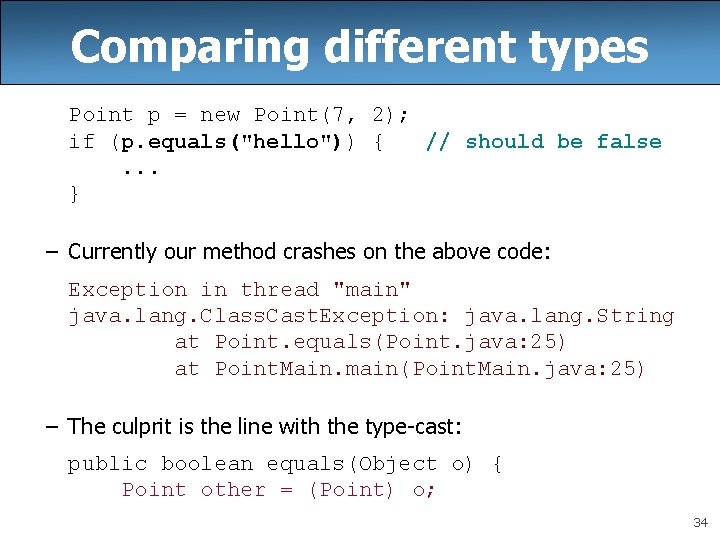
Comparing different types Point p = new Point(7, 2); if (p. equals("hello")) { // should be false. . . } – Currently our method crashes on the above code: Exception in thread "main" java. lang. Class. Cast. Exception: java. lang. String at Point. equals(Point. java: 25) at Point. Main. main(Point. Main. java: 25) – The culprit is the line with the type-cast: public boolean equals(Object o) { Point other = (Point) o; 34
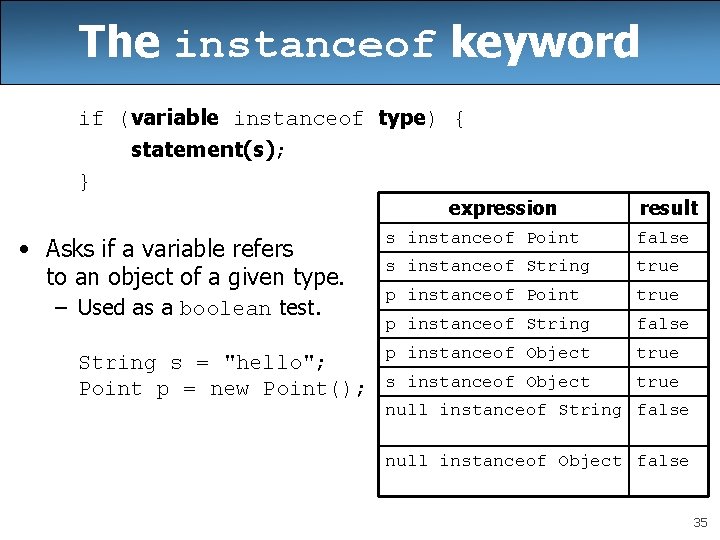
The instanceof keyword if (variable instanceof type) { statement(s); } expression • Asks if a variable refers to an object of a given type. – Used as a boolean test. result s instanceof Point false s instanceof String true p instanceof Point true p instanceof String false p instanceof Object String s = "hello"; Point p = new Point(); s instanceof Object true null instanceof String false null instanceof Object false 35
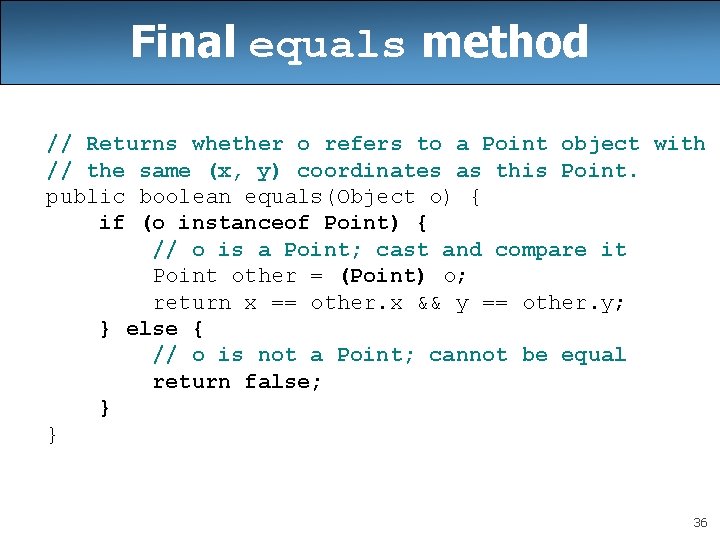
Final equals method // Returns whether o refers to a Point object with // the same (x, y) coordinates as this Point. public boolean equals(Object o) { if (o instanceof Point) { // o is a Point; cast and compare it Point other = (Point) o; return x == other. x && y == other. y; } else { // o is not a Point; cannot be equal return false; } } 36
- Slides: 36