
CSE 143 Lecture 11 Complexity Based on slides
CSE 143 Lecture 11 Complexity Based on slides by Ethan Apter
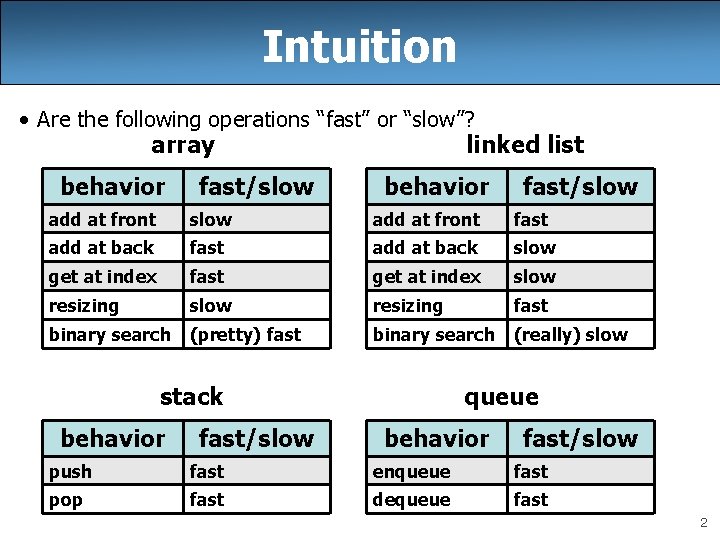
Intuition • Are the following operations “fast” or “slow”? array behavior fast/slow linked list behavior fast/slow add at front fast add at back slow get at index fast get at index slow resizing fast binary search (pretty) fast binary search (really) slow stack behavior fast/slow queue behavior fast/slow push fast enqueue fast pop fast dequeue fast 2

Complexity • “Complexity” is a word that has a special meaning in computer science • complexity: the amount of computational resources a of code requires in order to run block • main computational resources: – time: how long the code takes to execute – space: how much computer memory the code consumes • Often, one of these resources can be traded for the other: – e. g. : we can make some code use less memory if we don’t that it will need more time to finish (and vice-versa) mind 3
Time Complexity • We usually care more about time complexity – we want to make our code run fast! • But we don’t merely measure how long a piece of code to determine it’s time complexity takes • That approach would have results strongly skewed by: – – – size/kind of input speed of the computer’s hardware other programs running at the same time operating system etc 4
Time Complexity • Instead, we care about the growth rate as the input size increase • First, we have to be able to measure the input size – the number of names to sort – the number of nodes in a linked list – the number of students in the IPL queue • We usually call the input size “n” • What happens if we double the input size (n 2 n)? 5

Time Complexity • We can learn about this growth rate in two ways: – by examining code – by running the same code over different input sizes • Measuring the growth rate by is one of the few places where computer science is like the other sciences – here, we actually collect data • But this data can be misleading – modern computers are very complex – some features, like cache memory, interfere with our data 6
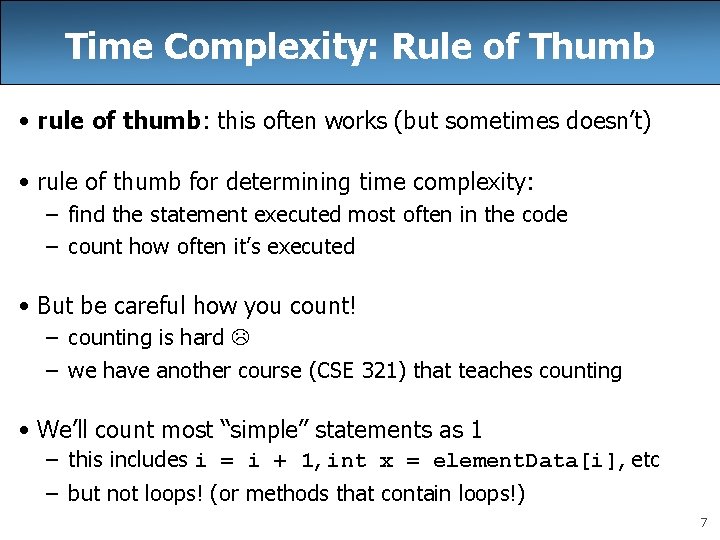
Time Complexity: Rule of Thumb • rule of thumb: this often works (but sometimes doesn’t) • rule of thumb for determining time complexity: – find the statement executed most often in the code – count how often it’s executed • But be careful how you count! – counting is hard – we have another course (CSE 321) that teaches counting • We’ll count most “simple” statements as 1 – this includes i = i + 1, int x = element. Data[i], etc – but not loops! (or methods that contain loops!) 7
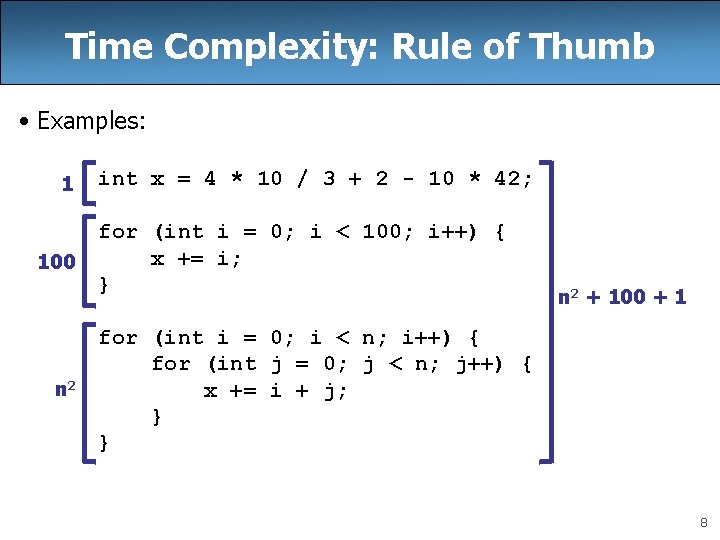
Time Complexity: Rule of Thumb • Examples: 1 100 n 2 int x = 4 * 10 / 3 + 2 - 10 * 42; for (int i = 0; i < 100; i++) { x += i; } n 2 + 100 + 1 for (int i = 0; i < n; i++) { for (int j = 0; j < n; j++) { x += i + j; } } 8
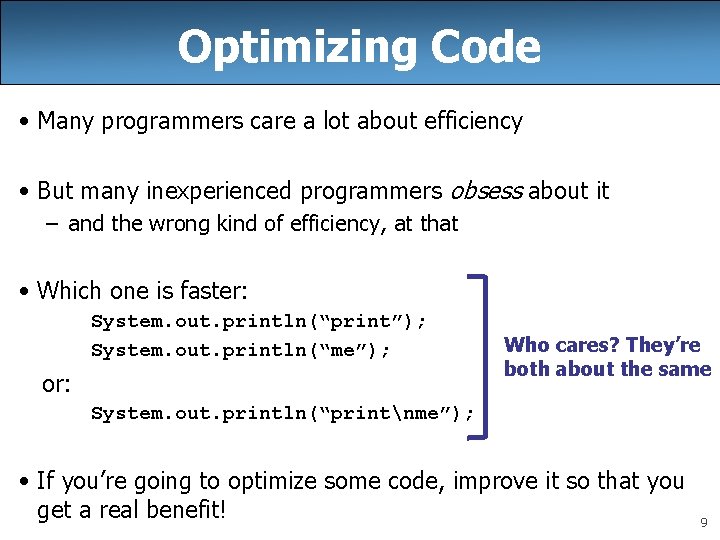
Optimizing Code • Many programmers care a lot about efficiency • But many inexperienced programmers obsess about it – and the wrong kind of efficiency, at that • Which one is faster: System. out. println(“print”); System. out. println(“me”); or: Who cares? They’re both about the same System. out. println(“printnme”); • If you’re going to optimize some code, improve it so that you get a real benefit! 9
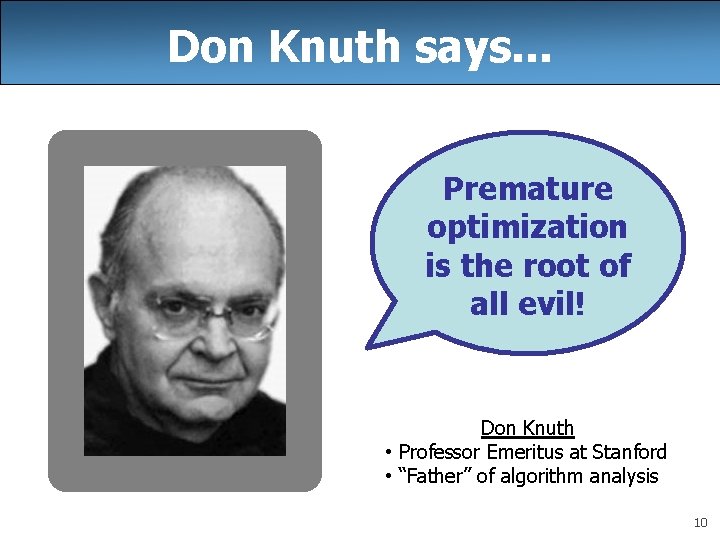
Don Knuth says. . . Premature optimization is the root of all evil! Don Knuth • Professor Emeritus at Stanford • “Father” of algorithm analysis 10
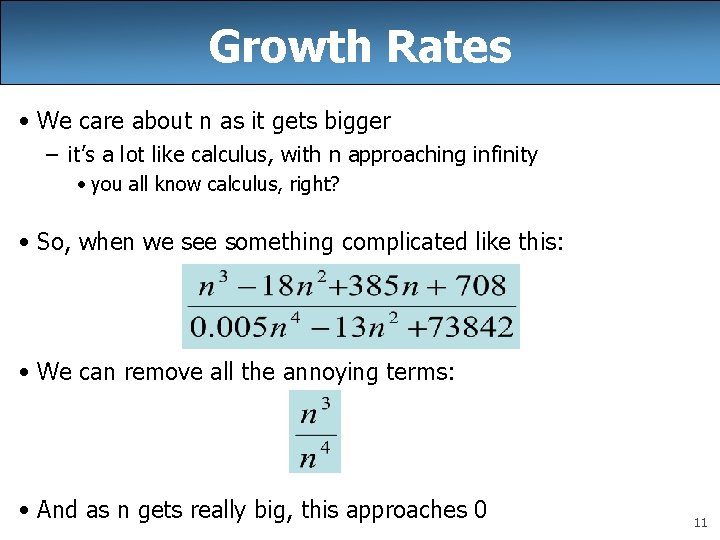
Growth Rates • We care about n as it gets bigger – it’s a lot like calculus, with n approaching infinity • you all know calculus, right? • So, when we see something complicated like this: • We can remove all the annoying terms: • And as n gets really big, this approaches 0 11
Big O Notation • We need a way to write a growth rate of a block of code • Computer scientists use big O (“big oh”) notation – O(n) – O(n 2) • In big O notation, we ignore coefficients that are constants – 5 n is written as O(n) – 100 n is also written as O(n) – 0. 05 n 2 is written as O(n 2) (and will eventually outgrow O(n)) • Each O([something]) specifies a different complexity class 12

Complexity Classes Complexity Class Name Example O(1) constant time popping a value off a stack O(log n) logarithmic time binary search on an array O(n) linear time scanning all elements of an array O(n log n) log-linear time binary search on a linked list and good sorting algorithms O(n 2) quadratic time poor sorting algorithms (like inserting n items into Sorted. Int. List) O(n 3) cubic time (example later today) O(2 n) exponential time Really hard problems. These grow so fast that they’re impractical 13
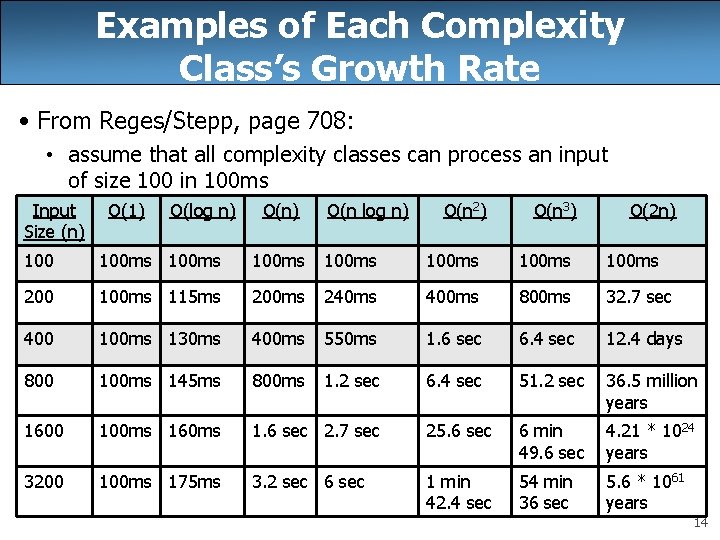
Examples of Each Complexity Class’s Growth Rate • From Reges/Stepp, page 708: • assume that all complexity classes can process an input of size 100 in 100 ms Input Size (n) O(1) O(log n) O(n 2) O(n 3) O(2 n) 100 ms 100 ms 200 100 ms 115 ms 200 ms 240 ms 400 ms 800 ms 32. 7 sec 400 100 ms 130 ms 400 ms 550 ms 1. 6 sec 6. 4 sec 12. 4 days 800 100 ms 145 ms 800 ms 1. 2 sec 6. 4 sec 51. 2 sec 36. 5 million years 1600 100 ms 160 ms 1. 6 sec 2. 7 sec 25. 6 sec 6 min 49. 6 sec 4. 21 * 1024 years 3200 100 ms 175 ms 3. 2 sec 6 sec 1 min 42. 4 sec 54 min 36 sec 5. 6 * 1061 years 14
Case Study: max. Sum • Given an array of ints, find the subsequence with the maximum sum • Additional information: – values in the array can be negative, positive, or zero – the subsequence must be contiguous (can’t skip elements) – you must compute: • the value of the sum of this subsequence • the starting index (inclusive) of this subsequence • the stopping index (inclusive) of this subsequence • This has been used as a Microsoft interview question! 15
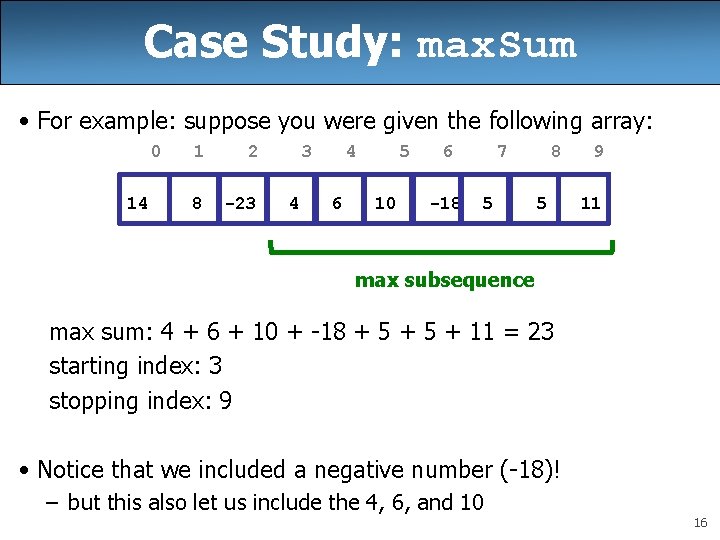
Case Study: max. Sum • For example: suppose you were given the following array: 0 14 1 2 8 -23 3 4 4 6 5 10 6 -18 7 5 8 5 9 11 max subsequence max sum: 4 + 6 + 10 + -18 + 5 + 11 = 23 starting index: 3 stopping index: 9 • Notice that we included a negative number (-18)! – but this also let us include the 4, 6, and 10 16
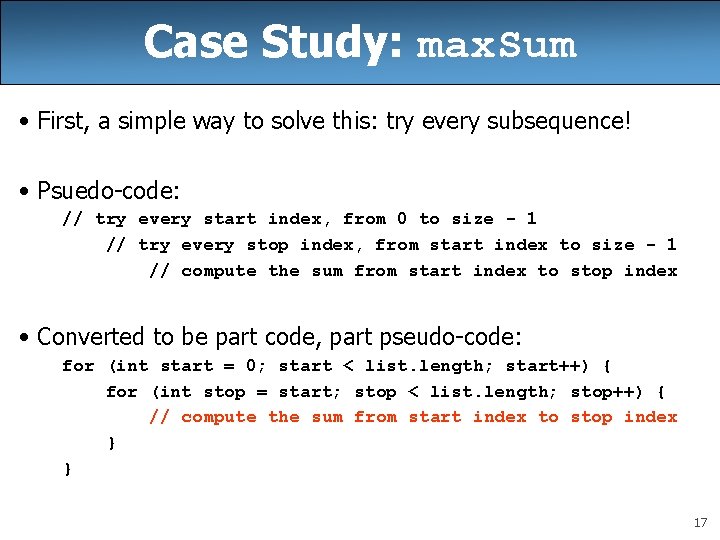
Case Study: max. Sum • First, a simple way to solve this: try every subsequence! • Psuedo-code: // try every start index, from 0 to size - 1 // try every stop index, from start index to size - 1 // compute the sum from start index to stop index • Converted to be part code, part pseudo-code: for (int start = 0; start < list. length; start++) { for (int stop = start; stop < list. length; stop++) { // compute the sum from start index to stop index } } 17
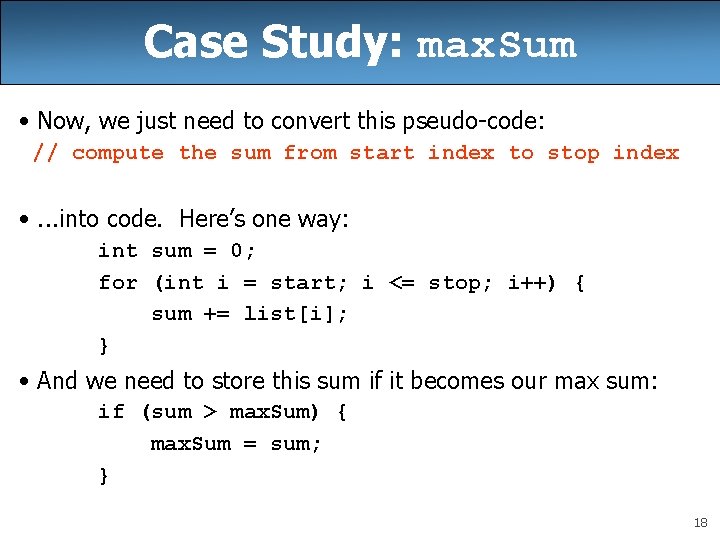
Case Study: max. Sum • Now, we just need to convert this pseudo-code: // compute the sum from start index to stop index • . . . into code. Here’s one way: int sum = 0; for (int i = start; i <= stop; i++) { sum += list[i]; } • And we need to store this sum if it becomes our max sum: if (sum > max. Sum) { max. Sum = sum; } 18
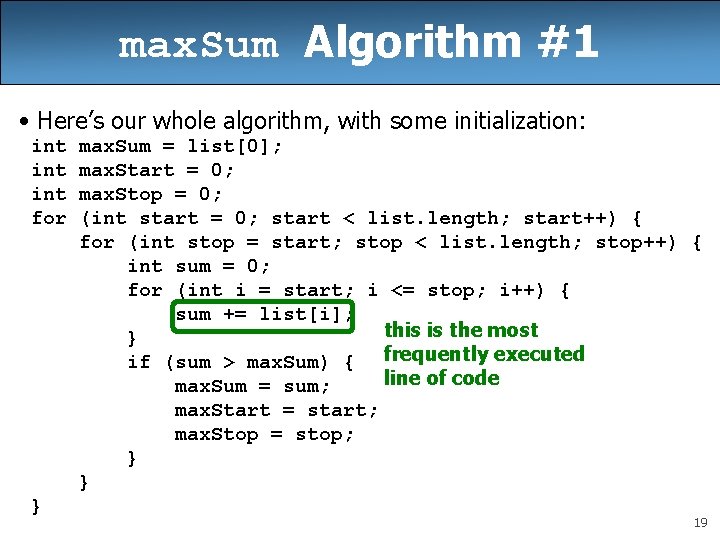
max. Sum Algorithm #1 • Here’s our whole algorithm, with some initialization: int int for } max. Sum = list[0]; max. Start = 0; max. Stop = 0; (int start = 0; start < list. length; start++) { for (int stop = start; stop < list. length; stop++) { int sum = 0; for (int i = start; i <= stop; i++) { sum += list[i]; this is the most } if (sum > max. Sum) { frequently executed line of code max. Sum = sum; max. Start = start; max. Stop = stop; } } 19
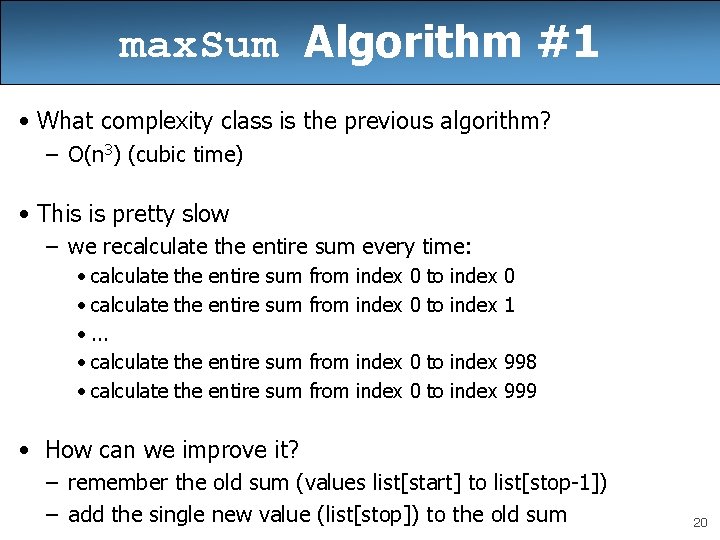
max. Sum Algorithm #1 • What complexity class is the previous algorithm? – O(n 3) (cubic time) • This is pretty slow – we recalculate the entire sum every time: • calculate • . . . • calculate the entire sum from index 0 to index 0 the entire sum from index 0 to index 1 the entire sum from index 0 to index 998 the entire sum from index 0 to index 999 • How can we improve it? – remember the old sum (values list[start] to list[stop-1]) – add the single new value (list[stop]) to the old sum 20
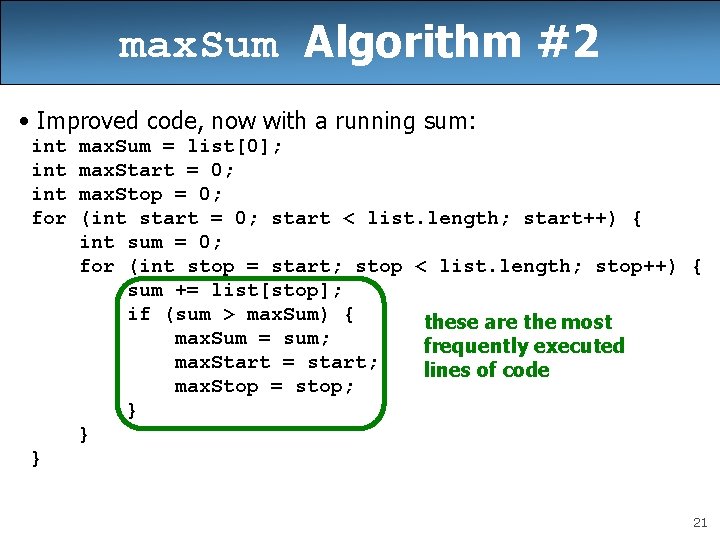
max. Sum Algorithm #2 • Improved code, now with a running sum: int int for max. Sum = list[0]; max. Start = 0; max. Stop = 0; (int start = 0; start < list. length; start++) { int sum = 0; for (int stop = start; stop < list. length; stop++) { sum += list[stop]; if (sum > max. Sum) { these are the most max. Sum = sum; frequently executed max. Start = start; lines of code max. Stop = stop; } } } 21
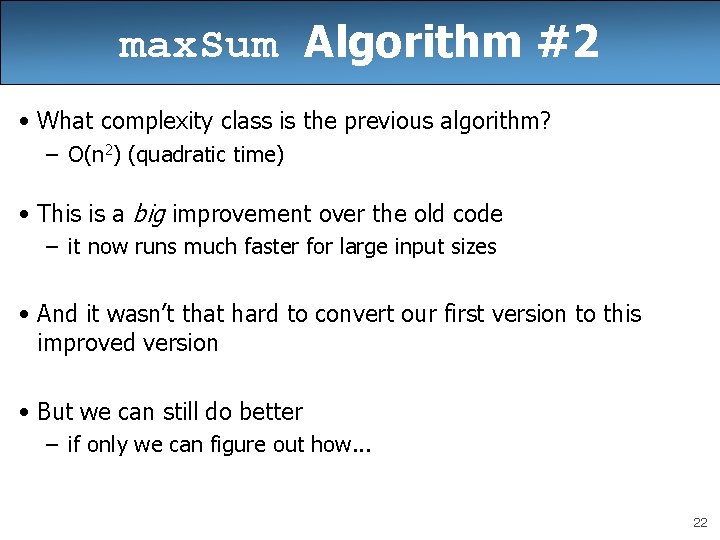
max. Sum Algorithm #2 • What complexity class is the previous algorithm? – O(n 2) (quadratic time) • This is a big improvement over the old code – it now runs much faster for large input sizes • And it wasn’t that hard to convert our first version to this improved version • But we can still do better – if only we can figure out how. . . 22
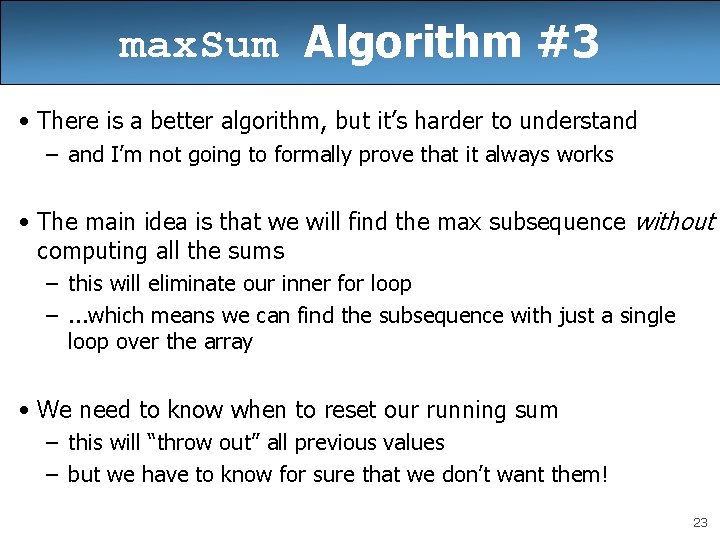
max. Sum Algorithm #3 • There is a better algorithm, but it’s harder to understand – and I’m not going to formally prove that it always works • The main idea is that we will find the max subsequence without computing all the sums – this will eliminate our inner for loop –. . . which means we can find the subsequence with just a single loop over the array • We need to know when to reset our running sum – this will “throw out” all previous values – but we have to know for sure that we don’t want them! 23
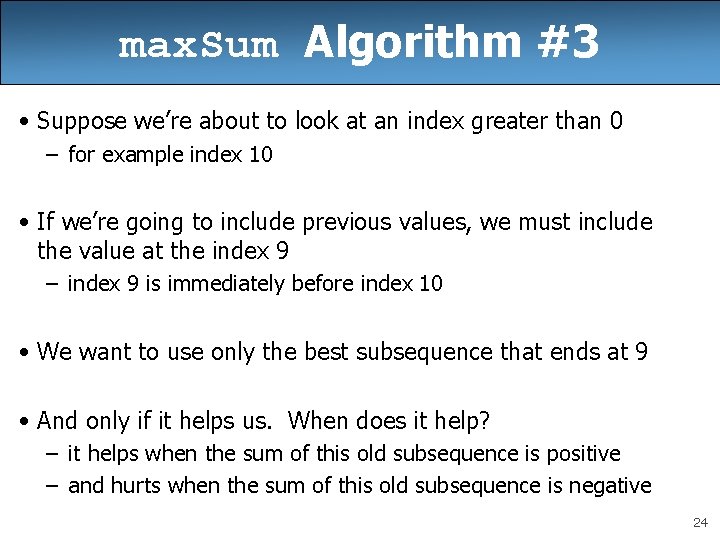
max. Sum Algorithm #3 • Suppose we’re about to look at an index greater than 0 – for example index 10 • If we’re going to include previous values, we must include the value at the index 9 – index 9 is immediately before index 10 • We want to use only the best subsequence that ends at 9 • And only if it helps us. When does it help? – it helps when the sum of this old subsequence is positive – and hurts when the sum of this old subsequence is negative 24
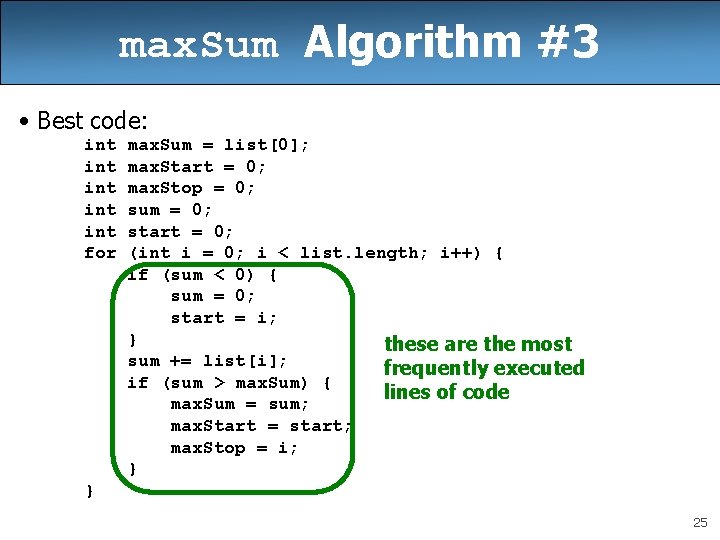
max. Sum Algorithm #3 • Best code: int int int for max. Sum = list[0]; max. Start = 0; max. Stop = 0; sum = 0; start = 0; (int i = 0; i < list. length; i++) { if (sum < 0) { sum = 0; start = i; } these are the most sum += list[i]; frequently executed if (sum > max. Sum) { lines of code max. Sum = sum; max. Start = start; max. Stop = i; } } 25
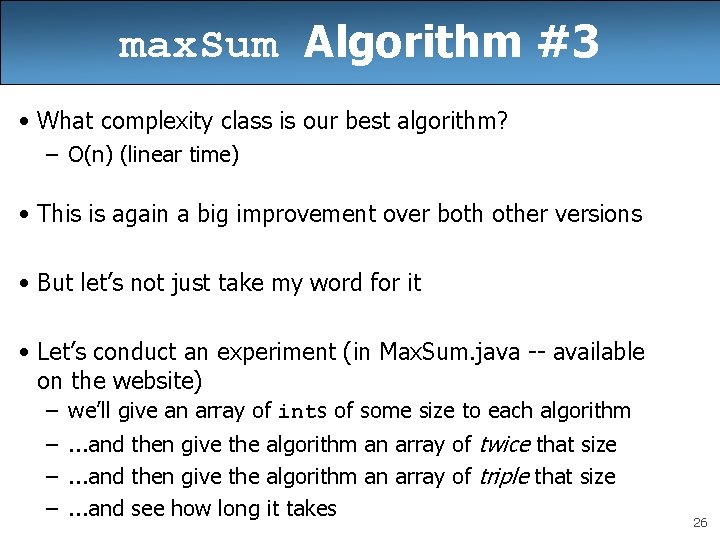
max. Sum Algorithm #3 • What complexity class is our best algorithm? – O(n) (linear time) • This is again a big improvement over both other versions • But let’s not just take my word for it • Let’s conduct an experiment (in Max. Sum. java -- available on the website) – we’ll give an array of ints of some size to each algorithm –. . . and then give the algorithm an array of twice that size –. . . and then give the algorithm an array of triple that size –. . . and see how long it takes 26
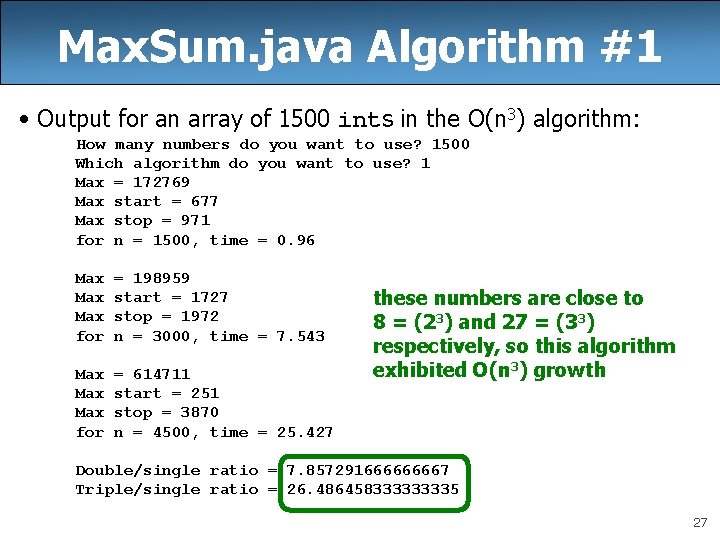
Max. Sum. java Algorithm #1 • Output for an array of 1500 ints in the O(n 3) algorithm: How many numbers do you want to use? 1500 Which algorithm do you want to use? 1 Max = 172769 Max start = 677 Max stop = 971 for n = 1500, time = 0. 96 Max Max for = 198959 start = 1727 stop = 1972 n = 3000, time = 7. 543 Max Max for = 614711 start = 251 stop = 3870 n = 4500, time = 25. 427 these numbers are close to 8 = (23) and 27 = (33) respectively, so this algorithm exhibited O(n 3) growth Double/single ratio = 7. 85729166667 Triple/single ratio = 26. 48645833335 27
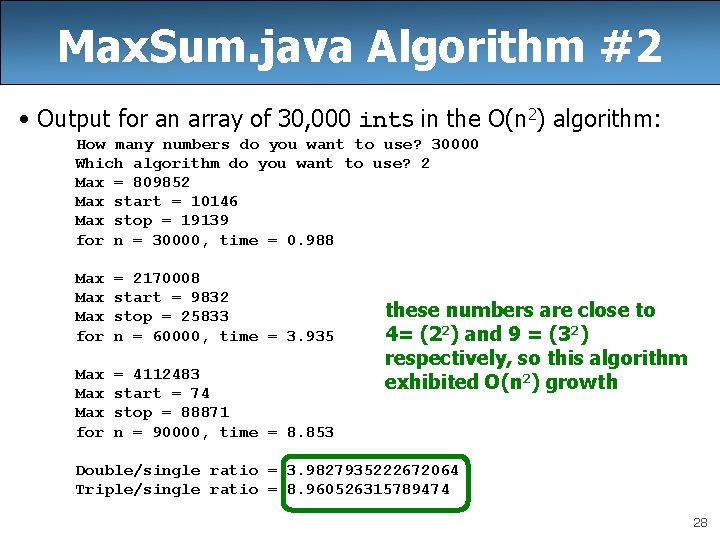
Max. Sum. java Algorithm #2 • Output for an array of 30, 000 ints in the O(n 2) algorithm: How many numbers do you want to use? 30000 Which algorithm do you want to use? 2 Max = 809852 Max start = 10146 Max stop = 19139 for n = 30000, time = 0. 988 Max Max for = 2170008 start = 9832 stop = 25833 n = 60000, time = 3. 935 Max Max for = 4112483 start = 74 stop = 88871 n = 90000, time = 8. 853 these numbers are close to 4= (22) and 9 = (32) respectively, so this algorithm exhibited O(n 2) growth Double/single ratio = 3. 9827935222672064 Triple/single ratio = 8. 960526315789474 28
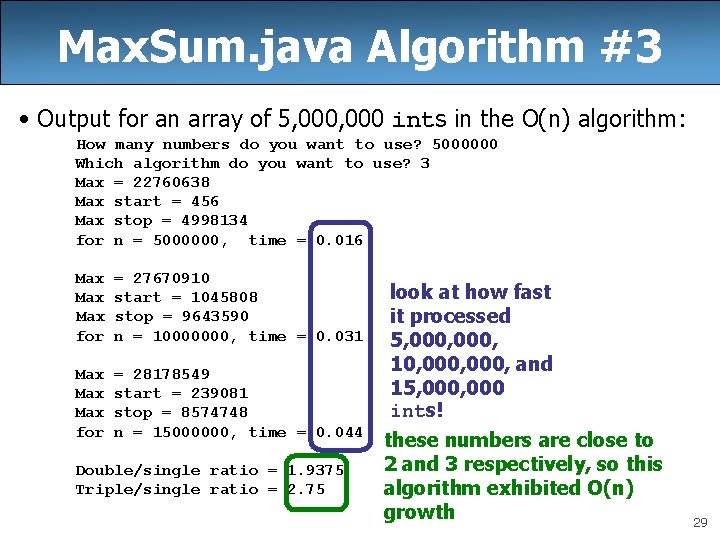
Max. Sum. java Algorithm #3 • Output for an array of 5, 000 ints in the O(n) algorithm: How many numbers do you want to use? 5000000 Which algorithm do you want to use? 3 Max = 22760638 Max start = 456 Max stop = 4998134 for n = 5000000, time = 0. 016 Max Max for = 27670910 start = 1045808 stop = 9643590 n = 10000000, time = 0. 031 Max Max for = 28178549 start = 239081 stop = 8574748 n = 15000000, time = 0. 044 Double/single ratio = 1. 9375 Triple/single ratio = 2. 75 look at how fast it processed 5, 000, 10, 000, and 15, 000 ints! these numbers are close to 2 and 3 respectively, so this algorithm exhibited O(n) growth 29
- Slides: 29