
CSE 140 Lecture 2 Combinational Logic CK Cheng
CSE 140, Lecture 2 Combinational Logic CK Cheng CSE Dept. UC San Diego 1
Outlines • Introduction – Motivation – Review of Boolean Algebra – Transformation of Logic Gates • Specification • Synthesis 2
Motivation: Combinational Logic • Description – Language – Boolean algebra – Truth table • Schematic Diagram – Inputs, Gates, Nets, Outputs • Goal – Validity: correctness, turnaround time – Performance: power, timing, cost – Testability: yield, diagnosis, robustness 3
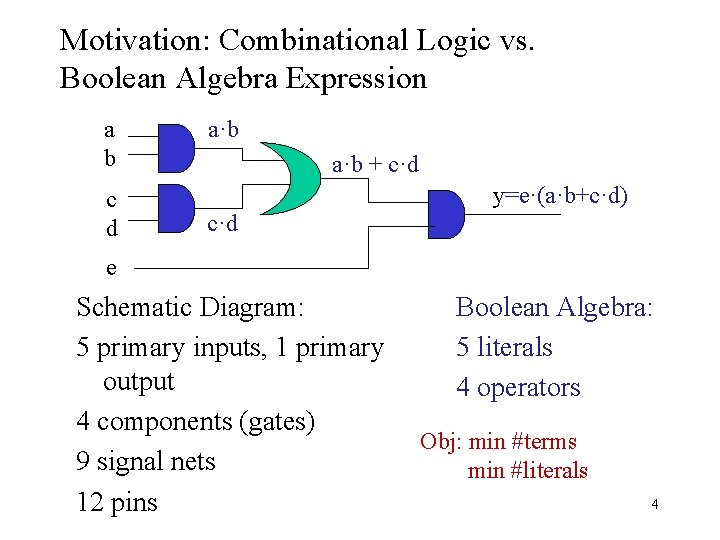
Motivation: Combinational Logic vs. Boolean Algebra Expression a b c d a·b + c·d y=e·(a·b+c·d) c·d e Schematic Diagram: 5 primary inputs, 1 primary output 4 components (gates) 9 signal nets 12 pins Boolean Algebra: 5 literals 4 operators Obj: min #terms min #literals 4
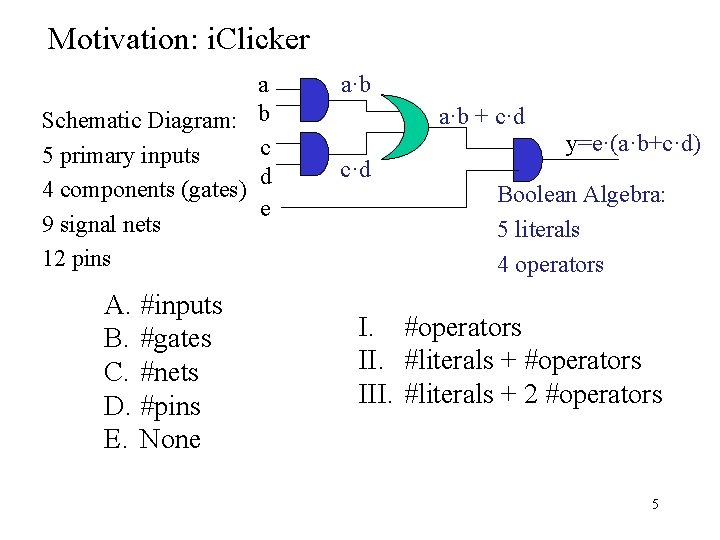
Motivation: i. Clicker a Schematic Diagram: b c 5 primary inputs d 4 components (gates) e 9 signal nets 12 pins A. #inputs B. #gates C. #nets D. #pins E. None a·b + c·d y=e·(a·b+c·d) Boolean Algebra: 5 literals 4 operators I. #operators II. #literals + #operators III. #literals + 2 #operators 5
Schematic Diagram vs. Boolean Expression • Boolean Expression: #literals, #operators • Schematic Diagram: #gates, #nets, #pins • One more example? 6
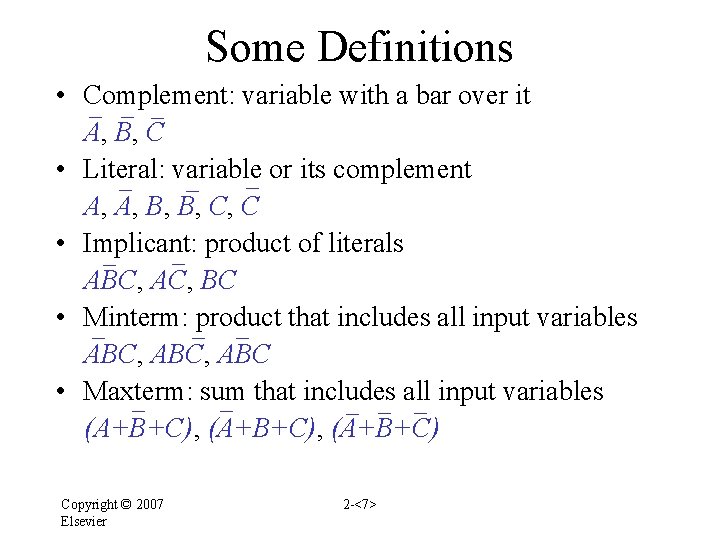
Some Definitions • Complement: variable with a bar over it A, B, C • Literal: variable or its complement A, A, B, B, C, C • Implicant: product of literals ABC, AC, BC • Minterm: product that includes all input variables ABC, ABC • Maxterm: sum that includes all input variables (A+B+C), (A+B+C) Copyright © 2007 Elsevier 2 -<7>
Digital Discipline: Binary Values • Typically consider only two discrete values: – 1’s and 0’s – 1, TRUE, HIGH – 0, FALSE, LOW • 1 and 0 can be represented by specific voltage levels, rotating gears, fluid levels, etc. • Digital circuits usually depend on specific voltage levels to represent 1 and 0 • Bit: Binary digit Copyright © 2007 Elsevier 1 -<8> 8
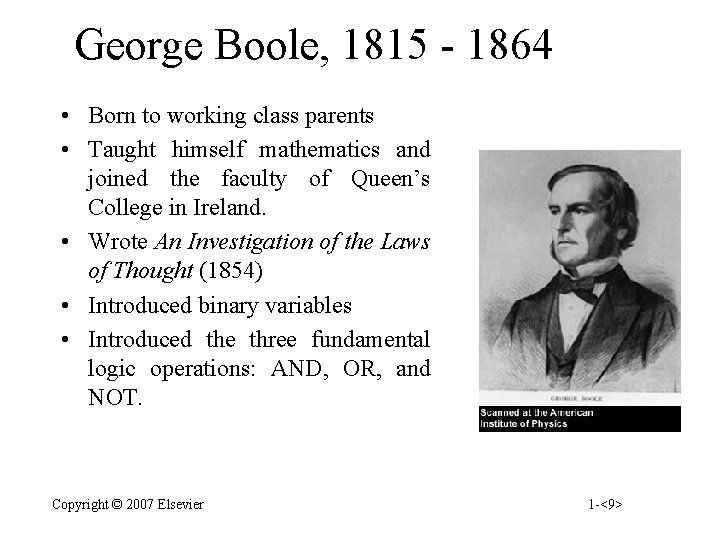
George Boole, 1815 - 1864 • Born to working class parents • Taught himself mathematics and joined the faculty of Queen’s College in Ireland. • Wrote An Investigation of the Laws of Thought (1854) • Introduced binary variables • Introduced the three fundamental logic operations: AND, OR, and NOT. Copyright © 2007 Elsevier 1 -<9>
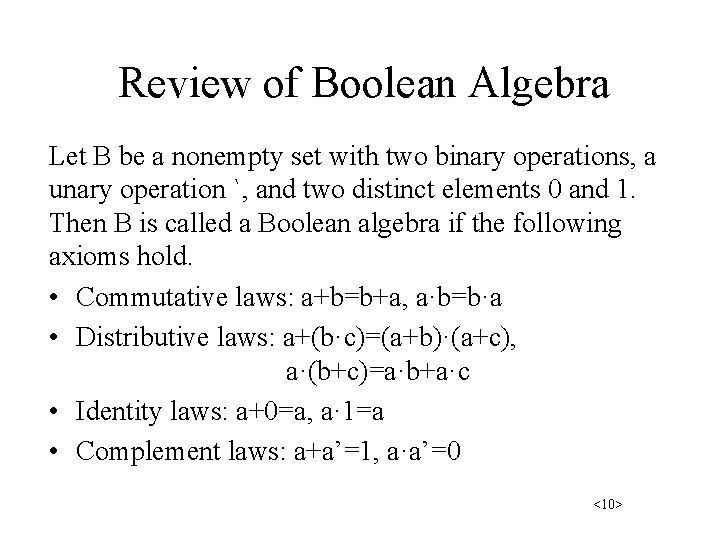
Review of Boolean Algebra Let B be a nonempty set with two binary operations, a unary operation `, and two distinct elements 0 and 1. Then B is called a Boolean algebra if the following axioms hold. • Commutative laws: a+b=b+a, a·b=b·a • Distributive laws: a+(b·c)=(a+b)·(a+c), a·(b+c)=a·b+a·c • Identity laws: a+0=a, a· 1=a • Complement laws: a+a’=1, a·a’=0 <10>
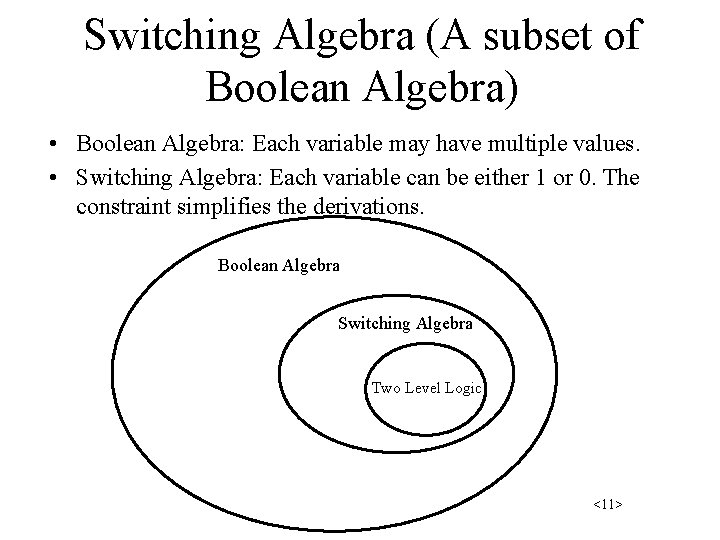
Switching Algebra (A subset of Boolean Algebra) • Boolean Algebra: Each variable may have multiple values. • Switching Algebra: Each variable can be either 1 or 0. The constraint simplifies the derivations. Boolean Algebra Switching Algebra BB Two Level Logic <11>
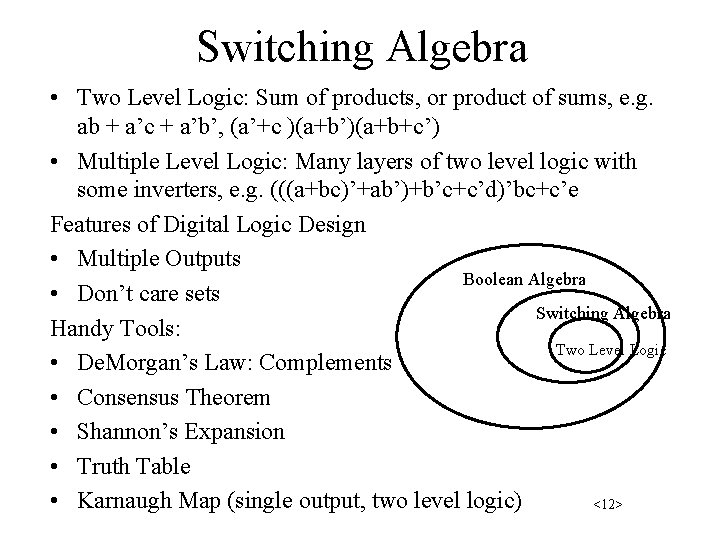
Switching Algebra • Two Level Logic: Sum of products, or product of sums, e. g. ab + a’c + a’b’, (a’+c )(a+b’)(a+b+c’) • Multiple Level Logic: Many layers of two level logic with some inverters, e. g. (((a+bc)’+ab’)+b’c+c’d)’bc+c’e Features of Digital Logic Design • Multiple Outputs Boolean Algebra • Don’t care sets Switching Algebra Handy Tools: BB Two Level Logic • De. Morgan’s Law: Complements • Consensus Theorem • Shannon’s Expansion • Truth Table • Karnaugh Map (single output, two level logic) <12>
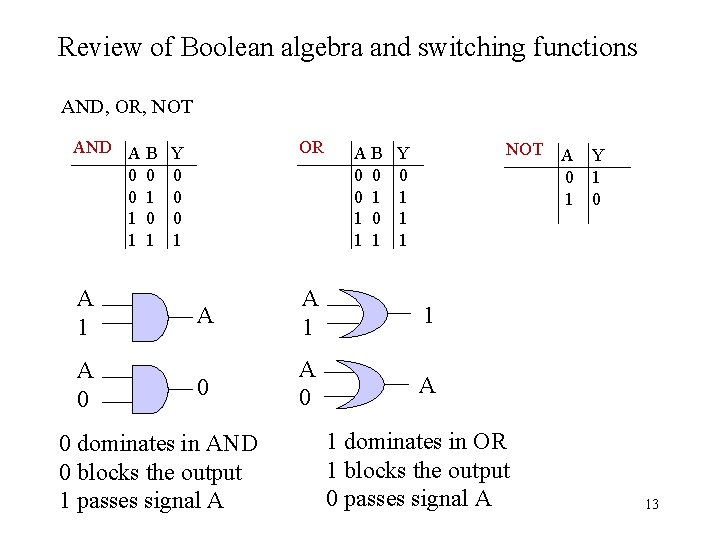
Review of Boolean algebra and switching functions AND, OR, NOT AND A B Y 0 0 0 0 1 0 1 0 0 1 1 1 OR A B Y 0 0 0 0 1 1 1 0 1 1 A 1 A A 1 1 0 A A 0 0 dominates in AND 0 blocks the output 1 passes signal A NOT A Y 0 1 1 0 1 dominates in OR 1 blocks the output 0 passes signal A 13
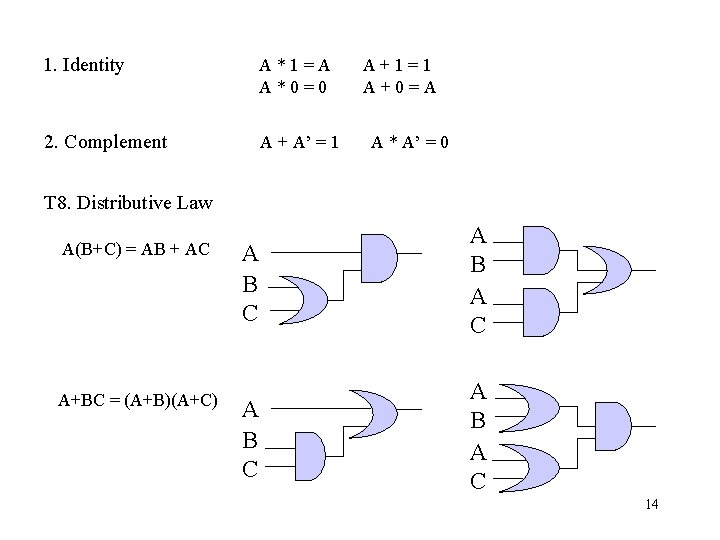
1. Identity A * 1 = A A + 1 = 1 A * 0 = 0 A + 0 = A 2. Complement A + A’ = 1 A * A’ = 0 T 8. Distributive Law A(B+C) = AB + AC A+BC = (A+B)(A+C) A B C A B A C 14
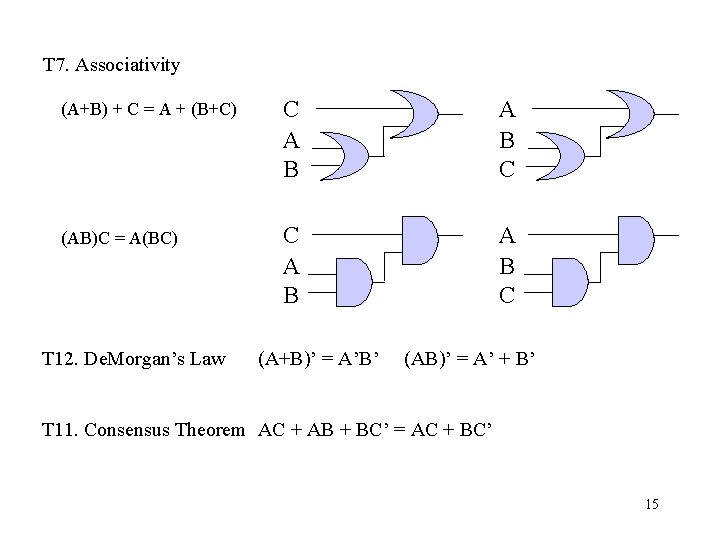
T 7. Associativity (A+B) + C = A + (B+C) (AB)C = A(BC) T 12. De. Morgan’s Law C A B A B C (A+B)’ = A’B’ (AB)’ = A’ + B’ T 11. Consensus Theorem AC + AB + BC’ = AC + BC’ 15
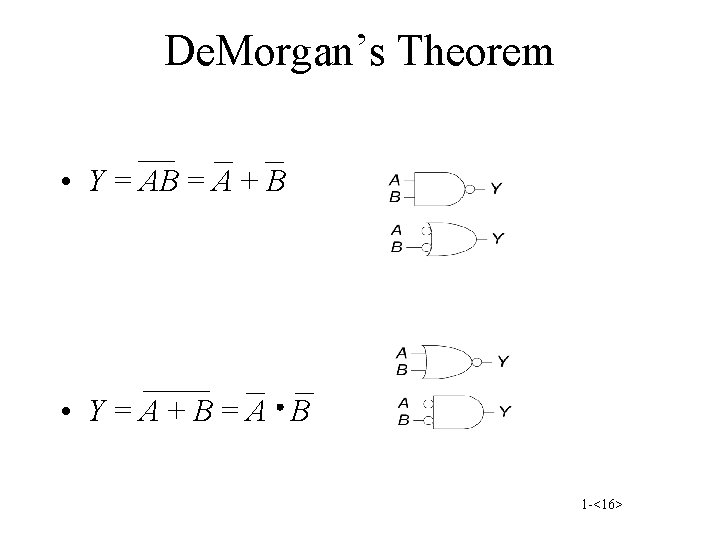
De. Morgan’s Theorem • Y = AB = A + B • Y = A + B = A B 1 -<16>
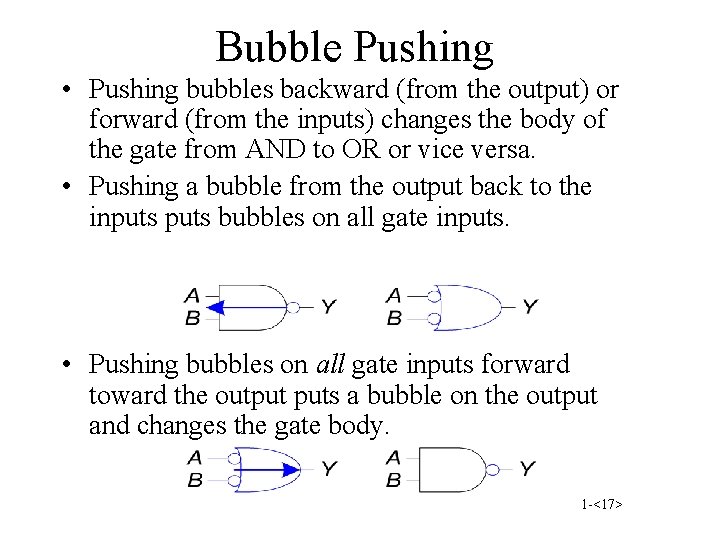
Bubble Pushing • Pushing bubbles backward (from the output) or forward (from the inputs) changes the body of the gate from AND to OR or vice versa. • Pushing a bubble from the output back to the inputs bubbles on all gate inputs. • Pushing bubbles on all gate inputs forward toward the output puts a bubble on the output and changes the gate body. 1 -<17>
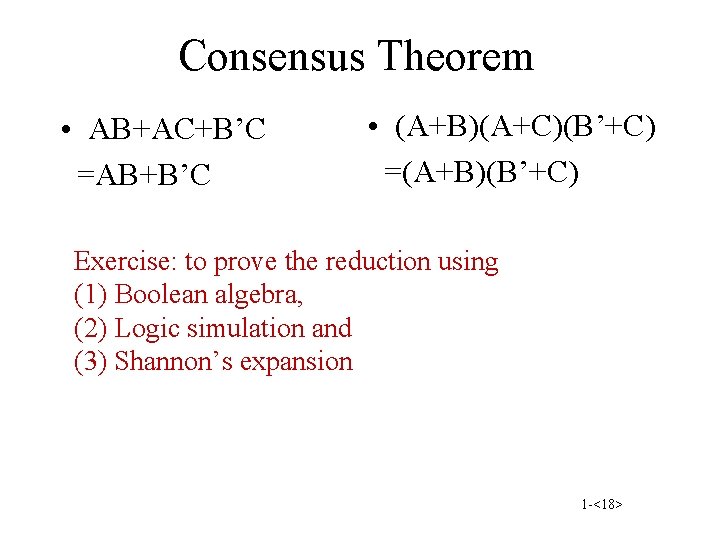
Consensus Theorem • AB+AC+B’C =AB+B’C • (A+B)(A+C)(B’+C) =(A+B)(B’+C) Exercise: to prove the reduction using (1) Boolean algebra, (2) Logic simulation and (3) Shannon’s expansion 1 -<18>
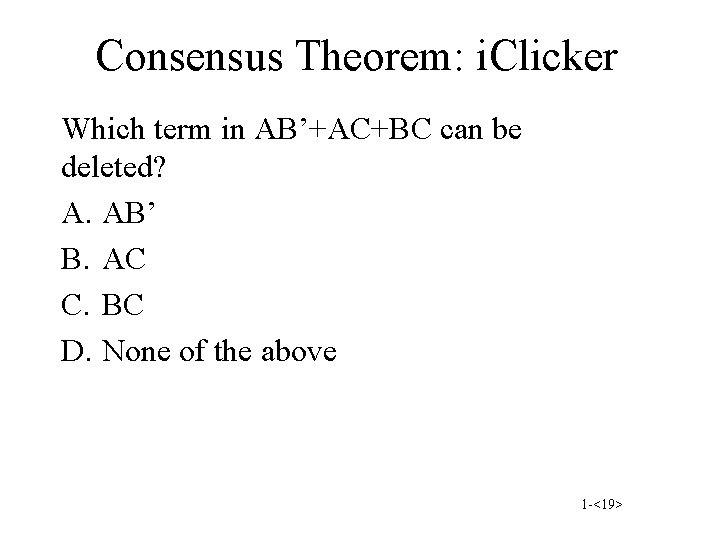
Consensus Theorem: i. Clicker Which term in AB’+AC+BC can be deleted? A. AB’ B. AC C. BC D. None of the above 1 -<19>
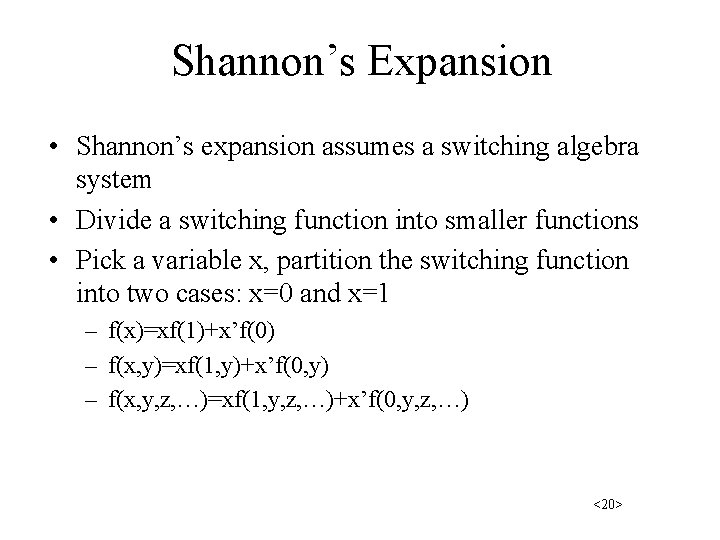
Shannon’s Expansion • Shannon’s expansion assumes a switching algebra system • Divide a switching function into smaller functions • Pick a variable x, partition the switching function into two cases: x=0 and x=1 – f(x)=xf(1)+x’f(0) – f(x, y)=xf(1, y)+x’f(0, y) – f(x, y, z, …)=xf(1, y, z, …)+x’f(0, y, z, …) <20>
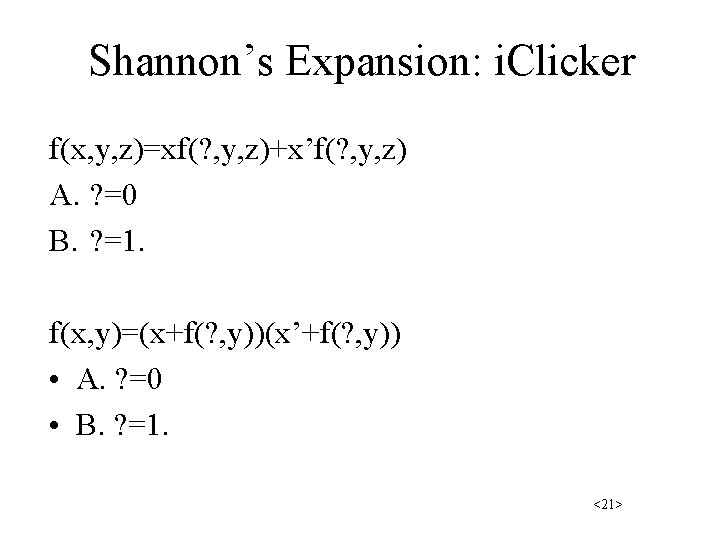
Shannon’s Expansion: i. Clicker f(x, y, z)=xf(? , y, z)+x’f(? , y, z) A. ? =0 B. ? =1. f(x, y)=(x+f(? , y))(x’+f(? , y)) • A. ? =0 • B. ? =1. <21>
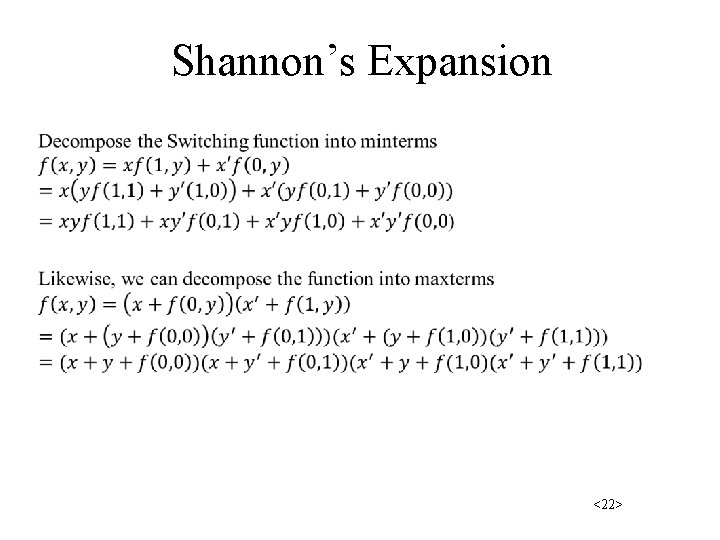
Shannon’s Expansion • <22>
Switching Algebra • Shannon’s expansion and consensus theorem are used for logic optimization • Shannon’s expansion divides the problem into smaller functions • Consensus theorem finds common terms when we merge small functions • Karnaugh map mimics the above two operations in two dimensional space as visual aids. 1 -<23>
Part I. Combinational Logic I) Specification a. Language b. Truth Table c. Boolean Algebra Canonical Expression: Sum of minterms and Product of maxterms d. Incompletely Specified Function 24
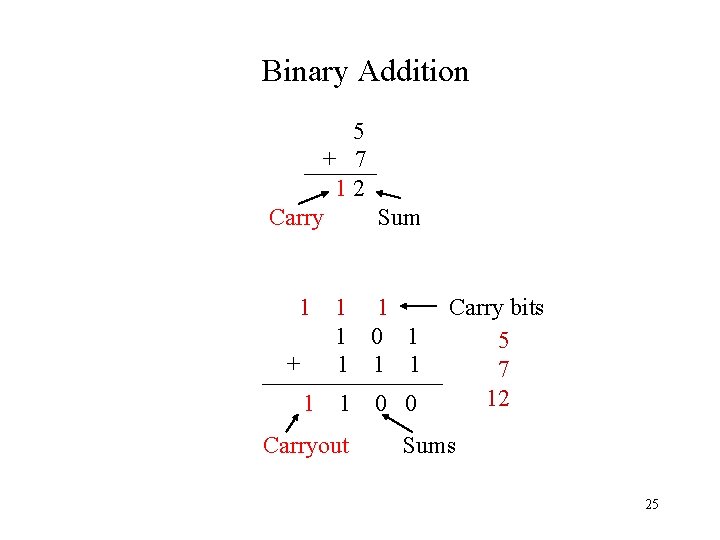
Binary Addition 5 + 7 1 2 Carry Sum 1 1 1 0 1 + 1 1 1 0 0 Carry bits 5 7 12 Carryout Sums 25
Binary Addition: Hardware • Half Adder: Two inputs (a, b) and two outputs (carry, sum). • Full Adder: Three inputs (a, b, c) and two outputs (carry, sum). 26
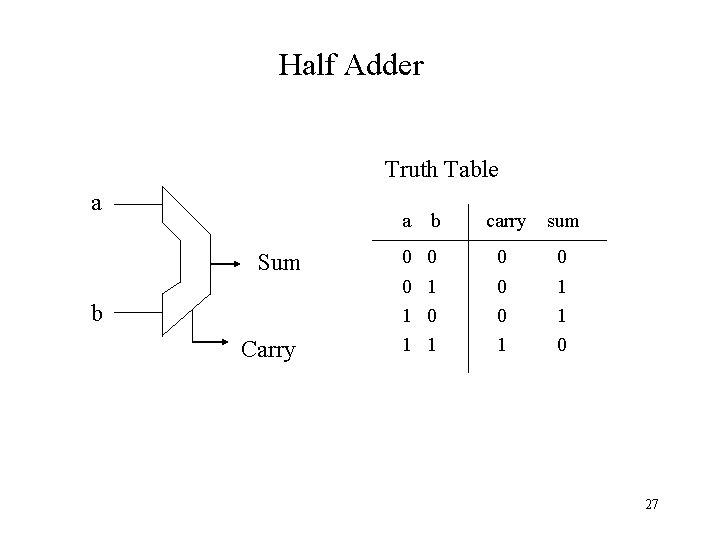
Half Adder Truth Table a a b carry sum Sum b Carry 0 0 0 0 1 0 1 1 0 0 1 1 1 1 0 27
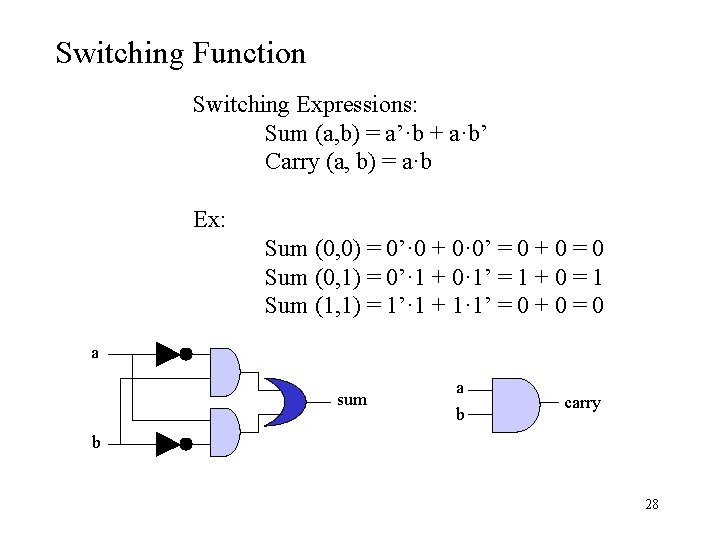
Switching Function Switching Expressions: Sum (a, b) = a’·b + a·b’ Carry (a, b) = a·b Ex: Sum (0, 0) = 0’· 0 + 0· 0’ = 0 + 0 = 0 Sum (0, 1) = 0’· 1 + 0· 1’ = 1 + 0 = 1 Sum (1, 1) = 1’· 1 + 1· 1’ = 0 + 0 = 0 a sum a b carry b 28
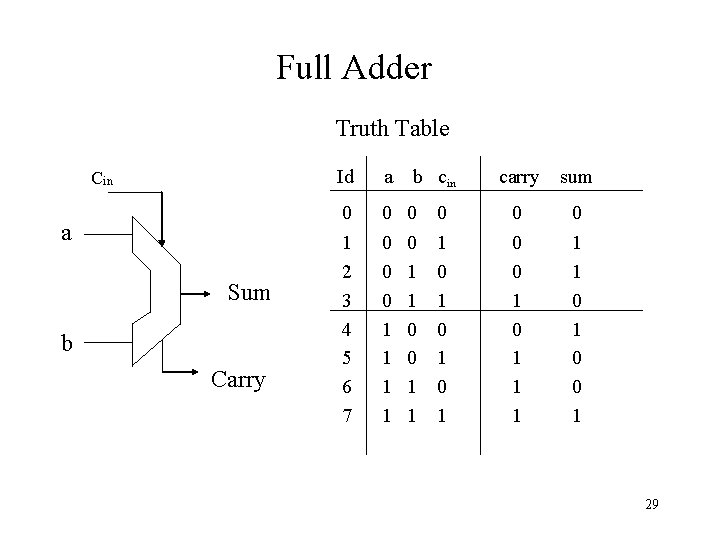
Full Adder Truth Table Id a b cin carry sum Cin 0 0 0 0 0 a Sum b Carry 1 0 0 1 0 1 2 0 1 0 1 3 0 1 1 0 4 1 0 0 1 5 1 0 1 0 6 1 1 0 1 0 7 1 1 1 1 29
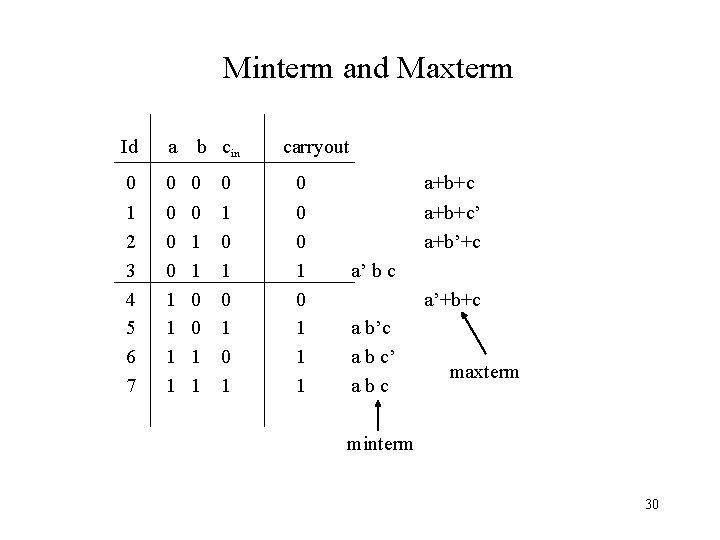
Minterm and Maxterm Id a b cin carryout 0 0 0 0 a+b+c 1 0 0 1 0 a+b+c’ 2 0 1 0 a+b’+c 3 0 1 1 a’ b c 4 1 0 0 a’+b+c 5 1 0 1 a b’c 6 1 1 0 1 a b c’ maxterm 7 1 1 1 a b c minterm 30
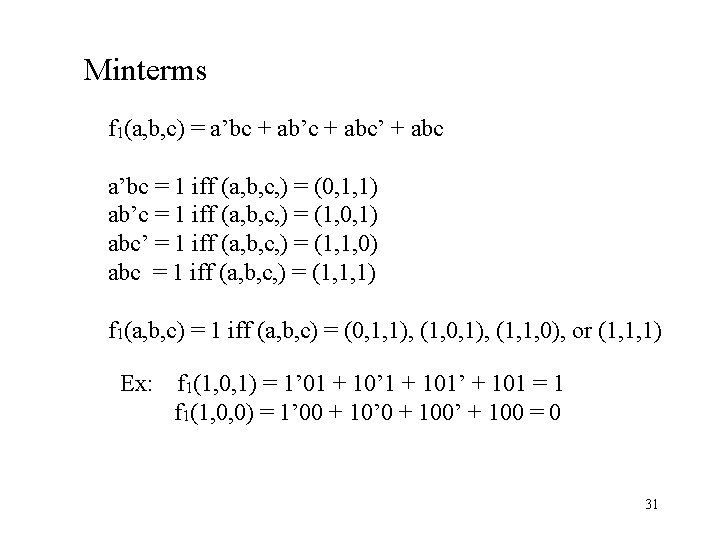
Minterms f 1(a, b, c) = a’bc + ab’c + abc’ + abc a’bc = 1 iff (a, b, c, ) = (0, 1, 1) ab’c = 1 iff (a, b, c, ) = (1, 0, 1) abc’ = 1 iff (a, b, c, ) = (1, 1, 0) abc = 1 iff (a, b, c, ) = (1, 1, 1) f 1(a, b, c) = 1 iff (a, b, c) = (0, 1, 1), (1, 0, 1), (1, 1, 0), or (1, 1, 1) Ex: f 1(1, 0, 1) = 1’ 01 + 10’ 1 + 101’ + 101 = 1 f 1(1, 0, 0) = 1’ 00 + 10’ 0 + 100’ + 100 = 0 31
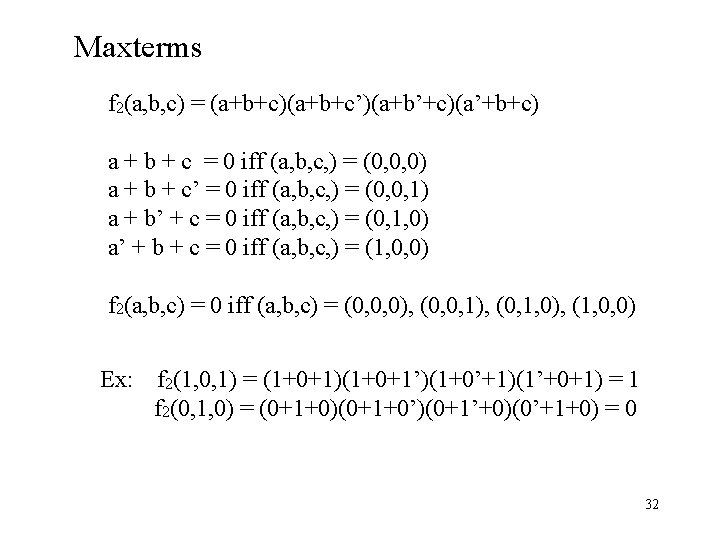
Maxterms f 2(a, b, c) = (a+b+c)(a+b+c’)(a+b’+c)(a’+b+c) a + b + c = 0 iff (a, b, c, ) = (0, 0, 0) a + b + c’ = 0 iff (a, b, c, ) = (0, 0, 1) a + b’ + c = 0 iff (a, b, c, ) = (0, 1, 0) a’ + b + c = 0 iff (a, b, c, ) = (1, 0, 0) f 2(a, b, c) = 0 iff (a, b, c) = (0, 0, 0), (0, 0, 1), (0, 1, 0), (1, 0, 0) Ex: f 2(1, 0, 1) = (1+0+1)(1+0+1’)(1+0’+1)(1’+0+1) = 1 f 2(0, 1, 0) = (0+1+0)(0+1+0’)(0+1’+0)(0’+1+0) = 0 32
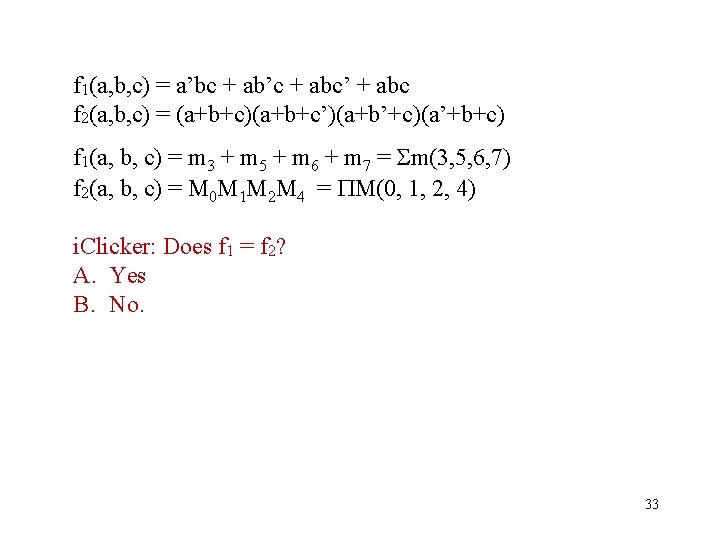
f 1(a, b, c) = a’bc + ab’c + abc’ + abc f 2(a, b, c) = (a+b+c)(a+b+c’)(a+b’+c)(a’+b+c) f 1(a, b, c) = m 3 + m 5 + m 6 + m 7 = Sm(3, 5, 6, 7) f 2(a, b, c) = M 0 M 1 M 2 M 4 = PM(0, 1, 2, 4) i. Clicker: Does f 1 = f 2? A. Yes B. No. 33
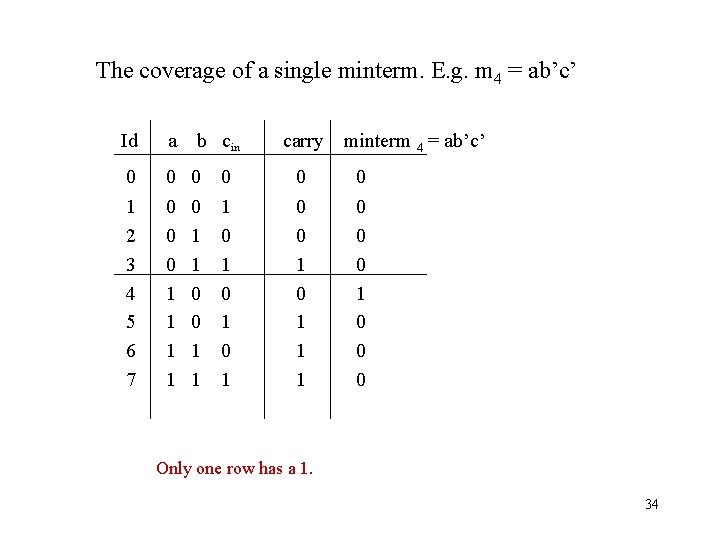
The coverage of a single minterm. E. g. m 4 = ab’c’ Id a b cin carry minterm 4 = ab’c’ 0 0 0 0 0 1 0 0 1 0 2 0 1 0 0 3 0 1 1 0 4 1 0 0 1 5 1 0 1 0 6 1 1 0 1 0 7 1 1 1 0 Only one row has a 1. 34
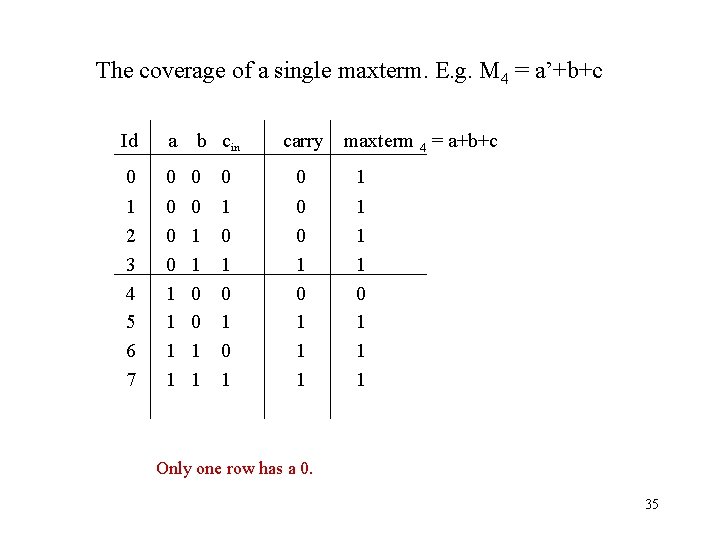
The coverage of a single maxterm. E. g. M 4 = a’+b+c Id a b cin carry maxterm 4 = a+b+c 0 0 0 0 1 1 0 0 1 0 1 2 0 1 0 1 3 0 1 1 1 4 1 0 0 0 5 1 0 1 1 6 1 1 0 1 7 1 1 1 1 Only one row has a 0. 35
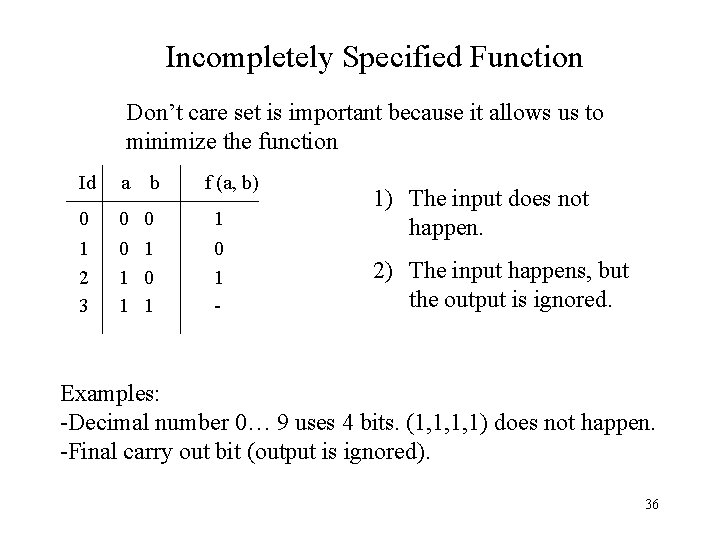
Incompletely Specified Function Don’t care set is important because it allows us to minimize the function Id a b f (a, b) 0 0 0 1 1 0 1 0 2 1 0 1 3 1 1 - 1) The input does not happen. 2) The input happens, but the output is ignored. Examples: -Decimal number 0… 9 uses 4 bits. (1, 1, 1, 1) does not happen. -Final carry out bit (output is ignored). 36
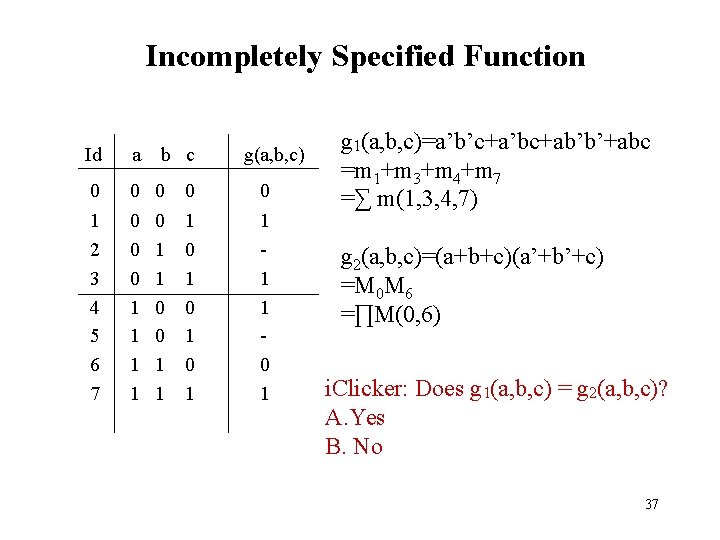
Incompletely Specified Function g 1(a, b, c)=a’b’c+a’bc+ab’b’+abc =m 1+m 3+m 4+m 7 0 0 0 0 =∑ m(1, 3, 4, 7) Id a b c g(a, b, c) 1 0 0 1 2 0 1 0 - g (a, b, c)=(a+b+c)(a’+b’+c) 2 3 0 1 1 =M M 0 6 4 1 0 0 1 =∏M(0, 6) 5 1 0 1 - 6 1 1 0 7 1 1 1 i. Clicker: Does g 1(a, b, c) = g 2(a, b, c)? A. Yes B. No 37
- Slides: 37