
CSE 140 Components and Design Techniques for Digital

- Slides: 30
CSE 140: Components and Design Techniques for Digital Systems Lecture 3: Incompletely Specified Functions and K Maps CK Cheng Dept. of Computer Science and Engineering University of California, San Diego 1
Outlines • Definitions • Minterms and Maxterms • Incompletely Specified Function • Implementation: Boolean Algebra vs Map • Karnaugh Maps: Two Dimensional Truth Table • 2 -Variable Map • 3 -Variable Map • Up to 6 -Variable Map 2
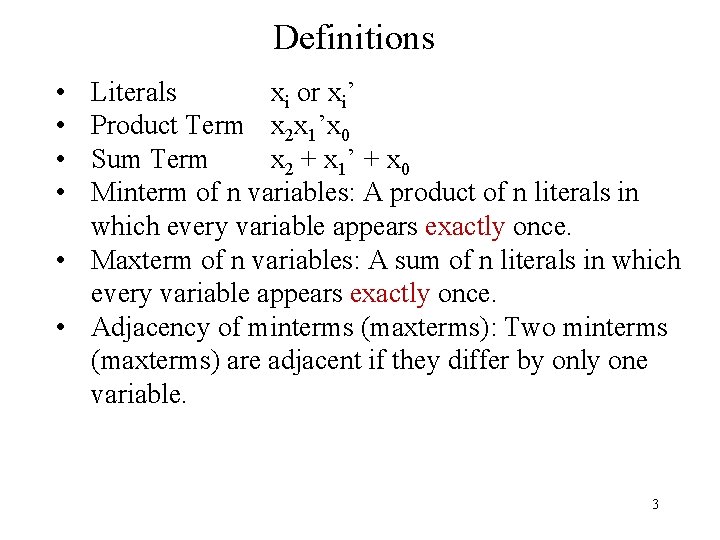
Definitions • • Literals xi or xi’ Product Term x 2 x 1’x 0 Sum Term x 2 + x 1’ + x 0 Minterm of n variables: A product of n literals in which every variable appears exactly once. • Maxterm of n variables: A sum of n literals in which every variable appears exactly once. • Adjacency of minterms (maxterms): Two minterms (maxterms) are adjacent if they differ by only one variable. 3
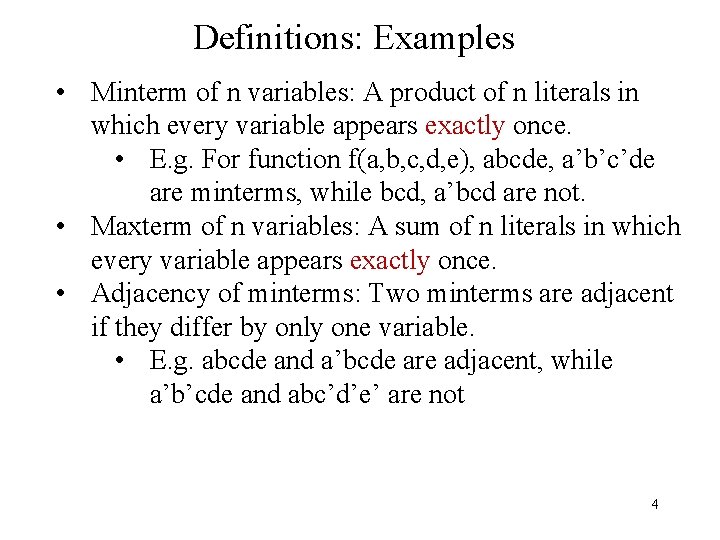
Definitions: Examples • Minterm of n variables: A product of n literals in which every variable appears exactly once. • E. g. For function f(a, b, c, d, e), abcde, a’b’c’de are minterms, while bcd, a’bcd are not. • Maxterm of n variables: A sum of n literals in which every variable appears exactly once. • Adjacency of minterms: Two minterms are adjacent if they differ by only one variable. • E. g. abcde and a’bcde are adjacent, while a’b’cde and abc’d’e’ are not 4
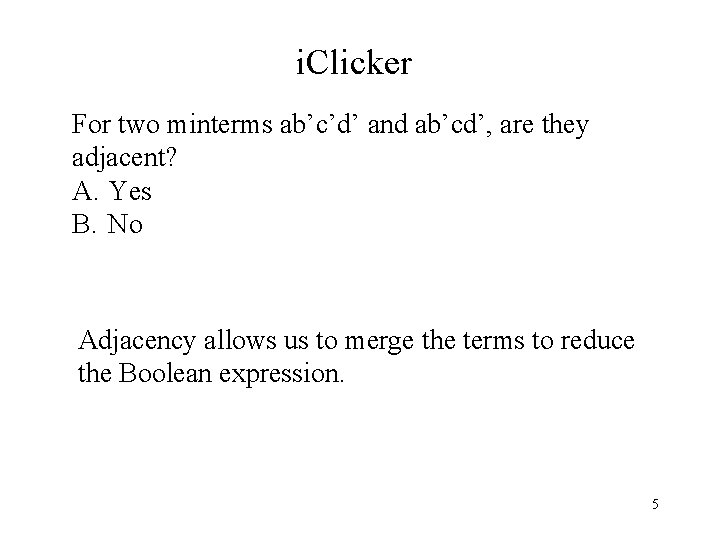
i. Clicker For two minterms ab’c’d’ and ab’cd’, are they adjacent? A. Yes B. No Adjacency allows us to merge the terms to reduce the Boolean expression. 5
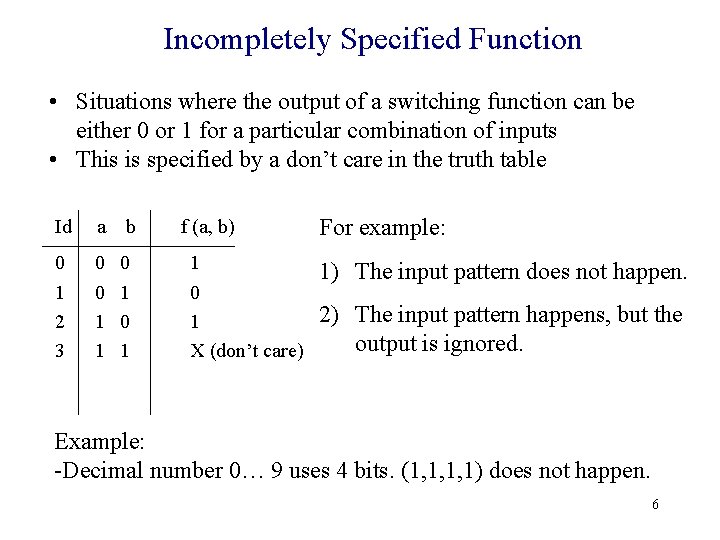
Incompletely Specified Function • Situations where the output of a switching function can be either 0 or 1 for a particular combination of inputs • This is specified by a don’t care in the truth table Id a b f (a, b) 0 0 0 1 1 2 3 0 1 1 0 1 X (don’t care) For example: 1) The input pattern does not happen. 2) The input pattern happens, but the output is ignored. Example: -Decimal number 0… 9 uses 4 bits. (1, 1, 1, 1) does not happen. 6
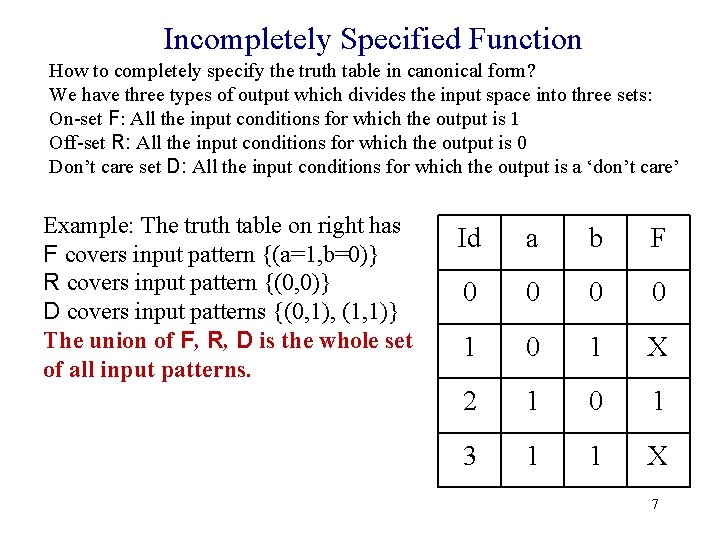
Incompletely Specified Function How to completely specify the truth table in canonical form? We have three types of output which divides the input space into three sets: On-set F: All the input conditions for which the output is 1 Off-set R: All the input conditions for which the output is 0 Don’t care set D: All the input conditions for which the output is a ‘don’t care’ Example: The truth table on right has F covers input pattern {(a=1, b=0)} R covers input pattern {(0, 0)} D covers input patterns {(0, 1), (1, 1)} The union of F, R, D is the whole set of all input patterns. Id a b F 0 0 1 0 1 X 2 1 0 1 3 1 1 X 7
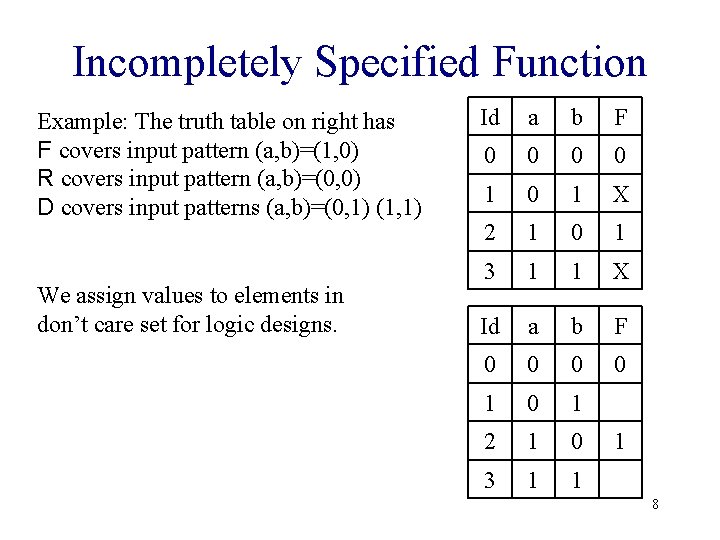
Incompletely Specified Function Example: The truth table on right has F covers input pattern (a, b)=(1, 0) R covers input pattern (a, b)=(0, 0) D covers input patterns (a, b)=(0, 1) (1, 1) We assign values to elements in don’t care set for logic designs. Id a b F 0 0 1 0 1 X 2 1 0 1 3 1 1 X Id a b F 0 0 1 0 1 2 1 0 3 1 1 1 8
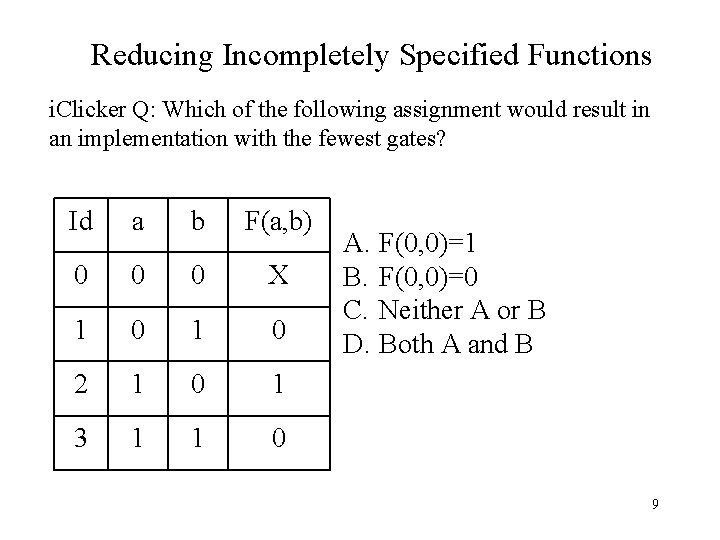
Reducing Incompletely Specified Functions i. Clicker Q: Which of the following assignment would result in an implementation with the fewest gates? Id a b F(a, b) 0 0 0 X 1 0 2 1 0 1 3 1 1 0 A. F(0, 0)=1 B. F(0, 0)=0 C. Neither A or B D. Both A and B 9
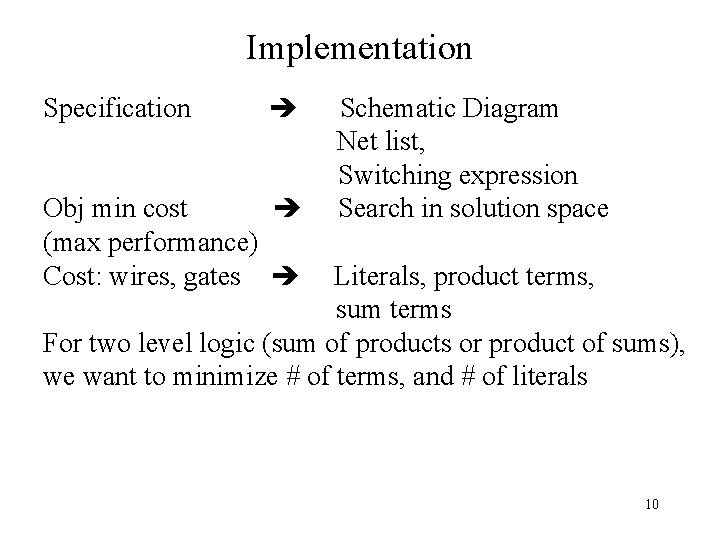
Implementation Specification Obj min cost (max performance) Cost: wires, gates Schematic Diagram Net list, Switching expression Search in solution space Literals, product terms, sum terms For two level logic (sum of products or product of sums), we want to minimize # of terms, and # of literals 10
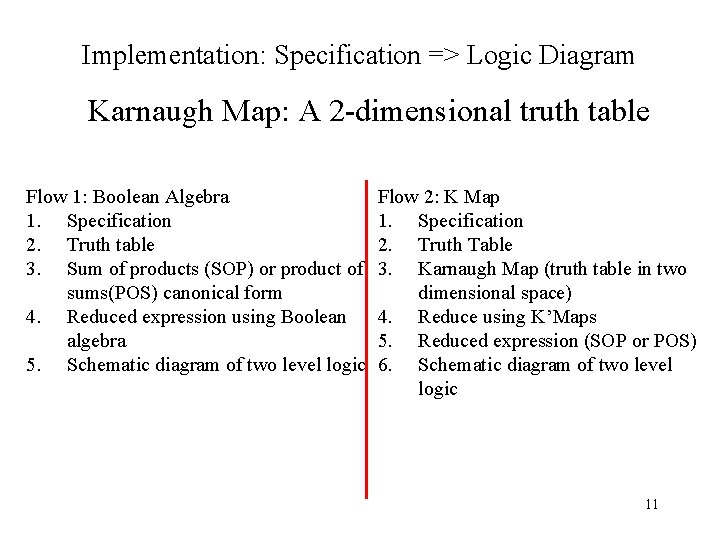
Implementation: Specification => Logic Diagram Karnaugh Map: A 2 -dimensional truth table Flow 1: Boolean Algebra 1. Specification 2. Truth table 3. Sum of products (SOP) or product of sums(POS) canonical form 4. Reduced expression using Boolean algebra 5. Schematic diagram of two level logic Flow 2: K Map 1. Specification 2. Truth Table 3. Karnaugh Map (truth table in two dimensional space) 4. Reduce using K’Maps 5. Reduced expression (SOP or POS) 6. Schematic diagram of two level logic 11
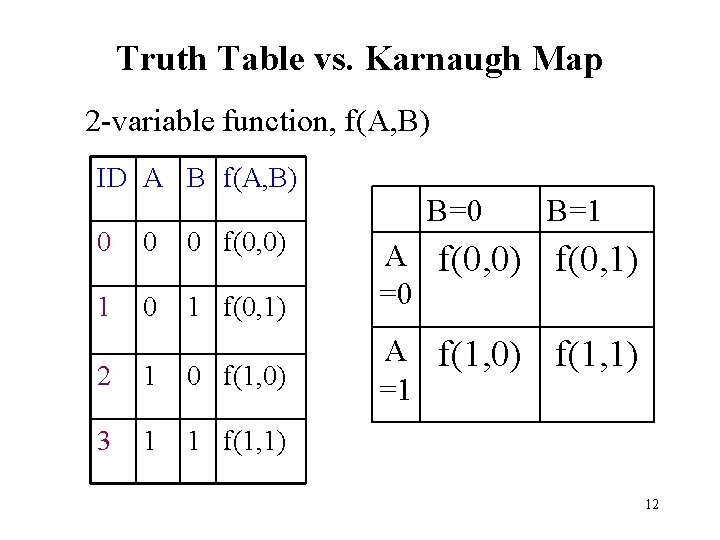
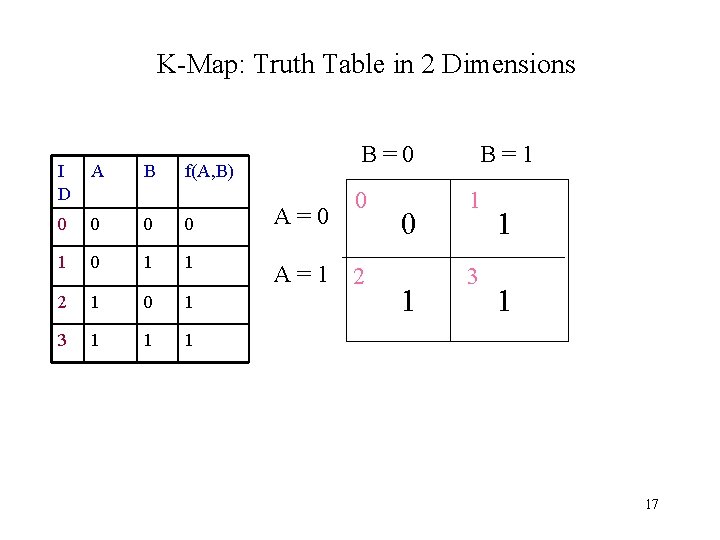
Truth Table vs. Karnaugh Map 2 -variable function, f(A, B) ID A B f(A, B) 0 0 0 f(0, 0) 1 0 1 f(0, 1) 2 1 0 f(1, 0) 3 1 1 f(1, 1) B=0 B=1 A f(0, 0) =0 f(0, 1) A f(1, 0) =1 f(1, 1) 12
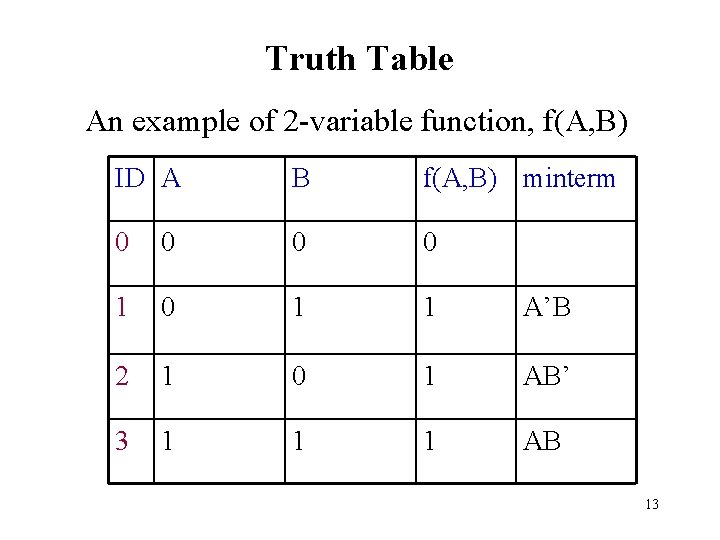
Truth Table An example of 2 -variable function, f(A, B) ID A B f(A, B) minterm 0 0 1 0 1 1 A’B 2 1 0 1 AB’ 3 1 1 1 AB 13
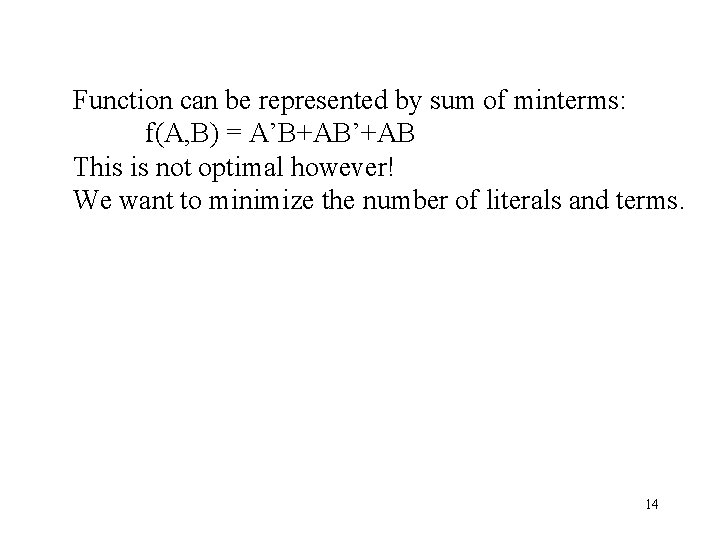
Function can be represented by sum of minterms: f(A, B) = A’B+AB’+AB This is not optimal however! We want to minimize the number of literals and terms. 14
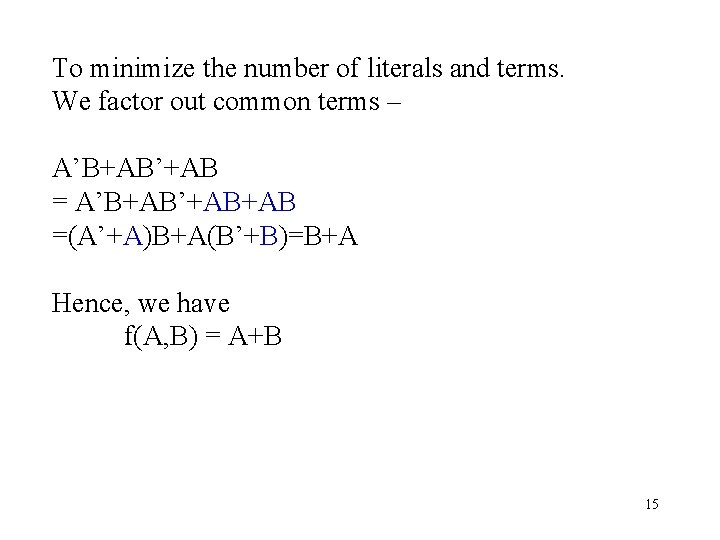
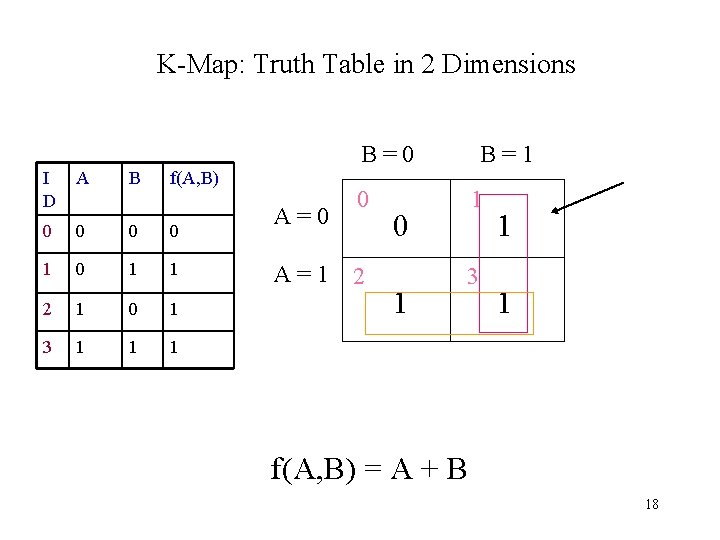
To minimize the number of literals and terms. We factor out common terms – A’B+AB’+AB = A’B+AB’+AB+AB =(A’+A)B+A(B’+B)=B+A Hence, we have f(A, B) = A+B 15
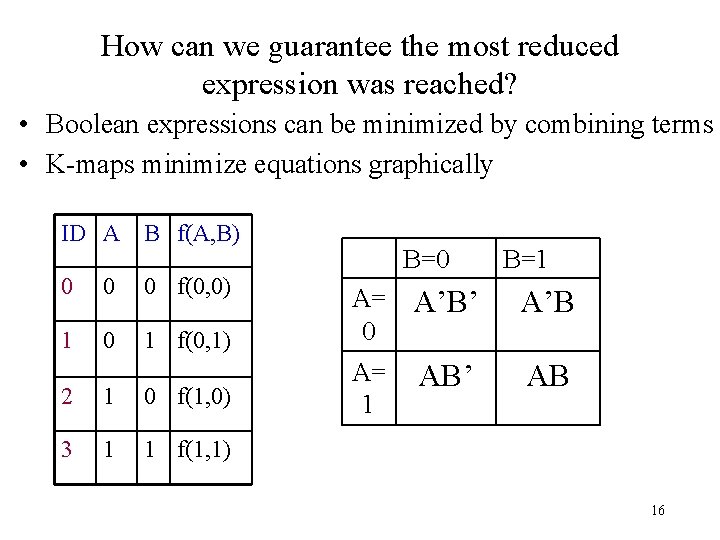
How can we guarantee the most reduced expression was reached? • Boolean expressions can be minimized by combining terms • K-maps minimize equations graphically ID A B f(A, B) 0 0 0 f(0, 0) 1 0 B=1 A’B 1 f(0, 1) A= A’B’ 0 A= 1 AB 2 1 0 f(1, 0) 3 1 1 f(1, 1) AB’ 16
K-Map: Truth Table in 2 Dimensions I D A B 0 0 1 0 1 1 2 1 0 1 3 1 1 1 B=0 f(A, B) A=0 A=1 0 2 0 1 B=1 1 3 1 1 17
K-Map: Truth Table in 2 Dimensions B=0 I D A B f(A, B) 0 0 1 0 1 1 2 1 0 1 3 1 1 1 A=0 A=1 0 2 B=1 1 0 1 3 1 1 f(A, B) = A + B 18
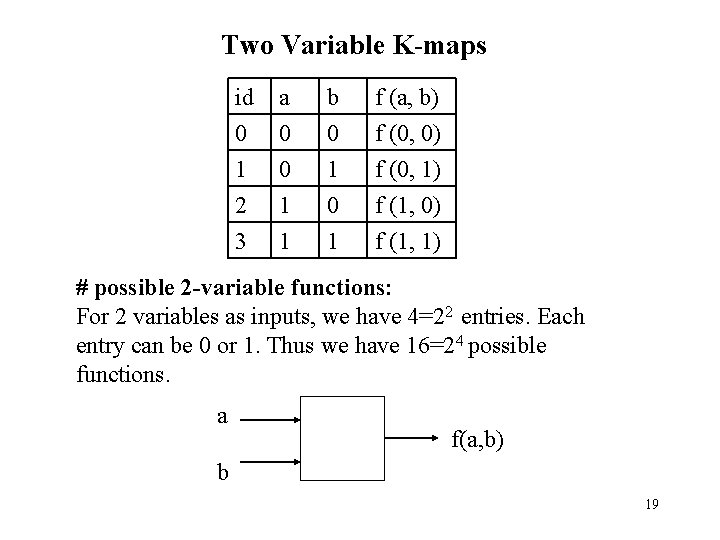
Two Variable K-maps id 0 1 2 a 0 0 1 b 0 1 0 f (a, b) f (0, 0) f (0, 1) f (1, 0) 3 1 1 f (1, 1) # possible 2 -variable functions: For 2 variables as inputs, we have 4=22 entries. Each entry can be 0 or 1. Thus we have 16=24 possible functions. a f(a, b) b 19
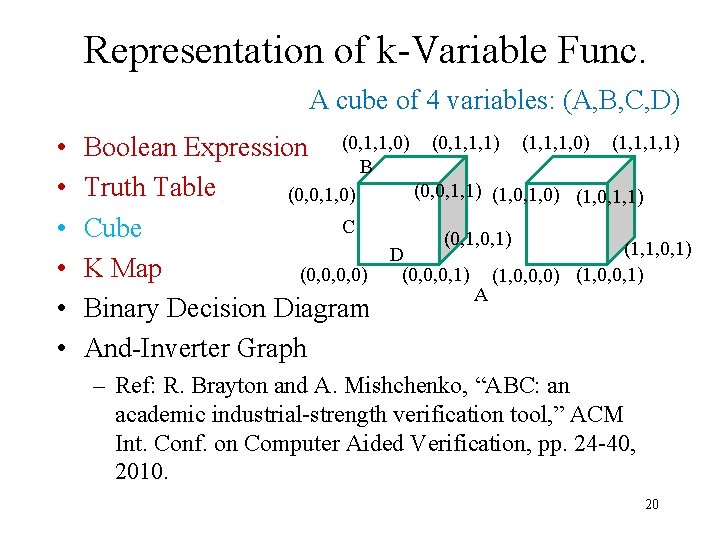
Representation of k-Variable Func. A cube of 4 variables: (A, B, C, D) • • • Boolean Expression (0, 1, 1, 0) (0, 1, 1, 1) (1, 1, 1, 0) (1, 1, 1, 1) B Truth Table (0, 0, 1, 1) (1, 0, 1, 0) (1, 0, 1, 1) (0, 0, 1, 0) C Cube (0, 1, 0, 1) (1, 1, 0, 1) D K Map (0, 0, 0, 0) (0, 0, 0, 1) (1, 0, 0, 0) (1, 0, 0, 1) A Binary Decision Diagram And-Inverter Graph – Ref: R. Brayton and A. Mishchenko, “ABC: an academic industrial-strength verification tool, ” ACM Int. Conf. on Computer Aided Verification, pp. 24 -40, 2010. 20
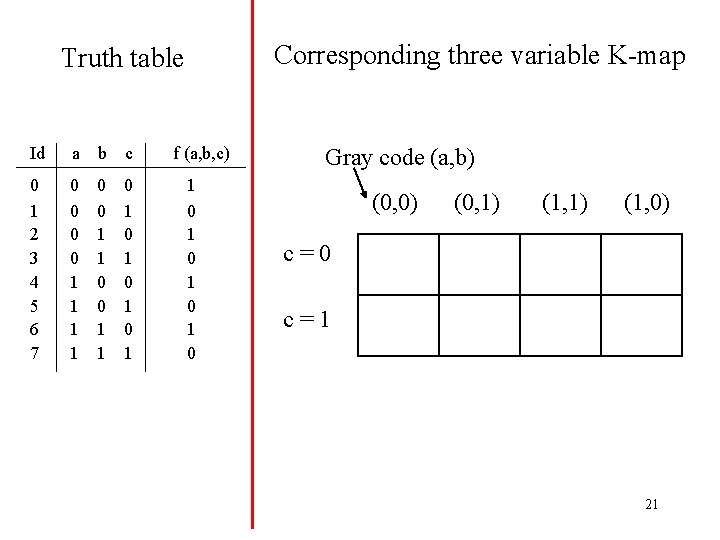
Corresponding three variable K-map Truth table Id a b c 0 1 2 3 4 5 6 7 0 0 1 1 0 1 0 1 f (a, b, c) 1 0 1 0 Gray code (a, b) (0, 0) (0, 1) (1, 0) c=0 c=1 21
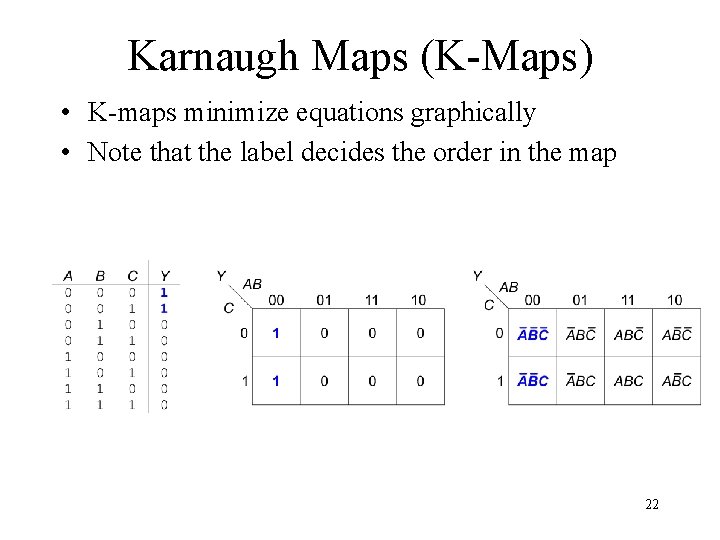
Karnaugh Maps (K-Maps) • K-maps minimize equations graphically • Note that the label decides the order in the map 22
23
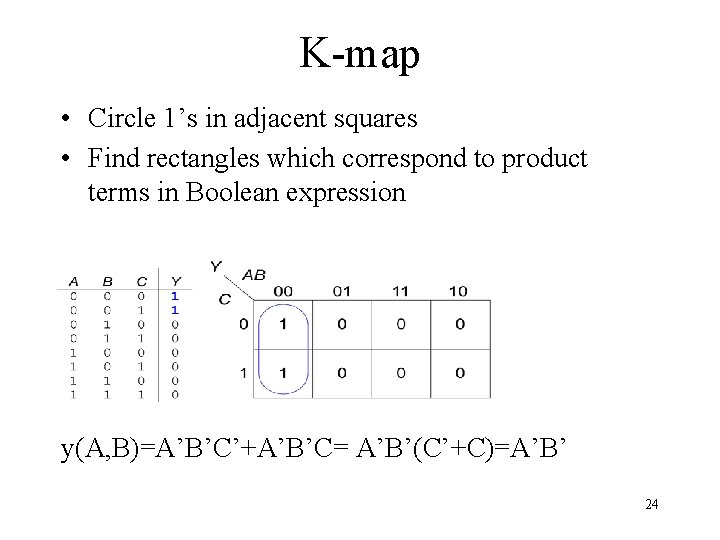
K-map • Circle 1’s in adjacent squares • Find rectangles which correspond to product terms in Boolean expression y(A, B)=A’B’C’+A’B’C= A’B’(C’+C)=A’B’ 24
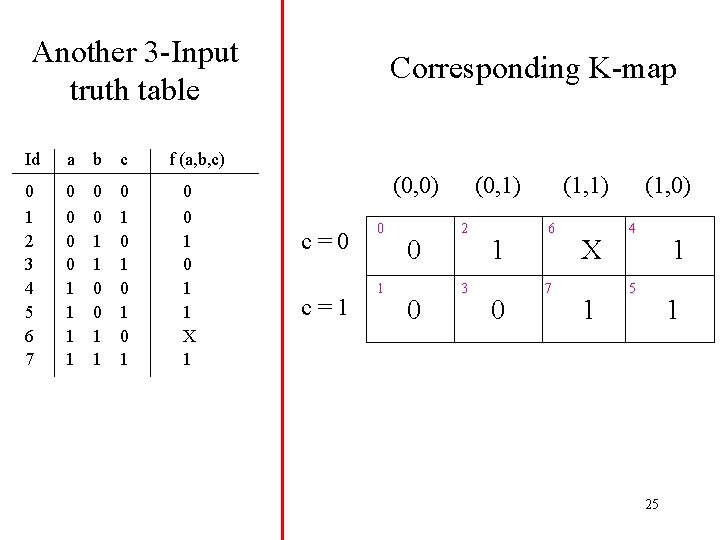
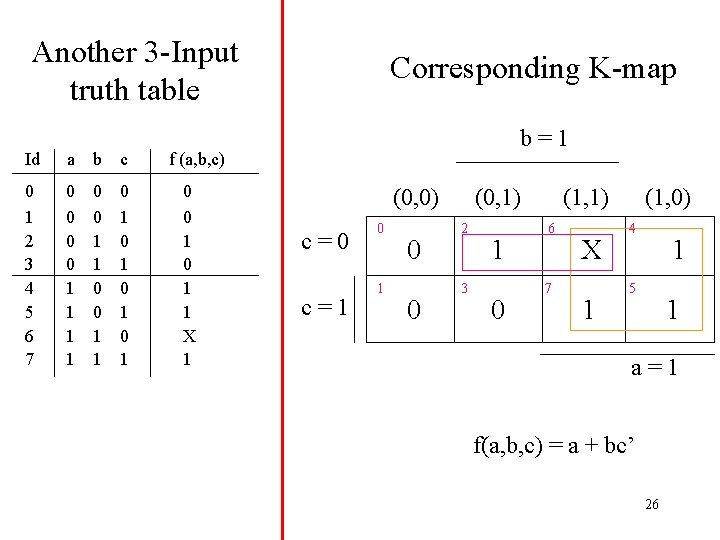
Another 3 -Input truth table Id a b c 0 1 2 3 4 5 6 7 0 0 1 1 0 1 0 1 Corresponding K-map f (a, b, c) 0 0 1 1 X 1 (0, 0) c=0 c=1 0 0 (0, 1) 2 3 1 0 (1, 1) 6 7 X 1 (1, 0) 4 1 5 1 25
Another 3 -Input truth table Id a b c 0 1 2 3 4 5 6 7 0 0 1 1 0 1 0 1 Corresponding K-map b=1 f (a, b, c) 0 0 1 1 X 1 (0, 0) c=0 c=1 0 0 (0, 1) 2 3 1 0 (1, 1) 6 7 X 1 (1, 0) 4 1 5 1 a=1 f(a, b, c) = a + bc’ 26
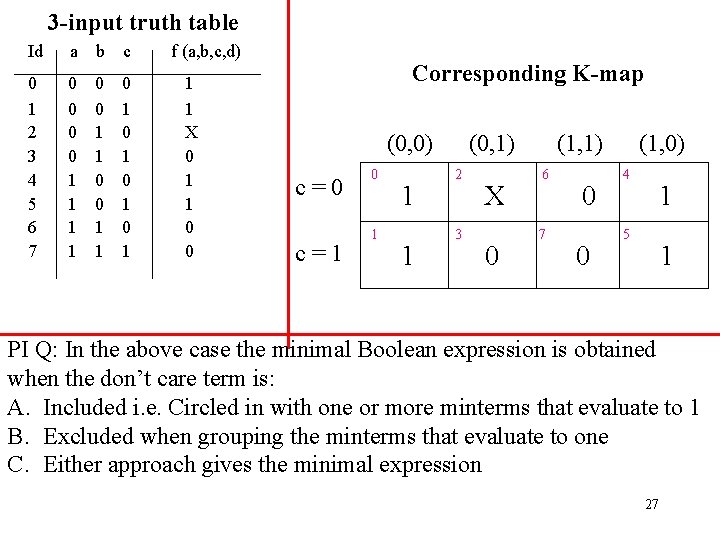
3 -input truth table Id a b c 0 1 2 3 4 5 6 7 0 0 1 1 0 1 0 1 f (a, b, c, d) 1 1 X 0 1 1 0 0 Corresponding K-map (0, 0) c=0 c=1 0 1 1 1 (0, 1) 2 3 X 0 (1, 1) 6 7 0 0 (1, 0) 4 1 5 1 PI Q: In the above case the minimal Boolean expression is obtained when the don’t care term is: A. Included i. e. Circled in with one or more minterms that evaluate to 1 B. Excluded when grouping the minterms that evaluate to one C. Either approach gives the minimal expression 27
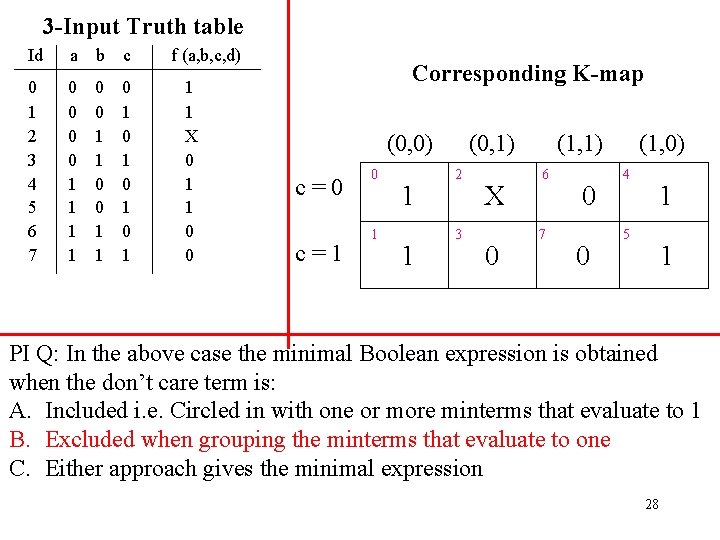
3 -Input Truth table Id a b c 0 1 2 3 4 5 6 7 0 0 1 1 0 1 0 1 f (a, b, c, d) 1 1 X 0 1 1 0 0 Corresponding K-map (0, 0) c=0 c=1 0 1 1 1 (0, 1) 2 3 X 0 (1, 1) 6 7 0 0 (1, 0) 4 1 5 1 PI Q: In the above case the minimal Boolean expression is obtained when the don’t care term is: A. Included i. e. Circled in with one or more minterms that evaluate to 1 B. Excluded when grouping the minterms that evaluate to one C. Either approach gives the minimal expression 28
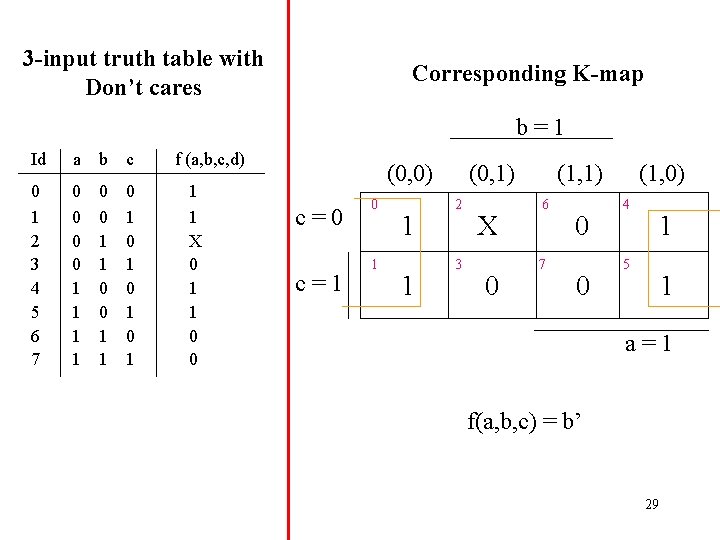
3 -input truth table with Don’t cares Corresponding K-map b=1 Id a b c 0 1 2 3 4 5 6 7 0 0 1 1 0 1 0 1 f (a, b, c, d) 1 1 X 0 1 1 0 0 (0, 0) c=0 c=1 0 1 1 1 (0, 1) 2 3 X 0 (1, 1) 6 7 0 0 (1, 0) 4 1 5 1 a=1 f(a, b, c) = b’ 29
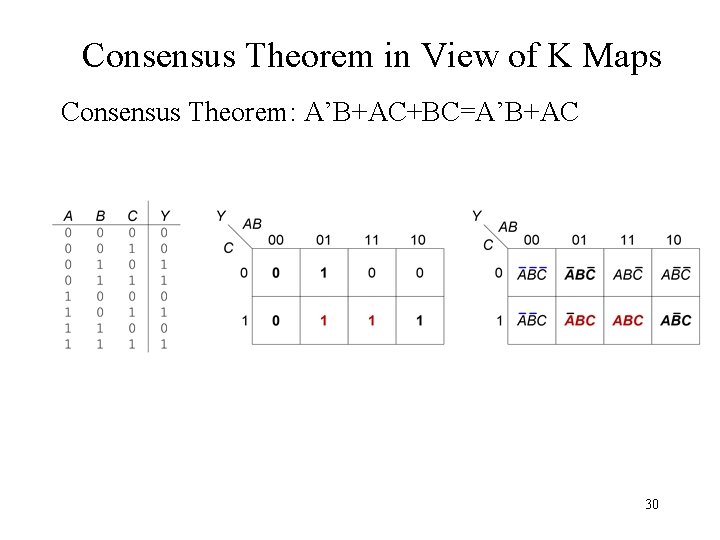
Consensus Theorem in View of K Maps Consensus Theorem: A’B+AC+BC=A’B+AC 30