
CSci 597 Software Architecture An Introduction Dr Nenad

- Slides: 27
CSci 597 Software Architecture: An Introduction Dr. Nenad Medvidovic Assistant Professor Center for Software Engineering Computer Science Department University of Southern California
Software Architecture Topics to be Covered • Motivation • Introduction to Software Architectures • Overview of Architectural Building Blocks • Scope of Software Architectures • Sources of Software Architectures • “Architecting” Software Systems • Summary • Additional Resources
Software Architecture Motivation • Software systems are rapidly and continously growing in size and complexity • Techniques and tools for developing and maintaining such systems typically play catch-up • To deal with this problem, many approaches exploit abstraction – Ignore all but the details of the system most relevant to a task (e. g. , developing the user interface or system-level testing – This greatly simplifies the model of the system – Apply techniques and tools on the simplified model – Incrementally reintroduce information to complete the “picture” • Software architecture is such an approach – Applicable to the task of software design
Software Architecture What is Architecture? • A high-level model of a thing – Describes critical aspects of the thing – Understandable to many stakeholders • architects, engineers, workers, managers, customers – Allows evaluation of the thing’s properties before it is built – Provides well understood tools and techniques for constructing the thing from its blueprint • Which aspects of a software system are architecturally relevant? • How should they be represented most effectively to enable stakeholders to understand, reason, and communicate about a system before it is built? • What tools and techniques are useful for implementing an architecture in a manner that preserves its properties?
Software Architecture What is Software Architecture? • A software system’s blueprint – Its components – Their interactions – Their interconnections • Informal descriptions – Boxes and lines – Informal prose • A shared, semantically rich vocabulary – – – Remote procedure calls (RPCs) Client-Server Pipe and Filer Layered Distributed Object-Oriented
Software Architecture From Requirements to Architecture • From problem definition to requirements specification – Determine exactly what the customer and user want – Specifies what the software product is to do • From requirements specification to architecture – Decompose software into modules with interfaces – Specify high-level behavior, interactions, and non-functional properties – Consider key tradeoffs • • Schedule vs. Budget Cost vs. Robustness Fault Tolerance vs. Size Security vs. Speed – Maintain a record of design decisions and traceability – Specifies how the software product is to do its tasks
Software Architecture Focus of Software Architectures • Two primary foci – System Structure – Correspondence between requirements and implementation • A framework for understanding system-level concerns – Global rates of flow – Communication patterns – Execution Control Structure – Scalability – Paths of System Evolution – Capacity – Throughput – Consistency – Component Compatibility
Software Architecture Why Software Architecture? • A key to reducing development costs – Component-based development philosophy – Explicit system structure • A natural evolution of design abstractions – Structure and interaction details overshadow the choice of algorithms and data structures in large/complex systems • Benefits of explicit architectures – – – A framework for satisfying requirements Technical basis for design Managerial basis for cost estimation & process management Effective basis for reuse Basis for consistency, dependency, and tradeoff analysis Avoidance of architectural erosion
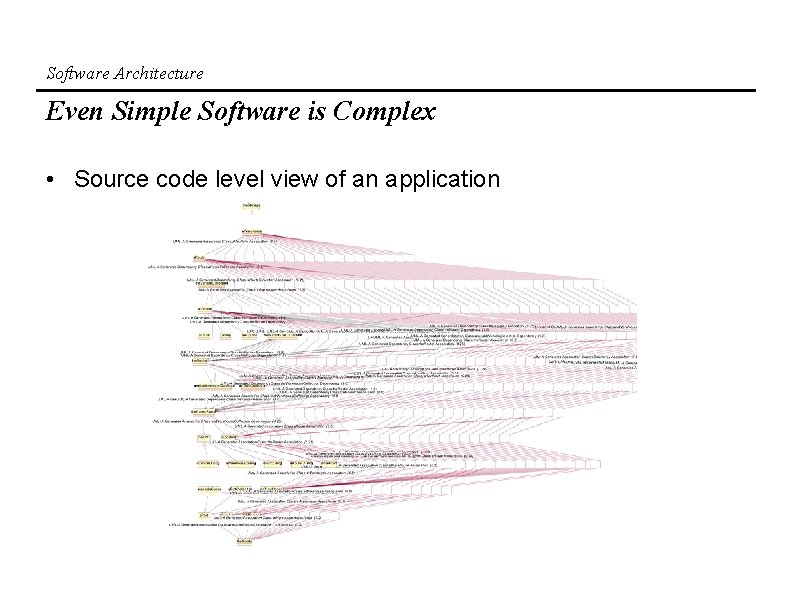
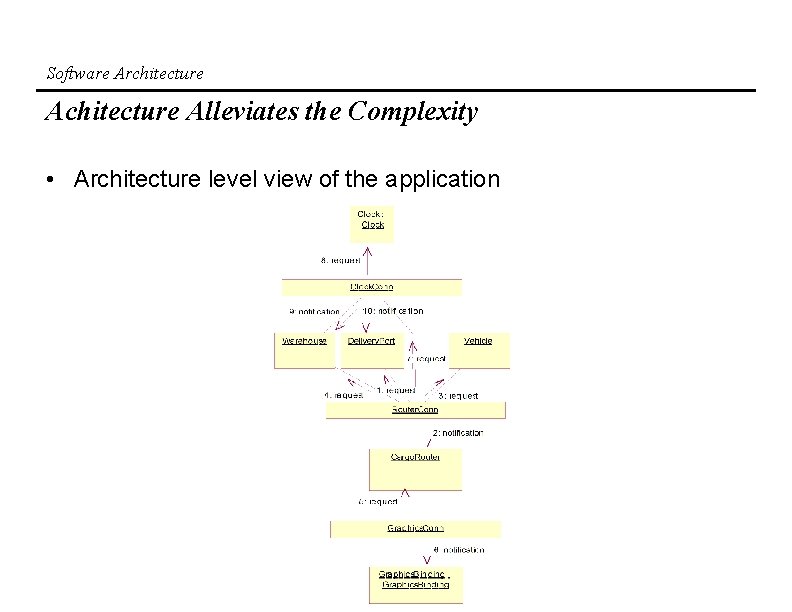
Software Architecture Even Simple Software is Complex • Source code level view of an application
Software Architecture Alleviates the Complexity • Architecture level view of the application
Software Architecture Definitions of Software Architecture • Perry and Wolf – Software Architecture = {Elements, Form, Rationale} • Shaw and Garlan What How Why – Software architecture involves the description of elements from which systems are built, interactions among those elements, patterns that guide their composition, and constraints on those patterns • Kruchten – Architecture deals with abstraction, decomposition, style and aesthetics. • Canonical Building Blocks – Components, Connectors, Configurations
Software Architecture Components • A component is a unit of computation or a data store. • Components are loci of computation and state. – – – Clients Servers Databases Filters Layers Abstract Data Types (ADTs) • A component may be simple or composite. – Composite components describe a system.
Software Architecture Connectors • A connector is an architectural element that models: – Interactions among components – Rules that govern those interactions • Simple interactions – Procedure calls – Shared variable access • Complex and semantically rich interactions – – Client-Server Protocols Database Access Protocols Asynchronous Event Multicast Piped Data Streams
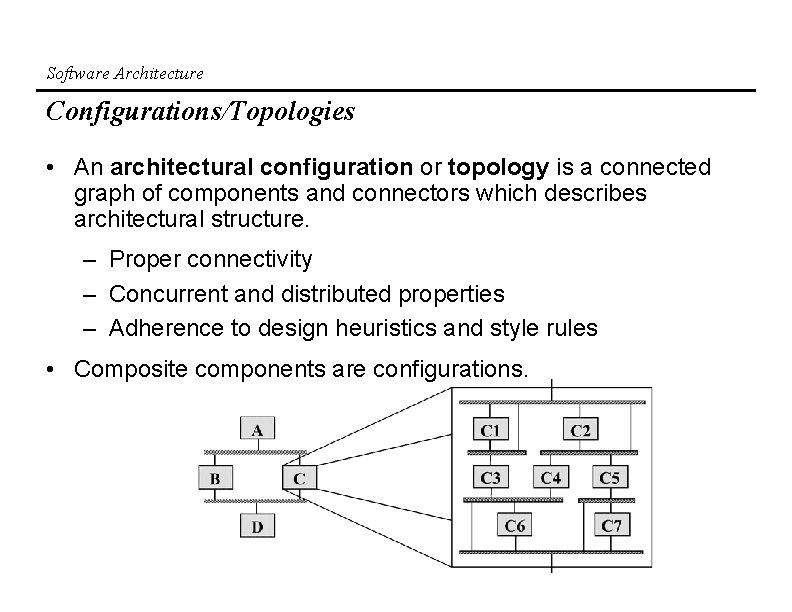
Software Architecture Configurations/Topologies • An architectural configuration or topology is a connected graph of components and connectors which describes architectural structure. – Proper connectivity – Concurrent and distributed properties – Adherence to design heuristics and style rules • Composite components are configurations.
Software Architecture Scope of Software Architectures • Every system has an architecture. • Details of the architecture a reflection of system requirements and trade-offs made to satisfy them • Possible decision factors – Performance – Compatibility with legacy software – Planning for reuse – Distribution profile • Current and Future – Safety, Security, Fault tolerance requirements – Evolvability Needs • Changes to processing algorithms • Changes to data representation • Modifications to the structure/functionality
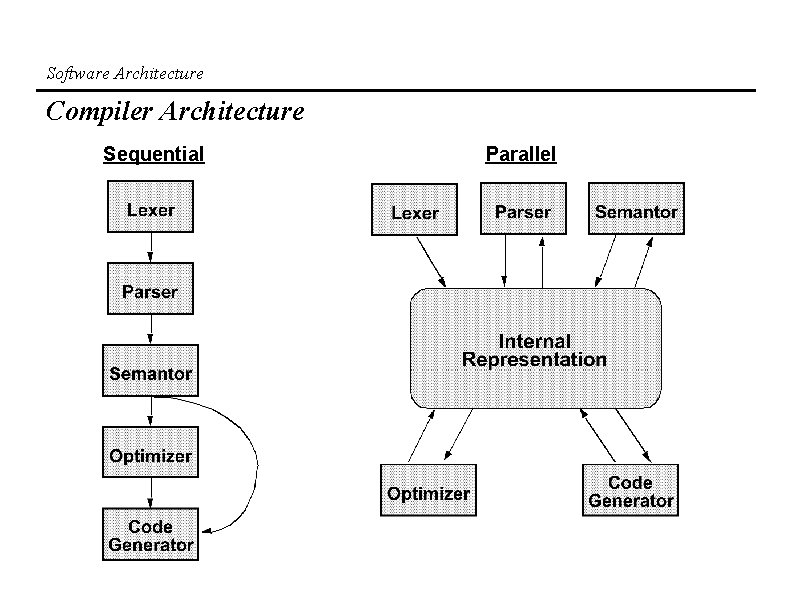
Software Architecture Compiler Architecture Sequential Parallel
Software Architecture Compiler Architecture Pros and Cons • Sequential + Conceptual Simplicity + Architecture reflects control flow - Performance • Parallel + + - Performance Adaptability Synchronization Coordination • Analysis and testing + = Pro, - = Con
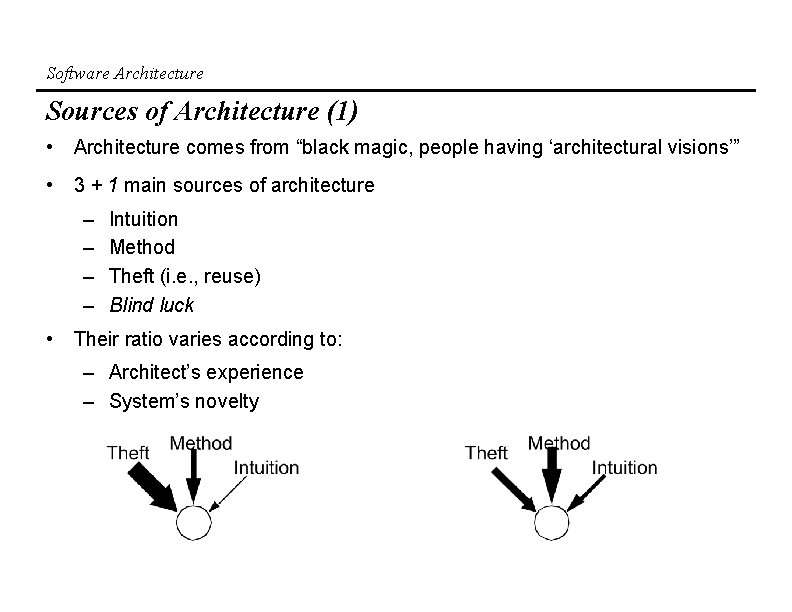
Software Architecture Sources of Architecture (1) • Architecture comes from “black magic, people having ‘architectural visions’” • 3 + 1 main sources of architecture – – Intuition Method Theft (i. e. , reuse) Blind luck • Their ratio varies according to: – Architect’s experience – System’s novelty
Software Architecture Sources of Architecture (2) • Theft – From previous similar systems – From literature • Method – Systematic and conscious – Possibly documented – Architecture is derived from requirements via transformations and heuristics • Intuition – “The ability to conceive without conscious reasoning. ” – Increased reliance on intuition increases the risk
Software Architecture Routine Design • Method is critical – “An architecture built with 50% theft and 50% intuition is doomed to fail. ” • Standardized methods • Similarity to previous solutions • Theft • Cheaper, but not optimal • Can be done by merely “good” designers • Potential pitfall – Over-reusing
Software Architecture Innovative Design • Raw invention • Intuition • Derivation from abstract principles • More optimal • More expensive • Must be done by “great” designers • Potential pitfall – Reinventing the wheel – Single point of failure in staffing
Software Architecture Software “Architecting” • The “architecting” problem lies in: – Decomposition of a system into constituent elements – Composition of (existing) elements into a system • Two idealized approaches – Top-Down • Decompose the large problem into sub-problems • Implement or reuse components that solve the sub-problems – Bottom-Up • Implement new or reuse existing stand-alone components • Compose (a subset of) the components into a system • A realistic approach will require both.
Software Architecture Issues in Decomposition (1) • How do we arrive at: – Components? – Connectors? – Their Configuration? • What is the adequate component granularity level? • What constraints on components are imposed by: – Functional requirements – Non-functional requirements – Envisioned evolution patterns – System Scale – Computing Environment – Customers/Users • What assumptions can components make about one another?
Software Architecture Issues in Decomposition (2) • How do components interact? • What are the connectors in the system? • What is the role of the connectors? – Mediation – Coordination – Communication • What is the nature of the connectors? – Type of interaction – Degree of concurrency – Degree of information exchange
Software Architecture Issues in Composition • Where does one locate existing: – Components? – Connectors? – Configurations? • How do we determine which elements are needed? – Both at development time and at reuse time • What is the adequate element granularity level? • How do we ensure effective composition of heterogeneous elements? • How do we know that we have the needed system?
Software Architecture Summary (1) • Software architecture has proven to be a key to: – – Controlling system development costs Ensuring critical system properties Highlighting major tradeoffs in development Enabling effective deployment, operation, and evolution • Several architectural concepts are part of mainstream development – Components – Complex interactions (connectors) – Styles and patterns
Software Architecture Summary (2) • To effectively leverage architecture, know your: – – – – – Requirements Constraints Domain Components Connectors Legacy and “off-the-shelf” Customers/Users Management Developers