
CSCI 3210 Theory of Programming Language Subprograms and
CSCI 3210: Theory of Programming Language Subprograms and Control Abstraction Based on Textbook Slides Dr. Zhijiang Dong @ Middle Tennessee State University 1
Outline l l l Fundamentals of Subprograms Parameter Passing Generic Subprograms Closures Coroutines Implementing Subprograms Dr. Zhijiang Dong @ Middle Tennessee State University 2
Introduction l Two fundamental abstraction facilities l Process abstraction l l l Emphasized from early days Discussed in this chapter Data abstraction l l Emphasized in the 1980 s Discussed at length in another chapter Dr. Zhijiang Dong @ Middle Tennessee State University 3

Fundamentals of Subprograms l l l Each subprogram has a single entry point The calling program is suspended during execution of the called subprogram Control always returns to the caller when the called subprogram’s execution terminates Dr. Zhijiang Dong @ Middle Tennessee State University 4
Basic Definitions l A subprogram definition describes the interface to and the actions of the subprogram abstraction l l l In Python, function definitions are executable; in all other languages, they are non-executable In Ruby, function definitions can appear either in or outside of class definitions. If outside, they are methods of Object. They can be called without an object, like a function In Lua, all functions are anonymous Dr. Zhijiang Dong @ Middle Tennessee State University 5
Basic Definitions l l A subprogram call is an explicit request that the subprogram be executed A subprogram header is the first part of the definition, including the name, the kind of subprogram, and the formal parameters The parameter profile (aka signature) of a subprogram is the number, order, and types of its parameters The protocol is a subprogram’s parameter profile and, if it is a function, its return type Dr. Zhijiang Dong @ Middle Tennessee State University 6
Basic Definitions l l A subprogram call is an explicit request that the subprogram be executed A subprogram header is the first part of the definition, including the name, the kind of subprogram, and the formal parameters The parameter profile (aka signature) of a subprogram is the number, order, and types of its parameters The protocol is a subprogram’s parameter profile and, if it is a function, its return type Dr. Zhijiang Dong @ Middle Tennessee State University 7
Basic Definitions l l Function declarations in C and C++ are often called prototypes A subprogram declaration provides the protocol, but not the body, of the subprogram A formal parameter is a dummy variable listed in the subprogram header and used in the subprogram An actual parameter represents a value or address used in the subprogram call statement Dr. Zhijiang Dong @ Middle Tennessee State University 8
Actual/Formal Parameter Correspondence l Positional l The binding of actual parameters to formal parameters is by position: the first actual parameter is bound to the first formal parameter and so forth Safe and effective Keyword l l l The name of the formal parameter to which an actual parameter is to be bound is specified with the actual parameter Advantage: Parameters can appear in any order, thereby avoiding parameter correspondence errors Disadvantage: User must know the formal parameter’s names Dr. Zhijiang Dong @ Middle Tennessee State University 9
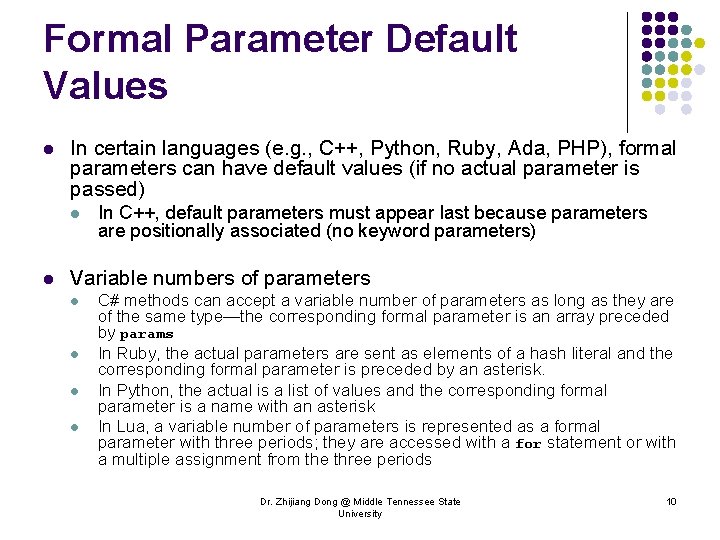
Formal Parameter Default Values l In certain languages (e. g. , C++, Python, Ruby, Ada, PHP), formal parameters can have default values (if no actual parameter is passed) l l In C++, default parameters must appear last because parameters are positionally associated (no keyword parameters) Variable numbers of parameters l l C# methods can accept a variable number of parameters as long as they are of the same type—the corresponding formal parameter is an array preceded by params In Ruby, the actual parameters are sent as elements of a hash literal and the corresponding formal parameter is preceded by an asterisk. In Python, the actual is a list of values and the corresponding formal parameter is a name with an asterisk In Lua, a variable number of parameters is represented as a formal parameter with three periods; they are accessed with a for statement or with a multiple assignment from the three periods Dr. Zhijiang Dong @ Middle Tennessee State University 10
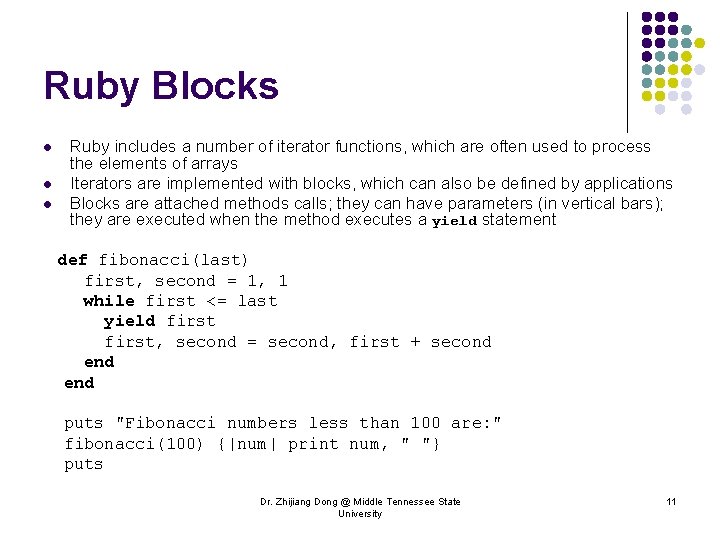
Ruby Blocks l l l Ruby includes a number of iterator functions, which are often used to process the elements of arrays Iterators are implemented with blocks, which can also be defined by applications Blocks are attached methods calls; they can have parameters (in vertical bars); they are executed when the method executes a yield statement def fibonacci(last) first, second = 1, 1 while first <= last yield first, second = second, first + second end puts "Fibonacci numbers less than 100 are: " fibonacci(100) {|num| print num, " "} puts Dr. Zhijiang Dong @ Middle Tennessee State University 11
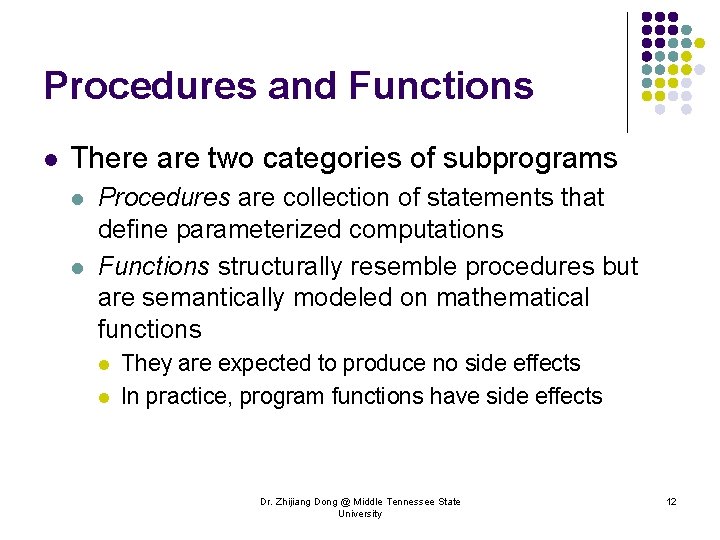
Procedures and Functions l There are two categories of subprograms l l Procedures are collection of statements that define parameterized computations Functions structurally resemble procedures but are semantically modeled on mathematical functions l l They are expected to produce no side effects In practice, program functions have side effects Dr. Zhijiang Dong @ Middle Tennessee State University 12
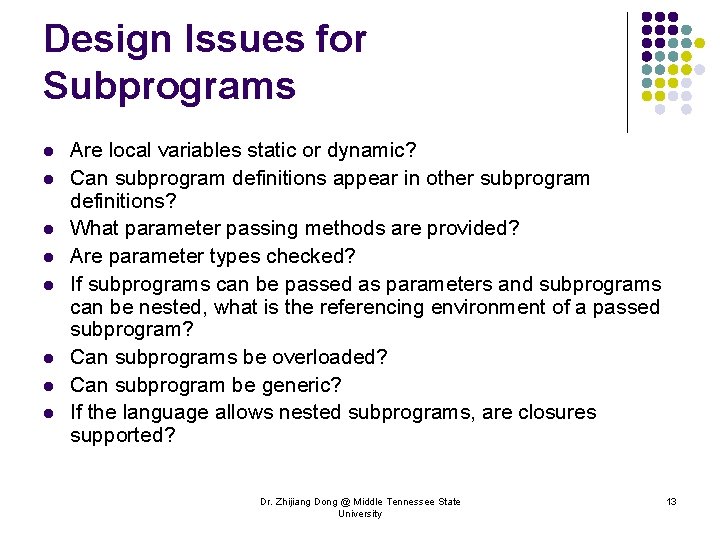
Design Issues for Subprograms l l l l Are local variables static or dynamic? Can subprogram definitions appear in other subprogram definitions? What parameter passing methods are provided? Are parameter types checked? If subprograms can be passed as parameters and subprograms can be nested, what is the referencing environment of a passed subprogram? Can subprograms be overloaded? Can subprogram be generic? If the language allows nested subprograms, are closures supported? Dr. Zhijiang Dong @ Middle Tennessee State University 13
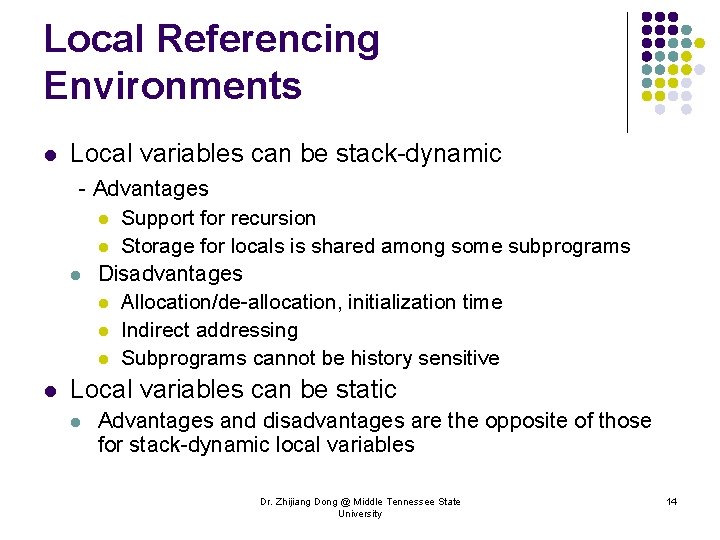
Local Referencing Environments l Local variables can be stack-dynamic - Advantages l Support for recursion l Storage for locals is shared among some subprograms l Disadvantages l Allocation/de-allocation, initialization time l Indirect addressing l Subprograms cannot be history sensitive l Local variables can be static l Advantages and disadvantages are the opposite of those for stack-dynamic local variables Dr. Zhijiang Dong @ Middle Tennessee State University 14
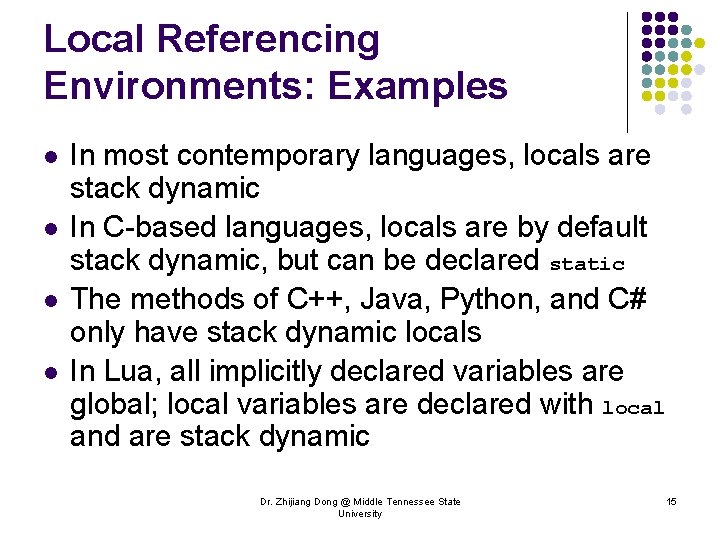
Local Referencing Environments: Examples l l In most contemporary languages, locals are stack dynamic In C-based languages, locals are by default stack dynamic, but can be declared static The methods of C++, Java, Python, and C# only have stack dynamic locals In Lua, all implicitly declared variables are global; local variables are declared with local and are stack dynamic Dr. Zhijiang Dong @ Middle Tennessee State University 15
Outline l l l Fundamentals of Subprograms Parameter Passing Generic Subprograms Closures Coroutines Implementing Subprograms Dr. Zhijiang Dong @ Middle Tennessee State University 16
Semantic Models of Parameter Passing l l l In mode Out mode Inout mode Dr. Zhijiang Dong @ Middle Tennessee State University 17
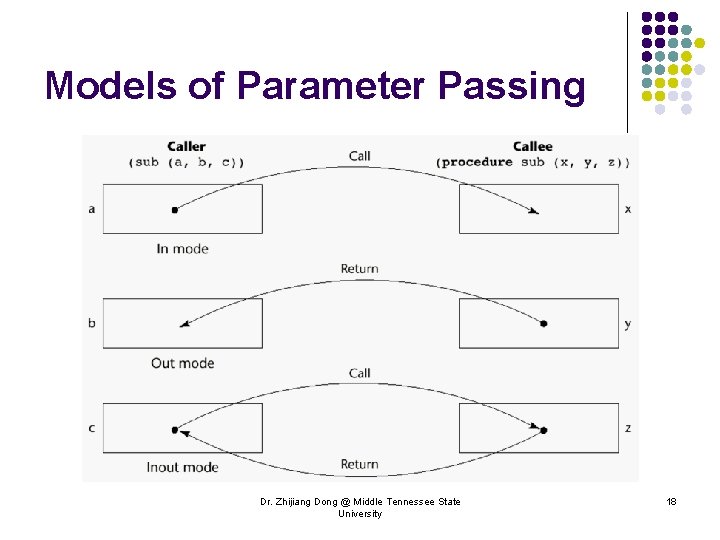
Models of Parameter Passing Dr. Zhijiang Dong @ Middle Tennessee State University 18
Conceptual Models of Transfer l l Physically move a value Move an access path to a value Dr. Zhijiang Dong @ Middle Tennessee State University 19
Pass-by-Value (In Mode) l The value of the actual parameter is used to initialize the corresponding formal parameter l l Normally implemented by copying Can be implemented by transmitting an access path but not recommended (enforcing write protection is not easy) Disadvantages (if by physical move): additional storage is required (stored twice) and the actual move can be costly (for large parameters) Disadvantages (if by access path method): must writeprotect in the called subprogram and accesses cost more (indirect addressing) Dr. Zhijiang Dong @ Middle Tennessee State University 20
Pass-by-Result (Out Mode) l When a parameter is passed by result, no value is transmitted to the subprogram; the corresponding formal parameter acts as a local variable; its value is transmitted to caller’s actual parameter when control is returned to the caller, by physical move l l Require extra storage location and copy operation Potential problems: l l whichever formal parameter is copied back will represent the current value of p 1 sub(list[sub], sub); Compute address of list[sub] at the beginning of the subprogram or end? sub(p 1, p 1); Dr. Zhijiang Dong @ Middle Tennessee State University 21
Pass-by-Value-Result (inout Mode) l l A combination of pass-by-value and pass-by-result Sometimes called pass-by-copy Formal parameters have local storage Disadvantages: l l Those of pass-by-result Those of pass-by-value Dr. Zhijiang Dong @ Middle Tennessee State University 22
Pass-by-Reference (Inout Mode) l l Pass an access path Also called pass-by-sharing Advantage: Passing process is efficient (no copying and no duplicated storage) Disadvantages l l l Slower accesses (compared to pass-by-value) to formal parameters Potentials for unwanted side effects (collisions) Unwanted aliases (access broadened) fun(total, total); fun(list[i], list[j]; Dr. Zhijiang Dong @ Middle Tennessee State University fun(list[i], i); 23
Pass-by-Name (Inout Mode) l l By textual substitution Formals are bound to an access method at the time of the call, but actual binding to a value or address takes place at the time of a reference or assignment Allows flexibility in late binding Implementation requires that the referencing environment of the caller is passed with the parameter, so the actual parameter address can be calculated Dr. Zhijiang Dong @ Middle Tennessee State University 24
Implementing Parameter-Passing Methods l l In most languages parameter communication takes place thru the run-time stack Pass-by-reference are the simplest to implement; only an address is placed in the stack Dr. Zhijiang Dong @ Middle Tennessee State University 25
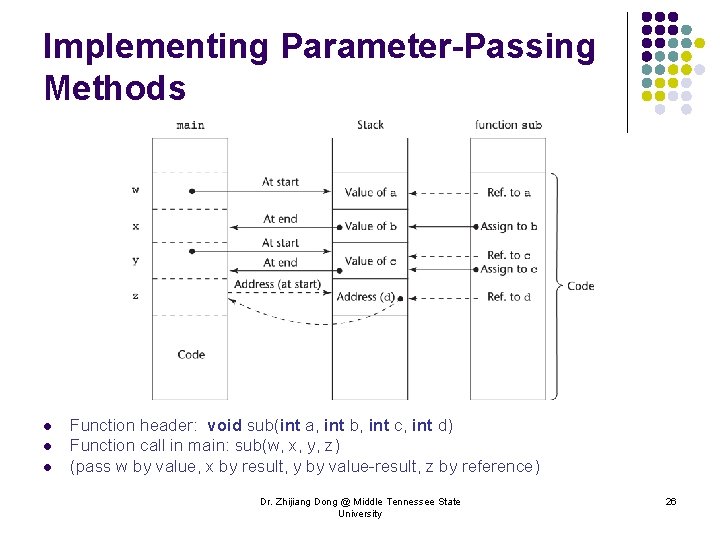
Implementing Parameter-Passing Methods l l l Function header: void sub(int a, int b, int c, int d) Function call in main: sub(w, x, y, z) (pass w by value, x by result, y by value-result, z by reference) Dr. Zhijiang Dong @ Middle Tennessee State University 26
Parameter Passing Methods of Major Languages l C l l l Pass-by-value Pass-by-reference is achieved by using pointers as parameters C++ l A special pointer type called reference type for pass-by-reference Java l All parameters are passed by value l Object parameters are passed by reference Ada l Three semantics modes of parameter transmission: in, out, in out; in is the default mode l Formal parameters declared out can be assigned but not referenced; those declared in can be referenced but not assigned; in out parameters can be referenced and assigned Dr. Zhijiang Dong @ Middle Tennessee State University 27
Parameter Passing Methods of Major Languages l Fortran 95+ l C# - Default method: pass-by-value l Pass-by-reference is specified by preceding both a formal parameter and its actual parameter with ref PHP l very similar to C#, except that either the actual or the formal parameter can specify ref Perl l all actual parameters are implicitly placed in a predefined array named @_ Python and Ruby use pass-by-assignment (all data values are objects); the actual is assigned to the formal l - Parameters can be declared to be in, out, or inout mode Dr. Zhijiang Dong @ Middle Tennessee State University 28
Type Checking Parameters l l Considered very important for reliability FORTRAN 77 and original C: none Pascal, FORTRAN 90+, Java, and Ada: it is always required ANSI C and C++: choice is made by the user l l l Prototypes Relatively new languages Perl, Java. Script, and PHP do not require type checking In Python and Ruby, variables do not have types (objects do), so parameter type checking is not possible Dr. Zhijiang Dong @ Middle Tennessee State University 29
Multidimensional Arrays as Parameters l If a multidimensional array is passed to a subprogram and the subprogram is separately compiled, the compiler needs to know the declared size of that array to build the storage mapping function Dr. Zhijiang Dong @ Middle Tennessee State University 30
Multidimensional Arrays as Parameters: C and C++ l l l Programmer is required to include the declared sizes of all but the first subscript in the actual parameter Disallows writing flexible subprograms Solution: pass a pointer to the array and the sizes of the dimensions as other parameters; the user must include the storage mapping function in terms of the size parameters Dr. Zhijiang Dong @ Middle Tennessee State University 31
Multidimensional Arrays as Parameters: Ada l Ada – not a problem l l Constrained arrays – size is part of the array’s type Unconstrained arrays - declared size is part of the object declaration Dr. Zhijiang Dong @ Middle Tennessee State University 32
Multidimensional Arrays as Parameters: Fortran l Formal parameters that are arrays have a declaration after the header l l For single-dimension arrays, the subscript is irrelevant For multidimensional arrays, the sizes are sent as parameters and used in the declaration of the formal parameter, so those variables are used in the storage mapping function Dr. Zhijiang Dong @ Middle Tennessee State University 33
Multidimensional Arrays as Parameters: Java and C# l l l Similar to Ada Arrays are objects; they are all singledimensioned, but the elements can be arrays Each array inherits a named constant (length in Java, Length in C#) that is set to the length of the array when the array object is created Dr. Zhijiang Dong @ Middle Tennessee State University 34
Design Considerations for Parameter Passing l Two important considerations l l l Efficiency One-way or two-way data transfer But the above considerations are in conflict l l Good programming suggest limited access to variables, which means one-way whenever possible But pass-by-reference is more efficient to pass structures of significant size Dr. Zhijiang Dong @ Middle Tennessee State University 35
Parameters that are Subprogram Names l l It is sometimes convenient to pass subprogram names as parameters Issues: 1. 2. Are parameter types checked? What is the correct referencing environment for a subprogram that was sent as a parameter? Dr. Zhijiang Dong @ Middle Tennessee State University 36
Parameters that are Subprogram Names: Referencing Environment l l l Shallow binding: The environment of the call statement that enacts the passed subprogram - Most natural for dynamic-scoped languages Deep binding: The environment of the definition of the passed subprogram - Most natural for static-scoped languages Ad hoc binding: The environment of the call statement that passed the subprogram Dr. Zhijiang Dong @ Middle Tennessee State University 37
Calling Subprograms Indirectly l l Usually when there are several possible subprograms to be called and the correct one on a particular run of the program is not know until execution (e. g. , event handling and GUIs) In C and C++, such calls are made through function pointers Dr. Zhijiang Dong @ Middle Tennessee State University 38
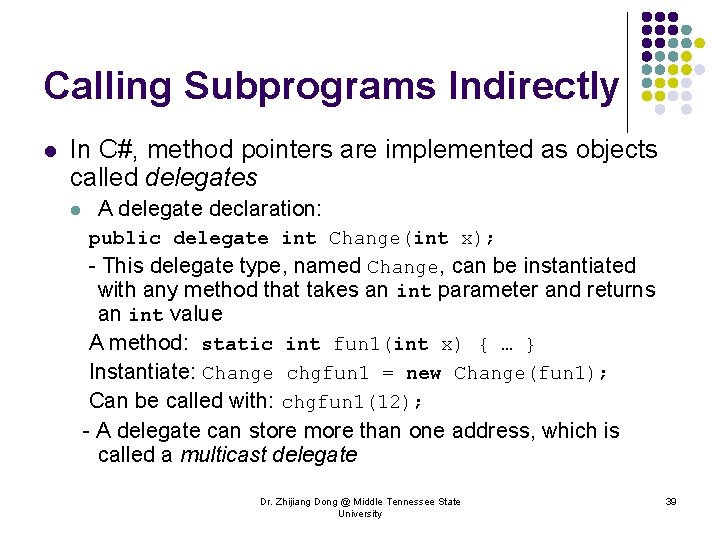
Calling Subprograms Indirectly l In C#, method pointers are implemented as objects called delegates l A delegate declaration: public delegate int Change(int x); - This delegate type, named Change, can be instantiated with any method that takes an int parameter and returns an int value A method: static int fun 1(int x) { … } Instantiate: Change chgfun 1 = new Change(fun 1); Can be called with: chgfun 1(12); - A delegate can store more than one address, which is called a multicast delegate Dr. Zhijiang Dong @ Middle Tennessee State University 39
Overloaded Subprograms l An overloaded subprogram is one that has the same name as another subprogram in the same referencing environment l l Every version of an overloaded subprogram has a unique protocol C++, Java, C#, and Ada include predefined overloaded subprograms In Ada, the return type of an overloaded function can be used to disambiguate calls (thus two overloaded functions can have the same parameters) Ada, Java, C++, and C# allow users to write multiple versions of subprograms with the same name Dr. Zhijiang Dong @ Middle Tennessee State University 40
Outline l l l Fundamentals of Subprograms Parameter Passing Generic Subprograms Closures Coroutines Implementing Subprograms Dr. Zhijiang Dong @ Middle Tennessee State University 41
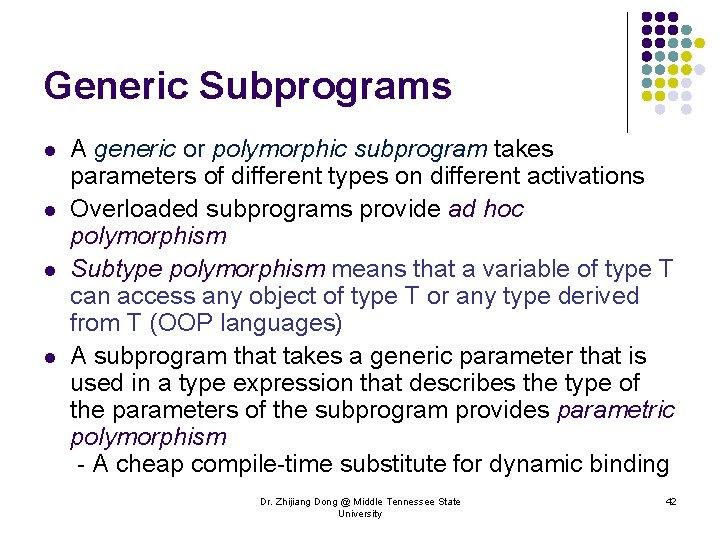
Generic Subprograms l l A generic or polymorphic subprogram takes parameters of different types on different activations Overloaded subprograms provide ad hoc polymorphism Subtype polymorphism means that a variable of type T can access any object of type T or any type derived from T (OOP languages) A subprogram that takes a generic parameter that is used in a type expression that describes the type of the parameters of the subprogram provides parametric polymorphism - A cheap compile-time substitute for dynamic binding Dr. Zhijiang Dong @ Middle Tennessee State University 42
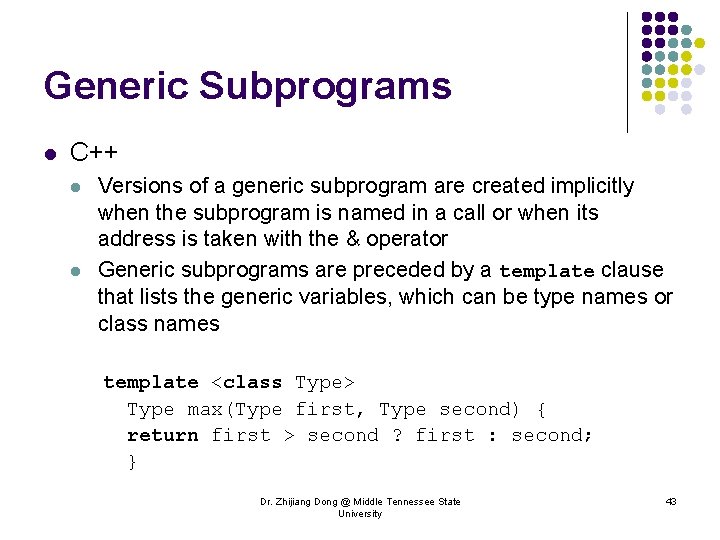
Generic Subprograms l C++ l l Versions of a generic subprogram are created implicitly when the subprogram is named in a call or when its address is taken with the & operator Generic subprograms are preceded by a template clause that lists the generic variables, which can be type names or class names template <class Type> Type max(Type first, Type second) { return first > second ? first : second; } Dr. Zhijiang Dong @ Middle Tennessee State University 43
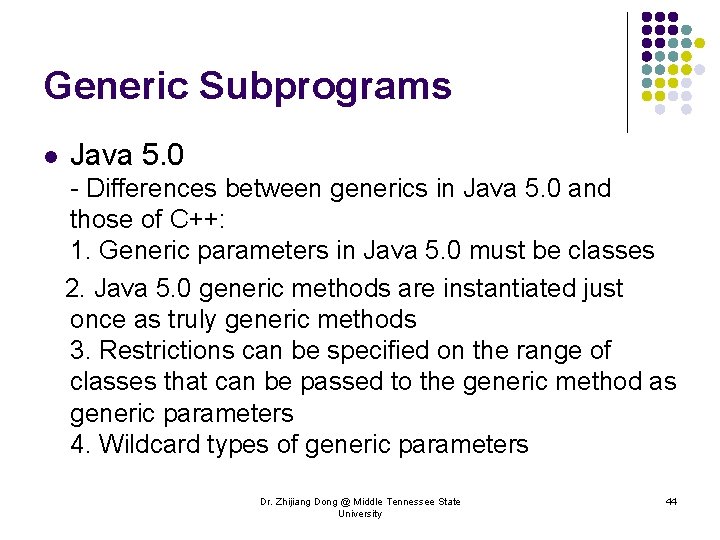
Generic Subprograms l Java 5. 0 - Differences between generics in Java 5. 0 and those of C++: 1. Generic parameters in Java 5. 0 must be classes 2. Java 5. 0 generic methods are instantiated just once as truly generic methods 3. Restrictions can be specified on the range of classes that can be passed to the generic method as generic parameters 4. Wildcard types of generic parameters Dr. Zhijiang Dong @ Middle Tennessee State University 44
![Generic Subprograms l Java 5. 0 (continued) public static <T> T do. It(T[] list)](http://slidetodoc.com/presentation_image_h2/a8e6fc0b0ab67b62f6e18bb714725833/image-45.jpg "Generic Subprograms l Java 5. 0 (continued) public static <T> T do. It(T[] list)")
Generic Subprograms l Java 5. 0 (continued) public static <T> T do. It(T[] list) { … } - The parameter is an array of generic elements (T is the name of the type) - A call: do. It<String>(my. List); Generic parameters can have bounds: public static <T extends Comparable> T do. It(T[] list) { … } The generic type must be of a class that implements the Comparable interface Dr. Zhijiang Dong @ Middle Tennessee State University 45
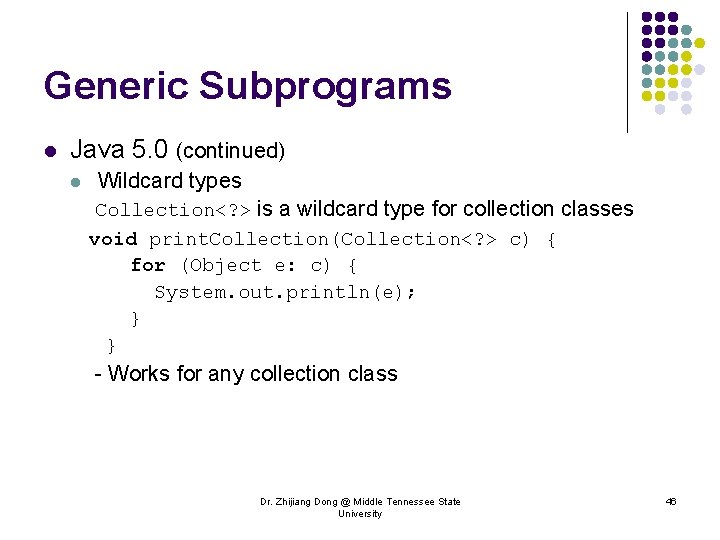
Generic Subprograms l Java 5. 0 (continued) l Wildcard types Collection<? > is a wildcard type for collection classes void print. Collection(Collection<? > c) { for (Object e: c) { System. out. println(e); } } - Works for any collection class Dr. Zhijiang Dong @ Middle Tennessee State University 46
Generic Subprograms l C# 2005 - Supports generic methods that are similar to those of Java 5. 0 - One difference: actual type parameters in a call can be omitted if the compiler can infer the unspecified type l Another – C# 2005 does not support wildcards Dr. Zhijiang Dong @ Middle Tennessee State University 47
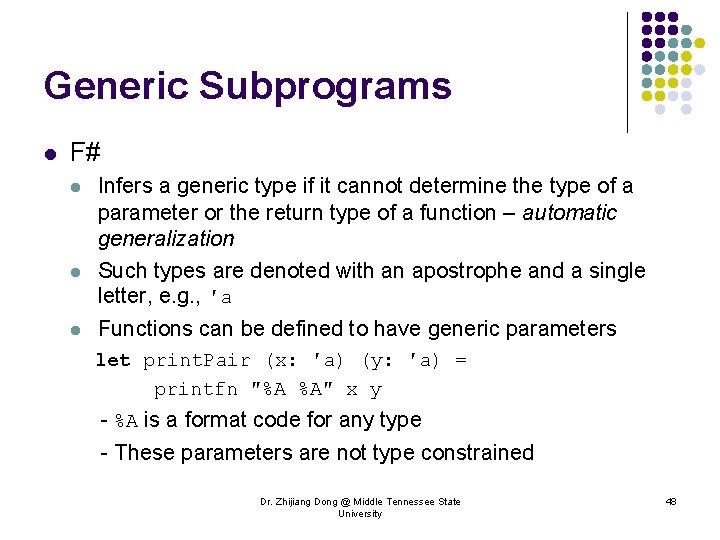
Generic Subprograms l F# l l l Infers a generic type if it cannot determine the type of a parameter or the return type of a function – automatic generalization Such types are denoted with an apostrophe and a single letter, e. g. , ′a Functions can be defined to have generic parameters let print. Pair (x: ′a) (y: ′a) = printfn ″%A %A″ x y - %A is a format code for any type - These parameters are not type constrained Dr. Zhijiang Dong @ Middle Tennessee State University 48
Generic Subprograms l F# (continued) l l If the parameters of a function are used with arithmetic operators, they are type constrained, even if the parameters are specified to be generic Because of type inferencing and the lack of type coercions, F# generic functions are far less useful than those of C++, Java 5. 0+, and C# 2005+ Dr. Zhijiang Dong @ Middle Tennessee State University 49
Design Issues for Functions l l Are side effects allowed? l Parameters should always be in-mode to reduce side effect (like Ada) What types of return values are allowed? l Most imperative languages restrict the return types l C allows any type except arrays and functions l C++ is like C but also allows user-defined types l Ada subprograms can return any type (but Ada subprograms are not types, so they cannot be returned) l Java and C# methods can return any type (but because methods are not types, they cannot be returned) l Python and Ruby treat methods as first-class objects, so they can be returned, as well as any other class l Lua allows functions to return multiple values Dr. Zhijiang Dong @ Middle Tennessee State University 50
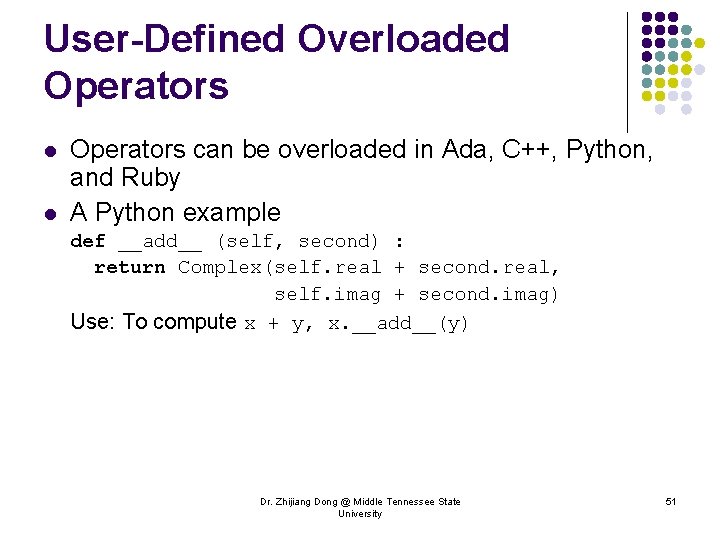
User-Defined Overloaded Operators l l Operators can be overloaded in Ada, C++, Python, and Ruby A Python example def __add__ (self, second) : return Complex(self. real + second. real, self. imag + second. imag) Use: To compute x + y, x. __add__(y) Dr. Zhijiang Dong @ Middle Tennessee State University 51
Outline l l l Fundamentals of Subprograms Parameter Passing Generic Subprograms Closures Coroutines Implementing Subprograms Dr. Zhijiang Dong @ Middle Tennessee State University 52
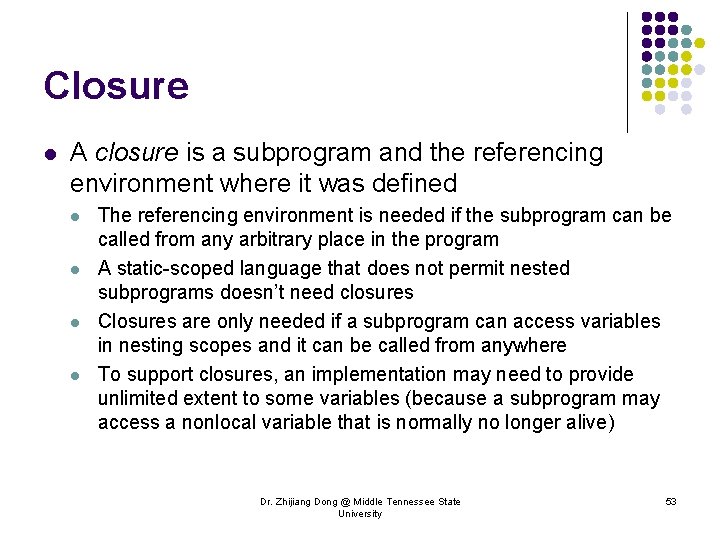
Closure l A closure is a subprogram and the referencing environment where it was defined l l The referencing environment is needed if the subprogram can be called from any arbitrary place in the program A static-scoped language that does not permit nested subprograms doesn’t need closures Closures are only needed if a subprogram can access variables in nesting scopes and it can be called from anywhere To support closures, an implementation may need to provide unlimited extent to some variables (because a subprogram may access a nonlocal variable that is normally no longer alive) Dr. Zhijiang Dong @ Middle Tennessee State University 53
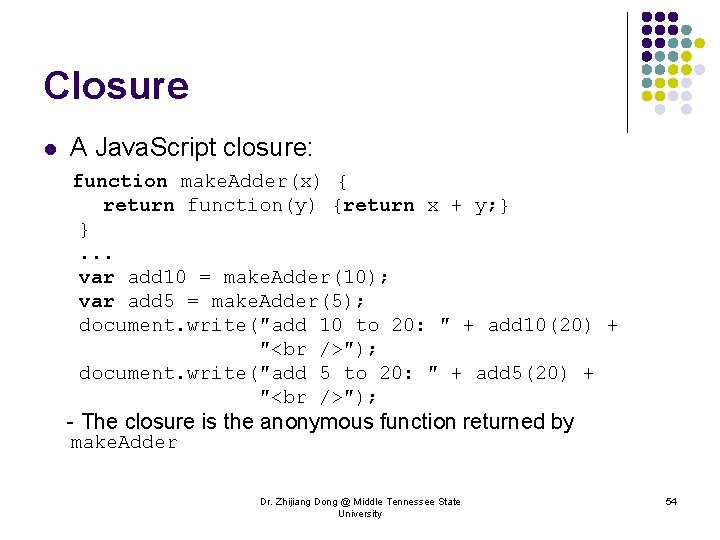
Closure l A Java. Script closure: function make. Adder(x) { return function(y) {return x + y; } }. . . var add 10 = make. Adder(10); var add 5 = make. Adder(5); document. write(″add 10 to 20: ″ + add 10(20) + ″ ″); document. write(″add 5 to 20: ″ + add 5(20) + ″ ″); - The closure is the anonymous function returned by make. Adder Dr. Zhijiang Dong @ Middle Tennessee State University 54
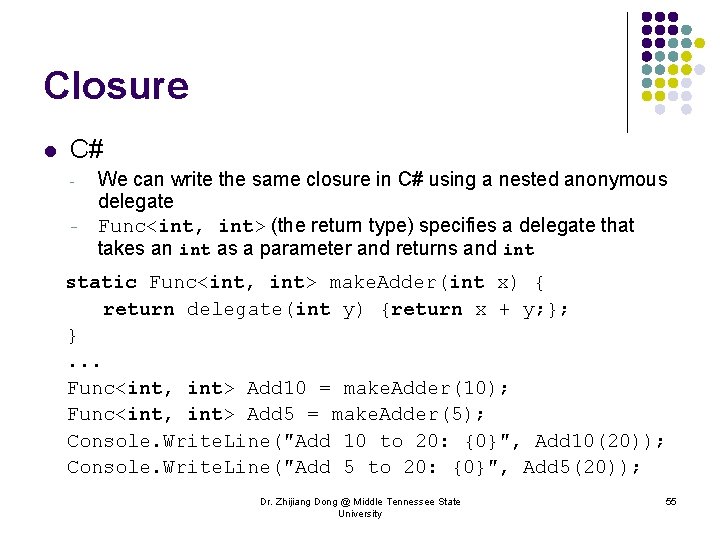
Closure l C# - We can write the same closure in C# using a nested anonymous delegate Func<int, int> (the return type) specifies a delegate that takes an int as a parameter and returns and int static Func<int, int> make. Adder(int x) { return delegate(int y) {return x + y; }; }. . . Func<int, int> Add 10 = make. Adder(10); Func<int, int> Add 5 = make. Adder(5); Console. Write. Line(″Add 10 to 20: {0}″, Add 10(20)); Console. Write. Line(″Add 5 to 20: {0}″, Add 5(20)); Dr. Zhijiang Dong @ Middle Tennessee State University 55
Outline l l l Fundamentals of Subprograms Parameter Passing Generic Subprograms Closures Coroutines Implementing Subprograms Dr. Zhijiang Dong @ Middle Tennessee State University 56
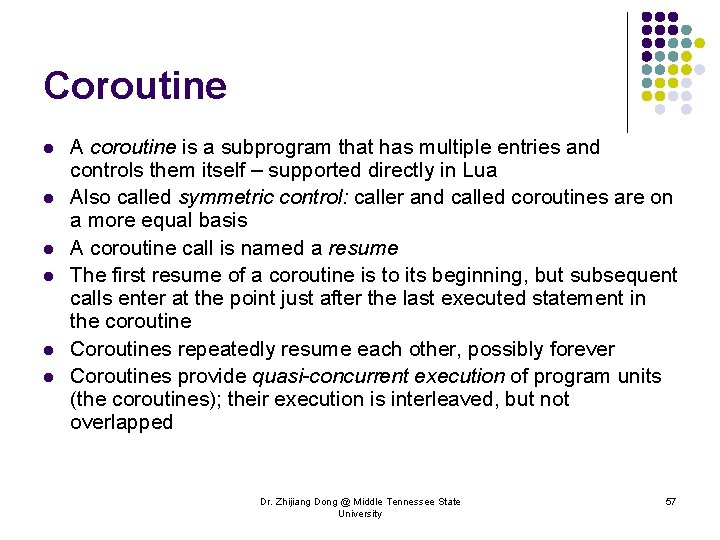
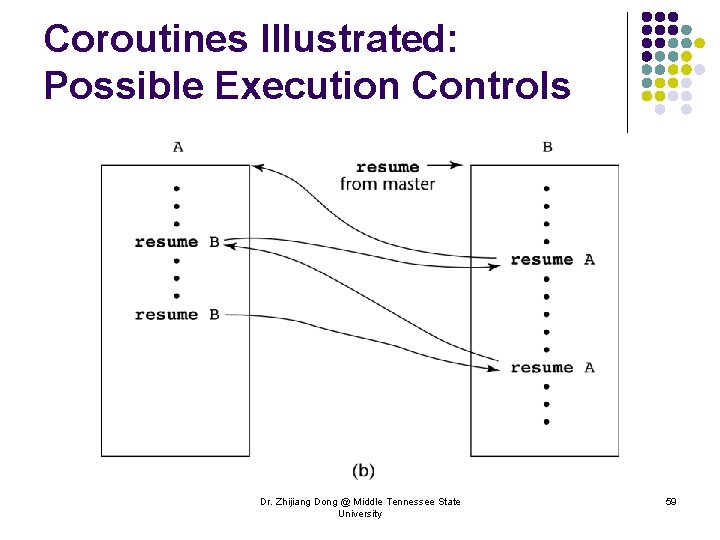
Coroutine l l l A coroutine is a subprogram that has multiple entries and controls them itself – supported directly in Lua Also called symmetric control: caller and called coroutines are on a more equal basis A coroutine call is named a resume The first resume of a coroutine is to its beginning, but subsequent calls enter at the point just after the last executed statement in the coroutine Coroutines repeatedly resume each other, possibly forever Coroutines provide quasi-concurrent execution of program units (the coroutines); their execution is interleaved, but not overlapped Dr. Zhijiang Dong @ Middle Tennessee State University 57
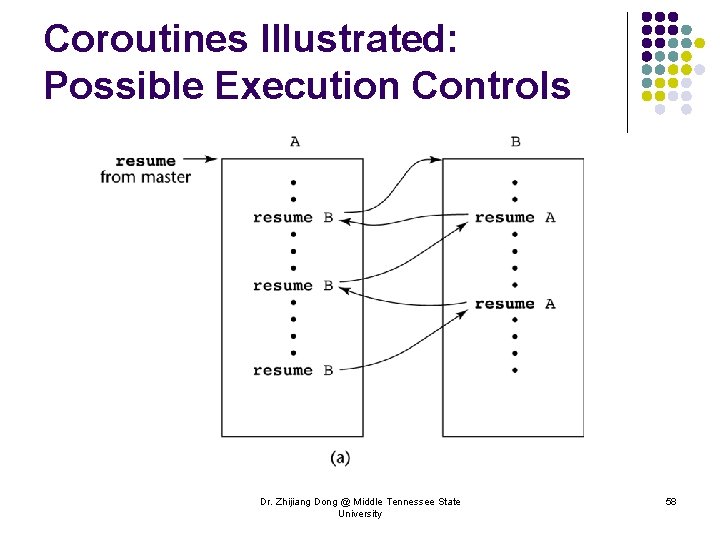
Coroutines Illustrated: Possible Execution Controls Dr. Zhijiang Dong @ Middle Tennessee State University 58
Coroutines Illustrated: Possible Execution Controls Dr. Zhijiang Dong @ Middle Tennessee State University 59
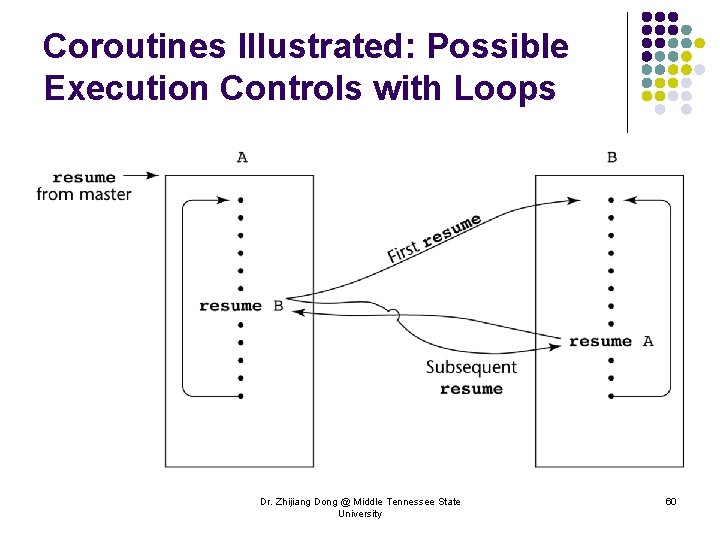
Coroutines Illustrated: Possible Execution Controls with Loops Dr. Zhijiang Dong @ Middle Tennessee State University 60
Outline l l l Fundamentals of Subprograms Parameter Passing Generic Subprograms Closures Coroutines Implementing Subprograms Dr. Zhijiang Dong @ Middle Tennessee State University 61
The General Semantics of Calls and Returns l l The subprogram call and return operations of a language are together called its subprogram linkage General semantics of calls to a subprogram l Parameter passing methods l Stack-dynamic allocation of local variables l Save the execution status of calling program l Transfer of control and arrange for the return l If subprogram nesting is supported, access to nonlocal variables must be arranged Dr. Zhijiang Dong @ Middle Tennessee State University 62
The General Semantics of Calls and Returns l General semantics of subprogram returns: l In mode and inout mode parameters must have their values returned l Deallocation of stack-dynamic locals l Restore the execution status l Return control to the caller Dr. Zhijiang Dong @ Middle Tennessee State University 63
Implementing “Simple” Subprograms l Call Semantics: - Save the execution status of the caller - Pass the parameters - Pass the return address to the called - Transfer control to the called Dr. Zhijiang Dong @ Middle Tennessee State University 64
Implementing “Simple” Subprograms l Return Semantics: l If pass-by-value-result or out mode parameters are used, move the current values of those parameters to their corresponding actual parameters l If it is a function, move the functional value to a place the caller can get it l Restore the execution status of the caller l Transfer control back to the caller l Required storage: l Status information, parameters, return address, return value for functions, temporaries Dr. Zhijiang Dong @ Middle Tennessee State University 65
Implementing “Simple” Subprograms l Two separate parts: the actual code and the non-code part (local variables and data that can change) l The format, or layout, of the non-code part of an executing subprogram is called an activation record l An activation record instance is a concrete example of an activation record (the collection of data for a particular subprogram activation) Dr. Zhijiang Dong @ Middle Tennessee State University 66
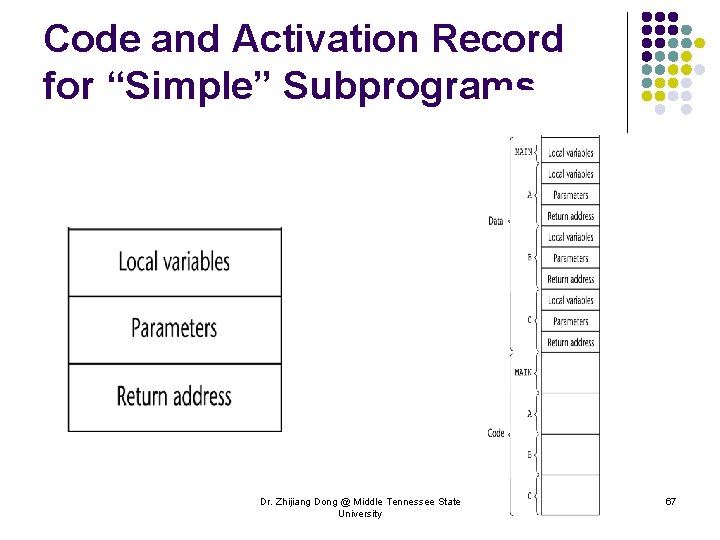
Code and Activation Record for “Simple” Subprograms Dr. Zhijiang Dong @ Middle Tennessee State University 67
Implementing Subprograms with Stack-Dynamic Local Variables l More complex activation record l The compiler must generate code to cause implicit allocation and deallocation of local variables l Recursion must be supported (adds the possibility of multiple simultaneous activations of a subprogram) Dr. Zhijiang Dong @ Middle Tennessee State University 68
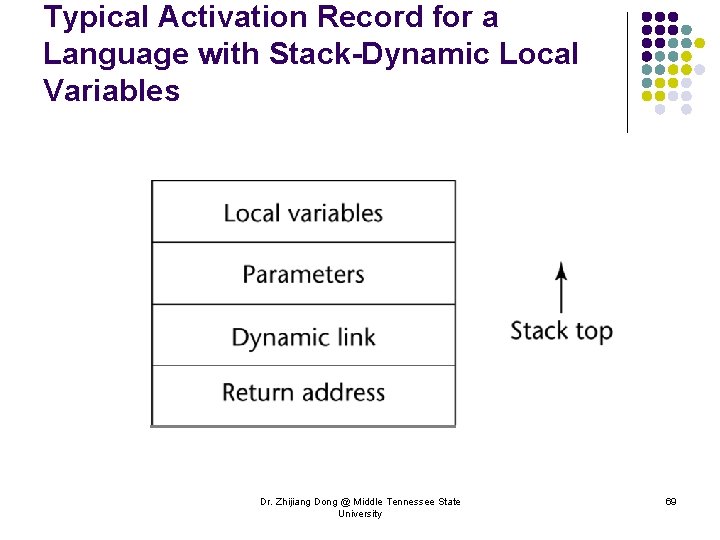
Typical Activation Record for a Language with Stack-Dynamic Local Variables Dr. Zhijiang Dong @ Middle Tennessee State University 69
Implementing Subprograms with Stack -Dynamic Local Variables: Activation Record l l l The activation record format is static, but its size may be dynamic The dynamic link points to the top of an instance of the activation record of the caller An activation record instance is dynamically created when a subprogram is called Activation record instances reside on the run-time stack The Environment Pointer (EP) must be maintained by the run-time system. It always points at the base of the activation record instance of the currently executing program unit Dr. Zhijiang Dong @ Middle Tennessee State University 70
![An Example: C Function void sub(float total, int part) { int list[5]; float sum;](http://slidetodoc.com/presentation_image_h2/a8e6fc0b0ab67b62f6e18bb714725833/image-71.jpg "An Example: C Function void sub(float total, int part) { int list[5]; float sum;")
An Example: C Function void sub(float total, int part) { int list[5]; float sum; … } Dr. Zhijiang Dong @ Middle Tennessee State University 71
Revised Semantic Call/Return Actions l Caller Actions: l l l Create an activation record instance Save the execution status of the current program unit Compute and pass the parameters Pass the return address to the called Transfer control to the called Prologue actions of the called: l l Save the old EP in the stack as the dynamic link and create the new value Allocate local variables Dr. Zhijiang Dong @ Middle Tennessee State University 72
Revised Semantic Call/Return Actions l Epilogue actions of the called: l l l If there are pass-by-value-result or out-mode parameters, the current values of those parameters are moved to the corresponding actual parameters If the subprogram is a function, its value is moved to a place accessible to the caller Restore the stack pointer by setting it to the value of the current EP-1 and set the EP to the old dynamic link Restore the execution status of the caller Transfer control back to the caller Dr. Zhijiang Dong @ Middle Tennessee State University 73
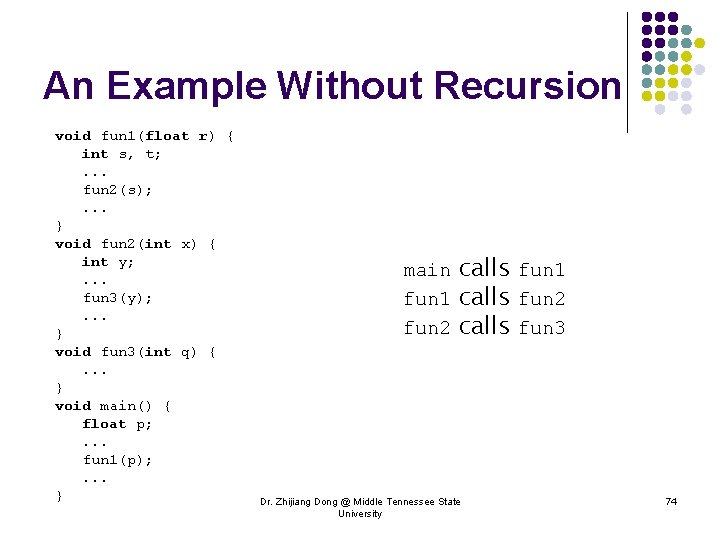
An Example Without Recursion void fun 1(float r) { int s, t; . . . fun 2(s); . . . } void fun 2(int x) { int y; . . . fun 3(y); . . . } void fun 3(int q) {. . . } void main() { float p; . . . fun 1(p); . . . } main fun 1 fun 2 calls fun 1 calls fun 2 calls fun 3 Dr. Zhijiang Dong @ Middle Tennessee State University 74
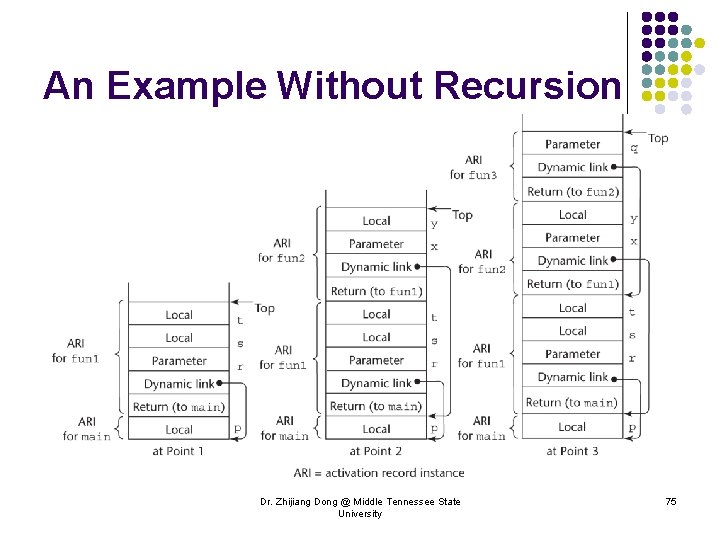
An Example Without Recursion Dr. Zhijiang Dong @ Middle Tennessee State University 75
Dynamic Chain and Local Offset l l l The collection of dynamic links in the stack at a given time is called the dynamic chain, or call chain Local variables can be accessed by their offset from the beginning of the activation record, whose address is in the EP. This offset is called the local_offset The local_offset of a local variable can be determined by the compiler at compile time Dr. Zhijiang Dong @ Middle Tennessee State University 76
An Example With Recursion l The activation record used in the previous example supports recursion int factorial (int n) { <---------------1 if (n <= 1) return 1; else return (n * factorial(n - 1)); <---------------2 } void main() { int value; value = factorial(3); <---------------3 } Dr. Zhijiang Dong @ Middle Tennessee State University 77
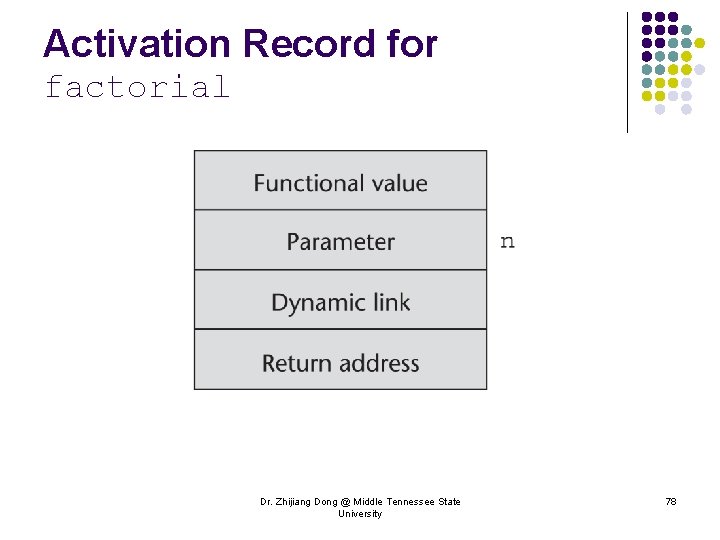
Activation Record for factorial Dr. Zhijiang Dong @ Middle Tennessee State University 78
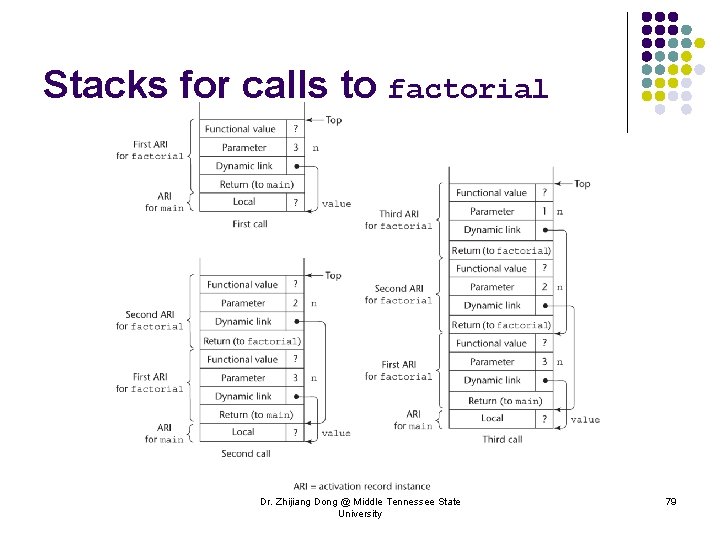
Stacks for calls to factorial Dr. Zhijiang Dong @ Middle Tennessee State University 79
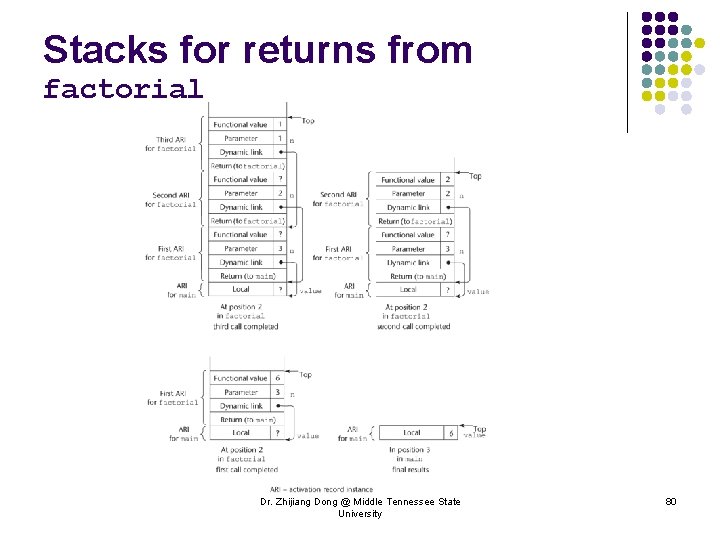
Stacks for returns from factorial Dr. Zhijiang Dong @ Middle Tennessee State University 80
Nested Subprograms l l l Some non-C-based static-scoped languages (e. g. , Fortran 95+, Ada, Python, Java. Script, Ruby, and Lua) use stack-dynamic local variables and allow subprograms to be nested All variables that can be non-locally accessed reside in some activation record instance in the stack The process of locating a non-local reference: 1. 2. Find the correct activation record instance Determine the correct offset within that activation record instance Dr. Zhijiang Dong @ Middle Tennessee State University 81
Locating a Non-local Reference l l Finding the offset is easy Finding the correct activation record instance l Static semantic rules guarantee that all non-local variables that can be referenced have been allocated in some activation record instance that is on the stack when the reference is made Dr. Zhijiang Dong @ Middle Tennessee State University 82
Static Scoping l A static chain is a chain of static links that connects certain activation record instances l The static link in an activation record instance for subprogram A points to one of the activation record instances of A's static parent l The static chain from an activation record instance connects it to all of its static ancestors l Static_depth is an integer associated with a static scope whose value is the depth of nesting of that scope Dr. Zhijiang Dong @ Middle Tennessee State University 83
Static Scoping l The chain_offset or nesting_depth of a nonlocal reference is the difference between the static_depth of the reference and that of the scope when it is declared l A reference to a variable can be represented by the pair: (chain_offset, local_offset), where local_offset is the offset in the activation record of the variable being referenced Dr. Zhijiang Dong @ Middle Tennessee State University 84
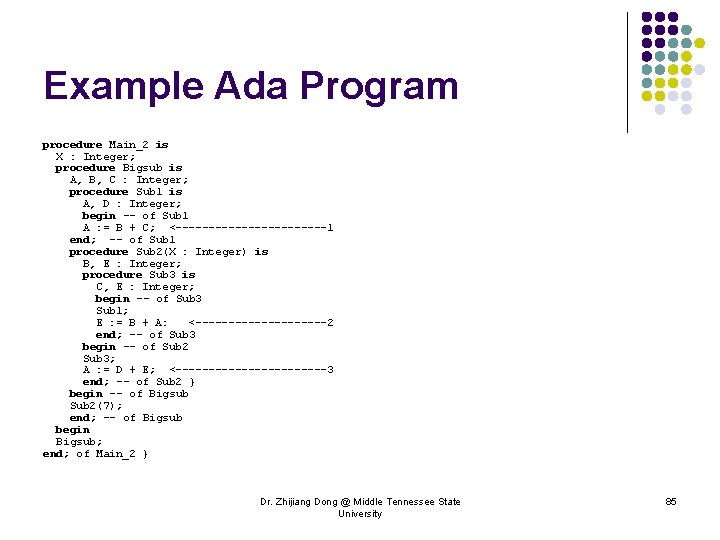
Example Ada Program procedure Main_2 is X : Integer; procedure Bigsub is A, B, C : Integer; procedure Sub 1 is A, D : Integer; begin -- of Sub 1 A : = B + C; <------------1 end; -- of Sub 1 procedure Sub 2(X : Integer) is B, E : Integer; procedure Sub 3 is C, E : Integer; begin -- of Sub 3 Sub 1; E : = B + A: <----------2 end; -- of Sub 3 begin -- of Sub 2 Sub 3; A : = D + E; <------------3 end; -- of Sub 2 } begin -- of Bigsub Sub 2(7); end; -- of Bigsub begin Bigsub; end; of Main_2 } Dr. Zhijiang Dong @ Middle Tennessee State University 85
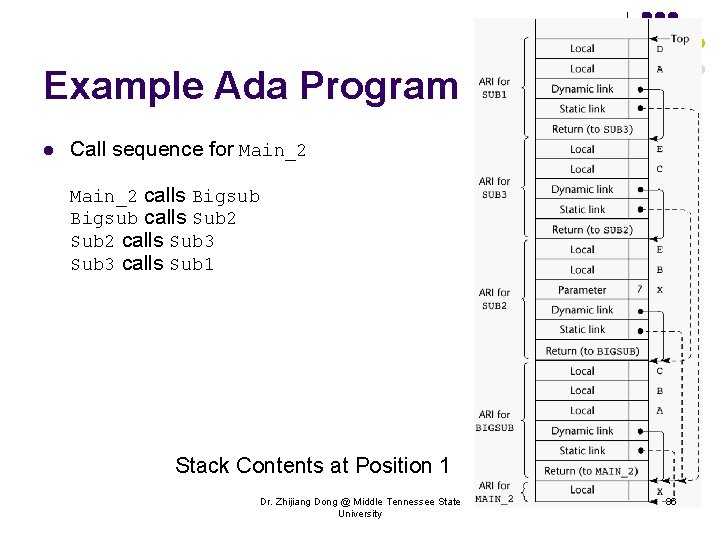
Example Ada Program l Call sequence for Main_2 calls Bigsub calls Sub 2 calls Sub 3 calls Sub 1 Stack Contents at Position 1 Dr. Zhijiang Dong @ Middle Tennessee State University 86
Static Chain Maintenance At the call, - The activation record instance must be built - The dynamic link is just the old stack top pointer - The static link must point to the most recent ari of the static parent - Two methods: 1. Search the dynamic chain 2. Treat subprogram calls and definitions like variable references and definitions Dr. Zhijiang Dong @ Middle Tennessee State University 87
Evaluation of Static Chains l Problems: 1. A nonlocal areference is slow if the nesting depth is large 2. Time-critical code is difficult: a. Costs of nonlocal references are difficult to determine b. Code changes can change the nesting depth, and therefore the cost Dr. Zhijiang Dong @ Middle Tennessee State University 88
Blocks l l Blocks are user-specified local scopes for variables An example in C {int temp; temp = list [upper]; list [upper] = list [lower]; list [lower] = temp } l l The lifetime of temp in the above example begins when control enters the block An advantage of using a local variable like temp is that it cannot interfere with any other variable with the same name Dr. Zhijiang Dong @ Middle Tennessee State University 89
Implementing Blocks l Two Methods: 1. Treat blocks as parameter-less subprograms that are always called from the same location – Every block has an activation record; an instance is created every time the block is executed 2. Since the maximum storage required for a block can be statically determined, this amount of space can be allocated after the local variables in the activation record Dr. Zhijiang Dong @ Middle Tennessee State University 90
Implementing Dynamic Scoping l Deep Access: non-local references are found by searching the activation record instances on the dynamic chain - Length of the chain cannot be statically determined - Every activation record instance must have variable names l Shallow Access: put locals in a central place l One stack for each variable name l Central table with an entry for each variable name Dr. Zhijiang Dong @ Middle Tennessee State University 91
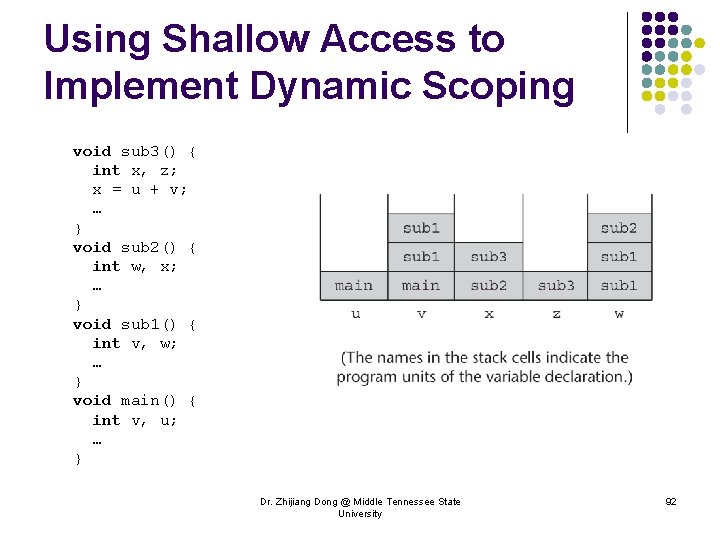
Using Shallow Access to Implement Dynamic Scoping void sub 3() { int x, z; x = u + v; … } void sub 2() { int w, x; … } void sub 1() { int v, w; … } void main() { int v, u; … } Dr. Zhijiang Dong @ Middle Tennessee State University 92
- Slides: 92