
CSCI 2670 Introduction to Theory of Computing October
CSCI 2670 Introduction to Theory of Computing October 20, 2004
Agenda • Yesterday – Some decidable problems involving regular languages and finite automata – One undecidable language • EQCFG • Today – More undecidable languages – Techniques for showing a languages is not decidable October 20, 2004
Announcements • Quiz tomorrow – Enumerators, definition of algorithm, decidable languages • No tutorial tomorrow – Extra office hours today (3: 00 – 5: 00) October 20, 2004
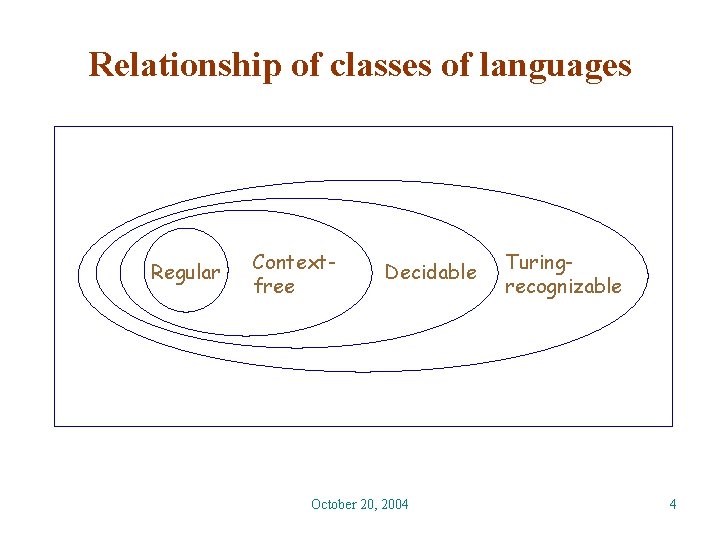
Relationship of classes of languages Regular Contextfree Decidable October 20, 2004 Turingrecognizable 4
Turing machine acceptance problem • Consider the following language ATM={<M, w> | M is a TM that accepts w} Theorem: ATM is Turing-recognizable Theorem: ATM is undecidable Proof: The universal Turing machine recognizes, but does not decide, ATM October 20, 2004
The universal Turing machine U = “On input <M, w>, wher M is a TM and w is a string: 1. Simulate M on input w 2. If M ever enters its accept state, accept 3. If M ever enters its reject state, reject” October 20, 2004
Why can’t U decide ATM? • Intuitively, if M never halts on w, then U never halts on <M, w> • This is also known as the halting problem – Given a TM M and a string w, does M halt on input w? – Undecidable – We will prove this more rigorously later • Need some new tools for proving properties of languages October 20, 2004
Comparing the size of infinite sets • Given two infinite sets A and B, is there any way of determining if |A|>|B|? – Yes! • Diagonalization October 20, 2004
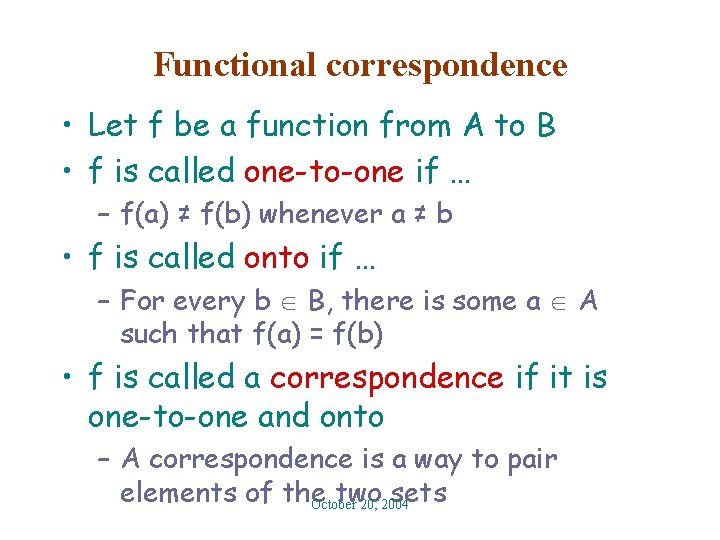
Functional correspondence • Let f be a function from A to B • f is called one-to-one if … – f(a) ≠ f(b) whenever a ≠ b • f is called onto if … – For every b B, there is some a A such that f(a) = f(b) • f is called a correspondence if it is one-to-one and onto – A correspondence is a way to pair elements of the two sets October 20, 2004
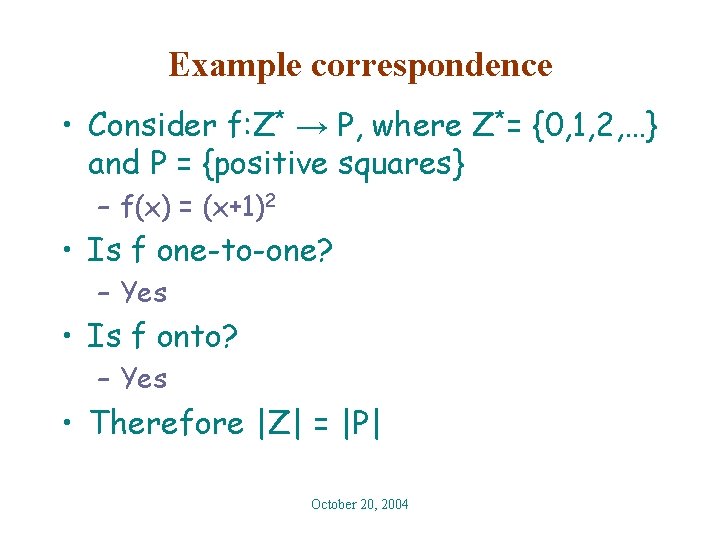
Example correspondence • Consider f: Z* → P, where Z*= {0, 1, 2, …} and P = {positive squares} – f(x) = (x+1)2 • Is f one-to-one? – Yes • Is f onto? – Yes • Therefore |Z| = |P| October 20, 2004
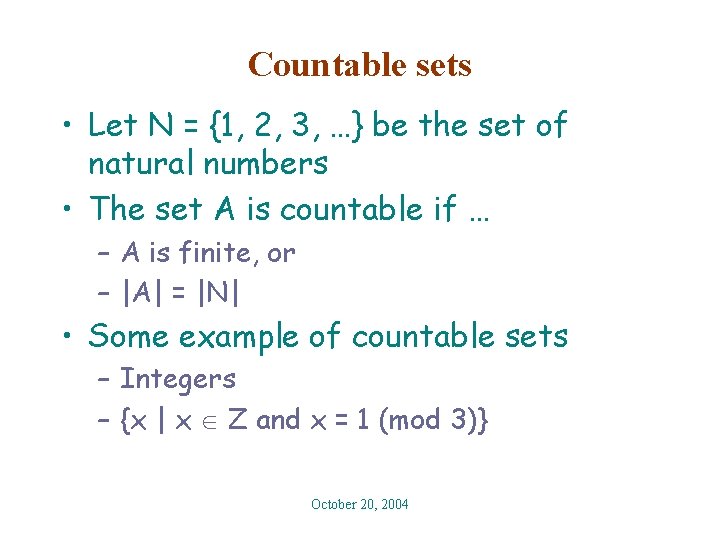
Countable sets • Let N = {1, 2, 3, …} be the set of natural numbers • The set A is countable if … – A is finite, or – |A| = |N| • Some example of countable sets – Integers – {x | x Z and x = 1 (mod 3)} October 20, 2004
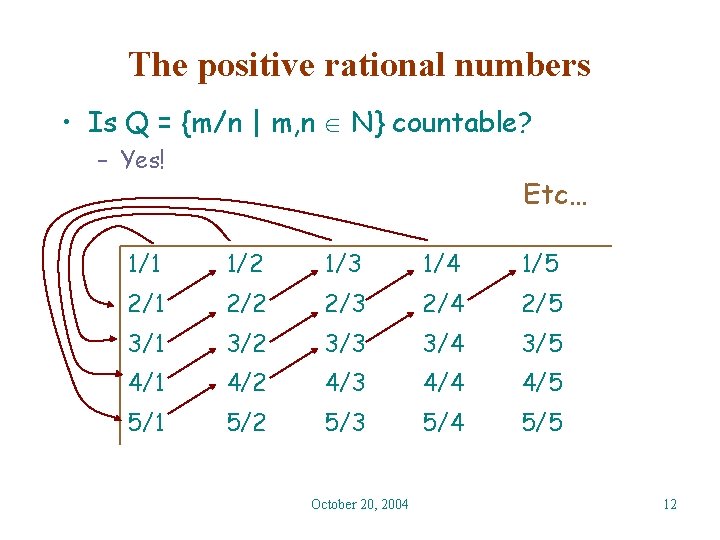
The positive rational numbers • Is Q = {m/n | m, n N} countable? – Yes! Etc… 1/1 1/2 1/3 1/4 1/5 2/1 2/2 2/3 2/4 2/5 3/1 3/2 3/3 3/4 3/5 4/1 4/2 4/3 4/4 4/5 5/1 5/2 5/3 5/4 5/5 October 20, 2004 12
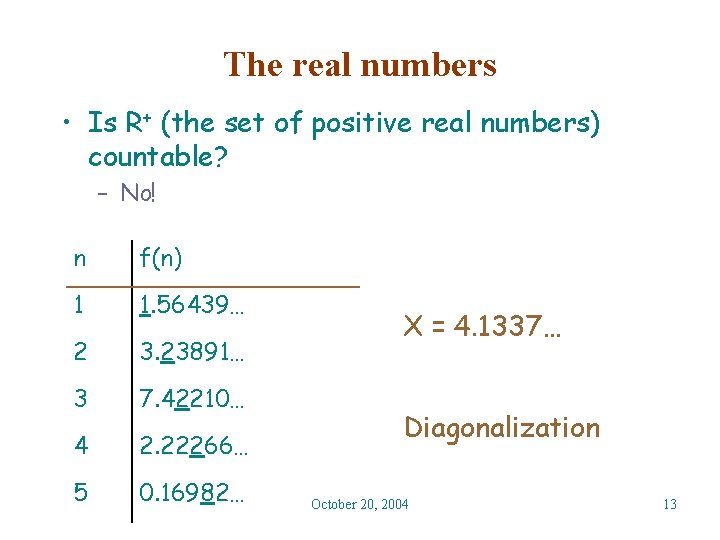
The real numbers • Is R+ (the set of positive real numbers) countable? – No! n f(n) 1 1. 56439… 2 3. 23891… 3 7. 42210… 4 2. 22266… 5 0. 16982… X = 4. 1337… Diagonalization October 20, 2004 13
- Slides: 13