
CSCI 204 Data Structures Algorithms Revised by Xiannong
CSCI 204: Data Structures & Algorithms Revised by Xiannong Meng based on textbook author’s notes 1
Hash Maps Introduction Revised based on textbook author’s notes.

Introduction When discussing search we saw: linear search – O( n ) binary search – O( log n ) Can we improve the search operation to achieve better than O( log n ) time? 3
Comparison-Based Searches 4 To locate an item, the target search key has to be compared against the other keys in the collection. O( log n) is the best that can be achieved in comparison-based search. We must use a different technique if we want to improve the search time.
Hashing 5 The process of mapping a search key to a limited range of array indices. The goal is to provide direct access to the keys. hash table – the array containing the keys. hash function – maps a key to an array index.
Hashing Example 6 Suppose we have a list of popular fruits, we want to find if a particular type of fruit is in our inventory. Apple, Banana, Grape, Orange, Pear, Pineapple, Strawberry. We could use an array of 26 elements, each is index by the first letter of the fruit name, assuming no repetition. We can simply check for fruit[name[0]]!
Hashing Example Suppose we have the following set of keys 765, 431, 96, 142, 579, 226, 903, 388 a hash table, T, with M = 13 elements. We can define a simple hash function h() h(765) -> 11, h(431) -> 2, … h(key) = key % M 7
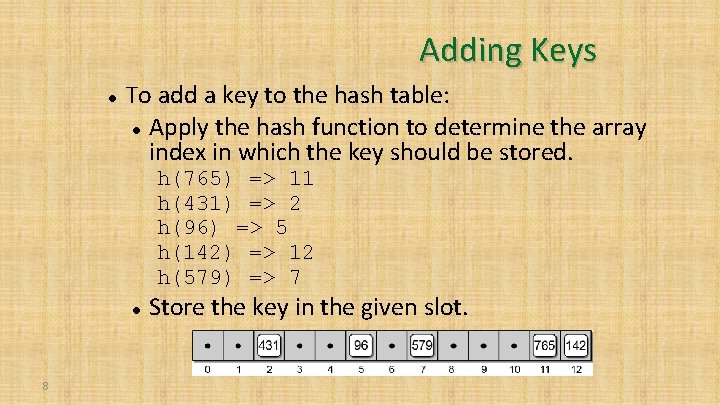
Adding Keys To add a key to the hash table: Apply the hash function to determine the array index in which the key should be stored. h(765) => 11 h(431) => 2 h(96) => 5 h(142) => 12 h(579) => 7 8 Store the key in the given slot.
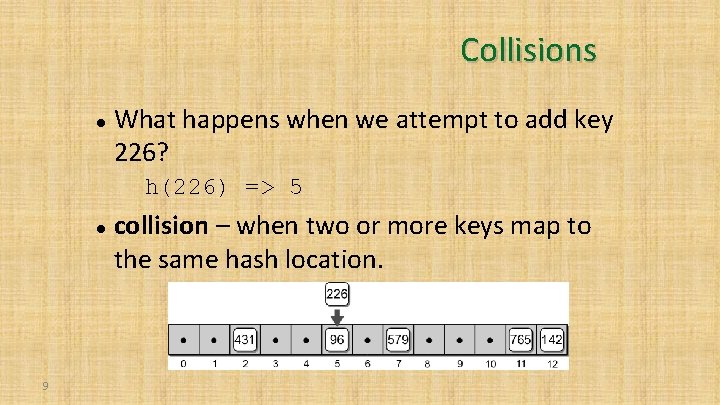
Collisions What happens when we attempt to add key 226? h(226) => 5 9 collision – when two or more keys map to the same hash location.
Resolving collisions • There are in general two approaches to resolve collisions, – Closed hashing: find an open spot within the hash table to store the new element – Open hashing: create a structure, e. g. , a list, or a tree, in the hashed spot to store the elements that have the same hashing key • We first concentrate on closed hashing.
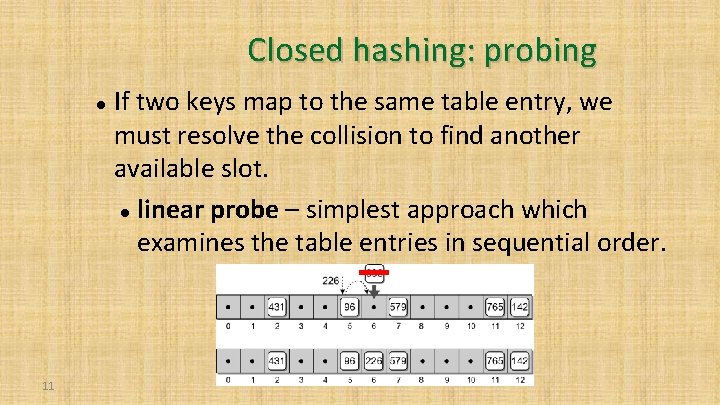
Closed hashing: probing 11 If two keys map to the same table entry, we must resolve the collision to find another available slot. linear probe – simplest approach which examines the table entries in sequential order.
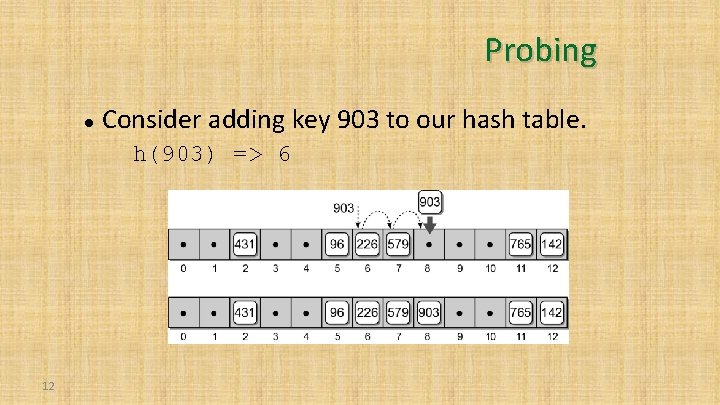
Probing Consider adding key 903 to our hash table. h(903) => 6 12
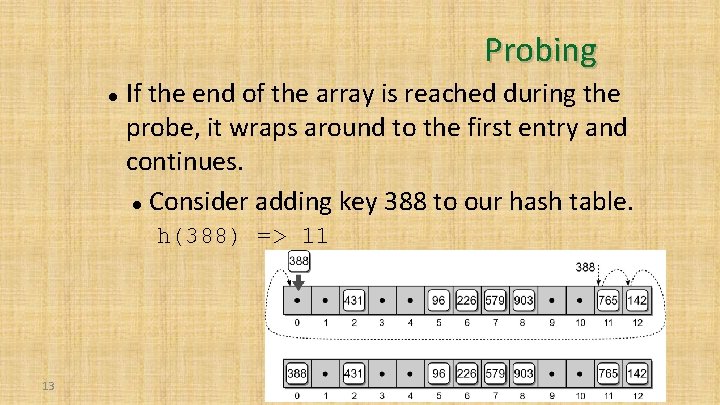
Probing If the end of the array is reached during the probe, it wraps around to the first entry and continues. Consider adding key 388 to our hash table. h(388) => 11 13
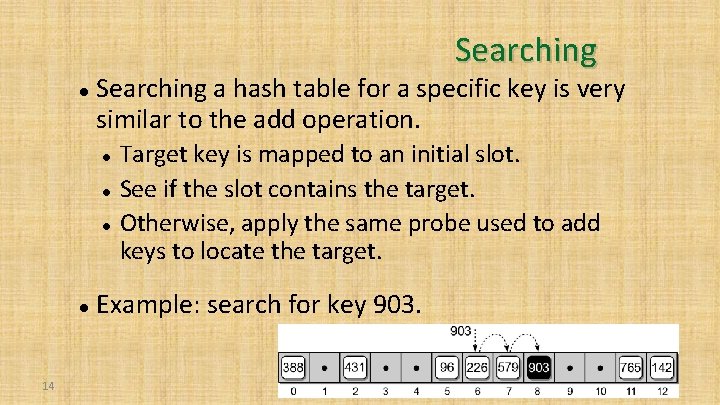
Searching a hash table for a specific key is very similar to the add operation. 14 Target key is mapped to an initial slot. See if the slot contains the target. Otherwise, apply the same probe used to add keys to locate the target. Example: search for key 903.
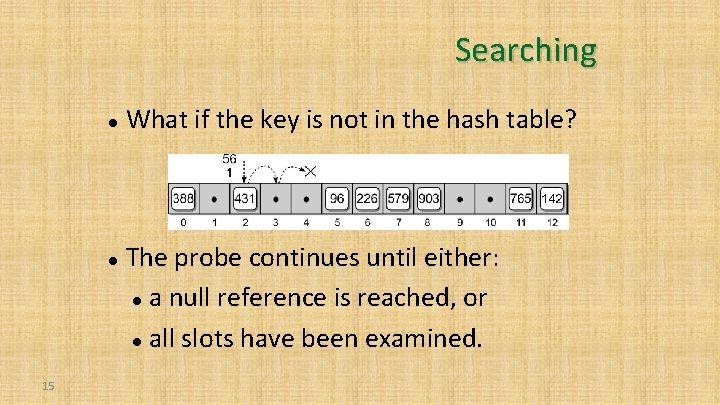
Searching 15 What if the key is not in the hash table? The probe continues until either: a null reference is reached, or all slots have been examined.
Deleting Keys 16 Deleting a key from a hash table is a bit more complicated than adding keys. We can search for the key to be deleted. But we cannot simply remove it by setting the entry to None.
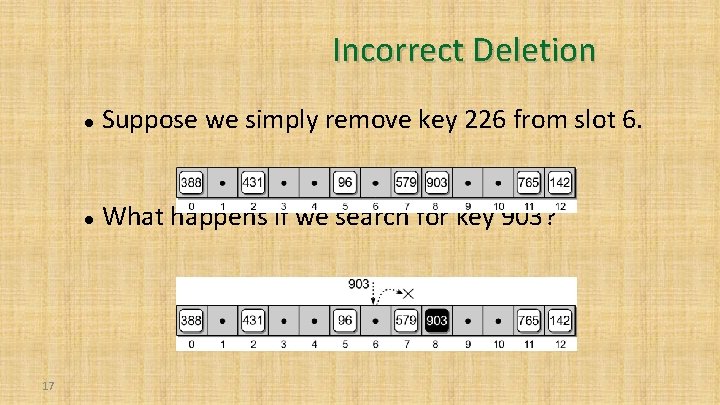
Incorrect Deletion 17 Suppose we simply remove key 226 from slot 6. What happens if we search for key 903?
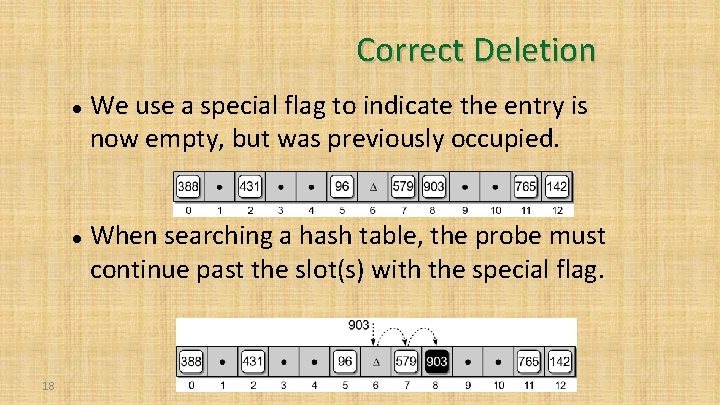
Correct Deletion 18 We use a special flag to indicate the entry is now empty, but was previously occupied. When searching a hash table, the probe must continue past the slot(s) with the special flag.
Clustering 19 The grouping of keys in a common area. As more keys are added to the hash table, more collisions are likely to occur. Clusters begin to form due to the probing required to find an empty slot. As a cluster grows larger, more collisions will occur. primary clustering – clustering around the original hash position.
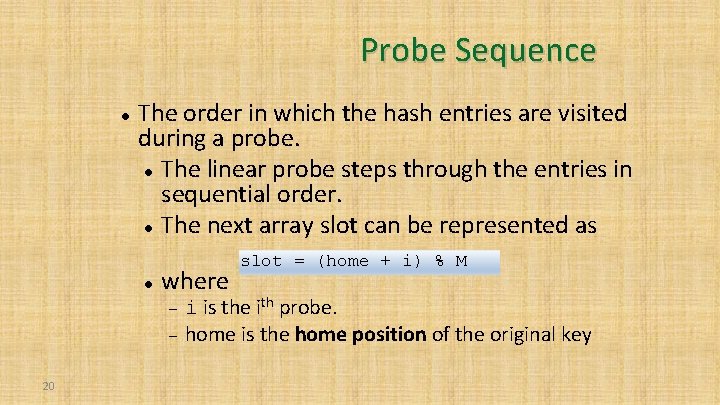
Probe Sequence The order in which the hash entries are visited during a probe. The linear probe steps through the entries in sequential order. The next array slot can be represented as where slot = (home + i) % M i is the ith probe. home is the home position of the original key 20
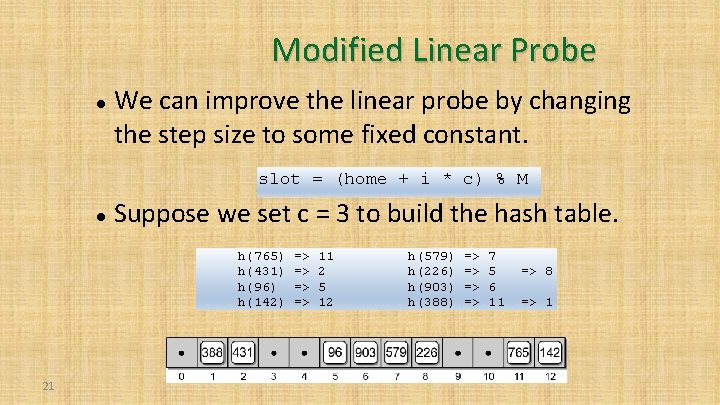
Modified Linear Probe We can improve the linear probe by changing the step size to some fixed constant. slot = (home + i * c) % M Suppose we set c = 3 to build the hash table. h(765) h(431) h(96) h(142) 21 => => 11 2 5 12 h(579) h(226) h(903) h(388) => => 7 5 6 11 => 8 => 1
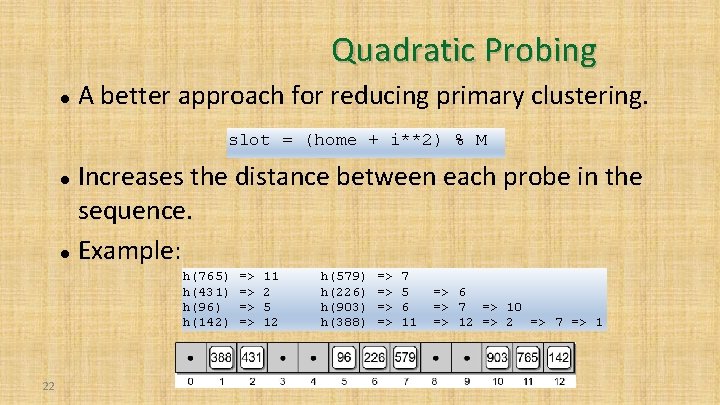
Quadratic Probing A better approach for reducing primary clustering. slot = (home + i**2) % M Increases the distance between each probe in the sequence. Example: h(765) h(431) h(96) h(142) 22 => => 11 2 5 12 h(579) h(226) h(903) h(388) => => 7 5 6 11 => 6 => 7 => 10 => 12 => 7 => 1
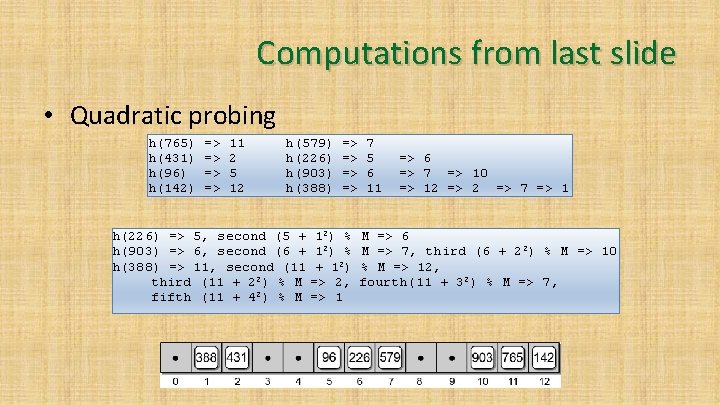
Computations from last slide • Quadratic probing h(765) h(431) h(96) h(142) => => 11 2 5 12 h(579) h(226) h(903) h(388) => => h(226) => 5, second (5 + 12) % h(903) => 6, second (6 + 12) % h(388) => 11, second (11 + 12) third (11 + 22) % M => 2, fifth (11 + 42) % M => 1 7 5 6 11 => 6 => 7 => 10 => 12 => 7 => 1 M => 6 M => 7, third (6 + 22) % M => 10 % M => 12, fourth(11 + 32) % M => 7,
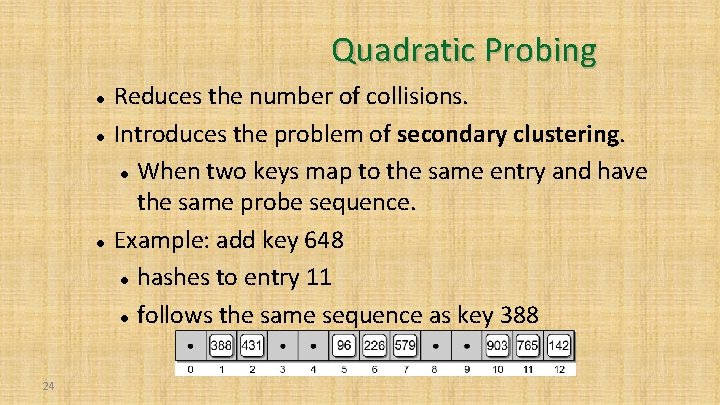
Quadratic Probing 24 Reduces the number of collisions. Introduces the problem of secondary clustering. When two keys map to the same entry and have the same probe sequence. Example: add key 648 hashes to entry 11 follows the same sequence as key 388
Double Hashing When a collision occurs, a second hash function is used to build a probe sequence. slot = (home + i * hp(key)) % M 25 Step size remains a constant throughout the probe. Multiple keys that have the same home position, will have different probe sequences.
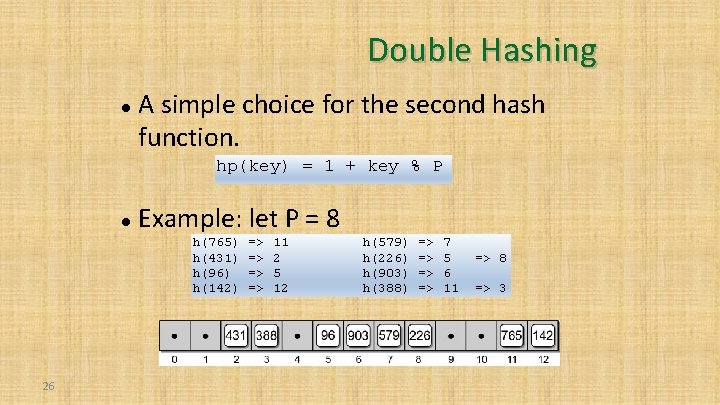
Double Hashing A simple choice for the second hash function. hp(key) = 1 + key % P Example: let P = 8 h(765) h(431) h(96) h(142) 26 => => 11 2 5 12 h(579) h(226) h(903) h(388) => => 7 5 6 11 => 8 => 3
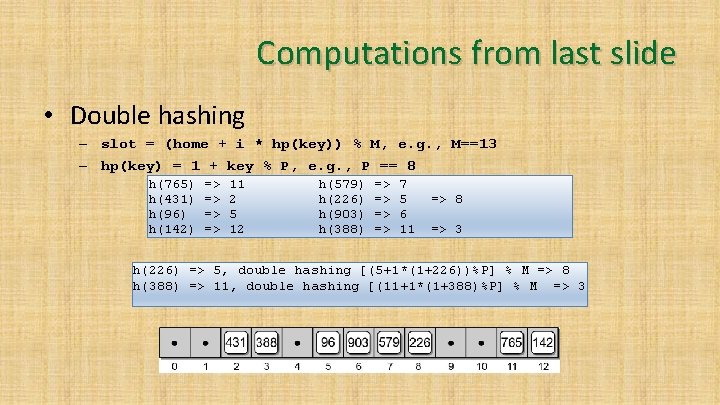
Computations from last slide • Double hashing – slot = (home + i * hp(key)) % M, e. g. , M==13 – hp(key) = 1 + key % P, e. g. , P == 8 h(765) h(431) h(96) h(142) => => 11 2 5 12 h(579) h(226) h(903) h(388) => => 7 5 6 11 => 8 => 3 h(226) => 5, double hashing [(5+1*(1+226))%P] % M => 8 h(388) => 11, double hashing [(11+1*(1+388)%P] % M => 3
- Slides: 27