
CSCI 1900 Discrete Structures Sequences Reading Kolman Section


- Slides: 25
CSCI 1900 Discrete Structures Sequences Reading: Kolman, Section 1. 3 CSCI 1900 – Discrete Structures Sequences – Page 1
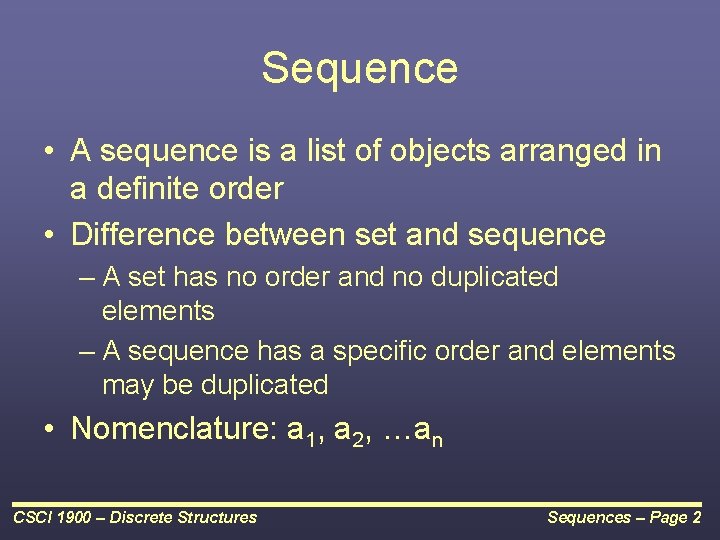
Sequence • A sequence is a list of objects arranged in a definite order • Difference between set and sequence – A set has no order and no duplicated elements – A sequence has a specific order and elements may be duplicated • Nomenclature: a 1, a 2, …an CSCI 1900 – Discrete Structures Sequences – Page 2
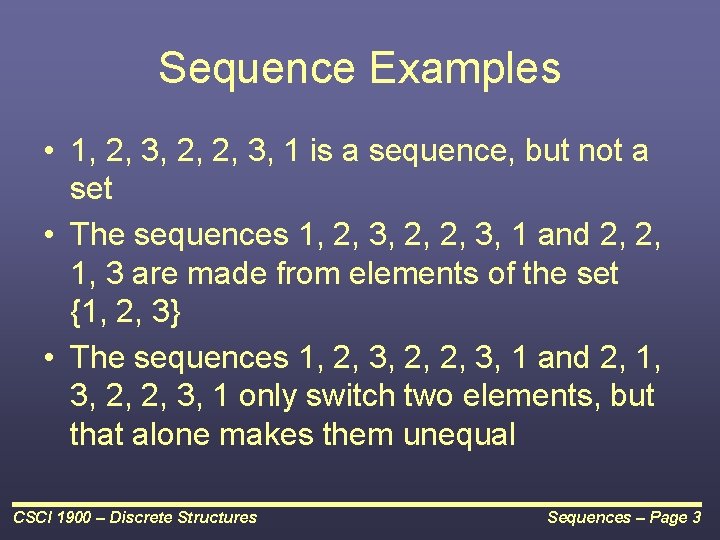
Sequence Examples • 1, 2, 3, 2, 2, 3, 1 is a sequence, but not a set • The sequences 1, 2, 3, 2, 2, 3, 1 and 2, 2, 1, 3 are made from elements of the set {1, 2, 3} • The sequences 1, 2, 3, 2, 2, 3, 1 and 2, 1, 3, 2, 2, 3, 1 only switch two elements, but that alone makes them unequal CSCI 1900 – Discrete Structures Sequences – Page 3
Types of Sequences • Sequence may stop after n steps (finite) or go on for ever (infinite) • Formulas can be used to describe sequences – Recursive – Explicit CSCI 1900 – Discrete Structures Sequences – Page 4
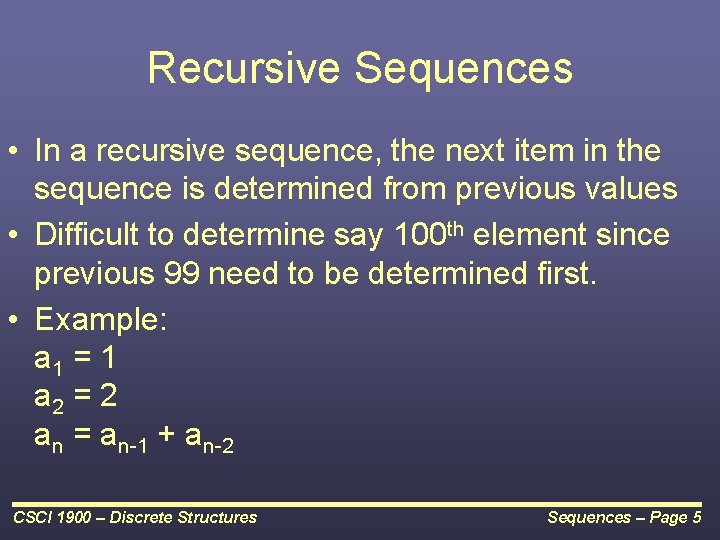
Recursive Sequences • In a recursive sequence, the next item in the sequence is determined from previous values • Difficult to determine say 100 th element since previous 99 need to be determined first. • Example: a 1 = 1 a 2 = 2 an = an-1 + an-2 CSCI 1900 – Discrete Structures Sequences – Page 5
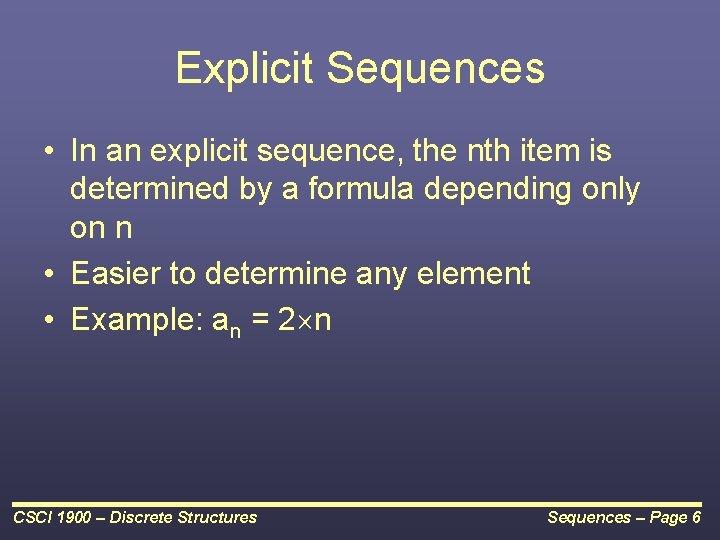
Explicit Sequences • In an explicit sequence, the nth item is determined by a formula depending only on n • Easier to determine any element • Example: an = 2 n CSCI 1900 – Discrete Structures Sequences – Page 6
Strings • Sequences can be made up of characters too • Example: W, a, k, e, , u, p • Removing the commas and you get a string: “Wake up” • Strings best illustrate difference between sequences and sets – a, b, a, … is a sequence, i. e. , “abababa…” is a string – The corresponding set is {a, b} CSCI 1900 – Discrete Structures Sequences – Page 7
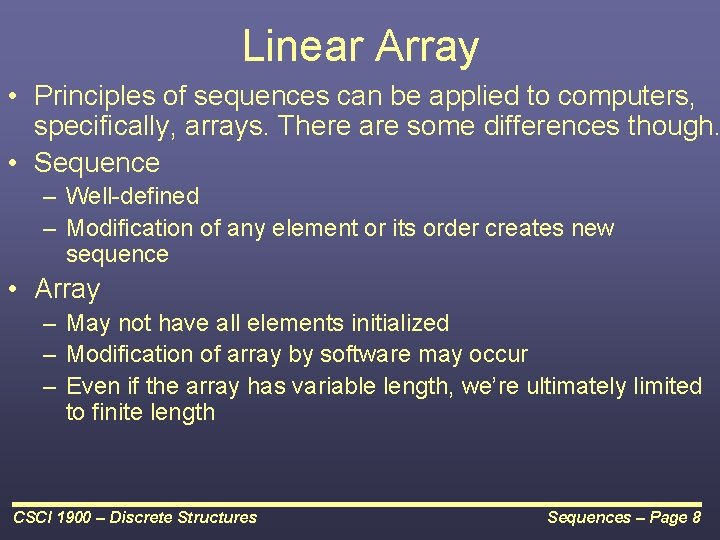
Linear Array • Principles of sequences can be applied to computers, specifically, arrays. There are some differences though. • Sequence – Well-defined – Modification of any element or its order creates new sequence • Array – May not have all elements initialized – Modification of array by software may occur – Even if the array has variable length, we’re ultimately limited to finite length CSCI 1900 – Discrete Structures Sequences – Page 8
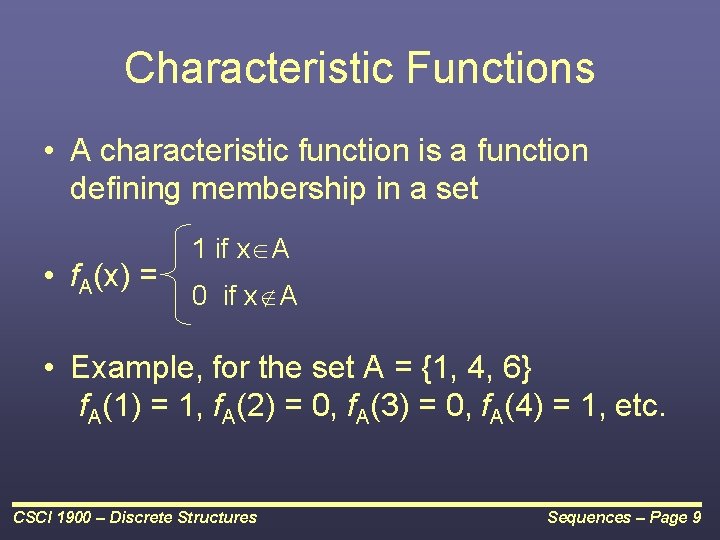
Characteristic Functions • A characteristic function is a function defining membership in a set • f. A(x) = 1 if x A 0 if x A • Example, for the set A = {1, 4, 6} f. A(1) = 1, f. A(2) = 0, f. A(3) = 0, f. A(4) = 1, etc. CSCI 1900 – Discrete Structures Sequences – Page 9
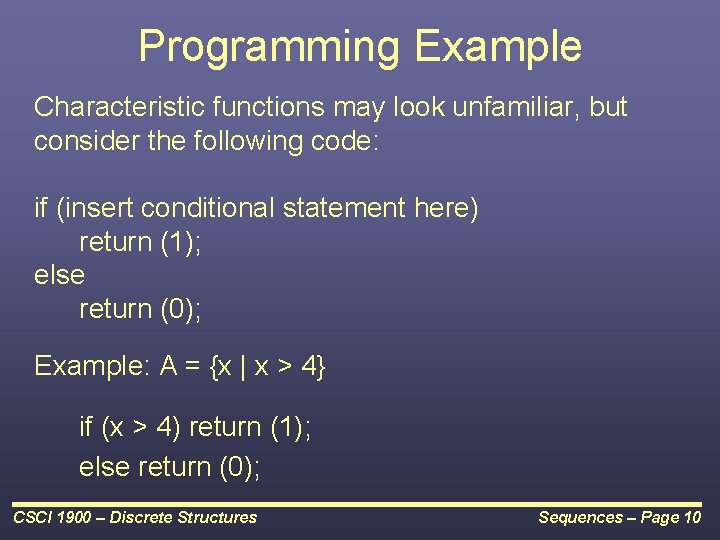
Programming Example Characteristic functions may look unfamiliar, but consider the following code: if (insert conditional statement here) return (1); else return (0); Example: A = {x | x > 4} if (x > 4) return (1); else return (0); CSCI 1900 – Discrete Structures Sequences – Page 10
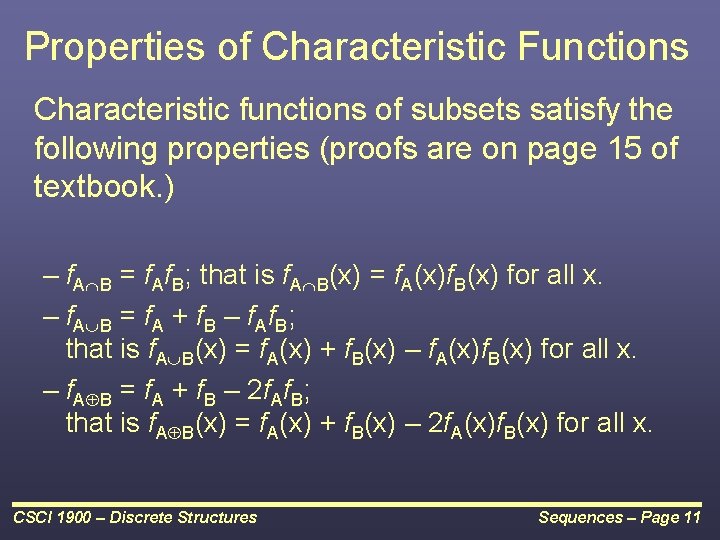
Properties of Characteristic Functions Characteristic functions of subsets satisfy the following properties (proofs are on page 15 of textbook. ) – f. A B = f. Af. B; that is f. A B(x) = f. A(x)f. B(x) for all x. – f. A B = f. A + f. B – f. Af. B; that is f. A B(x) = f. A(x) + f. B(x) – f. A(x)f. B(x) for all x. – f. A B = f. A + f. B – 2 f. Af. B; that is f. A B(x) = f. A(x) + f. B(x) – 2 f. A(x)f. B(x) for all x. CSCI 1900 – Discrete Structures Sequences – Page 11
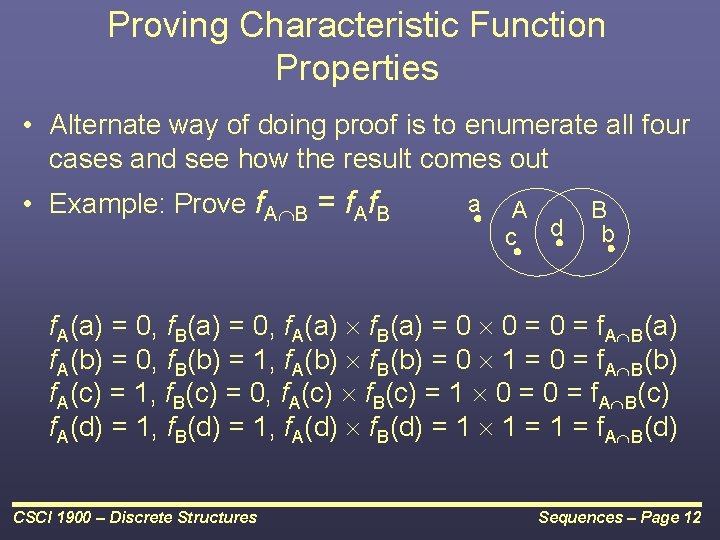
Proving Characteristic Function Properties • Alternate way of doing proof is to enumerate all four cases and see how the result comes out • Example: Prove f. A B = f. Af. B a A c d B b f. A(a) = 0, f. B(a) = 0, f. A(a) f. B(a) = 0 0 = f. A B(a) f. A(b) = 0, f. B(b) = 1, f. A(b) f. B(b) = 0 1 = 0 = f. A B(b) f. A(c) = 1, f. B(c) = 0, f. A(c) f. B(c) = 1 0 = f. A B(c) f. A(d) = 1, f. B(d) = 1, f. A(d) f. B(d) = 1 1 = f. A B(d) CSCI 1900 – Discrete Structures Sequences – Page 12
Representing Sets with a Computer • Remember that sets have no order and no duplicated elements. • The general need to assign each element in a set to a memory location gives it order in a computer. • We can use the characteristic function to define a set using a computer. CSCI 1900 – Discrete Structures Sequences – Page 13
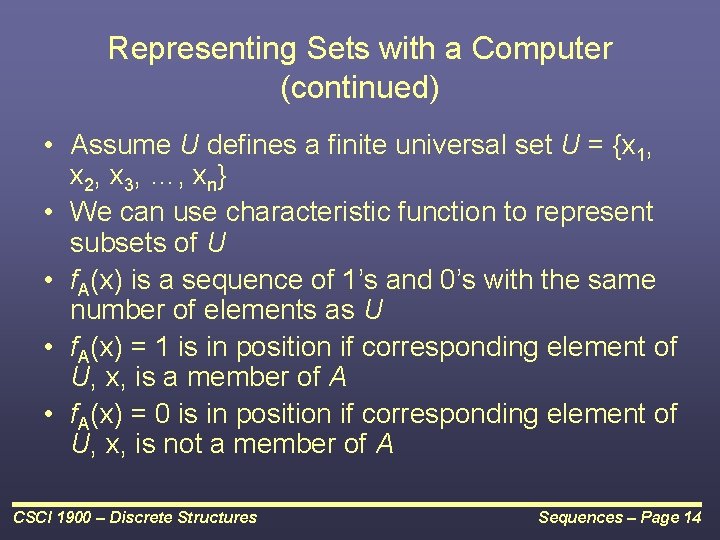
Representing Sets with a Computer (continued) • Assume U defines a finite universal set U = {x 1, x 2, x 3, …, xn} • We can use characteristic function to represent subsets of U • f. A(x) is a sequence of 1’s and 0’s with the same number of elements as U • f. A(x) = 1 is in position if corresponding element of U, x, is a member of A • f. A(x) = 0 is in position if corresponding element of U, x, is not a member of A CSCI 1900 – Discrete Structures Sequences – Page 14
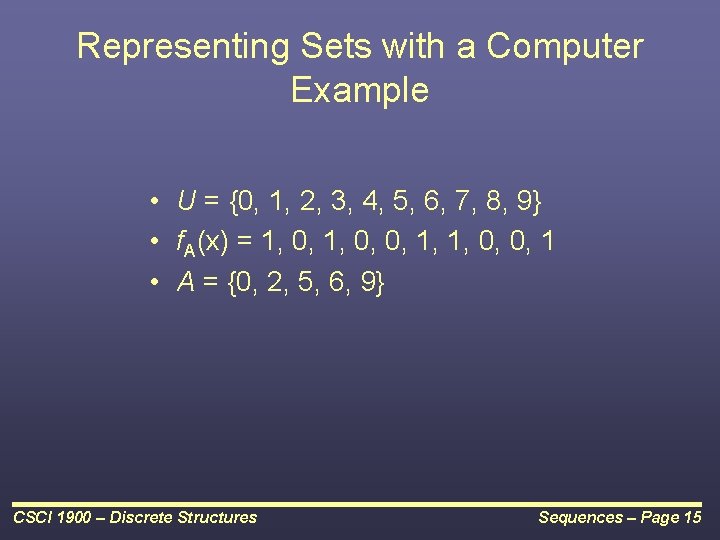
Representing Sets with a Computer Example • U = {0, 1, 2, 3, 4, 5, 6, 7, 8, 9} • f. A(x) = 1, 0, 0, 1, 1, 0, 0, 1 • A = {0, 2, 5, 6, 9} CSCI 1900 – Discrete Structures Sequences – Page 15
More Properties of Sequences • Any set with n elements can be arranged as a sequence of length n, but not vice versa. This is because sets have no order and duplicates are not allowed. • Each subset can be identified with its characteristic function as a sequence of 1’s and 0’s. • Characteristic function for universal set, U, is a sequence of all ones. CSCI 1900 – Discrete Structures Sequences – Page 16
Countable and Uncountable • A set is countable if it corresponds to some sequence. – Members of set can be arranged in a list – Elements have position • All finite sets are countable • Not all infinite sets are countable, and are therefore uncountable – Best example is real numbers – E. g. , what comes after 1. 23534? CSCI 1900 – Discrete Structures Sequences – Page 17
Strings and Regular Expressions • Given a set A, the set A* consists of all finite sequences of elements of A • Example: – A = alphabet = {a, b, c, d, e, f, g, h, i, j, k, l, m, n, o, p, q, r, s, t, u, v, w, x, y, z} – A* = words (the finite sequences, words, in A are not written with commas) – A* contains all possible words, even those that are unpronounceable or make no sense such as “prsartkc” • The empty sequence or empty string is represented with CSCI 1900 – Discrete Structures Sequences – Page 18
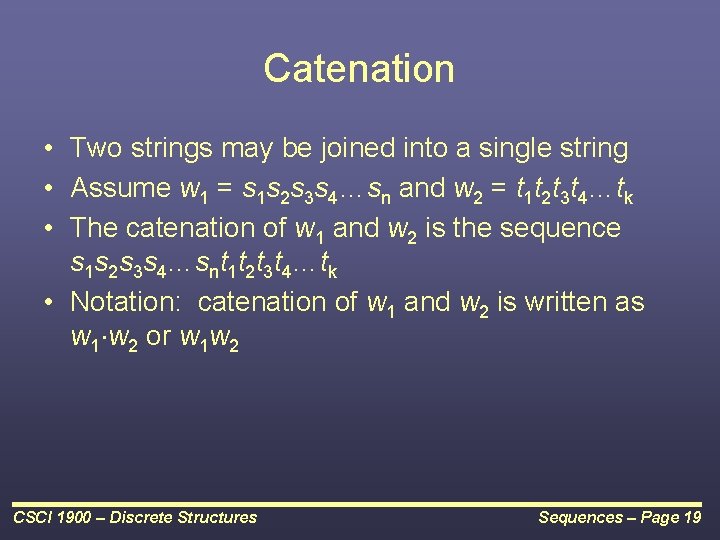
Catenation • Two strings may be joined into a single string • Assume w 1 = s 1 s 2 s 3 s 4…sn and w 2 = t 1 t 2 t 3 t 4…tk • The catenation of w 1 and w 2 is the sequence s 1 s 2 s 3 s 4…snt 1 t 2 t 3 t 4…tk • Notation: catenation of w 1 and w 2 is written as w 1 w 2 or w 1 w 2 CSCI 1900 – Discrete Structures Sequences – Page 19
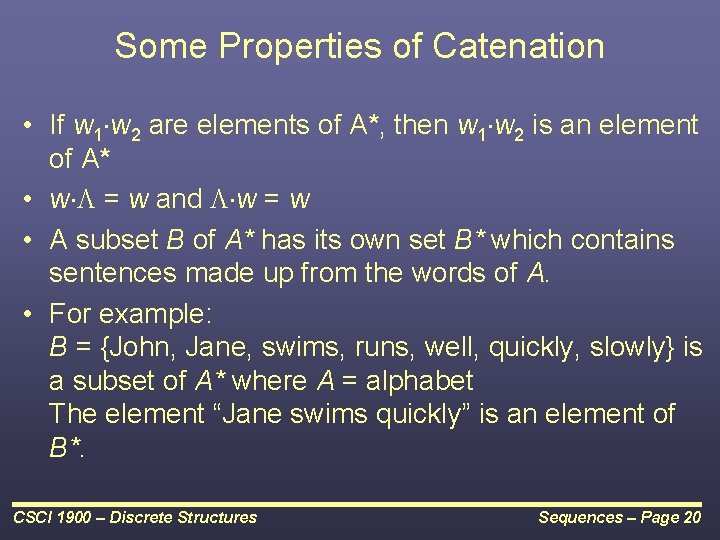
Some Properties of Catenation • If w 1 w 2 are elements of A*, then w 1 w 2 is an element of A* • w = w and w = w • A subset B of A* has its own set B* which contains sentences made up from the words of A. • For example: B = {John, Jane, swims, runs, well, quickly, slowly} is a subset of A* where A = alphabet The element “Jane swims quickly” is an element of B*. CSCI 1900 – Discrete Structures Sequences – Page 20
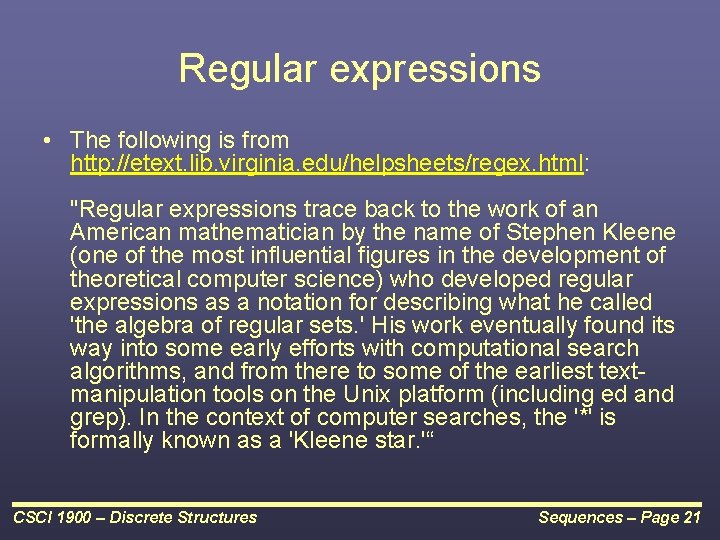
Regular expressions • The following is from http: //etext. lib. virginia. edu/helpsheets/regex. html: "Regular expressions trace back to the work of an American mathematician by the name of Stephen Kleene (one of the most influential figures in the development of theoretical computer science) who developed regular expressions as a notation for describing what he called 'the algebra of regular sets. ' His work eventually found its way into some early efforts with computational search algorithms, and from there to some of the earliest textmanipulation tools on the Unix platform (including ed and grep). In the context of computer searches, the '*' is formally known as a 'Kleene star. '“ CSCI 1900 – Discrete Structures Sequences – Page 21
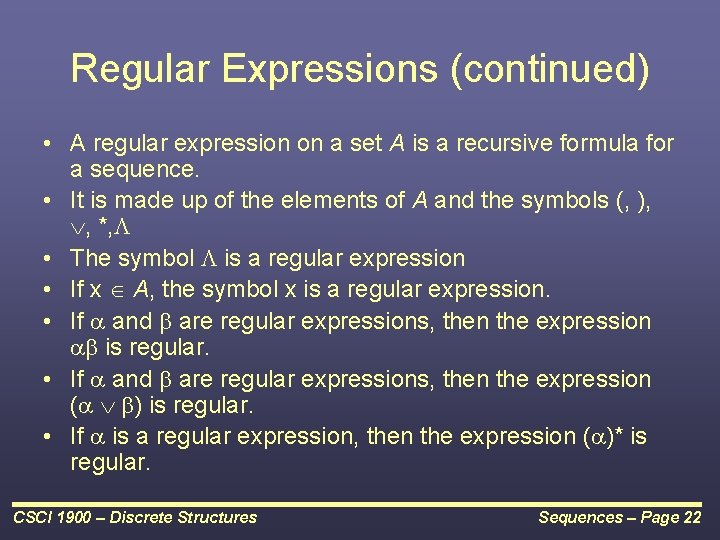
Regular Expressions (continued) • A regular expression on a set A is a recursive formula for a sequence. • It is made up of the elements of A and the symbols (, ), , *, • The symbol is a regular expression • If x A, the symbol x is a regular expression. • If and are regular expressions, then the expression is regular. • If and are regular expressions, then the expression ( ) is regular. • If is a regular expression, then the expression ( )* is regular. CSCI 1900 – Discrete Structures Sequences – Page 22
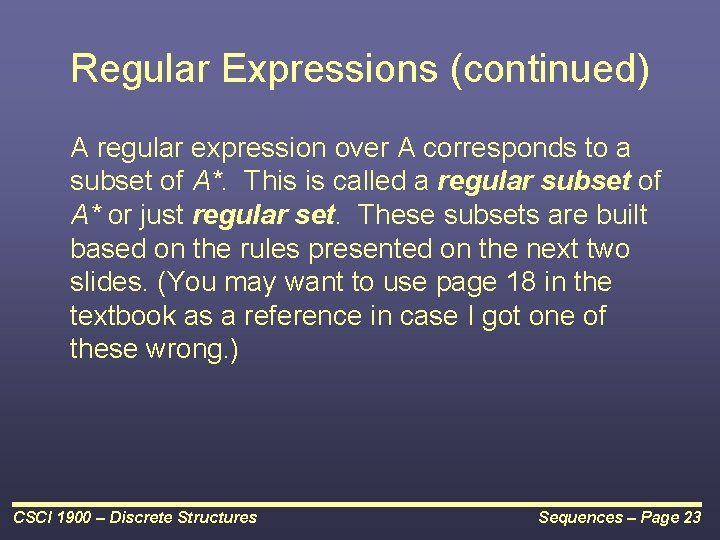
Regular Expressions (continued) A regular expression over A corresponds to a subset of A*. This is called a regular subset of A* or just regular set. These subsets are built based on the rules presented on the next two slides. (You may want to use page 18 in the textbook as a reference in case I got one of these wrong. ) CSCI 1900 – Discrete Structures Sequences – Page 23
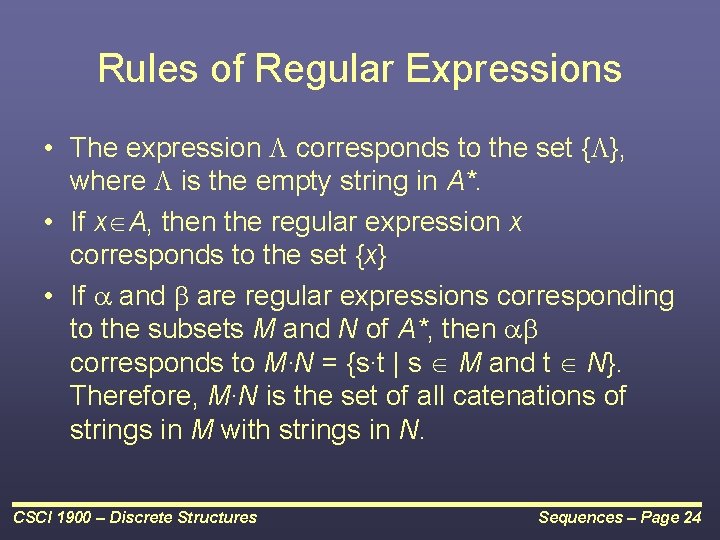
Rules of Regular Expressions • The expression corresponds to the set { }, where is the empty string in A*. • If x A, then the regular expression x corresponds to the set {x} • If and are regular expressions corresponding to the subsets M and N of A*, then corresponds to M∙N = {s∙t | s M and t N}. Therefore, M∙N is the set of all catenations of strings in M with strings in N. CSCI 1900 – Discrete Structures Sequences – Page 24
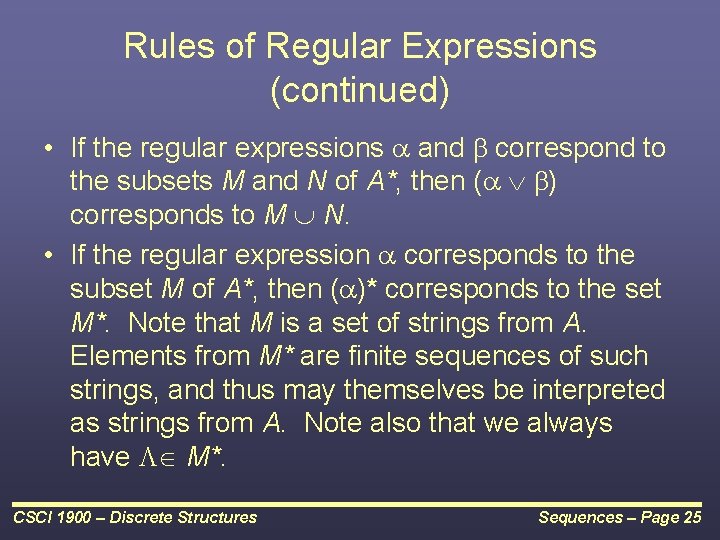
Rules of Regular Expressions (continued) • If the regular expressions and correspond to the subsets M and N of A*, then ( ) corresponds to M N. • If the regular expression corresponds to the subset M of A*, then ( )* corresponds to the set M*. Note that M is a set of strings from A. Elements from M* are finite sequences of such strings, and thus may themselves be interpreted as strings from A. Note also that we always have M*. CSCI 1900 – Discrete Structures Sequences – Page 25