
Csci 136 Computer Architecture II Designing a MultiCycle

![Breaking Instruction Execution into Multiple Cycles Instruction Fetch IR = Memory[PC] PC = PC+4](https://slidetodoc.com/presentation_image/003e8c3d548627c9644ec26d9138bb63/image-11.jpg "Breaking Instruction Execution into Multiple Cycles Instruction Fetch IR = Memory[PC] PC = PC+4")
- Slides: 23
Csci 136 Computer Architecture II – Designing a Multi-Cycle Processor Xiuzhen Cheng cheng@gwu. edu
Announcement Homework assignment #8, Due time – before class, March 29. Readings: Sections 5. 5 -5. 6 Problems: 5. 32, 5. 33, 5. 36. Quiz #3: March 29 Project #3 is on-line
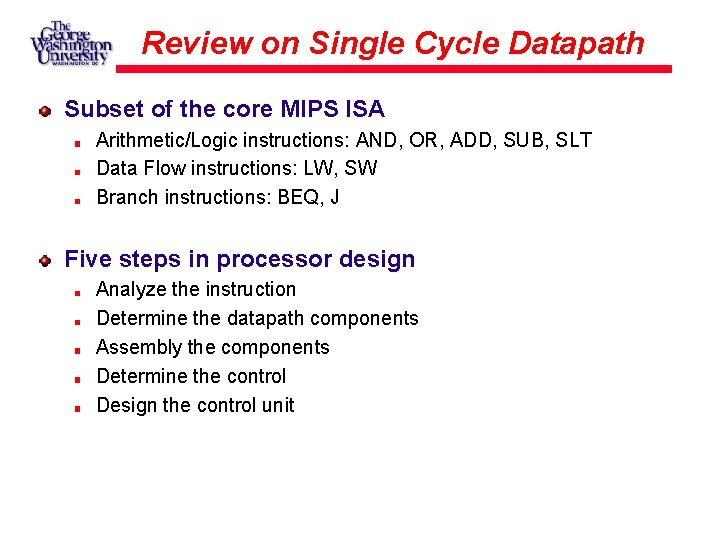
Review on Single Cycle Datapath Subset of the core MIPS ISA Arithmetic/Logic instructions: AND, OR, ADD, SUB, SLT Data Flow instructions: LW, SW Branch instructions: BEQ, J Five steps in processor design Analyze the instruction Determine the datapath components Assembly the components Determine the control Design the control unit
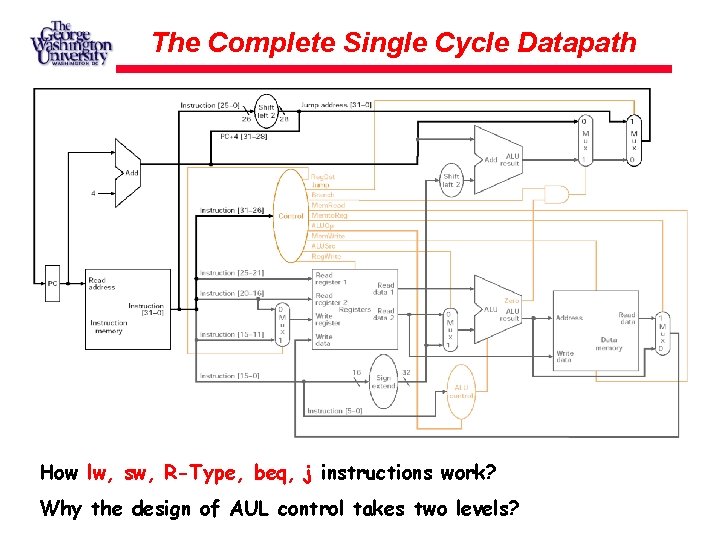
The Complete Single Cycle Datapath How lw, sw, R-Type, beq, j instructions work? Why the design of AUL control takes two levels?
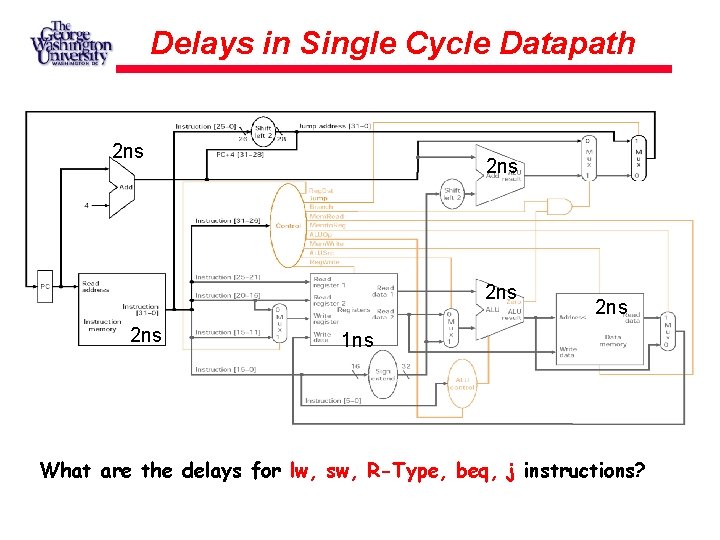
Delays in Single Cycle Datapath 2 ns 2 ns 2 ns 1 ns What are the delays for lw, sw, R-Type, beq, j instructions?
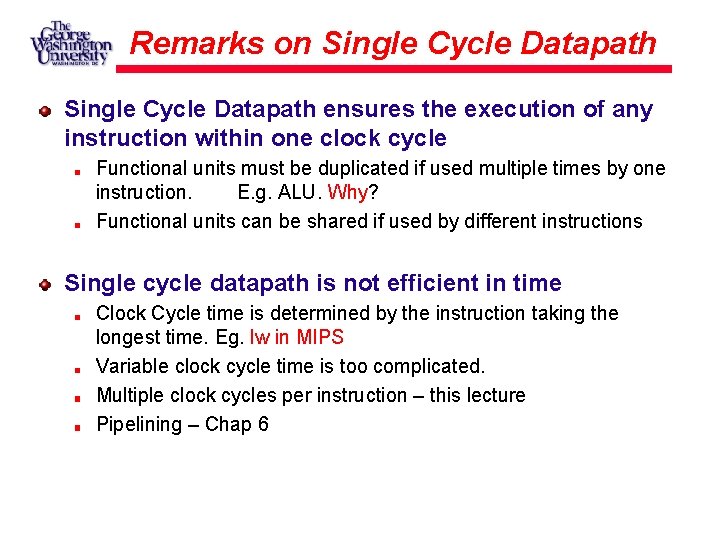
Remarks on Single Cycle Datapath ensures the execution of any instruction within one clock cycle Functional units must be duplicated if used multiple times by one instruction. E. g. ALU. Why? Functional units can be shared if used by different instructions Single cycle datapath is not efficient in time Clock Cycle time is determined by the instruction taking the longest time. Eg. lw in MIPS Variable clock cycle time is too complicated. Multiple clock cycles per instruction – this lecture Pipelining – Chap 6
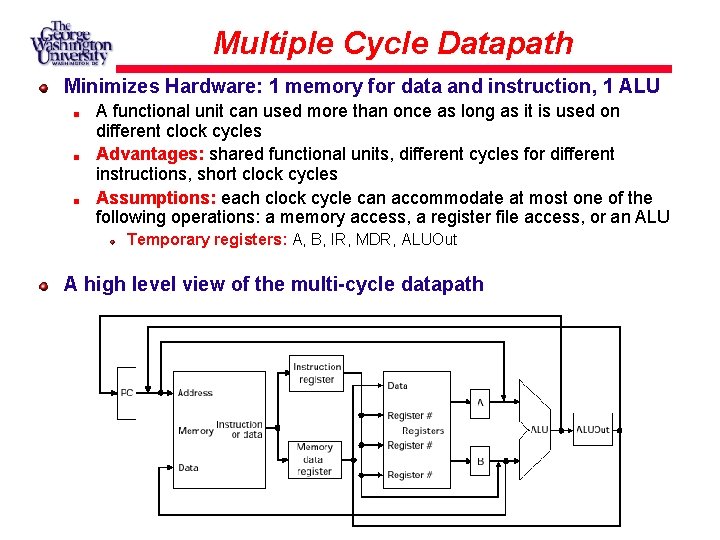
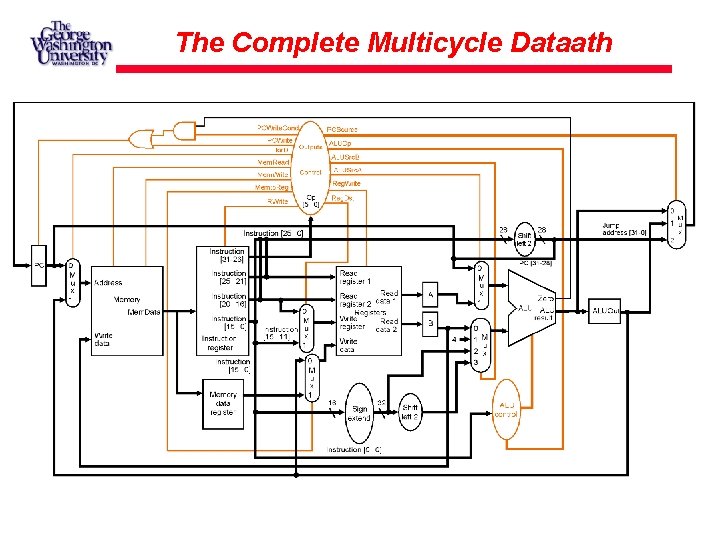
Multiple Cycle Datapath Minimizes Hardware: 1 memory for data and instruction, 1 ALU A functional unit can used more than once as long as it is used on different clock cycles Advantages: shared functional units, different cycles for different instructions, short clock cycles Assumptions: each clock cycle can accommodate at most one of the following operations: a memory access, a register file access, or an ALU Temporary registers: A, B, IR, MDR, ALUOut A high level view of the multi-cycle datapath
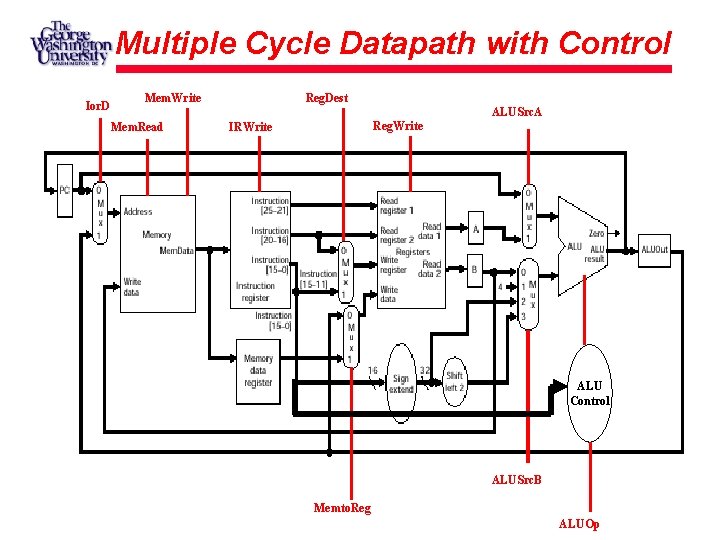
Multiple Cycle Datapath with Control Ior. D Mem. Write Reg. Dest ALUSrc. A Mem. Read Reg. Write IRWrite ALU Control ALUSrc. B Memto. Reg ALUOp
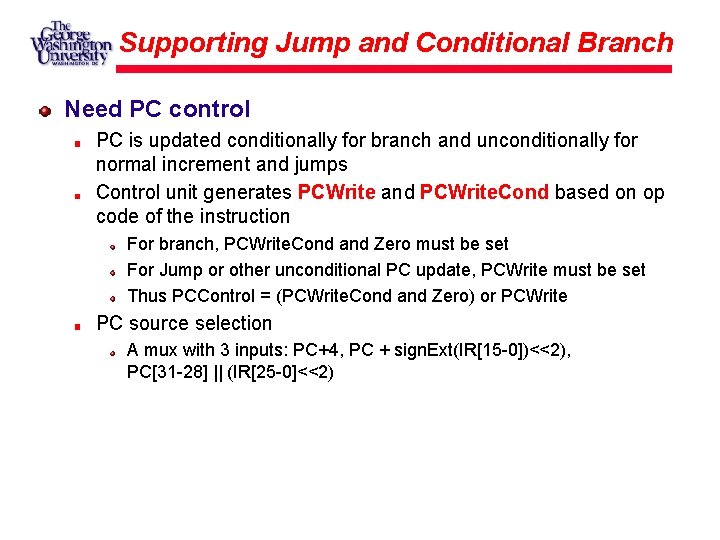
Supporting Jump and Conditional Branch Need PC control PC is updated conditionally for branch and unconditionally for normal increment and jumps Control unit generates PCWrite and PCWrite. Cond based on op code of the instruction For branch, PCWrite. Cond and Zero must be set For Jump or other unconditional PC update, PCWrite must be set Thus PCControl = (PCWrite. Cond and Zero) or PCWrite PC source selection A mux with 3 inputs: PC+4, PC + sign. Ext(IR[15 -0])<<2), PC[31 -28] || (IR[25 -0]<<2)
The Complete Multicycle Dataath
Breaking Instruction Execution into Multiple Cycles Instruction Fetch IR = Memory[PC] PC = PC+4 Instruction Decode/Register Fetch A = Reg[IR[25 -21]] B = Reg[IR[20 -16]] ALUOut = PC + (sign-extend(IR[15 -0])<<2) Execution, Address compuation, branch/jump completion R-type: ALUOut = A op B Memory access: ALUOut = A + sign-extend(IR[15 -0]) Branch: if (A==B) then PC = ALUOut Jump: PC = PC[31 -28] || (IR[25 -0]<<2) Memory Access or R-type Completion R-type: Load: Store: Reg[IR[15 -11]] = ALUOut MDR = Memory[ALUOut] or Memory[ALUOut] = B Memory read completion Load: Reg[IR[20 -16]] = MDR
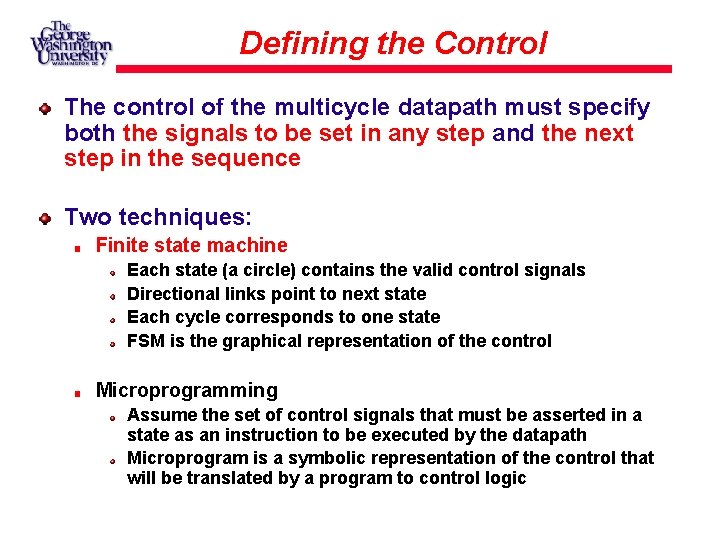
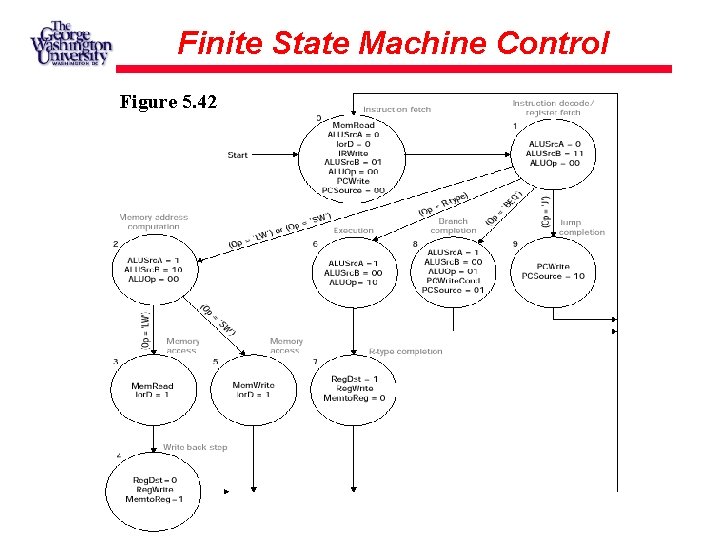
Defining the Control The control of the multicycle datapath must specify both the signals to be set in any step and the next step in the sequence Two techniques: Finite state machine Each state (a circle) contains the valid control signals Directional links point to next state Each cycle corresponds to one state FSM is the graphical representation of the control Microprogramming Assume the set of control signals that must be asserted in a state as an instruction to be executed by the datapath Microprogram is a symbolic representation of the control that will be translated by a program to control logic
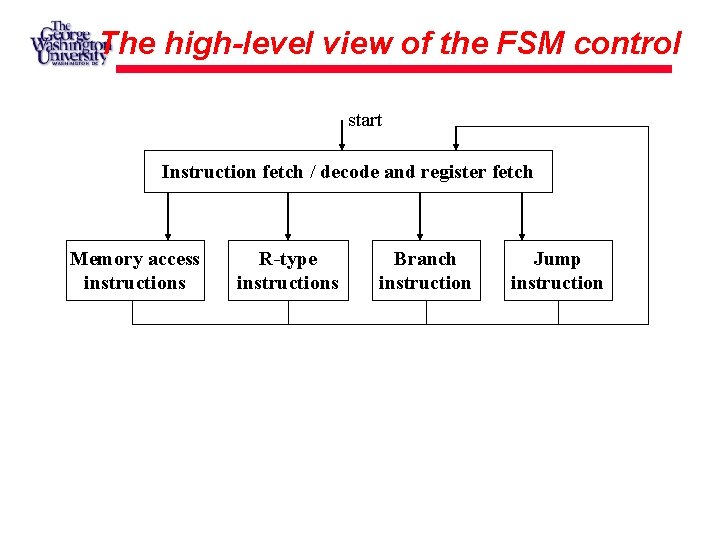
The high-level view of the FSM control start Instruction fetch / decode and register fetch Memory access instructions R-type instructions Branch instruction Jump instruction
Finite State Machine Control Figure 5. 42
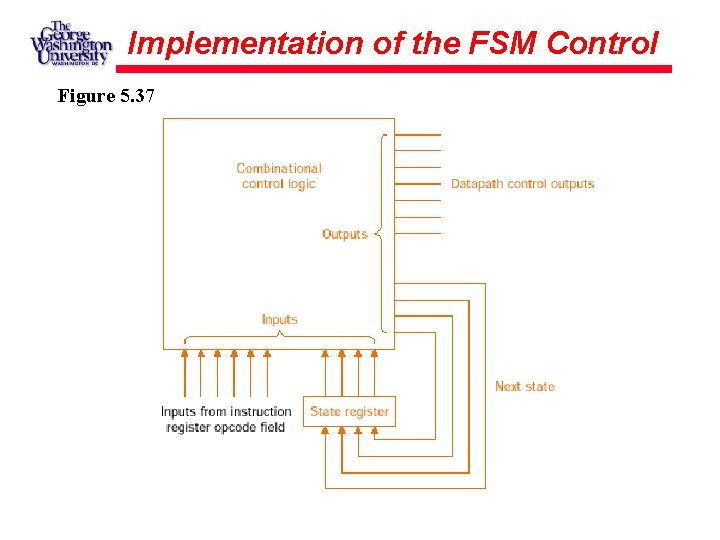
Implementation of the FSM Control Figure 5. 37
In-Class Exercise How to modify the complete datapath (Figure 5. 33) for the multiple cycle implementation to accommodate the ori (or immediate) instruction? Given the FSM control design What about addi, jal and jr instructions?
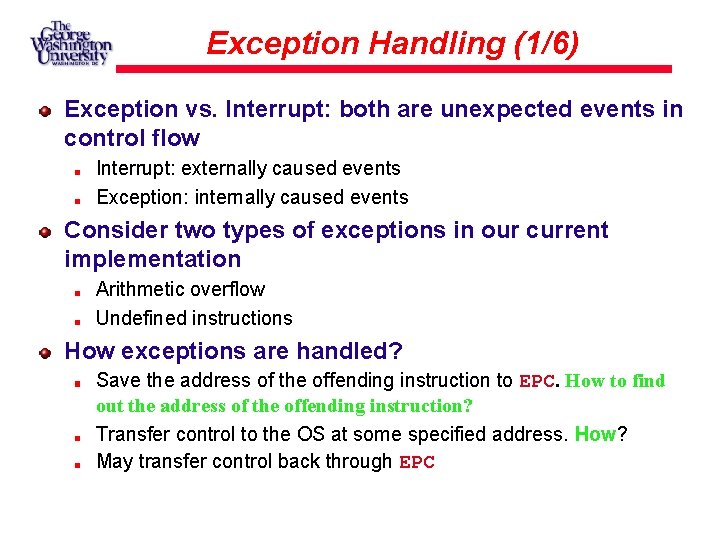
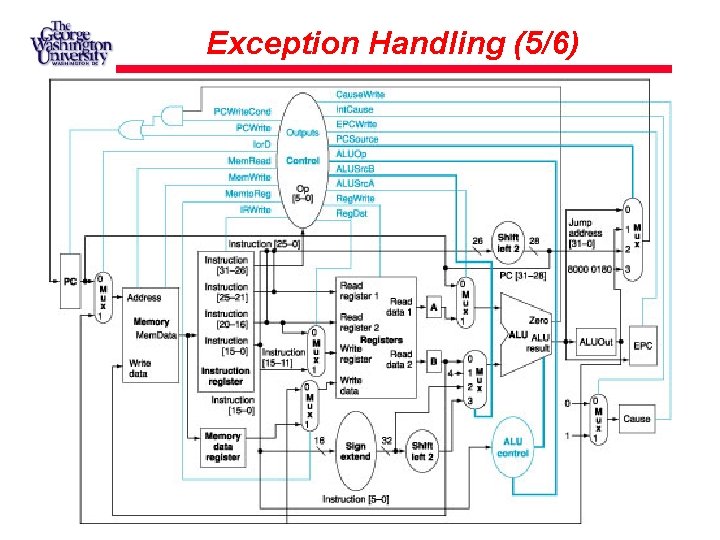
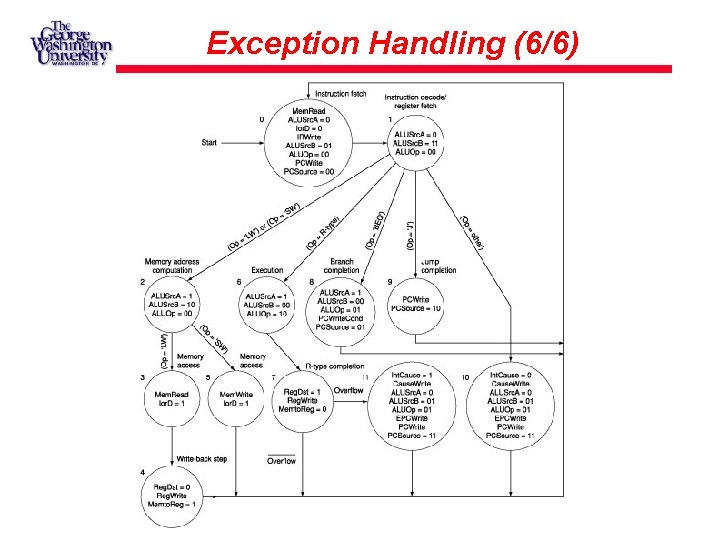
Exception Handling (1/6) Exception vs. Interrupt: both are unexpected events in control flow Interrupt: externally caused events Exception: internally caused events Consider two types of exceptions in our current implementation Arithmetic overflow Undefined instructions How exceptions are handled? Save the address of the offending instruction to EPC. How to find out the address of the offending instruction? Transfer control to the OS at some specified address. How? May transfer control back through EPC
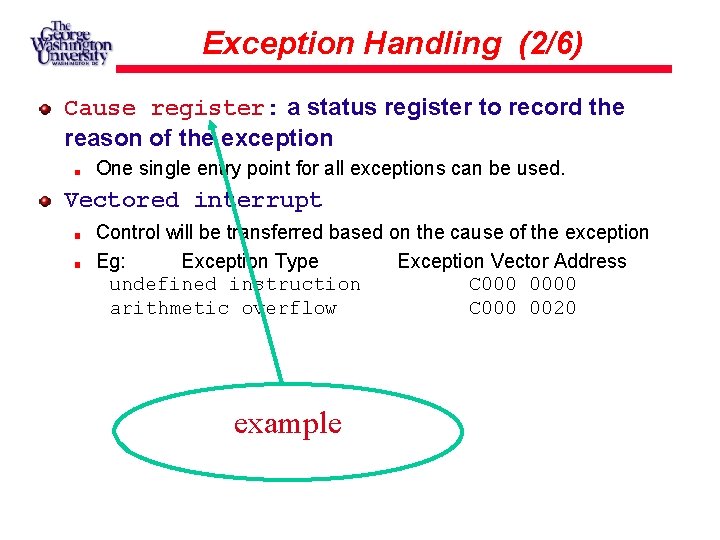
Exception Handling (2/6) Cause register: a status register to record the reason of the exception One single entry point for all exceptions can be used. Vectored interrupt Control will be transferred based on the cause of the exception Eg: Exception Type Exception Vector Address undefined instruction C 0000 arithmetic overflow C 000 0020 example
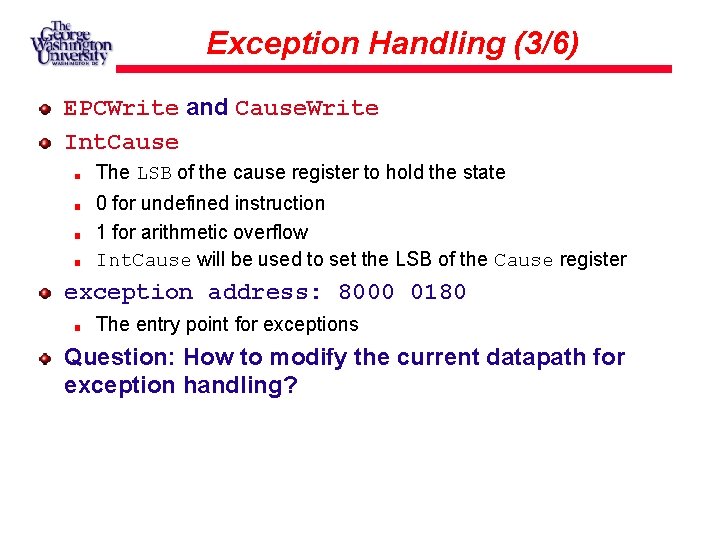
Exception Handling (3/6) EPCWrite and Cause. Write Int. Cause The LSB of the cause register to hold the state 0 for undefined instruction 1 for arithmetic overflow Int. Cause will be used to set the LSB of the Cause register exception address: 8000 0180 The entry point for exceptions Question: How to modify the current datapath for exception handling?
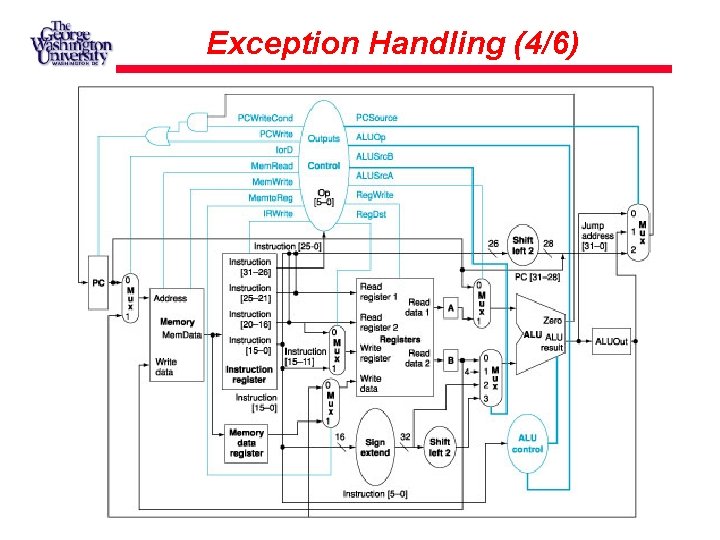
Exception Handling (4/6)
Exception Handling (5/6)
Exception Handling (6/6)
Questions?