
CSCE 590 Web Scraping NLTK Topics n n
CSCE 590 Web Scraping - NLTK Topics n n Introduction to NLTK Parsing with the NLTK Readings: n – 1– Online book February 21, 2017
http: //www. nltk. org/book/ 0. Preface 1. Language Processing and Python 2. Accessing Text Corpora and Lexical Resources 3. Processing Raw Text 4. Writing Structured Programs 5. Categorizing and Tagging Words (minor fixes still required) 6. Learning to Classify Text 7. Extracting Information from Text 8. Analyzing Sentence Structure 9. Building Feature Based Grammars 10. Analyzing the Meaning of Sentences (minor fixes still required) 11. Managing Linguistic Data (minor fixes still required) 12. Afterword: Facing the Language Challenge Bibliography – Term 2– Index
Installing NLTK Install Setuptools: http: //pypi. python. org/pypi/setuptools Install Pip: run sudo easy_install pip Install Numpy (optional): run sudo pip install -U numpy Install Py. YAML and NLTK: run sudo pip install -U pyyaml nltk Test installation: run python then type import nltk – 3–
Installing NLTK Data >>> import nltk >>> nltk. download() – 4–
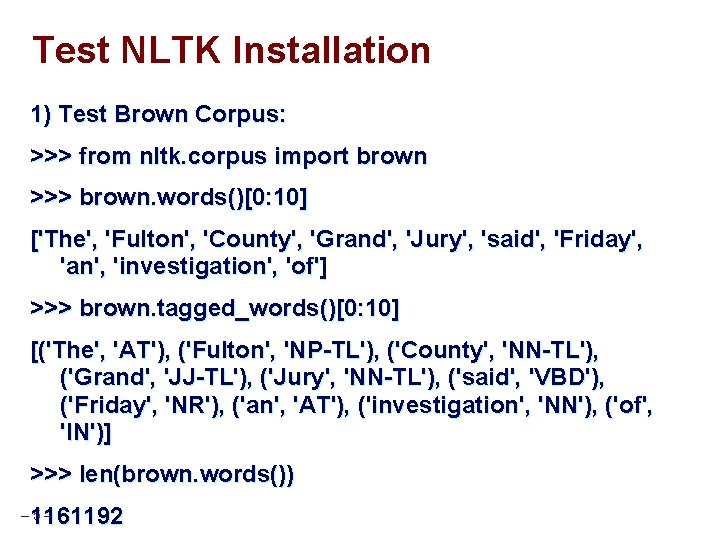
Test NLTK Installation 1) Test Brown Corpus: >>> from nltk. corpus import brown >>> brown. words()[0: 10] ['The', 'Fulton', 'County', 'Grand', 'Jury', 'said', 'Friday', 'an', 'investigation', 'of'] >>> brown. tagged_words()[0: 10] [('The', 'AT'), ('Fulton', 'NP-TL'), ('County', 'NN-TL'), ('Grand', 'JJ-TL'), ('Jury', 'NN-TL'), ('said', 'VBD'), ('Friday', 'NR'), ('an', 'AT'), ('investigation', 'NN'), ('of', 'IN')] >>> len(brown. words()) 1161192 – 5–
Sent Tokenize(sentence boundary detection, sentence segmentation), Word Tokenize and Pos Tagging: >>> from nltk import sent_tokenize, word_tokenize, pos_tag >>> text = "Machine learning …” >>> sents = sent_tokenize(text) >>> sents >>> tokens = word_tokenize(text) >>> tokens – 6–
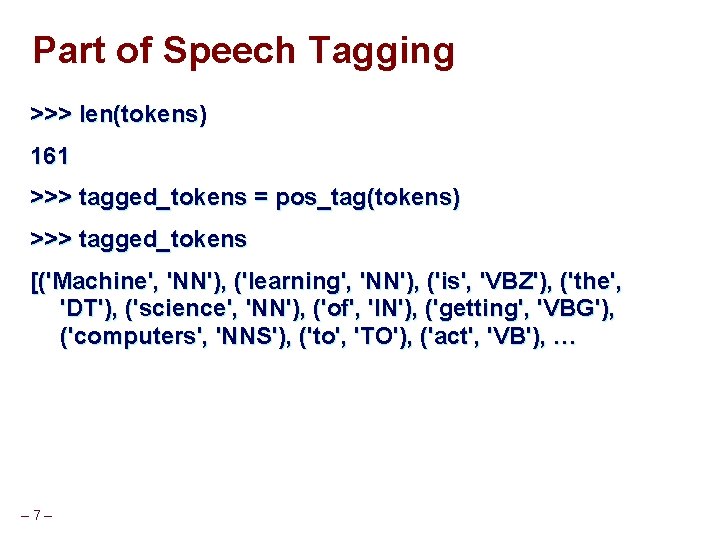
Part of Speech Tagging >>> len(tokens) 161 >>> tagged_tokens = pos_tag(tokens) >>> tagged_tokens [('Machine', 'NN'), ('learning', 'NN'), ('is', 'VBZ'), ('the', 'DT'), ('science', 'NN'), ('of', 'IN'), ('getting', 'VBG'), ('computers', 'NNS'), ('to', 'TO'), ('act', 'VB'), … – 7–
Parsing – 8–
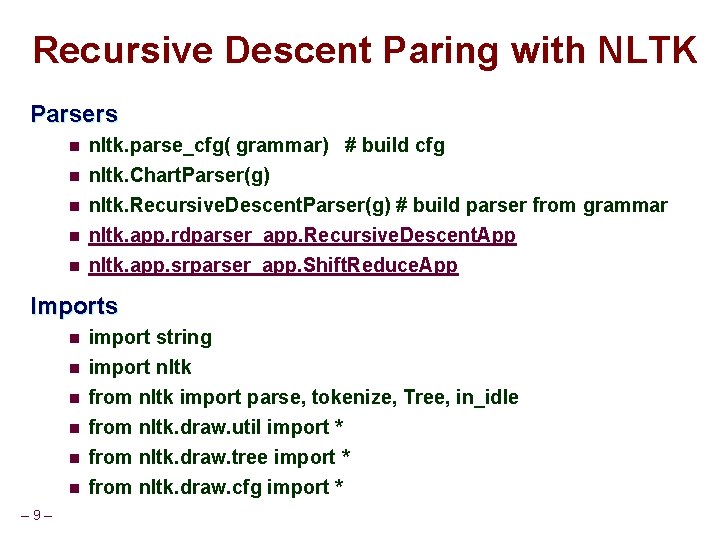
Recursive Descent Paring with NLTK Parsers n nltk. parse_cfg( grammar) # build cfg n nltk. Chart. Parser(g) nltk. Recursive. Descent. Parser(g) # build parser from grammar nltk. app. rdparser_app. Recursive. Descent. App nltk. app. srparser_app. Shift. Reduce. App n n n Imports n n n – 9– import string import nltk from nltk import parse, tokenize, Tree, in_idle from nltk. draw. util import * from nltk. draw. tree import * from nltk. draw. cfg import *
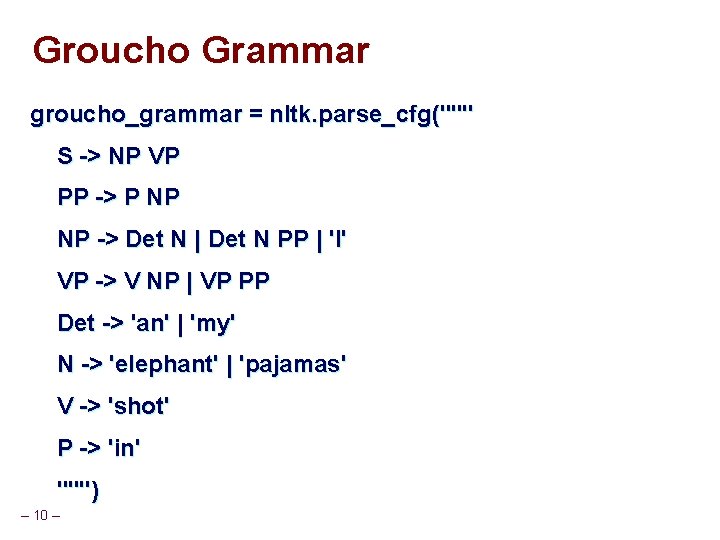
Groucho Grammar groucho_grammar = nltk. parse_cfg(""" S -> NP VP PP -> P NP NP -> Det N | Det N PP | 'I' VP -> V NP | VP PP Det -> 'an' | 'my' N -> 'elephant' | 'pajamas' V -> 'shot' P -> 'in' """) – 10 –
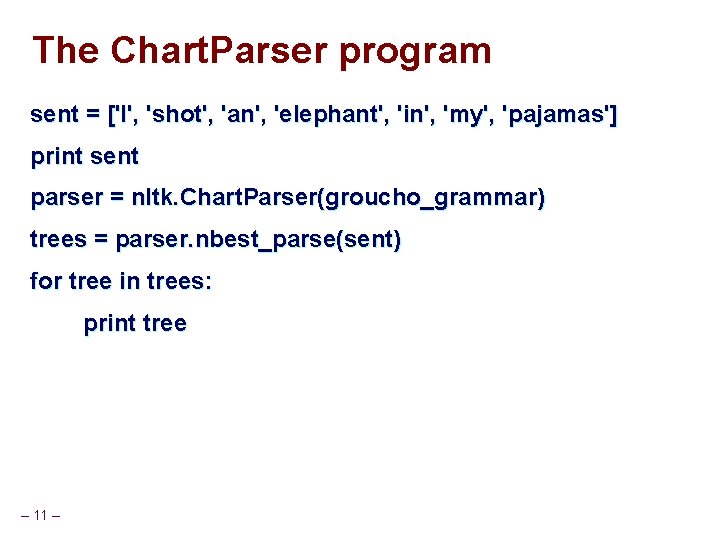
The Chart. Parser program sent = ['I', 'shot', 'an', 'elephant', 'in', 'my', 'pajamas'] print sent parser = nltk. Chart. Parser(groucho_grammar) trees = parser. nbest_parse(sent) for tree in trees: print tree – 11 –
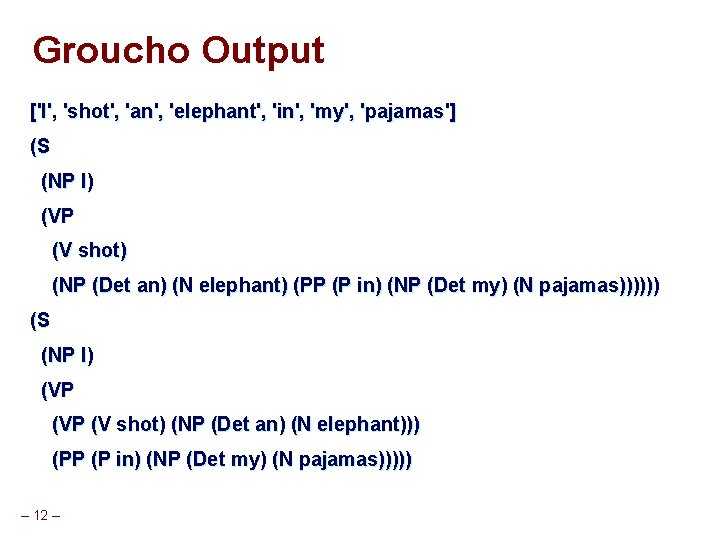
Groucho Output ['I', 'shot', 'an', 'elephant', 'in', 'my', 'pajamas'] (S (NP I) (VP (V shot) (NP (Det an) (N elephant) (PP (P in) (NP (Det my) (N pajamas)))))) (S (NP I) (VP (V shot) (NP (Det an) (N elephant))) (PP (P in) (NP (Det my) (N pajamas))))) – 12 –
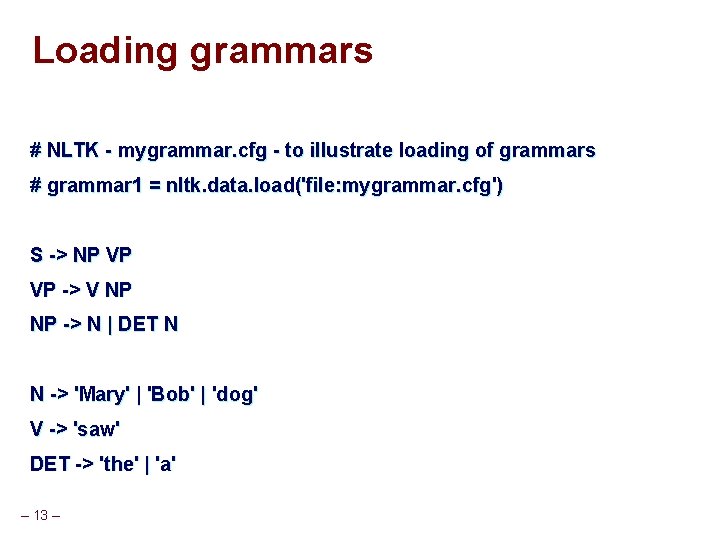
Loading grammars # NLTK - mygrammar. cfg - to illustrate loading of grammars # grammar 1 = nltk. data. load('file: mygrammar. cfg') S -> NP VP VP -> V NP NP -> N | DET N N -> 'Mary' | 'Bob' | 'dog' V -> 'saw' DET -> 'the' | 'a' – 13 –
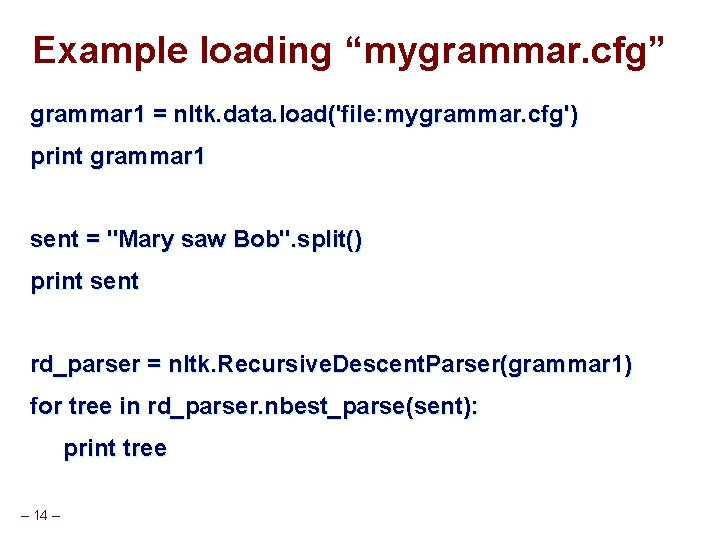
Example loading “mygrammar. cfg” grammar 1 = nltk. data. load('file: mygrammar. cfg') print grammar 1 sent = "Mary saw Bob". split() print sent rd_parser = nltk. Recursive. Descent. Parser(grammar 1) for tree in rd_parser. nbest_parse(sent): print tree – 14 –
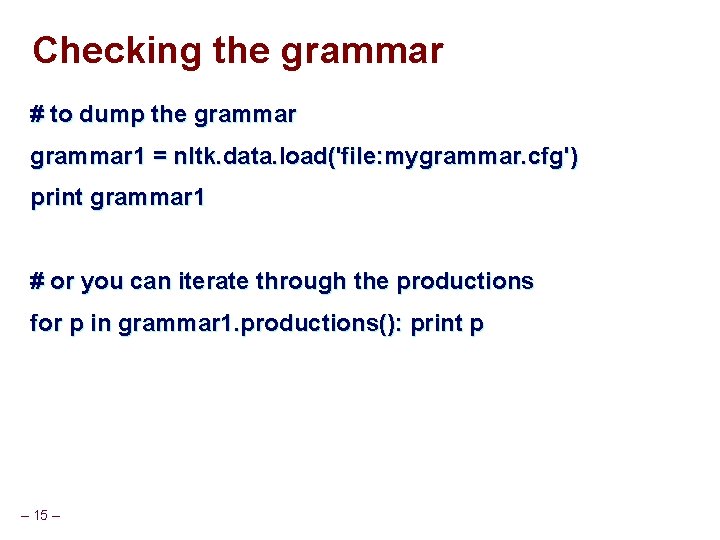
Checking the grammar # to dump the grammar 1 = nltk. data. load('file: mygrammar. cfg') print grammar 1 # or you can iterate through the productions for p in grammar 1. productions(): print p – 15 –
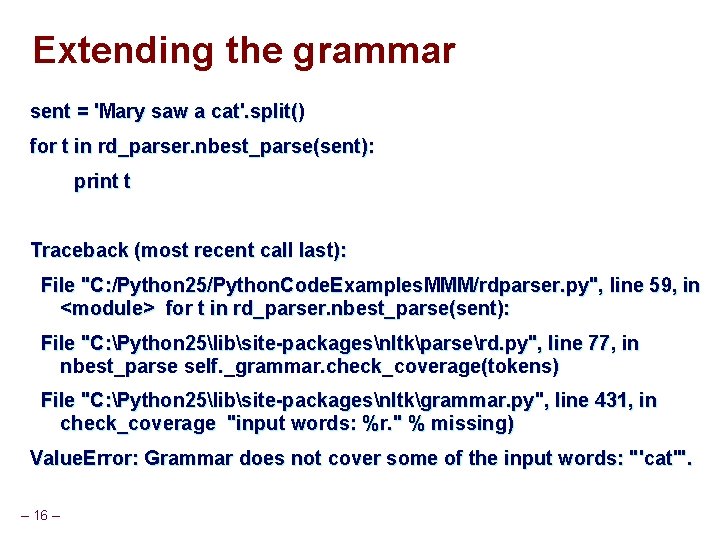
Extending the grammar sent = 'Mary saw a cat'. split() for t in rd_parser. nbest_parse(sent): print t Traceback (most recent call last): File "C: /Python 25/Python. Code. Examples. MMM/rdparser. py", line 59, in <module> for t in rd_parser. nbest_parse(sent): File "C: Python 25libsite-packagesnltkparserd. py", line 77, in nbest_parse self. _grammar. check_coverage(tokens) File "C: Python 25libsite-packagesnltkgrammar. py", line 431, in check_coverage "input words: %r. " % missing) Value. Error: Grammar does not cover some of the input words: "'cat'". – 16 –
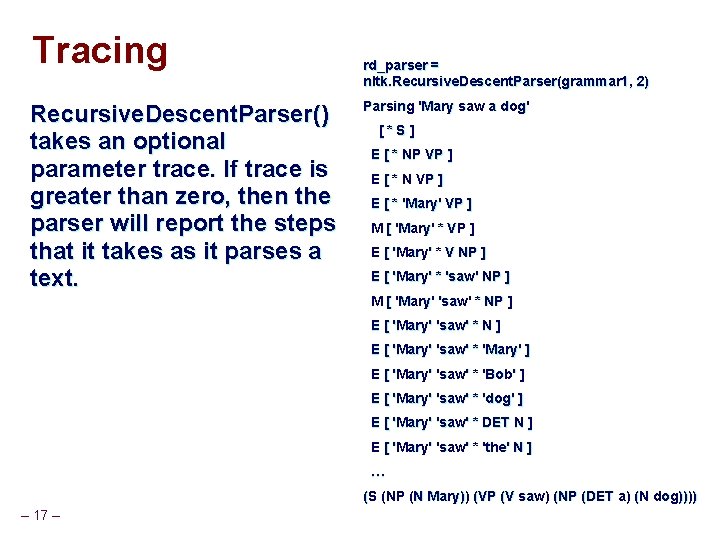
Tracing Recursive. Descent. Parser() takes an optional parameter trace. If trace is greater than zero, then the parser will report the steps that it takes as it parses a text. rd_parser = nltk. Recursive. Descent. Parser(grammar 1, 2) Parsing 'Mary saw a dog' [*S] E [ * NP VP ] E [ * N VP ] E [ * 'Mary' VP ] M [ 'Mary' * VP ] E [ 'Mary' * V NP ] E [ 'Mary' * 'saw' NP ] M [ 'Mary' 'saw' * NP ] E [ 'Mary' 'saw' * N ] E [ 'Mary' 'saw' * 'Mary' ] E [ 'Mary' 'saw' * 'Bob' ] E [ 'Mary' 'saw' * 'dog' ] E [ 'Mary' 'saw' * DET N ] E [ 'Mary' 'saw' * 'the' N ] … (S (NP (N Mary)) (VP (V saw) (NP (DET a) (N dog)))) – 17 –
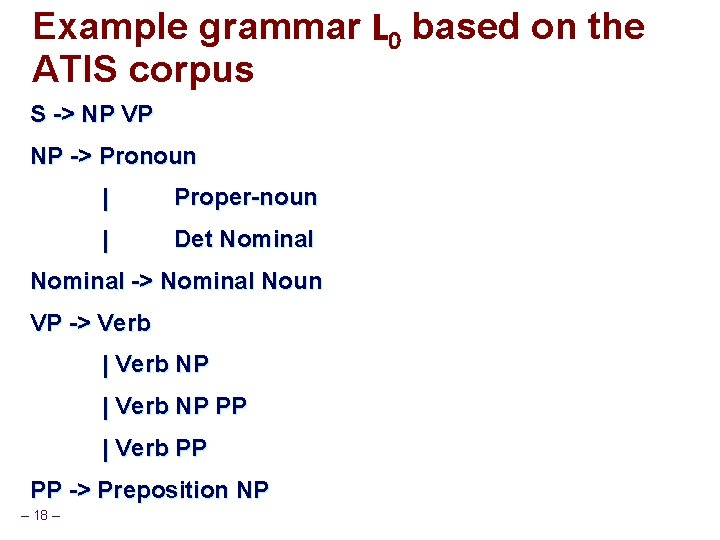
Example grammar L 0 based on the ATIS corpus S -> NP VP NP -> Pronoun | Proper-noun | Det Nominal -> Nominal Noun VP -> Verb | Verb NP PP | Verb PP PP -> Preposition NP – 18 –
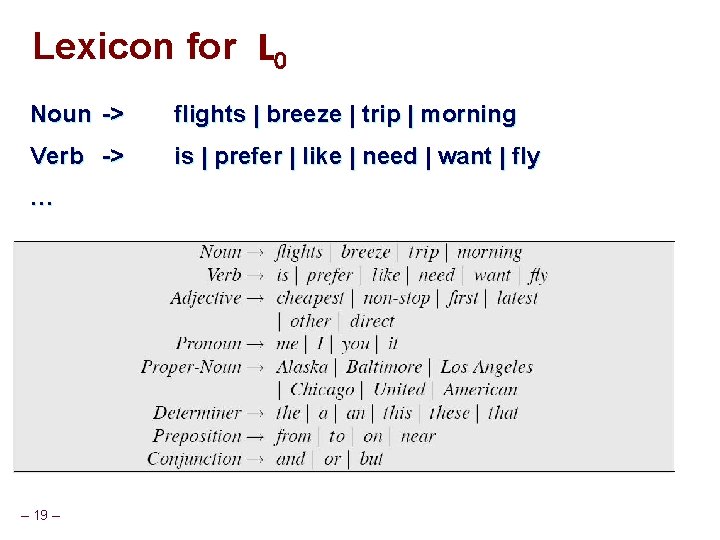
Lexicon for L 0 Noun -> flights | breeze | trip | morning Verb -> is | prefer | like | need | want | fly … – 19 –
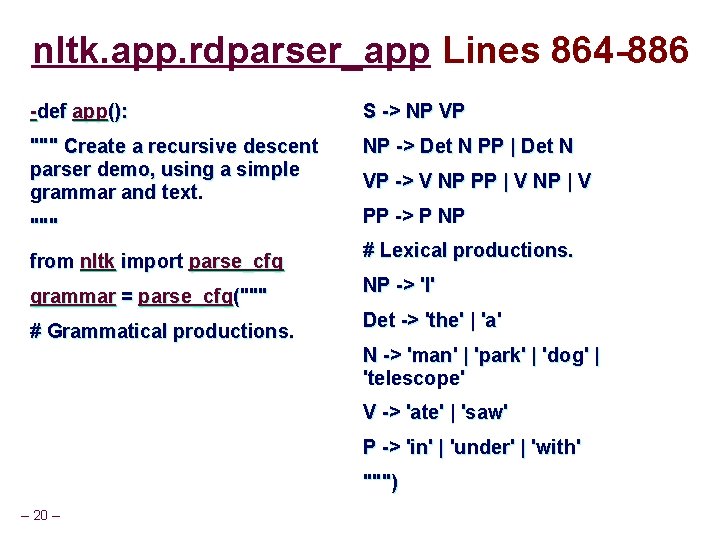
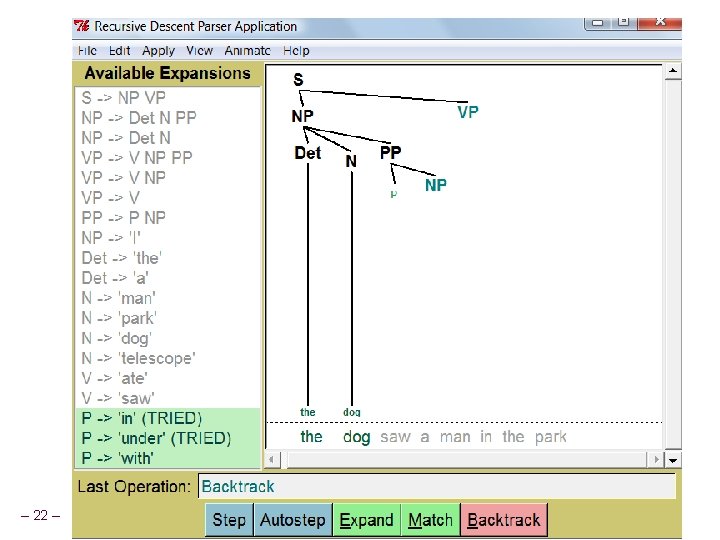
nltk. app. rdparser_app Lines 864 -886 -def app(): S -> NP VP """ Create a recursive descent parser demo, using a simple grammar and text. NP -> Det N PP | Det N """ from nltk import parse_cfg grammar = parse_cfg(""" # Grammatical productions. VP -> V NP PP | V NP | V PP -> P NP # Lexical productions. NP -> 'I' Det -> 'the' | 'a' N -> 'man' | 'park' | 'dog' | 'telescope' V -> 'ate' | 'saw' P -> 'in' | 'under' | 'with' """) – 20 –
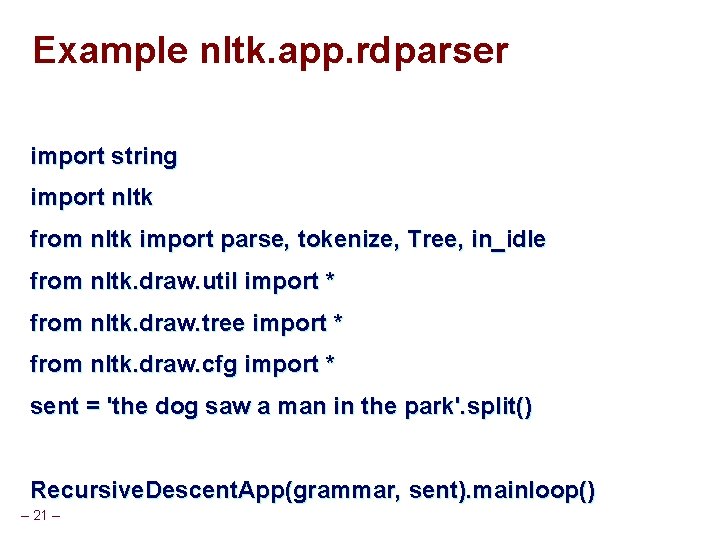
Example nltk. app. rdparser import string import nltk from nltk import parse, tokenize, Tree, in_idle from nltk. draw. util import * from nltk. draw. tree import * from nltk. draw. cfg import * sent = 'the dog saw a man in the park'. split() Recursive. Descent. App(grammar, sent). mainloop() – 21 –
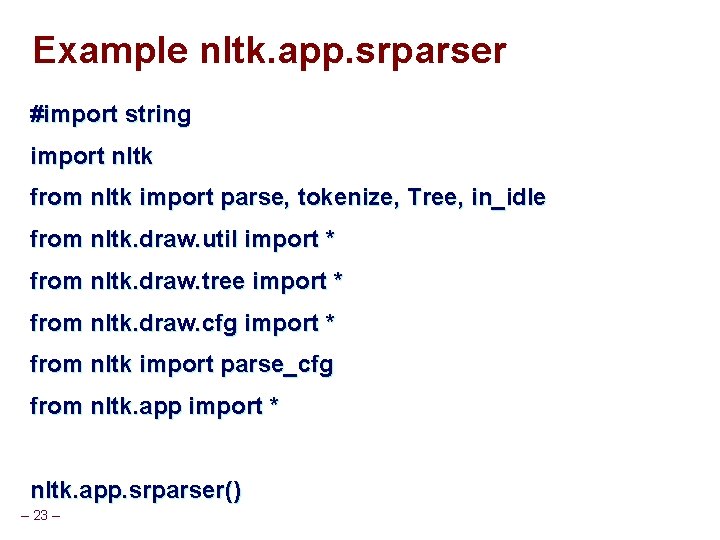
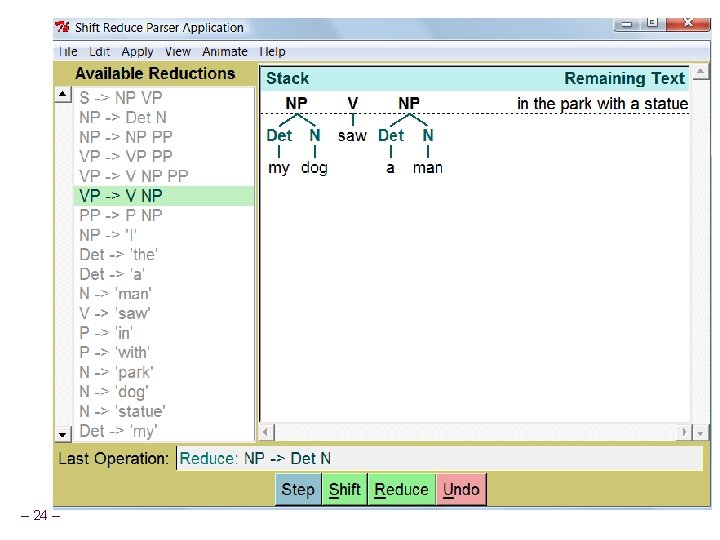
Example nltk. app. srparser #import string import nltk from nltk import parse, tokenize, Tree, in_idle from nltk. draw. util import * from nltk. draw. tree import * from nltk. draw. cfg import * from nltk import parse_cfg from nltk. app import * nltk. app. srparser() – 23 –
- Slides: 24