
CSCE 513 Computer Architecture Lecture 2 Quantifying Performance


![1. 8 [10/ 15/ 10] < 1. 4, 1. 5 > One challenge for](https://slidetodoc.com/presentation_image_h/356d778f7f72092046779f9f20dc076b/image-39.jpg "1. 8 [10/ 15/ 10] < 1. 4, 1. 5 > One challenge for")

![Stages of Classical 5 -stage pipeline Instruction Fetch Cycle n IR Mem[PC] n NPC](https://slidetodoc.com/presentation_image_h/356d778f7f72092046779f9f20dc076b/image-42.jpg "Stages of Classical 5 -stage pipeline Instruction Fetch Cycle n IR Mem[PC] n NPC")
- Slides: 50
CSCE 513 Computer Architecture Lecture 2 Quantifying Performance Topics n Speedup n Amdahl’s law Execution time n Readings: Chapter 1 August 30, 2017
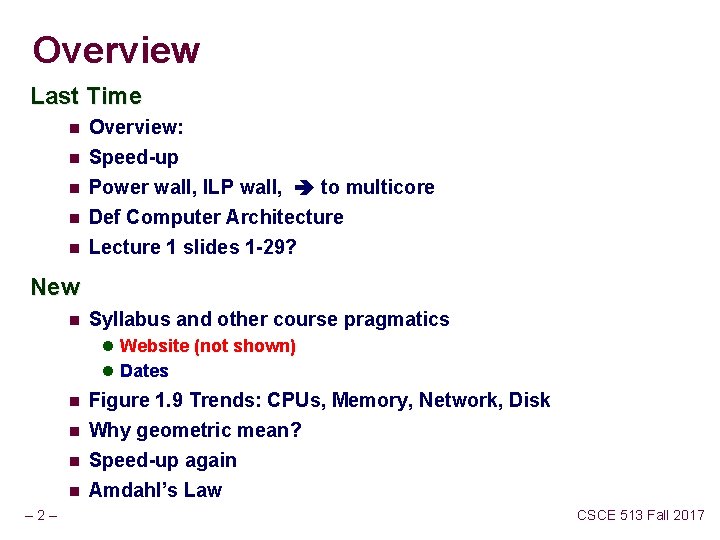
Overview Last Time n Overview: n Speed-up Power wall, ILP wall, to multicore n n n Def Computer Architecture Lecture 1 slides 1 -29? New n Syllabus and other course pragmatics l Website (not shown) l Dates n n – 2– Figure 1. 9 Trends: CPUs, Memory, Network, Disk Why geometric mean? Speed-up again Amdahl’s Law CSCE 513 Fall 2017
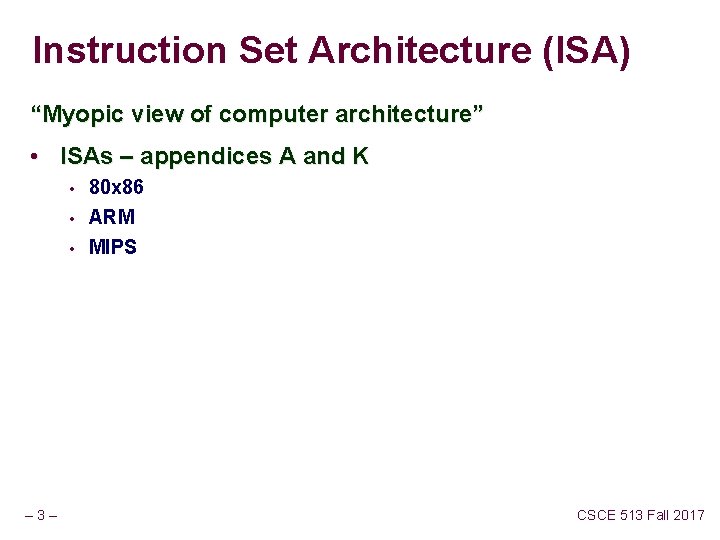
Instruction Set Architecture (ISA) “Myopic view of computer architecture” • ISAs – appendices A and K • • • – 3– 80 x 86 ARM MIPS CSCE 513 Fall 2017
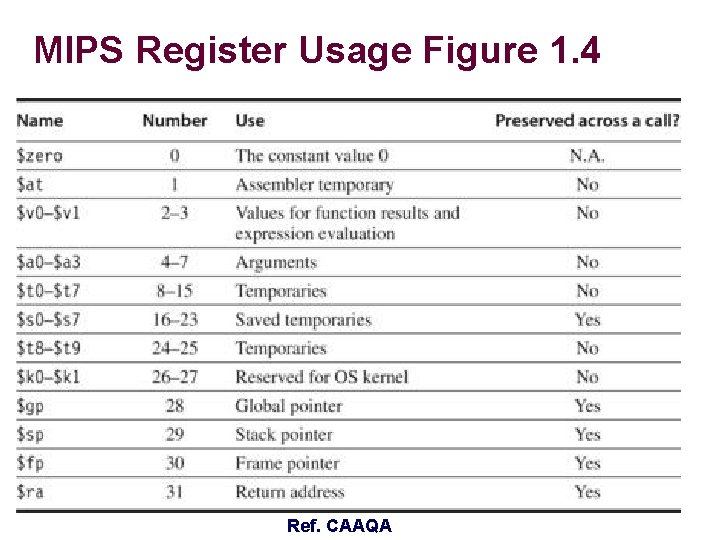
MIPS Register Usage Figure 1. 4 – 4– Ref. CAAQA CSCE 513 Fall 2017
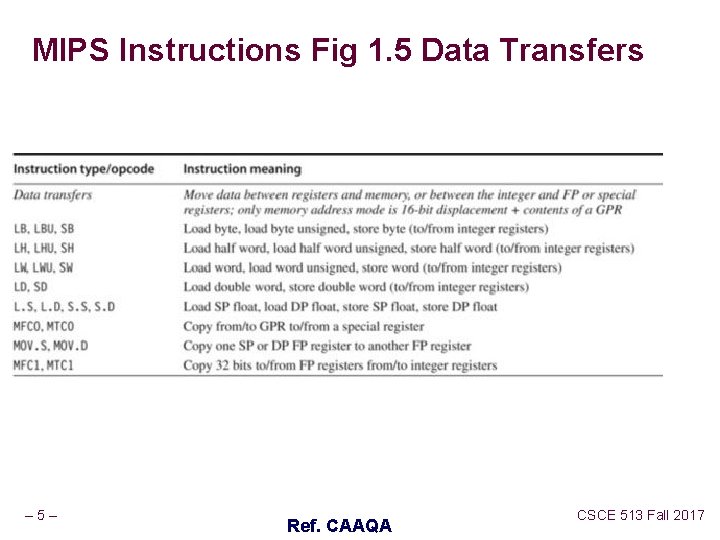
MIPS Instructions Fig 1. 5 Data Transfers – 5– Ref. CAAQA CSCE 513 Fall 2017
MIPS Instructions Fig 1. 5 Arithmetic/Logical Most significant bit is bit zero; lsb #63 – 6– Ref. CAAQA CSCE 513 Fall 2017
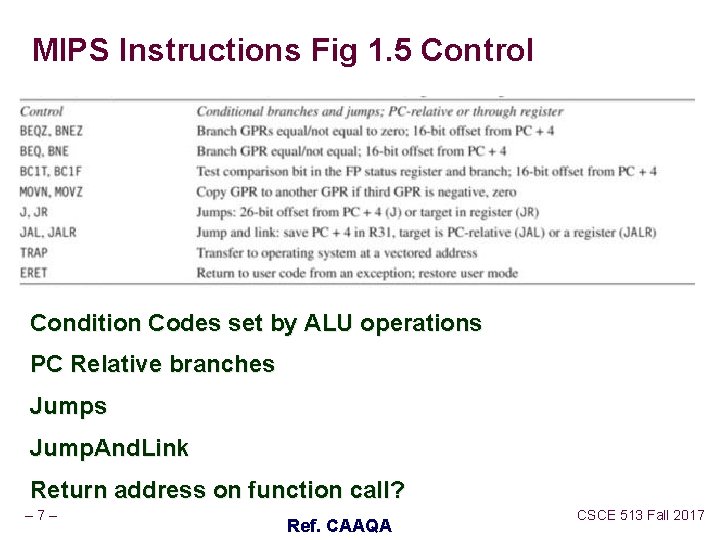
MIPS Instructions Fig 1. 5 Control Condition Codes set by ALU operations PC Relative branches Jump. And. Link Return address on function call? – 7– Ref. CAAQA CSCE 513 Fall 2017
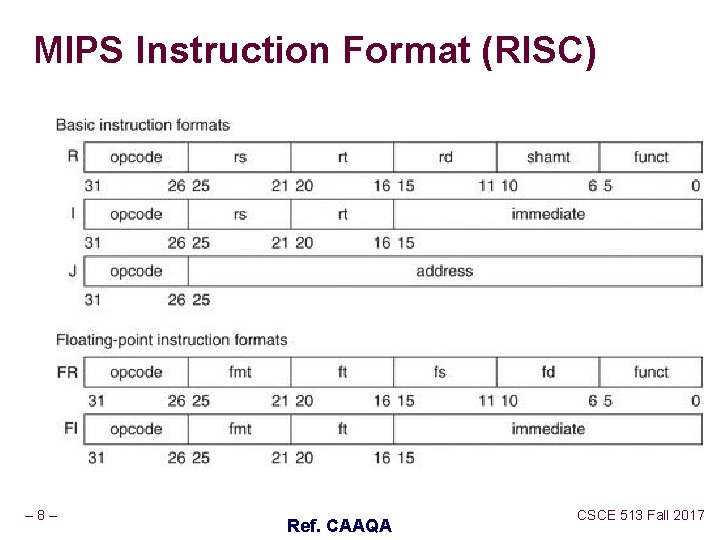
MIPS Instruction Format (RISC) – 8– Ref. CAAQA CSCE 513 Fall 2017
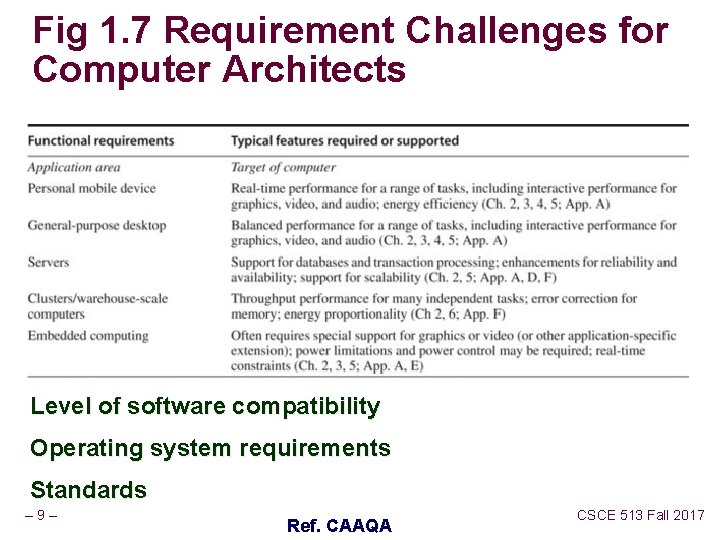
Fig 1. 7 Requirement Challenges for Computer Architects Level of software compatibility Operating system requirements Standards – 9– Ref. CAAQA CSCE 513 Fall 2017
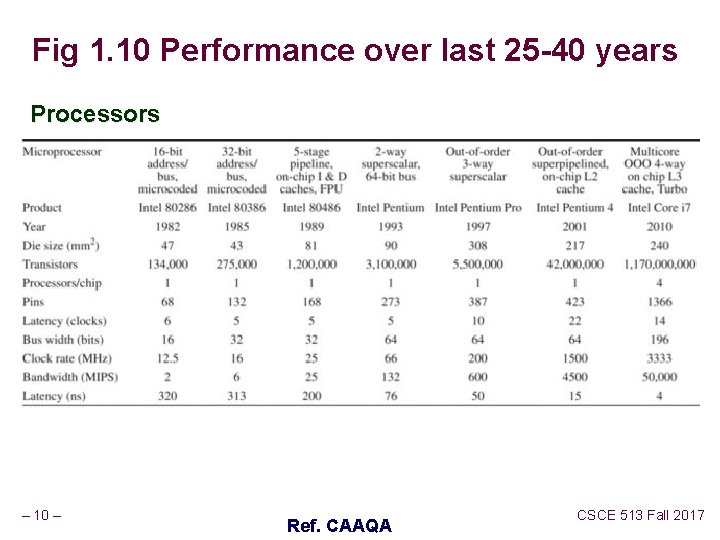
Fig 1. 10 Performance over last 25 -40 years Processors – 10 – Ref. CAAQA CSCE 513 Fall 2017
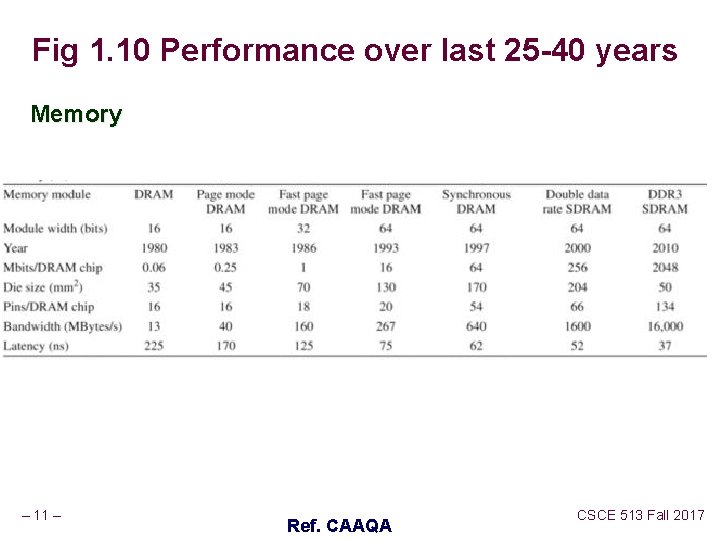
Fig 1. 10 Performance over last 25 -40 years Memory – 11 – Ref. CAAQA CSCE 513 Fall 2017
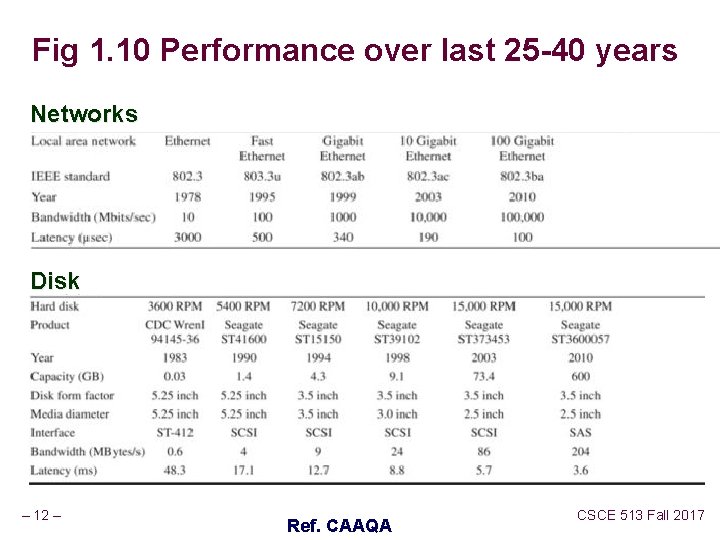
Fig 1. 10 Performance over last 25 -40 years Networks Disk – 12 – Ref. CAAQA CSCE 513 Fall 2017
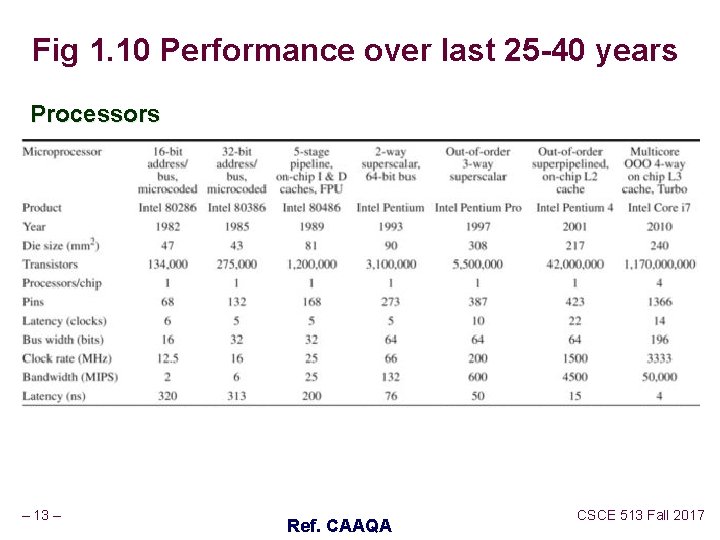
Fig 1. 10 Performance over last 25 -40 years Processors – 13 – Ref. CAAQA CSCE 513 Fall 2017
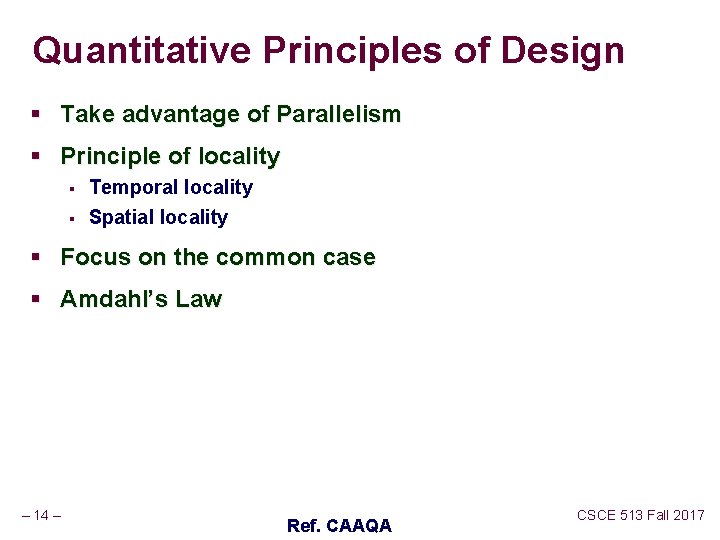
Quantitative Principles of Design § Take advantage of Parallelism § Principle of locality § § Temporal locality Spatial locality § Focus on the common case § Amdahl’s Law – 14 – Ref. CAAQA CSCE 513 Fall 2017
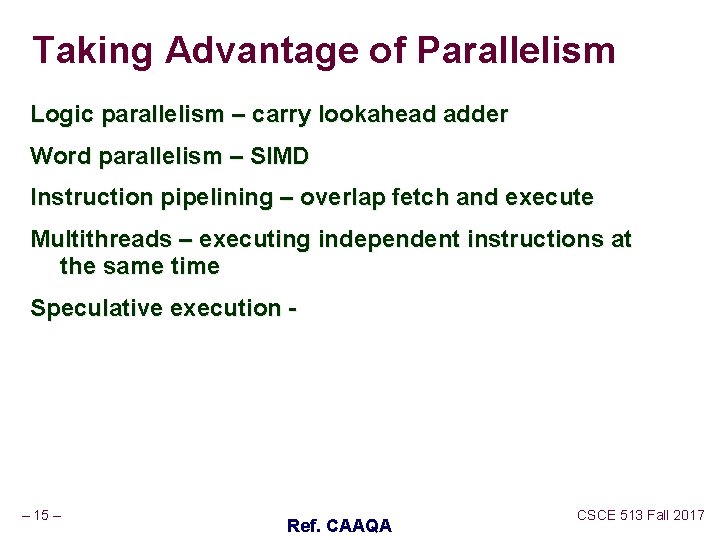
Taking Advantage of Parallelism Logic parallelism – carry lookahead adder Word parallelism – SIMD Instruction pipelining – overlap fetch and execute Multithreads – executing independent instructions at the same time Speculative execution - – 15 – Ref. CAAQA CSCE 513 Fall 2017
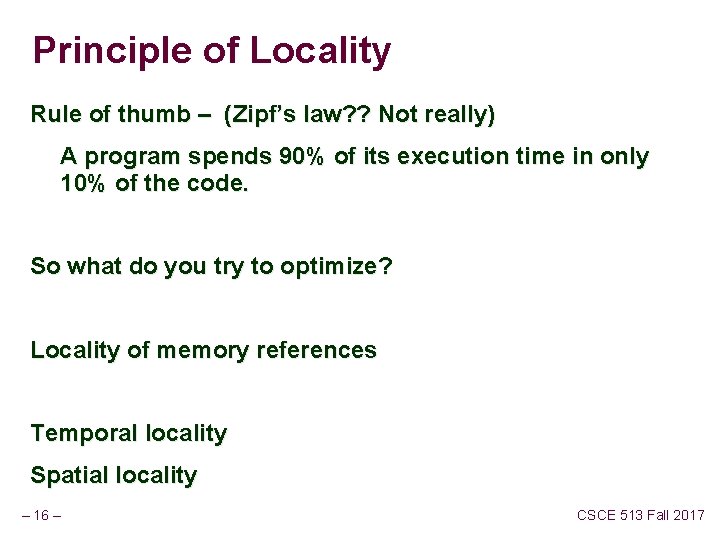
Principle of Locality Rule of thumb – (Zipf’s law? ? Not really) A program spends 90% of its execution time in only 10% of the code. So what do you try to optimize? Locality of memory references Temporal locality Spatial locality – 16 – CSCE 513 Fall 2017
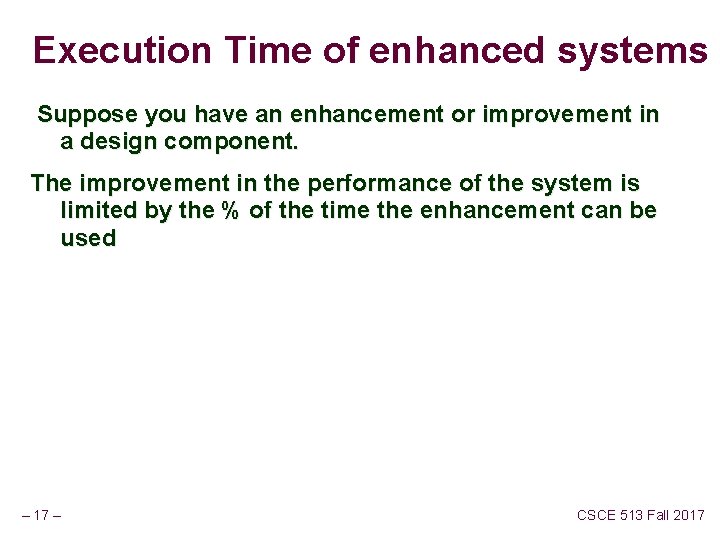
Execution Time of enhanced systems Suppose you have an enhancement or improvement in a design component. The improvement in the performance of the system is limited by the % of the time the enhancement can be used – 17 – CSCE 513 Fall 2017
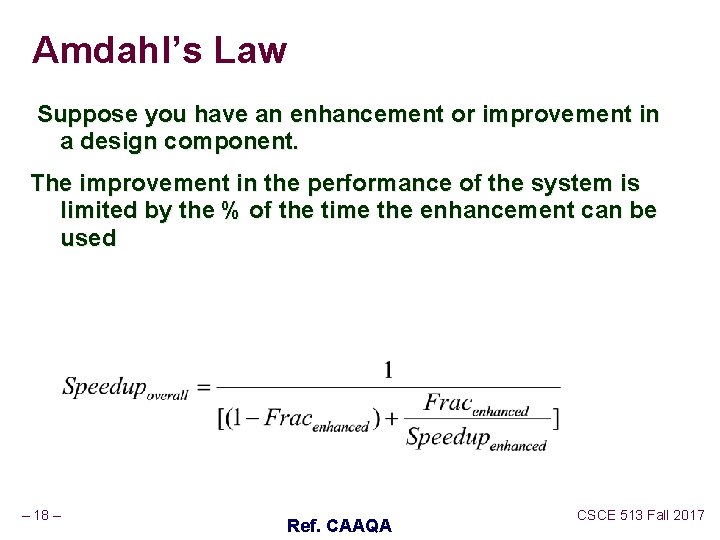
Amdahl’s Law Suppose you have an enhancement or improvement in a design component. The improvement in the performance of the system is limited by the % of the time the enhancement can be used – 18 – Ref. CAAQA CSCE 513 Fall 2017
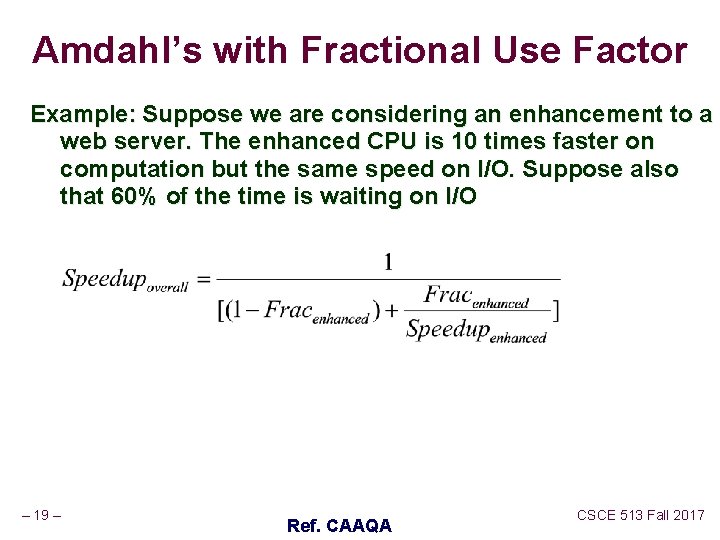
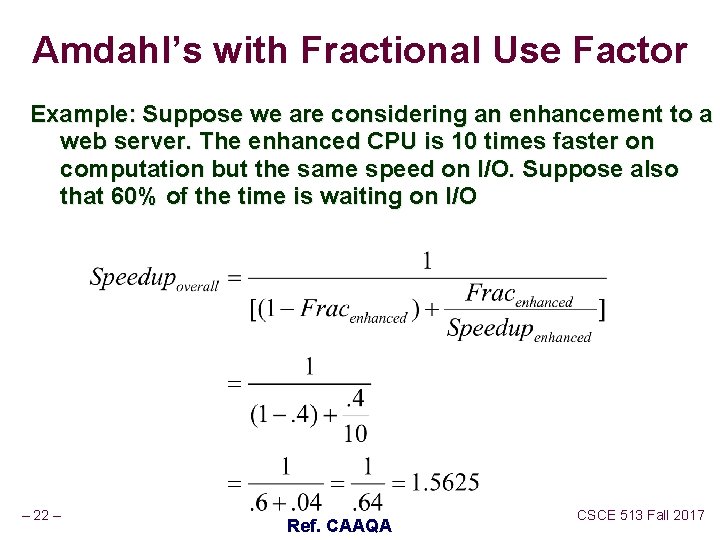
Amdahl’s with Fractional Use Factor Example: Suppose we are considering an enhancement to a web server. The enhanced CPU is 10 times faster on computation but the same speed on I/O. Suppose also that 60% of the time is waiting on I/O – 19 – Ref. CAAQA CSCE 513 Fall 2017
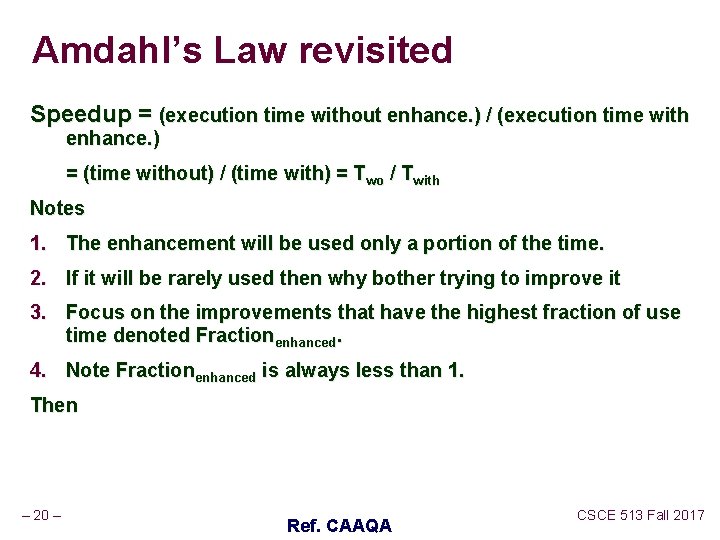
Amdahl’s Law revisited Speedup = (execution time without enhance. ) / (execution time with enhance. ) = (time without) / (time with) = Two / Twith Notes 1. The enhancement will be used only a portion of the time. 2. If it will be rarely used then why bother trying to improve it 3. Focus on the improvements that have the highest fraction of use time denoted Fractionenhanced. 4. Note Fractionenhanced is always less than 1. Then – 20 – Ref. CAAQA CSCE 513 Fall 2017
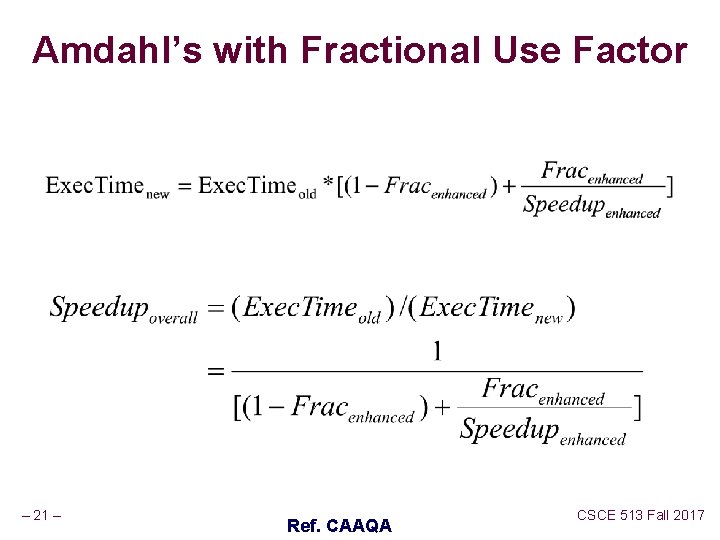
Amdahl’s with Fractional Use Factor – 21 – Ref. CAAQA CSCE 513 Fall 2017
Amdahl’s with Fractional Use Factor Example: Suppose we are considering an enhancement to a web server. The enhanced CPU is 10 times faster on computation but the same speed on I/O. Suppose also that 60% of the time is waiting on I/O – 22 – Ref. CAAQA CSCE 513 Fall 2017
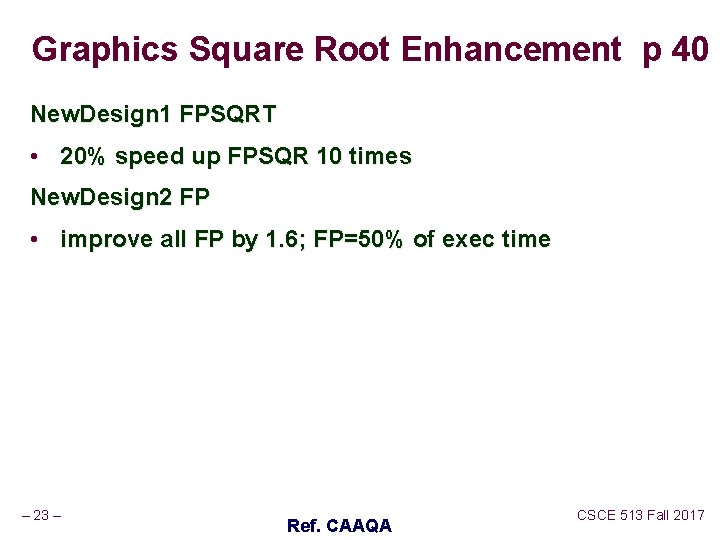
Graphics Square Root Enhancement p 40 New. Design 1 FPSQRT • 20% speed up FPSQR 10 times New. Design 2 FP • improve all FP by 1. 6; FP=50% of exec time – 23 – Ref. CAAQA CSCE 513 Fall 2017
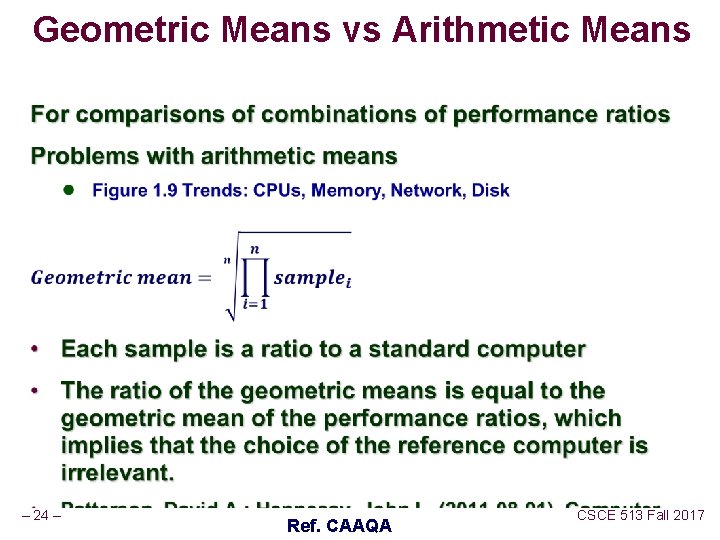
Geometric Means vs Arithmetic Means – 24 – Ref. CAAQA CSCE 513 Fall 2017
Comparing 2 computers Spec_Ratios – 25 – Ref. CAAQA CSCE 513 Fall 2017
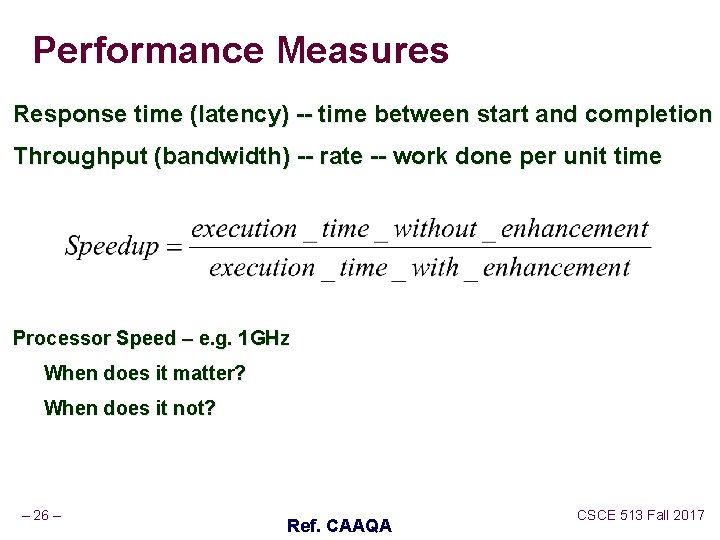
Performance Measures Response time (latency) -- time between start and completion Throughput (bandwidth) -- rate -- work done per unit time Processor Speed – e. g. 1 GHz When does it matter? When does it not? – 26 – Ref. CAAQA CSCE 513 Fall 2017
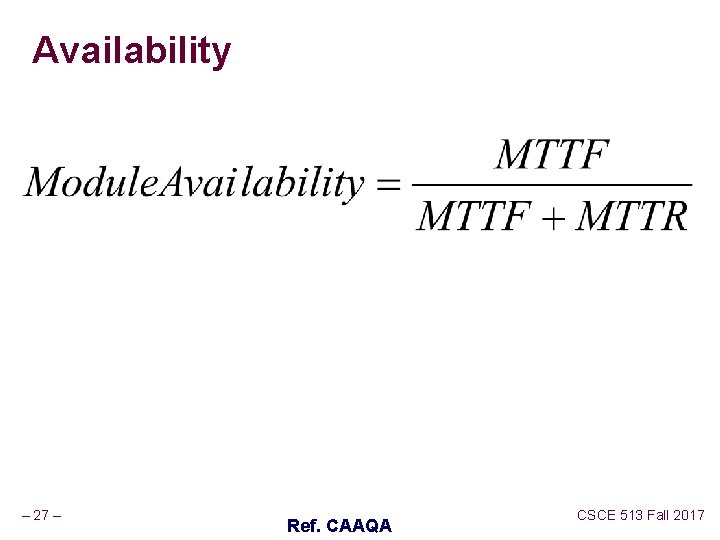
Availability – 27 – Ref. CAAQA CSCE 513 Fall 2017
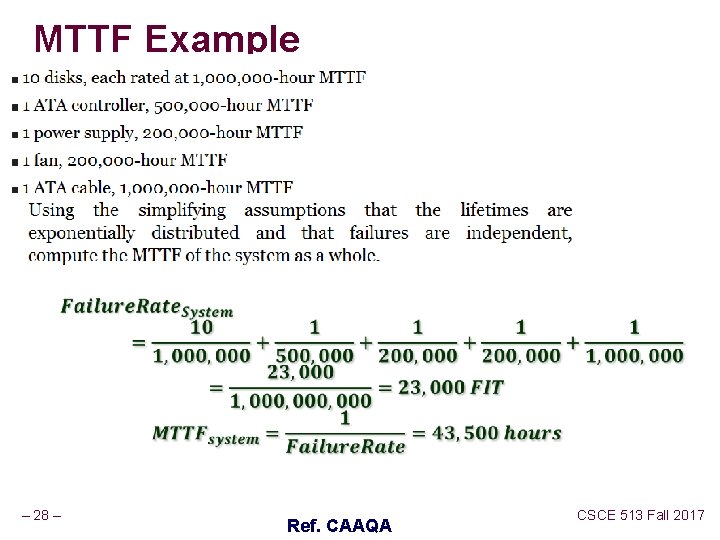
MTTF Example – 28 – Ref. CAAQA CSCE 513 Fall 2017
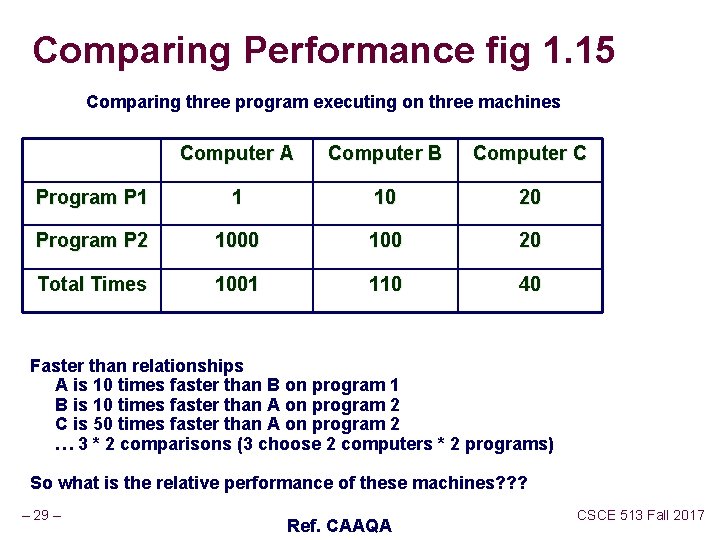
Comparing Performance fig 1. 15 Comparing three program executing on three machines Computer A Computer B Computer C Program P 1 1 10 20 Program P 2 1000 100 20 Total Times 1001 110 40 Faster than relationships A is 10 times faster than B on program 1 B is 10 times faster than A on program 2 C is 50 times faster than A on program 2 … 3 * 2 comparisons (3 choose 2 computers * 2 programs) So what is the relative performance of these machines? ? ? – 29 – Ref. CAAQA CSCE 513 Fall 2017
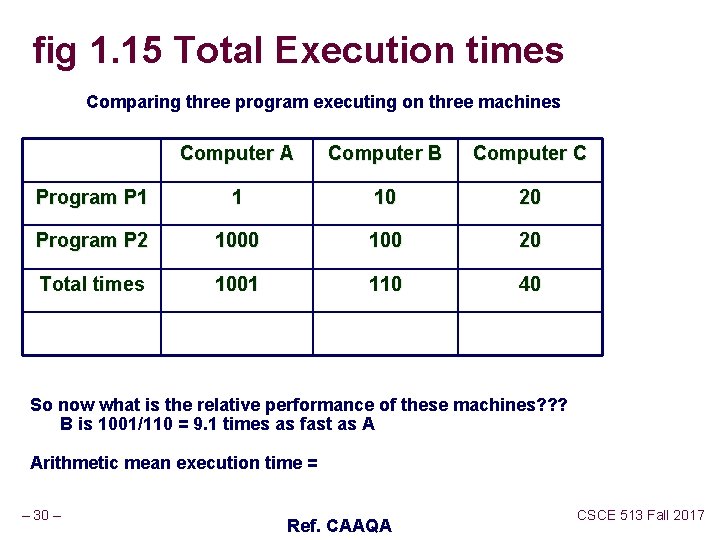
fig 1. 15 Total Execution times Comparing three program executing on three machines Computer A Computer B Computer C Program P 1 1 10 20 Program P 2 1000 100 20 Total times 1001 110 40 So now what is the relative performance of these machines? ? ? B is 1001/110 = 9. 1 times as fast as A Arithmetic mean execution time = – 30 – Ref. CAAQA CSCE 513 Fall 2017
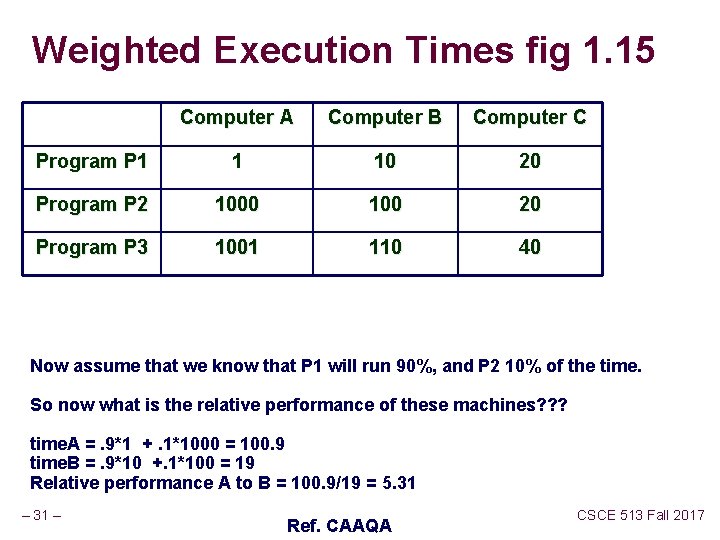
Weighted Execution Times fig 1. 15 Computer A Computer B Computer C Program P 1 1 10 20 Program P 2 1000 100 20 Program P 3 1001 110 40 Now assume that we know that P 1 will run 90%, and P 2 10% of the time. So now what is the relative performance of these machines? ? ? time. A =. 9*1 +. 1*1000 = 100. 9 time. B =. 9*10 +. 1*100 = 19 Relative performance A to B = 100. 9/19 = 5. 31 – Ref. CAAQA CSCE 513 Fall 2017
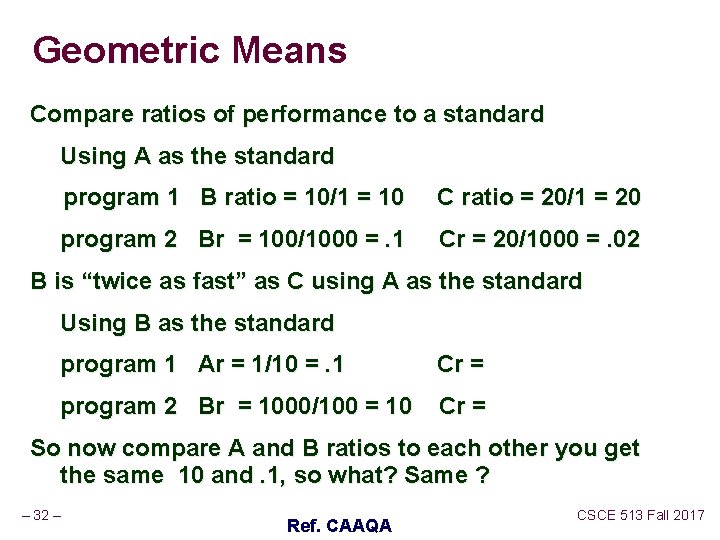
Geometric Means Compare ratios of performance to a standard Using A as the standard program 1 B ratio = 10/1 = 10 C ratio = 20/1 = 20 program 2 Br = 100/1000 =. 1 Cr = 20/1000 =. 02 B is “twice as fast” as C using A as the standard Using B as the standard program 1 Ar = 1/10 =. 1 Cr = program 2 Br = 1000/100 = 10 Cr = So now compare A and B ratios to each other you get the same 10 and. 1, so what? Same ? – 32 – Ref. CAAQA CSCE 513 Fall 2017
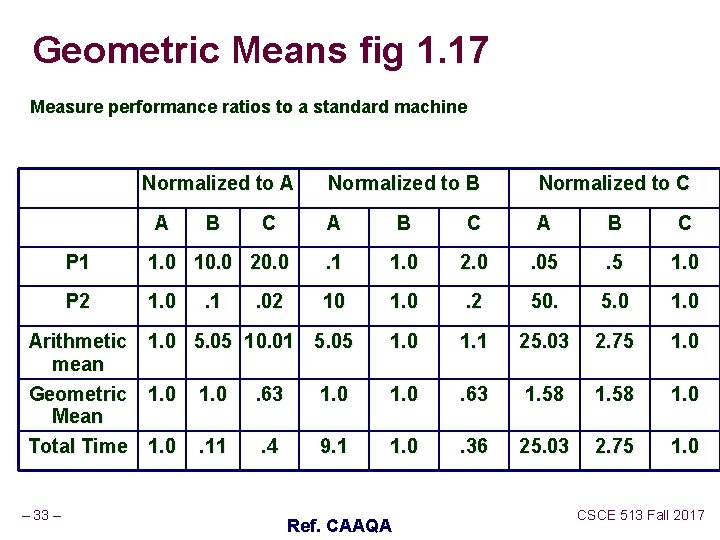
Geometric Means fig 1. 17 Measure performance ratios to a standard machine Normalized to A A C Normalized to C A B C P 1 1. 0 10. 0 20. 0 . 1 1. 0 2. 0 . 05 . 5 1. 0 P 2 1. 0 10 1. 0 . 2 50. 5. 0 1. 0 5. 05 10. 01 5. 05 1. 0 1. 1 25. 03 2. 75 1. 0 . 63 1. 58 1. 0 . 11 . 4 9. 1 1. 0 . 36 25. 03 2. 75 1. 0 Arithmetic mean Geometric Mean Total Time – 33 – B Normalized to B . 1 . 02 Ref. CAAQA CSCE 513 Fall 2017
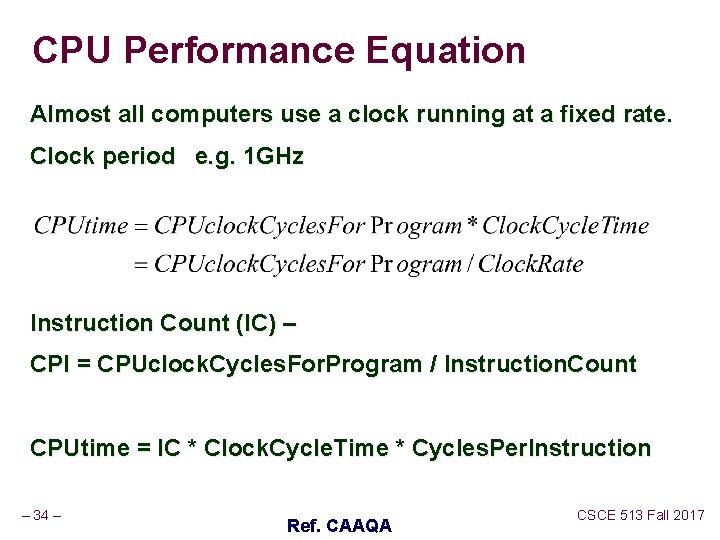
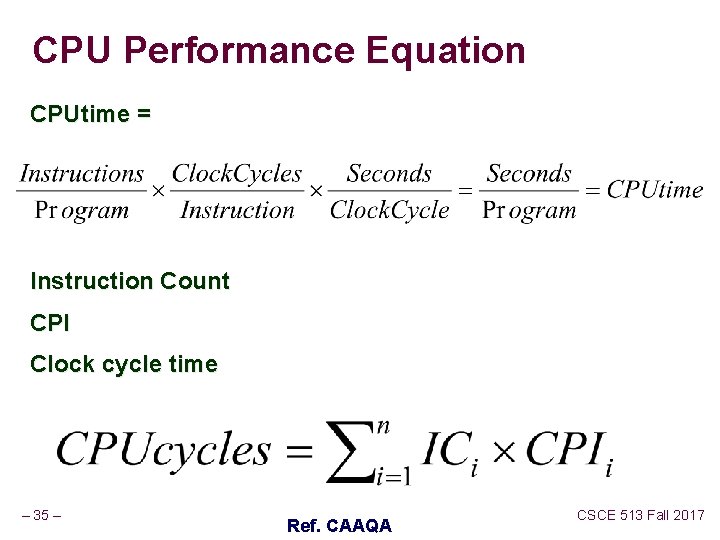
CPU Performance Equation Almost all computers use a clock running at a fixed rate. Clock period e. g. 1 GHz Instruction Count (IC) – CPI = CPUclock. Cycles. For. Program / Instruction. Count CPUtime = IC * Clock. Cycle. Time * Cycles. Per. Instruction – 34 – Ref. CAAQA CSCE 513 Fall 2017
CPU Performance Equation CPUtime = Instruction Count CPI Clock cycle time – 35 – Ref. CAAQA CSCE 513 Fall 2017
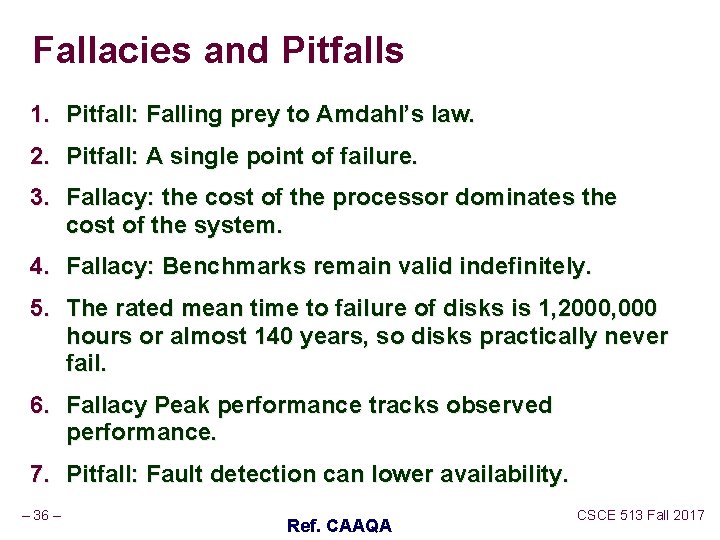
Fallacies and Pitfalls 1. Pitfall: Falling prey to Amdahl’s law. 2. Pitfall: A single point of failure. 3. Fallacy: the cost of the processor dominates the cost of the system. 4. Fallacy: Benchmarks remain valid indefinitely. 5. The rated mean time to failure of disks is 1, 2000, 000 hours or almost 140 years, so disks practically never fail. 6. Fallacy Peak performance tracks observed performance. 7. Pitfall: Fault detection can lower availability. – 36 – Ref. CAAQA CSCE 513 Fall 2017
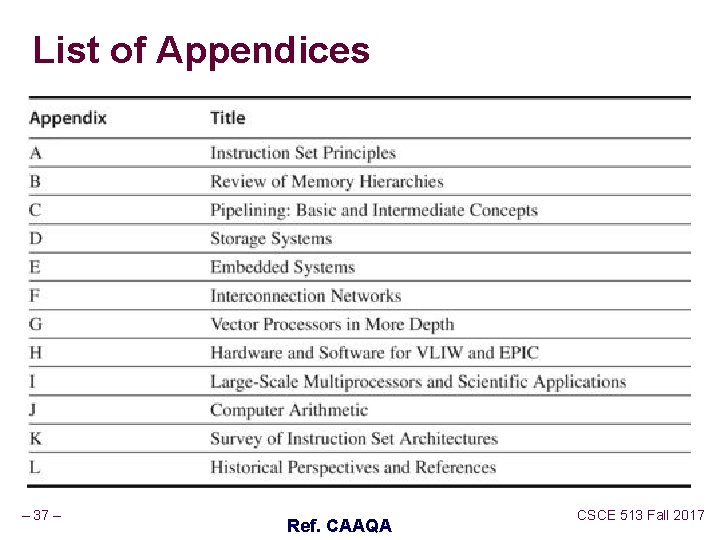
List of Appendices – 37 – Ref. CAAQA CSCE 513 Fall 2017
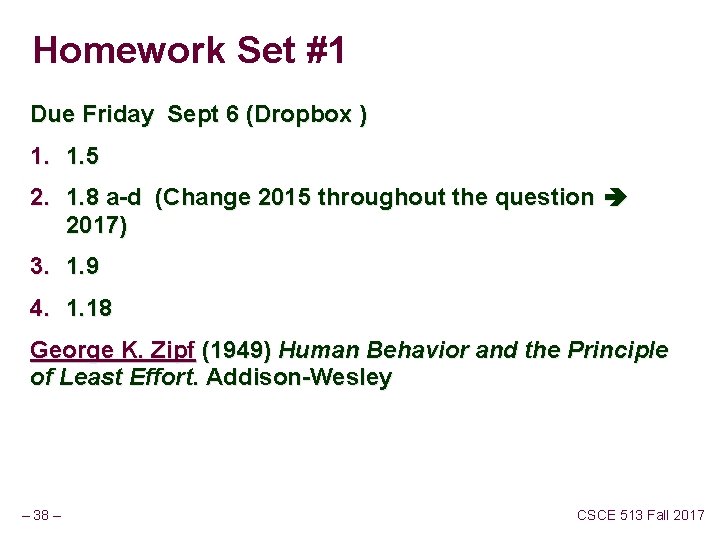
Homework Set #1 Due Friday Sept 6 (Dropbox ) 1. 1. 5 2. 1. 8 a-d (Change 2015 throughout the question 2017) 3. 1. 9 4. 1. 18 George K. Zipf (1949) Human Behavior and the Principle of Least Effort. Addison-Wesley – 38 – CSCE 513 Fall 2017
1. 8 [10/ 15/ 10] < 1. 4, 1. 5 > One challenge for architects is that the design created today will require several years of implementation, verification, and testing before appearing on the market. This means that the architect must project what the technology will be like several years in advance. Sometimes, this is difficult to do. a. [10] < 1. 4 > According to the trend in device scaling observed by Moore’s law, the number of transistors on a chip in 2015 should be how many times the number in 2005? b. b. [15] < 1. 5 > The increase in clock rates once mirrored this trend. Had clock rates continued to climb at the same rate as in the 1990 s, approximately how fast would clock rates be in 2015? c. c. [15] < 1. 5 > At the current rate of increase, what are the clock rates now projected to be in 2015? d. d. [10] < 1. 4 > What has limited the rate of growth of the clock rate, and what are architects doing with the extra transistors now to increase performance? Patterson, David A. ; Hennessy, John L. (2011 -08 -01). Computer Architecture: A Quantitative – 39 –Approach (The Morgan Kaufmann Series in Computer Architecture and Design) (Kindle CSCE 513 Fall 2017
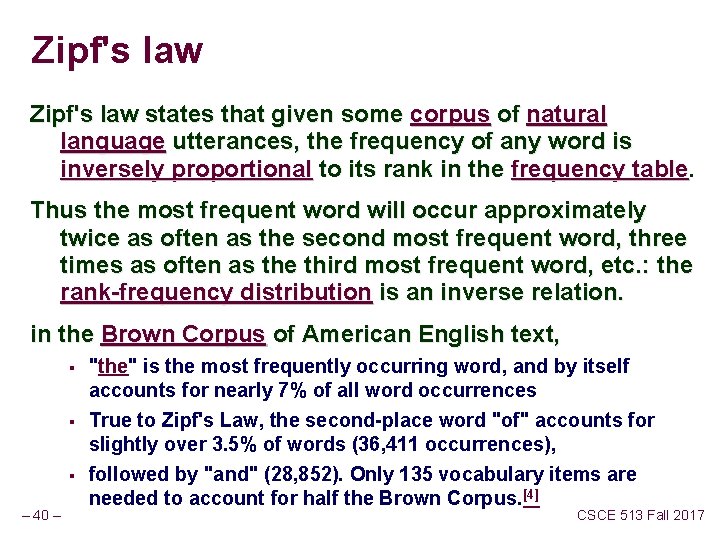
Zipf's law states that given some corpus of natural language utterances, the frequency of any word is inversely proportional to its rank in the frequency table. Thus the most frequent word will occur approximately twice as often as the second most frequent word, three times as often as the third most frequent word, etc. : the rank-frequency distribution is an inverse relation. in the Brown Corpus of American English text, § § § – 40 – "the" is the most frequently occurring word, and by itself accounts for nearly 7% of all word occurrences True to Zipf's Law, the second-place word "of" accounts for slightly over 3. 5% of words (36, 411 occurrences), followed by "and" (28, 852). Only 135 vocabulary items are needed to account for half the Brown Corpus. [4] CSCE 513 Fall 2017
– 41 – CSCE 513 Fall 2017
Stages of Classical 5 -stage pipeline Instruction Fetch Cycle n IR Mem[PC] n NPC PC + 4 Decode n n n A Regs[rs] B Imm sign-extend of Execute n . Memory n . Write Back – 42 – n . CSCE 513 Fall 2017
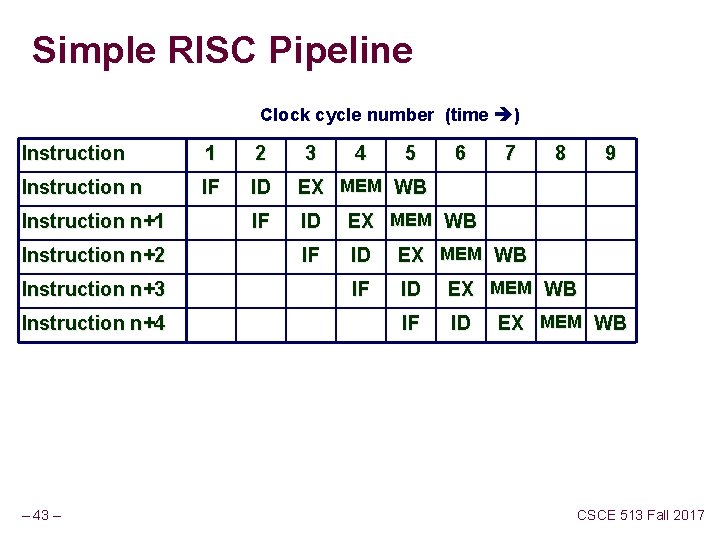
Simple RISC Pipeline Clock cycle number (time ) Instruction 1 2 Instruction n IF ID EX MEM WB IF ID Instruction n+1 Instruction n+2 Instruction n+3 Instruction n+4 – 43 – 3 4 5 6 7 8 9 EX MEM WB CSCE 513 Fall 2017
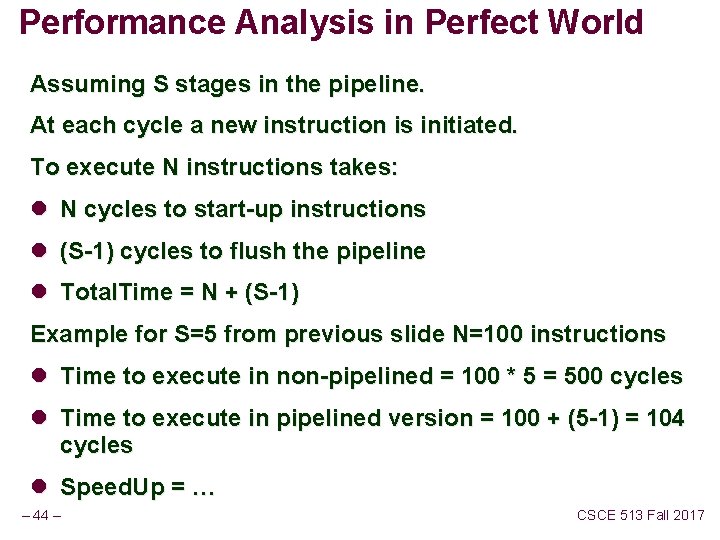
Performance Analysis in Perfect World Assuming S stages in the pipeline. At each cycle a new instruction is initiated. To execute N instructions takes: l N cycles to start-up instructions l (S-1) cycles to flush the pipeline l Total. Time = N + (S-1) Example for S=5 from previous slide N=100 instructions l Time to execute in non-pipelined = 100 * 5 = 500 cycles l Time to execute in pipelined version = 100 + (5 -1) = 104 cycles l Speed. Up = … – 44 – CSCE 513 Fall 2017
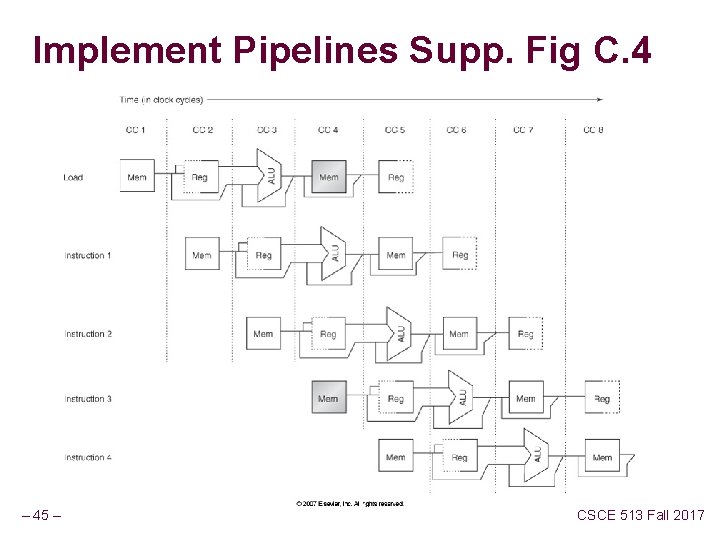
Implement Pipelines Supp. Fig C. 4 – 45 – CSCE 513 Fall 2017
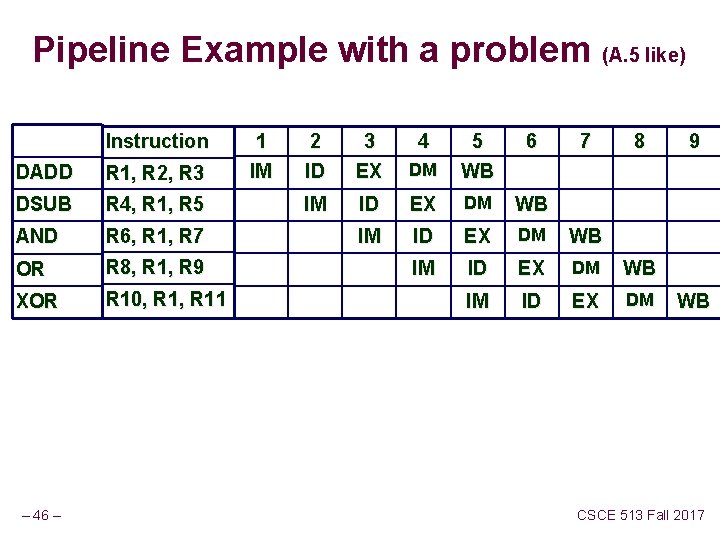
Pipeline Example with a problem (A. 5 like) Instruction DADD R 1, R 2, R 3 DSUB R 4, R 1, R 5 AND R 6, R 1, R 7 OR R 8, R 1, R 9 XOR R 10, R 11 – 46 – 1 IM 2 ID 3 EX IM 4 6 DM 5 WB 7 8 ID EX DM WB IM ID EX DM 9 WB CSCE 513 Fall 2017
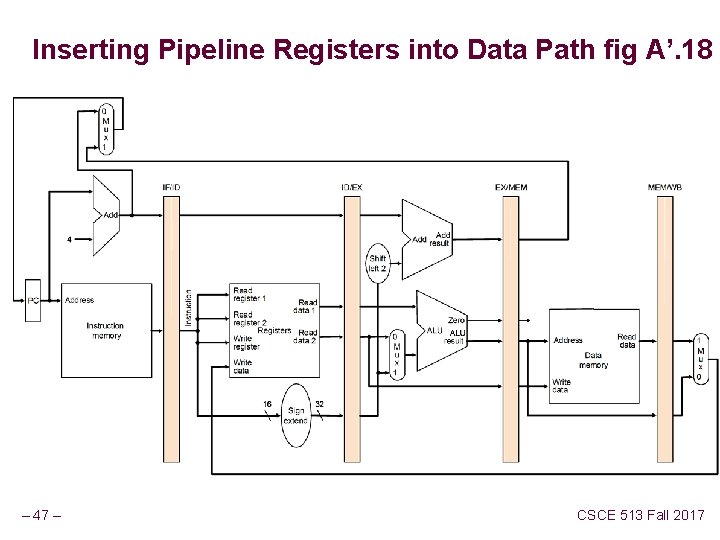
Inserting Pipeline Registers into Data Path fig A’. 18 – 47 – CSCE 513 Fall 2017
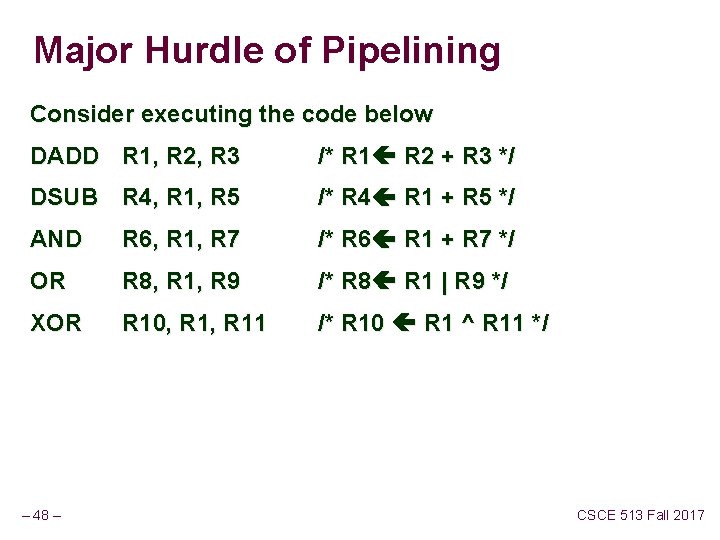
Major Hurdle of Pipelining Consider executing the code below DADD R 1, R 2, R 3 /* R 1 R 2 + R 3 */ DSUB R 4, R 1, R 5 /* R 4 R 1 + R 5 */ AND R 6, R 1, R 7 /* R 6 R 1 + R 7 */ OR /* R 8 R 1 | R 9 */ R 8, R 1, R 9 XOR R 10, R 11 – 48 – /* R 10 R 1 ^ R 11 */ CSCE 513 Fall 2017
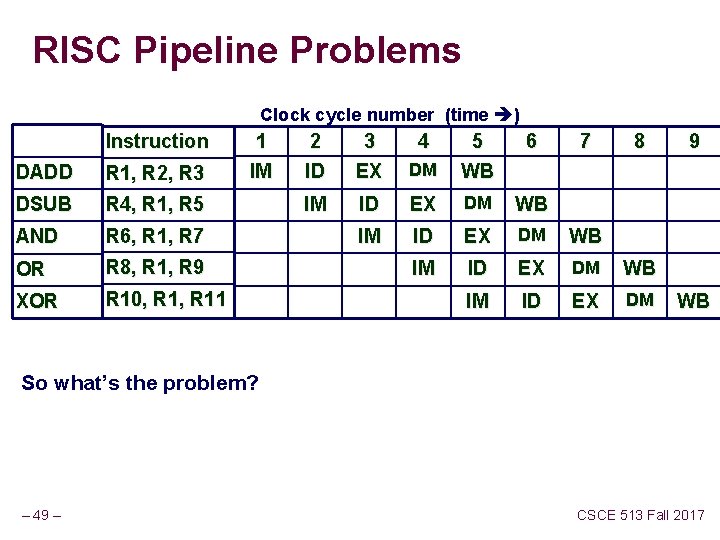
RISC Pipeline Problems Clock cycle number (time ) Instruction DADD R 1, R 2, R 3 DSUB R 4, R 1, R 5 AND R 6, R 1, R 7 OR R 8, R 1, R 9 XOR R 10, R 11 1 IM 2 ID 3 EX IM 4 6 DM 5 WB 7 8 ID EX DM WB IM ID EX DM 9 WB So what’s the problem? – 49 – CSCE 513 Fall 2017
Hazards Data Hazards – a data value computed in one stage is not ready when it is needed in another stage of the pipeline Simple Solution: stall until it is ready but we can do better Control or Branch Hazards Structural Hazards – arise when resources are not sufficient to completely overlap instruction sequence e. g. two floating point add units then having to do three simultaneously – 50 – CSCE 513 Fall 2017