
CSCE 432832 High Performance Processor Architectures Introduction to



- Slides: 81
CSCE 432/832 High Performance Processor Architectures Introduction to Multiprocessors Adopted from Professor David Patterson Electrical Engineering and Computer Sciences University of California, Berkeley CSCE 432/832, Introduction to Multiprocessors
Outline • • MP Motivation SISD v. SIMD v. MIMD Centralized vs. Distributed Memory Challenges to Parallel Programming Consistency, Coherency, Write Serialization Write Invalidate Protocol Example Conclusion 10/24/2021 CSCE 432/832, Introduction to Multiprocessors 2
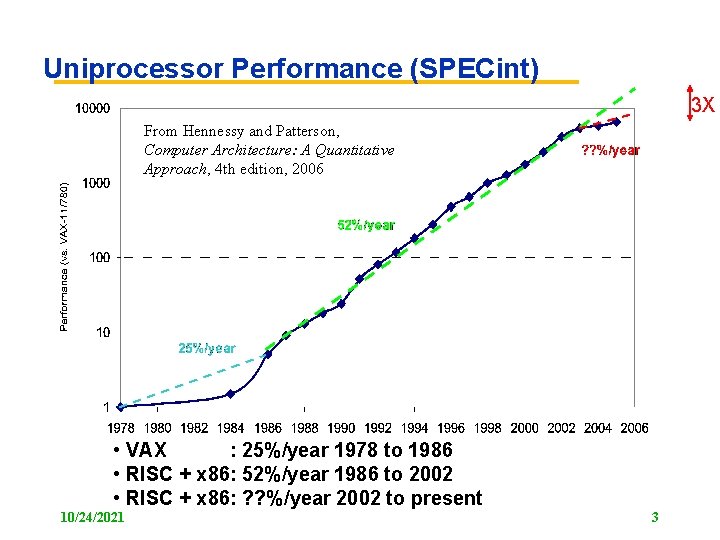
Uniprocessor Performance (SPECint) 3 X From Hennessy and Patterson, Computer Architecture: A Quantitative Approach, 4 th edition, 2006 • VAX : 25%/year 1978 to 1986 • RISC + x 86: 52%/year 1986 to 2002 • RISC + x 86: ? ? %/year 2002 to present 10/24/2021 3
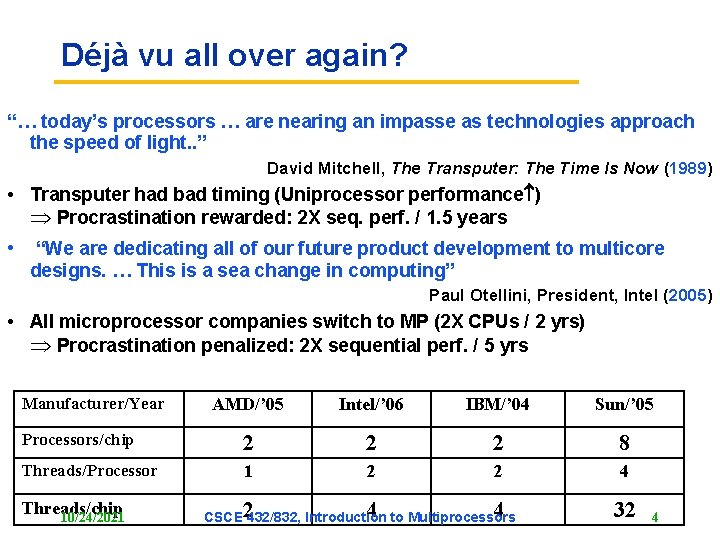
Déjà vu all over again? “… today’s processors … are nearing an impasse as technologies approach the speed of light. . ” David Mitchell, The Transputer: The Time Is Now (1989) • Transputer had bad timing (Uniprocessor performance ) Procrastination rewarded: 2 X seq. perf. / 1. 5 years • “We are dedicating all of our future product development to multicore designs. … This is a sea change in computing” Paul Otellini, President, Intel (2005) • All microprocessor companies switch to MP (2 X CPUs / 2 yrs) Procrastination penalized: 2 X sequential perf. / 5 yrs AMD/’ 05 Intel/’ 06 IBM/’ 04 Sun/’ 05 Processors/chip 2 2 2 8 Threads/Processor 1 2 2 4 Manufacturer/Year Threads/chip 10/24/2021 4 to Multiprocessors 4 CSCE 2432/832, Introduction 32 4
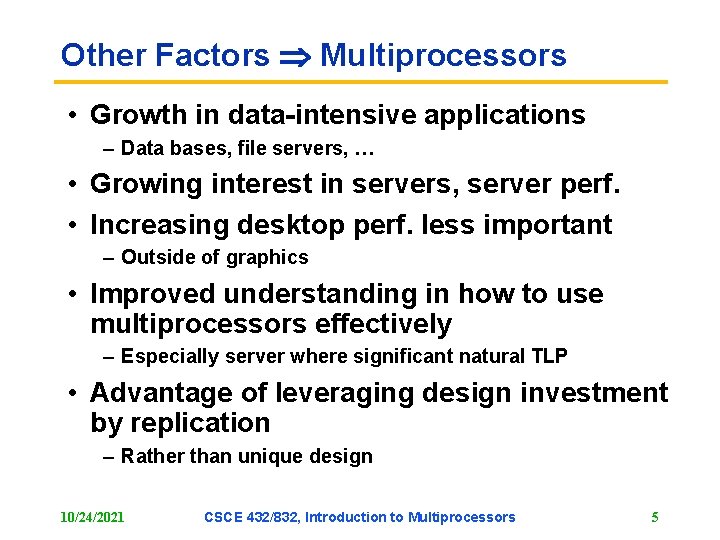
Other Factors Multiprocessors • Growth in data-intensive applications – Data bases, file servers, … • Growing interest in servers, server perf. • Increasing desktop perf. less important – Outside of graphics • Improved understanding in how to use multiprocessors effectively – Especially server where significant natural TLP • Advantage of leveraging design investment by replication – Rather than unique design 10/24/2021 CSCE 432/832, Introduction to Multiprocessors 5
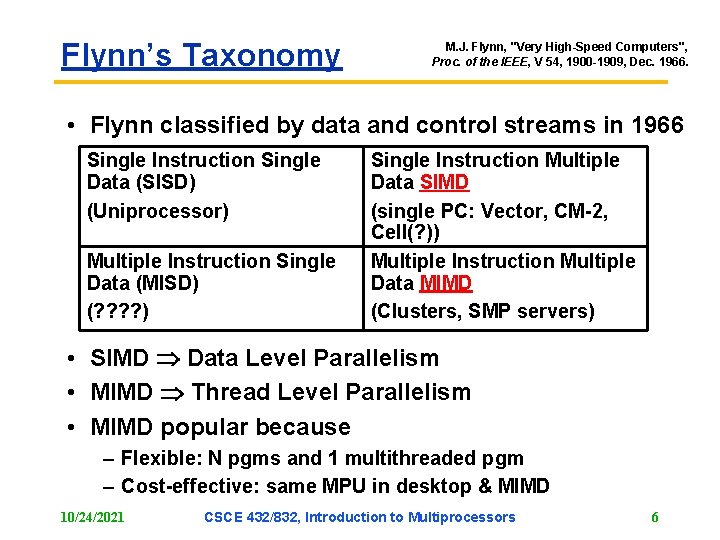
Flynn’s Taxonomy M. J. Flynn, "Very High-Speed Computers", Proc. of the IEEE, V 54, 1900 -1909, Dec. 1966. • Flynn classified by data and control streams in 1966 Single Instruction Single Data (SISD) (Uniprocessor) Multiple Instruction Single Data (MISD) (? ? ) Single Instruction Multiple Data SIMD (single PC: Vector, CM-2, Cell(? )) Multiple Instruction Multiple Data MIMD (Clusters, SMP servers) • SIMD Data Level Parallelism • MIMD Thread Level Parallelism • MIMD popular because – Flexible: N pgms and 1 multithreaded pgm – Cost-effective: same MPU in desktop & MIMD 10/24/2021 CSCE 432/832, Introduction to Multiprocessors 6
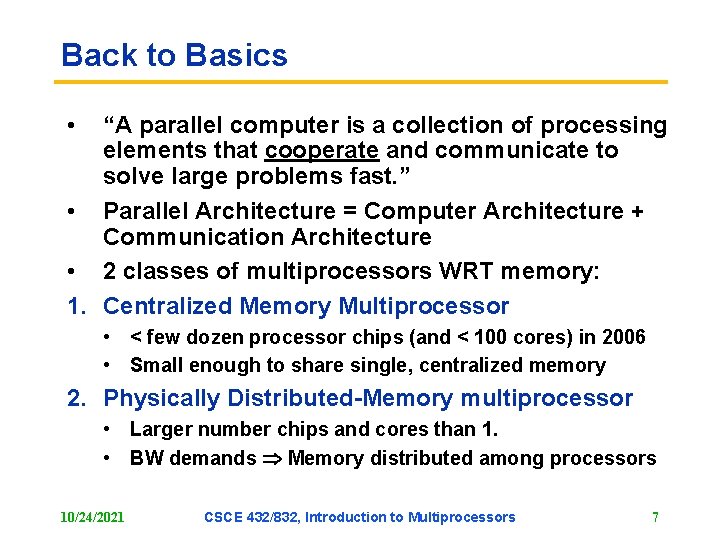
Back to Basics • “A parallel computer is a collection of processing elements that cooperate and communicate to solve large problems fast. ” • Parallel Architecture = Computer Architecture + Communication Architecture • 2 classes of multiprocessors WRT memory: 1. Centralized Memory Multiprocessor • < few dozen processor chips (and < 100 cores) in 2006 • Small enough to share single, centralized memory 2. Physically Distributed-Memory multiprocessor • Larger number chips and cores than 1. • BW demands Memory distributed among processors 10/24/2021 CSCE 432/832, Introduction to Multiprocessors 7
Centralized vs. Distributed Memory Scale P 1 Pn $ $ Pn P 1 Mem $ Inter connection network Mem Centralized Memory 10/24/2021 Distributed Memory CSCE 432/832, Introduction to Multiprocessors 8
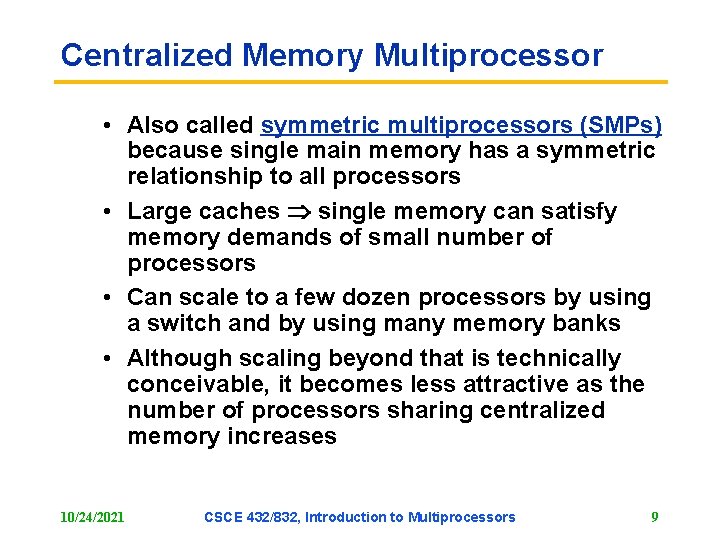
Centralized Memory Multiprocessor • Also called symmetric multiprocessors (SMPs) because single main memory has a symmetric relationship to all processors • Large caches single memory can satisfy memory demands of small number of processors • Can scale to a few dozen processors by using a switch and by using many memory banks • Although scaling beyond that is technically conceivable, it becomes less attractive as the number of processors sharing centralized memory increases 10/24/2021 CSCE 432/832, Introduction to Multiprocessors 9
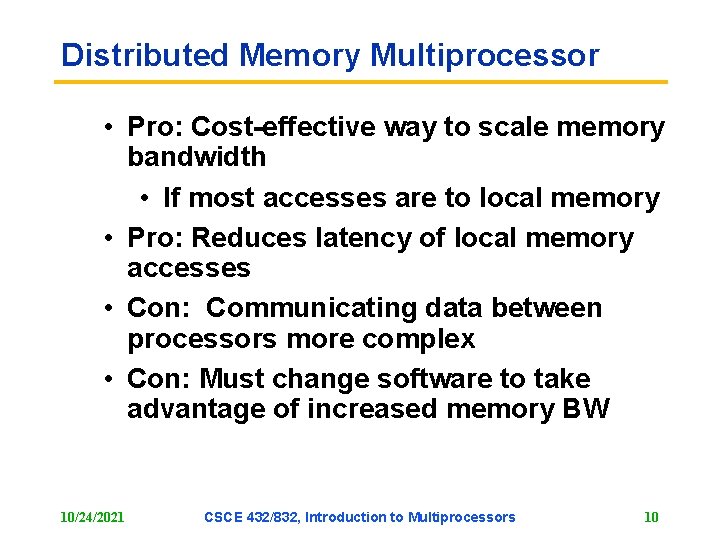
Distributed Memory Multiprocessor • Pro: Cost-effective way to scale memory bandwidth • If most accesses are to local memory • Pro: Reduces latency of local memory accesses • Con: Communicating data between processors more complex • Con: Must change software to take advantage of increased memory BW 10/24/2021 CSCE 432/832, Introduction to Multiprocessors 10
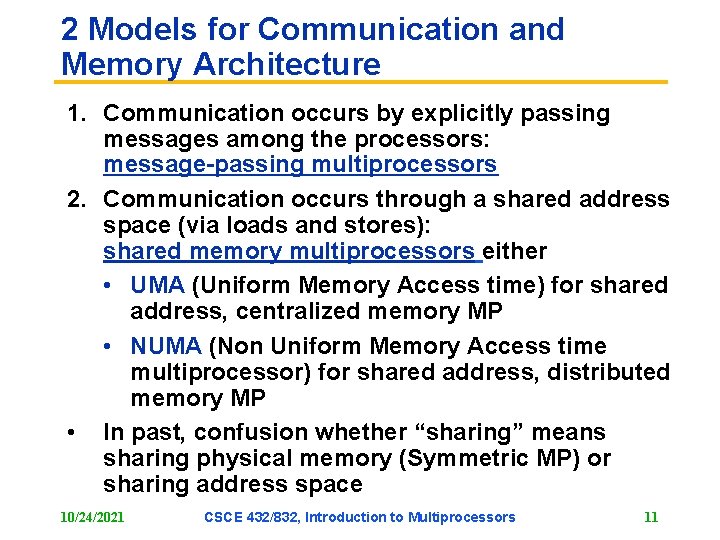
2 Models for Communication and Memory Architecture 1. Communication occurs by explicitly passing messages among the processors: message-passing multiprocessors 2. Communication occurs through a shared address space (via loads and stores): shared memory multiprocessors either • UMA (Uniform Memory Access time) for shared address, centralized memory MP • NUMA (Non Uniform Memory Access time multiprocessor) for shared address, distributed memory MP • In past, confusion whether “sharing” means sharing physical memory (Symmetric MP) or sharing address space 10/24/2021 CSCE 432/832, Introduction to Multiprocessors 11
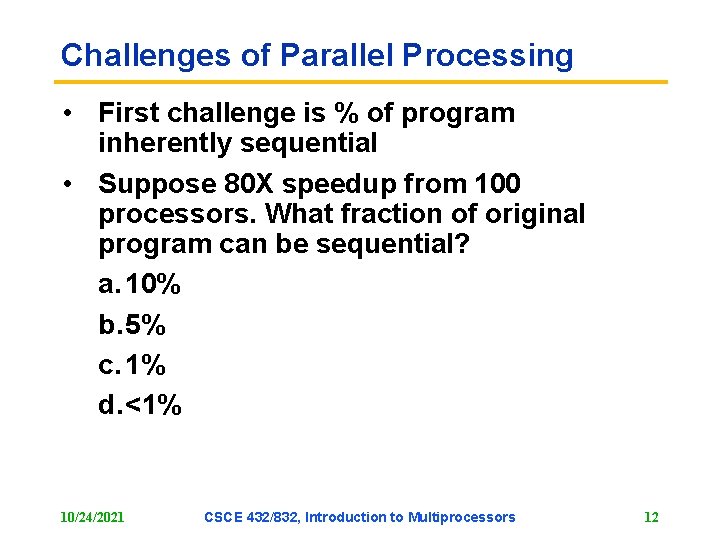
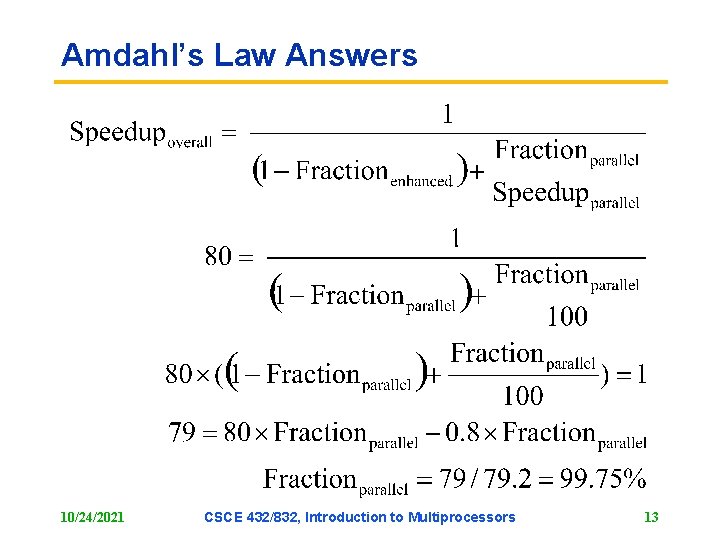
Challenges of Parallel Processing • First challenge is % of program inherently sequential • Suppose 80 X speedup from 100 processors. What fraction of original program can be sequential? a. 10% b. 5% c. 1% d. <1% 10/24/2021 CSCE 432/832, Introduction to Multiprocessors 12
Amdahl’s Law Answers 10/24/2021 CSCE 432/832, Introduction to Multiprocessors 13
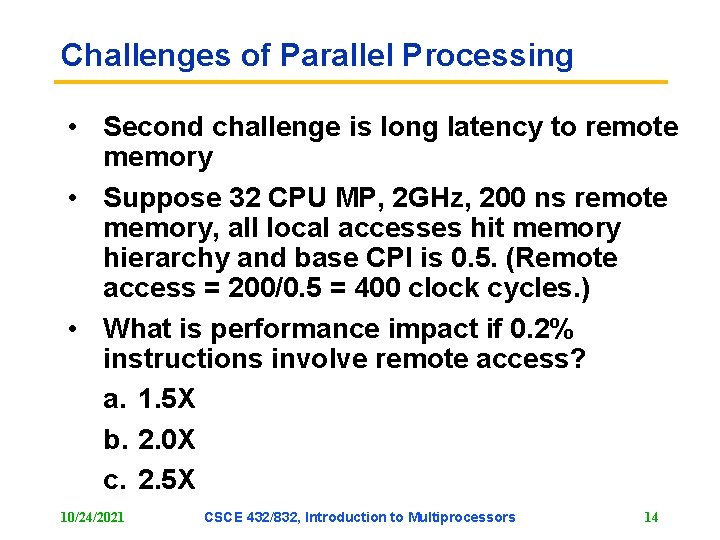
Challenges of Parallel Processing • Second challenge is long latency to remote memory • Suppose 32 CPU MP, 2 GHz, 200 ns remote memory, all local accesses hit memory hierarchy and base CPI is 0. 5. (Remote access = 200/0. 5 = 400 clock cycles. ) • What is performance impact if 0. 2% instructions involve remote access? a. 1. 5 X b. 2. 0 X c. 2. 5 X 10/24/2021 CSCE 432/832, Introduction to Multiprocessors 14
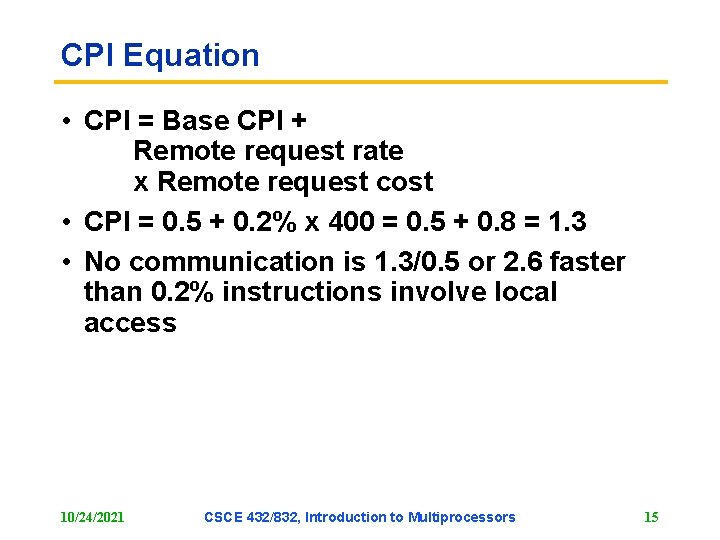
CPI Equation • CPI = Base CPI + Remote request rate x Remote request cost • CPI = 0. 5 + 0. 2% x 400 = 0. 5 + 0. 8 = 1. 3 • No communication is 1. 3/0. 5 or 2. 6 faster than 0. 2% instructions involve local access 10/24/2021 CSCE 432/832, Introduction to Multiprocessors 15
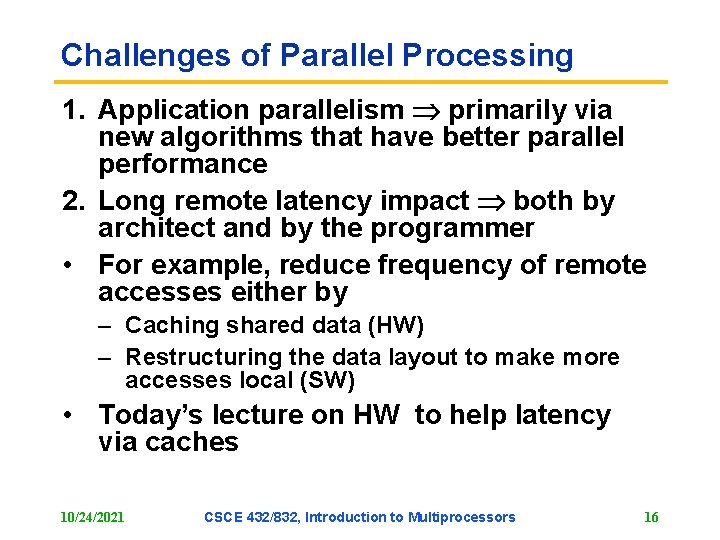
Challenges of Parallel Processing 1. Application parallelism primarily via new algorithms that have better parallel performance 2. Long remote latency impact both by architect and by the programmer • For example, reduce frequency of remote accesses either by – Caching shared data (HW) – Restructuring the data layout to make more accesses local (SW) • Today’s lecture on HW to help latency via caches 10/24/2021 CSCE 432/832, Introduction to Multiprocessors 16
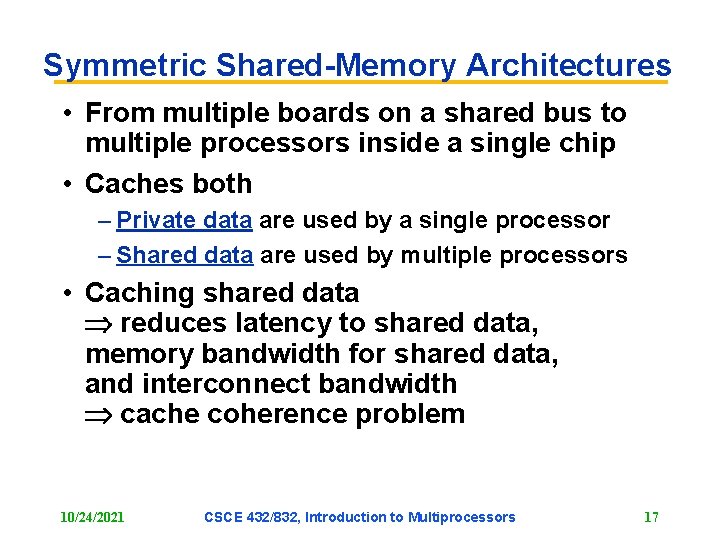
Symmetric Shared-Memory Architectures • From multiple boards on a shared bus to multiple processors inside a single chip • Caches both – Private data are used by a single processor – Shared data are used by multiple processors • Caching shared data reduces latency to shared data, memory bandwidth for shared data, and interconnect bandwidth cache coherence problem 10/24/2021 CSCE 432/832, Introduction to Multiprocessors 17
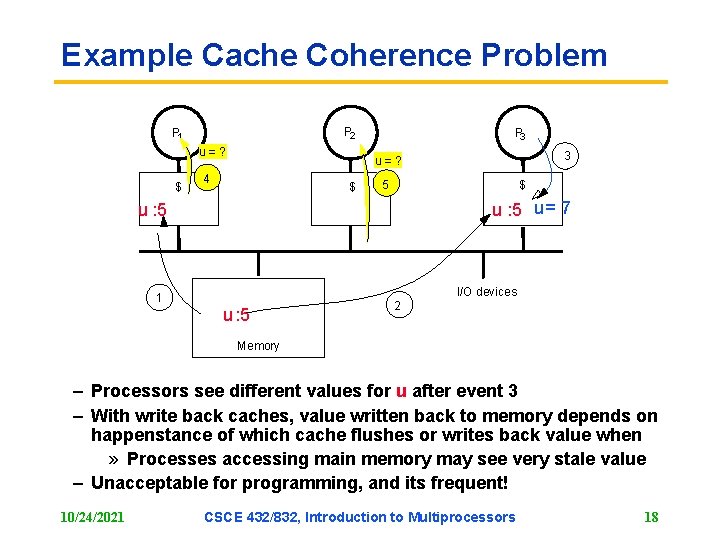
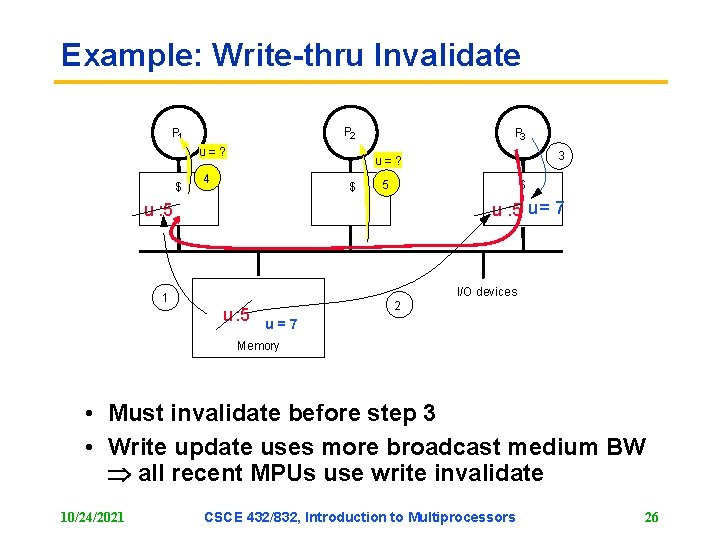
Example Cache Coherence Problem P 2 P 1 u=? $ P 3 3 u=? 4 $ 5 $ u : 5 u = 7 u : 5 I/O devices 1 u : 5 2 Memory – Processors see different values for u after event 3 – With write back caches, value written back to memory depends on happenstance of which cache flushes or writes back value when » Processes accessing main memory may see very stale value – Unacceptable for programming, and its frequent! 10/24/2021 CSCE 432/832, Introduction to Multiprocessors 18
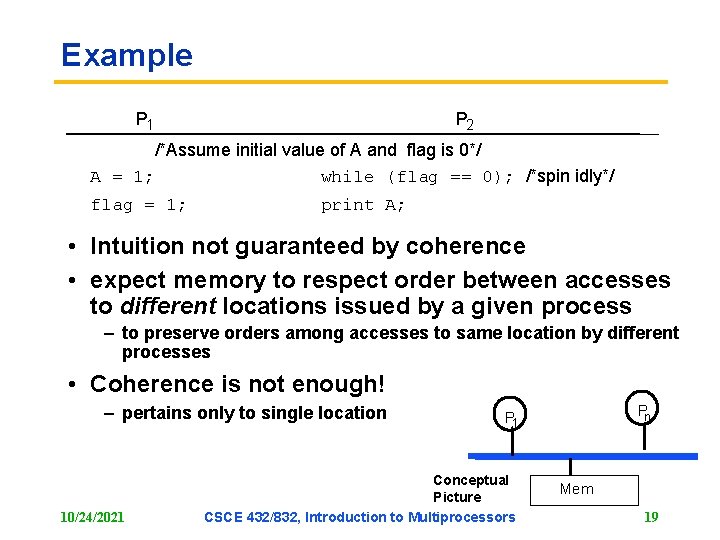
Example P 1 P 2 /*Assume initial value of A and flag is 0*/ A = 1; while (flag == 0); /*spin idly*/ flag = 1; print A; • Intuition not guaranteed by coherence • expect memory to respect order between accesses to different locations issued by a given process – to preserve orders among accesses to same location by different processes • Coherence is not enough! – pertains only to single location 10/24/2021 Pn P 1 Conceptual Picture CSCE 432/832, Introduction to Multiprocessors Mem 19
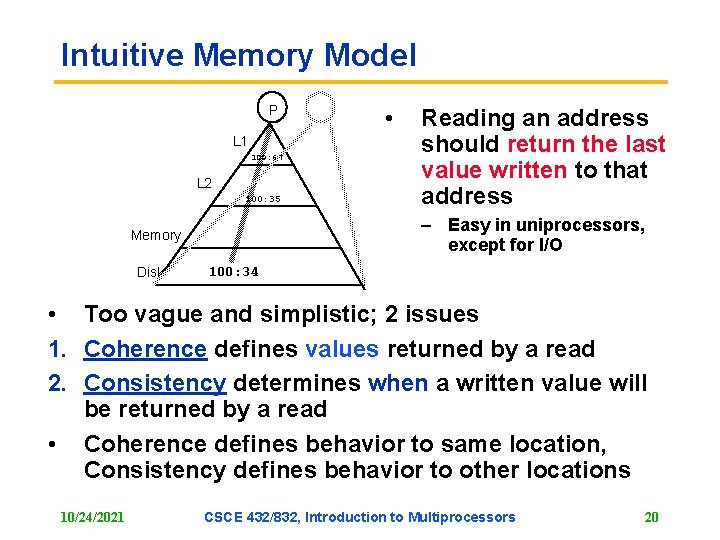
Intuitive Memory Model P L 1 100: 67 L 2 100: 35 Reading an address should return the last value written to that address – Easy in uniprocessors, except for I/O Memory Disk • 100: 34 • Too vague and simplistic; 2 issues 1. Coherence defines values returned by a read 2. Consistency determines when a written value will be returned by a read • Coherence defines behavior to same location, Consistency defines behavior to other locations 10/24/2021 CSCE 432/832, Introduction to Multiprocessors 20
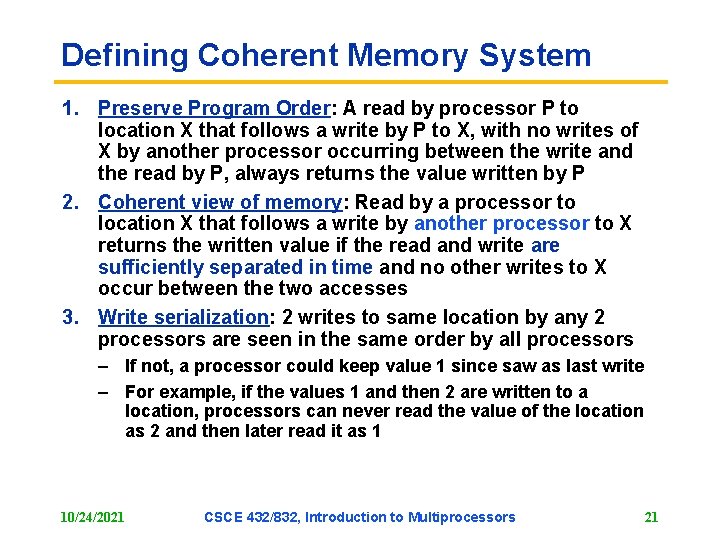
Defining Coherent Memory System 1. Preserve Program Order: A read by processor P to location X that follows a write by P to X, with no writes of X by another processor occurring between the write and the read by P, always returns the value written by P 2. Coherent view of memory: Read by a processor to location X that follows a write by another processor to X returns the written value if the read and write are sufficiently separated in time and no other writes to X occur between the two accesses 3. Write serialization: 2 writes to same location by any 2 processors are seen in the same order by all processors – If not, a processor could keep value 1 since saw as last write – For example, if the values 1 and then 2 are written to a location, processors can never read the value of the location as 2 and then later read it as 1 10/24/2021 CSCE 432/832, Introduction to Multiprocessors 21
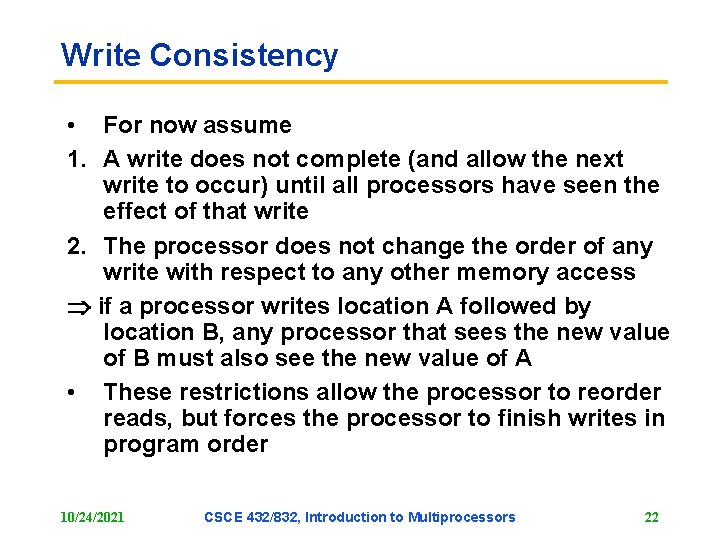
Write Consistency • For now assume 1. A write does not complete (and allow the next write to occur) until all processors have seen the effect of that write 2. The processor does not change the order of any write with respect to any other memory access if a processor writes location A followed by location B, any processor that sees the new value of B must also see the new value of A • These restrictions allow the processor to reorder reads, but forces the processor to finish writes in program order 10/24/2021 CSCE 432/832, Introduction to Multiprocessors 22
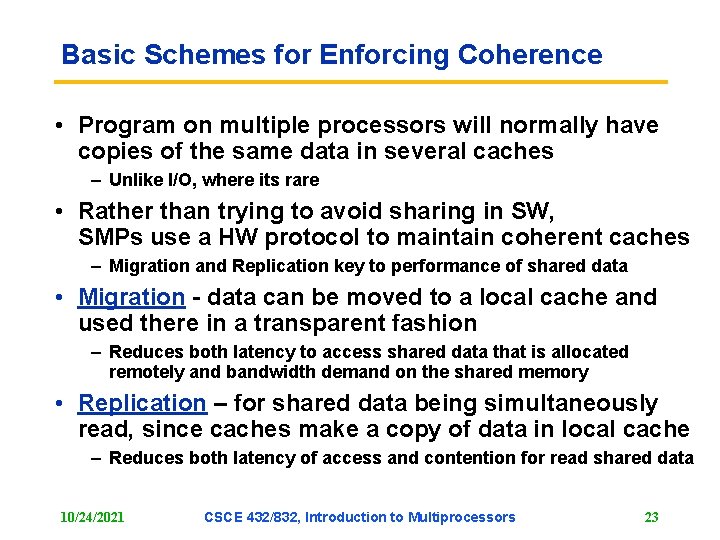
Basic Schemes for Enforcing Coherence • Program on multiple processors will normally have copies of the same data in several caches – Unlike I/O, where its rare • Rather than trying to avoid sharing in SW, SMPs use a HW protocol to maintain coherent caches – Migration and Replication key to performance of shared data • Migration - data can be moved to a local cache and used there in a transparent fashion – Reduces both latency to access shared data that is allocated remotely and bandwidth demand on the shared memory • Replication – for shared data being simultaneously read, since caches make a copy of data in local cache – Reduces both latency of access and contention for read shared data 10/24/2021 CSCE 432/832, Introduction to Multiprocessors 23
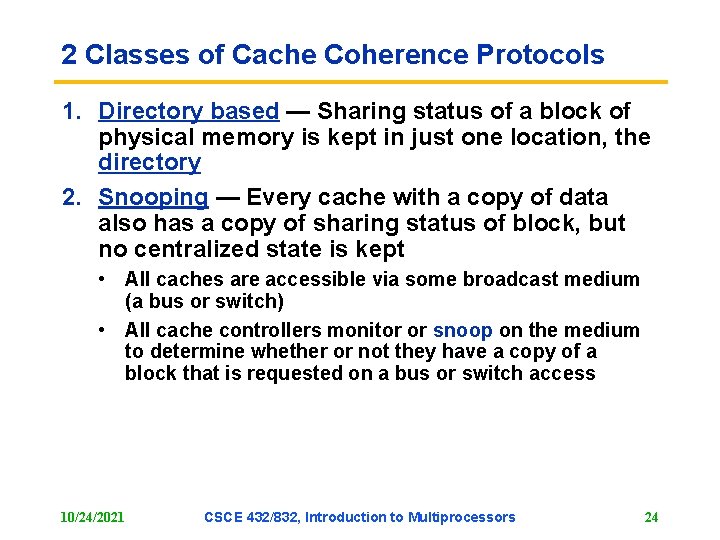
2 Classes of Cache Coherence Protocols 1. Directory based — Sharing status of a block of physical memory is kept in just one location, the directory 2. Snooping — Every cache with a copy of data also has a copy of sharing status of block, but no centralized state is kept • All caches are accessible via some broadcast medium (a bus or switch) • All cache controllers monitor or snoop on the medium to determine whether or not they have a copy of a block that is requested on a bus or switch access 10/24/2021 CSCE 432/832, Introduction to Multiprocessors 24
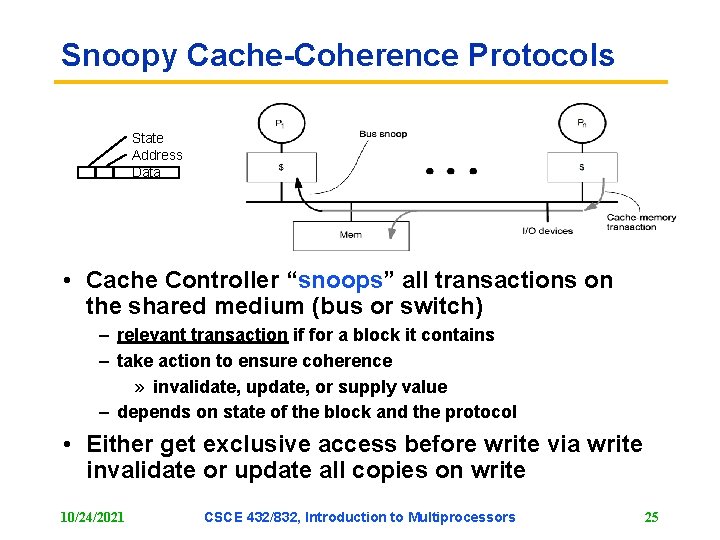
Snoopy Cache-Coherence Protocols State Address Data • Cache Controller “snoops” all transactions on the shared medium (bus or switch) – relevant transaction if for a block it contains – take action to ensure coherence » invalidate, update, or supply value – depends on state of the block and the protocol • Either get exclusive access before write via write invalidate or update all copies on write 10/24/2021 CSCE 432/832, Introduction to Multiprocessors 25
Example: Write-thru Invalidate P 2 P 1 u=? $ P 3 3 u=? 4 $ 5 $ u : 5 u = 7 u : 5 I/O devices 1 u : 5 2 u=7 Memory • Must invalidate before step 3 • Write update uses more broadcast medium BW all recent MPUs use write invalidate 10/24/2021 CSCE 432/832, Introduction to Multiprocessors 26
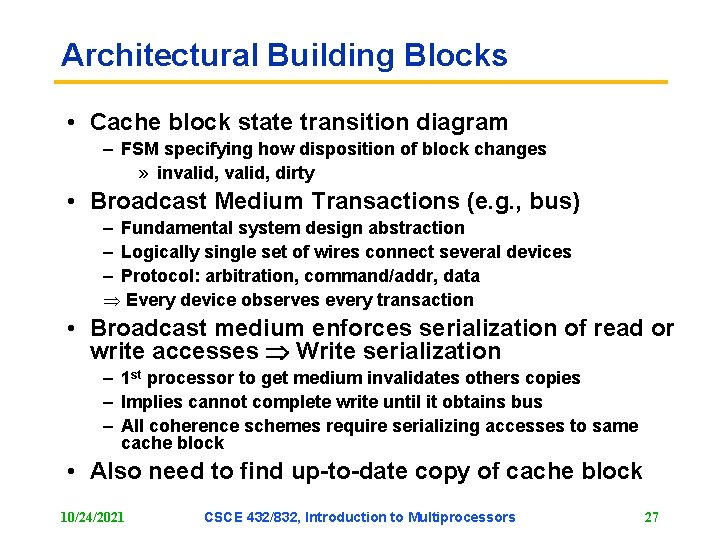
Architectural Building Blocks • Cache block state transition diagram – FSM specifying how disposition of block changes » invalid, dirty • Broadcast Medium Transactions (e. g. , bus) – Fundamental system design abstraction – Logically single set of wires connect several devices – Protocol: arbitration, command/addr, data Every device observes every transaction • Broadcast medium enforces serialization of read or write accesses Write serialization – 1 st processor to get medium invalidates others copies – Implies cannot complete write until it obtains bus – All coherence schemes require serializing accesses to same cache block • Also need to find up-to-date copy of cache block 10/24/2021 CSCE 432/832, Introduction to Multiprocessors 27
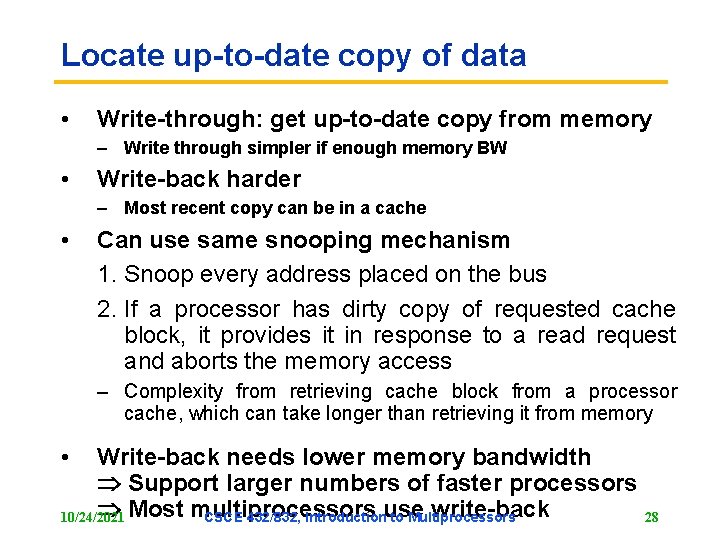
Locate up-to-date copy of data • Write-through: get up-to-date copy from memory – Write through simpler if enough memory BW • Write-back harder – Most recent copy can be in a cache • Can use same snooping mechanism 1. Snoop every address placed on the bus 2. If a processor has dirty copy of requested cache block, it provides it in response to a read request and aborts the memory access – Complexity from retrieving cache block from a processor cache, which can take longer than retrieving it from memory • Write-back needs lower memory bandwidth Support larger numbers of faster processors Most multiprocessors write-back 28 10/24/2021 CSCE 432/832, Introductionuse to Multiprocessors
Cache Resources for WB Snooping • • Normal cache tags can be used for snooping Valid bit per block makes invalidation easy Read misses easy since rely on snooping Writes Need to know if know whether any other copies of the block are cached – No other copies No need to place write on bus for WB – Other copies Need to place invalidate on bus 10/24/2021 CSCE 432/832, Introduction to Multiprocessors 29
Cache Resources for WB Snooping • To track whether a cache block is shared, add extra state bit associated with each cache block, like valid bit and dirty bit – Write to Shared block Need to place invalidate on bus and mark cache block as private (if an option) – No further invalidations will be sent for that block – This processor called owner of cache block – Owner then changes state from shared to unshared (or exclusive) 10/24/2021 CSCE 432/832, Introduction to Multiprocessors 30
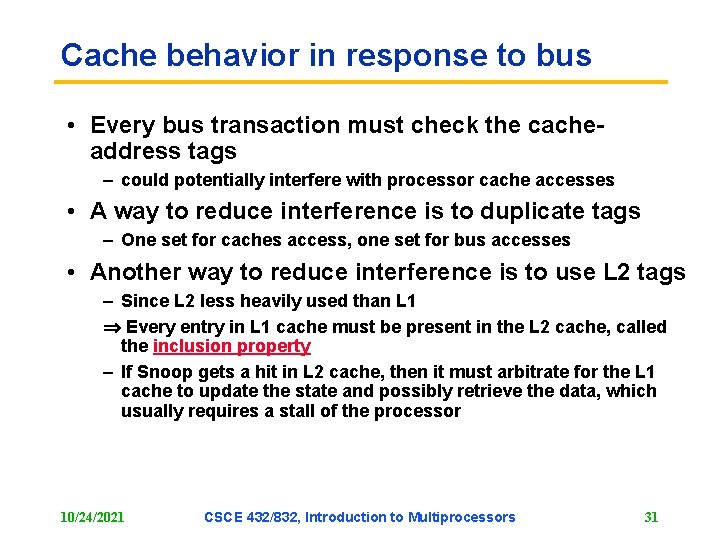
Cache behavior in response to bus • Every bus transaction must check the cacheaddress tags – could potentially interfere with processor cache accesses • A way to reduce interference is to duplicate tags – One set for caches access, one set for bus accesses • Another way to reduce interference is to use L 2 tags – Since L 2 less heavily used than L 1 Every entry in L 1 cache must be present in the L 2 cache, called the inclusion property – If Snoop gets a hit in L 2 cache, then it must arbitrate for the L 1 cache to update the state and possibly retrieve the data, which usually requires a stall of the processor 10/24/2021 CSCE 432/832, Introduction to Multiprocessors 31
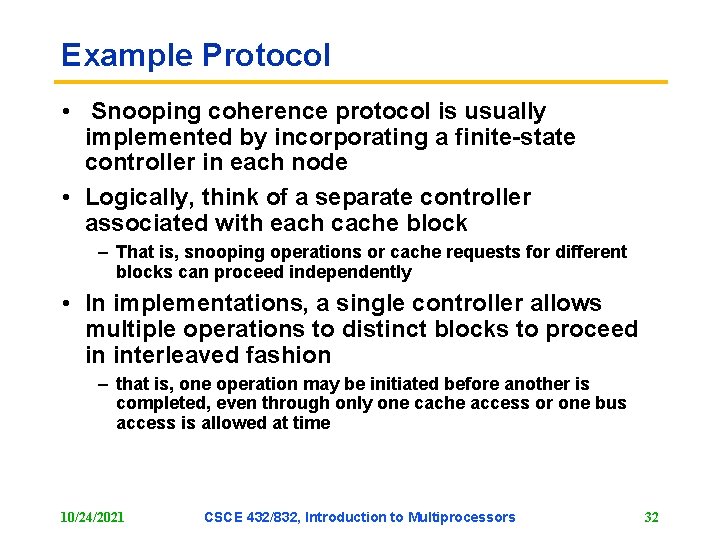
Example Protocol • Snooping coherence protocol is usually implemented by incorporating a finite-state controller in each node • Logically, think of a separate controller associated with each cache block – That is, snooping operations or cache requests for different blocks can proceed independently • In implementations, a single controller allows multiple operations to distinct blocks to proceed in interleaved fashion – that is, one operation may be initiated before another is completed, even through only one cache access or one bus access is allowed at time 10/24/2021 CSCE 432/832, Introduction to Multiprocessors 32
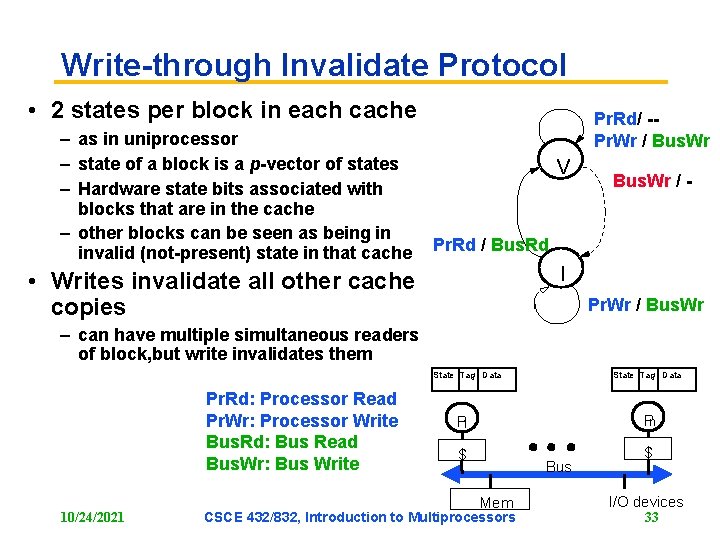
Write-through Invalidate Protocol • 2 states per block in each cache – as in uniprocessor – state of a block is a p-vector of states – Hardware state bits associated with blocks that are in the cache – other blocks can be seen as being in invalid (not-present) state in that cache Pr. Rd/ -Pr. Wr / Bus. Wr V Bus. Wr / - Pr. Rd / Bus. Rd I • Writes invalidate all other cache copies Pr. Wr / Bus. Wr – can have multiple simultaneous readers of block, but write invalidates them State Tag Data Pr. Rd: Processor Read Pr. Wr: Processor Write Bus. Rd: Bus Read Bus. Wr: Bus Write 10/24/2021 State Tag Data Pn P 1 $ Bus Mem CSCE 432/832, Introduction to Multiprocessors $ I/O devices 33
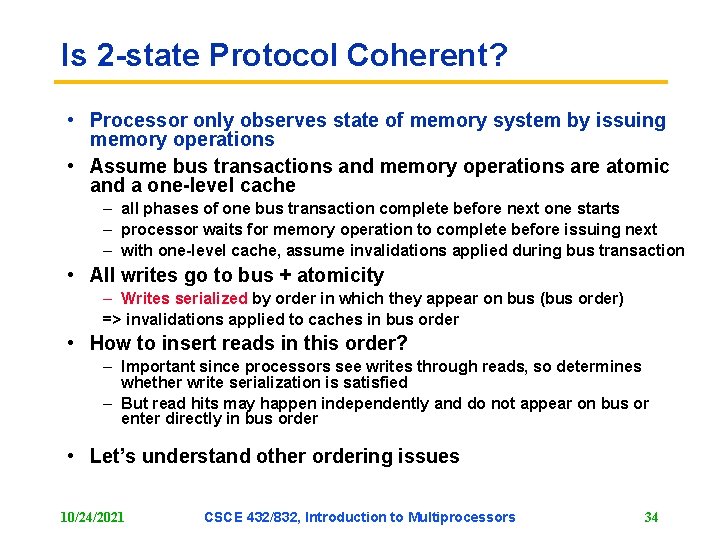
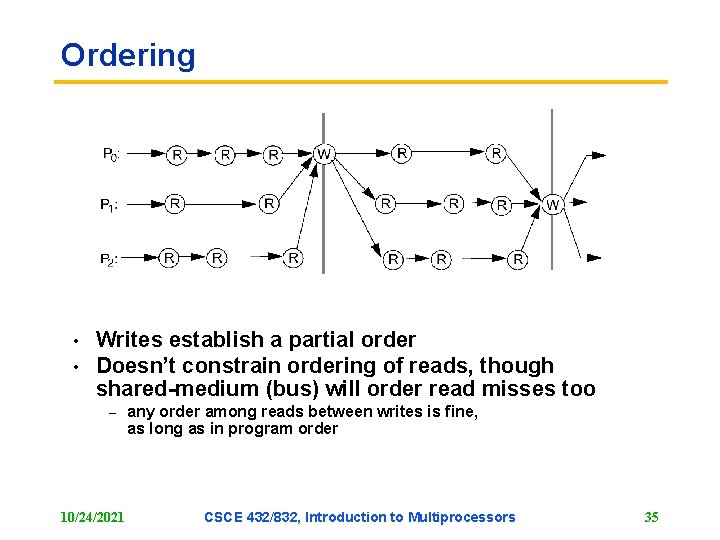
Is 2 -state Protocol Coherent? • Processor only observes state of memory system by issuing memory operations • Assume bus transactions and memory operations are atomic and a one-level cache – all phases of one bus transaction complete before next one starts – processor waits for memory operation to complete before issuing next – with one-level cache, assume invalidations applied during bus transaction • All writes go to bus + atomicity – Writes serialized by order in which they appear on bus (bus order) => invalidations applied to caches in bus order • How to insert reads in this order? – Important since processors see writes through reads, so determines whether write serialization is satisfied – But read hits may happen independently and do not appear on bus or enter directly in bus order • Let’s understand other ordering issues 10/24/2021 CSCE 432/832, Introduction to Multiprocessors 34
Ordering • • Writes establish a partial order Doesn’t constrain ordering of reads, though shared-medium (bus) will order read misses too – 10/24/2021 any order among reads between writes is fine, as long as in program order CSCE 432/832, Introduction to Multiprocessors 35
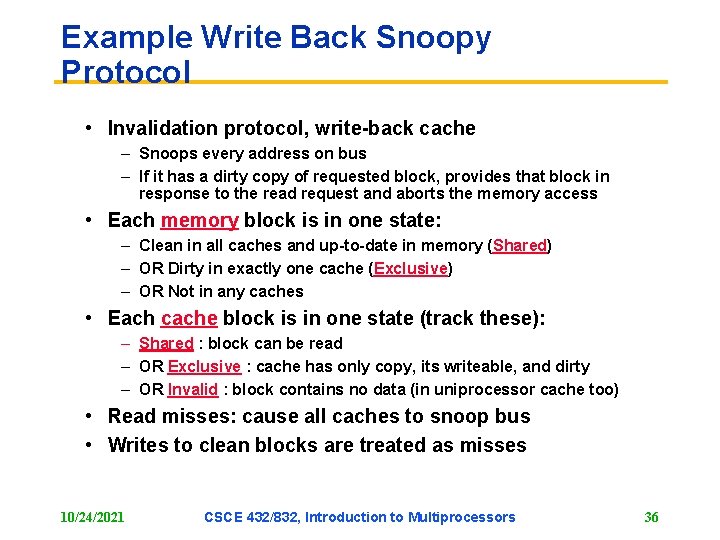
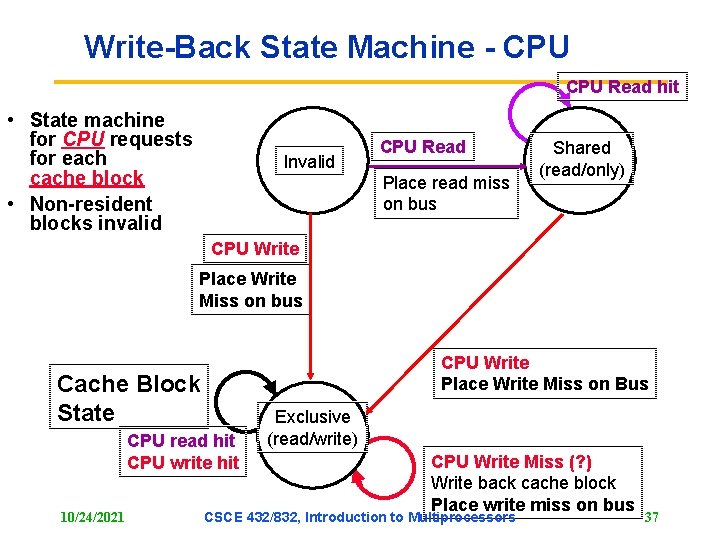
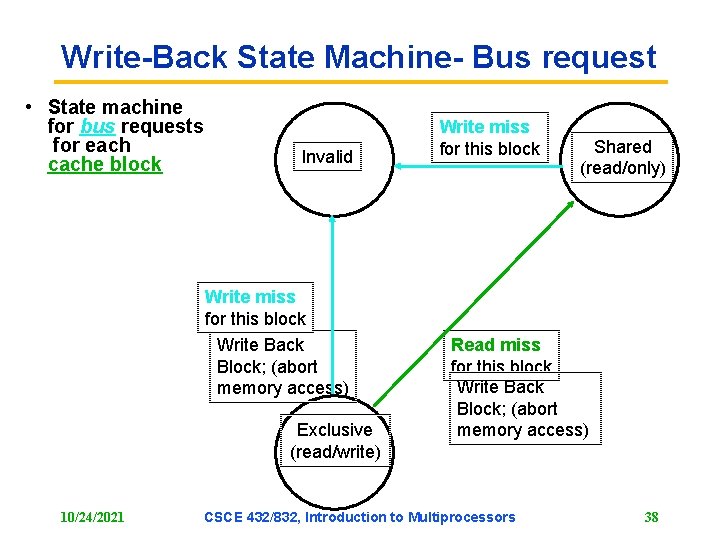
Example Write Back Snoopy Protocol • Invalidation protocol, write-back cache – Snoops every address on bus – If it has a dirty copy of requested block, provides that block in response to the read request and aborts the memory access • Each memory block is in one state: – Clean in all caches and up-to-date in memory (Shared) – OR Dirty in exactly one cache (Exclusive) – OR Not in any caches • Each cache block is in one state (track these): – Shared : block can be read – OR Exclusive : cache has only copy, its writeable, and dirty – OR Invalid : block contains no data (in uniprocessor cache too) • Read misses: cause all caches to snoop bus • Writes to clean blocks are treated as misses 10/24/2021 CSCE 432/832, Introduction to Multiprocessors 36
Write-Back State Machine - CPU Read hit • State machine for CPU requests for each cache block • Non-resident blocks invalid Invalid CPU Read Place read miss on bus Shared (read/only) CPU Write Place Write Miss on bus CPU Write Place Write Miss on Bus Cache Block State CPU read hit CPU write hit 10/24/2021 Exclusive (read/write) CPU Write Miss (? ) Write back cache block Place write miss on bus CSCE 432/832, Introduction to Multiprocessors 37
Write-Back State Machine- Bus request • State machine for bus requests for each cache block Invalid Write miss for this block Write Back Block; (abort memory access) Exclusive (read/write) 10/24/2021 Write miss for this block Shared (read/only) Read miss for this block Write Back Block; (abort memory access) CSCE 432/832, Introduction to Multiprocessors 38
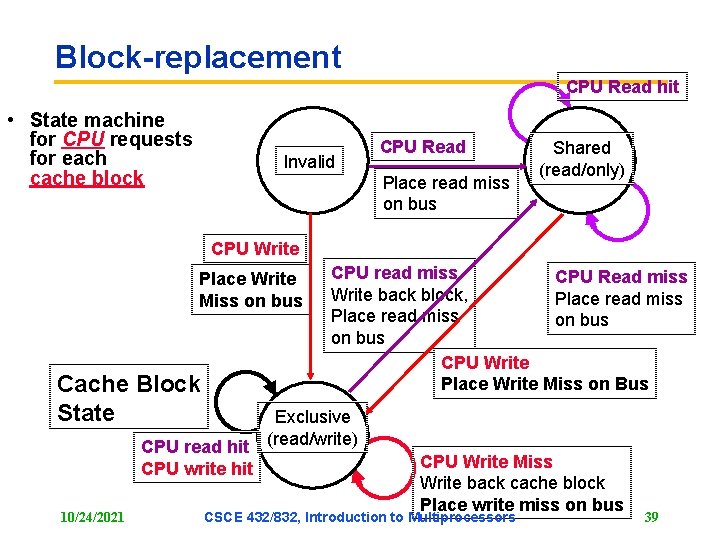
Block-replacement CPU Read hit • State machine for CPU requests for each cache block Invalid CPU Read Place read miss on bus Shared (read/only) CPU Write Place Write Miss on bus Cache Block State CPU read hit CPU write hit 10/24/2021 CPU read miss CPU Read miss Write back block, Place read miss on bus CPU Write Place Write Miss on Bus Exclusive (read/write) CPU Write Miss Write back cache block Place write miss on bus CSCE 432/832, Introduction to Multiprocessors 39
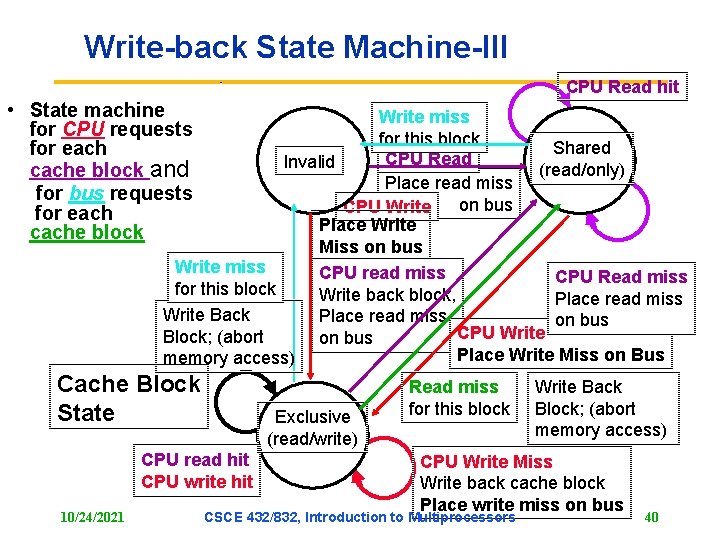
Write-back State Machine-III CPU Read hit • State machine for CPU requests for each cache block and for bus requests for each cache block Write miss for this block Shared CPU Read Invalid (read/only) Place read miss on bus CPU Write Place Write Miss on bus Write miss CPU read miss CPU Read miss for this block Write back block, Place read miss Write Back Place read miss on bus CPU Write Block; (abort on bus Place Write Miss on Bus memory access) Cache Block State Exclusive (read/write) CPU read hit CPU write hit 10/24/2021 Read miss for this block Write Back Block; (abort memory access) CPU Write Miss Write back cache block Place write miss on bus CSCE 432/832, Introduction to Multiprocessors 40
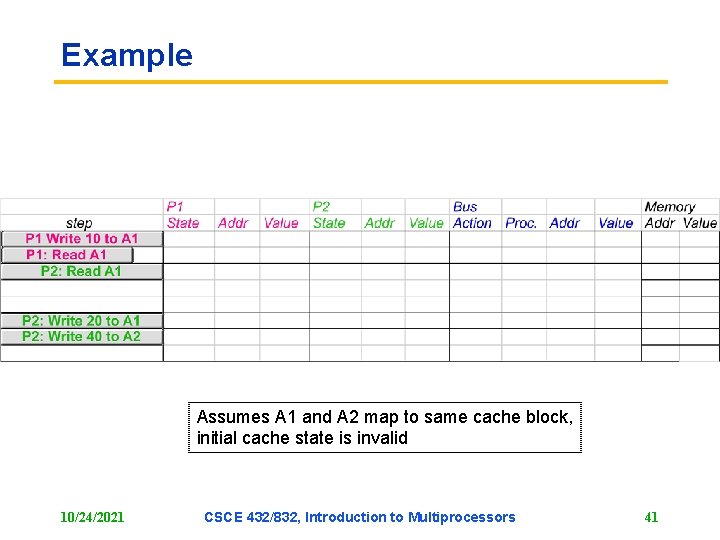
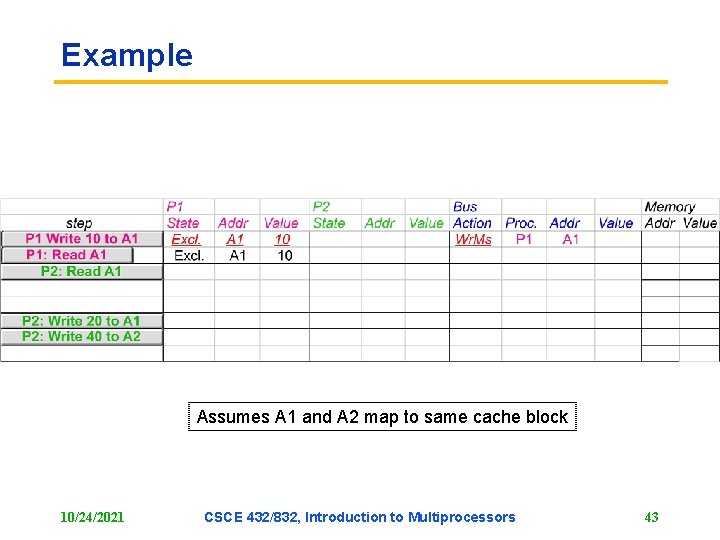
Example Assumes A 1 and A 2 map to same cache block, initial cache state is invalid 10/24/2021 CSCE 432/832, Introduction to Multiprocessors 41
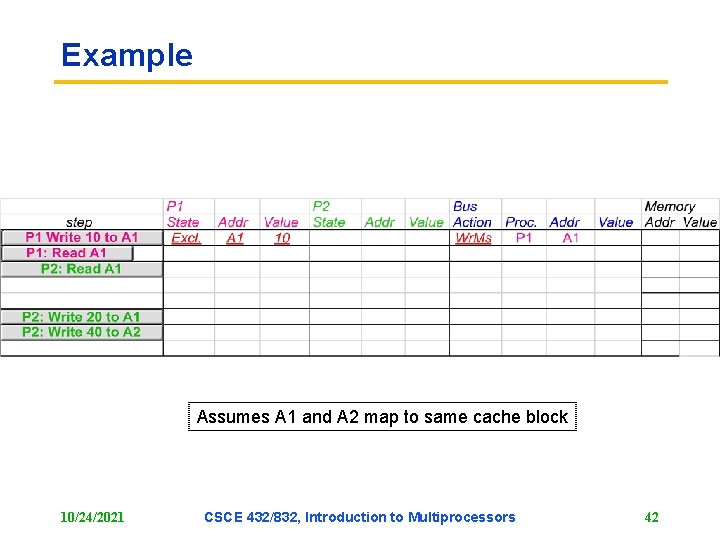
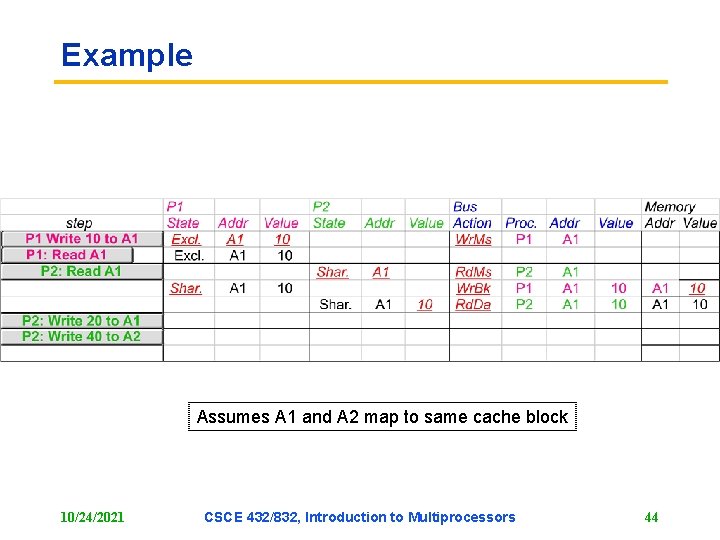
Example Assumes A 1 and A 2 map to same cache block 10/24/2021 CSCE 432/832, Introduction to Multiprocessors 42
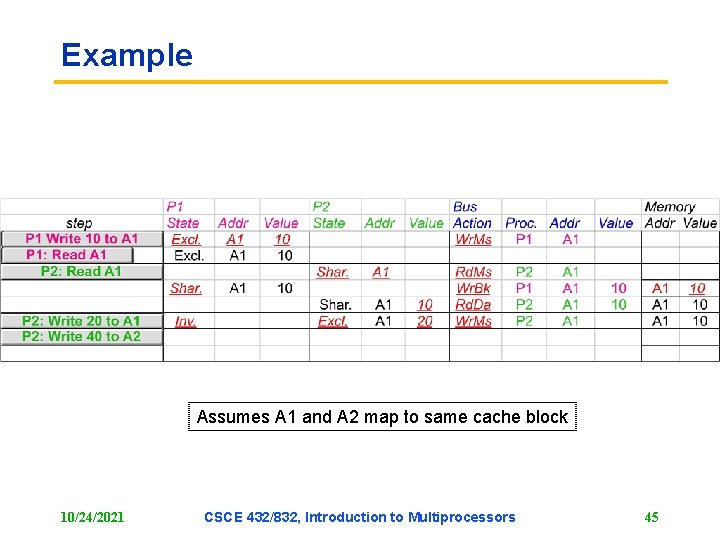
Example Assumes A 1 and A 2 map to same cache block 10/24/2021 CSCE 432/832, Introduction to Multiprocessors 43
Example Assumes A 1 and A 2 map to same cache block 10/24/2021 CSCE 432/832, Introduction to Multiprocessors 44
Example Assumes A 1 and A 2 map to same cache block 10/24/2021 CSCE 432/832, Introduction to Multiprocessors 45
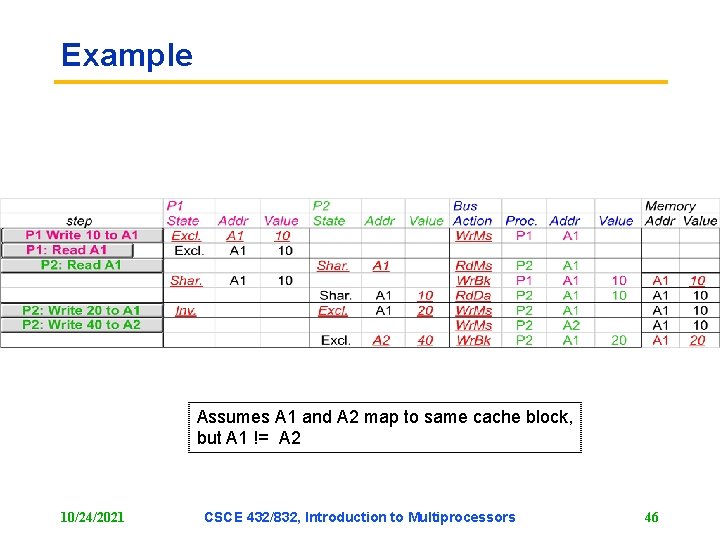
Example Assumes A 1 and A 2 map to same cache block, but A 1 != A 2 10/24/2021 CSCE 432/832, Introduction to Multiprocessors 46
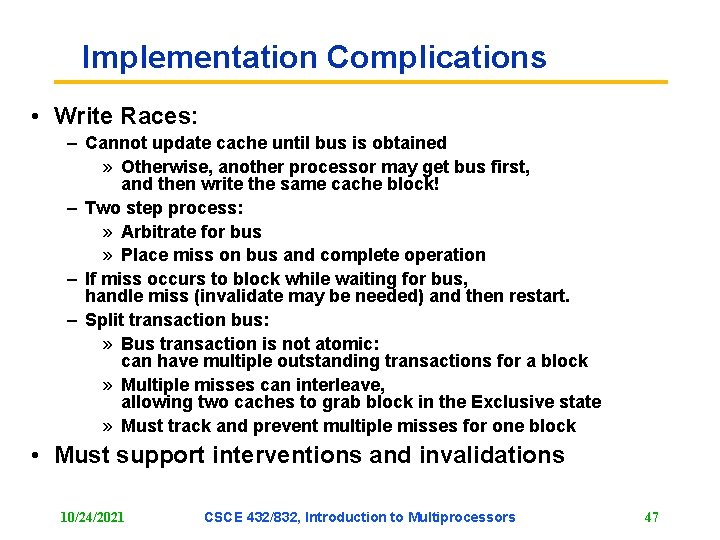
Implementation Complications • Write Races: – Cannot update cache until bus is obtained » Otherwise, another processor may get bus first, and then write the same cache block! – Two step process: » Arbitrate for bus » Place miss on bus and complete operation – If miss occurs to block while waiting for bus, handle miss (invalidate may be needed) and then restart. – Split transaction bus: » Bus transaction is not atomic: can have multiple outstanding transactions for a block » Multiple misses can interleave, allowing two caches to grab block in the Exclusive state » Must track and prevent multiple misses for one block • Must support interventions and invalidations 10/24/2021 CSCE 432/832, Introduction to Multiprocessors 47
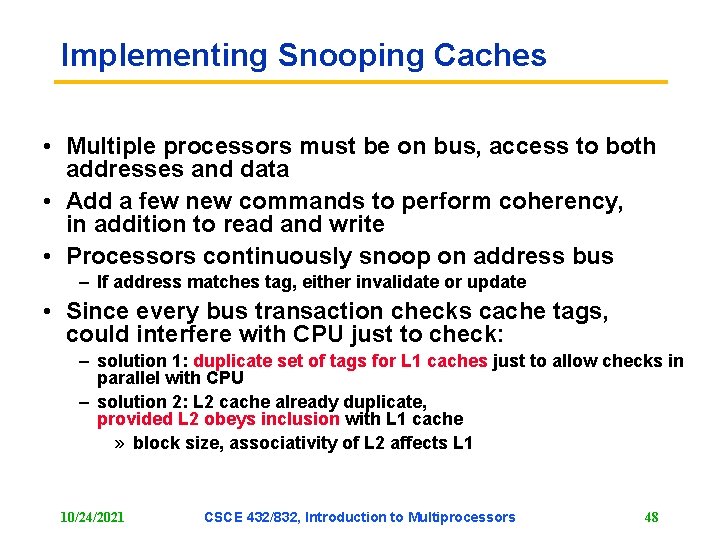
Implementing Snooping Caches • Multiple processors must be on bus, access to both addresses and data • Add a few new commands to perform coherency, in addition to read and write • Processors continuously snoop on address bus – If address matches tag, either invalidate or update • Since every bus transaction checks cache tags, could interfere with CPU just to check: – solution 1: duplicate set of tags for L 1 caches just to allow checks in parallel with CPU – solution 2: L 2 cache already duplicate, provided L 2 obeys inclusion with L 1 cache » block size, associativity of L 2 affects L 1 10/24/2021 CSCE 432/832, Introduction to Multiprocessors 48
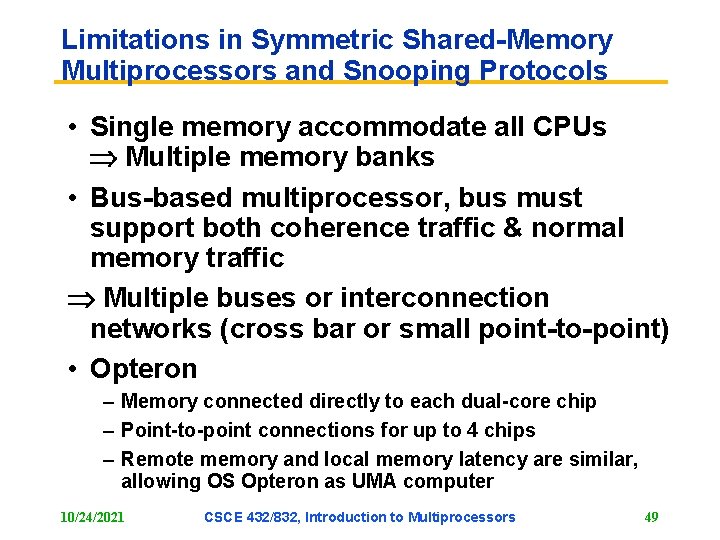
Limitations in Symmetric Shared-Memory Multiprocessors and Snooping Protocols • Single memory accommodate all CPUs Multiple memory banks • Bus-based multiprocessor, bus must support both coherence traffic & normal memory traffic Multiple buses or interconnection networks (cross bar or small point-to-point) • Opteron – Memory connected directly to each dual-core chip – Point-to-point connections for up to 4 chips – Remote memory and local memory latency are similar, allowing OS Opteron as UMA computer 10/24/2021 CSCE 432/832, Introduction to Multiprocessors 49
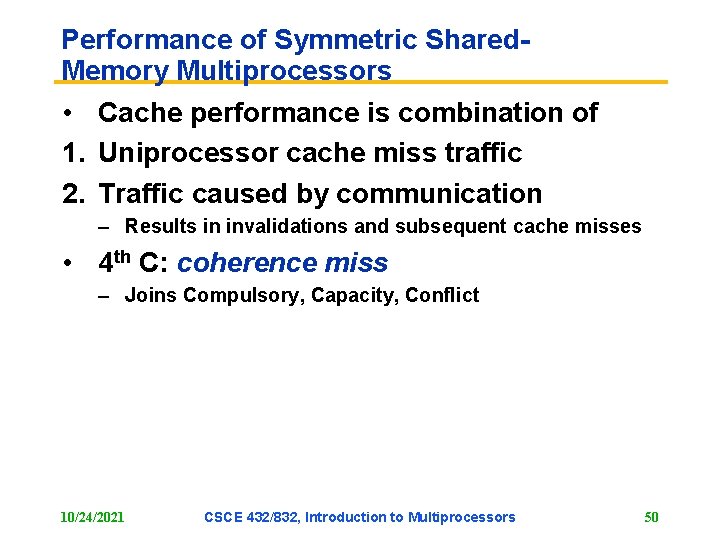
Performance of Symmetric Shared. Memory Multiprocessors • Cache performance is combination of 1. Uniprocessor cache miss traffic 2. Traffic caused by communication – Results in invalidations and subsequent cache misses • 4 th C: coherence miss – Joins Compulsory, Capacity, Conflict 10/24/2021 CSCE 432/832, Introduction to Multiprocessors 50
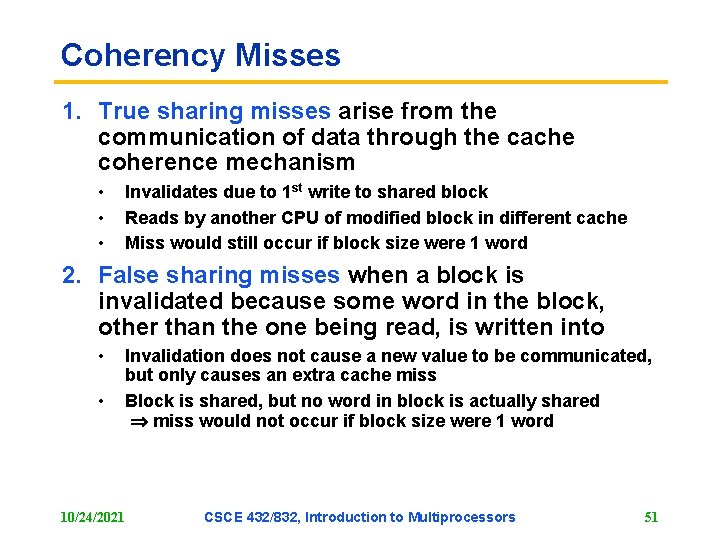
Coherency Misses 1. True sharing misses arise from the communication of data through the cache coherence mechanism • • • Invalidates due to 1 st write to shared block Reads by another CPU of modified block in different cache Miss would still occur if block size were 1 word 2. False sharing misses when a block is invalidated because some word in the block, other than the one being read, is written into • • 10/24/2021 Invalidation does not cause a new value to be communicated, but only causes an extra cache miss Block is shared, but no word in block is actually shared miss would not occur if block size were 1 word CSCE 432/832, Introduction to Multiprocessors 51
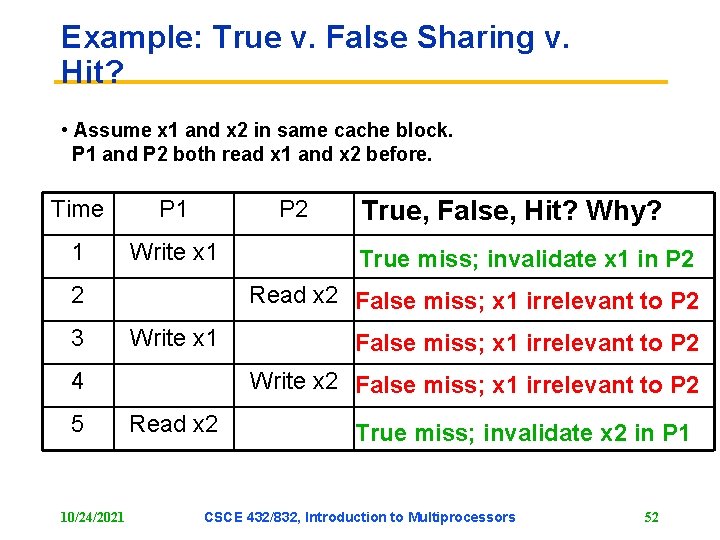
Example: True v. False Sharing v. Hit? • Assume x 1 and x 2 in same cache block. P 1 and P 2 both read x 1 and x 2 before. Time P 1 P 2 1 Write x 1 2 3 10/24/2021 True miss; invalidate x 1 in P 2 Read x 2 False miss; x 1 irrelevant to P 2 Write x 1 4 5 True, False, Hit? Why? False miss; x 1 irrelevant to P 2 Write x 2 False miss; x 1 irrelevant to P 2 Read x 2 True miss; invalidate x 2 in P 1 CSCE 432/832, Introduction to Multiprocessors 52
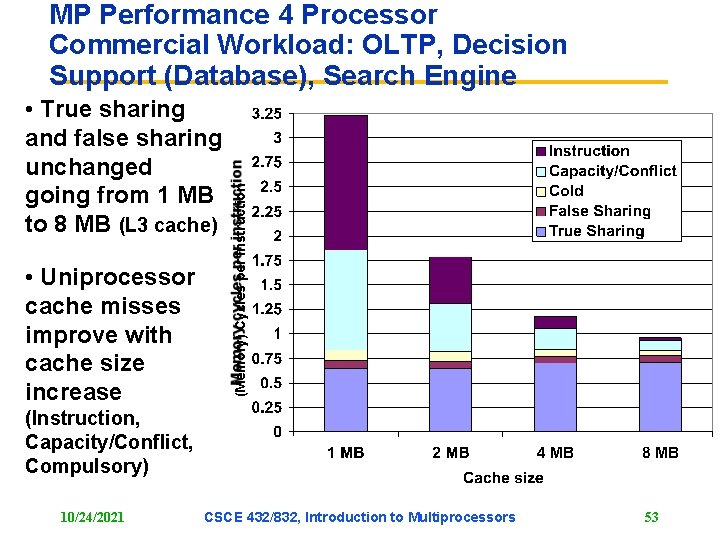
• True sharing and false sharing unchanged going from 1 MB to 8 MB (L 3 cache) • Uniprocessor cache misses improve with cache size increase (Memory) Cycles per Instruction MP Performance 4 Processor Commercial Workload: OLTP, Decision Support (Database), Search Engine (Instruction, Capacity/Conflict, Compulsory) 10/24/2021 CSCE 432/832, Introduction to Multiprocessors 53
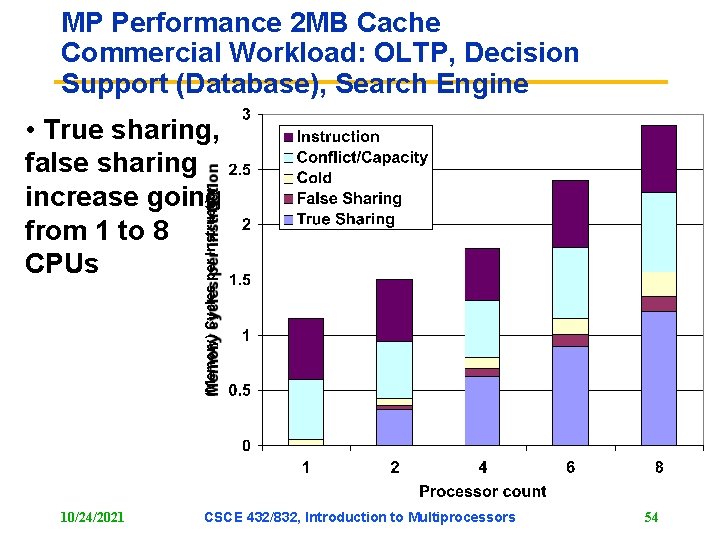
MP Performance 2 MB Cache Commercial Workload: OLTP, Decision Support (Database), Search Engine (Memory) Cycles per Instruction • True sharing, false sharing increase going from 1 to 8 CPUs 10/24/2021 CSCE 432/832, Introduction to Multiprocessors 54
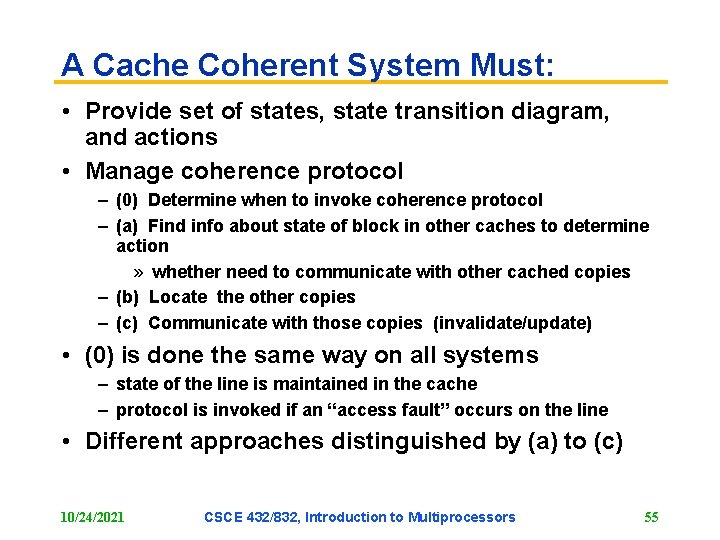
A Cache Coherent System Must: • Provide set of states, state transition diagram, and actions • Manage coherence protocol – (0) Determine when to invoke coherence protocol – (a) Find info about state of block in other caches to determine action » whether need to communicate with other cached copies – (b) Locate the other copies – (c) Communicate with those copies (invalidate/update) • (0) is done the same way on all systems – state of the line is maintained in the cache – protocol is invoked if an “access fault” occurs on the line • Different approaches distinguished by (a) to (c) 10/24/2021 CSCE 432/832, Introduction to Multiprocessors 55
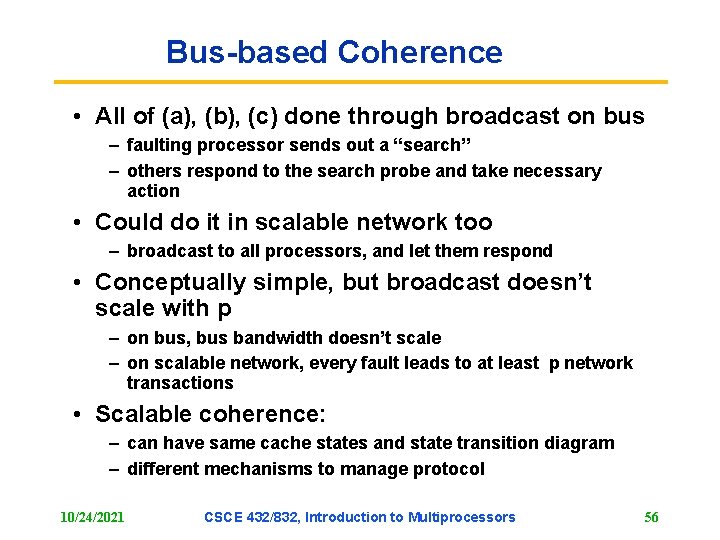
Bus-based Coherence • All of (a), (b), (c) done through broadcast on bus – faulting processor sends out a “search” – others respond to the search probe and take necessary action • Could do it in scalable network too – broadcast to all processors, and let them respond • Conceptually simple, but broadcast doesn’t scale with p – on bus, bus bandwidth doesn’t scale – on scalable network, every fault leads to at least p network transactions • Scalable coherence: – can have same cache states and state transition diagram – different mechanisms to manage protocol 10/24/2021 CSCE 432/832, Introduction to Multiprocessors 56
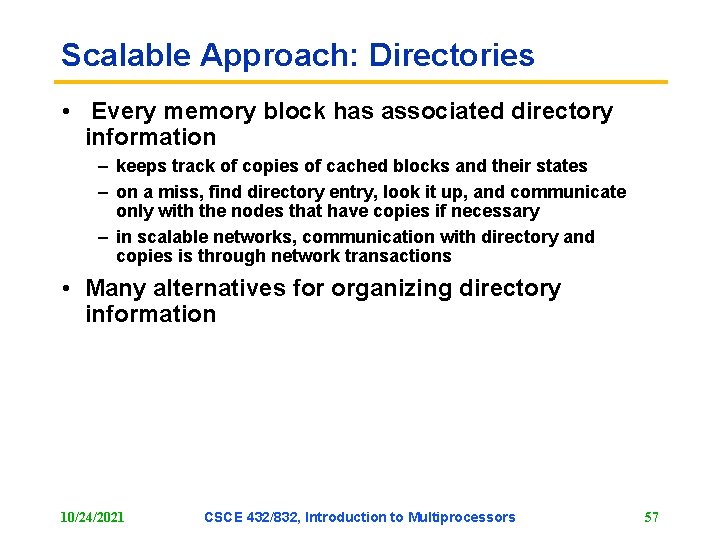
Scalable Approach: Directories • Every memory block has associated directory information – keeps track of copies of cached blocks and their states – on a miss, find directory entry, look it up, and communicate only with the nodes that have copies if necessary – in scalable networks, communication with directory and copies is through network transactions • Many alternatives for organizing directory information 10/24/2021 CSCE 432/832, Introduction to Multiprocessors 57
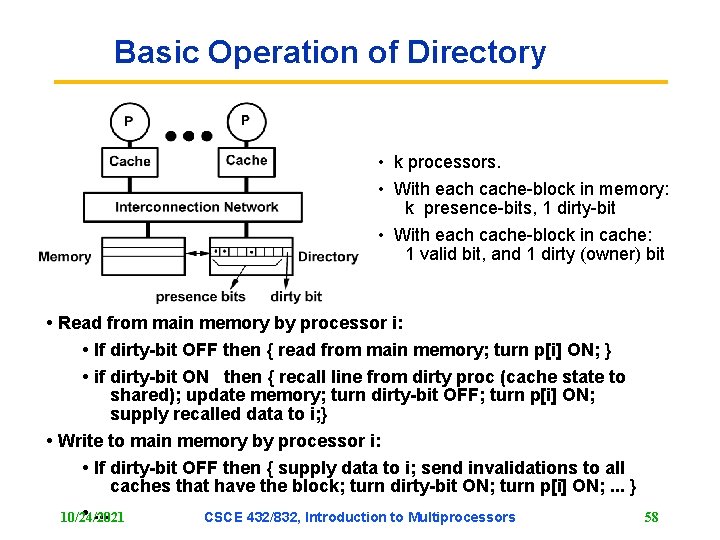
Basic Operation of Directory • k processors. • With each cache-block in memory: k presence-bits, 1 dirty-bit • With each cache-block in cache: 1 valid bit, and 1 dirty (owner) bit • Read from main memory by processor i: • If dirty-bit OFF then { read from main memory; turn p[i] ON; } • if dirty-bit ON then { recall line from dirty proc (cache state to shared); update memory; turn dirty-bit OFF; turn p[i] ON; supply recalled data to i; } • Write to main memory by processor i: • If dirty-bit OFF then { supply data to i; send invalidations to all caches that have the block; turn dirty-bit ON; turn p[i] ON; . . . } • . . . 10/24/2021 CSCE 432/832, Introduction to Multiprocessors 58
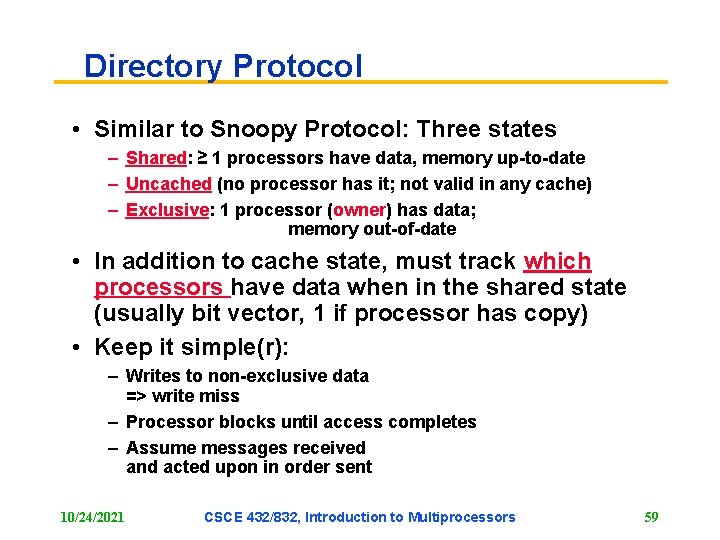
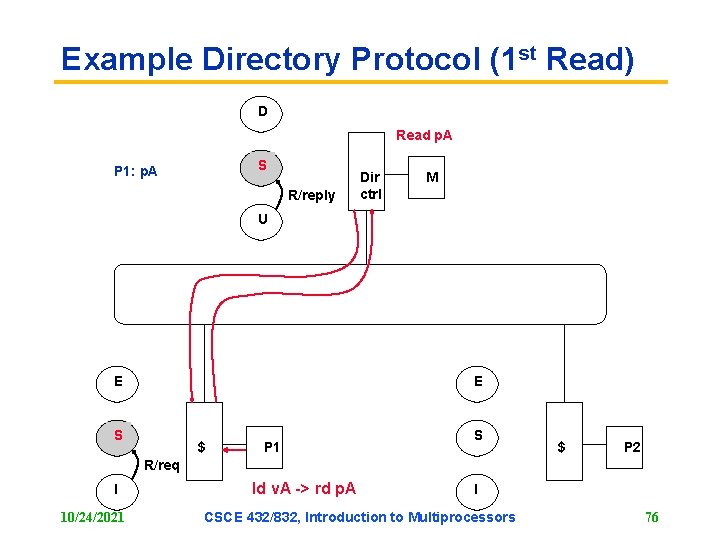
Directory Protocol • Similar to Snoopy Protocol: Three states – Shared: ≥ 1 processors have data, memory up-to-date – Uncached (no processor has it; not valid in any cache) – Exclusive: 1 processor (owner) has data; memory out-of-date • In addition to cache state, must track which processors have data when in the shared state (usually bit vector, 1 if processor has copy) • Keep it simple(r): – Writes to non-exclusive data => write miss – Processor blocks until access completes – Assume messages received and acted upon in order sent 10/24/2021 CSCE 432/832, Introduction to Multiprocessors 59
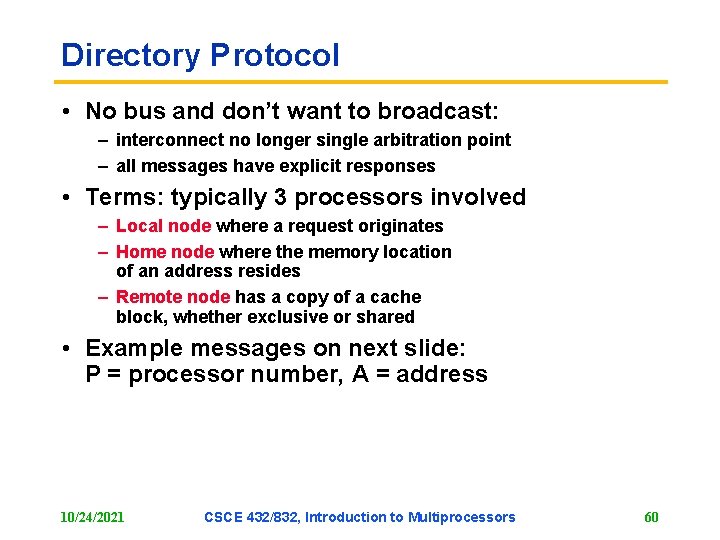
Directory Protocol • No bus and don’t want to broadcast: – interconnect no longer single arbitration point – all messages have explicit responses • Terms: typically 3 processors involved – Local node where a request originates – Home node where the memory location of an address resides – Remote node has a copy of a cache block, whether exclusive or shared • Example messages on next slide: P = processor number, A = address 10/24/2021 CSCE 432/832, Introduction to Multiprocessors 60
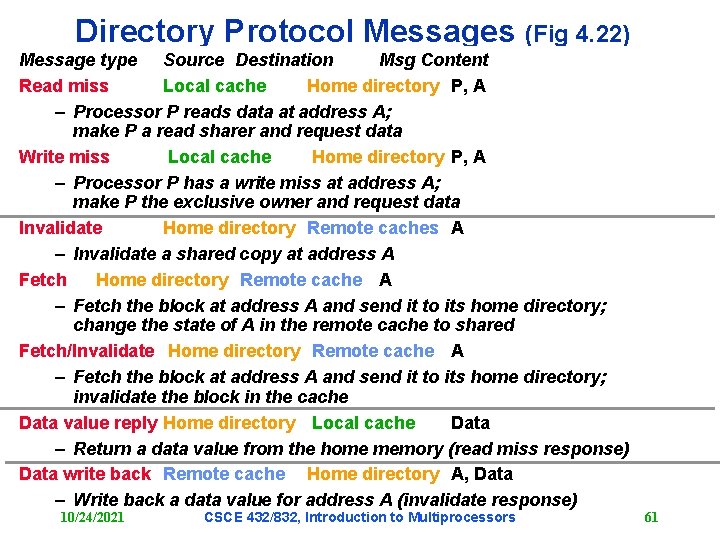
Directory Protocol Messages (Fig 4. 22) Message type Source Destination Msg Content Read miss Local cache Home directory P, A – Processor P reads data at address A; make P a read sharer and request data Write miss Local cache Home directory P, A – Processor P has a write miss at address A; make P the exclusive owner and request data Invalidate Home directory Remote caches A – Invalidate a shared copy at address A Fetch Home directory Remote cache A – Fetch the block at address A and send it to its home directory; change the state of A in the remote cache to shared Fetch/Invalidate Home directory Remote cache A – Fetch the block at address A and send it to its home directory; invalidate the block in the cache Data value reply Home directory Local cache Data – Return a data value from the home memory (read miss response) Data write back Remote cache Home directory A, Data – Write back a data value for address A (invalidate response) 10/24/2021 CSCE 432/832, Introduction to Multiprocessors 61
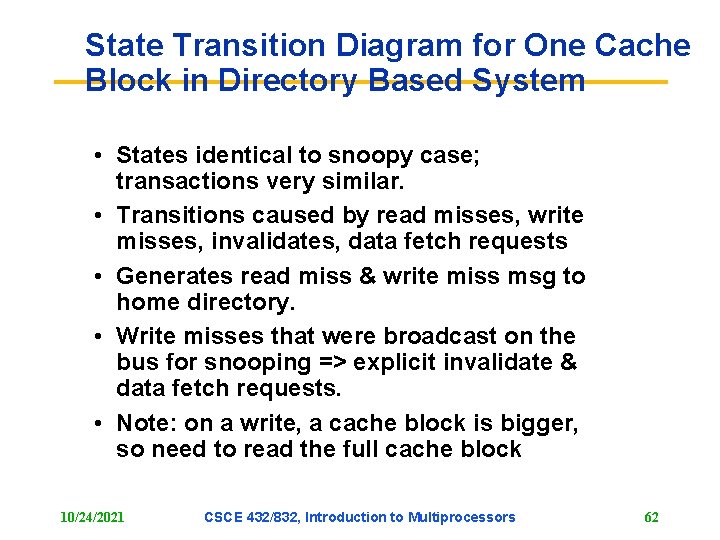
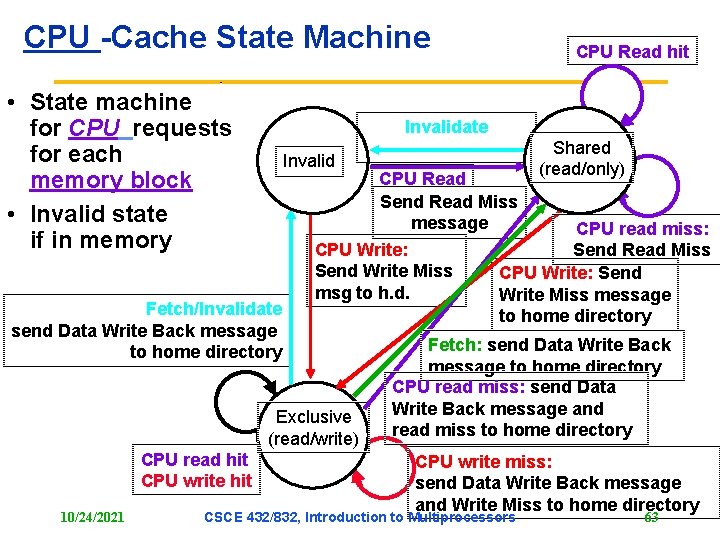
State Transition Diagram for One Cache Block in Directory Based System • States identical to snoopy case; transactions very similar. • Transitions caused by read misses, write misses, invalidates, data fetch requests • Generates read miss & write miss msg to home directory. • Write misses that were broadcast on the bus for snooping => explicit invalidate & data fetch requests. • Note: on a write, a cache block is bigger, so need to read the full cache block 10/24/2021 CSCE 432/832, Introduction to Multiprocessors 62
CPU -Cache State Machine • State machine for CPU requests for each memory block • Invalid state if in memory Invalidate CPU Read Send Read Miss message CPU read miss: CPU Write: Send Read Miss Send Write Miss CPU Write: Send msg to h. d. Write Miss message to home directory Exclusive (read/write) 10/24/2021 Shared (read/only) Invalid Fetch/Invalidate send Data Write Back message to home directory CPU read hit CPU write hit CPU Read hit Fetch: send Data Write Back message to home directory CPU read miss: send Data Write Back message and read miss to home directory CPU write miss: send Data Write Back message and Write Miss to home directory CSCE 432/832, Introduction to Multiprocessors 63
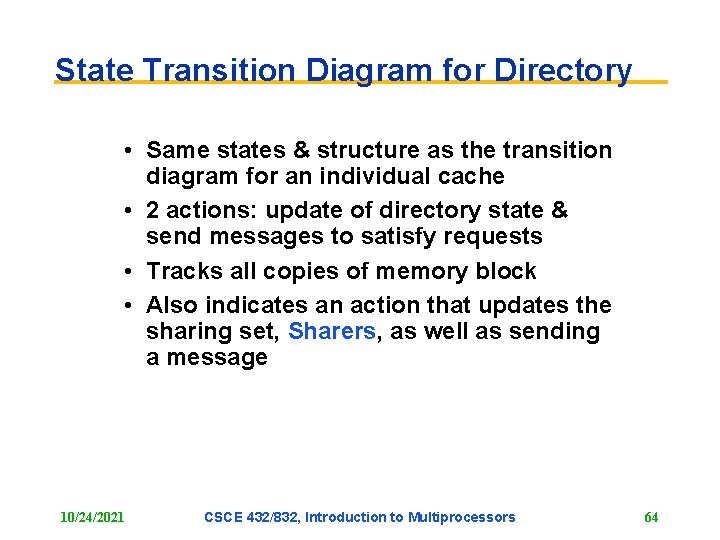
State Transition Diagram for Directory • Same states & structure as the transition diagram for an individual cache • 2 actions: update of directory state & send messages to satisfy requests • Tracks all copies of memory block • Also indicates an action that updates the sharing set, Sharers, as well as sending a message 10/24/2021 CSCE 432/832, Introduction to Multiprocessors 64
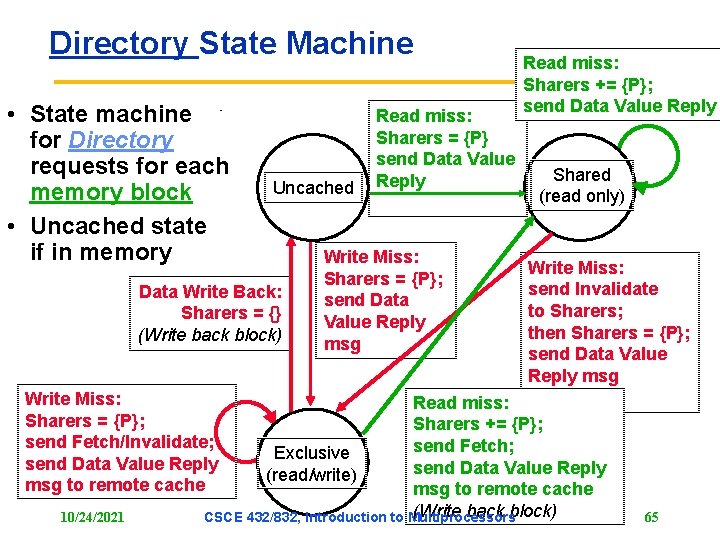
Directory State Machine • State machine for Directory requests for each memory block • Uncached state if in memory Uncached Data Write Back: Sharers = {} (Write back block) Read miss: Sharers = {P} send Data Value Reply Write Miss: Sharers = {P}; send Data Value Reply msg Read miss: Sharers += {P}; send Data Value Reply Shared (read only) Write Miss: send Invalidate to Sharers; then Sharers = {P}; send Data Value Reply msg Write Miss: Sharers = {P}; send Fetch/Invalidate; send Data Value Reply msg to remote cache 10/24/2021 Read miss: Sharers += {P}; send Fetch; Exclusive send Data Value Reply (read/write) msg to remote cache (Write back block) CSCE 432/832, Introduction to Multiprocessors 65
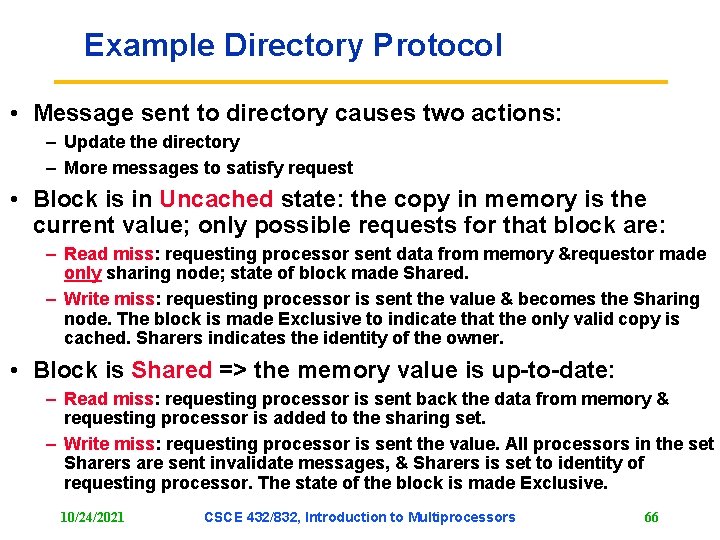
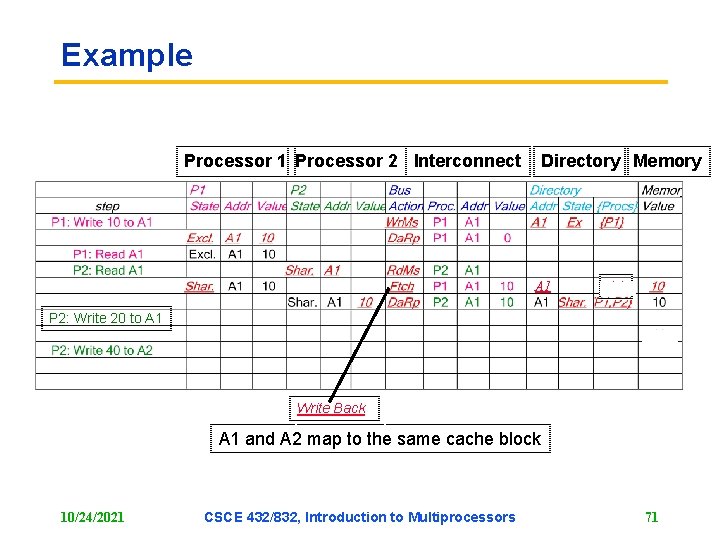
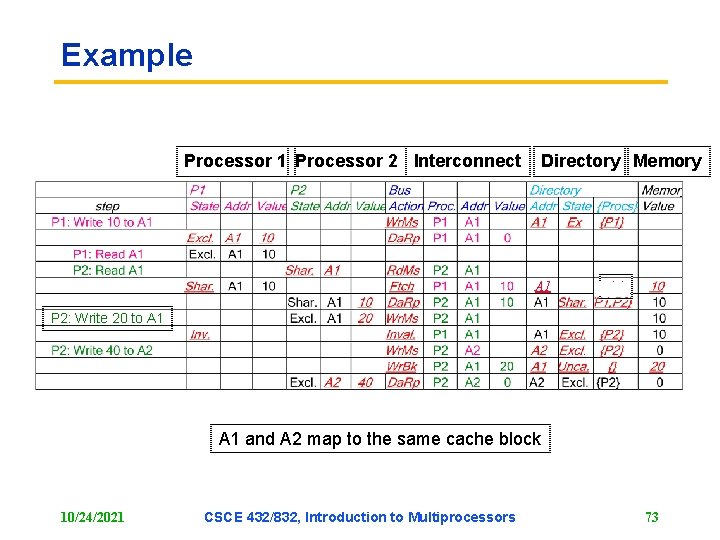
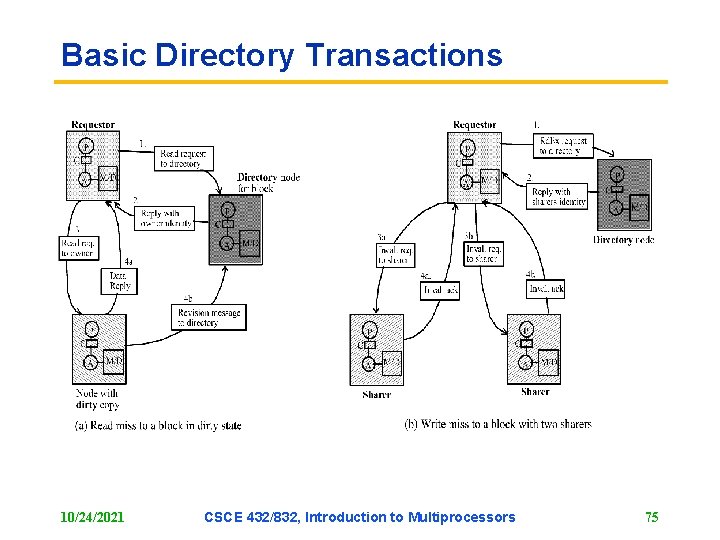
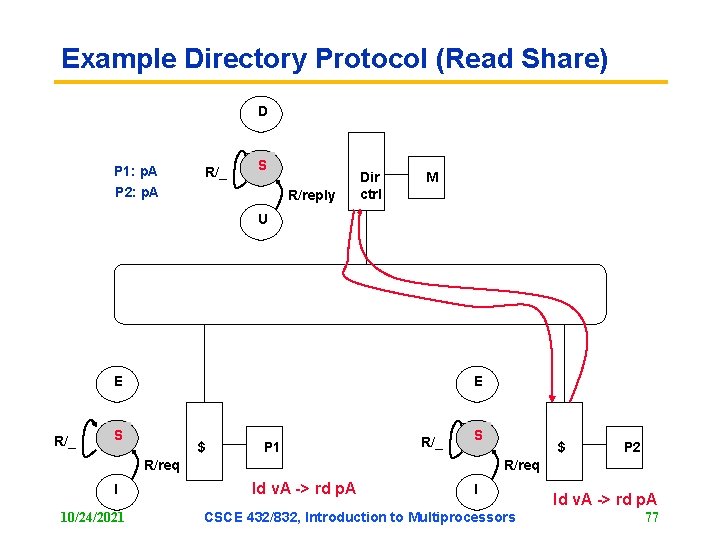
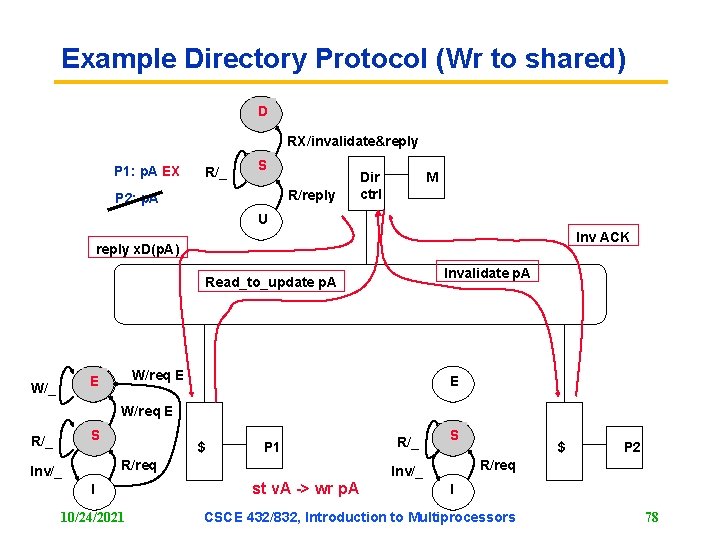
Example Directory Protocol • Message sent to directory causes two actions: – Update the directory – More messages to satisfy request • Block is in Uncached state: the copy in memory is the current value; only possible requests for that block are: – Read miss: requesting processor sent data from memory &requestor made only sharing node; state of block made Shared. – Write miss: requesting processor is sent the value & becomes the Sharing node. The block is made Exclusive to indicate that the only valid copy is cached. Sharers indicates the identity of the owner. • Block is Shared => the memory value is up-to-date: – Read miss: requesting processor is sent back the data from memory & requesting processor is added to the sharing set. – Write miss: requesting processor is sent the value. All processors in the set Sharers are sent invalidate messages, & Sharers is set to identity of requesting processor. The state of the block is made Exclusive. 10/24/2021 CSCE 432/832, Introduction to Multiprocessors 66
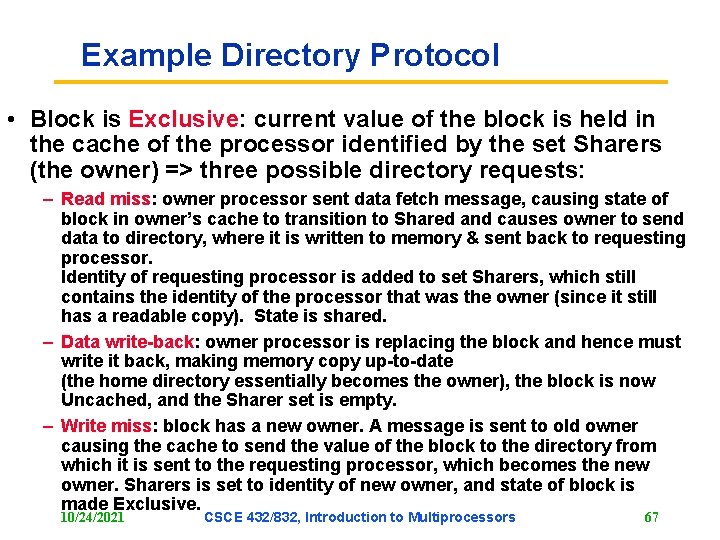
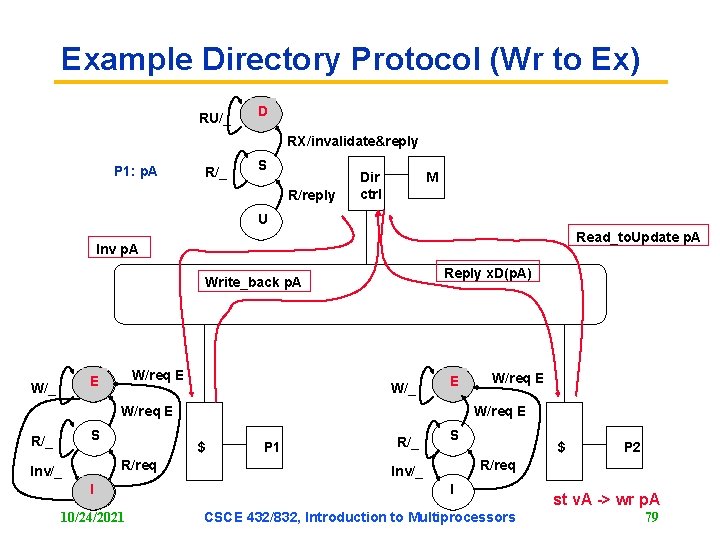
Example Directory Protocol • Block is Exclusive: current value of the block is held in the cache of the processor identified by the set Sharers (the owner) => three possible directory requests: – Read miss: owner processor sent data fetch message, causing state of block in owner’s cache to transition to Shared and causes owner to send data to directory, where it is written to memory & sent back to requesting processor. Identity of requesting processor is added to set Sharers, which still contains the identity of the processor that was the owner (since it still has a readable copy). State is shared. – Data write-back: owner processor is replacing the block and hence must write it back, making memory copy up-to-date (the home directory essentially becomes the owner), the block is now Uncached, and the Sharer set is empty. – Write miss: block has a new owner. A message is sent to old owner causing the cache to send the value of the block to the directory from which it is sent to the requesting processor, which becomes the new owner. Sharers is set to identity of new owner, and state of block is made Exclusive. 10/24/2021 CSCE 432/832, Introduction to Multiprocessors 67
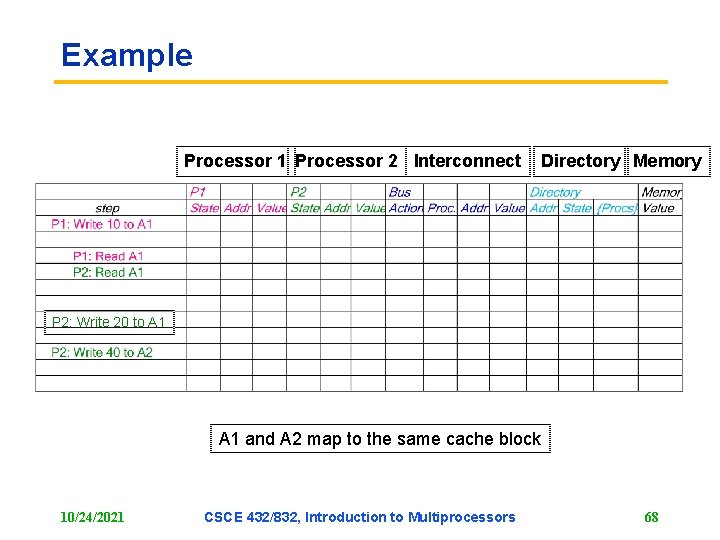
Example Processor 1 Processor 2 Interconnect Directory Memory P 2: Write 20 to A 1 and A 2 map to the same cache block 10/24/2021 CSCE 432/832, Introduction to Multiprocessors 68
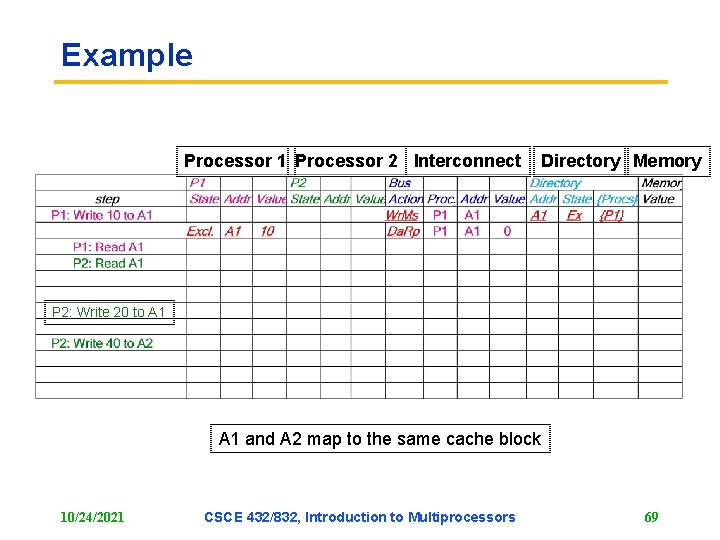
Example Processor 1 Processor 2 Interconnect Directory Memory P 2: Write 20 to A 1 and A 2 map to the same cache block 10/24/2021 CSCE 432/832, Introduction to Multiprocessors 69
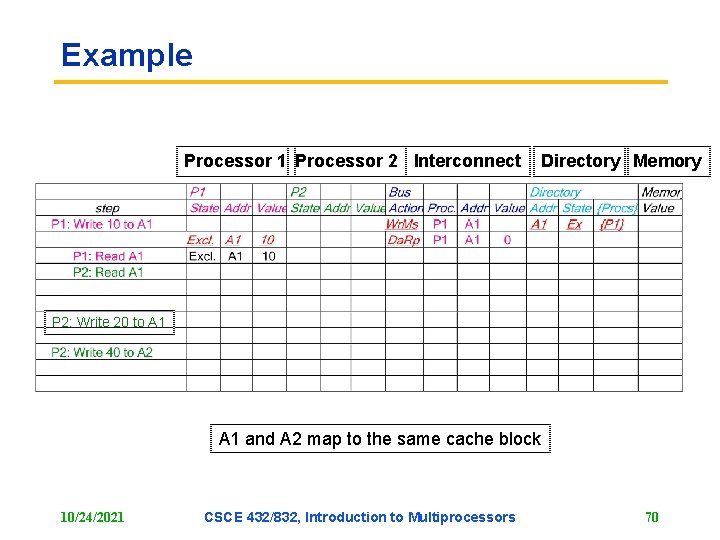
Example Processor 1 Processor 2 Interconnect Directory Memory P 2: Write 20 to A 1 and A 2 map to the same cache block 10/24/2021 CSCE 432/832, Introduction to Multiprocessors 70
Example Processor 1 Processor 2 Interconnect Directory Memory A 1 P 2: Write 20 to A 1 Write Back A 1 and A 2 map to the same cache block 10/24/2021 CSCE 432/832, Introduction to Multiprocessors 71
Example Processor 1 Processor 2 Interconnect Directory Memory A 1 P 2: Write 20 to A 1 and A 2 map to the same cache block 10/24/2021 CSCE 432/832, Introduction to Multiprocessors 72
Example Processor 1 Processor 2 Interconnect Directory Memory A 1 P 2: Write 20 to A 1 and A 2 map to the same cache block 10/24/2021 CSCE 432/832, Introduction to Multiprocessors 73
Implementing a Directory • We assume operations atomic, but they are not; reality is much harder; must avoid deadlock when run out of bufffers in network (see Appendix E) • Optimizations: – read miss or write miss in Exclusive: send data directly to requestor from owner vs. 1 st to memory and then from memory to requestor 10/24/2021 CSCE 432/832, Introduction to Multiprocessors 74
Basic Directory Transactions 10/24/2021 CSCE 432/832, Introduction to Multiprocessors 75
Example Directory Protocol (1 st Read) D Read p. A S P 1: p. A R/reply Dir ctrl M U E E S $ P 1 S $ P 2 R/req I 10/24/2021 ld v. A -> rd p. A I CSCE 432/832, Introduction to Multiprocessors 76
Example Directory Protocol (Read Share) D P 1: p. A R/_ S P 2: p. A R/reply Dir ctrl M U E R/_ E S $ P 1 R/_ S R/req I 10/24/2021 $ P 2 R/req ld v. A -> rd p. A I CSCE 432/832, Introduction to Multiprocessors ld v. A -> rd p. A 77
Example Directory Protocol (Wr to shared) D RX/invalidate&reply P 1: p. A EX R/_ S R/reply P 2: p. A Dir ctrl M U Inv ACK reply x. D(p. A) Invalidate p. A Read_to_update p. A W/req E E W/_ E W/req E S R/_ $ P 1 R/req Inv/_ I 10/24/2021 R/_ S P 2 R/req Inv/_ st v. A -> wr p. A $ I CSCE 432/832, Introduction to Multiprocessors 78
Example Directory Protocol (Wr to Ex) RU/_ D RX/invalidate&reply P 1: p. A R/_ S R/reply Dir ctrl M U Read_to. Update p. A Inv p. A Reply x. D(p. A) Write_back p. A W/req E E W/_ E W/req E S R/_ W/req E $ R/req Inv/_ I 10/24/2021 W/req E P 1 R/_ S $ P 2 R/req Inv/_ I CSCE 432/832, Introduction to Multiprocessors st v. A -> wr p. A 79
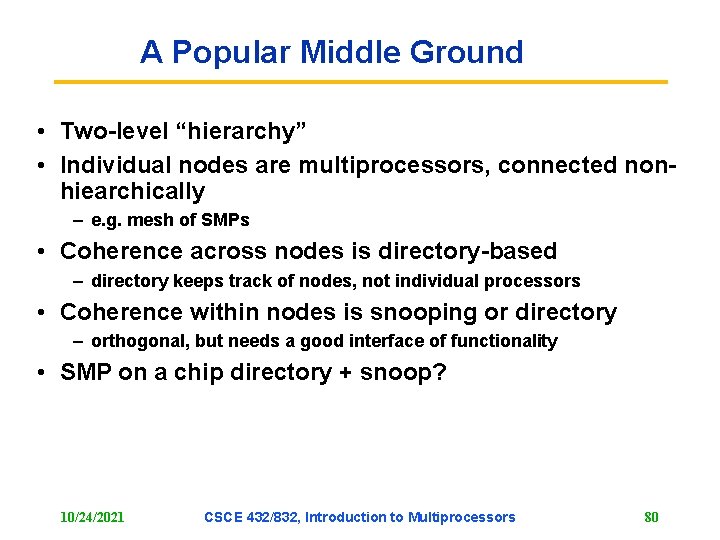
A Popular Middle Ground • Two-level “hierarchy” • Individual nodes are multiprocessors, connected nonhiearchically – e. g. mesh of SMPs • Coherence across nodes is directory-based – directory keeps track of nodes, not individual processors • Coherence within nodes is snooping or directory – orthogonal, but needs a good interface of functionality • SMP on a chip directory + snoop? 10/24/2021 CSCE 432/832, Introduction to Multiprocessors 80
And in Conclusion … • Caches contain all information on state of cached memory blocks • Snooping cache over shared medium for smaller MP by invalidating other cached copies on write • Sharing cached data Coherence (values returned by a read), Consistency (when a written value will be returned by a read) • Snooping and Directory Protocols similar; bus makes snooping easier because of broadcast (snooping => uniform memory access) • Directory has extra data structure to keep track of state of all cache blocks • Distributing directory => scalable shared address multiprocessor => Cache coherent, Non uniform memory access 10/24/2021 CSCE 432/832, Introduction to Multiprocessors 81