
CSCE 390 Professional Issues in Computer Science and
![1: Zeno of Citium 2: Epicurus 3: unknown[13] 4: Boethius or Anaximander or Empedocles?](https://slidetodoc.com/presentation_image_h2/845dad620c9ba4c186ad8c6cc28e5b22/image-7.jpg "1: Zeno of Citium 2: Epicurus 3: unknown[13] 4: Boethius or Anaximander or Empedocles?")
- Slides: 15
CSCE 390 Professional Issues in Computer Science and Engineering Ch. 3: Philosophic Belief Systems, part I: Idealism and Realism Fall 2020 Marco Valtorta mgv@cse. sc. edu UNIVERSITY OF SOUTH CAROLINA Department of Computer Science and Engineering
Why? • We accept that we need ethical standards • What are the sources of such standards? • Our ethical standards are affected, or even determined, by out worldview (weltanschauung, in German) • In philosophy, the study of the basic meaning of reality is called metaphysics • Metaphysics means “after” or “beyond” physics UNIVERSITY OF SOUTH CAROLINA Department of Computer Science and Engineering
Philosophic Belief Systems • Belief: unproven assumption – Contrast: in AI, posterior probability, as in “belief update” • Philosophic: about truth – Philia = love – Sophia = truth • System: consists of related parts – Metaphysics – Epistemology • The study of how we know things – Episteme = knowledge – Logos – Axiology – Axia = value • Ethics • Aesthetics UNIVERSITY OF SOUTH CAROLINA Department of Computer Science and Engineering
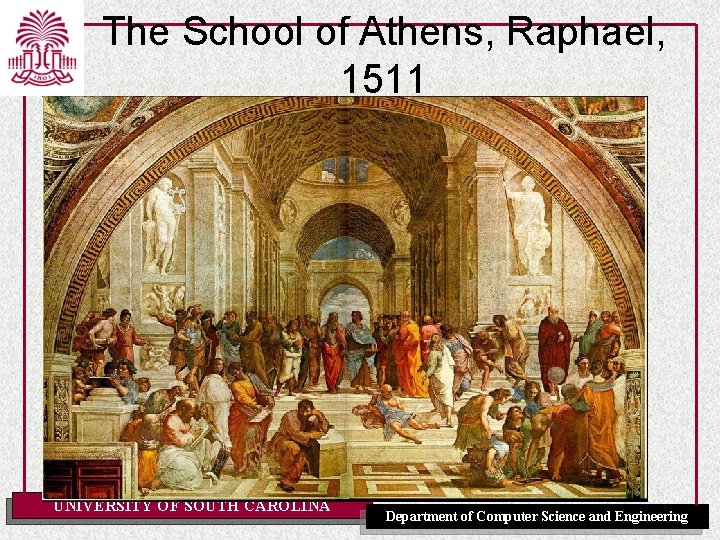
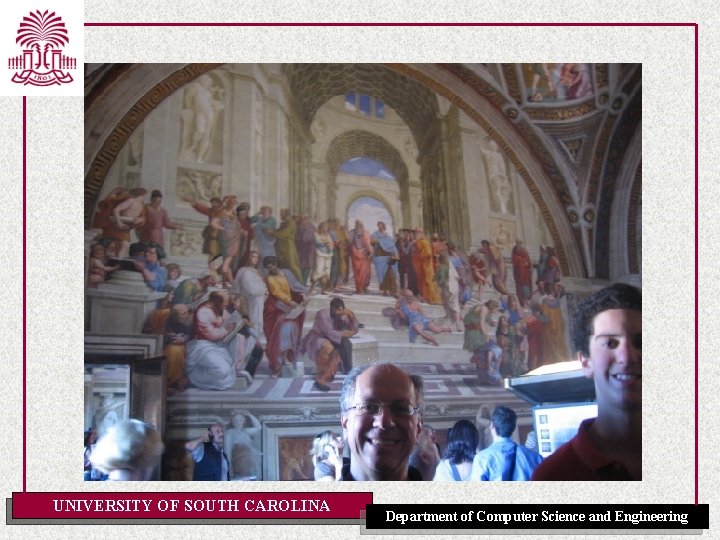
The School of Athens, Raphael, 1511 UNIVERSITY OF SOUTH CAROLINA Department of Computer Science and Engineering
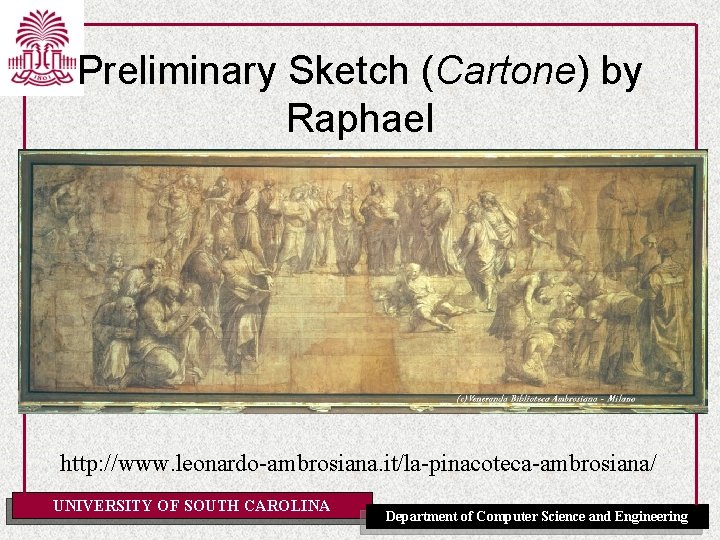
Preliminary Sketch (Cartone) by Raphael http: //www. leonardo-ambrosiana. it/la-pinacoteca-ambrosiana/ UNIVERSITY OF SOUTH CAROLINA Department of Computer Science and Engineering
UNIVERSITY OF SOUTH CAROLINA Department of Computer Science and Engineering
1: Zeno of Citium 2: Epicurus 3: unknown[13] 4: Boethius or Anaximander or Empedocles? 5: Averroes 6: Pythagoras 7: Alcibiades or Alexander the Great? 8: Antisthenes or Xenophon? 9: unknown [14][13] or the Fornarina as a personification of Love [15] or (Francesco Maria della Rovere? ) or Ipazia 10: Aeschines or Xenophon? 11: Parmenides? 12: Socrates 13: Heraclitus (Michelangelo) 14: Plato (Leonardo da Vinci) 15: Aristotle 16: Diogenes 17: Plotinus (Donatello? ) 18: Euclid or Archimedes with students (Bramante? ) 19: Zoroaster 20: Ptolemy? R: Apelles (Raphael) 21: Protogenes (Il Sodoma, Perugino, or Timoteo Viti)[16] UNIVERSITY OF SOUTH CAROLINA Department of Computer Science and Engineering
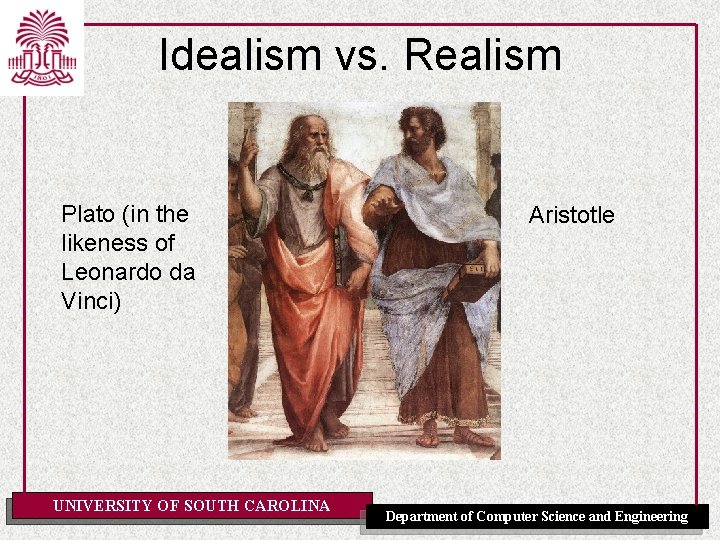
Idealism vs. Realism Plato (in the likeness of Leonardo da Vinci) UNIVERSITY OF SOUTH CAROLINA Aristotle Department of Computer Science and Engineering
Idealist Metaphysics • Socrates (470 -399 BC) and Plato (427 -327) • The parable of the cave • Ultimate reality can not be found in the world of sensory experience, but only in the world of ideas, which only our minds can experience UNIVERSITY OF SOUTH CAROLINA Department of Computer Science and Engineering
Idealist Epistemology • The process of knowing is abstract • We use reason to help our mind grasp the ideas that underlie the reality experienced by our senses UNIVERSITY OF SOUTH CAROLINA Department of Computer Science and Engineering
Idealist Ethics • Goodness is found in the ideal, i. e. , in perfection • Perfection is not found in material things • Goodness is conformance to the unchanging, ever-perfect, incorruptible ideal • Moral imperatives – No exceptions – But… the lesser of two evils UNIVERSITY OF SOUTH CAROLINA Department of Computer Science and Engineering
Immanuel Kant (German, 17241804) • A non-religious idealist • Moral imperatives – “Act only according to that maxim by which you can at the same time will that it should become a universal law” – “Act as to treat humanity, whether in your own person or in that of another, always as an end and not as a means only” • Do something simply because it is good, not because of what may come of it UNIVERSITY OF SOUTH CAROLINA Department of Computer Science and Engineering
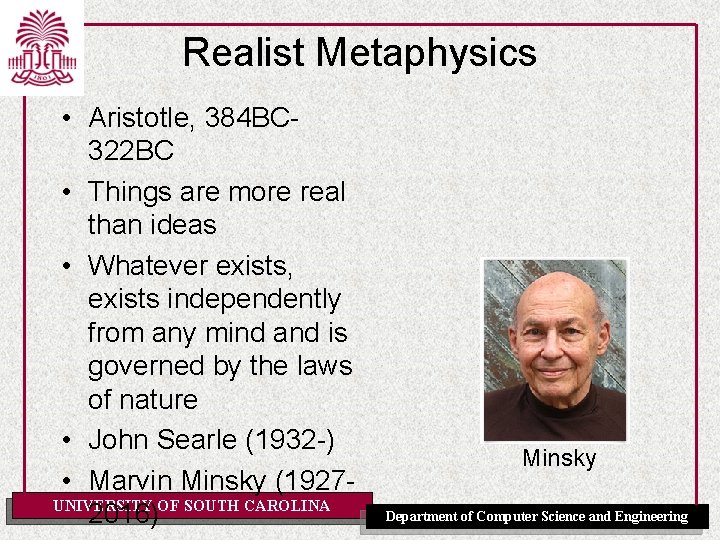
Realist Metaphysics • Aristotle, 384 BC 322 BC • Things are more real than ideas • Whatever exists, exists independently from any mind and is governed by the laws of nature • John Searle (1932 -) • Marvin Minsky (1927 UNIVERSITY OF SOUTH CAROLINA 2016) Minsky Department of Computer Science and Engineering
Realist Epistemology • Knowledge is acquired through the senses • Science is more important than reason UNIVERSITY OF SOUTH CAROLINA Department of Computer Science and Engineering
Realist Ethics • The criterion of goodness is conformity with reality • What is natural is good • Evil is the departure from the natural norm either by excess or defect • Evil is a breaking of the natural law • Goodness is found in living a life of virtue in harmony with nature • Virtue is identified with happiness • The golden middle: virtue is a mean between two vices: one involving excess, the other UNIVERSITY OF SOUTH CAROLINA Department of Computer Science and Engineering deficiency