
CSCE 355 Foundations of Computation Lecture 14 Grammars

![BNF Notation: Optional Elements • Surround one or more symbols by […] to make](https://slidetodoc.com/presentation_image/579bd806874181e1261b5d766060a656/image-7.jpg "BNF Notation: Optional Elements • Surround one or more symbols by […] to make")




- Slides: 42
CSCE 355 Foundations of Computation Lecture 14 Grammars – Parse Trees– Normal Forms Topics: n Context Free Grammars n Leftmost derivations and parse trees Chomsky Normal Form n June 18, 2015
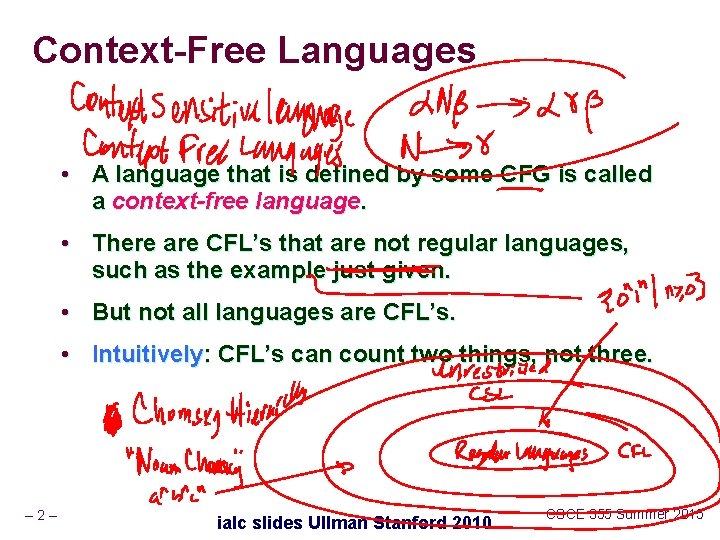
Context-Free Languages • A language that is defined by some CFG is called a context-free language. • There are CFL’s that are not regular languages, such as the example just given. • But not all languages are CFL’s. • Intuitively: CFL’s can count two things, not three. – 2– ialc slides Ullman Stanford 2010 CSCE 355 Summer 2015
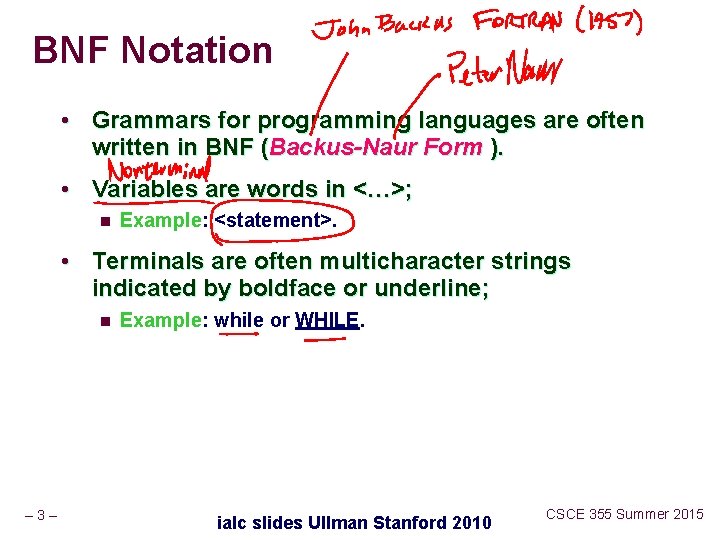
BNF Notation • Grammars for programming languages are often written in BNF (Backus-Naur Form ). • Variables are words in <…>; n Example: <statement>. • Terminals are often multicharacter strings indicated by boldface or underline; n – 3– Example: while or WHILE. ialc slides Ullman Stanford 2010 CSCE 355 Summer 2015
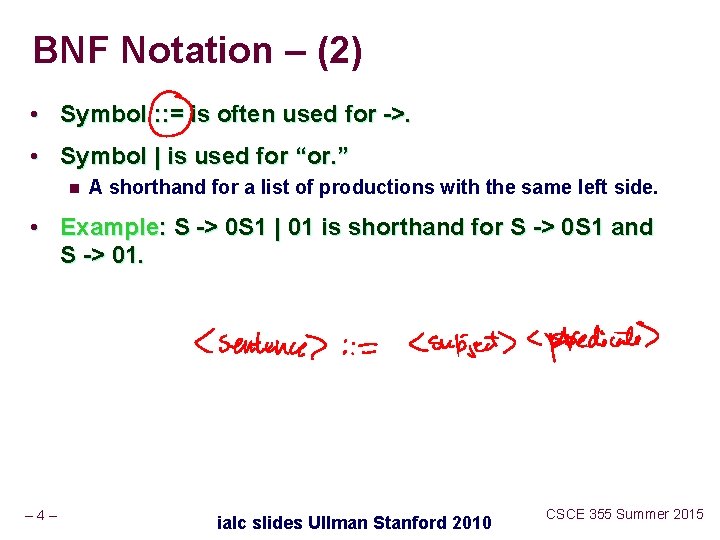
BNF Notation – (2) • Symbol : : = is often used for ->. • Symbol | is used for “or. ” n A shorthand for a list of productions with the same left side. • Example: S -> 0 S 1 | 01 is shorthand for S -> 0 S 1 and S -> 01. – 4– ialc slides Ullman Stanford 2010 CSCE 355 Summer 2015
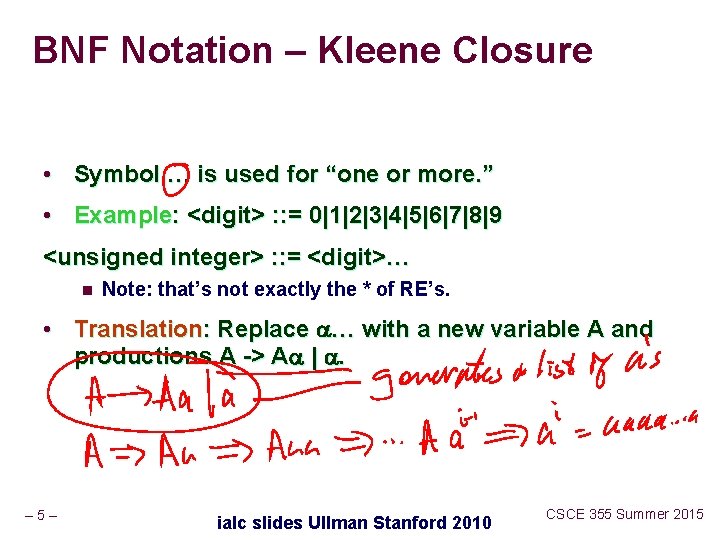
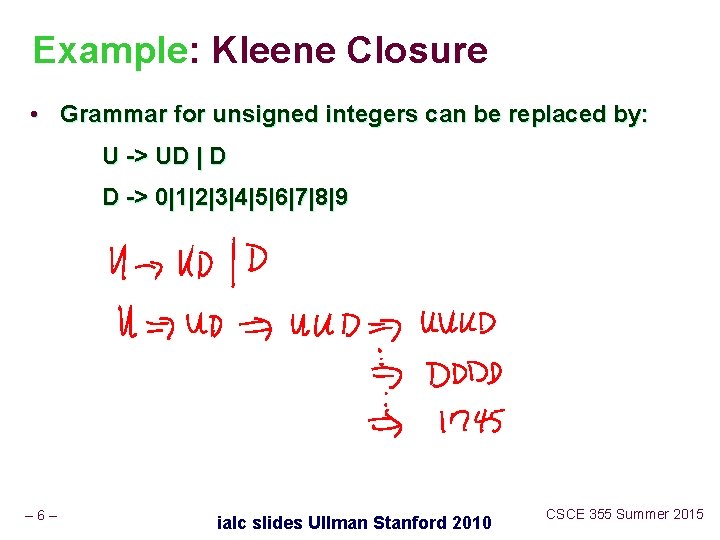
BNF Notation – Kleene Closure • Symbol … is used for “one or more. ” • Example: <digit> : : = 0|1|2|3|4|5|6|7|8|9 <unsigned integer> : : = <digit>… n Note: that’s not exactly the * of RE’s. • Translation: Replace … with a new variable A and productions A -> A | . – 5– ialc slides Ullman Stanford 2010 CSCE 355 Summer 2015
Example: Kleene Closure • Grammar for unsigned integers can be replaced by: U -> UD | D D -> 0|1|2|3|4|5|6|7|8|9 – 6– ialc slides Ullman Stanford 2010 CSCE 355 Summer 2015
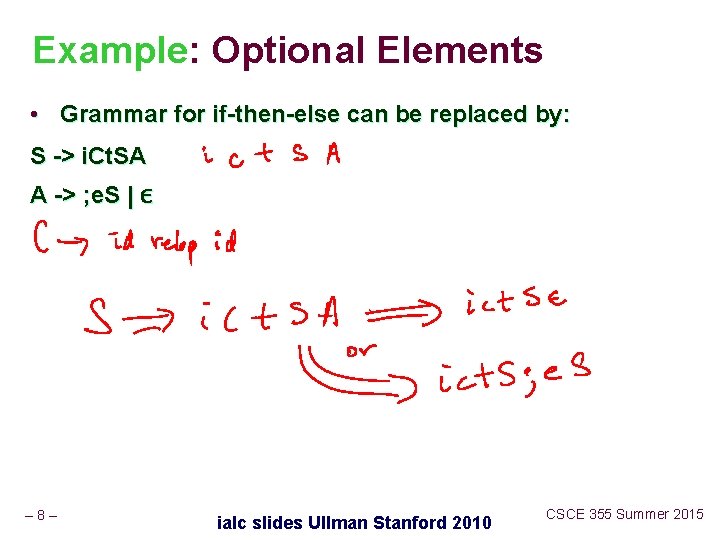
BNF Notation: Optional Elements • Surround one or more symbols by […] to make them optional. • Example: <statement> : : = if <condition> then <statement> [; else <statement>] • Translation: replace [ ] by a new variable A with productions A -> | ε. – 7– ialc slides Ullman Stanford 2010 CSCE 355 Summer 2015
Example: Optional Elements • Grammar for if-then-else can be replaced by: S -> i. Ct. SA A -> ; e. S | ε – 8– ialc slides Ullman Stanford 2010 CSCE 355 Summer 2015
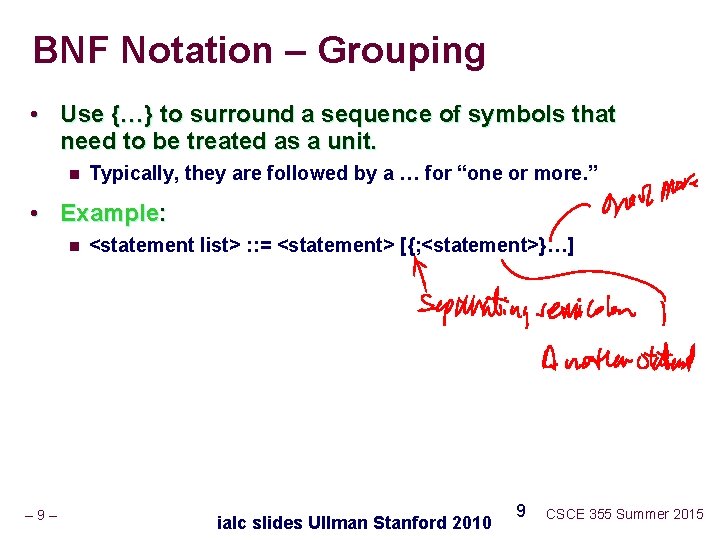
BNF Notation – Grouping • Use {…} to surround a sequence of symbols that need to be treated as a unit. n Typically, they are followed by a … for “one or more. ” • Example: n – 9– <statement list> : : = <statement> [{; <statement>}…] ialc slides Ullman Stanford 2010 9 CSCE 355 Summer 2015
Translation: Grouping • You may, if you wish, create a new variable A for { }. • One production for A: A -> . • Use A in place of { }. – 10 – ialc slides Ullman Stanford 2010 10 CSCE 355 Summer 2015
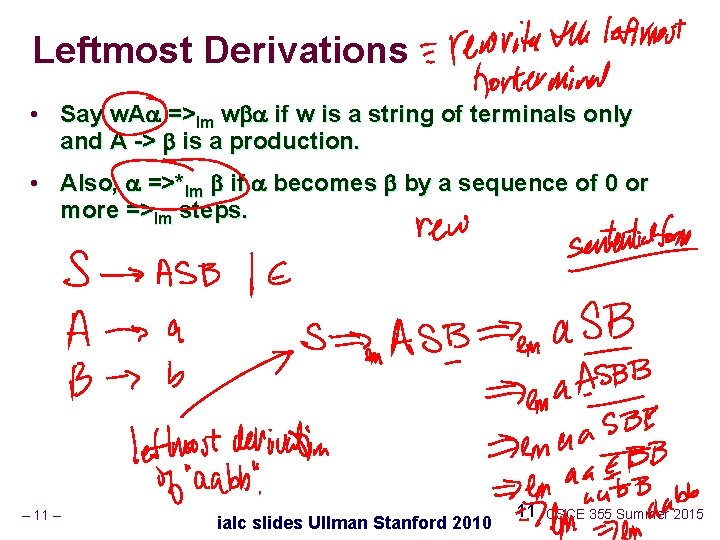
Leftmost Derivations • Say w. A =>lm w if w is a string of terminals only and A -> is a production. • Also, =>*lm if becomes by a sequence of 0 or more =>lm steps. – 11 – ialc slides Ullman Stanford 2010 11 CSCE 355 Summer 2015
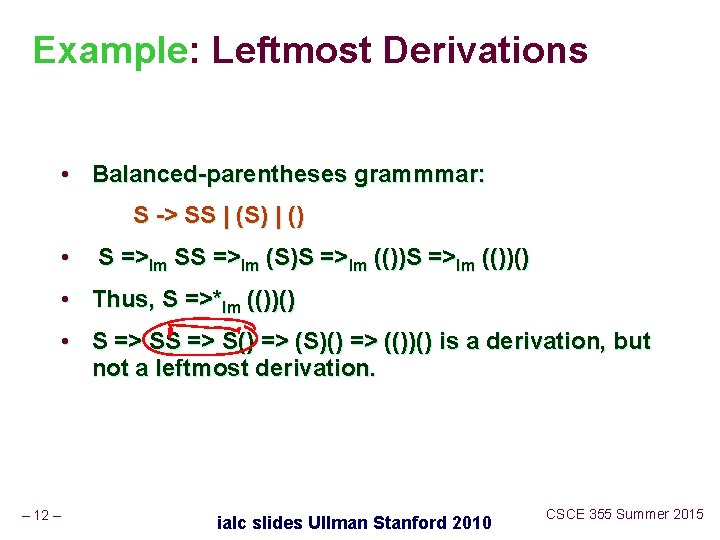
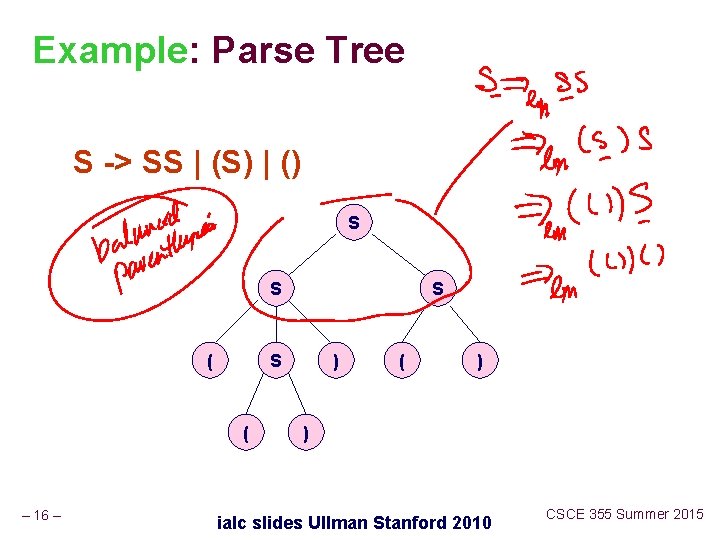
Example: Leftmost Derivations • Balanced-parentheses grammmar: S -> SS | (S) | () • S =>lm SS =>lm (S)S =>lm (())() • Thus, S =>*lm (())() • S => S() => (S)() => (())() is a derivation, but not a leftmost derivation. – 12 – ialc slides Ullman Stanford 2010 CSCE 355 Summer 2015
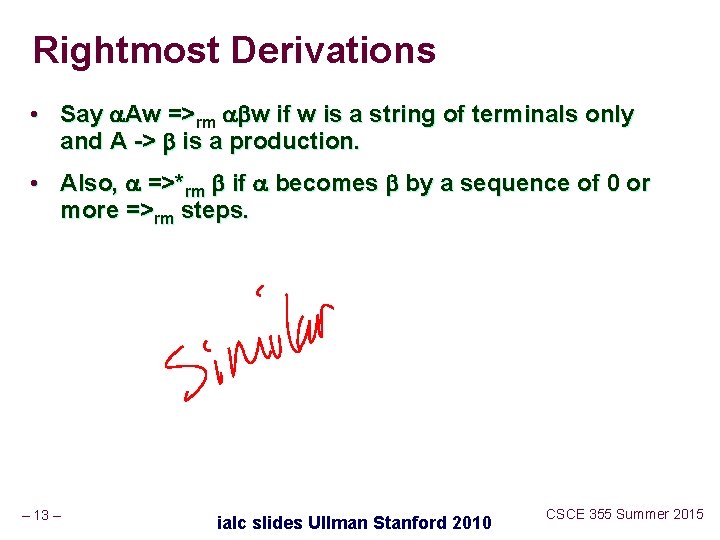
Rightmost Derivations • Say Aw =>rm w if w is a string of terminals only and A -> is a production. • Also, =>*rm if becomes by a sequence of 0 or more =>rm steps. – 13 – ialc slides Ullman Stanford 2010 CSCE 355 Summer 2015
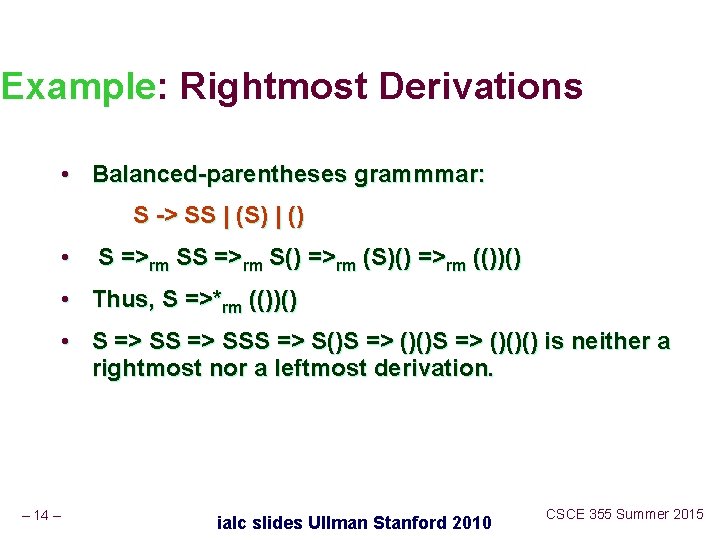
Example: Rightmost Derivations • Balanced-parentheses grammmar: S -> SS | (S) | () • S =>rm S() =>rm (S)() =>rm (())() • Thus, S =>*rm (())() • S => SSS => S()S => ()()() is neither a rightmost nor a leftmost derivation. – 14 – ialc slides Ullman Stanford 2010 CSCE 355 Summer 2015
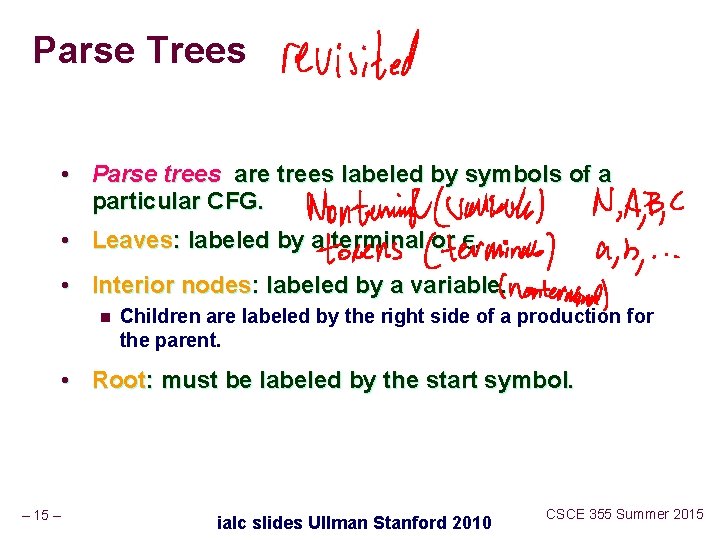
Parse Trees • Parse trees are trees labeled by symbols of a particular CFG. • Leaves: labeled by a terminal or ε. • Interior nodes: labeled by a variable. n Children are labeled by the right side of a production for the parent. • Root: must be labeled by the start symbol. – 15 – ialc slides Ullman Stanford 2010 CSCE 355 Summer 2015
Example: Parse Tree S -> SS | (S) | () S S ( – 16 – S ) ( ) ) ialc slides Ullman Stanford 2010 CSCE 355 Summer 2015
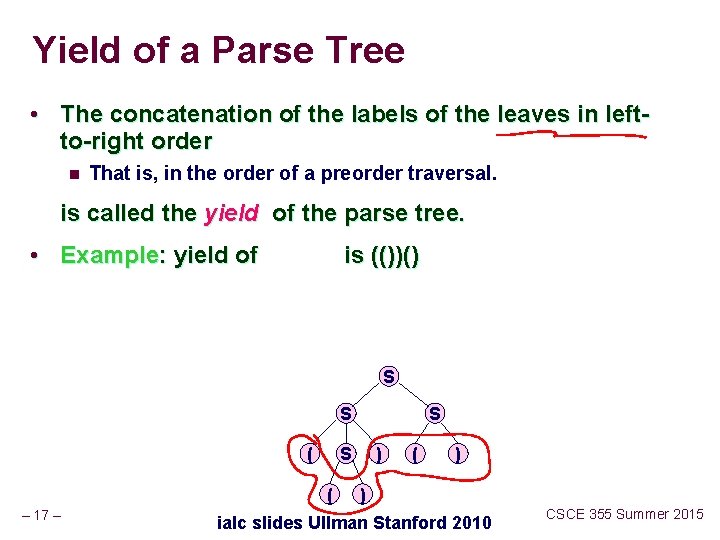
Yield of a Parse Tree • The concatenation of the labels of the leaves in leftto-right order n That is, in the order of a preorder traversal. is called the yield of the parse tree. • Example: yield of is (())() S S ( – 17 – S ) ( ) ) ialc slides Ullman Stanford 2010 CSCE 355 Summer 2015
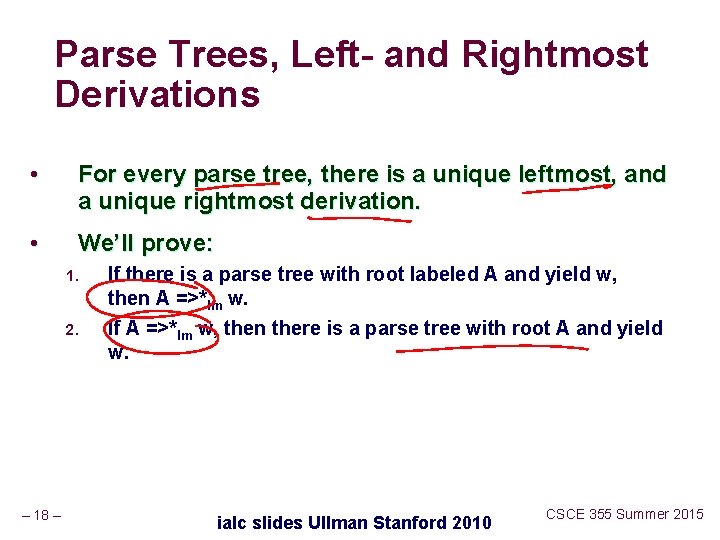
Parse Trees, Left- and Rightmost Derivations • For every parse tree, there is a unique leftmost, and a unique rightmost derivation. • We’ll prove: 1. 2. – 18 – If there is a parse tree with root labeled A and yield w, then A =>*lm w. If A =>*lm w, then there is a parse tree with root A and yield w. ialc slides Ullman Stanford 2010 CSCE 355 Summer 2015
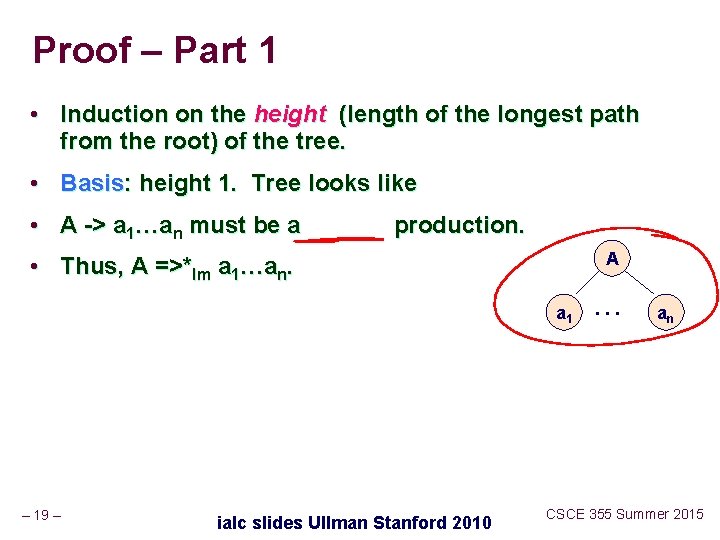
Proof – Part 1 • Induction on the height (length of the longest path from the root) of the tree. • Basis: height 1. Tree looks like • A -> a 1…an must be a production. A • Thus, A =>*lm a 1…an. a 1 – 19 – ialc slides Ullman Stanford 2010 . . . an CSCE 355 Summer 2015
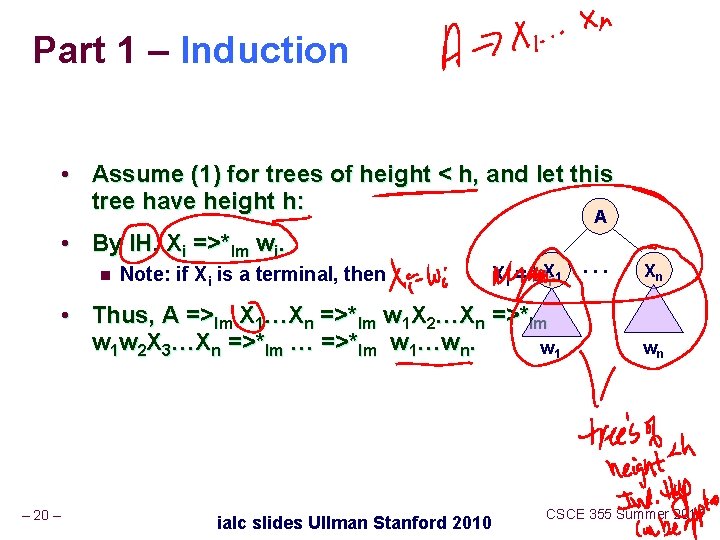
Part 1 – Induction • Assume (1) for trees of height < h, and let this tree have height h: A • By IH, Xi =>*lm wi. n Note: if Xi is a terminal, then Xi = w. Xi. 1 • Thus, A =>lm X 1…Xn =>*lm w 1 X 2…Xn =>*lm w 1 w 2 X 3…Xn =>*lm … =>*lm w 1…wn. w 1 – 20 – ialc slides Ullman Stanford 2010 . . . Xn wn CSCE 355 Summer 2015
Proof: Part 2 • Given a leftmost derivation of a terminal string, we need to prove the existence of a parse tree. • The proof is an induction on the length of the derivation. – 21 – ialc slides Ullman Stanford 2010 CSCE 355 Summer 2015
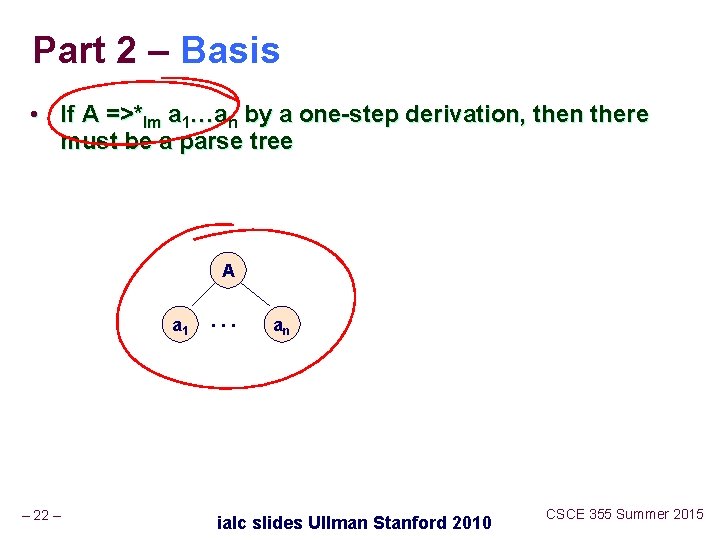
Part 2 – Basis • If A =>*lm a 1…an by a one-step derivation, then there must be a parse tree A a 1 – 22 – . . . an ialc slides Ullman Stanford 2010 CSCE 355 Summer 2015
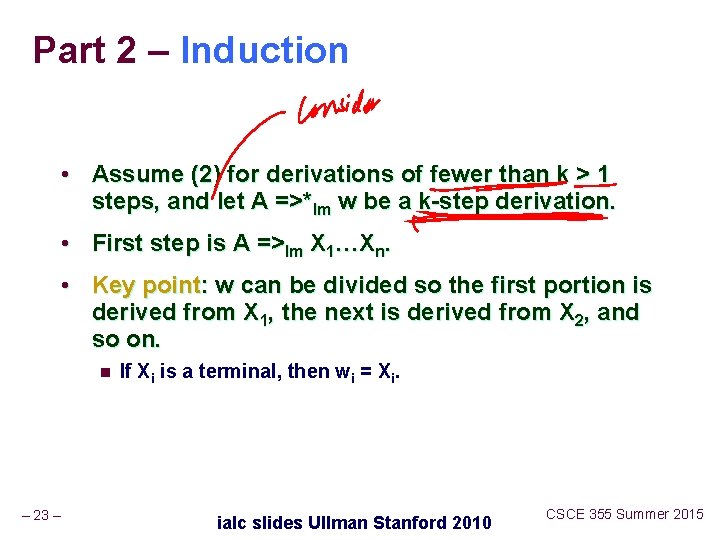
Part 2 – Induction • Assume (2) for derivations of fewer than k > 1 steps, and let A =>*lm w be a k-step derivation. • First step is A =>lm X 1…Xn. • Key point: w can be divided so the first portion is derived from X 1, the next is derived from X 2, and so on. n – 23 – If Xi is a terminal, then wi = Xi. ialc slides Ullman Stanford 2010 CSCE 355 Summer 2015
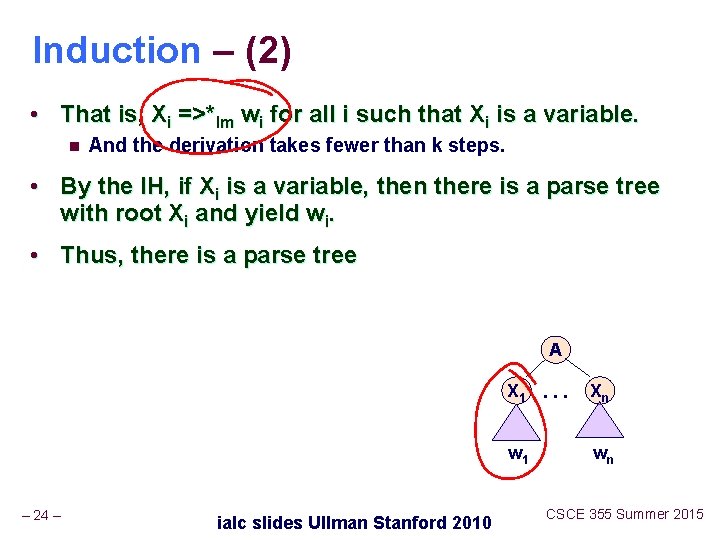
Induction – (2) • That is, Xi =>*lm wi for all i such that Xi is a variable. n And the derivation takes fewer than k steps. • By the IH, if Xi is a variable, then there is a parse tree with root Xi and yield wi. • Thus, there is a parse tree A – 24 – ialc slides Ullman Stanford 2010 X 1. . . Xn w 1 wn CSCE 355 Summer 2015
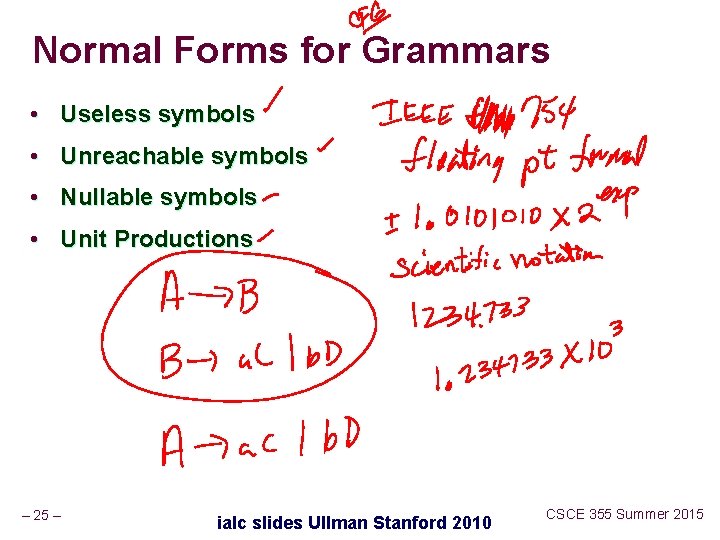
Normal Forms for Grammars • Useless symbols • Unreachable symbols • Nullable symbols • Unit Productions – 25 – ialc slides Ullman Stanford 2010 CSCE 355 Summer 2015
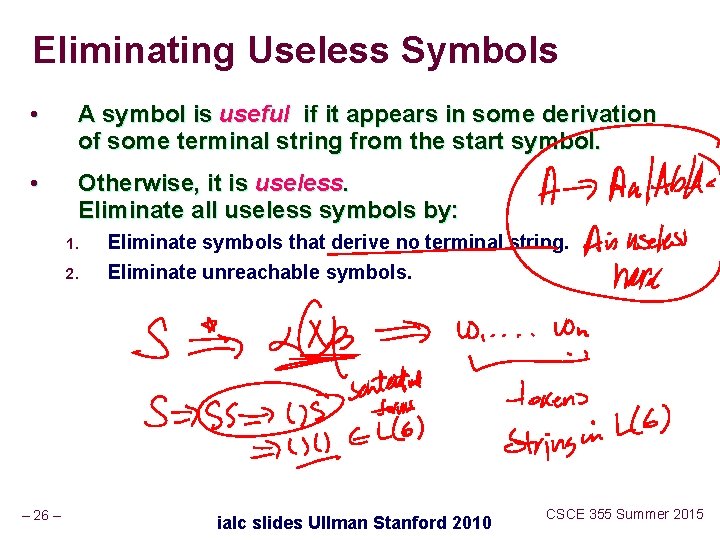
Eliminating Useless Symbols • A symbol is useful if it appears in some derivation of some terminal string from the start symbol. • Otherwise, it is useless. Eliminate all useless symbols by: 1. 2. – 26 – Eliminate symbols that derive no terminal string. Eliminate unreachable symbols. ialc slides Ullman Stanford 2010 CSCE 355 Summer 2015
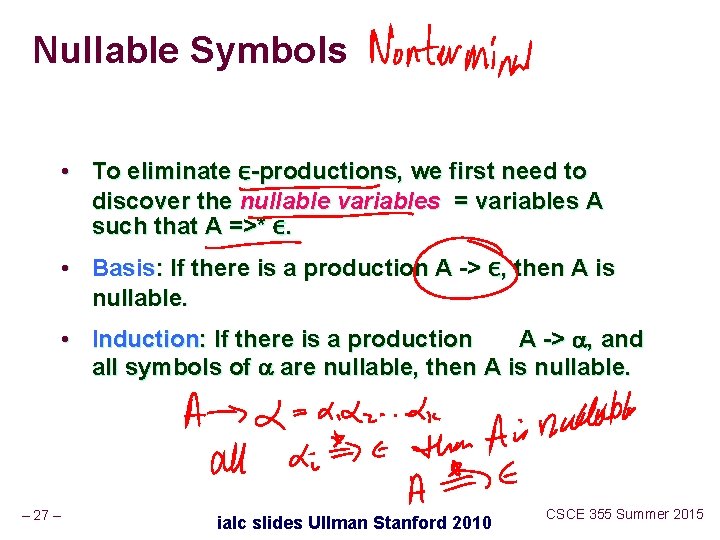
Nullable Symbols • To eliminate ε-productions, we first need to discover the nullable variables = variables A such that A =>* ε. • Basis: If there is a production A -> ε, then A is nullable. • Induction: If there is a production A -> , and all symbols of are nullable, then A is nullable. – 27 – ialc slides Ullman Stanford 2010 CSCE 355 Summer 2015
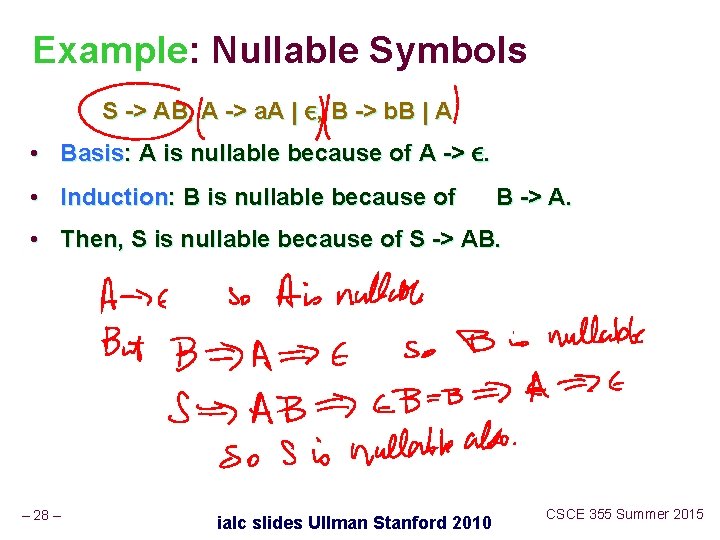
Example: Nullable Symbols S -> AB, A -> a. A | ε, B -> b. B | A • Basis: A is nullable because of A -> ε. • Induction: B is nullable because of B -> A. • Then, S is nullable because of S -> AB. – 28 – ialc slides Ullman Stanford 2010 CSCE 355 Summer 2015
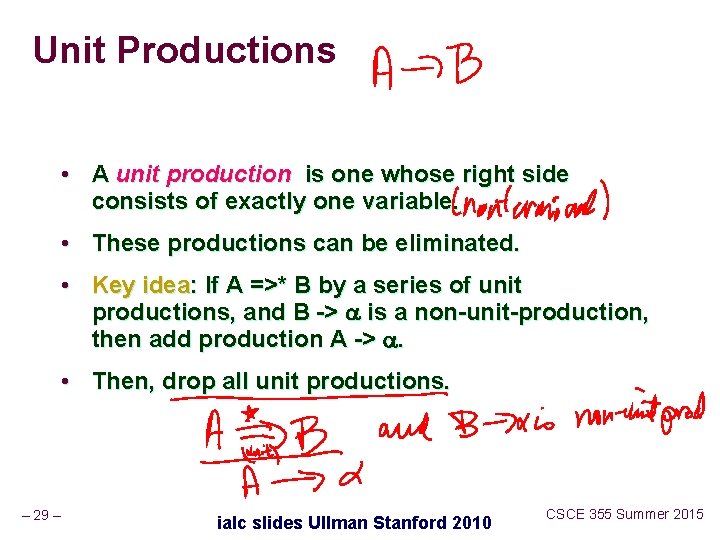
Unit Productions • A unit production is one whose right side consists of exactly one variable. • These productions can be eliminated. • Key idea: If A =>* B by a series of unit productions, and B -> is a non-unit-production, then add production A -> . • Then, drop all unit productions. – 29 – ialc slides Ullman Stanford 2010 CSCE 355 Summer 2015
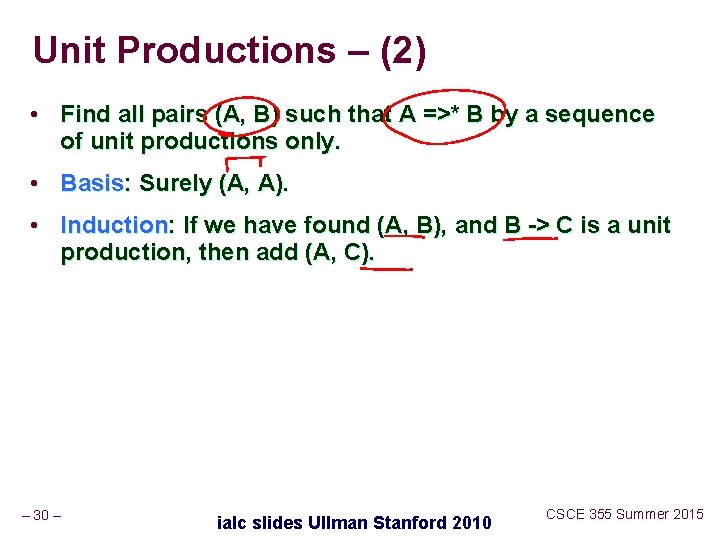
Unit Productions – (2) • Find all pairs (A, B) such that A =>* B by a sequence of unit productions only. • Basis: Surely (A, A). • Induction: If we have found (A, B), and B -> C is a unit production, then add (A, C). – 30 – ialc slides Ullman Stanford 2010 CSCE 355 Summer 2015
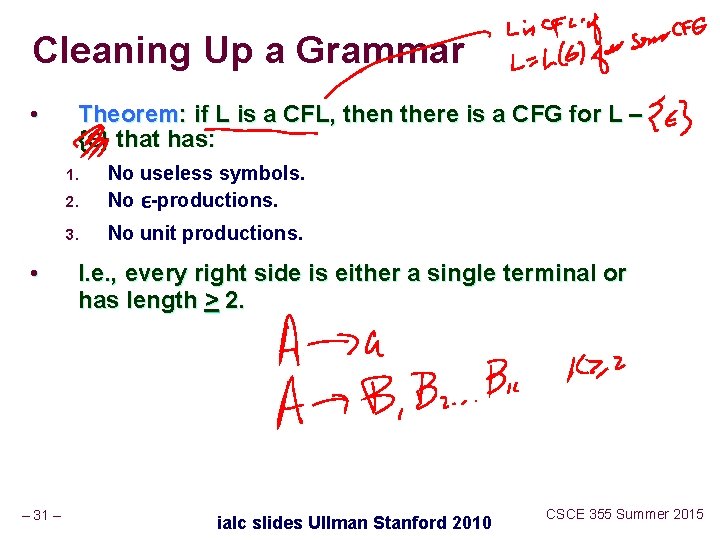
Cleaning Up a Grammar • Theorem: if L is a CFL, then there is a CFG for L – {ε} that has: 2. No useless symbols. No ε-productions. 3. No unit productions. 1. • – 31 – I. e. , every right side is either a single terminal or has length > 2. ialc slides Ullman Stanford 2010 CSCE 355 Summer 2015
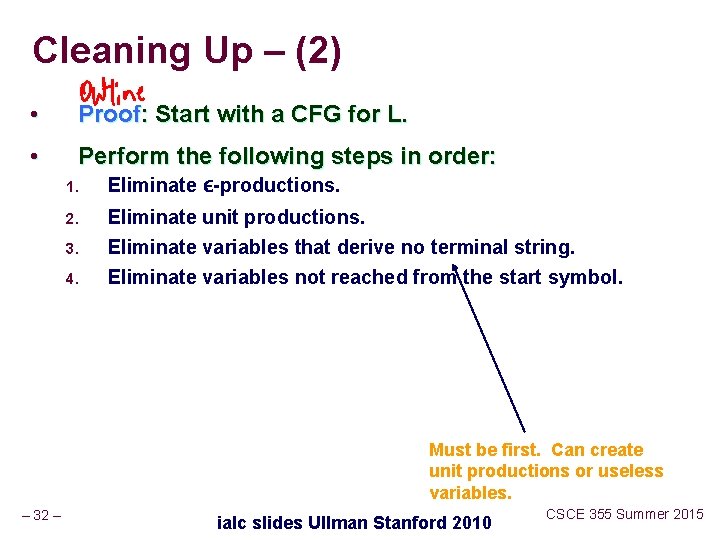
Cleaning Up – (2) • Proof: Start with a CFG for L. • Perform the following steps in order: 1. 2. 3. 4. Eliminate ε-productions. Eliminate unit productions. Eliminate variables that derive no terminal string. Eliminate variables not reached from the start symbol. Must be first. Can create unit productions or useless variables. – 32 – ialc slides Ullman Stanford 2010 CSCE 355 Summer 2015
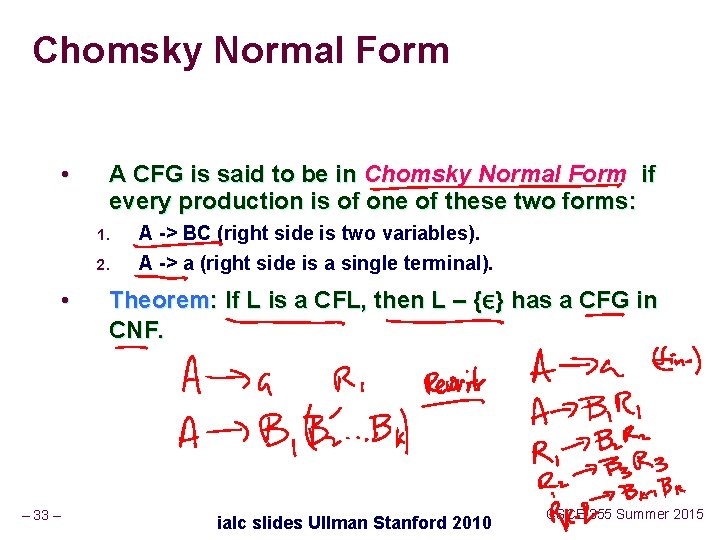
Chomsky Normal Form • A CFG is said to be in Chomsky Normal Form if every production is of one of these two forms: 1. 2. • – 33 – A -> BC (right side is two variables). A -> a (right side is a single terminal). Theorem: If L is a CFL, then L – {ε} has a CFG in CNF. ialc slides Ullman Stanford 2010 CSCE 355 Summer 2015
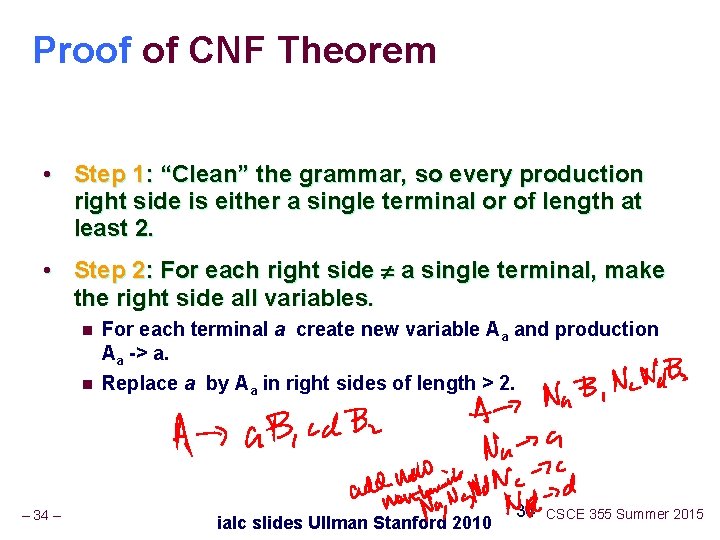
Proof of CNF Theorem • Step 1: “Clean” the grammar, so every production right side is either a single terminal or of length at least 2. • Step 2: For each right side a single terminal, make the right side all variables. n n – 34 – For each terminal a create new variable Aa and production Aa -> a. Replace a by Aa in right sides of length > 2. ialc slides Ullman Stanford 2010 34 CSCE 355 Summer 2015
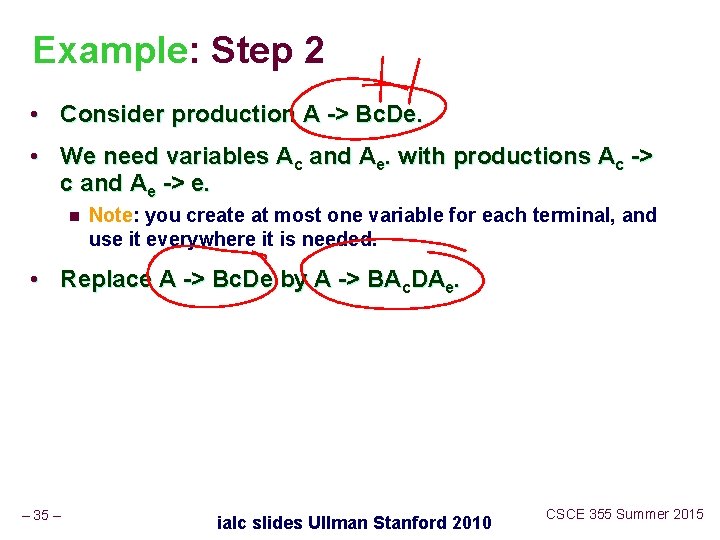
Example: Step 2 • Consider production A -> Bc. De. • We need variables Ac and Ae. with productions Ac -> c and Ae -> e. n Note: you create at most one variable for each terminal, and use it everywhere it is needed. • Replace A -> Bc. De by A -> BAc. DAe. – 35 – ialc slides Ullman Stanford 2010 CSCE 355 Summer 2015
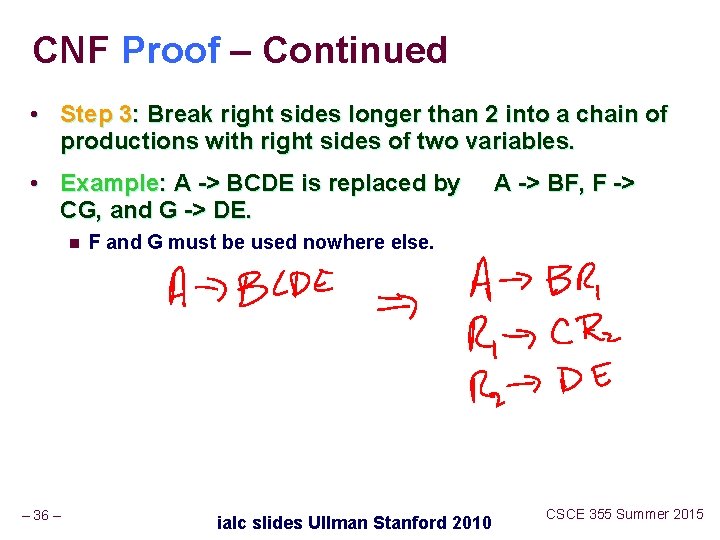
CNF Proof – Continued • Step 3: Break right sides longer than 2 into a chain of productions with right sides of two variables. • Example: A -> BCDE is replaced by CG, and G -> DE. n – 36 – A -> BF, F -> F and G must be used nowhere else. ialc slides Ullman Stanford 2010 CSCE 355 Summer 2015
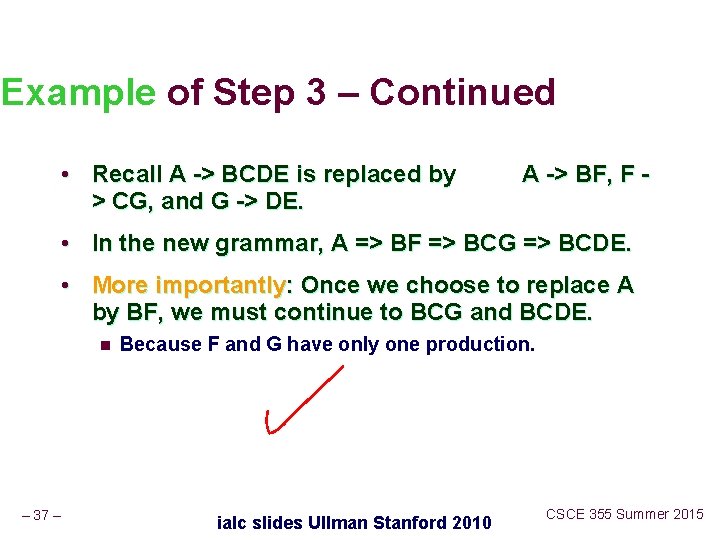
Example of Step 3 – Continued • Recall A -> BCDE is replaced by > CG, and G -> DE. A -> BF, F - • In the new grammar, A => BF => BCG => BCDE. • More importantly: Once we choose to replace A by BF, we must continue to BCG and BCDE. n – 37 – Because F and G have only one production. ialc slides Ullman Stanford 2010 CSCE 355 Summer 2015
CNF Proof – Concluded • We must prove that Steps 2 and 3 produce new grammars whose languages are the same as the previous grammar. • Proofs are of a familiar type and involve inductions on the lengths of derivations. – 38 – ialc slides Ullman Stanford 2010 CSCE 355 Summer 2015
– 39 – ialc slides Ullman Stanford 2010 CSCE 355 Summer 2015
– 40 – ialc slides Ullman Stanford 2010 CSCE 355 Summer 2015
– 41 – ialc slides Ullman Stanford 2010 CSCE 355 Summer 2015
– 42 – ialc slides Ullman Stanford 2010 CSCE 355 Summer 2015