
CSC 480 ARTIFICIAL INTELLIGENCE I PROBLEM SOLVING AS

CSC 480 ARTIFICIAL INTELLIGENCE I PROBLEM SOLVING AS SEARCH BAMSHAD MOBASHER

Part II Search Strategies

SIMPLE PROBLEM-SOLVING AGENT ALGORITHM • s 0 sense/read initial state • GOAL select/read goal test • Succ select/read successor function • solution search(s 0, GOAL, Succ) • perform(solution)
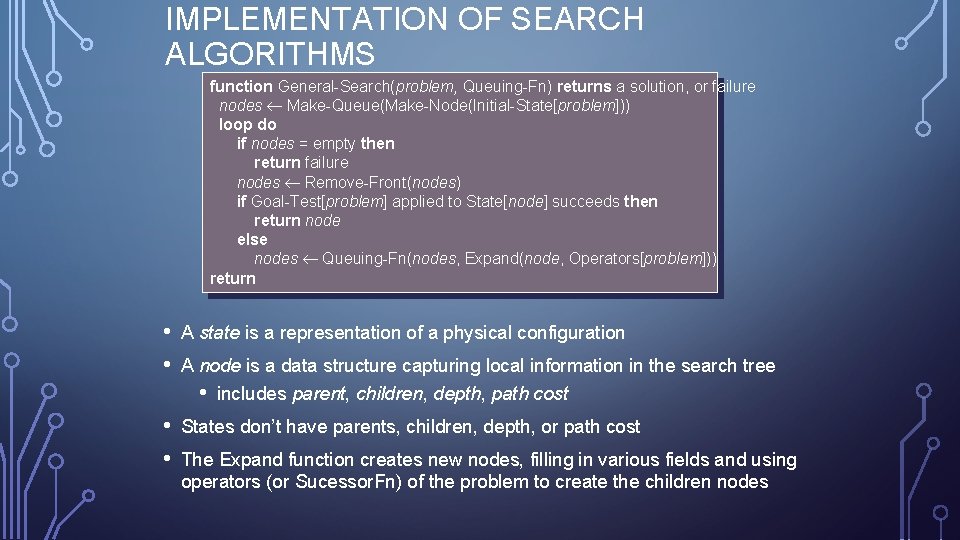
IMPLEMENTATION OF SEARCH ALGORITHMS function General-Search(problem, Queuing-Fn) returns a solution, or failure nodes ¬ Make-Queue(Make-Node(Initial-State[problem])) loop do if nodes = empty then return failure nodes ¬ Remove-Front(nodes) if Goal-Test[problem] applied to State[node] succeeds then return node else nodes ¬ Queuing-Fn(nodes, Expand(node, Operators[problem])) return • • A state is a representation of a physical configuration • • States don’t have parents, children, depth, or path cost A node is a data structure capturing local information in the search tree • includes parent, children, depth, path cost The Expand function creates new nodes, filling in various fields and using operators (or Sucessor. Fn) of the problem to create the children nodes
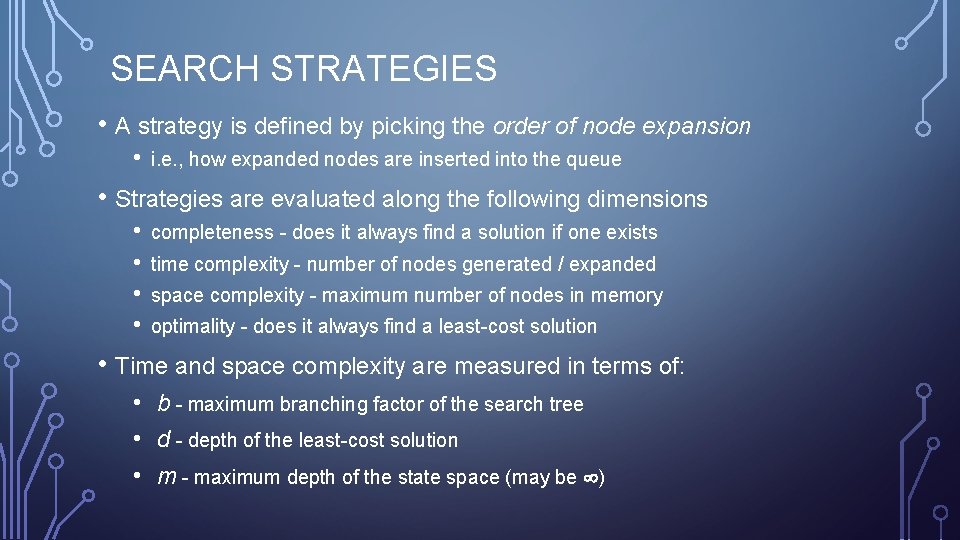
SEARCH STRATEGIES • A strategy is defined by picking the order of node expansion • i. e. , how expanded nodes are inserted into the queue • Strategies are evaluated along the following dimensions • • completeness - does it always find a solution if one exists time complexity - number of nodes generated / expanded space complexity - maximum number of nodes in memory optimality - does it always find a least-cost solution • Time and space complexity are measured in terms of: • b - maximum branching factor of the search tree • d - depth of the least-cost solution • m - maximum depth of the state space (may be ¥)
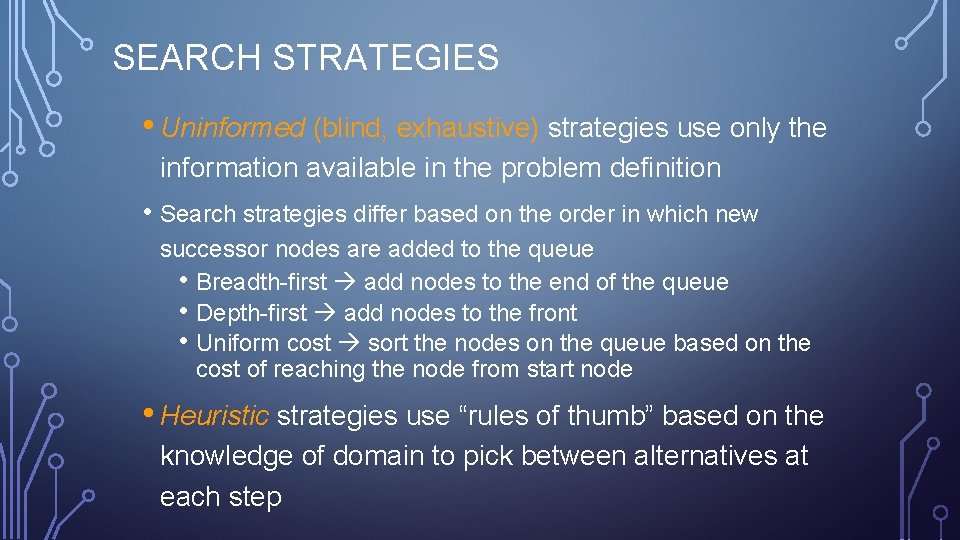
SEARCH STRATEGIES • Uninformed (blind, exhaustive) strategies use only the information available in the problem definition • Search strategies differ based on the order in which new successor nodes are added to the queue • Breadth-first add nodes to the end of the queue • Depth-first add nodes to the front • Uniform cost sort the nodes on the queue based on the cost of reaching the node from start node • Heuristic strategies use “rules of thumb” based on the knowledge of domain to pick between alternatives at each step

Breadth-First Search
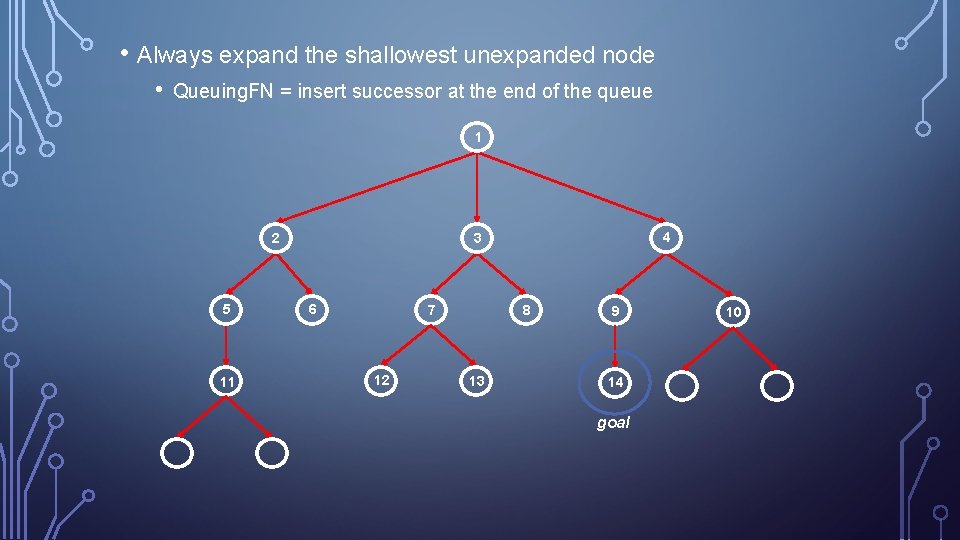
• Always expand the shallowest unexpanded node • Queuing. FN = insert successor at the end of the queue 1 2 5 11 4 3 6 7 12 8 13 9 14 goal 10
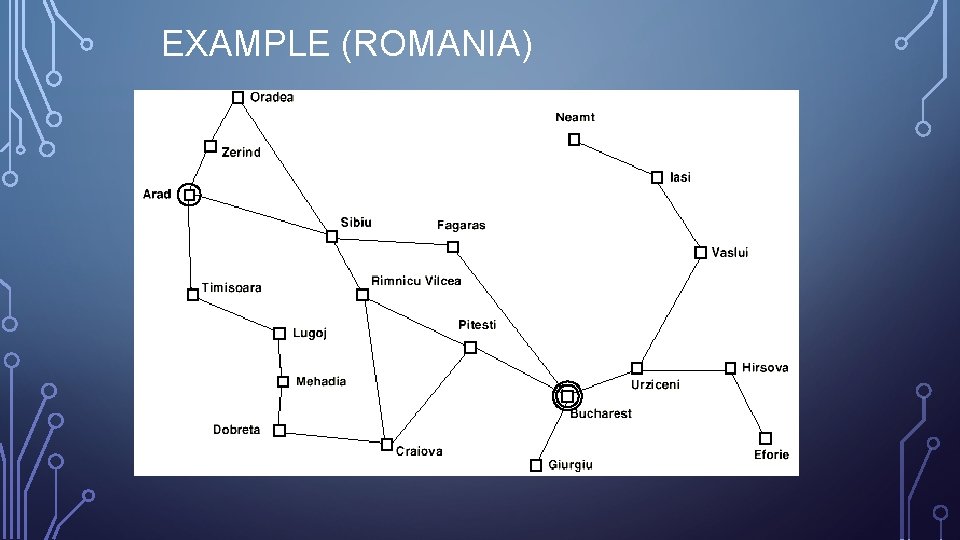
EXAMPLE (ROMANIA)
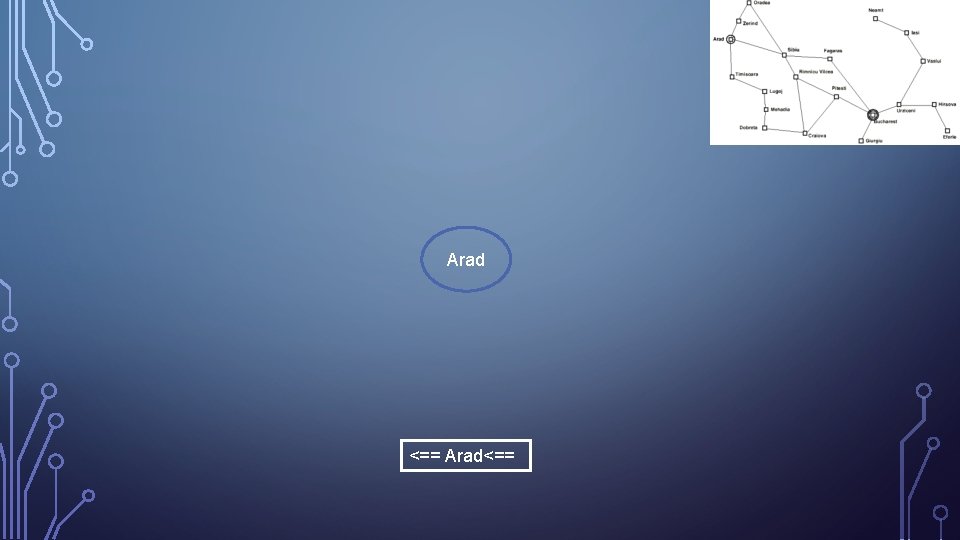
Arad <== Arad<==
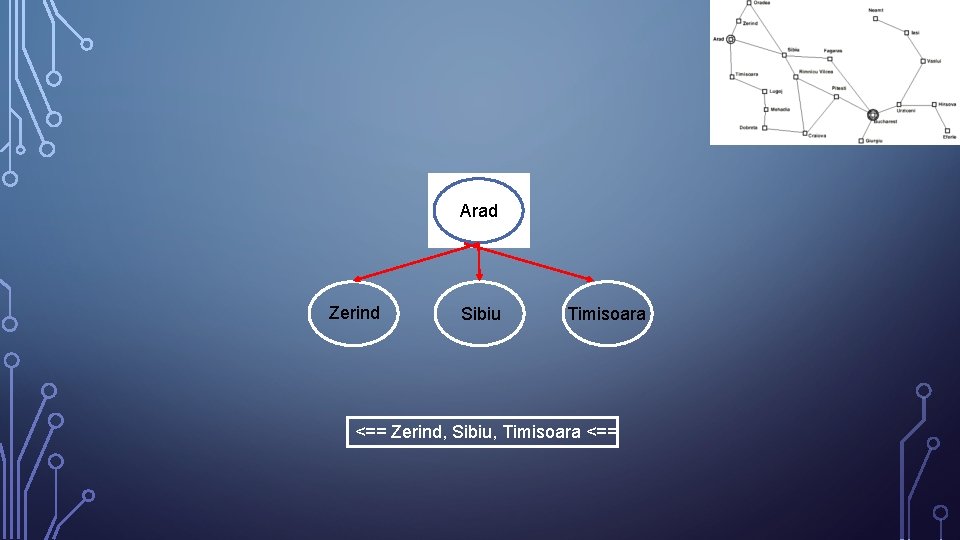
Arad Zerind Sibiu Timisoara <== Zerind, Sibiu, Timisoara <==
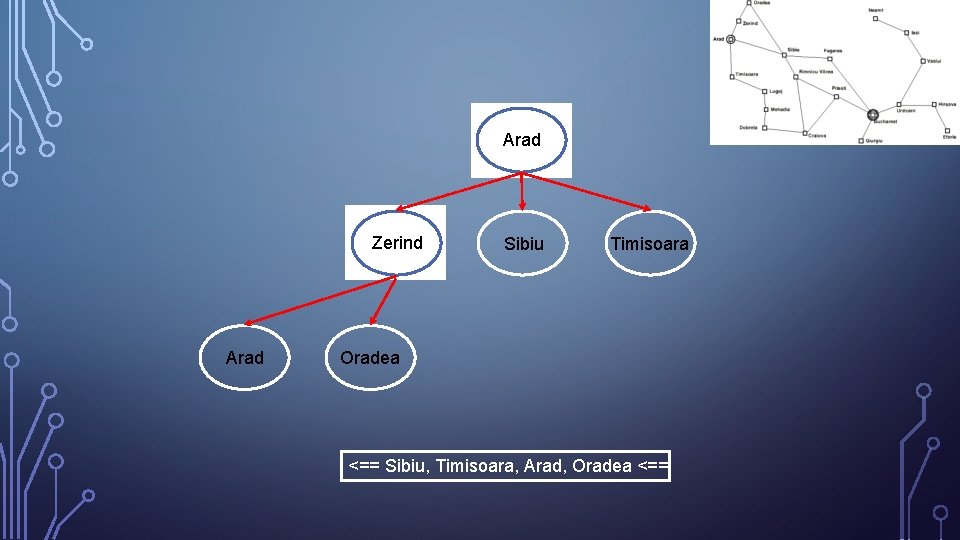
Arad Zerind Arad Sibiu Timisoara Oradea <== Sibiu, Timisoara, Arad, Oradea <==
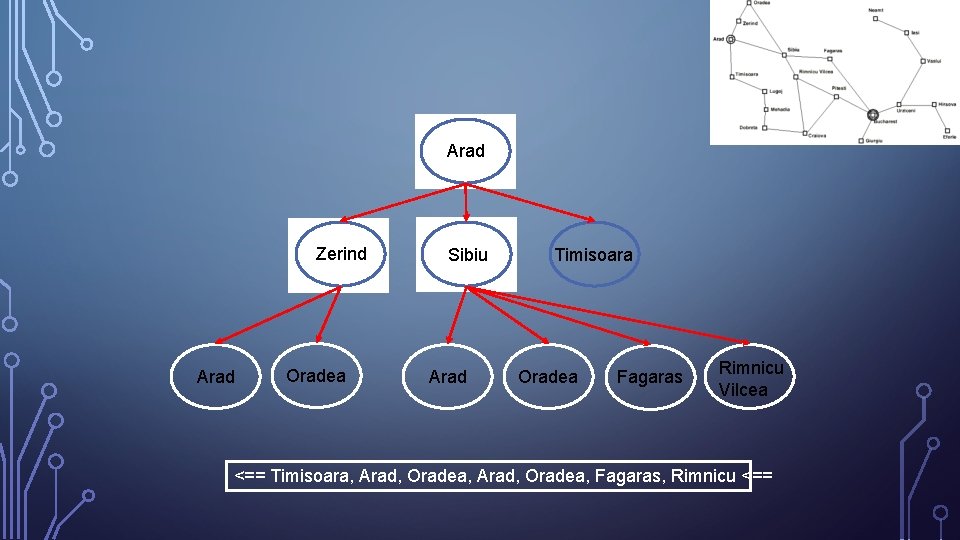
Arad Zerind Arad Oradea Sibiu Arad Timisoara Oradea Fagaras Rimnicu Vilcea <== Timisoara, Arad, Oradea, Fagaras, Rimnicu <==
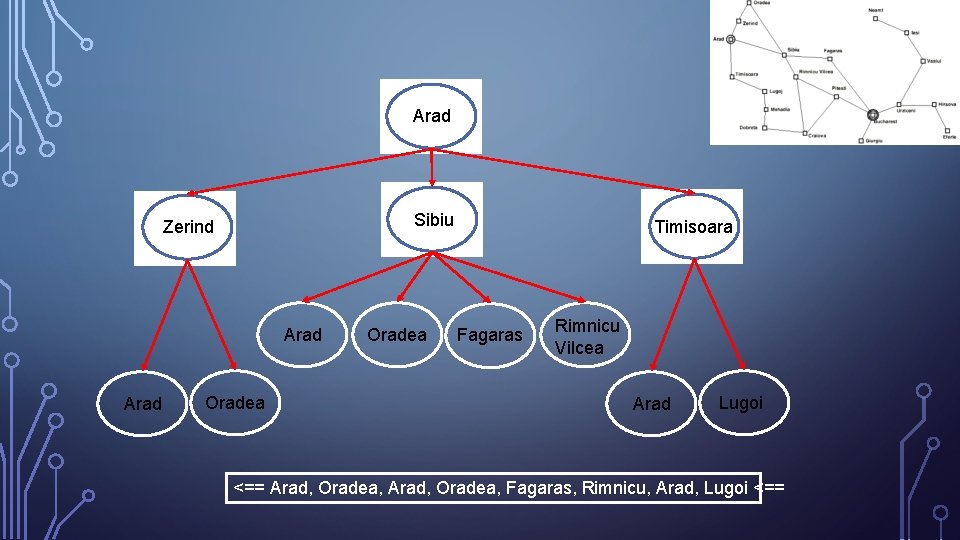
Arad Sibiu Zerind Arad Oradea Timisoara Fagaras Rimnicu Vilcea Arad Lugoi <== Arad, Oradea, Fagaras, Rimnicu, Arad, Lugoi <==
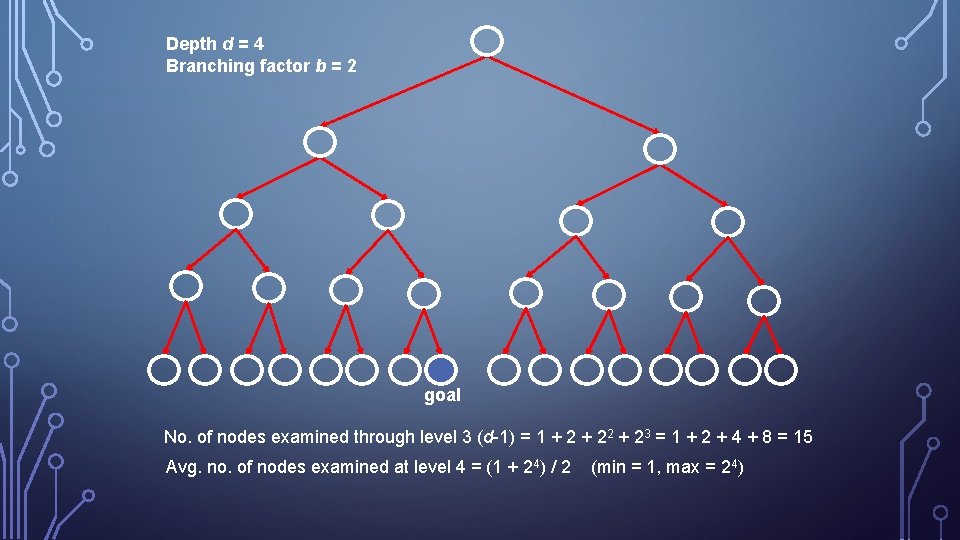
Depth d = 4 Branching factor b = 2 goal No. of nodes examined through level 3 (d-1) = 1 + 22 + 23 = 1 + 2 + 4 + 8 = 15 Avg. no. of nodes examined at level 4 = (1 + 24) / 2 (min = 1, max = 24)
BREADTH-FIRST SEARCH • Space complexity: • Full tree at depth d uses bd memory nodes • If you know there is a goal at depth d, you are done; otherwise have to store the nodes at depth d+1 as you generate them; so might need bd+1 memory nodes • for large b, this is O(bd) (the fringe dominates)
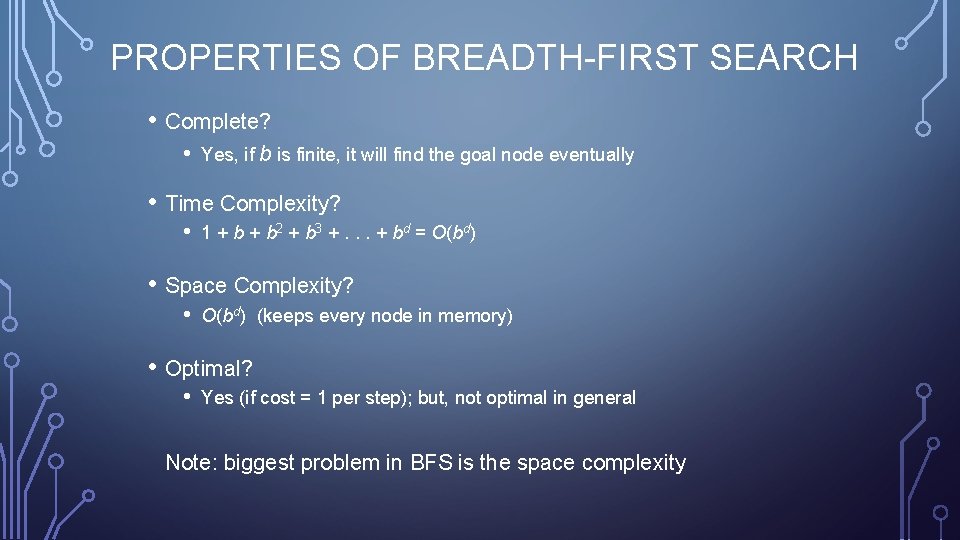
PROPERTIES OF BREADTH-FIRST SEARCH • Complete? • Yes, if b is finite, it will find the goal node eventually • Time Complexity? • 1 + b 2 + b 3 +. . . + bd = O(bd) • Space Complexity? • O(bd) (keeps every node in memory) • Optimal? • Yes (if cost = 1 per step); but, not optimal in general Note: biggest problem in BFS is the space complexity
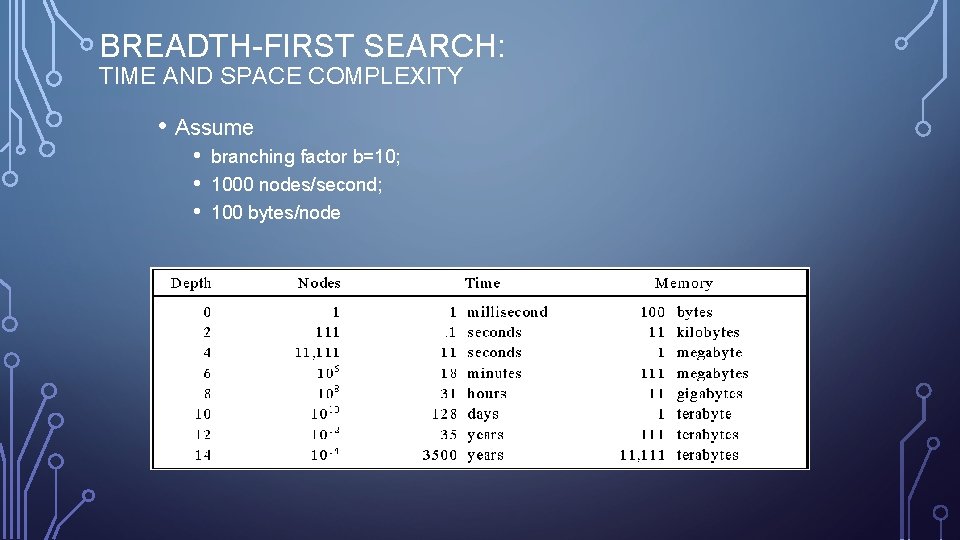
BREADTH-FIRST SEARCH: TIME AND SPACE COMPLEXITY • Assume • • • branching factor b=10; 1000 nodes/second; 100 bytes/node

Depth-First Search
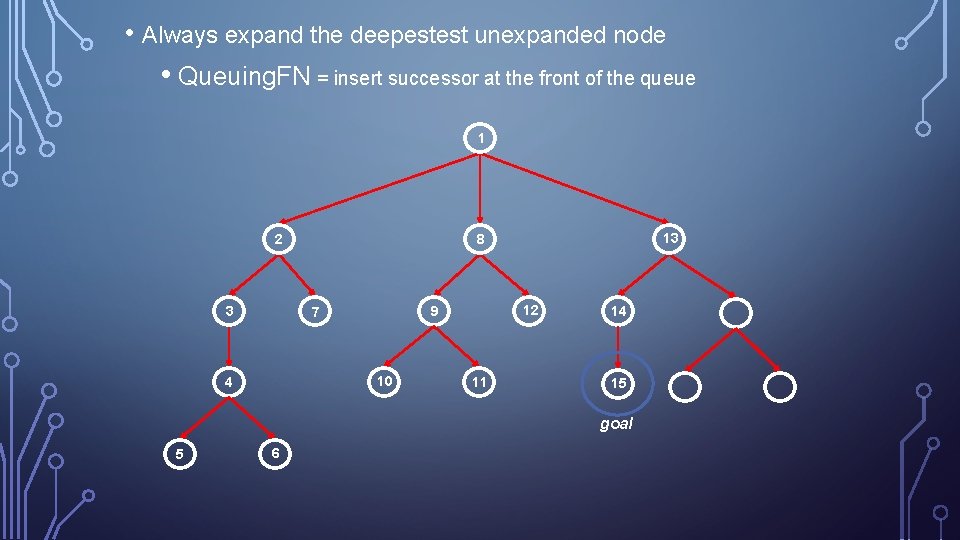
• Always expand the deepestest unexpanded node • Queuing. FN = insert successor at the front of the queue 1 2 3 12 9 7 10 4 13 8 11 14 15 goal 5 6
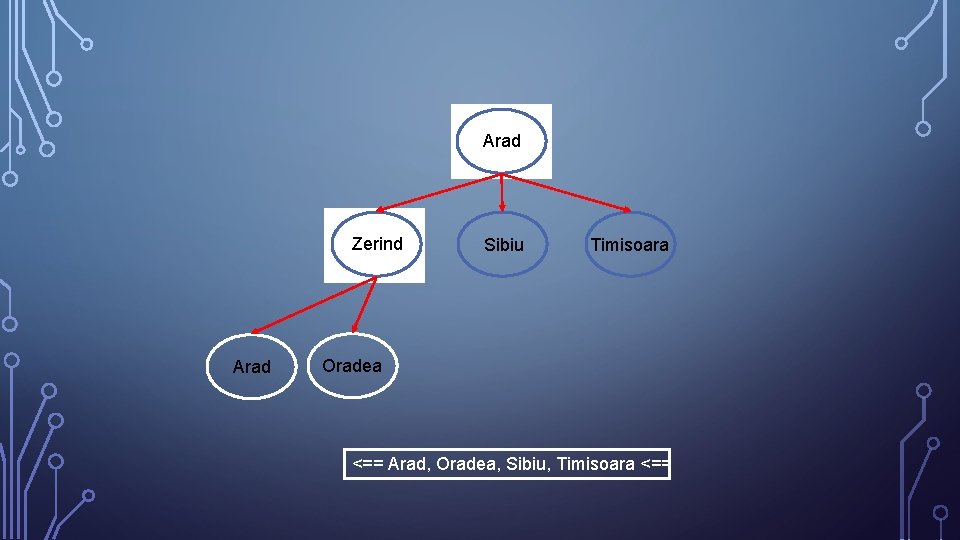
Arad Zerind Arad Sibiu Timisoara Oradea <== Arad, Oradea, Sibiu, Timisoara <==
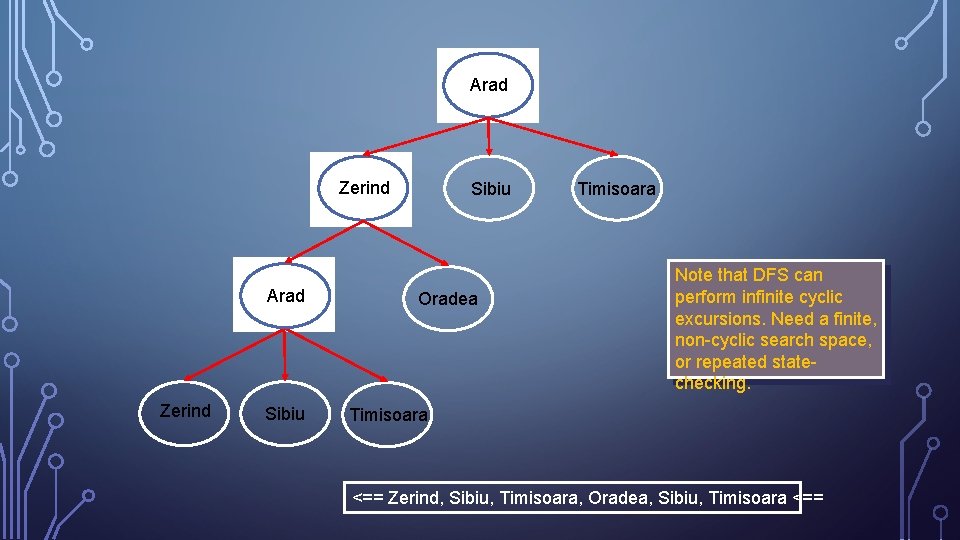
Arad Zerind Sibiu Oradea Timisoara Note that DFS can perform infinite cyclic excursions. Need a finite, non-cyclic search space, or repeated statechecking. Timisoara <== Zerind, Sibiu, Timisoara, Oradea, Sibiu, Timisoara <==
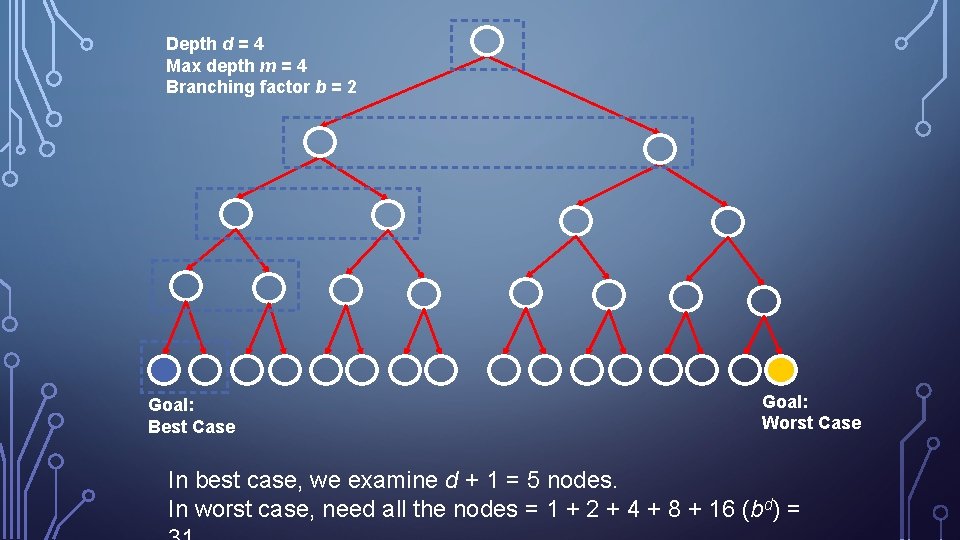
Depth d = 4 Max depth m = 4 Branching factor b = 2 Goal: Best Case Goal: Worst Case In best case, we examine d + 1 = 5 nodes. In worst case, need all the nodes = 1 + 2 + 4 + 8 + 16 (bd) =
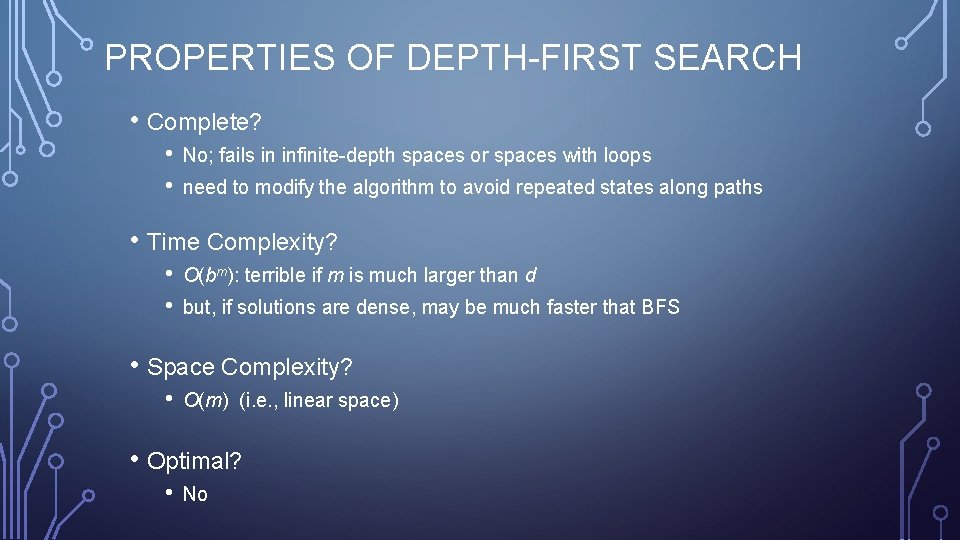
PROPERTIES OF DEPTH-FIRST SEARCH • Complete? • • No; fails in infinite-depth spaces or spaces with loops need to modify the algorithm to avoid repeated states along paths • Time Complexity? • • O(bm): terrible if m is much larger than d but, if solutions are dense, may be much faster that BFS • Space Complexity? • O(m) (i. e. , linear space) • Optimal? • No

Iterative Deepening
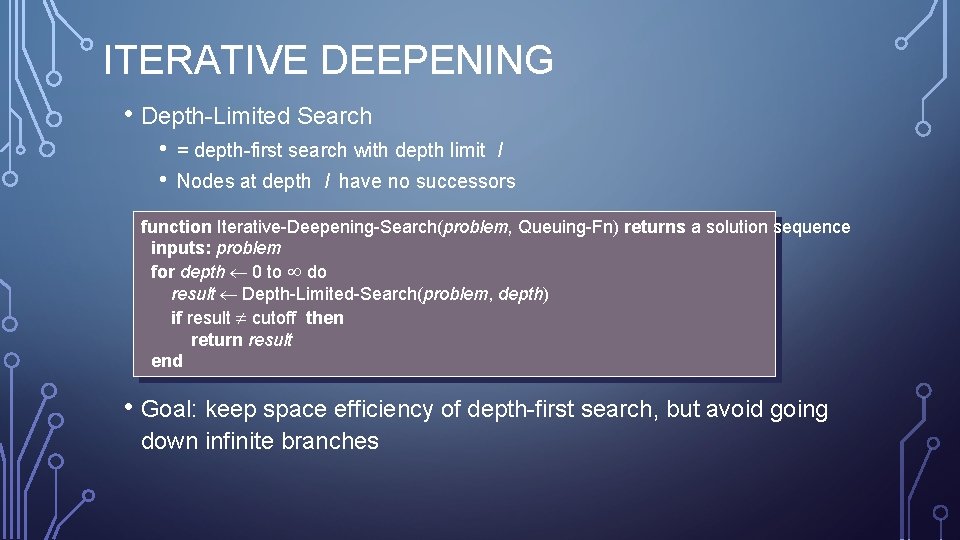
ITERATIVE DEEPENING • Depth-Limited Search • • = depth-first search with depth limit l Nodes at depth l have no successors function Iterative-Deepening-Search(problem, Queuing-Fn) returns a solution sequence inputs: problem for depth ¬ 0 to ¥ do result ¬ Depth-Limited-Search(problem, depth) if result ¹ cutoff then return result end • Goal: keep space efficiency of depth-first search, but avoid going down infinite branches

ITERATIVE DEEPENING Arad l=0
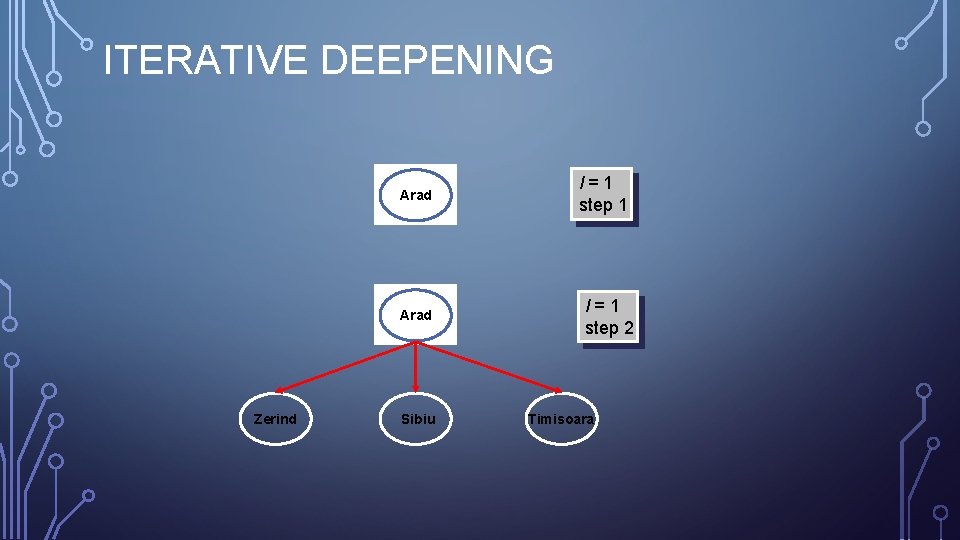
ITERATIVE DEEPENING Arad Zerind Sibiu l=1 step 1 l=1 step 2 Timisoara
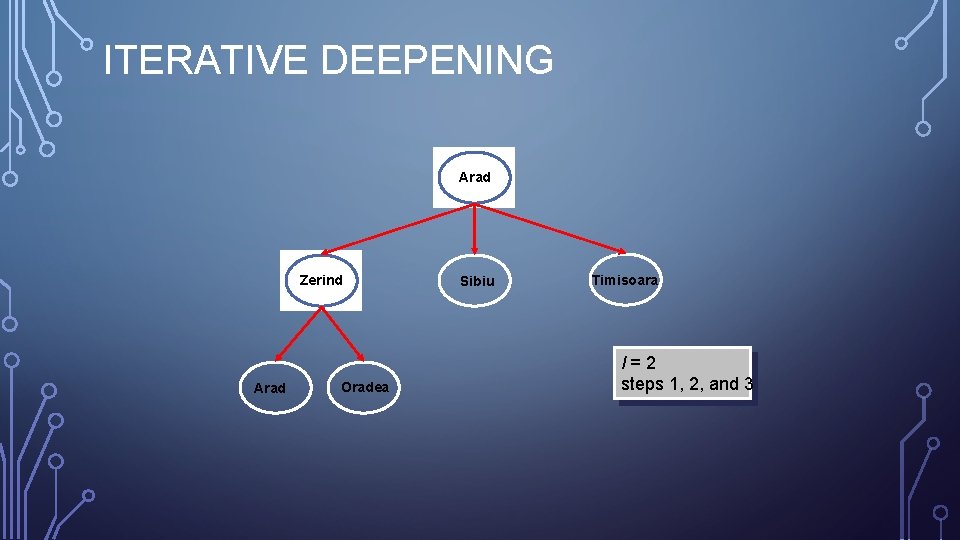
ITERATIVE DEEPENING Arad Zerind Arad Oradea Sibiu Timisoara l=2 steps 1, 2, and 3
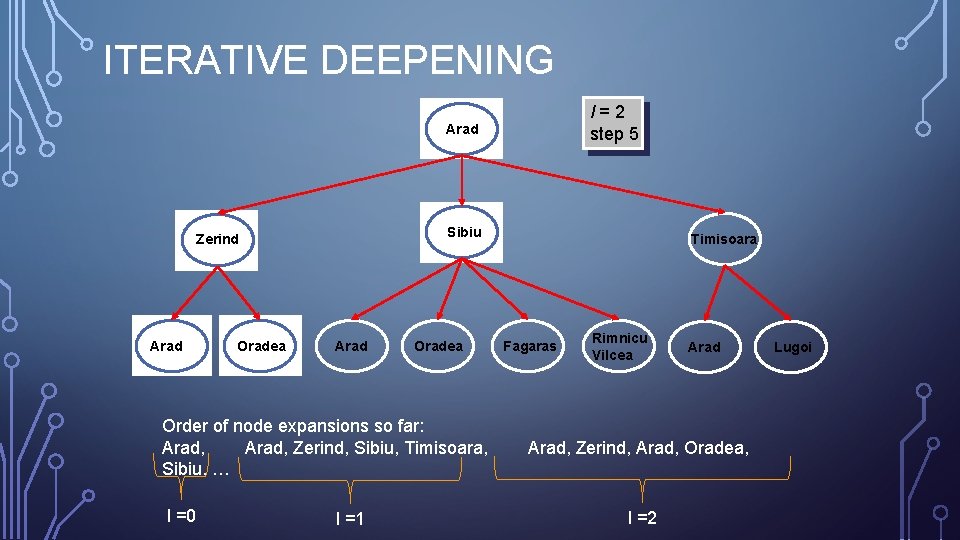
ITERATIVE DEEPENING l=2 step 5 Arad Sibiu Zerind Arad Oradea Order of node expansions so far: Arad, Zerind, Sibiu, Timisoara, Sibiu, … l =0 l =1 Timisoara Fagaras Rimnicu Vilcea Arad, Zerind, Arad, Oradea, l =2 Lugoi

PROPERTIES OF ITERATIVE DEEPENING • Complete? • Yes • Time Complexity? • O(bd) • Space Complexity? • O(bd) • Optimal? • Yes (if cost = 1 per step)

Uniform-Cost Search
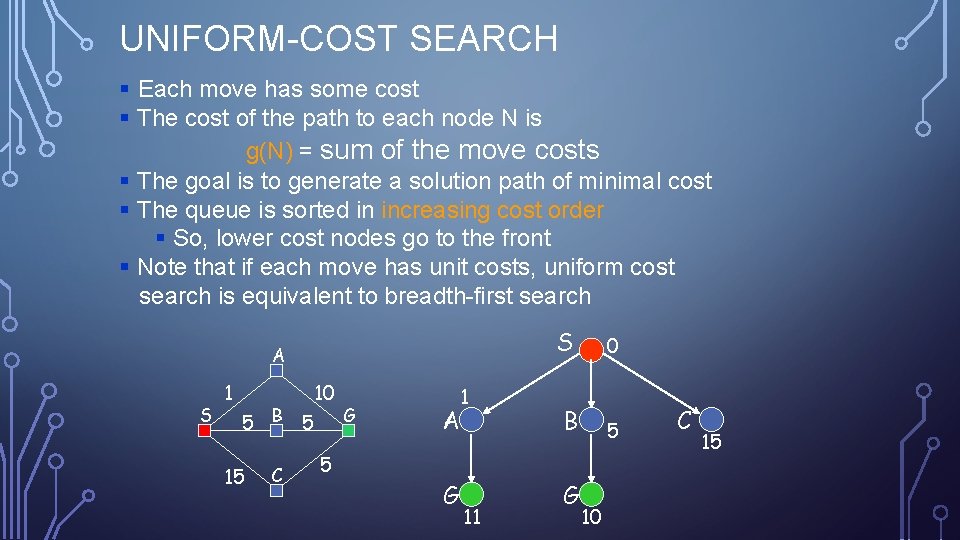
UNIFORM-COST SEARCH § Each move has some cost § The cost of the path to each node N is g(N) = sum of the move costs § The goal is to generate a solution path of minimal cost § The queue is sorted in increasing cost order § So, lower cost nodes go to the front § Note that if each move has unit costs, uniform cost search is equivalent to breadth-first search S 0 A B 5 G G A S 1 10 5 B 5 G 15 C 5 1 11 10 C 15
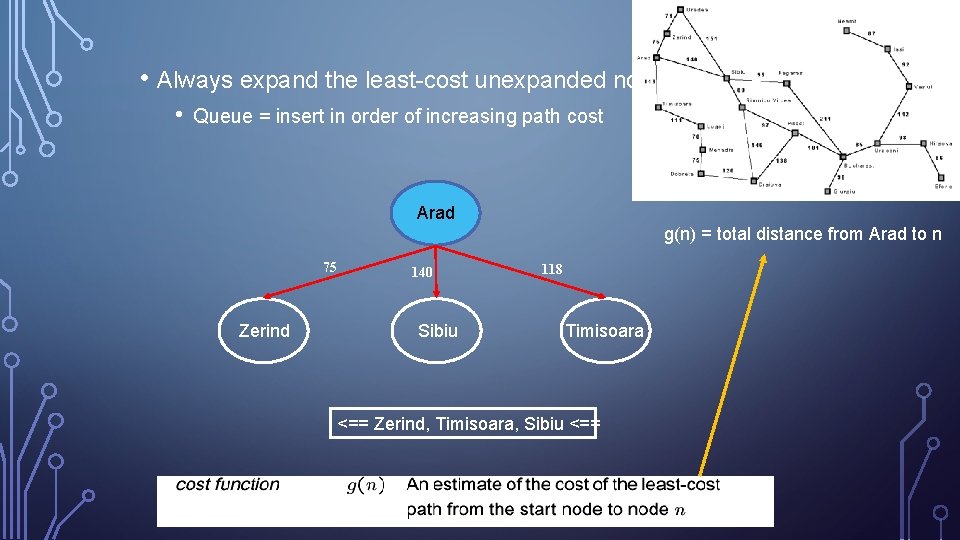
• Always expand the least-cost unexpanded node • Queue = insert in order of increasing path cost Arad g(n) = total distance from Arad to n 75 Zerind 140 Sibiu 118 Timisoara <== Zerind, Timisoara, Sibiu <==
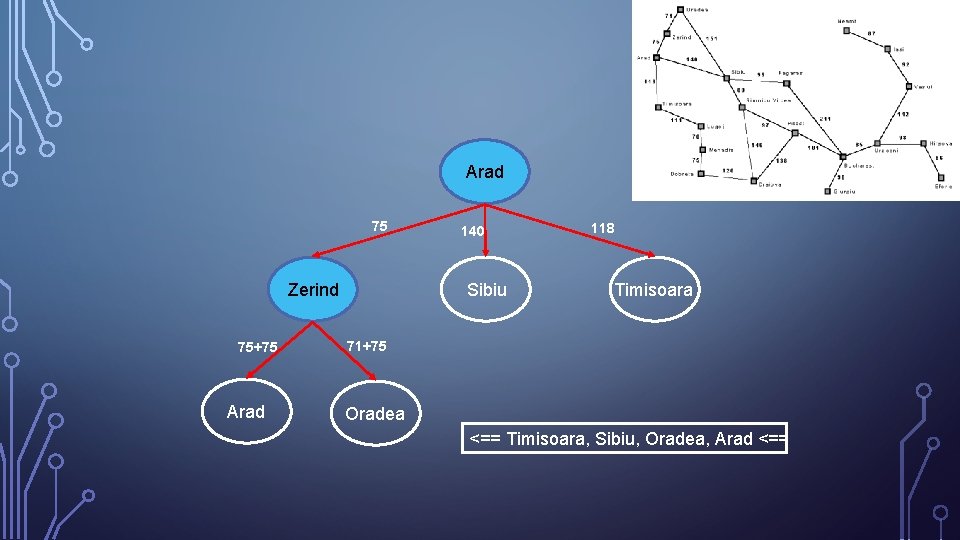
Arad 75 Zerind 75+75 Arad 140 Sibiu 118 Timisoara 71+75 Oradea <== Timisoara, Sibiu, Oradea, Arad <==
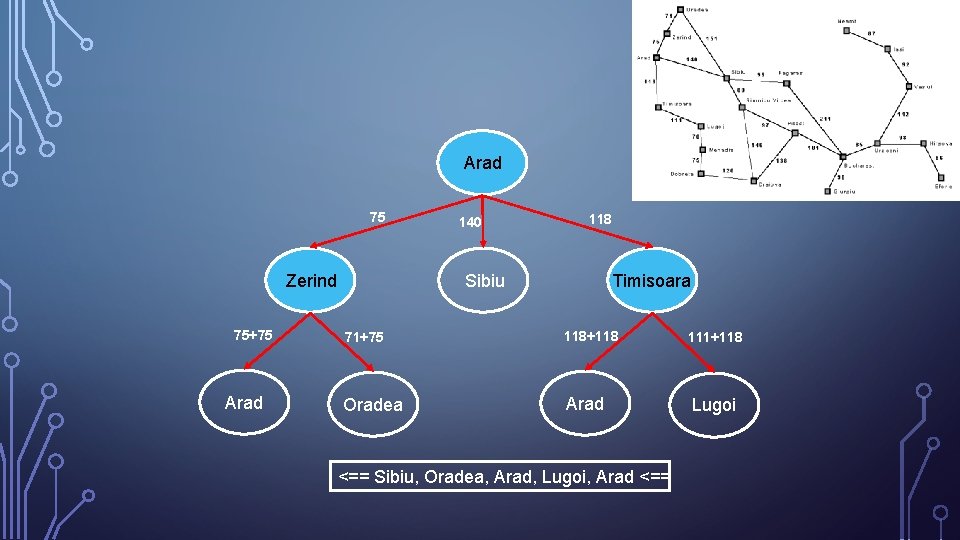
Arad 75 Zerind 75+75 Arad 140 118 Sibiu Timisoara 71+75 118+118 111+118 Oradea Arad Lugoi <== Sibiu, Oradea, Arad, Lugoi, Arad <==

UNIFORM COST SEARCH • For the rest of the example, let us assume repeated state checking: • If a newly generated state was previously expanded, then discard the new state • If multiple (unexpanded) instances of a state end up on the queue, we only keep the instance that has the least path cost from the start node and eliminate the other instances.
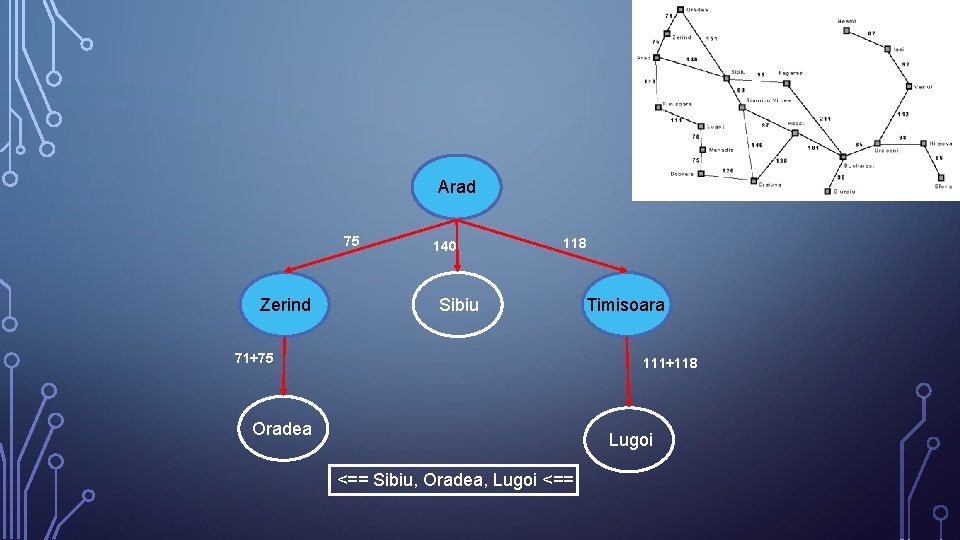
Arad 75 Zerind 140 118 Sibiu 71+75 Timisoara 111+118 Oradea Lugoi <== Sibiu, Oradea, Lugoi <==
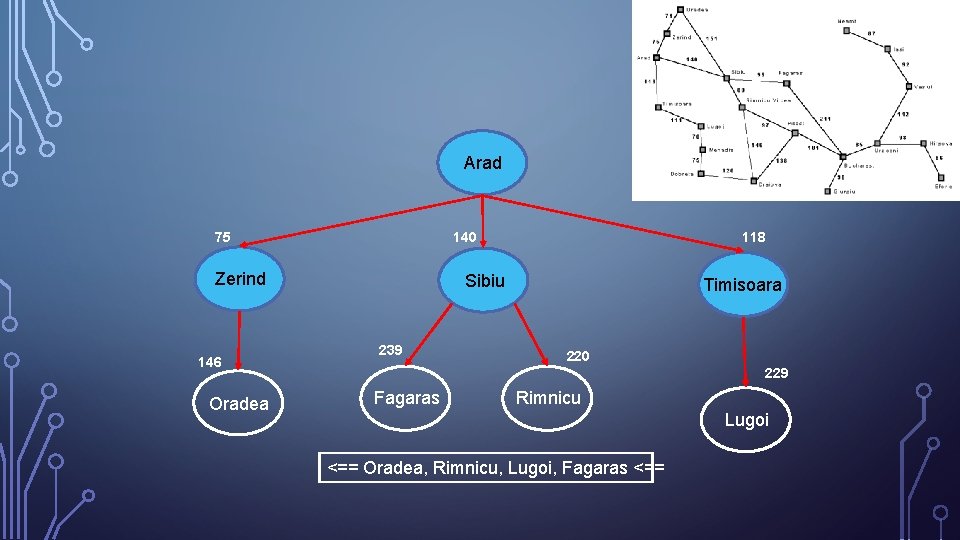
Arad 75 140 Zerind 146 Oradea 118 Sibiu 239 Timisoara 220 229 Fagaras Rimnicu Lugoi <== Oradea, Rimnicu, Lugoi, Fagaras <==
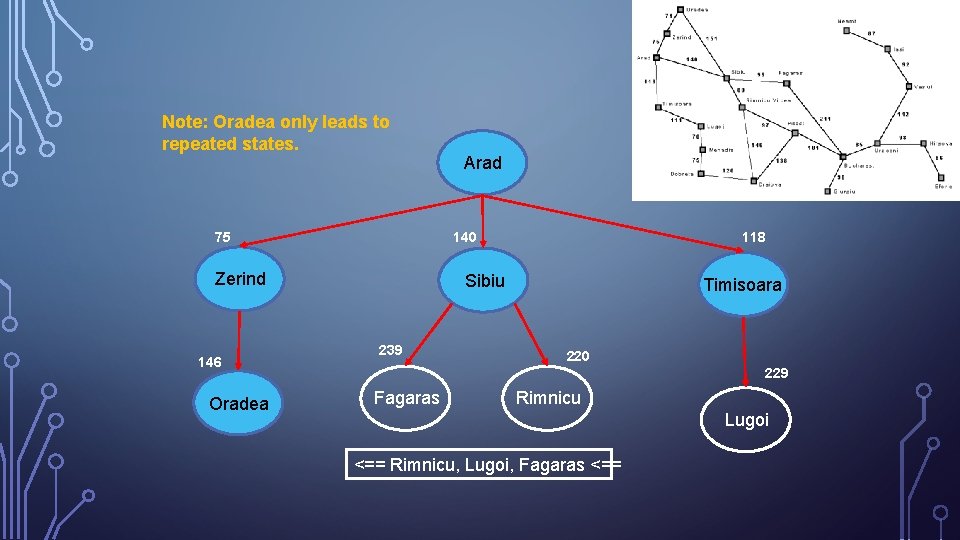
Note: Oradea only leads to repeated states. 75 140 Zerind 146 Oradea Arad 118 Sibiu 239 Timisoara 220 229 Fagaras Rimnicu Lugoi <== Rimnicu, Lugoi, Fagaras <==
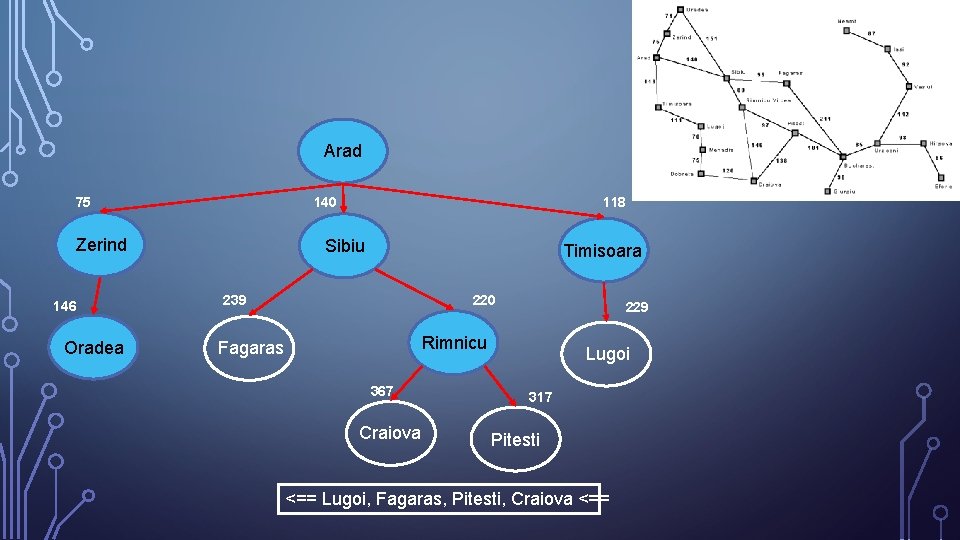
Arad 75 140 Zerind 146 Oradea 118 Sibiu Timisoara 239 220 229 Rimnicu Fagaras 367 Craiova Lugoi 317 Pitesti <== Lugoi, Fagaras, Pitesti, Craiova <==
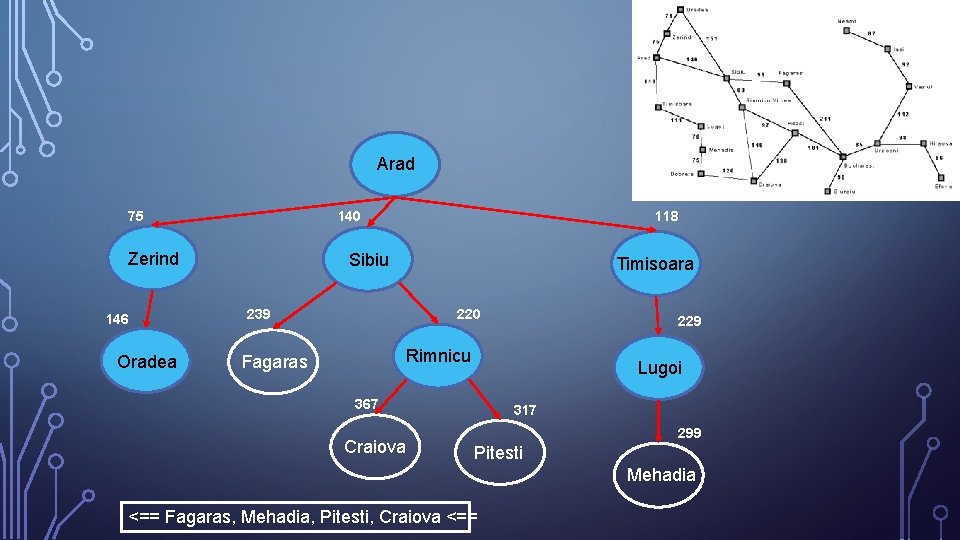
Arad 75 140 Zerind 146 Oradea 118 Sibiu 239 Timisoara 220 229 Rimnicu Fagaras Lugoi 367 Craiova 317 299 Pitesti Mehadia <== Fagaras, Mehadia, Pitesti, Craiova <==
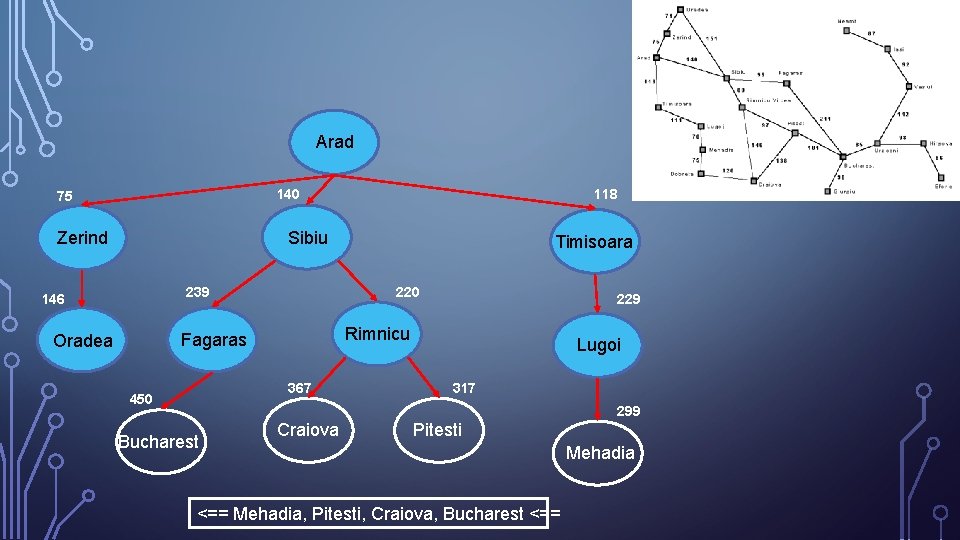
Arad 140 75 118 Sibiu Zerind 239 146 220 367 450 229 Rimnicu Fagaras Oradea Timisoara Lugoi 317 299 Bucharest Craiova Pitesti <== Mehadia, Pitesti, Craiova, Bucharest <== Mehadia
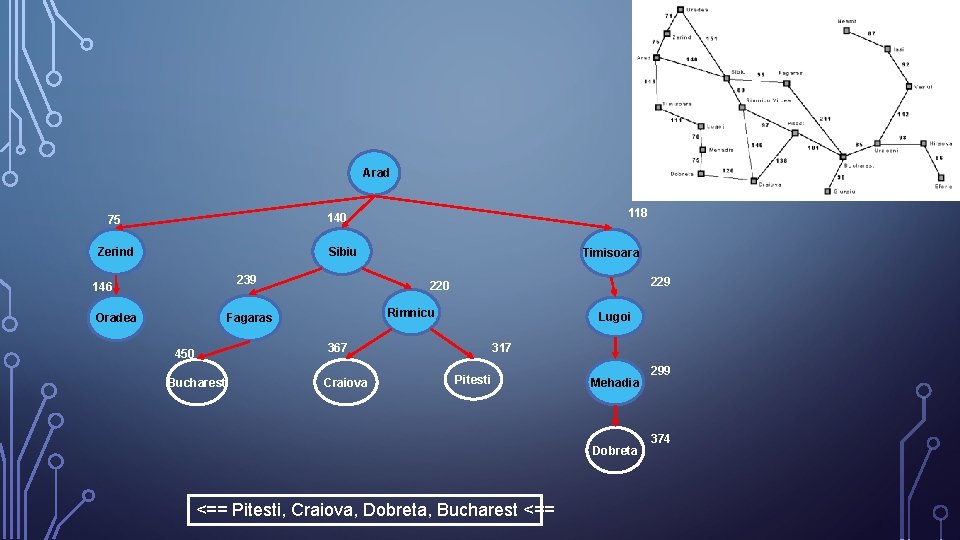
Arad 118 140 75 Sibiu Zerind 239 146 Oradea Timisoara 229 220 Rimnicu Fagaras Lugoi 367 450 Bucharest Craiova 317 Pitesti Mehadia Dobreta <== Pitesti, Craiova, Dobreta, Bucharest <== 299 374
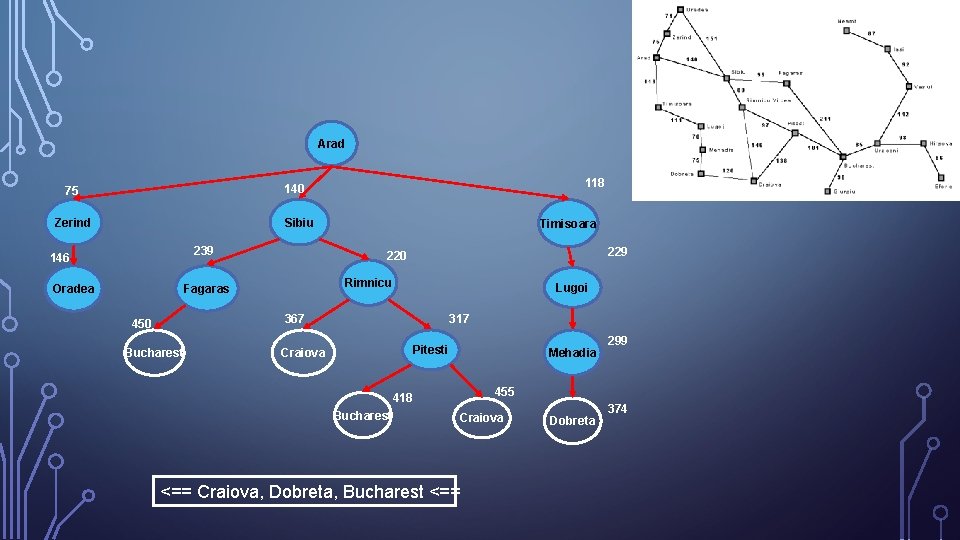
Arad 118 140 75 Sibiu Zerind 239 146 Oradea Timisoara 229 220 Rimnicu Fagaras Lugoi 367 450 Bucharest 317 Pitesti Craiova Mehadia 455 418 Bucharest 299 Craiova <== Craiova, Dobreta, Bucharest <== Dobreta 374
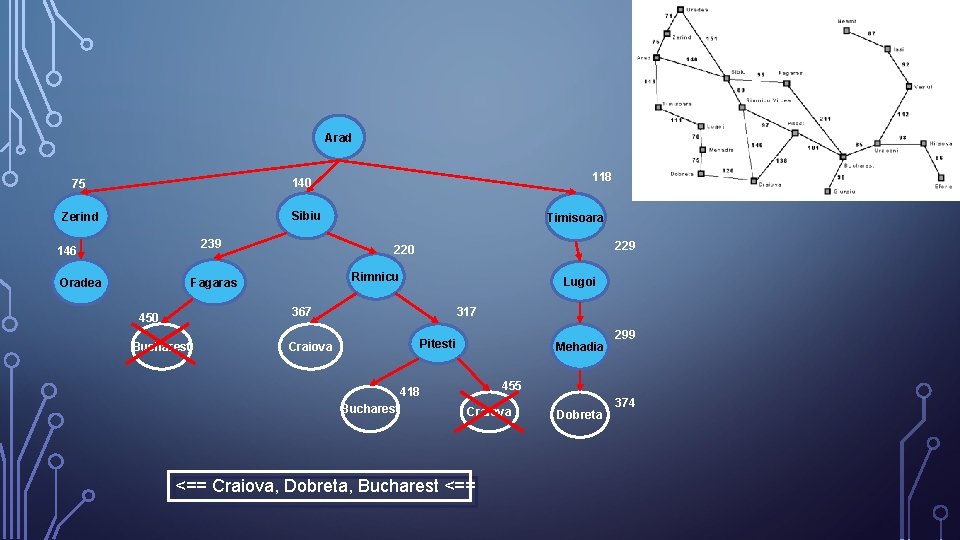
Arad 118 140 75 Sibiu Zerind 239 146 Oradea Timisoara 229 220 Rimnicu Fagaras Lugoi 367 450 Bucharest 317 Pitesti Craiova Mehadia 455 418 Bucharest 299 Craiova <== Craiova, Dobreta, Bucharest <== Dobreta 374
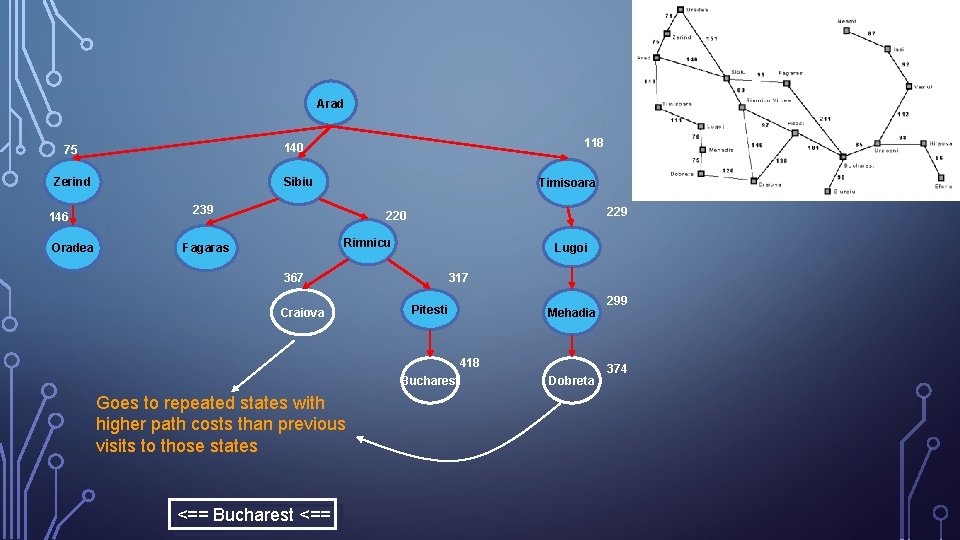
Arad Sibiu Zerind 146 Oradea 118 140 75 Timisoara 239 220 Rimnicu Fagaras Lugoi 367 Craiova 317 Pitesti Mehadia 418 Bucharest Goes to repeated states with higher path costs than previous visits to those states <== Bucharest <== Dobreta 299 374
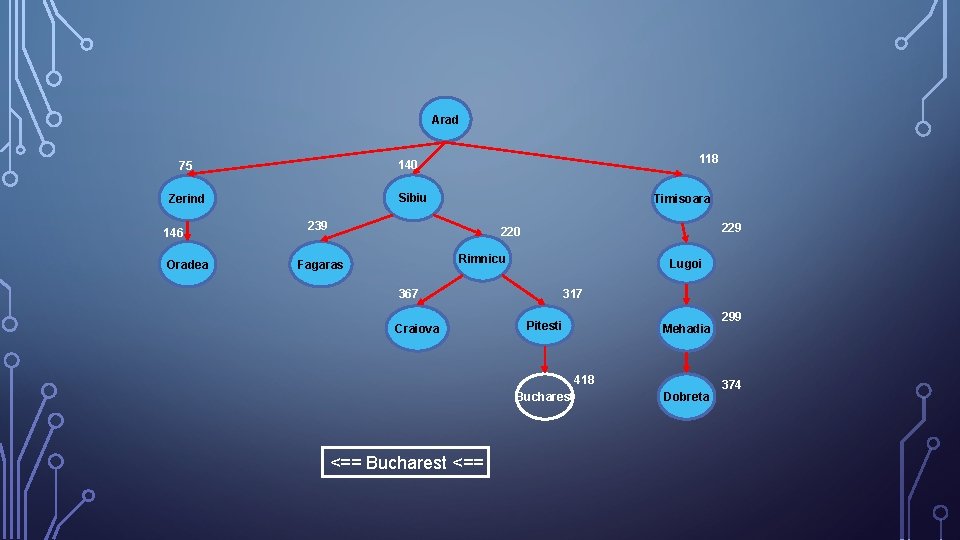
Arad Sibiu Zerind 146 Oradea 118 140 75 Timisoara 239 220 Rimnicu Fagaras Lugoi 367 Craiova 317 Pitesti Mehadia 418 Bucharest <== Dobreta 299 374
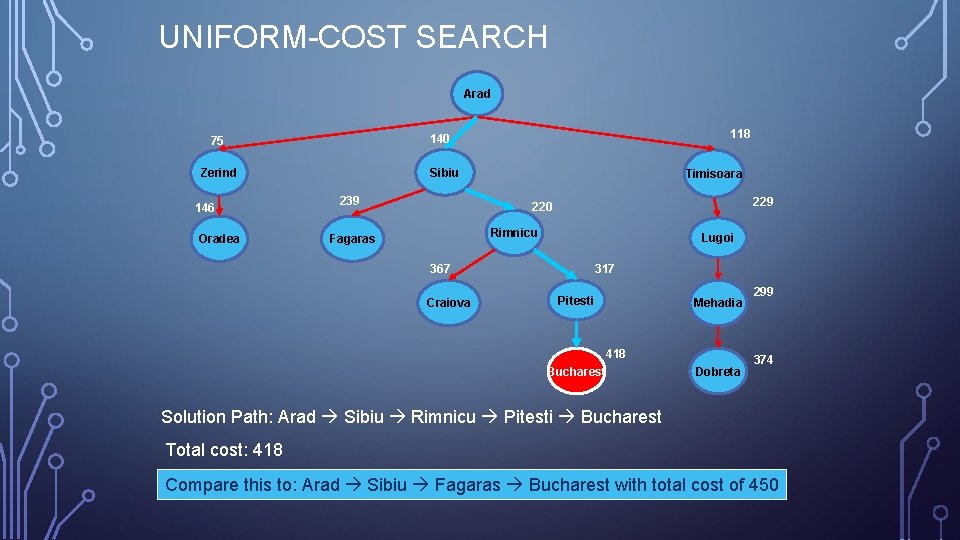
UNIFORM-COST SEARCH Arad Sibiu Zerind 146 Oradea 118 140 75 239 Timisoara 229 220 Rimnicu Fagaras Lugoi 367 Craiova 317 Pitesti Mehadia 418 Bucharest Dobreta 299 374 Solution Path: Arad Sibiu Rimnicu Pitesti Bucharest Total cost: 418 Compare this to: Arad Sibiu Fagaras Bucharest with total cost of 450
PROPERTIES OF UNIFORM-COST SEARCH • Complete? • Yes, if b is finite (similar to Breadth-First search) • Time Complexity? • Number of nodes with g(n) £ cost of optimal solution • Space Complexity? • Number of nodes with g(n) £ cost of optimal solution • Optimal? • • Yes, if the path cost never decreases along any path i. e. , if g(Successor(n)) ³ g(n), for all nodes n
PROBLEM WITH UNIFORM COST SEARCH • We are only considering the cost so far, not the expected cost of getting to the goal node • But, we don’t know before hand the cost of getting to the goal from a previous state • Solution: use heuristics (rules of thumb based on the knowledge of the domain) to estimate the cost of getting to a goal node
- Slides: 51