
CSC 421 Algorithm Design Analysis Spring 2019 Decrease
- Slides: 20
CSC 421: Algorithm Design & Analysis Spring 2019 Decrease & conquer § decrease by constant sequential search, insertion sort, topological sort § decrease by constant factor binary search, fake coin problem § decrease by variable amount BST search, selection problem 1
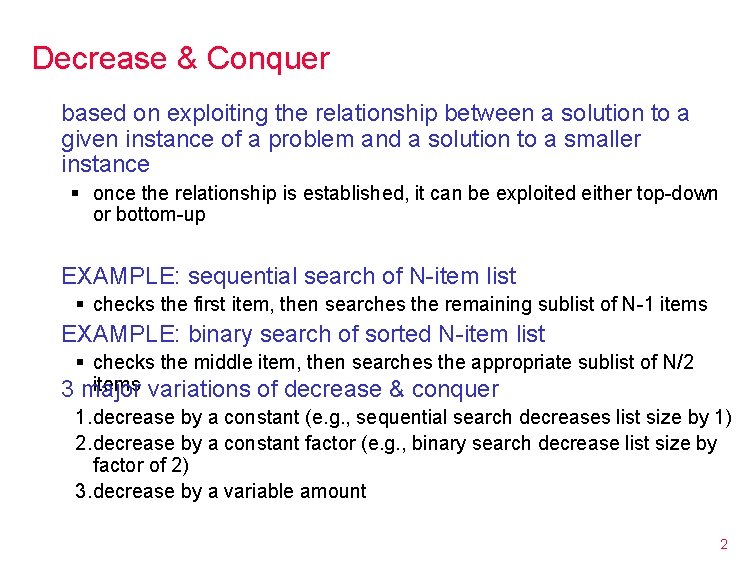
Decrease & Conquer based on exploiting the relationship between a solution to a given instance of a problem and a solution to a smaller instance § once the relationship is established, it can be exploited either top-down or bottom-up EXAMPLE: sequential search of N-item list § checks the first item, then searches the remaining sublist of N-1 items EXAMPLE: binary search of sorted N-item list § checks the middle item, then searches the appropriate sublist of N/2 items variations of decrease & conquer 3 major 1. decrease by a constant (e. g. , sequential search decreases list size by 1) 2. decrease by a constant factor (e. g. , binary search decrease list size by factor of 2) 3. decrease by a variable amount 2
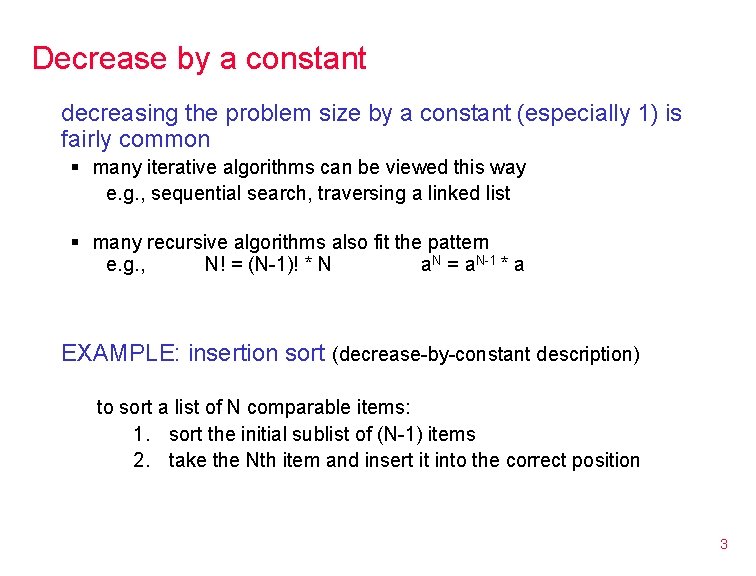
Decrease by a constant decreasing the problem size by a constant (especially 1) is fairly common § many iterative algorithms can be viewed this way e. g. , sequential search, traversing a linked list § many recursive algorithms also fit the pattern e. g. , N! = (N-1)! * N a. N = a. N-1 * a EXAMPLE: insertion sort (decrease-by-constant description) to sort a list of N comparable items: 1. sort the initial sublist of (N-1) items 2. take the Nth item and insert it into the correct position 3
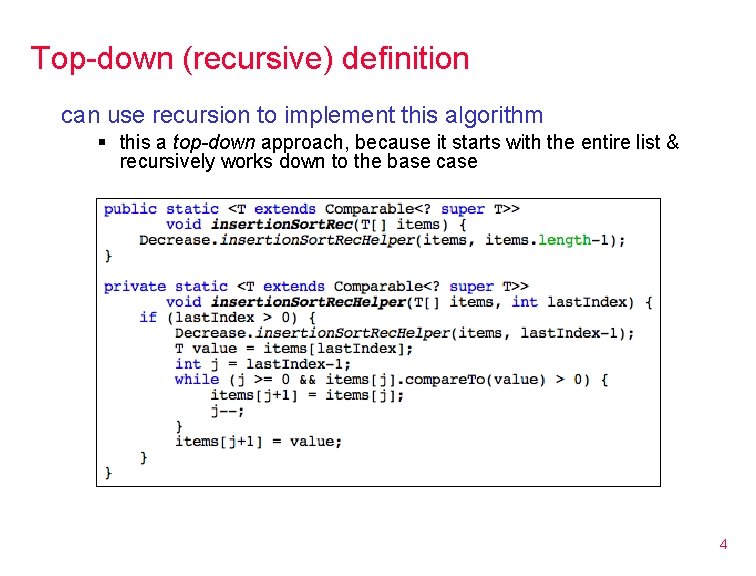
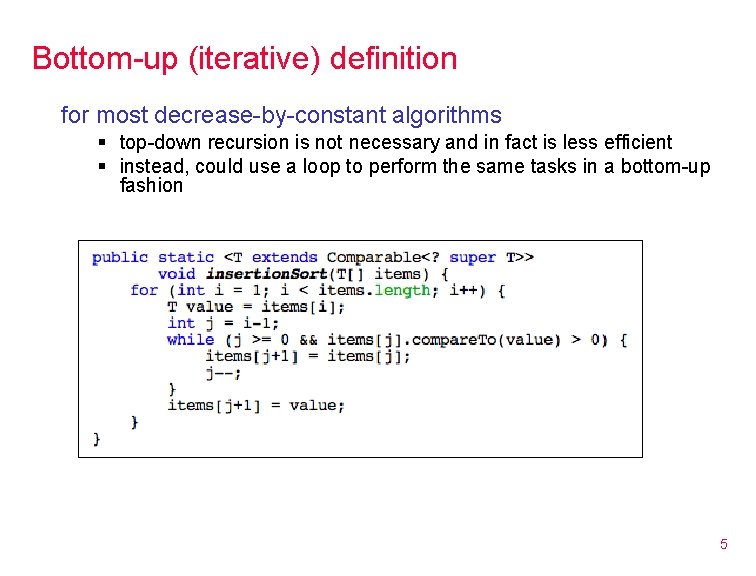
Top-down (recursive) definition can use recursion to implement this algorithm § this a top-down approach, because it starts with the entire list & recursively works down to the base case 4
Bottom-up (iterative) definition for most decrease-by-constant algorithms § top-down recursion is not necessary and in fact is less efficient § instead, could use a loop to perform the same tasks in a bottom-up fashion 5
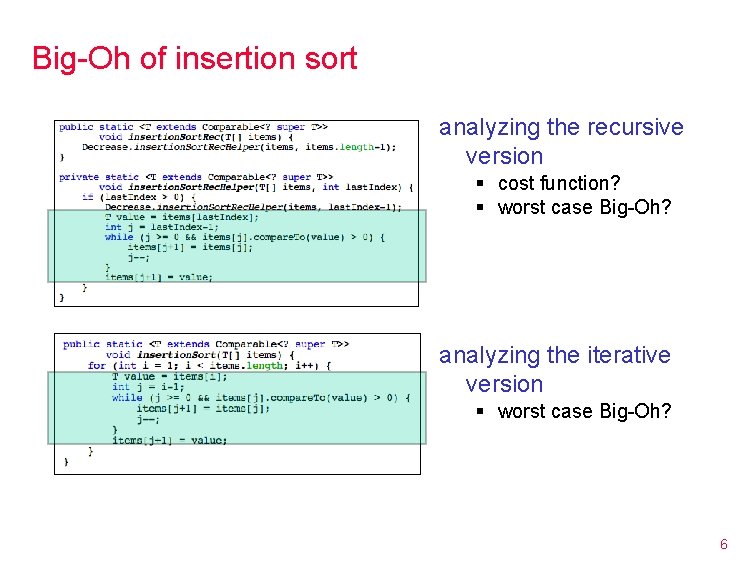
Big-Oh of insertion sort analyzing the recursive version § cost function? § worst case Big-Oh? analyzing the iterative version § worst case Big-Oh? 6
Analysis of insertion sort has advantages over other O(N 2) sorts § best case behavior of insertion sort? what is the best case scenario for a sort? does insertion sort take advantage of this scenario? does selection sort? § what if a list is partially ordered? (a fairly common occurrence) does insertion sort take advantage? 7
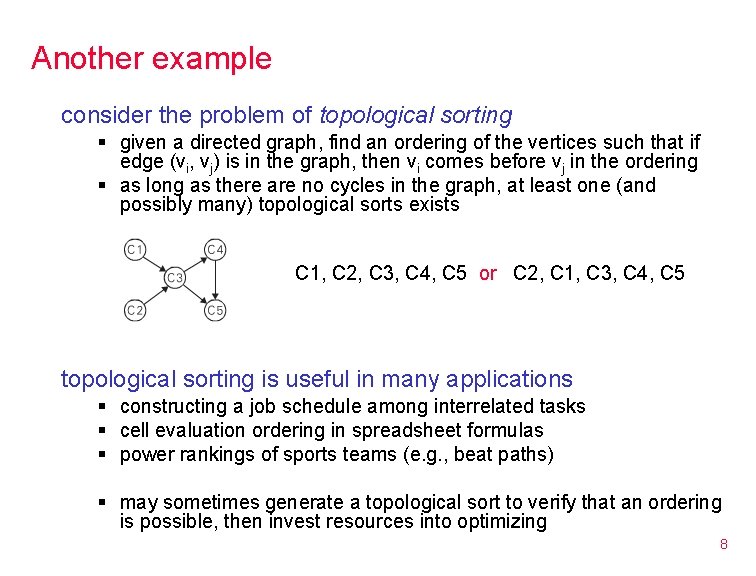
Another example consider the problem of topological sorting § given a directed graph, find an ordering of the vertices such that if edge (vi, vj) is in the graph, then vi comes before vj in the ordering § as long as there are no cycles in the graph, at least one (and possibly many) topological sorts exists C 1, C 2, C 3, C 4, C 5 or C 2, C 1, C 3, C 4, C 5 topological sorting is useful in many applications § constructing a job schedule among interrelated tasks § cell evaluation ordering in spreadsheet formulas § power rankings of sports teams (e. g. , beat paths) § may sometimes generate a topological sort to verify that an ordering is possible, then invest resources into optimizing 8
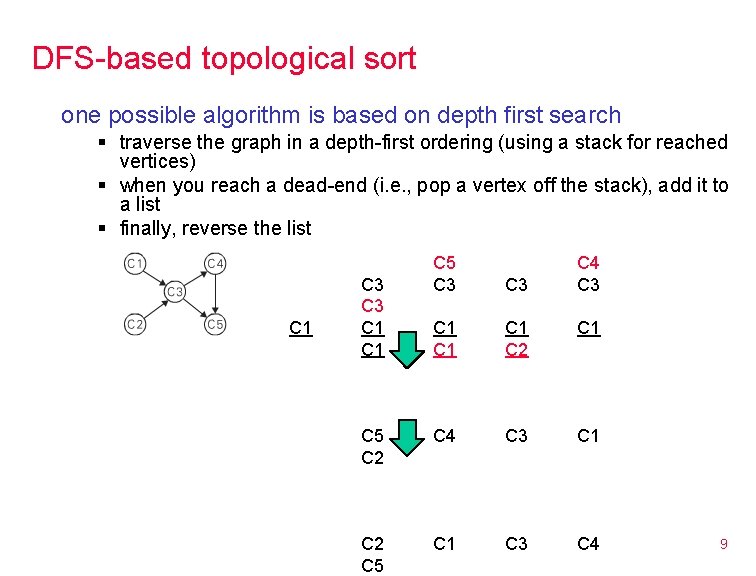
DFS-based topological sort one possible algorithm is based on depth first search § traverse the graph in a depth-first ordering (using a stack for reached vertices) § when you reach a dead-end (i. e. , pop a vertex off the stack), add it to a list § finally, reverse the list C 1 C 5 C 3 C 1 C 1 C 2 C 1 C 5 C 2 C 4 C 3 C 1 C 2 C 5 C 1 C 3 C 4 C 3 C 1 C 4 C 3 9
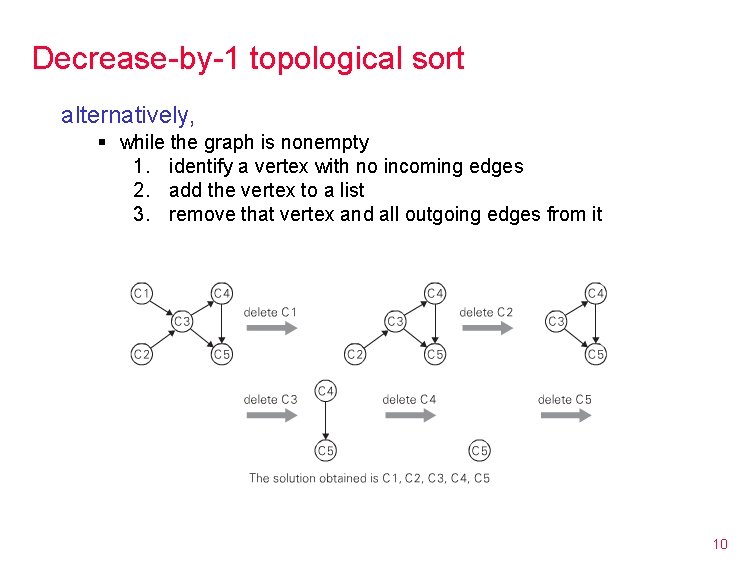
Decrease-by-1 topological sort alternatively, § while the graph is nonempty 1. identify a vertex with no incoming edges 2. add the vertex to a list 3. remove that vertex and all outgoing edges from it 10
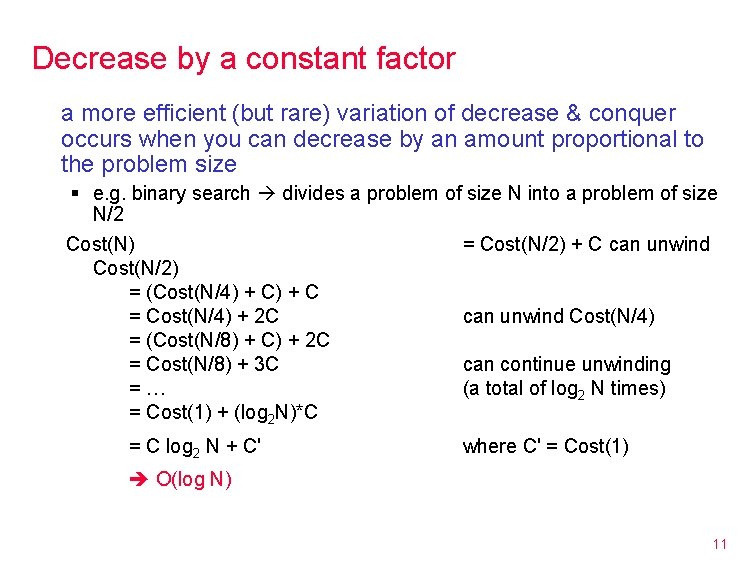
Decrease by a constant factor a more efficient (but rare) variation of decrease & conquer occurs when you can decrease by an amount proportional to the problem size § e. g. binary search divides a problem of size N into a problem of size N/2 Cost(N) = Cost(N/2) + C can unwind Cost(N/2) = (Cost(N/4) + C = Cost(N/4) + 2 C can unwind Cost(N/4) = (Cost(N/8) + C) + 2 C = Cost(N/8) + 3 C can continue unwinding =… (a total of log 2 N times) = Cost(1) + (log 2 N)*C = C log 2 N + C' where C' = Cost(1) O(log N) 11
Fake coin problem Given a scale and N coins, one of which is lighter than all the others. Identify the light coin using the minimal number of weighings. § solution? § cost function? § big-Oh? 12
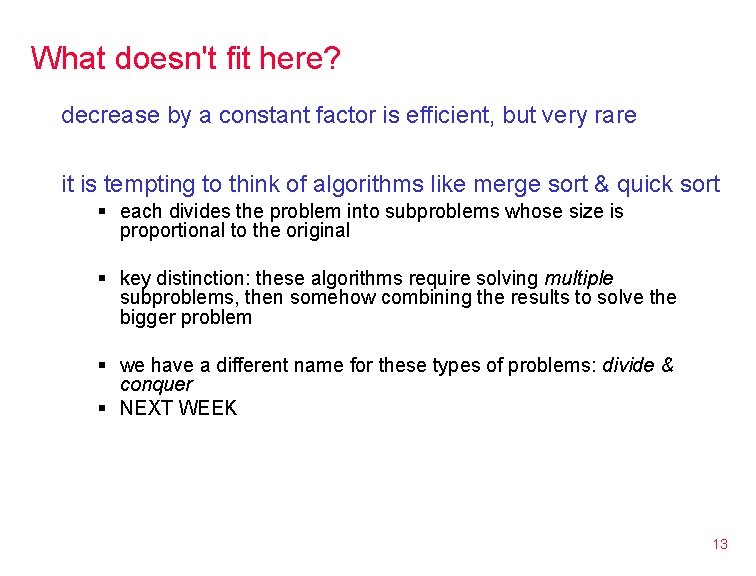
What doesn't fit here? decrease by a constant factor is efficient, but very rare it is tempting to think of algorithms like merge sort & quick sort § each divides the problem into subproblems whose size is proportional to the original § key distinction: these algorithms require solving multiple subproblems, then somehow combining the results to solve the bigger problem § we have a different name for these types of problems: divide & conquer § NEXT WEEK 13
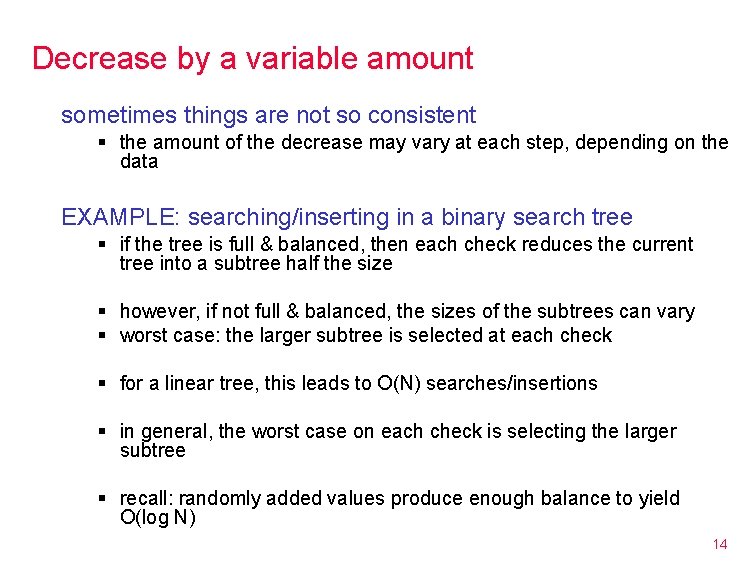
Decrease by a variable amount sometimes things are not so consistent § the amount of the decrease may vary at each step, depending on the data EXAMPLE: searching/inserting in a binary search tree § if the tree is full & balanced, then each check reduces the current tree into a subtree half the size § however, if not full & balanced, the sizes of the subtrees can vary § worst case: the larger subtree is selected at each check § for a linear tree, this leads to O(N) searches/insertions § in general, the worst case on each check is selecting the larger subtree § recall: randomly added values produce enough balance to yield O(log N) 14
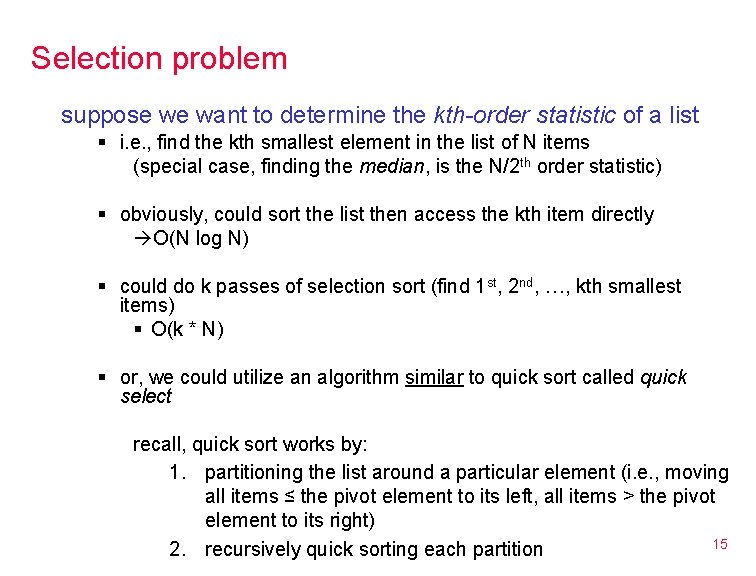
Selection problem suppose we want to determine the kth-order statistic of a list § i. e. , find the kth smallest element in the list of N items (special case, finding the median, is the N/2 th order statistic) § obviously, could sort the list then access the kth item directly O(N log N) § could do k passes of selection sort (find 1 st, 2 nd, …, kth smallest items) § O(k * N) § or, we could utilize an algorithm similar to quick sort called quick select recall, quick sort works by: 1. partitioning the list around a particular element (i. e. , moving all items ≤ the pivot element to its left, all items > the pivot element to its right) 15 2. recursively quick sorting each partition
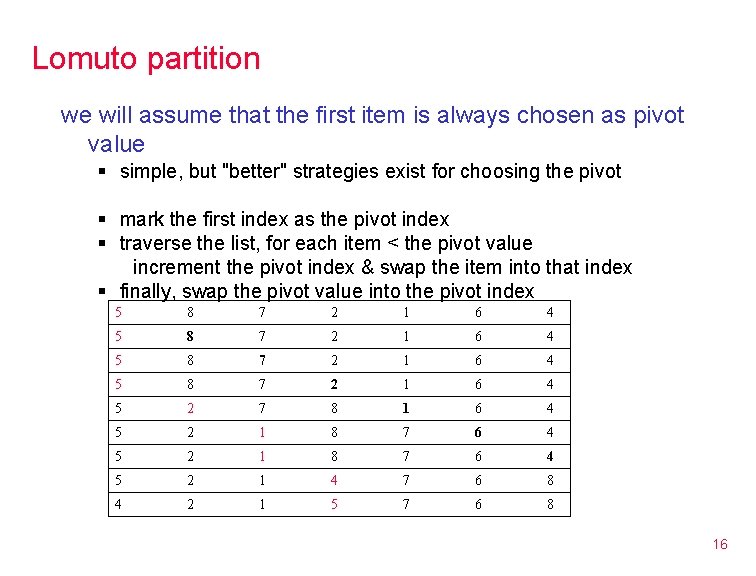
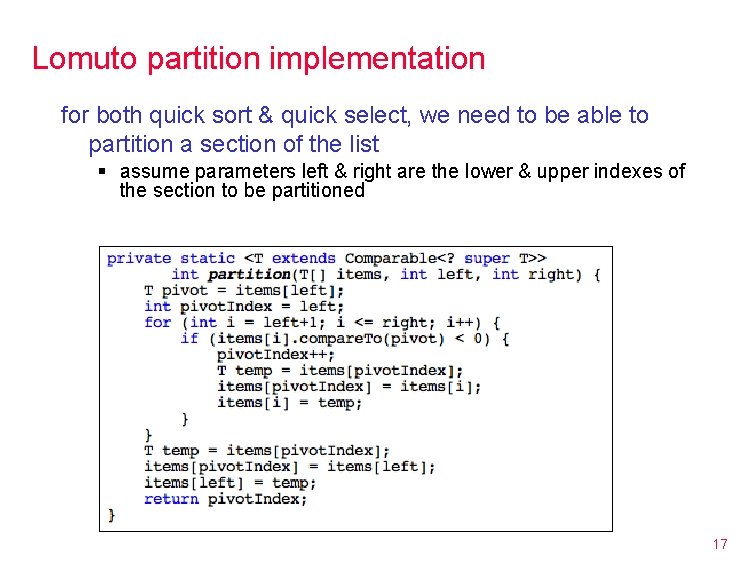
Lomuto partition we will assume that the first item is always chosen as pivot value § simple, but "better" strategies exist for choosing the pivot § mark the first index as the pivot index § traverse the list, for each item < the pivot value increment the pivot index & swap the item into that index § finally, swap the pivot value into the pivot index 5 8 7 2 1 6 4 5 2 7 8 1 6 4 5 2 1 8 7 6 4 5 2 1 4 7 6 8 4 2 1 5 7 6 8 16
Lomuto partition implementation for both quick sort & quick select, we need to be able to partition a section of the list § assume parameters left & right are the lower & upper indexes of the section to be partitioned 17
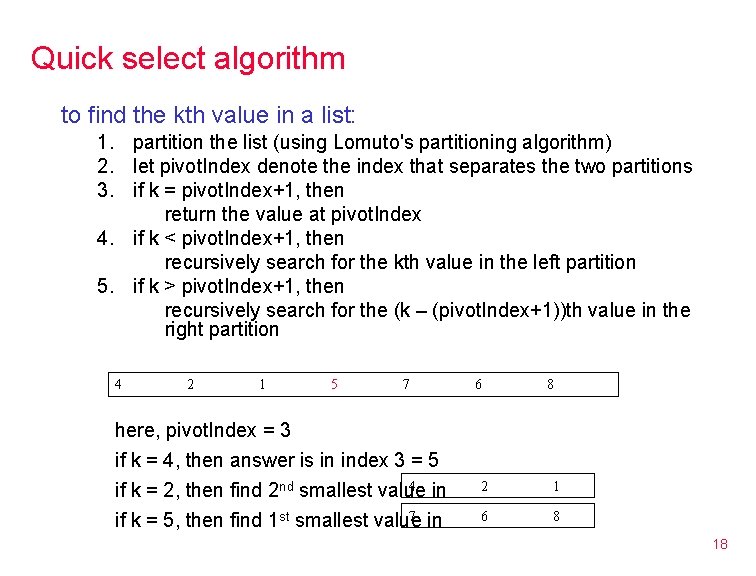
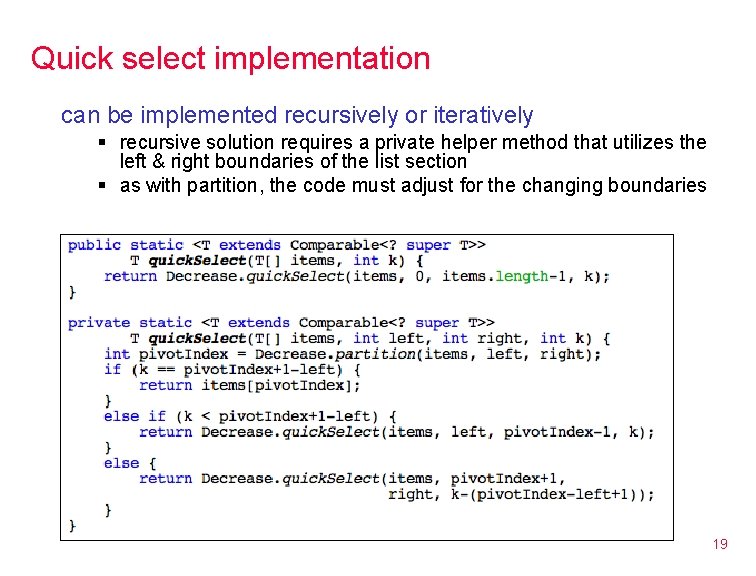
Quick select algorithm to find the kth value in a list: 1. partition the list (using Lomuto's partitioning algorithm) 2. let pivot. Index denote the index that separates the two partitions 3. if k = pivot. Index+1, then return the value at pivot. Index 4. if k < pivot. Index+1, then recursively search for the kth value in the left partition 5. if k > pivot. Index+1, then recursively search for the (k – (pivot. Index+1))th value in the right partition 4 2 1 5 7 6 8 here, pivot. Index = 3 if k = 4, then answer is in index 3 = 5 4 in if k = 2, then find 2 nd smallest value 7 in if k = 5, then find 1 st smallest value 2 1 6 8 18
Quick select implementation can be implemented recursively or iteratively § recursive solution requires a private helper method that utilizes the left & right boundaries of the list section § as with partition, the code must adjust for the changing boundaries 19
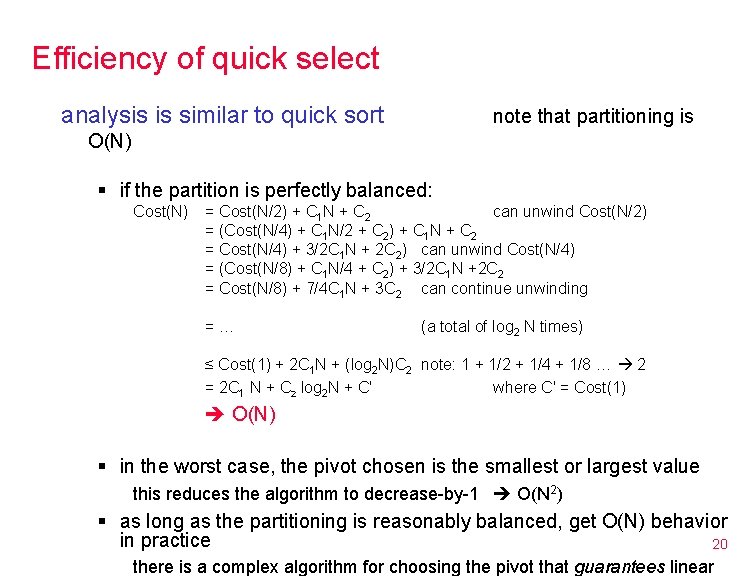
Efficiency of quick select analysis is similar to quick sort note that partitioning is O(N) § if the partition is perfectly balanced: Cost(N) = Cost(N/2) + C 1 N + C 2 can unwind Cost(N/2) = (Cost(N/4) + C 1 N/2 + C 2) + C 1 N + C 2 = Cost(N/4) + 3/2 C 1 N + 2 C 2) can unwind Cost(N/4) = (Cost(N/8) + C 1 N/4 + C 2) + 3/2 C 1 N +2 C 2 = Cost(N/8) + 7/4 C 1 N + 3 C 2 can continue unwinding =… (a total of log 2 N times) ≤ Cost(1) + 2 C 1 N + (log 2 N)C 2 note: 1 + 1/2 + 1/4 + 1/8 … 2 = 2 C 1 N + C 2 log 2 N + C' where C' = Cost(1) O(N) § in the worst case, the pivot chosen is the smallest or largest value this reduces the algorithm to decrease-by-1 O(N 2) § as long as the partitioning is reasonably balanced, get O(N) behavior in practice 20 there is a complex algorithm for choosing the pivot that guarantees linear