
CSC 4180 Compiler Construction Prof YehChing Chung School

- Slides: 78
CSC 4180 – Compiler Construction Prof. Yeh-Ching Chung School of Data Science Chinese University of Hong Kong, Shenzhen 香港中文大学(深圳)数据科学院 CUHK-SZ School of Data Science National Tsing Hua University ® copyright OIA 1
Outline l l l l 6. 0 Introduction 6. 1 Shift-Reduce Parsers 6. 2 LR Parsers 6. 3 LR(1) Parsing 6. 4 SLR(1)Parsing 6. 5 LALR(1) 6. 6 Calling Semantic Routines in Shift-Reduce Parsers 6. 7 Using a Parser Generator (TA course) 6. 8 Optimizing Parse Tables 6. 9 Practical LR(1) Parsers 6. 10 Properties of LR Parsing 6. 11 LL(1) or LAl. R(1) , That is the question 6. 12 Other Shift-Reduce Technique 2香港中文大学(深圳)数据科学院 2 CUHK-SZ School of Data Science National Tsing Hua University ® copyright OIA 2
SLR(1) Parsing (1) l LR(1) parsers – are the most powerful case of shift-reduce parsers, using a single look-ahead • LR(1) grammars exist for virtually all programming languages • LR(1)’s problem is that the LR(1) machine contains so many states that the go_to and action tables become prohibitively large l In reaction to the space inefficiency of LR(1) tables – computer scientists have devised parsing techniques that are almost as powerful as LR(1) but that require far smaller tables • One is to start with the CFSM, and then add look-ahead after the CFSM is build – SLR(1) • The other approach to reducing LR(1)’s space inefficiencies is to merger inessential LR(1) states – LALR(1) 香港中文大学(深圳)数据科学院 CUHK-SZ School of Data Science National Tsing Hua University ® copyright OIA 3
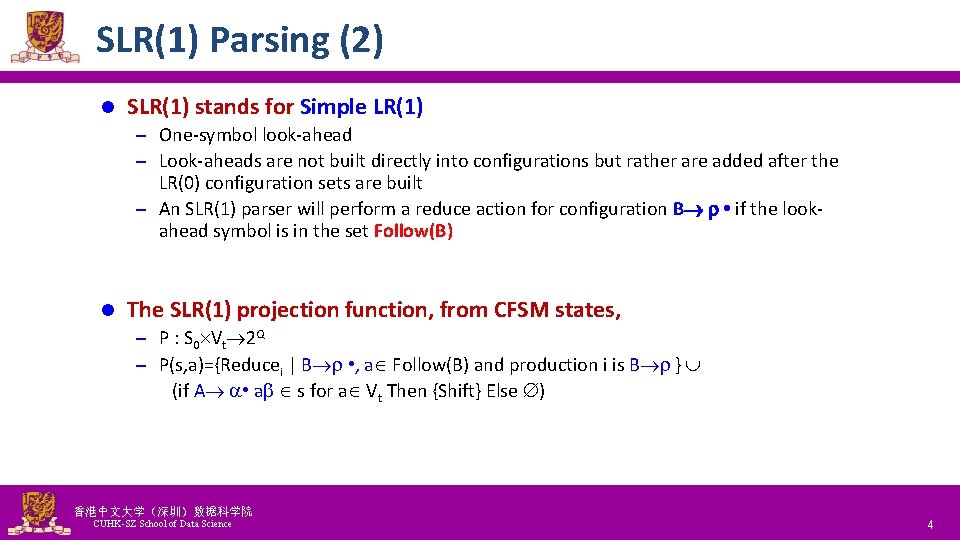
SLR(1) Parsing (2) l SLR(1) stands for Simple LR(1) – One-symbol look-ahead – Look-aheads are not built directly into configurations but rather are added after the LR(0) configuration sets are built – An SLR(1) parser will perform a reduce action for configuration B • if the lookahead symbol is in the set Follow(B) l The SLR(1) projection function, from CFSM states, – P : S 0 Vt 2 Q – P(s, a)={Reducei | B • , a Follow(B) and production i is B } (if A • a s for a Vt Then {Shift} Else ) 香港中文大学(深圳)数据科学院 CUHK-SZ School of Data Science National Tsing Hua University ® copyright OIA 4
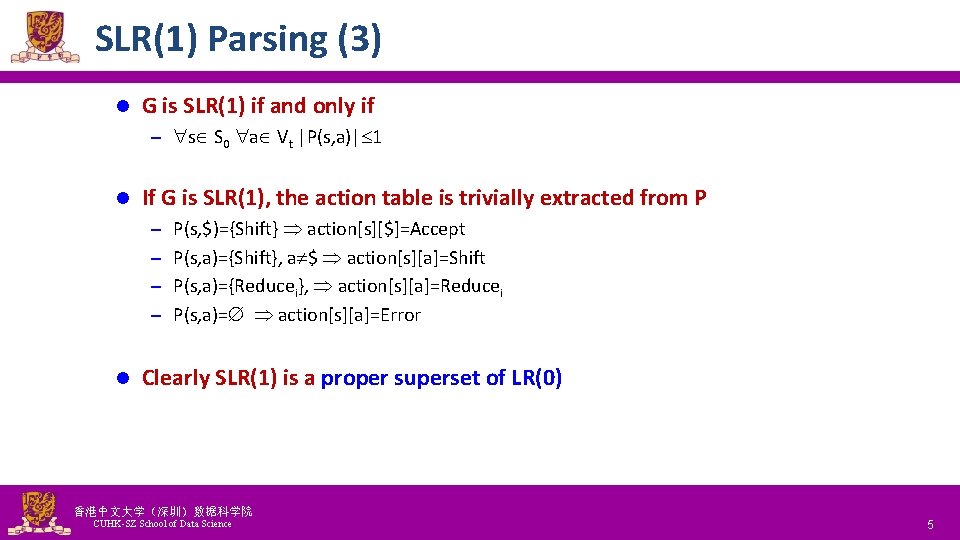
SLR(1) Parsing (3) l G is SLR(1) if and only if – s S 0 a Vt |P(s, a)| 1 l If G is SLR(1), the action table is trivially extracted from P – P(s, $)={Shift} action[s][$]=Accept – P(s, a)={Shift}, a $ action[s][a]=Shift – P(s, a)={Reducei}, action[s][a]=Reducei – P(s, a)= action[s][a]=Error l Clearly SLR(1) is a proper superset of LR(0) 香港中文大学(深圳)数据科学院 CUHK-SZ School of Data Science National Tsing Hua University ® copyright OIA 5
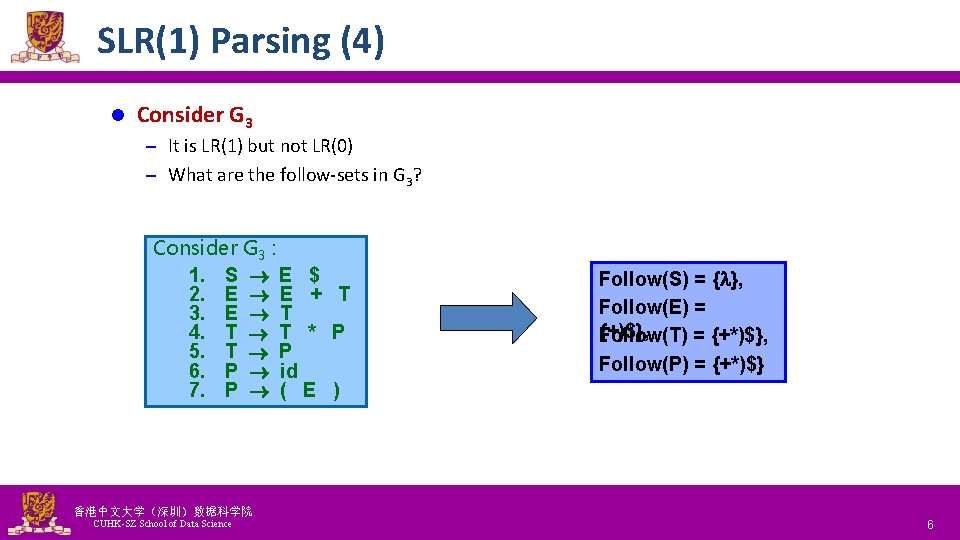
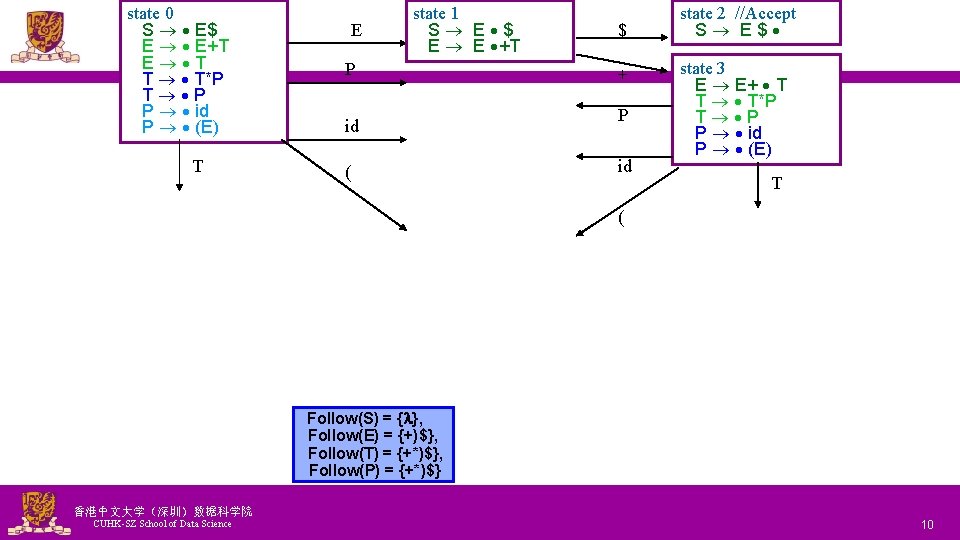
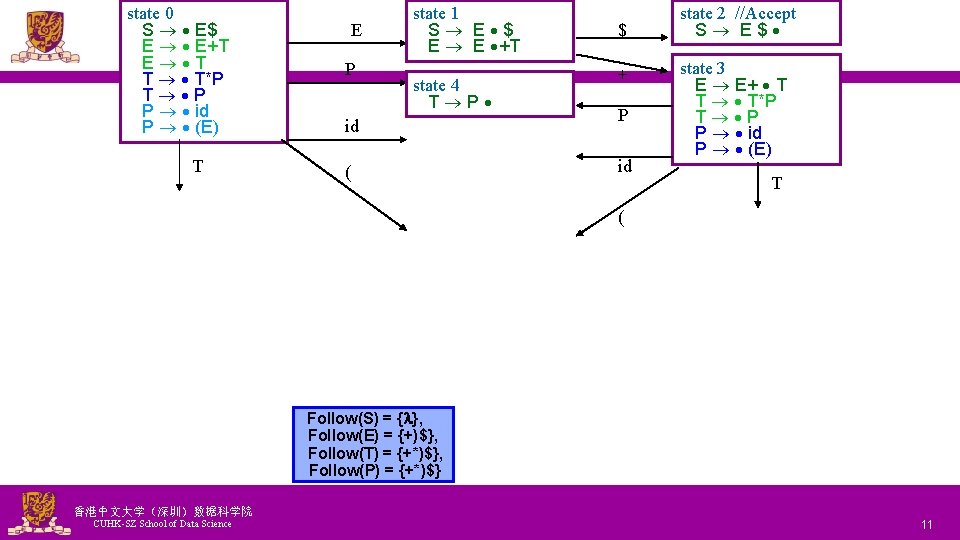
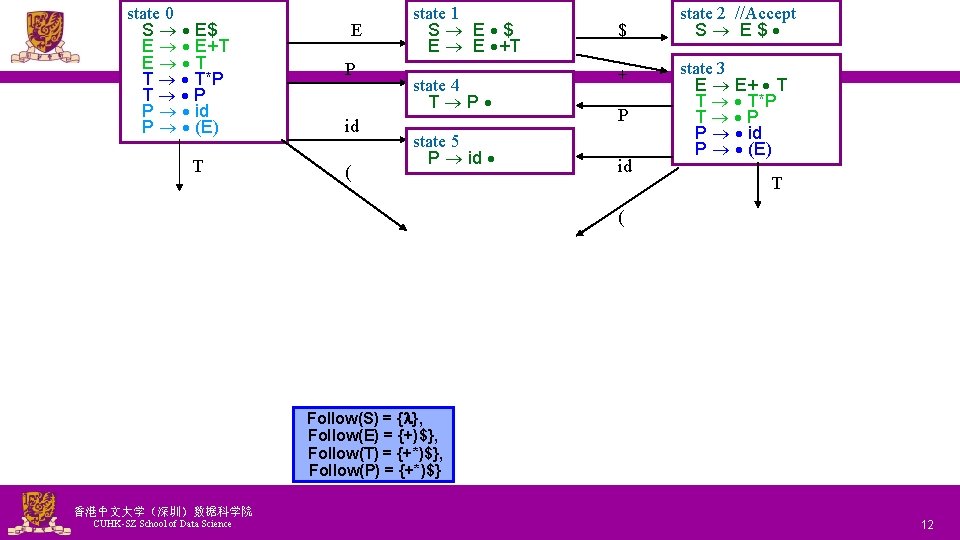
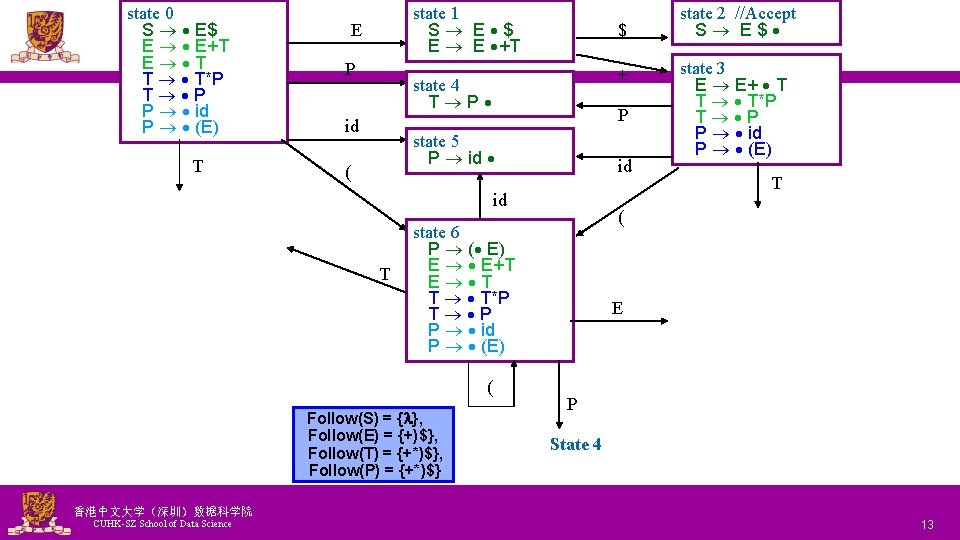
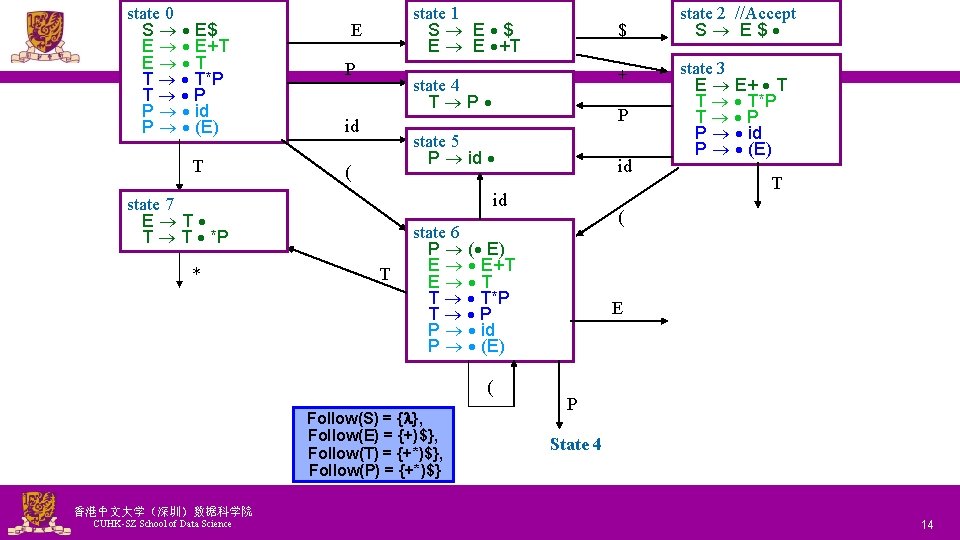
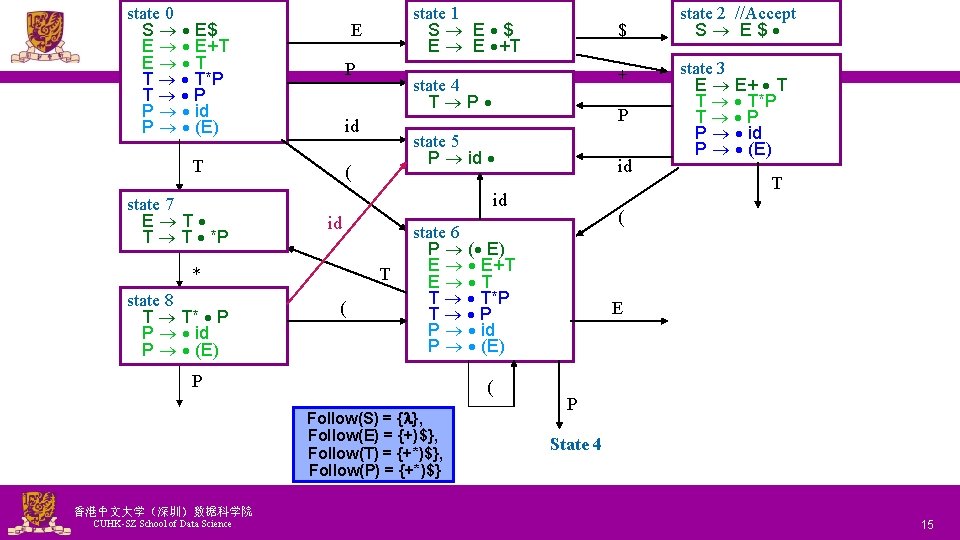
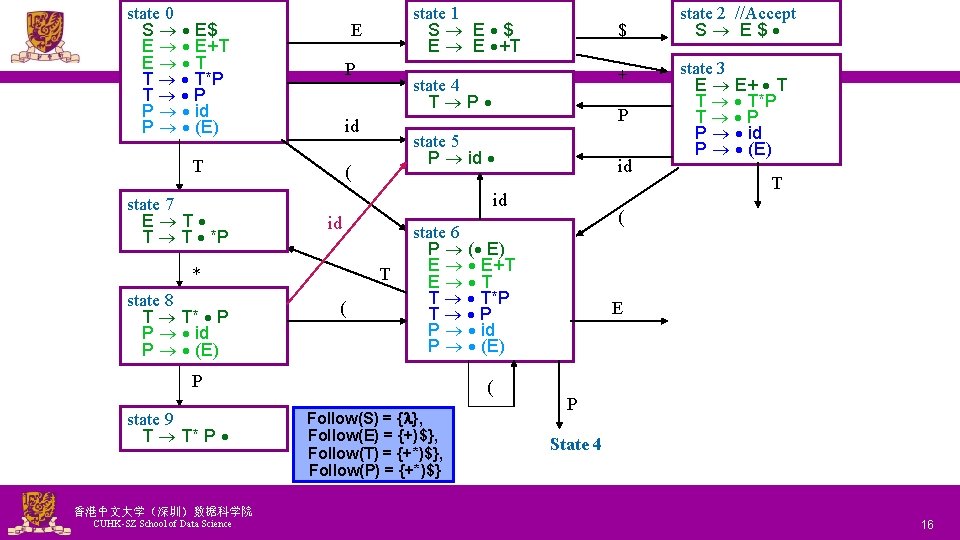
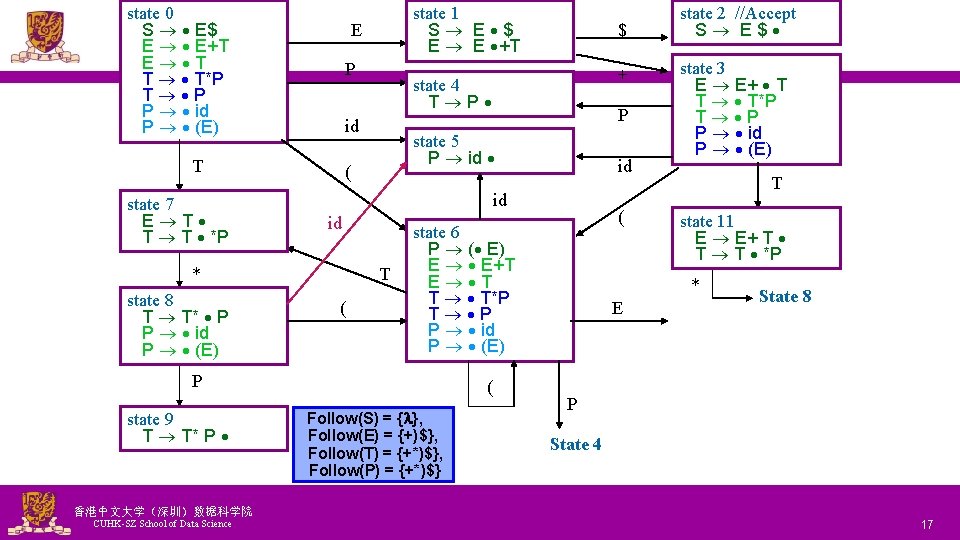
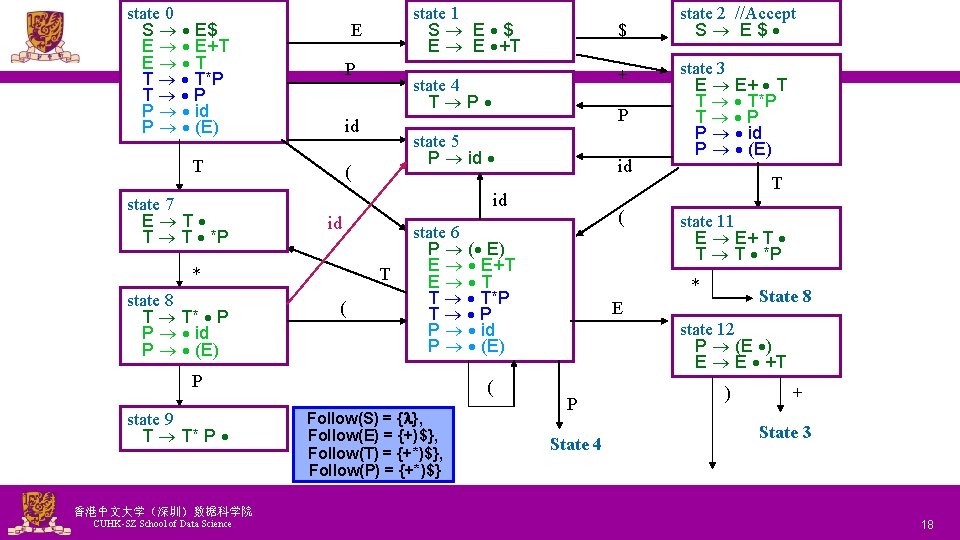
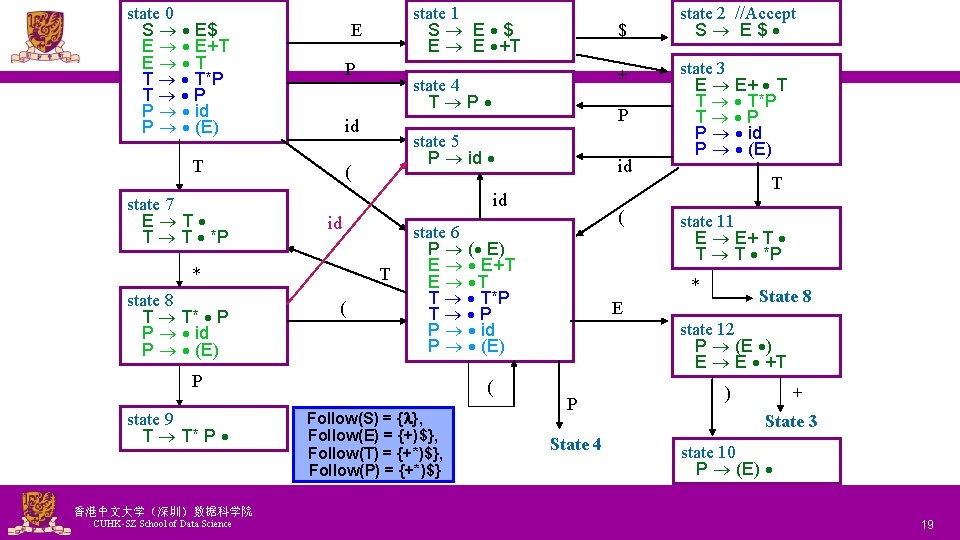
SLR(1) Parsing (4) l Consider G 3 – It is LR(1) but not LR(0) – What are the follow-sets in G 3? Consider G 3 : 1. S E $ 2. E E + T 3. E T 4. T T * P 5. T P 6. P id 7. P ( E ) 香港中文大学(深圳)数据科学院 CUHK-SZ School of Data Science National Tsing Hua University ® copyright OIA Follow(S) = {l}, Follow(E) = {+)$}, Follow(T) = {+*)$}, Follow(P) = {+*)$} 6
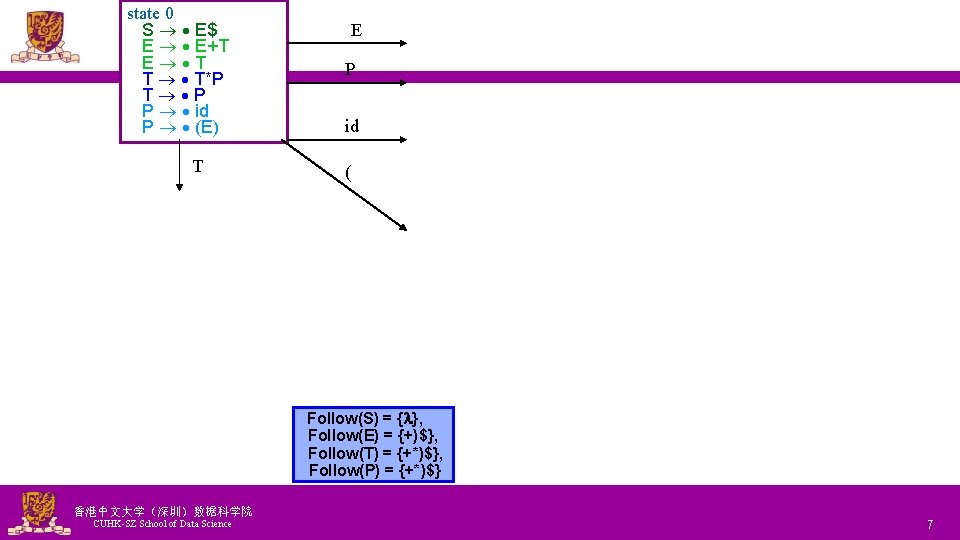
state 0 S E$ E E+T E T T T*P T P P id P (E) E P id T ( Follow(S) = {l}, Follow(E) = {+)$}, Follow(T) = {+*)$}, Follow(P) = {+*)$} 香港中文大学(深圳)数据科学院 CUHK-SZ School of Data Science National Tsing Hua University ® copyright OIA 7
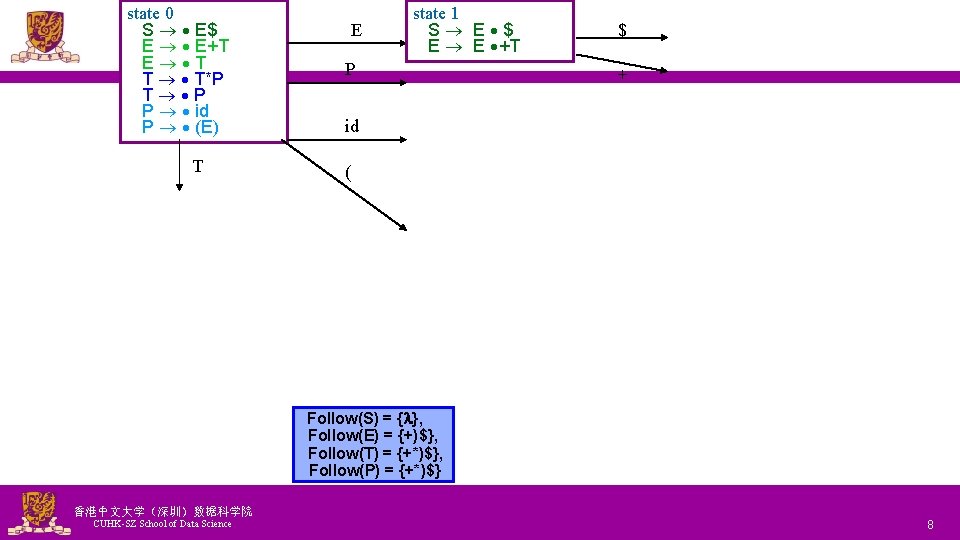
state 0 S E$ E E+T E T T T*P T P P id P (E) E state 1 S E $ E E +T P $ + id T ( Follow(S) = {l}, Follow(E) = {+)$}, Follow(T) = {+*)$}, Follow(P) = {+*)$} 香港中文大学(深圳)数据科学院 CUHK-SZ School of Data Science National Tsing Hua University ® copyright OIA 8
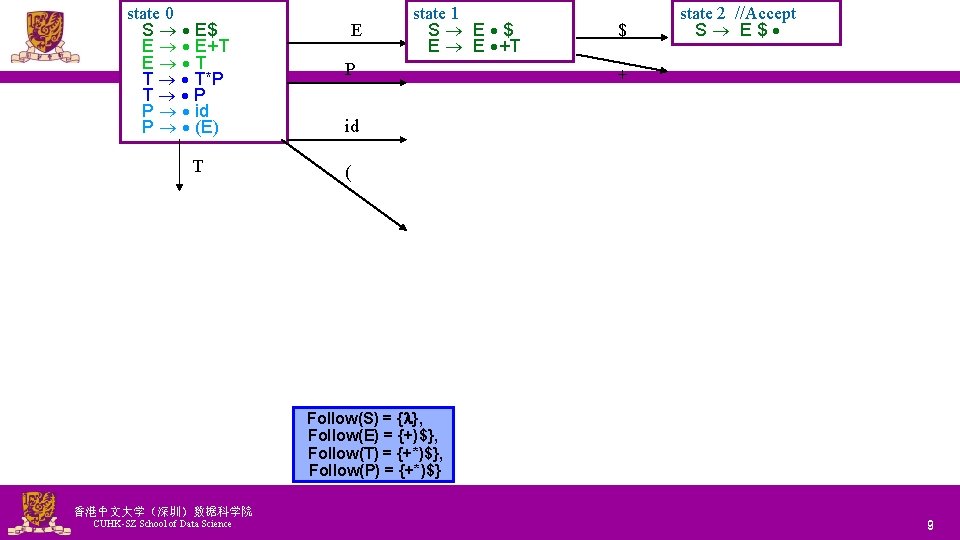
state 0 S E$ E E+T E T T T*P T P P id P (E) E state 1 S E $ E E +T P $ state 2 //Accept S E$ + id T ( Follow(S) = {l}, Follow(E) = {+)$}, Follow(T) = {+*)$}, Follow(P) = {+*)$} 香港中文大学(深圳)数据科学院 CUHK-SZ School of Data Science National Tsing Hua University ® copyright OIA 9
state 0 S E$ E E+T E T T T*P T P P id P (E) E state 1 S E $ E E +T P id T ( $ + P id state 2 //Accept S E$ state 3 E E+ T T T*P T P P id P (E) T ( Follow(S) = {l}, Follow(E) = {+)$}, Follow(T) = {+*)$}, Follow(P) = {+*)$} 香港中文大学(深圳)数据科学院 CUHK-SZ School of Data Science National Tsing Hua University ® copyright OIA 10
state 0 S E$ E E+T E T T T*P T P P id P (E) E P state 1 S E $ E E +T state 4 T P id T ( $ + P id state 2 //Accept S E$ state 3 E E+ T T T*P T P P id P (E) T ( Follow(S) = {l}, Follow(E) = {+)$}, Follow(T) = {+*)$}, Follow(P) = {+*)$} 香港中文大学(深圳)数据科学院 CUHK-SZ School of Data Science National Tsing Hua University ® copyright OIA 11
state 0 S E$ E E+T E T T T*P T P P id P (E) E P id T ( state 1 S E $ E E +T state 4 T P state 5 P id $ + P id state 2 //Accept S E$ state 3 E E+ T T T*P T P P id P (E) T ( Follow(S) = {l}, Follow(E) = {+)$}, Follow(T) = {+*)$}, Follow(P) = {+*)$} 香港中文大学(深圳)数据科学院 CUHK-SZ School of Data Science National Tsing Hua University ® copyright OIA 12
state 0 S E$ E E+T E T T T*P T P P id P (E) state 1 S E $ E E +T E P + state 4 T P id T $ P state 5 P id ( id id T Follow(S) = {l}, Follow(E) = {+)$}, Follow(T) = {+*)$}, Follow(P) = {+*)$} 香港中文大学(深圳)数据科学院 CUHK-SZ School of Data Science National Tsing Hua University ® copyright OIA state 3 E E+ T T T*P T P P id P (E) T ( state 6 P ( E) E E+T E T T T*P T P P id P (E) ( state 2 //Accept S E$ E P State 4 13
state 0 S E$ E E+T E T T T*P T P P id P (E) state 1 S E $ E E +T E P + state 4 T P id T $ P state 5 P id ( id id state 7 E T T T *P * T Follow(S) = {l}, Follow(E) = {+)$}, Follow(T) = {+*)$}, Follow(P) = {+*)$} 香港中文大学(深圳)数据科学院 CUHK-SZ School of Data Science National Tsing Hua University ® copyright OIA state 3 E E+ T T T*P T P P id P (E) T ( state 6 P ( E) E E+T E T T T*P T P P id P (E) ( state 2 //Accept S E$ E P State 4 14
state 0 S E$ E E+T E T T T*P T P P id P (E) E P $ + state 4 T P id T state 7 E T T T *P state 1 S E $ E E +T P state 5 P id ( id id id * T state 8 T T* P P id P (E) ( ( Follow(S) = {l}, Follow(E) = {+)$}, Follow(T) = {+*)$}, Follow(P) = {+*)$} 香港中文大学(深圳)数据科学院 CUHK-SZ School of Data Science National Tsing Hua University ® copyright OIA state 3 E E+ T T T*P T P P id P (E) T ( state 6 P ( E) E E+T E T T T*P T P P id P (E) P state 2 //Accept S E$ E P State 4 15
state 0 S E$ E E+T E T T T*P T P P id P (E) E P + P state 5 P id ( id id id * T state 8 T T* P P id P (E) ( ( Follow(S) = {l}, Follow(E) = {+)$}, Follow(T) = {+*)$}, Follow(P) = {+*)$} 香港中文大学(深圳)数据科学院 CUHK-SZ School of Data Science National Tsing Hua University ® copyright OIA state 2 //Accept S E$ state 3 E E+ T T T*P T P P id P (E) T ( state 6 P ( E) E E+T E T T T*P T P P id P (E) P state 9 T T* P $ state 4 T P id T state 7 E T T T *P state 1 S E $ E E +T E P State 4 16
state 0 S E$ E E+T E T T T*P T P P id P (E) E P + P state 5 P id ( id id id * T state 8 T T* P P id P (E) ( ( Follow(S) = {l}, Follow(E) = {+)$}, Follow(T) = {+*)$}, Follow(P) = {+*)$} 香港中文大学(深圳)数据科学院 CUHK-SZ School of Data Science National Tsing Hua University ® copyright OIA ( state 6 P ( E) E E+T E T T T*P T P P id P (E) P state 9 T T* P $ state 4 T P id T state 7 E T T T *P state 1 S E $ E E +T state 2 //Accept S E$ state 3 E E+ T T T*P T P P id P (E) T state 11 E E+ T T T *P * E State 8 P State 4 17
state 0 S E$ E E+T E T T T*P T P P id P (E) E P + P state 5 P id ( id id id * T state 8 T T* P P id P (E) ( ( Follow(S) = {l}, Follow(E) = {+)$}, Follow(T) = {+*)$}, Follow(P) = {+*)$} 香港中文大学(深圳)数据科学院 CUHK-SZ School of Data Science National Tsing Hua University ® copyright OIA ( state 6 P ( E) E E+T E T T T*P T P P id P (E) P state 9 T T* P $ state 4 T P id T state 7 E T T T *P state 1 S E $ E E +T state 2 //Accept S E$ state 3 E E+ T T T*P T P P id P (E) T state 11 E E+ T T T *P * State 8 E state 12 P (E ) E E +T P State 4 ) + State 3 18
state 0 S E$ E E+T E T T T*P T P P id P (E) E P + P state 5 P id ( id id id * T state 8 T T* P P id P (E) ( ( Follow(S) = {l}, Follow(E) = {+)$}, Follow(T) = {+*)$}, Follow(P) = {+*)$} 香港中文大学(深圳)数据科学院 CUHK-SZ School of Data Science National Tsing Hua University ® copyright OIA ( state 6 P ( E) E E+T E T T T*P T P P id P (E) P state 9 T T* P $ state 4 T P id T state 7 E T T T *P state 1 S E $ E E +T state 2 //Accept S E$ state 3 E E+ T T T*P T P P id P (E) T state 11 E E+ T T T *P * State 8 E state 12 P (E ) E E +T P State 4 ) + State 3 state 10 P (E) 19
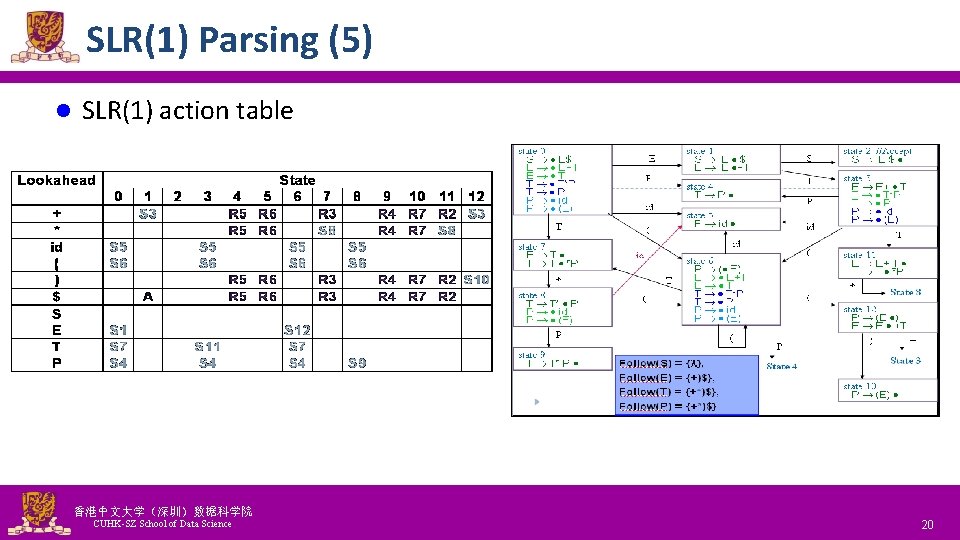
SLR(1) Parsing (5) l SLR(1) action table 香港中文大学(深圳)数据科学院 CUHK-SZ School of Data Science National Tsing Hua University ® copyright OIA 20
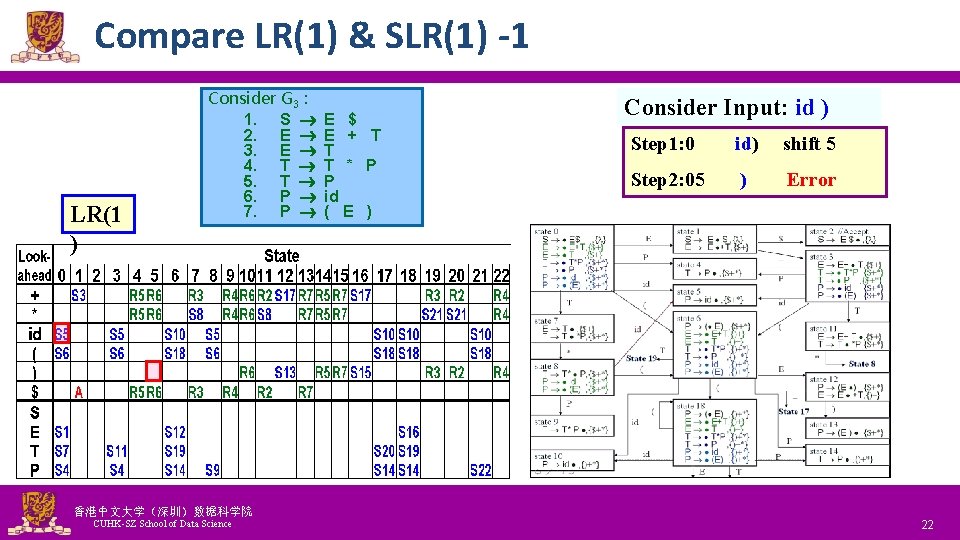
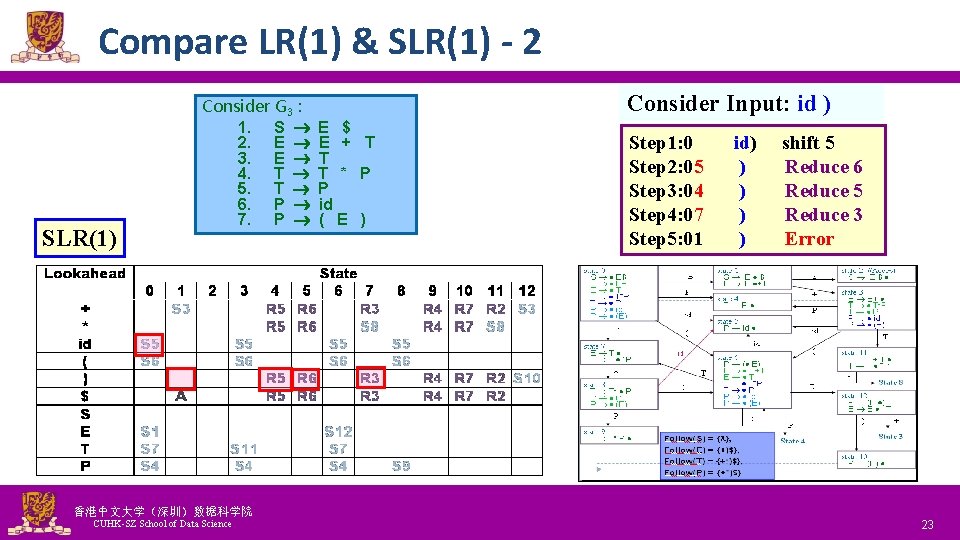
SLR(1) Parsing (6) l Limitations of the SLR(1) Technique – The use of follow sets to estimate the look-aheads that predict reduce actions is less precise than using the exact look-aheads incorporated into LR(1) configurations – Example in next page 香港中文大学(深圳)数据科学院 CUHK-SZ School of Data Science National Tsing Hua University ® copyright OIA 21
Compare LR(1) & SLR(1) -1 LR(1 ) Consider G 3 : 1. S E $ 2. E E + T 3. E T 4. T T * P 5. T P 6. P id 7. P ( E ) 香港中文大学(深圳)数据科学院 CUHK-SZ School of Data Science National Tsing Hua University ® copyright OIA Consider Input: id ) Step 1: 0 id) shift 5 Step 2: 05 ) Error 22
Compare LR(1) & SLR(1) - 2 SLR(1) Consider G 3 : 1. S E $ 2. E E + T 3. E T 4. T T * P 5. T P 6. P id 7. P ( E ) 香港中文大学(深圳)数据科学院 CUHK-SZ School of Data Science National Tsing Hua University ® copyright OIA Consider Input: id ) Step 1: 0 Step 2: 05 Step 3: 04 Step 4: 07 Step 5: 01 id) ) ) shift 5 Reduce 6 Reduce 5 Reduce 3 Error 23
Outline l l l l 6. 0 Introduction 6. 1 Shift-Reduce Parsers 6. 2 LR Parsers 6. 3 LR(1) Parsing 6. 4 SLR(1)Parsing 6. 5 LALR(1) 6. 6 Calling Semantic Routines in Shift-Reduce Parsers 6. 7 Using a Parser Generator (TA course) 6. 8 Optimizing Parse Tables 6. 9 Practical LR(1) Parsers 6. 10 Properties of LR Parsing 6. 11 LL(1) or LAl. R(1) , That is the question 6. 12 Other Shift-Reduce Technique 香港中文大学(深圳)数据科学院 CUHK-SZ School of Data Science National Tsing Hua University ® copyright OIA 24
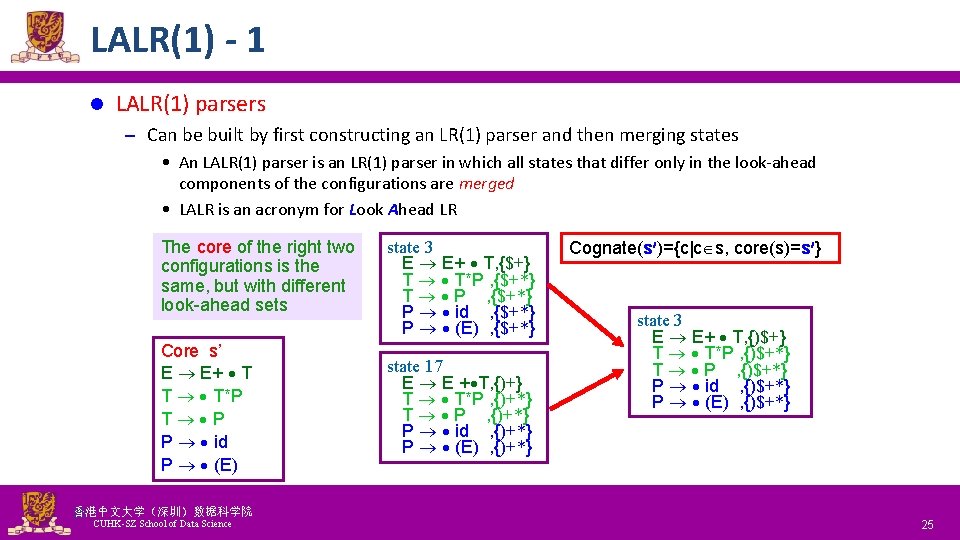
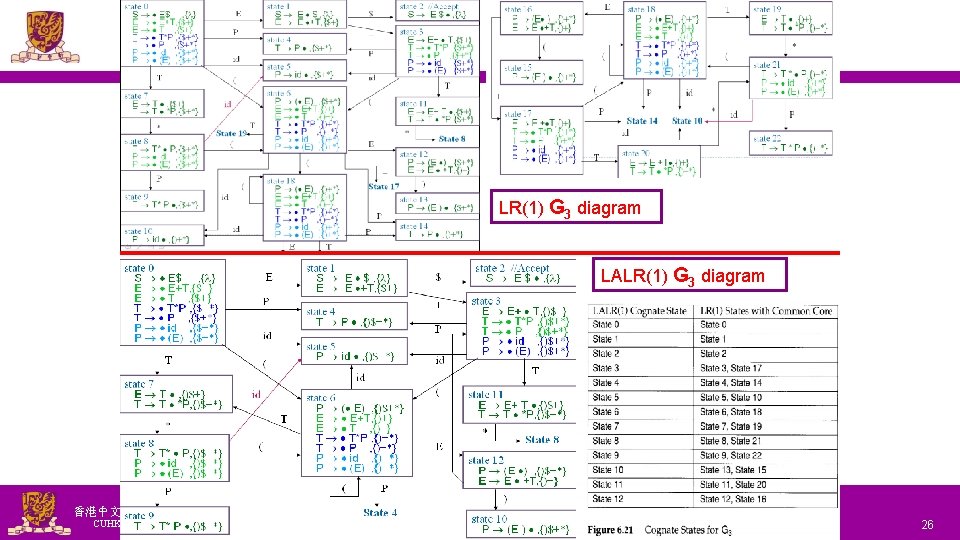
LALR(1) - 1 l LALR(1) parsers – Can be built by first constructing an LR(1) parser and then merging states • An LALR(1) parser is an LR(1) parser in which all states that differ only in the look-ahead components of the configurations are merged • LALR is an acronym for Look Ahead LR The core of the right two configurations is the same, but with different look-ahead sets Core s’ E E+ T T T*P T P P id P (E) 香港中文大学(深圳)数据科学院 25 CUHK-SZ School of Data Science National Tsing Hua University ® copyright OIA state 3 E E+ T, {$+} T T*P , {$+*} T P , {$+*} P id , {$+*} P (E) , {$+*} state 17 E E + T, {)+} T T*P , {)+*} T P , {)+*} P id , {)+*} P (E) , {)+*} Cognate(s )={c|c s, core(s)=s } state 3 E E+ T, {)$+} T T*P , {)$+*} T P , {)$+*} P id , {)$+*} P (E) , {)$+*} 25
LR(1) G 3 diagram LALR(1) G 3 diagram 香港中文大学(深圳)数据科学院 CUHK-SZ School of Data Science National Tsing Hua University ® copyright OIA 26
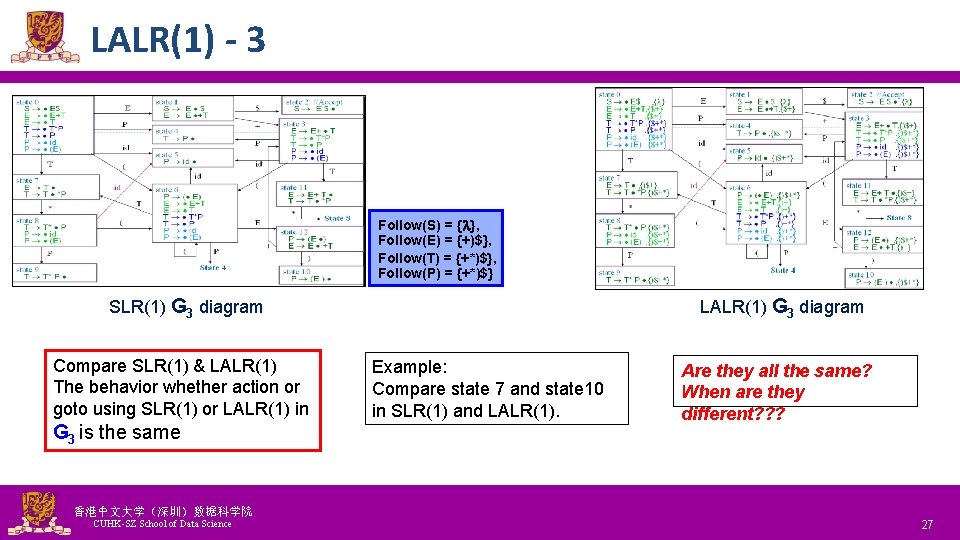
LALR(1) - 3 Follow(S) = {l}, Follow(E) = {+)$}, Follow(T) = {+*)$}, Follow(P) = {+*)$} SLR(1) G 3 diagram Compare SLR(1) & LALR(1) The behavior whether action or goto using SLR(1) or LALR(1) in G 3 is the same 香港中文大学(深圳)数据科学院 CUHK-SZ School of Data Science National Tsing Hua University ® copyright OIA LALR(1) G 3 diagram Example: Compare state 7 and state 10 in SLR(1) and LALR(1). Are they all the same? When are they different? ? ? 27
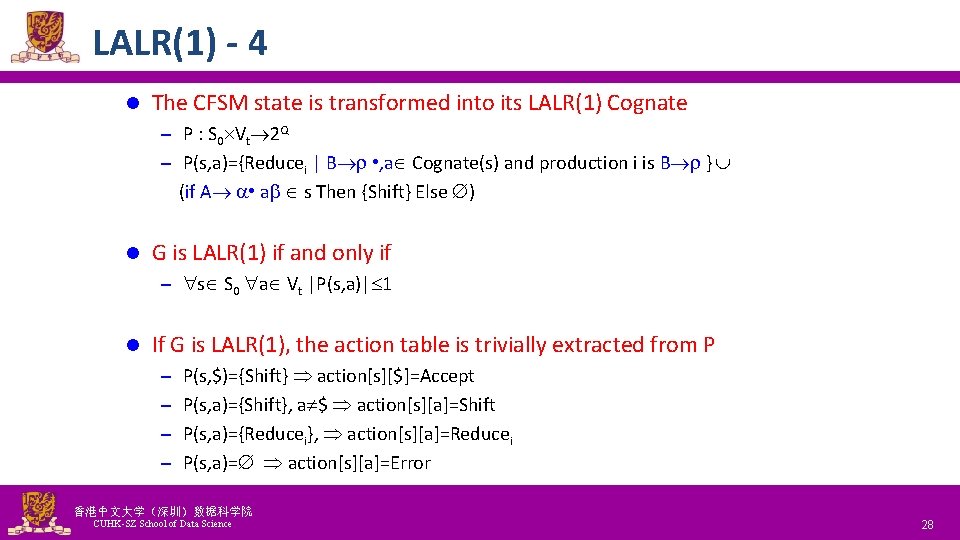
LALR(1) - 4 l The CFSM state is transformed into its LALR(1) Cognate – P : S 0 Vt 2 Q – P(s, a)={Reducei | B • , a Cognate(s) and production i is B } (if A • a s Then {Shift} Else ) l G is LALR(1) if and only if – s S 0 a Vt |P(s, a)| 1 l If G is LALR(1), the action table is trivially extracted from P – P(s, $)={Shift} action[s][$]=Accept – P(s, a)={Shift}, a $ action[s][a]=Shift – P(s, a)={Reducei}, action[s][a]=Reducei – P(s, a)= action[s][a]=Error 香港中文大学(深圳)数据科学院 CUHK-SZ School of Data Science National Tsing Hua University ® copyright OIA 28
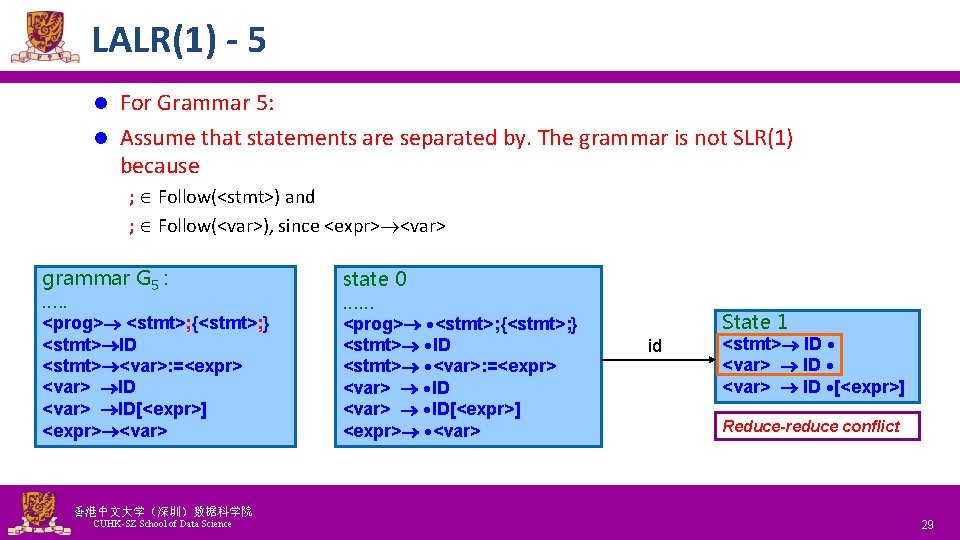
LALR(1) - 5 For Grammar 5: l Assume that statements are separated by. The grammar is not SLR(1) because l ; Follow(<stmt>) and ; Follow(<var>), since <expr> <var> grammar G 5 : …. . <prog> <stmt>; {<stmt>; } <stmt> ID <stmt> <var>: =<expr> <var> ID[<expr>] <expr> <var> 香港中文大学(深圳)数据科学院 29 CUHK-SZ School of Data Science National Tsing Hua University ® copyright OIA state 0 …… <prog> <stmt>; {<stmt>; } <stmt> ID <stmt> <var>: =<expr> <var> ID[<expr>] <expr> <var> State 1 id <stmt> ID <var> ID [<expr>] Reduce-reduce conflict 29
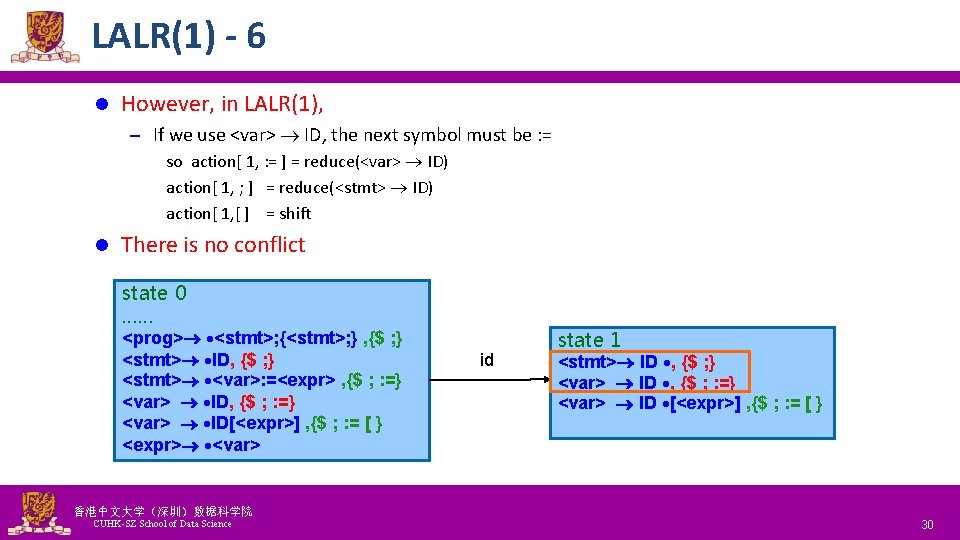
LALR(1) - 6 l However, in LALR(1), – If we use <var> ID, the next symbol must be : = so action[ 1, : = ] = reduce(<var> ID) action[ 1, ; ] = reduce(<stmt> ID) action[ 1, [ ] = shift l There is no conflict state 0 …… <prog> <stmt>; {<stmt>; } , {$ ; } <stmt> ID, {$ ; } <stmt> <var>: =<expr> , {$ ; : =} <var> ID[<expr>] , {$ ; : = [ } <expr> <var> 香港中文大学(深圳)数据科学院 CUHK-SZ School of Data Science National Tsing Hua University ® copyright OIA id state 1 <stmt> ID , {$ ; } <var> ID , {$ ; : =} <var> ID [<expr>] , {$ ; : = [ } 30
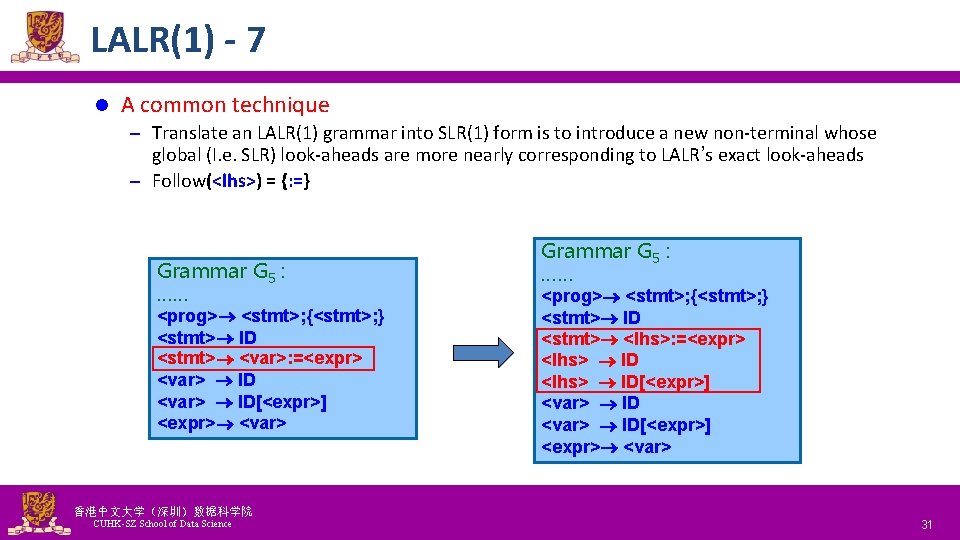
LALR(1) - 7 l A common technique – Translate an LALR(1) grammar into SLR(1) form is to introduce a new non-terminal whose global (I. e. SLR) look-aheads are more nearly corresponding to LALR’s exact look-aheads – Follow(<lhs>) = {: =} Grammar G 5 : …… <prog> <stmt>; {<stmt>; } <stmt> ID <stmt> <var>: =<expr> <var> ID[<expr>] <expr> <var> 香港中文大学(深圳)数据科学院 CUHK-SZ School of Data Science National Tsing Hua University ® copyright OIA Grammar G 5 : …… <prog> <stmt>; {<stmt>; } <stmt> ID <stmt> <lhs>: =<expr> <lhs> ID[<expr>] <var> ID[<expr>] <expr> <var> 31
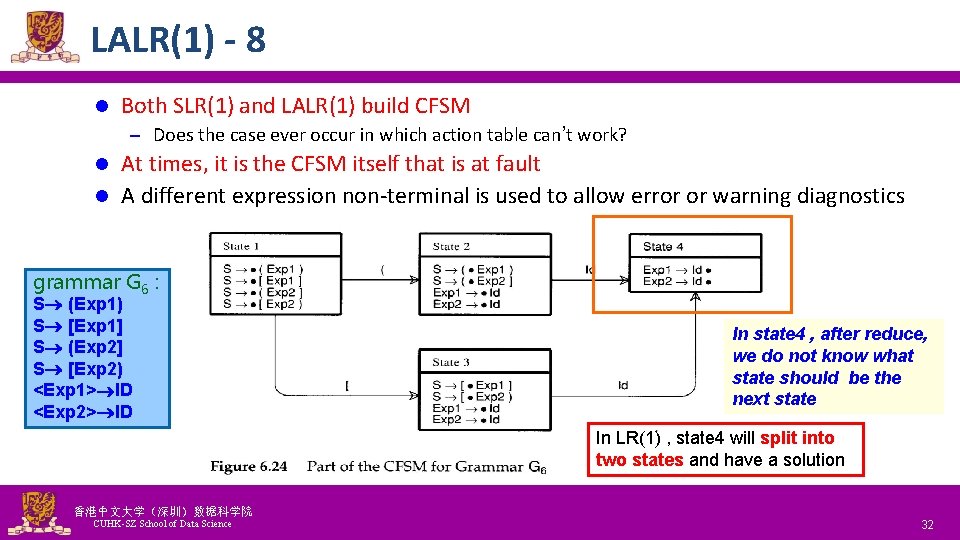
LALR(1) - 8 l Both SLR(1) and LALR(1) build CFSM – Does the case ever occur in which action table can’t work? At times, it is the CFSM itself that is at fault l A different expression non-terminal is used to allow error or warning diagnostics l grammar G 6 : S (Exp 1) S [Exp 1] S (Exp 2] S [Exp 2) <Exp 1> ID <Exp 2> ID In state 4 , after reduce, we do not know what state should be the next state In LR(1) , state 4 will split into two states and have a solution 香港中文大学(深圳)数据科学院 CUHK-SZ School of Data Science National Tsing Hua University ® copyright OIA 32
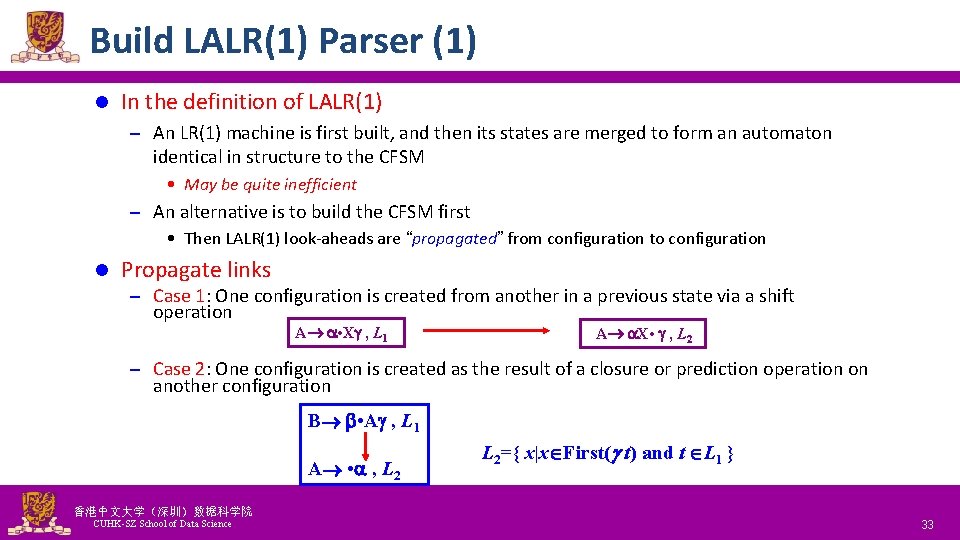
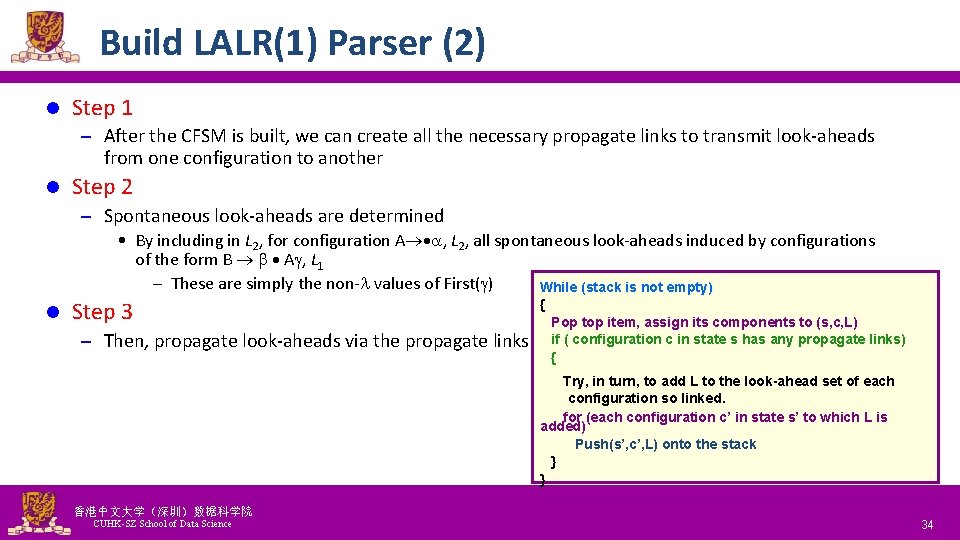
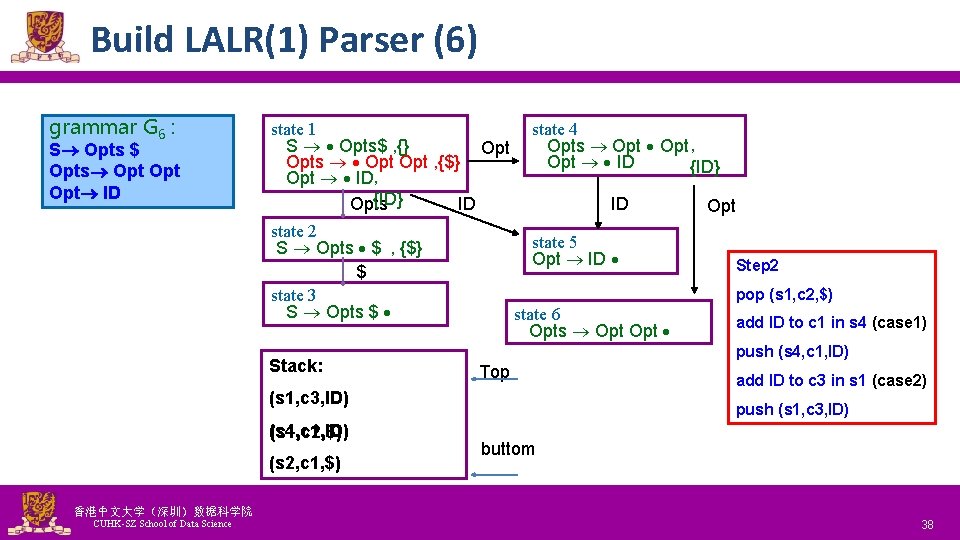
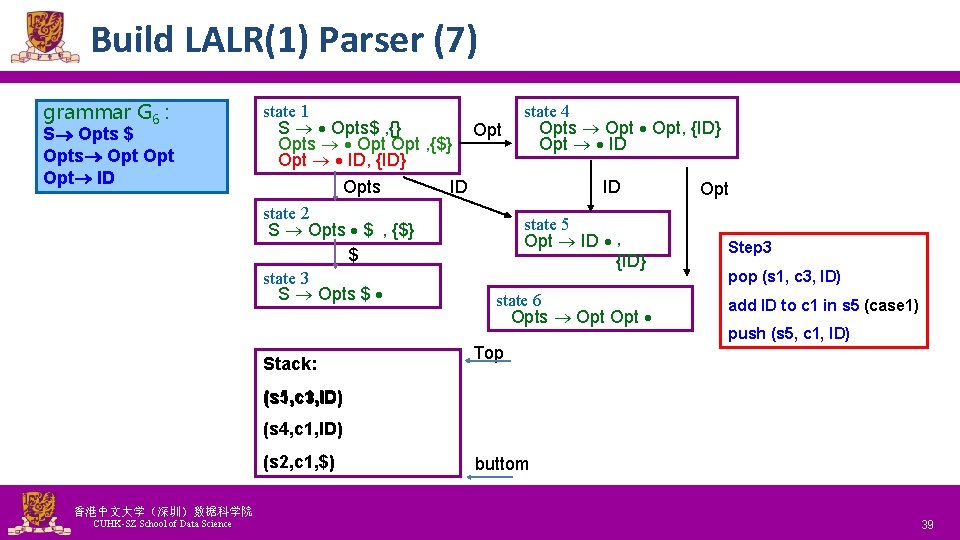
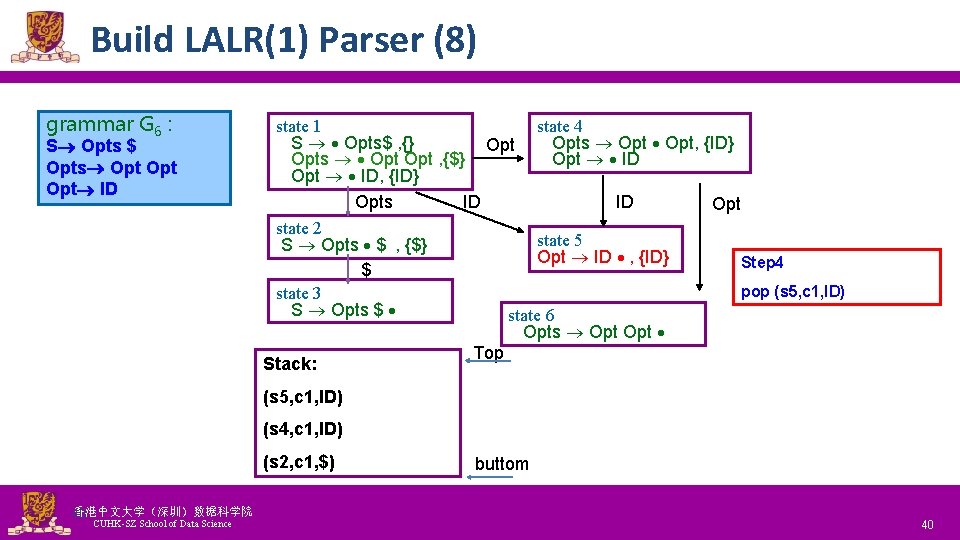
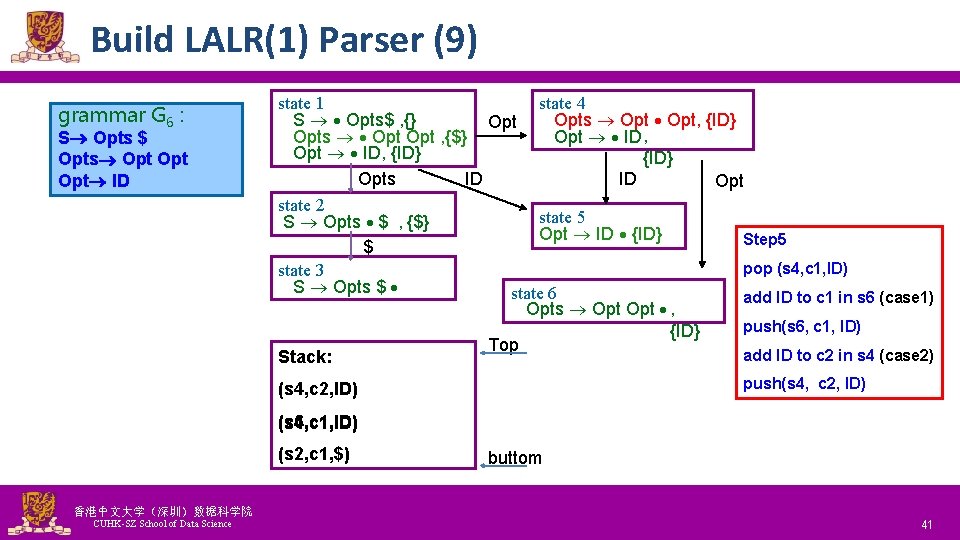
Build LALR(1) Parser (1) l In the definition of LALR(1) – An LR(1) machine is first built, and then its states are merged to form an automaton identical in structure to the CFSM • May be quite inefficient – An alternative is to build the CFSM first • Then LALR(1) look-aheads are “propagated” from configuration to configuration l Propagate links – Case 1: One configuration is created from another in a previous state via a shift operation A • X , L 1 A X • , L 2 – Case 2: One configuration is created as the result of a closure or prediction operation on another configuration B • A , L 1 A • , L 2 香港中文大学(深圳)数据科学院 CUHK-SZ School of Data Science National Tsing Hua University ® copyright OIA L 2={ x|x First( t) and t L 1 } 33
Build LALR(1) Parser (2) l Step 1 – After the CFSM is built, we can create all the necessary propagate links to transmit look-aheads from one configuration to another l Step 2 – Spontaneous look-aheads are determined • By including in L 2, for configuration A , L 2, all spontaneous look-aheads induced by configurations of the form B A , L 1 – These are simply the non- values of First( ) While (stack is not empty) l Step 3 – Then, propagate look-aheads via the propagate links { Pop top item, assign its components to (s, c, L) if ( configuration c in state s has any propagate links) { Try, in turn, to add L to the look-ahead set of each configuration so linked. for (each configuration c’ in state s’ to which L is added) Push(s’, c’, L) onto the stack } } 香港中文大学(深圳)数据科学院 CUHK-SZ School of Data Science National Tsing Hua University ® copyright OIA 34
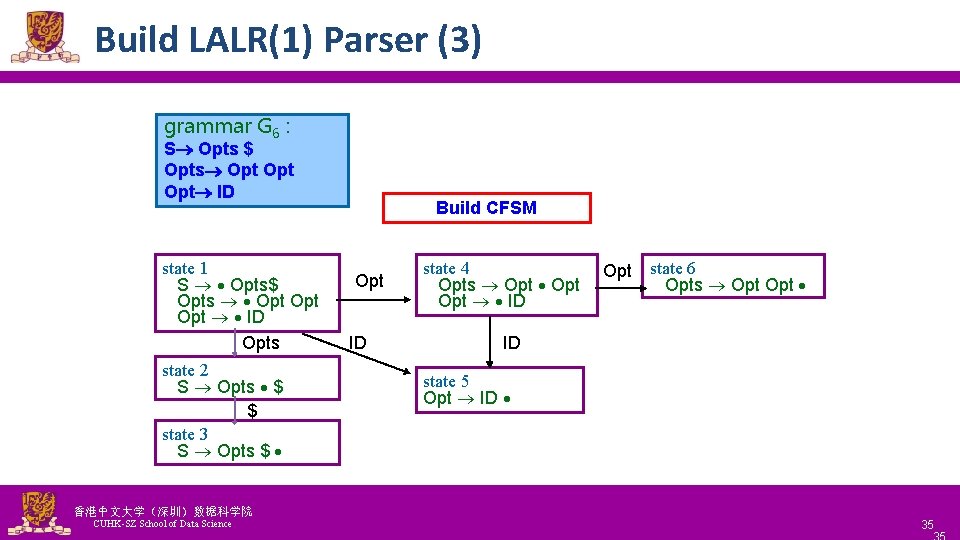
Build LALR(1) Parser (3) grammar G 6 : S Opts $ Opts Opt Opt ID state 1 S Opts$ Opts Opt Opt ID Opts state 2 S Opts $ $ state 3 S Opts $ 香港中文大学(深圳)数据科学院 CUHK-SZ School of Data Science National Tsing Hua University ® copyright OIA Build CFSM Opt ID state 4 Opts Opt Opt ID Opt state 6 Opts Opt ID state 5 Opt ID 35
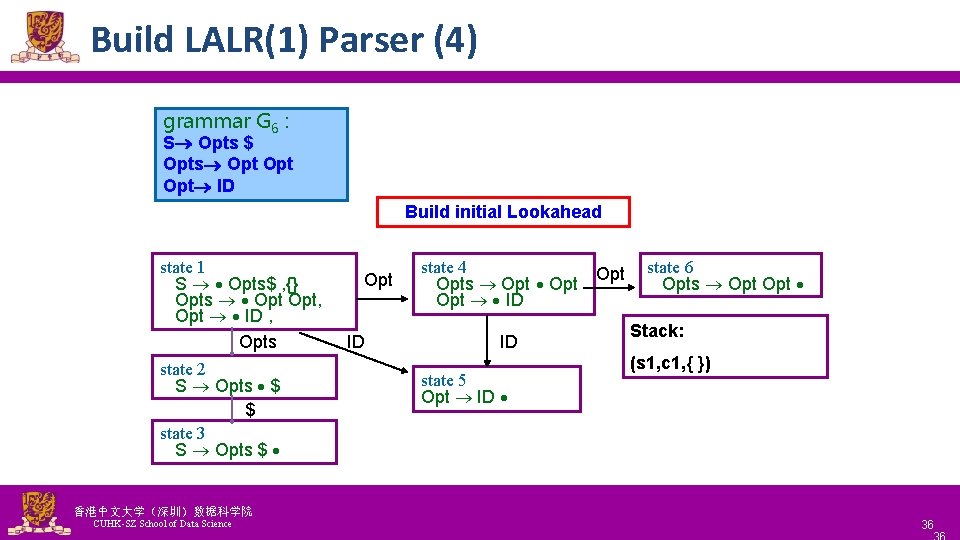
Build LALR(1) Parser (4) grammar G 6 : S Opts $ Opts Opt Opt ID Build initial Lookahead state 1 S Opts$ , {} Opts Opt, Opt ID , Opts state 2 S Opts $ $ state 3 S Opts $ 香港中文大学(深圳)数据科学院 CUHK-SZ School of Data Science National Tsing Hua University ® copyright OIA Opt ID state 4 Opts Opt Opt ID ID state 5 Opt ID Opt state 6 Opts Opt Stack: (s 1, c 1, { }) 36
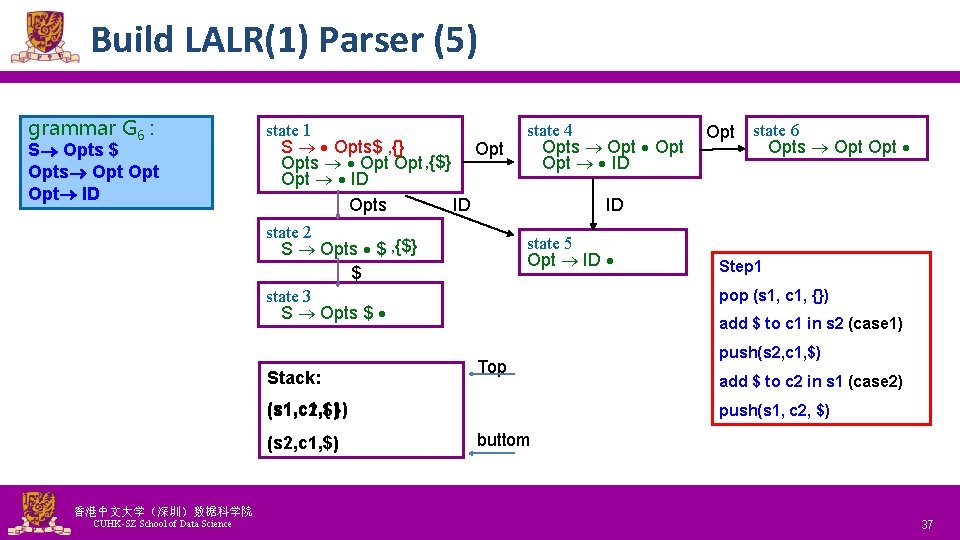
Build LALR(1) Parser (5) grammar G 6 : S Opts $ Opts Opt Opt ID state 1 S Opts$ , {} Opts Opt , {$} Opt ID Opts ID state 2 S Opts $ , {$} $ state 3 S Opts $ Stack: state 4 Opts Opt Opt ID 香港中文大学(深圳)数据科学院 CUHK-SZ School of Data Science National Tsing Hua University ® copyright OIA state 6 Opts Opt ID state 5 Opt ID Top (s 1, c 1, { }) (s 1, c 2, $) (s 2, c 1, $) Opt Step 1 pop (s 1, c 1, {}) add $ to c 1 in s 2 (case 1) push(s 2, c 1, $) add $ to c 2 in s 1 (case 2) push(s 1, c 2, $) buttom 37
Build LALR(1) Parser (6) grammar G 6 : S Opts $ Opts Opt Opt ID state 4 state 1 Opts Opt , S Opts$ , {} Opt ID Opts Opt , {$} {ID} Opt ID, {ID} Opts ID ID Opt state 2 state 5 S Opts $ , {$} Opt ID Step 2 $ pop (s 1, c 2, $) state 3 S Opts $ state 6 add ID to c 1 in s 4 (case 1) Opts Opt Stack: push (s 4, c 1, ID) Top (s 1, c 3, ID) (s 4, c 1, ID) (s 1, c 2, $) (s 2, c 1, $) 香港中文大学(深圳)数据科学院 CUHK-SZ School of Data Science National Tsing Hua University ® copyright OIA add ID to c 3 in s 1 (case 2) push (s 1, c 3, ID) buttom 38
Build LALR(1) Parser (7) grammar G 6 : S Opts $ Opts Opt Opt ID state 1 state 4 S Opts$ , {} Opts Opt, {ID} Opts Opt , {$} Opt ID, {ID} Opts ID ID Opt state 2 state 5 S Opts $ , {$} Opt ID , Step 3 $ {ID} pop (s 1, c 3, ID) state 3 S Opts $ state 6 add ID to c 1 in s 5 (case 1) Opts Opt Stack: Top push (s 5, c 1, ID) (s 1, c 3, ID) (s 4, c 1, ID) (s 2, c 1, $) 香港中文大学(深圳)数据科学院 CUHK-SZ School of Data Science National Tsing Hua University ® copyright OIA buttom 39
Build LALR(1) Parser (8) grammar G 6 : S Opts $ Opts Opt Opt ID state 1 state 4 S Opts$ , {} Opts Opt, {ID} Opts Opt , {$} Opt ID, {ID} Opts ID ID Opt state 2 state 5 S Opts $ , {$} Opt ID , {ID} Step 4 $ pop (s 5, c 1, ID) state 3 S Opts $ state 6 Opts Opt Top Stack: (s 5, c 1, ID) (s 4, c 1, ID) (s 2, c 1, $) 香港中文大学(深圳)数据科学院 40 CUHK-SZ School of Data Science National Tsing Hua University ® copyright OIA buttom 40
Build LALR(1) Parser (9) grammar G 6 : S Opts $ Opts Opt Opt ID state 1 state 4 S Opts$ , {} Opts Opt, {ID} Opts Opt , {$} Opt ID , Opt ID, {ID} Opts ID ID Opt state 2 state 5 S Opts $ , {$} Opt ID {ID} Step 5 $ pop (s 4, c 1, ID) state 3 S Opts $ state 6 add ID to c 1 in s 6 (case 1) Opts Opt , push(s 6, c 1, ID) {ID} Top add ID to c 2 in s 4 (case 2) Stack: push(s 4, c 2, ID) (s 6, c 1, ID) (s 4, c 1, ID) (s 2, c 1, $) 香港中文大学(深圳)数据科学院 CUHK-SZ School of Data Science National Tsing Hua University ® copyright OIA buttom 41
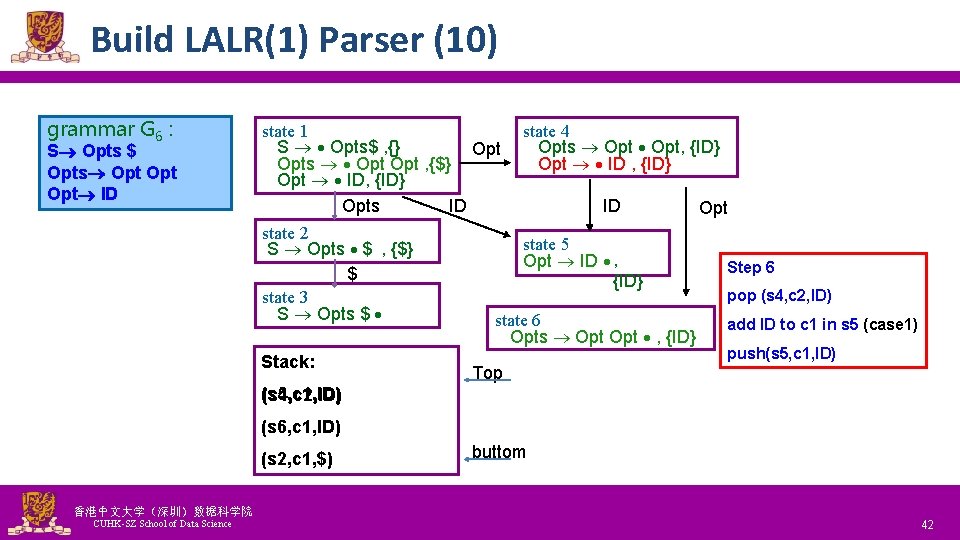
Build LALR(1) Parser (10) grammar G 6 : S Opts $ Opts Opt Opt ID state 1 state 4 S Opts$ , {} Opts Opt, {ID} Opts Opt , {$} Opt ID , {ID} Opt ID, {ID} Opts ID ID Opt state 2 state 5 S Opts $ , {$} Opt ID , Step 6 $ {ID} pop (s 4, c 2, ID) state 3 S Opts $ state 6 add ID to c 1 in s 5 (case 1) Opts Opt , {ID} push(s 5, c 1, ID) Stack: Top (s 5, c 1, ID) (s 4, c 2, ID) (s 6, c 1, ID) (s 2, c 1, $) 香港中文大学(深圳)数据科学院 CUHK-SZ School of Data Science National Tsing Hua University ® copyright OIA buttom 42
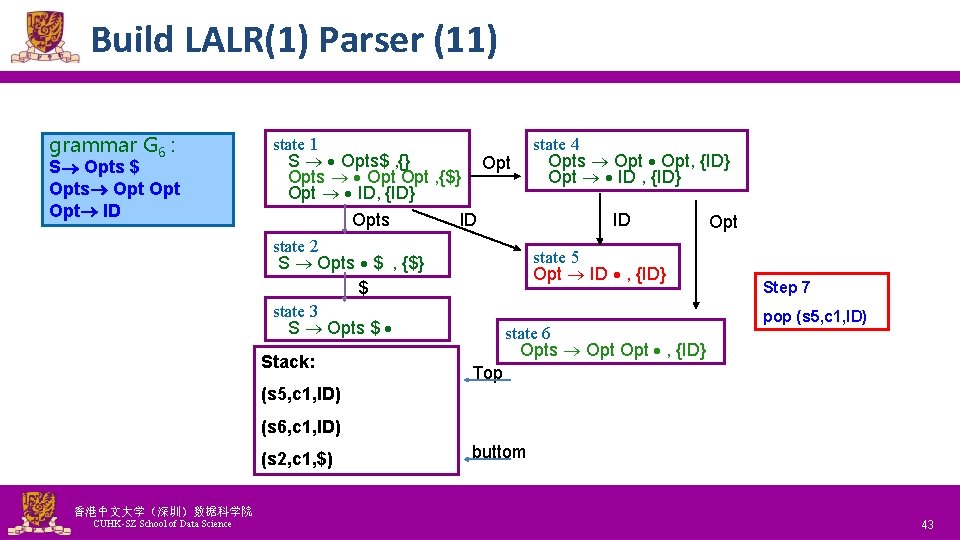
Build LALR(1) Parser (11) grammar G 6 : S Opts $ Opts Opt Opt ID state 1 state 4 S Opts$ , {} Opts Opt, {ID} Opts Opt , {$} Opt ID , {ID} Opt ID, {ID} Opts ID ID Opt state 2 state 5 S Opts $ , {$} Opt ID , {ID} $ state 3 S Opts $ state 6 Opts Opt , {ID} Stack: Top (s 5, c 1, ID) Step 7 pop (s 5, c 1, ID) (s 6, c 1, ID) (s 2, c 1, $) 香港中文大学(深圳)数据科学院 CUHK-SZ School of Data Science National Tsing Hua University ® copyright OIA buttom 43
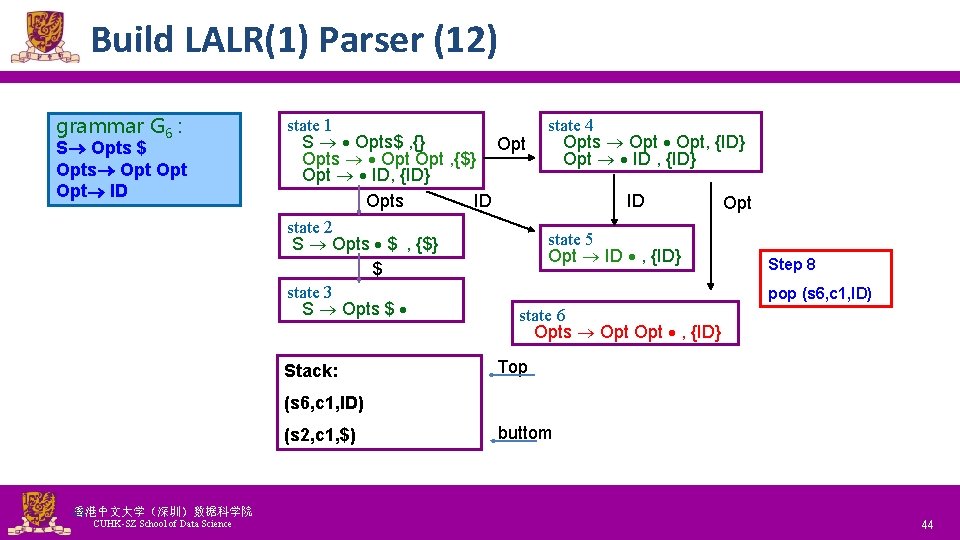
Build LALR(1) Parser (12) grammar G 6 : S Opts $ Opts Opt Opt ID state 4 state 1 Opts Opt, {ID} S Opts$ , {} Opt ID , {ID} Opts Opt , {$} Opt ID, {ID} Opts ID ID Opt state 2 state 5 S Opts $ , {$} Opt ID , {ID} Step 8 $ state 3 pop (s 6, c 1, ID) S Opts $ state 6 Opts Opt , {ID} Stack: Top (s 6, c 1, ID) (s 2, c 1, $) 香港中文大学(深圳)数据科学院 44 CUHK-SZ School of Data Science National Tsing Hua University ® copyright OIA buttom 44
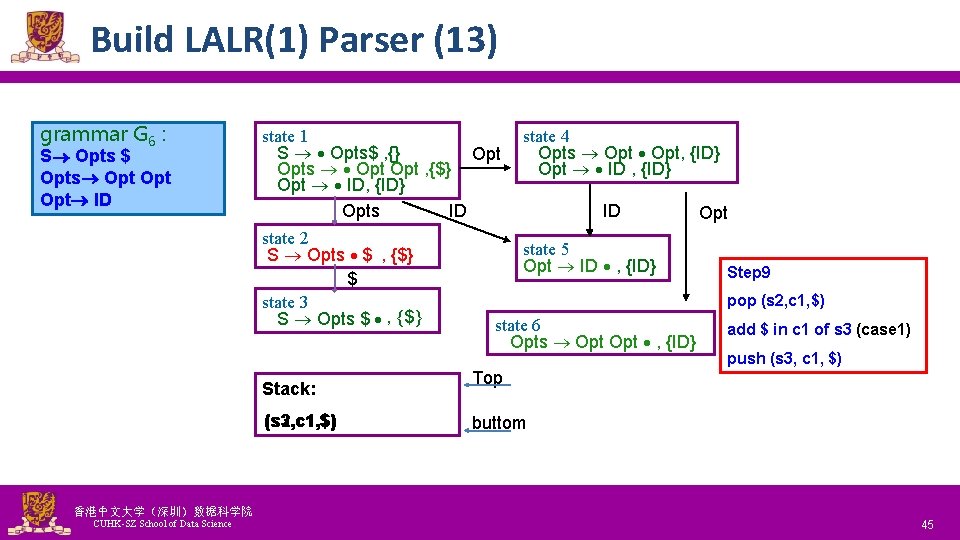
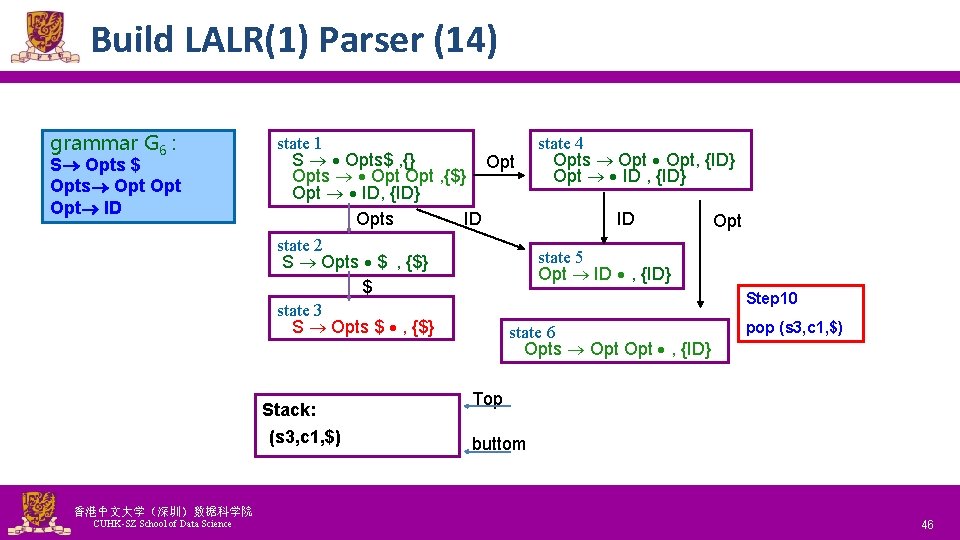
Build LALR(1) Parser (13) grammar G 6 : S Opts $ Opts Opt Opt ID state 4 state 1 Opts Opt, {ID} S Opts$ , {} Opt ID , {ID} Opts Opt , {$} Opt ID, {ID} Opts ID ID Opt state 2 state 5 S Opts $ , {$} Opt ID , {ID} Step 9 $ pop (s 2, c 1, $) state 3 S Opts $ , {$} state 6 add $ in c 1 of s 3 (case 1) Opts Opt , {ID} Stack: (s 3, c 1, $) (s 2, c 1, $) 香港中文大学(深圳)数据科学院 CUHK-SZ School of Data Science National Tsing Hua University ® copyright OIA Top push (s 3, c 1, $) buttom 45
Build LALR(1) Parser (14) grammar G 6 : S Opts $ Opts Opt Opt ID state 1 state 4 S Opts$ , {} Opts Opt, {ID} Opts Opt , {$} Opt ID , {ID} Opt ID, {ID} Opts ID ID Opt state 2 state 5 S Opts $ , {$} Opt ID , {ID} $ Step 10 state 3 S Opts $ , {$} pop (s 3, c 1, $) state 6 Opts Opt , {ID} Stack: (s 3, c 1, $) 香港中文大学(深圳)数据科学院 CUHK-SZ School of Data Science National Tsing Hua University ® copyright OIA Top buttom 46
Build LALR(1) Parser (15) l A number of LALR(1) parsers – Generators use look-ahead propagation to compute the parser action table • LALR-Gen uses the propagation algorithm • YACC examines each state repeatedly 香港中文大学(深圳)数据科学院 CUHK-SZ School of Data Science National Tsing Hua University ® copyright OIA 47
Outline l l l l 6. 0 Introduction 6. 1 Shift-Reduce Parsers 6. 2 LR Parsers 6. 3 LR(1) Parsing 6. 4 SLR(1)Parsing 6. 5 LALR(1) 6. 6 Calling Semantic Routines in Shift-Reduce Parsers 6. 7 Using a Parser Generator (TA course) 6. 8 Optimizing Parse Tables 6. 9 Practical LR(1) Parsers 6. 10 Properties of LR Parsing 6. 11 LL(1) or LAl. R(1) , That is the question 6. 12 Other Shift-Reduce Technique 香港中文大学(深圳)数据科学院 CUHK-SZ School of Data Science National Tsing Hua University ® copyright OIA 48
Calling Semantic Routines in Shift-Reduce Parsers (1) l Shift-reduce parsers – Can normally handle larger classes of grammars than LL(1) parsers, which is a major reason for their popularity – Are not predictive • We cannot always be sure what production is being recognized until its entire right-hand side has been matched • The semantic routines can be invoked only after a production is recognized and reduced – Action symbols only at the extreme right end of a right-hand side 香港中文大学(深圳)数据科学院 CUHK-SZ School of Data Science National Tsing Hua University ® copyright OIA 49
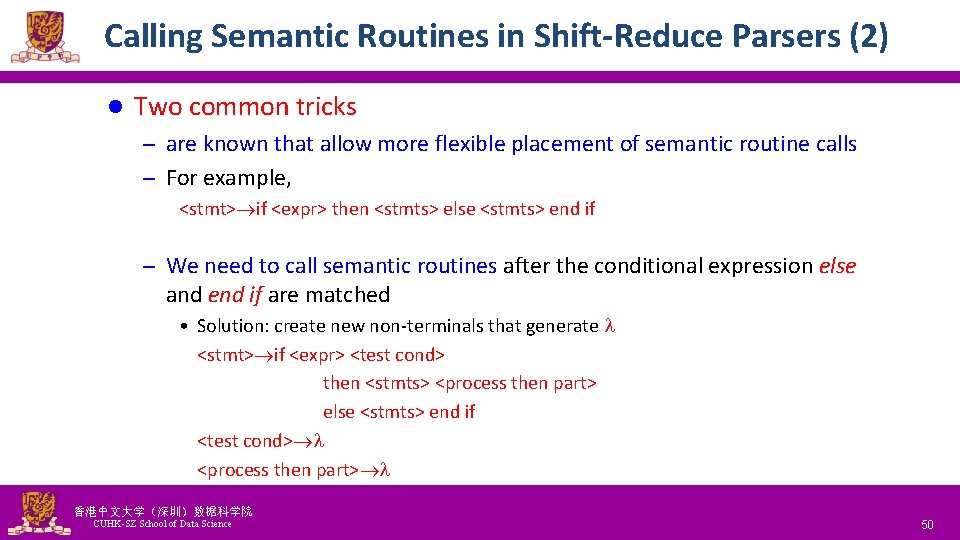
Calling Semantic Routines in Shift-Reduce Parsers (2) l Two common tricks – are known that allow more flexible placement of semantic routine calls – For example, <stmt> if <expr> then <stmts> else <stmts> end if – We need to call semantic routines after the conditional expression else and end if are matched • Solution: create new non-terminals that generate <stmt> if <expr> <test cond> then <stmts> <process then part> else <stmts> end if <test cond> <process then part> 香港中文大学(深圳)数据科学院 CUHK-SZ School of Data Science National Tsing Hua University ® copyright OIA 50
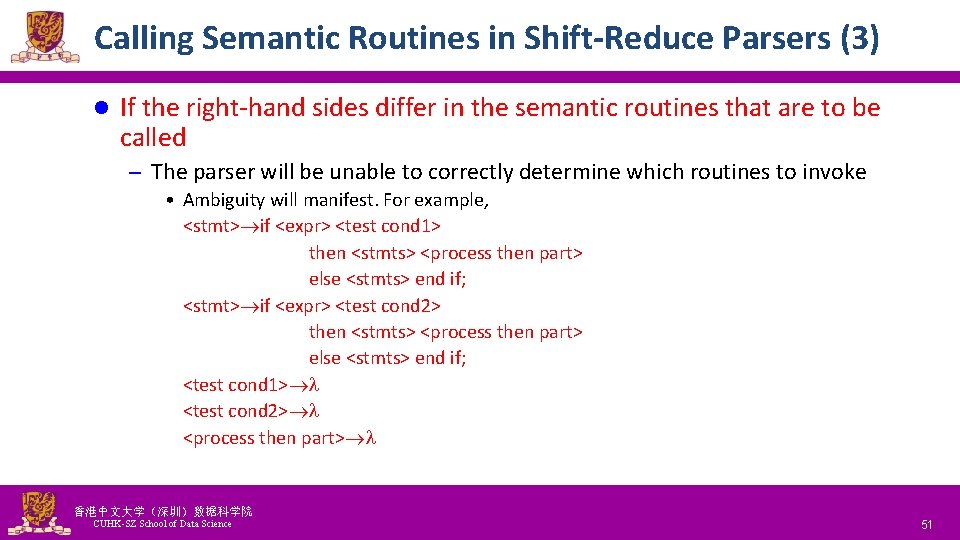
Calling Semantic Routines in Shift-Reduce Parsers (3) l If the right-hand sides differ in the semantic routines that are to be called – The parser will be unable to correctly determine which routines to invoke • Ambiguity will manifest. For example, <stmt> if <expr> <test cond 1> then <stmts> <process then part> else <stmts> end if; <stmt> if <expr> <test cond 2> then <stmts> <process then part> else <stmts> end if; <test cond 1> <test cond 2> <process then part> 香港中文大学(深圳)数据科学院 CUHK-SZ School of Data Science National Tsing Hua University ® copyright OIA 51
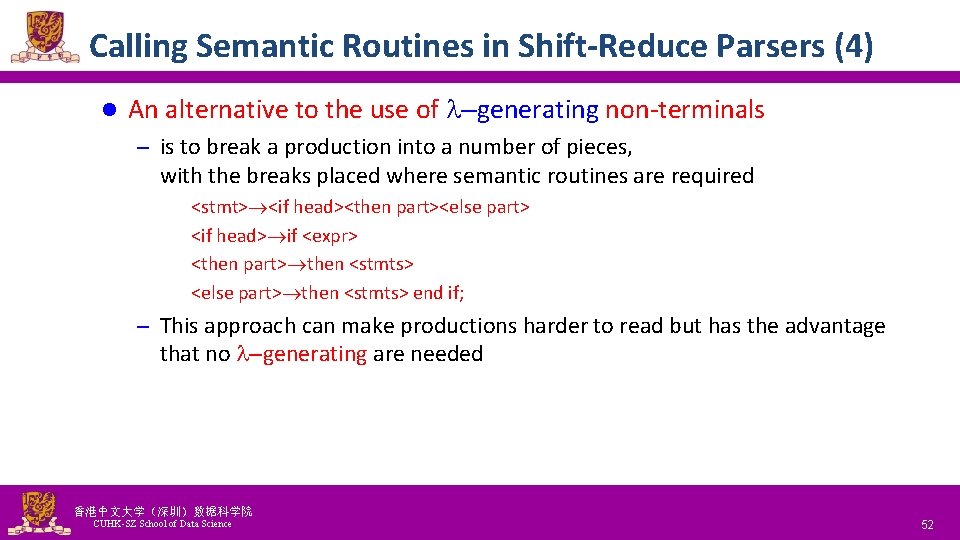
Calling Semantic Routines in Shift-Reduce Parsers (4) l An alternative to the use of –generating non-terminals – is to break a production into a number of pieces, with the breaks placed where semantic routines are required <stmt> <if head><then part><else part> <if head> if <expr> <then part> then <stmts> <else part> then <stmts> end if; – This approach can make productions harder to read but has the advantage that no –generating are needed 香港中文大学(深圳)数据科学院 CUHK-SZ School of Data Science National Tsing Hua University ® copyright OIA 52
Outline l l l l 6. 0 Introduction 6. 1 Shift-Reduce Parsers 6. 2 LR Parsers 6. 3 LR(1) Parsing 6. 4 SLR(1)Parsing 6. 5 LALR(1) 6. 6 Calling Semantic Routines in Shift-Reduce Parsers 6. 7 Using a Parser Generator (TA course) 6. 8 Optimizing Parse Tables 6. 9 Practical LR(1) Parsers 6. 10 Properties of LR Parsing 6. 11 LL(1) or LALR(1) , That is the question 6. 12 Other Shift-Reduce Technique 香港中文大学(深圳)数据科学院 53 53 CUHK-SZ School of Data Science National Tsing Hua University ® copyright OIA 53
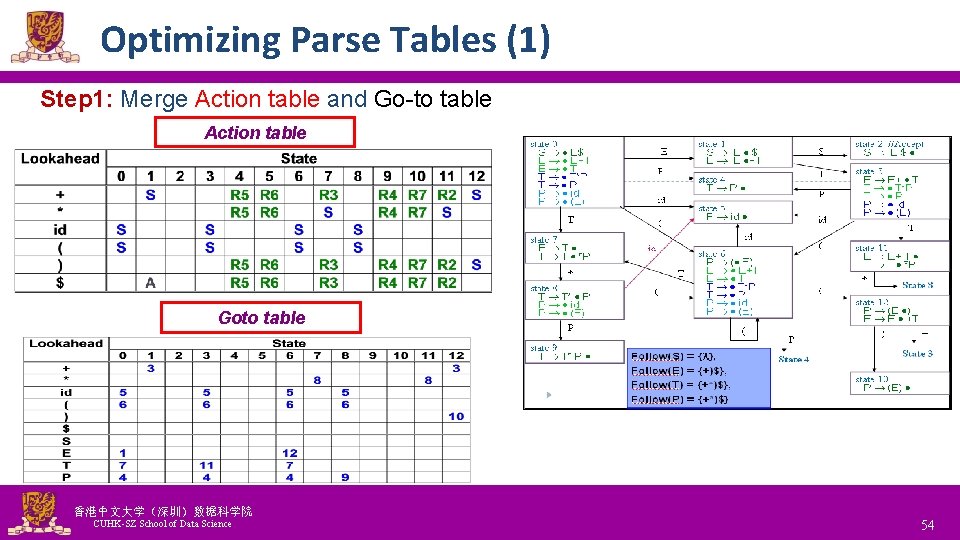
Optimizing Parse Tables (1) Step 1: Merge Action table and Go-to table Action table Goto table 香港中文大学(深圳)数据科学院 CUHK-SZ School of Data Science National Tsing Hua University ® copyright OIA 54
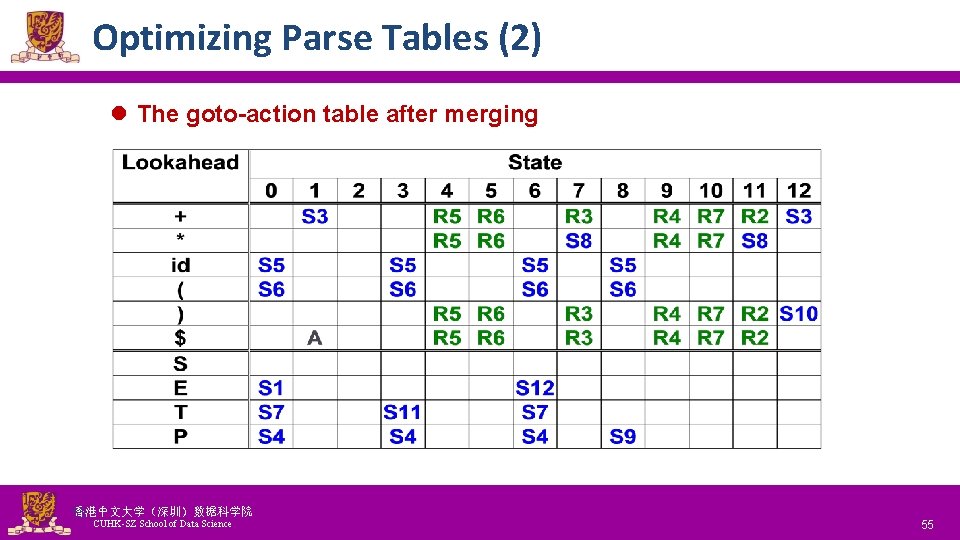
Optimizing Parse Tables (2) l The goto-action table after merging 香港中文大学(深圳)数据科学院 55 CUHK-SZ School of Data Science National Tsing Hua University ® copyright OIA 55
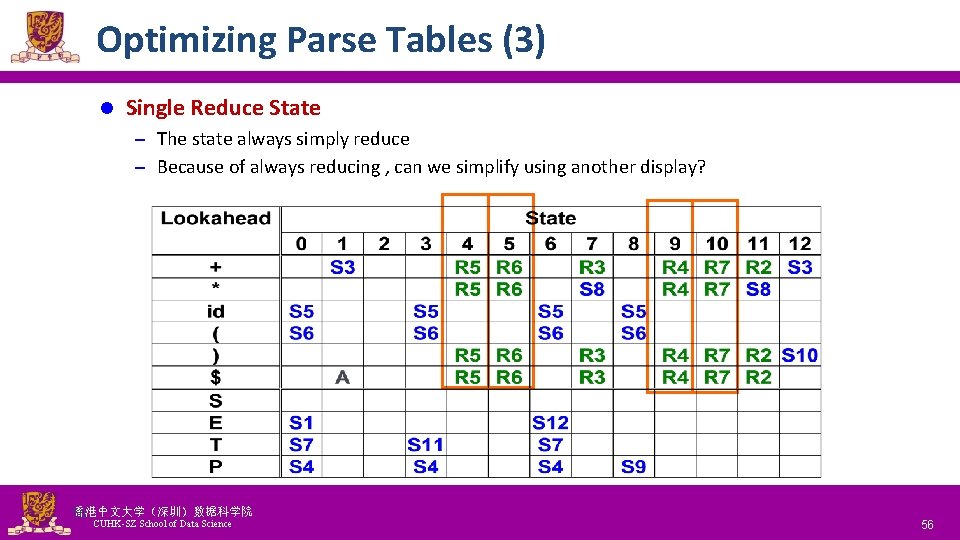
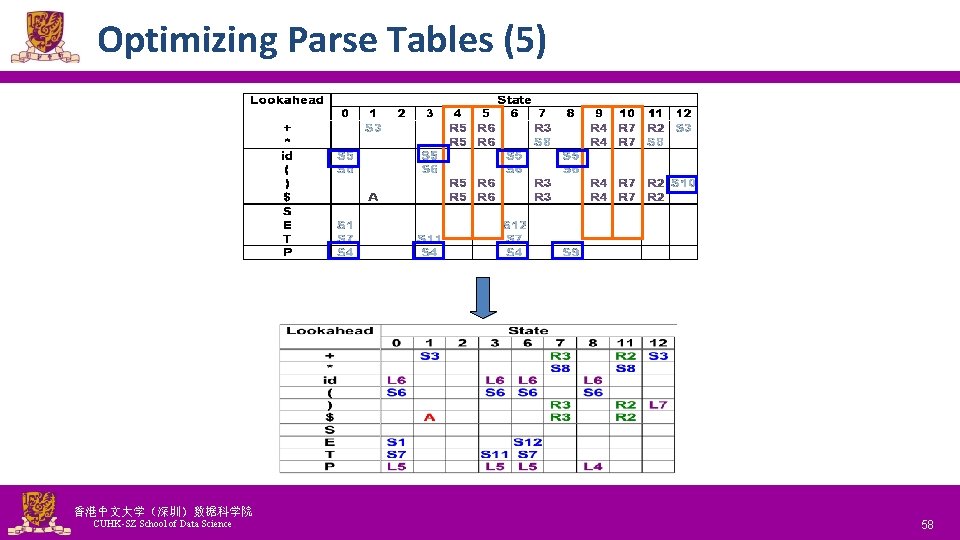
Optimizing Parse Tables (3) l Single Reduce State – The state always simply reduce – Because of always reducing , can we simplify using another display? 香港中文大学(深圳)数据科学院 56 CUHK-SZ School of Data Science National Tsing Hua University ® copyright OIA 56
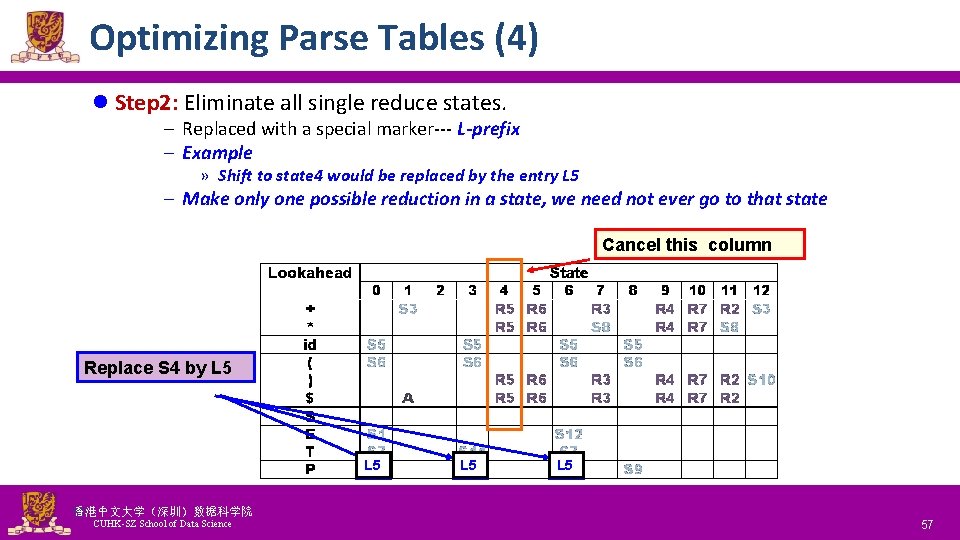
Optimizing Parse Tables (4) l Step 2: Eliminate all single reduce states. – Replaced with a special marker--- L-prefix – Example » Shift to state 4 would be replaced by the entry L 5 – Make only one possible reduction in a state, we need not ever go to that state Cancel this column Replace S 4 by L 5 香港中文大学(深圳)数据科学院 57 CUHK-SZ School of Data Science National Tsing Hua University ® copyright OIA L 5 57
Optimizing Parse Tables (5) 香港中文大学(深圳)数据科学院 CUHK-SZ School of Data Science National Tsing Hua University ® copyright OIA 58
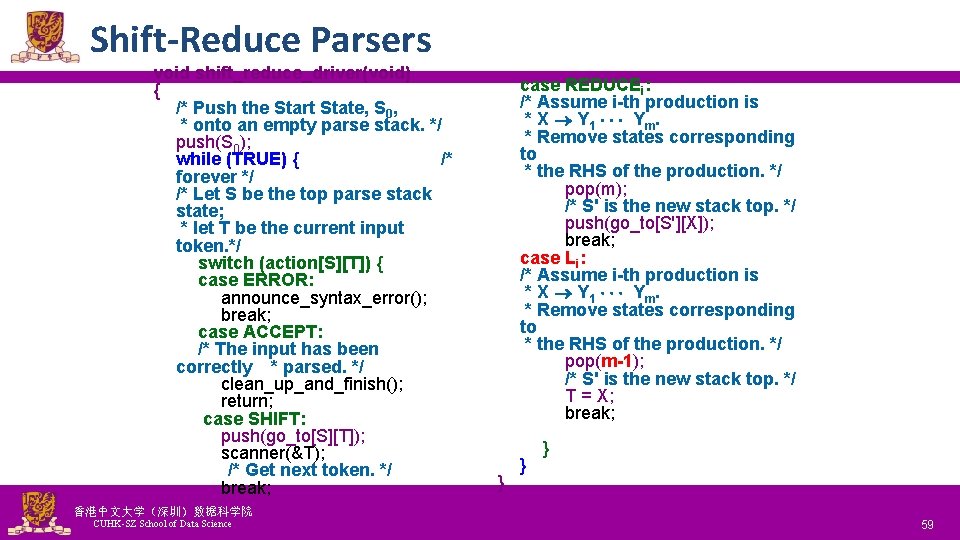
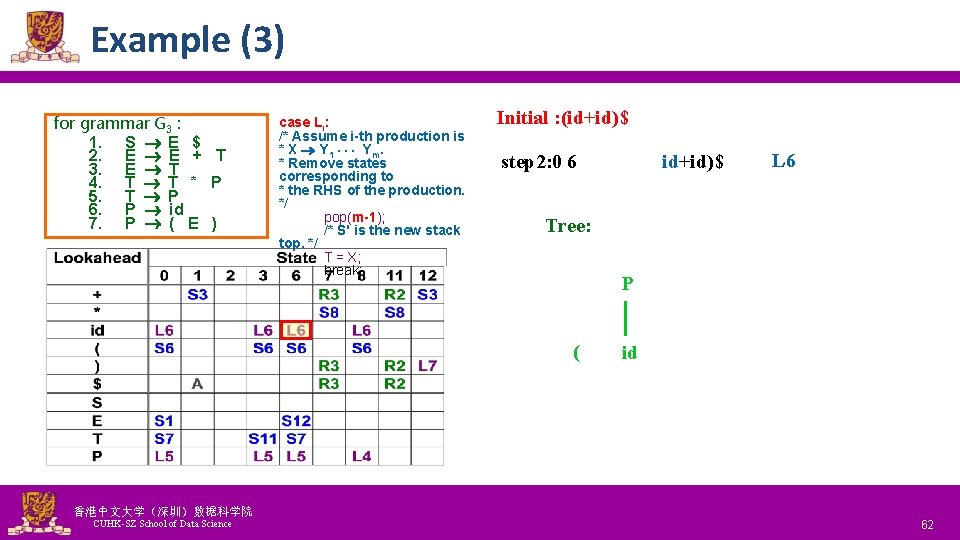
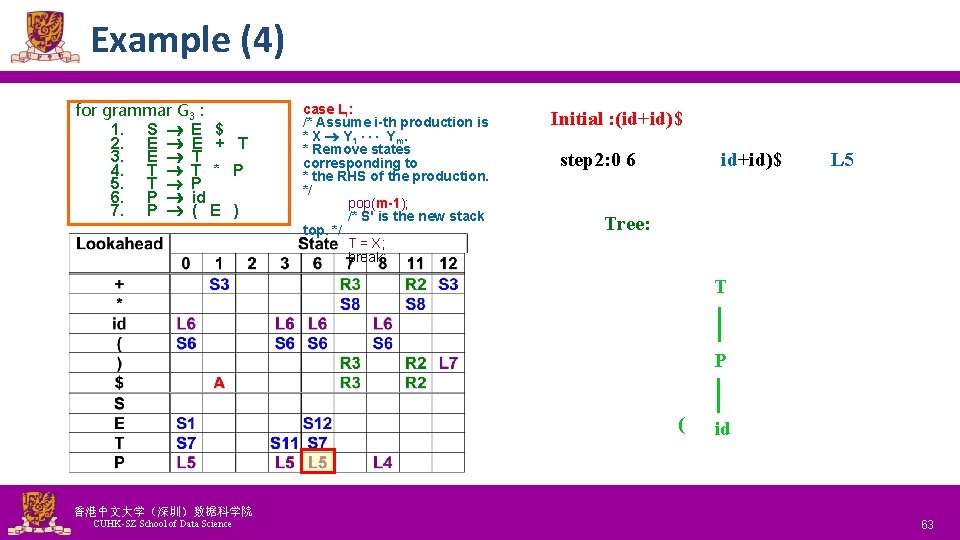
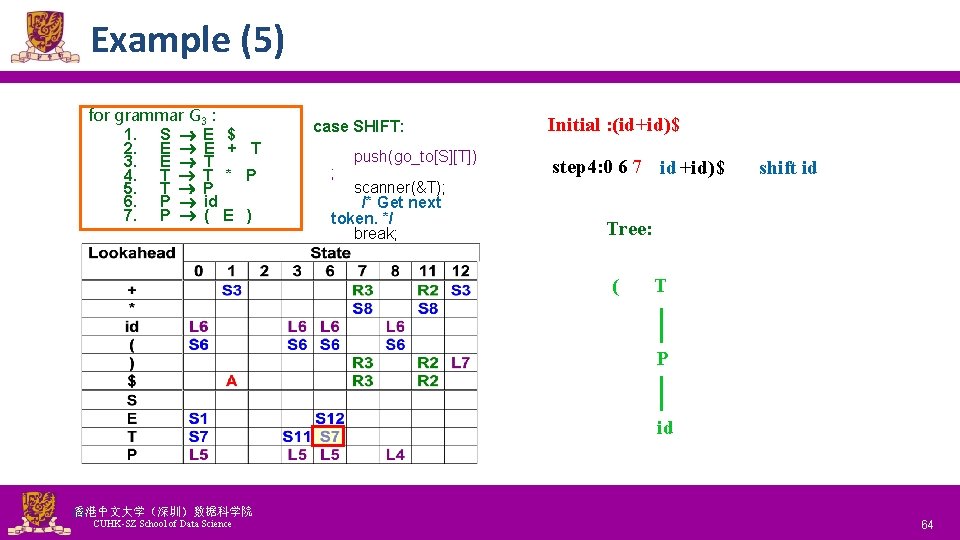
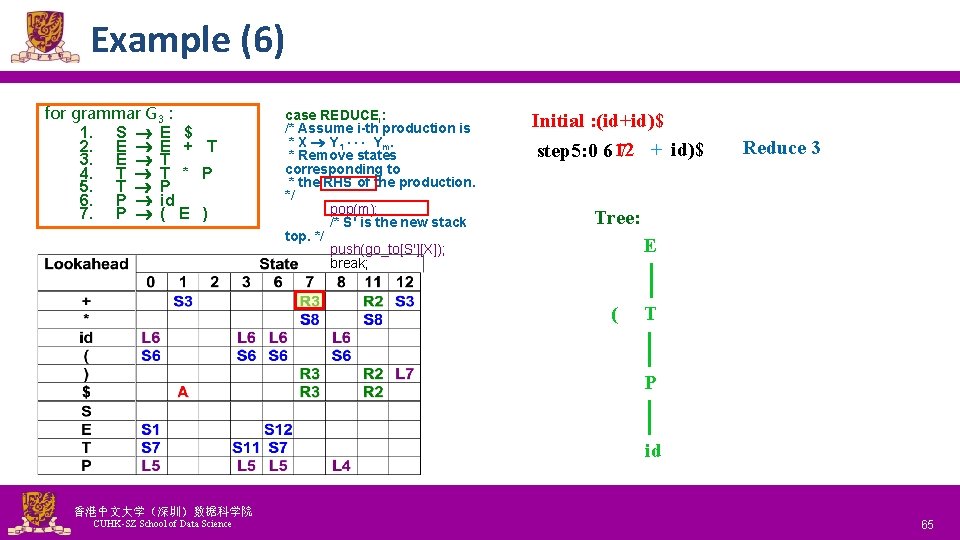
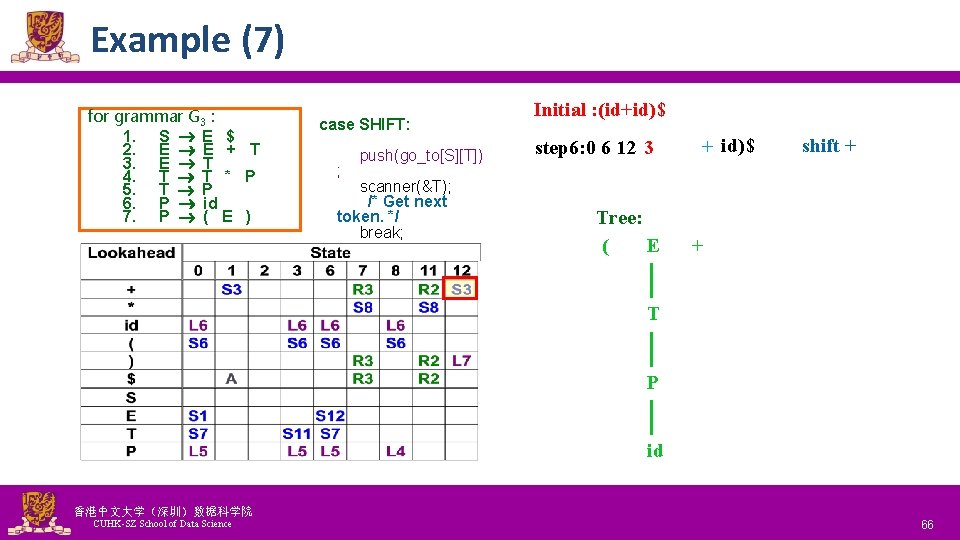
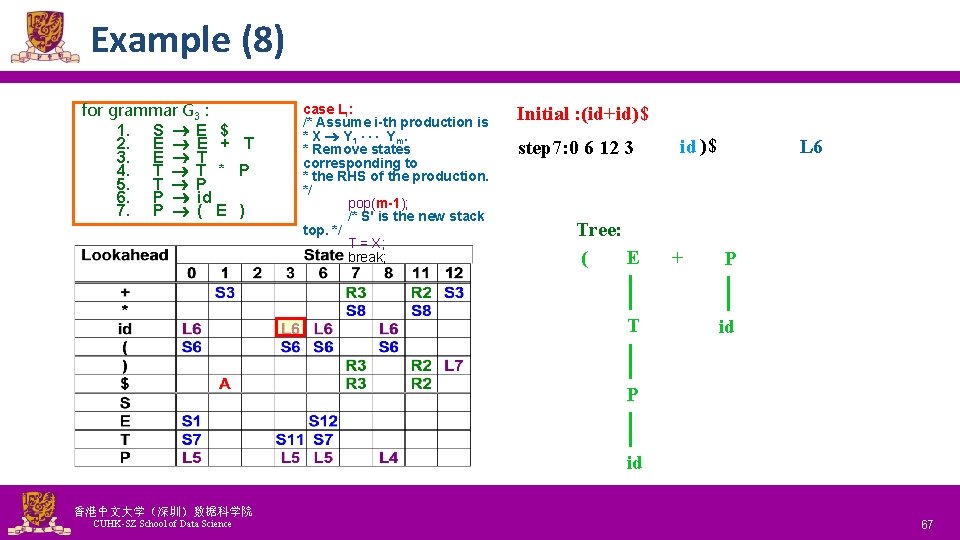
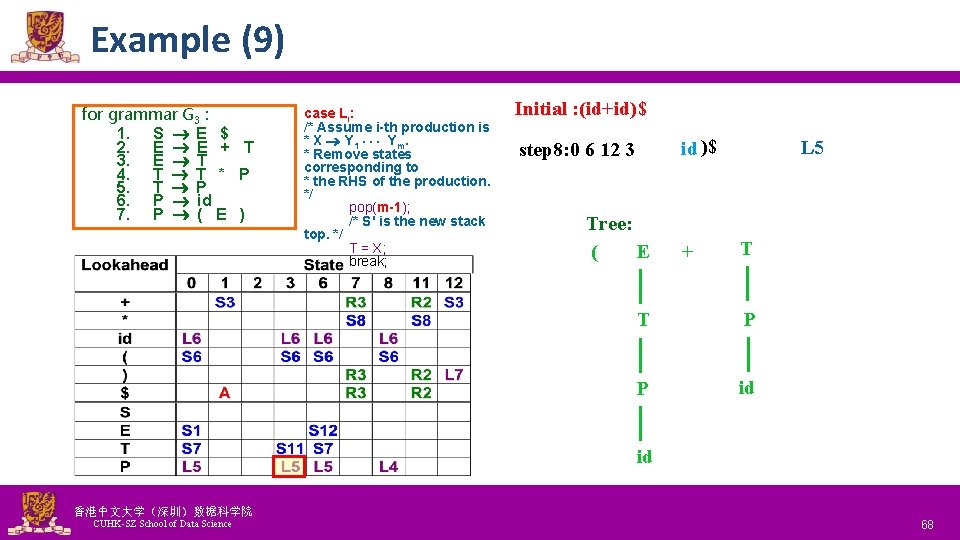
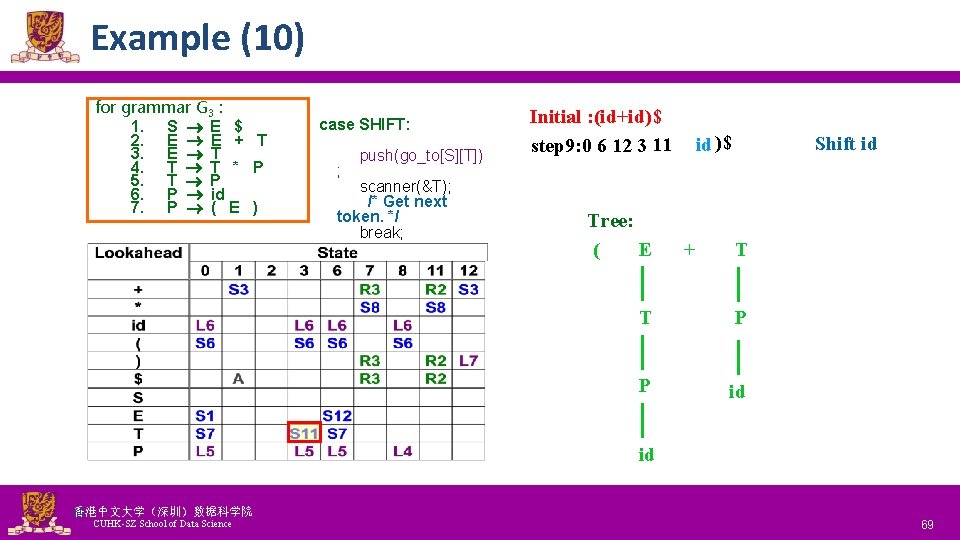
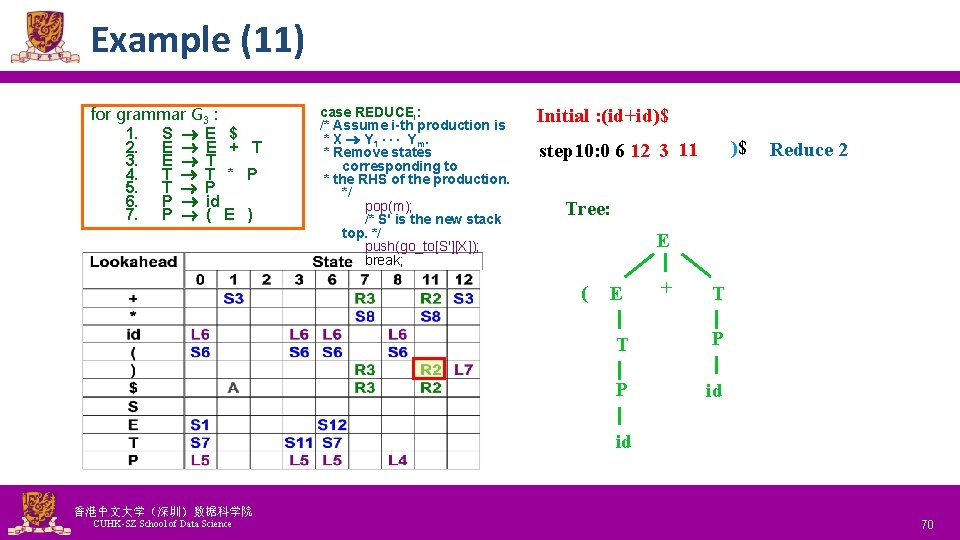
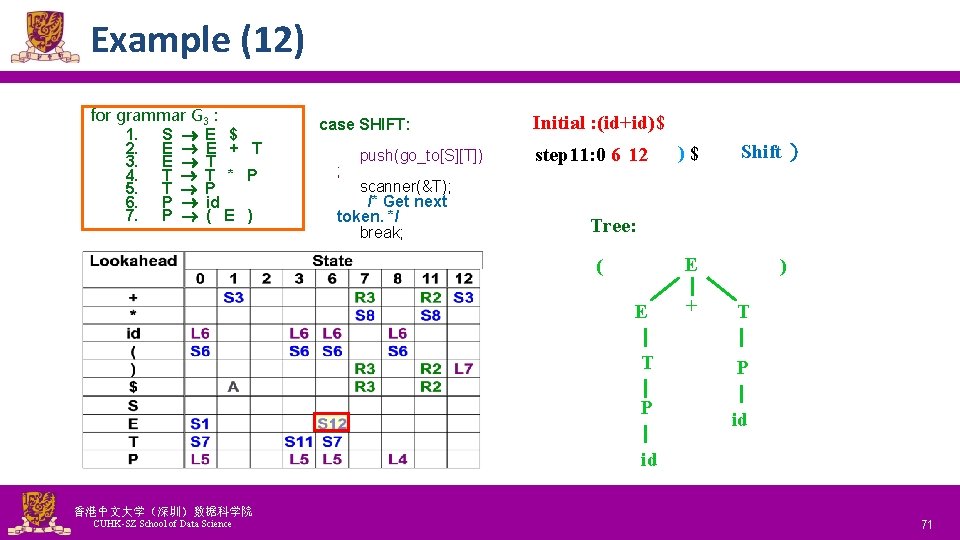
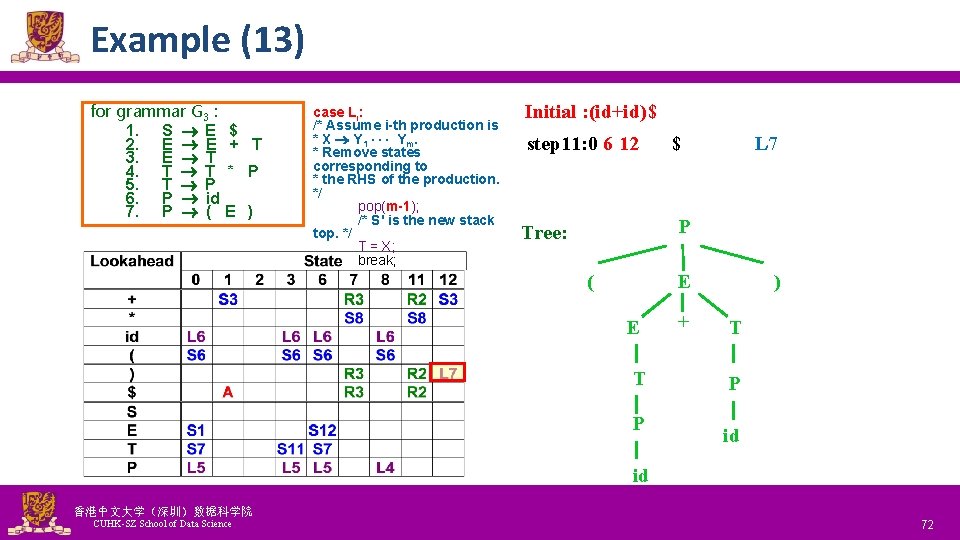
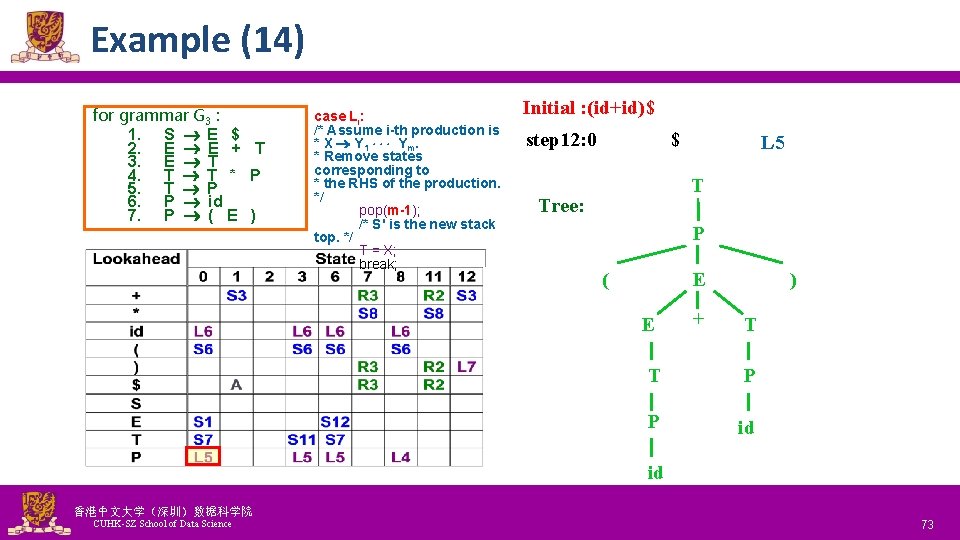
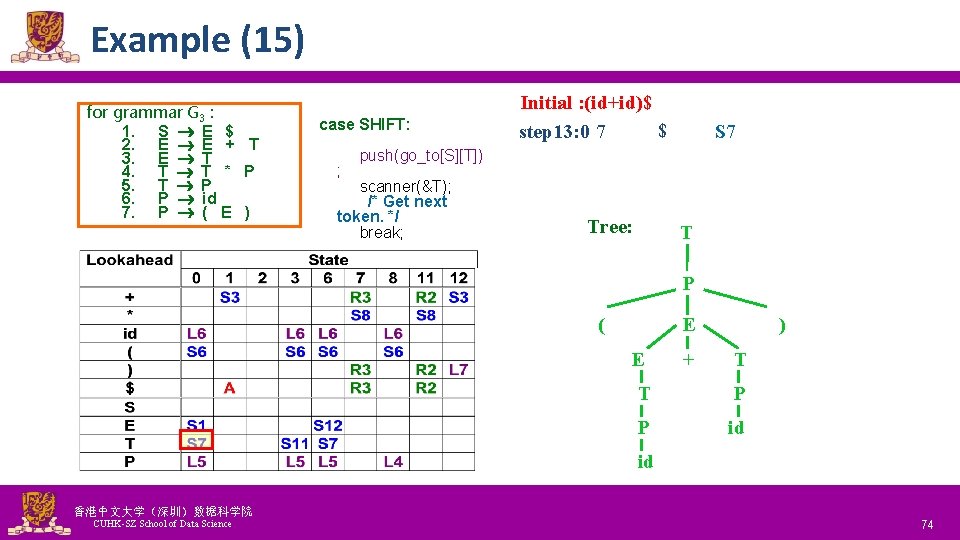
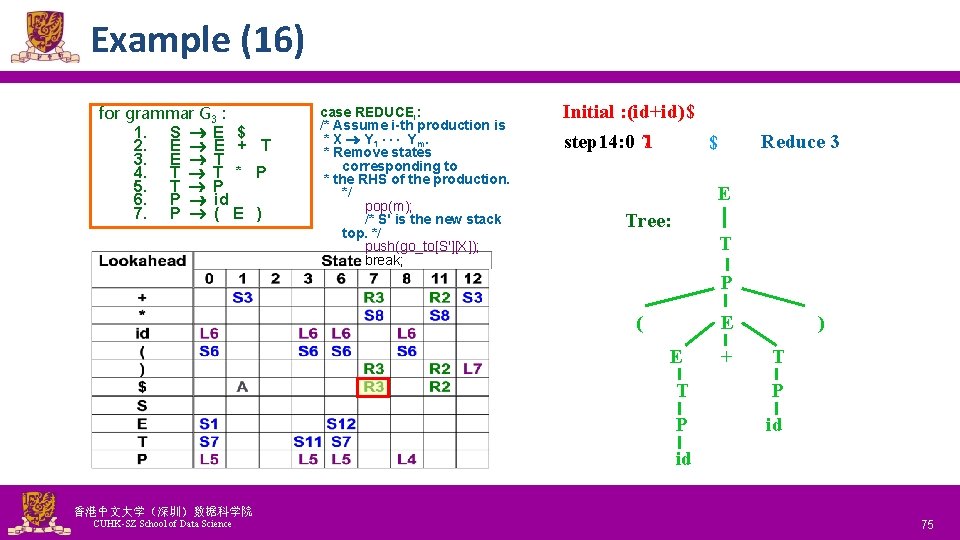
Shift-Reduce Parsers void shift_reduce_driver(void) { /* Push the Start State, S 0, * onto an empty parse stack. */ push(S 0); while (TRUE) { /* forever */ /* Let S be the top parse stack state; * let T be the current input token. */ switch (action[S][T]) { case ERROR: announce_syntax_error(); break; case ACCEPT: /* The input has been correctly * parsed. */ clean_up_and_finish(); return; case SHIFT: push(go_to[S][T]); scanner(&T); /* Get next token. */ break; 香港中文大学(深圳)数据科学院 CUHK-SZ School of Data Science National Tsing Hua University ® copyright OIA case REDUCEi: /* Assume i-th production is * X Y 1 Ym. * Remove states corresponding to * the RHS of the production. */ pop(m); /* S' is the new stack top. */ push(go_to[S'][X]); break; case Li: /* Assume i-th production is * X Y 1 Ym. * Remove states corresponding to * the RHS of the production. */ pop(m-1); /* S' is the new stack top. */ T = X; break; } } } 59
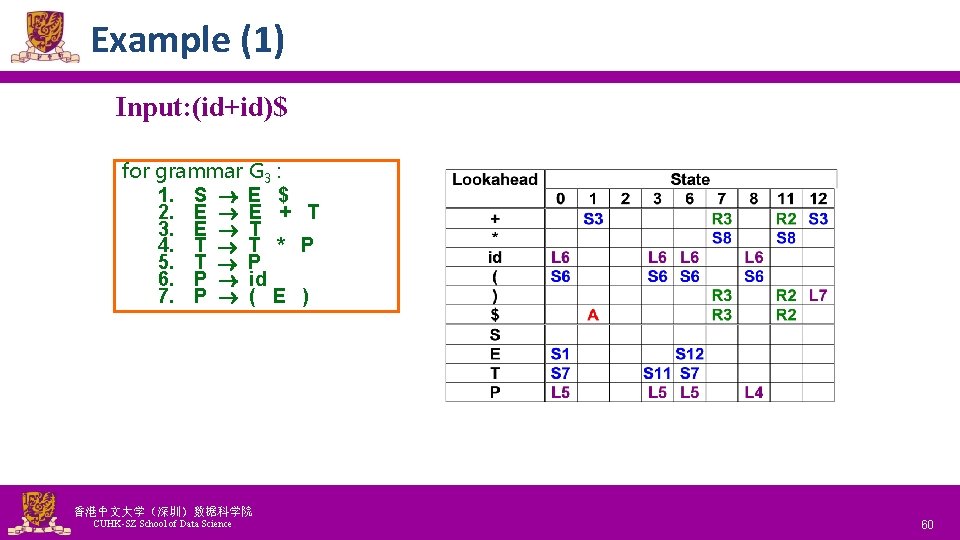
Example (1) Input: (id+id)$ for grammar G 3 : 1. S E $ 2. E E + T 3. E T 4. T T * P 5. T P 6. P id 7. P ( E ) 香港中文大学(深圳)数据科学院 CUHK-SZ School of Data Science National Tsing Hua University ® copyright OIA 60
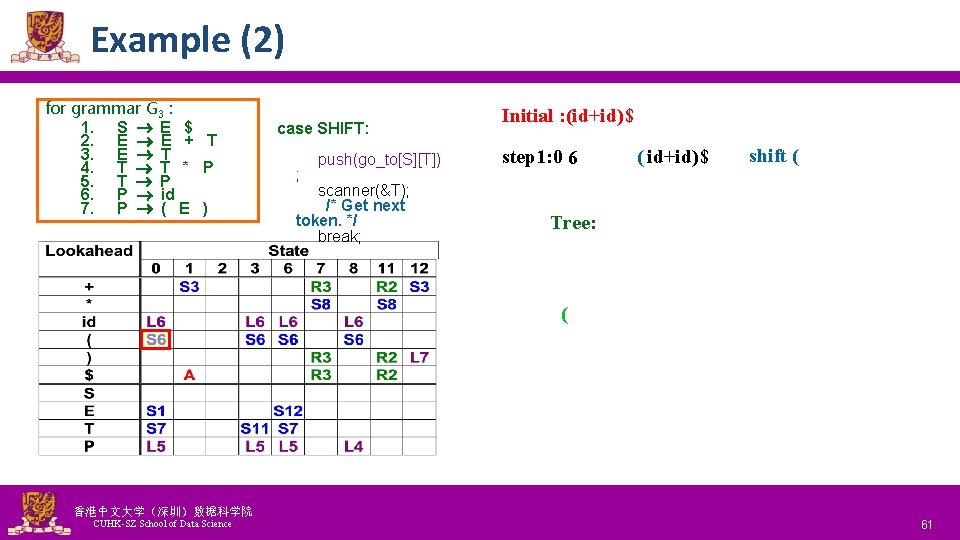
Example (2) for grammar G 3 : 1. S E $ 2. E E + T 3. E T 4. T T * P 5. T P 6. P id 7. P ( E ) case SHIFT: ; push(go_to[S][T]) scanner(&T); /* Get next token. */ break; Initial : (id+id)$ step 1: 0 6 ( id+id)$ shift ( Tree: ( 香港中文大学(深圳)数据科学院 CUHK-SZ School of Data Science National Tsing Hua University ® copyright OIA 61
Example (3) for grammar G 3 : 1. S E $ 2. E E + T 3. E T 4. T T * P 5. T P 6. P id 7. P ( E ) case Li: /* Assume i-th production is * X Y 1 Ym. * Remove states corresponding to * the RHS of the production. */ pop(m-1); /* S' is the new stack top. */ T = X; break; Initial : (id+id)$ step 2: 0 6 L 6 Tree: P ( 香港中文大学(深圳)数据科学院 CUHK-SZ School of Data Science National Tsing Hua University ® copyright OIA id+id)$ id 62
Example (4) for grammar G 3 : 1. S E $ 2. E E + T 3. E T 4. T T * P 5. T P 6. P id 7. P ( E ) case Li: /* Assume i-th production is * X Y 1 Ym. * Remove states corresponding to * the RHS of the production. */ pop(m-1); /* S' is the new stack top. */ T = X; break; Initial : (id+id)$ step 2: 0 6 id+id)$ L 5 Tree: T P ( 香港中文大学(深圳)数据科学院 CUHK-SZ School of Data Science National Tsing Hua University ® copyright OIA id 63
Example (5) for grammar G 3 : 1. S E $ 2. E E + T 3. E T 4. T T * P 5. T P 6. P id 7. P ( E ) case SHIFT: ; push(go_to[S][T]) scanner(&T); /* Get next token. */ break; Initial : (id+id)$ step 4: 0 6 7 id +id)$ shift id Tree: ( T P id 香港中文大学(深圳)数据科学院 64 CUHK-SZ School of Data Science National Tsing Hua University ® copyright OIA 64
Example (6) for grammar G 3 : 1. S E $ 2. E E + T 3. E T 4. T T * P 5. T P 6. P id 7. P ( E ) case REDUCEi: /* Assume i-th production is * X Y 1 Ym. * Remove states corresponding to * the RHS of the production. */ pop(m); /* S' is the new stack top. */ push(go_to[S'][X]); break; Initial : (id+id)$ step 5: 0 6 12 7 + id)$ Reduce 3 Tree: E ( T P id 香港中文大学(深圳)数据科学院 CUHK-SZ School of Data Science National Tsing Hua University ® copyright OIA 65
Example (7) for grammar G 3 : 1. S E $ 2. E E + T 3. E T 4. T T * P 5. T P 6. P id 7. P ( E ) case SHIFT: ; push(go_to[S][T]) scanner(&T); /* Get next token. */ break; Initial : (id+id)$ step 6: 0 6 12 3 Tree: ( E + id)$ shift + + T P id 香港中文大学(深圳)数据科学院 CUHK-SZ School of Data Science National Tsing Hua University ® copyright OIA 66
Example (8) for grammar G 3 : 1. S E $ 2. E E + T 3. E T 4. T T * P 5. T P 6. P id 7. P ( E ) case Li: /* Assume i-th production is * X Y 1 Ym. * Remove states corresponding to * the RHS of the production. */ pop(m-1); /* S' is the new stack top. */ T = X; break; Initial : (id+id)$ step 7: 0 6 12 3 Tree: ( E T id )$ + L 6 P id 香港中文大学(深圳)数据科学院 CUHK-SZ School of Data Science National Tsing Hua University ® copyright OIA 67
Example (9) for grammar G 3 : 1. S E $ 2. E E + T 3. E T 4. T T * P 5. T P 6. P id 7. P ( E ) case Li: /* Assume i-th production is * X Y 1 Ym. * Remove states corresponding to * the RHS of the production. */ pop(m-1); /* S' is the new stack top. */ T = X; break; Initial : (id+id)$ id )$ step 8: 0 6 12 3 Tree: ( E + L 5 T T P P id id 香港中文大学(深圳)数据科学院 CUHK-SZ School of Data Science National Tsing Hua University ® copyright OIA 68
Example (10) for grammar G 3 : 1. S E $ 2. E E + T 3. E T 4. T T * P 5. T P 6. P id 7. P ( E ) case SHIFT: ; push(go_to[S][T]) scanner(&T); /* Get next token. */ break; Initial : (id+id)$ step 9: 0 6 12 3 11 Tree: ( E id )$ + Shift id T T P P id id 香港中文大学(深圳)数据科学院 69 CUHK-SZ School of Data Science National Tsing Hua University ® copyright OIA 69
Example (11) for grammar G 3 : 1. S E $ 2. E E + T 3. E T 4. T T * P 5. T P 6. P id 7. P ( E ) case REDUCEi: /* Assume i-th production is * X Y 1 Ym. * Remove states corresponding to * the RHS of the production. */ pop(m); /* S' is the new stack top. */ push(go_to[S'][X]); break; Initial : (id+id)$ )$ step 10: 0 6 12 3 11 Reduce 2 Tree: E ( E + T T P P id id 香港中文大学(深圳)数据科学院 CUHK-SZ School of Data Science National Tsing Hua University ® copyright OIA 70
Example (12) for grammar G 3 : 1. S E $ 2. E E + T 3. E T 4. T T * P 5. T P 6. P id 7. P ( E ) case SHIFT: ; push(go_to[S][T]) scanner(&T); /* Get next token. */ break; Initial : (id+id)$ step 11: 0 6 12 )$ Shift ) Tree: E ( E T P + ) T P id id 香港中文大学(深圳)数据科学院 CUHK-SZ School of Data Science National Tsing Hua University ® copyright OIA 71
Example (13) for grammar G 3 : 1. S E $ 2. E E + T 3. E T 4. T T * P 5. T P 6. P id 7. P ( E ) case Li: /* Assume i-th production is * X Y 1 Ym. * Remove states corresponding to * the RHS of the production. */ pop(m-1); /* S' is the new stack top. */ T = X; break; Initial : (id+id)$ step 11: 0 6 12 $ L 7 P Tree: ( E E T P + ) T P id id 香港中文大学(深圳)数据科学院 CUHK-SZ School of Data Science National Tsing Hua University ® copyright OIA 72
Example (14) for grammar G 3 : 1. S E $ 2. E E + T 3. E T 4. T T * P 5. T P 6. P id 7. P ( E ) case Li: /* Assume i-th production is * X Y 1 Ym. * Remove states corresponding to * the RHS of the production. */ pop(m-1); /* S' is the new stack top. */ T = X; break; Initial : (id+id)$ step 12: 0 $ L 5 T Tree: P ( E E + ) T T P P id id 香港中文大学(深圳)数据科学院 CUHK-SZ School of Data Science National Tsing Hua University ® copyright OIA 73
Example (15) for grammar G 3 : 1. S E $ 2. E E + T 3. E T 4. T T * P 5. T P 6. P id 7. P ( E ) case SHIFT: ; Initial : (id+id)$ $ step 13: 0 7 S 7 push(go_to[S][T]) scanner(&T); /* Get next token. */ break; Tree: T P ( E E + ) T T P P id id 香港中文大学(深圳)数据科学院 CUHK-SZ School of Data Science National Tsing Hua University ® copyright OIA 74
Example (16) for grammar G 3 : 1. S E $ 2. E E + T 3. E T 4. T T * P 5. T P 6. P id 7. P ( E ) case REDUCEi: /* Assume i-th production is * X Y 1 Ym. * Remove states corresponding to * the RHS of the production. */ pop(m); /* S' is the new stack top. */ push(go_to[S'][X]); break; Initial : (id+id)$ step 14: 0 71 $ Reduce 3 E Tree: T P ( E E + ) T T P P id id 香港中文大学(深圳)数据科学院 CUHK-SZ School of Data Science National Tsing Hua University ® copyright OIA 75
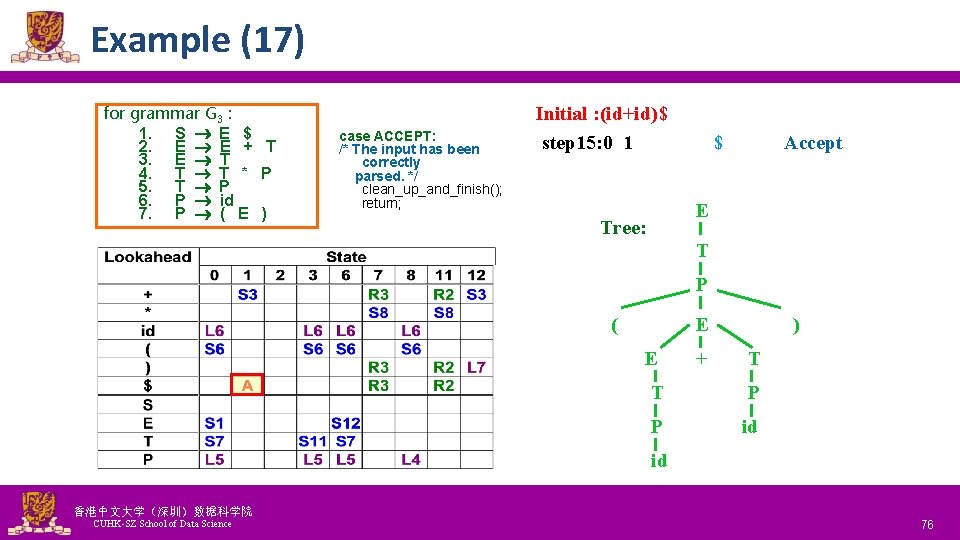
Example (17) for grammar G 3 : 1. S E $ 2. E E + T 3. E T 4. T T * P 5. T P 6. P id 7. P ( E ) case ACCEPT: /* The input has been correctly parsed. */ clean_up_and_finish(); return; Initial : (id+id)$ step 15: 0 1 $ Accept E Tree: T P ( E E + ) T T P P id id 香港中文大学(深圳)数据科学院 CUHK-SZ School of Data Science National Tsing Hua University ® copyright OIA 76
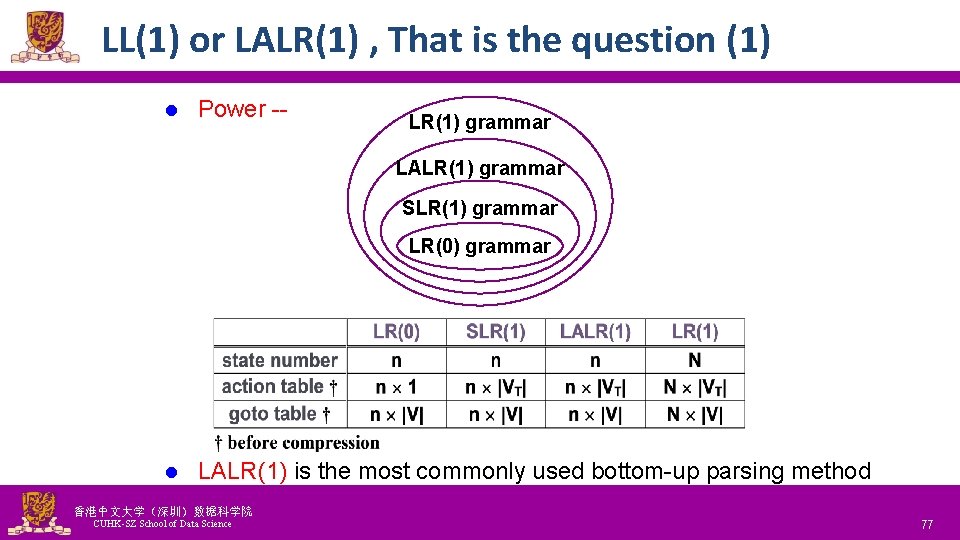
LL(1) or LALR(1) , That is the question (1) l Power -- LR(1) grammar LALR(1) grammar SLR(1) grammar LR(0) grammar l LALR(1) is the most commonly used bottom-up parsing method 香港中文大学(深圳)数据科学院 CUHK-SZ School of Data Science National Tsing Hua University ® copyright OIA 77
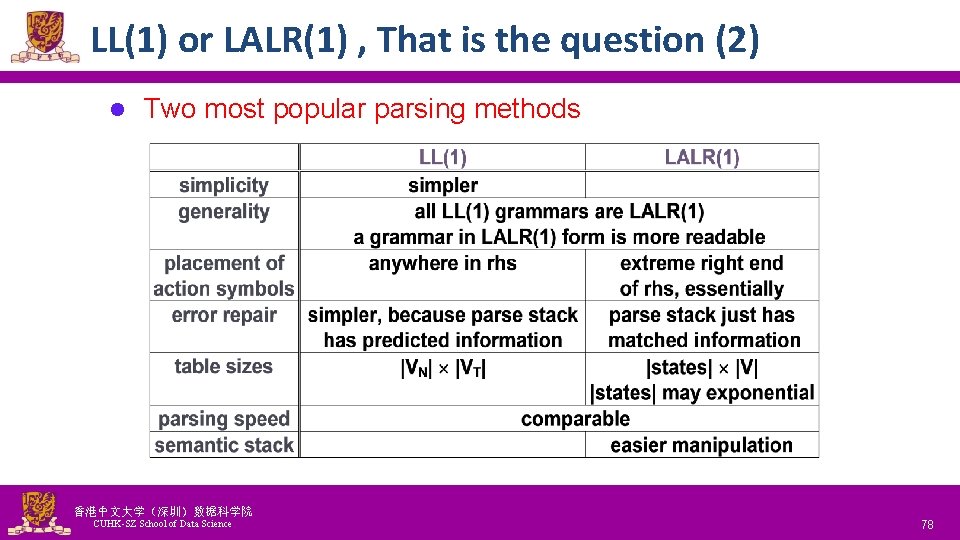
LL(1) or LALR(1) , That is the question (2) l Two most popular parsing methods 香港中文大学(深圳)数据科学院 CUHK-SZ School of Data Science National Tsing Hua University ® copyright OIA 78