
CSC 382 Computer Security Policies CSC 382 Computer
- Slides: 32
CSC 382: Computer Security Policies CSC 382: Computer Security 1
Topics 1. What is a security policy? 2. Types of Access Control 1. Discretionary (DAC) 2. Mandatory (MAC) 3. Originator-based (ORBAC) 3. Types of Policies 1. Multilevel: Bell La. Padula 2. Clark Wilson 3. Chinese Wall 4. Policy Expression Languages CSC 382: Computer Security 2
Security Policy Security policy partitions system states into: – Authorized (secure) • These are states the system is allowed to enter. – Unauthorized (nonsecure) • If the system enters any of these states, it’s a security violation. Secure system – Starts in authorized state. – Never enters unauthorized state. CSC 382: Computer Security 3
Policy vs. Mechanism Security Policy – Statement that divides system into authorized and unauthorized states. Mechanism – Entity or procedure that enforces some part of a security policy. CSC 382: Computer Security 4
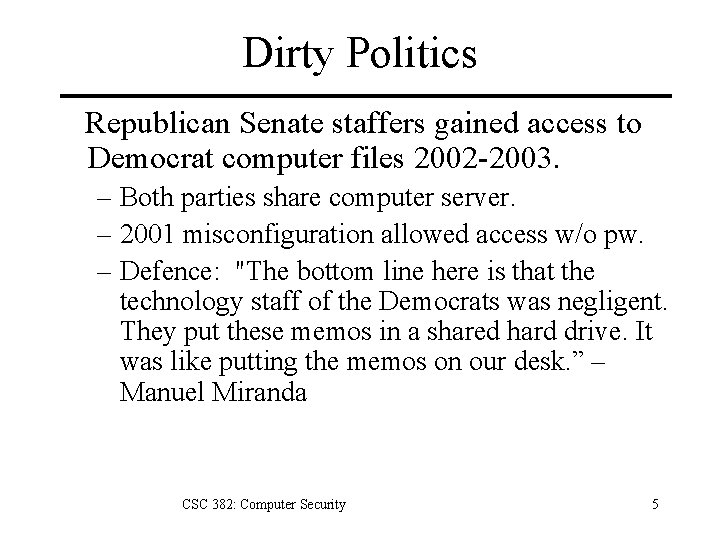
Dirty Politics Republican Senate staffers gained access to Democrat computer files 2002 -2003. – Both parties share computer server. – 2001 misconfiguration allowed access w/o pw. – Defence: "The bottom line here is that the technology staff of the Democrats was negligent. They put these memos in a shared hard drive. It was like putting the memos on our desk. ” – Manuel Miranda CSC 382: Computer Security 5
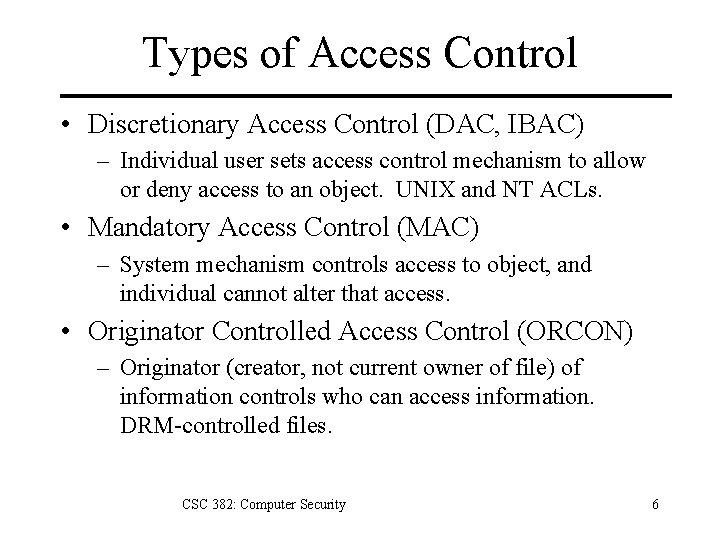
Types of Access Control • Discretionary Access Control (DAC, IBAC) – Individual user sets access control mechanism to allow or deny access to an object. UNIX and NT ACLs. • Mandatory Access Control (MAC) – System mechanism controls access to object, and individual cannot alter that access. • Originator Controlled Access Control (ORCON) – Originator (creator, not current owner of file) of information controls who can access information. DRM-controlled files. CSC 382: Computer Security 6
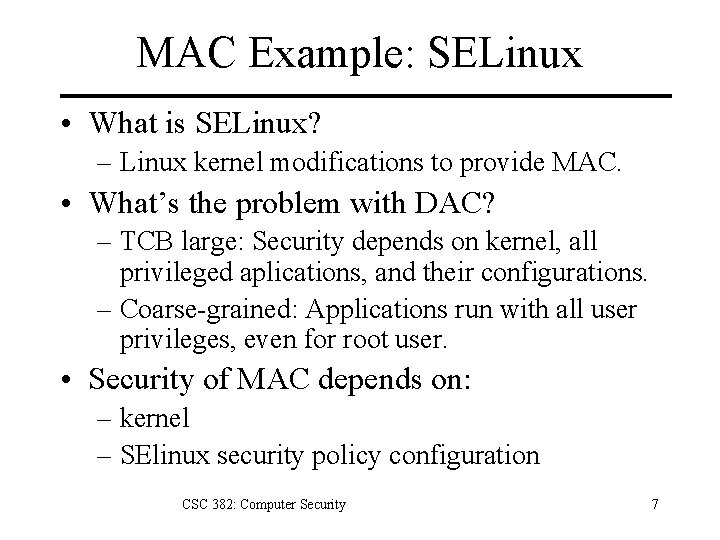
MAC Example: SELinux • What is SELinux? – Linux kernel modifications to provide MAC. • What’s the problem with DAC? – TCB large: Security depends on kernel, all privileged aplications, and their configurations. – Coarse-grained: Applications run with all user privileges, even for root user. • Security of MAC depends on: – kernel – SElinux security policy configuration CSC 382: Computer Security 7
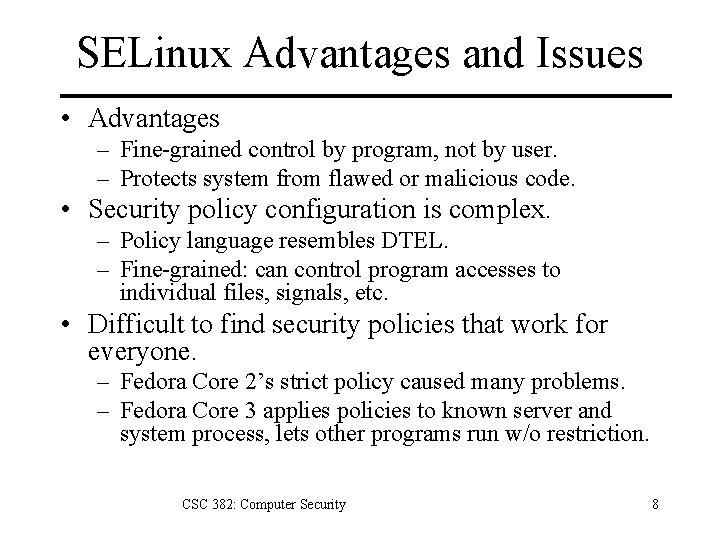
SELinux Advantages and Issues • Advantages – Fine-grained control by program, not by user. – Protects system from flawed or malicious code. • Security policy configuration is complex. – Policy language resembles DTEL. – Fine-grained: can control program accesses to individual files, signals, etc. • Difficult to find security policies that work for everyone. – Fedora Core 2’s strict policy caused many problems. – Fedora Core 3 applies policies to known server and system process, lets other programs run w/o restriction. CSC 382: Computer Security 8
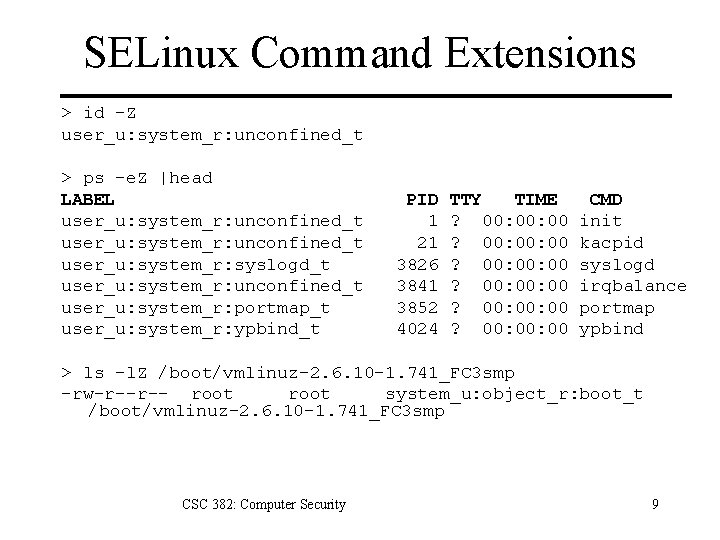
SELinux Command Extensions > id -Z user_u: system_r: unconfined_t > ps -e. Z |head LABEL user_u: system_r: unconfined_t user_u: system_r: syslogd_t user_u: system_r: unconfined_t user_u: system_r: portmap_t user_u: system_r: ypbind_t PID 1 21 3826 3841 3852 4024 TTY TIME ? 00: 00: 00 ? 00: 00: 00 CMD init kacpid syslogd irqbalance portmap ypbind > ls -l. Z /boot/vmlinuz-2. 6. 10 -1. 741_FC 3 smp -rw-r--r-- root system_u: object_r: boot_t /boot/vmlinuz-2. 6. 10 -1. 741_FC 3 smp CSC 382: Computer Security 9
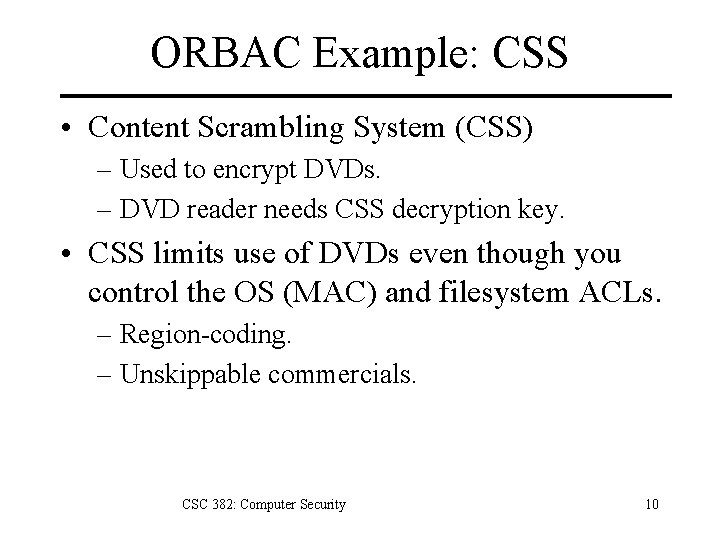
ORBAC Example: CSS • Content Scrambling System (CSS) – Used to encrypt DVDs. – DVD reader needs CSS decryption key. • CSS limits use of DVDs even though you control the OS (MAC) and filesystem ACLs. – Region-coding. – Unskippable commercials. CSC 382: Computer Security 10
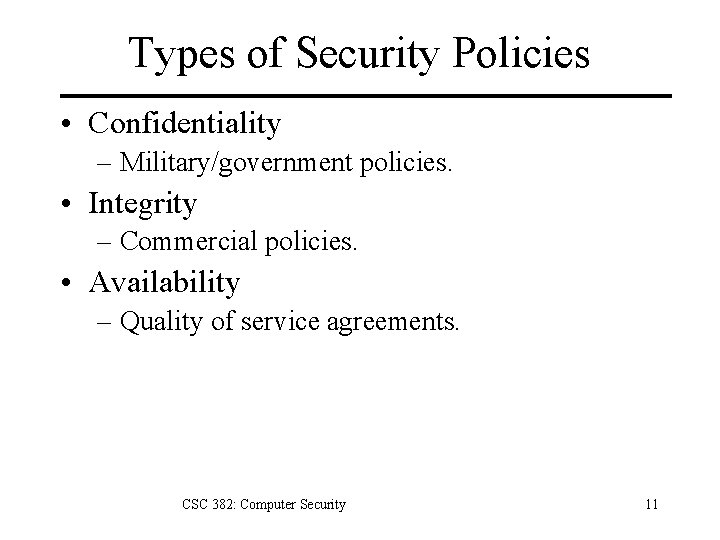
Types of Security Policies • Confidentiality – Military/government policies. • Integrity – Commercial policies. • Availability – Quality of service agreements. CSC 382: Computer Security 11
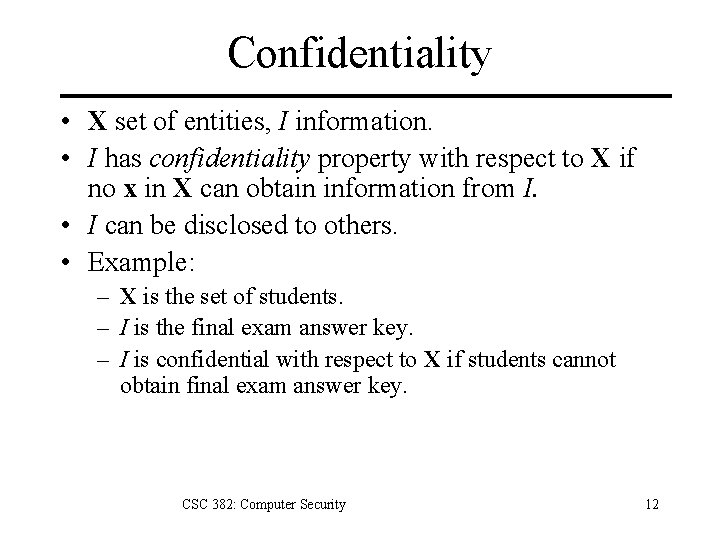
Confidentiality • X set of entities, I information. • I has confidentiality property with respect to X if no x in X can obtain information from I. • I can be disclosed to others. • Example: – X is the set of students. – I is the final exam answer key. – I is confidential with respect to X if students cannot obtain final exam answer key. CSC 382: Computer Security 12
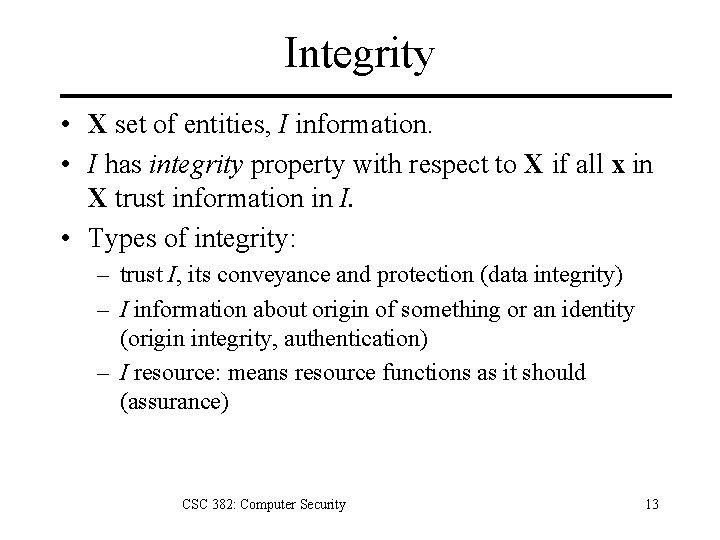
Integrity • X set of entities, I information. • I has integrity property with respect to X if all x in X trust information in I. • Types of integrity: – trust I, its conveyance and protection (data integrity) – I information about origin of something or an identity (origin integrity, authentication) – I resource: means resource functions as it should (assurance) CSC 382: Computer Security 13
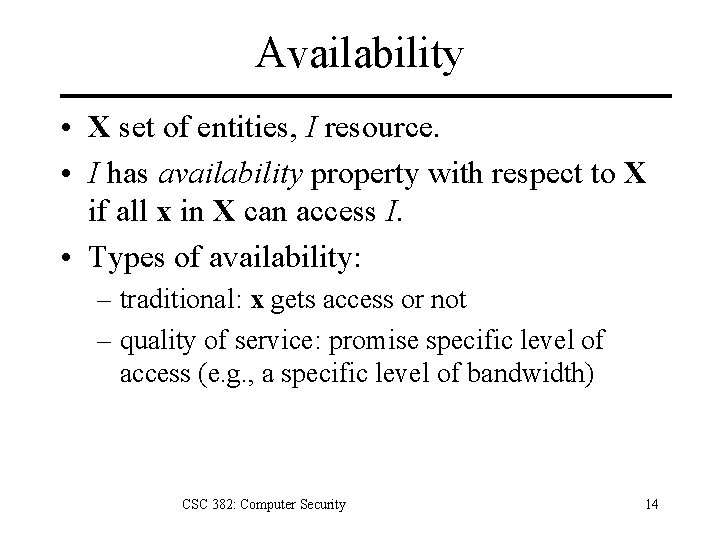
Availability • X set of entities, I resource. • I has availability property with respect to X if all x in X can access I. • Types of availability: – traditional: x gets access or not – quality of service: promise specific level of access (e. g. , a specific level of bandwidth) CSC 382: Computer Security 14
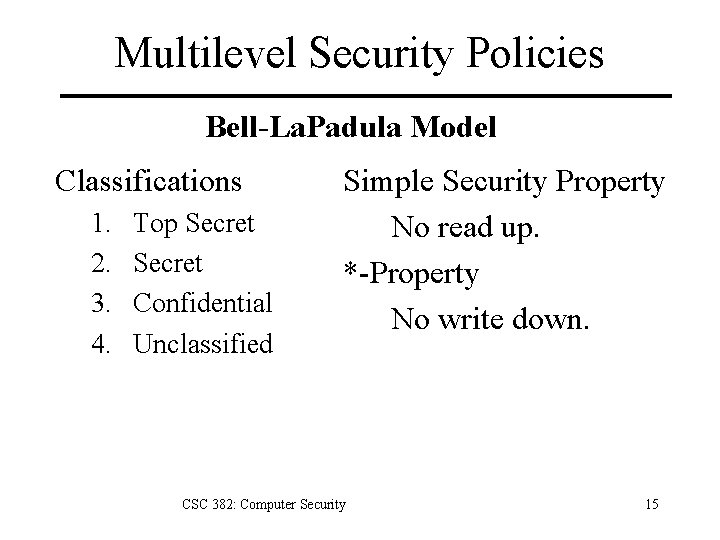
Multilevel Security Policies Bell-La. Padula Model Classifications 1. 2. 3. 4. Top Secret Confidential Unclassified Simple Security Property No read up. *-Property No write down. CSC 382: Computer Security 15
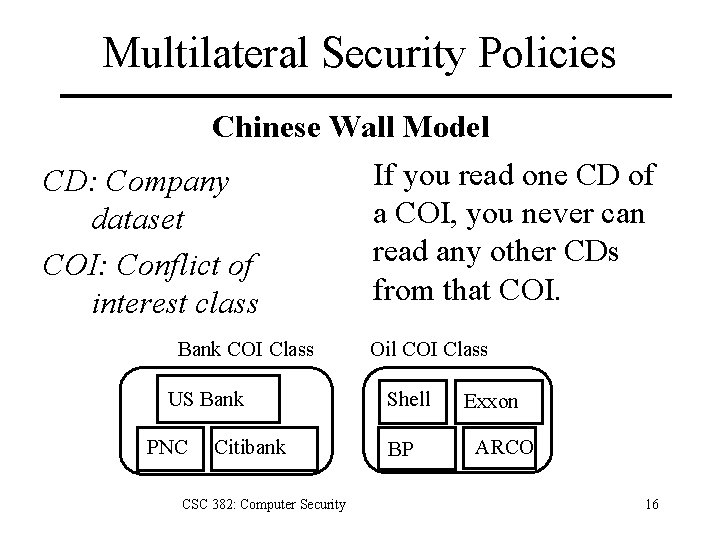
Multilateral Security Policies Chinese Wall Model CD: Company dataset COI: Conflict of interest class Bank COI Class US Bank PNC Citibank CSC 382: Computer Security If you read one CD of a COI, you never can read any other CDs from that COI. Oil COI Class Shell BP Exxon ARCO 16
Policy Languages • Express security policies in a precise way. • High-level languages – Policy constraints expressed abstractly. • Low-level languages – Policy constraints expressed in terms of program options, input, or specific characteristics of entities on system. CSC 382: Computer Security 17
High-Level Policy Languages • Constraints expressed independent of enforcement mechanism. • Constraints restrict entities, actions. • Constraints expressed unambiguously – Requires a precise language, usually a mathematical, logical, or programming-like language. CSC 382: Computer Security 18
Example: Web Browser • Goal: restrict actions of Java programs that are downloaded and executed under control of web browser. • Policy language specific to Java programs. • Expresses constraints as conditions restricting invocation of entities. CSC 382: Computer Security 19
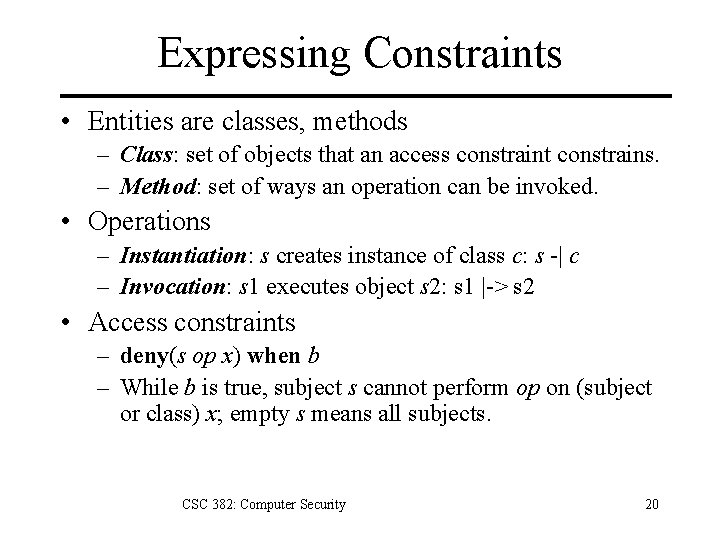
Expressing Constraints • Entities are classes, methods – Class: set of objects that an access constraint constrains. – Method: set of ways an operation can be invoked. • Operations – Instantiation: s creates instance of class c: s -| c – Invocation: s 1 executes object s 2: s 1 |-> s 2 • Access constraints – deny(s op x) when b – While b is true, subject s cannot perform op on (subject or class) x; empty s means all subjects. CSC 382: Computer Security 20
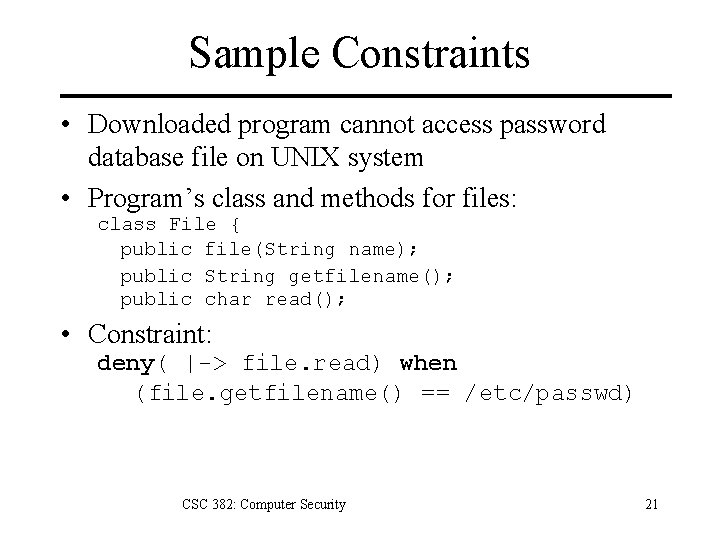
Sample Constraints • Downloaded program cannot access password database file on UNIX system • Program’s class and methods for files: class File { public file(String name); public String getfilename(); public char read(); • Constraint: deny( |-> file. read) when (file. getfilename() == /etc/passwd) CSC 382: Computer Security 21
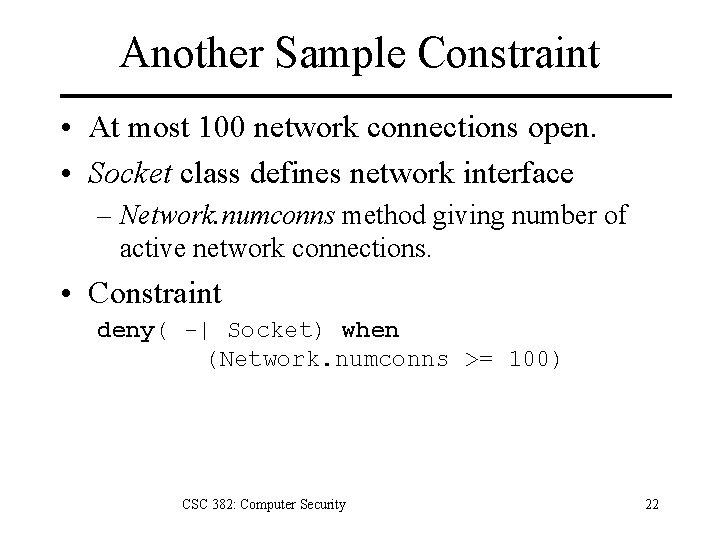
Another Sample Constraint • At most 100 network connections open. • Socket class defines network interface – Network. numconns method giving number of active network connections. • Constraint deny( -| Socket) when (Network. numconns >= 100) CSC 382: Computer Security 22
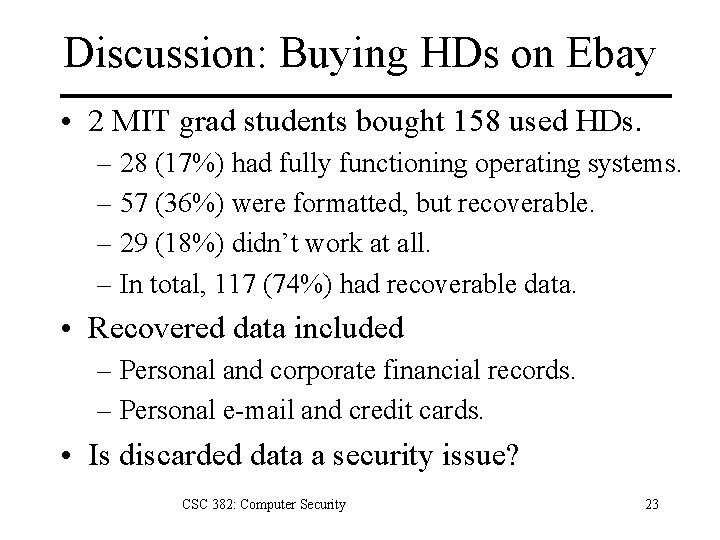
Discussion: Buying HDs on Ebay • 2 MIT grad students bought 158 used HDs. – 28 (17%) had fully functioning operating systems. – 57 (36%) were formatted, but recoverable. – 29 (18%) didn’t work at all. – In total, 117 (74%) had recoverable data. • Recovered data included – Personal and corporate financial records. – Personal e-mail and credit cards. • Is discarded data a security issue? CSC 382: Computer Security 23
Low-Level Policy Languages • Set of inputs or arguments to commands. – Check or set constraints on system. • Low level of abstraction. – Need details of system, commands. CSC 382: Computer Security 24
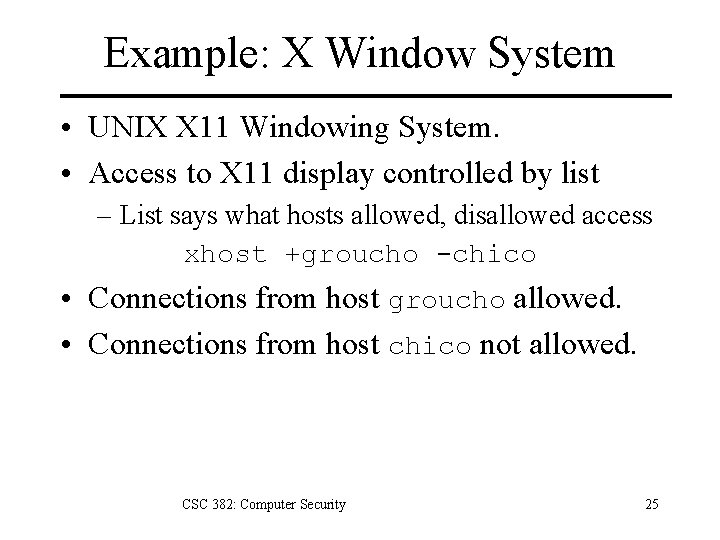
Example: X Window System • UNIX X 11 Windowing System. • Access to X 11 display controlled by list – List says what hosts allowed, disallowed access xhost +groucho -chico • Connections from host groucho allowed. • Connections from host chico not allowed. CSC 382: Computer Security 25
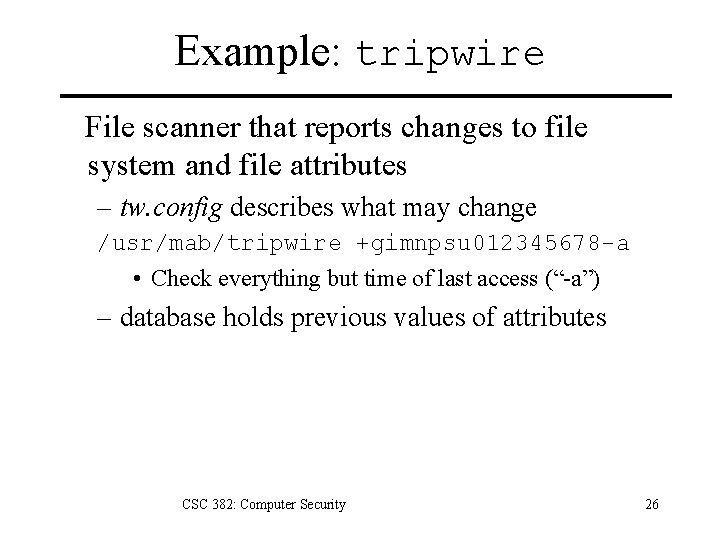
Example: tripwire File scanner that reports changes to file system and file attributes – tw. config describes what may change /usr/mab/tripwire +gimnpsu 012345678 -a • Check everything but time of last access (“-a”) – database holds previous values of attributes CSC 382: Computer Security 26
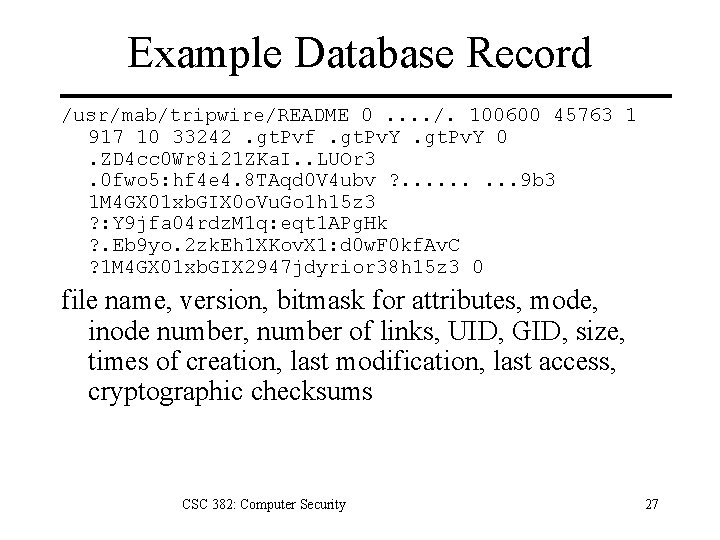
Example Database Record /usr/mab/tripwire/README 0. . /. 100600 45763 1 917 10 33242. gt. Pvf. gt. Pv. Y 0. ZD 4 cc 0 Wr 8 i 21 ZKa. I. . LUOr 3. 0 fwo 5: hf 4 e 4. 8 TAqd 0 V 4 ubv ? . . 9 b 3 1 M 4 GX 01 xb. GIX 0 o. Vu. Go 1 h 15 z 3 ? : Y 9 jfa 04 rdz. M 1 q: eqt 1 APg. Hk ? . Eb 9 yo. 2 zk. Eh 1 XKov. X 1: d 0 w. F 0 kf. Av. C ? 1 M 4 GX 01 xb. GIX 2947 jdyrior 38 h 15 z 3 0 file name, version, bitmask for attributes, mode, inode number, number of links, UID, GID, size, times of creation, last modification, last access, cryptographic checksums CSC 382: Computer Security 27
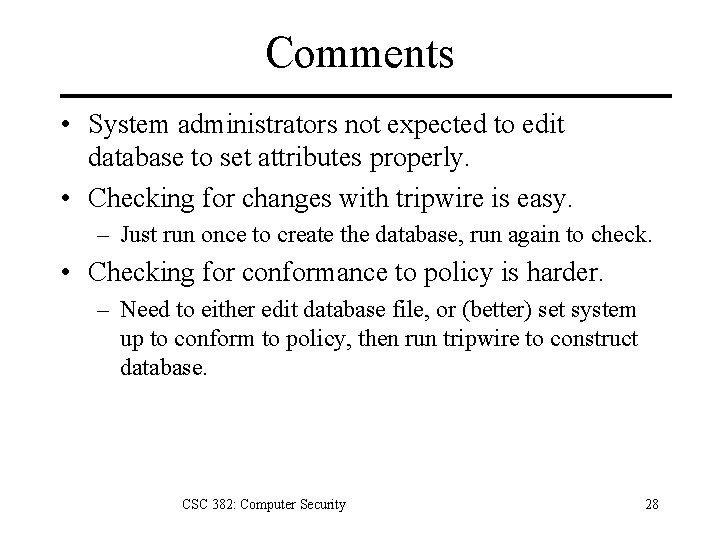
Comments • System administrators not expected to edit database to set attributes properly. • Checking for changes with tripwire is easy. – Just run once to create the database, run again to check. • Checking for conformance to policy is harder. – Need to either edit database file, or (better) set system up to conform to policy, then run tripwire to construct database. CSC 382: Computer Security 28
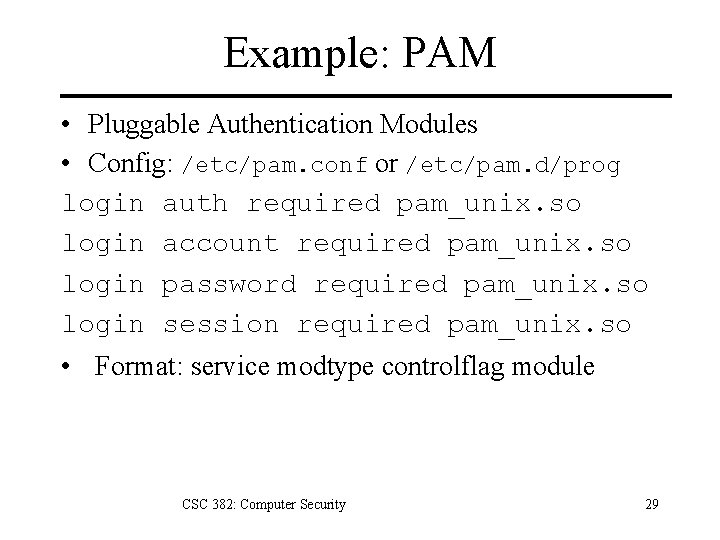
Example: PAM • Pluggable Authentication Modules • Config: /etc/pam. conf or /etc/pam. d/prog login auth required pam_unix. so login account required pam_unix. so login password required pam_unix. so login session required pam_unix. so • Format: service modtype controlflag module CSC 382: Computer Security 29
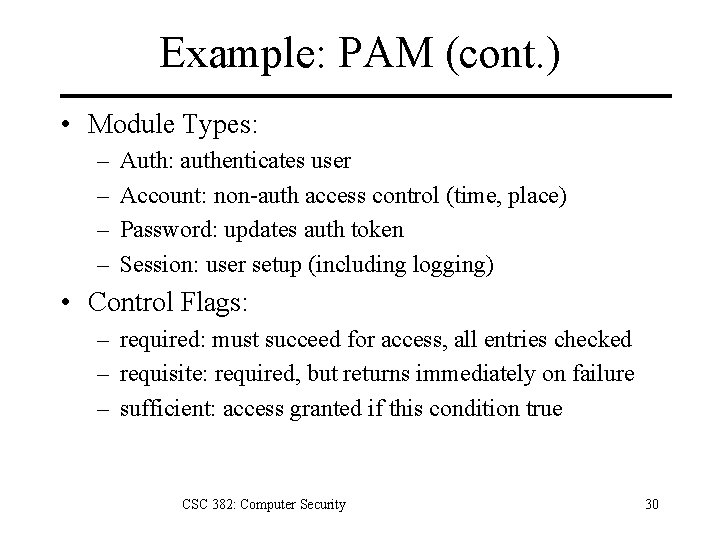
Example: PAM (cont. ) • Module Types: – – Auth: authenticates user Account: non-auth access control (time, place) Password: updates auth token Session: user setup (including logging) • Control Flags: – required: must succeed for access, all entries checked – requisite: required, but returns immediately on failure – sufficient: access granted if this condition true CSC 382: Computer Security 30
Key Points • Policies describe what is allowed. • Mechanisms control how policies are enforced. • Types of Access Control – Discretionary (DAC) – Mandatory (MAC) – Originator Based (ORBAC) • Trust underlies everything. CSC 382: Computer Security 31
References 1. Anderson, Ross, Security Engineering, Wiley, 2001. 2. David E. Bell and Leonard J. La. Padula, Secure Computer System: Unified Exposition and MULTICS Interpretation, MTR-2997 Rev. 1, The MITRE Corporation, Bedford, MA 01730 (Mar. 1976) http: //csrc. nist. gov/publications/history/bell 76. pdf 3. Bishop, Matt, Introduction to Computer Security, Addison. Wesley, 2005. 4. Department of Defense, Trusted Computer System Evaluation Criteria, Do. D 5200. 28 -STD (“Orange Book”), National Computer Security Center, Ft. Meade, MD 20755 (Dec. 1985) http: //csrc. nist. gov/publications/history/dod 85. pdf 5. Peter Loscocco and Stephen Smalley, “Integrating Flexible Support for Security Policies into the Linux Operating System, ” Proceedings of the FREENIX Track of the 2001 USENIX Annual Technical Conference, 2001. CSC 382: Computer Security 32