
CSC 322 Operating Systems Concepts Lecture 4 by
CSC 322 Operating Systems Concepts Lecture - 4: by Ahmed Mumtaz Mustehsan Special Thanks To: Tanenbaum, Modern Operating Systems 3 e, (c) 2008 Prentice-Hall, Inc. (Chapter-1) Ahmed Mumtaz Mustehsan, CIIT, Islamabad
Processes • A process is a Program in execution. • A process is fundamentally a container that holds all the information needed to run a program. • It requires a system call to create and delete a process. • Address space of a process (0 to maximum memory a process can access. ) Address space contains: • The instructions, the data, stack, a set of resources, registers (including PC and SP), a list of open files, set alarms, lists of related processes, and other information needed to run the program. Lecture 4 Ahmed Mumtaz Mustehsan, CIIT, Islamabad 2
Processes Process Table: (Data structure one per process) • Operating system table called the process table, which is an array (or linked list) of structures, • One for each process currently in existence. • Keeps info about process other than the contents of its own address space Context Switching: • OS stops one process and starts another • When a process is suspended temporarily, it must later be restarted in exactly the same state it had when it was stopped. Lecture 4 Ahmed Mumtaz Mustehsan, CIIT, Islamabad 3
Inter Process Communication (IPC) • A process can communicate with another process called Inter process communications. (IPC) • process can communicate with each other on the same computer or across the network. • Different methods exists for IPC. • Process has a UID’s and group ID’s (GID) that uniquely identifies each project. Lecture 4 Ahmed Mumtaz Mustehsan, CIIT, Islamabad 4
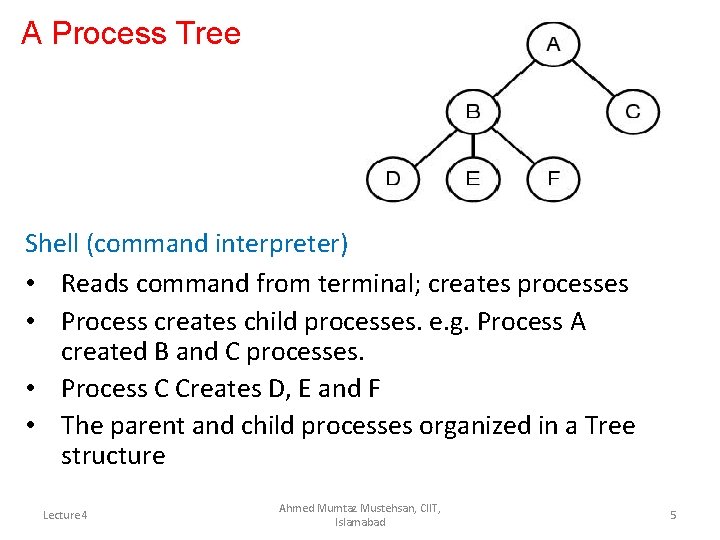
A Process Tree Shell (command interpreter) • Reads command from terminal; creates processes • Process creates child processes. e. g. Process A created B and C processes. • Process C Creates D, E and F • The parent and child processes organized in a Tree structure Lecture 4 Ahmed Mumtaz Mustehsan, CIIT, Islamabad 5
File System • OS hides the peculiarities of the disks and other I/O devices and present the programmer with a nice, clean abstract model of device independent files • Directory as a way of grouping files together. • Directory hierarchy can be specified by giving its path name from the top of the directory called the root directory. • Absolute path names consist of the list of directories that must be traversed from the root directory to get to the file, with slashes separating the components • Requires system calls to create a file, delete a file, open and close a file. Lecture 4 Ahmed Mumtaz Mustehsan, CIIT, Islamabad 6
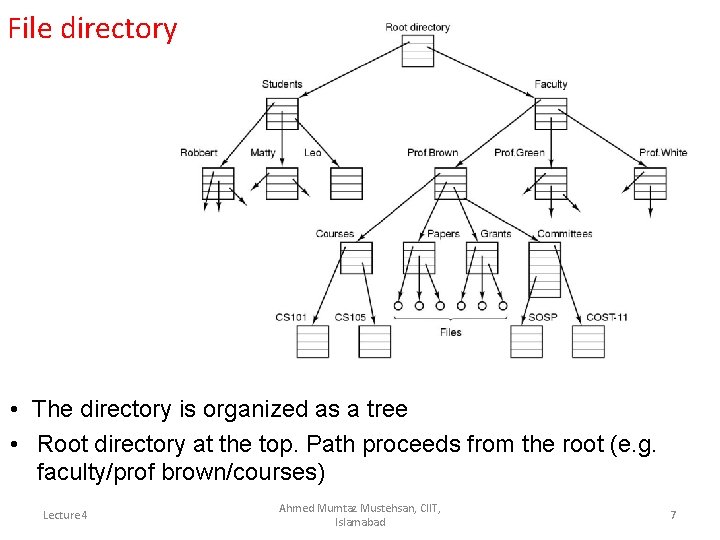
File directory • The directory is organized as a tree • Root directory at the top. Path proceeds from the root (e. g. faculty/prof brown/courses) Lecture 4 Ahmed Mumtaz Mustehsan, CIIT, Islamabad 7
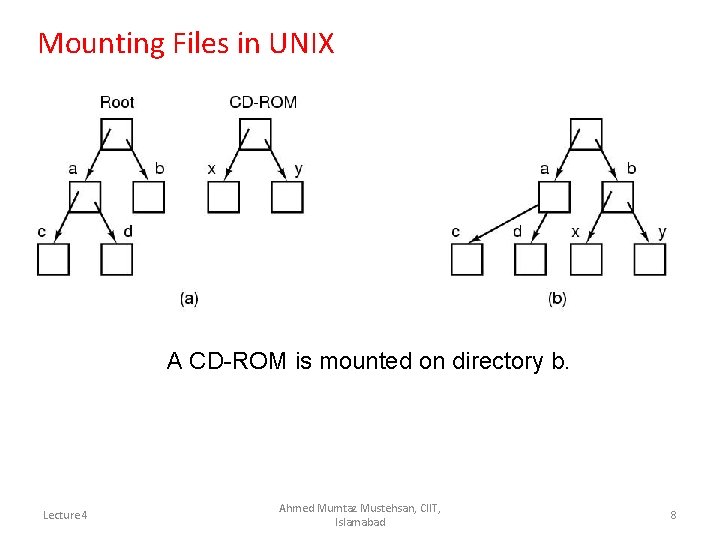
Mounting Files in UNIX A CD-ROM is mounted on directory b. Lecture 4 Ahmed Mumtaz Mustehsan, CIIT, Islamabad 8
Special files • Special files are provided in order to make I/O devices look like files • Use same calls for I/O as for files, OS treats them as files. • Block special files (disks) • Character special files (line printers, modems) Example: UNIX mount command mount at location or address /dev e. g. /dev/lp is line printer Lecture 4 Ahmed Mumtaz Mustehsan, CIIT, Islamabad 9
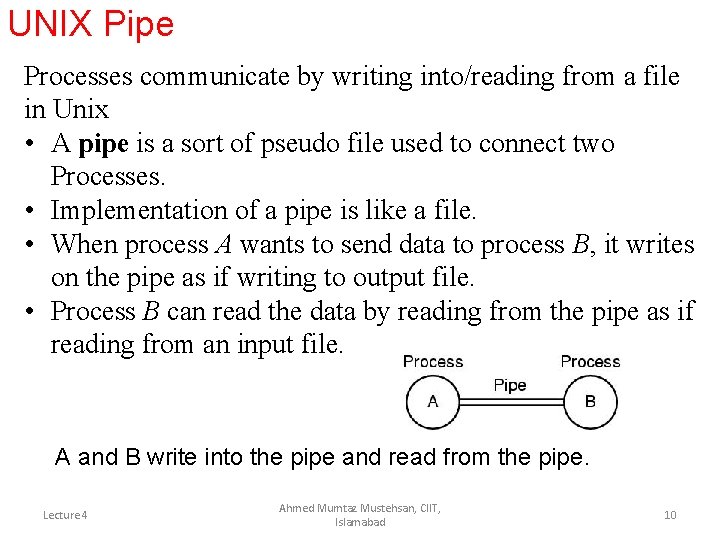
UNIX Pipe Processes communicate by writing into/reading from a file in Unix • A pipe is a sort of pseudo file used to connect two Processes. • Implementation of a pipe is like a file. • When process A wants to send data to process B, it writes on the pipe as if writing to output file. • Process B can read the data by reading from the pipe as if reading from an input file. A and B write into the pipe and read from the pipe. Lecture 4 Ahmed Mumtaz Mustehsan, CIIT, Islamabad 10
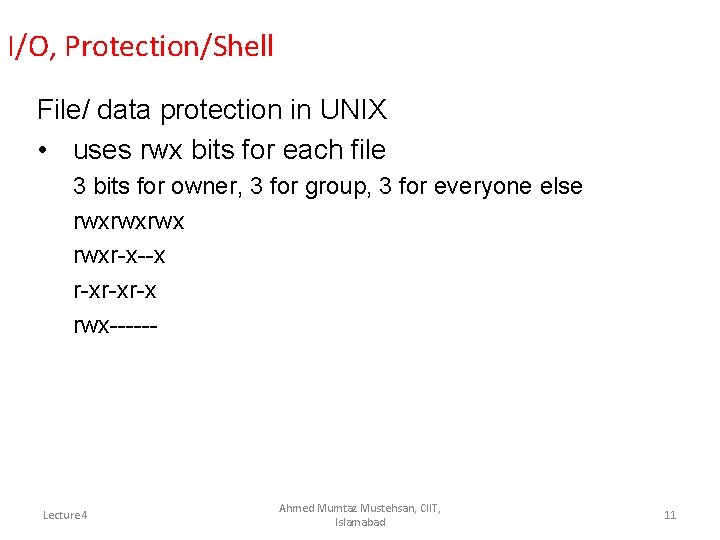
I/O, Protection/Shell File/ data protection in UNIX • uses rwx bits for each file 3 bits for owner, 3 for group, 3 for everyone else rwxrwxrwx rwxr-x--x r-xr-xr-x rwx------ Lecture 4 Ahmed Mumtaz Mustehsan, CIIT, Islamabad 11
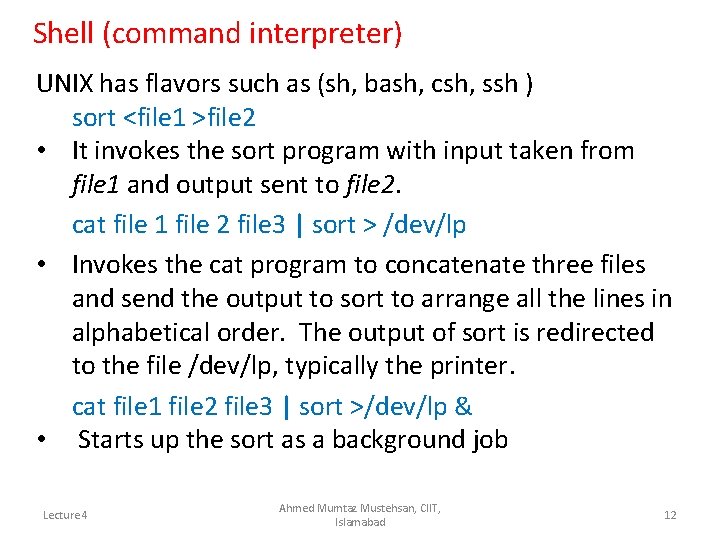
Shell (command interpreter) UNIX has flavors such as (sh, bash, csh, ssh ) sort <file 1 >file 2 • It invokes the sort program with input taken from file 1 and output sent to file 2. cat file 1 file 2 file 3 | sort > /dev/lp • Invokes the cat program to concatenate three files and send the output to sort to arrange all the lines in alphabetical order. The output of sort is redirected to the file /dev/lp, typically the printer. cat file 1 file 2 file 3 | sort >/dev/lp & • Starts up the sort as a background job Lecture 4 Ahmed Mumtaz Mustehsan, CIIT, Islamabad 12
System Calls • • • Interface between user programs and OS Varies from Operating system to operating system call is issued by user program Call uses a library procedure of the same name Library routine puts machine into kernel modes (by issuing a special instruction) • Finds actual routine for system call in a table • Does the work involved in the call • Returns to user program Lecture 4 Ahmed Mumtaz Mustehsan, CIIT, Islamabad 13
UNIX Read System Call count = read (fd, buffer, nbytes) • fd is a file descriptor. When a file is opened, permissions are checked. If access is allowed, a number (fd) is returned. Then file can be read/written • nbytes is number of bytes in file • buffer is where read deposits the bytes (call be reference) Lecture 4 Ahmed Mumtaz Mustehsan, CIIT, Islamabad 14
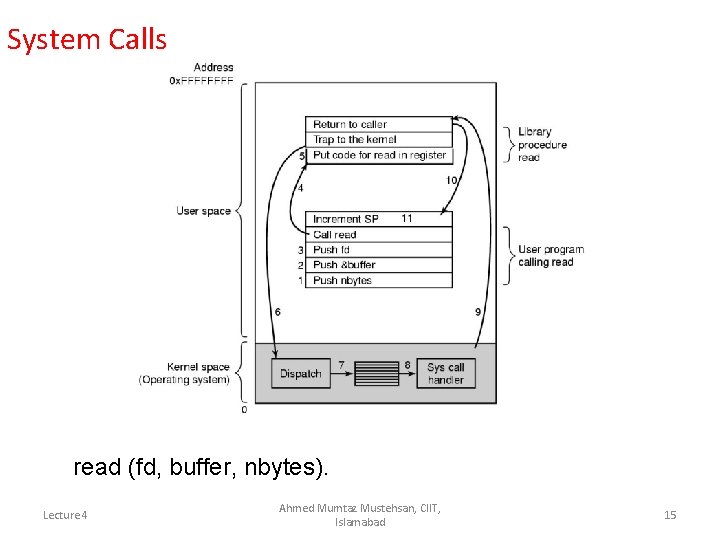
System Calls read (fd, buffer, nbytes). Lecture 4 Ahmed Mumtaz Mustehsan, CIIT, Islamabad 15
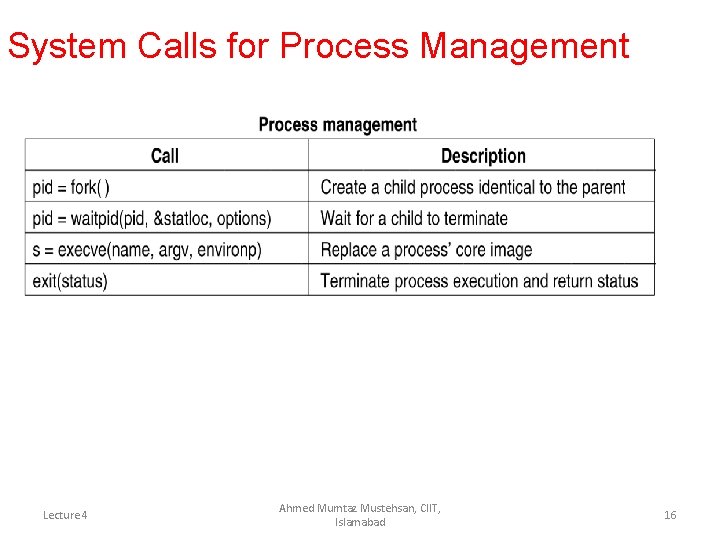
System Calls for Process Management Lecture 4 Ahmed Mumtaz Mustehsan, CIIT, Islamabad 16
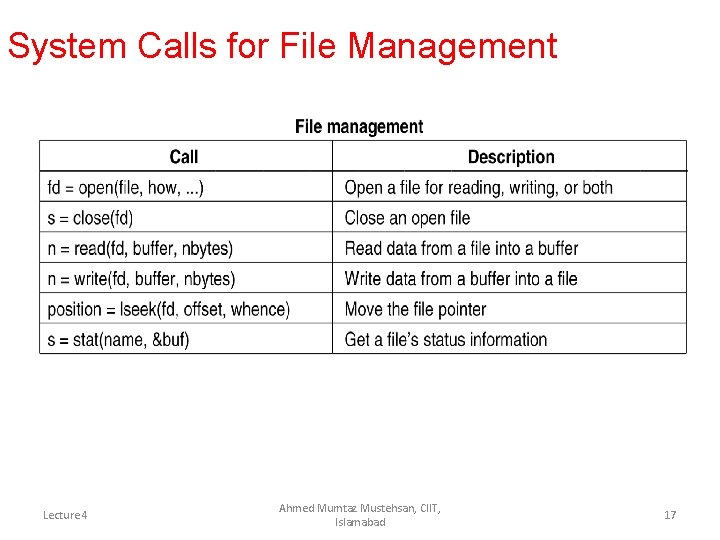
System Calls for File Management . Lecture 4 Ahmed Mumtaz Mustehsan, CIIT, Islamabad 17
File mode System keeps track of it • Regular, special • Date of creation • Size • Access status of file via stat command Lecture 4 Ahmed Mumtaz Mustehsan, CIIT, Islamabad 18
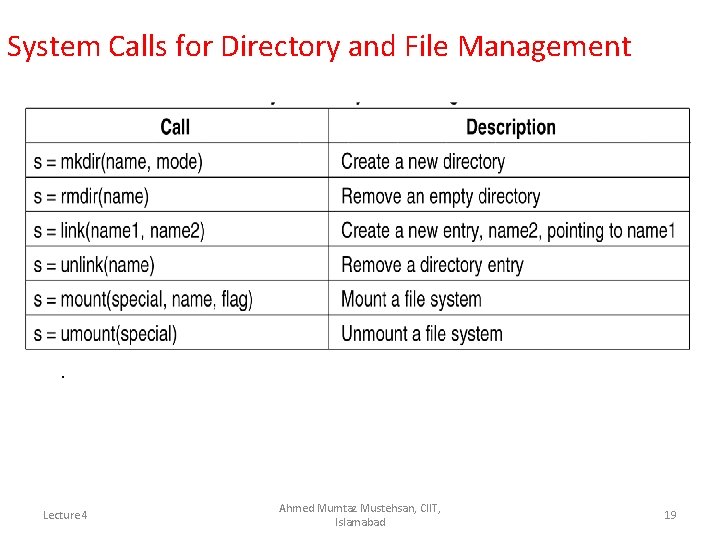
System Calls for Directory and File Management . Lecture 4 Ahmed Mumtaz Mustehsan, CIIT, Islamabad 19
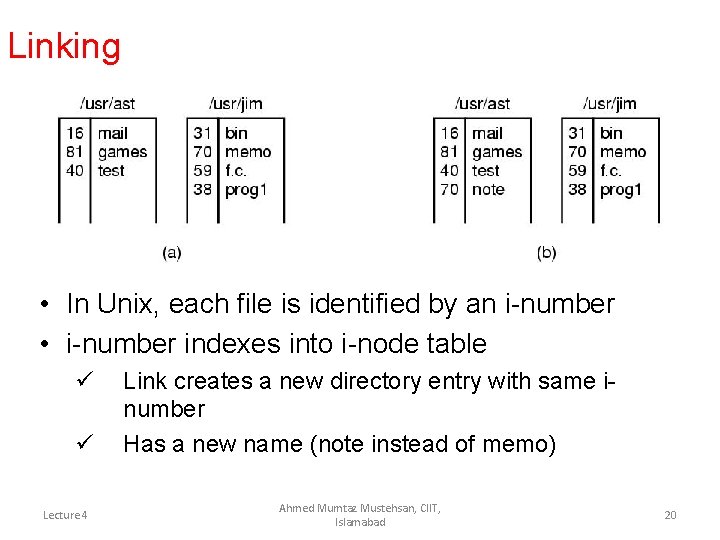
Linking • In Unix, each file is identified by an i-number • i-number indexes into i-node table ü ü Lecture 4 Link creates a new directory entry with same inumber Has a new name (note instead of memo) Ahmed Mumtaz Mustehsan, CIIT, Islamabad 20
Mount System Call • mount(“/dev/fd 0”, “/mnt”, 0) is system call • File comes from drive 0 and is mounted on binary file /mnt. • Third parameter tells if it is read or read-write • Result is that file on drive zero can be accessed from a directory • Saw this example before with CD-same mechanism for memory sticks and portions of hard drives Lecture 4 Ahmed Mumtaz Mustehsan, CIIT, Islamabad 21
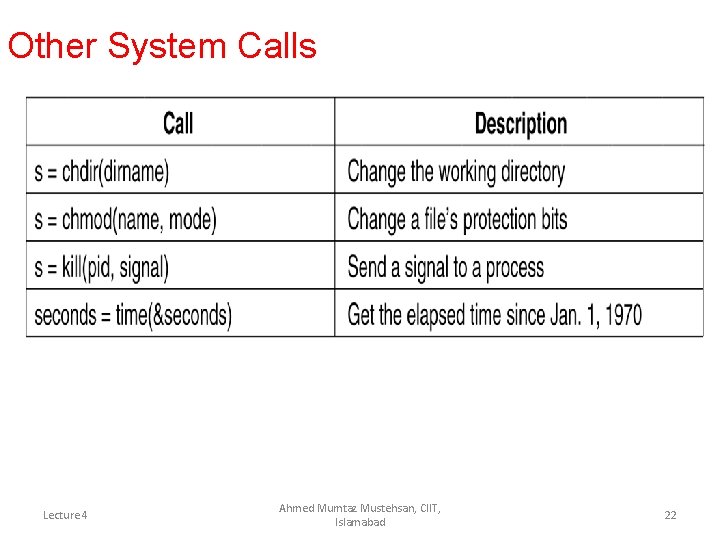
Other System Calls Lecture 4 Ahmed Mumtaz Mustehsan, CIIT, Islamabad 22
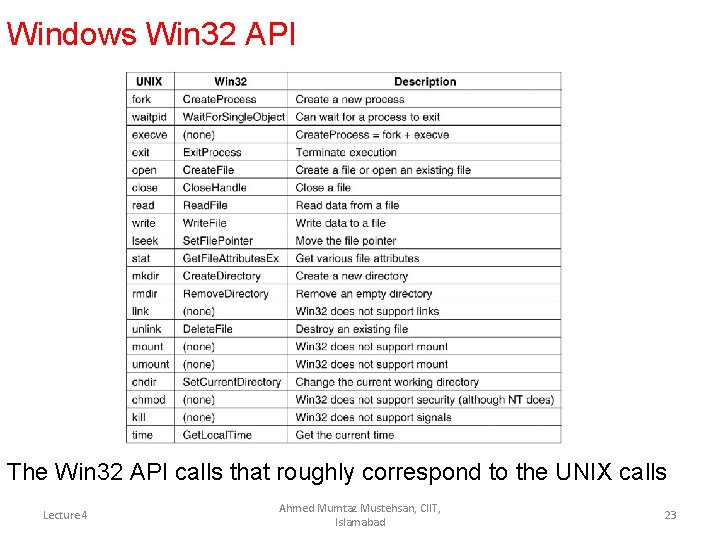
Windows Win 32 API The Win 32 API calls that roughly correspond to the UNIX calls Lecture 4 Ahmed Mumtaz Mustehsan, CIIT, Islamabad 23
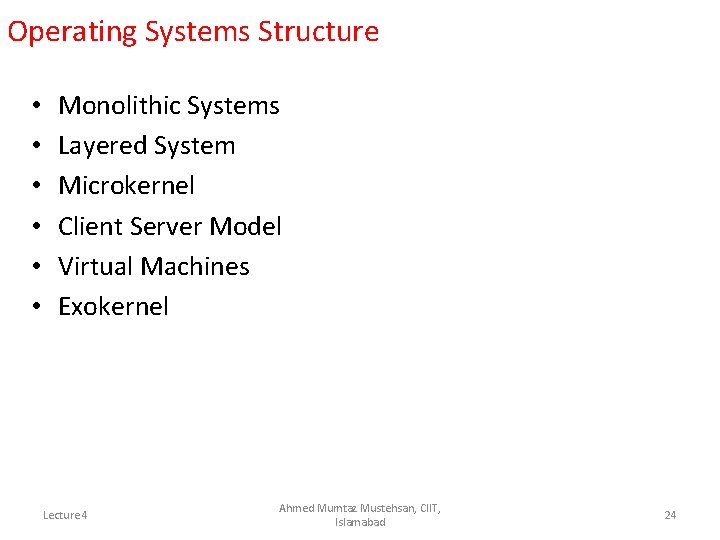
Operating Systems Structure • • • Monolithic Systems Layered System Microkernel Client Server Model Virtual Machines Exokernel Lecture 4 Ahmed Mumtaz Mustehsan, CIIT, Islamabad 24
- Slides: 24