
CSC 270 Survey of Programming Languages C Lecture
- Slides: 43
CSC 270 – Survey of Programming Languages C++ Lecture 3 - Introducing Objects
Object-Oriented Programming • Object-oriented programming (or OOP) attempts to allow the programmer to use data objects in ways that represent how they are viewed in the real world with less attention to the implementation method. • An object is characterized by its name, its properties (values that it contains) and its methods (procedures and operations performed on it).
Principles of OOP There are four main principles of OOP: • Data Abstraction - our main concern is what data represents and not how it is implemented. • Encapsulation - Private information about an object ought not be available the outside world and used only in prespecified ways. • Polymorphism - There may be more than version of a given function, where the different functions share a name but have different parameter lists • Inheritance - New classes of objects can be built from other classes of objects.
Defining A Class of Objects • Defining a class of objects is similar to defining a type of structure, except that we can add functions as well as variables. • By default, any item include is private (available only to functions within the class of objects) unless we include the keyword public.
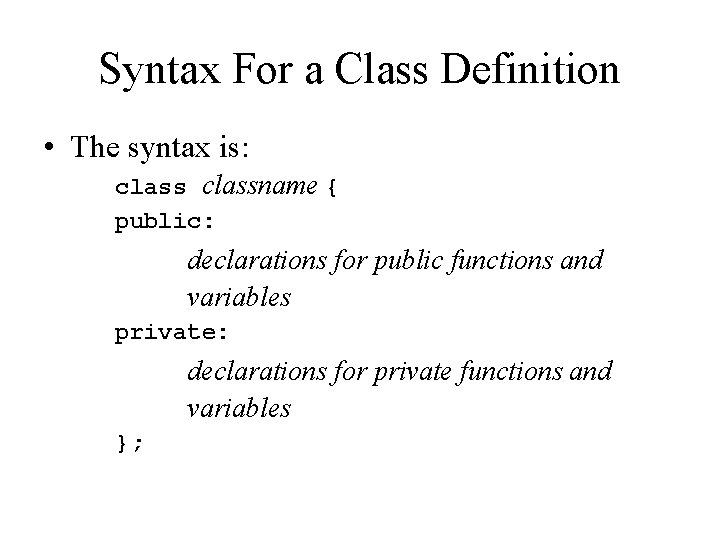
Syntax For a Class Definition • The syntax is: classname { public: declarations for public functions and variables private: declarations for private functions and variables };
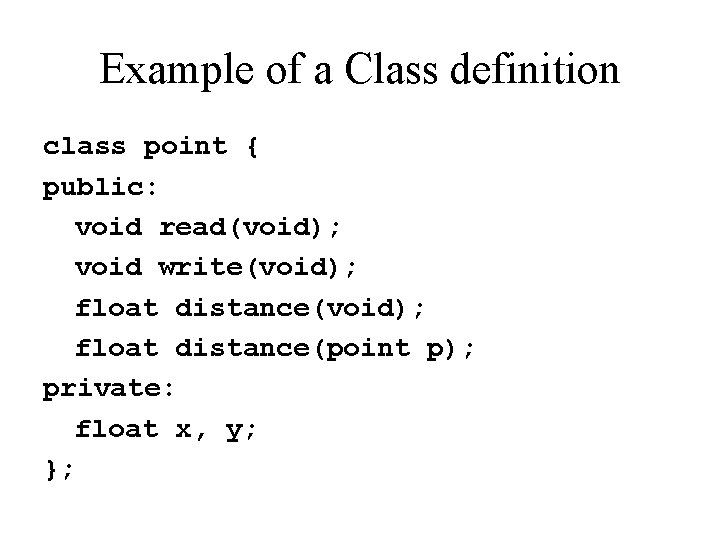
Example of a Class definition class point { public: void read(void); void write(void); float distance(point p); private: float x, y; };
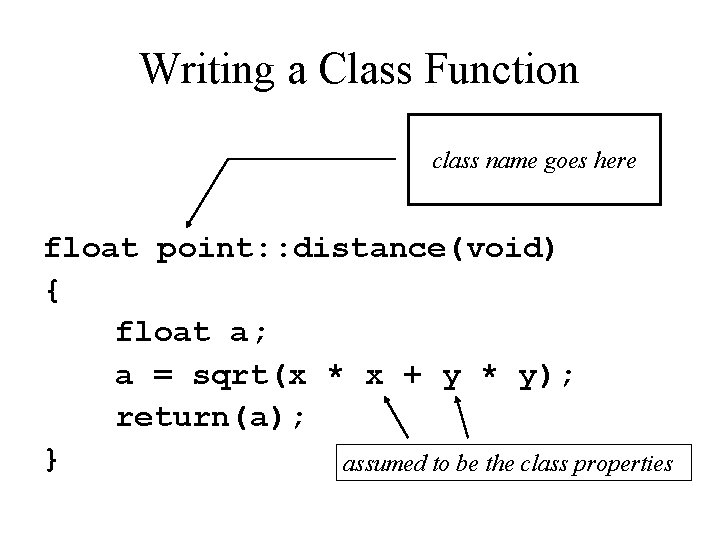
Writing a Class Function class name goes here float point: : distance(void) { float a; a = sqrt(x * x + y * y); return(a); } assumed to be the class properties
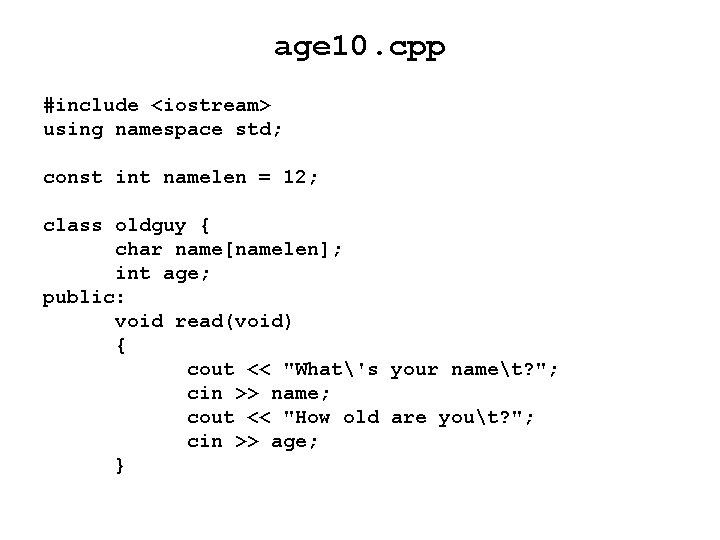
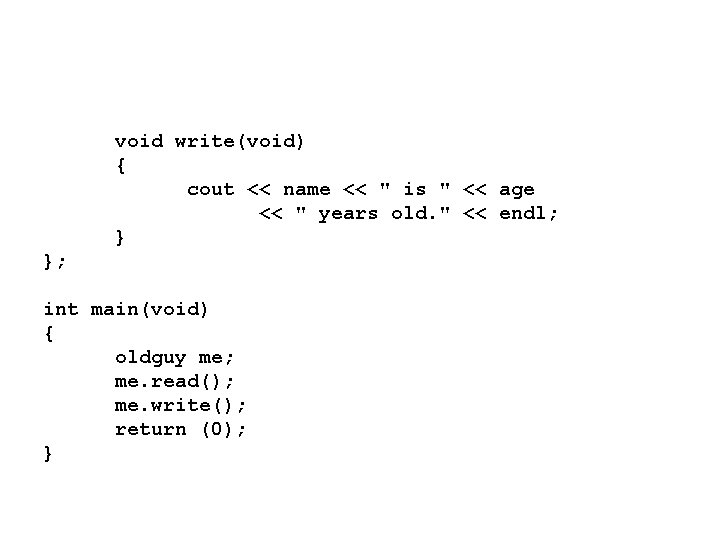
Example: Rewriting the Original Age Program • Let’s rewrite the program that asked for name and age and then printed these items. • There are two data items, both of which should be private: name and age. • There are two procedures, both of which should be public: read and write.
age 10. cpp #include <iostream> using namespace std; const int namelen = 12; class oldguy { char name[namelen]; int age; public: void read(void) { cout << "What's your namet? "; cin >> name; cout << "How old are yout? "; cin >> age; }
void write(void) { cout << name << " is " << age << " years old. " << endl; } }; int main(void) { oldguy me; me. read(); me. write(); return (0); }
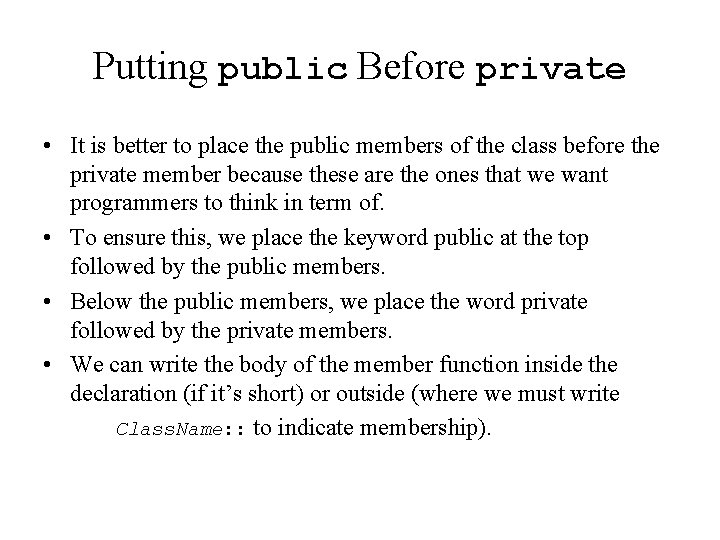
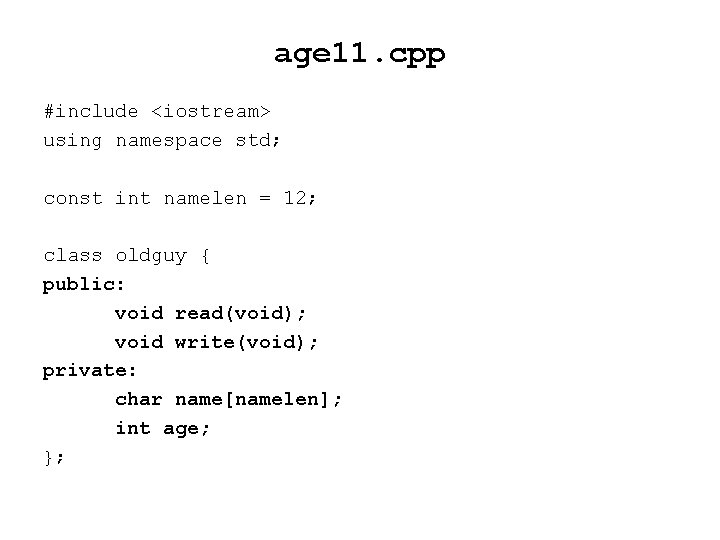
Putting public Before private • It is better to place the public members of the class before the private member because these are the ones that we want programmers to think in term of. • To ensure this, we place the keyword public at the top followed by the public members. • Below the public members, we place the word private followed by the private members. • We can write the body of the member function inside the declaration (if it’s short) or outside (where we must write Class. Name: : to indicate membership).
age 11. cpp #include <iostream> using namespace std; const int namelen = 12; class oldguy { public: void read(void); void write(void); private: char name[namelen]; int age; };
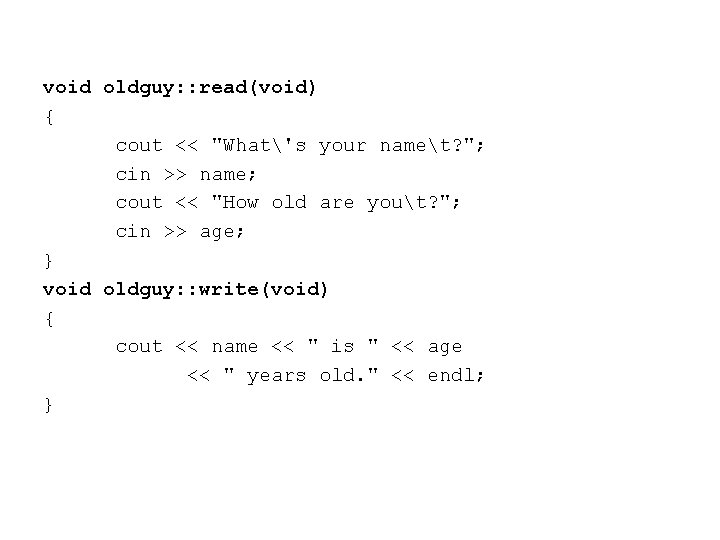
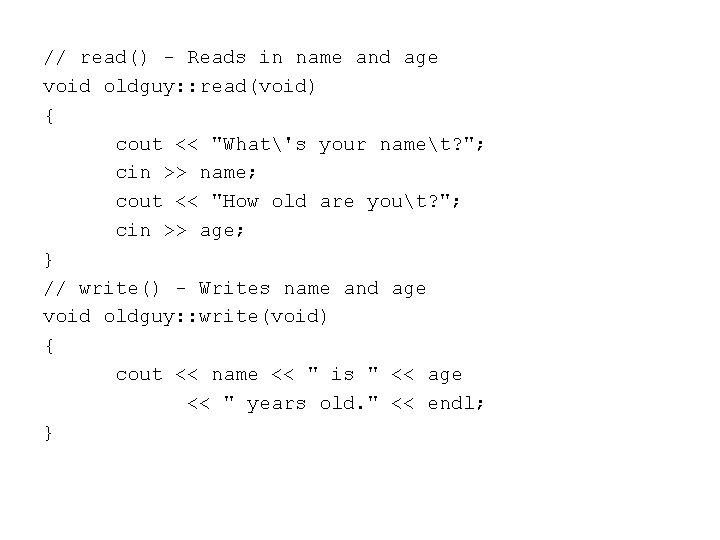
void oldguy: : read(void) { cout << "What's your namet? "; cin >> name; cout << "How old are yout? "; cin >> age; } void oldguy: : write(void) { cout << name << " is " << age << " years old. " << endl; }
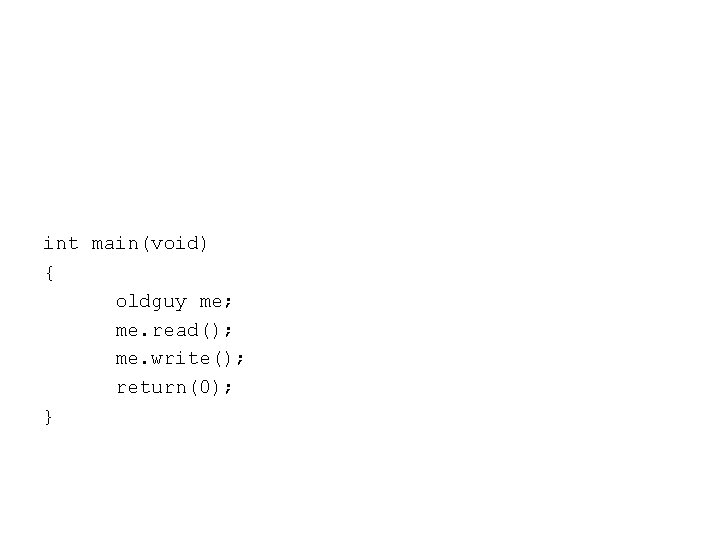
int main(void) { oldguy me; me. read(); me. write(); return(0); }
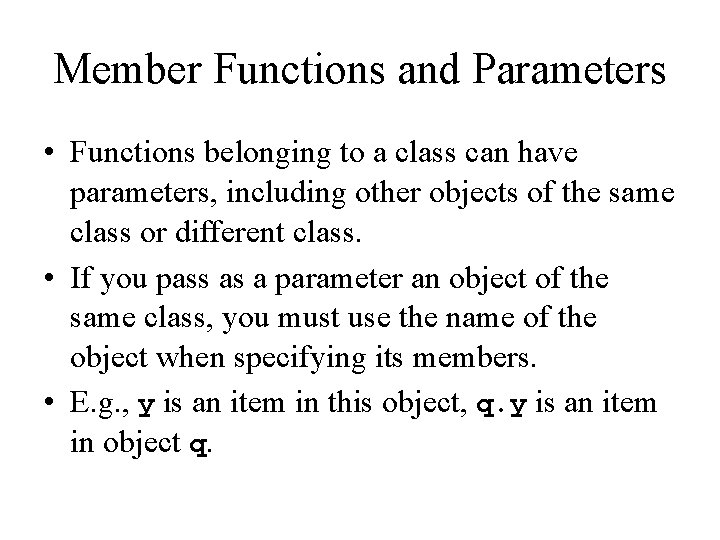
Member Functions and Parameters • Functions belonging to a class can have parameters, including other objects of the same class or different class. • If you pass as a parameter an object of the same class, you must use the name of the object when specifying its members. • E. g. , y is an item in this object, q. y is an item in object q.
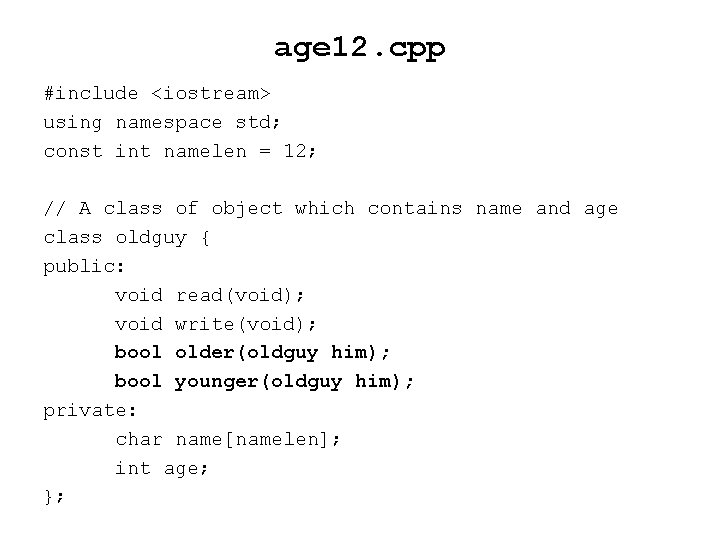
age 12. cpp #include <iostream> using namespace std; const int namelen = 12; // A class of object which contains name and age class oldguy { public: void read(void); void write(void); bool older(oldguy him); bool younger(oldguy him); private: char name[namelen]; int age; };
// read() - Reads in name and age void oldguy: : read(void) { cout << "What's your namet? "; cin >> name; cout << "How old are yout? "; cin >> age; } // write() - Writes name and age void oldguy: : write(void) { cout << name << " is " << age << " years old. " << endl; }
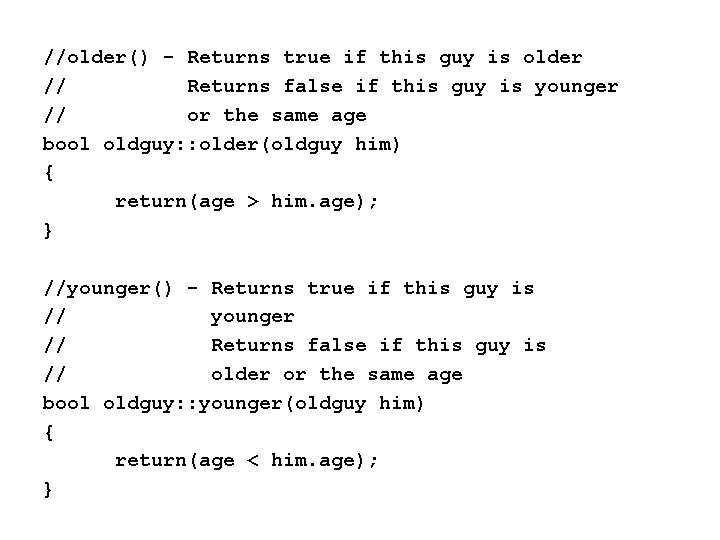
//older() - Returns true if this guy is older // Returns false if this guy is younger // or the same age bool oldguy: : older(oldguy him) { return(age > him. age); } //younger() - Returns true if this guy is // younger // Returns false if this guy is // older or the same age bool oldguy: : younger(oldguy him) { return(age < him. age); }
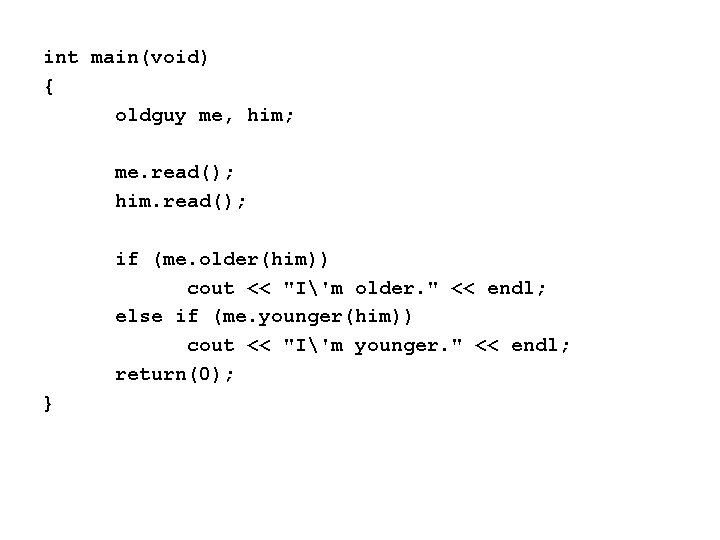
int main(void) { oldguy me, him; me. read(); him. read(); if (me. older(him)) cout << "I'm older. " << endl; else if (me. younger(him)) cout << "I'm younger. " << endl; return(0); }
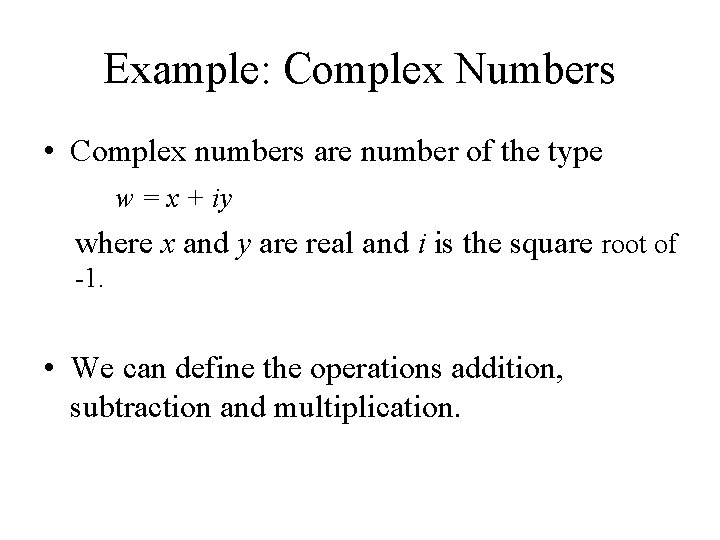
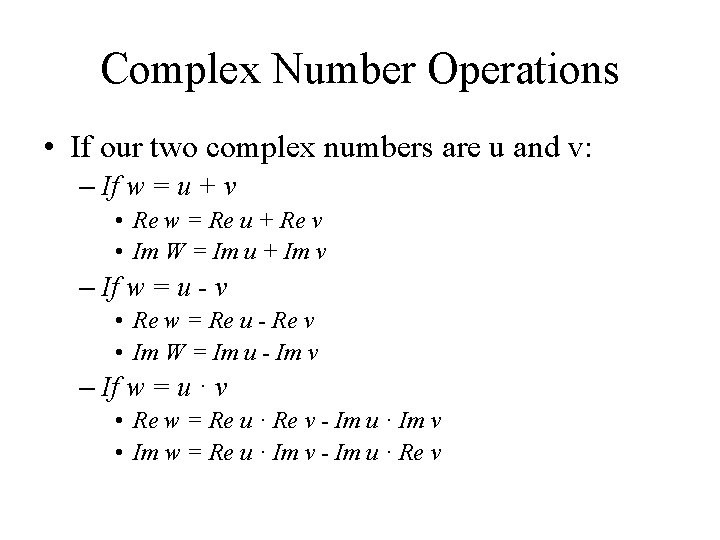
Example: Complex Numbers • Complex numbers are number of the type w = x + iy where x and y are real and i is the square root of -1. • We can define the operations addition, subtraction and multiplication.
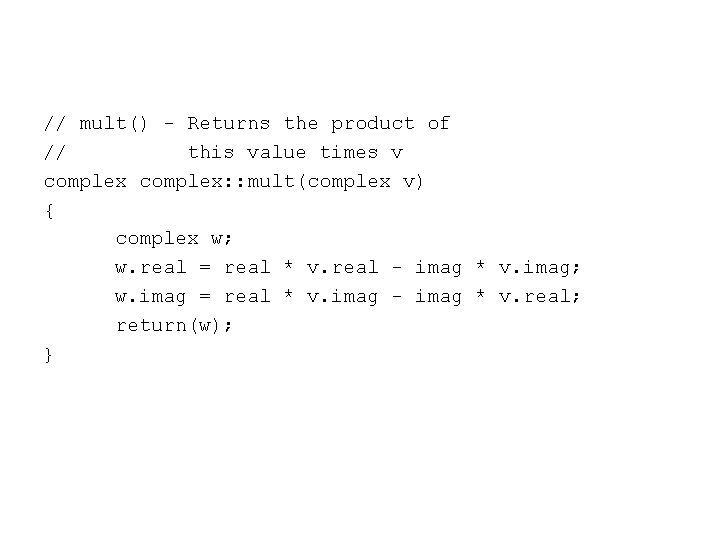
Complex Number Operations • If our two complex numbers are u and v: – If w = u + v • Re w = Re u + Re v • Im W = Im u + Im v – If w = u - v • Re w = Re u - Re v • Im W = Im u - Im v – If w = u · v • Re w = Re u · Re v - Im u · Im v • Im w = Re u · Im v - Im u · Re v
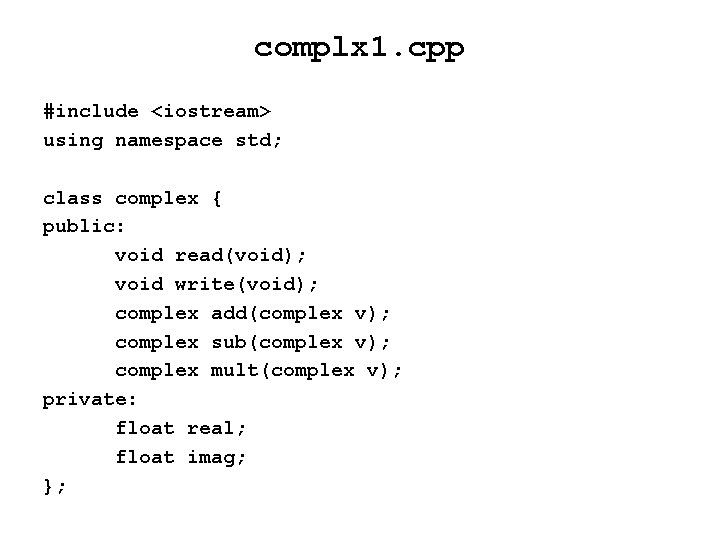
complx 1. cpp #include <iostream> using namespace std; class complex { public: void read(void); void write(void); complex add(complex v); complex sub(complex v); complex mult(complex v); private: float real; float imag; };
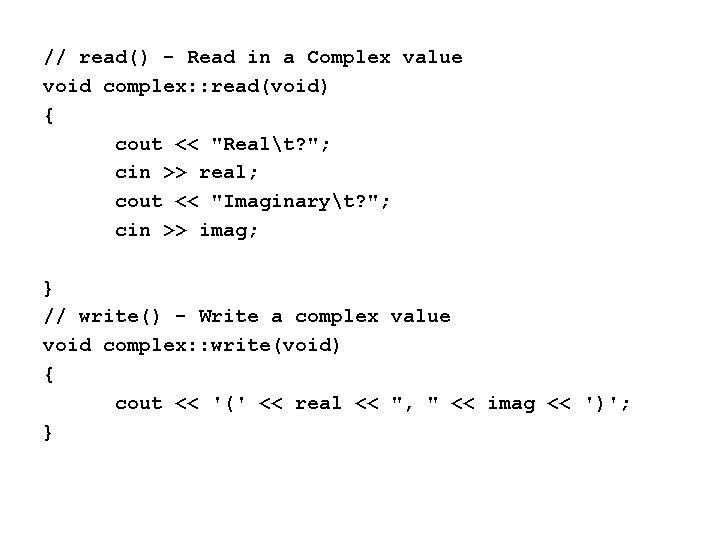
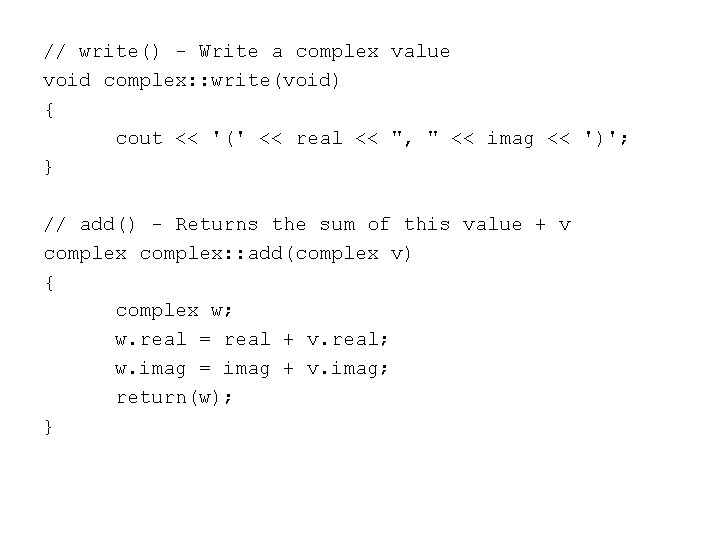
// read() - Read in a Complex value void complex: : read(void) { cout << "Realt? "; cin >> real; cout << "Imaginaryt? "; cin >> imag; } // write() - Write a complex value void complex: : write(void) { cout << '(' << real << ", " << imag << ')'; }
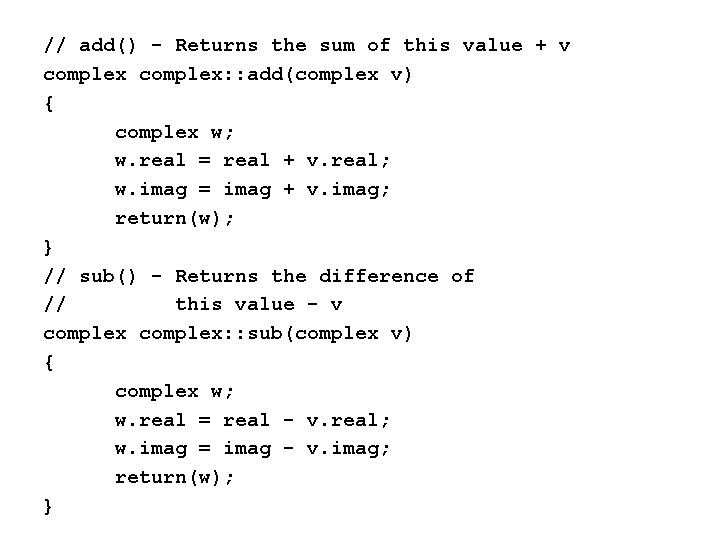
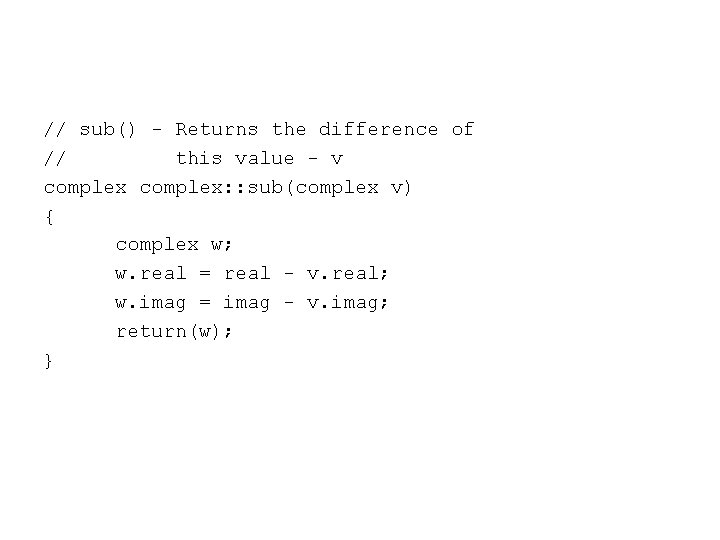
// add() - Returns the sum of this value + v complex: : add(complex v) { complex w; w. real = real + v. real; w. imag = imag + v. imag; return(w); } // sub() - Returns the difference of // this value - v complex: : sub(complex v) { complex w; w. real = real - v. real; w. imag = imag - v. imag; return(w); }
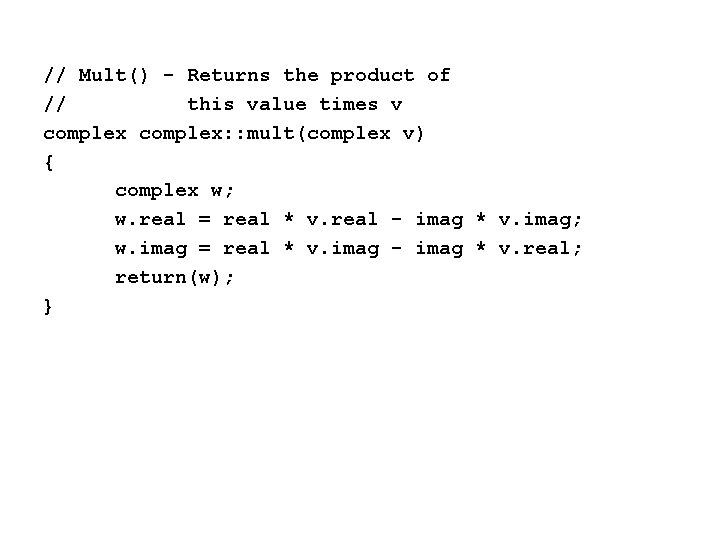
// Mult() - Returns the product of // this value times v complex: : mult(complex v) { complex w; w. real = real * v. real - imag * v. imag; w. imag = real * v. imag - imag * v. real; return(w); }
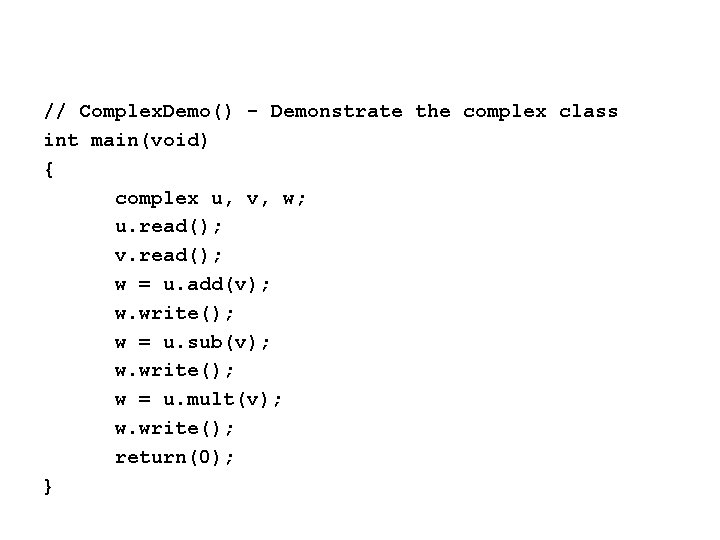
// Complex. Demo() - Demonstrate the complex class int main(void) { complex u, v, w; u. read(); v. read(); w = u. add(v); w. write(); w = u. sub(v); w. write(); w = u. mult(v); w. write(); return(0); }
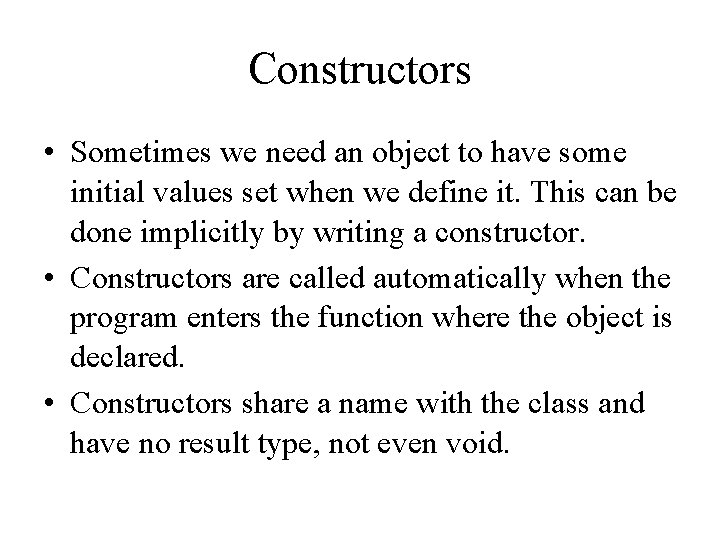
Constructors • Sometimes we need an object to have some initial values set when we define it. This can be done implicitly by writing a constructor. • Constructors are called automatically when the program enters the function where the object is declared. • Constructors share a name with the class and have no result type, not even void.
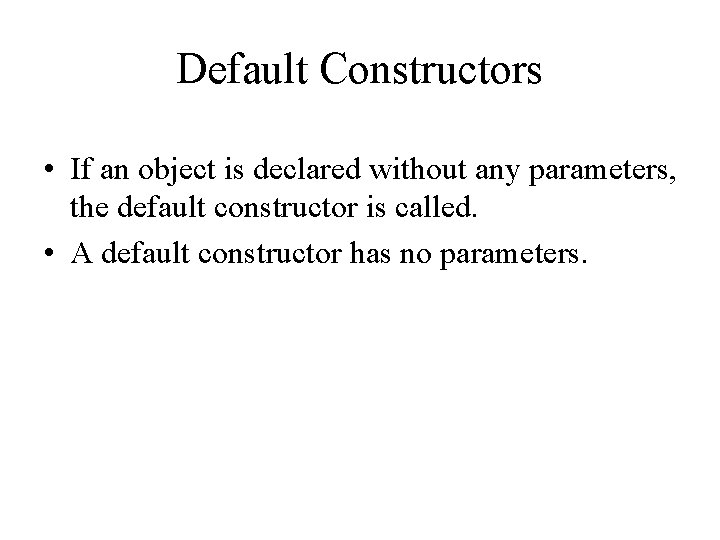
Default Constructors • If an object is declared without any parameters, the default constructor is called. • A default constructor has no parameters.
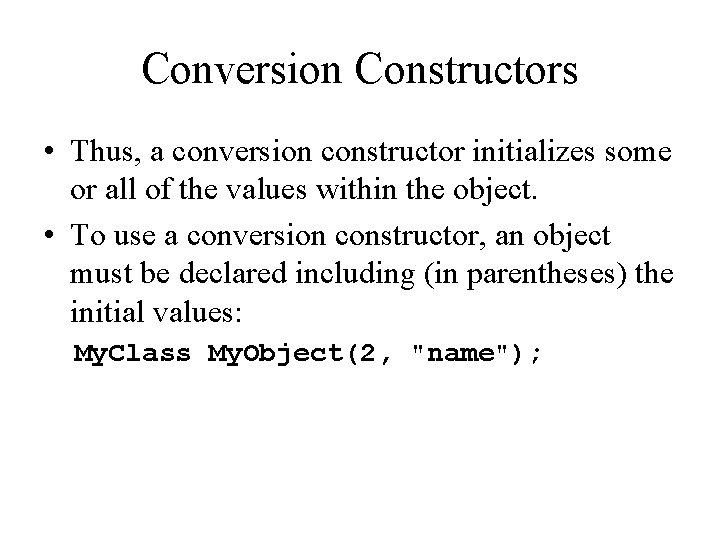
Conversion Constructors • Thus, a conversion constructor initializes some or all of the values within the object. • To use a conversion constructor, an object must be declared including (in parentheses) the initial values: My. Class My. Object(2, "name");
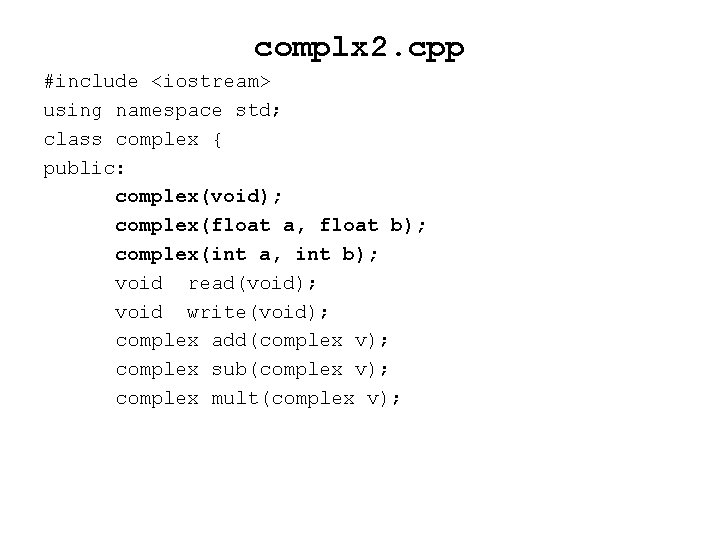
complx 2. cpp #include <iostream> using namespace std; class complex { public: complex(void); complex(float a, float b); complex(int a, int b); void read(void); void write(void); complex add(complex v); complex sub(complex v); complex mult(complex v);
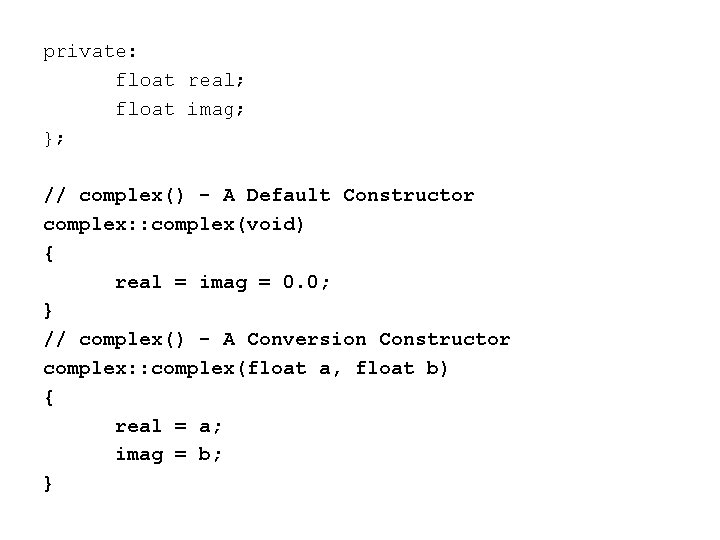
private: float real; float imag; }; // complex() - A Default Constructor complex: : complex(void) { real = imag = 0. 0; } // complex() - A Conversion Constructor complex: : complex(float a, float b) { real = a; imag = b; }
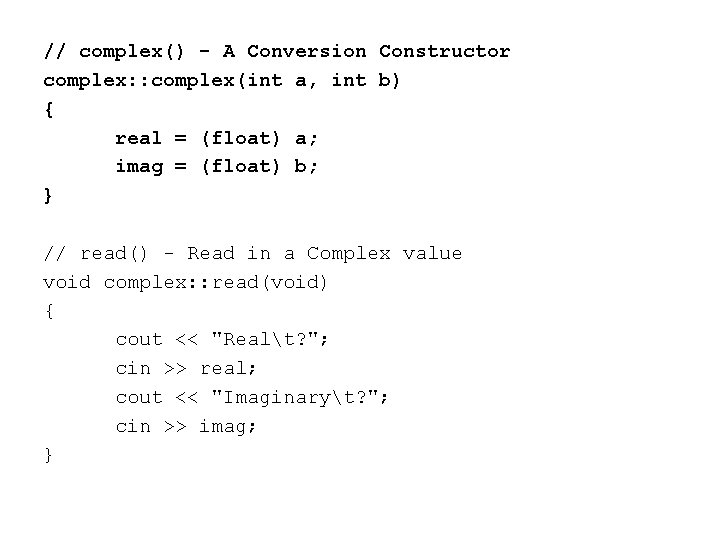
// complex() - A Conversion Constructor complex: : complex(int a, int b) { real = (float) a; imag = (float) b; } // read() - Read in a Complex value void complex: : read(void) { cout << "Realt? "; cin >> real; cout << "Imaginaryt? "; cin >> imag; }
// write() - Write a complex value void complex: : write(void) { cout << '(' << real << ", " << imag << ')'; } // add() - Returns the sum of this value + v complex: : add(complex v) { complex w; w. real = real + v. real; w. imag = imag + v. imag; return(w); }
// sub() - Returns the difference of // this value - v complex: : sub(complex v) { complex w; w. real = real - v. real; w. imag = imag - v. imag; return(w); }
// mult() - Returns the product of // this value times v complex: : mult(complex v) { complex w; w. real = real * v. real - imag * v. imag; w. imag = real * v. imag - imag * v. real; return(w); }
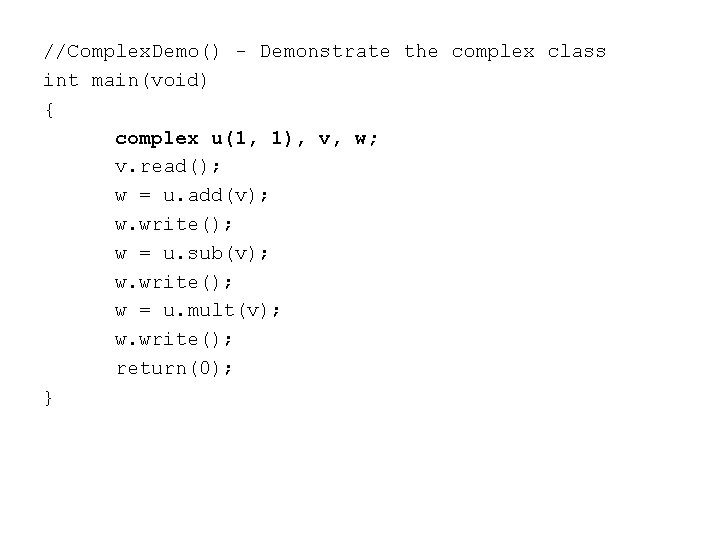
//Complex. Demo() - Demonstrate the complex class int main(void) { complex u(1, 1), v, w; v. read(); w = u. add(v); w. write(); w = u. sub(v); w. write(); w = u. mult(v); w. write(); return(0); }
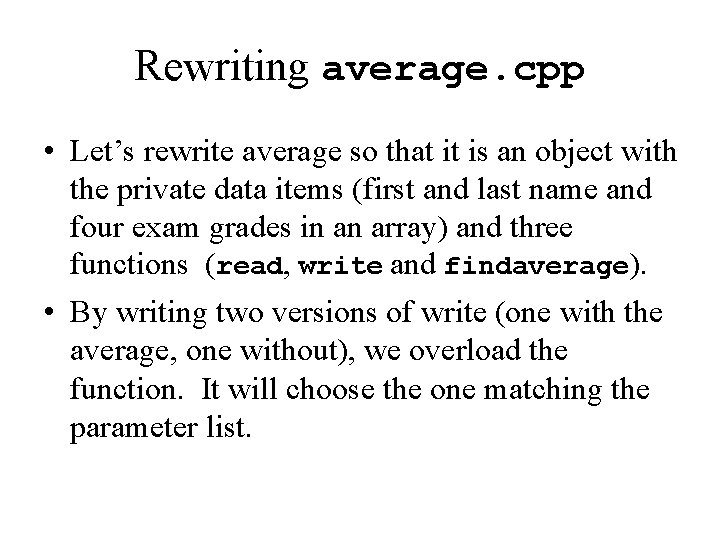
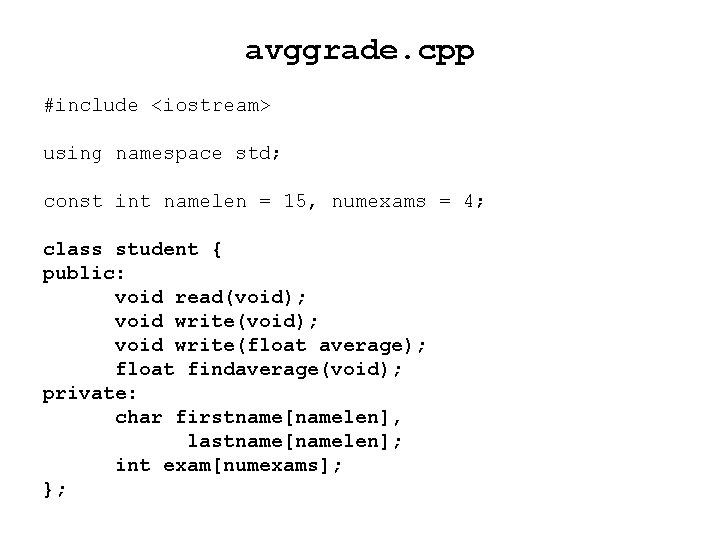
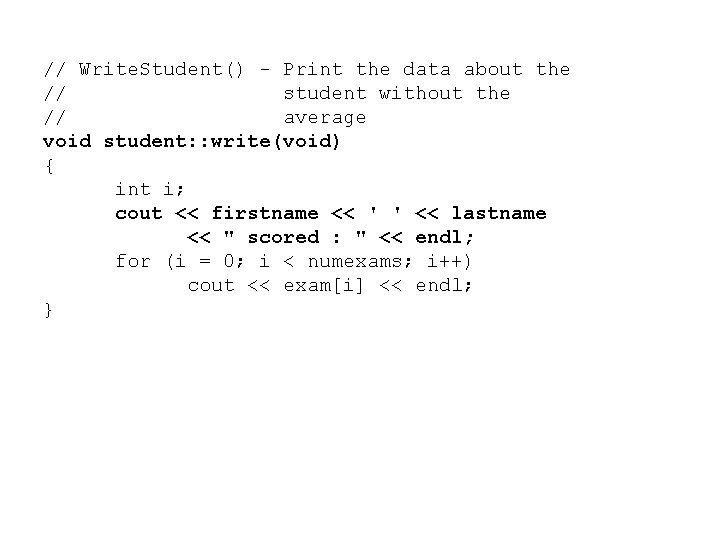
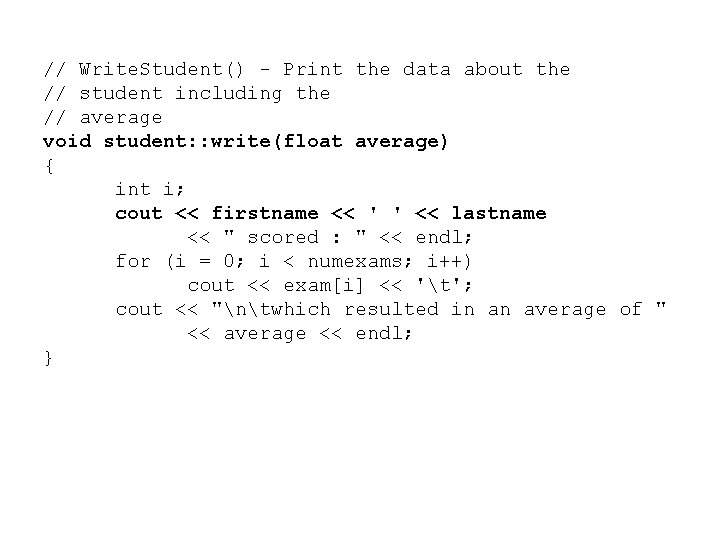
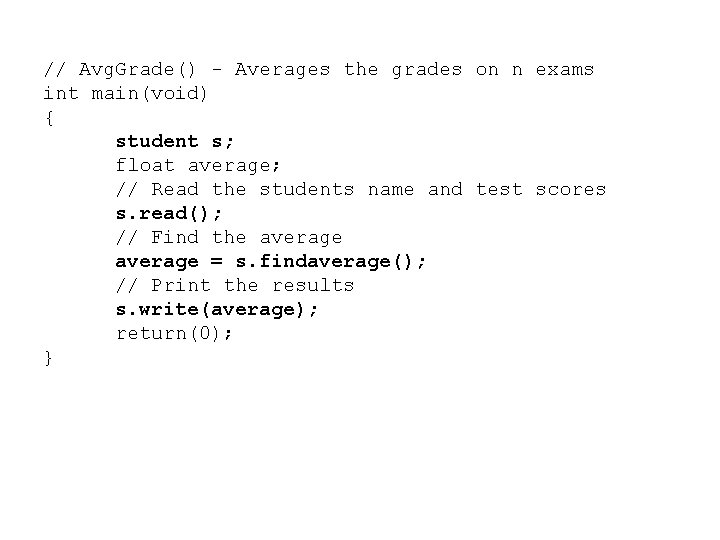
Rewriting average. cpp • Let’s rewrite average so that it is an object with the private data items (first and last name and four exam grades in an array) and three functions (read, write and findaverage). • By writing two versions of write (one with the average, one without), we overload the function. It will choose the one matching the parameter list.
avggrade. cpp #include <iostream> using namespace std; const int namelen = 15, numexams = 4; class student { public: void read(void); void write(float average); float findaverage(void); private: char firstname[namelen], lastname[namelen]; int exam[numexams]; };
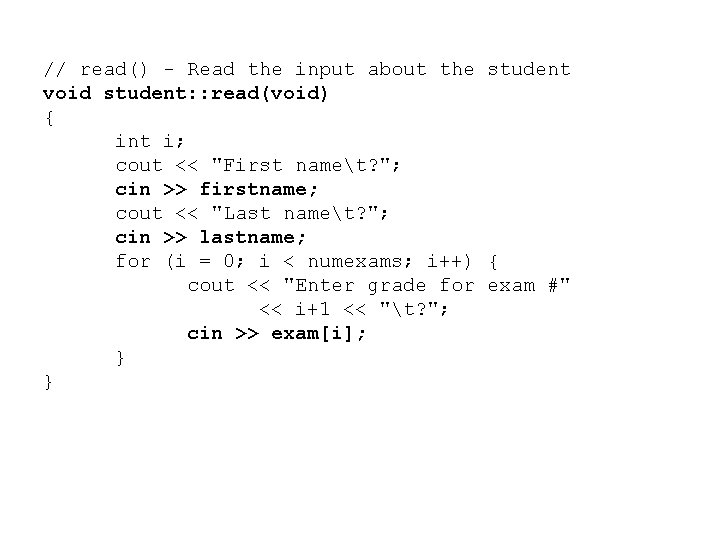
// read() - Read the input about the student void student: : read(void) { int i; cout << "First namet? "; cin >> firstname; cout << "Last namet? "; cin >> lastname; for (i = 0; i < numexams; i++) { cout << "Enter grade for exam #" << i+1 << "t? "; cin >> exam[i]; } }
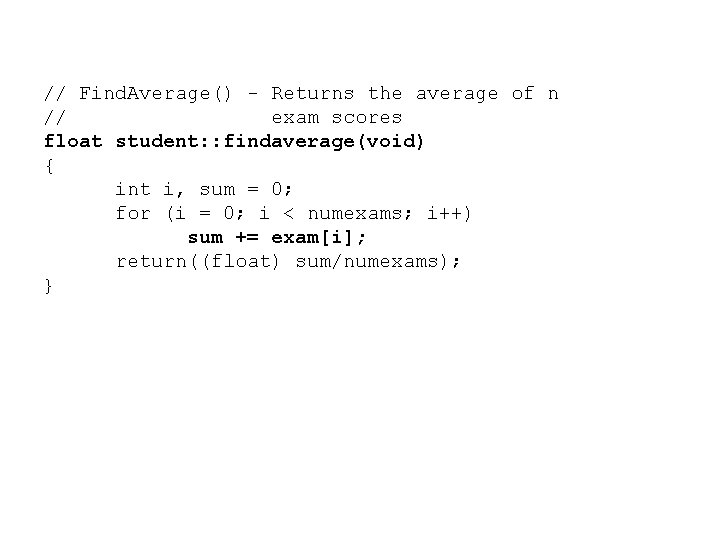
// Find. Average() - Returns the average of n // exam scores float student: : findaverage(void) { int i, sum = 0; for (i = 0; i < numexams; i++) sum += exam[i]; return((float) sum/numexams); }
// Write. Student() - Print the data about the // student without the // average void student: : write(void) { int i; cout << firstname << ' ' << lastname << " scored : " << endl; for (i = 0; i < numexams; i++) cout << exam[i] << endl; }
// Write. Student() - Print the data about the // student including the // average void student: : write(float average) { int i; cout << firstname << ' ' << lastname << " scored : " << endl; for (i = 0; i < numexams; i++) cout << exam[i] << 't'; cout << "ntwhich resulted in an average of " << average << endl; }
// Avg. Grade() - Averages the grades on n exams int main(void) { student s; float average; // Read the students name and test scores s. read(); // Find the average = s. findaverage(); // Print the results s. write(average); return(0); }