
CSC 241 Object Oriented Programming Lecture No 13
CSC 241: Object Oriented Programming Lecture No 13
Previous Lecture • Implicit conversion • Explicit constructor • Overloading – Stream insertion << – Stream extraction >> • Inheritance 2
Today’s Lecture • • Inheritance Protected members Constructor in derived class Function overriding 3
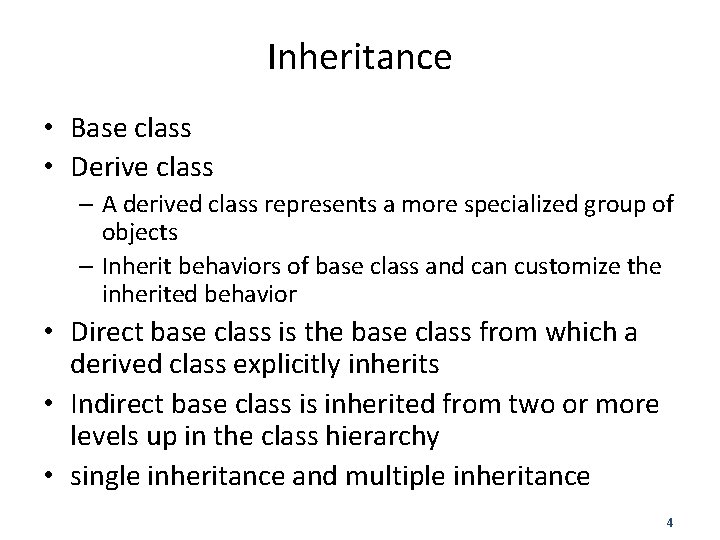
Inheritance • Base class • Derive class – A derived class represents a more specialized group of objects – Inherit behaviors of base class and can customize the inherited behavior • Direct base class is the base class from which a derived class explicitly inherits • Indirect base class is inherited from two or more levels up in the class hierarchy • single inheritance and multiple inheritance 4
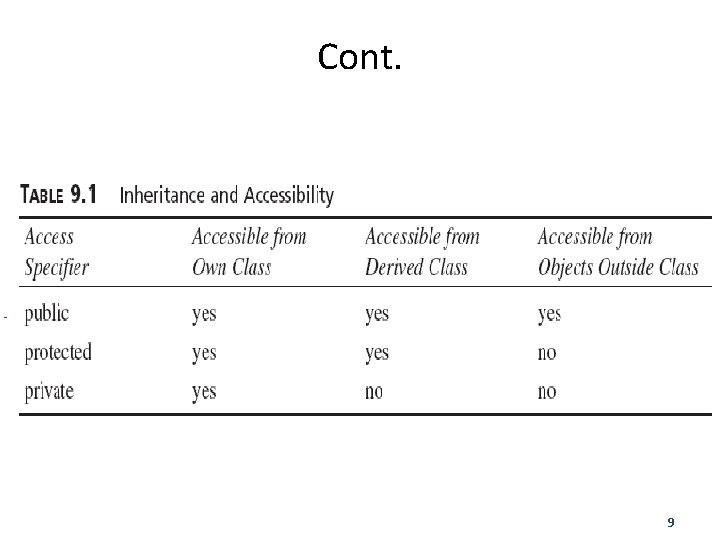
protected Members • Access specifiers – public: accessible within the body of base class and anywhere that the program – private: accessible only within the body of base class and the friends of base class • A base class's protected members can be accessed within – the body of that base class, – by members and friends of that base class, and – by members and friends of any classes derived from that base class 5
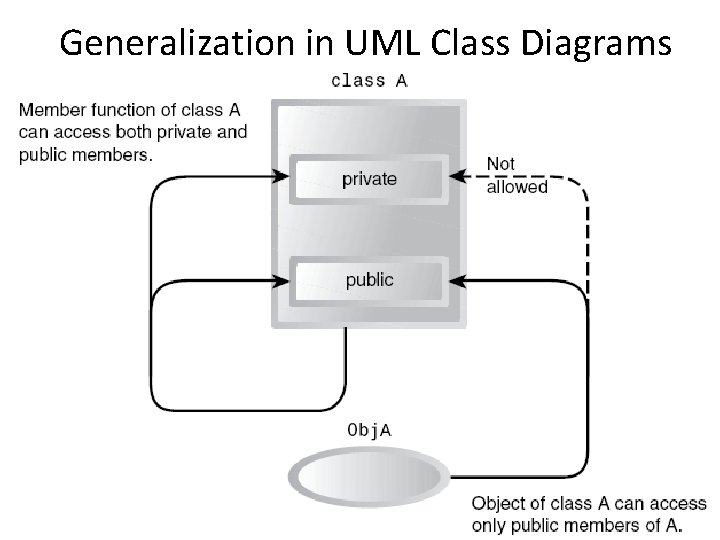
Generalization in UML Class Diagrams 6
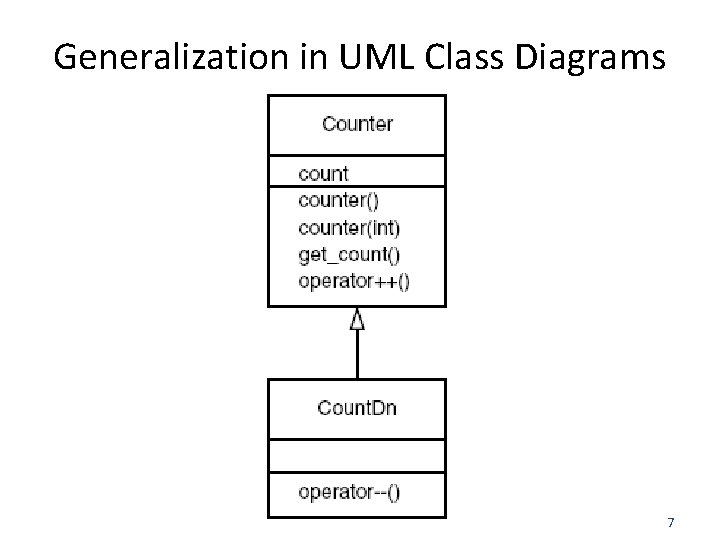
Generalization in UML Class Diagrams 7
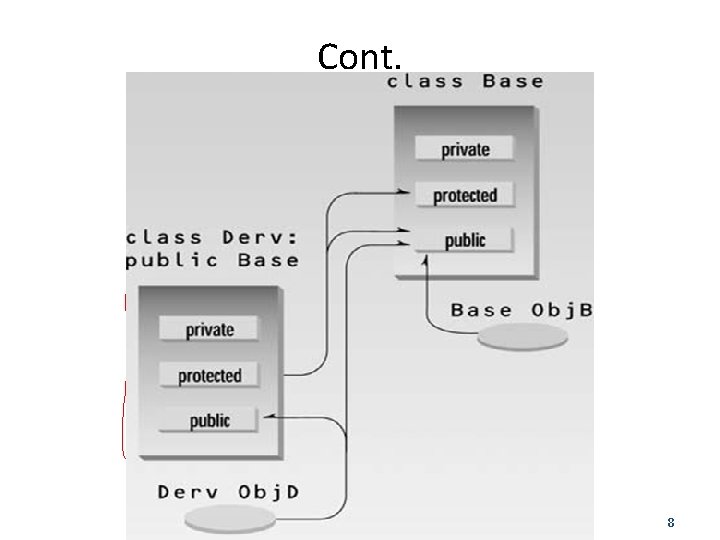
Cont. 8
Cont. 9
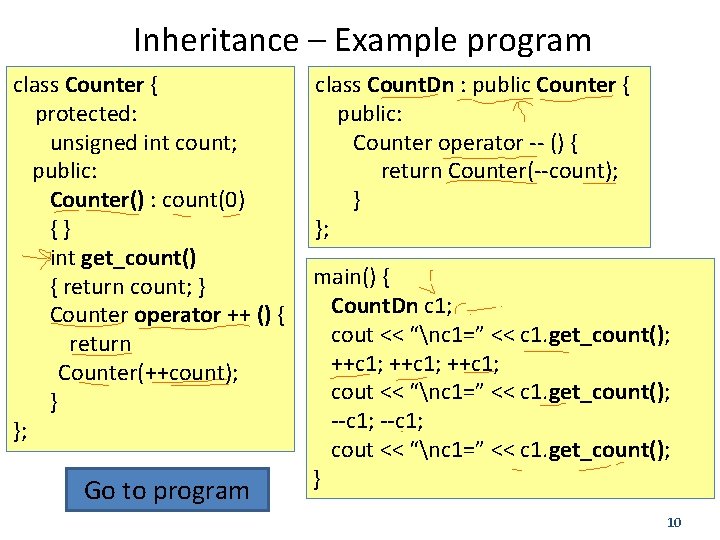
Inheritance – Example program class Counter { protected: unsigned int count; public: Counter() : count(0) {} int get_count() { return count; } Counter operator ++ () { return Counter(++count); } }; Go to program class Count. Dn : public Counter { public: Counter operator -- () { return Counter(--count); } }; main() { Count. Dn c 1; cout << “nc 1=” << c 1. get_count(); ++c 1; cout << “nc 1=” << c 1. get_count(); --c 1; cout << “nc 1=” << c 1. get_count(); } 10
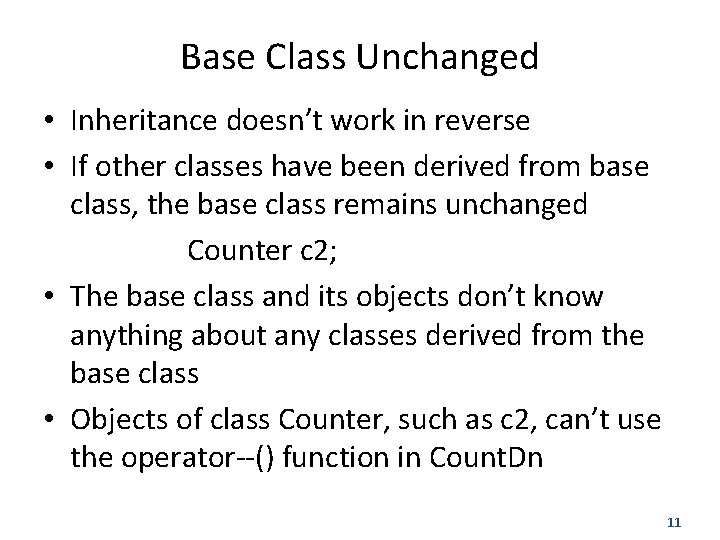
Base Class Unchanged • Inheritance doesn’t work in reverse • If other classes have been derived from base class, the base class remains unchanged Counter c 2; • The base class and its objects don’t know anything about any classes derived from the base class • Objects of class Counter, such as c 2, can’t use the operator--() function in Count. Dn 11
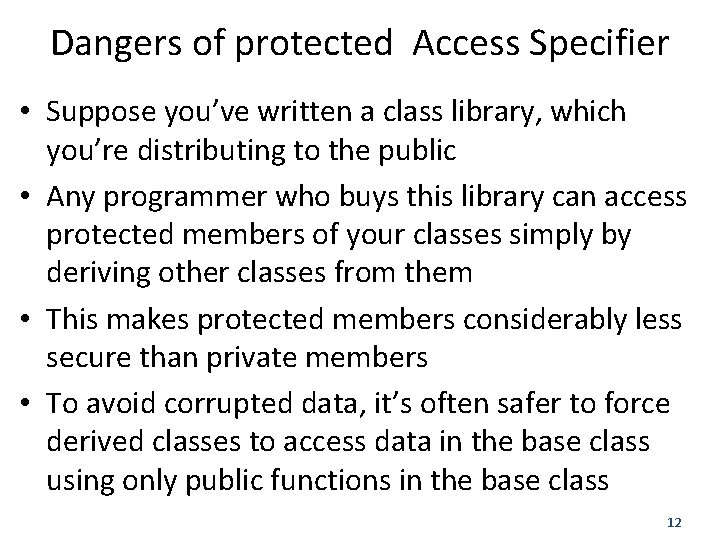
Dangers of protected Access Specifier • Suppose you’ve written a class library, which you’re distributing to the public • Any programmer who buys this library can access protected members of your classes simply by deriving other classes from them • This makes protected members considerably less secure than private members • To avoid corrupted data, it’s often safer to force derived classes to access data in the base class using only public functions in the base class 12
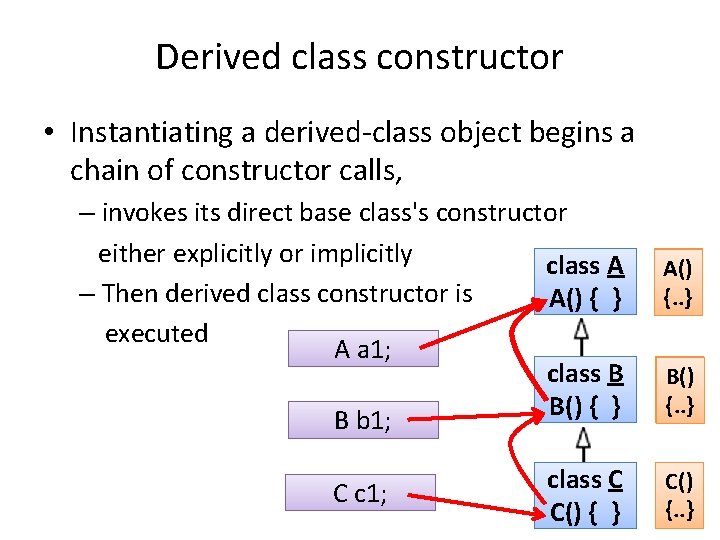
Derived class constructor • Instantiating a derived-class object begins a chain of constructor calls, – invokes its direct base class's constructor either explicitly or implicitly class A – Then derived class constructor is A() { } executed A a 1; class B B() { } B b 1; C c 1; class C C() { } A() {. . } B() {. . } C() {. . } 13
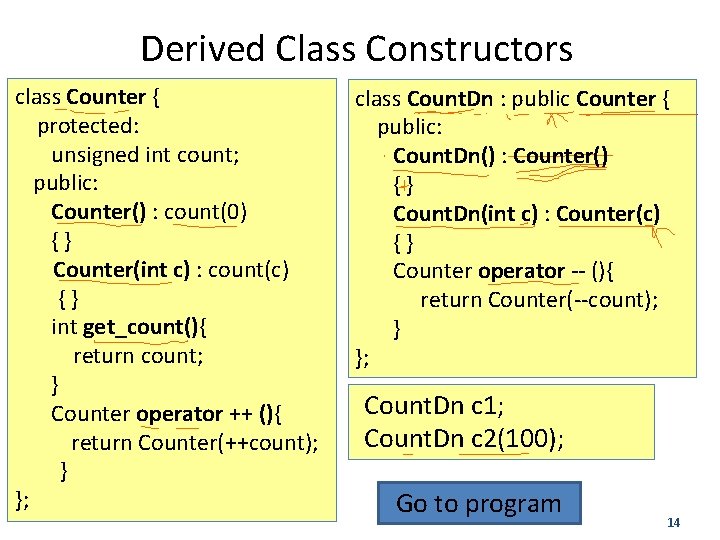
Derived Class Constructors class Counter { protected: unsigned int count; public: Counter() : count(0) {} Counter(int c) : count(c) {} int get_count(){ return count; } Counter operator ++ (){ return Counter(++count); } }; class Count. Dn : public Counter { public: Count. Dn() : Counter() {} Count. Dn(int c) : Counter(c) {} Counter operator -- (){ return Counter(--count); } }; Count. Dn c 1; Count. Dn c 2(100); Go to program 14
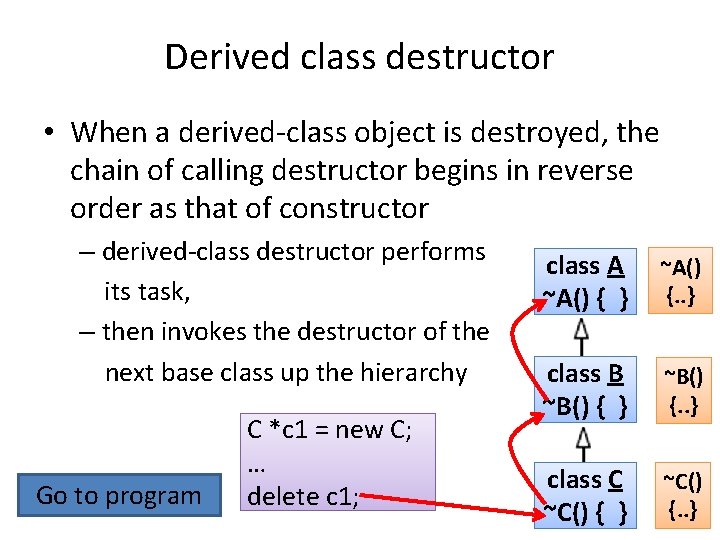
Derived class destructor • When a derived-class object is destroyed, the chain of calling destructor begins in reverse order as that of constructor – derived-class destructor performs its task, – then invokes the destructor of the next base class up the hierarchy Go to program C *c 1 = new C; … delete c 1; class A ~A() { } ~A() {. . } class B ~B() { } ~B() {. . } class C ~C() { } ~C() {. . } 15
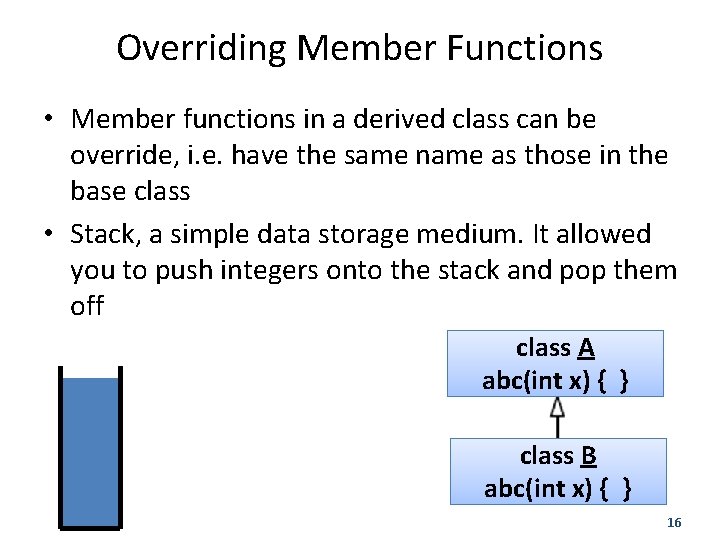
Overriding Member Functions • Member functions in a derived class can be override, i. e. have the same name as those in the base class • Stack, a simple data storage medium. It allowed you to push integers onto the stack and pop them off class A abc(int x) { } class B abc(int x) { } 16
![class Stack { protected: int st[3]; int top; public: Stack() { top = -1;](http://slidetodoc.com/presentation_image_h2/a448febb87ba8aee26d029c8c468b8e4/image-17.jpg "class Stack { protected: int st[3]; int top; public: Stack() { top = -1;")
class Stack { protected: int st[3]; int top; public: Stack() { top = -1; } void push(int var) { st[++top] = var; } int pop() { return st[top--]; } }; Stack 2 s 1; s 1. push(11); s 1. push(22); s 1. push(33); cout <<s 1. pop(); Example - stack S 1 top -1 012 st[3] 13 12 11 class Stack 2 : public Stack{ public: void push(int var 1){ if(top >= 3 -1){ cout << “n. Error: stack is full”; exit(1); } Stack: : push(var); } int pop() { if(top < 0) { cout << “n. Error: stack is empty”; exit(1); } return Stack: : pop(); } Go to program }; 17
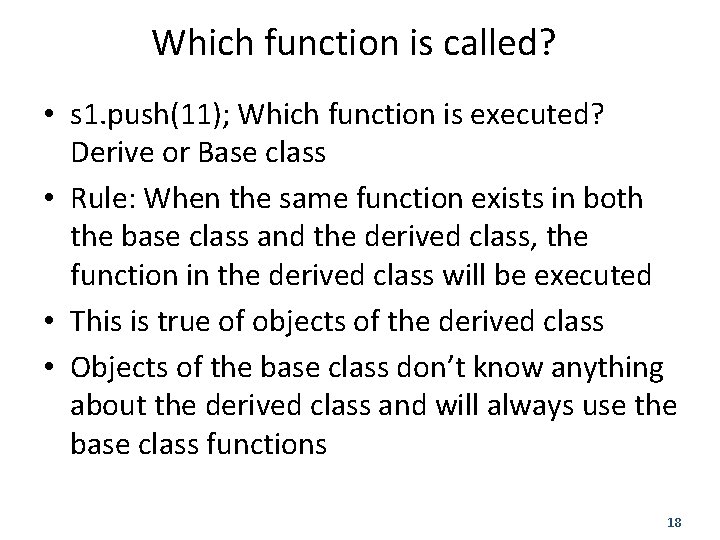
Which function is called? • s 1. push(11); Which function is executed? Derive or Base class • Rule: When the same function exists in both the base class and the derived class, the function in the derived class will be executed • This is true of objects of the derived class • Objects of the base class don’t know anything about the derived class and will always use the base class functions 18
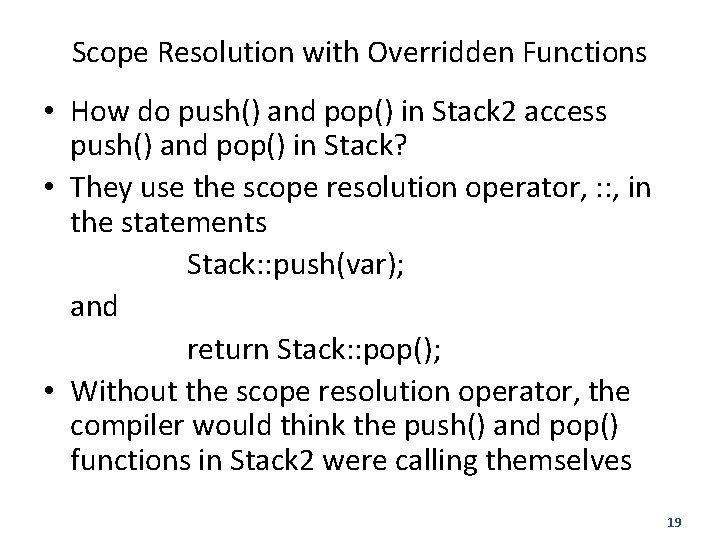
Scope Resolution with Overridden Functions • How do push() and pop() in Stack 2 access push() and pop() in Stack? • They use the scope resolution operator, : : , in the statements Stack: : push(var); and return Stack: : pop(); • Without the scope resolution operator, the compiler would think the push() and pop() functions in Stack 2 were calling themselves 19
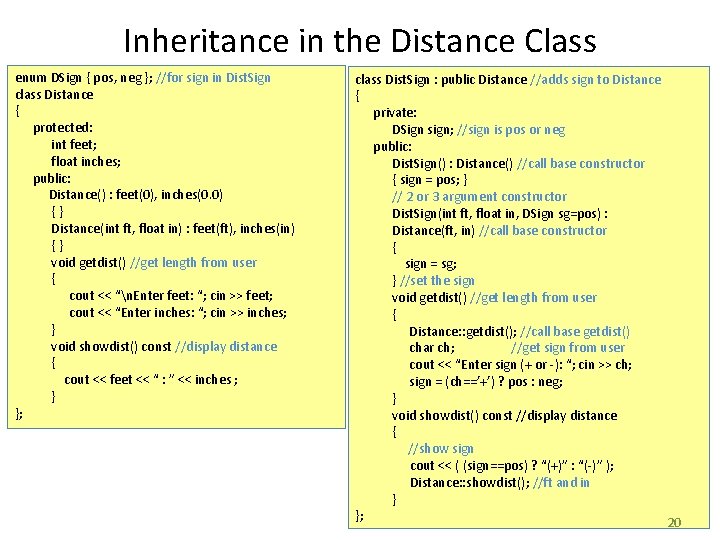
Inheritance in the Distance Class enum DSign { pos, neg }; //for sign in Dist. Sign class Distance { protected: int feet; float inches; public: Distance() : feet(0), inches(0. 0) {} Distance(int ft, float in) : feet(ft), inches(in) {} void getdist() //get length from user { cout << “n. Enter feet: “; cin >> feet; cout << “Enter inches: “; cin >> inches; } void showdist() const //display distance { cout << feet << “ : ” << inches ; } }; class Dist. Sign : public Distance //adds sign to Distance { private: DSign sign; //sign is pos or neg public: Dist. Sign() : Distance() //call base constructor { sign = pos; } // 2 or 3 argument constructor Dist. Sign(int ft, float in, DSign sg=pos) : Distance(ft, in) //call base constructor { sign = sg; } //set the sign void getdist() //get length from user { Distance: : getdist(); //call base getdist() char ch; //get sign from user cout << “Enter sign (+ or -): “; cin >> ch; sign = (ch==’+’) ? pos : neg; } void showdist() const //display distance { //show sign cout << ( (sign==pos) ? “(+)” : “(-)” ); Distance: : showdist(); //ft and in } }; 20
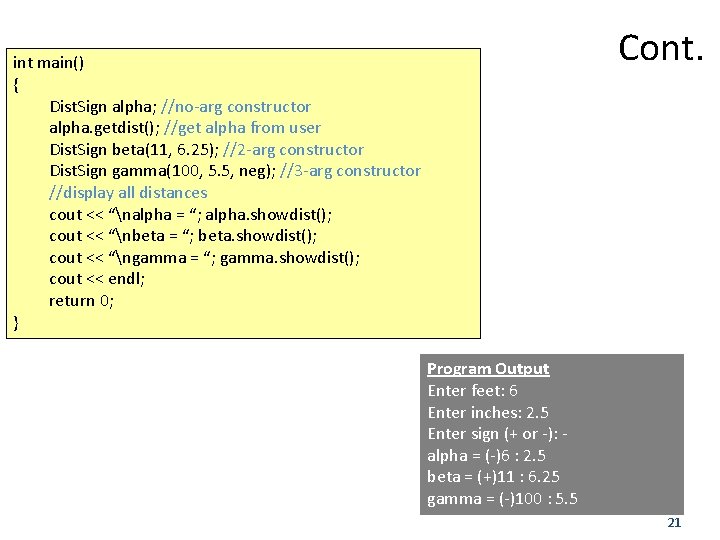
Cont. int main() { Dist. Sign alpha; //no-arg constructor alpha. getdist(); //get alpha from user Dist. Sign beta(11, 6. 25); //2 -arg constructor Dist. Sign gamma(100, 5. 5, neg); //3 -arg constructor //display all distances cout << “nalpha = “; alpha. showdist(); cout << “nbeta = “; beta. showdist(); cout << “ngamma = “; gamma. showdist(); cout << endl; return 0; } Program Output Enter feet: 6 Enter inches: 2. 5 Enter sign (+ or -): alpha = (-)6 : 2. 5 beta = (+)11 : 6. 25 gamma = (-)100 : 5. 5 21
22
- Slides: 22