
CSC 2125 Advanced Topics in Software Engineering Program
- Slides: 29
CSC 2125 – Advanced Topics in Software Engineering: Program Analysis and Understanding Fall 2006
About this Class • Topic: Analyzing and understanding software • Three main focus areas: ■ Static analysis - Automatic reasoning about source code ■ Formal systems and notations - Vocabulary for talking about programs ■ Programming language features - Affects programs and how we reason about them 2
Readings • Nielson, Hankin. Principles of Program Analysis, 2005, Springer. • Supplemental readings from classical papers and from recent advances 3
Preparation • A course in compilers would be helpful • A course in model-checking would be most helpful 4
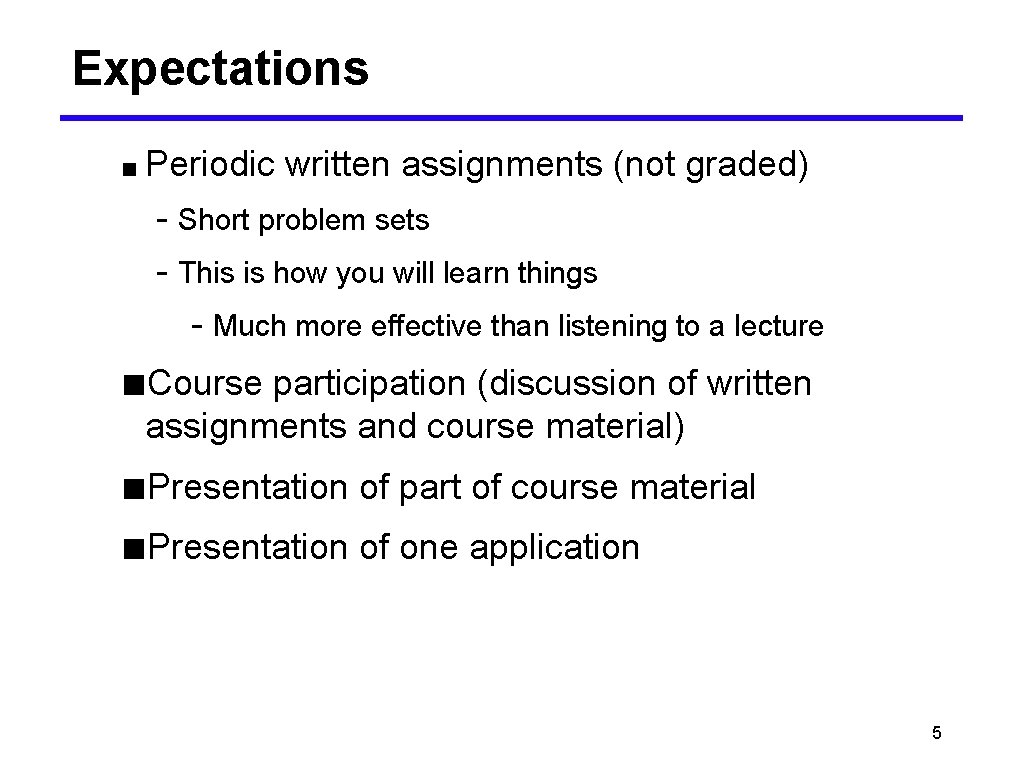
Expectations ■ Periodic written assignments (not graded) - Short problem sets - This is how you will learn things - Much more effective than listening to a lecture ■Course participation (discussion of written assignments and course material) ■Presentation of part of course material ■Presentation of one application 5
What this course is about? 20 Ideas and Applications in Program Analysis in 40 Minutes
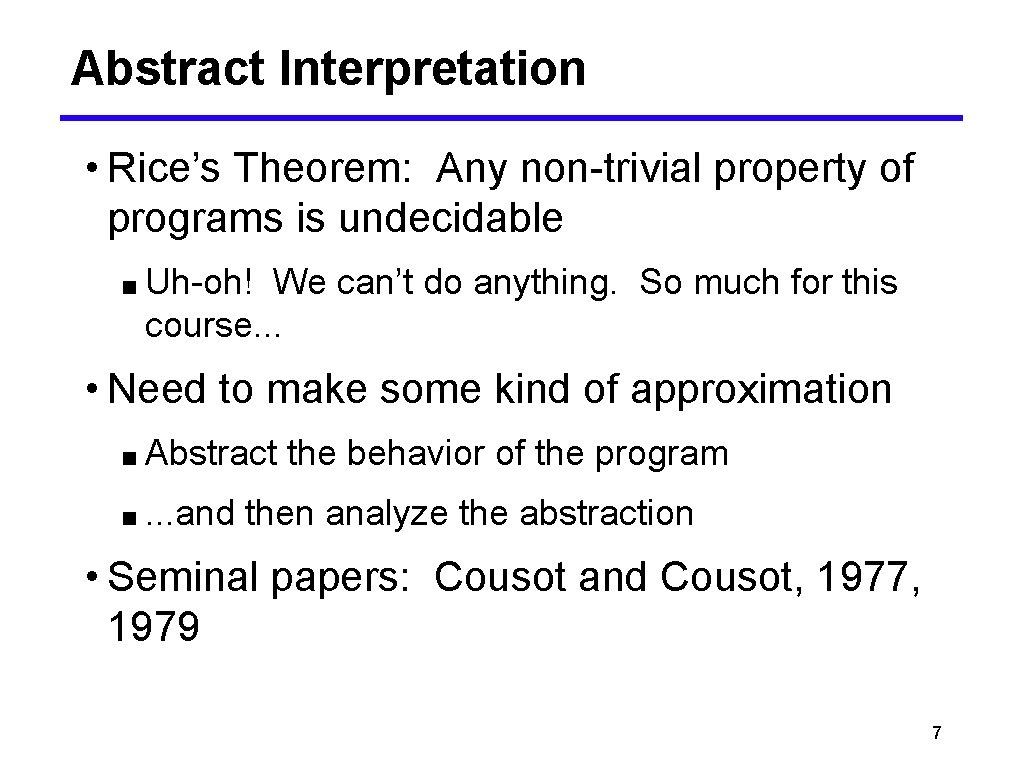
Abstract Interpretation • Rice’s Theorem: Any non-trivial property of programs is undecidable ■ Uh-oh! We can’t do anything. So much for this course. . . • Need to make some kind of approximation ■ Abstract ■. . . and the behavior of the program then analyze the abstraction • Seminal papers: Cousot and Cousot, 1977, 1979 7
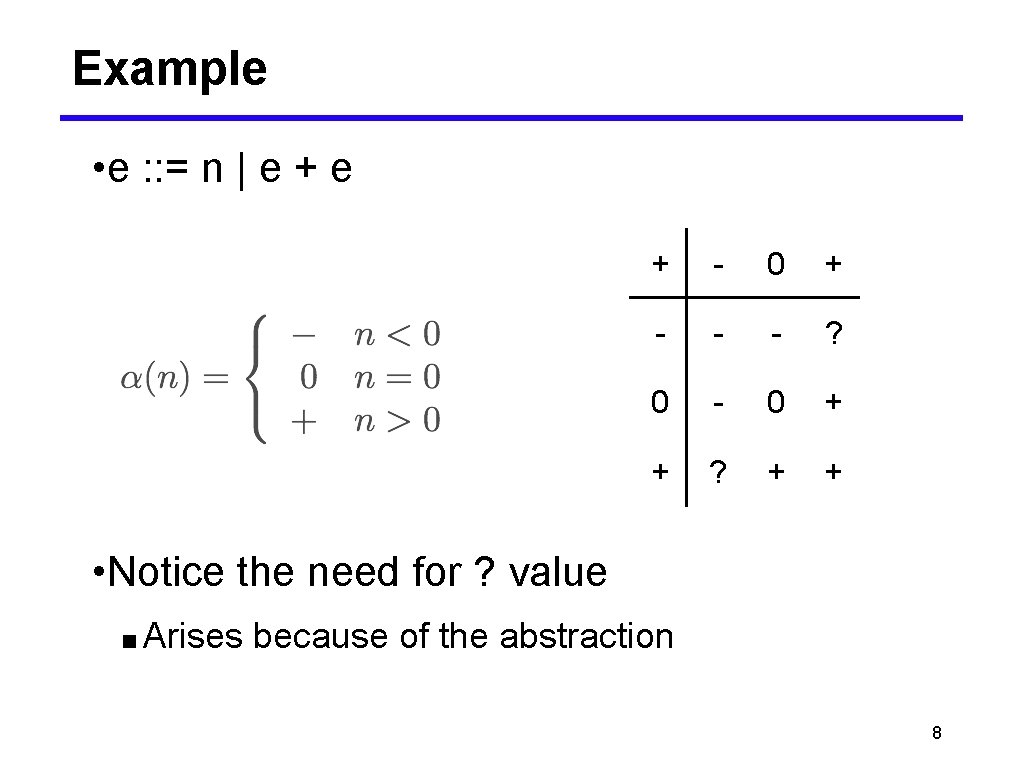
Example • e : : = n | e + - 0 + - - - ? 0 - 0 + + ? + + • Notice the need for ? value ■ Arises because of the abstraction 8
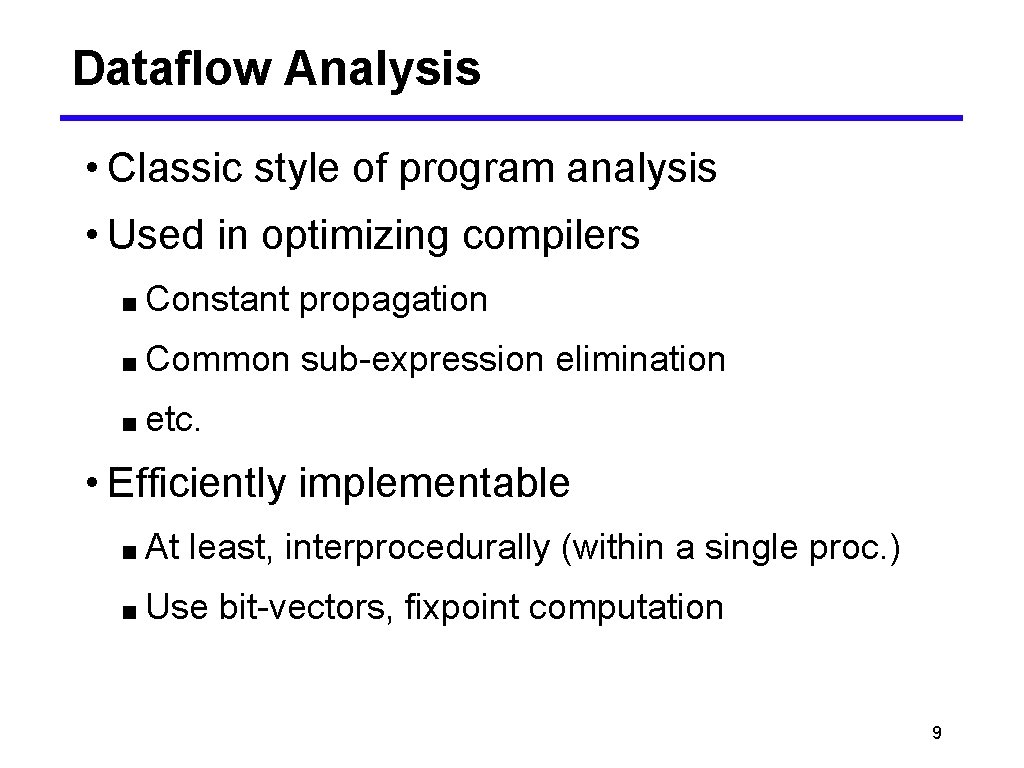
Dataflow Analysis • Classic style of program analysis • Used in optimizing compilers ■ Constant propagation ■ Common sub-expression elimination ■ etc. • Efficiently implementable ■ At least, interprocedurally (within a single proc. ) ■ Use bit-vectors, fixpoint computation 9
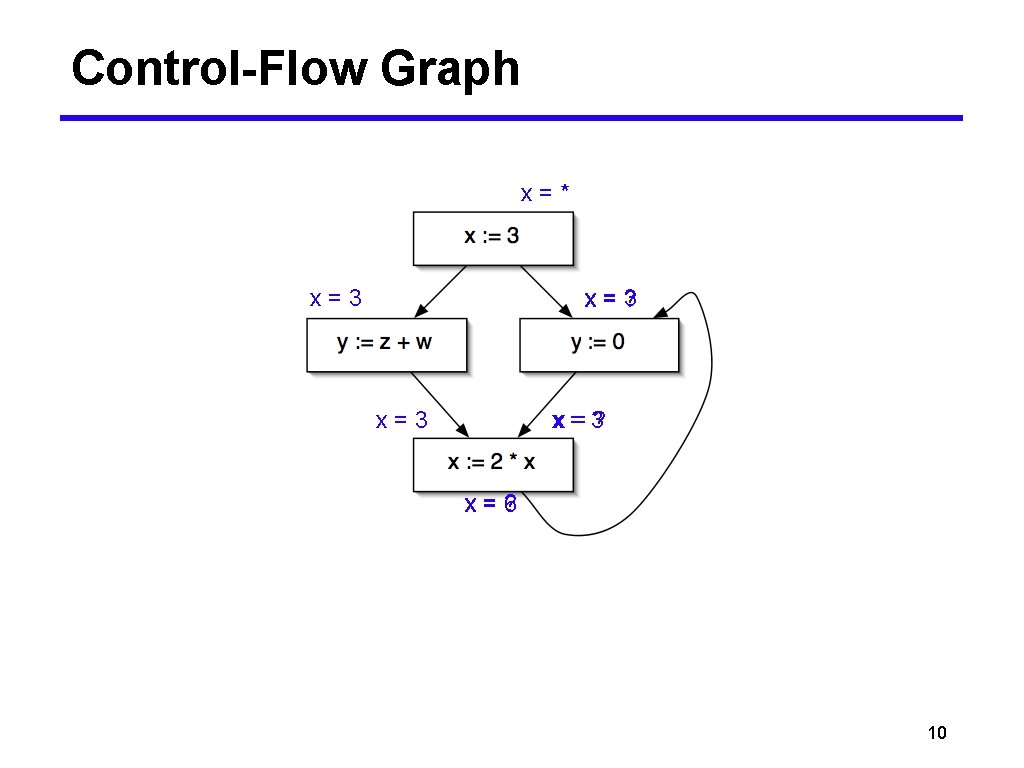
Control-Flow Graph x=* x=3 3 x=? x=3 x = 3? x=? 6 10
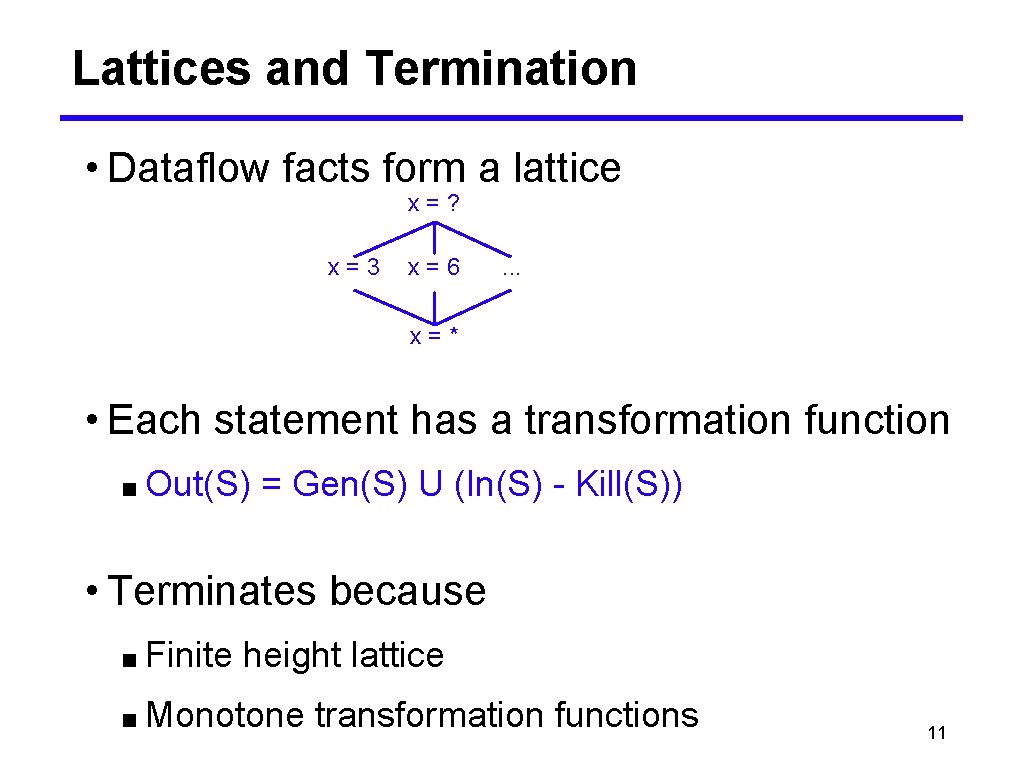
Lattices and Termination • Dataflow facts form a lattice x=? x=3 x=6 . . . x=* • Each statement has a transformation function ■ Out(S) = Gen(S) U (In(S) - Kill(S)) • Terminates because ■ Finite height lattice ■ Monotone transformation functions 11
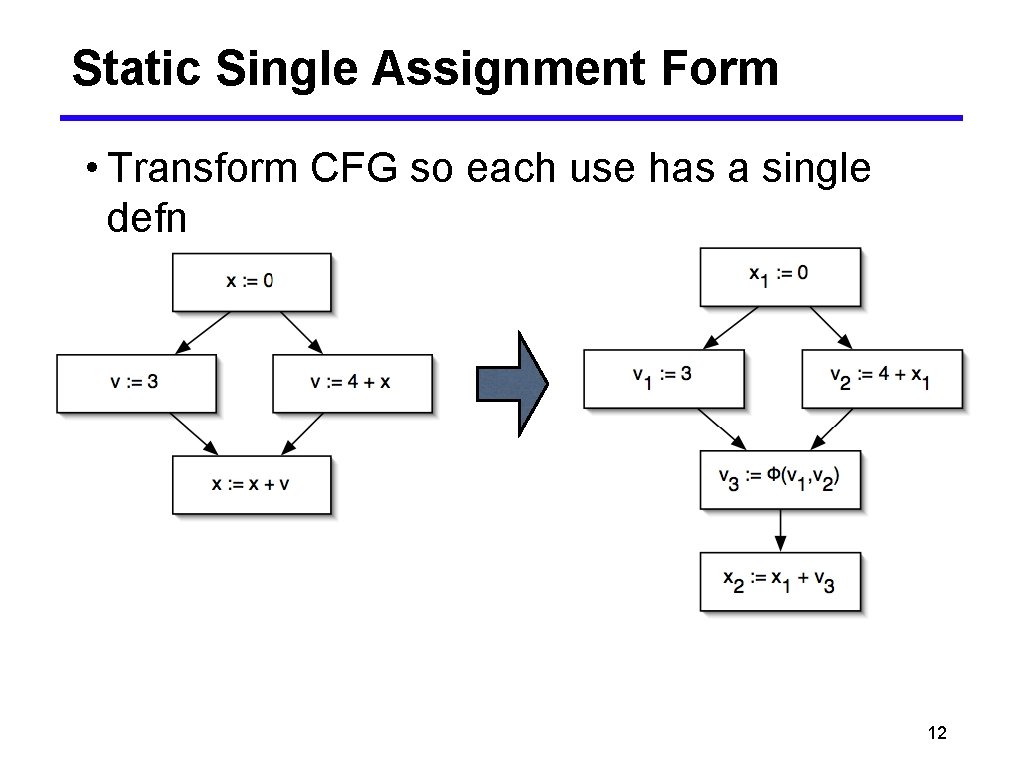
Static Single Assignment Form • Transform CFG so each use has a single defn 12
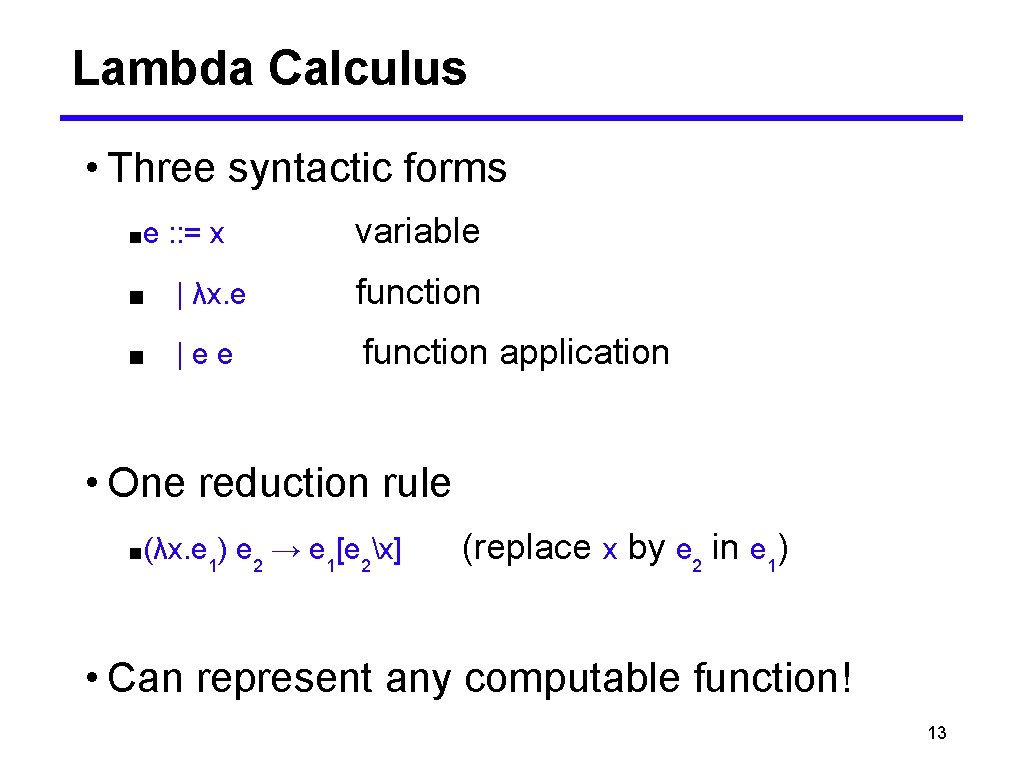
Lambda Calculus • Three syntactic forms : : = x variable ■ | λx. e function ■ |ee function application ■e • One reduction rule ■(λx. e ) e → e [e x] 1 2 (replace x by e 2 in e 1) • Can represent any computable function! 13
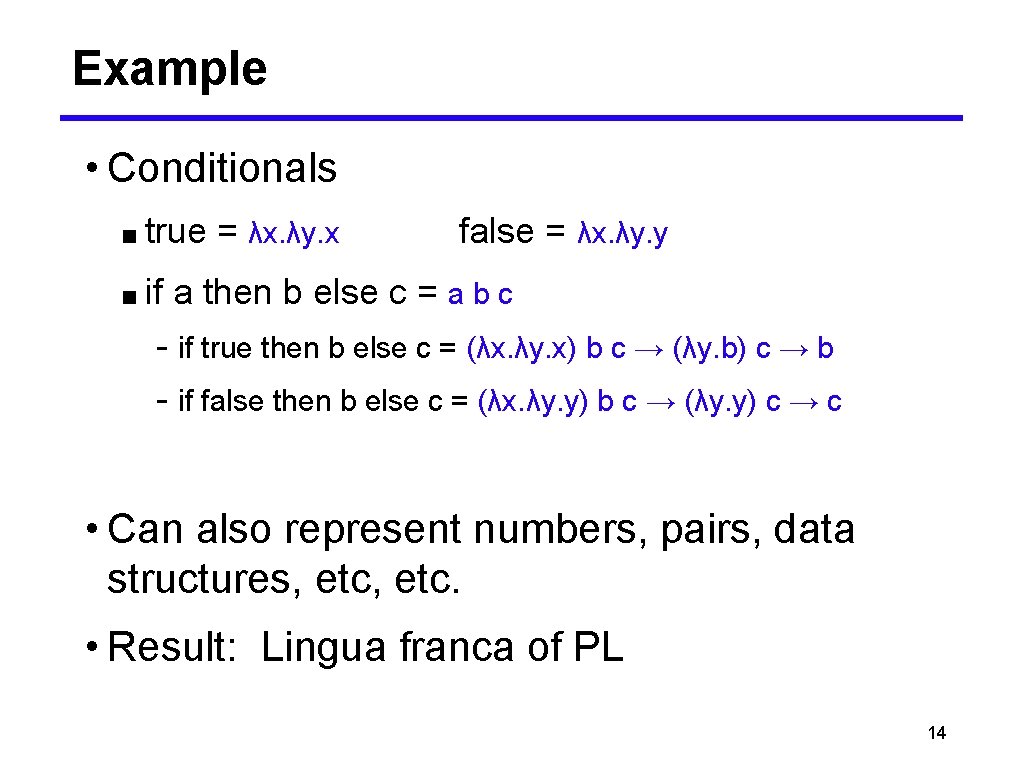
Example • Conditionals ■ true ■ if = λx. λy. x false = λx. λy. y a then b else c = a b c - if true then b else c = (λx. λy. x) b c → (λy. b) c → b - if false then b else c = (λx. λy. y) b c → (λy. y) c → c • Can also represent numbers, pairs, data structures, etc. • Result: Lingua franca of PL 14
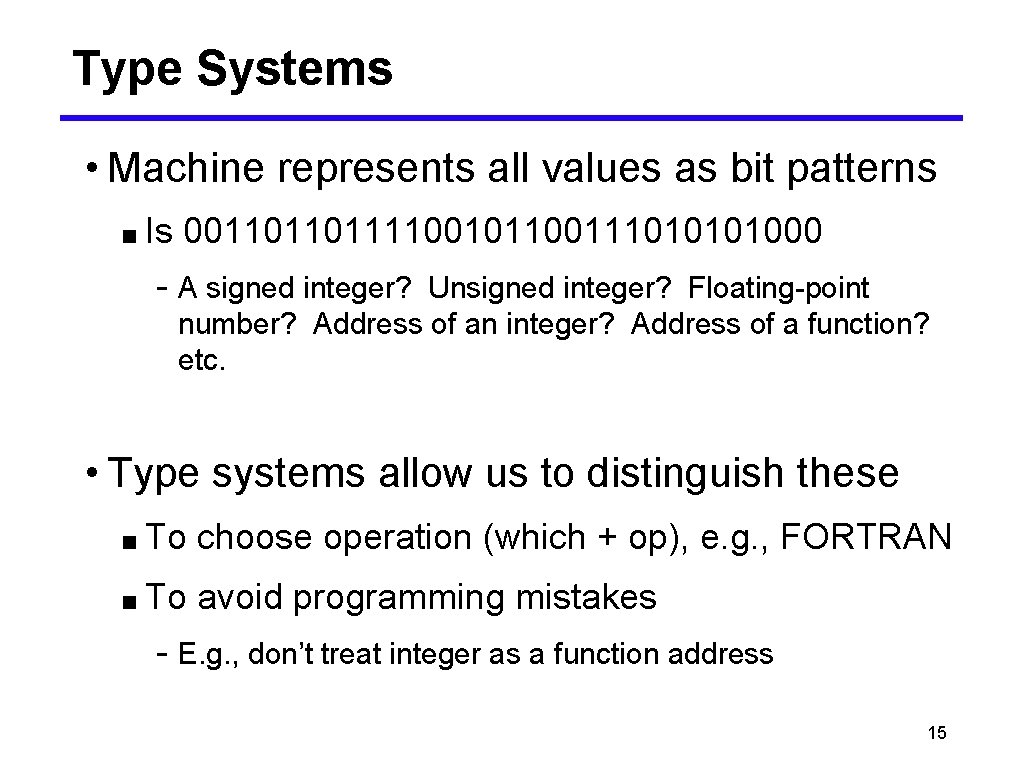
Type Systems • Machine represents all values as bit patterns ■ Is 0011011011110010110011101000 - A signed integer? Unsigned integer? Floating-point number? Address of an integer? Address of a function? etc. • Type systems allow us to distinguish these ■ To choose operation (which + op), e. g. , FORTRAN ■ To avoid programming mistakes - E. g. , don’t treat integer as a function address 15
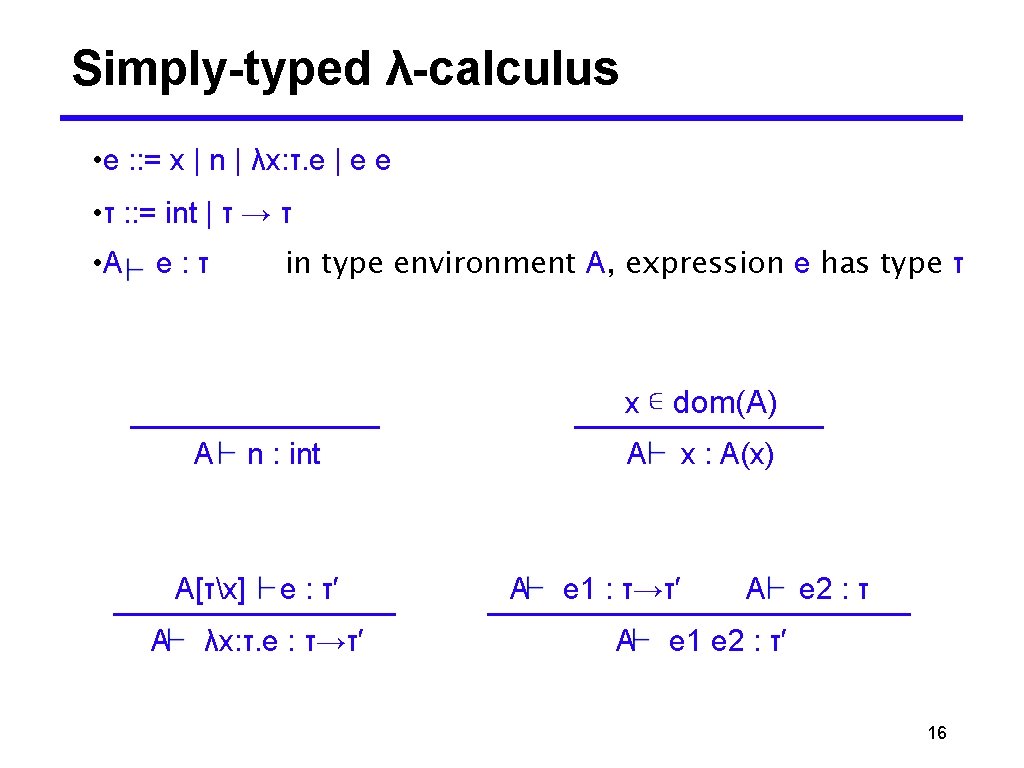
Simply-typed λ-calculus • e : : = x | n | λx: τ. e | e e • τ : : = int | τ → τ • A e: τ in type environment A, expression e has type τ x ∊ dom(A) A A[τx] A n : int e : τ′ λx: τ. e : τ→τ′ A A x : A(x) e 1 : τ→τ′ A A e 2 : τ e 1 e 2 : τ′ 16
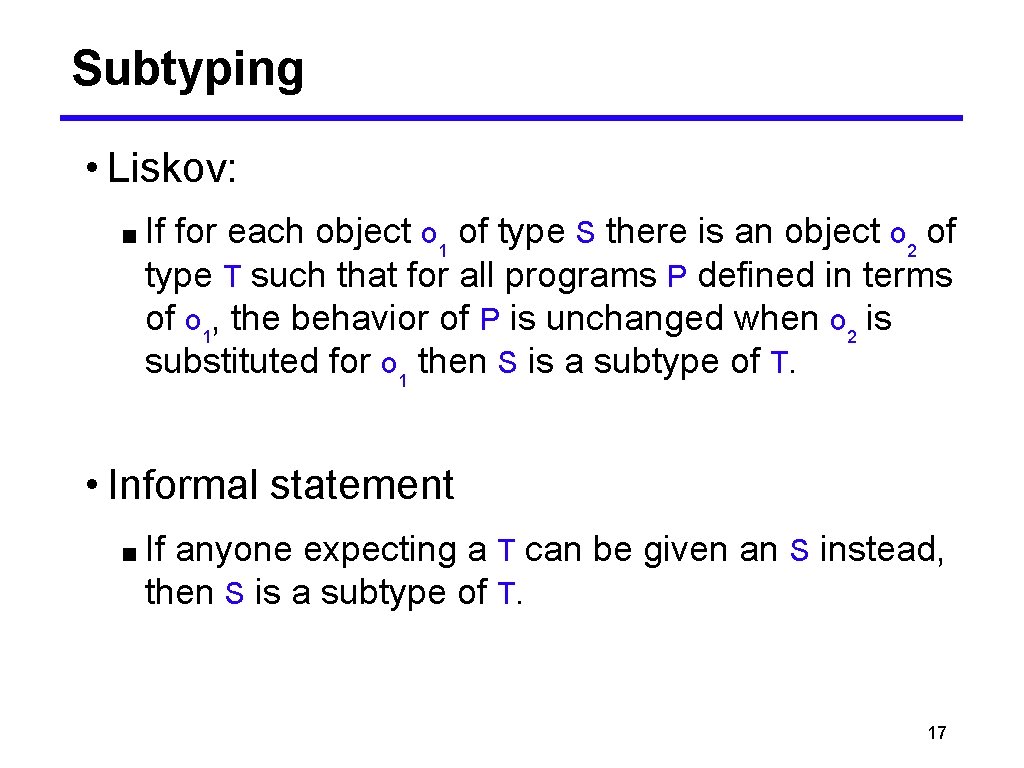
Subtyping • Liskov: ■ If for each object o 1 of type S there is an object o 2 of type T such that for all programs P defined in terms of o 1, the behavior of P is unchanged when o 2 is substituted for o 1 then S is a subtype of T. • Informal statement ■ If anyone expecting a T can be given an S instead, then S is a subtype of T. 17
Axiomatic Semantics • Old idea: Shouldn’t just hack up code, try to prove programs are correct • Proofs require reasoning about the meaning of programs • First system: Formalize program behavior in logic ■ Hoare, Dijkstra, Gries, others 18
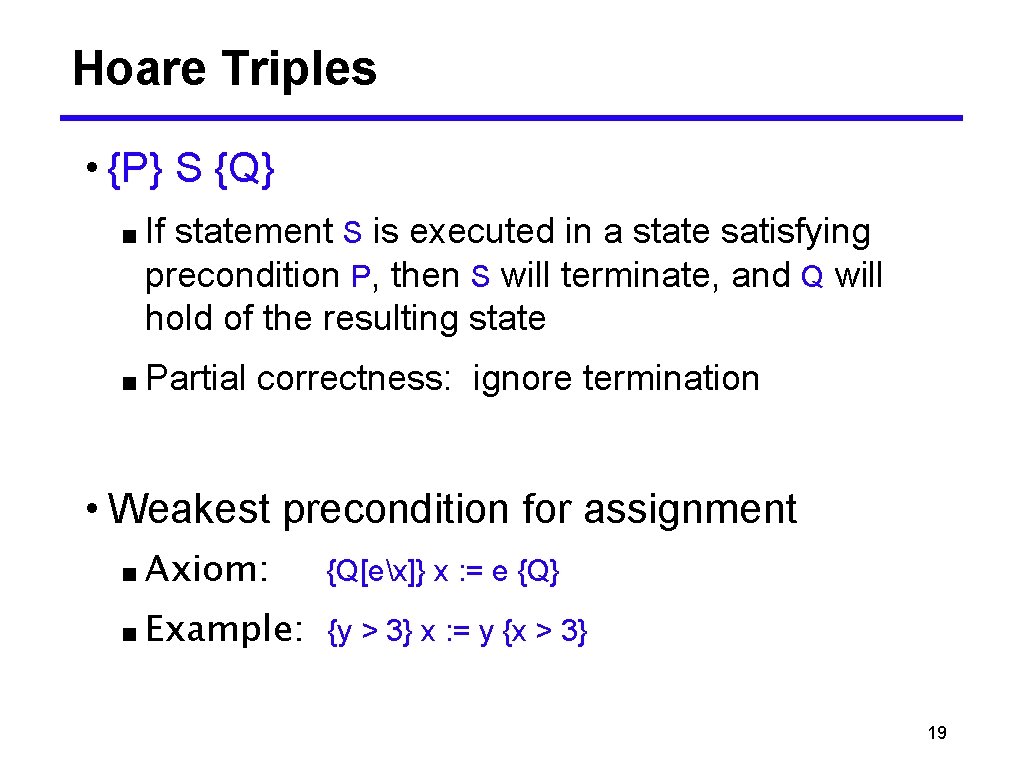
Hoare Triples • {P} S {Q} ■ If statement S is executed in a state satisfying precondition P, then S will terminate, and Q will hold of the resulting state ■ Partial correctness: ignore termination • Weakest precondition for assignment ■ Axiom: {Q[ex]} x : = e {Q} ■ Example: {y > 3} x : = y {x > 3} 19
Other Technologies and Topics • Control-flow analysis • CFL reachablity and polymorphism • Constraint-based analysis • Alias and pointer analysis • Region-based memory management • Garbage collection • More. . . 20
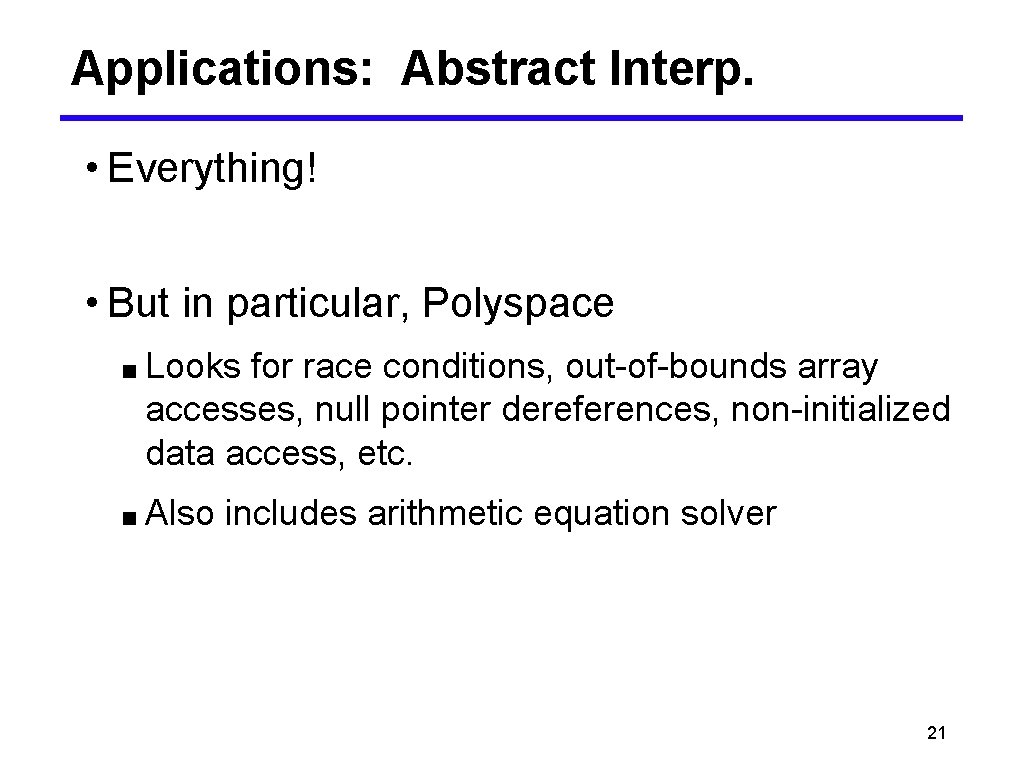
Applications: Abstract Interp. • Everything! • But in particular, Polyspace ■ Looks for race conditions, out-of-bounds array accesses, null pointer dereferences, non-initialized data access, etc. ■ Also includes arithmetic equation solver 21
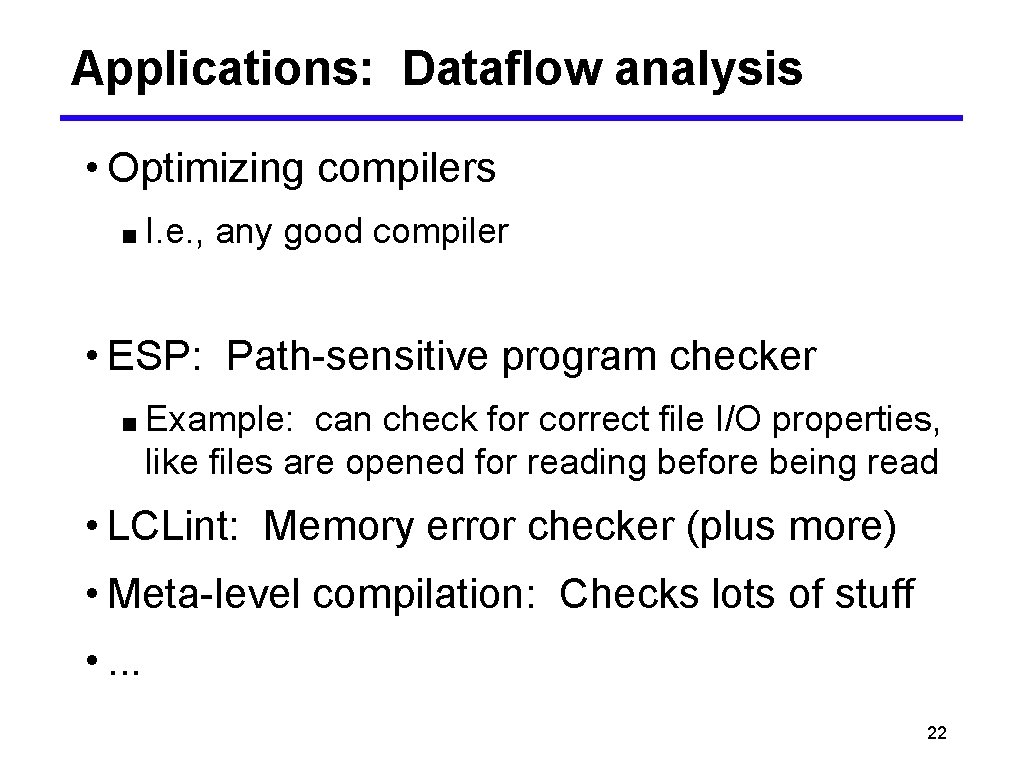
Applications: Dataflow analysis • Optimizing compilers ■ I. e. , any good compiler • ESP: Path-sensitive program checker ■ Example: can check for correct file I/O properties, like files are opened for reading before being read • LCLint: Memory error checker (plus more) • Meta-level compilation: Checks lots of stuff • . . . 22
Applications: Symbolic Evaluation • PREFix ■ Finds null pointer dereferences, array-out-of bounds errors, etc. ■ Used regularly at Microsoft • Also ESP 23
Applications: Model Checking • SLAM, BLAST, Yasm ■ Focus on device drivers: lock/unlock protocol errors, and other errors sequencing of operations • Uses alias analysis, predicate abstraction, analysis of recursive functions… 24
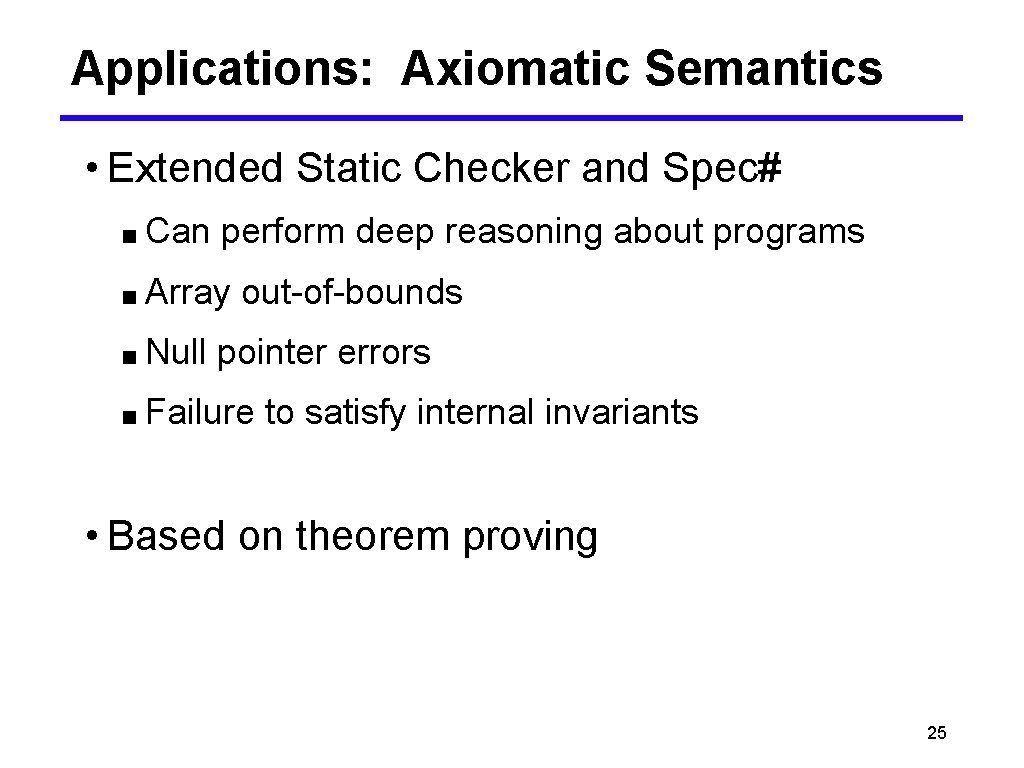
Applications: Axiomatic Semantics • Extended Static Checker and Spec# ■ Can perform deep reasoning about programs ■ Array ■ Null out-of-bounds pointer errors ■ Failure to satisfy internal invariants • Based on theorem proving 25
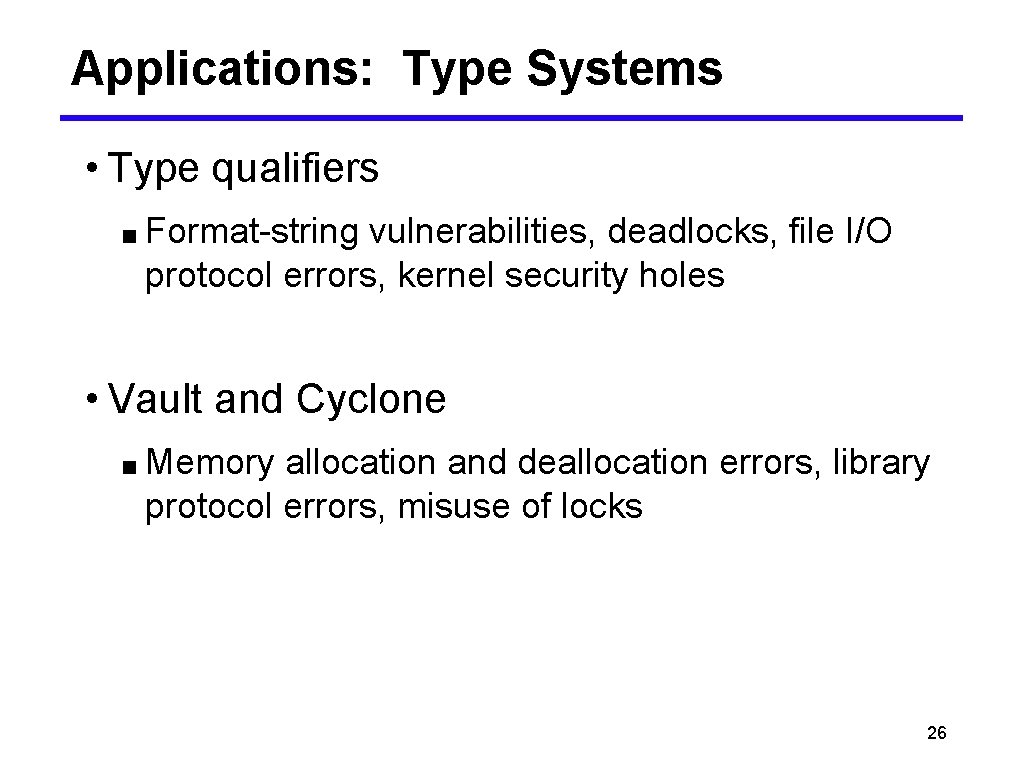
Applications: Type Systems • Type qualifiers ■ Format-string vulnerabilities, deadlocks, file I/O protocol errors, kernel security holes • Vault and Cyclone ■ Memory allocation and deallocation errors, library protocol errors, misuse of locks 26
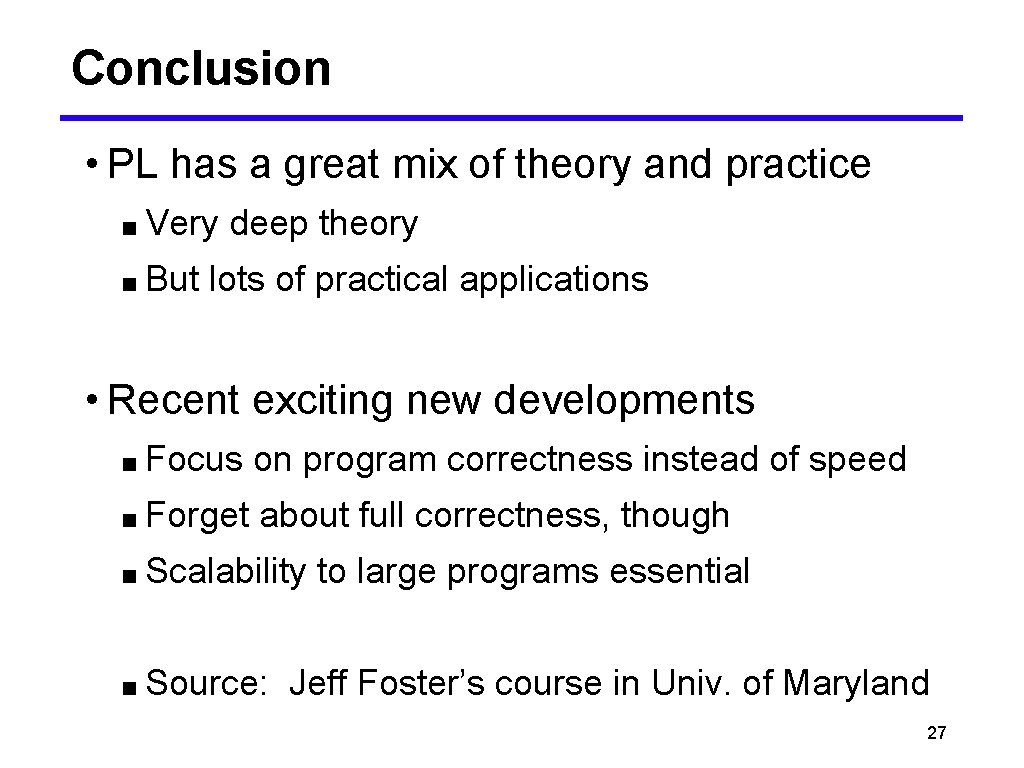
Conclusion • PL has a great mix of theory and practice ■ Very ■ But deep theory lots of practical applications • Recent exciting new developments ■ Focus on program correctness instead of speed ■ Forget about full correctness, though ■ Scalability ■ Source: to large programs essential Jeff Foster’s course in Univ. of Maryland 27
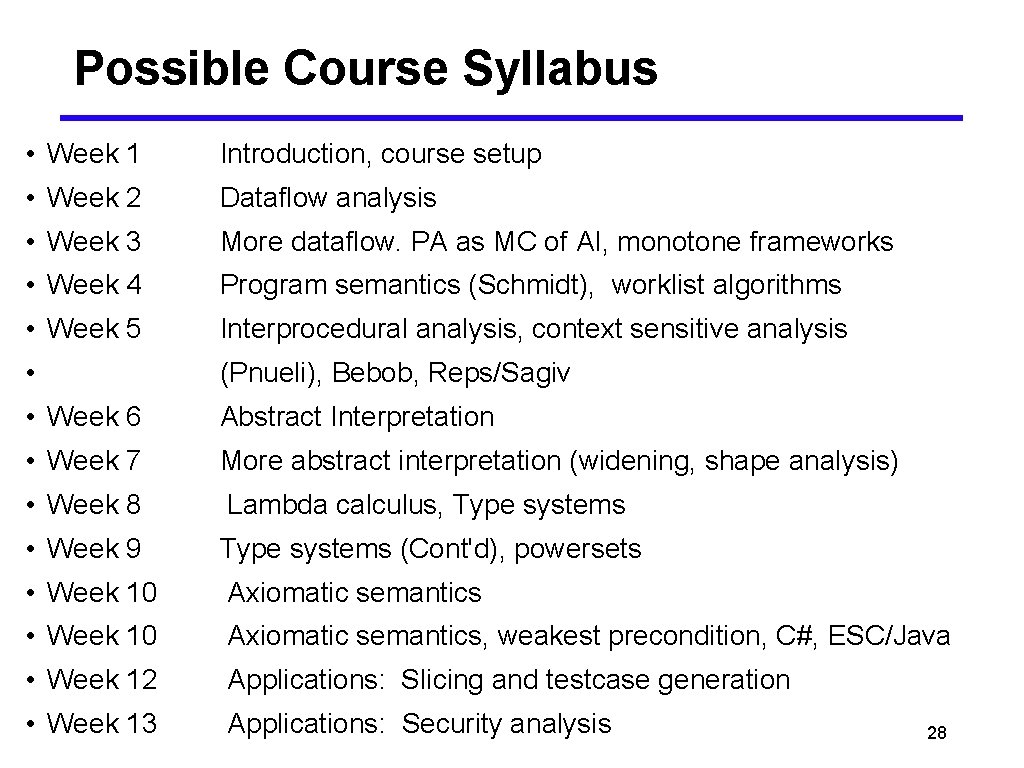
Possible Course Syllabus • Week 1 Introduction, course setup • Week 2 Dataflow analysis • Week 3 More dataflow. PA as MC of AI, monotone frameworks • Week 4 Program semantics (Schmidt), worklist algorithms • Week 5 Interprocedural analysis, context sensitive analysis • (Pnueli), Bebob, Reps/Sagiv • Week 6 Abstract Interpretation • Week 7 More abstract interpretation (widening, shape analysis) • Week 8 Lambda calculus, Type systems • Week 9 Type systems (Cont'd), powersets • Week 10 Axiomatic semantics, weakest precondition, C#, ESC/Java • Week 12 Applications: Slicing and testcase generation • Week 13 Applications: Security analysis 28
Introduction to the actual material • Data-flow analysis – reaching definitions ■ From Chapter 1 of textbook ■ Slides 15, 18 -37 • Abstract interpretation ■ From Chapter 1 of textbook ■ Slides 58 -71 29