
CSC 212 Data Structure Section EF Lecture 11

- Slides: 31
CSC 212 Data Structure - Section EF Lecture 11 Templates, Iterators and STL Instructor: Professor Zhigang Zhu Department of Computer Science City College of New York
CSC 212 Data Structure - Section EF Lecture 11 Templates, Iterators and STL Instructor: Professor Zhigang Zhu Department of Computer Science City College of New York
Topics p Template Functions and Template Classes p for code that is meant be reused in a variety of settings in a single program p Iterators p step through all items of a container in a standard manner p Standard Template Library (STL) p the ANSI/ISO C++ Standard provides a variety of container classes in the STL
Template Functions Chapter 6 introduces templates, which are a C++ feature that easily permits the reuse of existing code for new purposes. p This presentation shows how to implement and use the simplest kinds of templates: template functions. p CHAPTER 6 Data Structures and Other Objects
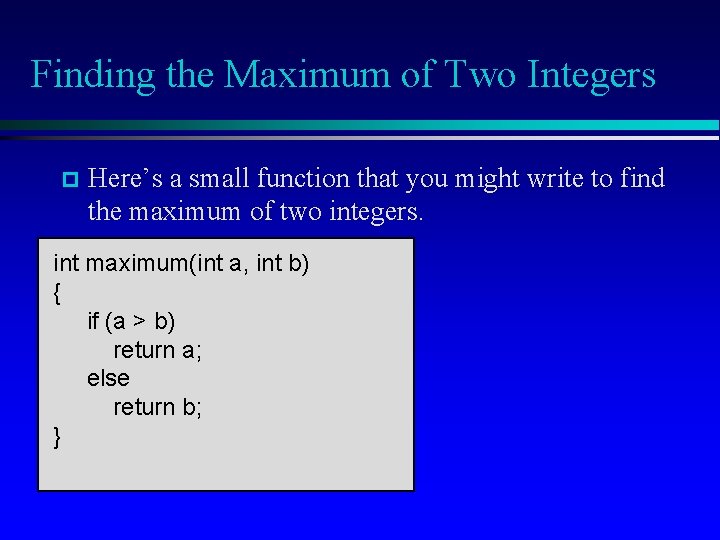
Finding the Maximum of Two Integers p Here’s a small function that you might write to find the maximum of two integers. int maximum(int a, int b) { if (a > b) return a; else return b; }
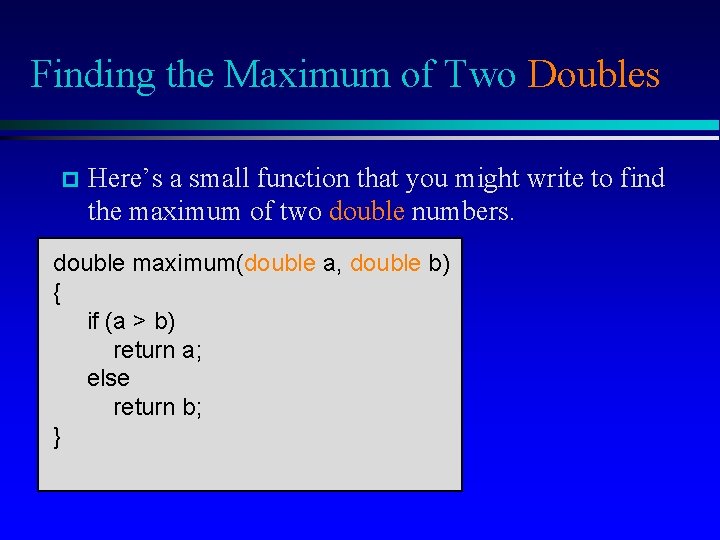
Finding the Maximum of Two Doubles p Here’s a small function that you might write to find the maximum of two double numbers. double maximum(double a, double b) { if (a > b) return a; else return b; }
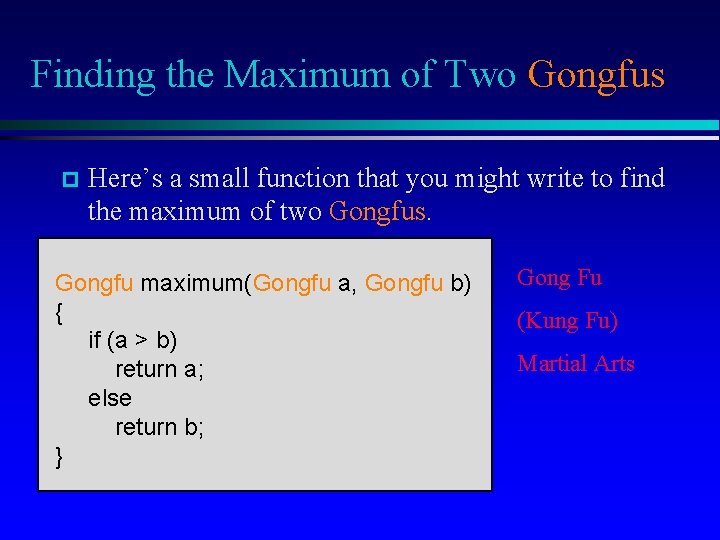
Finding the Maximum of Two Gongfus p Here’s a small function that you might write to find the maximum of two Gongfus. Gongfu maximum(Gongfu a, Gongfu b) { if (a > b) return a; else return b; } Gong Fu (Kung Fu) Martial Arts
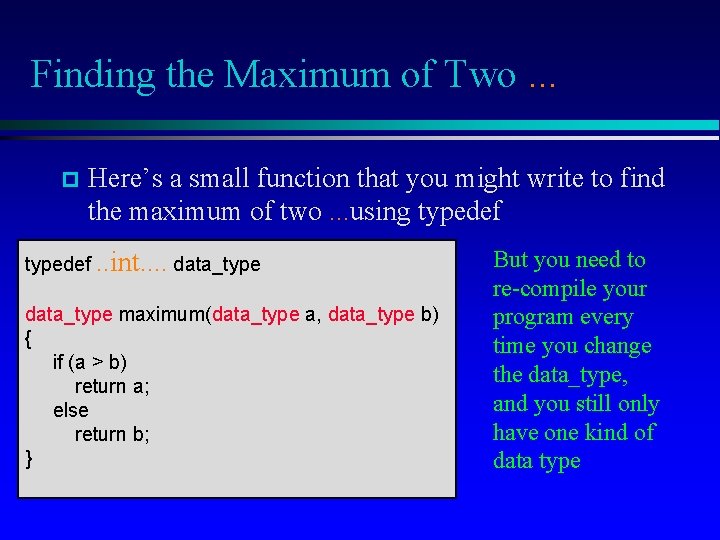
Finding the Maximum of Two. . . p Here’s a small function that you might write to find the maximum of two. . . using typedef. . int. . data_type maximum(data_type a, data_type b) { if (a > b) return a; else return b; } But you need to re-compile your program every time you change the data_type, and you still only have one kind of data type
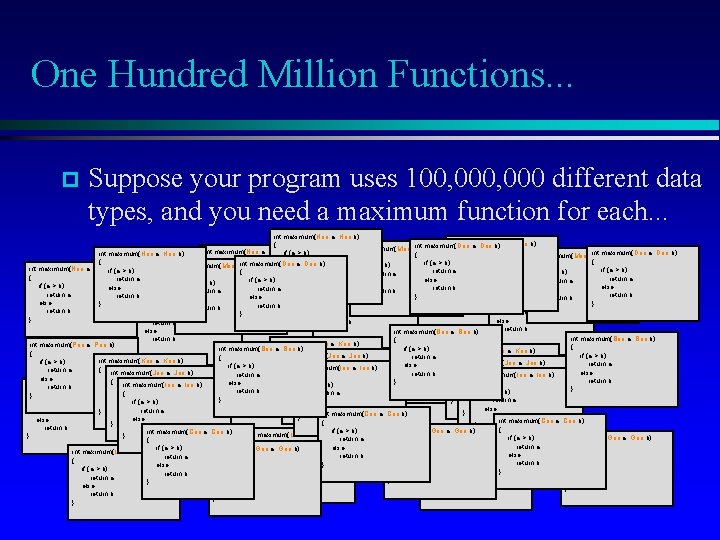
One Hundred Million Functions. . . p Suppose your program uses 100, 000 different data types, and you need a maximum function for each. . . int maximum(Hoo a, Hoo b) int maximum(Hoo { int. Moo maximum(Doo a, Doo b) a, Hoo b) int maximum(Moo a, b) int maximum(Noo a, Noo ifb)(a > b) { int. Moo maximum(Doo a, Doo b) int maximum(Hoo a, Hoo b) { int maximum(Moo a, b) { int maximum(Noo a, Noo ifb)(a > b) { { return a; b) { if (a > b) int maximum(Doo a, Doo { if (a > b) int maximum(Moo b) { if (a > b)a, int maximum(Noo a, Noo ifb)(a > b) if (a > b) else return a; { if (a > b) return a; { return a; if (a > b) else { return a; return int b; maximum(Foo a, Foo b)if (a > b) else return a; else if (a > b) return a; else return b; if (a > b) else int maximum(Foo else a, Foo b) else return b; { return} a; return else b; return a; return b; } return a; return b; { return int b; maximum(Foo a, Foo b) } if (a > b) } else return b; else } if (a > b) } } return a; return b; { return b; } return b; return a; else } if (a > b) } } else return b; return a; int maximum(Poo a, Poo b) return b; } else int maximum(Boo a, Boo int maximum(Poo a, Poo b) b) } { int maximum(Boo a, Boo b) return b; { { int maximum(Koo a, Koo b) if (a > b) int maximum(Poo a, Poo b) { } int maximum(Boo {a, Boo b) int maximum(Koo a, Koo b) if (a if>(a b)> b) return a; { if (a > b) int maximum(Joo a, Joo b) return { { return a; a; if (a > b) else int maximum(Koo a, Koo b) if (a > b) int maximum(Joo a, Joo b) return a; { else if (a > b) a, Knafn if (a > b) int maximum(Ioo a, Ioo b) else int maximum(Knafn b) return a; return b; { return a; { else if (a > b) int maximum(Joo a, Joo b) return b; a, Knafn return a; int maximum(Ioo a, Ioo b) int maximum(Knafn b) return a; { return b; { else } if (a > b) else if (a > b) return b; return a; { {} } else { (a > b) a, Ioo b) if (a >else b) returnif b; int maximum(Knafn a, Knafn return b)int maximum(Ioo a; return b; return a; } else if (a > b) return b; return a; { return a; } {} else return b; return a; } else (a > b) else if (a > b) returnif b; return b; } else return b; return a; } } int maximum(Coo a, Coo b) return b; } else int maximum(Coo a, Coo b) { } } } return b; { if (a > b) int maximum(Goo a, Goo b) int maximum(Coo a, Coo b) int maximum(Loo a, Loo b) } } if (a > b) int maximum(Goo a, Goo b) return a; { { int maximum(Loo a, Loo b) { return a; { else if (a > b) { if (a > b) int maximum(Goo b) if (a a, > b) int maximum(Loo a, Loo b) else if (a > b) return b; return a; if (a > b) return a; { return b; return a; } else if (a > b) else return a; if (a > b) } else return b; return a; return b; } } else return b; } else } return b; } }
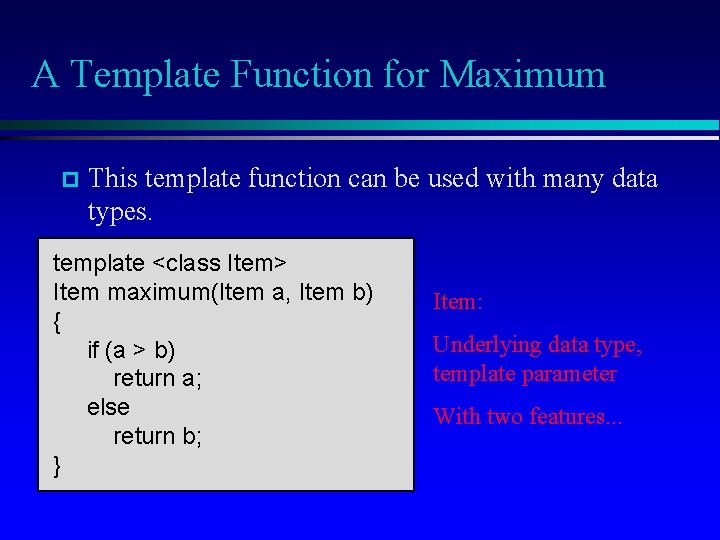
A Template Function for Maximum p This template function can be used with many data types. template <class Item> Item maximum(Item a, Item b) { if (a > b) return a; else return b; } Item: Underlying data type, template parameter With two features. . .
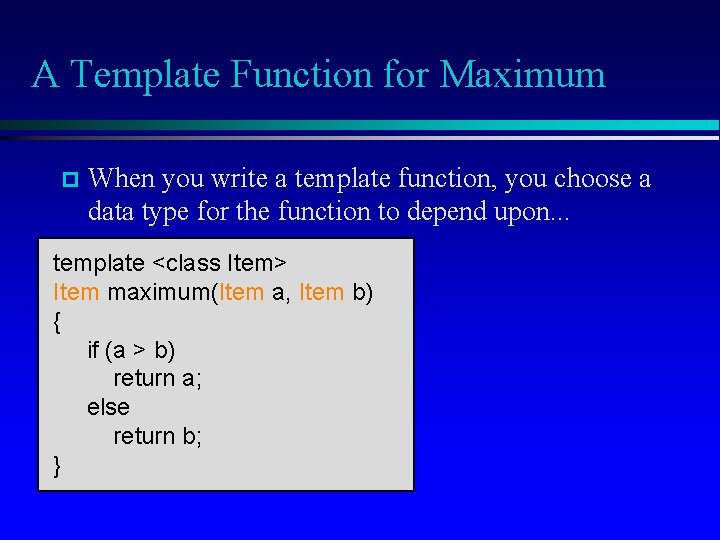
A Template Function for Maximum p When you write a template function, you choose a data type for the function to depend upon. . . template <class Item> Item maximum(Item a, Item b) { if (a > b) return a; else return b; }
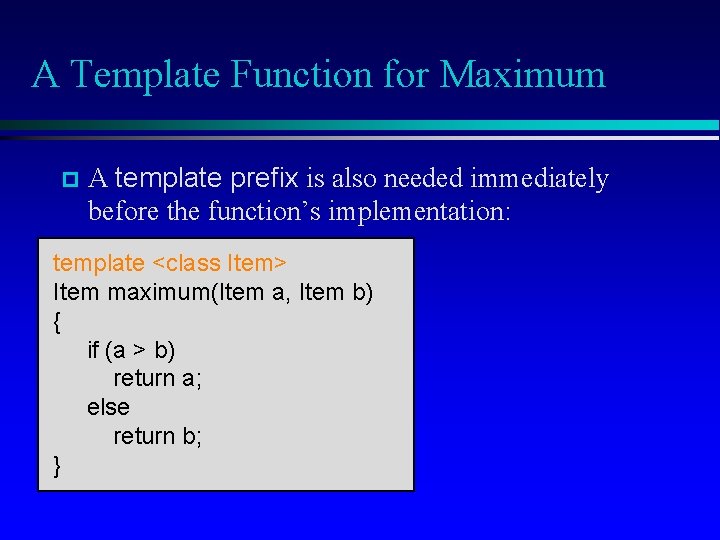
A Template Function for Maximum p A template prefix is also needed immediately before the function’s implementation: template <class Item> Item maximum(Item a, Item b) { if (a > b) return a; else return b; }
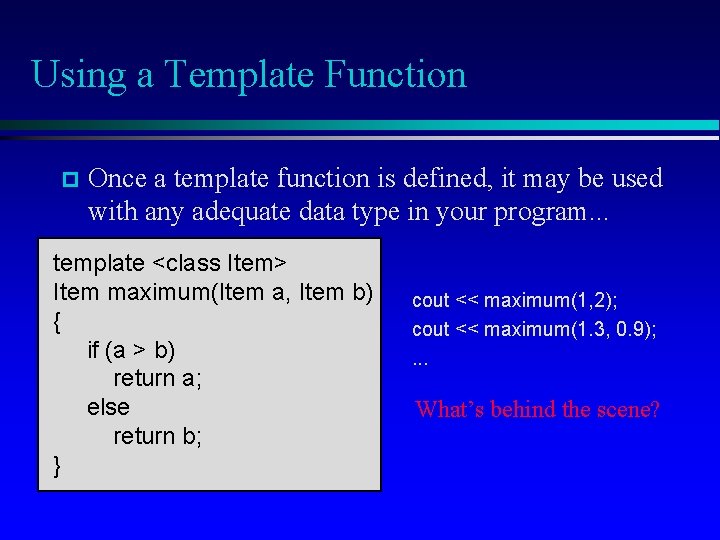
Using a Template Function p Once a template function is defined, it may be used with any adequate data type in your program. . . template <class Item> Item maximum(Item a, Item b) { if (a > b) return a; else return b; } cout << maximum(1, 2); cout << maximum(1. 3, 0. 9); . . . What’s behind the scene?
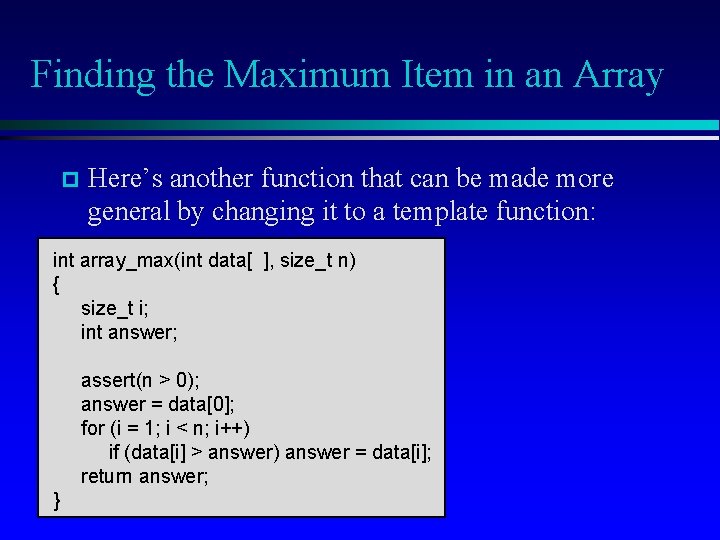
Finding the Maximum Item in an Array p Here’s another function that can be made more general by changing it to a template function: int array_max(int data[ ], size_t n) { size_t i; int answer; assert(n > 0); answer = data[0]; for (i = 1; i < n; i++) if (data[i] > answer) answer = data[i]; return answer; }
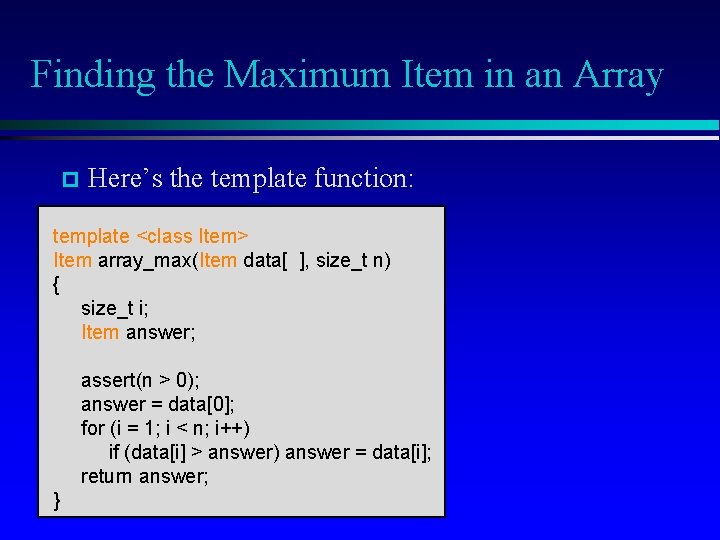
Finding the Maximum Item in an Array p Here’s the template function: template <class Item> Item array_max(Item data[ ], size_t n) { size_t i; Item answer; assert(n > 0); answer = data[0]; for (i = 1; i < n; i++) if (data[i] > answer) answer = data[i]; return answer; }
Template Functions: a summary A template function depends on an underlying data type – the template parameter. p More complex template functions and template classes are discussed in Chapter 6. p Presentation copyright 1997, Addison Wesley Longman, For use with Data Structures and Other Objects Using C++ by Michael Main and Walter Savitch. Some artwork in the presentation is used with permission from Presentation Task Force (copyright New Vision Technologies Inc) and Corel Gallery Clipart Catalog (copyright Corel Corporation, 3 G Graphics Inc, Archive Arts, Cartesia Software, Image Club Graphics Inc, One Mile Up Inc, Tech. Pool Studios, Totem Graphics Inc). Students and instructors who use Data Structures and Other Objects Using C++ are welcome to use this presentation however they see fit, so long as this copyright notice remains intact.
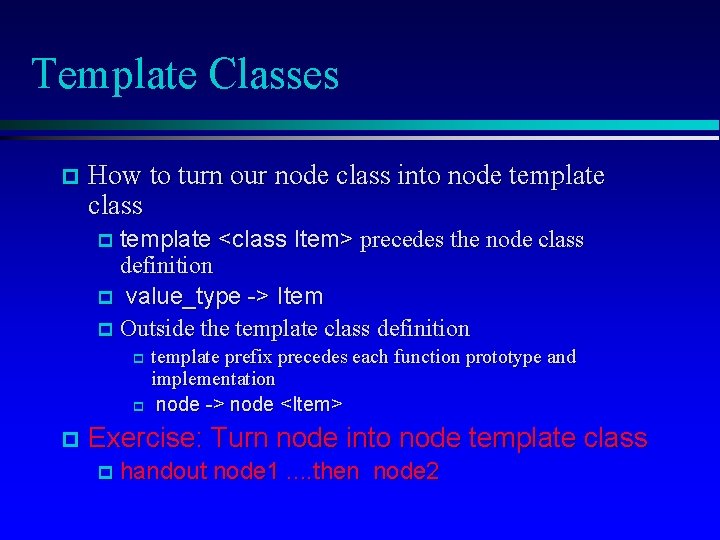
Template Classes p How to turn our node class into node template class p template <class Item> precedes the node class definition p value_type -> Item p Outside the template class definition template prefix precedes each function prototype and implementation p node -> node <Item> p p Exercise: Turn node into node template class p handout node 1. . then node 2
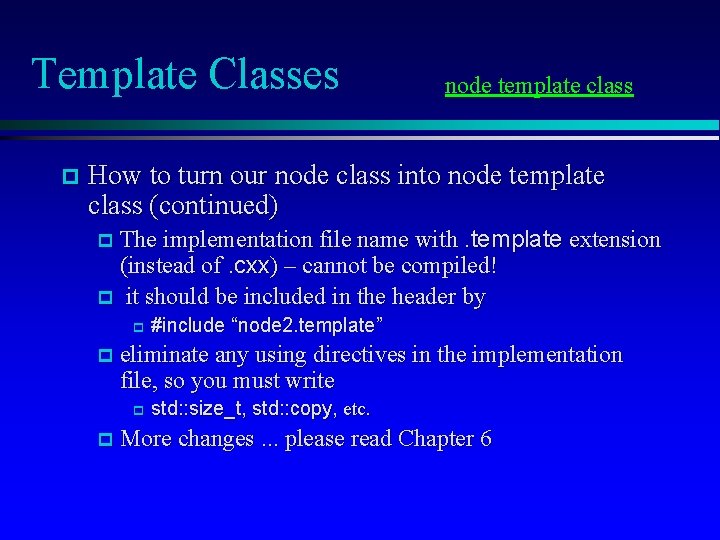
Template Classes p node template class How to turn our node class into node template class (continued) p The implementation file name with. template extension (instead of. cxx) – cannot be compiled! p it should be included in the header by p #include “node 2. template” p eliminate any using directives in the implementation file, so you must write p std: : size_t, std: : copy, etc. p More changes. . . please read Chapter 6
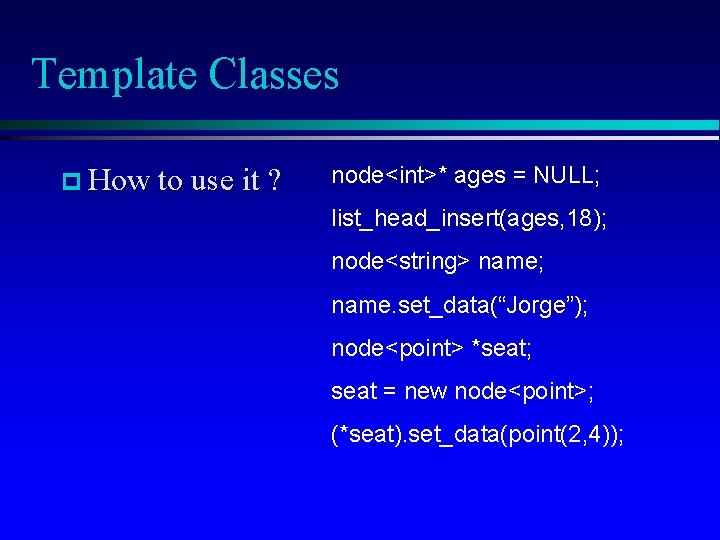
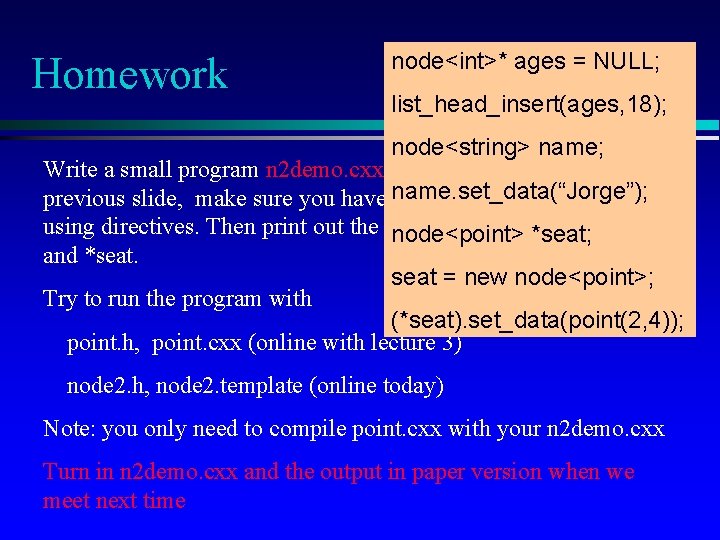
Template Classes p How to use it ? node<int>* ages = NULL; list_head_insert(ages, 18); node<string> name; name. set_data(“Jorge”); node<point> *seat; seat = new node<point>; (*seat). set_data(point(2, 4));
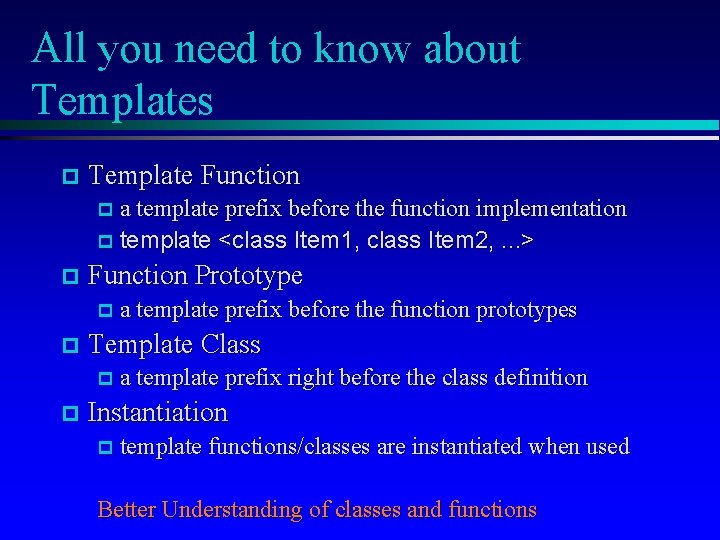
All you need to know about Templates p Template Function p a template prefix before the function implementation p template p <class Item 1, class Item 2, . . . > Function Prototype p a template prefix before the function prototypes p Template Class p a template prefix right before the class definition p Instantiation p template functions/classes are instantiated when used Better Understanding of classes and functions
Homework node<int>* ages = NULL; list_head_insert(ages, 18); node<string> name; Write a small program n 2 demo. cxx with the lines in the previous slide, make sure you have name. set_data(“Jorge”); the correct include and using directives. Then print out the data in node *ages, name node<point> *seat; and *seat = new node<point>; Try to run the program with (*seat). set_data(point(2, 4)); point. h, point. cxx (online with lecture 3) node 2. h, node 2. template (online today) Note: you only need to compile point. cxx with your n 2 demo. cxx Turn in n 2 demo. cxx and the output in paper version when we meet next time
p Break…
CSC 212 Data Structure - Section EF Lecture 11 Templates, Iterators and STL Instructor: Professor Zhigang Zhu Department of Computer Science City College of New York
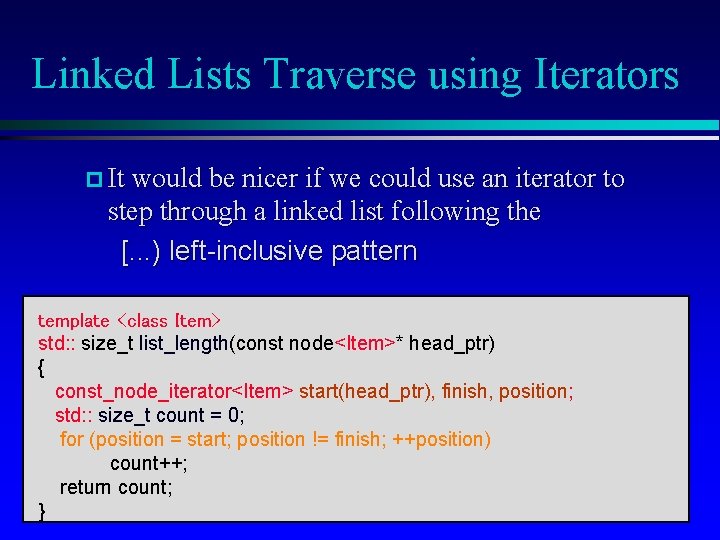
Iterators p We are going to see how to build an iterator for the linked list p so that each of the containers can build its own iterator(s) easily p A node_iterator is an object of the node_iterator class, and can step through the nodes of the linked list
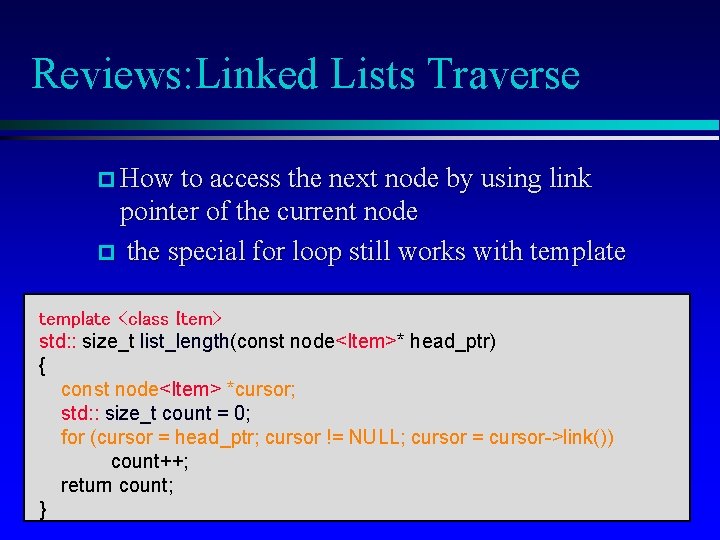
Reviews: Linked Lists Traverse p How to access the next node by using link pointer of the current node p the special for loop still works with template <class Item> std: : size_t list_length(const node<Item>* head_ptr) { const node<Item> *cursor; std: : size_t count = 0; for (cursor = head_ptr; cursor != NULL; cursor = cursor->link()) count++; return count; }
Linked Lists Traverse using Iterators p It would be nicer if we could use an iterator to step through a linked list following the [. . . ) left-inclusive pattern template <class Item> std: : size_t list_length(const node<Item>* head_ptr) { const_node_iterator<Item> start(head_ptr), finish, position; std: : size_t count = 0; for (position = start; position != finish; ++position) count++; return count; }
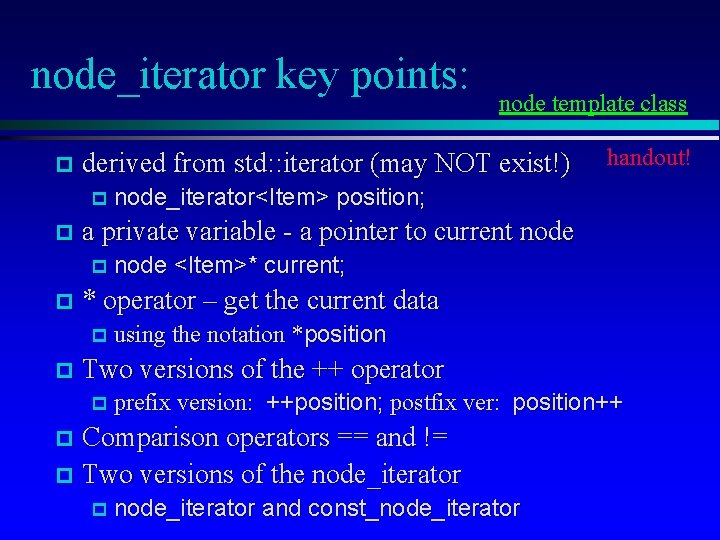
node_iterator key points: p derived from std: : iterator (may NOT exist!) p node_iterator<Item> p handout! position; a private variable - a pointer to current node p node template class <Item>* current; * operator – get the current data p using the notation *position p Two versions of the ++ operator p prefix version: ++position; postfix ver: position++ Comparison operators == and != p Two versions of the node_iterator p p node_iterator and const_node_iterator
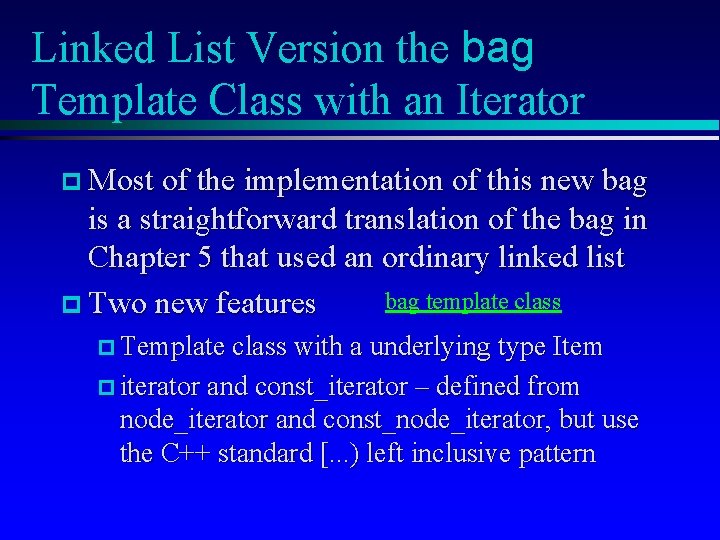
Linked List Version the bag Template Class with an Iterator p Most of the implementation of this new bag is a straightforward translation of the bag in Chapter 5 that used an ordinary linked list bag template class p Two new features p Template class with a underlying type Item p iterator and const_iterator – defined from node_iterator and const_node_iterator, but use the C++ standard [. . . ) left inclusive pattern
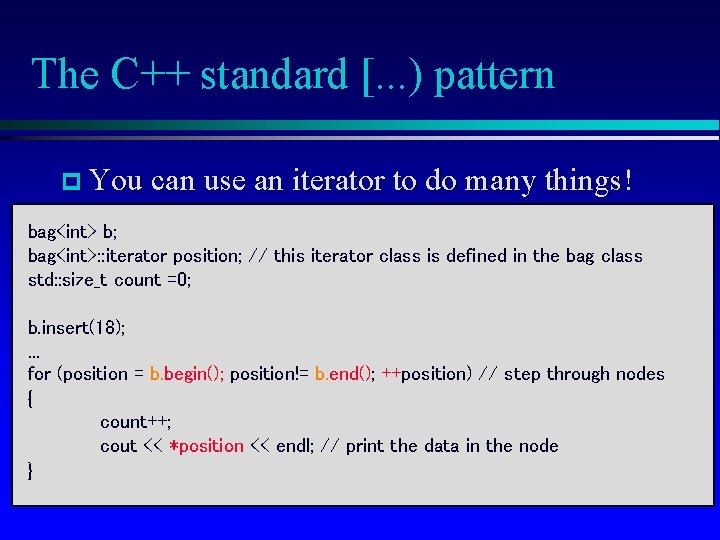
The C++ standard [. . . ) pattern p You can use an iterator to do many things! bag<int> b; bag<int>: : iterator position; // this iterator class is defined in the bag class std: : size_t count =0; b. insert(18); . . . for (position = b. begin(); position!= b. end(); ++position) // step through nodes { count++; cout << *position << endl; // print the data in the node }
Standard Template Library (STL) p The ANSI/ISO C++ Standard provides a variety of container classes in the STL p set, multiset, stack, queue, string, vector p Featured templates and iterators p For example, the multiset template class is similar to our bag template class p More classes summarized in Appendix H
Summary Five bag implementations p A template function depends on a underlying data type (e. g Item) which is instantiated when used. p A single program may has several different instantiations of a template function p A template class depends on a underlying data type p A iterator allows a programmer to easily step through the items of a container class p The C++ STL container classes are all provided with iterators p