
CSC 211 Data Structures Lecture 18 a Trees
- Slides: 14
CSC 211 Data Structures Lecture 18 a Trees, Logs and Time Analysis Instructor: Prof. Xiaoyan Li Department of Computer Science Mount Holyoke College Xiaoyan Li, 2007 1
Topics p Big-O Notation p Worse Case Times for Tree Operations p Time Analysis for BSTs p Time Analysis for Heaps p Logarithms and Logarithmic Algorithms Xiaoyan Li, 2007 2
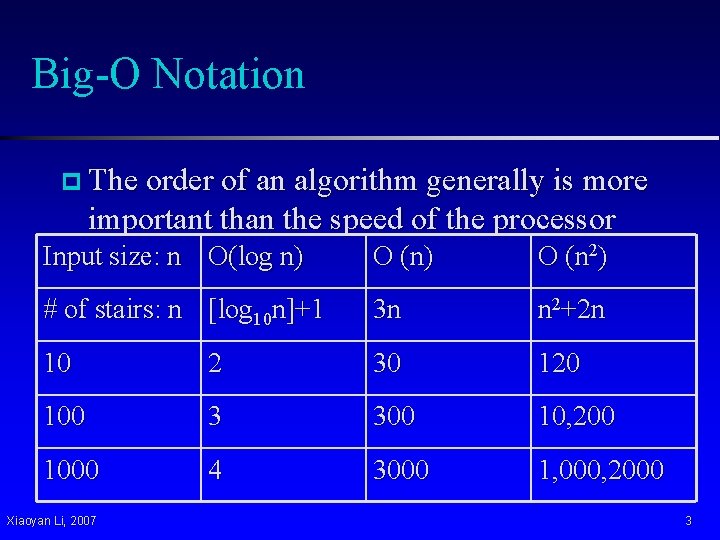
Big-O Notation p The order of an algorithm generally is more important than the speed of the processor Input size: n O(log n) O (n 2) # of stairs: n [log 10 n]+1 3 n n 2+2 n 10 2 30 120 100 3 300 10, 200 1000 4 3000 1, 000, 2000 Xiaoyan Li, 2007 3
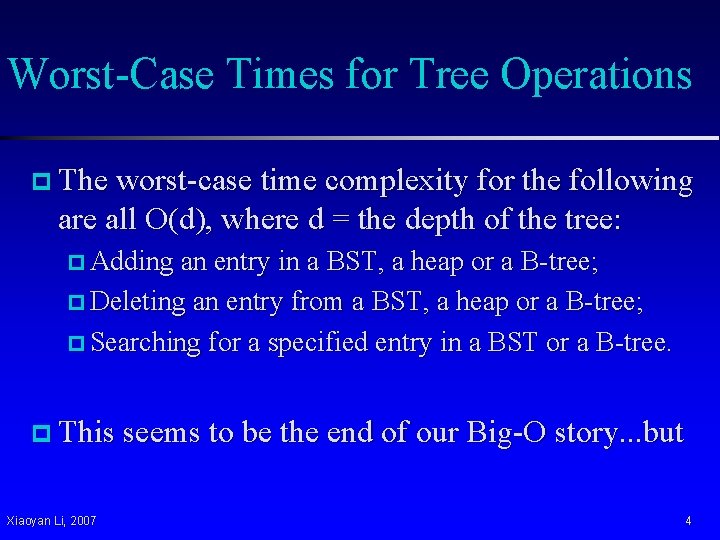
Worst-Case Times for Tree Operations p The worst-case time complexity for the following are all O(d), where d = the depth of the tree: p Adding an entry in a BST, a heap or a B-tree; p Deleting an entry from a BST, a heap or a B-tree; p Searching for a specified entry in a BST or a B-tree. p This seems to be the end of our Big-O story. . . but Xiaoyan Li, 2007 4
What’s d, then? p Time Analyses for these operations are more useful if they are given in term of the number of entries (n) instead of the tree’s depth (d) p Question: p What is the maximum depth for a tree with n entries? Xiaoyan Li, 2007 5
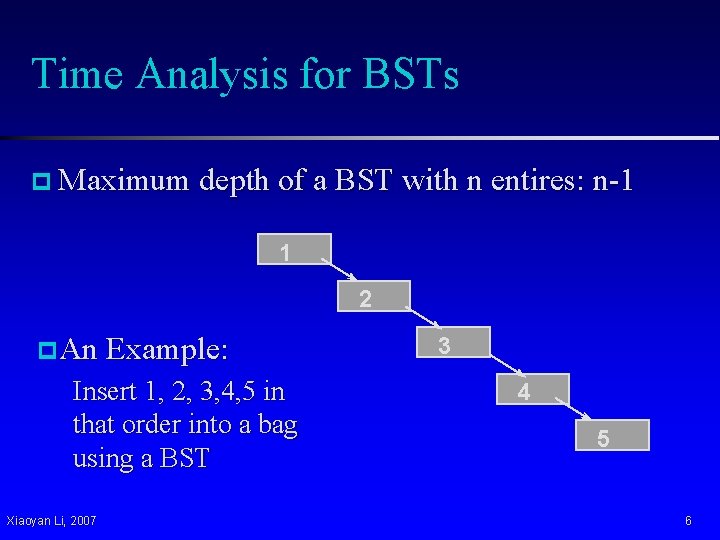
Time Analysis for BSTs p Maximum depth of a BST with n entires: n-1 1 2 p. An Example: Insert 1, 2, 3, 4, 5 in that order into a bag using a BST Xiaoyan Li, 2007 3 4 5 6
Worst-Case Times for BSTs p Adding, deleting or searching for an entry in a BST with n entries is O(d), where d is the depth of the BST p Since d is no more than n-1, the operations in the worst case is (n-1). p Conclusion: the worst case time for the add, delete or search operation of a BST is O(n) Xiaoyan Li, 2007 7
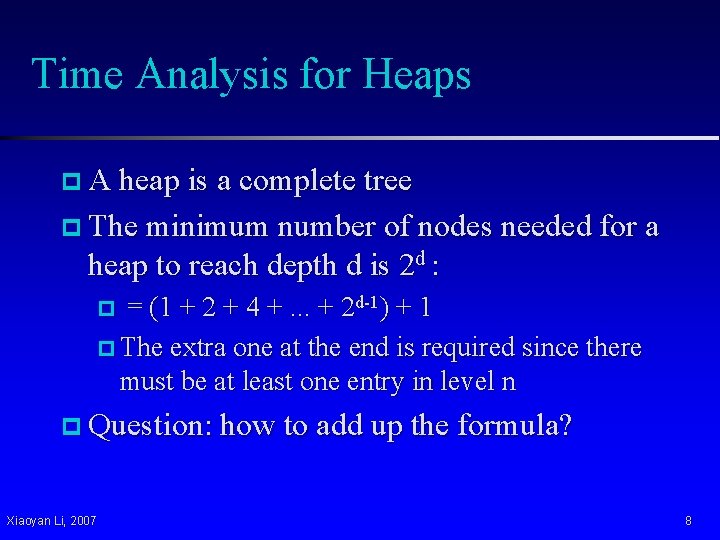
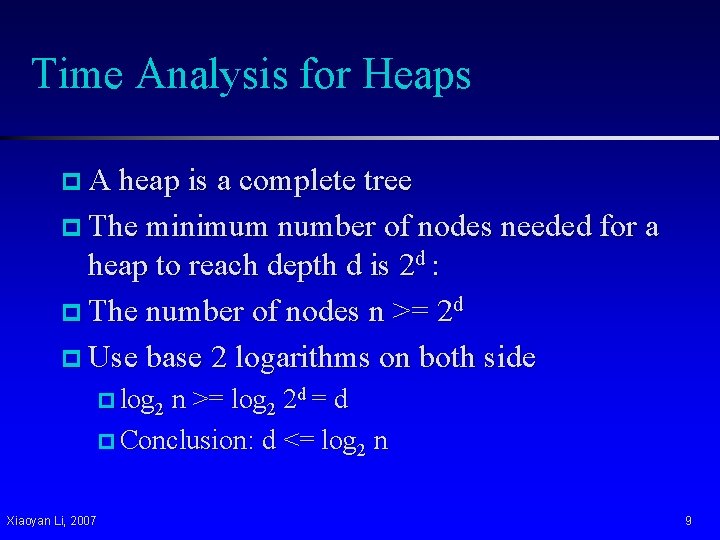
Time Analysis for Heaps p A heap is a complete tree p The minimum number of nodes needed for a heap to reach depth d is 2 d : = (1 + 2 + 4 +. . . + 2 d-1) + 1 p The extra one at the end is required since there must be at least one entry in level n p p Question: how to add up the formula? Xiaoyan Li, 2007 8
Time Analysis for Heaps p A heap is a complete tree p The minimum number of nodes needed for a heap to reach depth d is 2 d : p The number of nodes n >= 2 d p Use base 2 logarithms on both side p log 2 n >= log 2 2 d = d p Conclusion: d <= log 2 n Xiaoyan Li, 2007 9
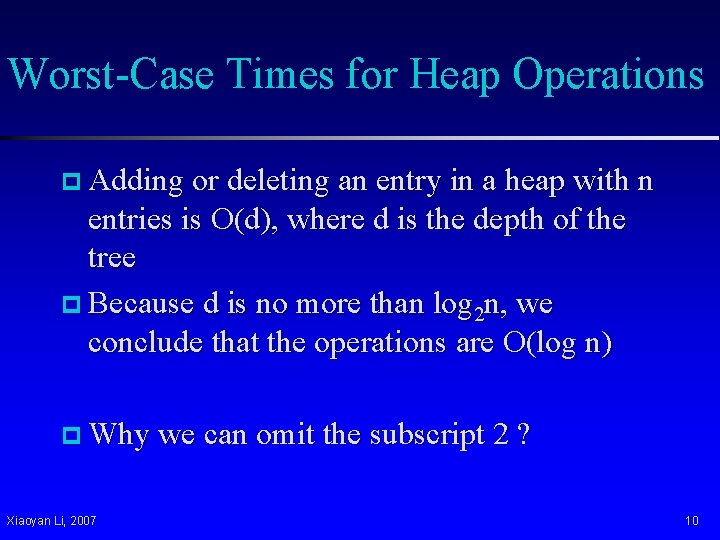
Worst-Case Times for Heap Operations p Adding or deleting an entry in a heap with n entries is O(d), where d is the depth of the tree p Because d is no more than log 2 n, we conclude that the operations are O(log n) p Why we can omit the subscript 2 ? Xiaoyan Li, 2007 10
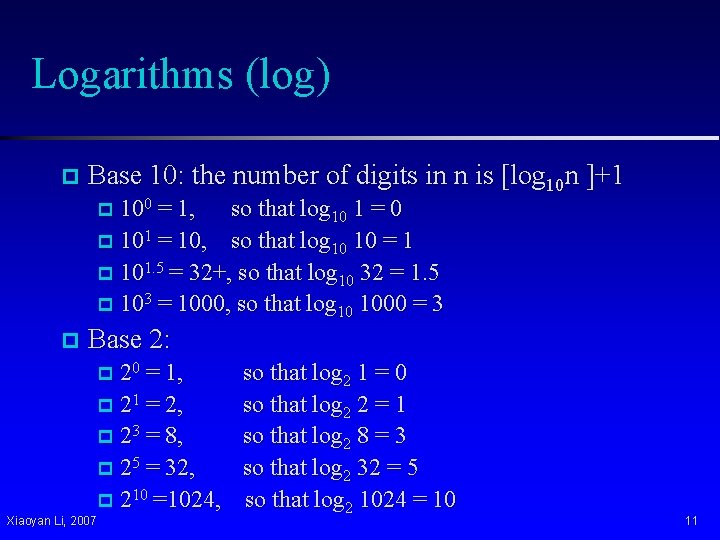
Logarithms (log) p Base 10: the number of digits in n is [log 10 n ]+1 p 100 = 1, so that log 10 1 = 0 p 101 = 10, so that log 10 10 = 1 p 101. 5 = 32+, so that log 10 32 = 1. 5 p 103 = 1000, so that log 10 1000 = 3 p Base 2: p 20 = 1, Xiaoyan Li, 2007 so that log 2 1 = 0 p 21 = 2, so that log 2 2 = 1 p 23 = 8, so that log 2 8 = 3 p 25 = 32, so that log 2 32 = 5 p 210 =1024, so that log 2 1024 = 10 11
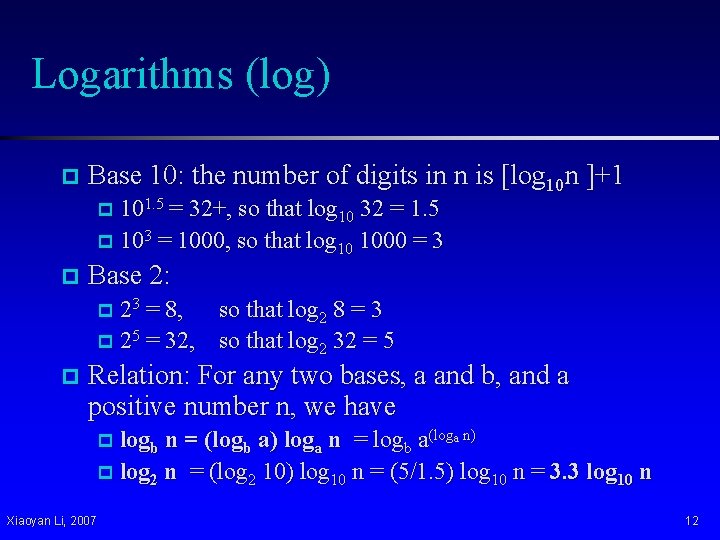
Logarithms (log) p Base 10: the number of digits in n is [log 10 n ]+1 p 101. 5 = 32+, so that log 10 32 = 1. 5 p 103 = 1000, so that log 10 1000 = 3 p Base 2: p 23 = 8, so that log 2 8 = 3 p 25 = 32, so that log 2 32 = 5 p Relation: For any two bases, a and b, and a positive number n, we have p logb n = (logb a) loga n = logb a(loga n) p log 2 n = (log 2 10) log 10 n = (5/1. 5) log 10 n = 3. 3 log 10 n Xiaoyan Li, 2007 12
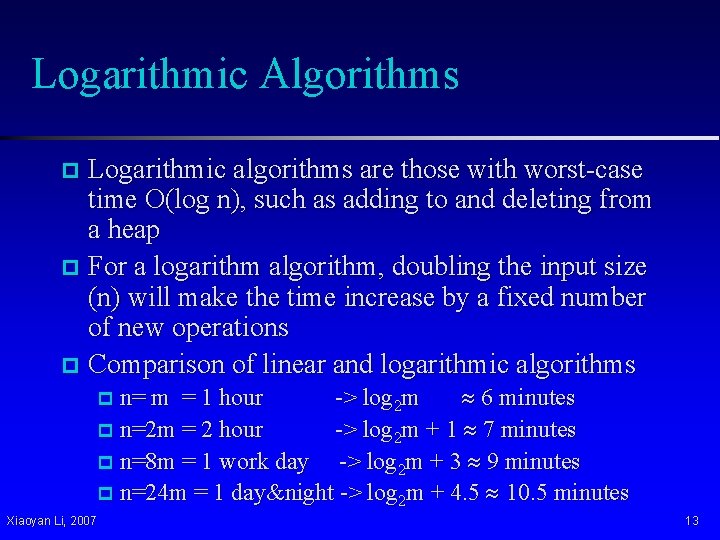
Logarithmic Algorithms Logarithmic algorithms are those with worst-case time O(log n), such as adding to and deleting from a heap p For a logarithm algorithm, doubling the input size (n) will make the time increase by a fixed number of new operations p Comparison of linear and logarithmic algorithms p = 1 hour -> log 2 m 6 minutes p n=2 m = 2 hour -> log 2 m + 1 7 minutes p n=8 m = 1 work day -> log 2 m + 3 9 minutes p n=24 m = 1 day&night -> log 2 m + 4. 5 10. 5 minutes p n= m Xiaoyan Li, 2007 13
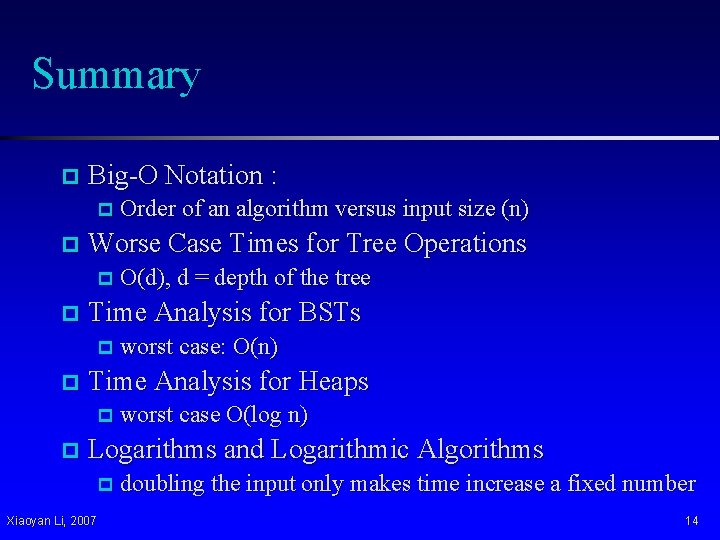
Summary p Big-O Notation : p Order of an algorithm versus input size (n) p Worse Case Times for Tree Operations p O(d), d = depth of the tree p Time Analysis for BSTs p worst case: O(n) p Time Analysis for Heaps p worst case O(log n) p Logarithms and Logarithmic Algorithms p doubling the input only makes time increase a fixed number Xiaoyan Li, 2007 14