
CSC 2100 B Tutorial 10 Graph Hao Ma

CSC 2100 B Tutorial 10 Graph Hao Ma 1
Outline l l l Graph Adjacency Representation Topological Sort Minimum Spanning Tree l l l Kruskal’s Algorithm Prim’s Algorithm Shortest Path l Dijkstra’ Algorithm 2
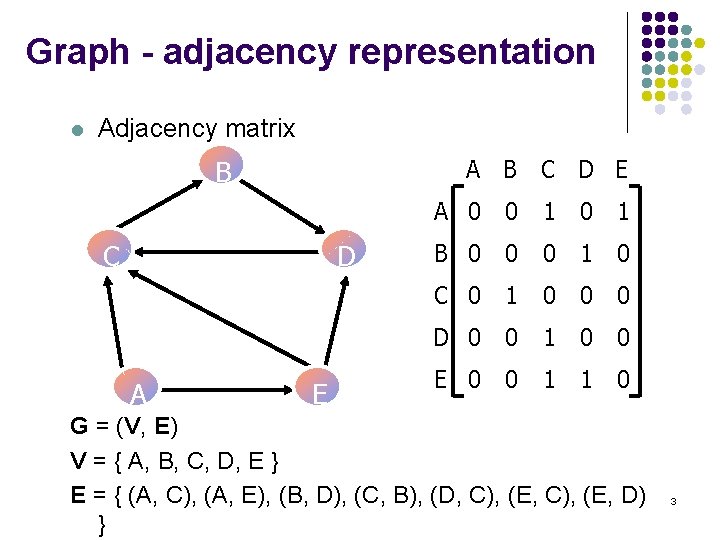
Graph - adjacency representation l Adjacency matrix A B C D E B C D A E A 0 0 1 B 0 0 0 1 0 C 0 1 0 0 0 D 0 0 1 0 0 E 0 0 1 1 0 G = (V, E) V = { A, B, C, D, E } E = { (A, C), (A, E), (B, D), (C, B), (D, C), (E, D) } 3
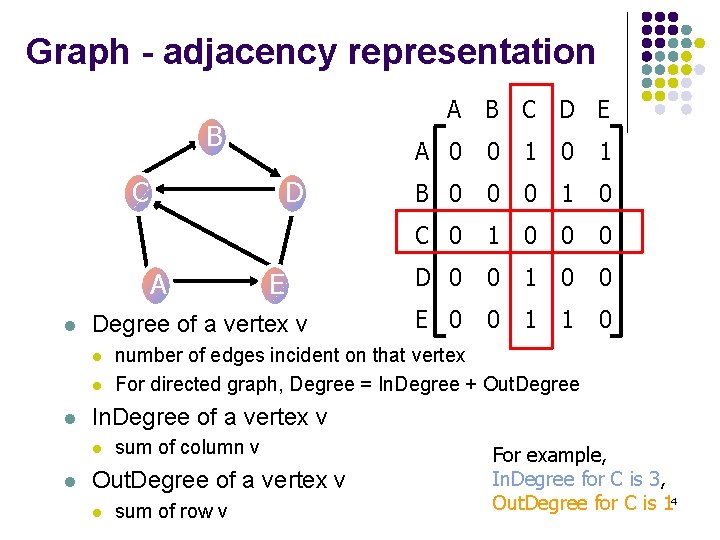
Graph - adjacency representation A B C D E B C D A l Degree of a vertex v l l l 0 1 B 0 0 0 1 0 C 0 1 0 0 0 D 0 0 1 0 0 E 0 0 1 1 0 number of edges incident on that vertex For directed graph, Degree = In. Degree + Out. Degree In. Degree of a vertex v l l E A 0 sum of column v Out. Degree of a vertex v l sum of row v For example, In. Degree for C is 3, Out. Degree for C is 14
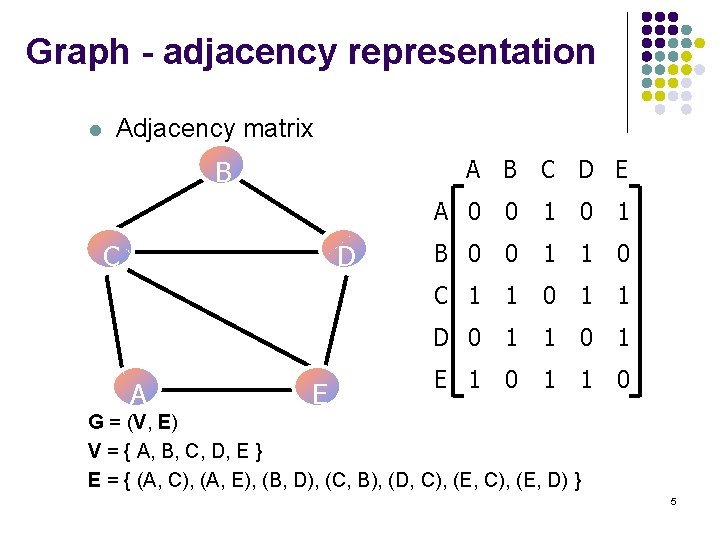
Graph - adjacency representation l Adjacency matrix A B C D E B C D A E A 0 0 1 B 0 0 1 1 0 C 1 1 0 1 1 D 0 1 1 0 1 E 1 0 1 1 0 G = (V, E) V = { A, B, C, D, E } E = { (A, C), (A, E), (B, D), (C, B), (D, C), (E, D) } 5
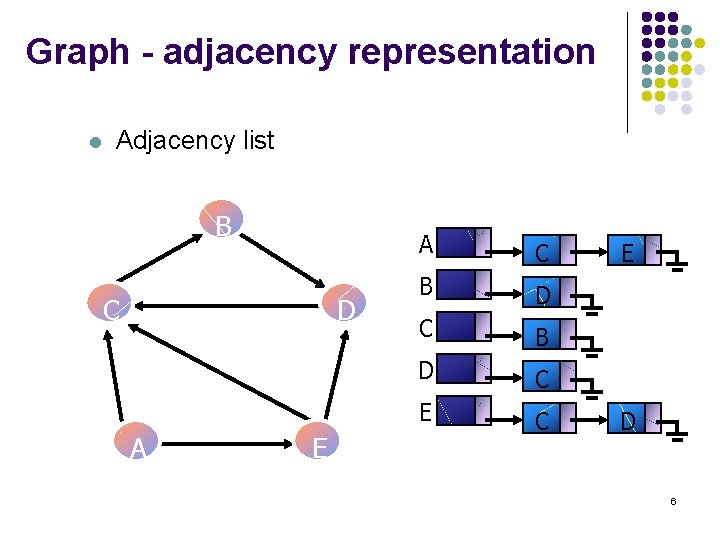
Graph - adjacency representation l Adjacency list B C D A E A C B D C E D 6
Topological Sort l A topological sort of a DAG (Directed Acyclic Graph) G is a linear ordering of all its vertices such that if G contains an edge (u, v), then u appears before v in the ordering. 7
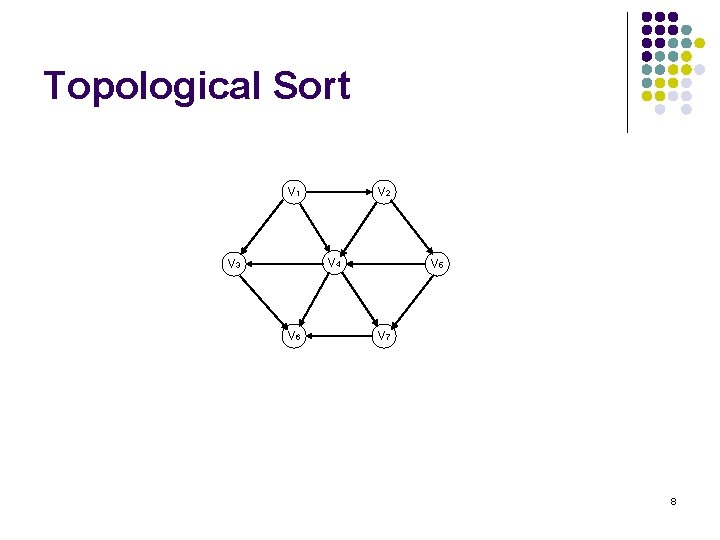
Topological Sort V 1 V 2 V 4 V 3 V 6 V 5 V 7 8
How to find the topological ordering? l l Define the indegree of a vertex v as the # of edges (u, v). We compute the indegrees of all vertices in the graph. Find any vertex with no incoming edges (or the indegree is 0). We print this vertex, and remove it, along with its edges, from the graph. Then we apply this same strategy to the rest of the graph. 9
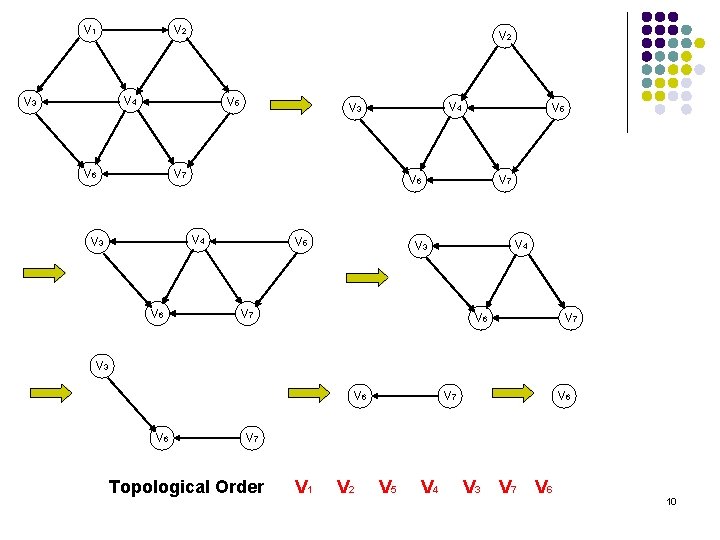
V 1 V 2 V 4 V 3 V 5 V 6 V 4 V 3 V 7 V 6 V 4 V 3 V 6 V 5 V 7 V 4 V 3 V 7 V 6 V 7 V 3 V 6 V 7 Topological Order V 1 V 2 V 5 V 4 V 3 V 7 V 6 10
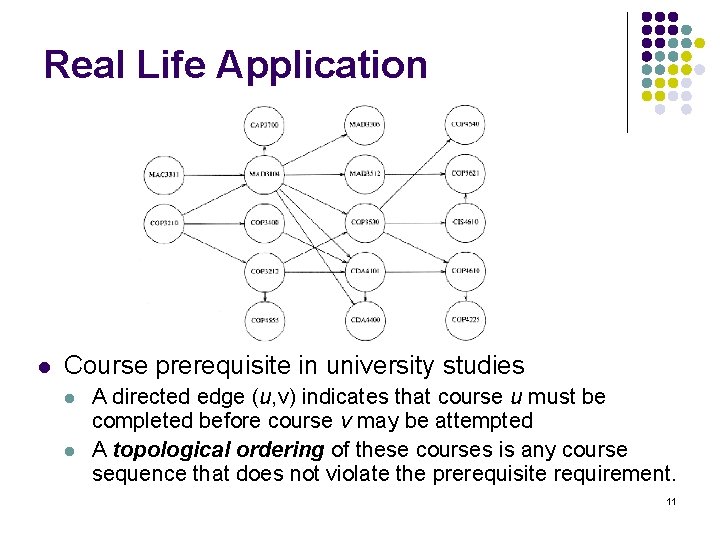
Real Life Application l Course prerequisite in university studies l l A directed edge (u, v) indicates that course u must be completed before course v may be attempted A topological ordering of these courses is any course sequence that does not violate the prerequisite requirement. 11
Notes l Is topological ordering possible with a cyclic graph? l l No, since for two vertices v and w on the cycle, v precedes w and w precedes v. Is the ordering unique? l It is not necessarily unique; any legal ordering will do (e. g. , v 1, v 2, v 5, v 4, v 3, v 7, v 6 and v 1, v 2, v 5, v 4, v 7, v 3, v 6 are topological orderings). 12
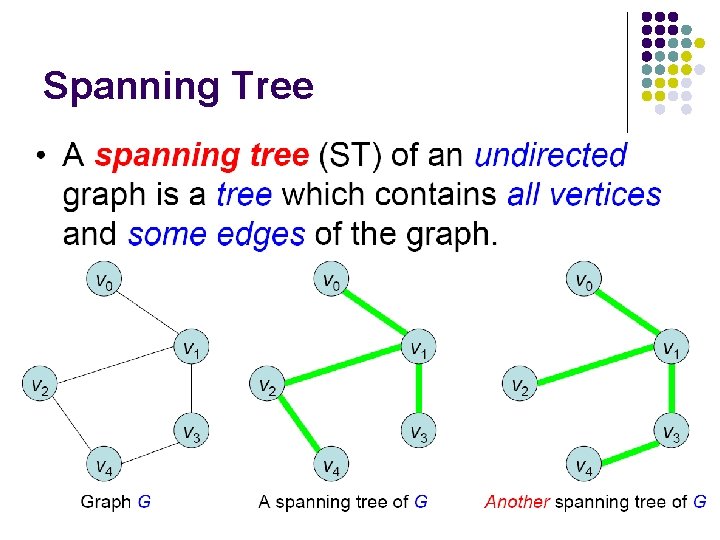
Spanning Tree 13
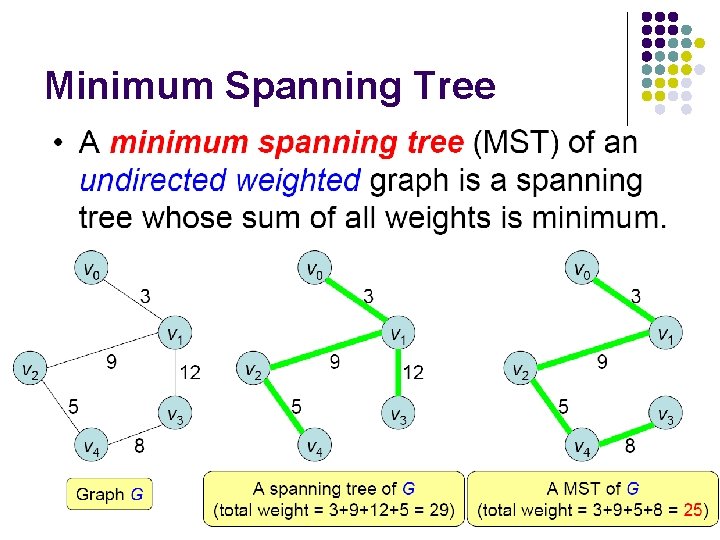
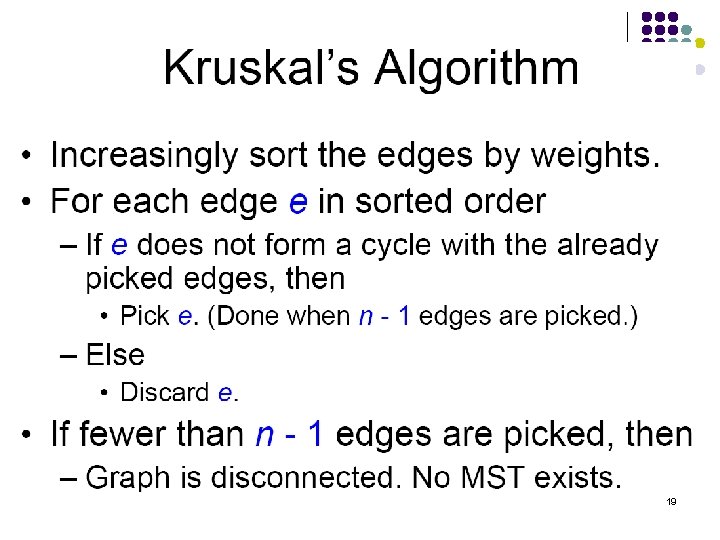
Minimum Spanning Tree 14
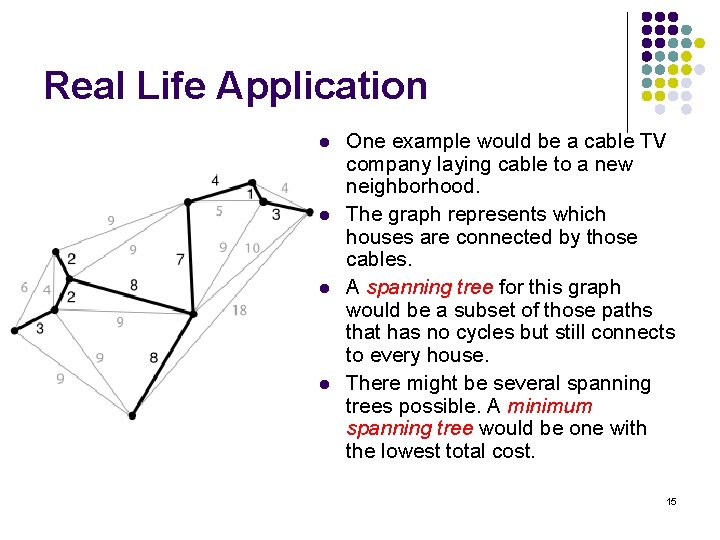
Real Life Application l l One example would be a cable TV company laying cable to a new neighborhood. The graph represents which houses are connected by those cables. A spanning tree for this graph would be a subset of those paths that has no cycles but still connects to every house. There might be several spanning trees possible. A minimum spanning tree would be one with the lowest total cost. 15
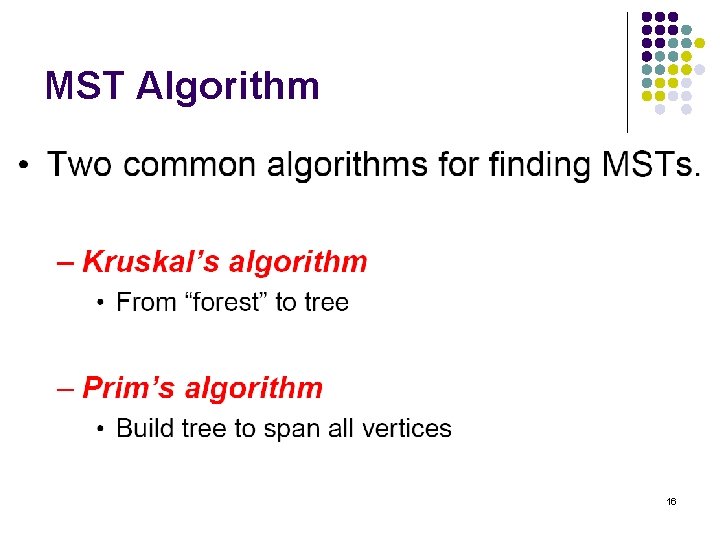
MST Algorithm 16
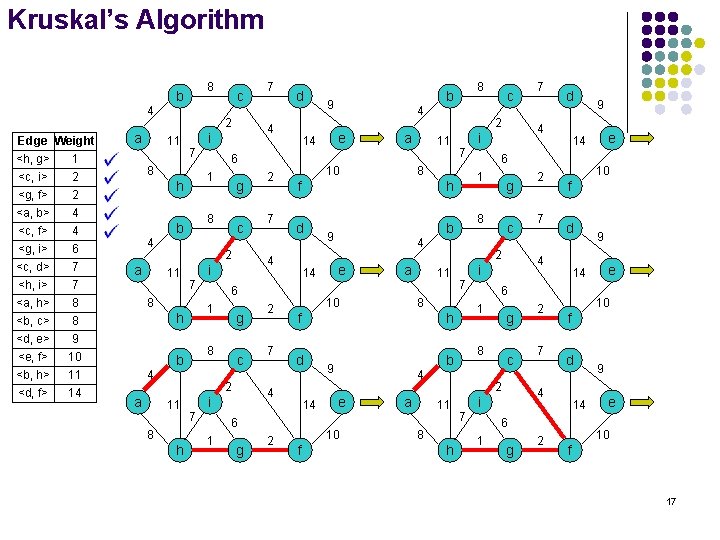
Kruskal’s Algorithm 8 b 4 Edge Weight <h, g> 1 <c, i> 2 <g, f> 2 <a, b> 4 <c, f> <g, i> <c, d> <h, i> <a, h> 4 6 7 7 8 <b, c> <d, e> <e, f> <b, h> <d, f> 8 9 10 11 14 a 2 11 7 4 c 2 11 7 g 8 b 4 c 2 11 8 h 7 7 g 2 a 11 d b 9 a 10 h d b 9 10 f a c 7 8 h 7 1 g 8 c f d 7 g 2 e 10 f d 14 6 1 9 14 4 i 7 2 e 10 6 2 11 2 9 14 4 i 4 e g 8 8 f 14 1 2 11 d 6 4 e 14 7 7 4 i 8 h 6 1 e c 2 f 4 i 7 2 4 10 6 1 h 2 8 b 9 14 4 i 8 a g 8 b d 6 1 h 7 4 i 8 a c 9 e 10 f 17
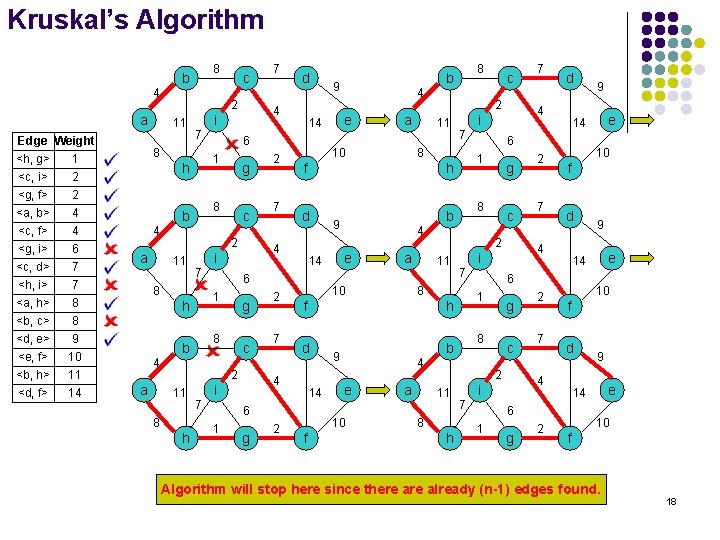
Kruskal’s Algorithm 8 b 4 a Edge Weight <h, g> 1 <c, i> 2 <g, f> 2 <a, b> 4 <c, f> <g, i> <c, d> <h, i> <a, h> 4 6 7 7 8 <b, c> <d, e> <e, f> <b, h> <d, f> 8 9 10 11 14 2 11 7 4 c 2 11 7 g 8 b 4 c 2 11 8 h 7 7 g 2 a 11 d b 9 a 10 h d b 9 10 f a c 7 8 h 7 1 g 8 c f d 7 g 2 e 10 f d 9 e 14 6 1 9 14 4 i 7 2 e 10 6 2 11 2 9 14 4 i 4 e g 8 8 f 14 1 2 11 d 6 4 e 14 7 7 4 i 8 h 6 1 e c 2 f 4 i 7 2 4 10 6 1 h 2 8 b 9 14 4 i 8 a g 8 b d 6 1 h 7 4 i 8 a c 10 f Algorithm will stop here since there already (n-1) edges found. 18
19
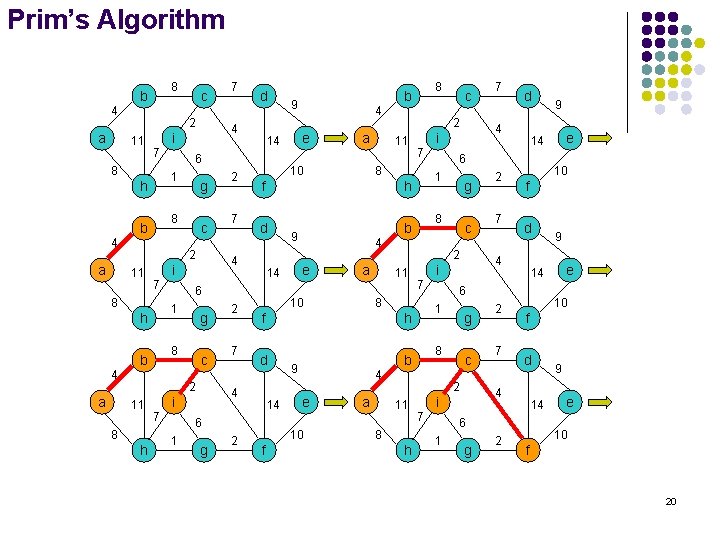
Prim’s Algorithm 8 b 4 a 2 11 7 4 c 2 11 7 g 8 b 4 c 2 11 8 h 7 7 g 2 a 11 d b 9 a 10 h d b 9 10 f a c 7 8 h 7 1 g 8 c f d 7 g 2 e 10 f d 14 6 1 9 14 4 i 7 2 e 10 6 2 11 2 9 14 4 i 4 e g 8 8 f 14 1 2 11 d 6 4 e 14 7 7 4 i 8 h 6 1 e c 2 f 4 i 7 2 4 10 6 1 h 2 8 b 9 14 4 i 8 a g 8 b d 6 1 h 7 4 i 8 a c 9 e 10 f 20
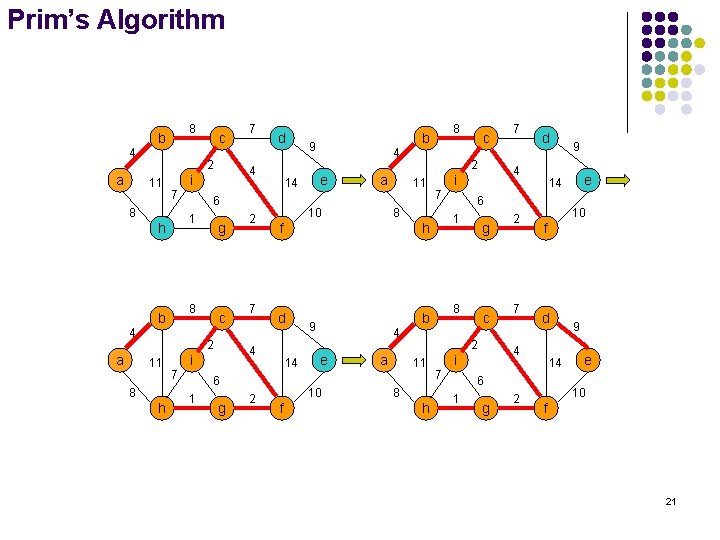
Prim’s Algorithm 8 b 4 a 2 11 7 g 8 b 4 c 2 11 8 h d 7 g 2 e a 11 h d b 14 e a 1 g 8 c 2 11 8 h d 7 f d 14 6 1 g 2 e 10 4 i 7 2 9 14 6 4 10 f 7 7 4 i 8 9 c 2 f 6 1 4 10 4 i 7 2 8 b 9 14 6 1 h 7 4 i 8 a c 9 e 10 f 21
22
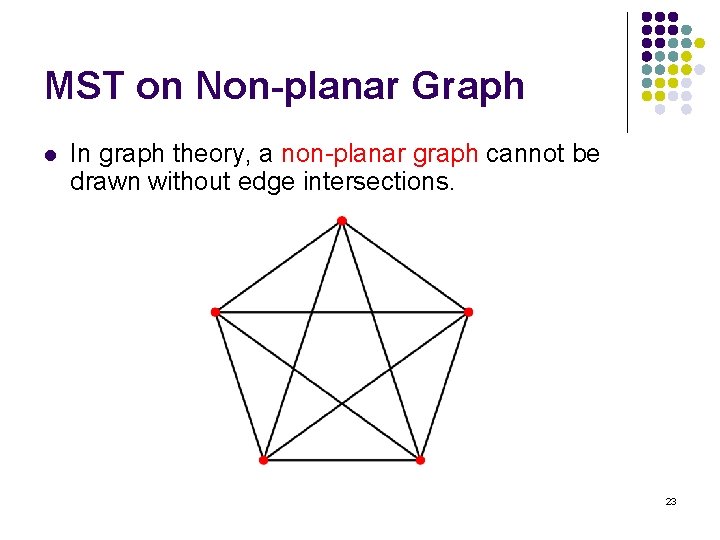
MST on Non-planar Graph l In graph theory, a non-planar graph cannot be drawn without edge intersections. 23
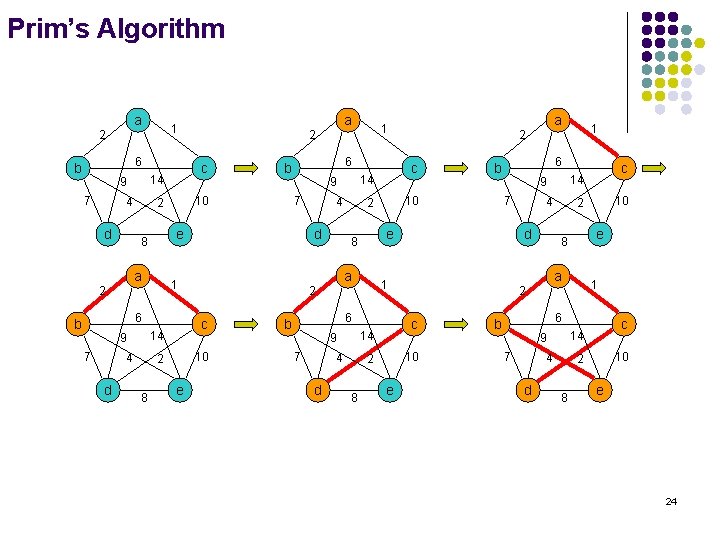
Prim’s Algorithm a 6 b 7 4 d 10 2 a 7 4 d 10 2 8 e 7 4 d 8 e e 8 a 10 2 1 2 c 14 4 d 1 6 9 7 c 14 9 e 8 a b 6 b 10 2 2 c 14 4 d 1 6 9 7 1 2 c 14 9 e 8 2 b 6 b a 1 2 c 14 9 a 1 2 6 b 7 4 d c 14 9 10 2 8 e 24
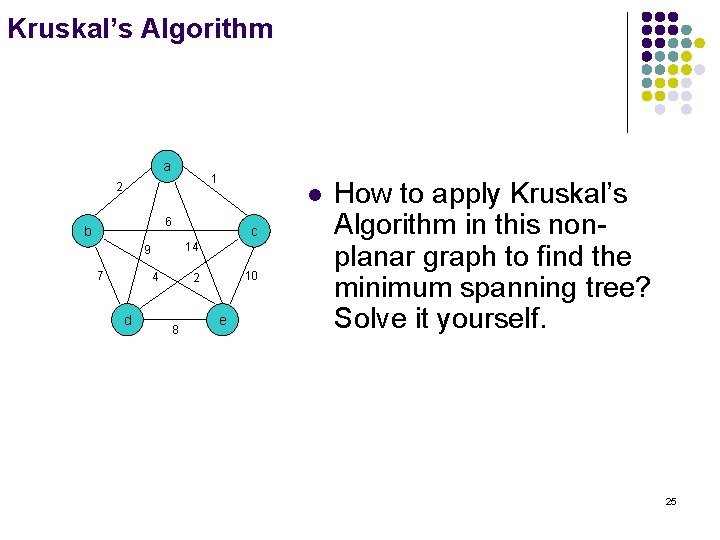
Kruskal’s Algorithm a 1 2 l 6 b c 14 9 7 4 d 10 2 8 e How to apply Kruskal’s Algorithm in this nonplanar graph to find the minimum spanning tree? Solve it yourself. 25
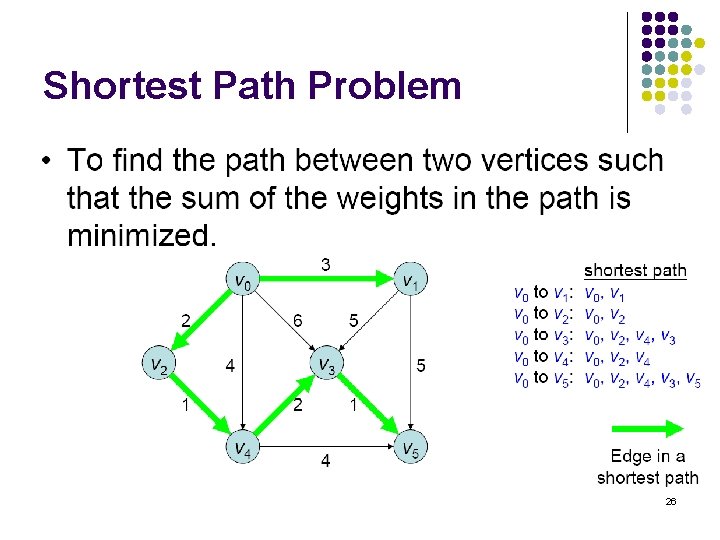
Shortest Path Problem 26
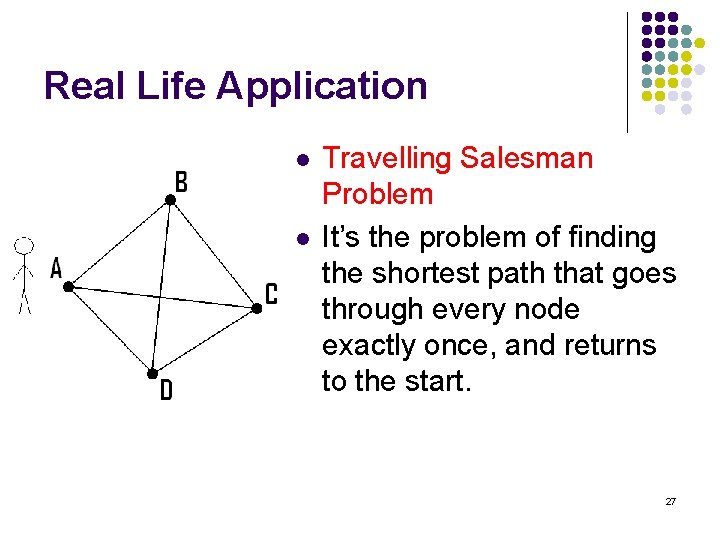
Real Life Application l l Travelling Salesman Problem It’s the problem of finding the shortest path that goes through every node exactly once, and returns to the start. 27
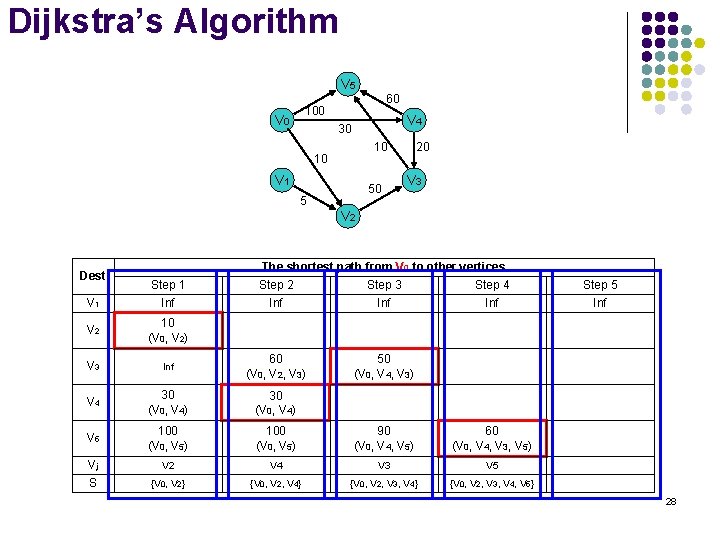
Dijkstra’s Algorithm V 5 60 100 V 4 30 10 10 V 1 50 5 20 V 3 V 2 Dest V 1 Step 1 Inf The shortest path from V 0 to other vertices Step 2 Step 3 Step 4 Inf Inf V 2 10 (V 0, V 2) V 3 Inf 60 (V 0, V 2, V 3) V 4 30 (V 0, V 4) V 5 100 (V 0, V 5) 90 (V 0, V 4, V 5) 60 (V 0, V 4, V 3, V 5) V 2 V 4 V 3 V 5 {V 0, V 2} {V 0, V 2, V 4} {V 0, V 2, V 3, V 4, V 5} Vj S Step 5 Inf 50 (V 0, V 4, V 3) 28
29
The End Any Questions? 30
- Slides: 30