
CSC 143 Java Program Efficiency Introduction to Complexity
- Slides: 35
CSC 143 Java Program Efficiency & Introduction to Complexity Theory 1
GREAT IDEAS IN COMPUTER SCIENCE ANALYSIS OF ALGORITHMIC COMPLEXITY 2
Overview • Topics • Measuring time and space used by algorithms • Machine-independent measurements • Costs of operations • Comparing algorithms • Asymptotic complexity – O( ) notation and complexity classes 3
Comparing Algorithms • Example: We’ve seen two different list implementations • Dynamic expanding array • Linked list • Which is “better”? • How do we measure? • Stopwatch? Why or why not? 4
Program Efficiency & Resources • Goal: Find way to measure "resource" usage in a way that is independent of particular machines/implementations • Resources • Execution time • Execution space • Network bandwidth • others • We will focus on execution time • Basic techniques/vocabulary apply to other resource measures 5
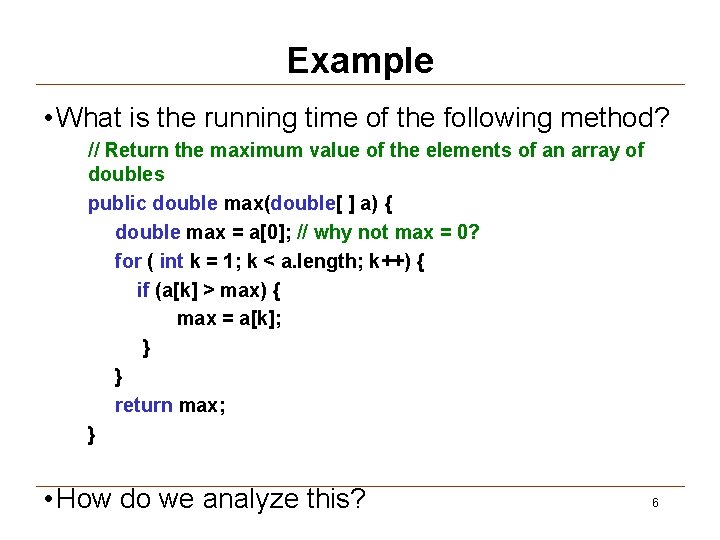
Example • What is the running time of the following method? // Return the maximum value of the elements of an array of doubles public double max(double[ ] a) { double max = a[0]; // why not max = 0? for ( int k = 1; k < a. length; k++) { if (a[k] > max) { max = a[k]; } } return max; } • How do we analyze this? 6
Analysis of Execution Time 1. First: describe the size of the problem in terms of one or more parameters • • For max, size of array makes sense Often size of data structure, but can be magnitude of some numeric parameter, etc. 2. Then, count the number of steps needed as a function of the problem size • Need to define what a "step" is. • • First approximation: one simple statement More complex statements will be multiple steps 7
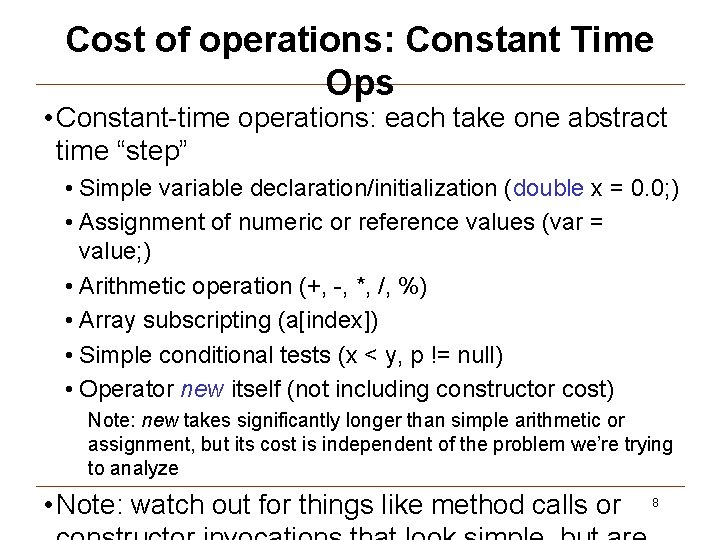
Cost of operations: Constant Time Ops • Constant-time operations: each take one abstract time “step” • Simple variable declaration/initialization (double x = 0. 0; ) • Assignment of numeric or reference values (var = value; ) • Arithmetic operation (+, -, *, /, %) • Array subscripting (a[index]) • Simple conditional tests (x < y, p != null) • Operator new itself (not including constructor cost) Note: new takes significantly longer than simple arithmetic or assignment, but its cost is independent of the problem we’re trying to analyze • Note: watch out for things like method calls or 8
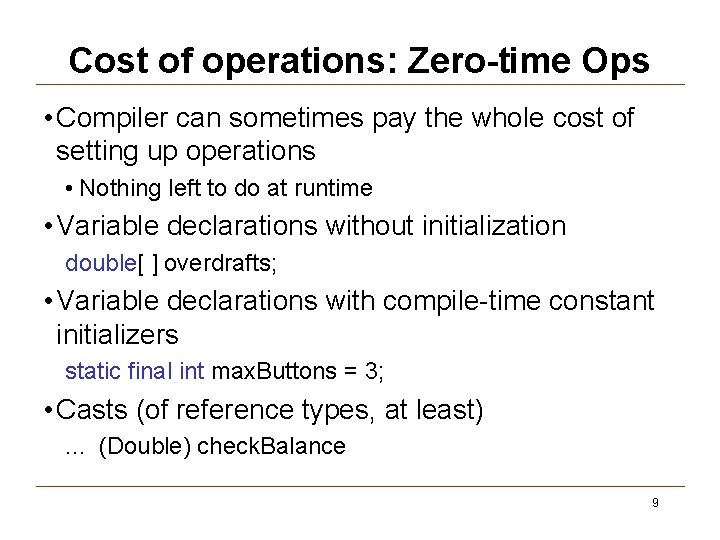
Cost of operations: Zero-time Ops • Compiler can sometimes pay the whole cost of setting up operations • Nothing left to do at runtime • Variable declarations without initialization double[ ] overdrafts; • Variable declarations with compile-time constant initializers static final int max. Buttons = 3; • Casts (of reference types, at least). . . (Double) check. Balance 9
Sequences of Statements • Cost of S 1; S 2; … Sn is sum of the costs of S 1 + S 2 + … + Sn 10
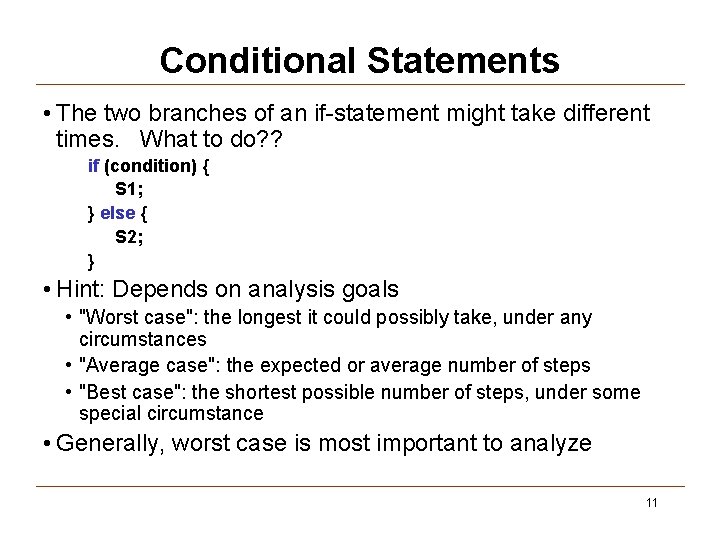
Conditional Statements • The two branches of an if-statement might take different times. What to do? ? if (condition) { S 1; } else { S 2; } • Hint: Depends on analysis goals • "Worst case": the longest it could possibly take, under any circumstances • "Average case": the expected or average number of steps • "Best case": the shortest possible number of steps, under some special circumstance • Generally, worst case is most important to analyze 11
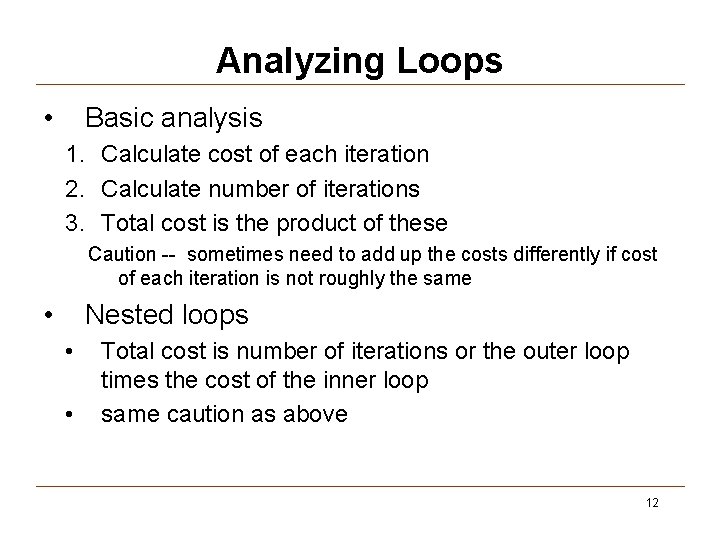
Analyzing Loops • Basic analysis 1. Calculate cost of each iteration 2. Calculate number of iterations 3. Total cost is the product of these Caution -- sometimes need to add up the costs differently if cost of each iteration is not roughly the same • Nested loops • • Total cost is number of iterations or the outer loop times the cost of the inner loop same caution as above 12
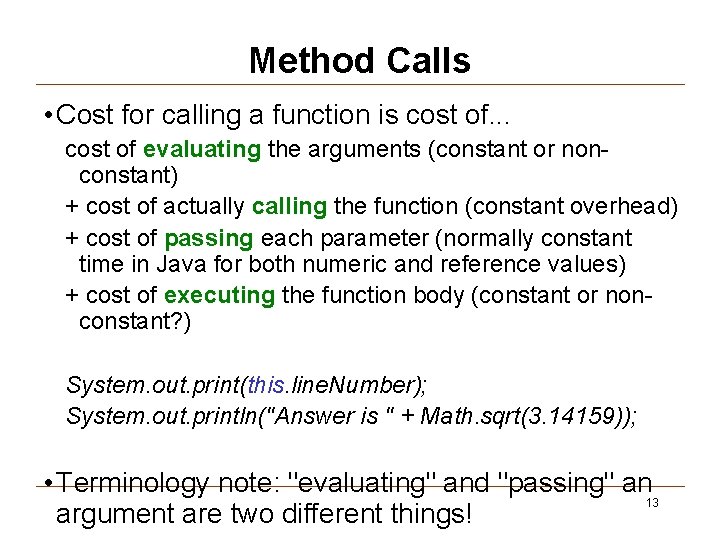
Method Calls • Cost for calling a function is cost of. . . cost of evaluating the arguments (constant or nonconstant) + cost of actually calling the function (constant overhead) + cost of passing each parameter (normally constant time in Java for both numeric and reference values) + cost of executing the function body (constant or nonconstant? ) System. out. print(this. line. Number); System. out. println("Answer is " + Math. sqrt(3. 14159)); • Terminology note: "evaluating" and "passing" an 13 argument are two different things!
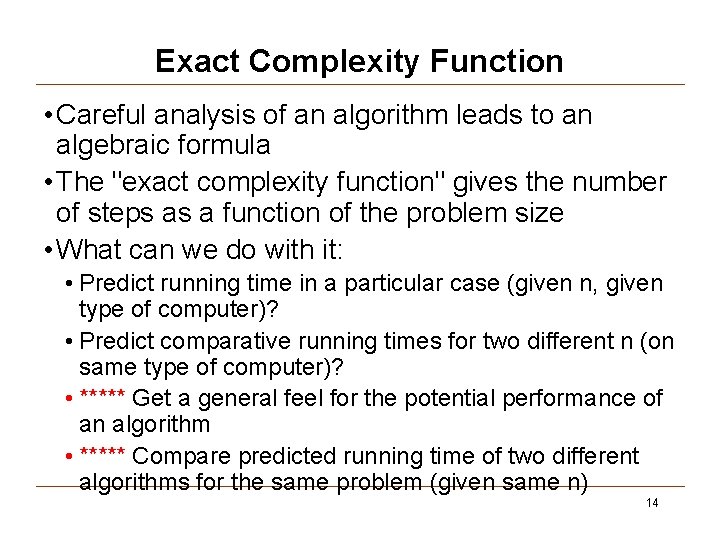
Exact Complexity Function • Careful analysis of an algorithm leads to an algebraic formula • The "exact complexity function" gives the number of steps as a function of the problem size • What can we do with it: • Predict running time in a particular case (given n, given type of computer)? • Predict comparative running times for two different n (on same type of computer)? • ***** Get a general feel for the potential performance of an algorithm • ***** Compare predicted running time of two different algorithms for the same problem (given same n) 14
A Graph is Worth A Bunch of Words • Graphs are a good tool to illustrate, study, and compare complexity functions • Fun math review for you • How do you graph a function? • What are the shapes of some common functions? For example, ones mentioned in these slides or the textbook. 15
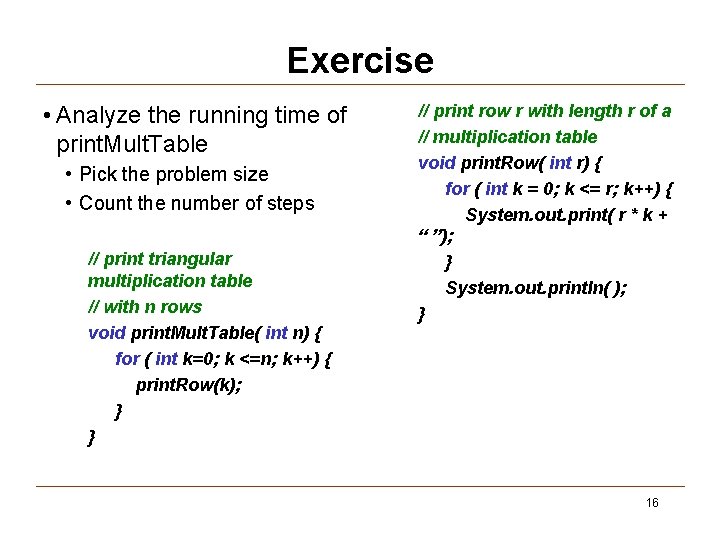
Exercise • Analyze the running time of print. Mult. Table • Pick the problem size • Count the number of steps // print triangular multiplication table // with n rows void print. Mult. Table( int n) { for ( int k=0; k <=n; k++) { print. Row(k); } } // print row r with length r of a // multiplication table void print. Row( int r) { for ( int k = 0; k <= r; k++) { System. out. print( r * k + “ ”); } System. out. println( ); } 16
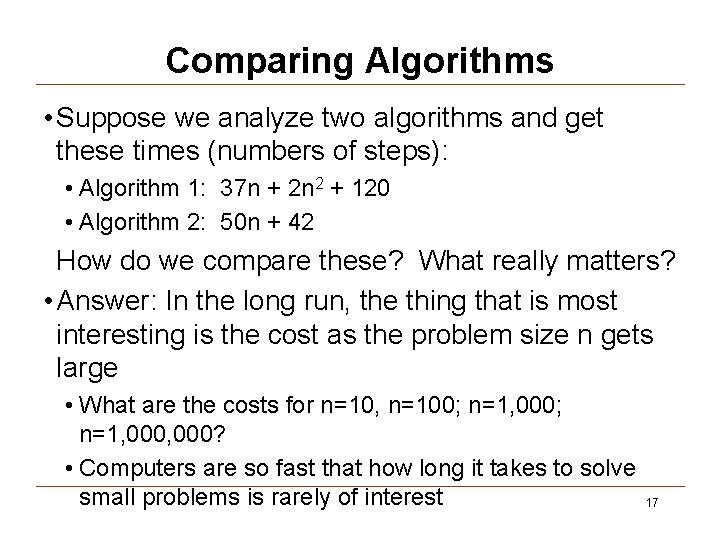
Comparing Algorithms • Suppose we analyze two algorithms and get these times (numbers of steps): • Algorithm 1: 37 n + 2 n 2 + 120 • Algorithm 2: 50 n + 42 How do we compare these? What really matters? • Answer: In the long run, the thing that is most interesting is the cost as the problem size n gets large • What are the costs for n=10, n=100; n=1, 000, 000? • Computers are so fast that how long it takes to solve small problems is rarely of interest 17
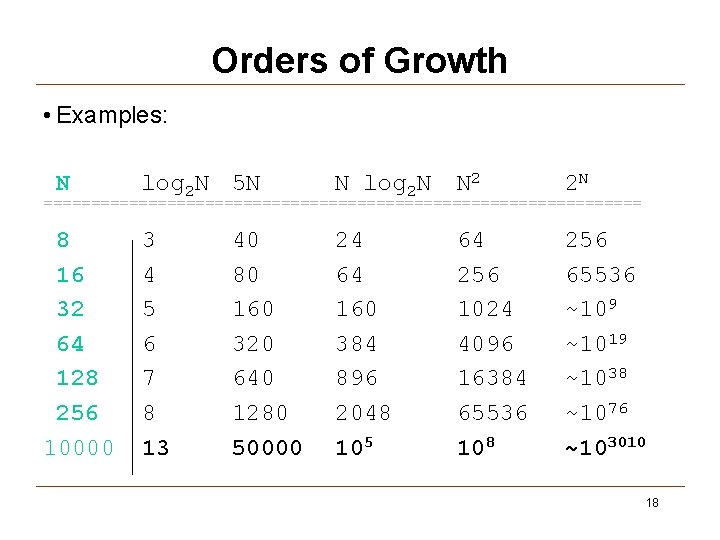
Orders of Growth • Examples: N log 2 N 5 N N log 2 N N 2 2 N 3 4 5 6 7 8 13 24 64 160 384 896 2048 105 64 256 1024 4096 16384 65536 108 256 65536 ~109 ~1019 ~1038 ~1076 ~103010 ================================ 8 16 32 64 128 256 10000 40 80 160 320 640 1280 50000 18
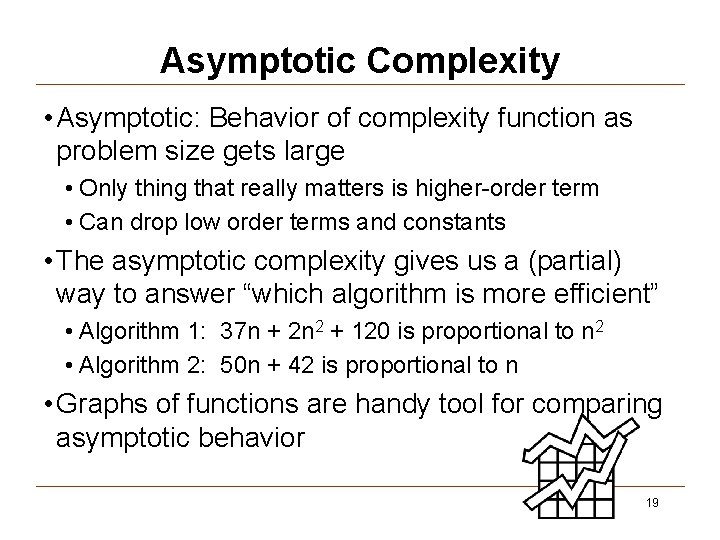
Asymptotic Complexity • Asymptotic: Behavior of complexity function as problem size gets large • Only thing that really matters is higher-order term • Can drop low order terms and constants • The asymptotic complexity gives us a (partial) way to answer “which algorithm is more efficient” • Algorithm 1: 37 n + 2 n 2 + 120 is proportional to n 2 • Algorithm 2: 50 n + 42 is proportional to n • Graphs of functions are handy tool for comparing asymptotic behavior 19
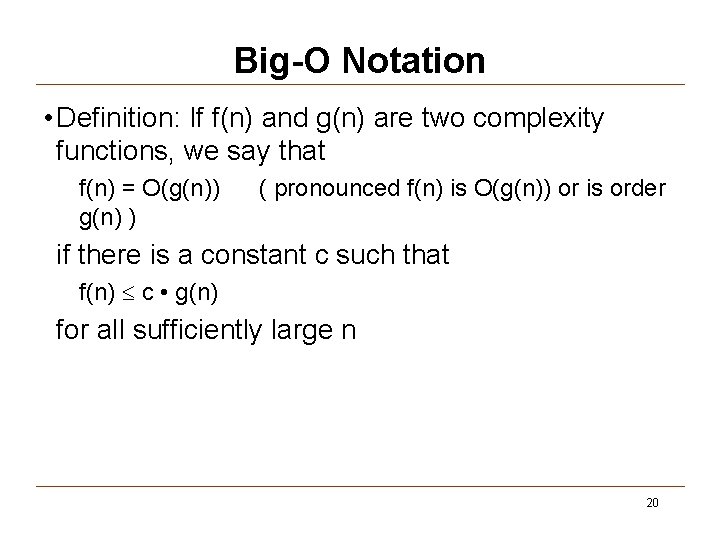
Big-O Notation • Definition: If f(n) and g(n) are two complexity functions, we say that f(n) = O(g(n)) g(n) ) ( pronounced f(n) is O(g(n)) or is order if there is a constant c such that f(n) c • g(n) for all sufficiently large n 20
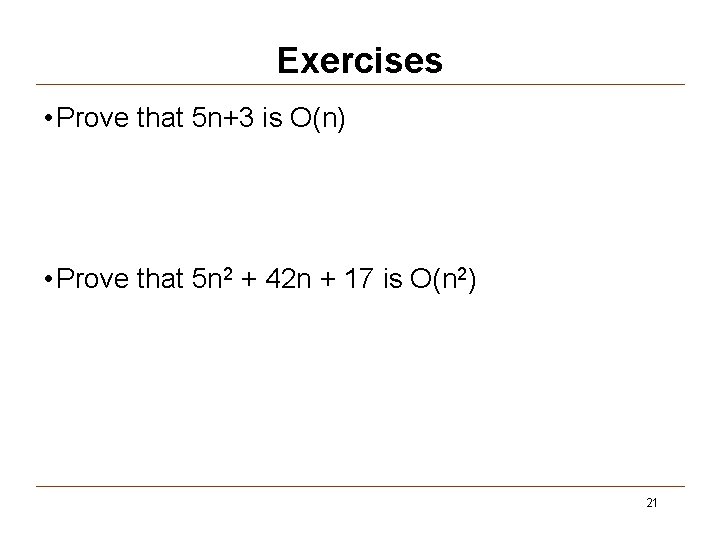
Exercises • Prove that 5 n+3 is O(n) • Prove that 5 n 2 + 42 n + 17 is O(n 2) 21
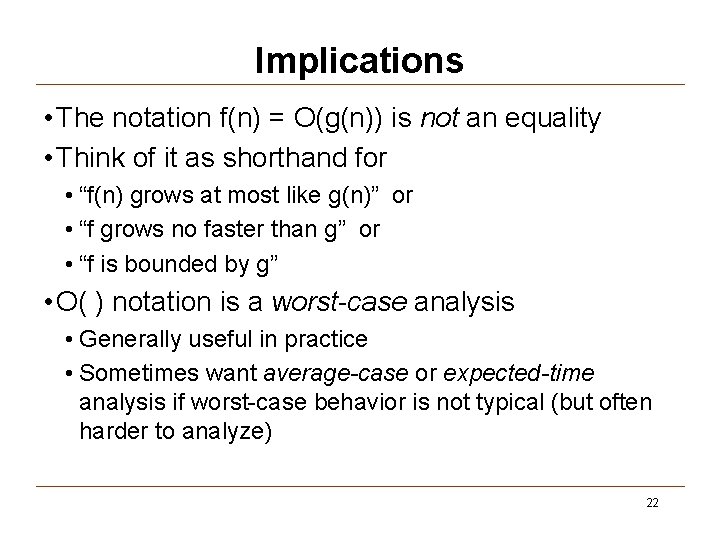
Implications • The notation f(n) = O(g(n)) is not an equality • Think of it as shorthand for • “f(n) grows at most like g(n)” or • “f grows no faster than g” or • “f is bounded by g” • O( ) notation is a worst-case analysis • Generally useful in practice • Sometimes want average-case or expected-time analysis if worst-case behavior is not typical (but often harder to analyze) 22
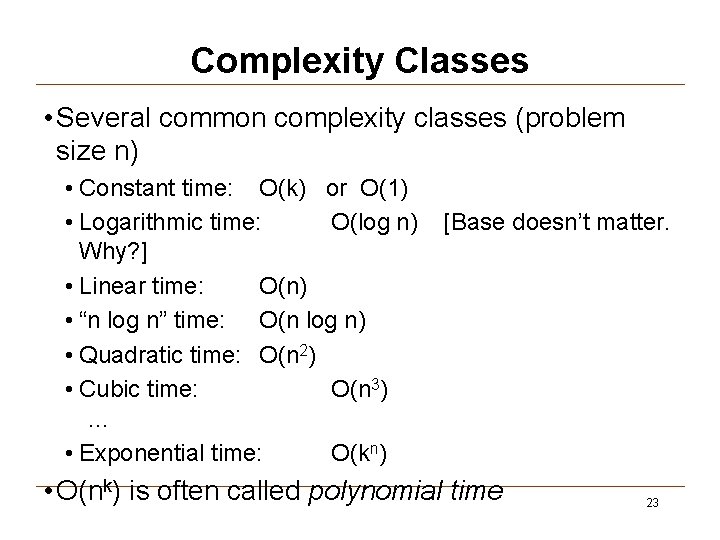
Complexity Classes • Several common complexity classes (problem size n) • Constant time: O(k) or O(1) • Logarithmic time: O(log n) Why? ] • Linear time: O(n) • “n log n” time: O(n log n) • Quadratic time: O(n 2) • Cubic time: O(n 3) [Base doesn’t matter. … • Exponential time: O(kn) • O(nk) is often called polynomial time 23
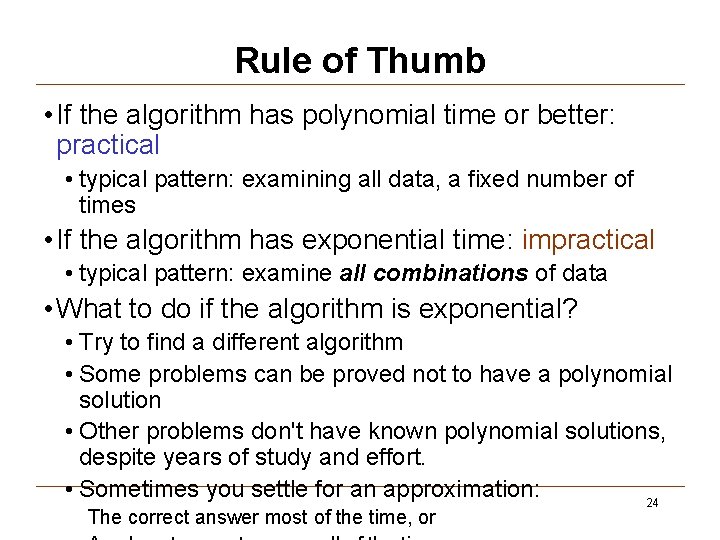
Rule of Thumb • If the algorithm has polynomial time or better: practical • typical pattern: examining all data, a fixed number of times • If the algorithm has exponential time: impractical • typical pattern: examine all combinations of data • What to do if the algorithm is exponential? • Try to find a different algorithm • Some problems can be proved not to have a polynomial solution • Other problems don't have known polynomial solutions, despite years of study and effort. • Sometimes you settle for an approximation: 24 The correct answer most of the time, or
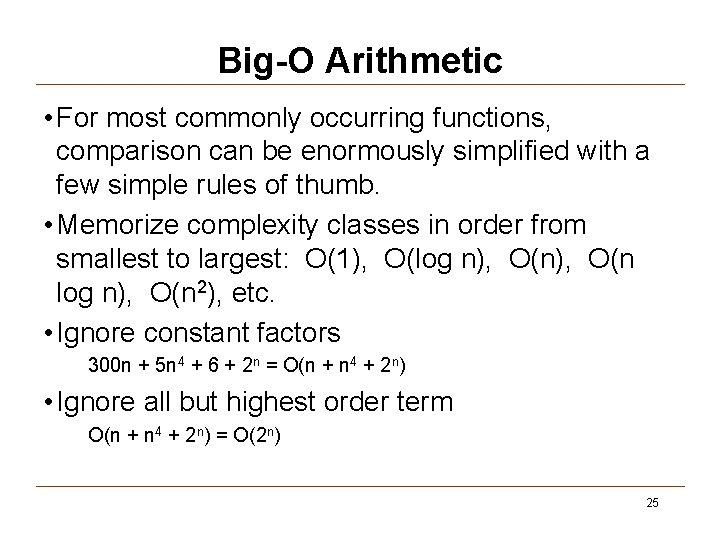
Big-O Arithmetic • For most commonly occurring functions, comparison can be enormously simplified with a few simple rules of thumb. • Memorize complexity classes in order from smallest to largest: O(1), O(log n), O(n 2), etc. • Ignore constant factors 300 n + 5 n 4 + 6 + 2 n = O(n + n 4 + 2 n) • Ignore all but highest order term O(n + n 4 + 2 n) = O(2 n) 25
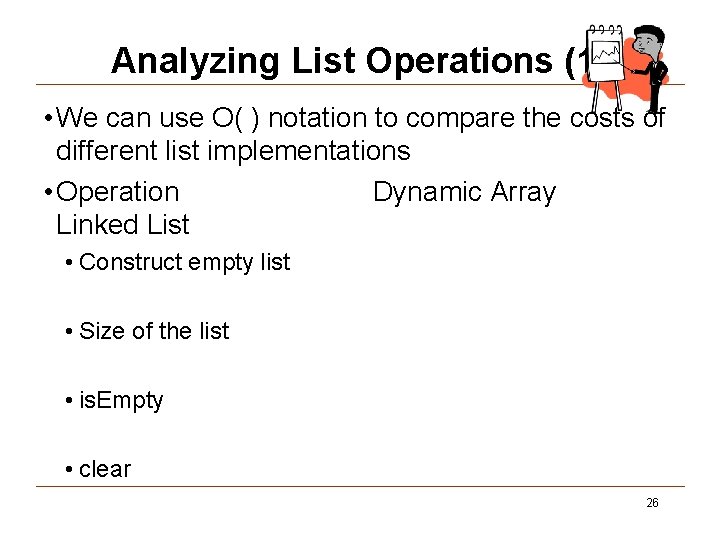
Analyzing List Operations (1) • We can use O( ) notation to compare the costs of different list implementations • Operation Dynamic Array Linked List • Construct empty list • Size of the list • is. Empty • clear 26
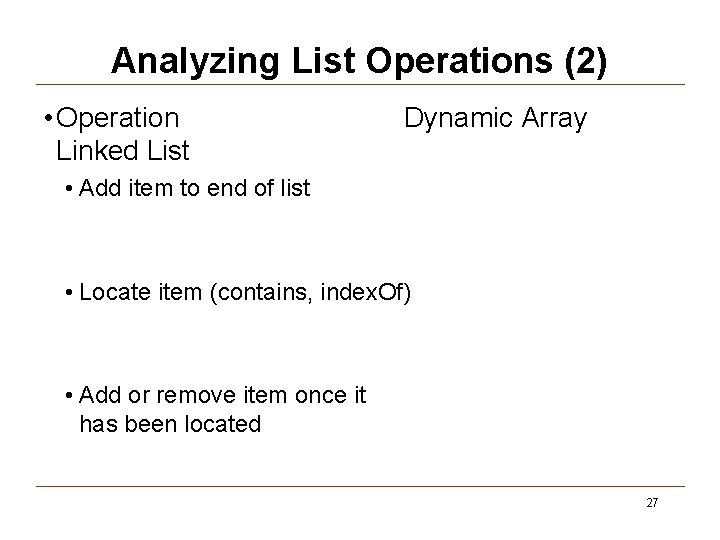
Analyzing List Operations (2) • Operation Linked List Dynamic Array • Add item to end of list • Locate item (contains, index. Of) • Add or remove item once it has been located 27
Wait! Isn’t this totally bogus? ? • Write better code!! • More clever hacking in the inner loops (assembly language, special-purpose hardware in extreme cases) • Moore’s law: Speeds double every 18 months • Wait and buy a faster computer in a year or two! • But … 28
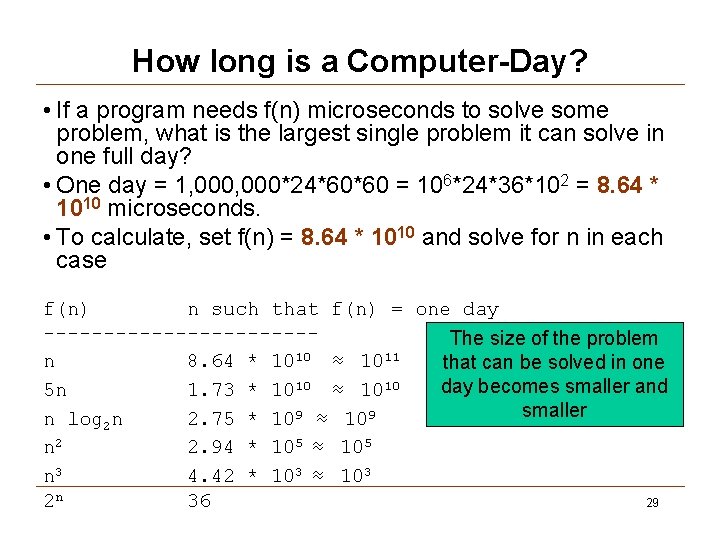
How long is a Computer-Day? • If a program needs f(n) microseconds to solve some problem, what is the largest single problem it can solve in one full day? • One day = 1, 000*24*60*60 = 106*24*36*102 = 8. 64 * 1010 microseconds. • To calculate, set f(n) = 8. 64 * 1010 and solve for n in each case f(n) n such that f(n) = one day -----------The size of the problem n 8. 64 * 1010 ≈ 1011 that can be solved in one day becomes smaller and 5 n 1. 73 * 1010 ≈ 1010 smaller n log 2 n 2. 75 * 109 ≈ 109 n 2 2. 94 * 105 ≈ 105 n 3 4. 42 * 103 ≈ 103 29 2 n 36
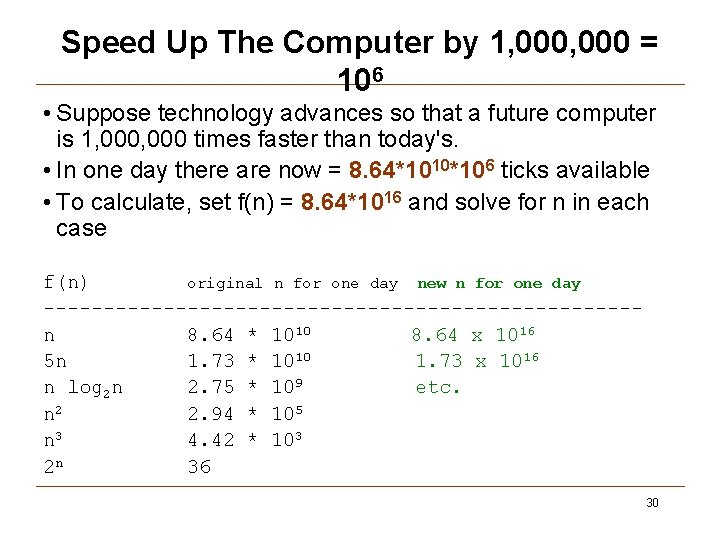
Speed Up The Computer by 1, 000 = 106 • Suppose technology advances so that a future computer is 1, 000 times faster than today's. • In one day there are now = 8. 64*1010*106 ticks available • To calculate, set f(n) = 8. 64*1016 and solve for n in each case f(n) original n for one day new n for one day -------------------------n 8. 64 * 1010 8. 64 x 1016 5 n 1. 73 * 1010 1. 73 x 1016 n log 2 n 2. 75 * 109 etc. n 2 2. 94 * 105 n 3 4. 42 * 103 2 n 36 30
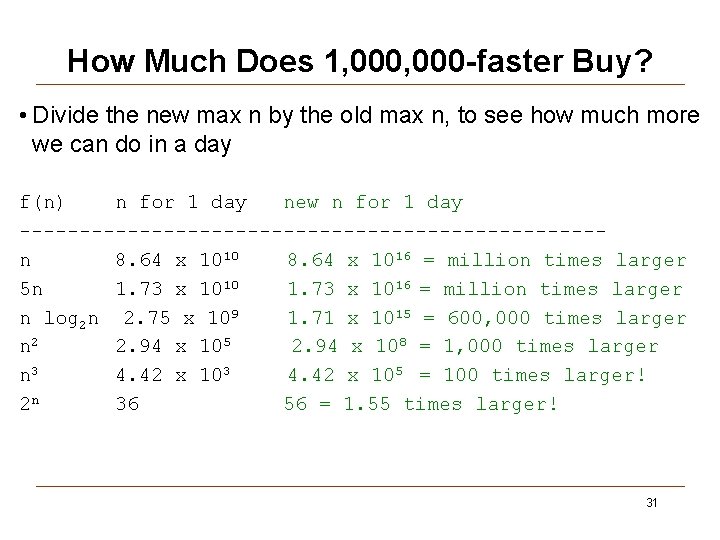
How Much Does 1, 000 -faster Buy? • Divide the new max n by the old max n, to see how much more we can do in a day f(n) n for 1 day new n for 1 day ------------------------n 8. 64 x 1010 8. 64 x 1016 = million times larger 5 n 1. 73 x 1010 1. 73 x 1016 = million times larger n log 2 n 2. 75 x 109 1. 71 x 1015 = 600, 000 times larger n 2 2. 94 x 105 2. 94 x 108 = 1, 000 times larger n 3 4. 42 x 105 = 100 times larger! 2 n 36 56 = 1. 55 times larger! 31
Practical Advice For Speed Lovers • First pick the right algorithm and data structure • Implement it carefully, insuring correctness • Then optimize for speed – but only where it matters Constants do matter in the real world Clever coding can speed things up, but result can be harder to read, modify • Current state-of-the-art approach: Use measurement tools to find hotspots, then tweak those spots. “Premature optimization is the root of all evil” – Donald 32 Knuth
"It is easier to make a correct program efficient than to make an efficient program correct" -- Edsgar Dijkstra 33
Summary • Analyze algorithm sufficiently to determine complexity • Compare algorithms by comparing asymptotic complexity • For large problems an asymptotically faster algorithm will always trump clever coding tricks “Premature optimization is the root of all evil” – Donald Knuth 34
Computer Science Note • Algorithmic complexity theory is one of the key intellectual contributions of Computer Science • Typical problems • What is the worst/average/best-case performance of an algorithm? • What is the best complexity bound for all algorithms that solve a particular problem? • Interesting and (in many cases) complex, sophisticated math • Probabilistic and statistical as well as discrete • Still some key open problems • Most notorious: P ? = NP 35