
CSc 110 Spring 2018 Lecture 21 LineBased File
CSc 110, Spring 2018 Lecture 21: Line-Based File Input Adapted from slides by Marty Stepp and Stuart Reges
Gas prices question • Write a program that reads a file gasprices. txt • Format: Belgium $/gal US $/gal date … 8. 20 3. 81 3/21/11 8. 08 3. 84 3/28/11. . . • The program should print the average gas price over all data in the file for both countries: Belgium average: 8. 3 USA average: 3. 9
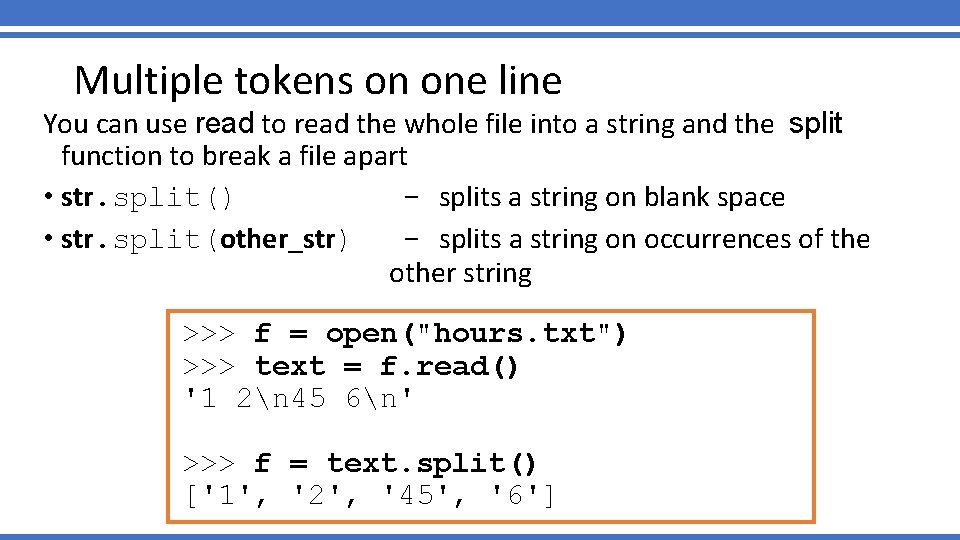
Multiple tokens on one line You can use read to read the whole file into a string and the split function to break a file apart • str. split() - splits a string on blank space • str. split(other_str) - splits a string on occurrences of the other string >>> f = open("hours. txt") >>> text = f. read() '1 2n 45 6n' >>> f = text. split() ['1', '2', '45', '6']
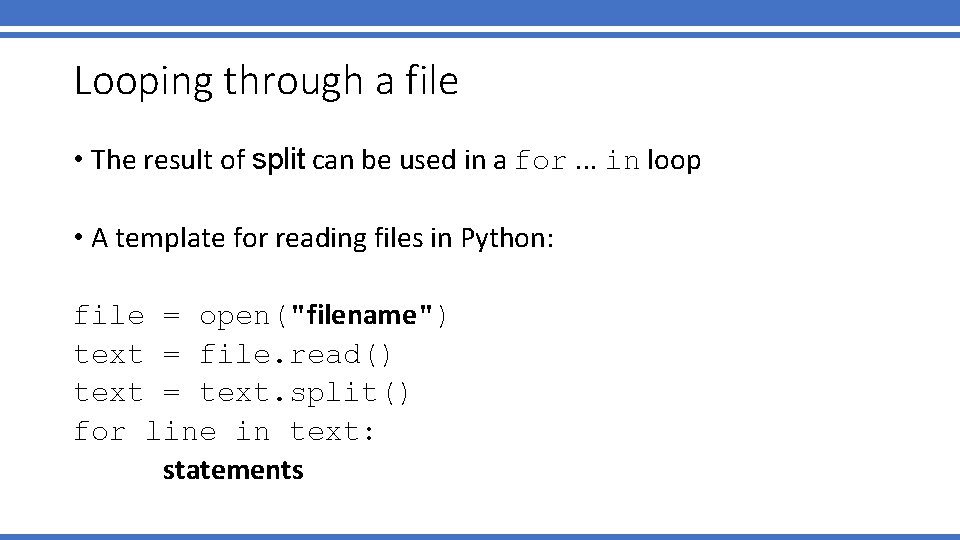
Looping through a file • The result of split can be used in a for. . . in loop • A template for reading files in Python: file = open("filename") text = file. read() text = text. split() for line in text: statements
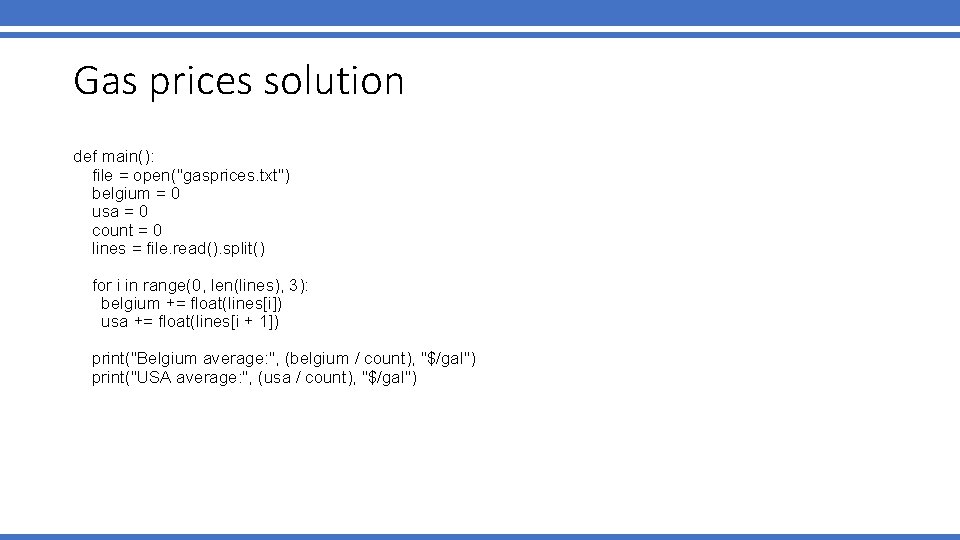
Gas prices solution def main(): file = open("gasprices. txt") belgium = 0 usa = 0 count = 0 lines = file. read(). split() for i in range(0, len(lines), 3): belgium += float(lines[i]) usa += float(lines[i + 1]) print("Belgium average: ", (belgium / count), "$/gal") print("USA average: ", (usa / count), "$/gal")
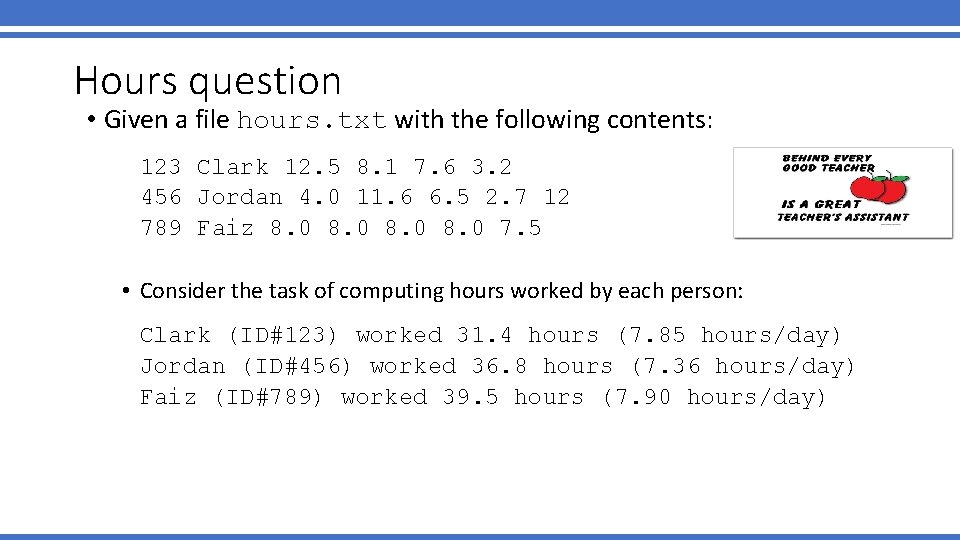
Hours question • Given a file hours. txt with the following contents: 123 Clark 12. 5 8. 1 7. 6 3. 2 456 Jordan 4. 0 11. 6 6. 5 2. 7 12 789 Faiz 8. 0 7. 5 • Consider the task of computing hours worked by each person: Clark (ID#123) worked 31. 4 hours (7. 85 hours/day) Jordan (ID#456) worked 36. 8 hours (7. 36 hours/day) Faiz (ID#789) worked 39. 5 hours (7. 90 hours/day)
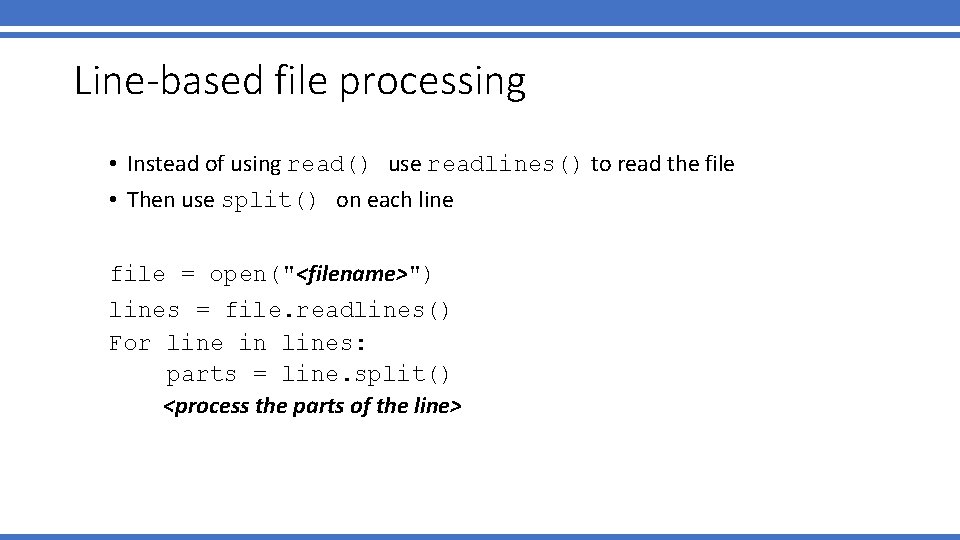
Line-based file processing • Instead of using read() use readlines() to read the file • Then use split() on each line file = open("<filename>") lines = file. readlines() For line in lines: parts = line. split() <process the parts of the line>
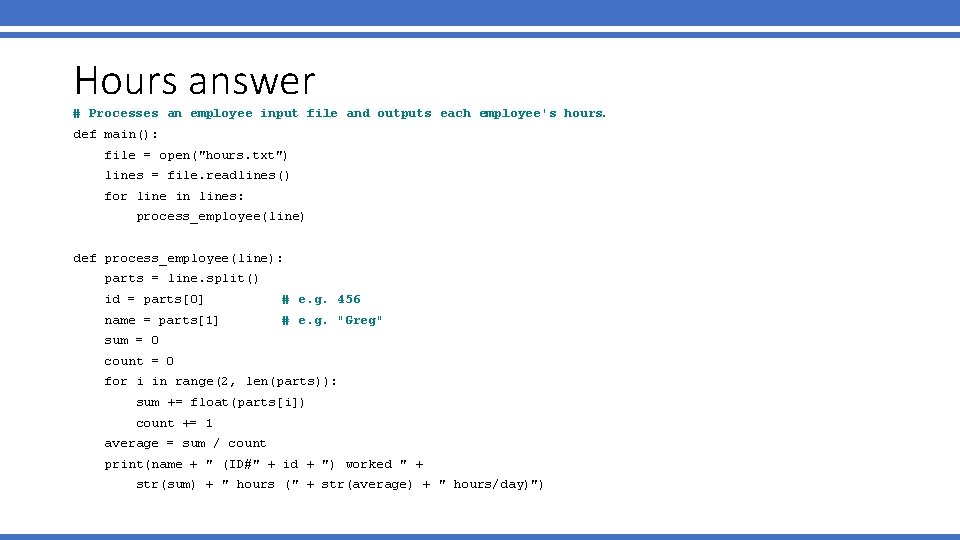
Hours answer # Processes an employee input file and outputs each employee's hours. def main(): file = open("hours. txt") lines = file. readlines() for line in lines: process_employee(line) def process_employee(line): parts = line. split() id = parts[0] # e. g. 456 name = parts[1] # e. g. "Greg" sum = 0 count = 0 for i in range(2, len(parts)): sum += float(parts[i]) count += 1 average = sum / count print(name + " (ID#" + id + ") worked " + str(sum) + " hours (" + str(average) + " hours/day)")
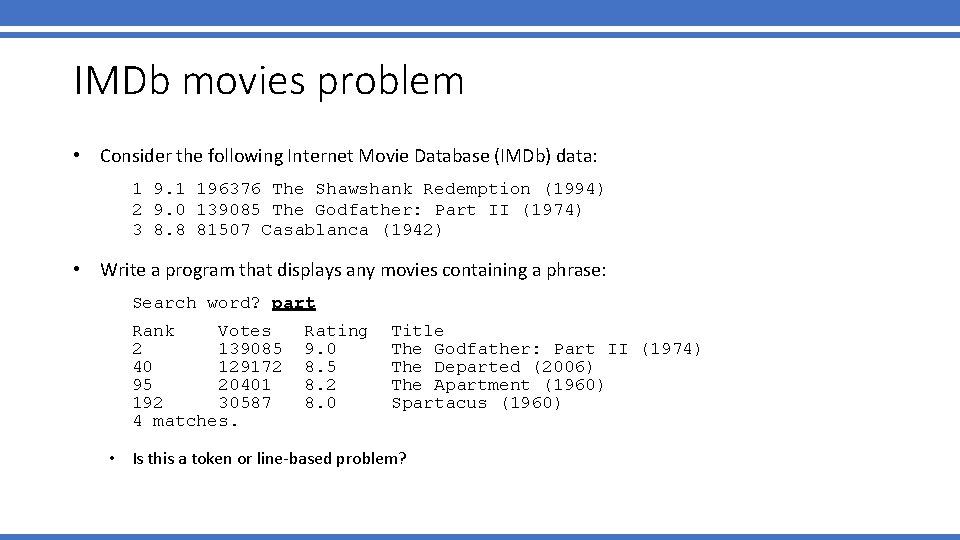
IMDb movies problem • Consider the following Internet Movie Database (IMDb) data: 1 9. 1 196376 The Shawshank Redemption (1994) 2 9. 0 139085 The Godfather: Part II (1974) 3 8. 8 81507 Casablanca (1942) • Write a program that displays any movies containing a phrase: Search word? part Rank Votes 2 139085 40 129172 95 20401 192 30587 4 matches. Rating 9. 0 8. 5 8. 2 8. 0 Title The Godfather: Part II (1974) The Departed (2006) The Apartment (1960) Spartacus (1960) • Is this a token or line-based problem?
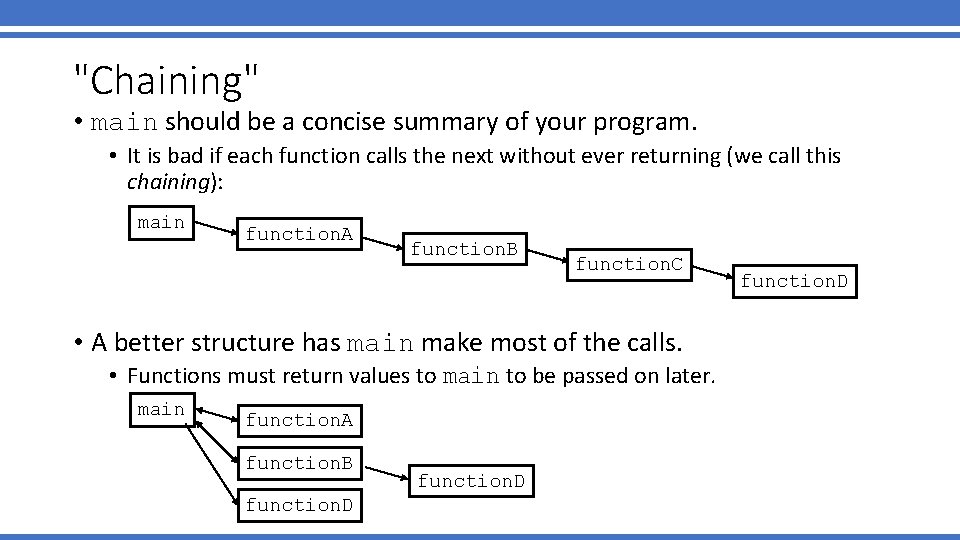
"Chaining" • main should be a concise summary of your program. • It is bad if each function calls the next without ever returning (we call this chaining): main function. A function. B function. C • A better structure has main make most of the calls. • Functions must return values to main to be passed on later. main function. A function. B function. D
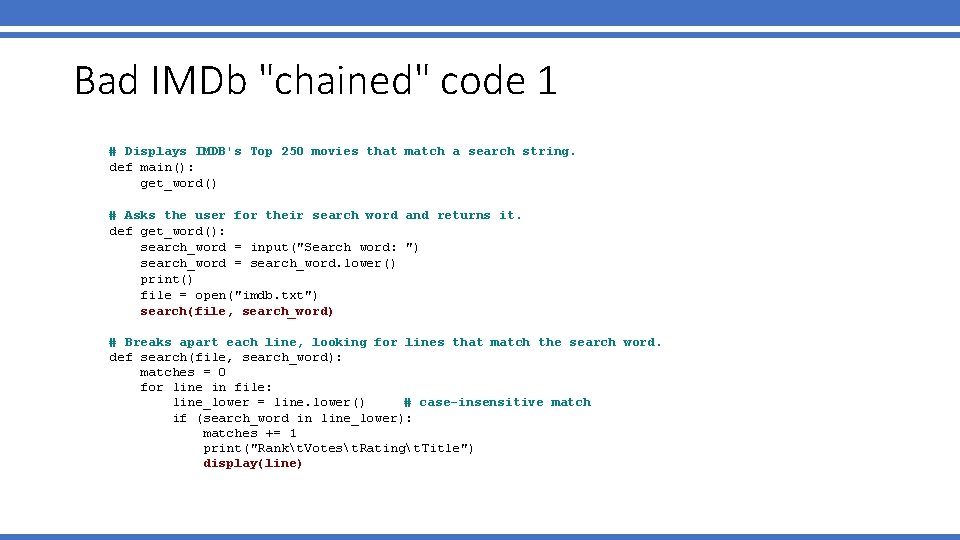
Bad IMDb "chained" code 1 # Displays IMDB's Top 250 movies that match a search string. def main(): get_word() # Asks the user for their search word and returns it. def get_word(): search_word = input("Search word: ") search_word = search_word. lower() print() file = open("imdb. txt") search(file, search_word) # Breaks apart each line, looking for lines that match the search word. def search(file, search_word): matches = 0 for line in file: line_lower = line. lower() # case-insensitive match if (search_word in line_lower): matches += 1 print("Rankt. Votest. Ratingt. Title") display(line)
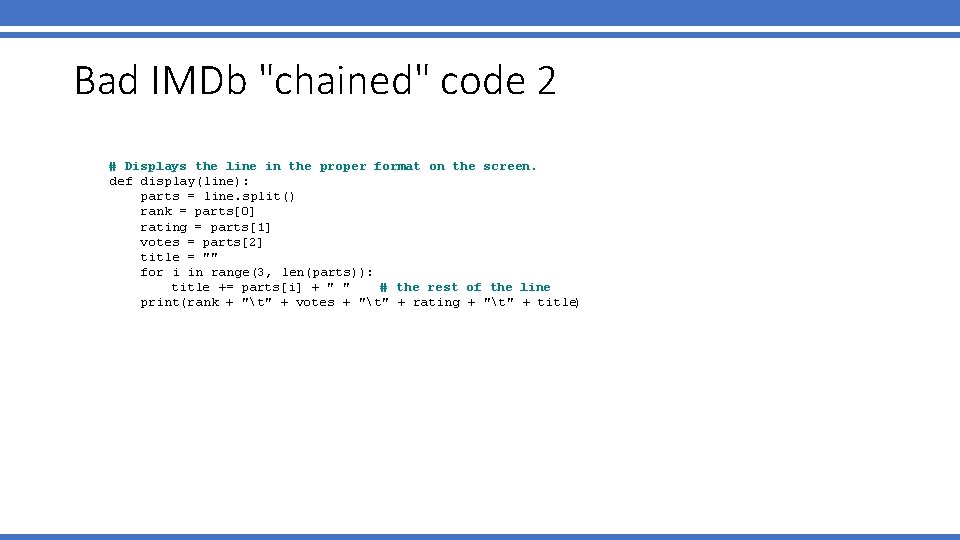
Bad IMDb "chained" code 2 # Displays the line in the proper format on the screen. def display(line): parts = line. split() rank = parts[0] rating = parts[1] votes = parts[2] title = "" for i in range(3, len(parts)): title += parts[i] + " " # the rest of the line print(rank + "t" + votes + "t" + rating + "t" + title)
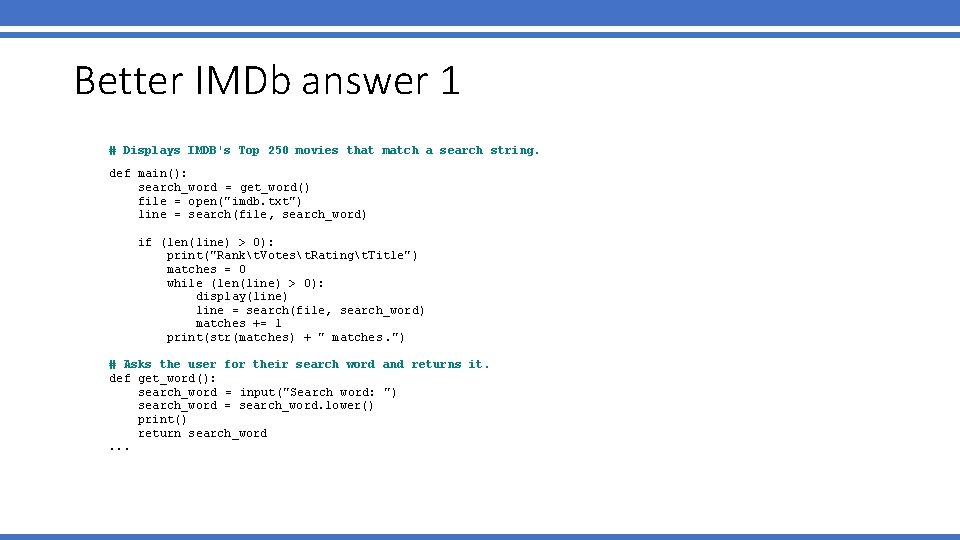
Better IMDb answer 1 # Displays IMDB's Top 250 movies that match a search string. def main(): search_word = get_word() file = open("imdb. txt") line = search(file, search_word) if (len(line) > 0): print("Rankt. Votest. Ratingt. Title") matches = 0 while (len(line) > 0): display(line) line = search(file, search_word) matches += 1 print(str(matches) + " matches. ") # Asks the user for their search word and returns it. def get_word(): search_word = input("Search word: ") search_word = search_word. lower() print() return search_word. . .
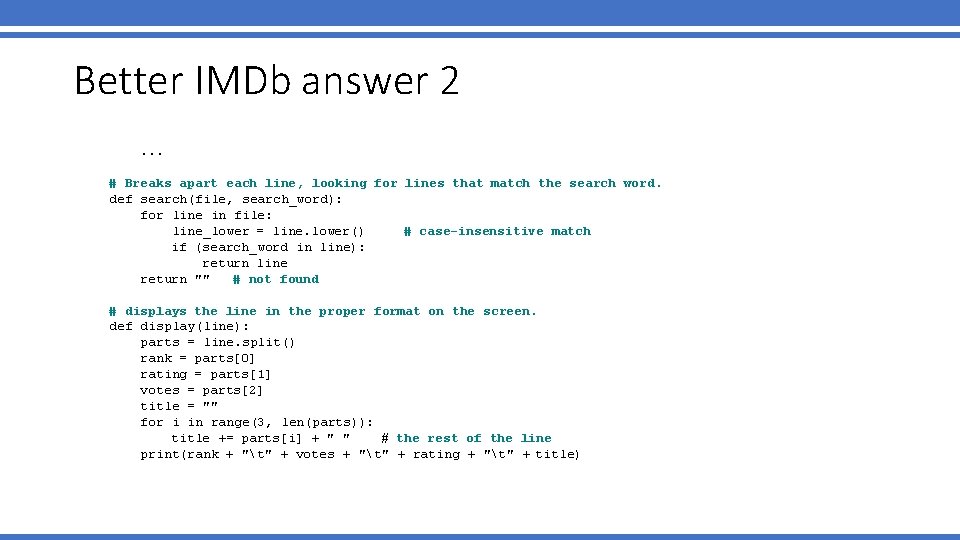
Better IMDb answer 2. . . # Breaks apart each line, looking for lines that match the search word. def search(file, search_word): for line in file: line_lower = line. lower() # case-insensitive match if (search_word in line): return line return "" # not found # displays the line in the proper format on the screen. def display(line): parts = line. split() rank = parts[0] rating = parts[1] votes = parts[2] title = "" for i in range(3, len(parts)): title += parts[i] + " " # the rest of the line print(rank + "t" + votes + "t" + rating + "t" + title)
- Slides: 14