
CSBG Comprehensive Community Needs Assessment Process Training offered
CSBG Comprehensive Community Needs Assessment Process Training offered by: Office on Volunteerism and Community Services Virginia Department of Social Services Office on Volunteerism and Community Services, November 2016 Virginia Department of Social Services
VDSS Office on Volunteerism & Community Services; Community Services Block Grant Office Purpose To provide a thorough training module on the CSBG Comprehensive Community Needs Assessment (CNA) and to help participants to learn and understand: üthe requirements and importance of the CNA ühow to approach the project and plan for success ühow to form and use a CNA Task Force üvarious data collection techniques and best practices üthe importance of data analysis and tools to assist üideas for the final report and report distribution
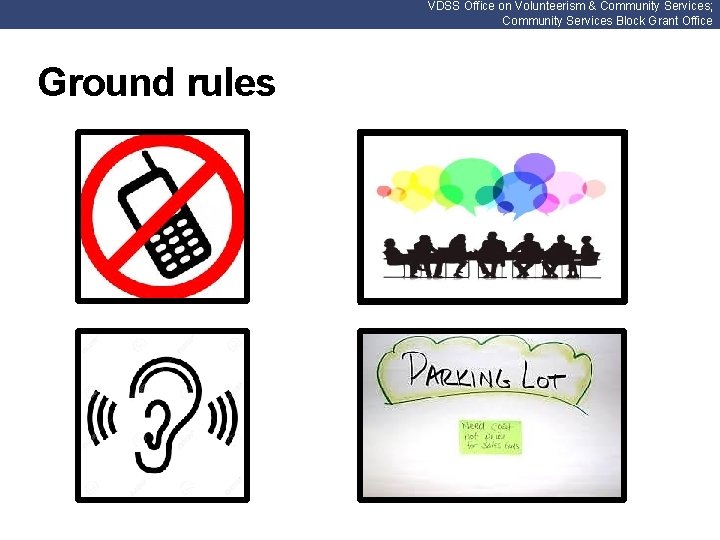
VDSS Office on Volunteerism & Community Services; Community Services Block Grant Office Ground rules

VDSS Office on Volunteerism & Community Services; Community Services Block Grant Office Reminder of the regulations CSBG Organizational Standards: Community Assessment Local control of Federal CSBG resources is predicated on regular comprehensive community assessments that take into account the breadth of community needs as well as the partners and resources available in a community to meet these needs. Regular assessment of needs and resources at the community level is the foundation of Community Action and a vital management and leadership tool that is used across the organization and utilized by the community to set the course for both CSBG and all agency resources.
VDSS Office on Volunteerism & Community Services; Community Services Block Grant Office
VDSS Office on Volunteerism & Community Services; Community Services Block Grant Office Why conduct a needs assessment? 1. Required every 3 years 2. Needs assessment findings are the basis for a good strategic plan 3. Informs community change efforts
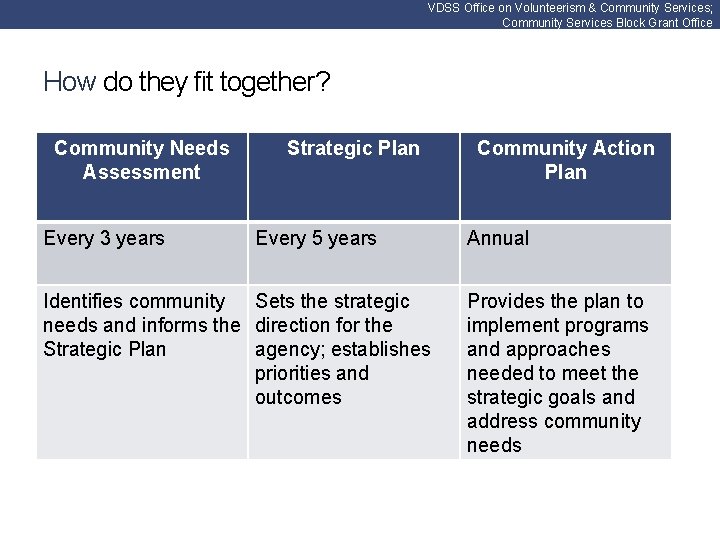
VDSS Office on Volunteerism & Community Services; Community Services Block Grant Office How do they fit together? Community Needs Assessment Every 3 years Strategic Plan Every 5 years Identifies community Sets the strategic needs and informs the direction for the Strategic Plan agency; establishes priorities and outcomes Community Action Plan Annual Provides the plan to implement programs and approaches needed to meet the strategic goals and address community needs
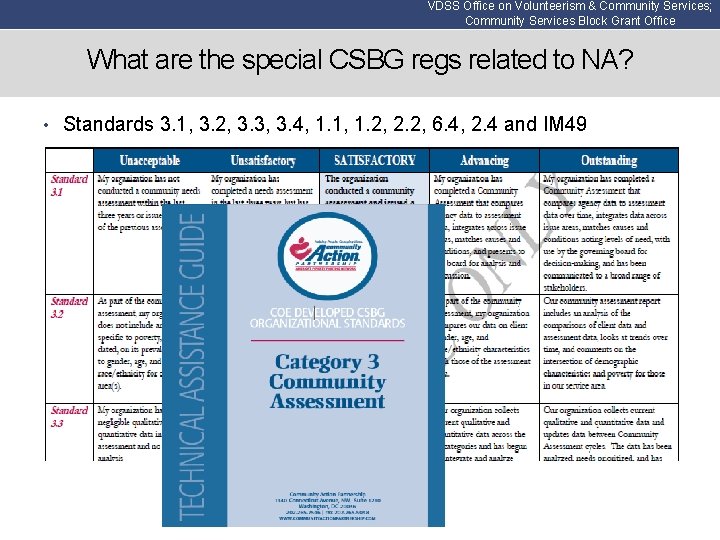
VDSS Office on Volunteerism & Community Services; Community Services Block Grant Office What are the special CSBG regs related to NA? • Standards 3. 1, 3. 2, 3. 3, 3. 4, 1. 1, 1. 2, 2. 2, 6. 4, 2. 4 and IM 49

VDSS Office on Volunteerism & Community Services; Community Services Block Grant Office Components Referenced in the Regulations Participation and information from low income individuals Data on poverty and prevalence: gender, age, race/ethnicity. Comparisons. Trends. Current. Quantitative data: on all localities, trends, comparisons Conditions of poverty: key findings and analysis Qualitative data: from all localities, trends, comparisons Input gathered from key sectors (at least community organizations, faith groups, private sector, public sector and education) Causes of poverty: key findings and analysis Customer satisfaction data Available resources at agency and in the community; assets. Relationship of your CAA’s activities to other antipoverty services Community profiles for each locality Data analysis and identification of areas of greatest community needs. Level of needs and changes over time. Gaps. At family, agency and community levels. Key findings section to the final report
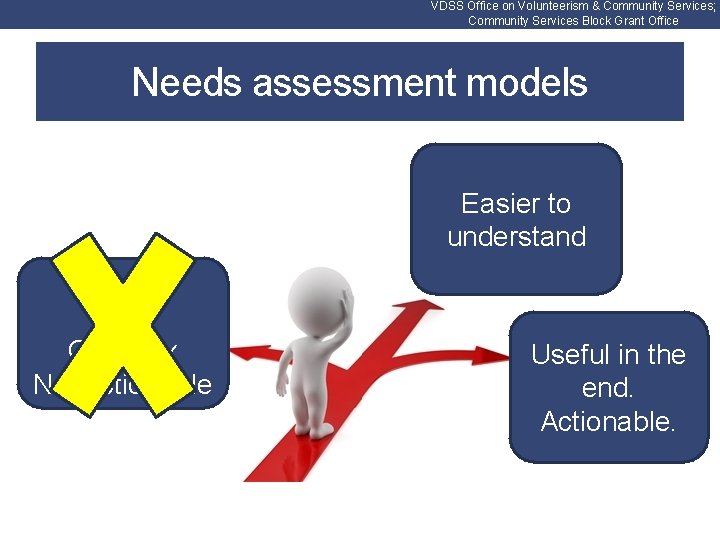
VDSS Office on Volunteerism & Community Services; Community Services Block Grant Office Needs assessment models Easier to understand Long Hard Complex Not actionable Useful in the end. Actionable.
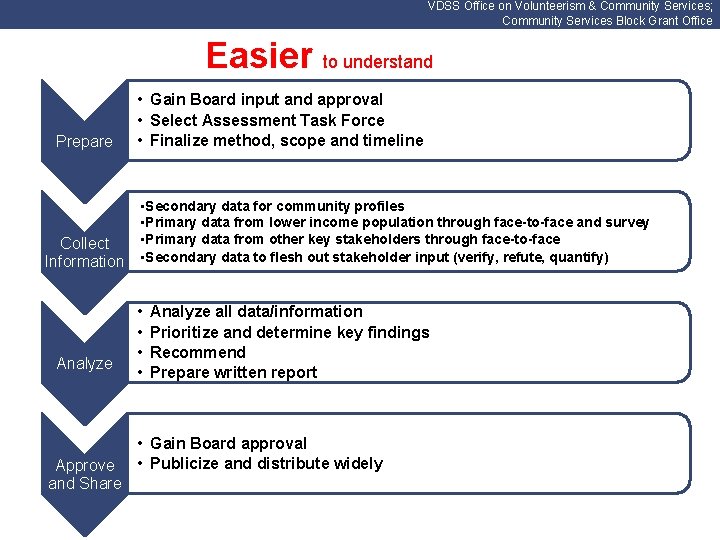
VDSS Office on Volunteerism & Community Services; Community Services Block Grant Office Easier to understand Prepare Collect Information Analyze Approve and Share • Gain Board input and approval • Select Assessment Task Force • Finalize method, scope and timeline • Secondary data for community profiles • Primary data from lower income population through face-to-face and survey • Primary data from other key stakeholders through face-to-face • Secondary data to flesh out stakeholder input (verify, refute, quantify) • • Analyze all data/information Prioritize and determine key findings Recommend Prepare written report • Gain Board approval • Publicize and distribute widely
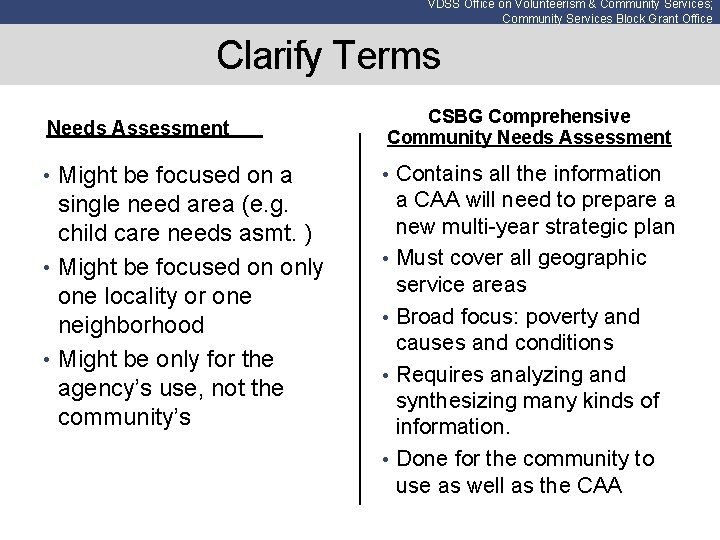
VDSS Office on Volunteerism & Community Services; Community Services Block Grant Office Clarify Terms Needs Assessment CSBG Comprehensive Community Needs Assessment • Might be focused on a • Contains all the information single need area (e. g. child care needs asmt. ) • Might be focused on only one locality or one neighborhood • Might be only for the agency’s use, not the community’s • • a CAA will need to prepare a new multi-year strategic plan Must cover all geographic service areas Broad focus: poverty and causes and conditions Requires analyzing and synthesizing many kinds of information. Done for the community to use as well as the CAA
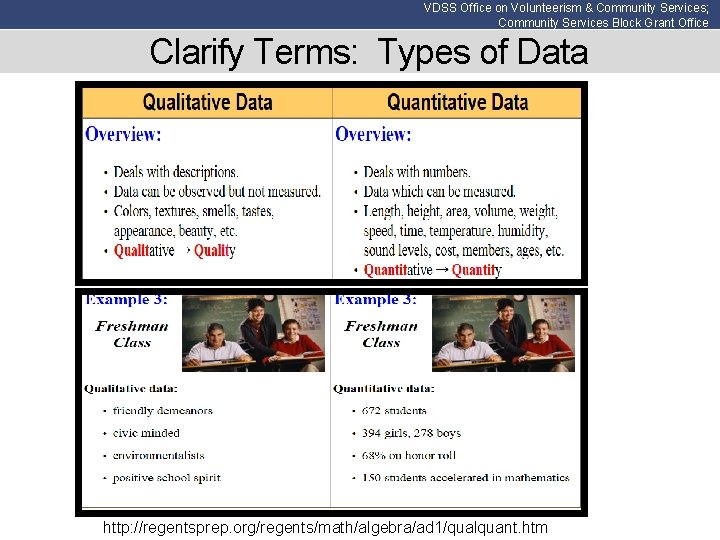
VDSS Office on Volunteerism & Community Services; Community Services Block Grant Office Clarify Terms: Types of Data http: //regentsprep. org/regents/math/algebra/ad 1/qualquant. htm
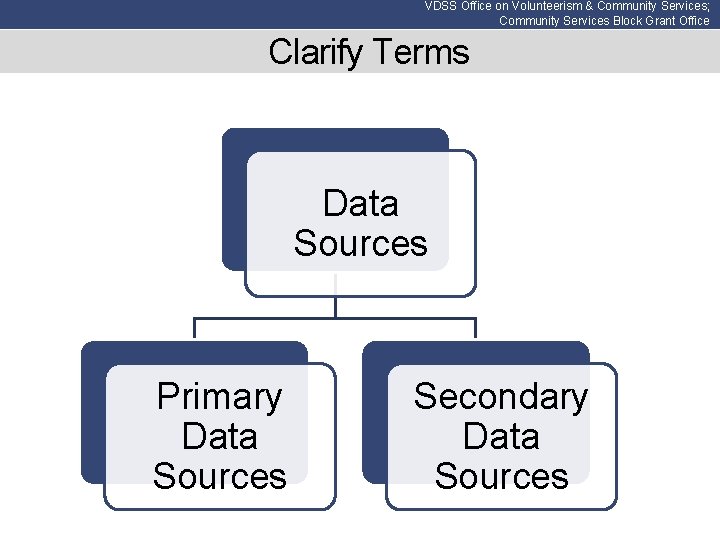
VDSS Office on Volunteerism & Community Services; Community Services Block Grant Office Clarify Terms Data Sources Primary Data Sources Secondary Data Sources
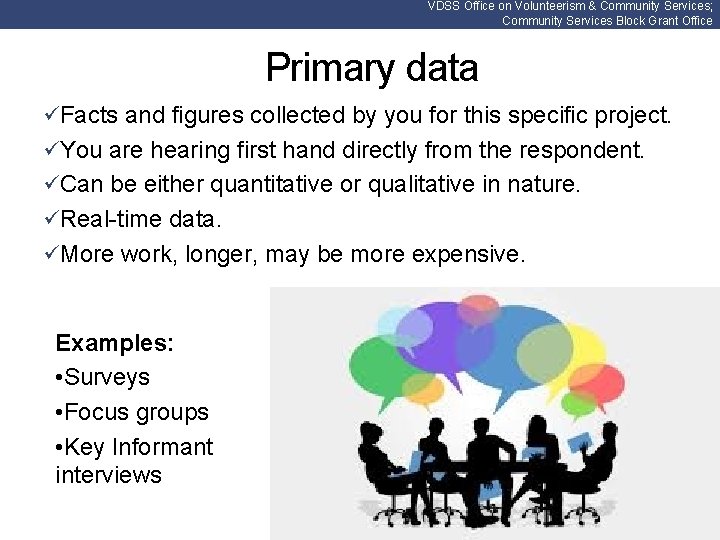
VDSS Office on Volunteerism & Community Services; Community Services Block Grant Office Primary data üFacts and figures collected by you for this specific project. üYou are hearing first hand directly from the respondent. üCan be either quantitative or qualitative in nature. üReal-time data. üMore work, longer, may be more expensive. Examples: • Surveys • Focus groups • Key Informant interviews
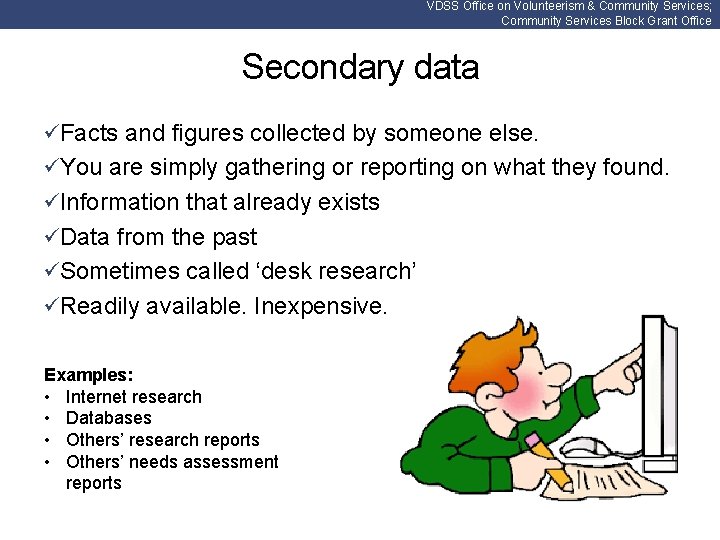
VDSS Office on Volunteerism & Community Services; Community Services Block Grant Office Secondary data üFacts and figures collected by someone else. üYou are simply gathering or reporting on what they found. üInformation that already exists üData from the past üSometimes called ‘desk research’ üReadily available. Inexpensive. Examples: • Internet research • Databases • Others’ research reports • Others’ needs assessment reports
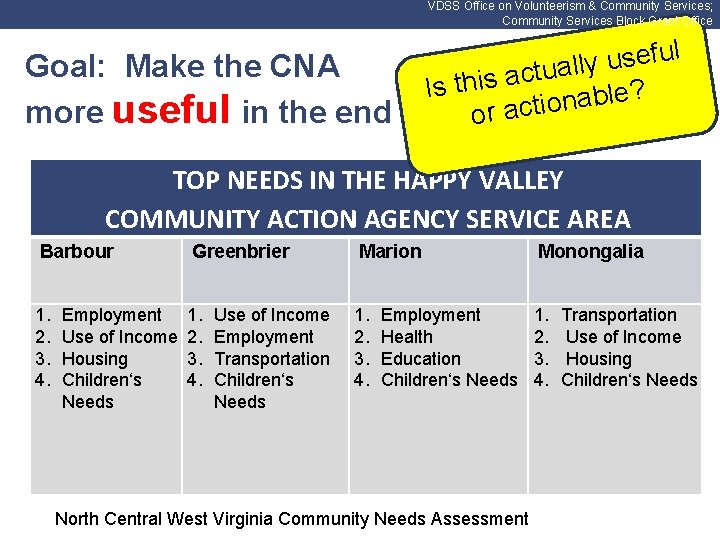
VDSS Office on Volunteerism & Community Services; Community Services Block Grant Office l u f e s u ly l Goal: Make the CNA a u t c a Is this ? e l b a n more useful in the end or actio TOP NEEDS IN THE HAPPY VALLEY COMMUNITY ACTION AGENCY SERVICE AREA Barbour 1. 2. 3. 4. Greenbrier Employment 1. Use of Income 2. Housing 3. Children‘s 4. Needs Use of Income Employment Transportation Children‘s Needs Marion Monongalia 1. 2. 3. 4. Employment Health Education Children‘s Needs North Central West Virginia Community Needs Assessment Transportation Use of Income Housing Children‘s Needs
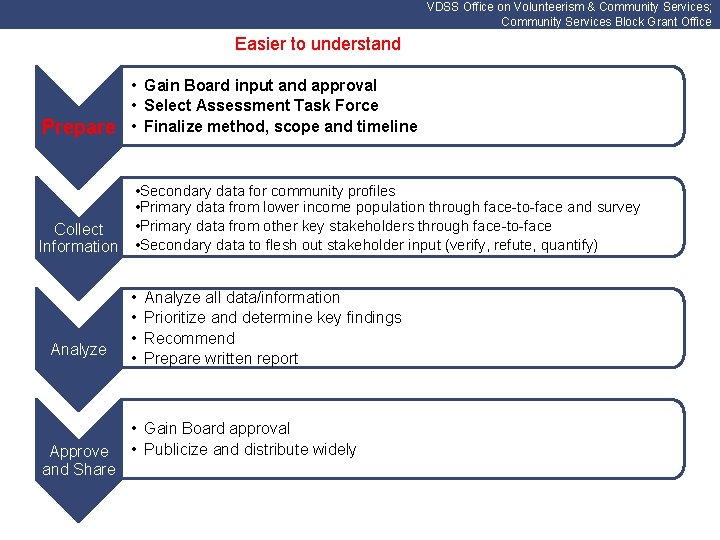
VDSS Office on Volunteerism & Community Services; Community Services Block Grant Office Easier to understand Prepare • Gain Board input and approval • Select Assessment Task Force • Finalize method, scope and timeline Collect Information • Secondary data for community profiles • Primary data from lower income population through face-to-face and survey • Primary data from other key stakeholders through face-to-face • Secondary data to flesh out stakeholder input (verify, refute, quantify) Analyze Approve and Share • • Analyze all data/information Prioritize and determine key findings Recommend Prepare written report • Gain Board approval • Publicize and distribute widely
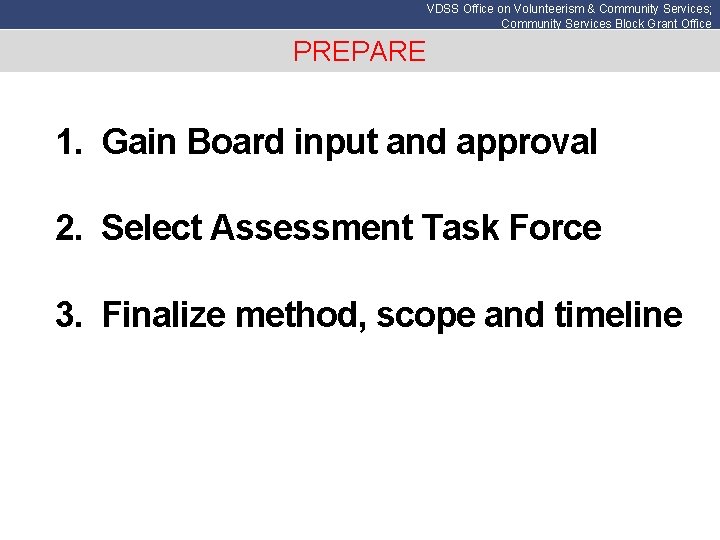
VDSS Office on Volunteerism & Community Services; Community Services Block Grant Office PREPARE 1. Gain Board input and approval 2. Select Assessment Task Force 3. Finalize method, scope and timeline
VDSS Office on Volunteerism & Community Services Block Grant Office
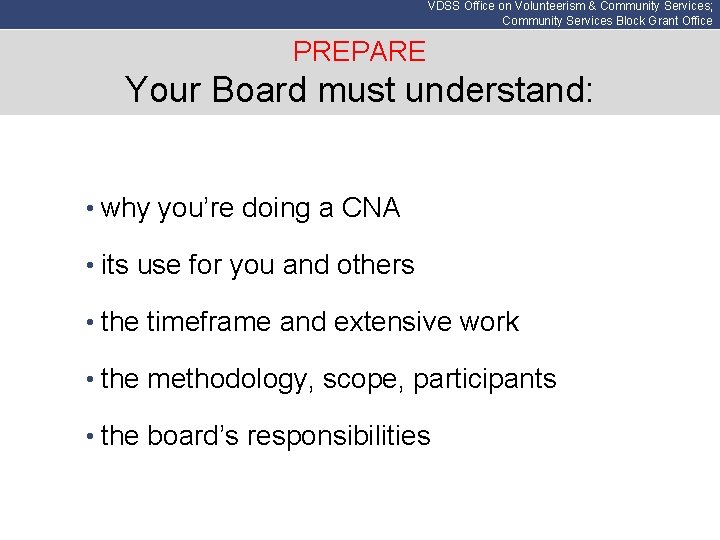
VDSS Office on Volunteerism & Community Services; Community Services Block Grant Office PREPARE Your Board must understand: • why you’re doing a CNA • its use for you and others • the timeframe and extensive work • the methodology, scope, participants • the board’s responsibilities
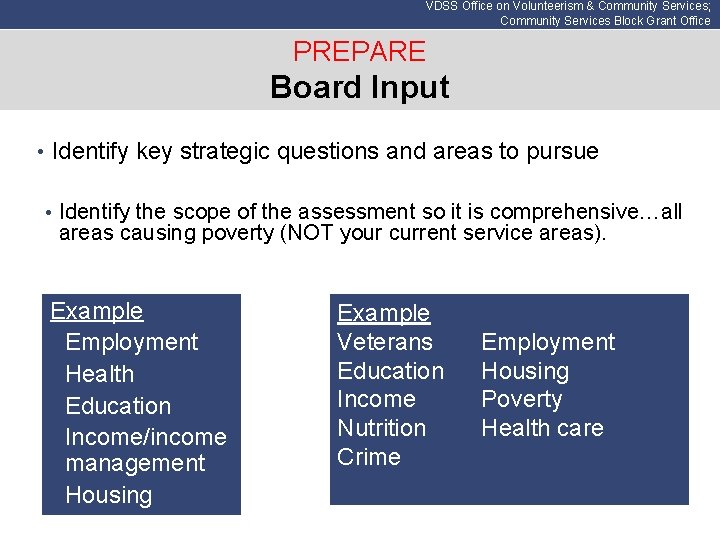
VDSS Office on Volunteerism & Community Services; Community Services Block Grant Office PREPARE Board Input • Identify key strategic questions and areas to pursue • Identify the scope of the assessment so it is comprehensive…all areas causing poverty (NOT your current service areas). Example • Employment • Health • Education • Income/income management • Housing Example Veterans Education Income Nutrition Crime Employment Housing Poverty Health care
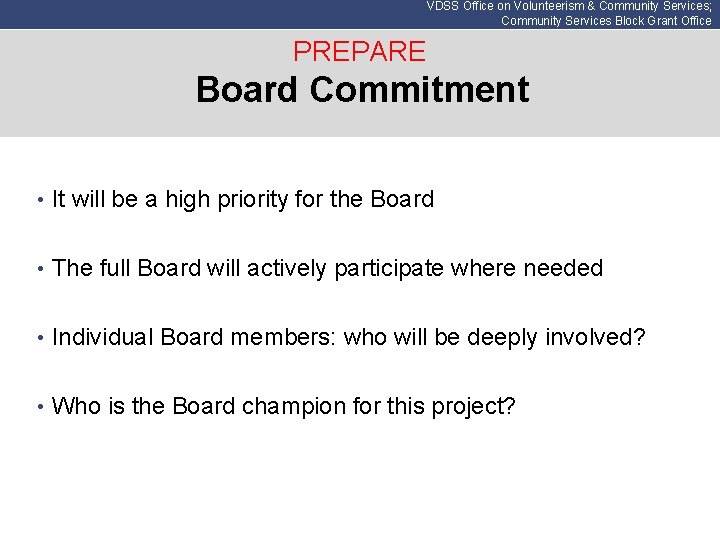
VDSS Office on Volunteerism & Community Services; Community Services Block Grant Office PREPARE Board Commitment • It will be a high priority for the Board • The full Board will actively participate where needed • Individual Board members: who will be deeply involved? • Who is the Board champion for this project?
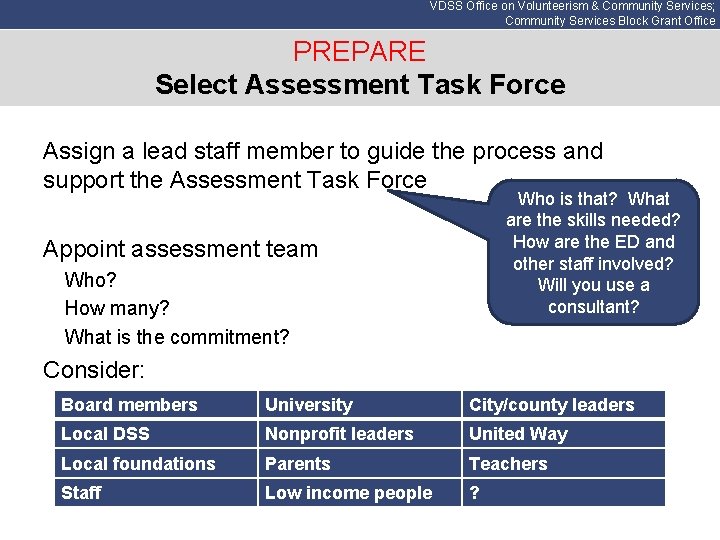
VDSS Office on Volunteerism & Community Services; Community Services Block Grant Office PREPARE Select Assessment Task Force Assign a lead staff member to guide the process and support the Assessment Task Force Who is that? What are the skills needed? How are the ED and other staff involved? Will you use a consultant? Appoint assessment team Who? How many? What is the commitment? Consider: Board members University City/county leaders Local DSS Nonprofit leaders United Way Local foundations Parents Teachers Staff Low income people ?
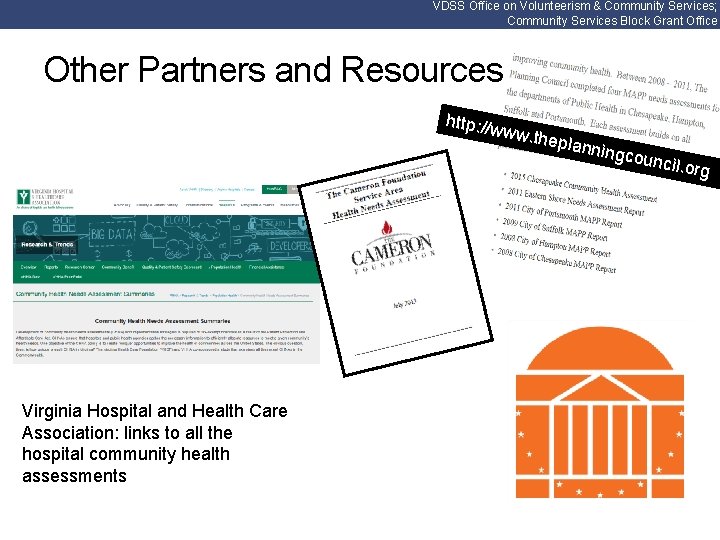
VDSS Office on Volunteerism & Community Services; Community Services Block Grant Office Other Partners and Resources http: //w ww. the Virginia Hospital and Health Care Association: links to all the hospital community health assessments planni ngcou ncil. or g
VDSS Office on Volunteerism & Community Services Block Grant Offi Group Discussion: CNA Task Force Members
VDSS Office on Volunteerism & Community Services; Community Services Block Grant Office PREPARE Finalize method, scope and timeline • Orient the Task Force and plan out the assessment process. • Be clear on the process and desired outcomes as well as the CSBG requirements • Clarify the end-in-mind. • What will the final report include and look like? • What is essential to include? • How can you assure it is a useful document to the community and to your CAA?
VDSS Office on Volunteerism & Community Services; Community Services Block Grant Office PREPARE Finalize method, scope and timeline Things to consider • What population will you seek for input: currently in poverty? Low income? How inclusive will you try to be? • How will you handle the various localities in the service area? • What is your time frame? • How much work will team members do vs. staff?
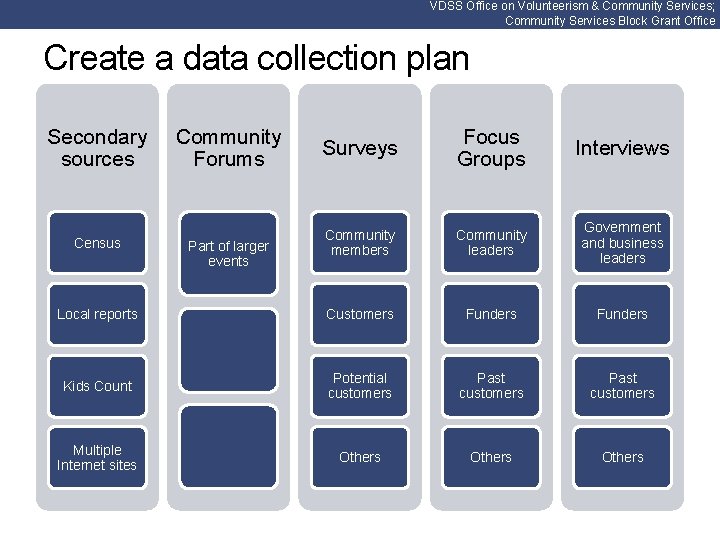
VDSS Office on Volunteerism & Community Services; Community Services Block Grant Office Create a data collection plan Secondary sources Surveys Focus Groups Interviews Community members Community leaders Government and business leaders Local reports Customers Funders Kids Count Potential customers Past customers Multiple Internet sites Others Census Community Forums Part of larger events
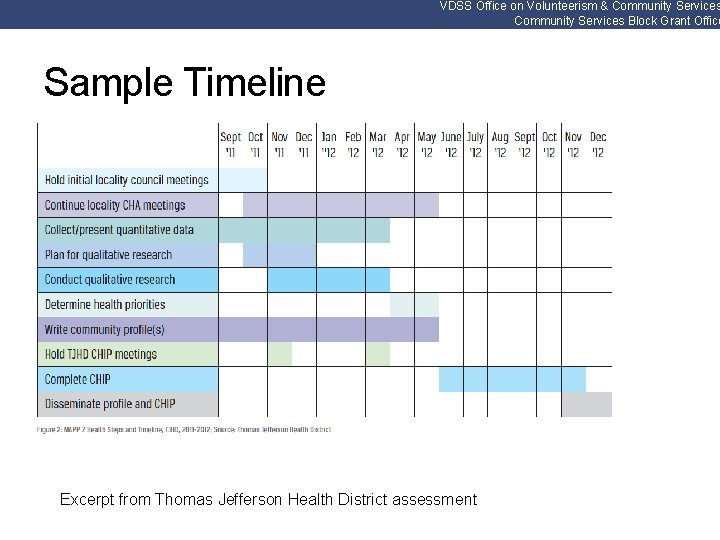
VDSS Office on Volunteerism & Community Services Block Grant Office Sample Timeline Excerpt from Thomas Jefferson Health District assessment
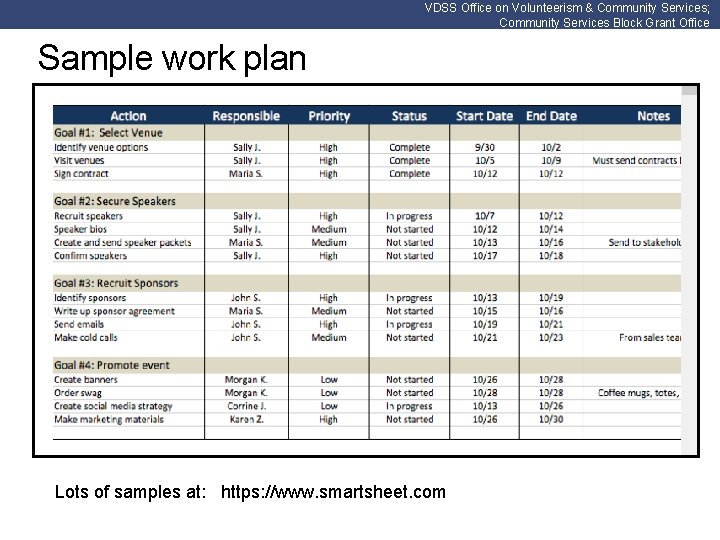
VDSS Office on Volunteerism & Community Services; Community Services Block Grant Office Sample work plan Lots of samples at: https: //www. smartsheet. com
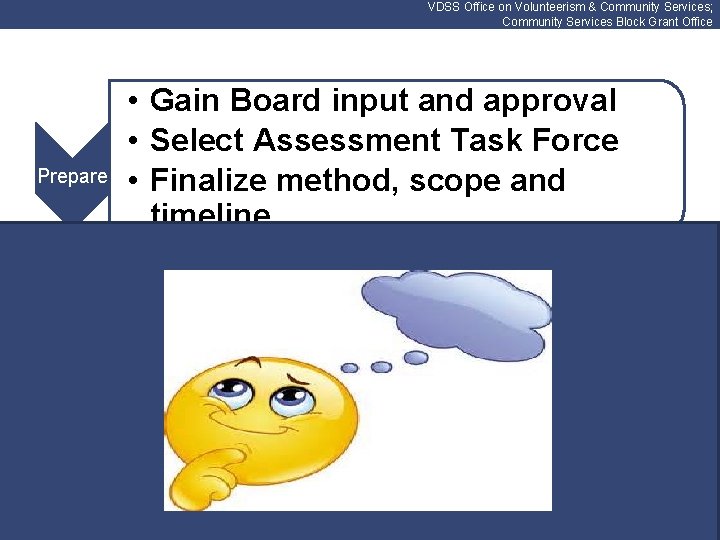
VDSS Office on Volunteerism & Community Services; Community Services Block Grant Office Prepare Collect Information Analyze • Gain Board input and approval • Select Assessment Task Force • Finalize method, scope and timeline • Secondary data for community profiles • Primary data from lower income population through face-to-face and survey • Primary data from other key stakeholders through face-to-face • Secondary data to flesh out stakeholder input (verify, refute, quantify) • • Analyze all data/information Prioritize and determine key findings Recommend Prepare written report • Gain Board approval Approve • Publicize and distribute widely and Share
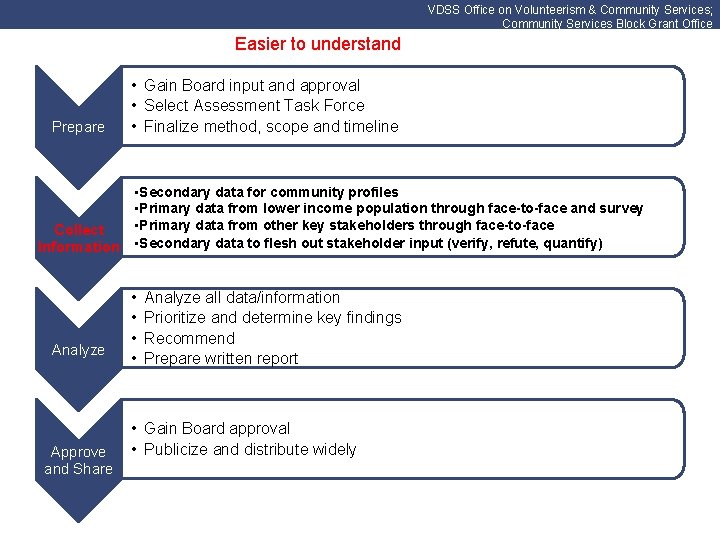
VDSS Office on Volunteerism & Community Services; Community Services Block Grant Office Easier to understand Prepare • Gain Board input and approval • Select Assessment Task Force • Finalize method, scope and timeline • Secondary data for community profiles • Primary data from lower income population through face-to-face and survey • Primary data from other key stakeholders through face-to-face Collect Information • Secondary data to flesh out stakeholder input (verify, refute, quantify) Analyze Approve and Share • • Analyze all data/information Prioritize and determine key findings Recommend Prepare written report • Gain Board approval • Publicize and distribute widely
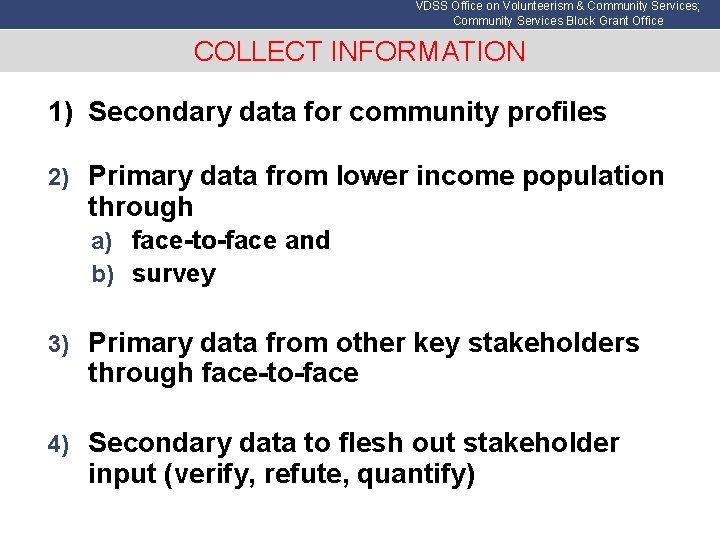
VDSS Office on Volunteerism & Community Services; Community Services Block Grant Office COLLECT INFORMATION 1) Secondary data for community profiles 2) Primary data from lower income population through a) face-to-face and b) survey 3) Primary data from other key stakeholders through face-to-face 4) Secondary data to flesh out stakeholder input (verify, refute, quantify)
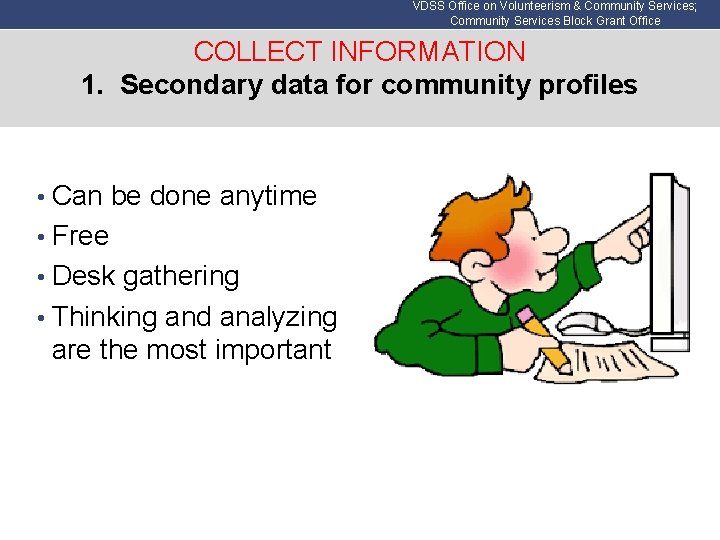
VDSS Office on Volunteerism & Community Services; Community Services Block Grant Office COLLECT INFORMATION 1. Secondary data for community profiles • Can be done anytime • Free • Desk gathering • Thinking and analyzing are the most important
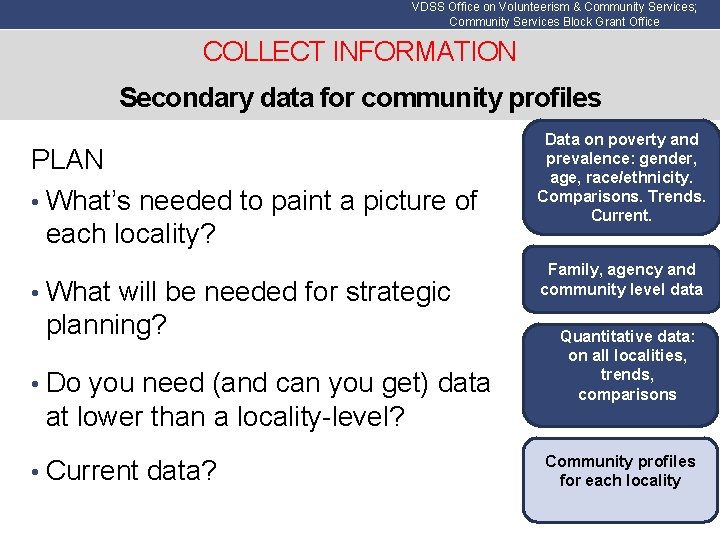
VDSS Office on Volunteerism & Community Services; Community Services Block Grant Office COLLECT INFORMATION Secondary data for community profiles PLAN • What’s needed to paint a picture of each locality? • What will be needed for strategic planning? • Do you need (and can you get) data at lower than a locality-level? • Current data? Data on poverty and prevalence: gender, age, race/ethnicity. Comparisons. Trends. Current. Family, agency and community level data • Quantitative data: on all localities, trends, comparisons Community profiles for each locality

Beware to too much data! Page after page of raw data in the report with no analysis or summary is not helpful. Compare. Look at the trends. Find the nuggets. Summarize. VDSS Office on Volunteerism & Community Services; Community Services Block Grant Office
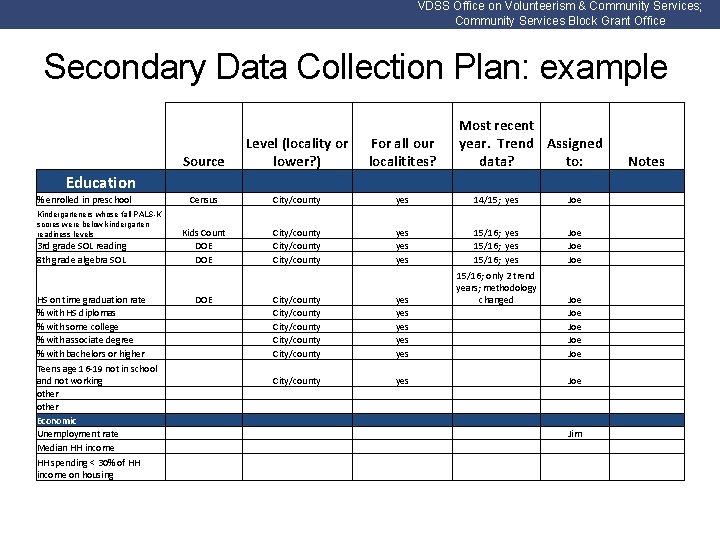
VDSS Office on Volunteerism & Community Services; Community Services Block Grant Office Secondary Data Collection Plan: example Education % enrolled in preschool Kindergarteners whose fall PALS-K scores were below kindergarten readiness levels 3 rd grade SOL reading 8 th grade algebra SOL HS on time graduation rate % with HS diplomas % with some college % with associate degree % with bachelors or higher Teens age 16 -19 not in school and not working other Economic Unemployment rate Median HH income HH spending < 30% of HH income on housing Most recent year. Trend Assigned data? to: Source Level (locality or lower? ) For all our localitites? Census City/county yes 14/15; yes Joe Kids Count DOE City/county yes yes 15/16; yes Joe Joe Joe Notes DOE City/county City/county yes yes yes 15/16; only 2 trend years; methodology changed City/county yes Joe Jim
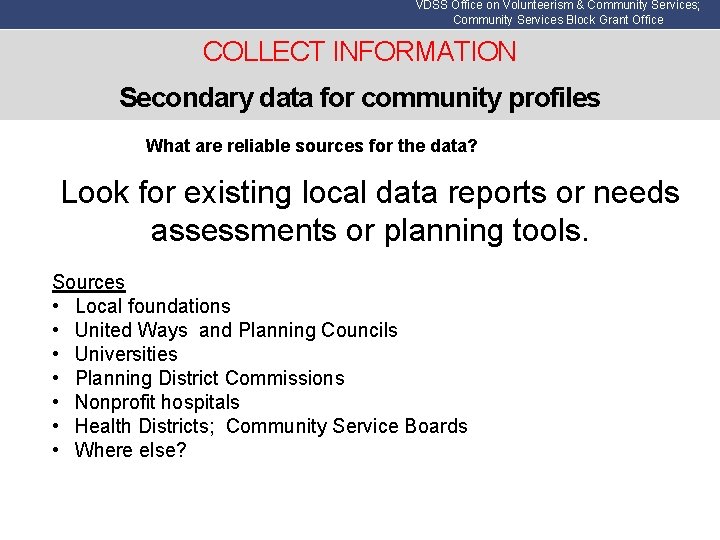
VDSS Office on Volunteerism & Community Services; Community Services Block Grant Office COLLECT INFORMATION Secondary data for community profiles What are reliable sources for the data? Look for existing local data reports or needs assessments or planning tools. Sources • Local foundations • United Ways and Planning Councils • Universities • Planning District Commissions • Nonprofit hospitals • Health Districts; Community Service Boards • Where else?
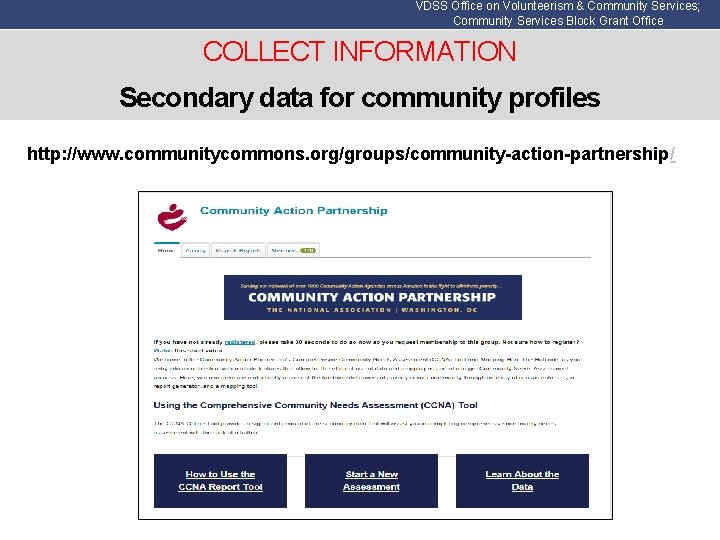
VDSS Office on Volunteerism & Community Services; Community Services Block Grant Office COLLECT INFORMATION Secondary data for community profiles http: //www. communitycommons. org/groups/community-action-partnership/
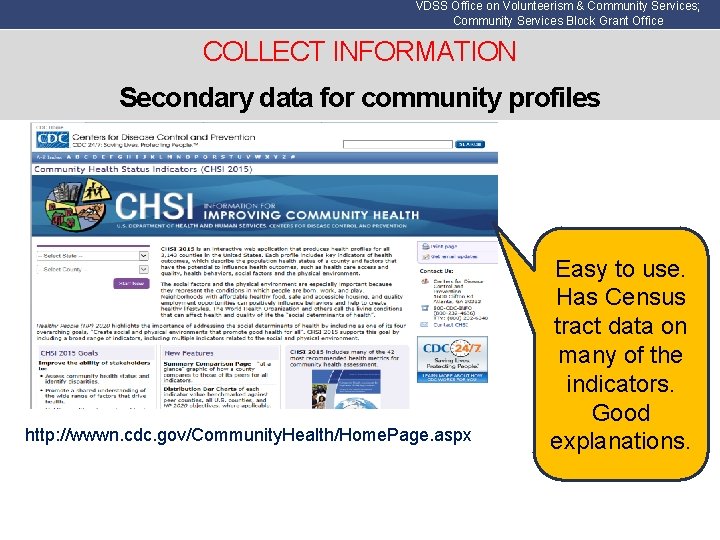
VDSS Office on Volunteerism & Community Services; Community Services Block Grant Office COLLECT INFORMATION Secondary data for community profiles http: //wwwn. cdc. gov/Community. Health/Home. Page. aspx Easy to use. Has Census tract data on many of the indicators. Good explanations.
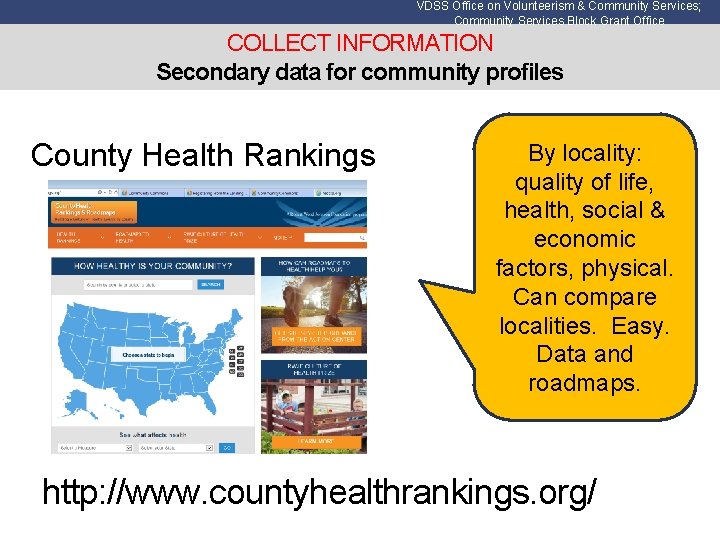
VDSS Office on Volunteerism & Community Services; Community Services Block Grant Office COLLECT INFORMATION Secondary data for community profiles County Health Rankings By locality: quality of life, health, social & economic factors, physical. Can compare localities. Easy. Data and roadmaps. http: //www. countyhealthrankings. org/
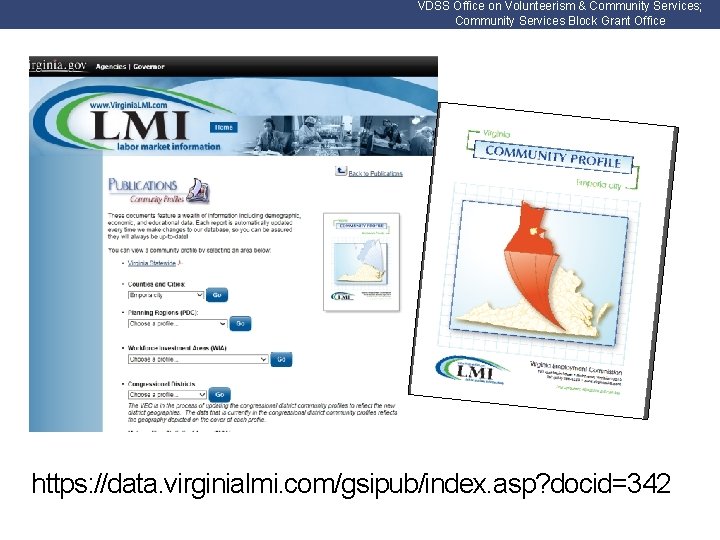
VDSS Office on Volunteerism & Community Services; Community Services Block Grant Office https: //data. virginialmi. com/gsipub/index. asp? docid=342
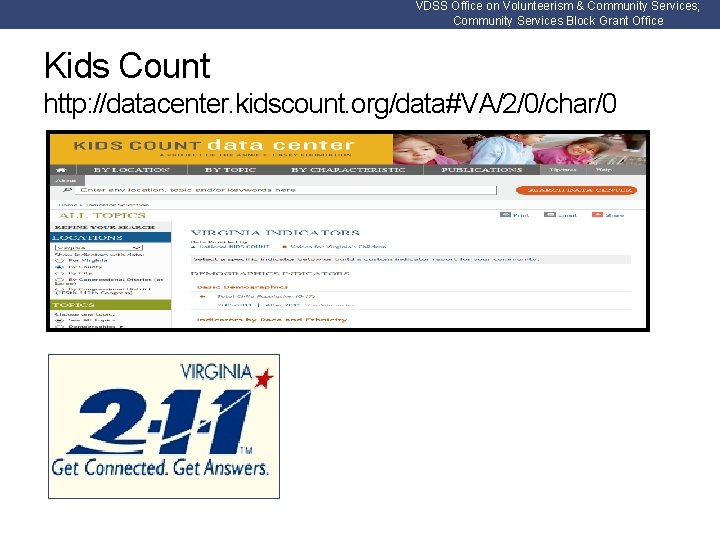
VDSS Office on Volunteerism & Community Services; Community Services Block Grant Office Kids Count http: //datacenter. kidscount. org/data#VA/2/0/char/0
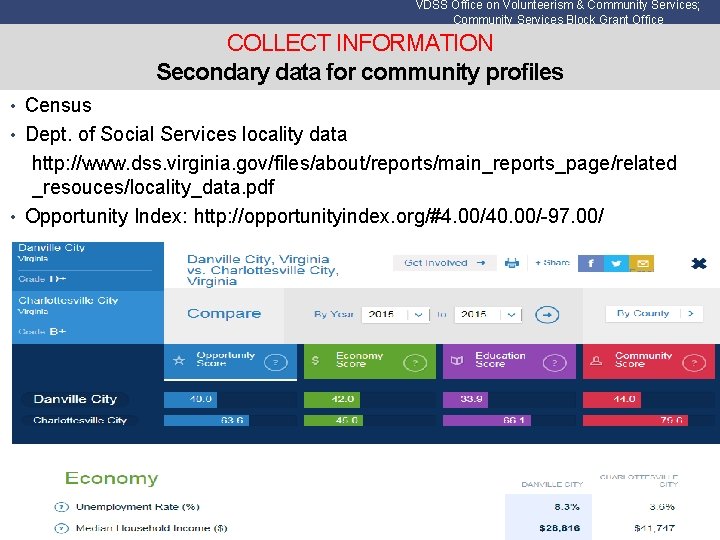
VDSS Office on Volunteerism & Community Services; Community Services Block Grant Office COLLECT INFORMATION Secondary data for community profiles • Census • Dept. of Social Services locality data http: //www. dss. virginia. gov/files/about/reports/main_reports_page/related _resouces/locality_data. pdf • Opportunity Index: http: //opportunityindex. org/#4. 00/40. 00/-97. 00/
VDSS Office on Volunteerism & Community Services; Community Services Block Grant Office Group Discussion: Community Profiles and Data sleuthing group exercise
VDSS Office on Volunteerism & Community Services; Community Services Block Grant Office COLLECT INFORMATION Secondary data for community profiles
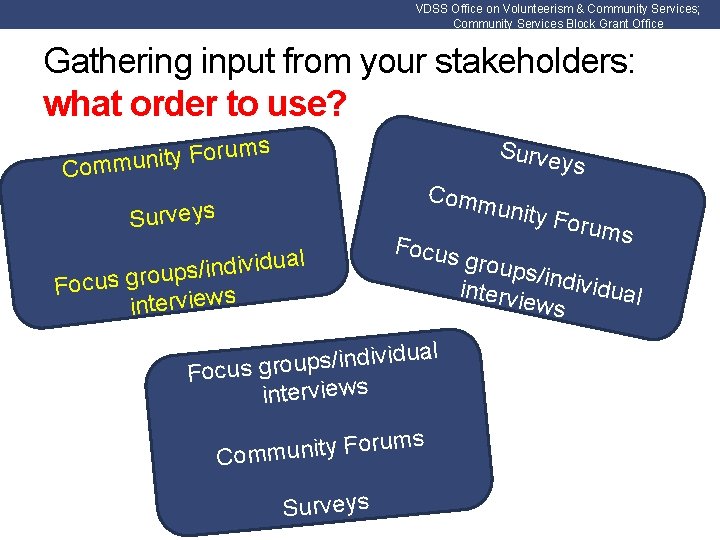
VDSS Office on Volunteerism & Community Services; Community Services Block Grant Office Gathering input from your stakeholders: what order to use? ms u r o F y t i n Commu Surve y s Surveys al u d i v i d n i / s up Focus gro interviews Comm unity F orums Focus group s/indiv idual interv iews al u d i v i d n i / s p u Focus gro interviews s m u r o F y t i n u Comm Surveys
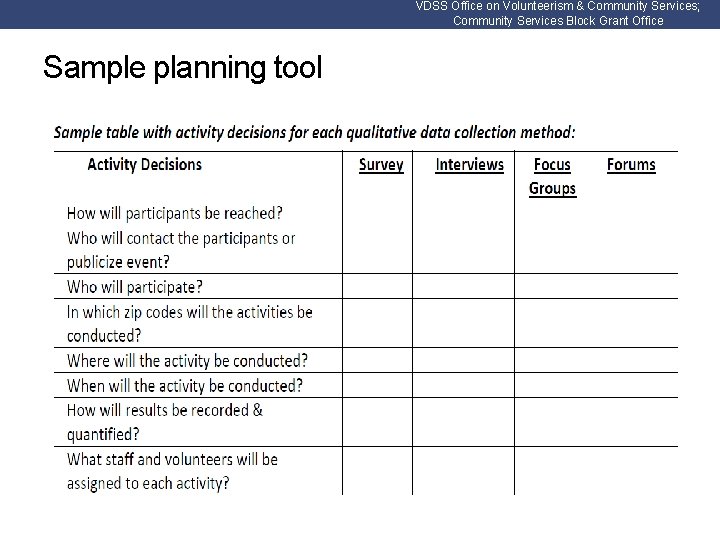
VDSS Office on Volunteerism & Community Services; Community Services Block Grant Office Sample planning tool
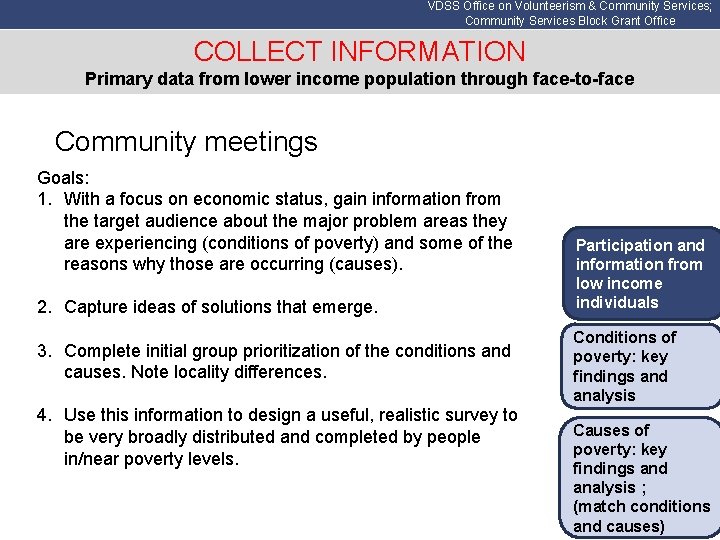
VDSS Office on Volunteerism & Community Services; Community Services Block Grant Office COLLECT INFORMATION Primary data from lower income population through face-to-face Community meetings Goals: 1. With a focus on economic status, gain information from the target audience about the major problem areas they are experiencing (conditions of poverty) and some of the reasons why those are occurring (causes). 2. Capture ideas of solutions that emerge. 3. Complete initial group prioritization of the conditions and causes. Note locality differences. 4. Use this information to design a useful, realistic survey to be very broadly distributed and completed by people in/near poverty levels. Participation and information from low income individuals Conditions of poverty: key findings and analysis Causes of poverty: key findings and analysis ; (match conditions and causes)
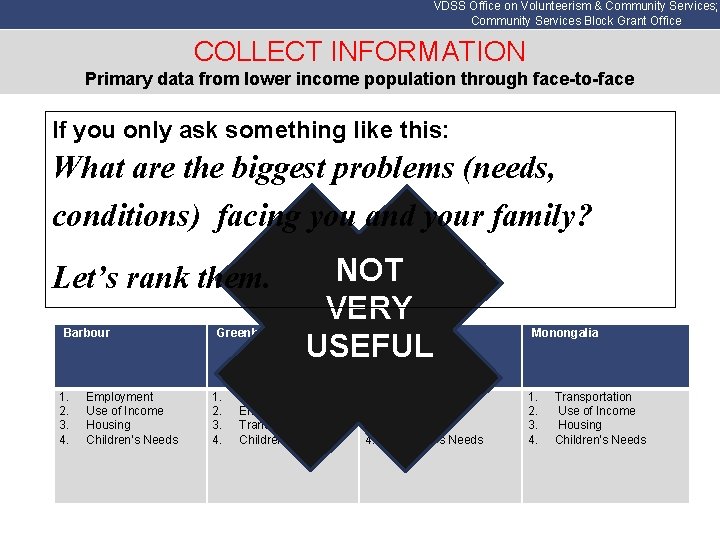
VDSS Office on Volunteerism & Community Services; Community Services Block Grant Office COLLECT INFORMATION Primary data from lower income population through face-to-face If you only ask something like this: What are the biggest problems (needs, conditions) facing you and your family? Let’s rank them. Barbour 1. 2. 3. 4. Employment Use of Income Housing Children‘s Needs Greenbrier 1. 2. 3. 4. NOT VERY USEFUL Use of Income Employment Transportation Children‘s Needs Marion 1. 2. 3. 4. Employment Health Education Children‘s Needs Monongalia 1. 2. 3. 4. Transportation Use of Income Housing Children‘s Needs
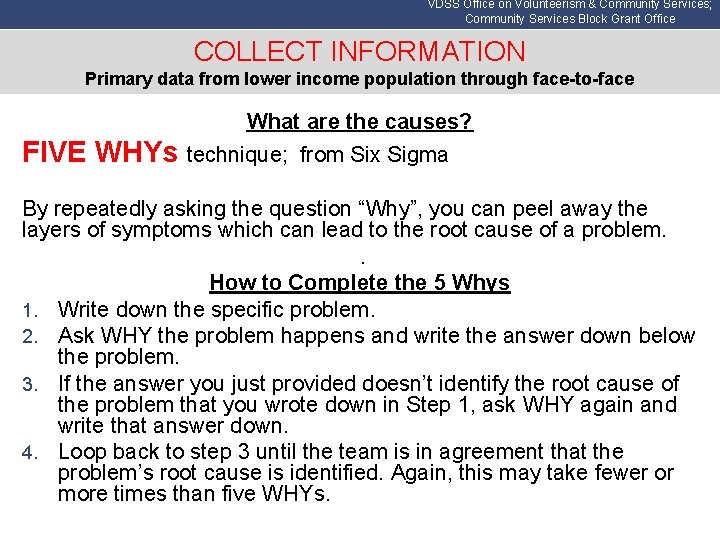
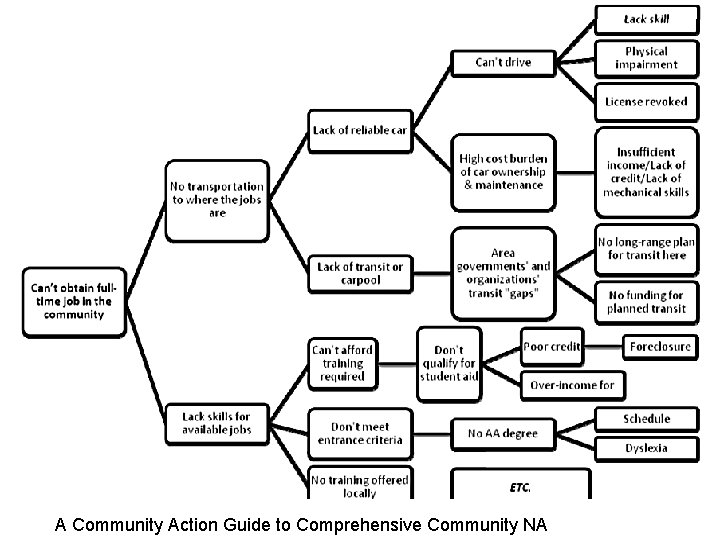
VDSS Office on Volunteerism & Community Services; Community Services Block Grant Office COLLECT INFORMATION Primary data from lower income population through face-to-face What are the causes? FIVE WHYs technique; from Six Sigma By repeatedly asking the question “Why”, you can peel away the layers of symptoms which can lead to the root cause of a problem. . How to Complete the 5 Whys 1. Write down the specific problem. 2. Ask WHY the problem happens and write the answer down below the problem. 3. If the answer you just provided doesn’t identify the root cause of the problem that you wrote down in Step 1, ask WHY again and write that answer down. 4. Loop back to step 3 until the team is in agreement that the problem’s root cause is identified. Again, this may take fewer or more times than five WHYs.
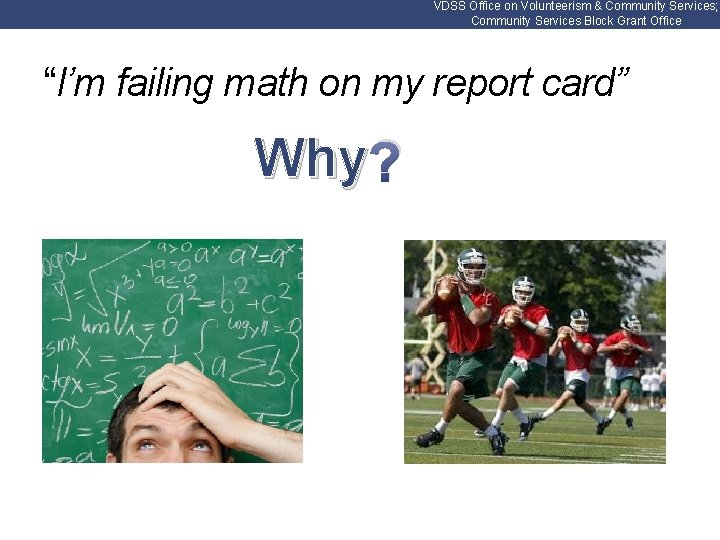
VDSS Office on Volunteerism & Community Services; Community Services Block Grant Office “I’m failing math on my report card” Why ?
VDSS Office on Volunteerism & Community Services; Community Services Block Grant Office A Community Action Guide to Comprehensive Community NA
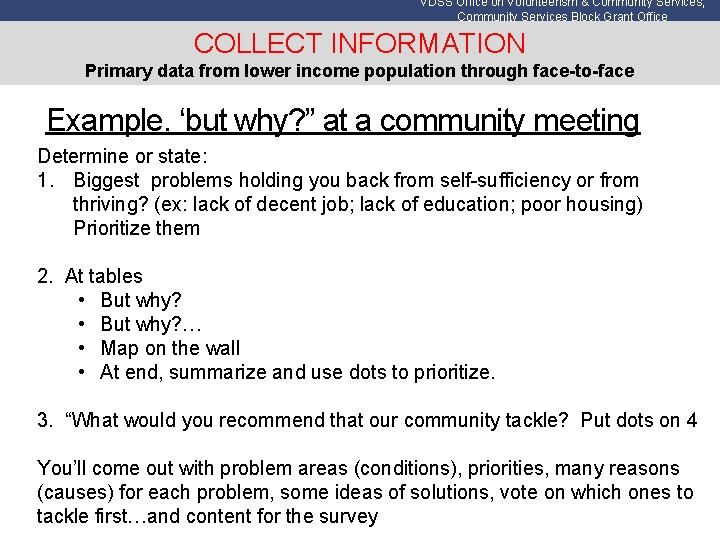
VDSS Office on Volunteerism & Community Services; Community Services Block Grant Office COLLECT INFORMATION Primary data from lower income population through face-to-face Example. ‘but why? ” at a community meeting Determine or state: 1. Biggest problems holding you back from self-sufficiency or from thriving? (ex: lack of decent job; lack of education; poor housing) Prioritize them 2. At tables • But why? … • Map on the wall • At end, summarize and use dots to prioritize. 3. “What would you recommend that our community tackle? Put dots on 4 You’ll come out with problem areas (conditions), priorities, many reasons (causes) for each problem, some ideas of solutions, vote on which ones to tackle first…and content for the survey
VDSS Office on Volunteerism & Community Services; Community Services Block Grant Office Group Exercise: Five Whys
VDSS Office on Volunteerism & Community Services; Community Services Block Grant Office COLLECT INFORMATION Primary data from lower income population through face-to-face What is a community meeting? • A well-publicized, well-planned public conversation that results in information sharing and development for use in addressing a need/issue in the community.
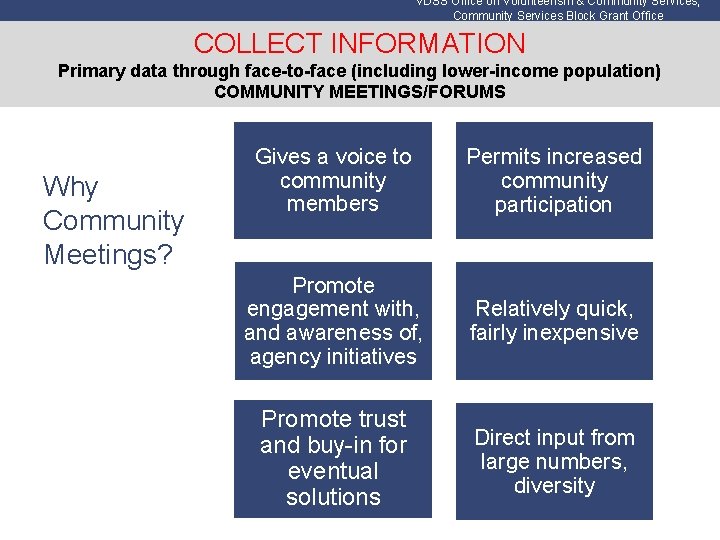
VDSS Office on Volunteerism & Community Services; Community Services Block Grant Office COLLECT INFORMATION Primary data through face-to-face (including lower-income population) COMMUNITY MEETINGS/FORUMS Why Community Meetings? Gives a voice to community members Permits increased community participation Promote engagement with, and awareness of, agency initiatives Relatively quick, fairly inexpensive Promote trust and buy-in for eventual solutions Direct input from large numbers, diversity
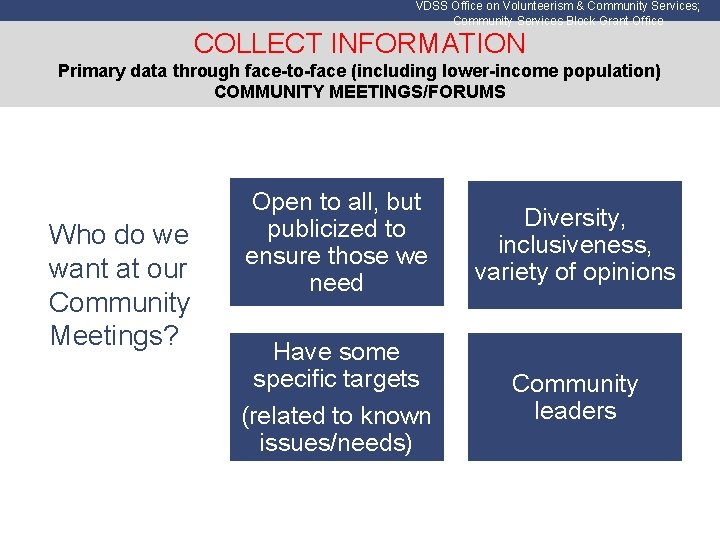
VDSS Office on Volunteerism & Community Services; Community Services Block Grant Office COLLECT INFORMATION Primary data through face-to-face (including lower-income population) COMMUNITY MEETINGS/FORUMS Who do we want at our Community Meetings? Open to all, but publicized to ensure those we need Diversity, inclusiveness, variety of opinions Have some specific targets (related to known issues/needs) Community leaders
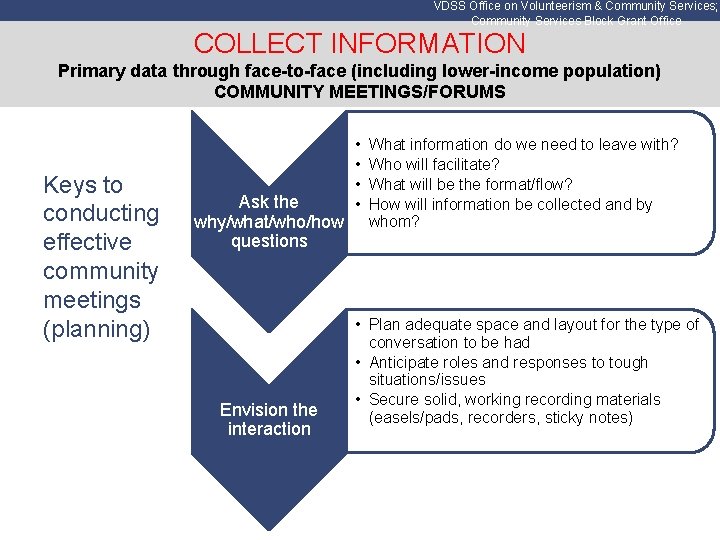
VDSS Office on Volunteerism & Community Services; Community Services Block Grant Office COLLECT INFORMATION Primary data through face-to-face (including lower-income population) COMMUNITY MEETINGS/FORUMS Keys to conducting effective community meetings (planning) Ask the why/what/who/how questions Envision the interaction • • What information do we need to leave with? Who will facilitate? What will be the format/flow? How will information be collected and by whom? • Plan adequate space and layout for the type of conversation to be had • Anticipate roles and responses to tough situations/issues • Secure solid, working recording materials (easels/pads, recorders, sticky notes)
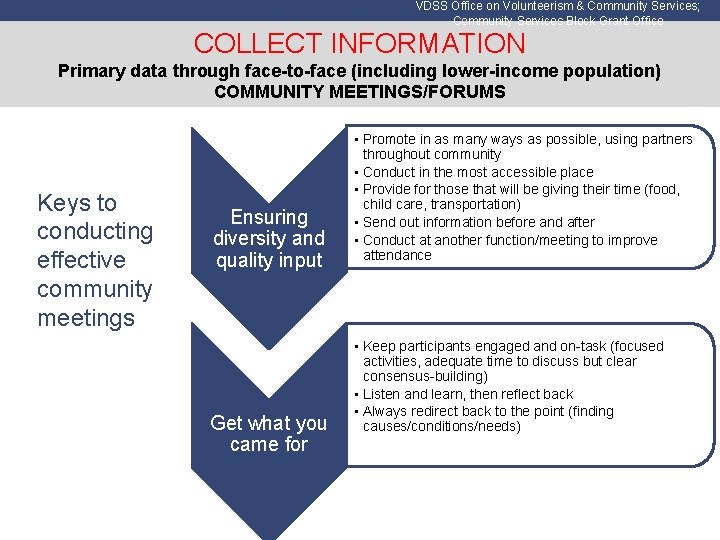
VDSS Office on Volunteerism & Community Services; Community Services Block Grant Office COLLECT INFORMATION Primary data through face-to-face (including lower-income population) COMMUNITY MEETINGS/FORUMS Keys to conducting effective community meetings Ensuring diversity and quality input Get what you came for • Promote in as many ways as possible, using partners throughout community • Conduct in the most accessible place • Provide for those that will be giving their time (food, child care, transportation) • Send out information before and after • Conduct at another function/meeting to improve attendance • Keep participants engaged and on-task (focused activities, adequate time to discuss but clear consensus-building) • Listen and learn, then reflect back • Always redirect back to the point (finding causes/conditions/needs)
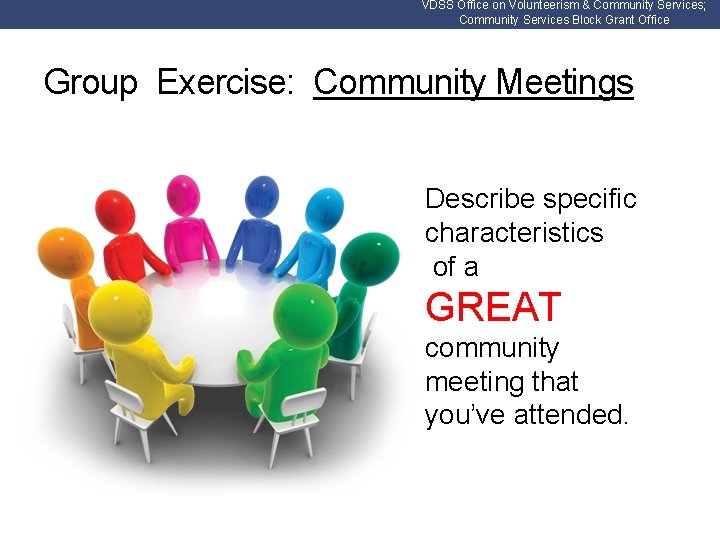
VDSS Office on Volunteerism & Community Services; Community Services Block Grant Office Group Exercise: Community Meetings Describe specific characteristics of a GREAT community meeting that you’ve attended.
COLLECT INFORMATION Primary data collection from lower income population through face-to-face
VDSS Office on Volunteerism & Community Services; Community Services Block Grant Office COLLECT INFORMATION Primary data from lower income population through a survey Why? • Broader response • Good size samples per locality • More diverse and representative respondents • Test out what you heard at the community forums with broader audiences • Gives you more quantitative data
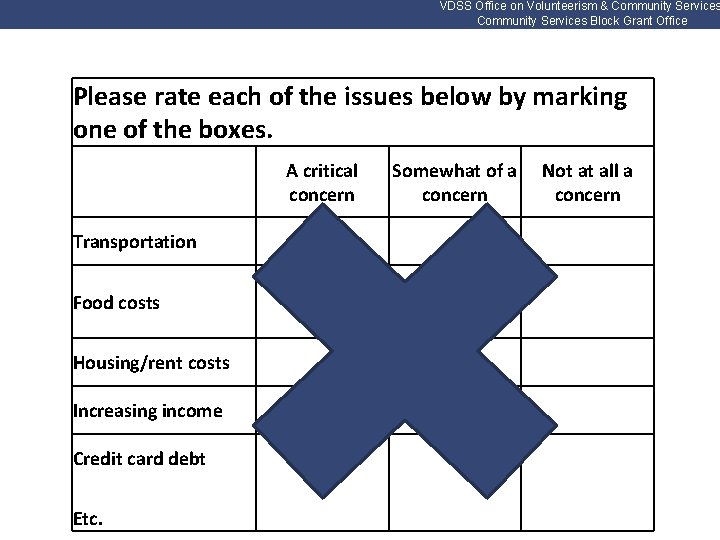
VDSS Office on Volunteerism & Community Services Block Grant Office Please rate each of the issues below by marking one of the boxes. A critical concern Somewhat of a concern Not at all a concern Transportation Food costs Housing/rent costs Increasing income Credit card debt Etc.
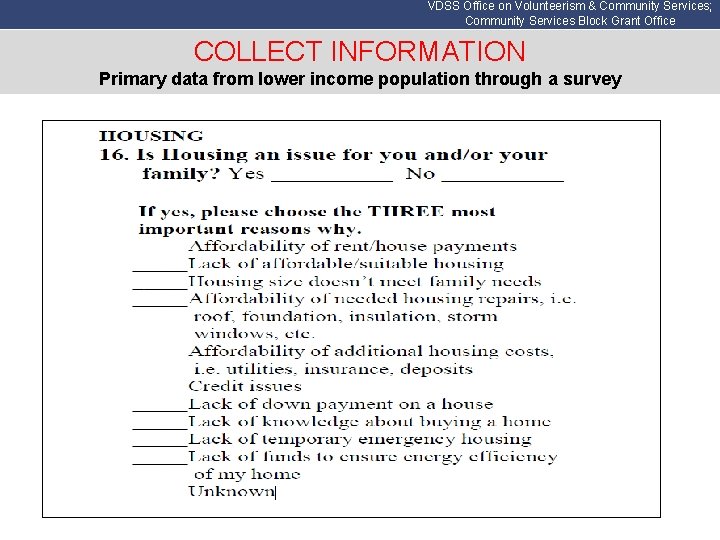
VDSS Office on Volunteerism & Community Services; Community Services Block Grant Office COLLECT INFORMATION Primary data from lower income population through a survey
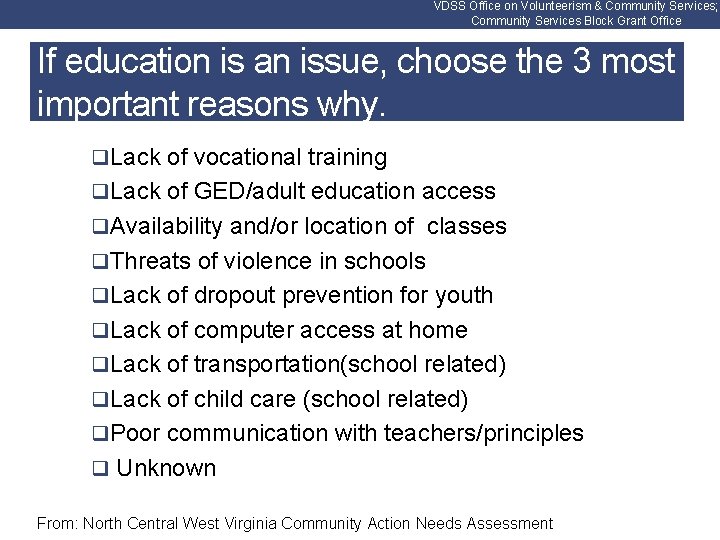
VDSS Office on Volunteerism & Community Services; Community Services Block Grant Office If education is an issue, choose the 3 most important reasons why. q. Lack of vocational training q. Lack of GED/adult education access q. Availability and/or location of classes q. Threats of violence in schools q. Lack of dropout prevention for youth q. Lack of computer access at home q. Lack of transportation(school related) q. Lack of child care (school related) q. Poor communication with teachers/principles q Unknown From: North Central West Virginia Community Action Needs Assessment
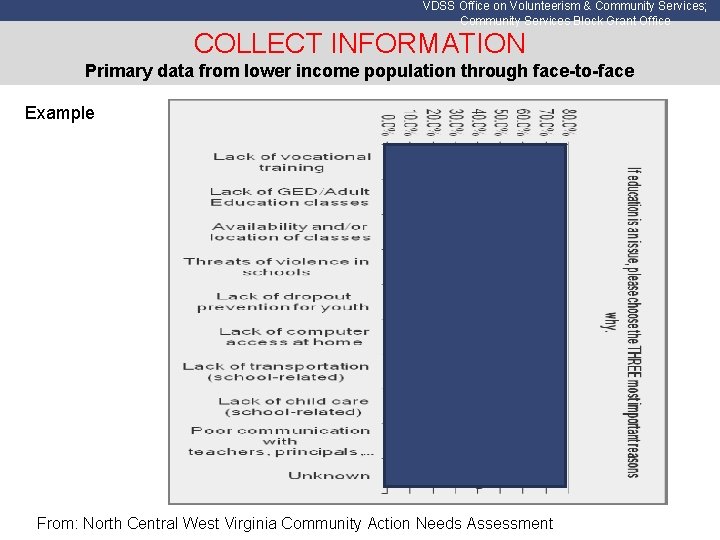
VDSS Office on Volunteerism & Community Services; Community Services Block Grant Office COLLECT INFORMATION Primary data from lower income population through face-to-face Example From: North Central West Virginia Community Action Needs Assessment
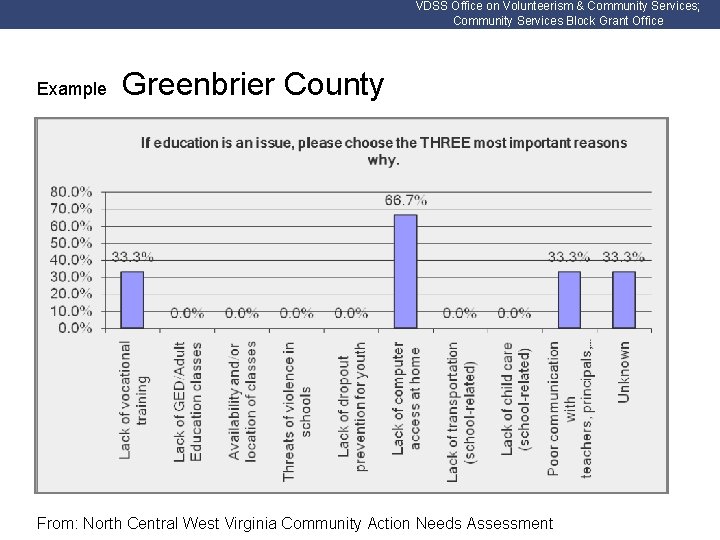
VDSS Office on Volunteerism & Community Services; Community Services Block Grant Office Example Greenbrier County From: North Central West Virginia Community Action Needs Assessment
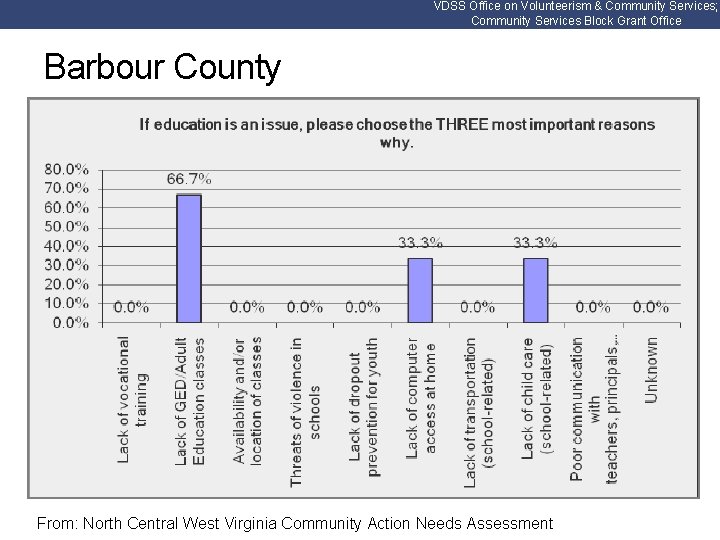
VDSS Office on Volunteerism & Community Services; Community Services Block Grant Office Barbour County From: North Central West Virginia Community Action Needs Assessment
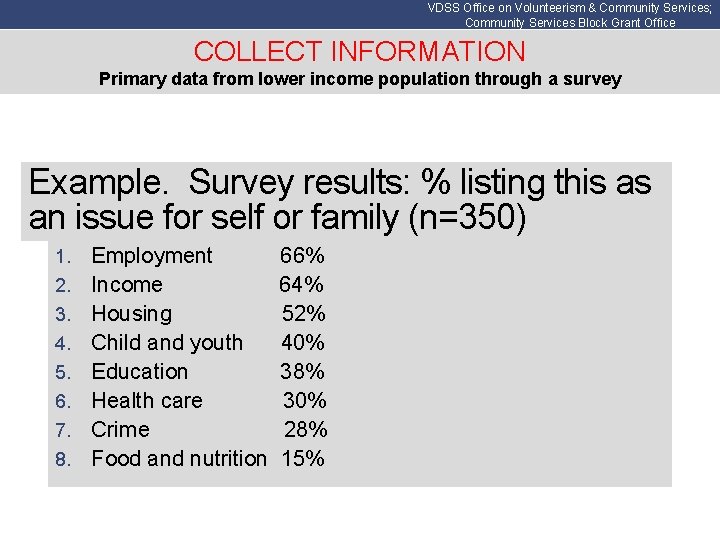
VDSS Office on Volunteerism & Community Services; Community Services Block Grant Office COLLECT INFORMATION Primary data from lower income population through a survey Example. Survey results: % listing this as an issue for self or family (n=350) 1. 2. 3. 4. 5. 6. 7. 8. Employment 66% Income 64% Housing 52% Child and youth 40% Education 38% Health care 30% Crime 28% Food and nutrition 15%
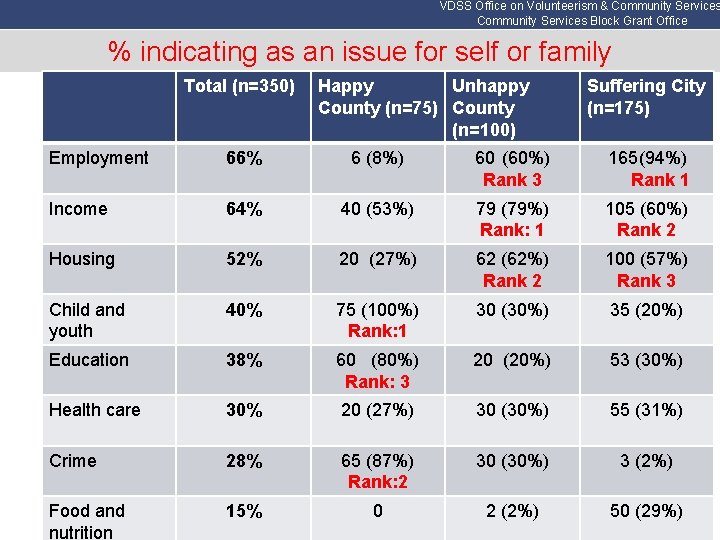
VDSS Office on Volunteerism & Community Services Block Grant Office % indicating as an issue for self or family COLLECT INFORMATION Total (n=350) Happy Unhappy County (n=75) County (n=100) Suffering City (n=175) Employment 66% 6 (8%) 60 (60%) Rank 3 165(94%) Rank 1 Income 64% 40 (53%) 79 (79%) Rank: 1 105 (60%) Rank 2 Housing 52% 20 (27%) 62 (62%) Rank 2 100 (57%) Rank 3 Child and youth 40% 75 (100%) Rank: 1 30 (30%) 35 (20%) Education 38% 60 (80%) Rank: 3 20 (20%) 53 (30%) Health care 30% 20 (27%) 30 (30%) 55 (31%) Crime 28% 65 (87%) Rank: 2 30 (30%) 3 (2%) Food and nutrition 15% 0 2 (2%) 50 (29%)
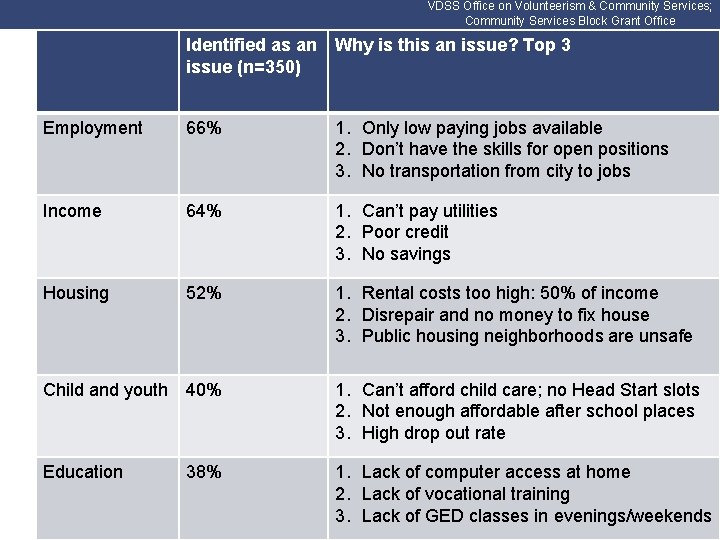
VDSS Office on Volunteerism & Community Services; Community Services Block Grant Office Identified as an Why is this an issue? Top 3 issue (n=350) Employment 66% 1. Only low paying jobs available 2. Don’t have the skills for open positions 3. No transportation from city to jobs Income 64% 1. Can’t pay utilities 2. Poor credit 3. No savings Housing 52% 1. Rental costs too high: 50% of income 2. Disrepair and no money to fix house 3. Public housing neighborhoods are unsafe Child and youth 40% 1. Can’t afford child care; no Head Start slots 2. Not enough affordable after school places 3. High drop out rate Education 1. Lack of computer access at home 2. Lack of vocational training 3. Lack of GED classes in evenings/weekends 38%
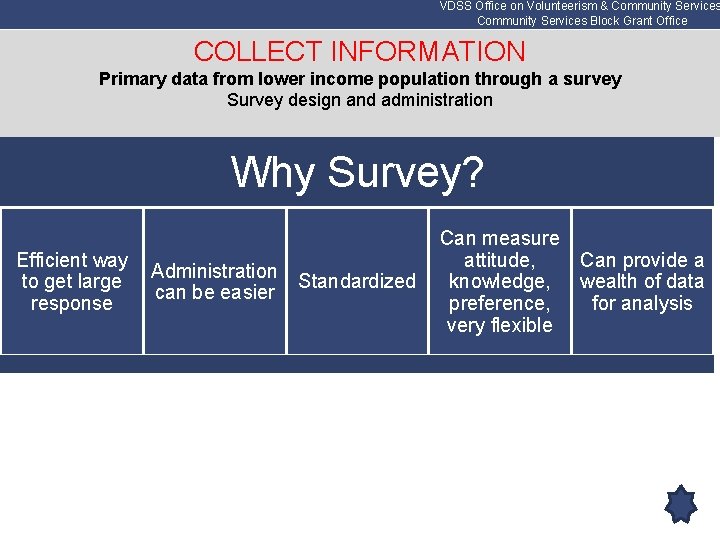
VDSS Office on Volunteerism & Community Services Block Grant Office COLLECT INFORMATION Primary data from lower income population through a survey Survey design and administration Why Survey? Efficient way Administration to get large Standardized can be easier response Can measure Can provide a attitude, knowledge, wealth of data for analysis preference, very flexible
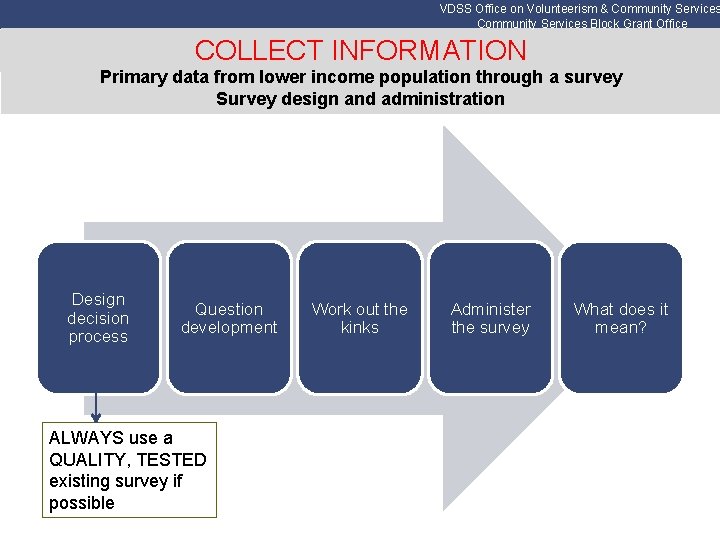
VDSS Office on Volunteerism & Community Services Block Grant Office COLLECT INFORMATION Primary data from lower income population through a survey Survey design and administration Design decision process Question development ALWAYS use a QUALITY, TESTED existing survey if possible Work out the kinks Administer the survey What does it mean?
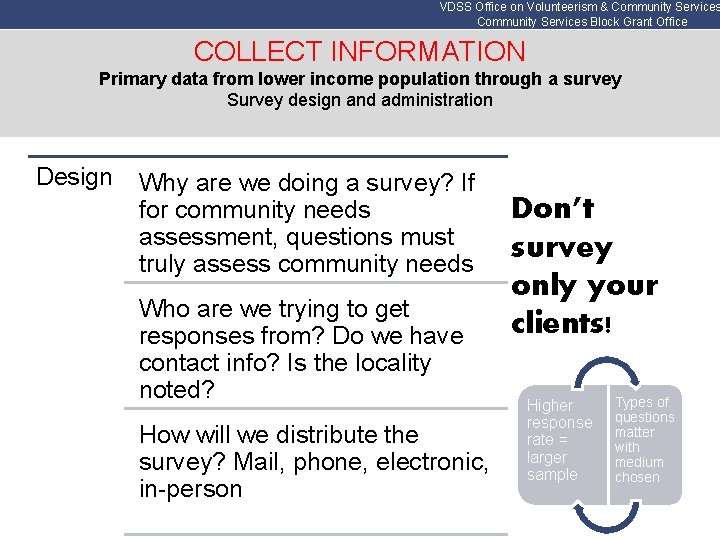
VDSS Office on Volunteerism & Community Services Block Grant Office COLLECT INFORMATION Primary data from lower income population through a survey Survey design and administration Design Why are we doing a survey? If for community needs assessment, questions must truly assess community needs Who are we trying to get responses from? Do we have contact info? Is the locality noted? How will we distribute the survey? Mail, phone, electronic, in-person Don’t survey only your clients! Higher response rate = larger sample Types of questions matter with medium chosen
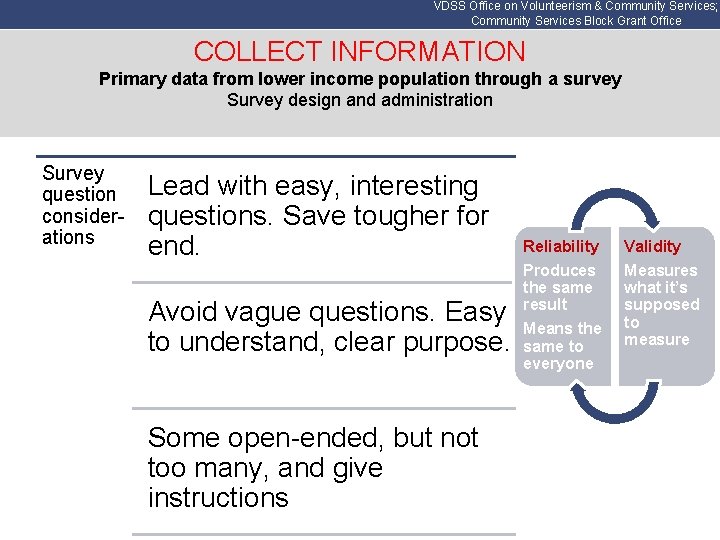
VDSS Office on Volunteerism & Community Services; Community Services Block Grant Office COLLECT INFORMATION Primary data from lower income population through a survey Survey design and administration Survey question considerations Lead with easy, interesting questions. Save tougher for end. Avoid vague questions. Easy to understand, clear purpose. Some open-ended, but not too many, and give instructions Reliability Validity Produces the same result Means the same to everyone Measures what it’s supposed to measure
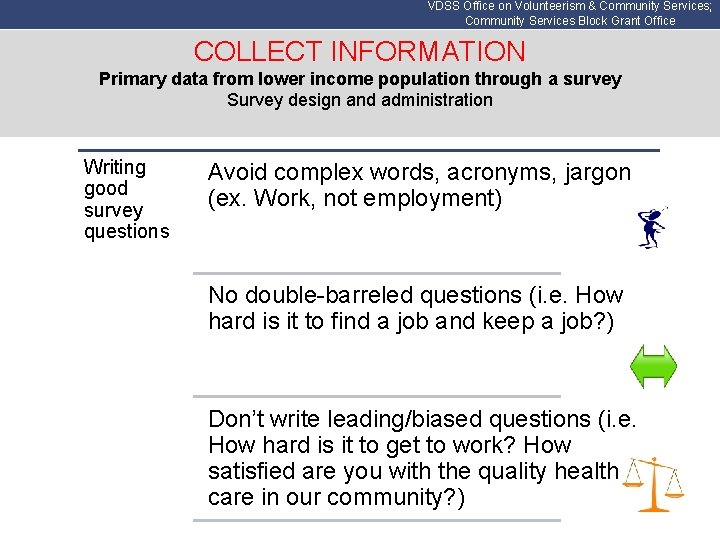
VDSS Office on Volunteerism & Community Services; Community Services Block Grant Office COLLECT INFORMATION Primary data from lower income population through a survey Survey design and administration Writing good survey questions Avoid complex words, acronyms, jargon (ex. Work, not employment) No double-barreled questions (i. e. How hard is it to find a job and keep a job? ) Don’t write leading/biased questions (i. e. How hard is it to get to work? How satisfied are you with the quality health care in our community? )
VDSS Office on Volunteerism & Community Services; Community Services Block Grant Office COLLECT INFORMATION Primary data from lower income population through a survey Survey design and administration Analyzing Is information complete and valid? the results! Can data be turned into charts/diagrams/graphs to be better digested? Relationships and trends, are any evident in answers? Open-ended (look for themes), Closed-ended (Mean/average, median/middle number, mode/most occurring) Do these findings relate to other information collected?
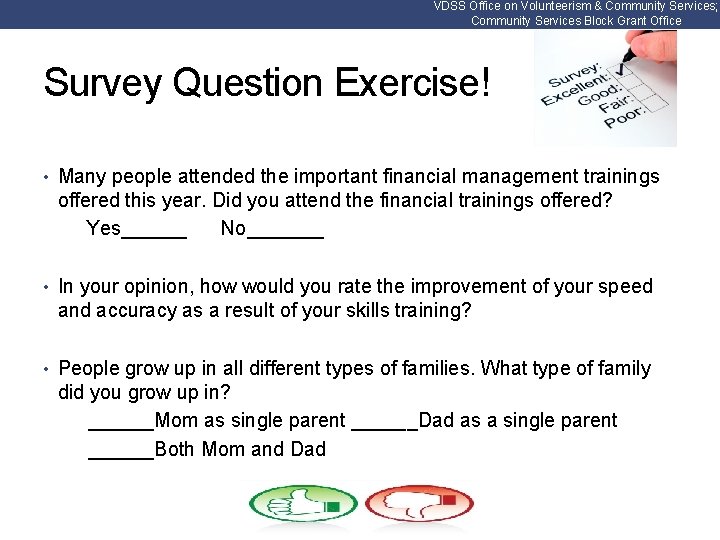
VDSS Office on Volunteerism & Community Services; Community Services Block Grant Office Survey Question Exercise! • Many people attended the important financial management trainings offered this year. Did you attend the financial trainings offered? Yes______ No_______ • In your opinion, how would you rate the improvement of your speed and accuracy as a result of your skills training? • People grow up in all different types of families. What type of family did you grow up in? ______Mom as single parent ______Dad as a single parent ______Both Mom and Dad
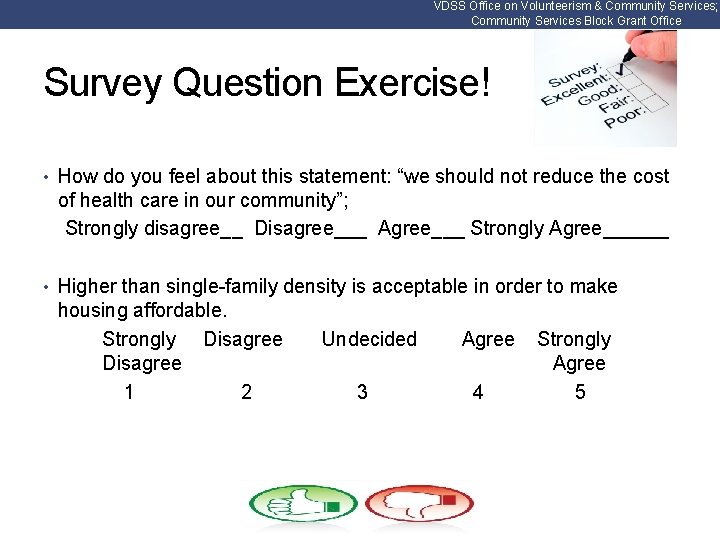
VDSS Office on Volunteerism & Community Services; Community Services Block Grant Office Survey Question Exercise! • How do you feel about this statement: “we should not reduce the cost of health care in our community”; Strongly disagree__ Disagree___ Agree___ Strongly Agree______ • Higher than single-family density is acceptable in order to make housing affordable. Strongly Disagree Undecided Agree Strongly Disagree Agree 1 2 3 4 5
COLLECT INFORMATION Primary data collection from lower income population through surveys
VDSS Office on Volunteerism & Community Services; Community Services Block Grant Office COLLECT INFORMATION Primary data from other key stakeholders through face-to-face Interviews or focus groups Why are these important? What is the purpose? Who do you want to hear from? • Government leaders • Other nonprofit leaders • Community or other foundation leaders • Local college • United Way • People who have moved to self sufficiency • Who else?
VDSS Office on Volunteerism & Community Services Block Grant Office COLLECT INFORMATION Primary data from other key stakeholders through face to face FOCUS GROUPS AND KEY INFORMANT INTERVIEWS • Specific focus areas, targeted questions, structured • Not expensive to conduct, mostly time spent planning/implementing • Expand on answers, get more detail • Very rich data
VDSS Office on Volunteerism & Community Services; Community Services Block Grant Office COLLECT INFORMATION Primary data from other key stakeholders through face to face • What would you ask? Available Resources at agency and in the community; assets. • Verify or refute what you’ve heard from low income people • What other needs are high on their lists? Relationship of your CAA’s activities to other anti-poverty services • What other organizations are addressing those needs? • What are the current resources available? • Are there new resources coming? • Where do they perceive gaps? Input gathered from key sectors (at least community organizations, faith groups, private sector, public sector and education)
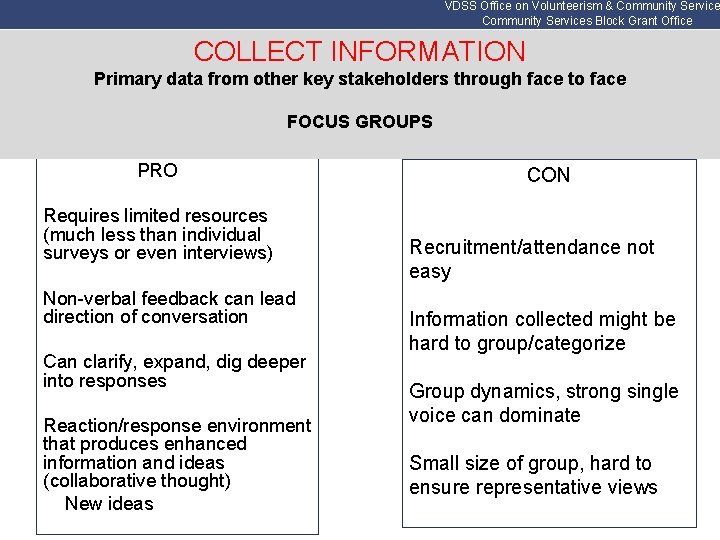
VDSS Office on Volunteerism & Community Services Block Grant Office g COLLECT INFORMATION Primary data from other key stakeholders through face to face FOCUS GROUPS PRO Requires limited resources (much less than individual surveys or even interviews) Non-verbal feedback can lead direction of conversation Can clarify, expand, dig deeper into responses Reaction/response environment that produces enhanced information and ideas (collaborative thought) New ideas CON Recruitment/attendance not easy Information collected might be hard to group/categorize Group dynamics, strong single voice can dominate Small size of group, hard to ensure representative views
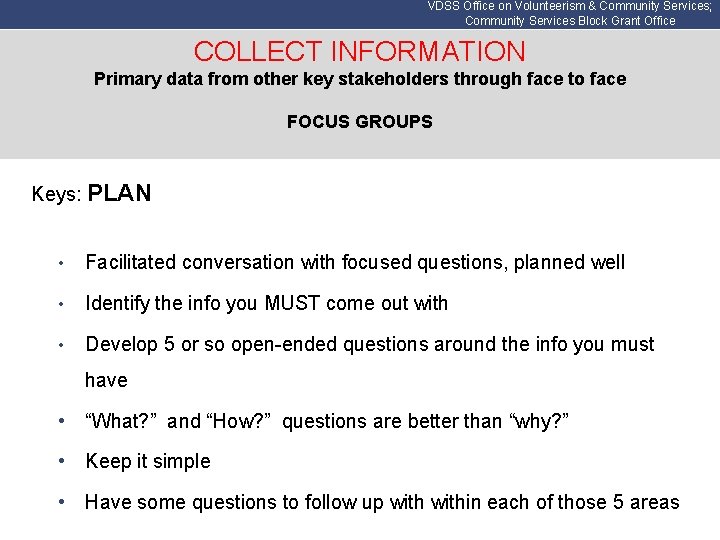
VDSS Office on Volunteerism & Community Services; Community Services Block Grant Office g COLLECT INFORMATION Primary data from other key stakeholders through face to face FOCUS GROUPS Keys: PLAN • Facilitated conversation with focused questions, planned well • Identify the info you MUST come out with • Develop 5 or so open-ended questions around the info you must have • “What? ” and “How? ” questions are better than “why? ” • Keep it simple • Have some questions to follow up within each of those 5 areas
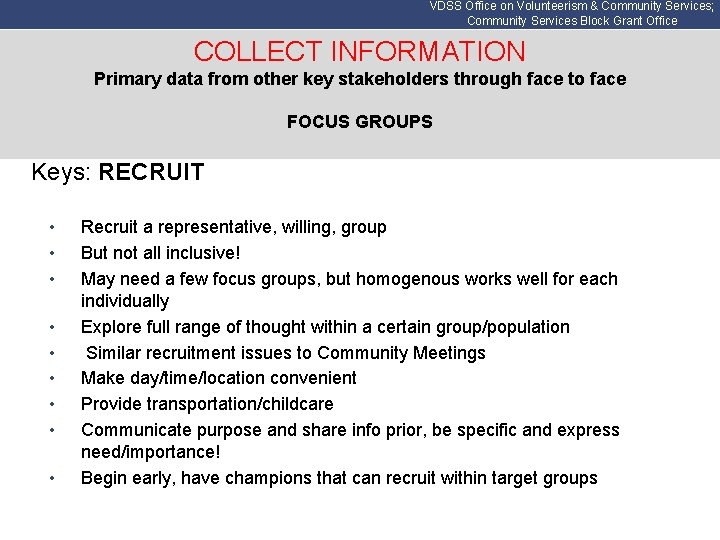
VDSS Office on Volunteerism & Community Services; Community Services Block Grant Office g COLLECT INFORMATION Primary data from other key stakeholders through face to face FOCUS GROUPS Keys: RECRUIT • • • Recruit a representative, willing, group But not all inclusive! May need a few focus groups, but homogenous works well for each individually Explore full range of thought within a certain group/population Similar recruitment issues to Community Meetings Make day/time/location convenient Provide transportation/childcare Communicate purpose and share info prior, be specific and express need/importance! Begin early, have champions that can recruit within target groups
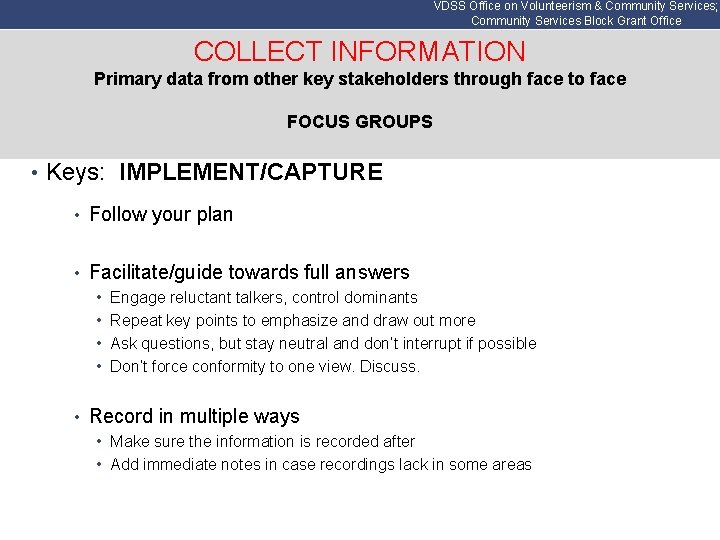
VDSS Office on Volunteerism & Community Services; Community Services Block Grant Office g COLLECT INFORMATION Primary data from other key stakeholders through face to face FOCUS GROUPS • Keys: IMPLEMENT/CAPTURE • Follow your plan • Facilitate/guide towards full answers • • Engage reluctant talkers, control dominants Repeat key points to emphasize and draw out more Ask questions, but stay neutral and don’t interrupt if possible Don’t force conformity to one view. Discuss. • Record in multiple ways • Make sure the information is recorded after • Add immediate notes in case recordings lack in some areas
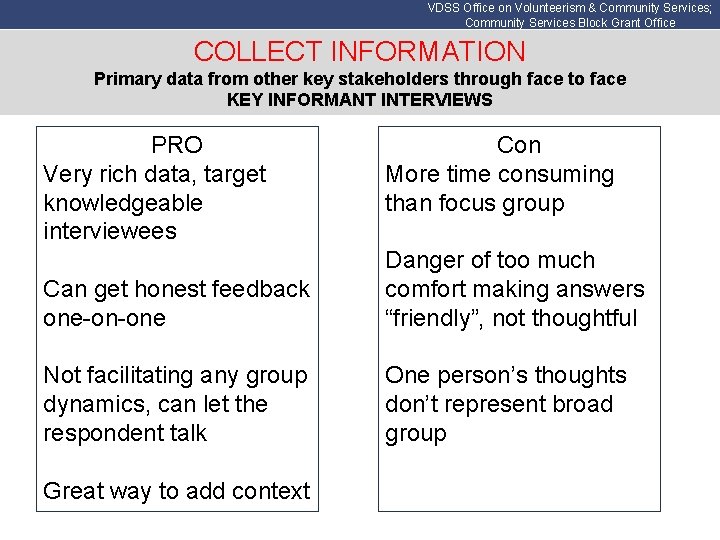
VDSS Office on Volunteerism & Community Services; Community Services Block Grant Office COLLECT INFORMATION Primary data from other key stakeholders through face to face KEY INFORMANT INTERVIEWS PRO Very rich data, target knowledgeable interviewees Con More time consuming than focus group Can get honest feedback one-on-one Danger of too much comfort making answers “friendly”, not thoughtful Not facilitating any group dynamics, can let the respondent talk One person’s thoughts don’t represent broad group Great way to add context
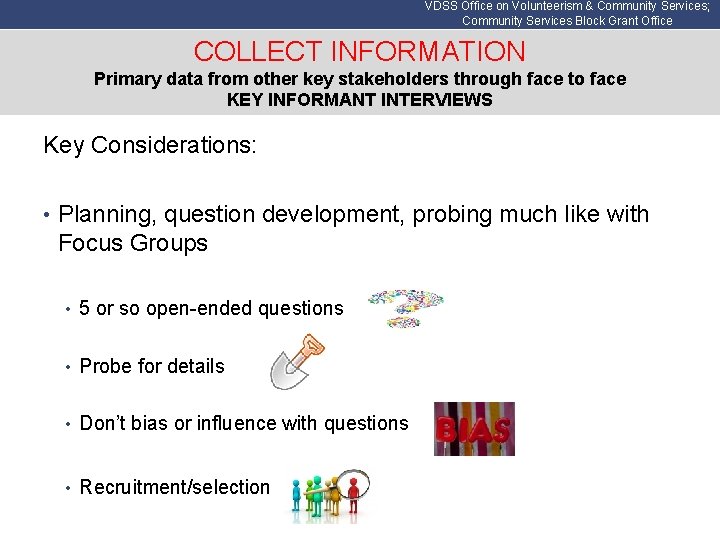
VDSS Office on Volunteerism & Community Services; Community Services Block Grant Office COLLECT INFORMATION Primary data from other key stakeholders through face to face KEY INFORMANT INTERVIEWS Key Considerations: • Planning, question development, probing much like with Focus Groups • 5 or so open-ended questions • Probe for details • Don’t bias or influence with questions • Recruitment/selection
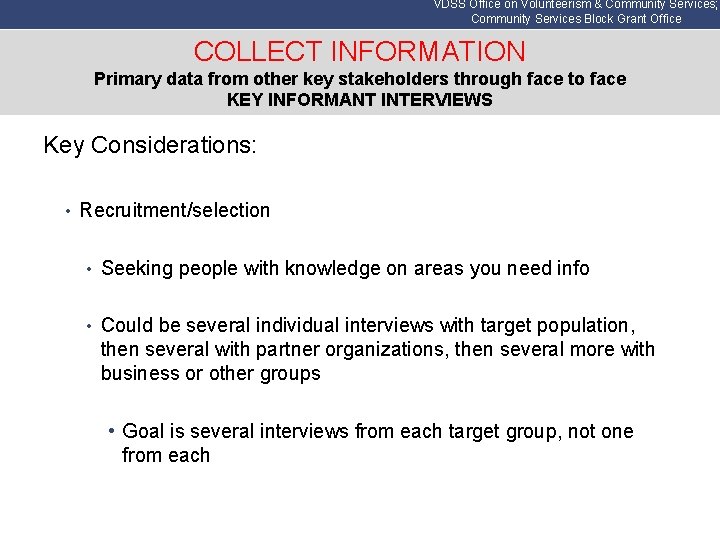
VDSS Office on Volunteerism & Community Services; Community Services Block Grant Office COLLECT INFORMATION Primary data from other key stakeholders through face to face KEY INFORMANT INTERVIEWS Key Considerations: • Recruitment/selection • Seeking people with knowledge on areas you need info • Could be several individual interviews with target population, then several with partner organizations, then several more with business or other groups • Goal is several interviews from each target group, not one from each
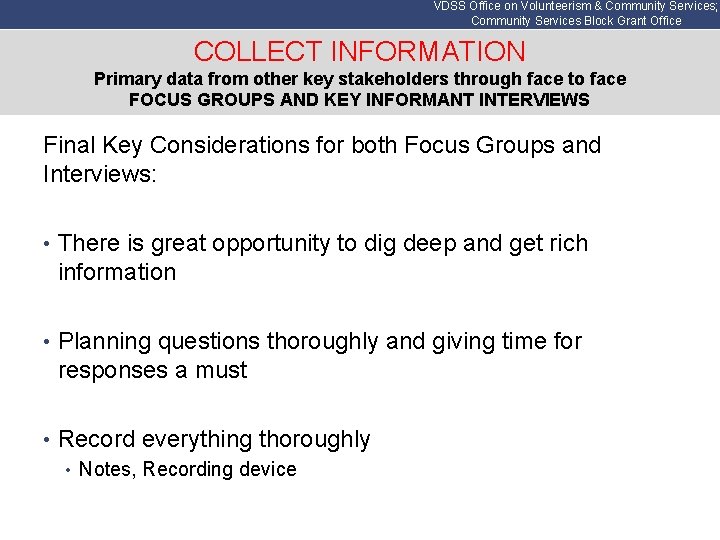
VDSS Office on Volunteerism & Community Services; Community Services Block Grant Office COLLECT INFORMATION Primary data from other key stakeholders through face to face FOCUS GROUPS AND KEY INFORMANT INTERVIEWS Final Key Considerations for both Focus Groups and Interviews: • There is great opportunity to dig deep and get rich information • Planning questions thoroughly and giving time for responses a must • Record everything thoroughly • Notes, Recording device
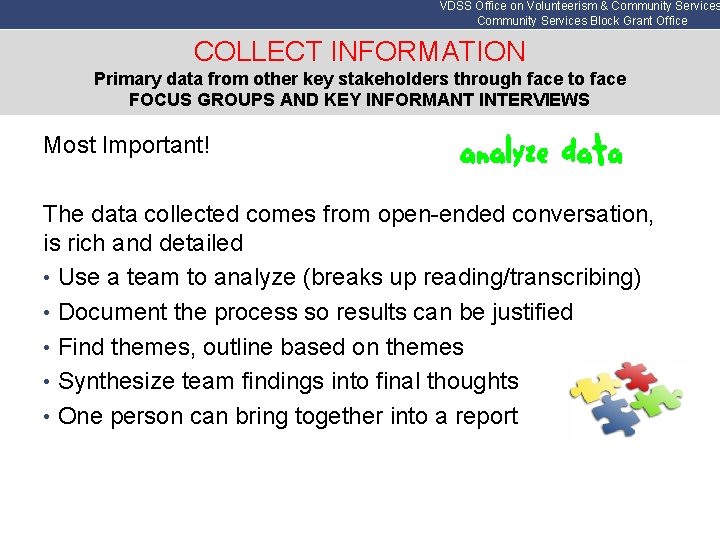
VDSS Office on Volunteerism & Community Services Block Grant Office COLLECT INFORMATION Primary data from other key stakeholders through face to face FOCUS GROUPS AND KEY INFORMANT INTERVIEWS Most Important! The data collected comes from open-ended conversation, is rich and detailed • Use a team to analyze (breaks up reading/transcribing) • Document the process so results can be justified • Find themes, outline based on themes • Synthesize team findings into final thoughts • One person can bring together into a report
COLLECT INFORMATION Primary data collection from key stakeholders through face to face
VDSS Office on Volunteerism & Community Services Block Grant Office COLLECT INFORMATION Collect secondary data to round out the picture For example: • A key informant tells you that a large new industry is coming that will employ 250 in manufacturing: VERIFY • Community members: “no buses to west-end businesses in the morning”. Key informant: “yes there are”. : GET THE FACTS • Community members: “rents have almost doubled in our locality in the past 3 years”: FACT or NOT? How much have rents increased?
ü ü COLLECT INFORMATION Secondary data for community profiles Primary data from lower income population through face-toface and survey Primary data from other key stakeholders through face-to-face Secondary data to flesh out stakeholder input
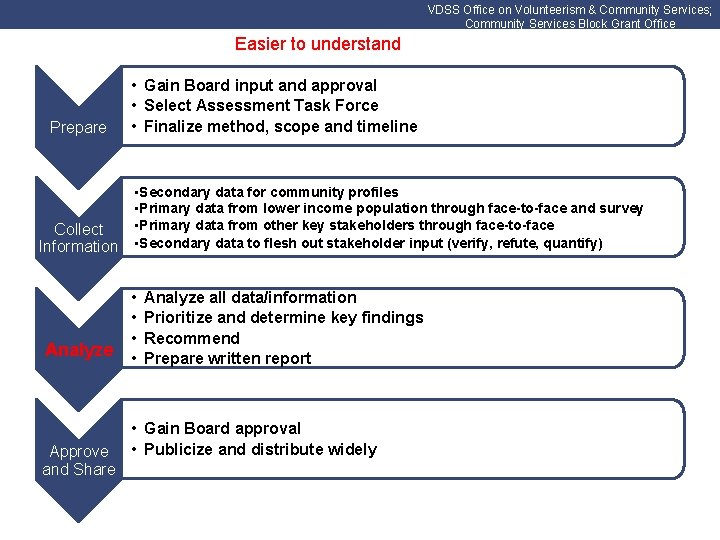
VDSS Office on Volunteerism & Community Services; Community Services Block Grant Office Easier to understand Prepare Collect Information Analyze Approve and Share • Gain Board input and approval • Select Assessment Task Force • Finalize method, scope and timeline • Secondary data for community profiles • Primary data from lower income population through face-to-face and survey • Primary data from other key stakeholders through face-to-face • Secondary data to flesh out stakeholder input (verify, refute, quantify) • • Analyze all data/information Prioritize and determine key findings Recommend Prepare written report • Gain Board approval • Publicize and distribute widely
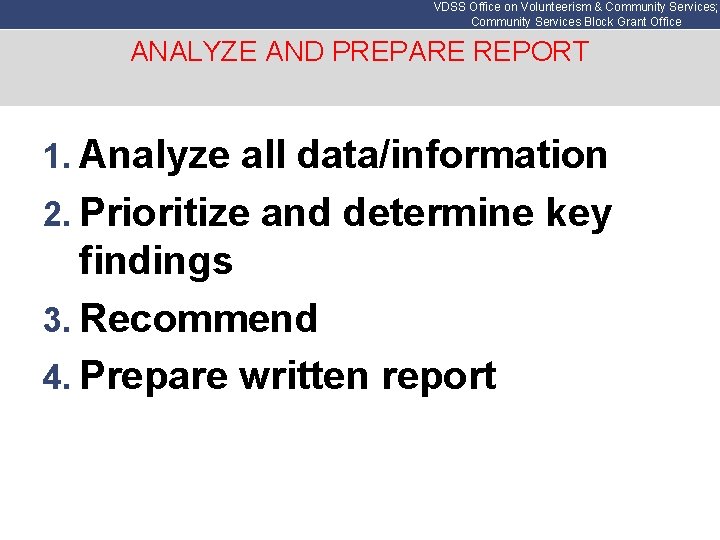
VDSS Office on Volunteerism & Community Services; Community Services Block Grant Office ANALYZE AND PREPARE REPORT 1. Analyze all data/information 2. Prioritize and determine key findings 3. Recommend 4. Prepare written report
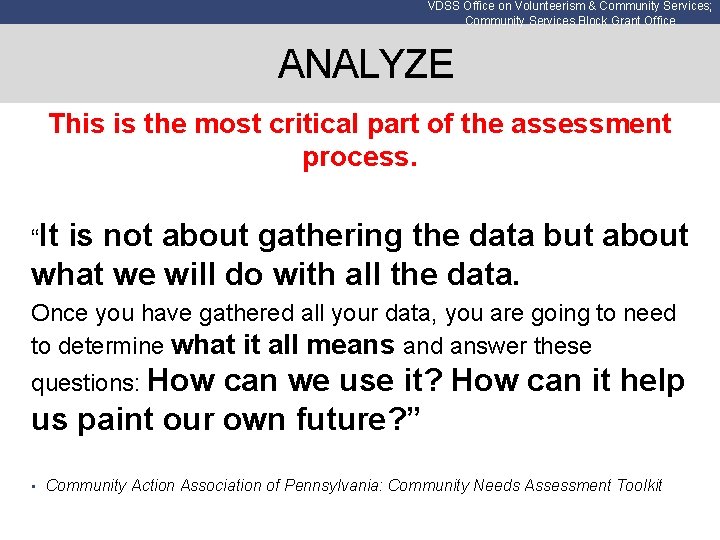
VDSS Office on Volunteerism & Community Services; Community Services Block Grant Office ANALYZE This is the most critical part of the assessment process. “It is not about gathering the data but about what we will do with all the data. Once you have gathered all your data, you are going to need to determine what it all means and answer these questions: How can we use it? How can it help us paint our own future? ” • Community Action Association of Pennsylvania: Community Needs Assessment Toolkit
VDSS Office on Volunteerism & Community Services; Community Services Block Grant Office ASSESSMENT MEANS ANALYSIS, NOT COMPILATION A CNA is not about presenting the data; it is about sharing the story of what the data is telling you. It is about letting your agency, Board of Directors, state and federal agencies, funders, decisionmakers, and the community-at-large get a picture of the needs and strengths of your community, while understanding the critical role your agency plays in it. CAAP Community Needs Assessment Toolkit
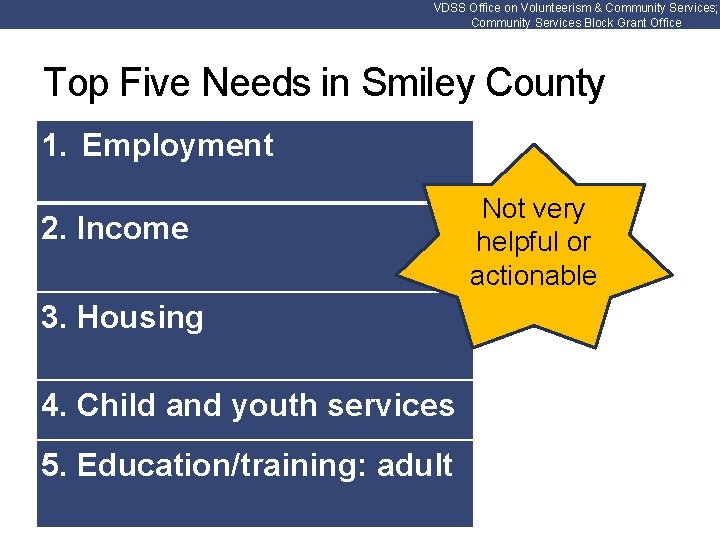
VDSS Office on Volunteerism & Community Services; Community Services Block Grant Office Top Five Needs in Smiley County 1. Employment 2. Income 3. Housing 4. Child and youth services 5. Education/training: adult Not very helpful or actionable
VDSS Office on Volunteerism & Community Services Block Grant Office While analyzing your qualitative data it is important that you continuously ask yourself the following types of questions: • What patterns and common themes emerge? • What story are they telling us? • Are they a root cause or symptom? • What are the deviations from these patterns? • What interesting stories emerge from the data? How can these stories help to shed light on the broader issues?
VDSS Office on Volunteerism & Community Services; Community Services Block Grant Office ANALYZE What to do with all the input? One way: organize your data by focus area • Find the common themes • Where does the secondary data align with your stakeholders’ input? • What issues rose to the top or were most frequently listed? What causes and conditions and solutions did you hear repeated?
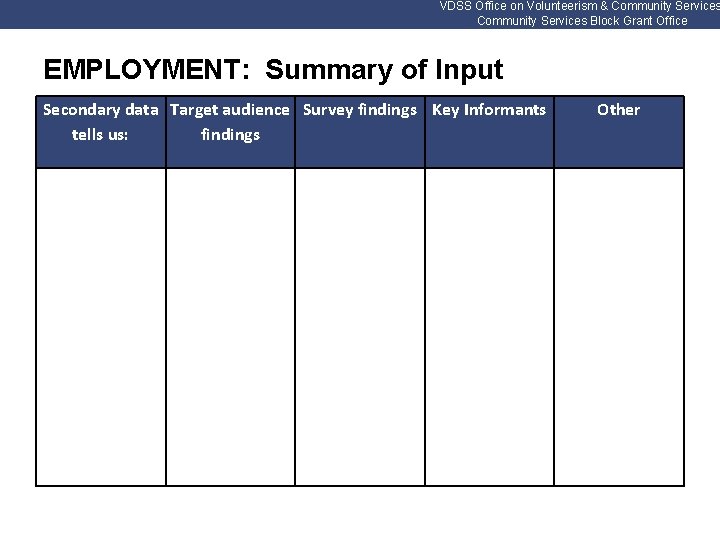
VDSS Office on Volunteerism & Community Services Block Grant Office EMPLOYMENT: Summary of Input Secondary data Target audience Survey findings Key Informants tells us: findings Other
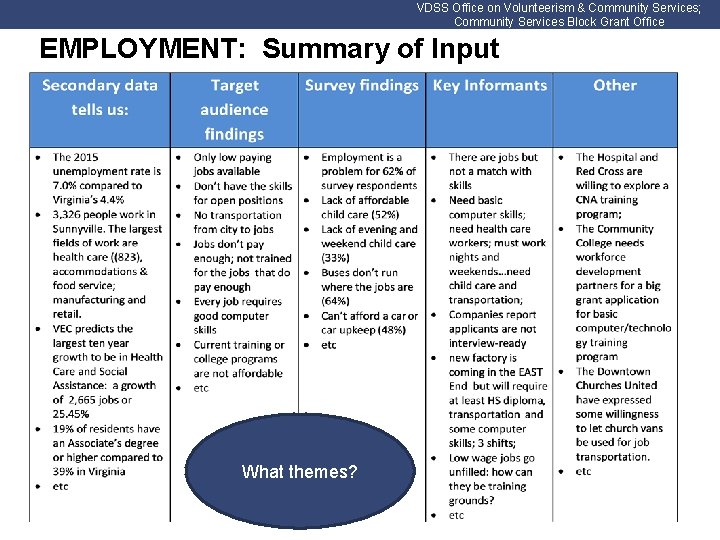
VDSS Office on Volunteerism & Community Services; Community Services Block Grant Office EMPLOYMENT: Summary of Input What themes?
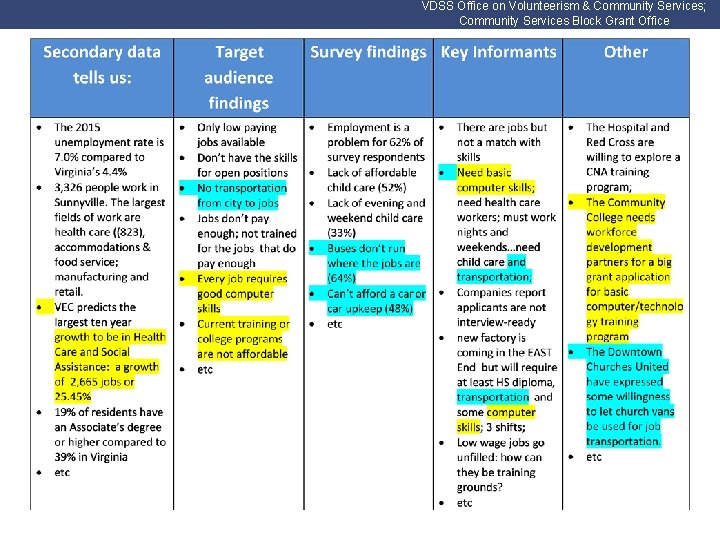
VDSS Office on Volunteerism & Community Services; Community Services Block Grant Office
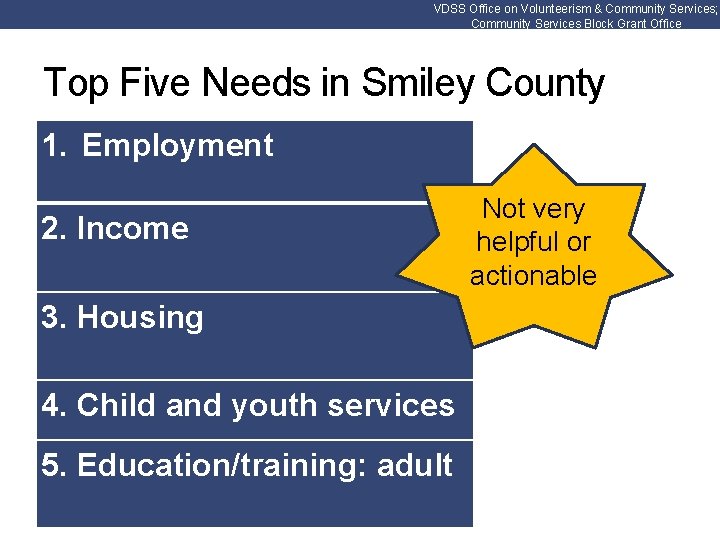
VDSS Office on Volunteerism & Community Services; Community Services Block Grant Office Top Five Needs in Smiley County 1. Employment 2. Income 3. Housing 4. Child and youth services 5. Education/training: adult Not very helpful or actionable
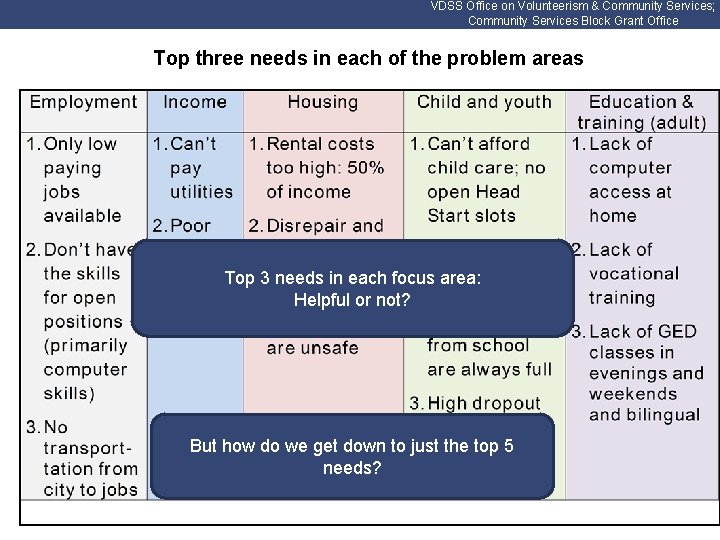
VDSS Office on Volunteerism & Community Services; Community Services Block Grant Office Top three needs in each of the problem areas Top 3 needs in each focus area: Helpful or not? But how do we get down to just the top 5 needs?
VDSS Office on Volunteerism & Community Services; Community Services Block Grant Office ANALYZE What is prioritization? Prioritization is a process whereby an individual or group places a number of items in rank order based on their perceived or measured importance or significance. (CDC)
VDSS Office on Volunteerism & Community Services; Community Services Block Grant Office Prioritizing: one method Grid Analysis or Decision Matrix When to use: Grid analysis is useful when you must or might have to defend your program decisions with ample evidence. It is a great process for when you have many different criteria. Limitations: Compared to the other techniques listed above, grid analysis takes more time and requires a more sophisticated and engaged audience with adequate time available to complete a detailed, thoughtful ranking process. http: //www. ohpe. ca/node/11169
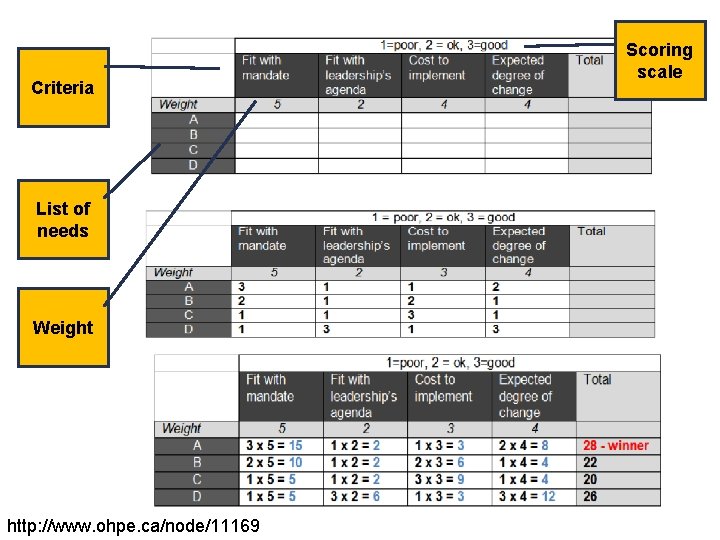
VDSS Office on Volunteerism & Community Services; Community Services Block Grant Office Criteria List of needs Weight http: //www. ohpe. ca/node/11169 Scoring scale
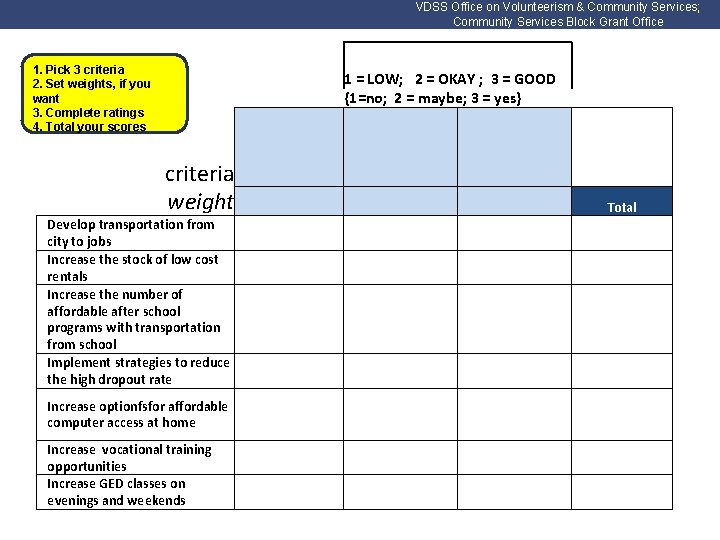
VDSS Office on Volunteerism & Community Services; Community Services Block Grant Office 1. Pick 3 criteria 2. Set weights, if you want 3. Complete ratings 4. Total your scores 1 = LOW; 2 = OKAY ; 3 = GOOD {1=no; 2 = maybe; 3 = yes} criteria weight Develop transportation from city to jobs Increase the stock of low cost rentals Increase the number of affordable after school programs with transportation from school Implement strategies to reduce the high dropout rate Increase optionfsfor affordable computer access at home Increase vocational training opportunities Increase GED classes on evenings and weekends Total
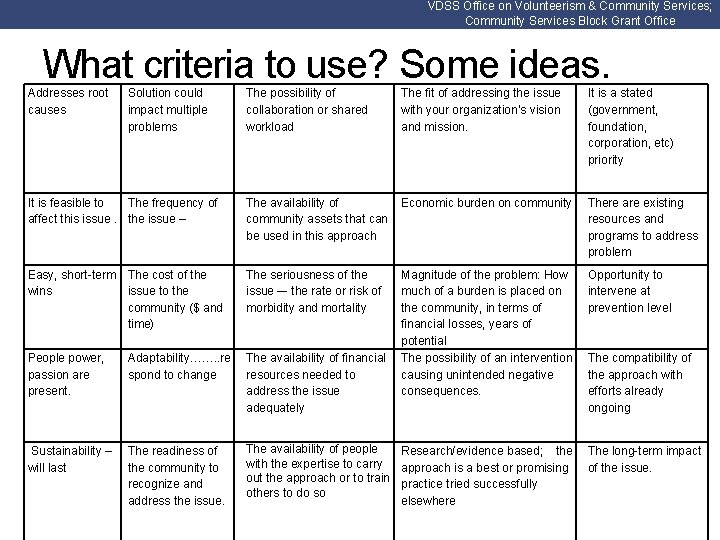
VDSS Office on Volunteerism & Community Services; Community Services Block Grant Office What criteria to use? Some ideas. Addresses root causes Solution could impact multiple problems It is feasible to The frequency of affect this issue. the issue – Easy, short-term The cost of the wins issue to the community ($ and time) People power, passion are present. Adaptability……. . re spond to change Sustainability – will last The readiness of the community to recognize and address the issue. The possibility of collaboration or shared workload The fit of addressing the issue with your organization’s vision and mission. It is a stated (government, foundation, corporation, etc) priority The availability of Economic burden on community There are existing community assets that can resources and be used in this approach programs to address problem The seriousness of the issue –- the rate or risk of morbidity and mortality Magnitude of the problem: How much of a burden is placed on the community, in terms of financial losses, years of potential The availability of financial The possibility of an intervention resources needed to causing unintended negative address the issue consequences. adequately Opportunity to intervene at prevention level The compatibility of the approach with efforts already ongoing The availability of people Research/evidence based; the The long-term impact with the expertise to carry approach is a best or promising of the issue. out the approach or to train practice tried successfully others to do so elsewhere
VDSS Office on Volunteerism & Community Services; Community Services Block Grant Office Group Exercise: Prioritizing needs
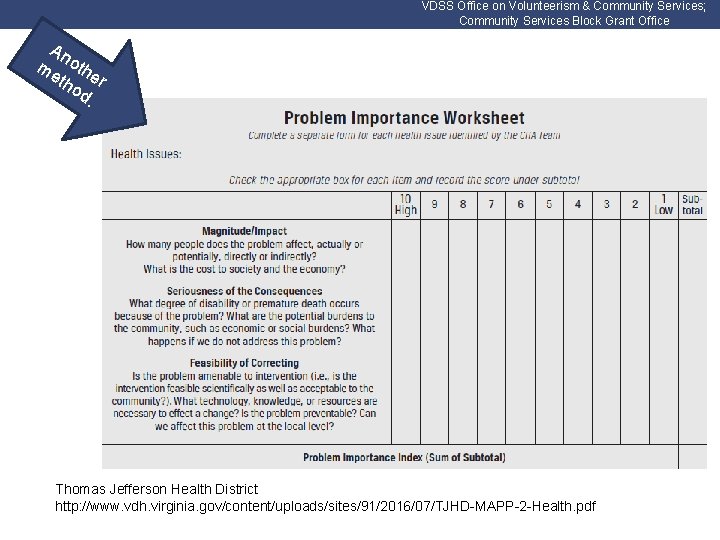
VDSS Office on Volunteerism & Community Services; Community Services Block Grant Office An me othe tho r d. Thomas Jefferson Health District http: //www. vdh. virginia. gov/content/uploads/sites/91/2016/07/TJHD-MAPP-2 -Health. pdf
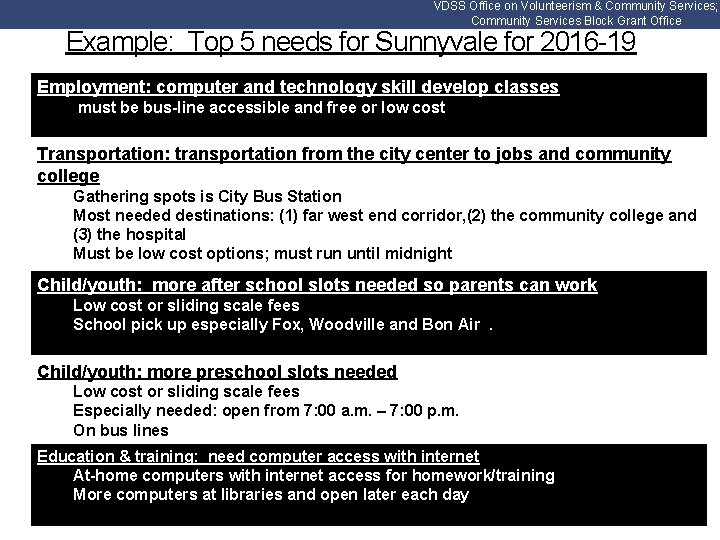
VDSS Office on Volunteerism & Community Services; Community Services Block Grant Office Example: Top 5 needs for Sunnyvale for 2016 -19 Employment: computer and technology skill develop classes must be bus-line accessible and free or low cost Transportation: transportation from the city center to jobs and community college Gathering spots is City Bus Station Most needed destinations: (1) far west end corridor, (2) the community college and (3) the hospital Must be low cost options; must run until midnight Child/youth: more after school slots needed so parents can work Low cost or sliding scale fees School pick up especially Fox, Woodville and Bon Air . Child/youth: more preschool slots needed Low cost or sliding scale fees Especially needed: open from 7: 00 a. m. – 7: 00 p. m. On bus lines Education & training: need computer access with internet At-home computers with internet access for homework/training More computers at libraries and open later each day
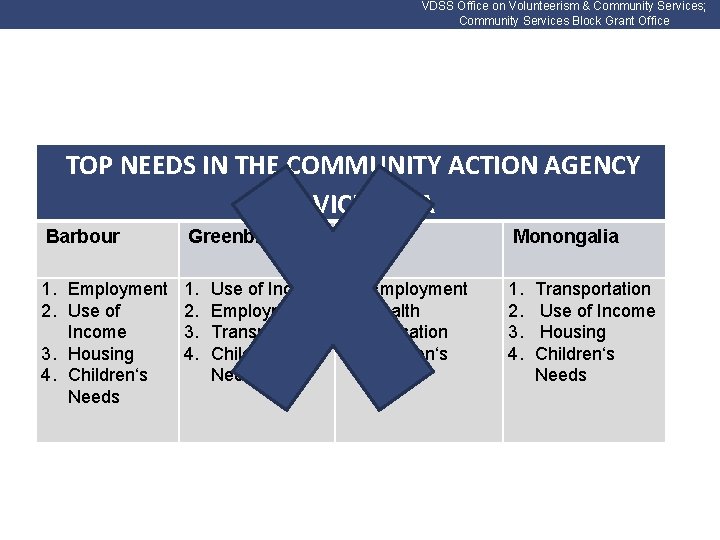
VDSS Office on Volunteerism & Community Services; Community Services Block Grant Office TOP NEEDS IN THE COMMUNITY ACTION AGENCY SERVICE AREA Barbour 1. Employment 2. Use of Income 3. Housing 4. Children‘s Needs Greenbrier 1. Use of Income 2. Employment 3. Transportation 4. Children‘s Marion 1. Employment 2. Health 3. Education 4. Children‘s Needs Monongalia 1. Transportation 2. Use of Income 3. Housing 4. Children‘s Needs
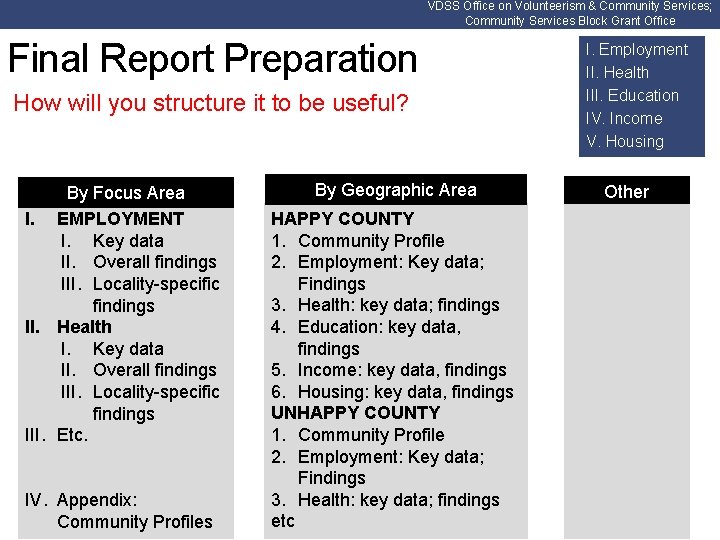
VDSS Office on Volunteerism & Community Services; Community Services Block Grant Office Final Report Preparation How will you structure it to be useful? By Focus Area I. EMPLOYMENT I. Key data II. Overall findings III. Locality-specific findings II. Health I. Key data II. Overall findings III. Locality-specific findings III. Etc. IV. Appendix: Community Profiles By Geographic Area HAPPY COUNTY 1. Community Profile 2. Employment: Key data; Findings 3. Health: key data; findings 4. Education: key data, findings 5. Income: key data, findings 6. Housing: key data, findings UNHAPPY COUNTY 1. Community Profile 2. Employment: Key data; Findings 3. Health: key data; findings etc I. Employment II. Health III. Education IV. Income V. Housing Other
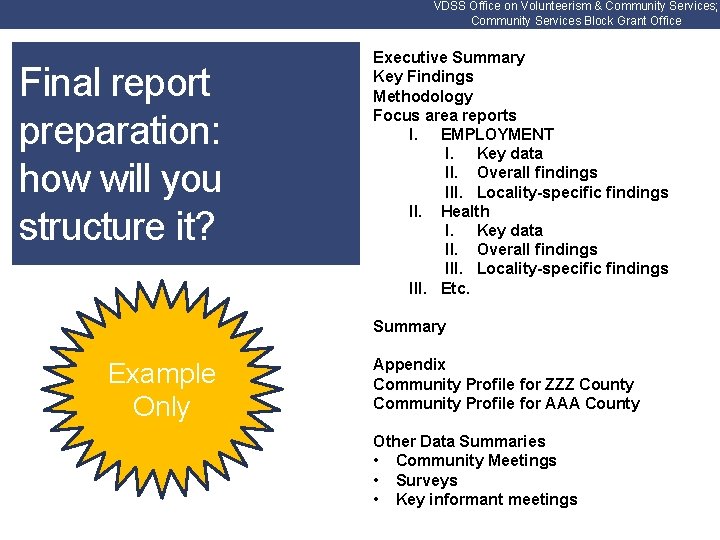
VDSS Office on Volunteerism & Community Services; Community Services Block Grant Office Final report preparation: how will you structure it? Executive Summary Key Findings Methodology Focus area reports I. EMPLOYMENT I. Key data II. Overall findings III. Locality-specific findings II. Health I. Key data II. Overall findings III. Locality-specific findings III. Etc. Summary Example Only Appendix Community Profile for ZZZ County Community Profile for AAA County Other Data Summaries • Community Meetings • Surveys • Key informant meetings
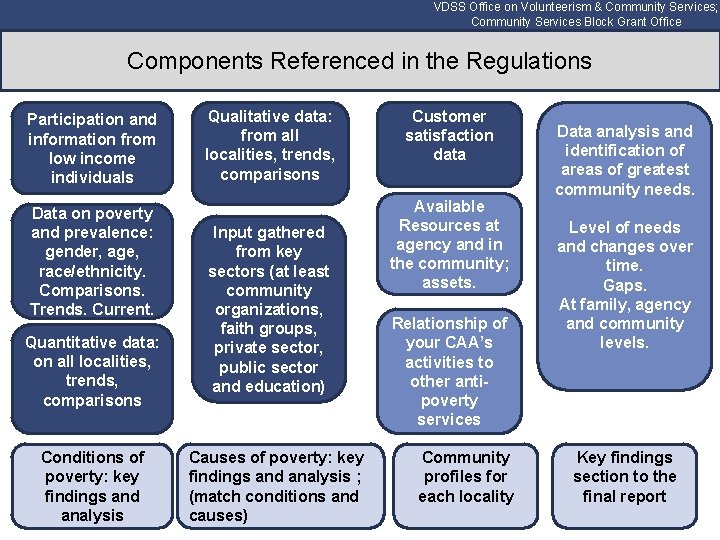
VDSS Office on Volunteerism & Community Services; Community Services Block Grant Office Components Referenced in the Regulations Participation and information from low income individuals Data on poverty and prevalence: gender, age, race/ethnicity. Comparisons. Trends. Current. Quantitative data: on all localities, trends, comparisons Conditions of poverty: key findings and analysis Qualitative data: from all localities, trends, comparisons Input gathered from key sectors (at least community organizations, faith groups, private sector, public sector and education) Causes of poverty: key findings and analysis ; (match conditions and causes) Customer satisfaction data Available Resources at agency and in the community; assets. Relationship of your CAA’s activities to other antipoverty services Community profiles for each locality Data analysis and identification of areas of greatest community needs. Level of needs and changes over time. Gaps. At family, agency and community levels. Key findings section to the final report
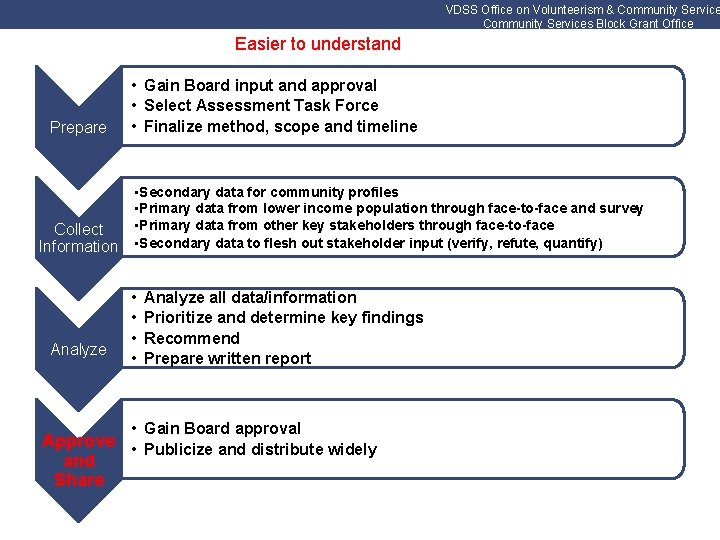
VDSS Office on Volunteerism & Community Services Block Grant Office Easier to understand Prepare Collect Information Analyze • Gain Board input and approval • Select Assessment Task Force • Finalize method, scope and timeline • Secondary data for community profiles • Primary data from lower income population through face-to-face and survey • Primary data from other key stakeholders through face-to-face • Secondary data to flesh out stakeholder input (verify, refute, quantify) • • Analyze all data/information Prioritize and determine key findings Recommend Prepare written report • Gain Board approval Approve • Publicize and distribute widely and Share
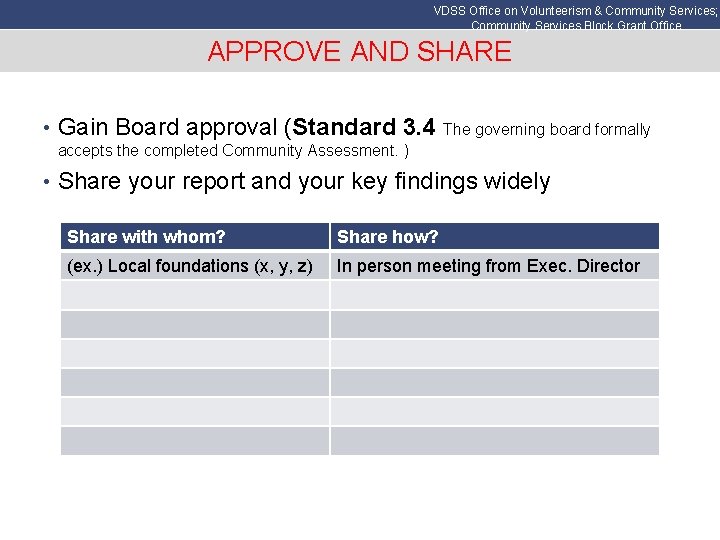
VDSS Office on Volunteerism & Community Services; Community Services Block Grant Office APPROVE AND SHARE • Gain Board approval (Standard 3. 4 The governing board formally accepts the completed Community Assessment. ) • Share your report and your key findings widely Share with whom? Share how? (ex. ) Local foundations (x, y, z) In person meeting from Exec. Director


This training curriculum and supporting materials were developed by the: Office on Volunteerism & Community Services Block Grant Office Virginia Department of Social Services 801 East Main Street Richmond, VA 23219 For information please contact: csbg@dss. virginia. gov Permission is granted to copy, distribute and use these materials for non-commercial purposes with proper attribution.
- Slides: 127