
CS255 PROGRAMMING LANGUAGES HARISH TIWARI SCHOOL OF ENGINEERING
- Slides: 13
CS-255 PROGRAMMING LANGUAGES HARISH TIWARI, SCHOOL OF ENGINEERING, SIR PADAMPAT SINGHANIA UNIVERSITY, UDAIPUR
UNIT 1 - Introduction to Programming language Programming Domains, Influences on Language Design. Language Categories. Language Design Trade-Offs. Implementation Methods. Programming Environments. Harish Tiwari, SPSU, Udaipur
Programming Domains Computers have been applied to a variety of different areas, from controlling nuclear power plants to providing video games in mobile phones. Because of this great diversity in computer use, programming languages with very different goals have been developed. In this section, we briefly discuss a few of the areas of computer applications and their associated languages. � Scientific Applications. � Business Applications. � Artificial Intelligence. � Systems Programming. � Web Software. Harish Tiwari, SPSU, Udaipur
Programming Domains Scientific Applications. � The first digital computers, which appeared in the late 1940 s and early 1950 s, were invented and used for scientific applications. � the scientific applications of that time used relatively simple data structures, but required large numbers of floating-point arithmetic computations. � The most common data structures were arrays and matrices. � the most common control structures were counting loops and selections. � The first language for scientific applications was Fortran. (FORmula TRANslation). � For some scientific applications where efficiency is the primary concern, no subsequent language is significantly better than Fortran. Harish Tiwari, SPSU, Udaipur
Programming Domains Business Applications. � The use of computers for business applications began in the 1950 s. � Special computers were developed for this purpose, along with special languages. � The first successful high-level language for business was COBOL, initial version of which appeared in 1960. � Business languages are characterized by facilities for producing elaborate reports, precise ways of describing and storing decimal numbers and character data, and the ability to specify decimal arithmetic operations. Harish Tiwari, SPSU, Udaipur
Programming Domains Artificial Intelligence(AI). Artificial intelligence (AI) applications are characterized by the use of symbolic rather than numeric computations. � Symbolic computation means that symbols, consisting of names rather than numbers, are manipulated. � Symbolic computation is done with linked lists of data rather than arrays. � The first programming language developed for AI applications was the functional language LISP (LISt Processing), which appeared in 1959. � During the early 1970 s, an alternative approach appeared —logic programming using the Prolog language. � More recently, some AI applications have been written in systems languages such as C. � Harish Tiwari, SPSU, Udaipur
Programming Domains Systems Programming. The operating system and the programming support tools of a computer system are collectively known as its systems software. Systems software is used almost continuously and so it must be efficient. In the 1960 -70 s, computer manufacturers, developed special machine-oriented high-level languages for systems software on their machines. � IBM mainframe computers, the language was PL/S. � for Digital, it was BLISS, a language at a level just above assembly language; � for Burroughs, it was Extended ALGOL. The UNIX operating system is written almost entirely in C. � Some of the characteristics of C make it a good choice for systems programming. Harish Tiwari, SPSU, Udaipur It is low level,
Programming Domains. Web Software. The World Wide Web is supported by a collection of languages, ranging from markup languages, such as HTML(which is not a programming language) to general-purpose programming languages, such as Java. for dynamic Web content, some computation capability is included in the content presentation. This functionality can be provided by embedding programming code in an HTML document. Such code is often in the form of a scripting language. Example- Java. Script or PHP. Harish Tiwari, SPSU, Udaipur
Influences on Language Design. There are several factors that influence the basic design of programming languages including following Computer Architecture. Programming Design Methodologies. Harish Tiwari, SPSU, Udaipur
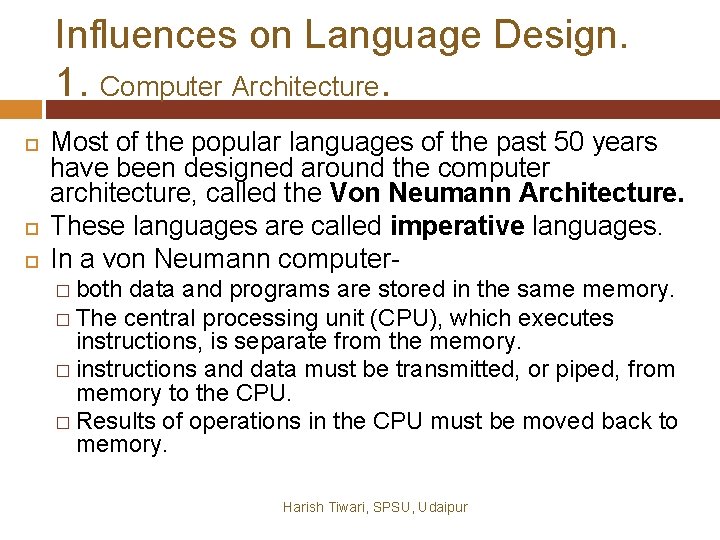
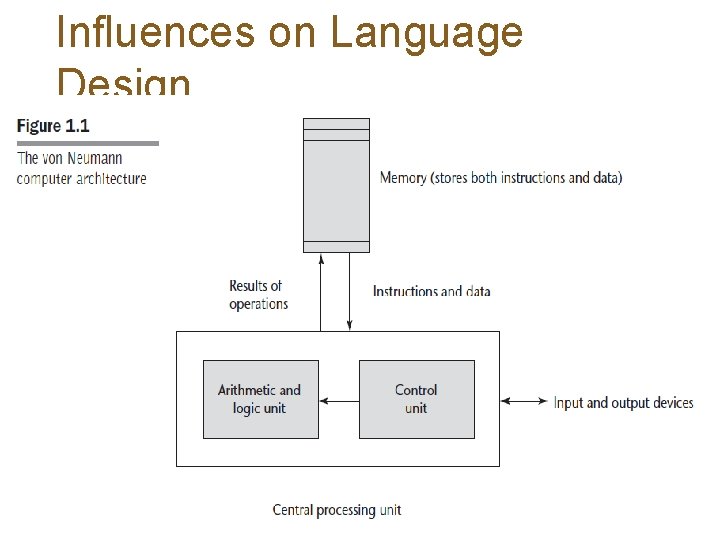
Influences on Language Design. 1. Computer Architecture. Most of the popular languages of the past 50 years have been designed around the computer architecture, called the Von Neumann Architecture. These languages are called imperative languages. In a von Neumann computer� both data and programs are stored in the same memory. � The central processing unit (CPU), which executes instructions, is separate from the memory. � instructions and data must be transmitted, or piped, from memory to the CPU. � Results of operations in the CPU must be moved back to memory. Harish Tiwari, SPSU, Udaipur
Influences on Language Design. Harish Tiwari, SPSU, Udaipur
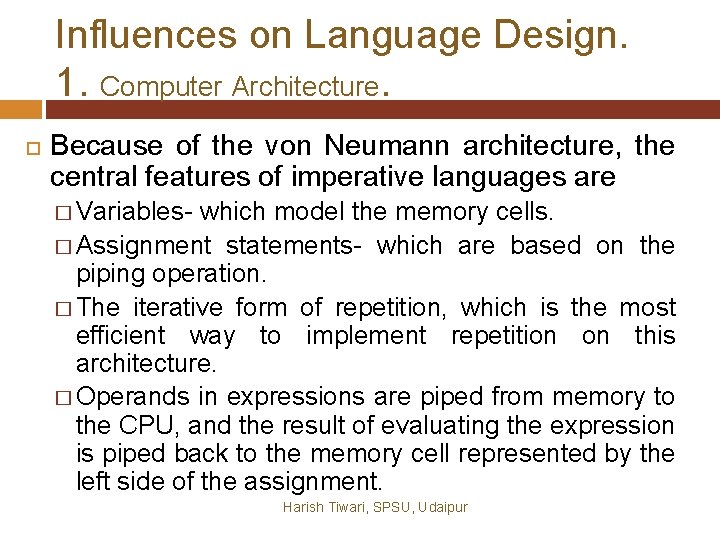
Influences on Language Design. 1. Computer Architecture. Because of the von Neumann architecture, the central features of imperative languages are � Variables- which model the memory cells. � Assignment statements- which are based on the piping operation. � The iterative form of repetition, which is the most efficient way to implement repetition on this architecture. � Operands in expressions are piped from memory to the CPU, and the result of evaluating the expression is piped back to the memory cell represented by the left side of the assignment. Harish Tiwari, SPSU, Udaipur
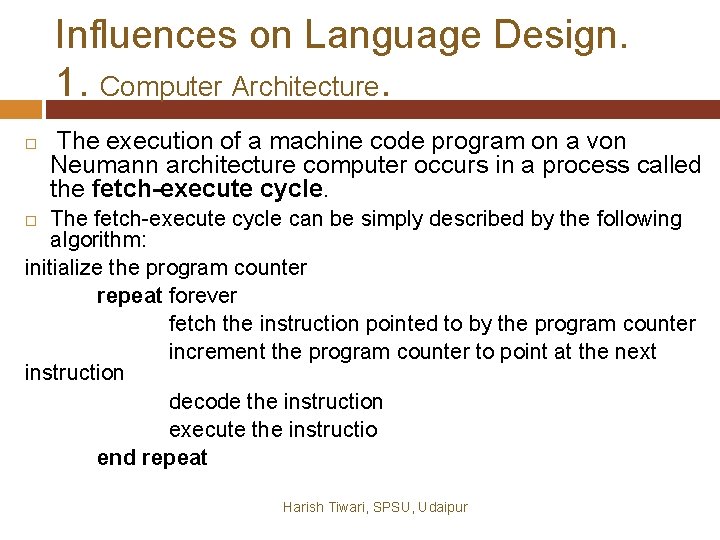
Influences on Language Design. 1. Computer Architecture. The execution of a machine code program on a von Neumann architecture computer occurs in a process called the fetch-execute cycle. The fetch-execute cycle can be simply described by the following algorithm: initialize the program counter repeat forever fetch the instruction pointed to by the program counter increment the program counter to point at the next instruction decode the instruction execute the instructio end repeat Harish Tiwari, SPSU, Udaipur