
CS212 Distributed Database Systems Distributed Database Design Part
CS-212 Distributed Database Systems Distributed Database Design (Part 2: Fragmenations) Instructor: Ms. Mariam Nosheen
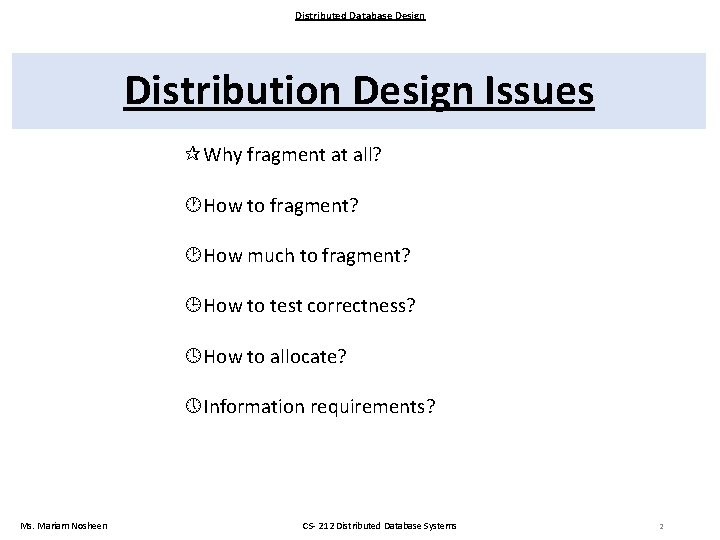
Distributed Database Design Distribution Design Issues Why fragment at all? How to fragment? How much to fragment? How to test correctness? How to allocate? Information requirements? Ms. Mariam Nosheen CS- 212 Distributed Database Systems 2

Distributed Database Design Fragmentation • Can't we just distribute relations? • What is a reasonable unit of distribution? • relation • views are subsets of relations �� locality • extra communication • fragments of relations (sub-relations) • concurrent execution of a number of transactions that access different portions of a relation • views that cannot be defined on a single fragment will require extra processing • semantic data control (especially integrity enforcement) more difficult Ms. Mariam Nosheen CS- 212 Distributed Database Systems 3
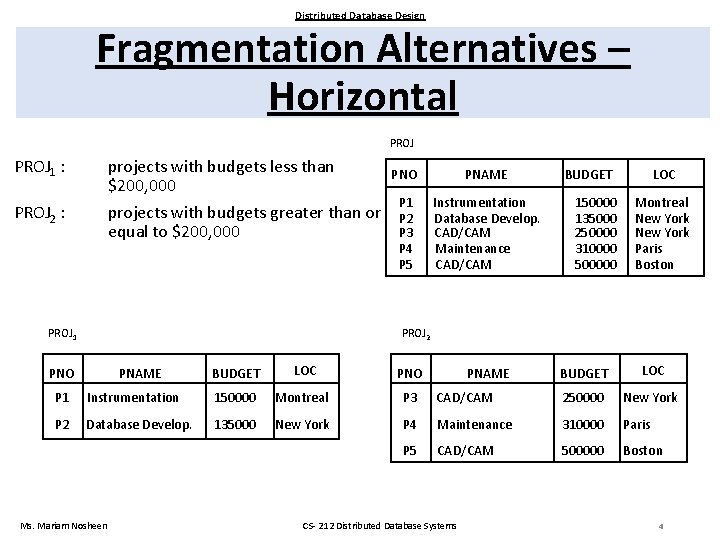
Distributed Database Design Fragmentation Alternatives – Horizontal PROJ 1 : projects with budgets less than $200, 000 projects with budgets greater than or equal to $200, 000 PROJ 2 : PROJ 1 PNO PNAME P 1 P 2 P 3 P 4 P 5 Instrumentation Database Develop. CAD/CAM Maintenance CAD/CAM BUDGET 150000 135000 250000 310000 500000 LOC Montreal New York Paris Boston PROJ 2 PNO PNAME BUDGET LOC P 1 Instrumentation 150000 Montreal P 3 CAD/CAM 250000 New York P 2 Database Develop. 135000 New York P 4 Maintenance 310000 Paris P 5 CAD/CAM 500000 Boston Ms. Mariam Nosheen CS- 212 Distributed Database Systems 4
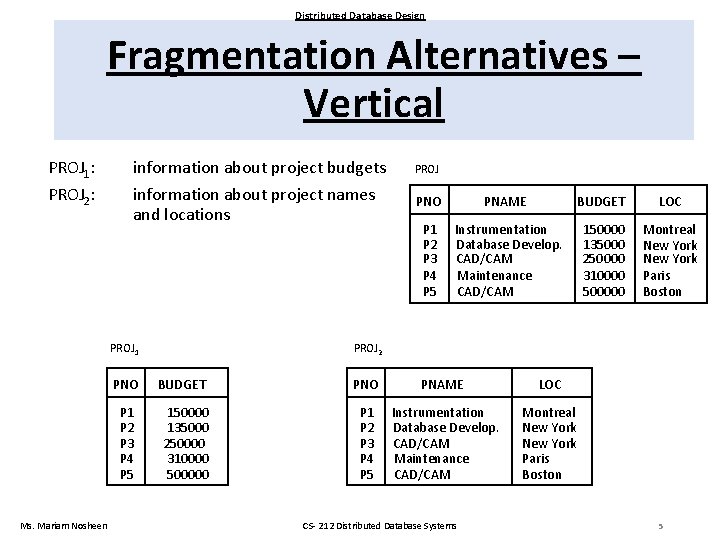
Distributed Database Design Fragmentation Alternatives – Vertical PROJ 1: PROJ 2: information about project budgets information about project names and locations PROJ 1 Ms. Mariam Nosheen PROJ PNO PNAME BUDGET LOC P 1 P 2 P 3 P 4 P 5 Instrumentation Database Develop. CAD/CAM Maintenance CAD/CAM 150000 135000 250000 310000 500000 Montreal New York Paris Boston PROJ 2 PNO BUDGET PNO PNAME LOC P 1 P 2 P 3 P 4 P 5 150000 135000 250000 310000 500000 P 1 P 2 P 3 P 4 P 5 Instrumentation Database Develop. CAD/CAM Maintenance CAD/CAM Montreal New York Paris Boston CS- 212 Distributed Database Systems 5
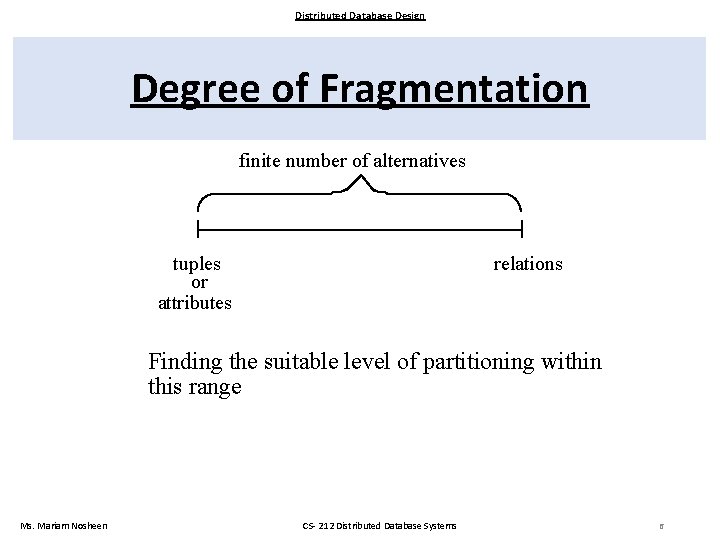
Distributed Database Design Degree of Fragmentation finite number of alternatives tuples or attributes relations Finding the suitable level of partitioning within this range Ms. Mariam Nosheen CS- 212 Distributed Database Systems 6
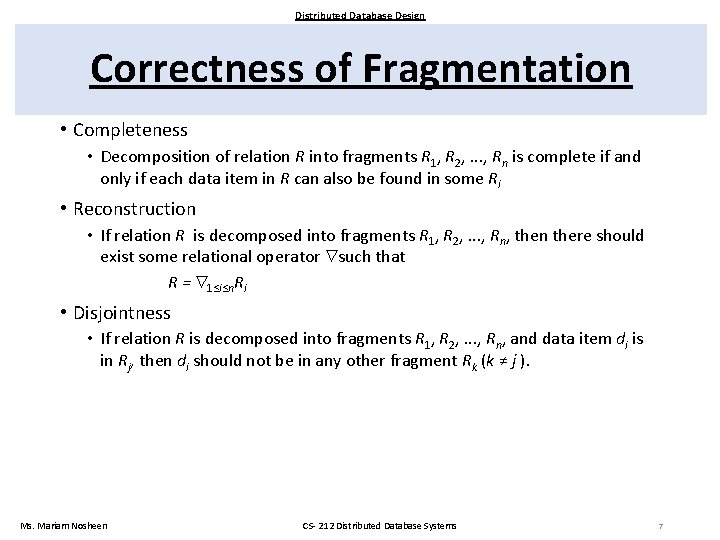
Distributed Database Design Correctness of Fragmentation • Completeness • Decomposition of relation R into fragments R 1, R 2, . . . , Rn is complete if and only if each data item in R can also be found in some Ri • Reconstruction • If relation R is decomposed into fragments R 1, R 2, . . . , Rn, then there should exist some relational operator such that R = 1≤i≤n. Ri • Disjointness • If relation R is decomposed into fragments R 1, R 2, . . . , Rn, and data item di is in Rj, then di should not be in any other fragment Rk (k ≠ j ). Ms. Mariam Nosheen CS- 212 Distributed Database Systems 7
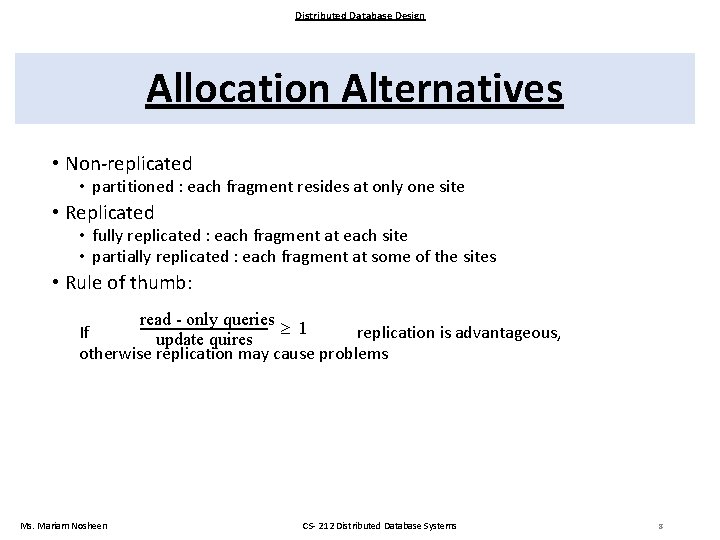
Distributed Database Design Allocation Alternatives • Non-replicated • partitioned : each fragment resides at only one site • Replicated • fully replicated : each fragment at each site • partially replicated : each fragment at some of the sites • Rule of thumb: read - only queries 1 If replication is advantageous, update quires otherwise replication may cause problems Ms. Mariam Nosheen CS- 212 Distributed Database Systems 8
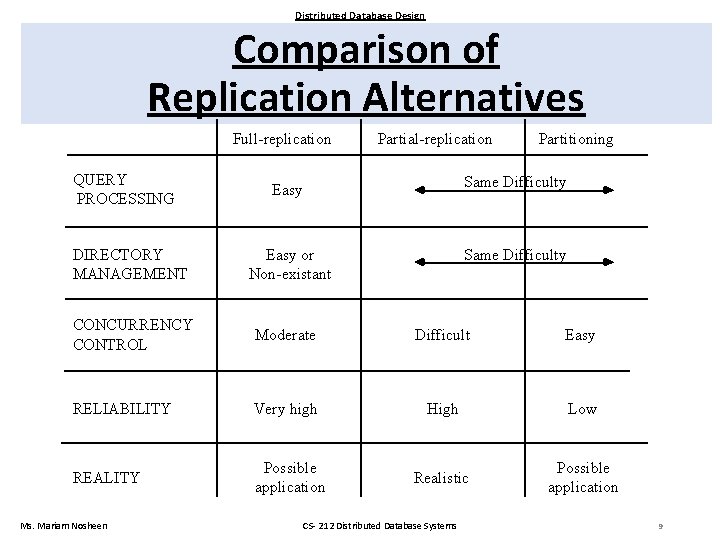
Distributed Database Design Comparison of Replication Alternatives Full-replication QUERY PROCESSING Partial-replication Partitioning Easy Same Difficulty DIRECTORY MANAGEMENT Easy or Non-existant Same Difficulty CONCURRENCY CONTROL Moderate Difficult Easy RELIABILITY Very high High Low REALITY Possible application Realistic Possible application Ms. Mariam Nosheen CS- 212 Distributed Database Systems 9
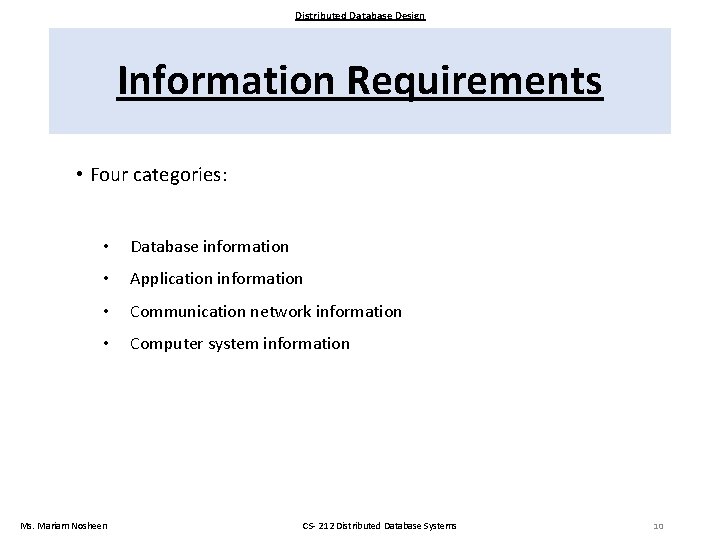
Distributed Database Design Information Requirements • Four categories: • Database information • Application information • Communication network information • Computer system information Ms. Mariam Nosheen CS- 212 Distributed Database Systems 10
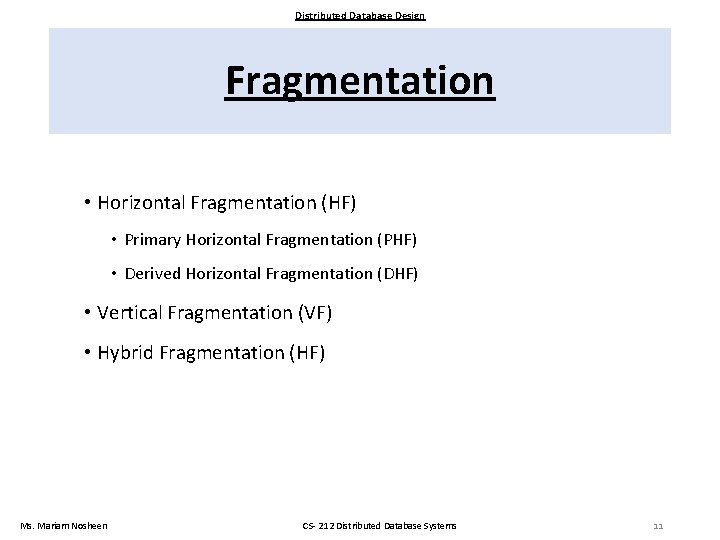
Distributed Database Design Fragmentation • Horizontal Fragmentation (HF) • Primary Horizontal Fragmentation (PHF) • Derived Horizontal Fragmentation (DHF) • Vertical Fragmentation (VF) • Hybrid Fragmentation (HF) Ms. Mariam Nosheen CS- 212 Distributed Database Systems 11
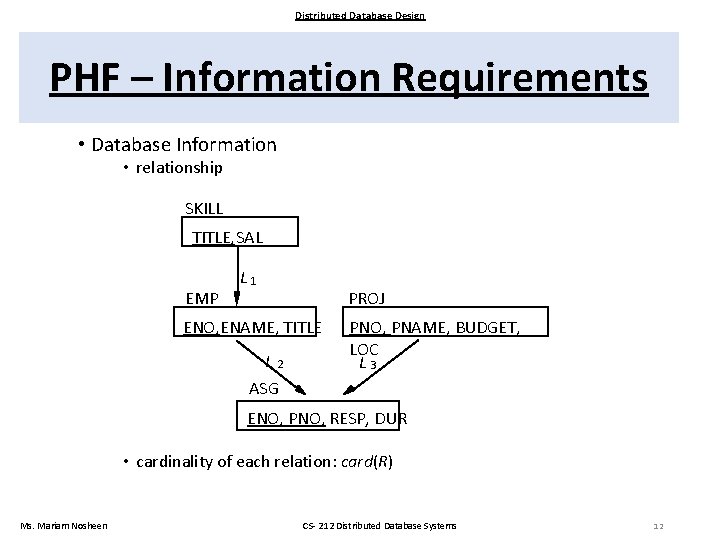
Distributed Database Design PHF – Information Requirements • Database Information • relationship SKILL TITLE, SAL EMP L 1 PROJ ENO, ENAME, TITLE L 2 ASG PNO, PNAME, BUDGET, LOC L 3 ENO, PNO, RESP, DUR • cardinality of each relation: card(R) Ms. Mariam Nosheen CS- 212 Distributed Database Systems 12
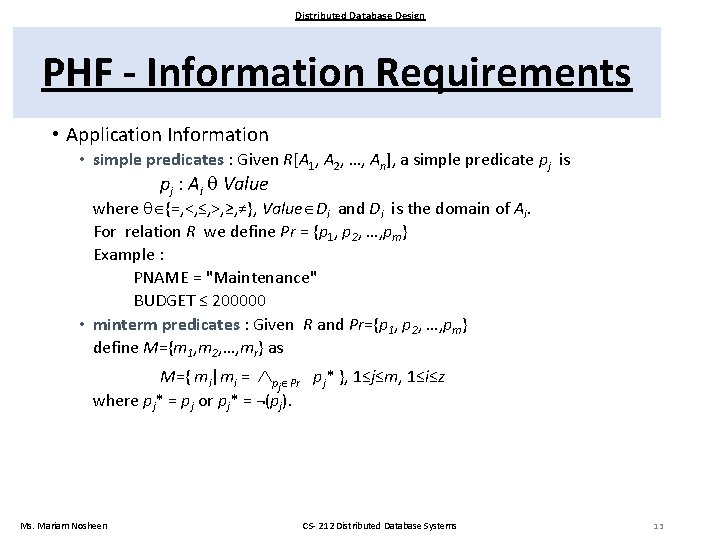
Distributed Database Design PHF - Information Requirements • Application Information • simple predicates : Given R[A 1, A 2, …, An], a simple predicate pj is pj : Ai Value where {=, <, ≤, >, ≥, ≠}, Value Di and Di is the domain of Ai. For relation R we define Pr = {p 1, p 2, …, pm} Example : PNAME = "Maintenance" BUDGET ≤ 200000 • minterm predicates : Given R and Pr={p 1, p 2, …, pm} define M={m 1, m 2, …, mr} as M={ mi|mi = pj Pr pj* }, 1≤j≤m, 1≤i≤z where pj* = pj or pj* = ¬(pj). Ms. Mariam Nosheen CS- 212 Distributed Database Systems 13
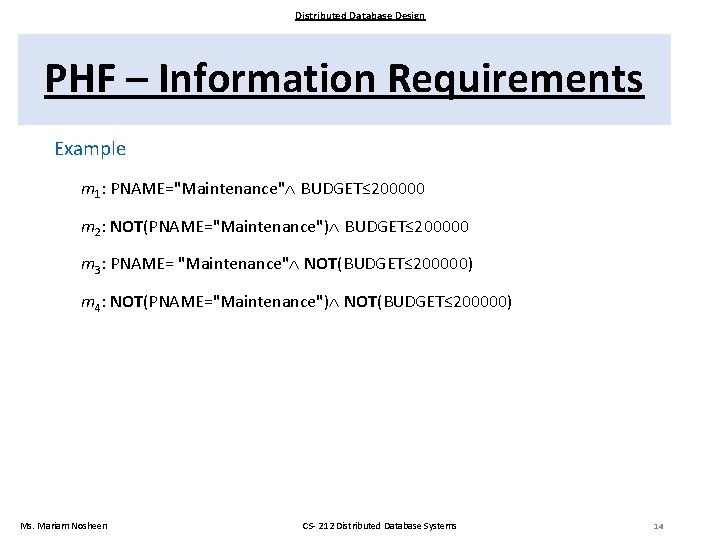
Distributed Database Design PHF – Information Requirements Example m 1: PNAME="Maintenance" BUDGET≤ 200000 m 2: NOT(PNAME="Maintenance") BUDGET≤ 200000 m 3: PNAME= "Maintenance" NOT(BUDGET≤ 200000) m 4: NOT(PNAME="Maintenance") NOT(BUDGET≤ 200000) Ms. Mariam Nosheen CS- 212 Distributed Database Systems 14
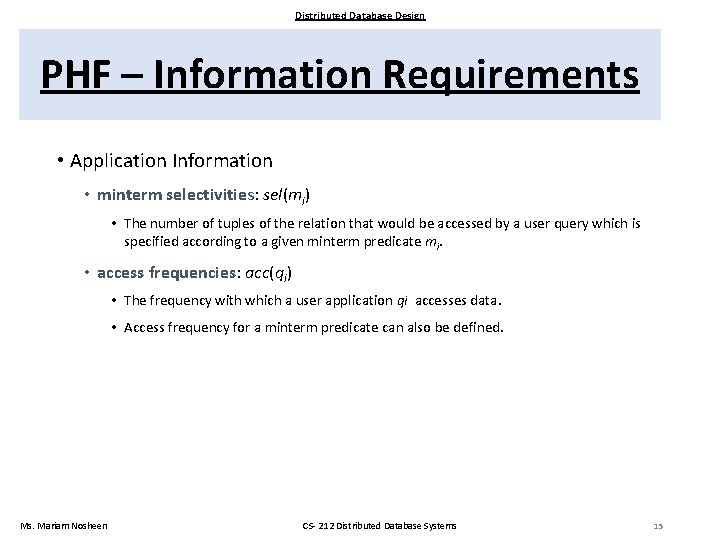
Distributed Database Design PHF – Information Requirements • Application Information • minterm selectivities: sel(mi) • The number of tuples of the relation that would be accessed by a user query which is specified according to a given minterm predicate mi. • access frequencies: acc(qi) • The frequency with which a user application qi accesses data. • Access frequency for a minterm predicate can also be defined. Ms. Mariam Nosheen CS- 212 Distributed Database Systems 15
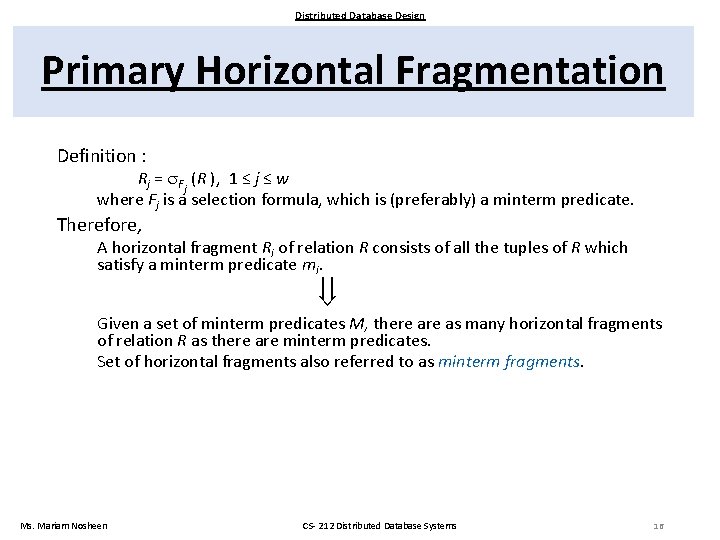
Distributed Database Design Primary Horizontal Fragmentation Definition : Rj = Fj (R ), 1 ≤ j ≤ w where Fj is a selection formula, which is (preferably) a minterm predicate. Therefore, A horizontal fragment Ri of relation R consists of all the tuples of R which satisfy a minterm predicate mi. Given a set of minterm predicates M, there as many horizontal fragments of relation R as there are minterm predicates. Set of horizontal fragments also referred to as minterm fragments. Ms. Mariam Nosheen CS- 212 Distributed Database Systems 16
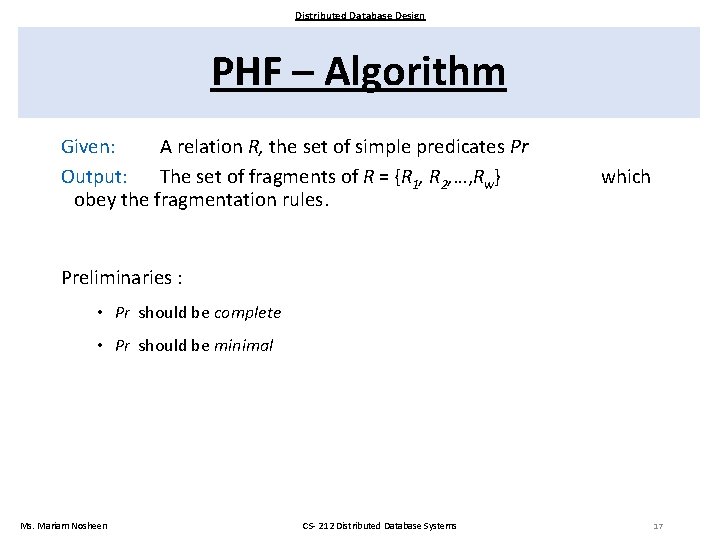
Distributed Database Design PHF – Algorithm Given: A relation R, the set of simple predicates Pr Output: The set of fragments of R = {R 1, R 2, …, Rw} obey the fragmentation rules. which Preliminaries : • Pr should be complete • Pr should be minimal Ms. Mariam Nosheen CS- 212 Distributed Database Systems 17
Distributed Database Design Completeness of Simple Predicates • A set of simple predicates Pr is said to be complete if and only if the accesses to the tuples of the minterm fragments defined on Pr requires that two tuples of the same minterm fragment have the same probability of being accessed by any application. • Example : • Assume PROJ[PNO, PNAME, BUDGET, LOC] has two applications defined on it. • Find the budgets of projects at each location. (1) • Find projects with budgets less than $200000. (2) Ms. Mariam Nosheen CS- 212 Distributed Database Systems 18
Distributed Database Design Completeness of Simple Predicates According to (1), Pr={LOC=“Montreal”, LOC=“New York”, LOC=“Paris”} which is not complete with respect to (2). Modify Pr ={LOC=“Montreal”, LOC=“New York”, LOC=“Paris”, BUDGET≤ 200000, BUDGET>200000} which is complete. Ms. Mariam Nosheen CS- 212 Distributed Database Systems 19
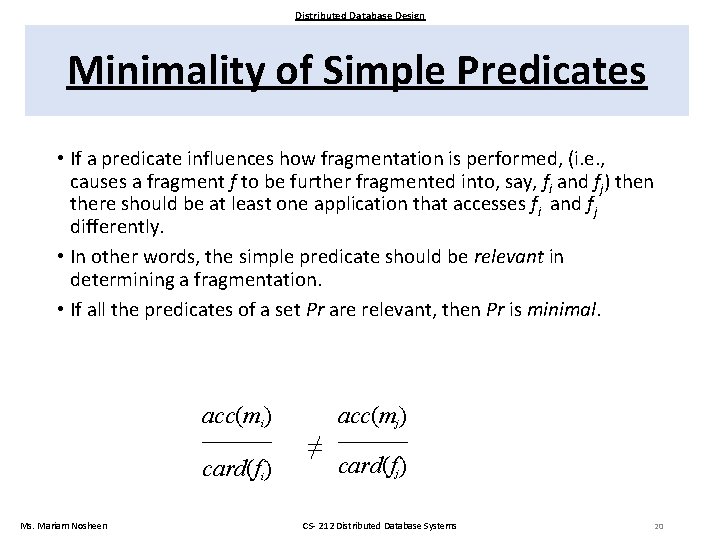
Distributed Database Design Minimality of Simple Predicates • If a predicate influences how fragmentation is performed, (i. e. , causes a fragment f to be further fragmented into, say, fi and fj) then there should be at least one application that accesses fi and fj differently. • In other words, the simple predicate should be relevant in determining a fragmentation. • If all the predicates of a set Pr are relevant, then Pr is minimal. acc(mi) ––––– card(fi) Ms. Mariam Nosheen acc(mj) ≠ ––––– card(fj) CS- 212 Distributed Database Systems 20
Distributed Database Design Minimality of Simple Predicates Example : Pr ={LOC=“Montreal”, LOC=“New York”, LOC=“Paris”, BUDGET≤ 200000, BUDGET>200000} is minimal (in addition to being complete). However, if we add PNAME = “Instrumentation” then Pr is not minimal. Ms. Mariam Nosheen CS- 212 Distributed Database Systems 21
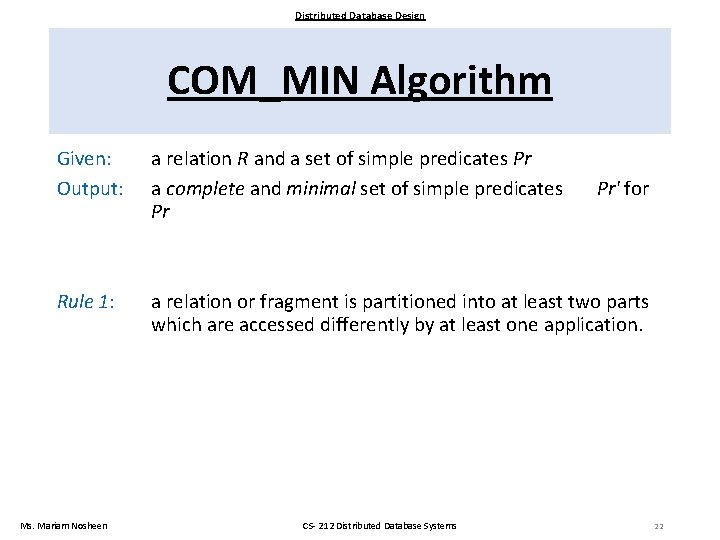
Distributed Database Design COM_MIN Algorithm Given: Output: a relation R and a set of simple predicates Pr a complete and minimal set of simple predicates Pr Rule 1: a relation or fragment is partitioned into at least two parts which are accessed differently by at least one application. Ms. Mariam Nosheen CS- 212 Distributed Database Systems Pr' for 22
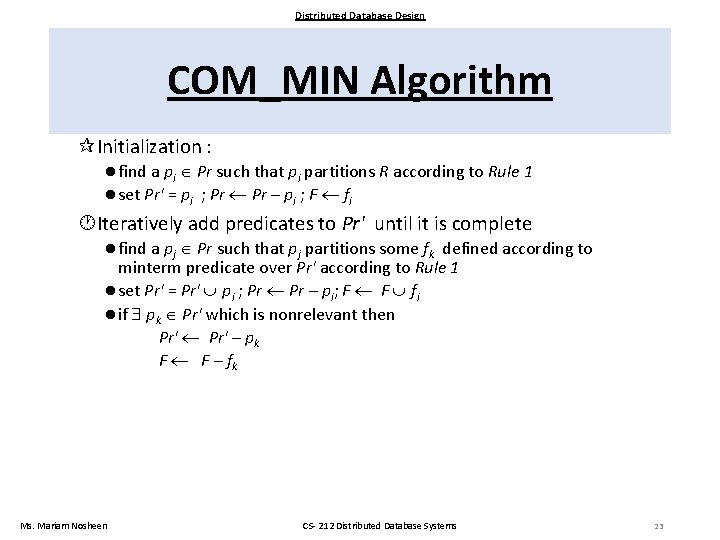
Distributed Database Design COM_MIN Algorithm Initialization : find a pi Pr such that pi partitions R according to Rule 1 set Pr' = pi ; Pr – pi ; F fi Iteratively add predicates to Pr' until it is complete find a pj Pr such that pj partitions some fk defined according to minterm predicate over Pr' according to Rule 1 set Pr' = Pr' pi ; Pr – pi; F F fi if pk Pr' which is nonrelevant then Pr' – pk F F – fk Ms. Mariam Nosheen CS- 212 Distributed Database Systems 23
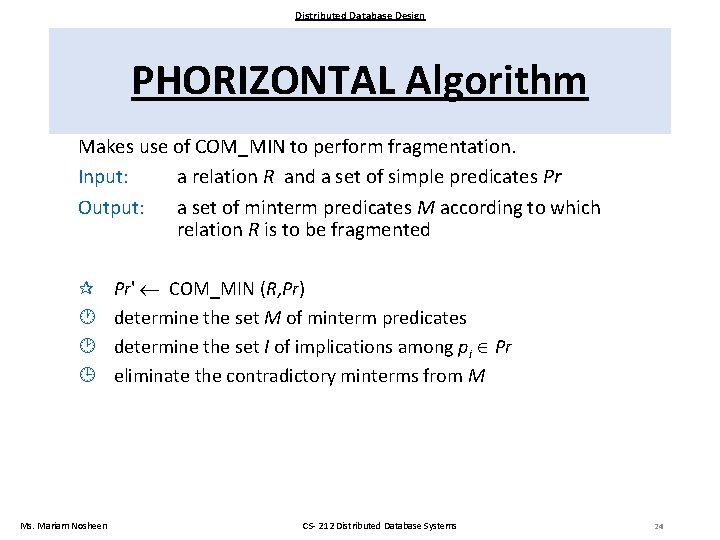
Distributed Database Design PHORIZONTAL Algorithm Makes use of COM_MIN to perform fragmentation. Input: a relation R and a set of simple predicates Pr Output: a set of minterm predicates M according to which relation R is to be fragmented Ms. Mariam Nosheen Pr' COM_MIN (R, Pr) determine the set M of minterm predicates determine the set I of implications among pi Pr eliminate the contradictory minterms from M CS- 212 Distributed Database Systems 24
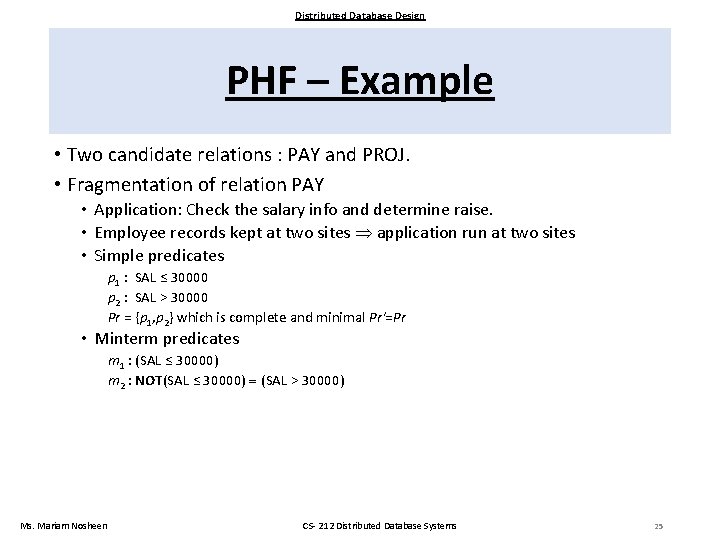
Distributed Database Design PHF – Example • Two candidate relations : PAY and PROJ. • Fragmentation of relation PAY • Application: Check the salary info and determine raise. • Employee records kept at two sites application run at two sites • Simple predicates p 1 : SAL ≤ 30000 p 2 : SAL > 30000 Pr = {p 1, p 2} which is complete and minimal Pr'=Pr • Minterm predicates m 1 : (SAL ≤ 30000) m 2 : NOT(SAL ≤ 30000) (SAL > 30000) Ms. Mariam Nosheen CS- 212 Distributed Database Systems 25
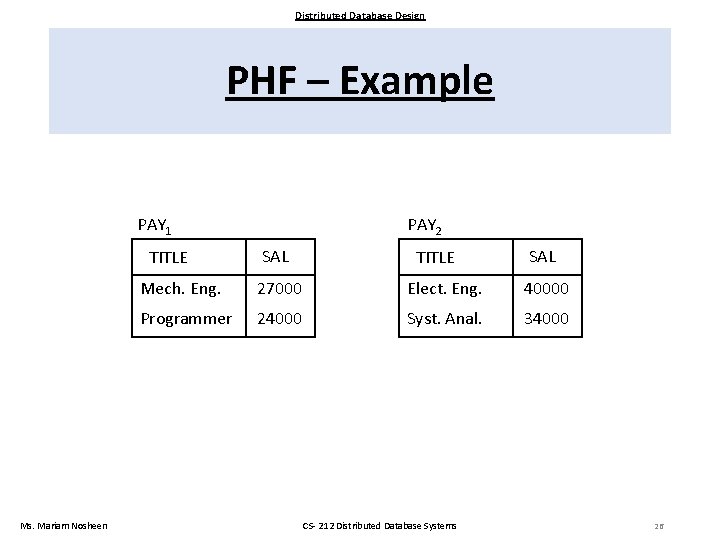
Distributed Database Design PHF – Example PAY 1 TITLE Ms. Mariam Nosheen PAY 2 SAL TITLE SAL Mech. Eng. 27000 Elect. Eng. 40000 Programmer 24000 Syst. Anal. 34000 CS- 212 Distributed Database Systems 26
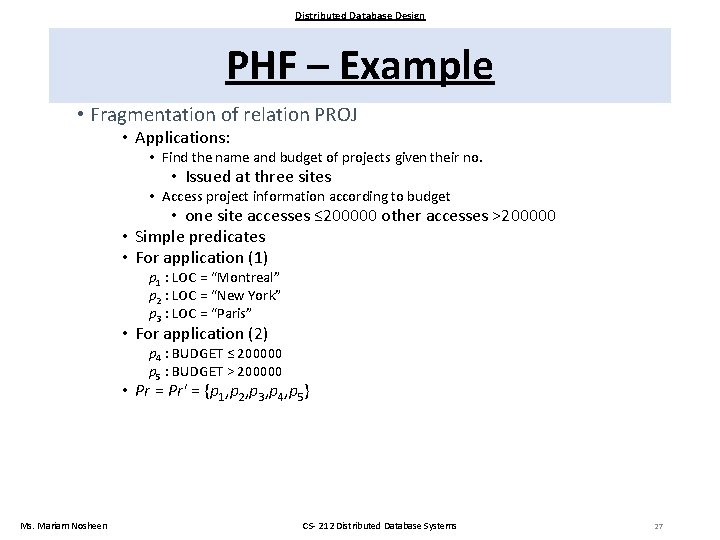
Distributed Database Design PHF – Example • Fragmentation of relation PROJ • Applications: • Find the name and budget of projects given their no. • Issued at three sites • Access project information according to budget • one site accesses ≤ 200000 other accesses >200000 • Simple predicates • For application (1) p 1 : LOC = “Montreal” p 2 : LOC = “New York” p 3 : LOC = “Paris” • For application (2) p 4 : BUDGET ≤ 200000 p 5 : BUDGET > 200000 • Pr = Pr' = {p 1, p 2, p 3, p 4, p 5} Ms. Mariam Nosheen CS- 212 Distributed Database Systems 27
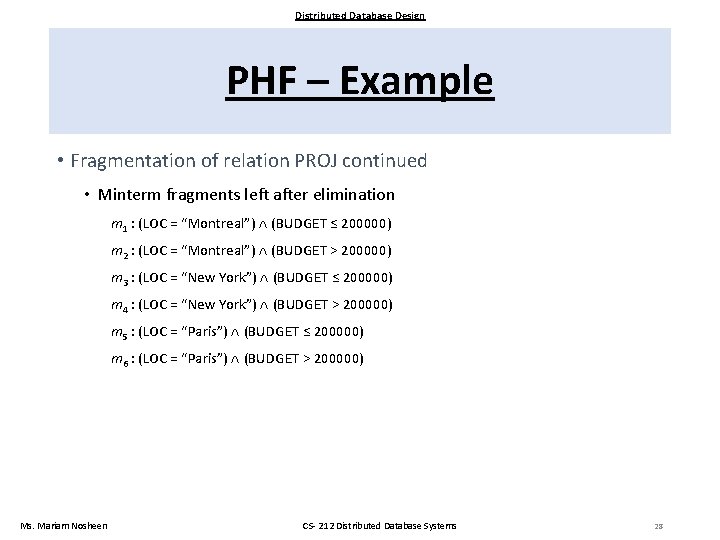
Distributed Database Design PHF – Example • Fragmentation of relation PROJ continued • Minterm fragments left after elimination m 1 : (LOC = “Montreal”) (BUDGET ≤ 200000) m 2 : (LOC = “Montreal”) (BUDGET > 200000) m 3 : (LOC = “New York”) (BUDGET ≤ 200000) m 4 : (LOC = “New York”) (BUDGET > 200000) m 5 : (LOC = “Paris”) (BUDGET ≤ 200000) m 6 : (LOC = “Paris”) (BUDGET > 200000) Ms. Mariam Nosheen CS- 212 Distributed Database Systems 28
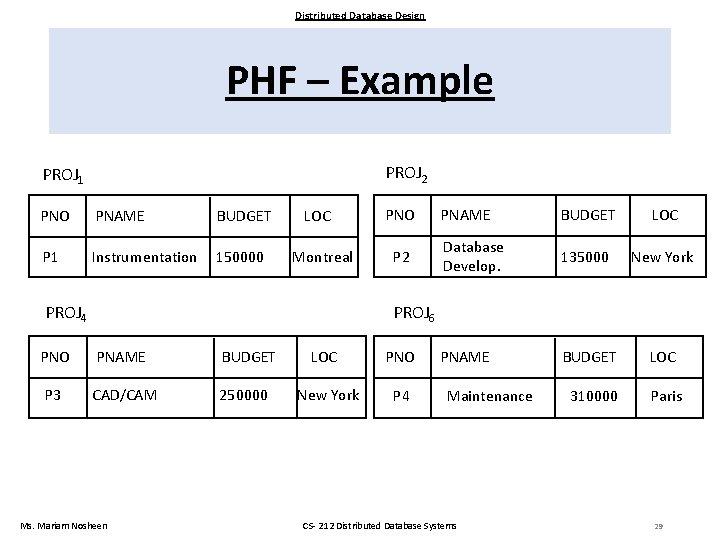
Distributed Database Design PHF – Example PROJ 2 PROJ 1 PNO PNAME BUDGET P 1 Instrumentation 150000 LOC Montreal PROJ 4 PNO P 2 PNAME BUDGET LOC Database Develop. 135000 New York PNAME BUDGET LOC 310000 Paris PROJ 6 PNO PNAME P 3 CAD/CAM Ms. Mariam Nosheen BUDGET 250000 LOC PNO New York P 4 Maintenance CS- 212 Distributed Database Systems 29
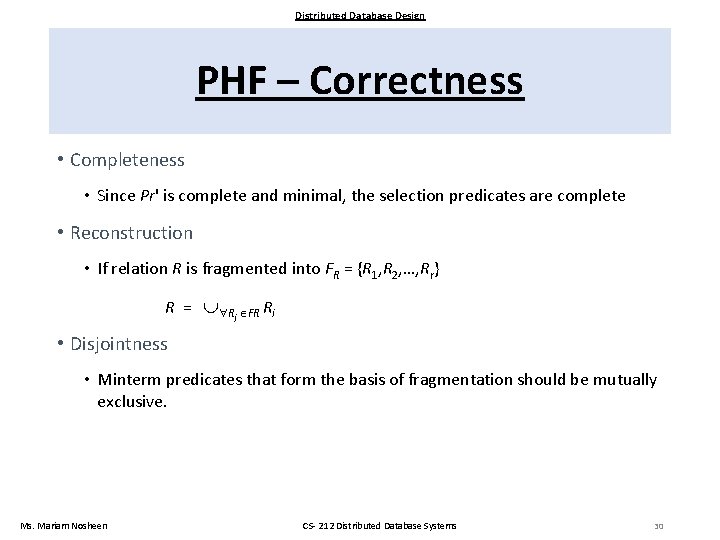
Distributed Database Design PHF – Correctness • Completeness • Since Pr' is complete and minimal, the selection predicates are complete • Reconstruction • If relation R is fragmented into FR = {R 1, R 2, …, Rr} R = Ri FR Ri • Disjointness • Minterm predicates that form the basis of fragmentation should be mutually exclusive. Ms. Mariam Nosheen CS- 212 Distributed Database Systems 30
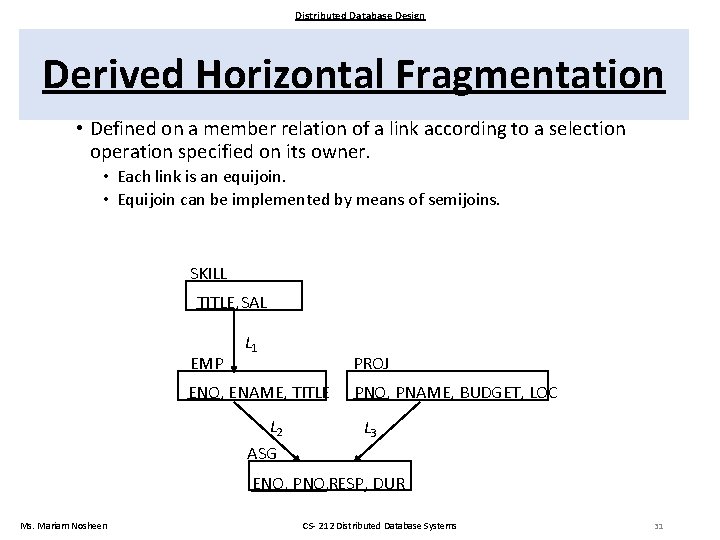
Distributed Database Design Derived Horizontal Fragmentation • Defined on a member relation of a link according to a selection operation specified on its owner. • Each link is an equijoin. • Equijoin can be implemented by means of semijoins. SKILL TITLE, SAL EMP L 1 PROJ ENO, ENAME, TITLE L 2 ASG PNO, PNAME, BUDGET, LOC L 3 ENO, PNO, RESP, DUR Ms. Mariam Nosheen CS- 212 Distributed Database Systems 31
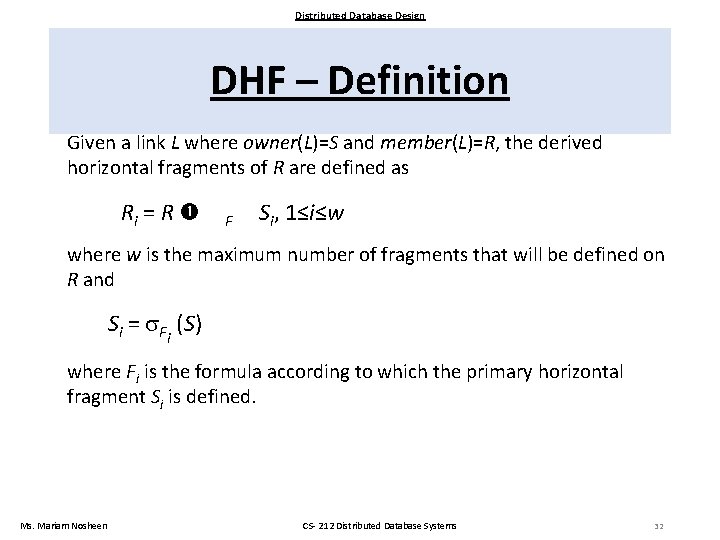
Distributed Database Design DHF – Definition Given a link L where owner(L)=S and member(L)=R, the derived horizontal fragments of R are defined as Ri = R F Si, 1≤i≤w where w is the maximum number of fragments that will be defined on R and Si = Fi (S) where Fi is the formula according to which the primary horizontal fragment Si is defined. Ms. Mariam Nosheen CS- 212 Distributed Database Systems 32
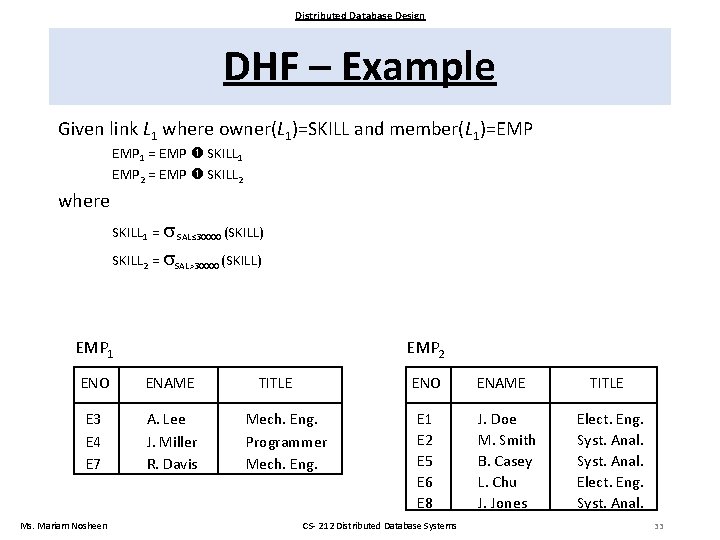
Distributed Database Design DHF – Example Given link L 1 where owner(L 1)=SKILL and member(L 1)=EMP 1 = EMP SKILL 1 EMP 2 = EMP SKILL 2 where SKILL 1 = SAL≤ 30000 (SKILL) SKILL 2 = SAL>30000 (SKILL) EMP 1 EMP 2 ENO ENAME E 3 E 4 E 7 A. Lee J. Miller R. Davis Ms. Mariam Nosheen TITLE ENO Mech. Eng. Programmer Mech. Eng. E 1 E 2 E 5 E 6 E 8 CS- 212 Distributed Database Systems ENAME J. Doe M. Smith B. Casey L. Chu J. Jones TITLE Elect. Eng. Syst. Anal. 33
Distributed Database Design DHF – Correctness • Completeness • Referential integrity • Let R be the member relation of a link whose owner is relation S which is fragmented as FS = {S 1, S 2, . . . , Sn}. Furthermore, let A be the join attribute between R and S. Then, for each tuple t of R, there should be a tuple t' of S such that t[A]=t'[A] • Reconstruction • Same as primary horizontal fragmentation. • Disjointness • Simple join graphs between the owner and the member fragments. Ms. Mariam Nosheen CS- 212 Distributed Database Systems 34
Distributed Database Design Vertical Fragmentation • Has been studied within the centralized context • design methodology • physical clustering • More difficult than horizontal, because more alternatives exist. Two approaches : • grouping • attributes to fragments • splitting • relation to fragments Ms. Mariam Nosheen CS- 212 Distributed Database Systems 35
Distributed Database Design Vertical Fragmentation • Overlapping fragments • grouping • Non-overlapping fragments • splitting We do not consider the replicated key attributes to be overlapping. Advantage: Easier to enforce functional dependencies (for integrity checking etc. ) Ms. Mariam Nosheen CS- 212 Distributed Database Systems 36
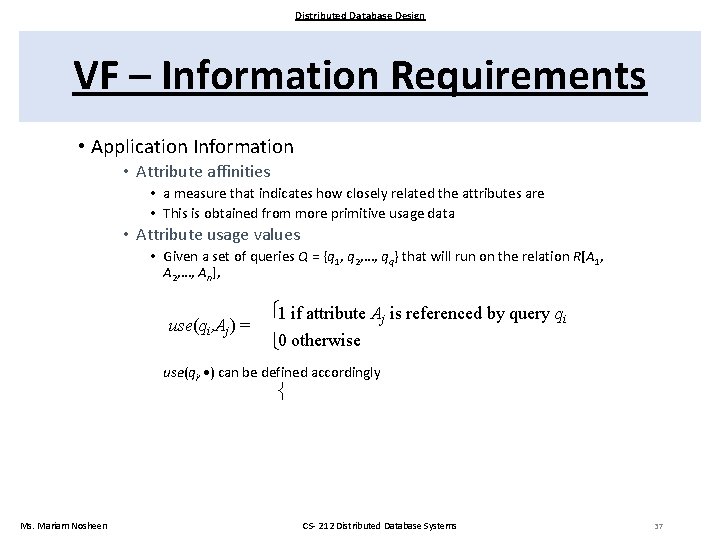
Distributed Database Design VF – Information Requirements • Application Information • Attribute affinities • a measure that indicates how closely related the attributes are • This is obtained from more primitive usage data • Attribute usage values • Given a set of queries Q = {q 1, q 2, …, qq} that will run on the relation R[A 1, A 2, …, An], use(qi, Aj) = 1 if attribute Aj is referenced by query qi 0 otherwise use(qi, • ) can be defined accordingly Ms. Mariam Nosheen CS- 212 Distributed Database Systems 37
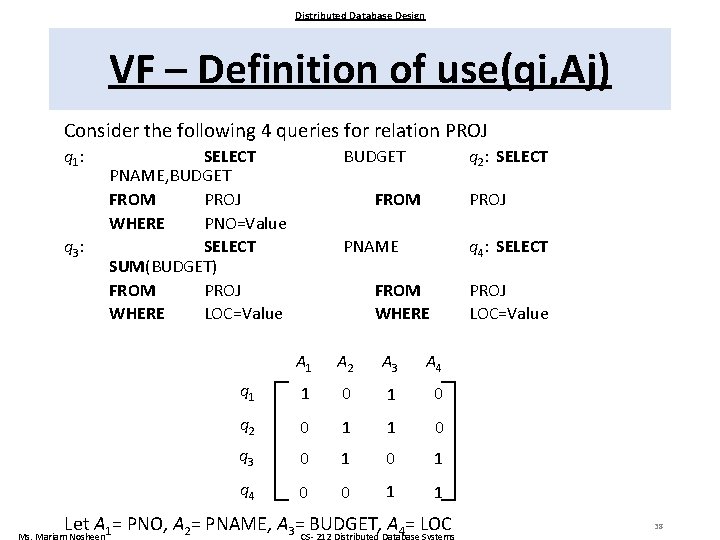
Distributed Database Design VF – Definition of use(qi, Aj) Consider the following 4 queries for relation PROJ q 1: q 3: SELECT PNAME, BUDGET FROM PROJ WHERE PNO=Value SELECT SUM(BUDGET) FROM PROJ WHERE LOC=Value BUDGET q 2: SELECT FROM PROJ PNAME q 4: SELECT FROM WHERE PROJ LOC=Value A 1 A 2 A 3 A 4 q 1 1 0 q 2 0 1 1 0 q 3 0 1 q 4 0 0 1 1 Let A = PNO, A 2= PNAME, A 3=CS-BUDGET, A 4= LOC 212 Distributed Database Systems Ms. Mariam Nosheen 1 38
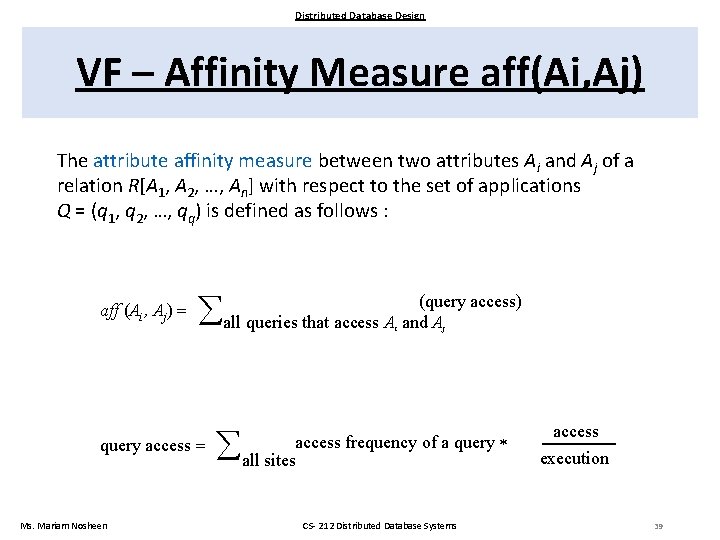
Distributed Database Design VF – Affinity Measure aff(Ai, Aj) The attribute affinity measure between two attributes Ai and Aj of a relation R[A 1, A 2, …, An] with respect to the set of applications Q = (q 1, q 2, …, qq) is defined as follows : aff (Ai, Aj) query access Ms. Mariam Nosheen (query access) all queries that access Ai and Aj access frequency of a query all sites CS- 212 Distributed Database Systems access execution 39
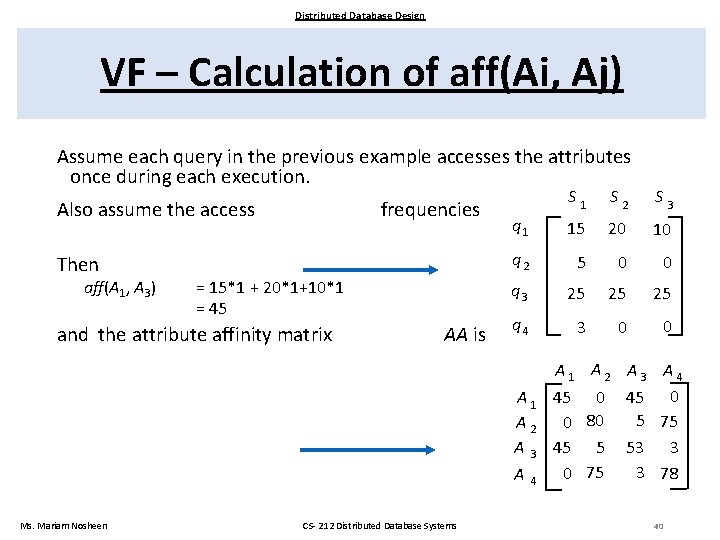
Distributed Database Design VF – Calculation of aff(Ai, Aj) Assume each query in the previous example accesses the attributes once during each execution. Also assume the access Then aff(A 1, A 3) frequencies = 15*1 + 20*1+10*1 = 45 and the attribute affinity matrix AA is S 1 S 2 S 3 q 1 15 20 10 q 2 5 0 0 q 3 25 25 25 q 4 3 0 0 A 1 A 2 A 3 A 4 Ms. Mariam Nosheen CS- 212 Distributed Database Systems A 1 A 2 A 3 A 4 45 0 5 75 0 80 45 5 53 3 3 78 0 75 40
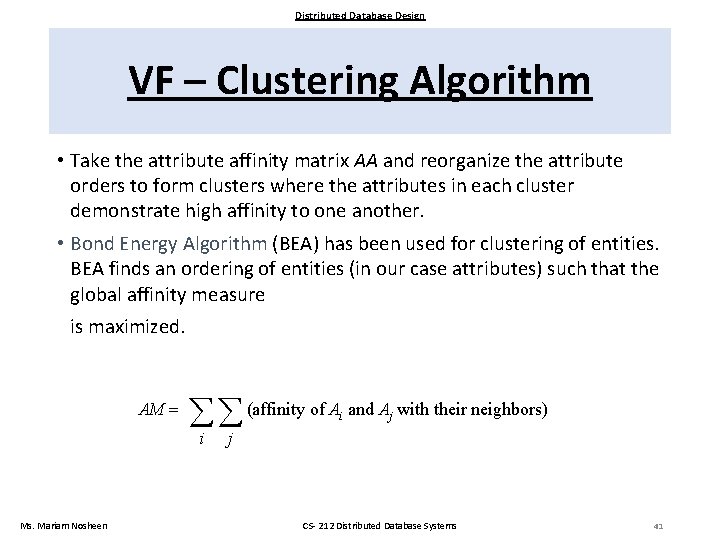
Distributed Database Design VF – Clustering Algorithm • Take the attribute affinity matrix AA and reorganize the attribute orders to form clusters where the attributes in each cluster demonstrate high affinity to one another. • Bond Energy Algorithm (BEA) has been used for clustering of entities. BEA finds an ordering of entities (in our case attributes) such that the global affinity measure is maximized. AM (affinity of A and A with their neighbors) i i Ms. Mariam Nosheen j j CS- 212 Distributed Database Systems 41
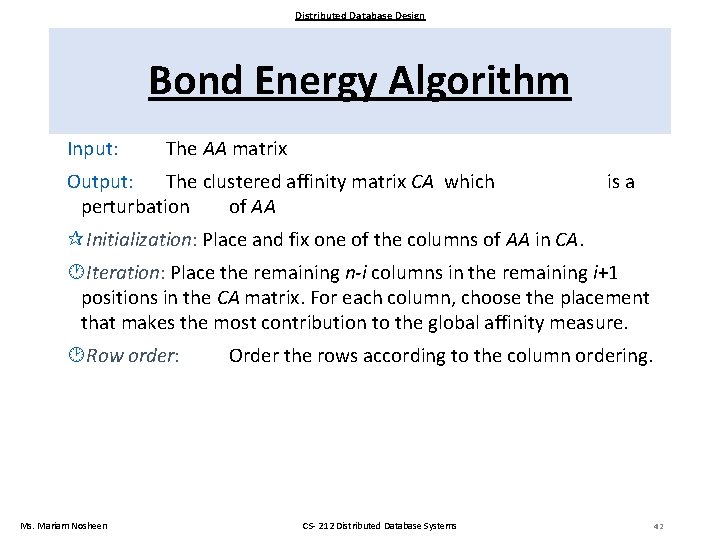
Distributed Database Design Bond Energy Algorithm Input: The AA matrix Output: The clustered affinity matrix CA which perturbation of AA is a Initialization: Place and fix one of the columns of AA in CA. Iteration: Place the remaining n-i columns in the remaining i+1 positions in the CA matrix. For each column, choose the placement that makes the most contribution to the global affinity measure. Row order: Ms. Mariam Nosheen Order the rows according to the column ordering. CS- 212 Distributed Database Systems 42
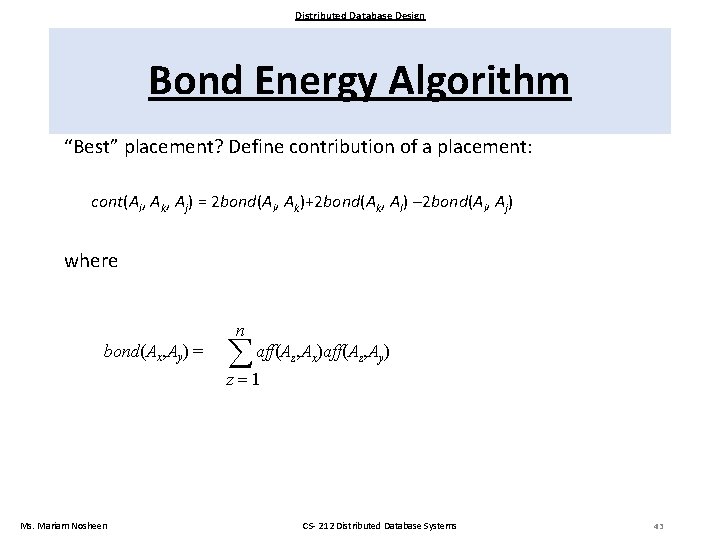
Distributed Database Design Bond Energy Algorithm “Best” placement? Define contribution of a placement: cont(Ai, Ak, Aj) = 2 bond(Ai, Ak)+2 bond(Ak, Al) – 2 bond(Ai, Aj) where n bond(Ax, Ay) = aff(A , A ) z x z y z 1 Ms. Mariam Nosheen CS- 212 Distributed Database Systems 43
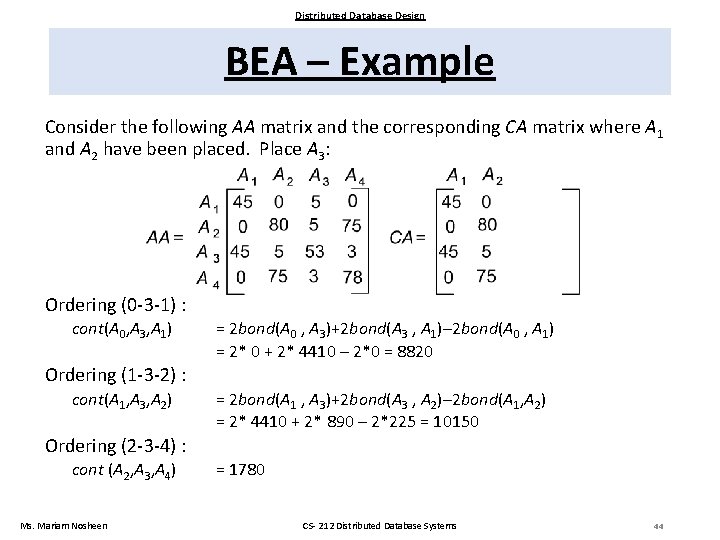
Distributed Database Design BEA – Example Consider the following AA matrix and the corresponding CA matrix where A 1 and A 2 have been placed. Place A 3: Ordering (0 -3 -1) : cont(A 0, A 3, A 1) = 2 bond(A 0 , A 3)+2 bond(A 3 , A 1)– 2 bond(A 0 , A 1) = 2* 0 + 2* 4410 – 2*0 = 8820 Ordering (1 -3 -2) : cont(A 1, A 3, A 2) = 2 bond(A 1 , A 3)+2 bond(A 3 , A 2)– 2 bond(A 1, A 2) = 2* 4410 + 2* 890 – 2*225 = 10150 Ordering (2 -3 -4) : cont (A 2, A 3, A 4) Ms. Mariam Nosheen = 1780 CS- 212 Distributed Database Systems 44
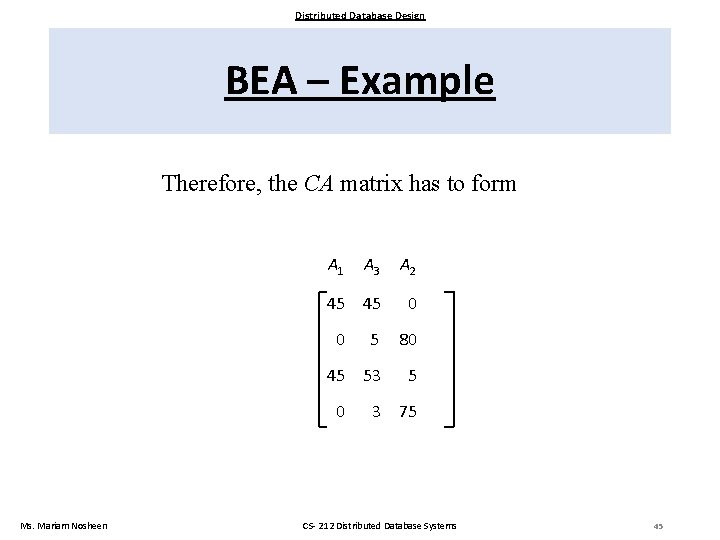
Distributed Database Design BEA – Example Therefore, the CA matrix has to form A 1 A 3 A 2 45 45 0 0 5 80 45 53 5 0 Ms. Mariam Nosheen 3 75 CS- 212 Distributed Database Systems 45
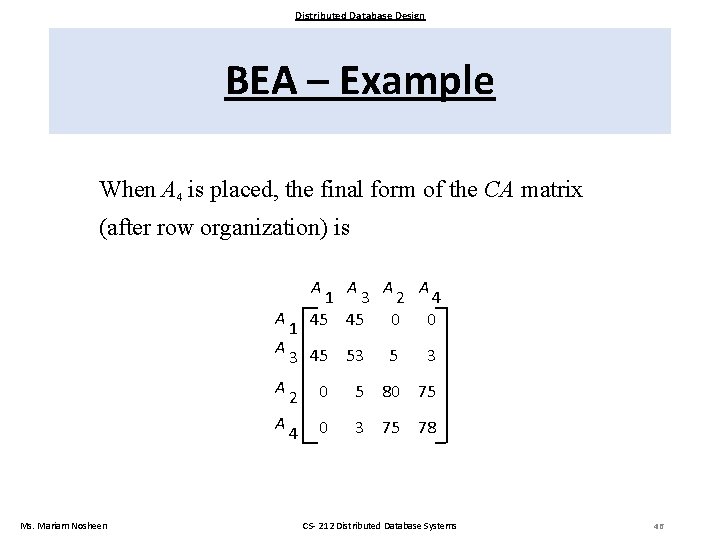
Distributed Database Design BEA – Example When A 4 is placed, the final form of the CA matrix (after row organization) is A A A Ms. Mariam Nosheen 1 A A A 1 3 2 4 45 45 0 0 3 45 53 5 3 2 0 5 80 75 4 0 3 75 78 CS- 212 Distributed Database Systems 46
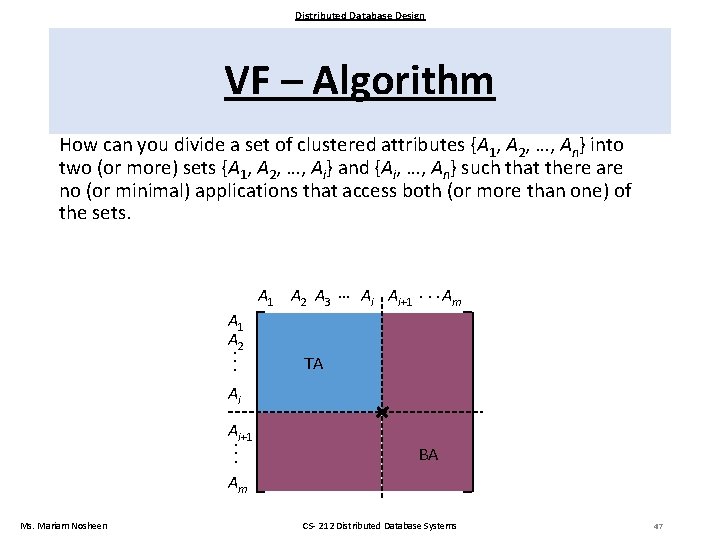
Distributed Database Design VF – Algorithm How can you divide a set of clustered attributes {A 1, A 2, …, An} into two (or more) sets {A 1, A 2, …, Ai} and {Ai, …, An} such that there are no (or minimal) applications that access both (or more than one) of the sets. A 1 A 2 A 3 … Ai Ai+1. . . Am . . . A 1 A 2 TA Ai . . . Ai+1 BA Am Ms. Mariam Nosheen CS- 212 Distributed Database Systems 47
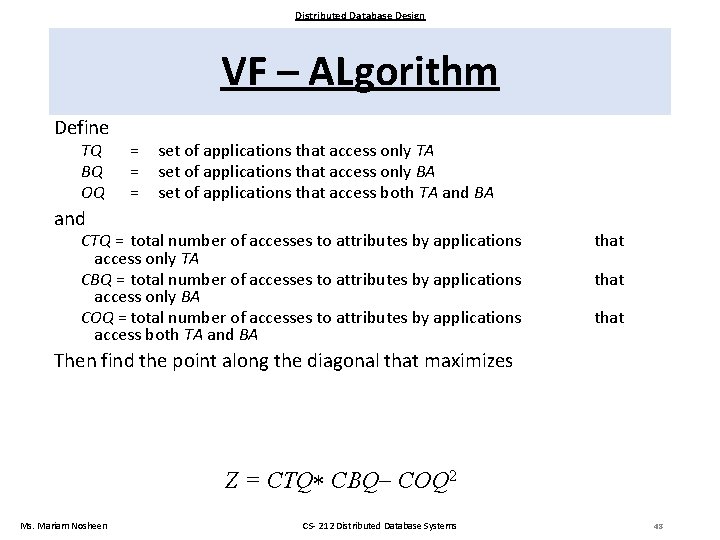
Distributed Database Design VF – ALgorithm Define TQ BQ OQ = = = set of applications that access only TA set of applications that access only BA set of applications that access both TA and BA and CTQ = total number of accesses to attributes by applications access only TA CBQ = total number of accesses to attributes by applications access only BA COQ = total number of accesses to attributes by applications access both TA and BA that Then find the point along the diagonal that maximizes Z = CTQ CBQ COQ 2 Ms. Mariam Nosheen CS- 212 Distributed Database Systems 48
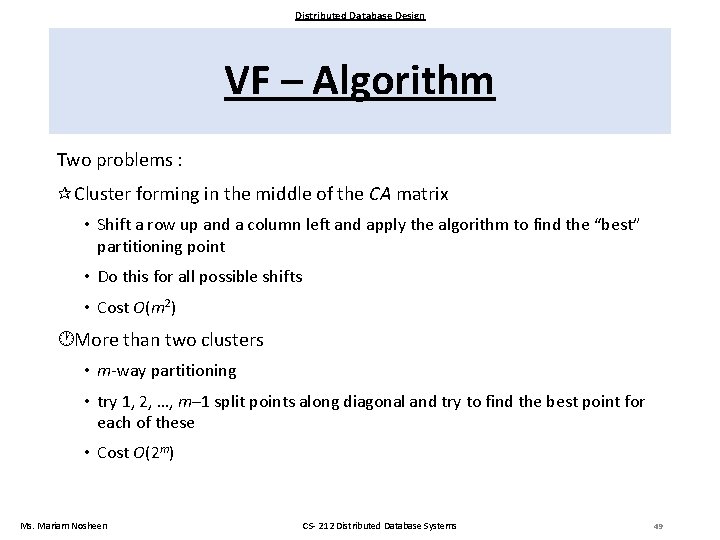
Distributed Database Design VF – Algorithm Two problems : Cluster forming in the middle of the CA matrix • Shift a row up and a column left and apply the algorithm to find the “best” partitioning point • Do this for all possible shifts • Cost O(m 2) More than two clusters • m-way partitioning • try 1, 2, …, m– 1 split points along diagonal and try to find the best point for each of these • Cost O(2 m) Ms. Mariam Nosheen CS- 212 Distributed Database Systems 49
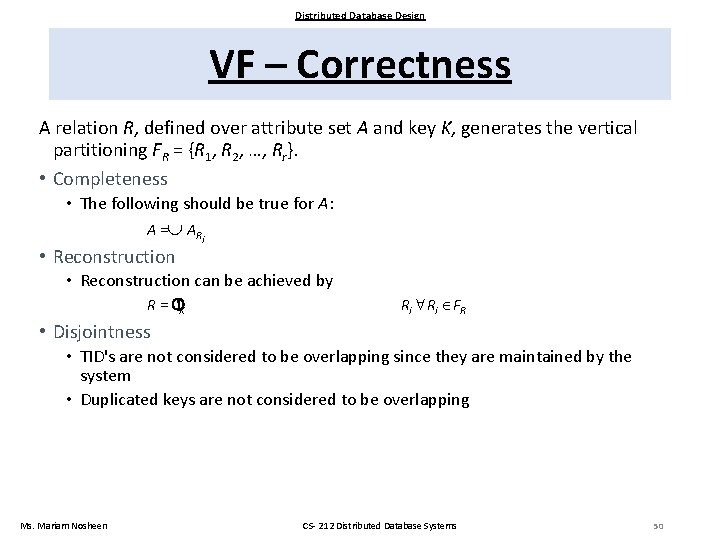
Distributed Database Design VF – Correctness A relation R, defined over attribute set A and key K, generates the vertical partitioning FR = {R 1, R 2, …, Rr}. • Completeness • The following should be true for A: A = A R i • Reconstruction can be achieved by R = K Ri Ri FR • Disjointness • TID's are not considered to be overlapping since they are maintained by the system • Duplicated keys are not considered to be overlapping Ms. Mariam Nosheen CS- 212 Distributed Database Systems 50
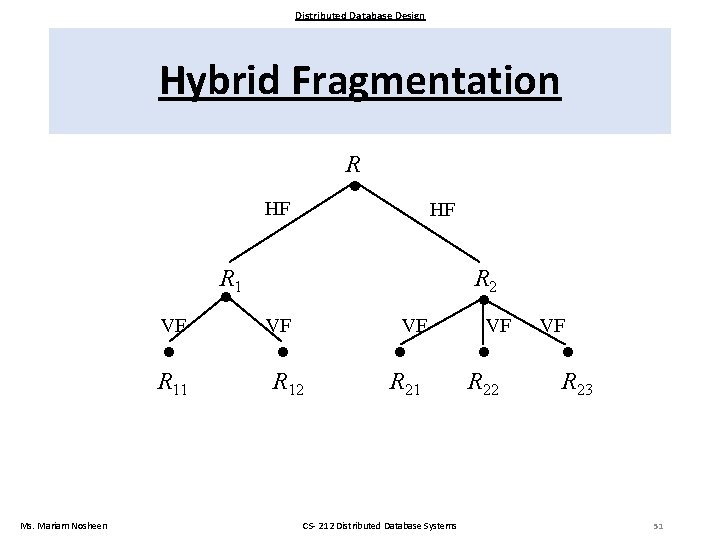
Distributed Database Design Hybrid Fragmentation R HF HF R 1 R 2 Ms. Mariam Nosheen VF VF VF R 11 R 12 R 21 CS- 212 Distributed Database Systems VF R 22 VF R 23 51
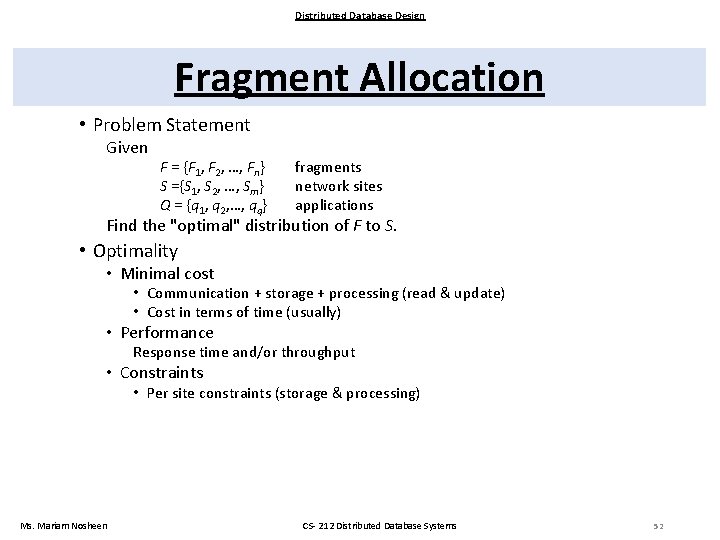
Distributed Database Design Fragment Allocation • Problem Statement Given F = {F 1, F 2, …, Fn} S ={S 1, S 2, …, Sm} Q = {q 1, q 2, …, qq} fragments network sites applications Find the "optimal" distribution of F to S. • Optimality • Minimal cost • Communication + storage + processing (read & update) • Cost in terms of time (usually) • Performance Response time and/or throughput • Constraints • Per site constraints (storage & processing) Ms. Mariam Nosheen CS- 212 Distributed Database Systems 52
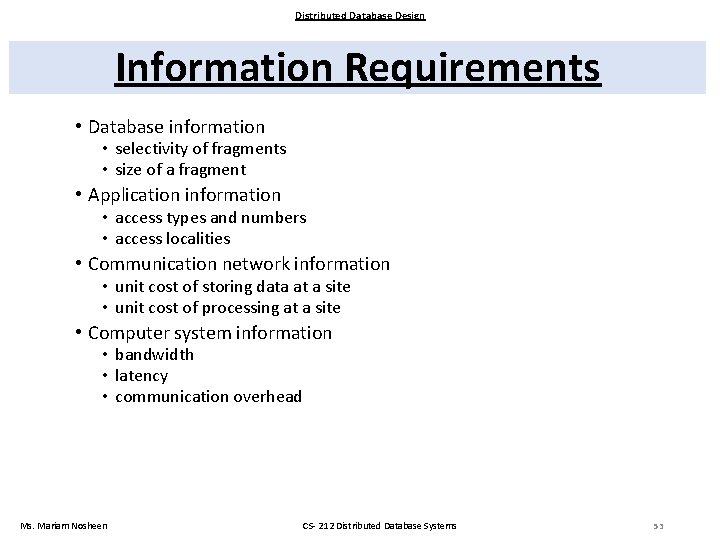
Distributed Database Design Information Requirements • Database information • selectivity of fragments • size of a fragment • Application information • access types and numbers • access localities • Communication network information • unit cost of storing data at a site • unit cost of processing at a site • Computer system information • bandwidth • latency • communication overhead Ms. Mariam Nosheen CS- 212 Distributed Database Systems 53
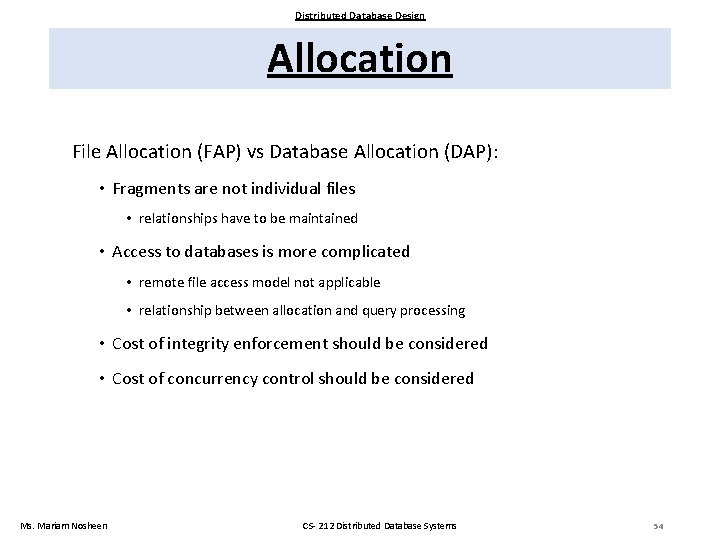
Distributed Database Design Allocation File Allocation (FAP) vs Database Allocation (DAP): • Fragments are not individual files • relationships have to be maintained • Access to databases is more complicated • remote file access model not applicable • relationship between allocation and query processing • Cost of integrity enforcement should be considered • Cost of concurrency control should be considered Ms. Mariam Nosheen CS- 212 Distributed Database Systems 54
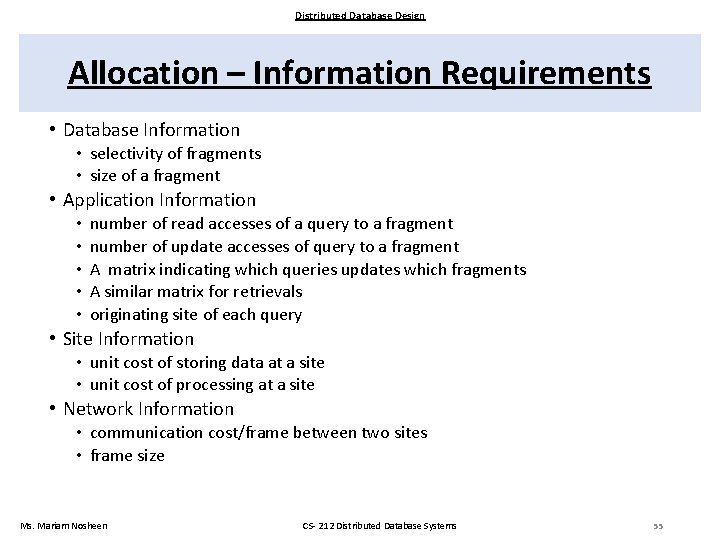
Distributed Database Design Allocation – Information Requirements • Database Information • selectivity of fragments • size of a fragment • Application Information • • • number of read accesses of a query to a fragment number of update accesses of query to a fragment A matrix indicating which queries updates which fragments A similar matrix for retrievals originating site of each query • Site Information • unit cost of storing data at a site • unit cost of processing at a site • Network Information • communication cost/frame between two sites • frame size Ms. Mariam Nosheen CS- 212 Distributed Database Systems 55
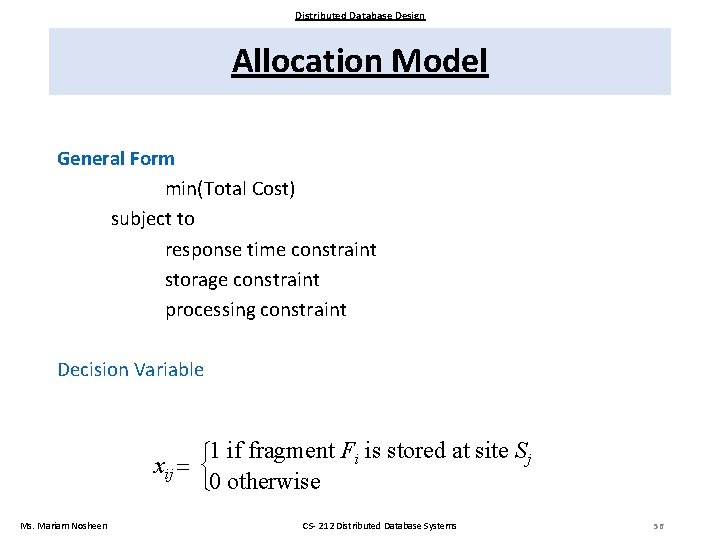
Distributed Database Design Allocation Model General Form min(Total Cost) subject to response time constraint storage constraint processing constraint Decision Variable xij Ms. Mariam Nosheen 1 0 if fragment Fi is stored at site Sj otherwise CS- 212 Distributed Database Systems 56
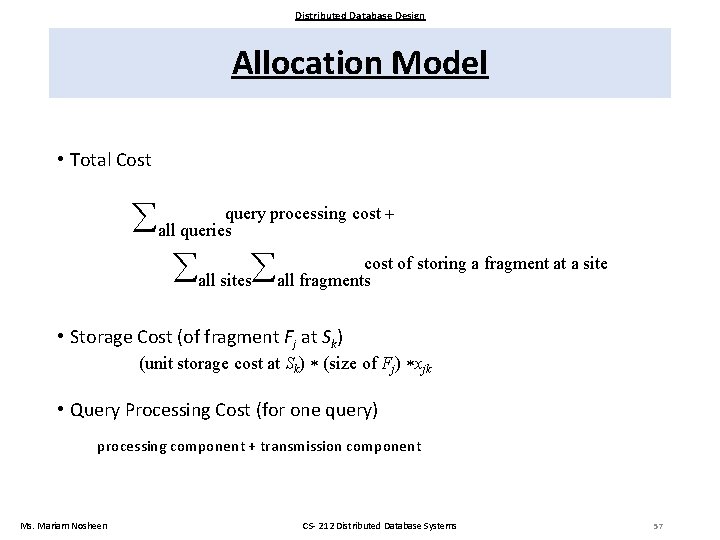
Distributed Database Design Allocation Model • Total Cost all queriesquery processing cost all sites all fragmentscost of storing a fragment at a site • Storage Cost (of fragment Fj at Sk) (unit storage cost at Sk) (size of Fj) xjk • Query Processing Cost (for one query) processing component + transmission component Ms. Mariam Nosheen CS- 212 Distributed Database Systems 57
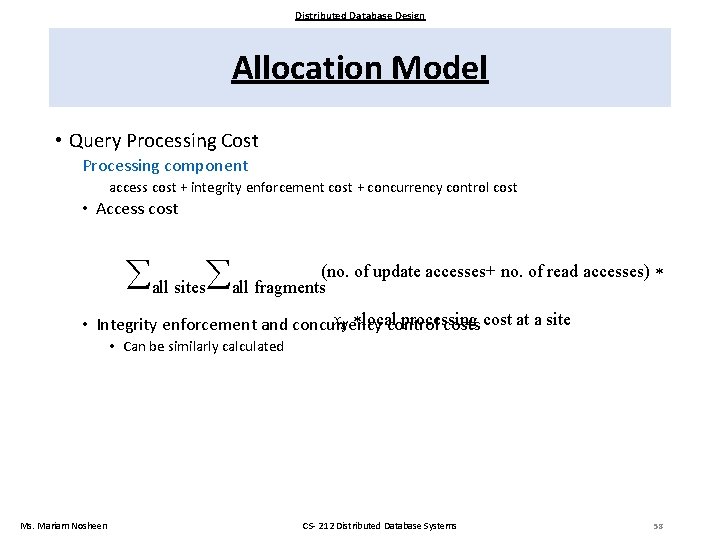
Distributed Database Design Allocation Model • Query Processing Cost Processing component access cost + integrity enforcement cost + concurrency control cost • Access cost all sites all fragments(no. of update accesses+ no. of read accesses) xij local processing • Integrity enforcement and concurrency control costs cost at a site • Can be similarly calculated Ms. Mariam Nosheen CS- 212 Distributed Database Systems 58
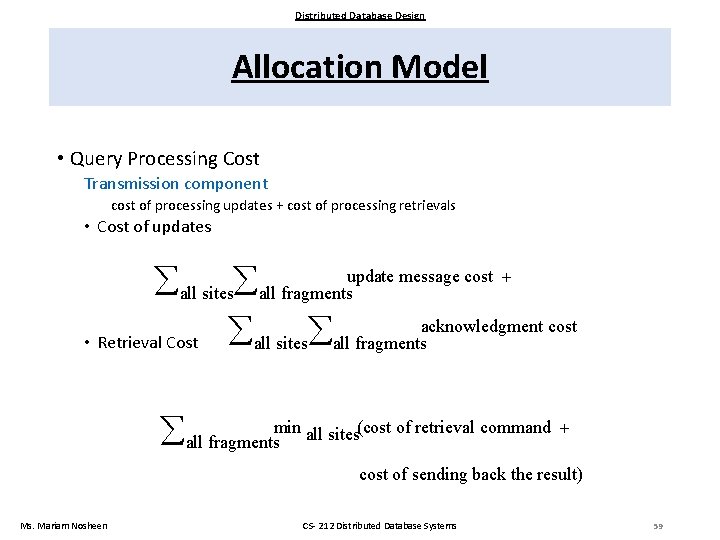
Distributed Database Design Allocation Model • Query Processing Cost Transmission component cost of processing updates + cost of processing retrievals • Cost of updates all sites all fragmentsupdate message cost acknowledgment cost • Retrieval Cost all sites all fragmentsmin all sites(cost of retrieval command cost of sending back the result) Ms. Mariam Nosheen CS- 212 Distributed Database Systems 59
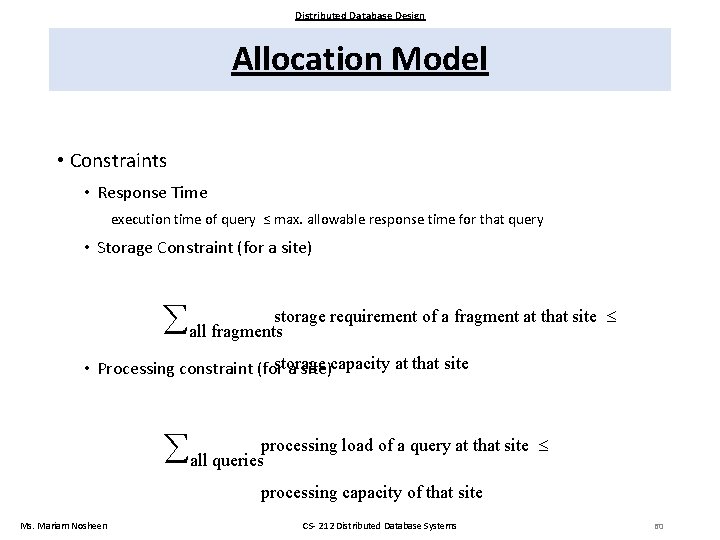
Distributed Database Design Allocation Model • Constraints • Response Time execution time of query ≤ max. allowable response time for that query • Storage Constraint (for a site) all fragmentsstorage requirement of a fragment at that site storage • Processing constraint (for a site)capacity at that site all queriesprocessing load of a query at that site processing capacity of that site Ms. Mariam Nosheen CS- 212 Distributed Database Systems 60
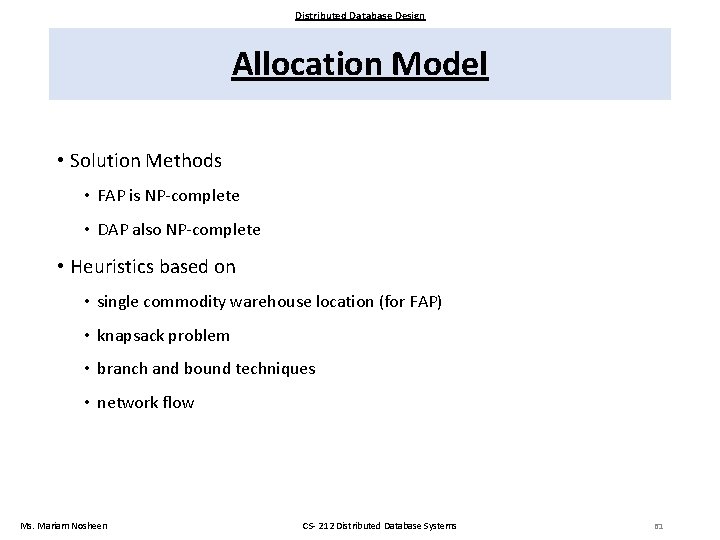
Distributed Database Design Allocation Model • Solution Methods • FAP is NP-complete • DAP also NP-complete • Heuristics based on • single commodity warehouse location (for FAP) • knapsack problem • branch and bound techniques • network flow Ms. Mariam Nosheen CS- 212 Distributed Database Systems 61
Distributed Database Design Allocation Model • Attempts to reduce the solution space • assume all candidate partitionings known; select the “best” partitioning • ignore replication at first • sliding window on fragments Ms. Mariam Nosheen CS- 212 Distributed Database Systems 62
- Slides: 62