
CS G 140 Graduate Computer Graphics Prof Harriet



- Slides: 54
CS G 140 Graduate Computer Graphics Prof. Harriet Fell Spring 2009 Lecture 4 – January 28, 2009 College of Computer and Information Science, Northeastern University 1
Today’s Topics • Raster Algorithms § Lines - Section 3. 5 in Shirley et al. § Circles § Antialiasing • RAY Tracing Continued § Ray-Plane § Ray-Triangle § Ray-Polygon College of Computer and Information Science, Northeastern University 2
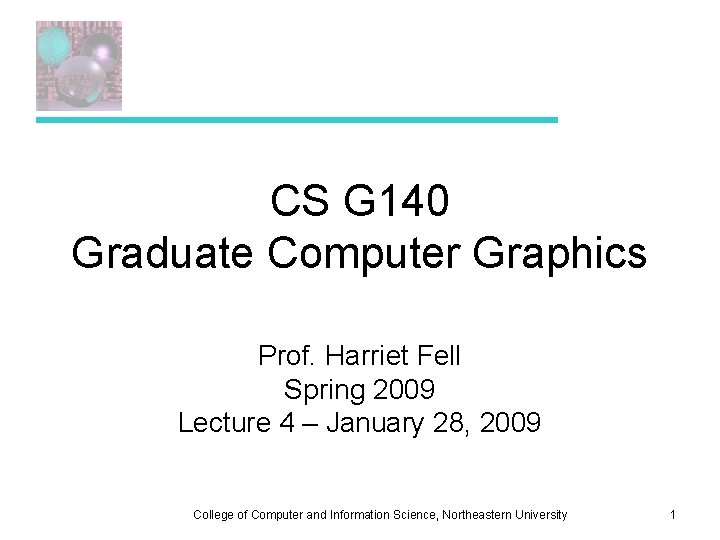
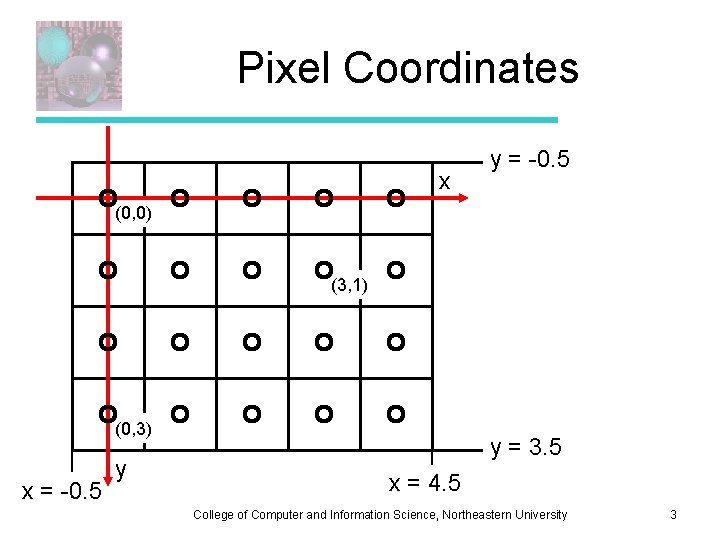
Pixel Coordinates x y = -0. 5 (0, 0) (3, 1) (0, 3) x = -0. 5 y y = 3. 5 x = 4. 5 College of Computer and Information Science, Northeastern University 3
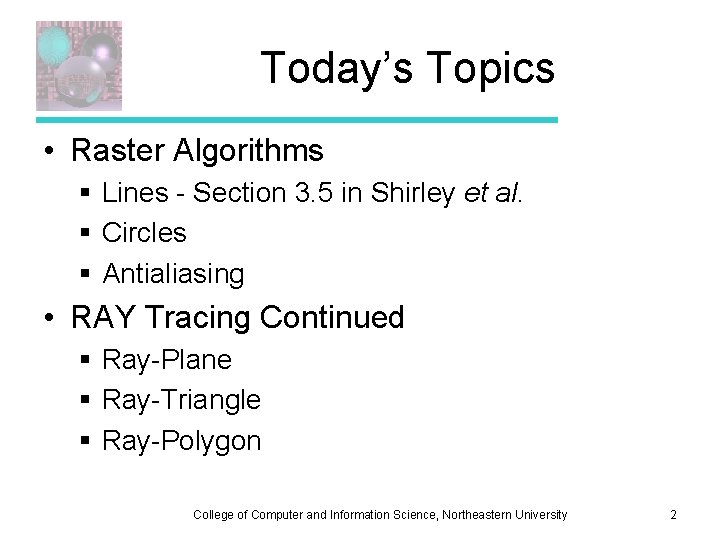
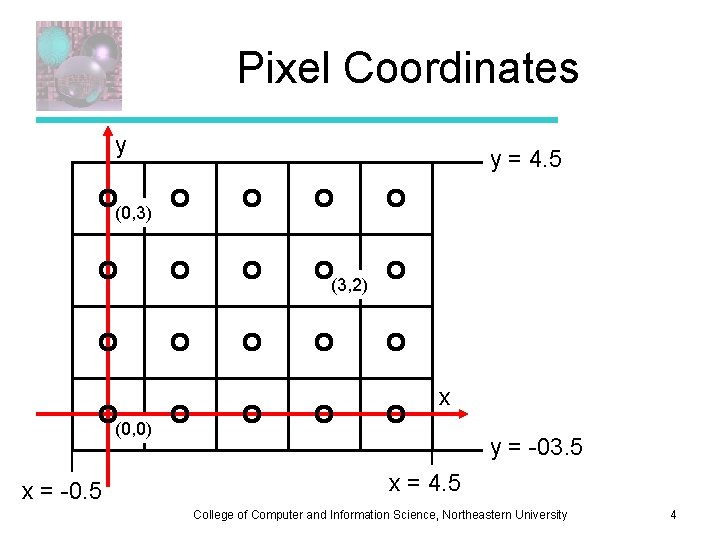
Pixel Coordinates y y = 4. 5 (0, 3) (3, 2) x (0, 0) x = -0. 5 y = -03. 5 x = 4. 5 College of Computer and Information Science, Northeastern University 4
What Makes a Good Line? • Not too jaggy • Uniform thickness along a line • Uniform thickness of lines at different angles • Symmetry, Line(P, Q) = Line(Q, P) • A good line algorithm should be fast. College of Computer and Information Science, Northeastern University 5
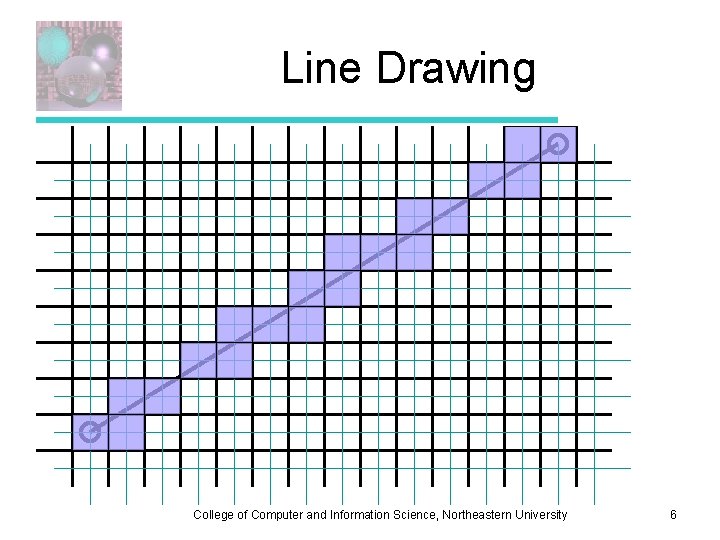
Line Drawing College of Computer and Information Science, Northeastern University 6
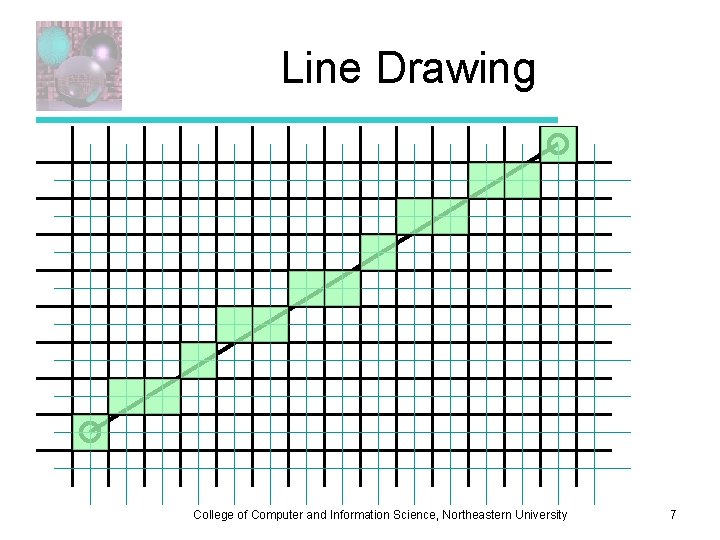
Line Drawing College of Computer and Information Science, Northeastern University 7
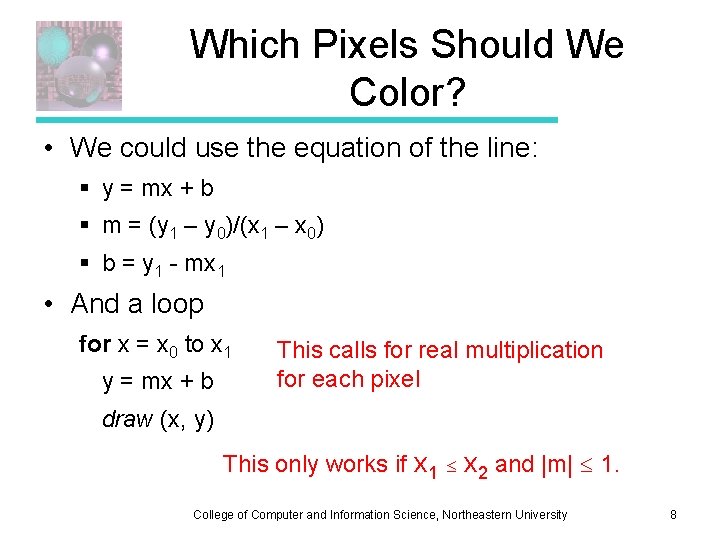
Which Pixels Should We Color? • We could use the equation of the line: § y = mx + b § m = (y 1 – y 0)/(x 1 – x 0) § b = y 1 - mx 1 • And a loop for x = x 0 to x 1 y = mx + b This calls for real multiplication for each pixel draw (x, y) This only works if x 1 x 2 and |m| 1. College of Computer and Information Science, Northeastern University 8
Midpoint Algorithm • Pitteway 1967 • Van Aiken and Nowak 1985 • Draws the same pixels as the Bresenham Algorithm 1965. • Uses integer arithmetic and incremental computation. • Draws the thinnest possible line from (x 0, y 0) to (x 1, y 1) that has no gaps. • A diagonal connection between pixels is not a gap. College of Computer and Information Science, Northeastern University 9
Implicit Equation of a Line f(x, y) = (y 0 – y 1)x +(x 1 - x 0)y + x 0 y 1 - x 1 y 0 f(x, y) > 0 y , f(x (x 0, y 0) (x 1, y 1) 0 = ) f(x, y) < 0 We will assume x 0 x 1 and that m = (y 1 – y 0 )/(x 1 - x 0 ) is in (0, 1]. College of Computer and Information Science, Northeastern University 10
Basic Form of the Algotithm y = y 0 for x = x 0 to x 1 do draw (x, y) if (some condition) then y = y + 1 We want to compute this condition efficiently. Since m (0, 1], as we move from x to x+1, the y value stays the same or goes up by 1. College of Computer and Information Science, Northeastern University 11
Above or Below the Midpoint? College of Computer and Information Science, Northeastern University 12
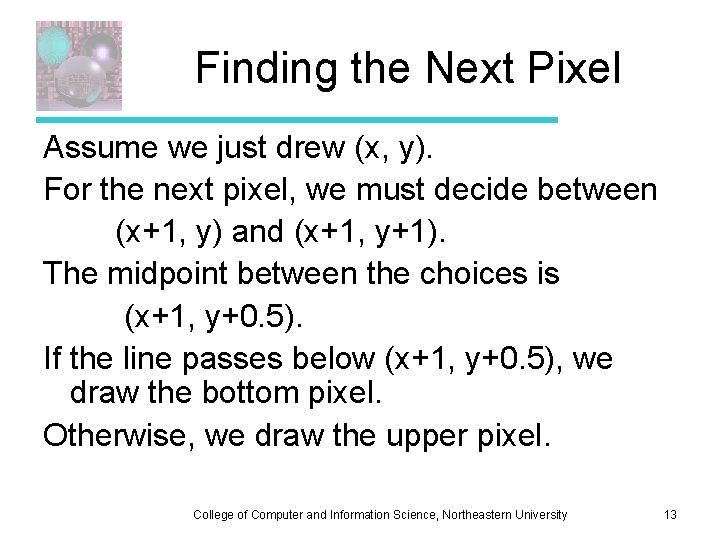
Finding the Next Pixel Assume we just drew (x, y). For the next pixel, we must decide between (x+1, y) and (x+1, y+1). The midpoint between the choices is (x+1, y+0. 5). If the line passes below (x+1, y+0. 5), we draw the bottom pixel. Otherwise, we draw the upper pixel. College of Computer and Information Science, Northeastern University 13
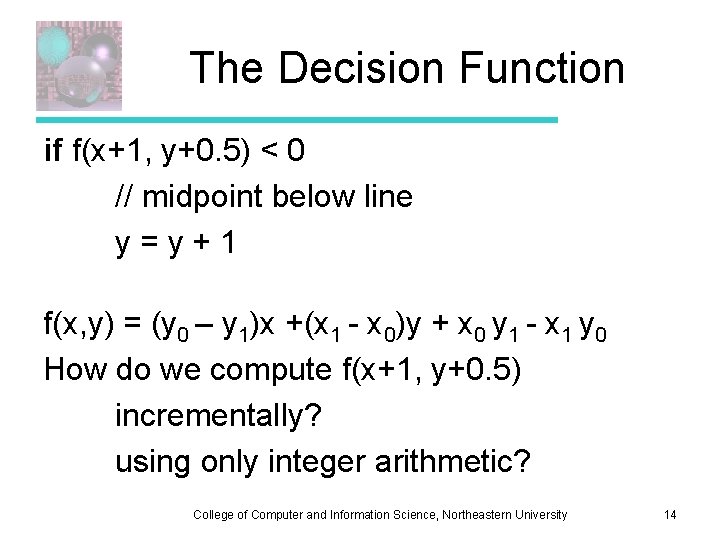
The Decision Function if f(x+1, y+0. 5) < 0 // midpoint below line y=y+1 f(x, y) = (y 0 – y 1)x +(x 1 - x 0)y + x 0 y 1 - x 1 y 0 How do we compute f(x+1, y+0. 5) incrementally? using only integer arithmetic? College of Computer and Information Science, Northeastern University 14
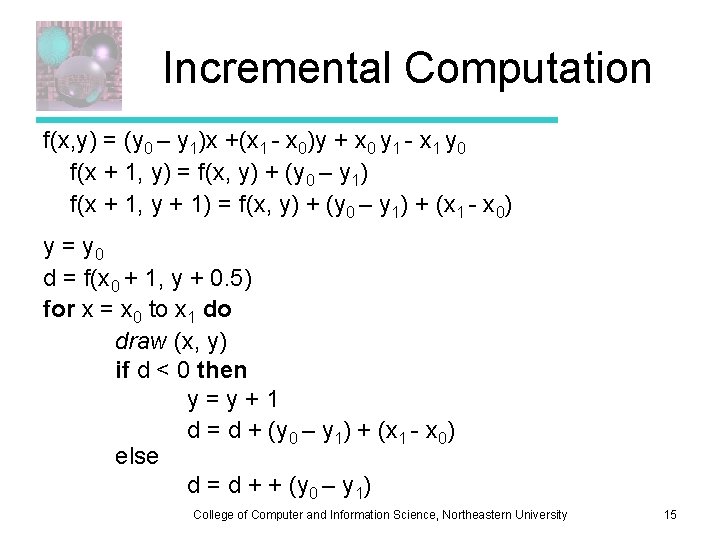
Incremental Computation f(x, y) = (y 0 – y 1)x +(x 1 - x 0)y + x 0 y 1 - x 1 y 0 f(x + 1, y) = f(x, y) + (y 0 – y 1) f(x + 1, y + 1) = f(x, y) + (y 0 – y 1) + (x 1 - x 0) y = y 0 d = f(x 0 + 1, y + 0. 5) for x = x 0 to x 1 do draw (x, y) if d < 0 then y=y+1 d = d + (y 0 – y 1) + (x 1 - x 0) else d = d + + (y 0 – y 1) College of Computer and Information Science, Northeastern University 15
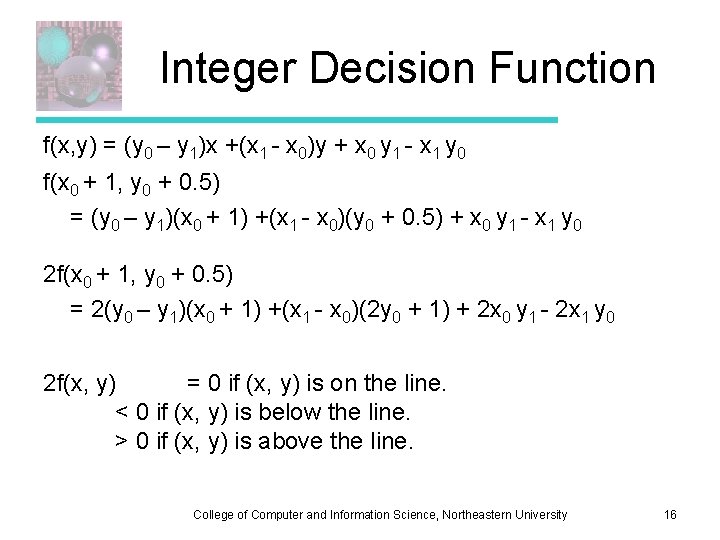
Integer Decision Function f(x, y) = (y 0 – y 1)x +(x 1 - x 0)y + x 0 y 1 - x 1 y 0 f(x 0 + 1, y 0 + 0. 5) = (y 0 – y 1)(x 0 + 1) +(x 1 - x 0)(y 0 + 0. 5) + x 0 y 1 - x 1 y 0 2 f(x 0 + 1, y 0 + 0. 5) = 2(y 0 – y 1)(x 0 + 1) +(x 1 - x 0)(2 y 0 + 1) + 2 x 0 y 1 - 2 x 1 y 0 2 f(x, y) = 0 if (x, y) is on the line. < 0 if (x, y) is below the line. > 0 if (x, y) is above the line. College of Computer and Information Science, Northeastern University 16
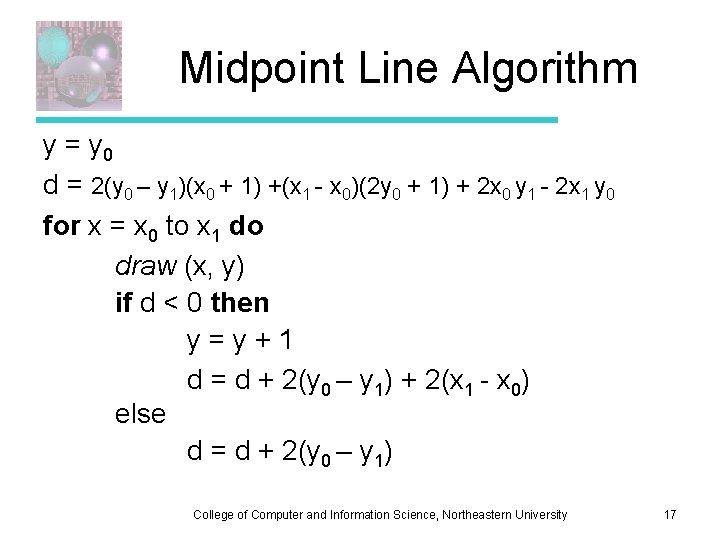
Midpoint Line Algorithm y = y 0 d = 2(y 0 – y 1)(x 0 + 1) +(x 1 - x 0)(2 y 0 + 1) + 2 x 0 y 1 - 2 x 1 y 0 for x = x 0 to x 1 do draw (x, y) if d < 0 then y=y+1 d = d + 2(y 0 – y 1) + 2(x 1 - x 0) else d = d + 2(y 0 – y 1) College of Computer and Information Science, Northeastern University 17
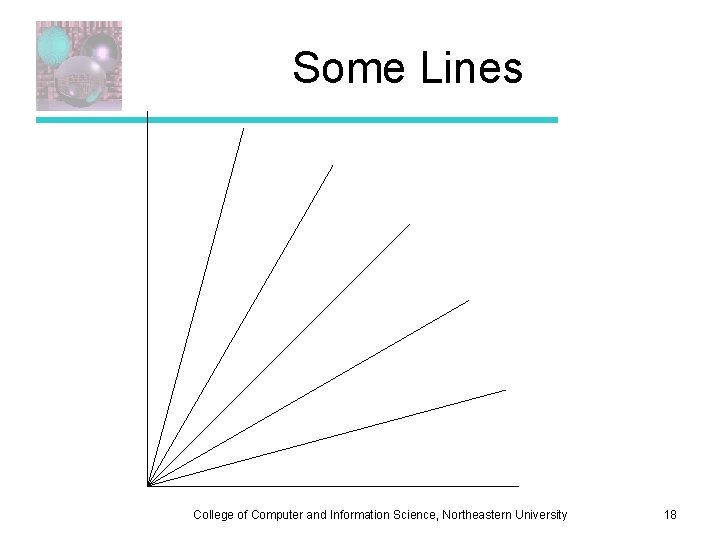
Some Lines College of Computer and Information Science, Northeastern University 18
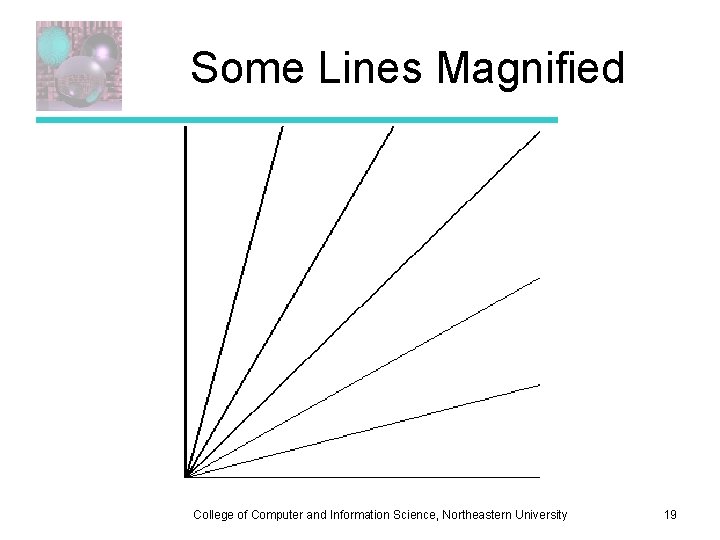
Some Lines Magnified College of Computer and Information Science, Northeastern University 19
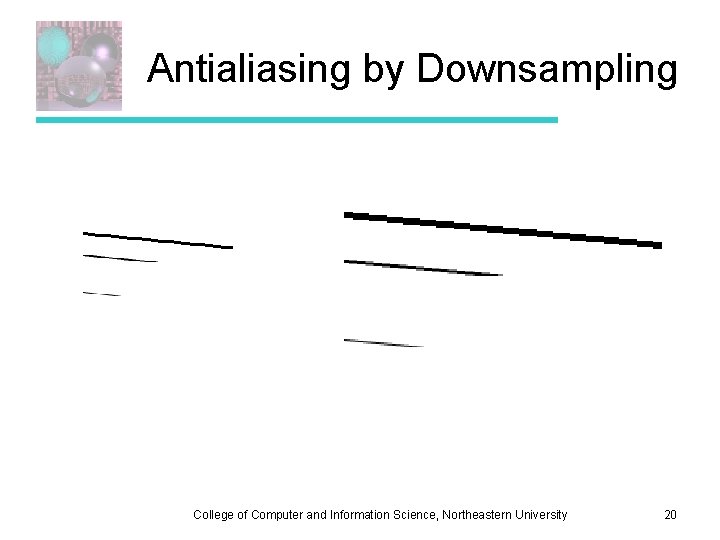
Antialiasing by Downsampling College of Computer and Information Science, Northeastern University 20
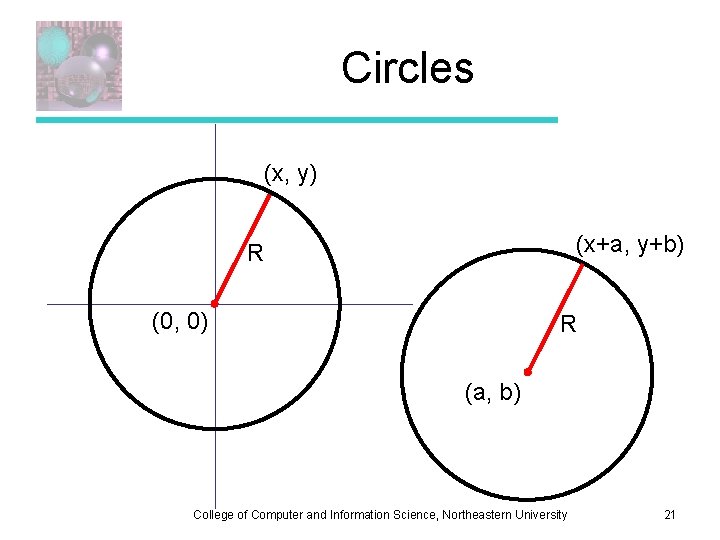
Circles (x, y) (x+a, y+b) R (0, 0) R (a, b) College of Computer and Information Science, Northeastern University 21
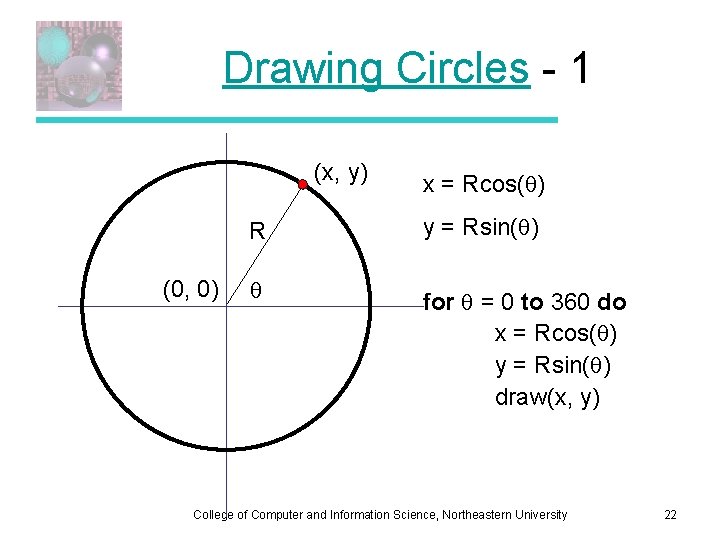
Drawing Circles - 1 (x, y) (0, 0) x = Rcos( ) R y = Rsin( ) for = 0 to 360 do x = Rcos( ) y = Rsin( ) draw(x, y) College of Computer and Information Science, Northeastern University 22
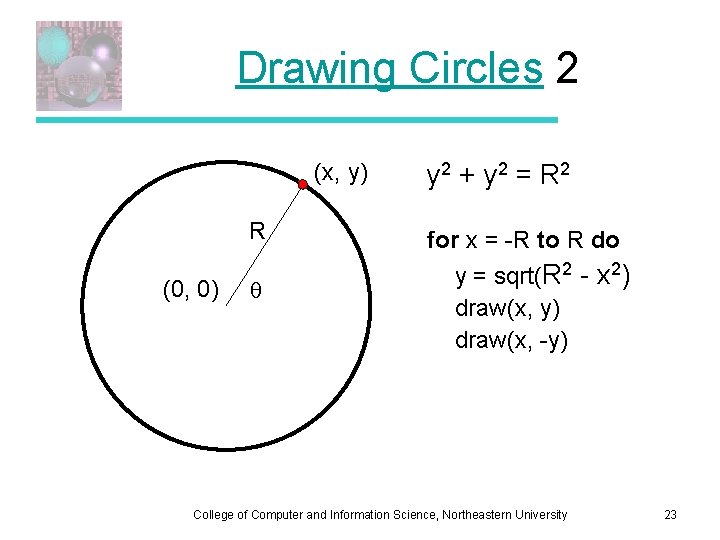
Drawing Circles 2 (x, y) R (0, 0) y 2 + y 2 = R 2 for x = -R to R do y = sqrt(R 2 - x 2) draw(x, y) draw(x, -y) College of Computer and Information Science, Northeastern University 23
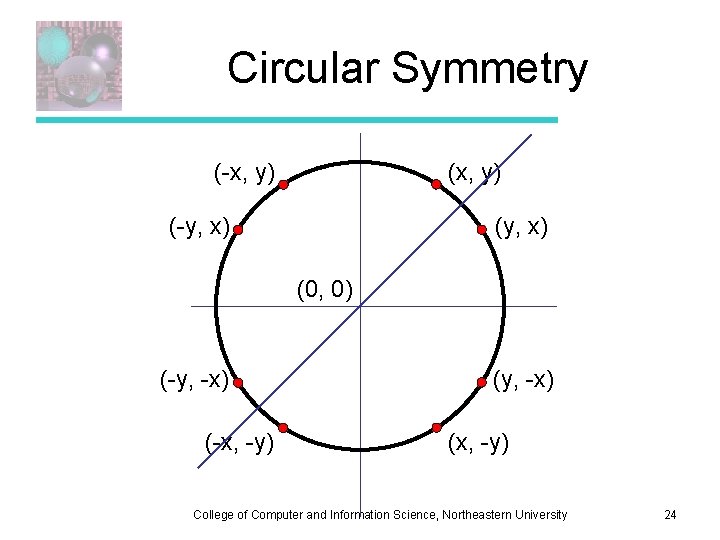
Circular Symmetry (-x, y) (-y, x) (0, 0) (-y, -x) (-x, -y) (y, -x) (x, -y) College of Computer and Information Science, Northeastern University 24
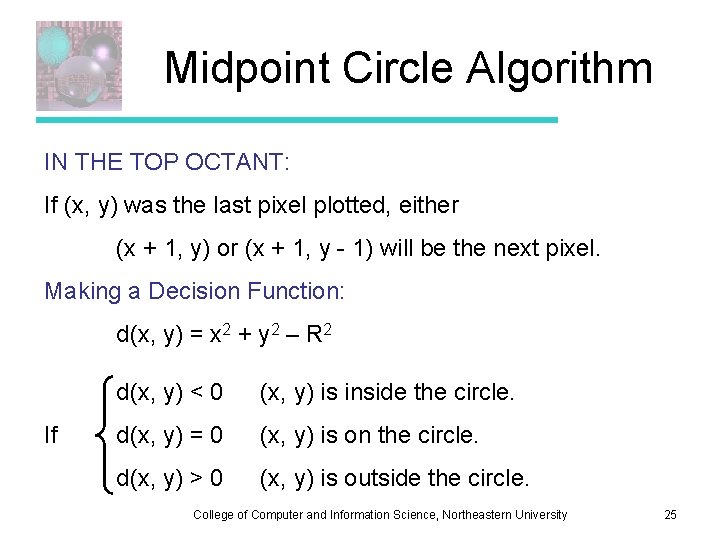
Midpoint Circle Algorithm IN THE TOP OCTANT: If (x, y) was the last pixel plotted, either (x + 1, y) or (x + 1, y - 1) will be the next pixel. Making a Decision Function: d(x, y) = x 2 + y 2 – R 2 If d(x, y) < 0 (x, y) is inside the circle. d(x, y) = 0 (x, y) is on the circle. d(x, y) > 0 (x, y) is outside the circle. College of Computer and Information Science, Northeastern University 25
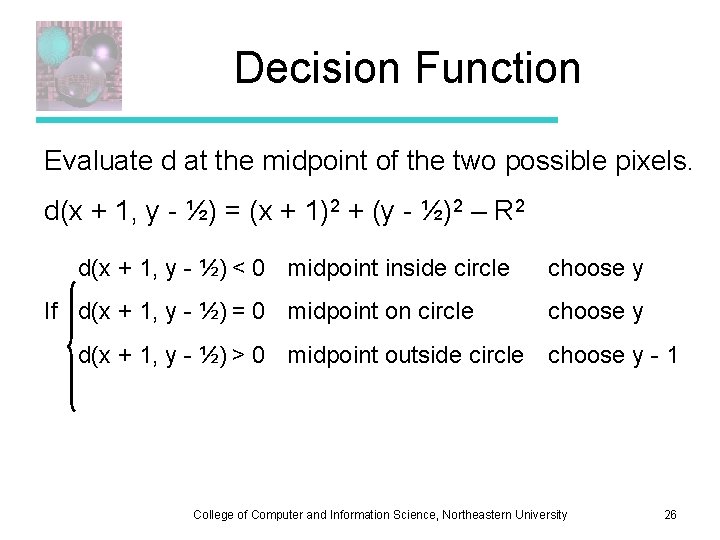
Decision Function Evaluate d at the midpoint of the two possible pixels. d(x + 1, y - ½) = (x + 1)2 + (y - ½)2 – R 2 d(x + 1, y - ½) < 0 midpoint inside circle If d(x + 1, y - ½) = 0 midpoint on circle choose y d(x + 1, y - ½) > 0 midpoint outside circle choose y - 1 College of Computer and Information Science, Northeastern University 26
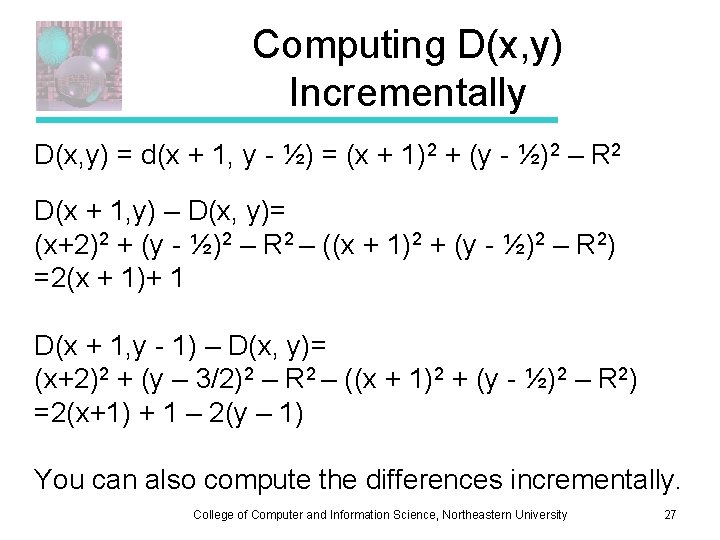
Computing D(x, y) Incrementally D(x, y) = d(x + 1, y - ½) = (x + 1)2 + (y - ½)2 – R 2 D(x + 1, y) – D(x, y)= (x+2)2 + (y - ½)2 – R 2 – ((x + 1)2 + (y - ½)2 – R 2) =2(x + 1)+ 1 D(x + 1, y - 1) – D(x, y)= (x+2)2 + (y – 3/2)2 – R 2 – ((x + 1)2 + (y - ½)2 – R 2) =2(x+1) + 1 – 2(y – 1) You can also compute the differences incrementally. College of Computer and Information Science, Northeastern University 27
Time for a Break College of Computer and Information Science, Northeastern University 28
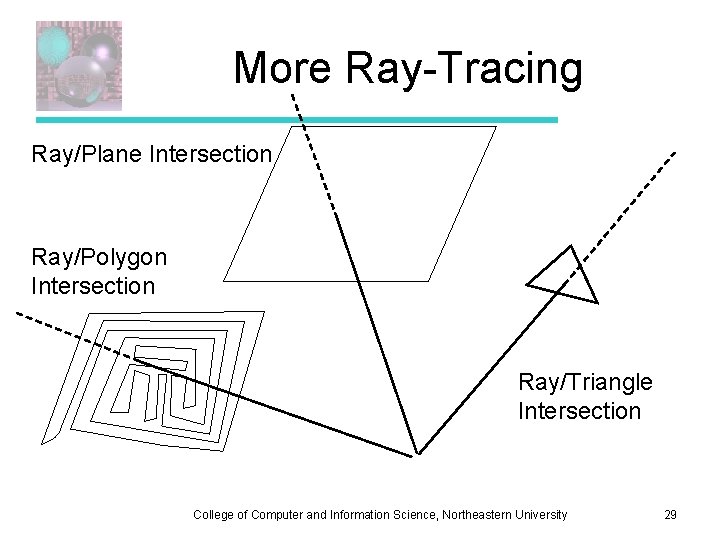
More Ray-Tracing Ray/Plane Intersection Ray/Polygon Intersection Ray/Triangle Intersection College of Computer and Information Science, Northeastern University 29
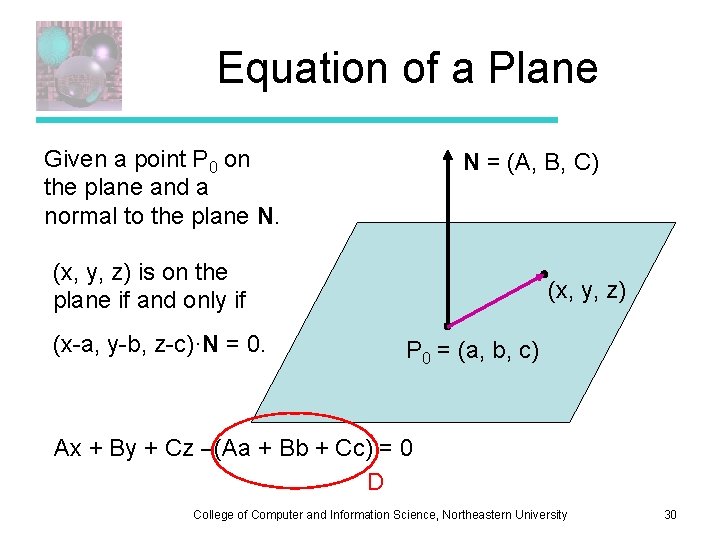
Equation of a Plane Given a point P 0 on the plane and a normal to the plane N. N = (A, B, C) (x, y, z) is on the plane if and only if (x-a, y-b, z-c)·N = 0. (x, y, z) P 0 = (a, b, c) Ax + By + Cz –(Aa + Bb + Cc) = 0 D College of Computer and Information Science, Northeastern University 30
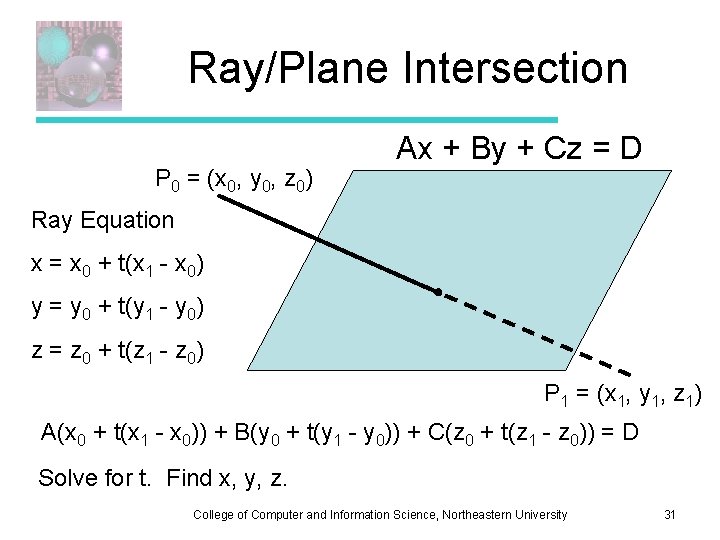
Ray/Plane Intersection P 0 = (x 0, y 0, z 0) Ax + By + Cz = D Ray Equation x = x 0 + t(x 1 - x 0) y = y 0 + t(y 1 - y 0) z = z 0 + t(z 1 - z 0) P 1 = (x 1, y 1, z 1) A(x 0 + t(x 1 - x 0)) + B(y 0 + t(y 1 - y 0)) + C(z 0 + t(z 1 - z 0)) = D Solve for t. Find x, y, z. College of Computer and Information Science, Northeastern University 31
Planes in Your Scenes • Planes are specified by § A, B, C, D or by N and P § Color and other coefficients are as for spheres • To search for the nearest object, go through all the spheres and planes and find the smallest t. • A plane will not be visible if the normal vector (A, B, C) points away from the light. College of Computer and Information Science, Northeastern University 32
Ray/Triangle Intersection Using the Ray/Plane intersection: § Given the three vertices of the triangle, • Find N, the normal to the plane containing the triangle. • Use N and one of the triangle vertices to describe the plane, i. e. Find A, B, C, and D. • If the Ray intersects the Plane, find the intersection point and its and . • If 0 and + 1, the Ray hits the Triangle. College of Computer and Information Science, Northeastern University 33
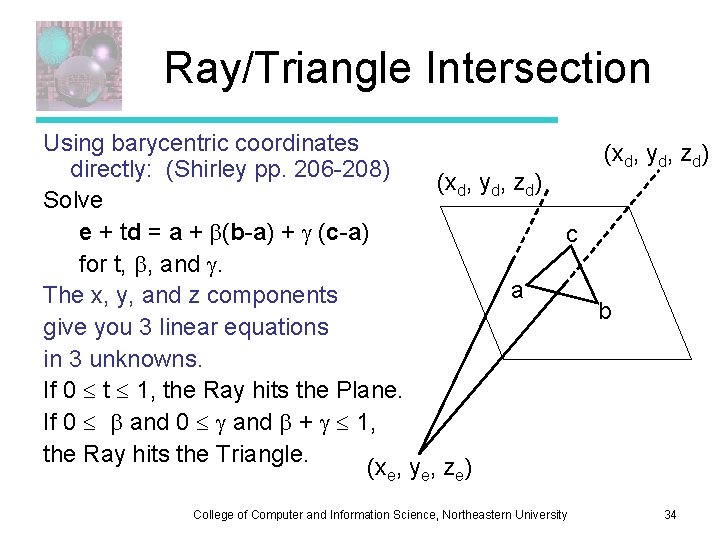
Ray/Triangle Intersection Using barycentric coordinates directly: (Shirley pp. 206 -208) (xd, yd, zd) Solve e + td = a + (b-a) + (c-a) for t, , and . a The x, y, and z components give you 3 linear equations in 3 unknowns. If 0 t 1, the Ray hits the Plane. If 0 and + 1, the Ray hits the Triangle. (xe, ye, ze) (xd, yd, zd) c College of Computer and Information Science, Northeastern University b 34
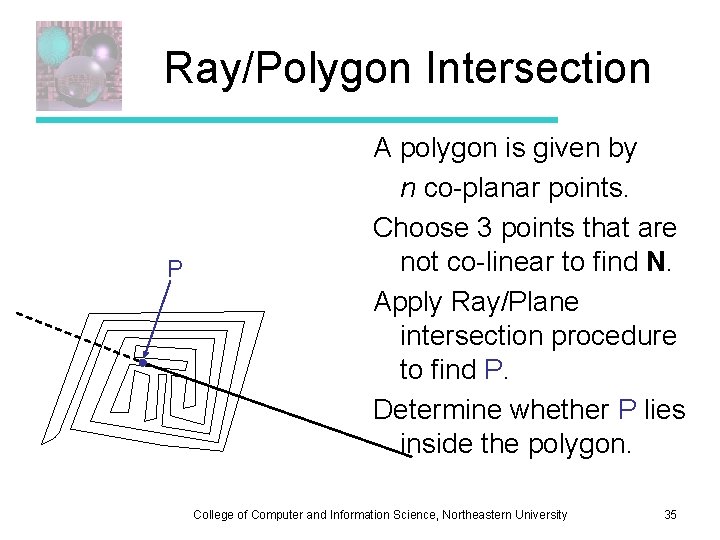
Ray/Polygon Intersection P A polygon is given by n co-planar points. Choose 3 points that are not co-linear to find N. Apply Ray/Plane intersection procedure to find P. Determine whether P lies inside the polygon. College of Computer and Information Science, Northeastern University 35
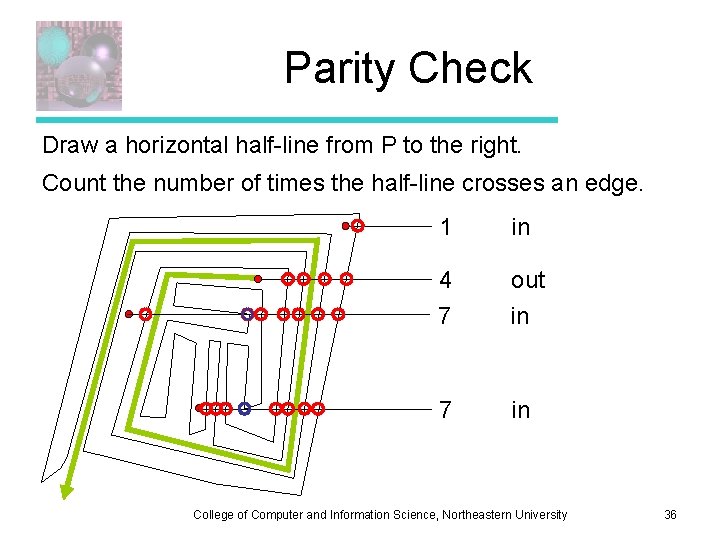
Parity Check Draw a horizontal half-line from P to the right. Count the number of times the half-line crosses an edge. 1 in 4 7 out in 7 in College of Computer and Information Science, Northeastern University 36
Images with Planes and Polygons College of Computer and Information Science, Northeastern University 37
Images with Planes and Polygons College of Computer and Information Science, Northeastern University 38
Scan Line Polygon Fill College of Computer and Information Science, Northeastern University 39
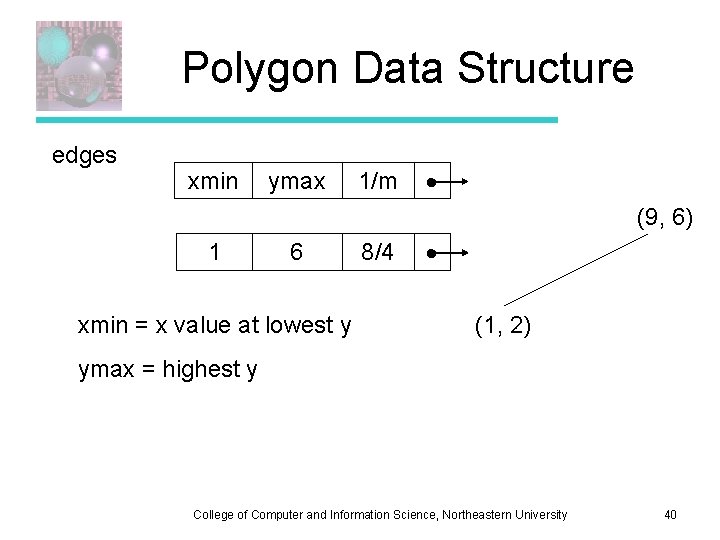
Polygon Data Structure edges xmin ymax 1/m (9, 6) 1 6 xmin = x value at lowest y 8/4 (1, 2) ymax = highest y College of Computer and Information Science, Northeastern University 40
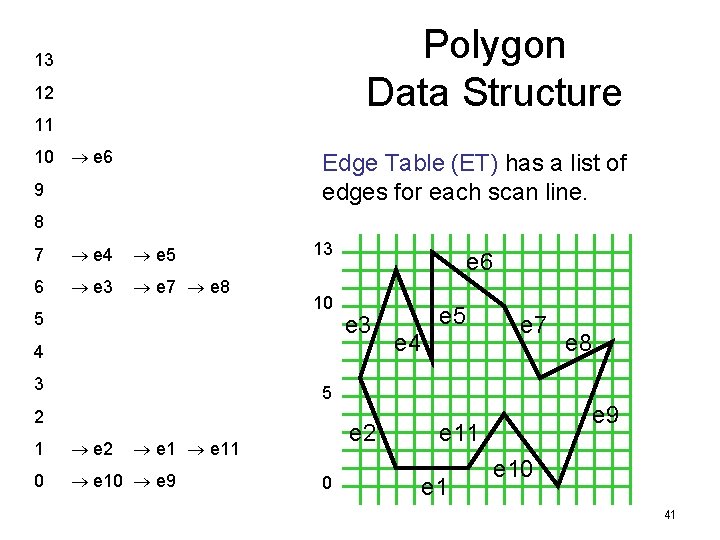
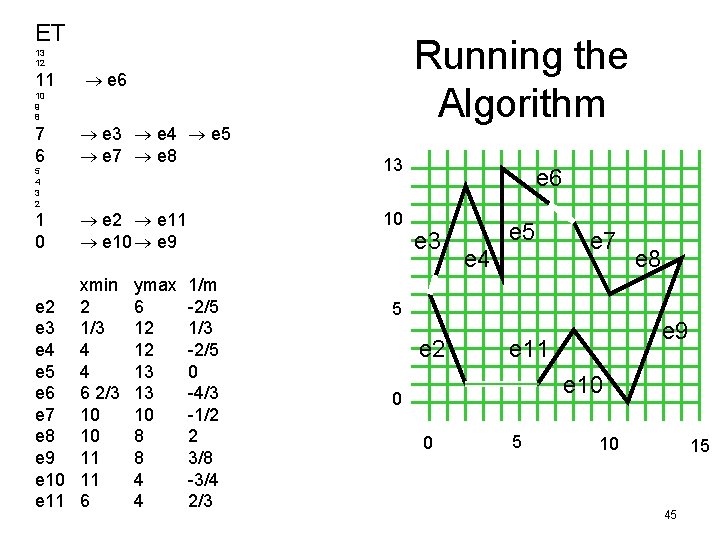
Polygon Data Structure 13 12 11 10 e 6 Edge Table (ET) has a list of edges for each scan line. 9 8 7 e 4 e 5 6 e 3 e 7 e 8 5 13 10 e 6 e 3 4 3 e 5 e 4 e 7 5 2 1 e 2 0 e 10 e 9 e 2 e 11 0 e 9 e 11 e 8 e 10 41
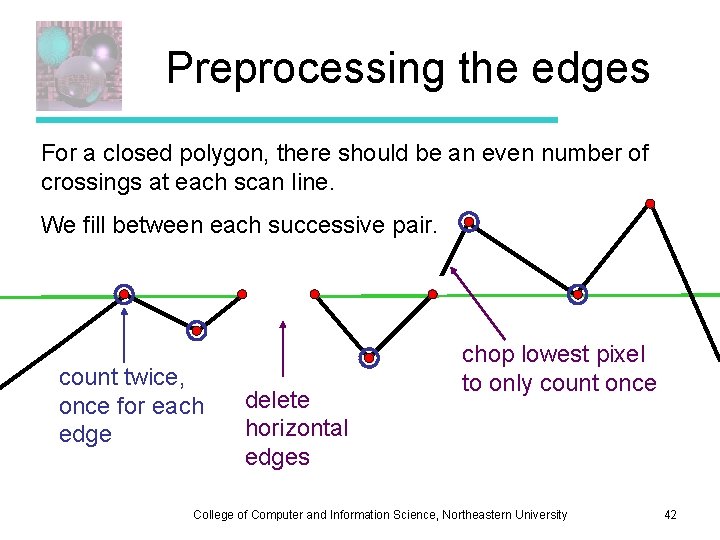
Preprocessing the edges For a closed polygon, there should be an even number of crossings at each scan line. We fill between each successive pair. count twice, once for each edge delete horizontal edges chop lowest pixel to only count once College of Computer and Information Science, Northeastern University 42
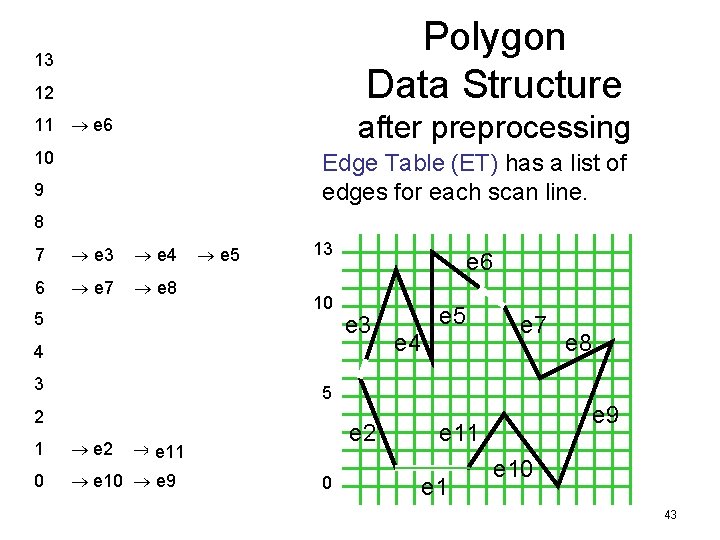
Polygon Data Structure 13 12 after preprocessing 11 e 6 10 e 6 Edge Table (ET) has a list of edges for each scan line. 9 8 7 e 4 e 3 e 5 e 4 6 e 3 e 7 e 8 e 5 5 13 10 e 6 e 3 4 3 e 5 e 4 e 7 5 2 1 e 2 0 e 10 e 9 e 2 e 11 e 11 0 e 9 e 11 e 8 e 10 43
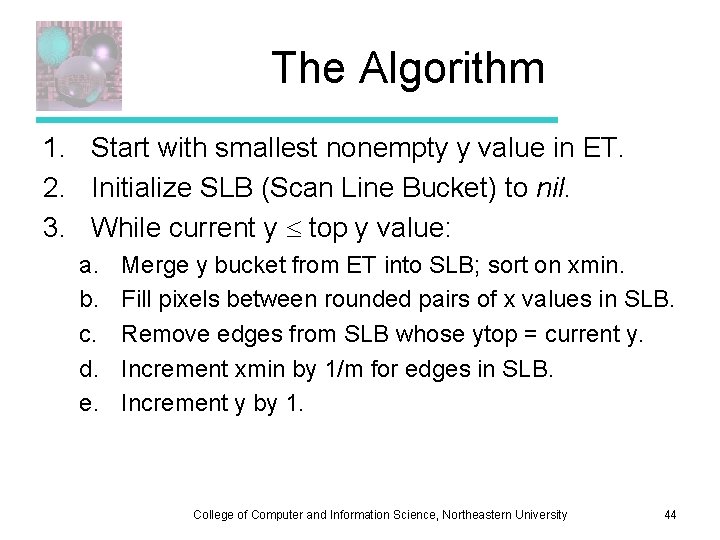
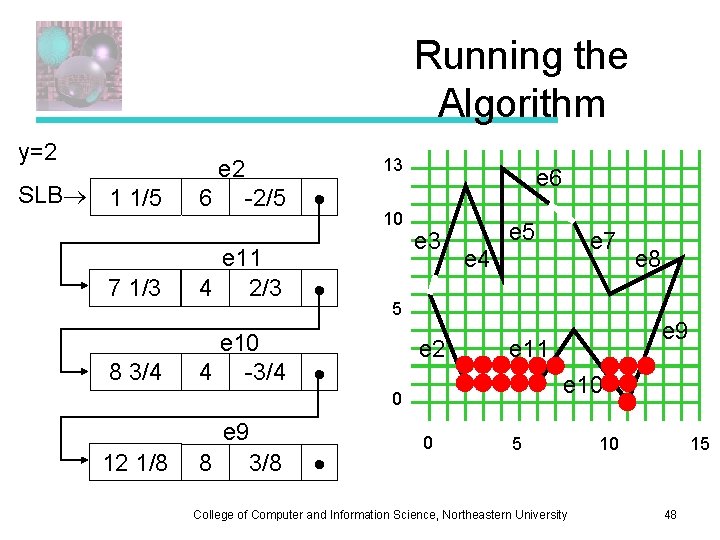
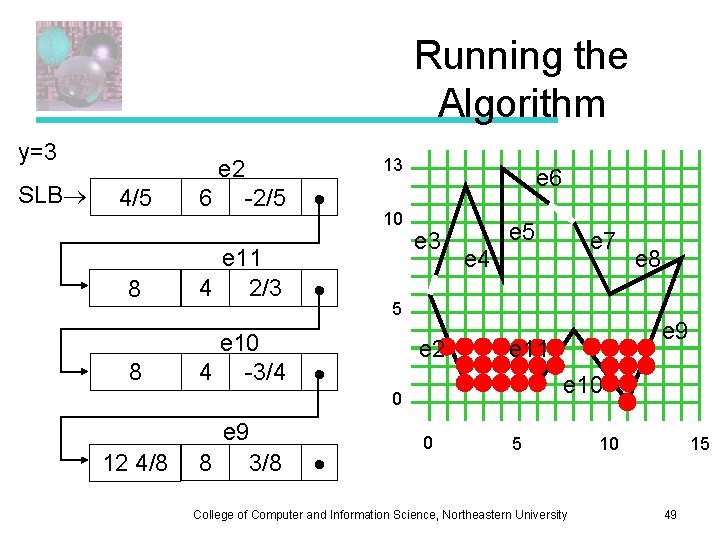
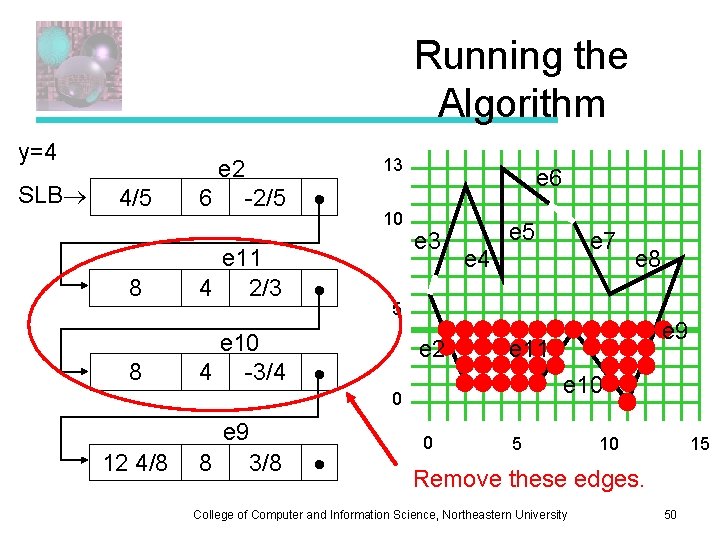
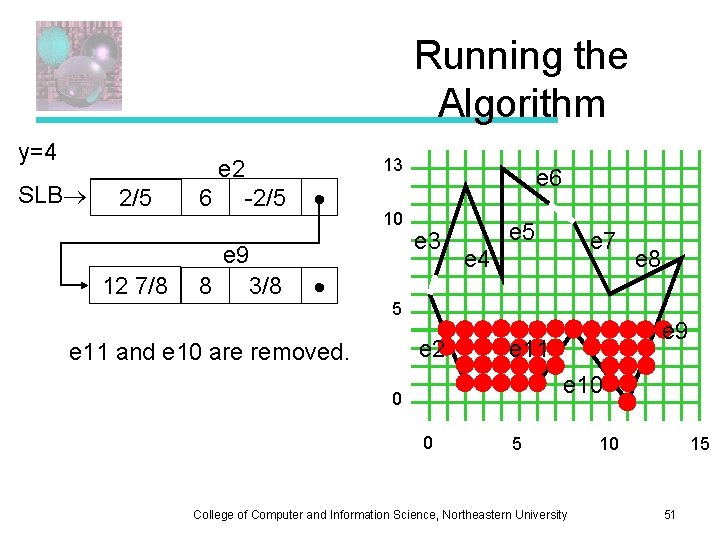
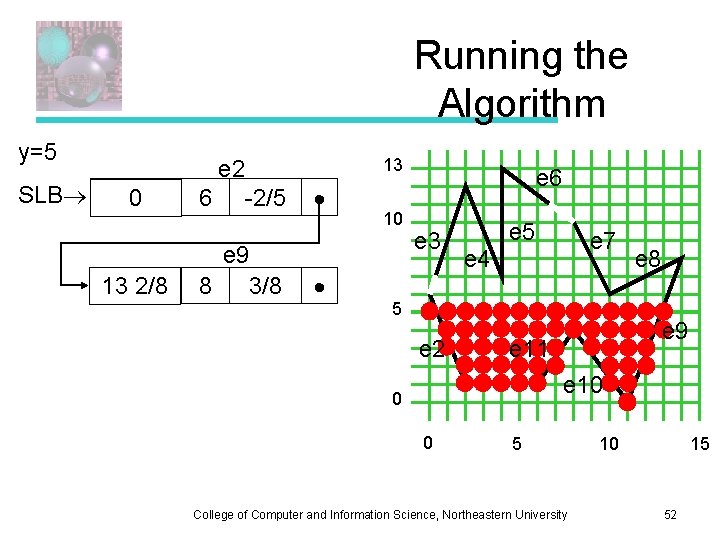
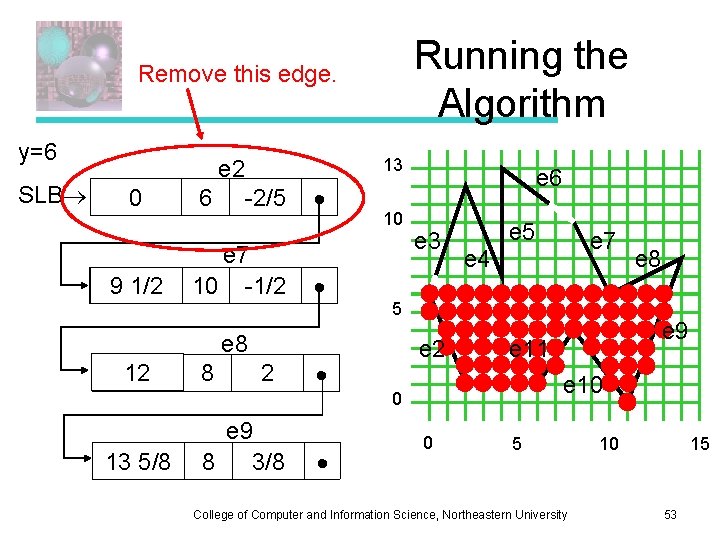
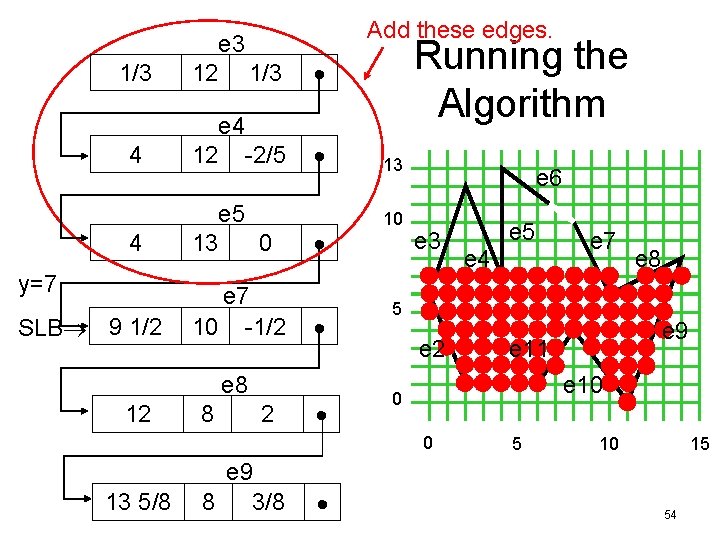
The Algorithm 1. Start with smallest nonempty y value in ET. 2. Initialize SLB (Scan Line Bucket) to nil. 3. While current y top y value: a. b. c. d. e. Merge y bucket from ET into SLB; sort on xmin. Fill pixels between rounded pairs of x values in SLB. Remove edges from SLB whose ytop = current y. Increment xmin by 1/m for edges in SLB. Increment y by 1. College of Computer and Information Science, Northeastern University 44
ET 13 12 11 10 9 8 7 6 5 4 3 2 1 0 Running the Algorithm e 6 e 3 e 4 e 5 e 7 e 8 e 2 e 11 e 10 e 9 xmin e 2 2 e 3 1/3 e 4 4 e 5 4 e 6 6 2/3 e 7 10 e 8 10 e 9 11 e 10 11 e 11 6 ymax 6 12 12 13 13 10 8 8 4 4 13 10 1/m -2/5 1/3 -2/5 0 -4/3 -1/2 2 3/8 -3/4 2/3 e 6 e 3 e 5 e 4 e 7 5 e 2 e 8 e 9 e 11 e 10 0 0 5 10 15 45
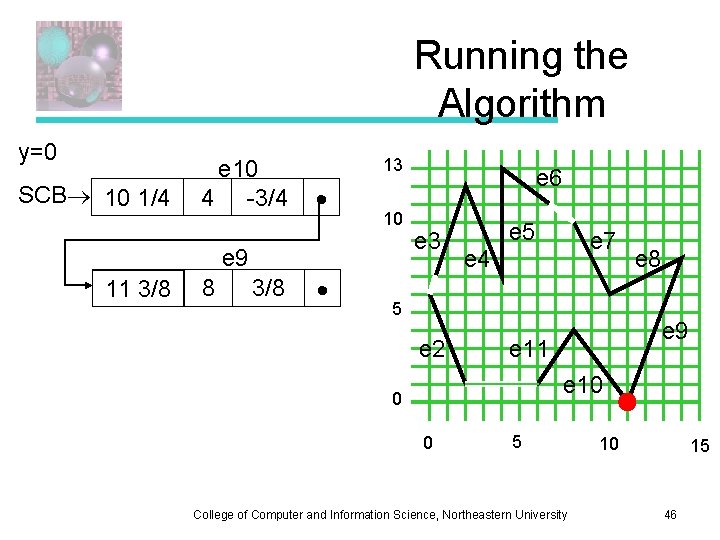
Running the Algorithm y=0 SCB 1011 1/4 e 10 4 -3/4 13 10 e 9 1111 3/8 8 3/8 e 6 e 3 e 5 e 7 e 4 5 e 2 e 8 e 9 e 11 e 10 0 0 5 College of Computer and Information Science, Northeastern University 10 15 46
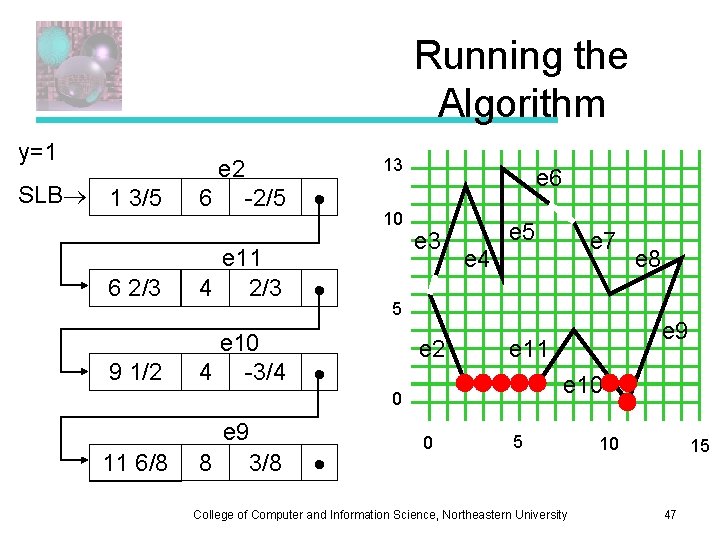
Running the Algorithm y=1 SLB 1 3/5 2 e 2 6 -2/5 6 2/3 6 e 11 4 2/3 10 9 1/2 1/4 e 10 4 -3/4 13 10 e 6 e 3 e 5 e 4 5 e 2 6/8 11 3/8 e 9 e 11 e 10 0 e 9 8 3/8 e 7 0 5 College of Computer and Information Science, Northeastern University 10 15 47
Running the Algorithm y=2 SLB 1 3/5 1/5 e 2 6 -2/5 7 6 1/3 2/3 e 11 4 2/3 8 1/2 3/4 9 e 10 4 -3/4 13 10 e 6 e 3 e 5 e 4 5 e 2 12 6/8 11 e 8 e 9 e 11 e 10 0 e 9 8 3/8 e 7 0 5 College of Computer and Information Science, Northeastern University 10 15 48
Running the Algorithm y=3 SLB 14/5 1/5 e 2 6 -2/5 78 1/3 e 11 4 2/3 8 8 3/4 e 10 4 -3/4 13 10 e 6 e 3 e 5 e 4 5 e 2 1/8 12 4/8 e 9 e 11 e 10 0 e 9 8 3/8 e 7 0 5 College of Computer and Information Science, Northeastern University 10 15 49
Running the Algorithm y=4 SLB 4/5 e 2 6 -2/5 8 e 11 4 2/3 8 e 10 4 -3/4 13 10 e 6 e 3 e 5 e 4 12 4/8 e 2 e 8 5 e 9 e 11 e 10 0 e 9 8 3/8 e 7 0 5 10 15 Remove these edges. College of Computer and Information Science, Northeastern University 50
Running the Algorithm y=4 SLB 4/5 2/5 12 7/8 4/8 e 2 6 -2/5 e 9 8 3/8 13 10 e 6 e 3 e 5 e 7 e 4 5 e 2 e 11 and e 10 are removed. e 8 e 9 e 11 e 10 0 0 5 College of Computer and Information Science, Northeastern University 10 15 51
Running the Algorithm y=5 SLB 2/5 0 12 2/8 7/8 13 e 2 6 -2/5 e 9 8 3/8 13 10 e 6 e 3 e 5 e 7 e 4 5 e 2 e 8 e 9 e 11 e 10 0 0 5 College of Computer and Information Science, Northeastern University 10 15 52
Running the Algorithm Remove this edge. y=6 SLB 0 910 1/2 e 2 6 -2/5 e 7 10 -1/2 13 10 8 2 e 3 e 5 e 4 e 2 13 2/8 5/8 e 9 e 11 e 10 0 e 9 8 3/8 e 7 5 e 8 12 10 e 6 0 5 College of Computer and Information Science, Northeastern University 10 15 53
Add these edges. 1/3 e 3 12 1/3 4 e 4 12 -2/5 4 e 5 13 0 y=7 SLB 9 1/2 e 7 10 -1/2 e 8 12 8 2 Running the Algorithm 13 10 e 6 e 3 13 5/8 e 4 e 7 5 e 2 e 8 e 9 e 11 e 10 0 0 e 9 8 3/8 e 5 5 10 15 54