
CS Club Meeting 4 101013 Meeting Topic Integers
CS Club Meeting 4 10/10/13
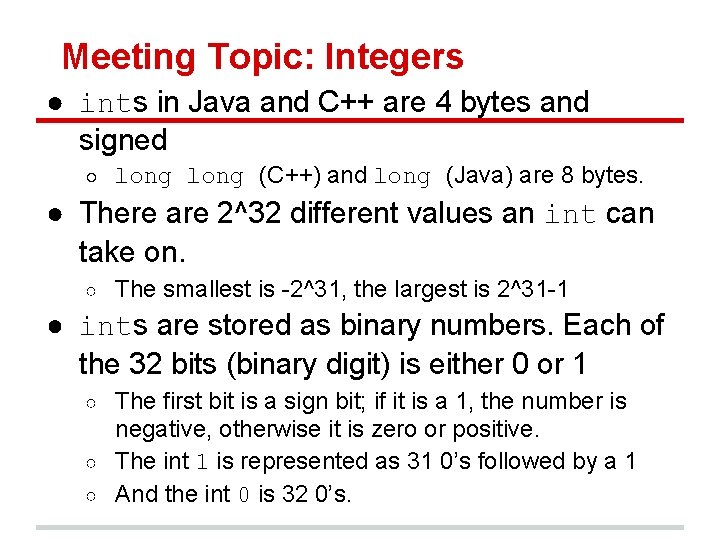
Meeting Topic: Integers ● ints in Java and C++ are 4 bytes and signed ○ long (C++) and long (Java) are 8 bytes. ● There are 2^32 different values an int can take on. ○ The smallest is -2^31, the largest is 2^31 -1 ● ints are stored as binary numbers. Each of the 32 bits (binary digit) is either 0 or 1 The first bit is a sign bit; if it is a 1, the number is negative, otherwise it is zero or positive. ○ The int 1 is represented as 31 0’s followed by a 1 ○ And the int 0 is 32 0’s. ○
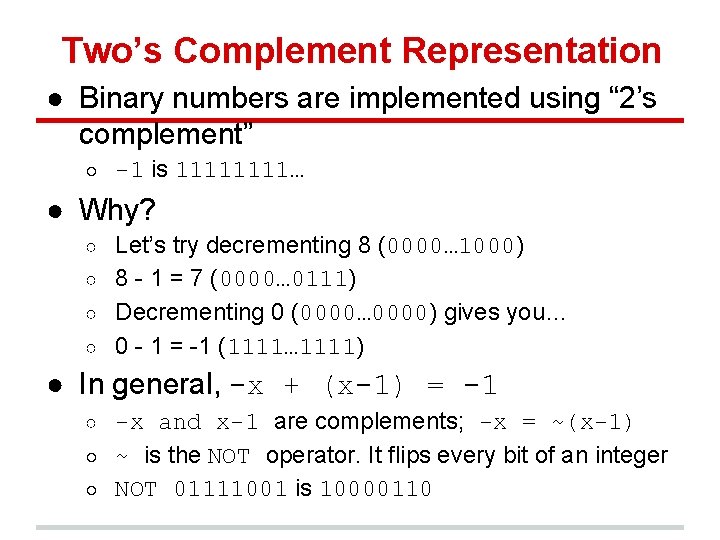
Two’s Complement Representation ● Binary numbers are implemented using “ 2’s complement” ○ -1 is 1111… ● Why? Let’s try decrementing 8 (0000… 1000) ○ 8 - 1 = 7 (0000… 0111) ○ Decrementing 0 (0000… 0000) gives you… ○ 0 - 1 = -1 (1111… 1111) ○ ● In general, -x + (x-1) = -1 -x and x-1 are complements; -x = ~(x-1) ○ ~ is the NOT operator. It flips every bit of an integer ○ NOT 01111001 is 10000110 ○
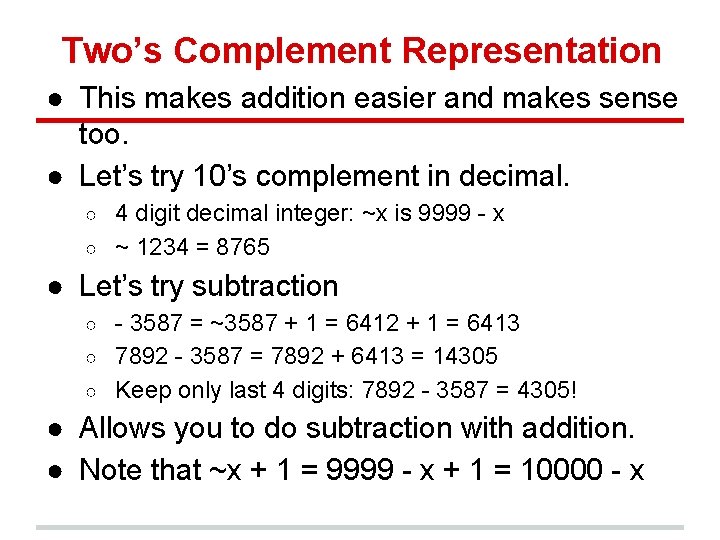
Two’s Complement Representation ● This makes addition easier and makes sense too. ● Let’s try 10’s complement in decimal. 4 digit decimal integer: ~x is 9999 - x ○ ~ 1234 = 8765 ○ ● Let’s try subtraction - 3587 = ~3587 + 1 = 6412 + 1 = 6413 ○ 7892 - 3587 = 7892 + 6413 = 14305 ○ Keep only last 4 digits: 7892 - 3587 = 4305! ○ ● Allows you to do subtraction with addition. ● Note that ~x + 1 = 9999 - x + 1 = 10000 - x

Integer Overflow ● Integer overflow is when arithmetic attempts to create a value that is too large ● Arithmetic with large integers often leads to overflow ○ If you do 100000 * 100000, you won’t get 100000 because that doesn’t fit in an int ○ In fact, you’ll get 1410065408 (10^10 mod 2^32) ○ Be careful, even if you use a long! int x = 100000; long y = x * x;
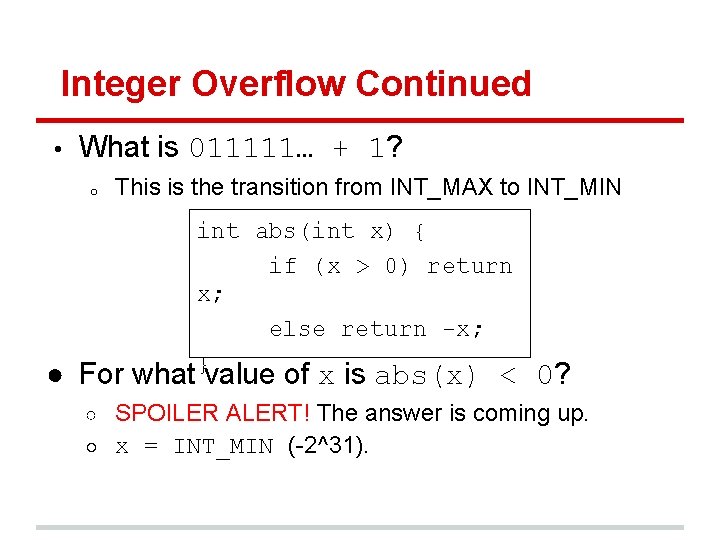
Integer Overflow Continued • What is 011111… + 1? o This is the transition from INT_MAX to INT_MIN int abs(int x) { if (x > 0) return x; else return -x; } ● For what value of x is abs(x) < 0? SPOILER ALERT! The answer is coming up. ○ x = INT_MIN (-2^31). ○
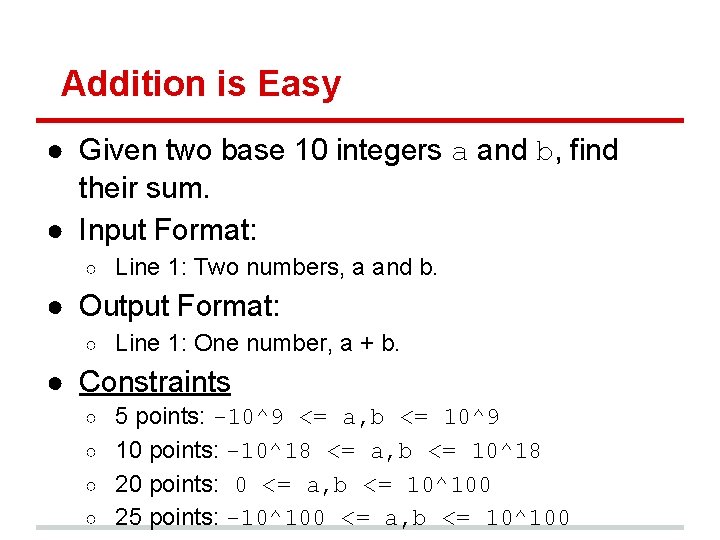
Addition is Easy ● Given two base 10 integers a and b, find their sum. ● Input Format: ○ Line 1: Two numbers, a and b. ● Output Format: ○ Line 1: One number, a + b. ● Constraints 5 points: -10^9 <= a, b <= 10^9 ○ 10 points: -10^18 <= a, b <= 10^18 ○ 20 points: 0 <= a, b <= 10^100 ○ 25 points: -10^100 <= a, b <= 10^100 ○
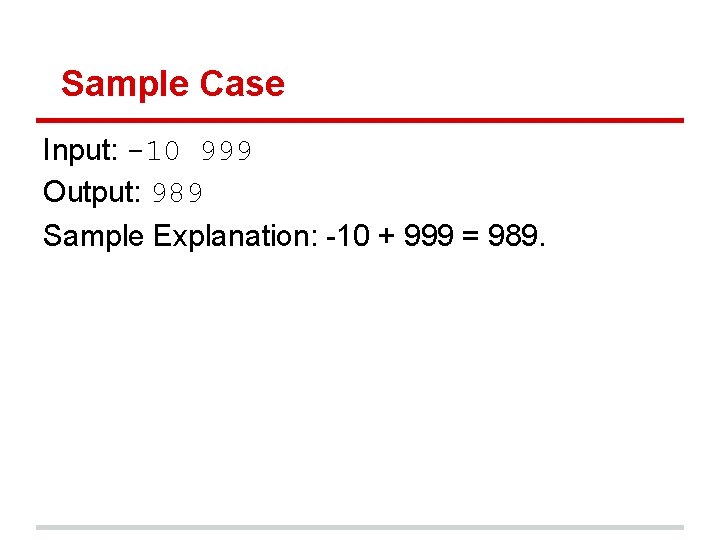
Sample Case Input: -10 999 Output: 989 Sample Explanation: -10 + 999 = 989.
- Slides: 8