
CS 854 Advanced Topics in Operating Systems Instructor
- Slides: 10
CS 854: Advanced Topics in Operating Systems Instructor: Ali Mashtizadeh
Overview Website: https: //cs. uwaterloo. ca/~mashti/cs 854 -f 17/ Piazza: https: //piazza. com/class/j 7 aoc 9 b 46 mc 6 q 6 Email: mashti@uwaterloo. ca All handouts and lecture notes will be online Please print them yourselves
Prerequirements Assume familiarity with C, UNIX, etc. Have taken an undergraduate course in operating systems
Grading (tentative) 25% Class Participation 25% Paper Summaries/Presentation 50% Project/Peer Reviews Expectations: Everyone must present papers in this class Everyone must read and be ready to discuss every paper
Paper Reading Everyone must read every paper before class Write ~1 page response due by email or in class Any key ideas and tools you could use in other work? Anything you agree/disagree with? Or would do differently? Any assumptions you think do not apply today?
Group Project Choose a small sized research project that you complete in the term with a group of 2 -3 people Write a one page proposal with your teammates You could build a prototype system, expand an open source project, or conduct an evaluation of an existing system
Course Topics Synchronization & Multi-core Language-driven Design Security Storage and File Systems Virtual Machines
What is an operating system? Provides abstractions for the programmer Hides the details of hardware Manages hardware resources Providing higher level interfaces Provides protection Prevent one process/user damaging another process/user’s stuff
Why study operating systems? Operating systems are a maturing field Most people use a handful of mature OSes: Windows, Mac OS, Linux, Free. BSD, etc. Improving performance, power utilization, and security are all OS issues Virtual machines, embedded devices, unikernels provide opportunities for rethinking operating systems again
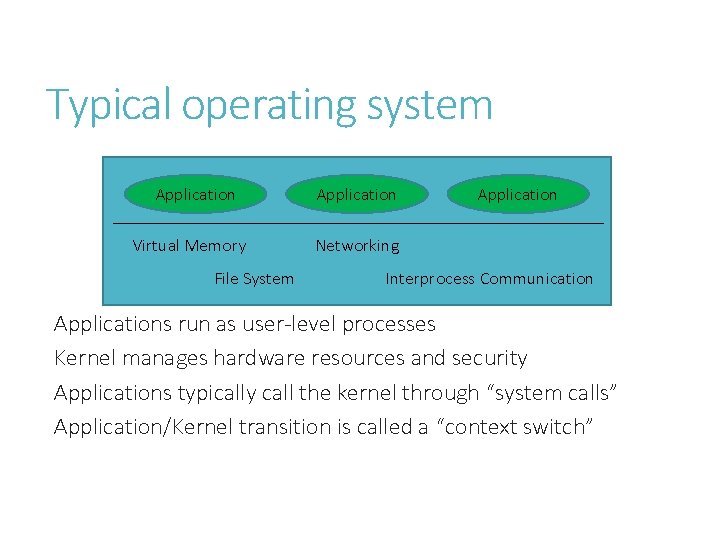
Typical operating system Application Virtual Memory File System Application Networking Interprocess Communication Applications run as user-level processes Kernel manages hardware resources and security Applications typically call the kernel through “system calls” Application/Kernel transition is called a “context switch”