
CS 6501 Computational Visual Recognition Machine Learning I
![Grading • Labs: 30% (4 labs [5%, 10%, 10%]) • Paper presentation + Paper](https://slidetodoc.com/presentation_image_h2/b1a519505d2926f98a5d5d0e7a963834/image-4.jpg "Grading • Labs: 30% (4 labs [5%, 10%, 10%]) • Paper presentation + Paper")
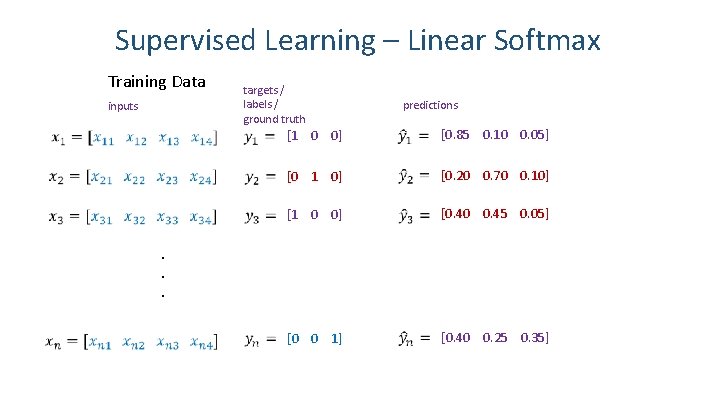
![Supervised Learning – Linear Softmax [1 0 0] 27](https://slidetodoc.com/presentation_image_h2/b1a519505d2926f98a5d5d0e7a963834/image-27.jpg "Supervised Learning – Linear Softmax [1 0 0] 27")
![How do we find a good w and b? [1 0 0] We need](https://slidetodoc.com/presentation_image_h2/b1a519505d2926f98a5d5d0e7a963834/image-28.jpg "How do we find a good w and b? [1 0 0] We need")

- Slides: 39
CS 6501: Computational Visual Recognition Machine Learning I & II
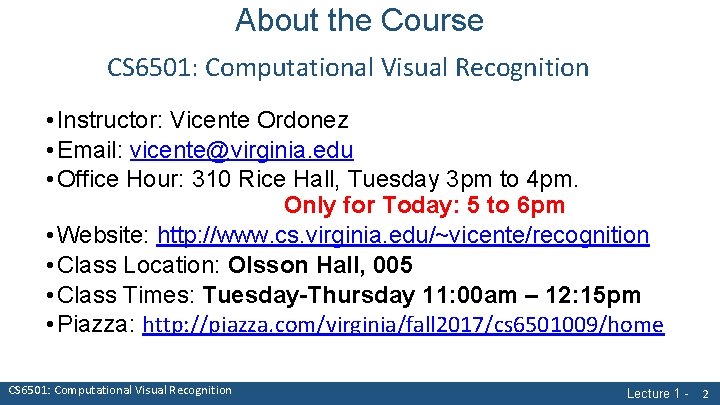
About the Course CS 6501: Computational Visual Recognition • Instructor: Vicente Ordonez • Email: vicente@virginia. edu • Office Hour: 310 Rice Hall, Tuesday 3 pm to 4 pm. Only for Today: 5 to 6 pm • Website: http: //www. cs. virginia. edu/~vicente/recognition • Class Location: Olsson Hall, 005 • Class Times: Tuesday-Thursday 11: 00 am – 12: 15 pm • Piazza: http: //piazza. com/virginia/fall 2017/cs 6501009/home CS 6501: Computational Visual Recognition Lecture 1 - 2
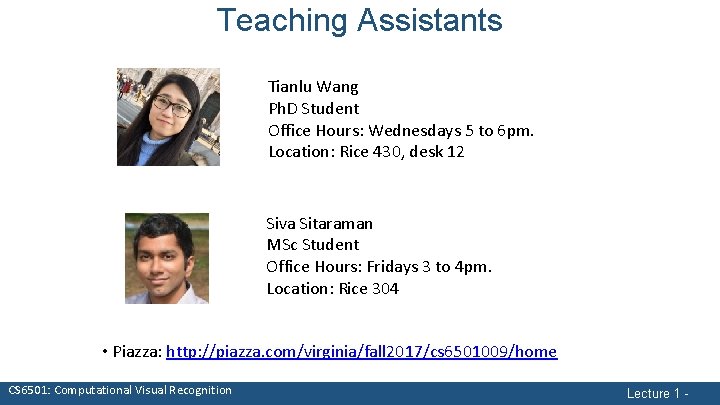
Teaching Assistants Tianlu Wang Ph. D Student Office Hours: Wednesdays 5 to 6 pm. Location: Rice 430, desk 12 Siva Sitaraman MSc Student Office Hours: Fridays 3 to 4 pm. Location: Rice 304 • Piazza: http: //piazza. com/virginia/fall 2017/cs 6501009/home CS 6501: Computational Visual Recognition Lecture 1 -
Grading • Labs: 30% (4 labs [5%, 10%, 10%]) • Paper presentation + Paper summaries: 10% • Quiz: 20% • Final project: 40% • No Late Assignments / Honor Code Reminder CS 6501: Computational Visual Recognition Lecture 1 - 4
Objectives for Today • Machine Learning Overview • Supervised vs Unsupervised Learning • Machine Learning as an Optimization Problem • Softmax Classifier • Stochastic Gradient Descent (SGD) CS 6501: Computational Visual Recognition Lecture 1 -
Machine Learning Machine learning is the subfield of computer science that gives "computers the ability to learn without being explicitly programmed. ” - term coined by Arthur Samuel 1959 while at IBM • The study of algorithms that can learn from data. • In contrast to previous Artificial Intelligence systems based on Logic, e. g. ”Expert Systems” CS 6501: Computational Visual Recognition Lecture 1 -
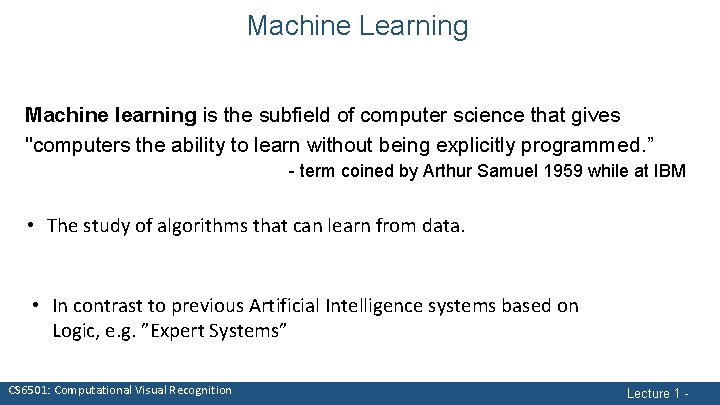
Supervised Learning vs Unsupervised Learning cat dog bear dog cat bear
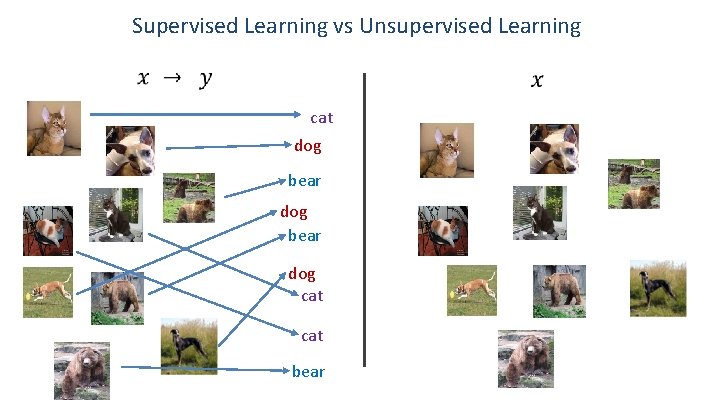
Supervised Learning vs Unsupervised Learning cat dog bear dog cat bear
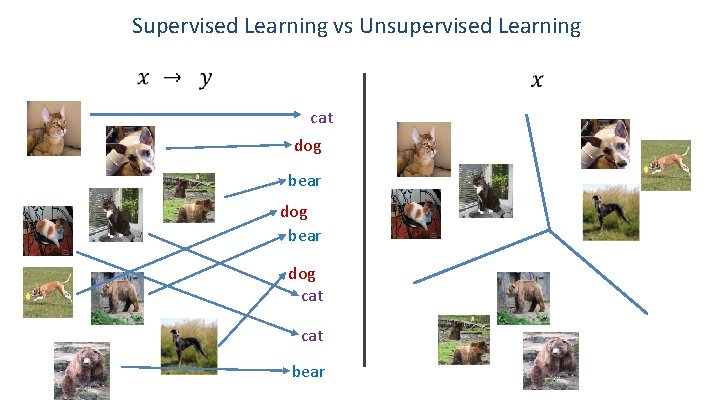
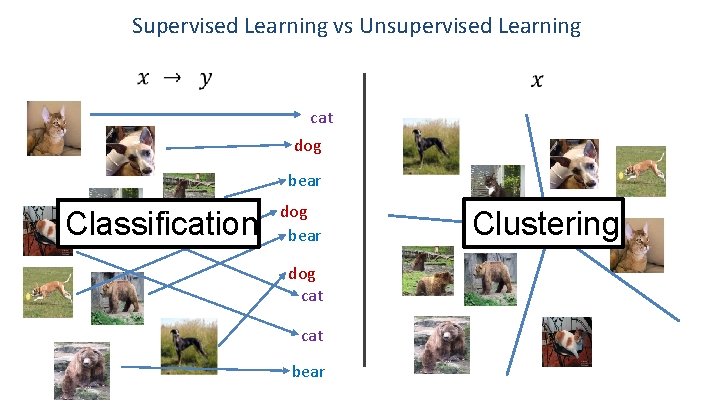
Supervised Learning vs Unsupervised Learning cat dog bear Classification dog bear dog cat bear Clustering
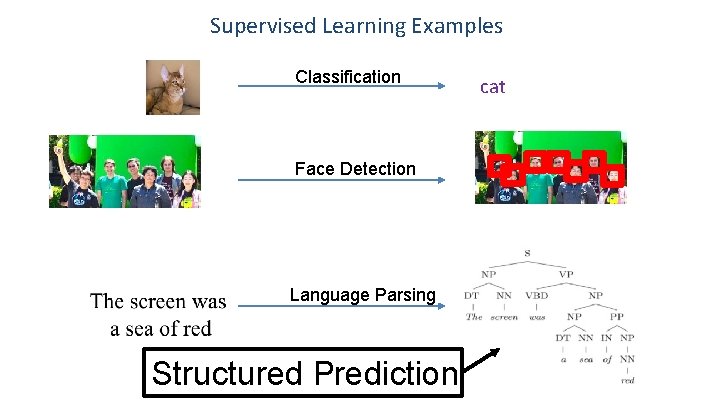
Supervised Learning Examples Classification Face Detection Language Parsing Structured Prediction cat
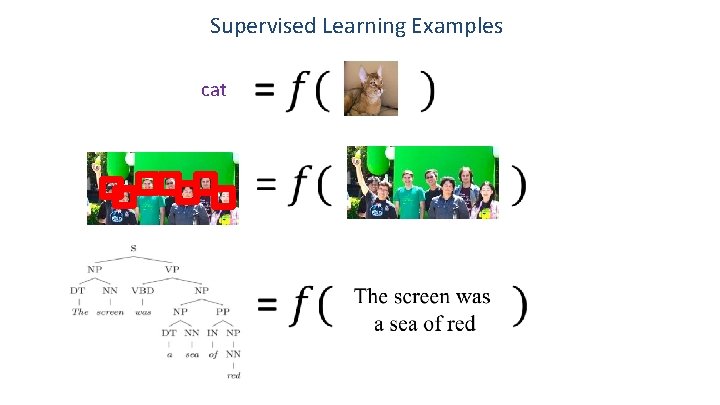
Supervised Learning Examples cat
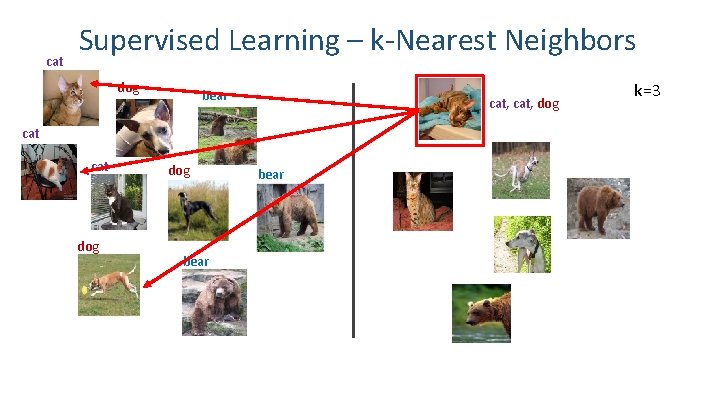
cat Supervised Learning – k-Nearest Neighbors dog bear cat, dog k=3 cat dog bear 12
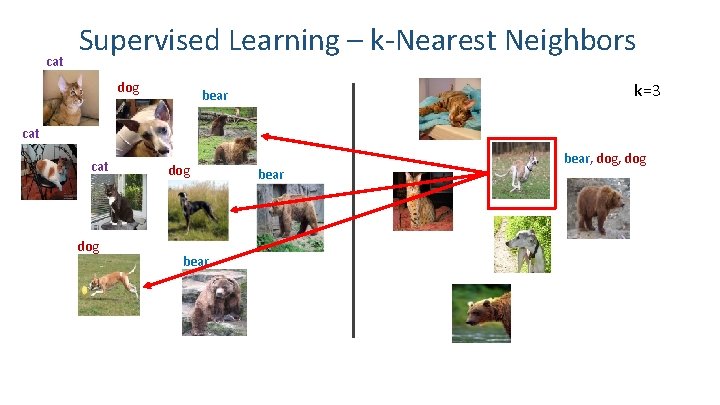
cat Supervised Learning – k-Nearest Neighbors dog k=3 bear cat dog bear, dog bear 13
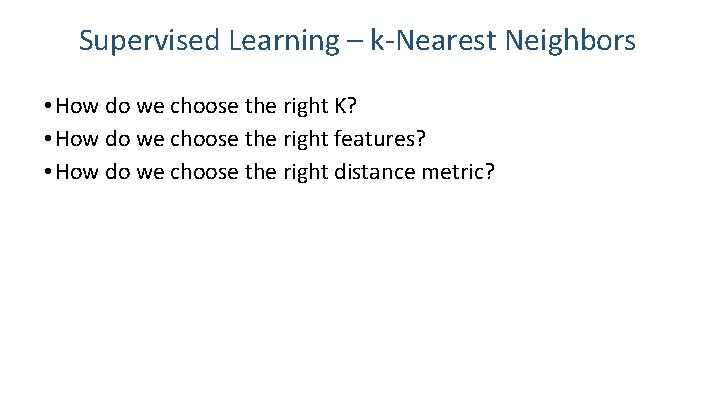
Supervised Learning – k-Nearest Neighbors • How do we choose the right K? • How do we choose the right features? • How do we choose the right distance metric? 14
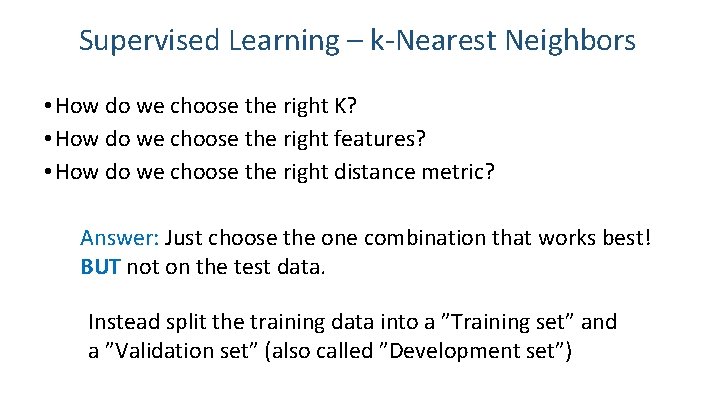
Supervised Learning – k-Nearest Neighbors • How do we choose the right K? • How do we choose the right features? • How do we choose the right distance metric? Answer: Just choose the one combination that works best! BUT not on the test data. Instead split the training data into a ”Training set” and a ”Validation set” (also called ”Development set”) 15
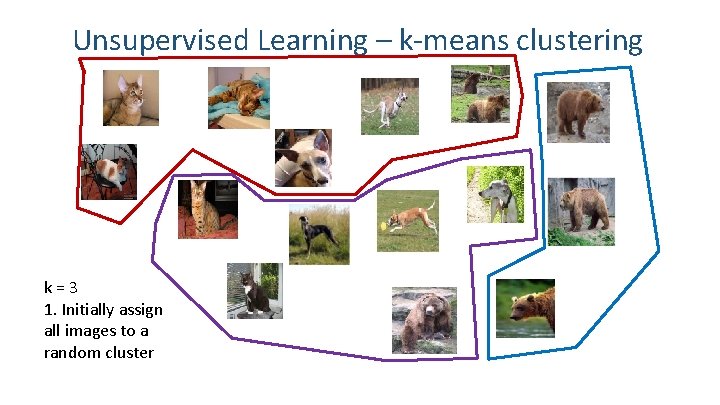
Unsupervised Learning – k-means clustering k=3 1. Initially assign all images to a random cluster 16
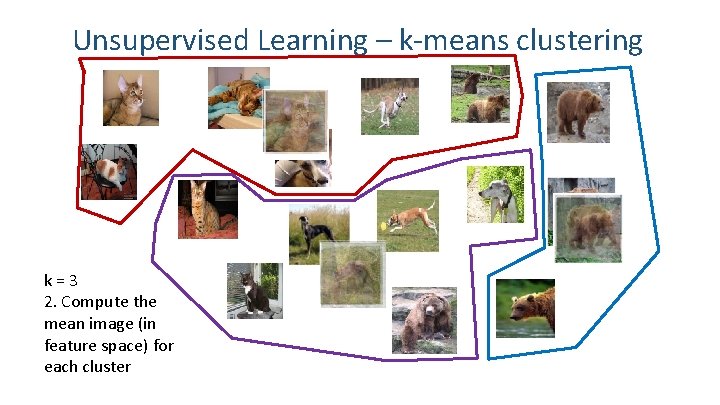
Unsupervised Learning – k-means clustering k=3 2. Compute the mean image (in feature space) for each cluster 17
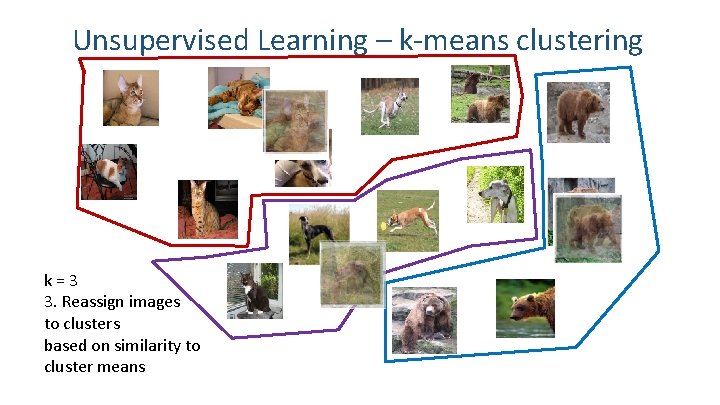
Unsupervised Learning – k-means clustering k=3 3. Reassign images to clusters based on similarity to cluster means 18
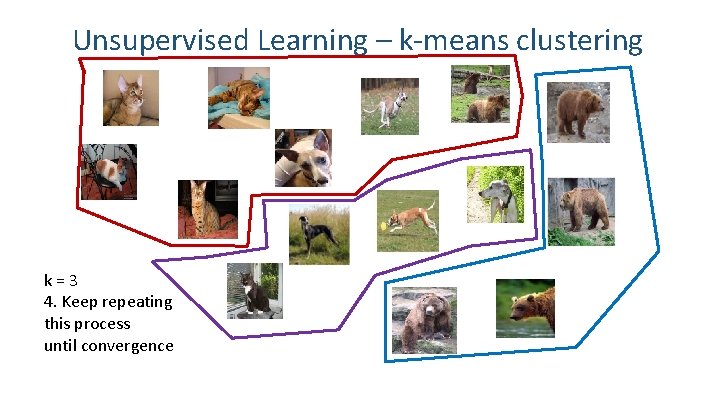
Unsupervised Learning – k-means clustering k=3 4. Keep repeating this process until convergence 19
Unsupervised Learning – k-Means clustering • How do we choose the right K? • How do we choose the right features? • How do we choose the right distance metric? • How sensitive is this method with respect to the random assignment of clusters? Answer: Just choose the one combination that works best! BUT not on the test data. Instead split the training data into a ”Training set” and a ”Validation set” (also called ”Development set”) 20
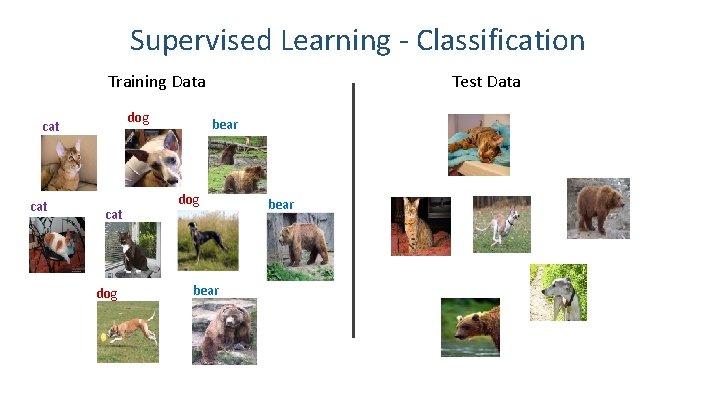
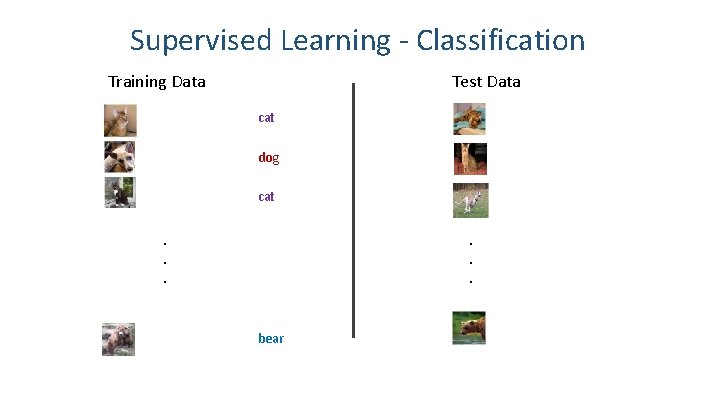
Supervised Learning - Classification Test Data Training Data dog cat cat dog bear 21
Supervised Learning - Classification Test Data Training Data cat dog cat . . . bear 22
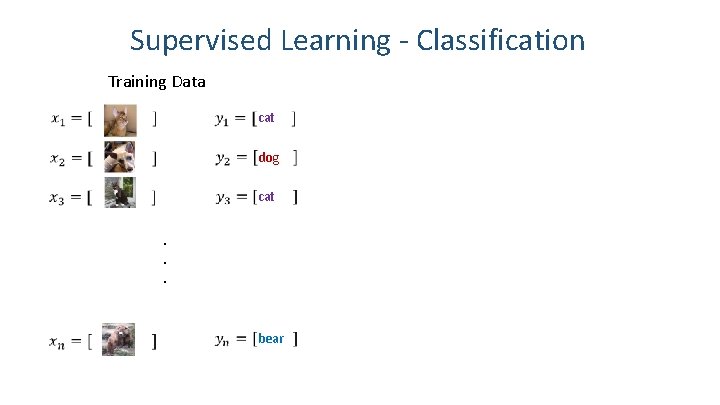
Supervised Learning - Classification Training Data cat dog cat . . . bear 23
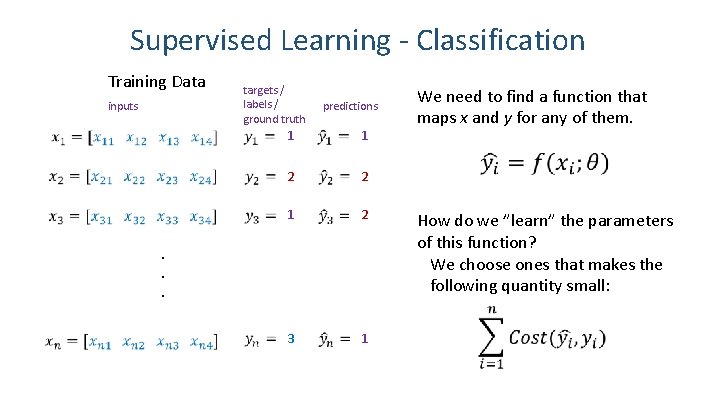
Supervised Learning - Classification Training Data inputs targets / labels / ground truth predictions 1 1 2 2 1 2 3 1 . . . We need to find a function that maps x and y for any of them. How do we ”learn” the parameters of this function? We choose ones that makes the following quantity small: 24
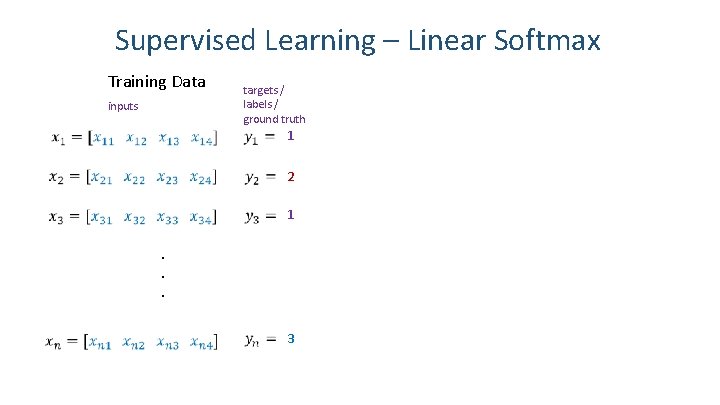
Supervised Learning – Linear Softmax Training Data inputs targets / labels / ground truth 1 2 1 . . . 3 25
Supervised Learning – Linear Softmax Training Data inputs targets / labels / ground truth predictions [1 0 0] [0. 85 0. 10 0. 05] [0 1 0] [0. 20 0. 70 0. 10] [1 0 0] [0. 40 0. 45 0. 05] [0 0 1] [0. 40 0. 25 0. 35] . . . 26
Supervised Learning – Linear Softmax [1 0 0] 27
How do we find a good w and b? [1 0 0] We need to find w, and b that minimize the following: Why? 28
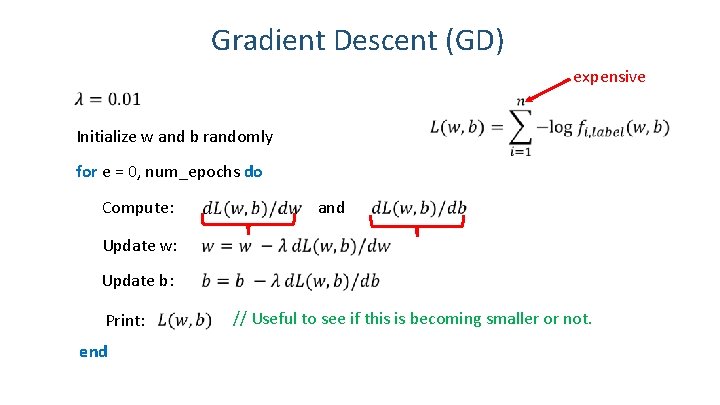
Gradient Descent (GD) expensive Initialize w and b randomly for e = 0, num_epochs do Compute: and Update w: Update b: Print: // Useful to see if this is becoming smaller or not. end 29
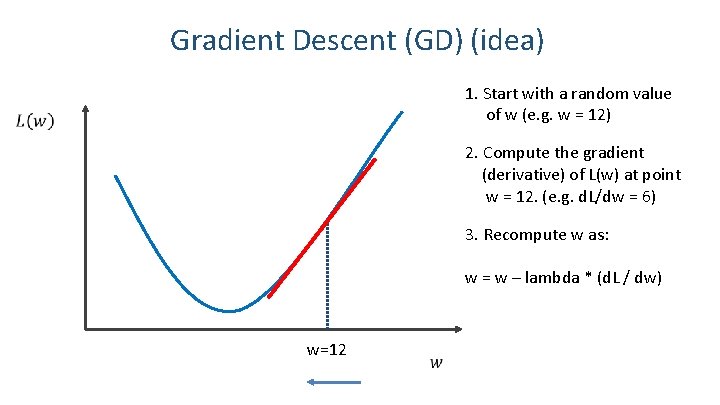
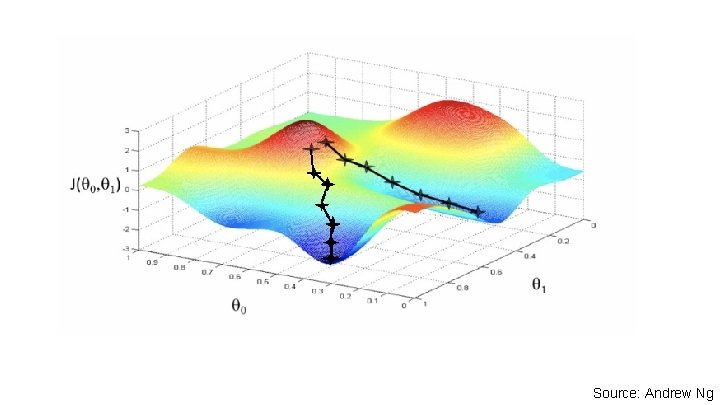
Gradient Descent (GD) (idea) 1. Start with a random value of w (e. g. w = 12) 2. Compute the gradient (derivative) of L(w) at point w = 12. (e. g. d. L/dw = 6) 3. Recompute w as: w = w – lambda * (d. L / dw) w=12 30
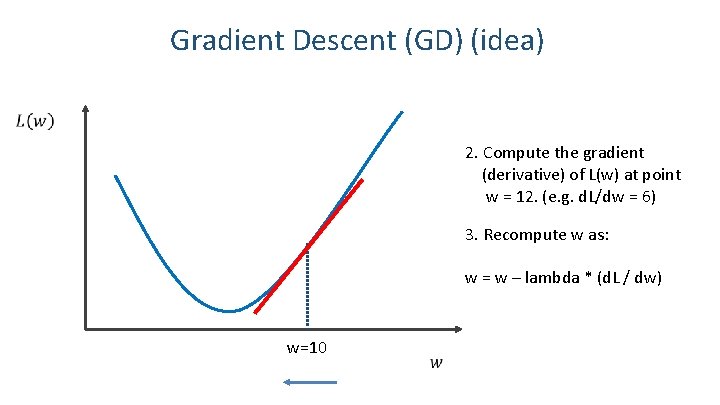
Gradient Descent (GD) (idea) 2. Compute the gradient (derivative) of L(w) at point w = 12. (e. g. d. L/dw = 6) 3. Recompute w as: w = w – lambda * (d. L / dw) w=10 31
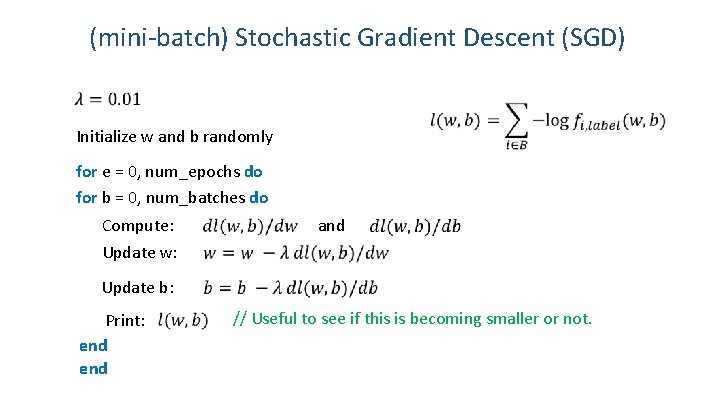
(mini-batch) Stochastic Gradient Descent (SGD) Initialize w and b randomly for e = 0, num_epochs do for b = 0, num_batches do Compute: Update w: and Update b: Print: end // Useful to see if this is becoming smaller or not. 32
Source: Andrew Ng
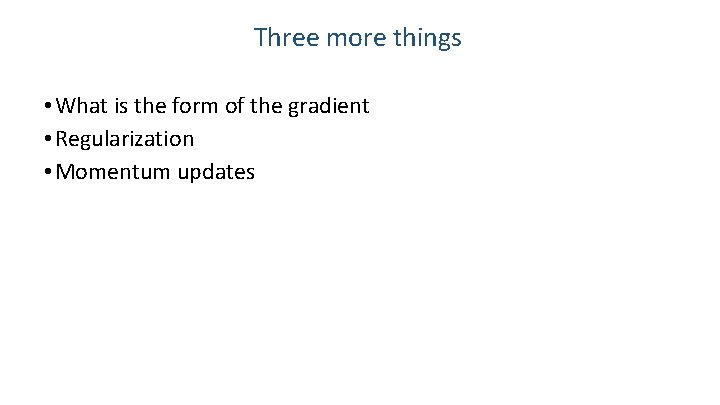
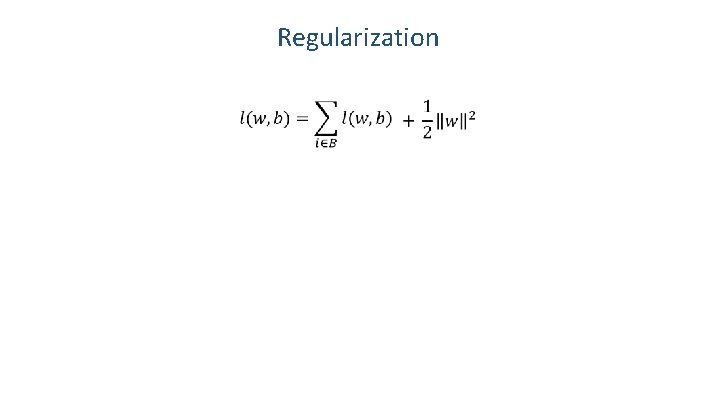
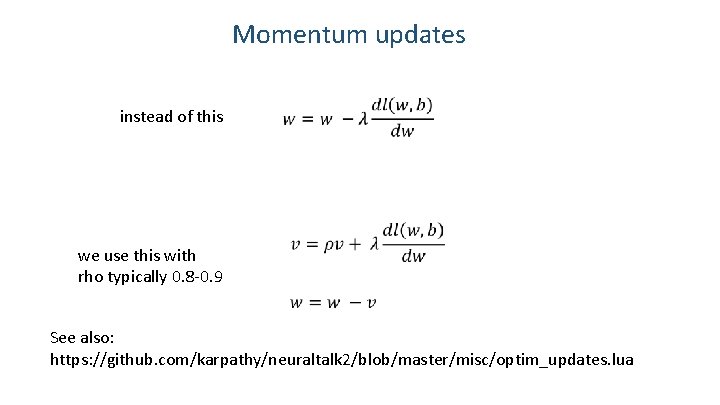
Three more things • What is the form of the gradient • Regularization • Momentum updates 34
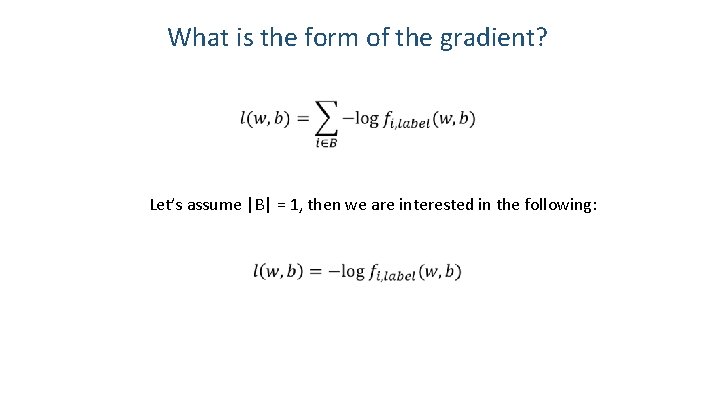
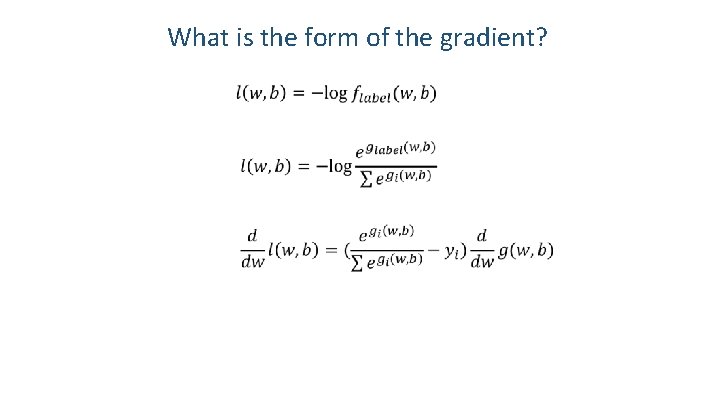
What is the form of the gradient? Let’s assume |B| = 1, then we are interested in the following: 35
What is the form of the gradient? 36
Regularization 37
Momentum updates instead of this we use this with rho typically 0. 8 -0. 9 See also: https: //github. com/karpathy/neuraltalk 2/blob/master/misc/optim_updates. lua 38 38
39