
CS 6463 AT Computational Geometry Fall 2006 Plane
- Slides: 24
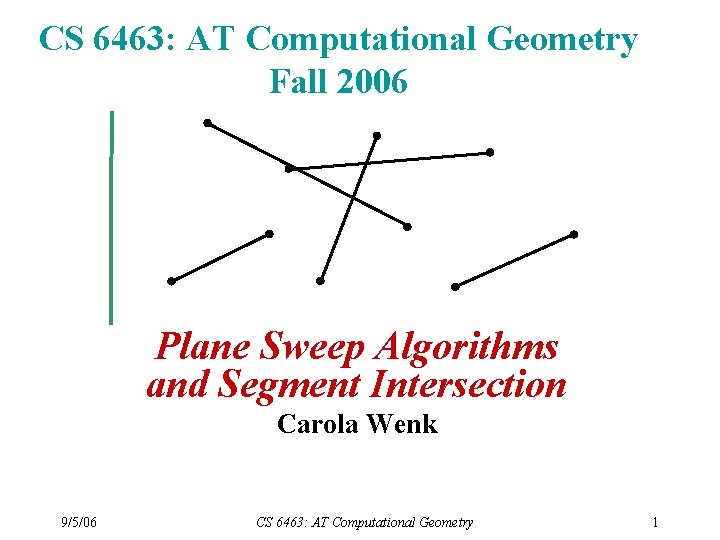
CS 6463: AT Computational Geometry Fall 2006 Plane Sweep Algorithms and Segment Intersection Carola Wenk 9/5/06 CS 6463: AT Computational Geometry 1
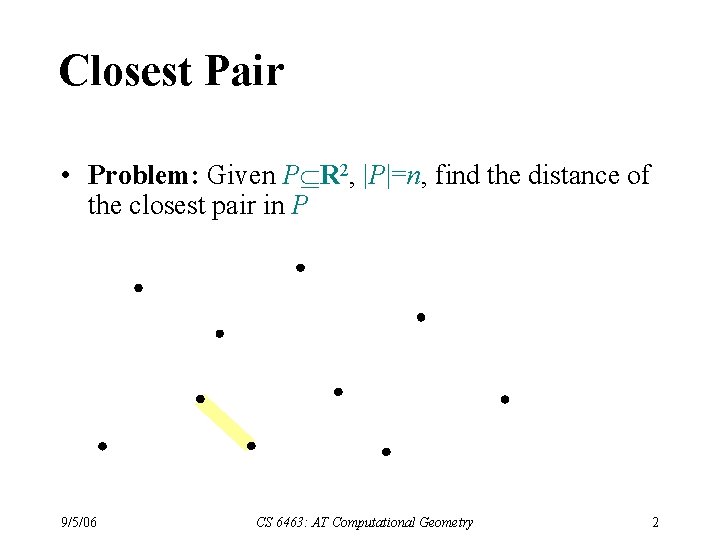
Closest Pair • Problem: Given P R 2, |P|=n, find the distance of the closest pair in P 9/5/06 CS 6463: AT Computational Geometry 2
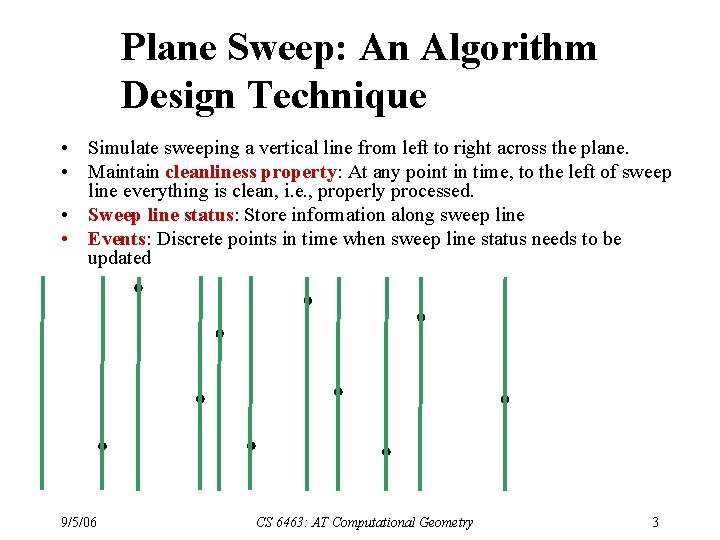
Plane Sweep: An Algorithm Design Technique • Simulate sweeping a vertical line from left to right across the plane. • Maintain cleanliness property: At any point in time, to the left of sweep line everything is clean, i. e. , properly processed. • Sweep line status: Store information along sweep line • Events: Discrete points in time when sweep line status needs to be updated 9/5/06 CS 6463: AT Computational Geometry 3
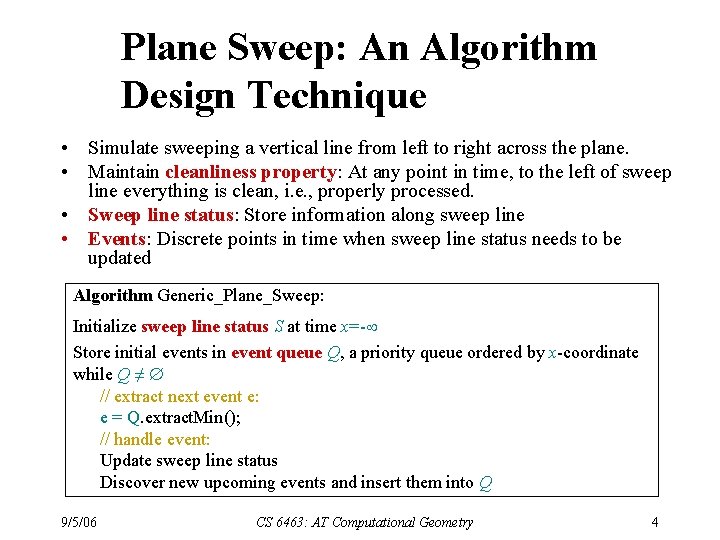
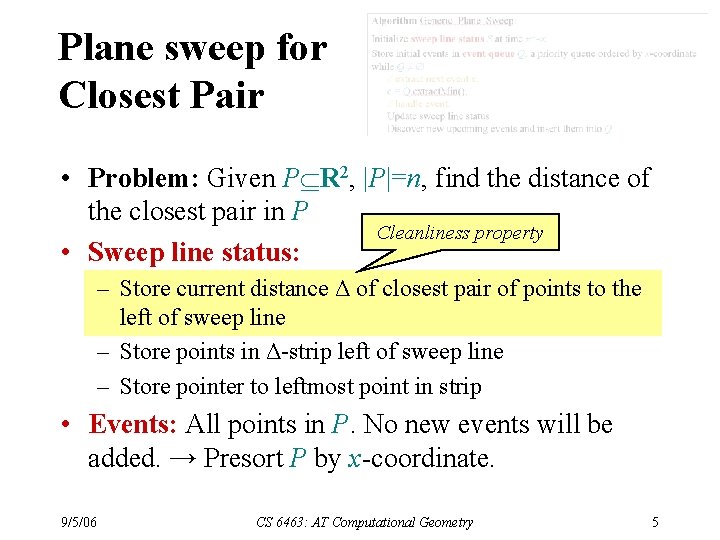
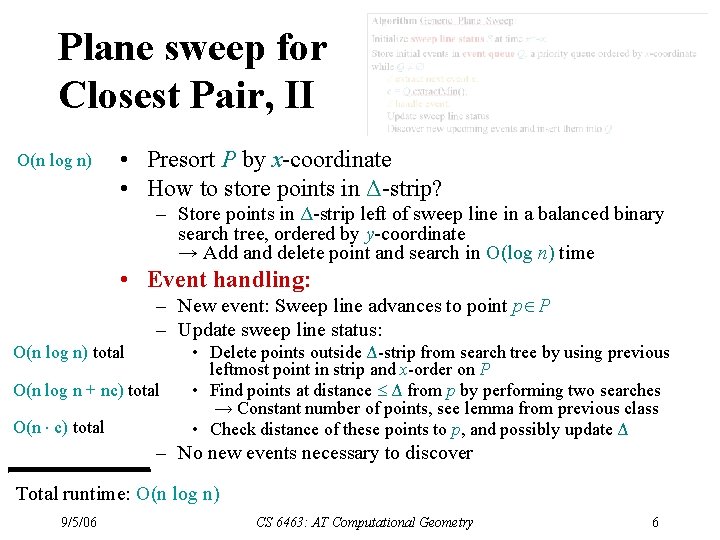
Plane Sweep: An Algorithm Design Technique • Simulate sweeping a vertical line from left to right across the plane. • Maintain cleanliness property: At any point in time, to the left of sweep line everything is clean, i. e. , properly processed. • Sweep line status: Store information along sweep line • Events: Discrete points in time when sweep line status needs to be updated Algorithm Generic_Plane_Sweep: Initialize sweep line status S at time x=- Store initial events in event queue Q, a priority queue ordered by x-coordinate while Q ≠ // extract next event e: e = Q. extract. Min(); // handle event: Update sweep line status Discover new upcoming events and insert them into Q 9/5/06 CS 6463: AT Computational Geometry 4
Plane sweep for Closest Pair • Problem: Given P R 2, |P|=n, find the distance of the closest pair in P Cleanliness property • Sweep line status: – Store current distance Δ of closest pair of points to the left of sweep line – Store points in Δ-strip left of sweep line – Store pointer to leftmost point in strip • Events: All points in P. No new events will be added. → Presort P by x-coordinate. 9/5/06 CS 6463: AT Computational Geometry 5
Plane sweep for Closest Pair, II O(n log n) • Presort P by x-coordinate • How to store points in Δ-strip? – Store points in Δ-strip left of sweep line in a balanced binary search tree, ordered by y-coordinate → Add and delete point and search in O(log n) time • Event handling: – New event: Sweep line advances to point p P – Update sweep line status: O(n log n) total O(n log n + nc) total O(n c) total • Delete points outside Δ-strip from search tree by using previous leftmost point in strip and x-order on P • Find points at distance Δ from p by performing two searches → Constant number of points, see lemma from previous class • Check distance of these points to p, and possibly update Δ – No new events necessary to discover Total runtime: O(n log n) 9/5/06 CS 6463: AT Computational Geometry 6
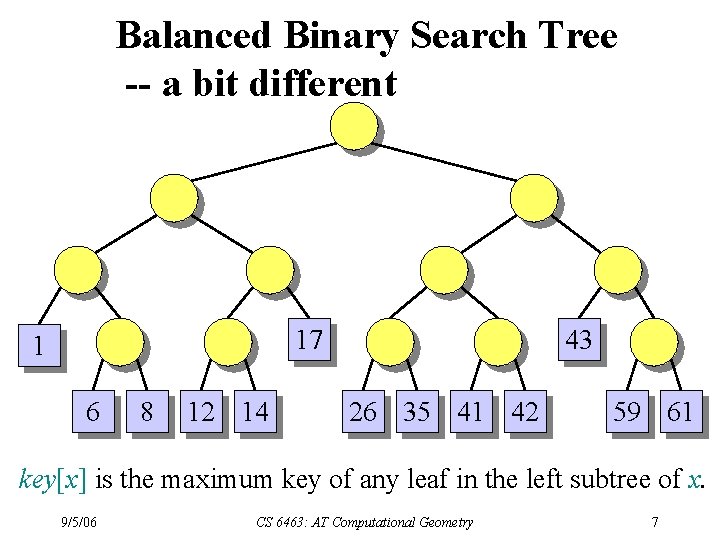
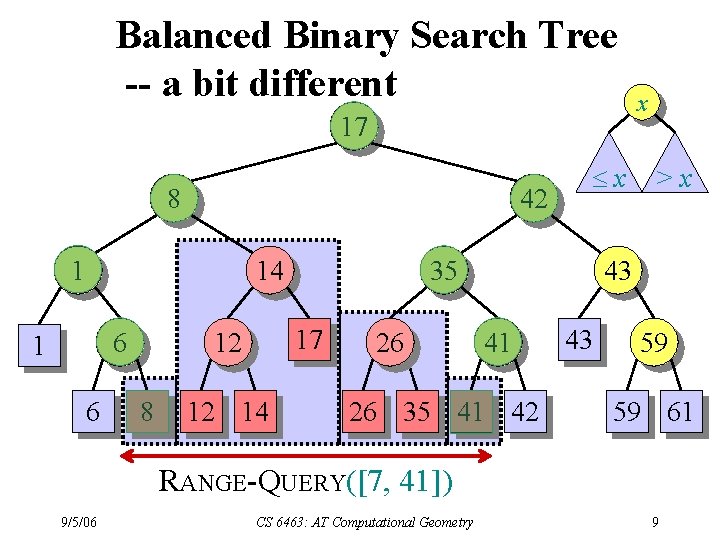
Balanced Binary Search Tree -- a bit different 17 1 6 8 12 14 43 26 35 41 42 59 61 key[x] is the maximum key of any leaf in the left subtree of x. 9/5/06 CS 6463: AT Computational Geometry 7
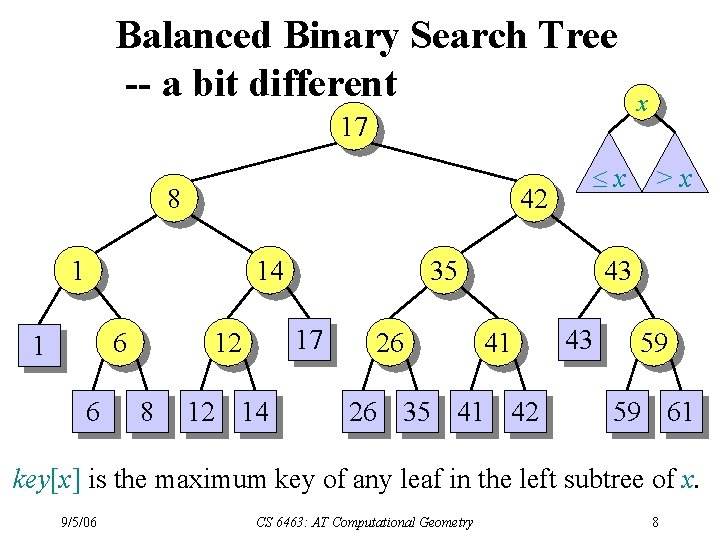
Balanced Binary Search Tree -- a bit different 17 8 42 1 14 6 1 6 8 35 17 12 12 14 x 26 x >x 43 41 26 35 41 42 43 59 59 61 key[x] is the maximum key of any leaf in the left subtree of x. 9/5/06 CS 6463: AT Computational Geometry 8
Balanced Binary Search Tree -- a bit different 17 8 42 1 14 6 8 35 17 12 6 1 12 14 x 26 x >x 43 41 26 35 41 42 43 59 59 61 RANGE-QUERY([7, 41]) 9/5/06 CS 6463: AT Computational Geometry 9
Plane Sweep: An Algorithm Design Technique • Plane sweep algorithms (also called sweep line algorithms) are a special kind of incremental algorithms • Their correctness follows inductively by maintaining the cleanliness property • Common runtimes in the plane are O(n log n): – n events are processed – Update of sweep line status takes O(log n) – Update of event queue: O(log n) per event 9/5/06 CS 6463: AT Computational Geometry 10
Geometric Intersections • Important and basic problem in Computational Geometry • Solid modeling: Build shapes by applying set operations (intersection, union). • Robotics: Collision detection and avoidance • Geographic information systems: Overlay two subdivisions (e. g. , road network and river network) • Computer graphics: Ray shooting to render scenes 9/5/06 CS 6463: AT Computational Geometry 11
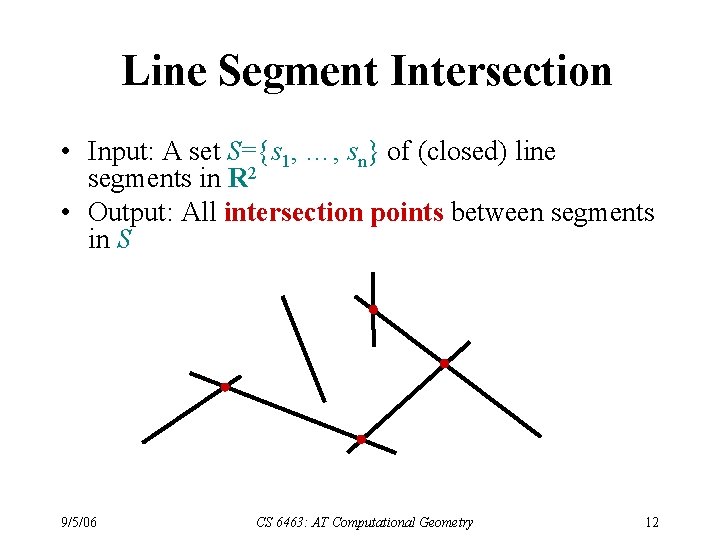
Line Segment Intersection • Input: A set S={s 1, …, sn} of (closed) line segments in R 2 • Output: All intersection points between segments in S 9/5/06 CS 6463: AT Computational Geometry 12
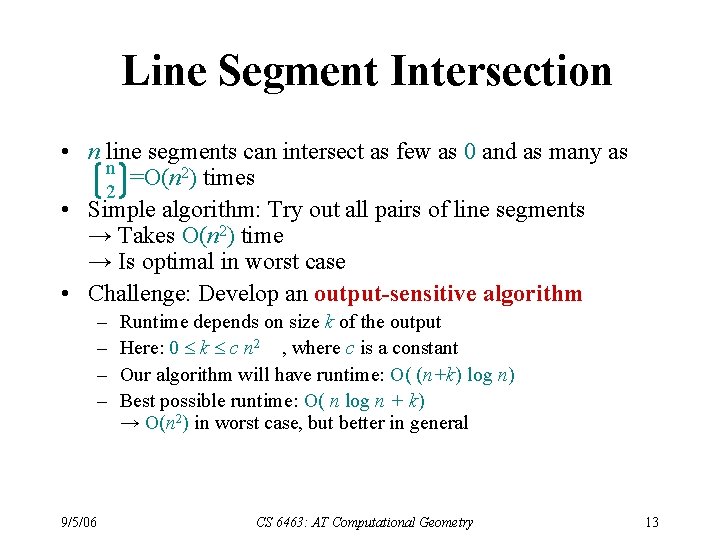
Line Segment Intersection • n line segments can intersect as few as 0 and as many as n =O(n 2) times 2 • Simple algorithm: Try out all pairs of line segments → Takes O(n 2) time → Is optimal in worst case • Challenge: Develop an output-sensitive algorithm – – 9/5/06 Runtime depends on size k of the output Here: 0 k c n 2 , where c is a constant Our algorithm will have runtime: O( (n+k) log n) Best possible runtime: O( n log n + k) → O(n 2) in worst case, but better in general CS 6463: AT Computational Geometry 13
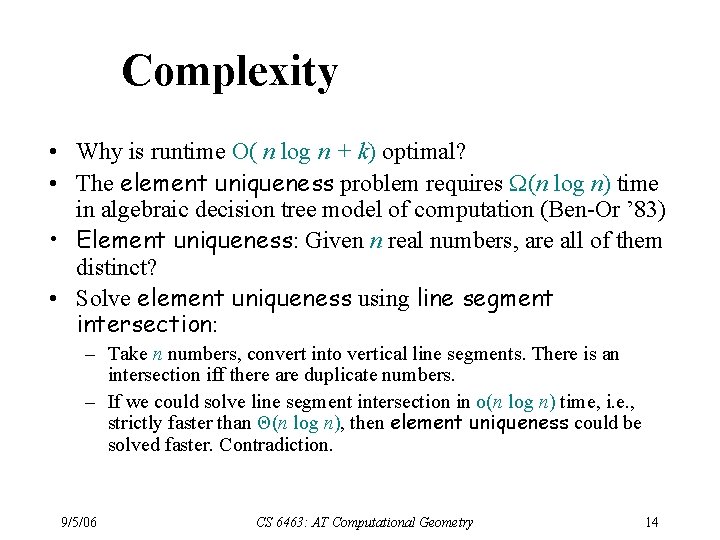
Complexity • Why is runtime O( n log n + k) optimal? • The element uniqueness problem requires W(n log n) time in algebraic decision tree model of computation (Ben-Or ’ 83) • Element uniqueness: Given n real numbers, are all of them distinct? • Solve element uniqueness using line segment intersection: – Take n numbers, convert into vertical line segments. There is an intersection iff there are duplicate numbers. – If we could solve line segment intersection in o(n log n) time, i. e. , strictly faster than Θ(n log n), then element uniqueness could be solved faster. Contradiction. 9/5/06 CS 6463: AT Computational Geometry 14
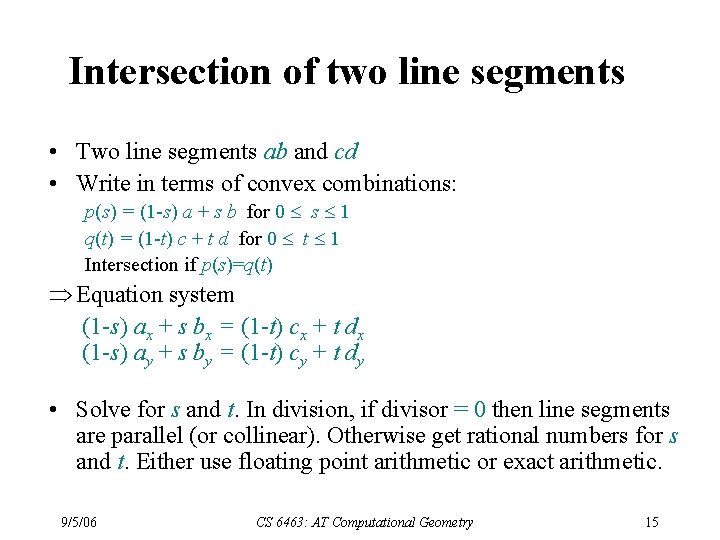
Intersection of two line segments • Two line segments ab and cd • Write in terms of convex combinations: p(s) = (1 -s) a + s b for 0 s 1 q(t) = (1 -t) c + t d for 0 t 1 Intersection if p(s)=q(t) Þ Equation system (1 -s) ax + s bx = (1 -t) cx + t dx (1 -s) ay + s by = (1 -t) cy + t dy • Solve for s and t. In division, if divisor = 0 then line segments are parallel (or collinear). Otherwise get rational numbers for s and t. Either use floating point arithmetic or exact arithmetic. 9/5/06 CS 6463: AT Computational Geometry 15
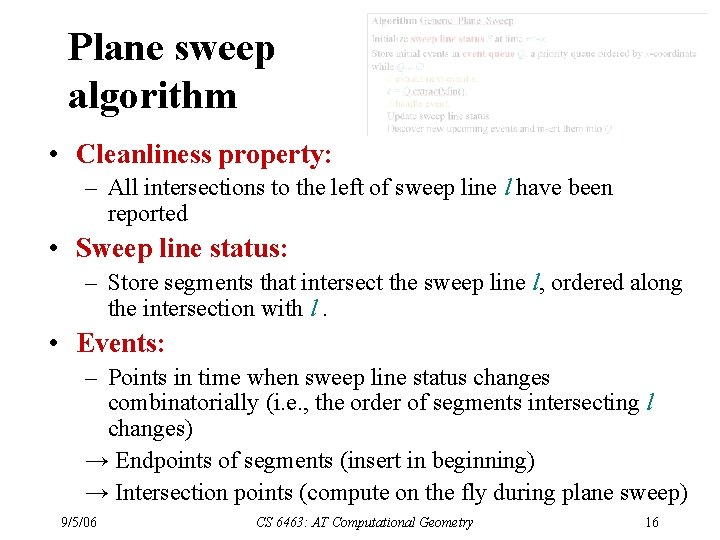
Plane sweep algorithm • Cleanliness property: – All intersections to the left of sweep line l have been reported • Sweep line status: – Store segments that intersect the sweep line l, ordered along the intersection with l. • Events: – Points in time when sweep line status changes combinatorially (i. e. , the order of segments intersecting l changes) → Endpoints of segments (insert in beginning) → Intersection points (compute on the fly during plane sweep) 9/5/06 CS 6463: AT Computational Geometry 16
General position Assume that “nasty” special cases don’t happen: – No line segment is vertical – Two segments intersect in at most one point – No three segments intersect in a common point 9/5/06 CS 6463: AT Computational Geometry 17
Event Queue • Need to keep events sorted: – Lexicographic order (first by x-coordinate, and if two events have same x-coordinate then by y-coordinate) • Need to be able to remove next point, and insert new points in O(log n) time • Need to make sure not to process same event twice Þ Use a priority queue (heap), and possibly extract multiples Þ Or, use balanced binary search tree 9/5/06 CS 6463: AT Computational Geometry 18
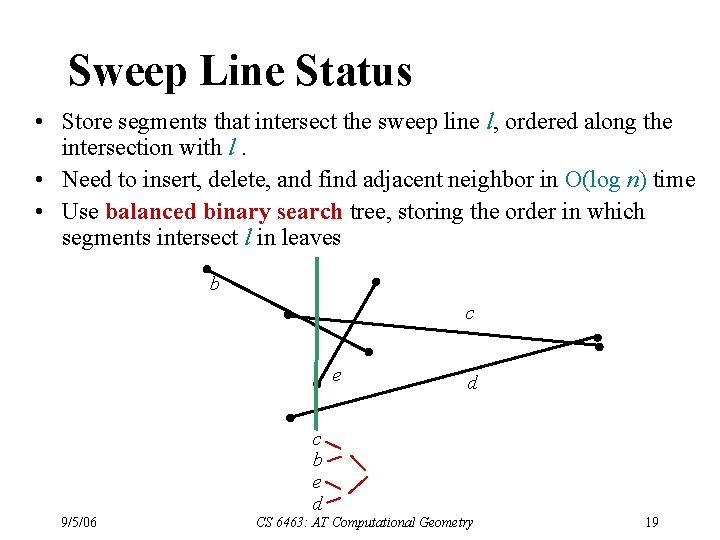
Sweep Line Status • Store segments that intersect the sweep line l, ordered along the intersection with l. • Need to insert, delete, and find adjacent neighbor in O(log n) time • Use balanced binary search tree, storing the order in which segments intersect l in leaves b c e d c b e d 9/5/06 CS 6463: AT Computational Geometry 19
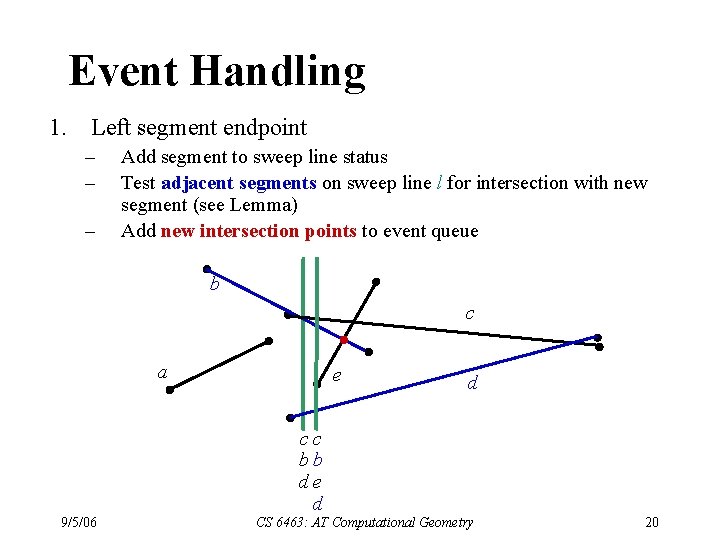
Event Handling 1. Left segment endpoint – – – Add segment to sweep line status Test adjacent segments on sweep line l for intersection with new segment (see Lemma) Add new intersection points to event queue b c a e d cc bb de d 9/5/06 CS 6463: AT Computational Geometry 20
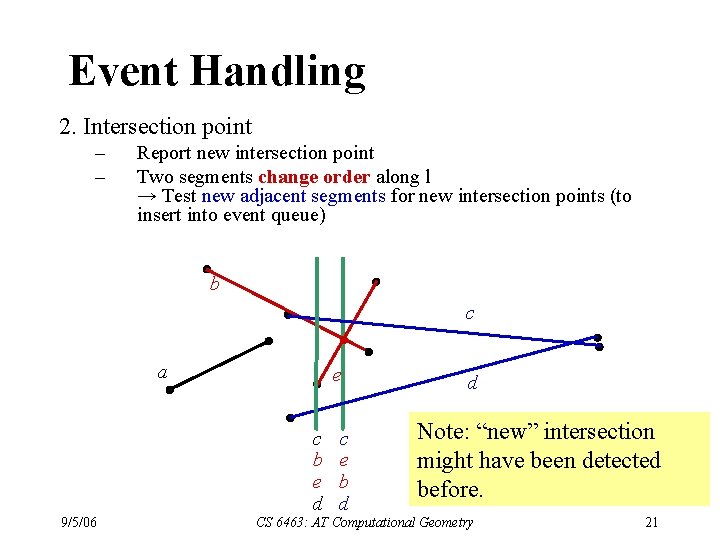
Event Handling 2. Intersection point – – Report new intersection point Two segments change order along l → Test new adjacent segments for new intersection points (to insert into event queue) b c a e c b e d 9/5/06 c e b d d Note: “new” intersection might have been detected before. CS 6463: AT Computational Geometry 21
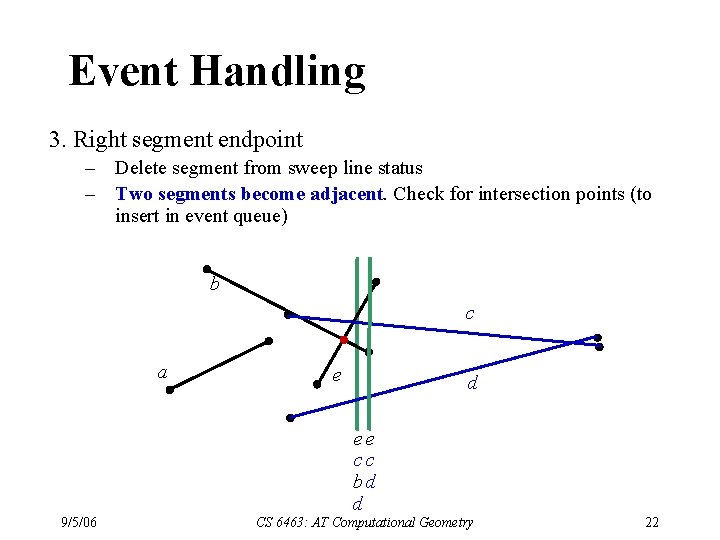
Event Handling 3. Right segment endpoint – Delete segment from sweep line status – Two segments become adjacent. Check for intersection points (to insert in event queue) b c a e d ee cc bd d 9/5/06 CS 6463: AT Computational Geometry 22
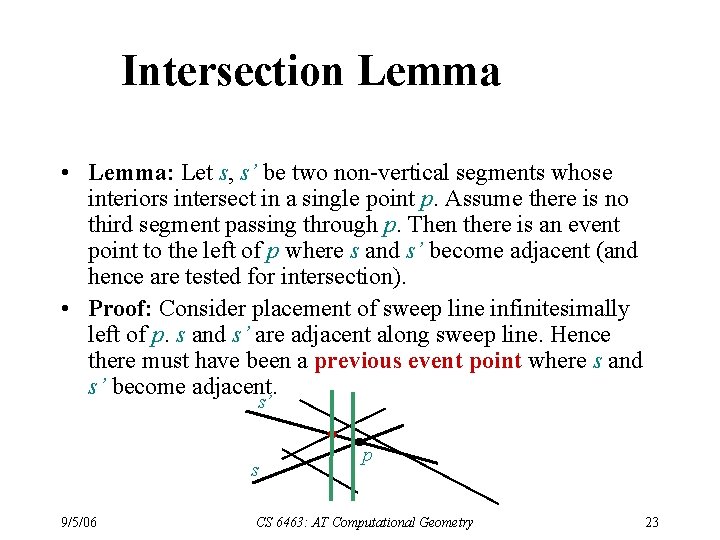
Intersection Lemma • Lemma: Let s, s’ be two non-vertical segments whose interiors intersect in a single point p. Assume there is no third segment passing through p. Then there is an event point to the left of p where s and s’ become adjacent (and hence are tested for intersection). • Proof: Consider placement of sweep line infinitesimally left of p. s and s’ are adjacent along sweep line. Hence there must have been a previous event point where s and s’ become adjacent. s’ s 9/5/06 p CS 6463: AT Computational Geometry 23
Runtime • Sweep line status updates: O(log n) • Event queue operations: O(log n), as the total number of stored events is 2 n + k, and each operation takes time O(log(2 n+k)) = O(log n 2) = O(log n) k = O(n 2) • There are O(n+k) events. Hence the total runtime is O((n+k) log n) 9/5/06 CS 6463: AT Computational Geometry 24