
CS 646 OWL Tutorial session 2 Presented by

CS 646: OWL Tutorial (session 2) Presented by the CO-ODE and Hy. Ont. Use projects Funded by 1 29/11/2004 CS 646: N. Drummond, M. Horridge
CS 646: This session • • 2 Issue: Primitive Classes & Polyhierarchies Advanced: Reasoning Advanced: Creating Defined Classes Union Classes: Covering Axioms Example: Creating a Vegetarian Pizza Issue: Open World Assumption Union Classes: Closure 29/11/2004 CS 646: N. Drummond, M. Horridge

Loading OWL files from scratch Run Protégé. exe 1. If you’ve only got an OWL file: Select “OWL Files” as the Project Format, then “Build” to select the. owl file 2. If you’ve got a valid project file*: Select “OWL Files” as the Project Format, and then “Open Other” to find the. pprj file (if you’ve already opened it, it will be in “Open Recent”) 3. Open C: Protégé_3. 0_betaexamplespizzas 2_0. owl 4. 3 * ie one created on this version of Protégé - the s/w gets updated once every few days, so don’t count on it unless you’ve created it recently– safest to build from the. owl file if in doubt 29/11/2004 CS 646: N. Drummond, M. Horridge
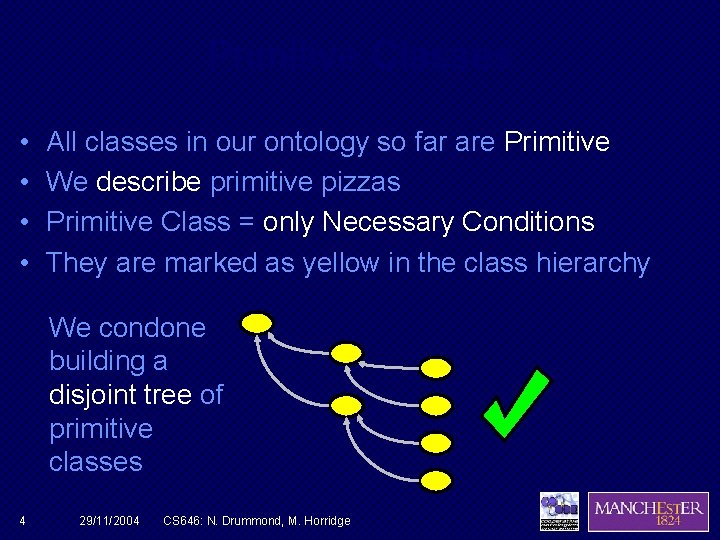
Primitive Classes • • All classes in our ontology so far are Primitive We describe primitive pizzas Primitive Class = only Necessary Conditions They are marked as yellow in the class hierarchy We condone building a disjoint tree of primitive classes 4 29/11/2004 CS 646: N. Drummond, M. Horridge
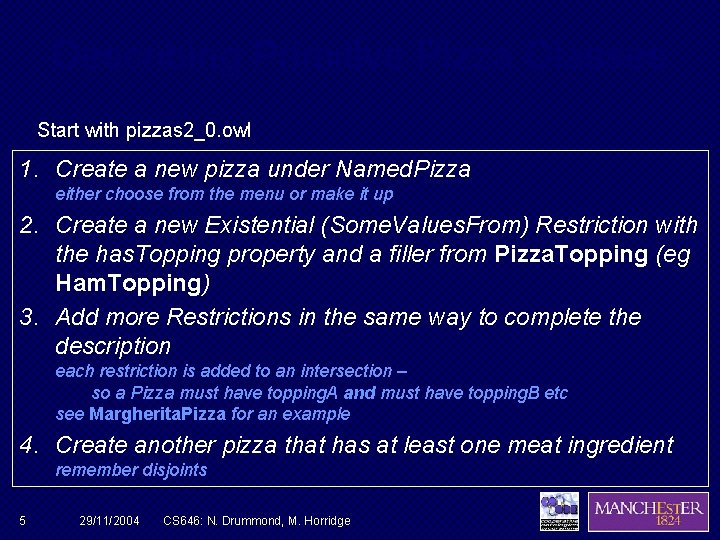
Describing Primitive Pizza Classes Start with pizzas 2_0. owl 1. Create a new pizza under Named. Pizza either choose from the menu or make it up 2. Create a new Existential (Some. Values. From) Restriction with the has. Topping property and a filler from Pizza. Topping (eg Ham. Topping) 3. Add more Restrictions in the same way to complete the description each restriction is added to an intersection – so a Pizza must have topping. A and must have topping. B etc see Margherita. Pizza for an example 4. Create another pizza that has at least one meat ingredient remember disjoints 5 29/11/2004 CS 646: N. Drummond, M. Horridge
Polyhierarchies • By the end of this tutorial we intent to create a Vegetarian. Pizza • Some of our existing Pizzas should be types of Vegetarian. Pizza • However, they could also be types of Spicy. Pizza or Cheese. Lovers. Pizza • We need to be able to give them multiple parents 6 29/11/2004 CS 646: N. Drummond, M. Horridge
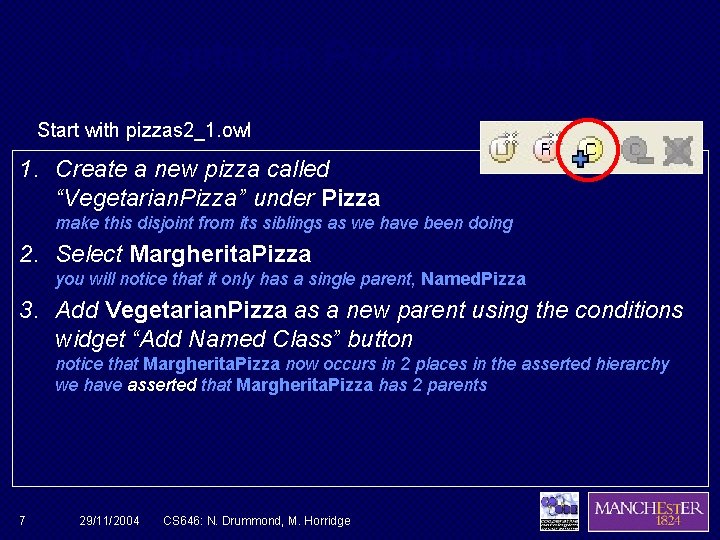
Vegetarian Pizza attempt 1 Start with pizzas 2_1. owl 1. Create a new pizza called “Vegetarian. Pizza” under Pizza make this disjoint from its siblings as we have been doing 2. Select Margherita. Pizza you will notice that it only has a single parent, Named. Pizza 3. Add Vegetarian. Pizza as a new parent using the conditions widget “Add Named Class” button notice that Margherita. Pizza now occurs in 2 places in the asserted hierarchy we have asserted that Margherita. Pizza has 2 parents 7 29/11/2004 CS 646: N. Drummond, M. Horridge
Reasoning • We’d like to be able to check the logical consistency of our model • We’d also like to make automatic inferences about the subsumption hierarchy. A process known as classifying – ie Moving classes around in the hierarchy based on their logical definition • Generic software capable of these tasks are known as reasoners (although you may hear them being referred to as Classifiers) • RACER is a reasoner 8 29/11/2004 CS 646: N. Drummond, M. Horridge
Running Racer 1. Open C: Protégé_3. 0_beta 2. Run racer. exe A cmd window will open and two “service enabled” messages will appear in the ouput Racer is now ready for use as an http server using a standard interface called DIG 3. NB. Alternative DIG reasoners like Fa. CT can also be used 9 29/11/2004 CS 646: N. Drummond, M. Horridge
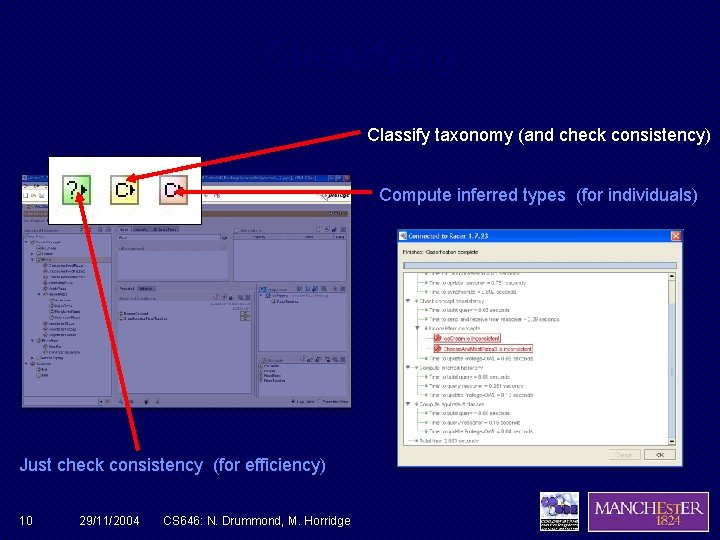
Classifying Classify taxonomy (and check consistency) Compute inferred types (for individuals) Just check consistency (for efficiency) 10 29/11/2004 CS 646: N. Drummond, M. Horridge
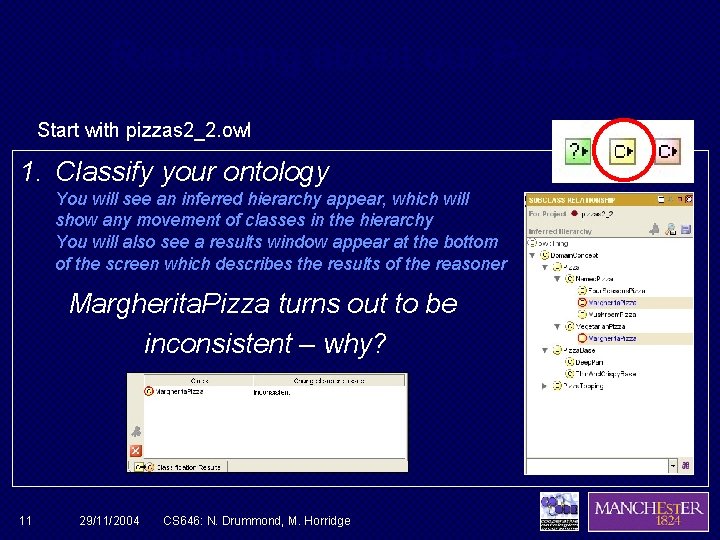
Reasoning about our Pizzas Start with pizzas 2_2. owl 1. Classify your ontology You will see an inferred hierarchy appear, which will show any movement of classes in the hierarchy You will also see a results window appear at the bottom of the screen which describes the results of the reasoner Margherita. Pizza turns out to be inconsistent – why? 11 29/11/2004 CS 646: N. Drummond, M. Horridge
Why is Margherita. Pizza inconsistent? • We are asserting that a Margherita. Pizza is a subclass of two classes we have stated are disjoint • The disjoint means nothing can be a Named. Pizza and a Vegetarian. Pizza at the same time • This means that the class of Margherita. Pizzas can never contain any individuals • The class is therefore inconsistent 12 29/11/2004 CS 646: N. Drummond, M. Horridge
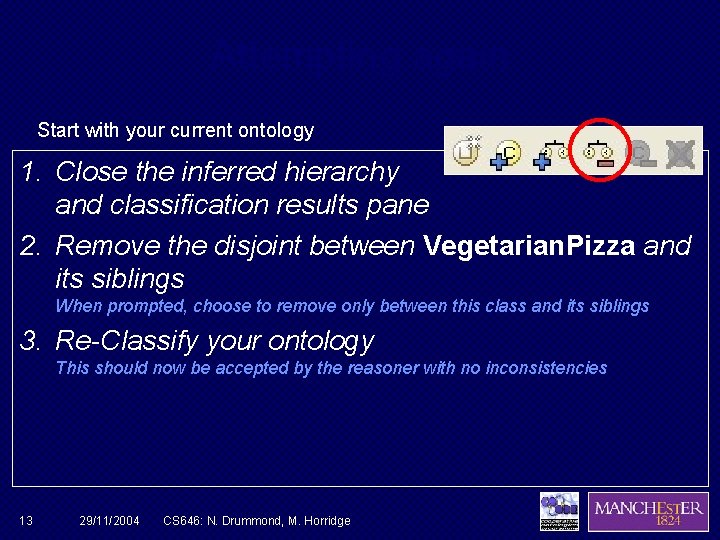
Attempting again Start with your current ontology 1. Close the inferred hierarchy and classification results pane 2. Remove the disjoint between Vegetarian. Pizza and its siblings When prompted, choose to remove only between this class and its siblings 3. Re-Classify your ontology This should now be accepted by the reasoner with no inconsistencies 13 29/11/2004 CS 646: N. Drummond, M. Horridge
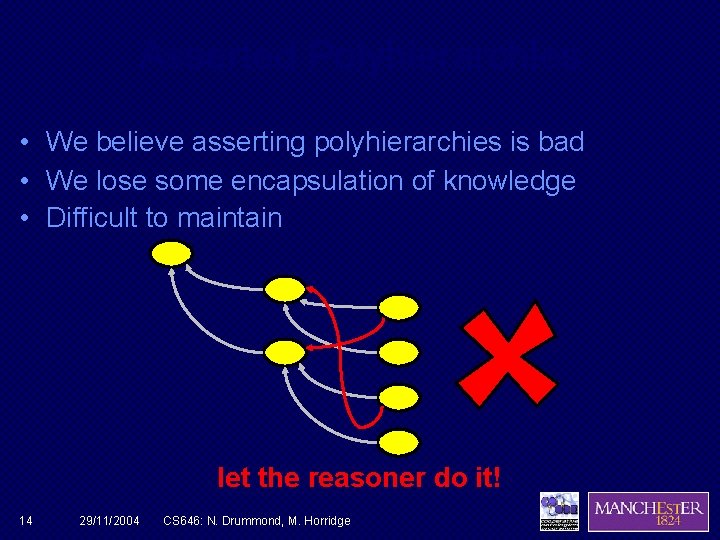
Asserted Polyhierarchies • We believe asserting polyhierarchies is bad • We lose some encapsulation of knowledge • Difficult to maintain let the reasoner do it! 14 29/11/2004 CS 646: N. Drummond, M. Horridge
Defined Classes • Have a definition. That is at least one Necessary and Sufficient condition • Are marked in orange in the interface • Classes, all of whose individuals satisfy this definition, can be inferred to be subclasses • Reasoners can perform this inference 15 29/11/2004 CS 646: N. Drummond, M. Horridge
Describing a Meaty. Pizza Start with pizzas 2_3. owl, close the reasoner panes 1. Create a subclass of Pizza called Meaty. Pizza Don’t put in the disjoints or you’ll get the same problems as before In general, defined classes are not disjoint 2. Add a restriction to say: “Every Meaty. Pizza must have at least one meat topping” 3. Classify your ontology What happens? 16 29/11/2004 CS 646: N. Drummond, M. Horridge
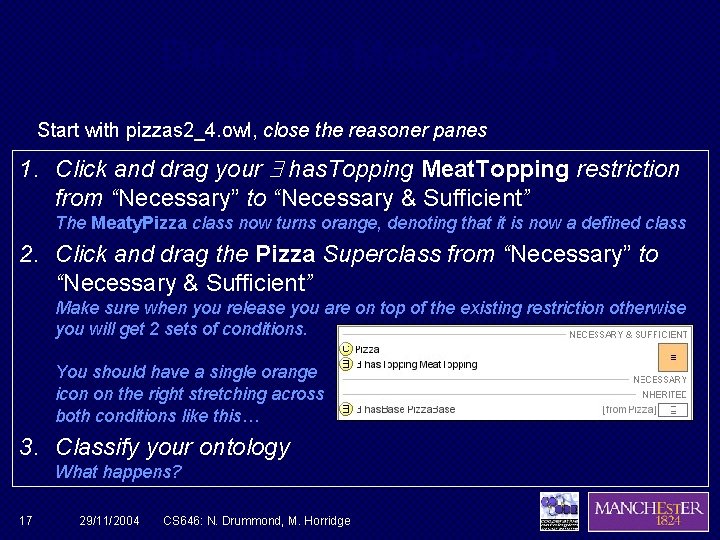
Defining a Meaty. Pizza Start with pizzas 2_4. owl, close the reasoner panes 1. Click and drag your has. Topping Meat. Topping restriction from “Necessary” to “Necessary & Sufficient” The Meaty. Pizza class now turns orange, denoting that it is now a defined class 2. Click and drag the Pizza Superclass from “Necessary” to “Necessary & Sufficient” Make sure when you release you are on top of the existing restriction otherwise you will get 2 sets of conditions. You should have a single orange icon on the right stretching across both conditions like this… 3. Classify your ontology What happens? 17 29/11/2004 CS 646: N. Drummond, M. Horridge
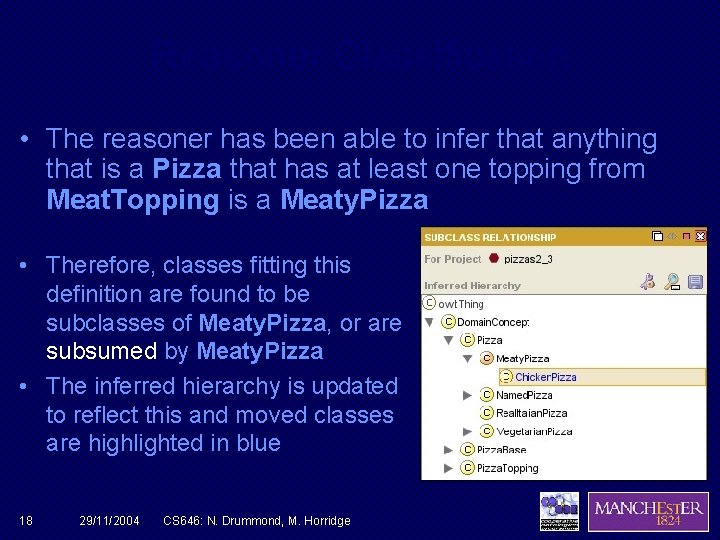
Reasoner Classification • The reasoner has been able to infer that anything that is a Pizza that has at least one topping from Meat. Topping is a Meaty. Pizza • Therefore, classes fitting this definition are found to be subclasses of Meaty. Pizza, or are subsumed by Meaty. Pizza • The inferred hierarchy is updated to reflect this and moved classes are highlighted in blue 18 29/11/2004 CS 646: N. Drummond, M. Horridge
How do we Define a Vegetarian Pizza? • Nasty • Define in words? – “a pizza with only vegetarian toppings”? – “a pizza with no meat (or fish) toppings”? – “a pizza that is not a Meaty. Pizza”? • More than one way to model this 19 29/11/2004 CS 646: N. Drummond, M. Horridge
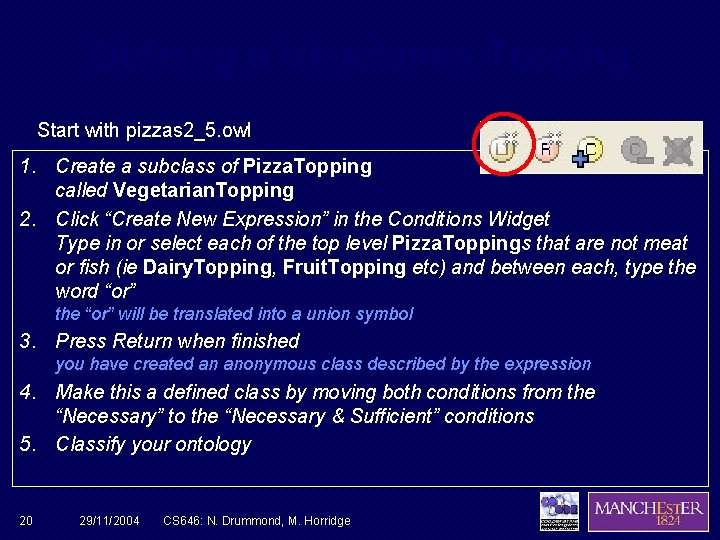
Defining a Vegetarian Topping Start with pizzas 2_5. owl 1. Create a subclass of Pizza. Topping called Vegetarian. Topping 2. Click “Create New Expression” in the Conditions Widget Type in or select each of the top level Pizza. Toppings that are not meat or fish (ie Dairy. Topping, Fruit. Topping etc) and between each, type the word “or” the “or” will be translated into a union symbol 3. Press Return when finished you have created an anonymous class described by the expression 4. Make this a defined class by moving both conditions from the “Necessary” to the “Necessary & Sufficient” conditions 5. Classify your ontology 20 29/11/2004 CS 646: N. Drummond, M. Horridge
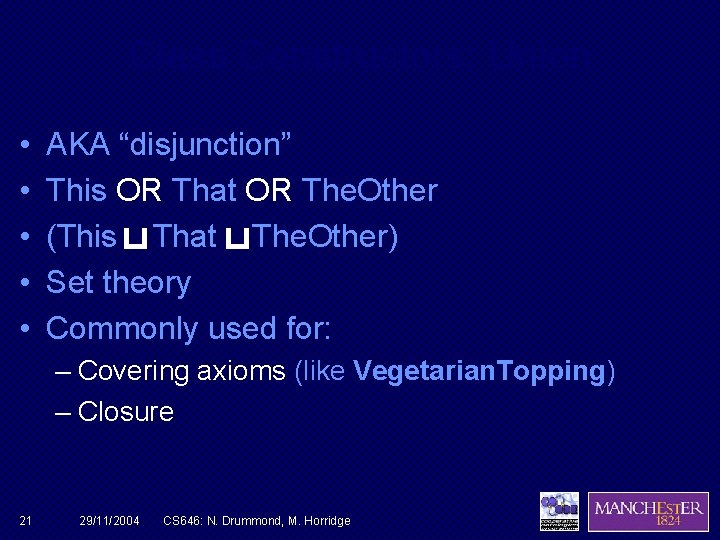
Class Constructors: Union • • • AKA “disjunction” This OR That OR The. Other (This That The. Other) Set theory Commonly used for: – Covering axioms (like Vegetarian. Topping) – Closure 21 29/11/2004 CS 646: N. Drummond, M. Horridge
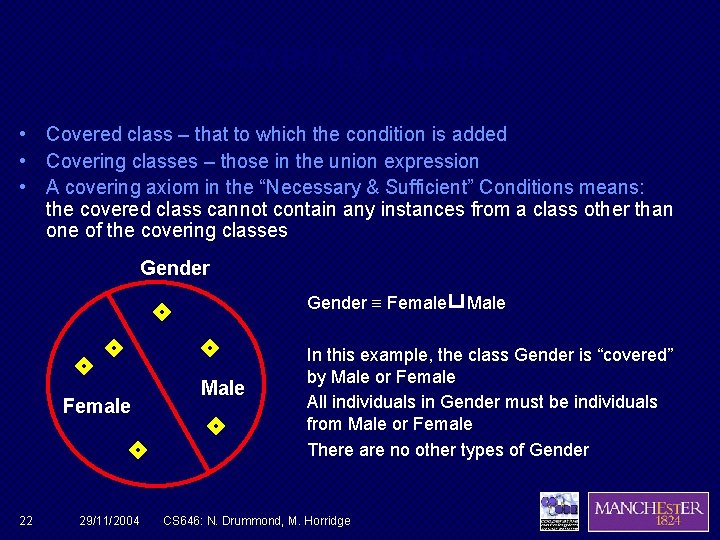
Covering Axioms • Covered class – that to which the condition is added • Covering classes – those in the union expression • A covering axiom in the “Necessary & Sufficient” Conditions means: the covered class cannot contain any instances from a class other than one of the covering classes Gender Female 22 29/11/2004 Male In this example, the class Gender is “covered” by Male or Female All individuals in Gender must be individuals from Male or Female There are no other types of Gender CS 646: N. Drummond, M. Horridge
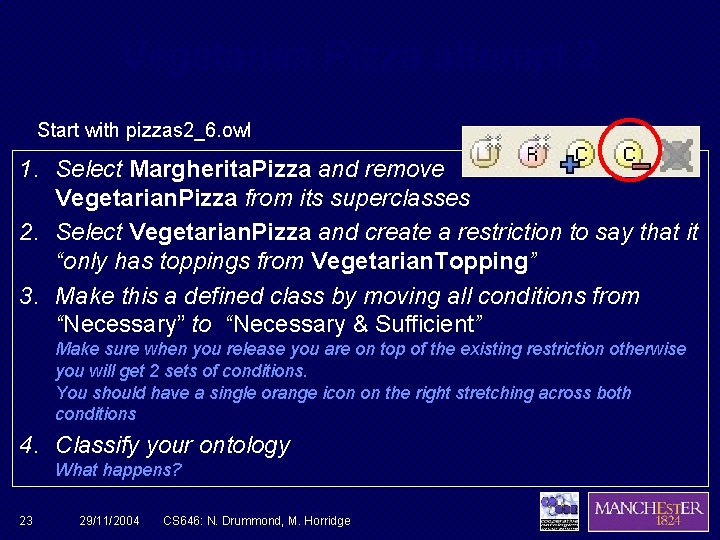
Vegetarian Pizza attempt 2 Start with pizzas 2_6. owl 1. Select Margherita. Pizza and remove Vegetarian. Pizza from its superclasses 2. Select Vegetarian. Pizza and create a restriction to say that it “only has toppings from Vegetarian. Topping” 3. Make this a defined class by moving all conditions from “Necessary” to “Necessary & Sufficient” Make sure when you release you are on top of the existing restriction otherwise you will get 2 sets of conditions. You should have a single orange icon on the right stretching across both conditions 4. Classify your ontology What happens? 23 29/11/2004 CS 646: N. Drummond, M. Horridge
Open World Assumption • The reasoner does not have enough information to classify pizzas under Vegetarian. Pizza • Typically several Existential restrictions on a single property with different fillers – like primitive pizzas • Existential should be paraphrased by “amongst other things…” • Must state that a description is complete • We need closure for the given property • This is in the form of a Universal Restriction with a Union of the other fillers using that property 24 29/11/2004 CS 646: N. Drummond, M. Horridge
Closure • Example: Margherita. Pizza All Margherita. Pizzas must have: at least 1 topping from Mozzarella. Topping and at least 1 topping from Tomato. Topping and only toppings from Mozzarella. Topping or Tomato. Topping • The last part is paraphrased into “no other toppings” • The union closes the has. Topping property on Margherita. Pizza 25 29/11/2004 CS 646: N. Drummond, M. Horridge
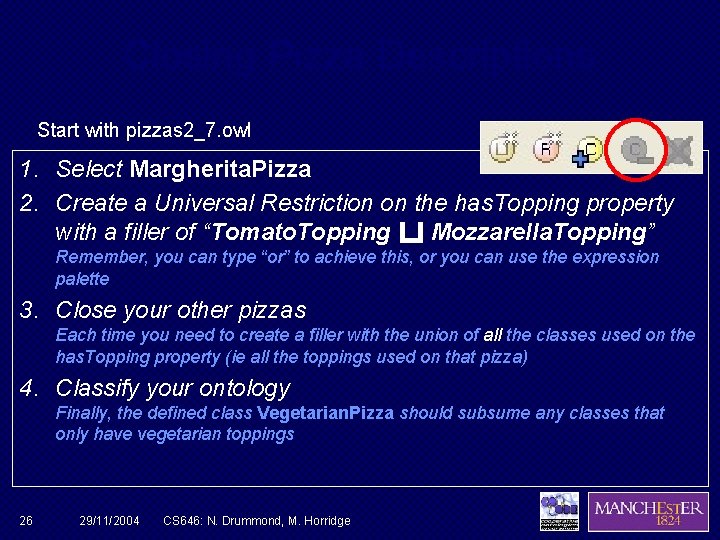
Closing Pizza Descriptions Start with pizzas 2_7. owl 1. Select Margherita. Pizza 2. Create a Universal Restriction on the has. Topping property with a filler of “Tomato. Topping Mozzarella. Topping” Remember, you can type “or” to achieve this, or you can use the expression palette 3. Close your other pizzas Each time you need to create a filler with the union of all the classes used on the has. Topping property (ie all the toppings used on that pizza) 4. Classify your ontology Finally, the defined class Vegetarian. Pizza should subsume any classes that only have vegetarian toppings 26 29/11/2004 CS 646: N. Drummond, M. Horridge
Summary You should now be able to: • Use Defined Classes allow a polyhierarchy to be computed • Classify and check consistency using a Reasoner • Create Covering Axioms • Close Class Descriptions to cope with Open World Reasoning 27 29/11/2004 CS 646: N. Drummond, M. Horridge
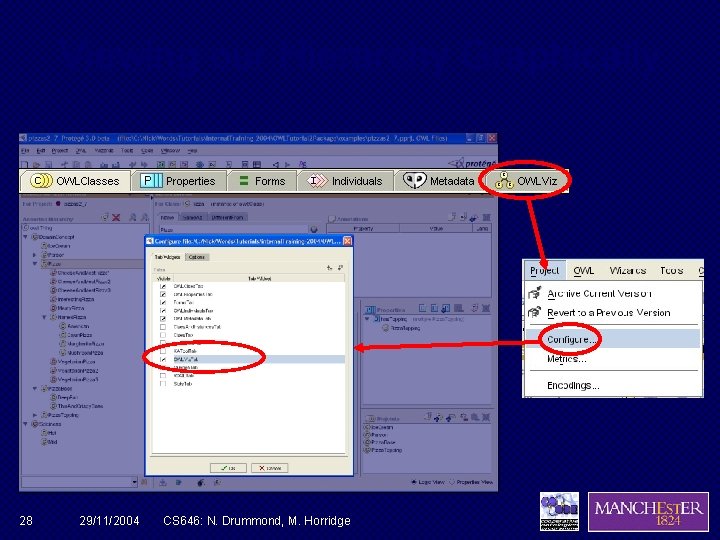
Viewing our Hierarchy Graphically 28 29/11/2004 CS 646: N. Drummond, M. Horridge
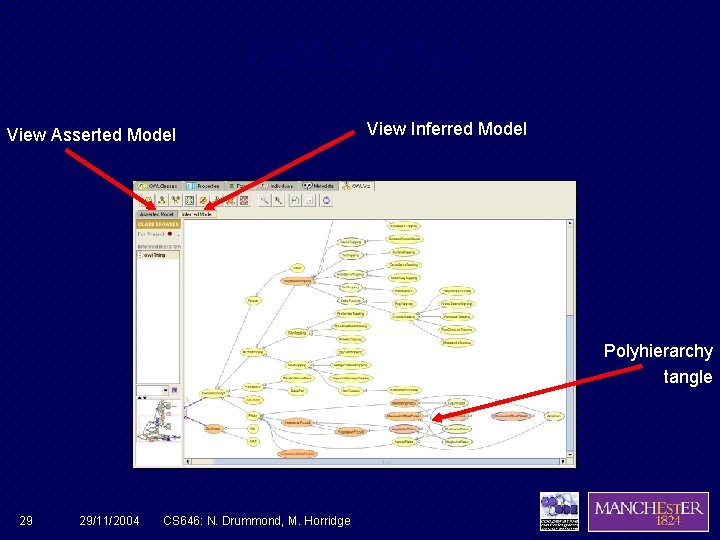
OWLViz Tab View Asserted Model View Inferred Model Polyhierarchy tangle 29 29/11/2004 CS 646: N. Drummond, M. Horridge
Your Pizza Finder • Once you have a pizza ontology you are happy with, you can “plug it in” to the Pizza. Finder • Instructions available on line at… 30 29/11/2004 CS 646: N. Drummond, M. Horridge
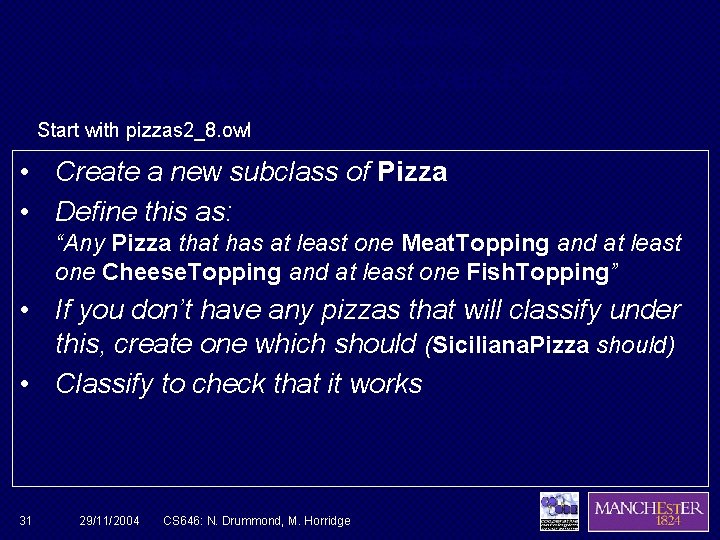
Other Exercises: Create a Protein. Lovers. Pizza Start with pizzas 2_8. owl • Create a new subclass of Pizza • Define this as: “Any Pizza that has at least one Meat. Topping and at least one Cheese. Topping and at least one Fish. Topping” • If you don’t have any pizzas that will classify under this, create one which should (Siciliana. Pizza should) • Classify to check that it works 31 29/11/2004 CS 646: N. Drummond, M. Horridge
Other Exercises: Define Real. Italian. Pizza Start with pizzas 2_9. owl • Convert Real. Italian. Pizza to a defined class • Add information to your pizzas to allow some of them to classify under this one • Classify remember to check your disjoint if you have problems 32 29/11/2004 CS 646: N. Drummond, M. Horridge
Thankyou • Feedback on tutorial appreciated • Powerpoint slides available from - http: //www. cs. man. ac. uk/~drummond/cs 646 • Software / resources / community at: – http: //www. co-ode. org/ – http: //protege. stanford. edu/ 33 29/11/2004 CS 646: N. Drummond, M. Horridge
- Slides: 33