
CS 6234 Advanced Algorithms Splay Trees Fibonacci Heaps
CS 6234 Advanced Algorithms: Splay Trees, Fibonacci Heaps, Persistent Data Structures 1
Splay Trees Muthu Kumar C. , Xie Shudong Fibonacci Heaps Agus Pratondo, Aleksanr Farseev Persistent Data Structures: Summary Li Furong, Song Chonggang Hong Hande 2
SOURCES: Splay Trees Base slides from: David Kaplan, Dept of Computer Science & Engineering, Autumn 2001 CS UMD Lecture 10 Splay Tree UC Berkeley 61 B Lecture 34 Splay Tree Fibonacci Heap Lecture slides adapted from: · Chapter 20 of Introduction to Algorithms by Cormen, Leiserson, Rivest, and Stein. · Chapter 9 of The Design and Analysis of Algorithms by Dexter Kozen. Persistent Data Structure Some of the slides are adapted from: · http: //electures. informatik. uni-freiburg. de 3
Pre-knowledge: Amortized Cost Analysis n n Amortized Analysis – Upper bound, for example, O(log n) – Overall cost of a arbitrary sequences – Picking a good “credit” or “potential” function Potential Function: a function that maps a data structure onto a real valued, nonnegative “potential” – High potential state is volatile, built on cheap operation – Low potential means the cost is equal to the amount allocated to it Amortized Time = sum of actual time + potential change 4
Splay Tree Muthu Kumar C. Xie Shudong CS 6234 Advanced Algorithms
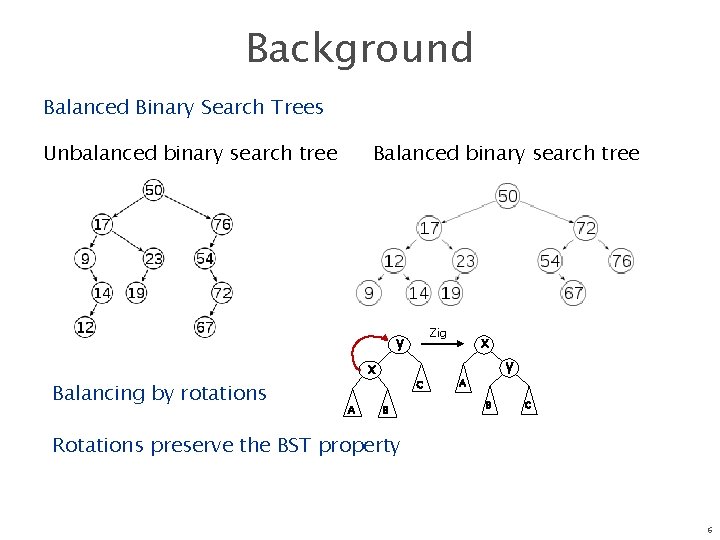
Background Balanced Binary Search Trees Unbalanced binary search tree Balanced binary search tree Zig y Balancing by rotations x A C B x y A B C Rotations preserve the BST property 6
Motivation for Splay Trees Problems with AVL Trees n n Extra storage/complexity for height fields Ugly delete code Solution: Splay trees (Sleator and Tarjan in 1985) n n n Go for a tradeoff by not aiming at balanced trees always. Splay trees are self-adjusting BSTs that have the additional helpful property that more commonly accessed nodes are more quickly retrieved. Blind adjusting version of AVL trees. Amortized time (average over a sequence of inputs) for all operations is O(log n). Worst case time is O(n). 7
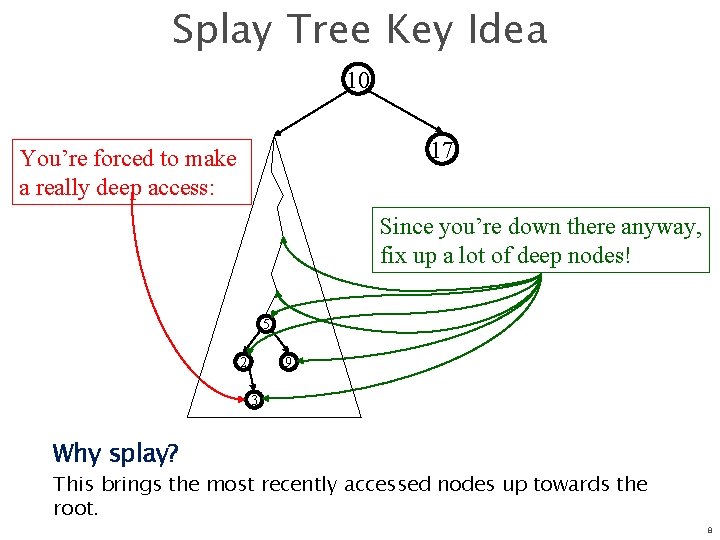
Splay Tree Key Idea 10 17 You’re forced to make a really deep access: Since you’re down there anyway, fix up a lot of deep nodes! 5 2 9 3 Why splay? This brings the most recently accessed nodes up towards the root. 8
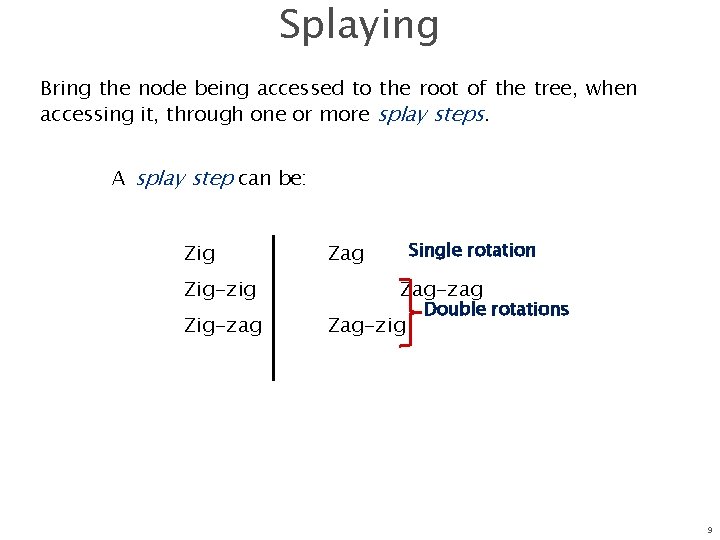
Splaying Bring the node being accessed to the root of the tree, when accessing it, through one or more splay steps. A splay step can be: Zig-zig Zig-zag Single rotation Zag-zag Zag-zig Double rotations 9
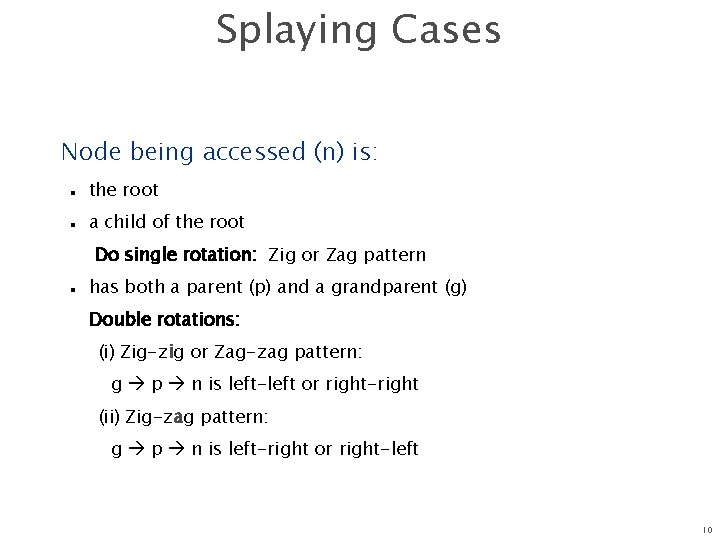
Splaying Cases Node being accessed (n) is: n n the root a child of the root Do single rotation: Zig or Zag pattern n has both a parent (p) and a grandparent (g) Double rotations: (i) Zig-zig or Zag-zag pattern: g p n is left-left or right-right (ii) Zig-zag pattern: g p n is left-right or right-left 10
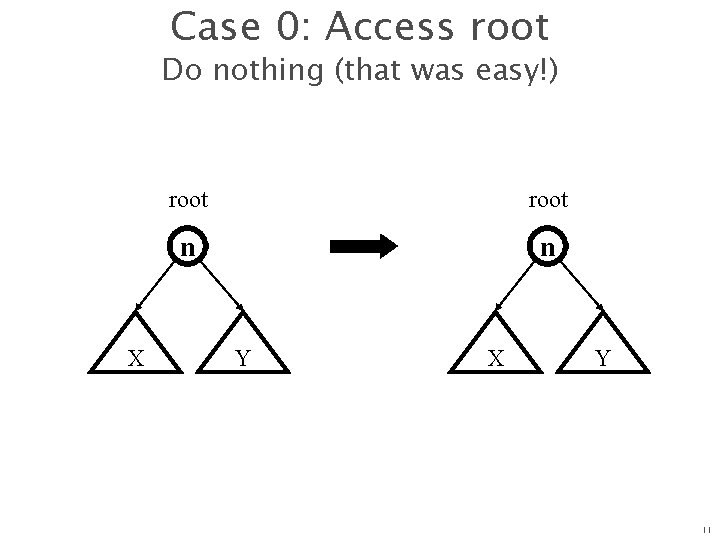
Case 0: Access root Do nothing (that was easy!) X root n n Y X Y 11
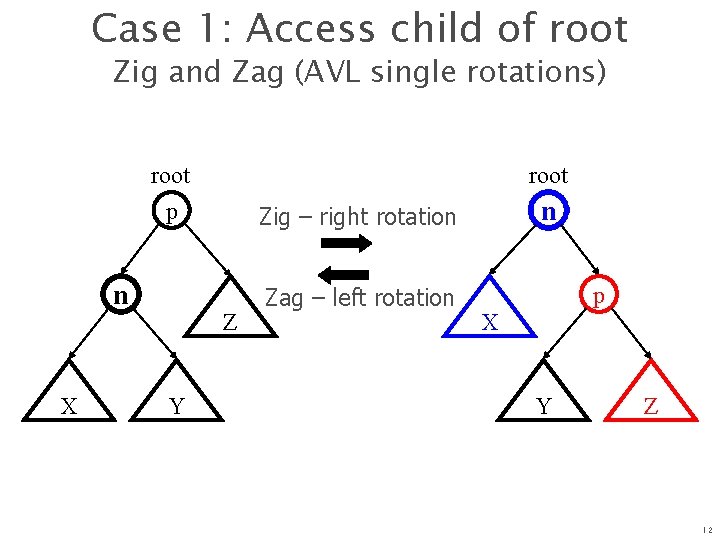
Case 1: Access child of root Zig and Zag (AVL single rotations) root p n X root Z Y n Zig – right rotation Zag – left rotation p X Y Z 12
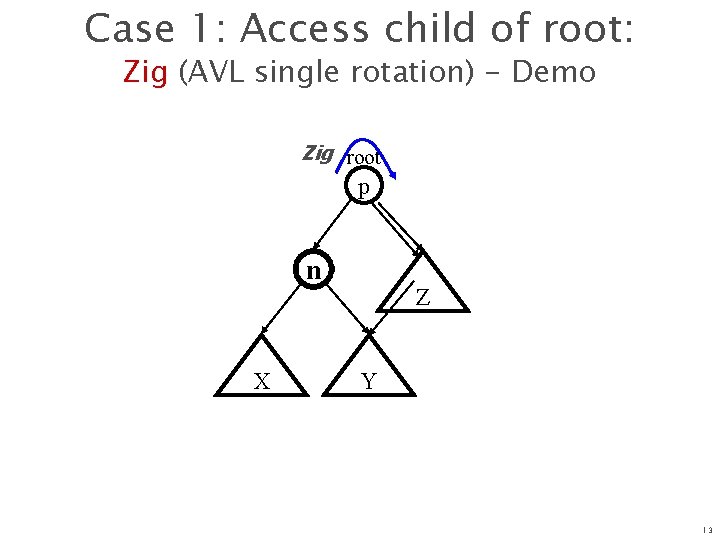
Case 1: Access child of root: Zig (AVL single rotation) - Demo Zig root p n X Z Y 13
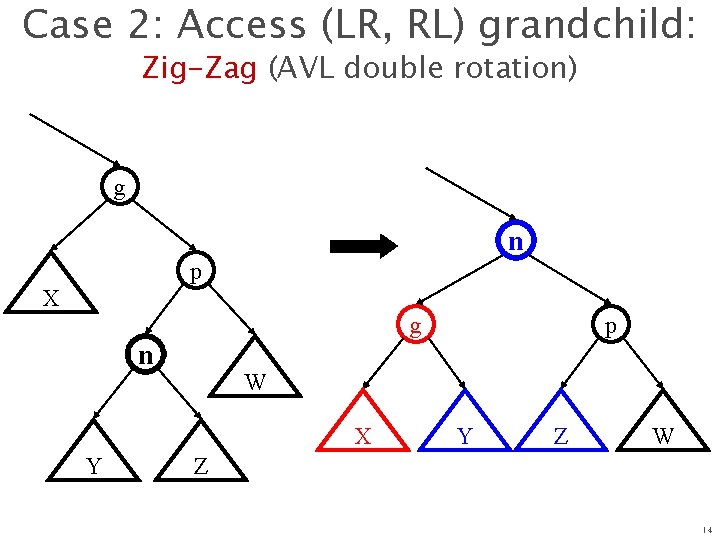
Case 2: Access (LR, RL) grandchild: Zig-Zag (AVL double rotation) g n p X g n W X Y p Y Z W Z 14
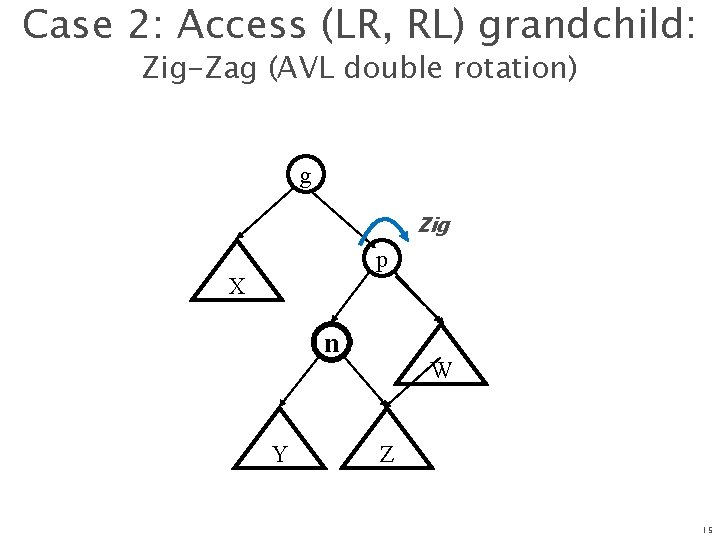
Case 2: Access (LR, RL) grandchild: Zig-Zag (AVL double rotation) g Zig p X n Y W Z 15
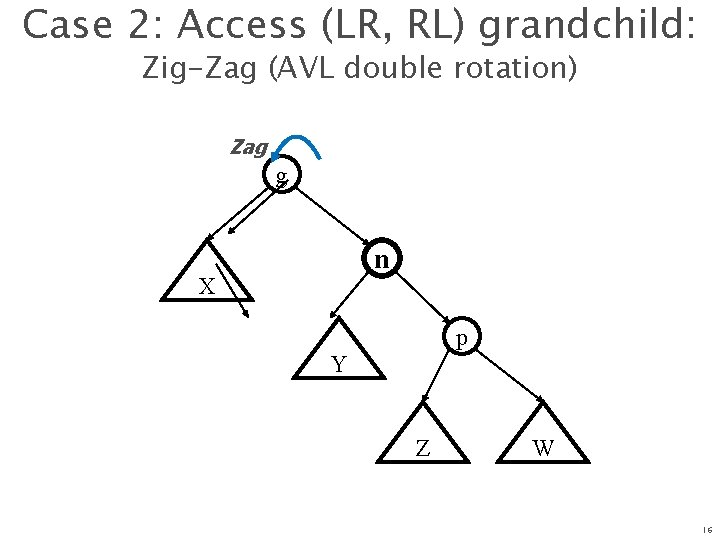
Case 2: Access (LR, RL) grandchild: Zig-Zag (AVL double rotation) Zag g n X p Y Z W 16
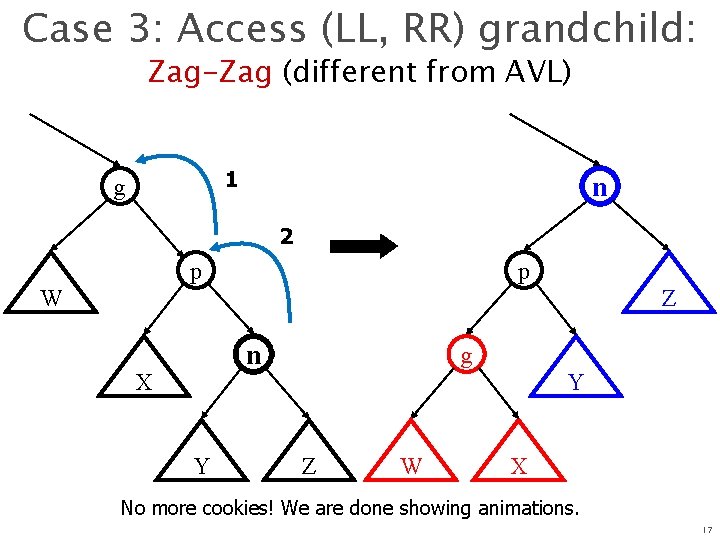
Case 3: Access (LL, RR) grandchild: Zag-Zag (different from AVL) 1 g n 2 p p W Z n X Y g Y Z W X No more cookies! We are done showing animations. 17
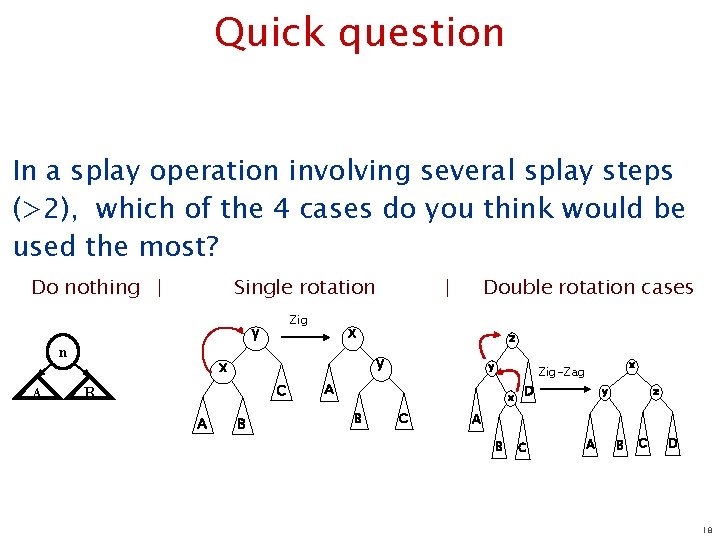
Quick question In a splay operation involving several splay steps (>2), which of the 4 cases do you think would be used the most? Do nothing | Single rotation Zig y n A Double rotation cases x z y x C B A | B y A x B C x Zig-Zag D y z A B C D 18
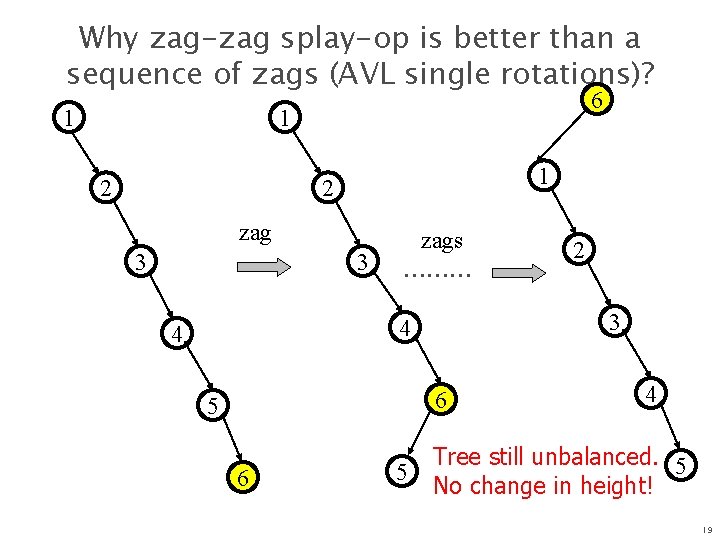
Why zag-zag splay-op is better than a sequence of zags (AVL single rotations)? 1 6 1 2 zag 3 3 zags ……… 3 4 4 6 5 2 4 Tree still unbalanced. 5 No change in height! 19
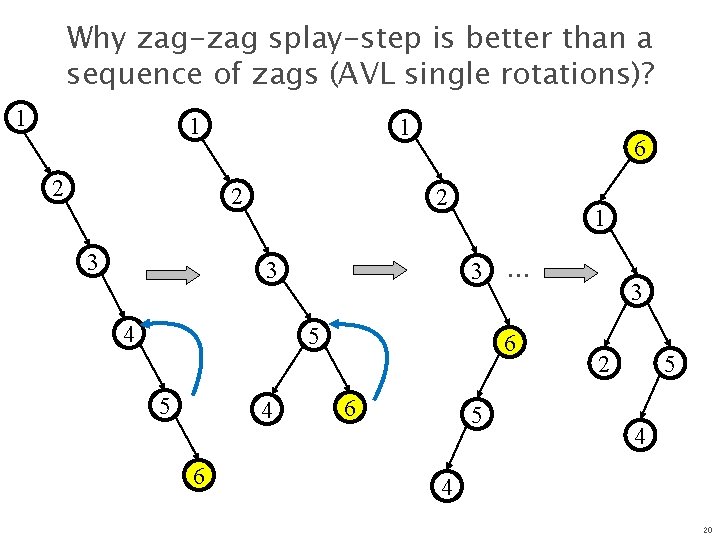
Why zag-zag splay-step is better than a sequence of zags (AVL single rotations)? 1 1 2 3 6 2 3 4 1 3 5 5 4 6 … 6 6 5 3 2 5 4 4 20
Why Splaying Helps If a node n on the access path, to a target node say x, is at depth d before splaying x, then it’s at depth <= 3+d/2 after the splay. (Proof in Goodrich and Tamassia) Overall, nodes which are below nodes on the access path tend to move closer to the root Splaying gets amortized to give O(log n) performance. (Maybe not now, but soon, and for the rest of the operations. ) 21
Splay Operations: Find the node in normal BST manner path Note that we will always splay the last node on the access even if we don’t find the node for the key we are looking for. Splay the node to the root Using 3 cases of rotations we discussed earlier 22
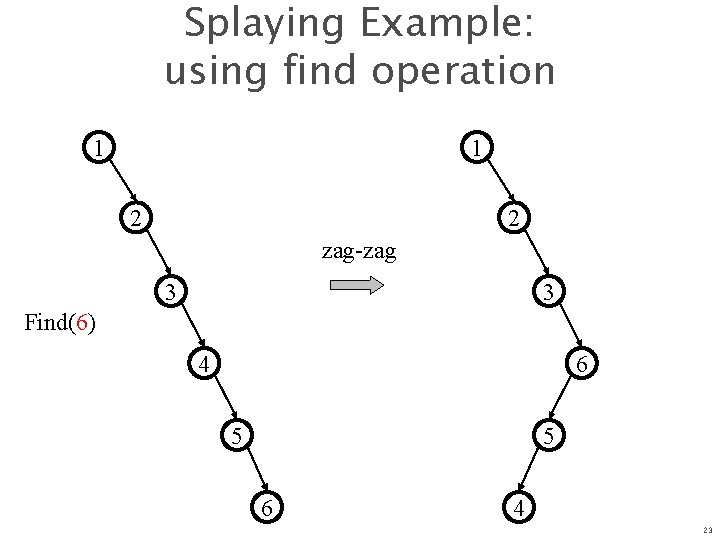
Splaying Example: using find operation 1 1 2 2 zag-zag 3 3 Find(6) 4 6 5 5 6 4 23
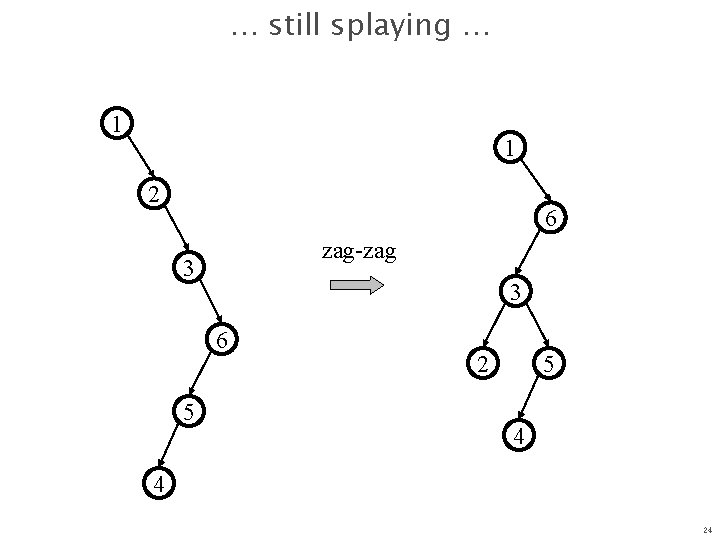
… still splaying … 1 1 2 6 zag-zag 3 3 6 5 2 5 4 4 24
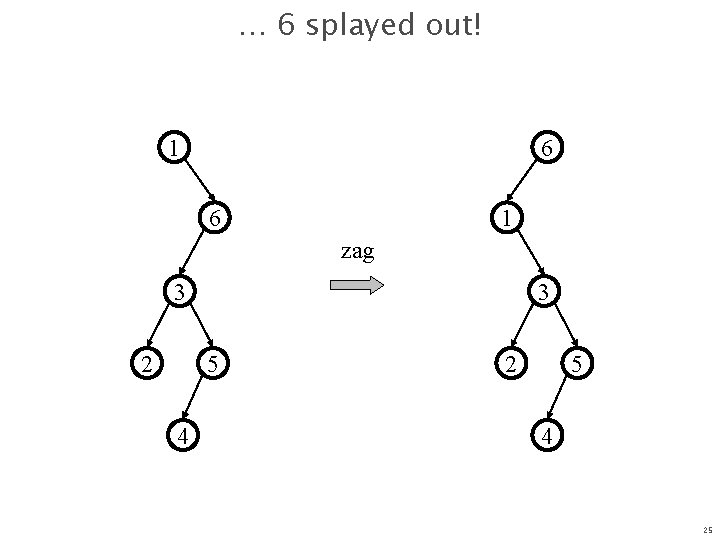
… 6 splayed out! 1 6 zag 3 2 3 5 4 25
Splay Operations: Insert Can we just do BST insert? Yes. But we also splay the newly inserted node up to the root. Alternatively, we can do a Split(T, x) 26
Digression: Splitting Split(T, x) creates two BSTs L and R: n n all elements of T are in either L or R (T = L R) all elements in L are x all elements in R are x L and R share no elements (L R = ) 27
Splitting in Splay Trees How can we split? n n We can do Find(x), which will splay x to the root. Now, what’s true about the left subtree L and right subtree R of the root? n So, we simply cut the tree at x, attach x either L or R 28
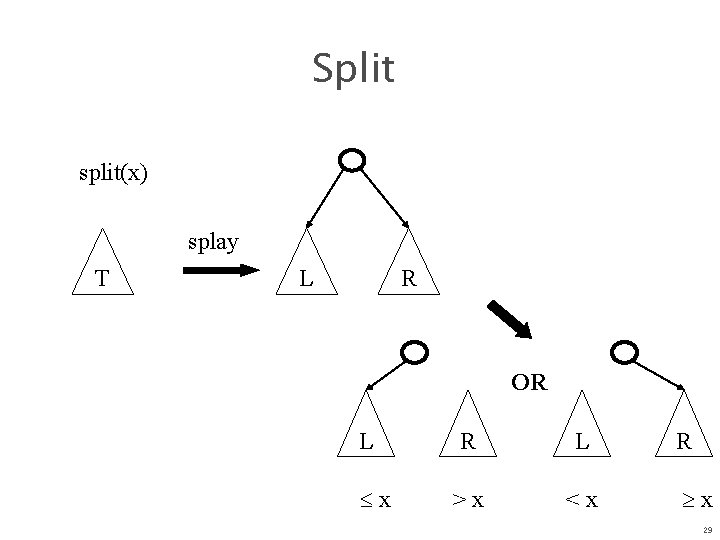
Split split(x) splay T L R OR L x R L >x <x R x 29
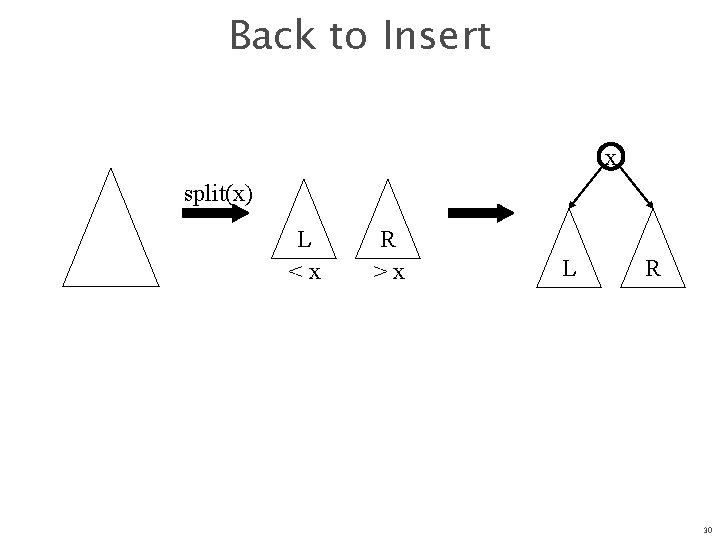
Back to Insert x split(x) L <x R >x L R 30
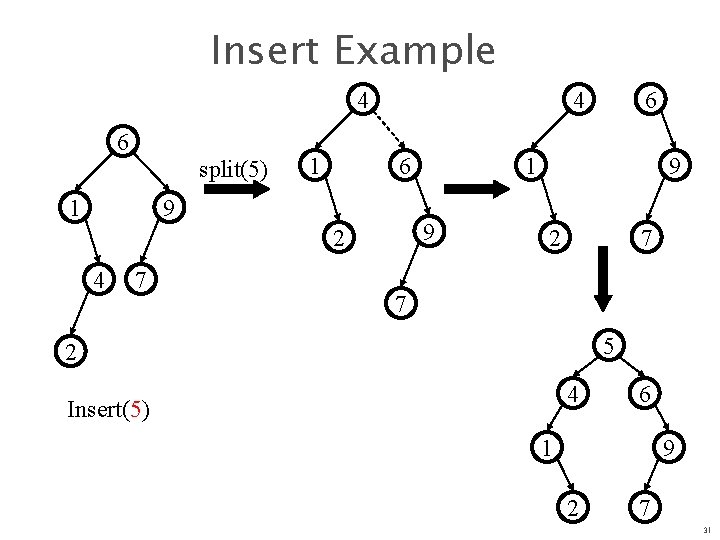
Insert Example 4 6 split(5) 1 1 4 6 9 4 7 1 9 2 6 9 2 7 7 5 2 4 Insert(5) 6 1 9 2 7 31
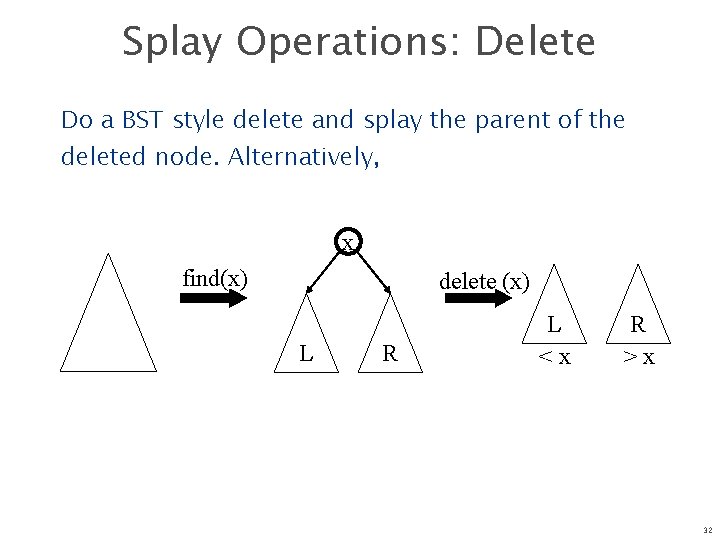
Splay Operations: Delete Do a BST style delete and splay the parent of the deleted node. Alternatively, x find(x) delete (x) L R L <x R >x 32
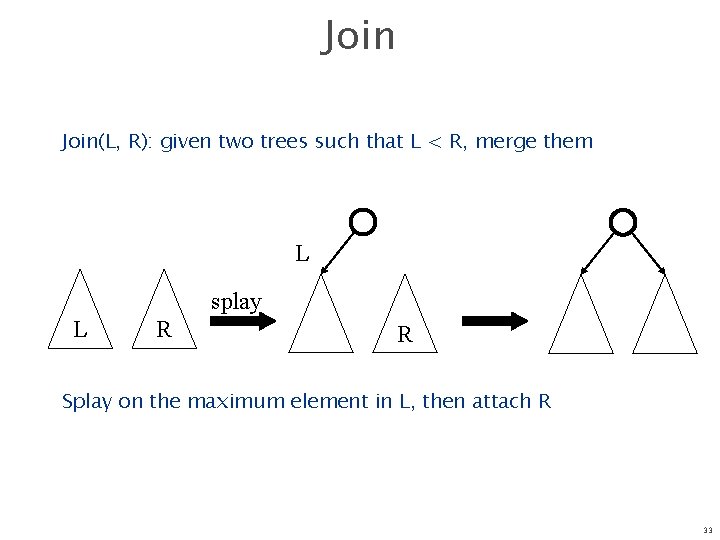
Join(L, R): given two trees such that L < R, merge them L splay L R R Splay on the maximum element in L, then attach R 33
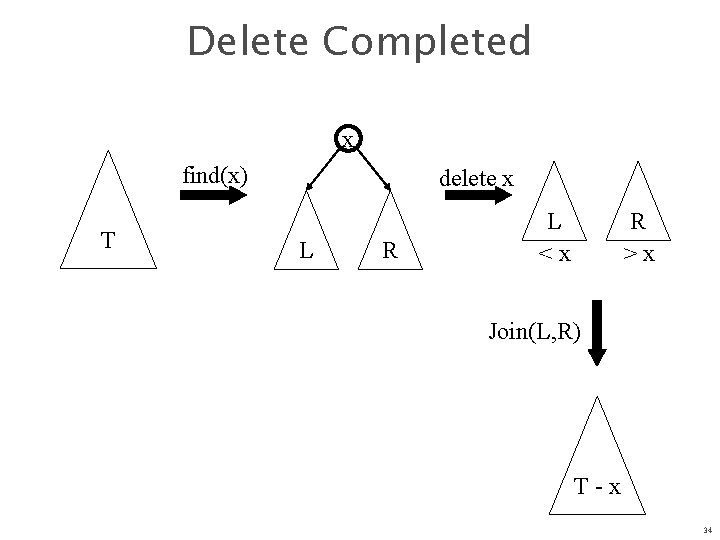
Delete Completed x find(x) T delete x L R L <x R >x Join(L, R) T-x 34
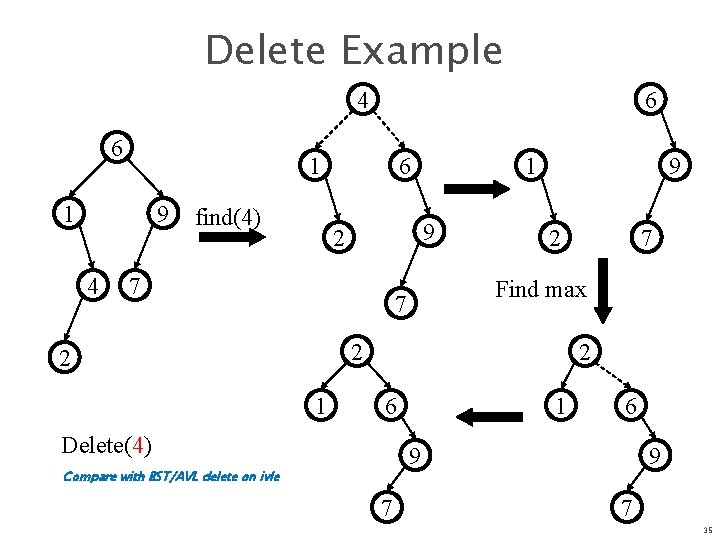
Delete Example 4 6 1 1 9 4 6 find(4) 6 1 9 2 7 9 2 Find max 7 2 2 1 7 2 6 Delete(4) 1 6 9 Compare with BST/AVL delete on ivle 7 9 7 35
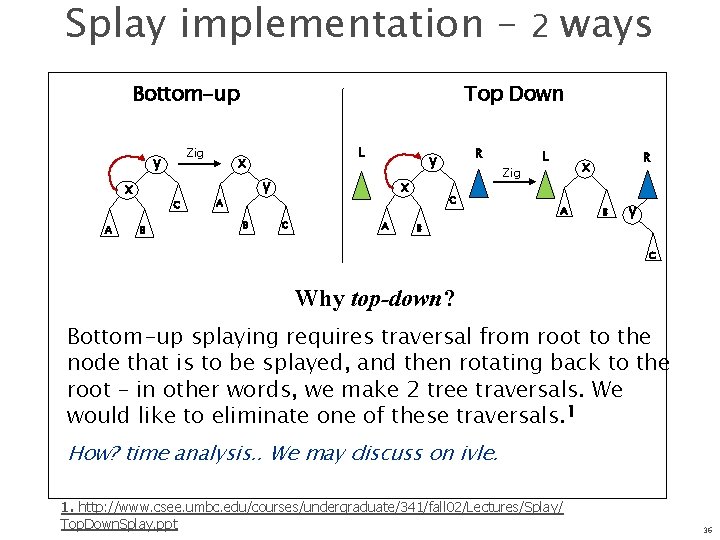
Splay implementation – Bottom-up Zig y x A C B 2 ways Top Down L x y A B x C R y A Zig C L R x A B B y C Why top-down? Bottom-up splaying requires traversal from root to the node that is to be splayed, and then rotating back to the root – in other words, we make 2 tree traversals. We would like to eliminate one of these traversals. 1 How? time analysis. . We may discuss on ivle. 1. http: //www. csee. umbc. edu/courses/undergraduate/341/fall 02/Lectures/Splay/ Top. Down. Splay. ppt 36
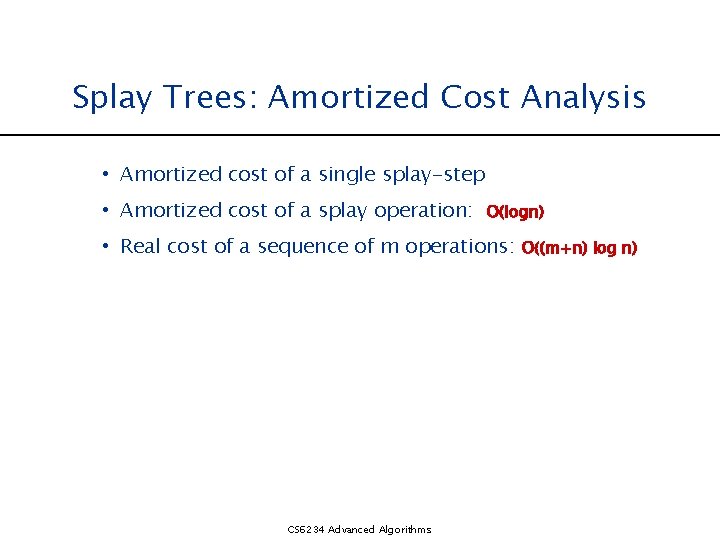
Splay Trees: Amortized Cost Analysis • Amortized cost of a single splay-step • Amortized cost of a splay operation: O(logn) • Real cost of a sequence of m operations: CS 6234 Advanced Algorithms O((m+n) log n)
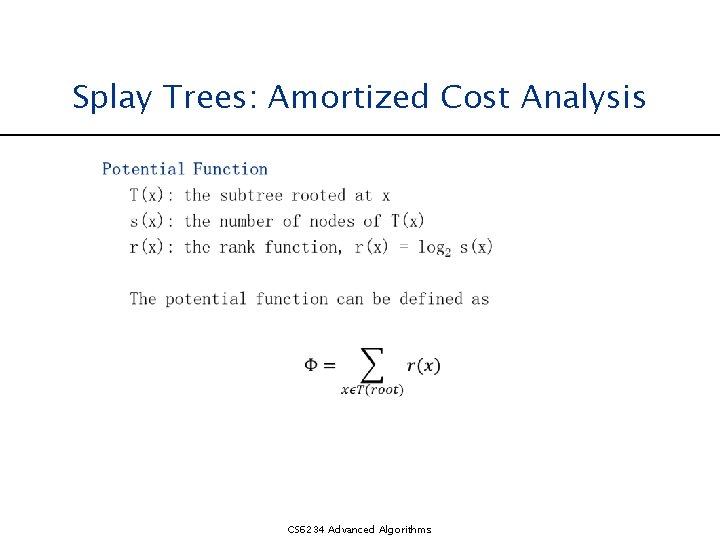
Splay Trees: Amortized Cost Analysis CS 6234 Advanced Algorithms
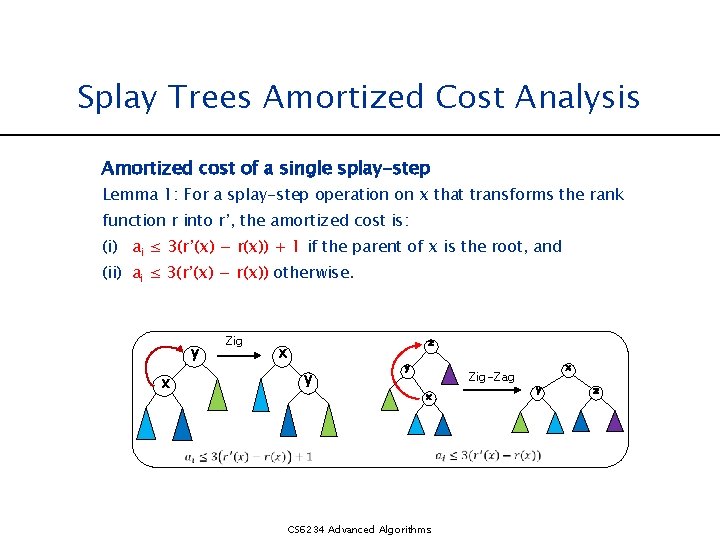
Splay Trees Amortized Cost Analysis Amortized cost of a single splay-step Lemma 1: For a splay-step operation on x that transforms the rank function r into r’, the amortized cost is: (i) ai ≤ 3(r’(x) − r(x)) + 1 if the parent of x is the root, and (ii) ai ≤ 3(r’(x) − r(x)) otherwise. y x Zig z x y y Zig-Zag x CS 6234 Advanced Algorithms x y z
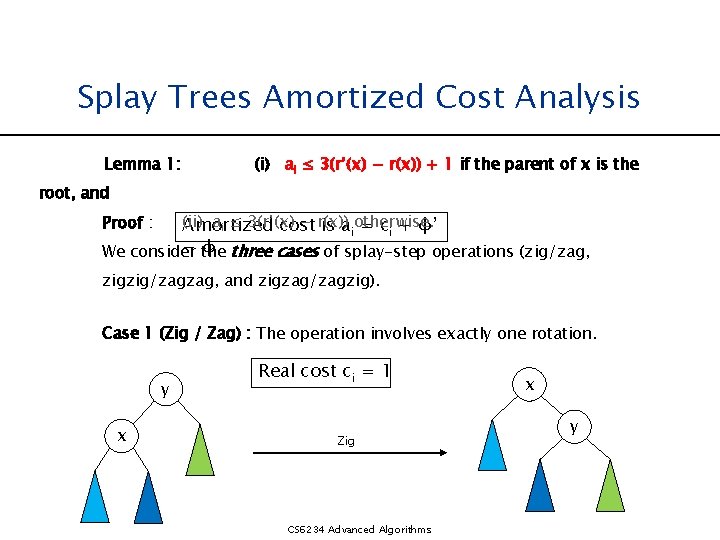
Splay Trees Amortized Cost Analysis Lemma 1: (i) ai ≤ 3(r’(x) − r(x)) + 1 if the parent of x is the root, and (ii) ai ≤ 3(r’(x) − r(x)) Amortized cost is aiotherwise. = ci + φ’ − the φ three cases of splay-step operations (zig/zag, We consider Proof : zigzig/zagzag, and zigzag/zagzig). Case 1 (Zig / Zag) : The operation involves exactly one rotation. y x Real cost ci = 1 Zig CS 6234 Advanced Algorithms x y
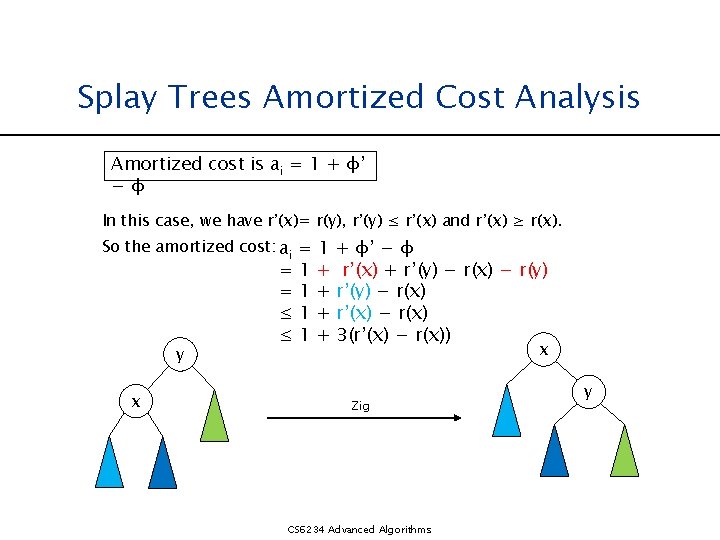
Splay Trees Amortized Cost Analysis Amortized cost is ai = 1 + φ’ −φ In this case, we have r’(x)= r(y), r’(y) ≤ r’(x) and r’(x) ≥ r(x). So the amortized cost: ai = 1 + φ’ − φ y x = = ≤ ≤ 1 1 + + r’(x) + r’(y) − r(x) − r(y) r’(y) − r(x) r’(x) − r(x) 3(r’(x) − r(x)) x Zig CS 6234 Advanced Algorithms y
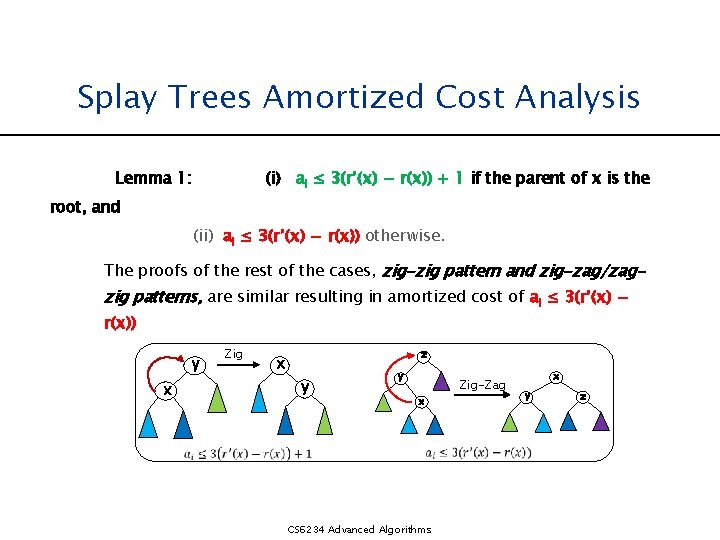
Splay Trees Amortized Cost Analysis Lemma 1: (i) ai ≤ 3(r’(x) − r(x)) + 1 if the parent of x is the root, and (ii) ai ≤ 3(r’(x) − r(x)) otherwise. The proofs of the rest of the cases, zig-zig pattern and zig-zag/zag- zig patterns, are similar resulting in amortized cost of ai ≤ 3(r’(x) − r(x)) y x Zig z x y y x CS 6234 Advanced Algorithms Zig-Zag x y z
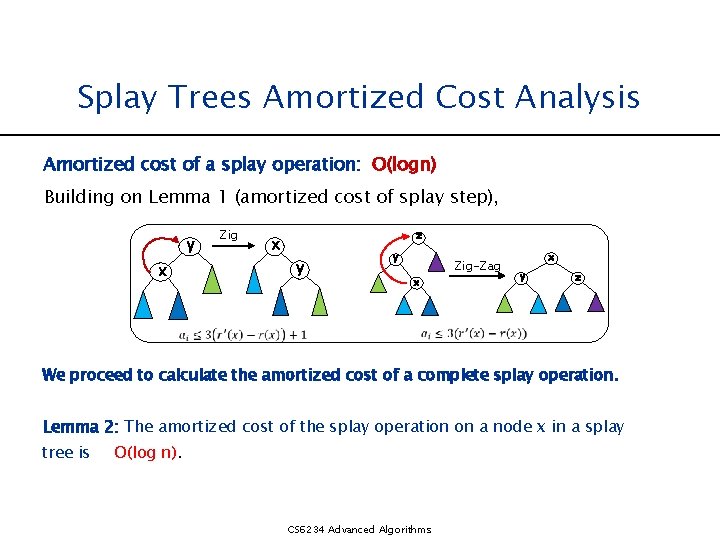
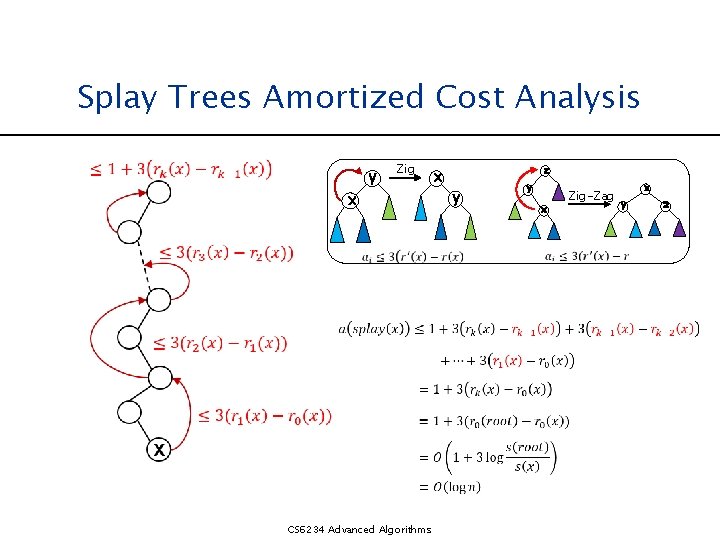
Splay Trees Amortized Cost Analysis Amortized cost of a splay operation: O(logn) Building on Lemma 1 (amortized cost of splay step), y x Zig z x y y x Zig-Zag x y z We proceed to calculate the amortized cost of a complete splay operation. Lemma 2: The amortized cost of the splay operation on a node x in a splay tree is O(log n). CS 6234 Advanced Algorithms
Splay Trees Amortized Cost Analysis y Zig x CS 6234 Advanced Algorithms x z y y x Zig-Zag x y z
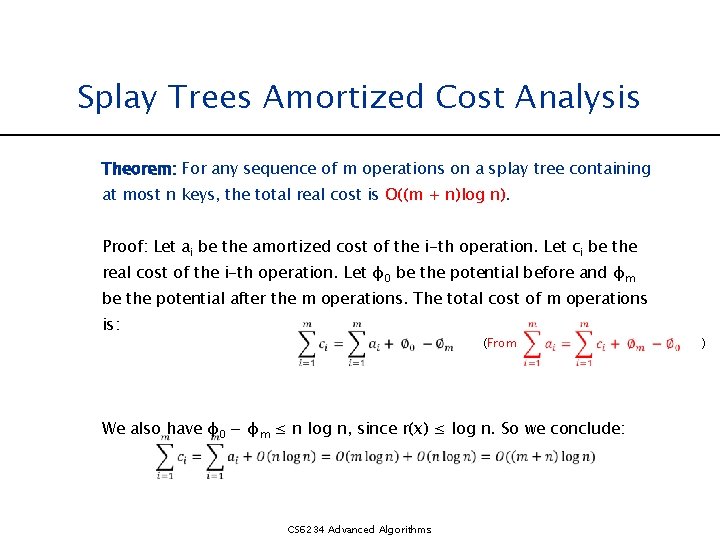
Splay Trees Amortized Cost Analysis Theorem: For any sequence of m operations on a splay tree containing at most n keys, the total real cost is O((m + n)log n). Proof: Let ai be the amortized cost of the i-th operation. Let ci be the real cost of the i-th operation. Let φ0 be the potential before and φm be the potential after the m operations. The total cost of m operations is: (From We also have φ0 − φm ≤ n log n, since r(x) ≤ log n. So we conclude: CS 6234 Advanced Algorithms )
![Range Removal [7, 14] 10 17 5 3 13 6 8 7 22 16](http://slidetodoc.com/presentation_image_h2/456e428018d5ab8ec3371ac428bf1f8d/image-46.jpg "Range Removal [7, 14] 10 17 5 3 13 6 8 7 22 16")
Range Removal [7, 14] 10 17 5 3 13 6 8 7 22 16 9 Find the maximum value within range (-inf, 7), and splay it to the root. CS 6234 Advanced Algorithms
![Range Removal [7, 14] 6 5 10 8 17 3 7 9 13 22](http://slidetodoc.com/presentation_image_h2/456e428018d5ab8ec3371ac428bf1f8d/image-47.jpg "Range Removal [7, 14] 6 5 10 8 17 3 7 9 13 22")
Range Removal [7, 14] 6 5 10 8 17 3 7 9 13 22 16 Find the minimum value within range (14, +inf), and splay it to the root of the right subtree. CS 6234 Advanced Algorithms
![Range Removal [7, 14] 6 5 10 3 8 7 X 16 17 13](http://slidetodoc.com/presentation_image_h2/456e428018d5ab8ec3371ac428bf1f8d/image-48.jpg "Range Removal [7, 14] 6 5 10 3 8 7 X 16 17 13")
Range Removal [7, 14] 6 5 10 3 8 7 X 16 17 13 9 22 [7, 14] Cut off the link between the subtree and its parent. CS 6234 Advanced Algorithms
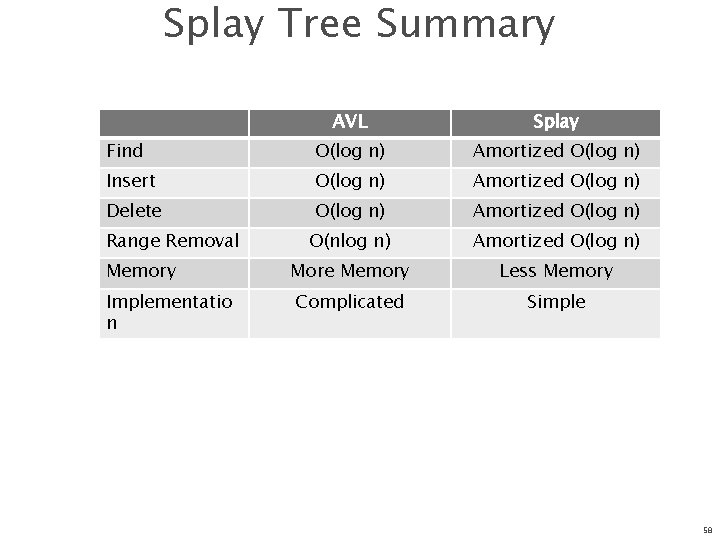
Splay Tree Summary AVL Splay Find O(log n) Amortized O(log n) Insert O(log n) Amortized O(log n) Delete O(log n) Amortized O(log n) O(nlog n) Amortized O(log n) Memory More Memory Less Memory Implementatio n Complicated Simple Range Removal 58
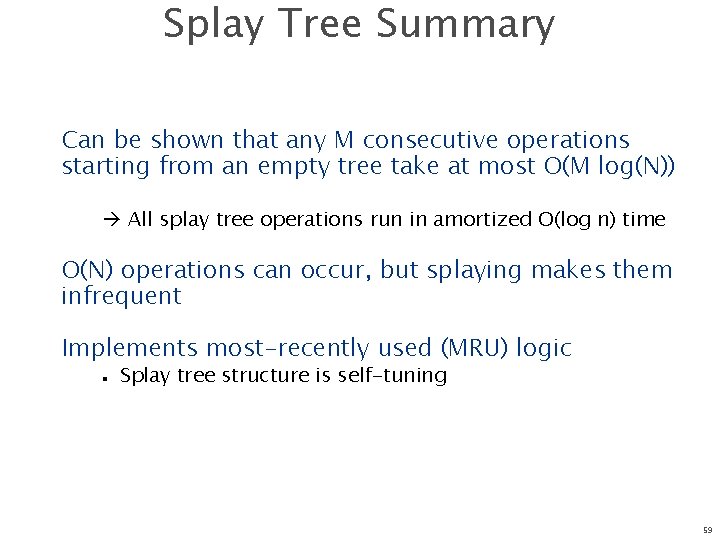
Splay Tree Summary Can be shown that any M consecutive operations starting from an empty tree take at most O(M log(N)) All splay tree operations run in amortized O(log n) time O(N) operations can occur, but splaying makes them infrequent Implements most-recently used (MRU) logic n Splay tree structure is self-tuning 59
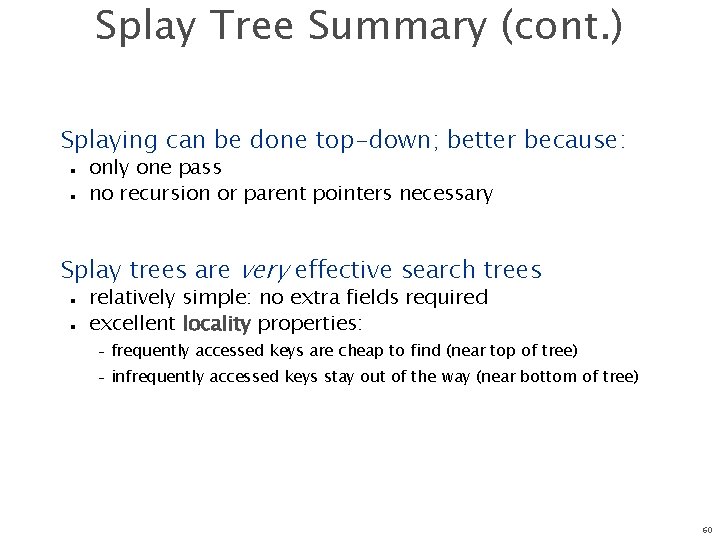
Splay Tree Summary (cont. ) Splaying can be done top-down; better because: n n only one pass no recursion or parent pointers necessary Splay trees are very effective search trees n n relatively simple: no extra fields required excellent locality properties: – frequently accessed keys are cheap to find (near top of tree) – infrequently accessed keys stay out of the way (near bottom of tree) 60
Fibonacci Heaps Agus Pratondo Aleksanr Farseev CS 6234 Advanced Algorithms
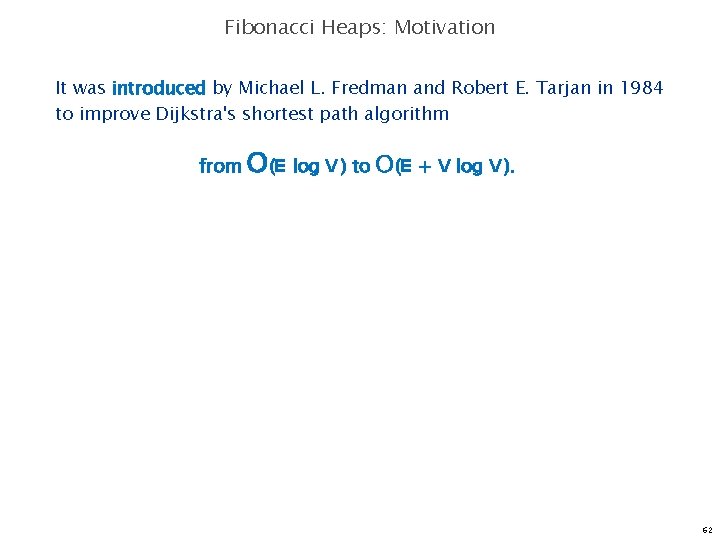
Fibonacci Heaps: Motivation It was introduced by Michael L. Fredman and Robert E. Tarjan in 1984 to improve Dijkstra's shortest path algorithm from O(E log V ) to O(E + V log V ). 62
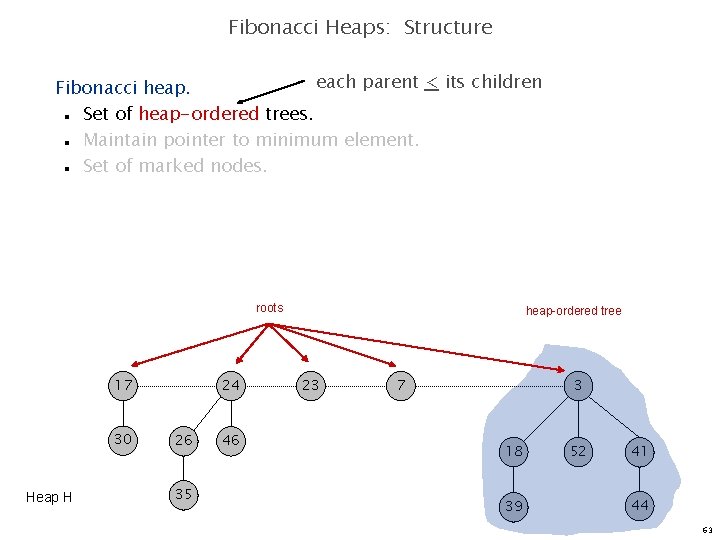
Fibonacci Heaps: Structure each parent < its children Fibonacci heap. Set of heap-ordered trees. Maintain pointer to minimum element. Set of marked nodes. n n n roots 17 30 Heap H 24 26 35 46 heap-ordered tree 23 7 3 18 39 52 41 44 63
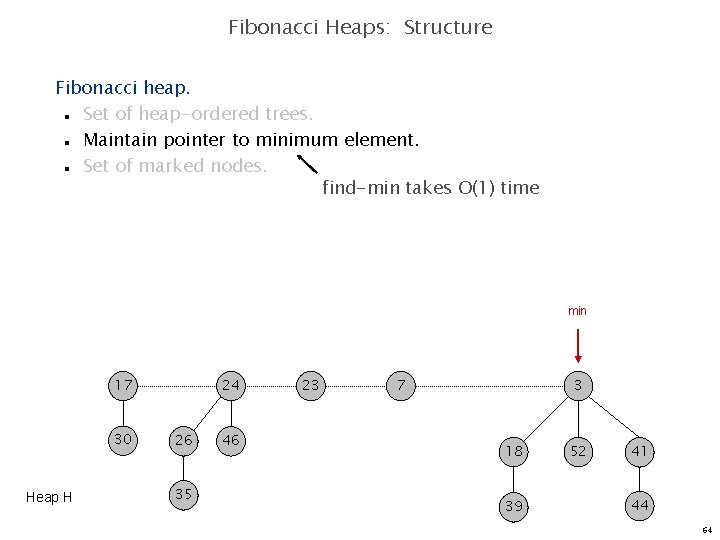
Fibonacci Heaps: Structure Fibonacci heap. Set of heap-ordered trees. Maintain pointer to minimum element. Set of marked nodes. find-min takes O(1) time n n n min 17 30 Heap H 24 26 35 46 23 7 3 18 39 52 41 44 64
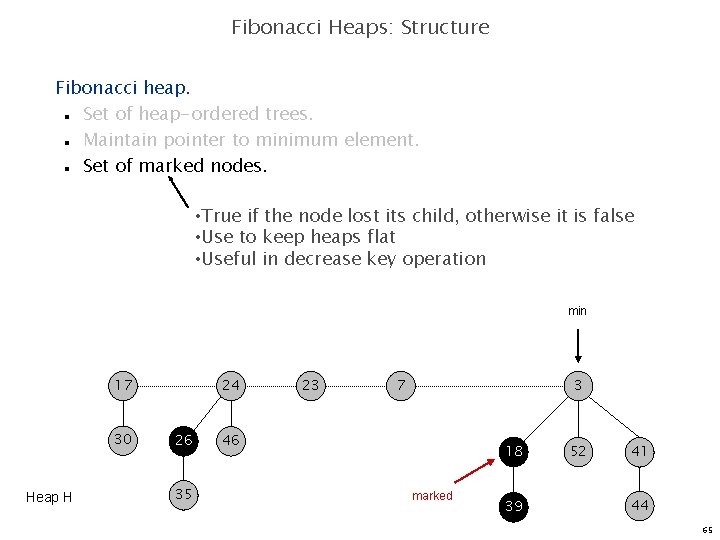
Fibonacci Heaps: Structure Fibonacci heap. Set of heap-ordered trees. Maintain pointer to minimum element. Set of marked nodes. n n n • True if the node lost its child, otherwise it is false • Use to keep heaps flat • Useful in decrease key operation min 17 30 Heap H 24 26 35 23 7 3 46 18 marked 39 52 41 44 65
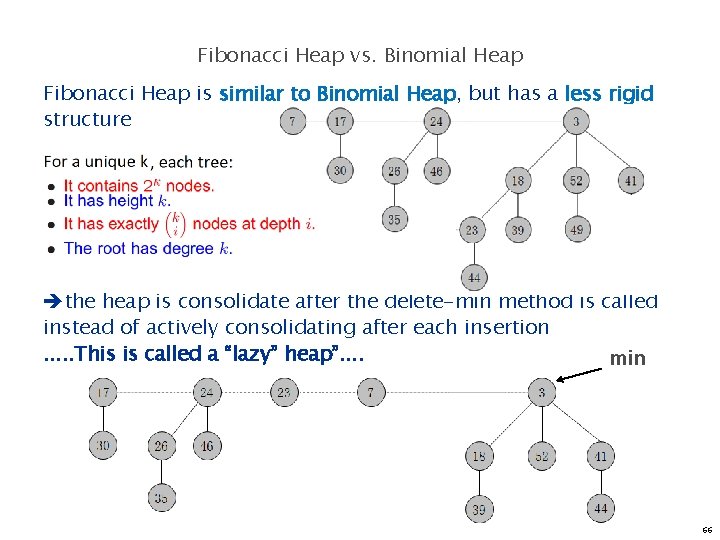
Fibonacci Heap vs. Binomial Heap Fibonacci Heap is similar to Binomial Heap, but has a less rigid structure the heap is consolidate after the delete-min method is called instead of actively consolidating after each insertion. . . This is called a “lazy” heap”. . min 66
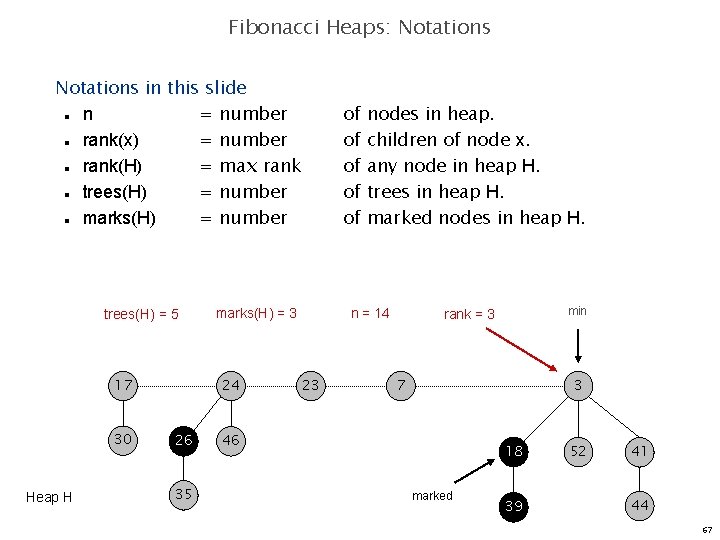
Fibonacci Heaps: Notations in this slide n = number rank(x) = number rank(H) = max rank trees(H) = number marks(H) = number of of of n n n trees(H) = 5 17 30 Heap H marks(H) = 3 24 26 35 nodes in heap. children of node x. any node in heap H. trees in heap H. marked nodes in heap H. n = 14 23 min rank = 3 7 3 46 18 marked 39 52 41 44 67
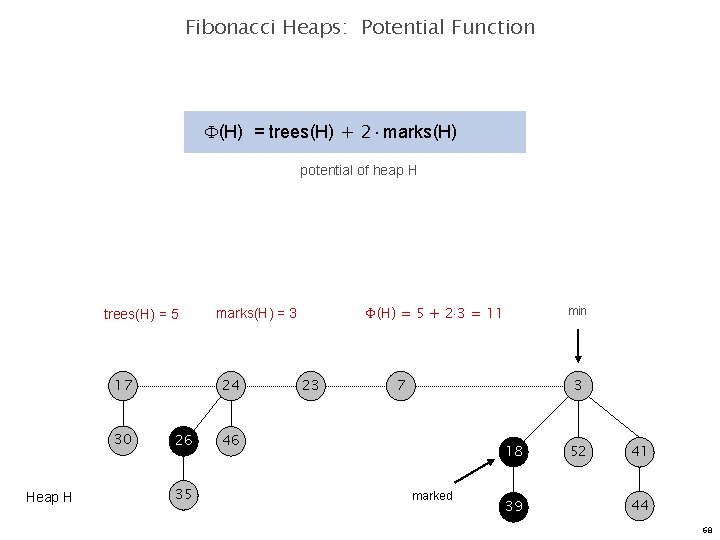
Fibonacci Heaps: Potential Function (H) = trees(H) + 2 marks(H) potential of heap H trees(H) = 5 17 30 Heap H 24 26 35 (H) = 5 + 2 3 = 11 marks(H) = 3 23 min 7 3 46 18 marked 39 52 41 44 68
Insert 69
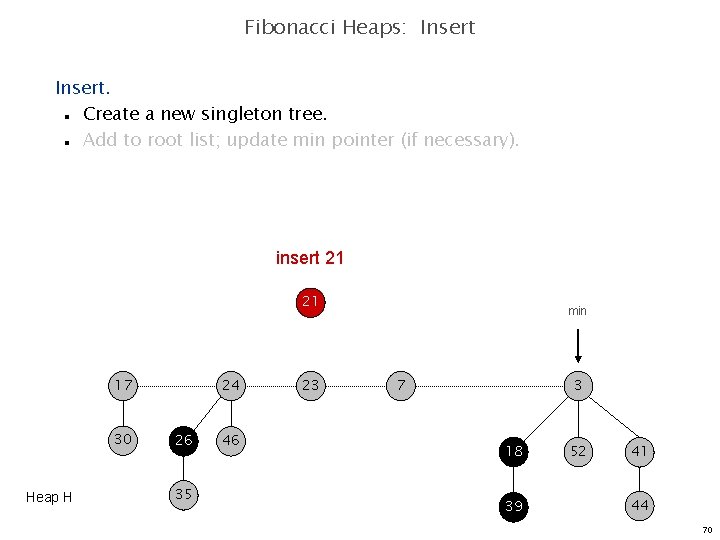
Fibonacci Heaps: Insert. Create a new singleton tree. Add to root list; update min pointer (if necessary). n n insert 21 21 17 30 Heap H 24 26 35 46 23 min 7 3 18 39 52 41 44 70
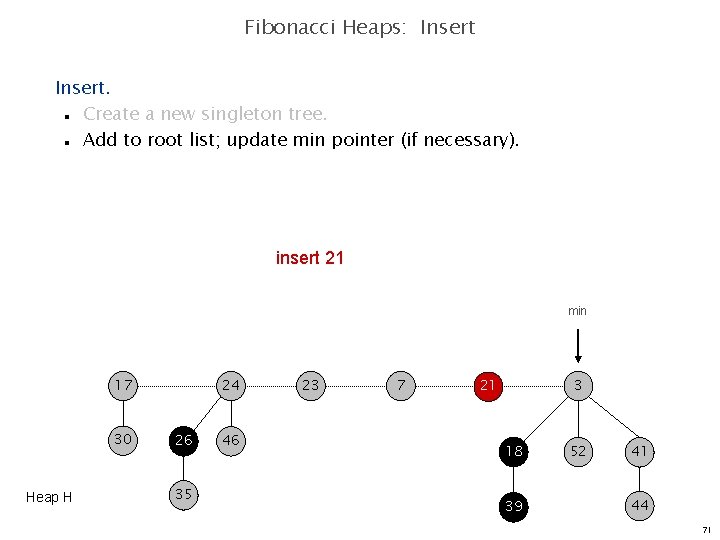
Fibonacci Heaps: Insert. Create a new singleton tree. Add to root list; update min pointer (if necessary). n n insert 21 min 17 30 Heap H 24 26 35 46 23 7 3 21 18 39 52 41 44 71
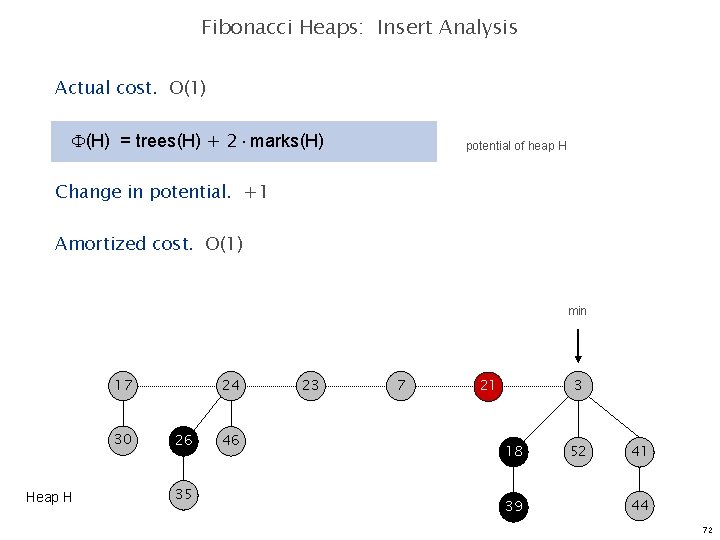
Fibonacci Heaps: Insert Analysis Actual cost. O(1) (H) = trees(H) + 2 marks(H) potential of heap H Change in potential. +1 Amortized cost. O(1) min 17 30 Heap H 24 26 35 46 23 7 3 21 18 39 52 41 44 72
Linking Operation 73
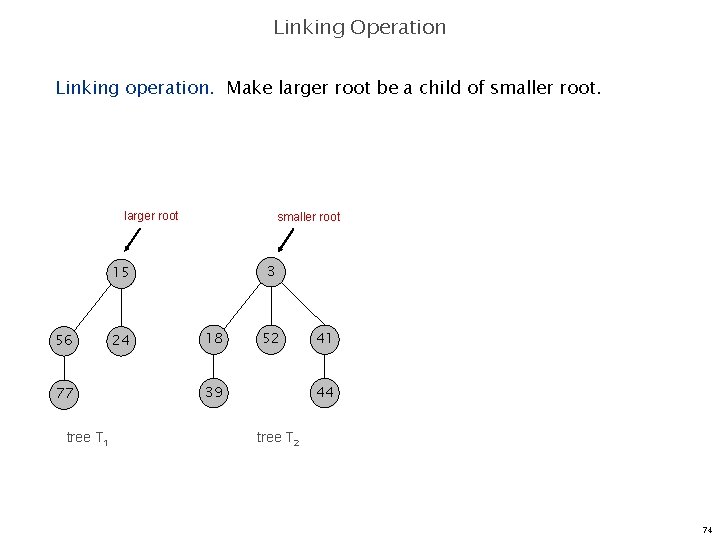
Linking Operation Linking operation. Make larger root be a child of smaller root. larger root smaller root 3 15 56 77 tree T 1 24 18 52 39 41 44 tree T 2 74
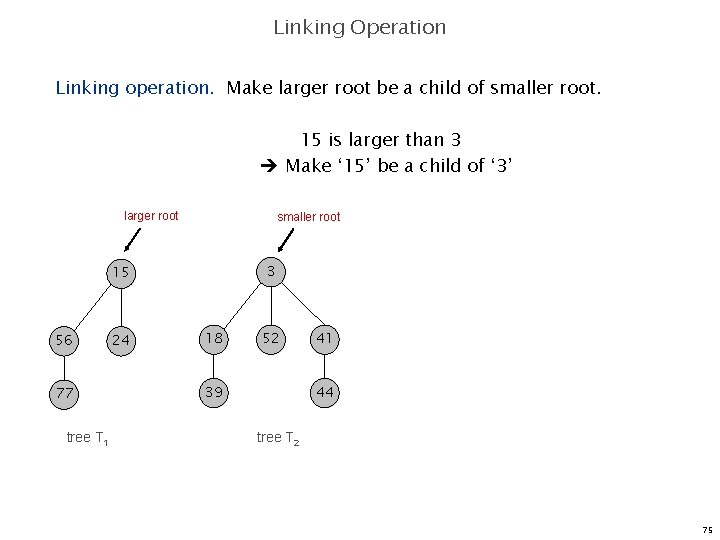
Linking Operation Linking operation. Make larger root be a child of smaller root. 15 is larger than 3 Make ‘ 15’ be a child of ‘ 3’ larger root smaller root 3 15 56 77 tree T 1 24 18 52 39 41 44 tree T 2 75
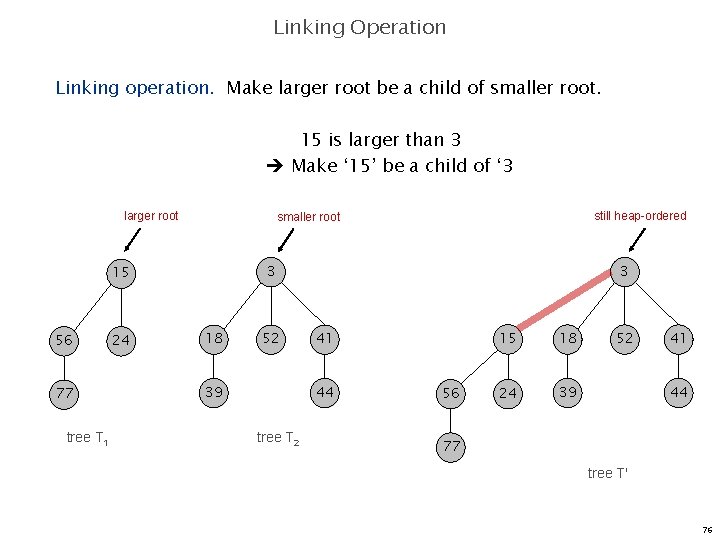
Linking Operation Linking operation. Make larger root be a child of smaller root. 15 is larger than 3 Make ‘ 15’ be a child of ‘ 3 larger root 77 tree T 1 24 3 3 15 56 still heap-ordered smaller root 18 52 39 41 44 tree T 2 56 15 18 24 39 52 41 44 77 tree T' 76
Delete Min 77
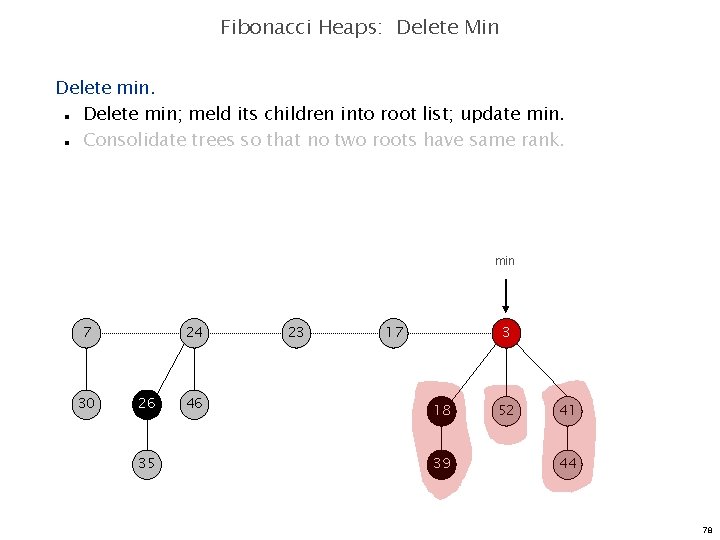
Fibonacci Heaps: Delete Min Delete min; meld its children into root list; update min. Consolidate trees so that no two roots have same rank. n n min 7 30 24 26 35 46 23 17 3 18 39 52 41 44 78
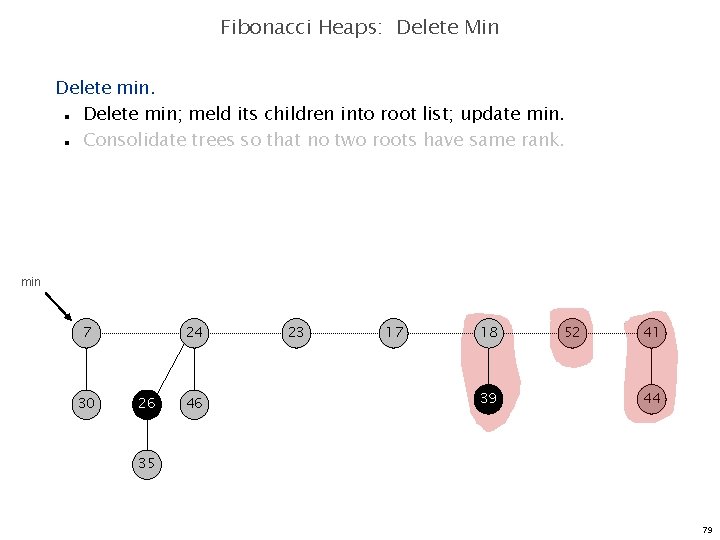
Fibonacci Heaps: Delete Min Delete min; meld its children into root list; update min. Consolidate trees so that no two roots have same rank. n n min 7 30 24 26 46 23 17 18 39 52 41 44 35 79
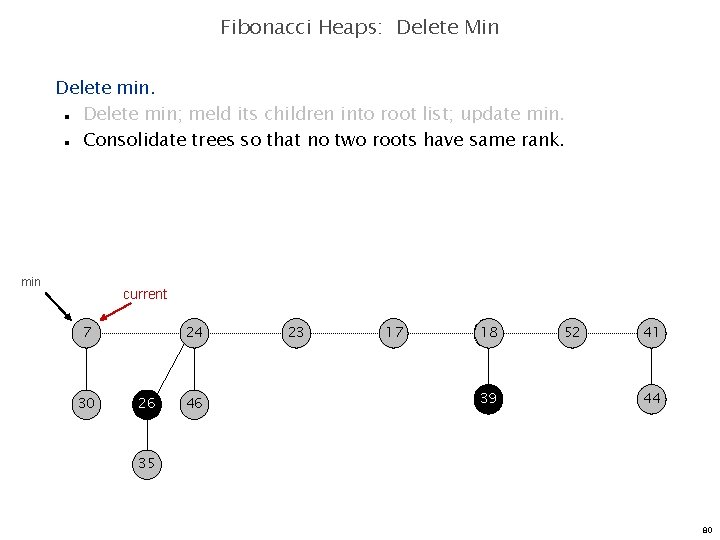
Fibonacci Heaps: Delete Min Delete min; meld its children into root list; update min. Consolidate trees so that no two roots have same rank. n n min current 7 30 24 26 46 23 17 18 39 52 41 44 35 80
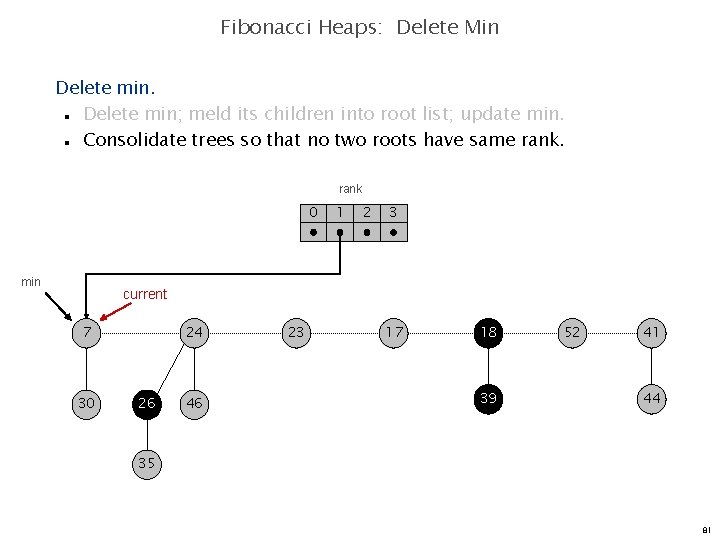
Fibonacci Heaps: Delete Min Delete min; meld its children into root list; update min. Consolidate trees so that no two roots have same rank. n n rank 0 min 1 2 3 current 7 30 24 26 46 23 17 18 39 52 41 44 35 81
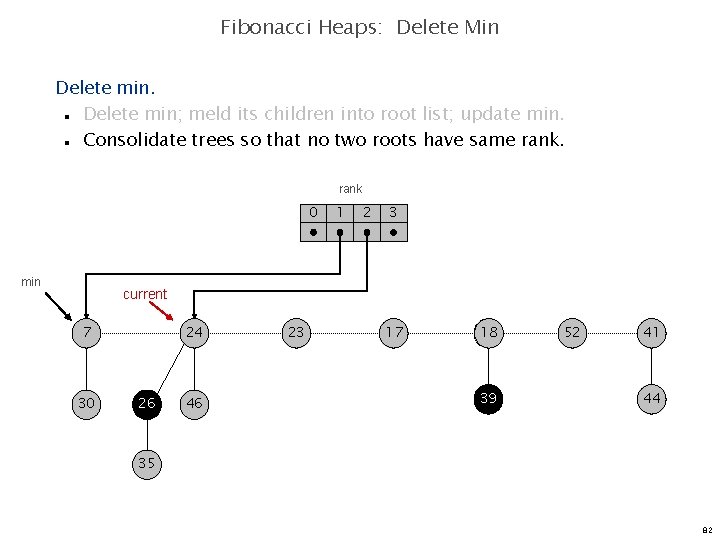
Fibonacci Heaps: Delete Min Delete min; meld its children into root list; update min. Consolidate trees so that no two roots have same rank. n n rank 0 min 1 2 3 current 7 30 24 26 46 23 17 18 39 52 41 44 35 82
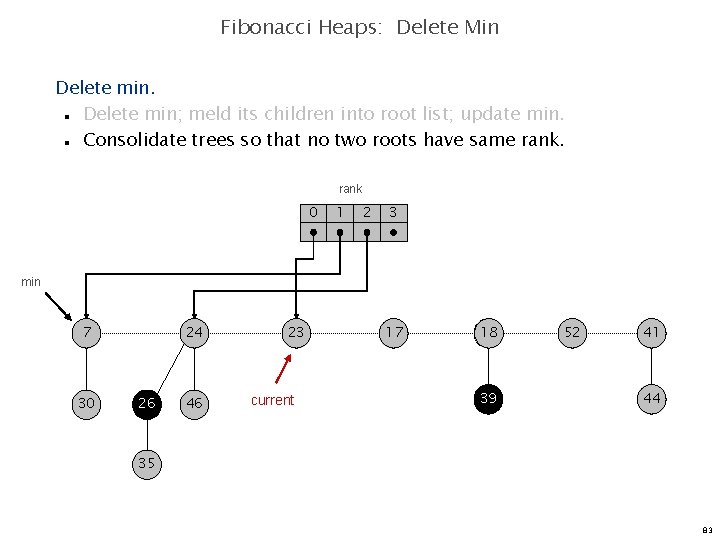
Fibonacci Heaps: Delete Min Delete min; meld its children into root list; update min. Consolidate trees so that no two roots have same rank. n n rank 0 1 2 3 min 7 30 24 26 46 23 current 17 18 39 52 41 44 35 83
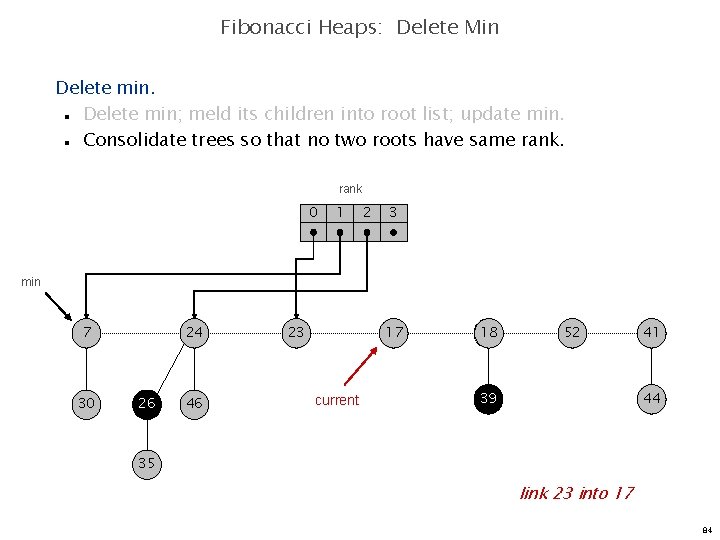
Fibonacci Heaps: Delete Min Delete min; meld its children into root list; update min. Consolidate trees so that no two roots have same rank. n n rank 0 1 2 3 min 7 30 24 26 46 23 17 current 18 52 39 41 44 35 link 23 into 17 84
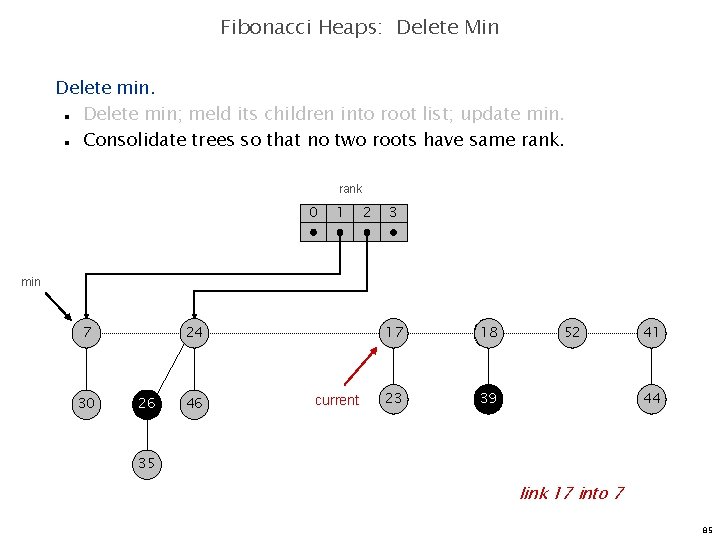
Fibonacci Heaps: Delete Min Delete min; meld its children into root list; update min. Consolidate trees so that no two roots have same rank. n n rank 0 1 2 3 min 7 30 24 26 46 current 17 18 23 39 52 41 44 35 link 17 into 7 85
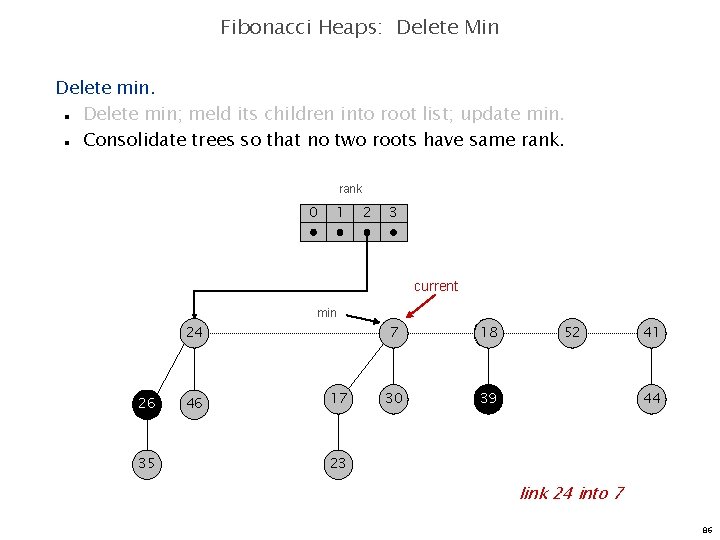
Fibonacci Heaps: Delete Min Delete min; meld its children into root list; update min. Consolidate trees so that no two roots have same rank. n n rank 0 1 2 3 current min 24 26 35 46 17 7 18 30 39 52 41 44 23 link 24 into 7 86
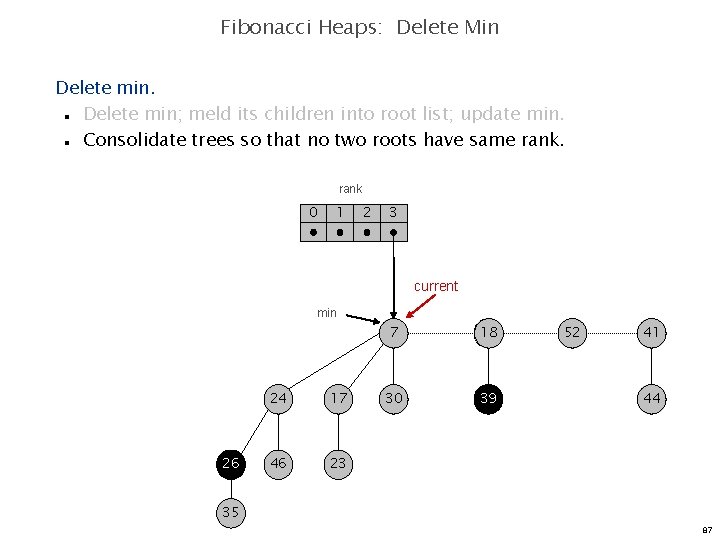
Fibonacci Heaps: Delete Min Delete min; meld its children into root list; update min. Consolidate trees so that no two roots have same rank. n n rank 0 1 2 3 current min 26 24 17 46 23 7 18 30 39 52 41 44 35 87
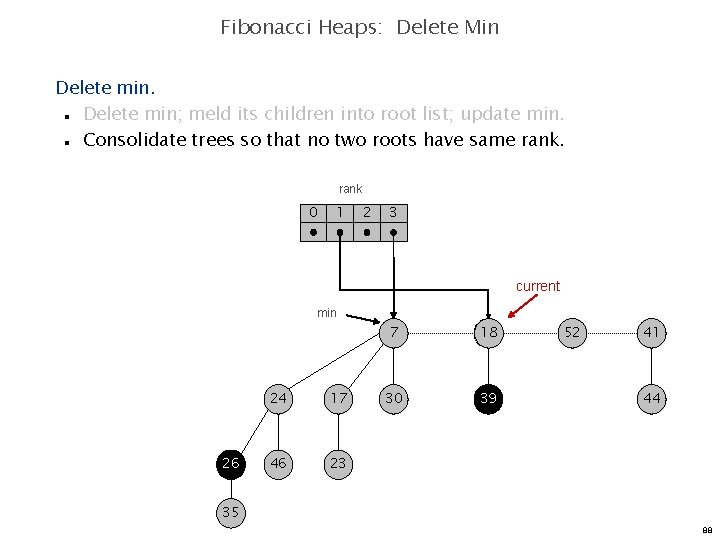
Fibonacci Heaps: Delete Min Delete min; meld its children into root list; update min. Consolidate trees so that no two roots have same rank. n n rank 0 1 2 3 current min 26 24 17 46 23 7 18 30 39 52 41 44 35 88
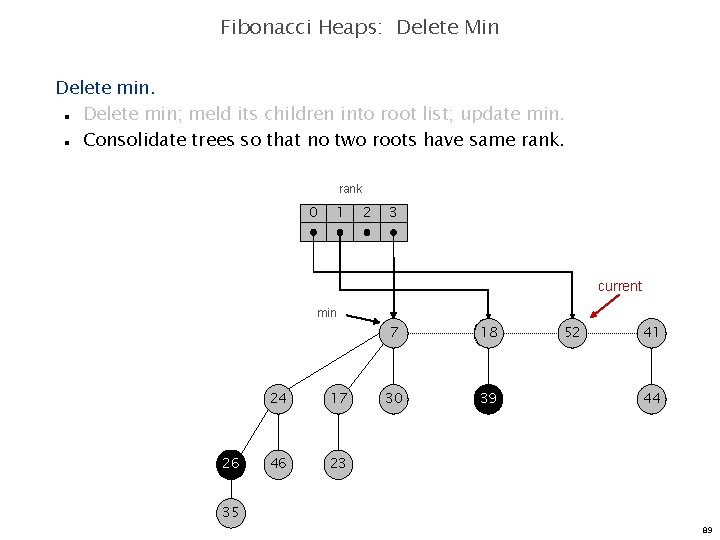
Fibonacci Heaps: Delete Min Delete min; meld its children into root list; update min. Consolidate trees so that no two roots have same rank. n n rank 0 1 2 3 current min 26 24 17 46 23 7 18 30 39 52 41 44 35 89
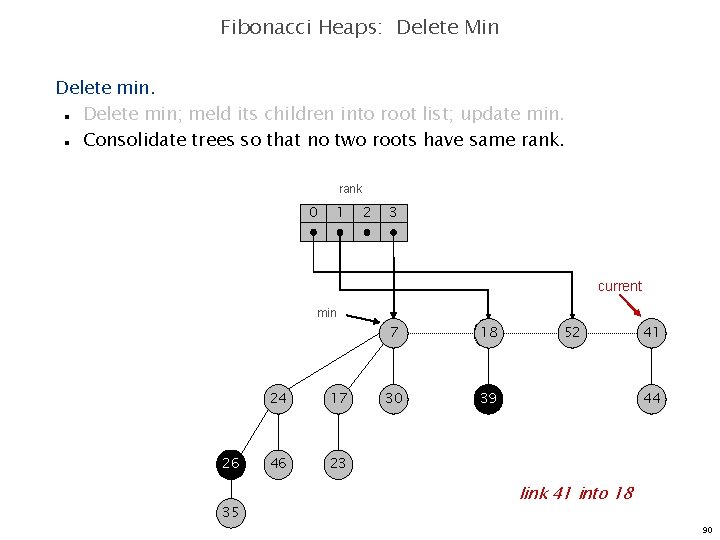
Fibonacci Heaps: Delete Min Delete min; meld its children into root list; update min. Consolidate trees so that no two roots have same rank. n n rank 0 1 2 3 current min 26 35 24 17 46 23 7 18 30 39 52 41 44 link 41 into 18 90
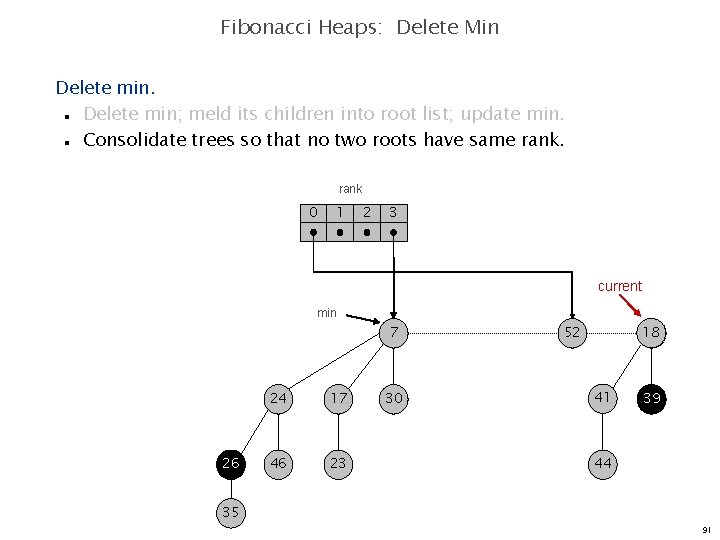
Fibonacci Heaps: Delete Min Delete min; meld its children into root list; update min. Consolidate trees so that no two roots have same rank. n n rank 0 1 2 3 current min 7 26 24 17 46 23 30 18 52 41 39 44 35 91
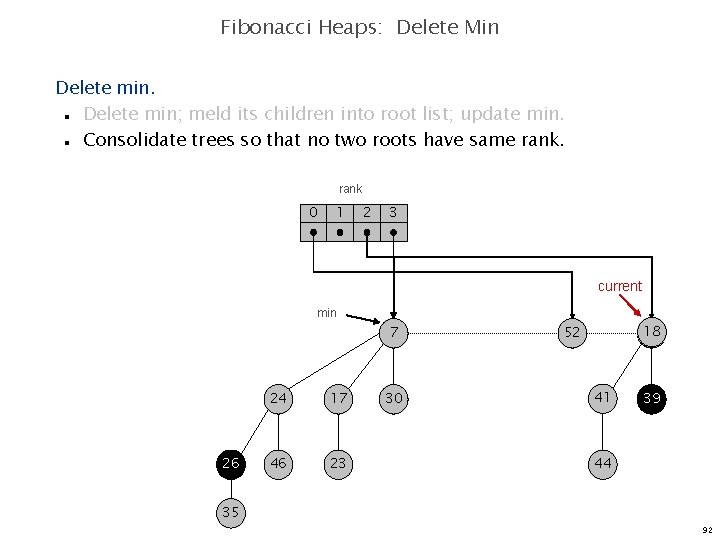
Fibonacci Heaps: Delete Min Delete min; meld its children into root list; update min. Consolidate trees so that no two roots have same rank. n n rank 0 1 2 3 current min 7 26 24 17 46 23 30 18 52 41 39 44 35 92
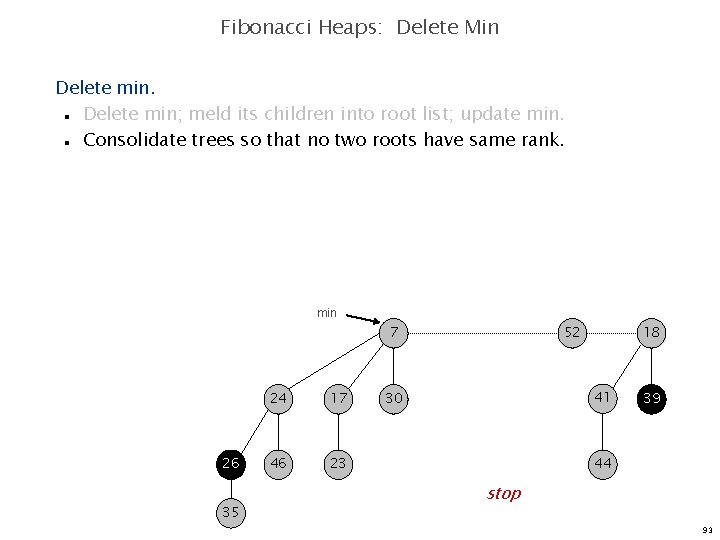
Fibonacci Heaps: Delete Min Delete min; meld its children into root list; update min. Consolidate trees so that no two roots have same rank. n n min 7 26 35 24 17 46 23 52 18 41 30 39 44 stop 93
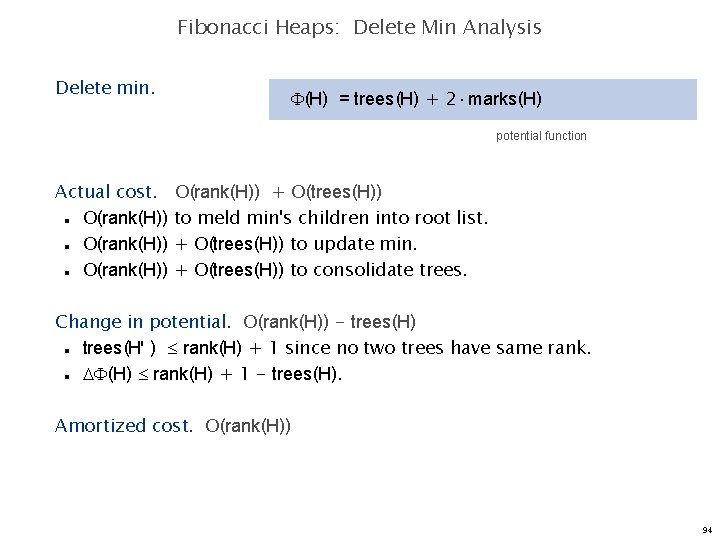
Fibonacci Heaps: Delete Min Analysis Delete min. (H) = trees(H) + 2 marks(H) potential function Actual cost. O(rank(H)) n n n O(rank(H)) + O(trees(H)) to meld min's children into root list. + O(trees(H)) to update min. + O(trees(H)) to consolidate trees. Change in potential. O(rank(H)) - trees(H) trees(H' ) rank(H) + 1 since no two trees have same rank. (H) rank(H) + 1 - trees(H). n n Amortized cost. O(rank(H)) 94
Decrease Key 95
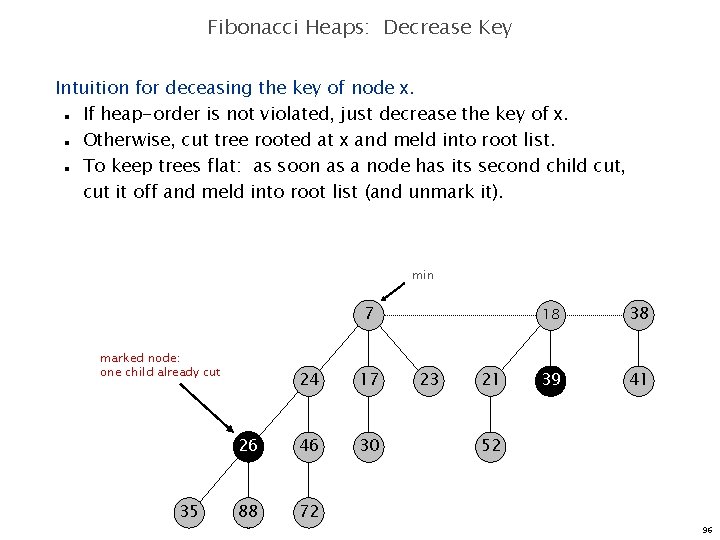
Fibonacci Heaps: Decrease Key Intuition for deceasing the key of node x. If heap-order is not violated, just decrease the key of x. Otherwise, cut tree rooted at x and meld into root list. To keep trees flat: as soon as a node has its second child cut, cut it off and meld into root list (and unmark it). n n n min 7 marked node: one child already cut 35 24 17 26 46 30 88 72 23 21 18 38 39 41 52 96
![Fibonacci Heaps: Decrease Key Case 1. [heap order not violated] Decrease key of x.](http://slidetodoc.com/presentation_image_h2/456e428018d5ab8ec3371ac428bf1f8d/image-88.jpg "Fibonacci Heaps: Decrease Key Case 1. [heap order not violated] Decrease key of x.")
Fibonacci Heaps: Decrease Key Case 1. [heap order not violated] Decrease key of x. Change heap min pointer (if necessary). n n min 7 26 24 17 46 29 30 23 21 18 38 39 41 52 x 35 88 72 decrease-key of x from 46 to 29 97
![Fibonacci Heaps: Decrease Key Case 1. [heap order not violated] Decrease key of x.](http://slidetodoc.com/presentation_image_h2/456e428018d5ab8ec3371ac428bf1f8d/image-89.jpg "Fibonacci Heaps: Decrease Key Case 1. [heap order not violated] Decrease key of x.")
Fibonacci Heaps: Decrease Key Case 1. [heap order not violated] Decrease key of x. Change heap min pointer (if necessary). n n min 7 26 24 17 29 30 23 21 18 38 39 41 52 x 35 88 72 decrease-key of x from 46 to 29 98
![Fibonacci Heaps: Decrease Key Case 2 a. [heap order violated] Decrease key of x.](http://slidetodoc.com/presentation_image_h2/456e428018d5ab8ec3371ac428bf1f8d/image-90.jpg "Fibonacci Heaps: Decrease Key Case 2 a. [heap order violated] Decrease key of x.")
Fibonacci Heaps: Decrease Key Case 2 a. [heap order violated] Decrease key of x. Cut tree rooted at x, meld into root list, and unmark. If parent p of x is unmarked (hasn't yet lost a child), mark it; Otherwise, cut p, meld into root list, and unmark (and do so recursively for all ancestors that lose a second child). n n n min 7 24 17 23 21 18 38 39 41 p 26 29 15 30 52 x 35 88 72 decrease-key of x from 29 to 15 99
![Fibonacci Heaps: Decrease Key Case 2 a. [heap order violated] Decrease key of x.](http://slidetodoc.com/presentation_image_h2/456e428018d5ab8ec3371ac428bf1f8d/image-91.jpg "Fibonacci Heaps: Decrease Key Case 2 a. [heap order violated] Decrease key of x.")
Fibonacci Heaps: Decrease Key Case 2 a. [heap order violated] Decrease key of x. Cut tree rooted at x, meld into root list, and unmark. If parent p of x is unmarked (hasn't yet lost a child), mark it; Otherwise, cut p, meld into root list, and unmark (and do so recursively for all ancestors that lose a second child). n n n min 7 24 17 23 21 18 38 39 41 p 26 15 30 52 x 35 88 72 decrease-key of x from 29 to 15 100
![Fibonacci Heaps: Decrease Key Case 2 a. [heap order violated] Decrease key of x.](http://slidetodoc.com/presentation_image_h2/456e428018d5ab8ec3371ac428bf1f8d/image-92.jpg "Fibonacci Heaps: Decrease Key Case 2 a. [heap order violated] Decrease key of x.")
Fibonacci Heaps: Decrease Key Case 2 a. [heap order violated] Decrease key of x. Cut tree rooted at x, meld into root list, and unmark. If parent p of x is unmarked (hasn't yet lost a child), mark it; Otherwise, cut p, meld into root list, and unmark (and do so recursively for all ancestors that lose a second child). n n n x min 15 7 72 24 17 23 21 18 38 39 41 p 26 35 88 30 52 decrease-key of x from 29 to 15 101
![Fibonacci Heaps: Decrease Key Case 2 a. [heap order violated] Decrease key of x.](http://slidetodoc.com/presentation_image_h2/456e428018d5ab8ec3371ac428bf1f8d/image-93.jpg "Fibonacci Heaps: Decrease Key Case 2 a. [heap order violated] Decrease key of x.")
Fibonacci Heaps: Decrease Key Case 2 a. [heap order violated] Decrease key of x. Cut tree rooted at x, meld into root list, and unmark. If parent p of x is unmarked (hasn't yet lost a child), mark it; Otherwise, cut p, meld into root list, and unmark (and do so recursively for all ancestors that lose a second child). n n n x min 15 7 72 24 23 21 38 39 41 p mark parent 26 35 17 18 88 30 52 decrease-key of x from 29 to 15 102
![Fibonacci Heaps: Decrease Key Case 2 b. [heap order violated] Decrease key of x.](http://slidetodoc.com/presentation_image_h2/456e428018d5ab8ec3371ac428bf1f8d/image-94.jpg "Fibonacci Heaps: Decrease Key Case 2 b. [heap order violated] Decrease key of x.")
Fibonacci Heaps: Decrease Key Case 2 b. [heap order violated] Decrease key of x. Cut tree rooted at x, meld into root list, and unmark. If parent p of x is unmarked (hasn't yet lost a child), mark it; Otherwise, cut p, meld into root list, and unmark (and do so recursively for all ancestors that lose a second child). n n n min 15 7 72 24 p x 35 5 26 88 17 30 23 21 18 38 39 41 52 decrease-key of x from 35 to 5 103
![Fibonacci Heaps: Decrease Key Case 2 b. [heap order violated] Decrease key of x.](http://slidetodoc.com/presentation_image_h2/456e428018d5ab8ec3371ac428bf1f8d/image-95.jpg "Fibonacci Heaps: Decrease Key Case 2 b. [heap order violated] Decrease key of x.")
Fibonacci Heaps: Decrease Key Case 2 b. [heap order violated] Decrease key of x. Cut tree rooted at x, meld into root list, and unmark. If parent p of x is unmarked (hasn't yet lost a child), mark it; Otherwise, cut p, meld into root list, and unmark (and do so recursively for all ancestors that lose a second child). n n n min 15 7 72 24 p x 5 26 88 17 30 23 21 18 38 39 41 52 decrease-key of x from 35 to 5 104
![Fibonacci Heaps: Decrease Key Case 2 b. [heap order violated] Decrease key of x.](http://slidetodoc.com/presentation_image_h2/456e428018d5ab8ec3371ac428bf1f8d/image-96.jpg "Fibonacci Heaps: Decrease Key Case 2 b. [heap order violated] Decrease key of x.")
Fibonacci Heaps: Decrease Key Case 2 b. [heap order violated] Decrease key of x. Cut tree rooted at x, meld into root list, and unmark. If parent p of x is unmarked (hasn't yet lost a child), mark it; Otherwise, cut p, meld into root list, and unmark (and do so recursively for all ancestors that lose a second child). n n n min 15 x 5 7 72 24 p 26 88 17 30 23 21 18 38 39 41 52 decrease-key of x from 35 to 5 105
![Fibonacci Heaps: Decrease Key Case 2 b. [heap order violated] Decrease key of x.](http://slidetodoc.com/presentation_image_h2/456e428018d5ab8ec3371ac428bf1f8d/image-97.jpg "Fibonacci Heaps: Decrease Key Case 2 b. [heap order violated] Decrease key of x.")
Fibonacci Heaps: Decrease Key Case 2 b. [heap order violated] Decrease key of x. Cut tree rooted at x, meld into root list, and unmark. If parent p of x is unmarked (hasn't yet lost a child), mark it; Otherwise, cut p, meld into root list, and unmark (and do so recursively for all ancestors that lose a second child). n n n min 15 72 x 5 7 24 second child cut p 26 88 17 30 23 21 18 38 39 41 52 decrease-key of x from 35 to 5 106
![Fibonacci Heaps: Decrease Key Case 2 b. [heap order violated] Decrease key of x.](http://slidetodoc.com/presentation_image_h2/456e428018d5ab8ec3371ac428bf1f8d/image-98.jpg "Fibonacci Heaps: Decrease Key Case 2 b. [heap order violated] Decrease key of x.")
Fibonacci Heaps: Decrease Key Case 2 b. [heap order violated] Decrease key of x. Cut tree rooted at x, meld into root list, and unmark. If parent p of x is unmarked (hasn't yet lost a child), mark it; Otherwise, cut p, meld into root list, and unmark (and do so recursively for all ancestors that lose a second child). n n n min 15 72 x p 5 26 88 7 24 17 30 23 21 18 38 39 41 52 decrease-key of x from 35 to 5 107
![Fibonacci Heaps: Decrease Key Case 2 b. [heap order violated] Decrease key of x.](http://slidetodoc.com/presentation_image_h2/456e428018d5ab8ec3371ac428bf1f8d/image-99.jpg "Fibonacci Heaps: Decrease Key Case 2 b. [heap order violated] Decrease key of x.")
Fibonacci Heaps: Decrease Key Case 2 b. [heap order violated] Decrease key of x. Cut tree rooted at x, meld into root list, and unmark. If parent p of x is unmarked (hasn't yet lost a child), mark it; Otherwise, cut p, meld into root list, and unmark (and do so recursively for all ancestors that lose a second child). n n n min 15 72 x p 5 26 88 7 p' second child cut 24 17 30 23 21 18 38 39 41 52 decrease-key of x from 35 to 5 108
![Fibonacci Heaps: Decrease Key Case 2 b. [heap order violated] Decrease key of x.](http://slidetodoc.com/presentation_image_h2/456e428018d5ab8ec3371ac428bf1f8d/image-100.jpg "Fibonacci Heaps: Decrease Key Case 2 b. [heap order violated] Decrease key of x.")
Fibonacci Heaps: Decrease Key Case 2 b. [heap order violated] Decrease key of x. Cut tree rooted at x, meld into root list, and unmark. If parent p of x is unmarked (hasn't yet lost a child), mark it; Otherwise, cut p, meld into root list, and unmark (and do so recursively for all ancestors that lose a second child). n n n min 15 72 x p p' p'' 5 26 24 7 88 don't mark parent if it's a root 17 30 23 21 18 38 39 41 52 decrease-key of x from 35 to 5 109
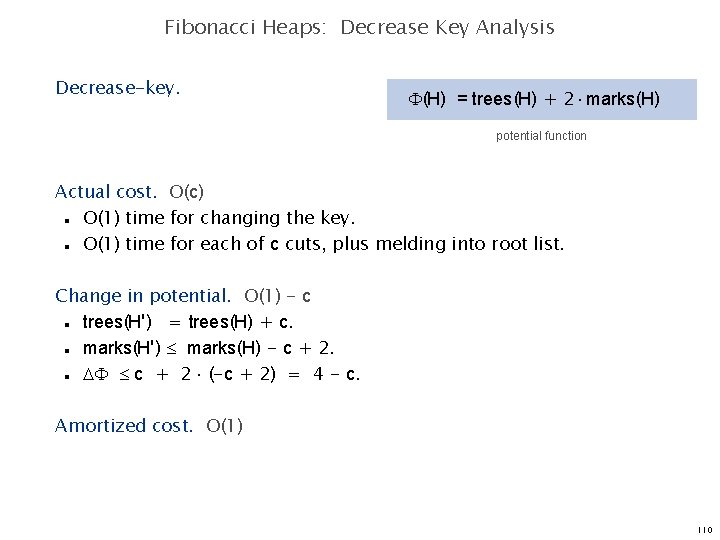
Fibonacci Heaps: Decrease Key Analysis Decrease-key. (H) = trees(H) + 2 marks(H) potential function Actual cost. O(c) O(1) time for changing the key. O(1) time for each of c cuts, plus melding into root list. n n Change in potential. O(1) - c trees(H') = trees(H) + c. marks(H') marks(H) - c + 2 (-c + 2) = 4 - c. n n n Amortized cost. O(1) 110
Analysis 111
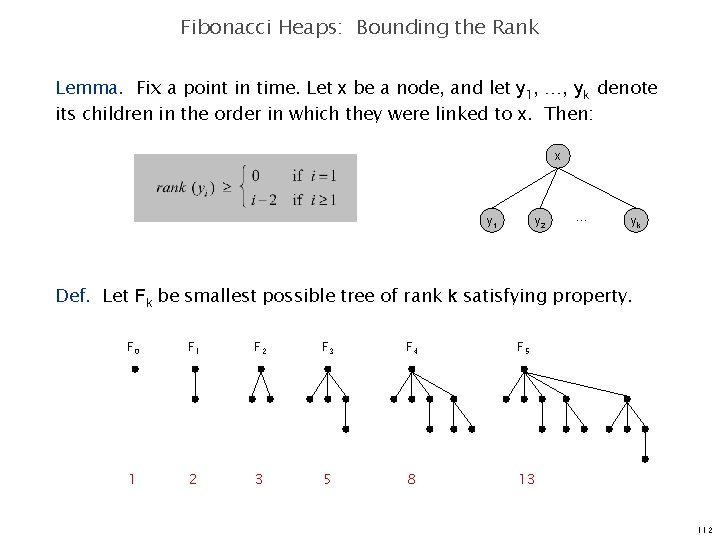
Fibonacci Heaps: Bounding the Rank Lemma. Fix a point in time. Let x be a node, and let y 1, …, yk denote its children in the order in which they were linked to x. Then: x y 1 y 2 … yk Def. Let Fk be smallest possible tree of rank k satisfying property. F 0 F 1 F 2 F 3 F 4 F 5 1 2 3 5 8 13 112
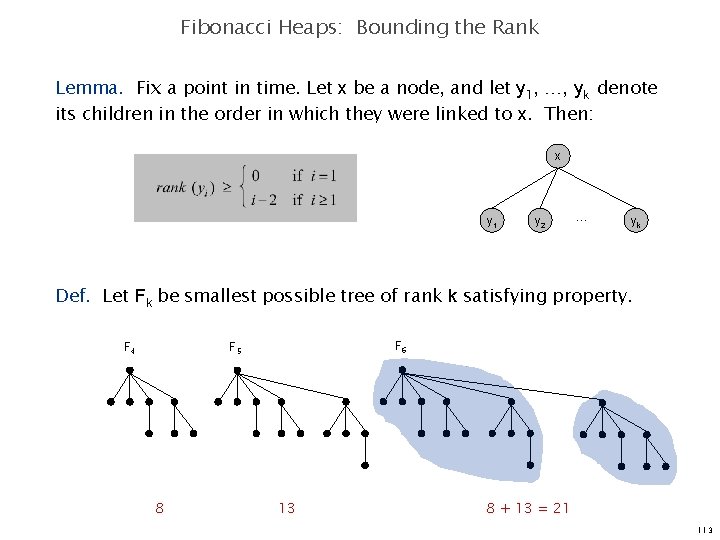
Fibonacci Heaps: Bounding the Rank Lemma. Fix a point in time. Let x be a node, and let y 1, …, yk denote its children in the order in which they were linked to x. Then: x y 1 y 2 … yk Def. Let Fk be smallest possible tree of rank k satisfying property. F 4 F 6 F 5 8 13 8 + 13 = 21 113
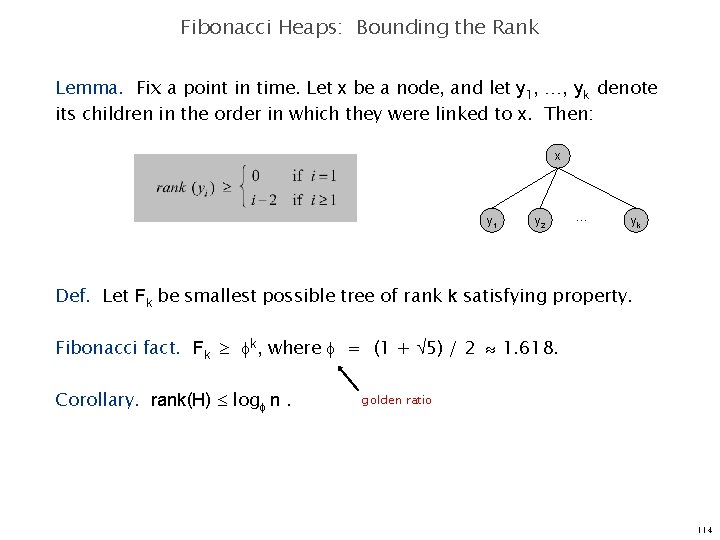
Fibonacci Heaps: Bounding the Rank Lemma. Fix a point in time. Let x be a node, and let y 1, …, yk denote its children in the order in which they were linked to x. Then: x y 1 y 2 … yk Def. Let Fk be smallest possible tree of rank k satisfying property. Fibonacci fact. Fk k, where = (1 + 5) / 2 1. 618. Corollary. rank(H) log n. golden ratio 114
Fibonacci Numbers 115
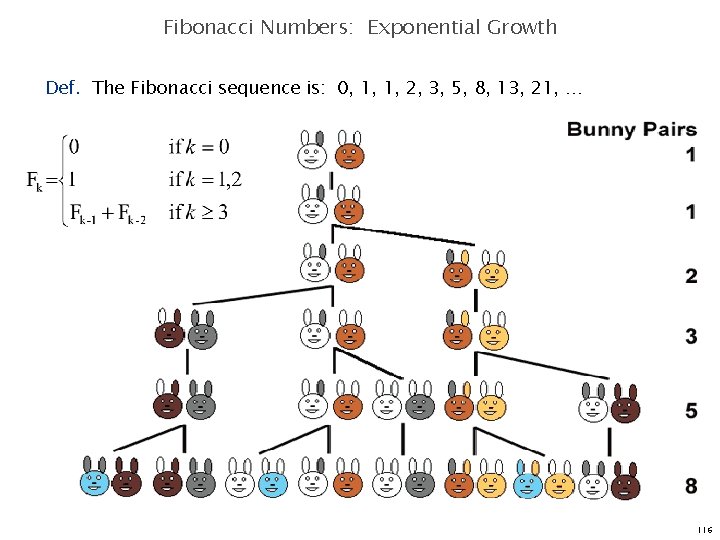
Fibonacci Numbers: Exponential Growth Def. The Fibonacci sequence is: 0, 1, 1, 2, 3, 5, 8, 13, 21, … 116
Union 117
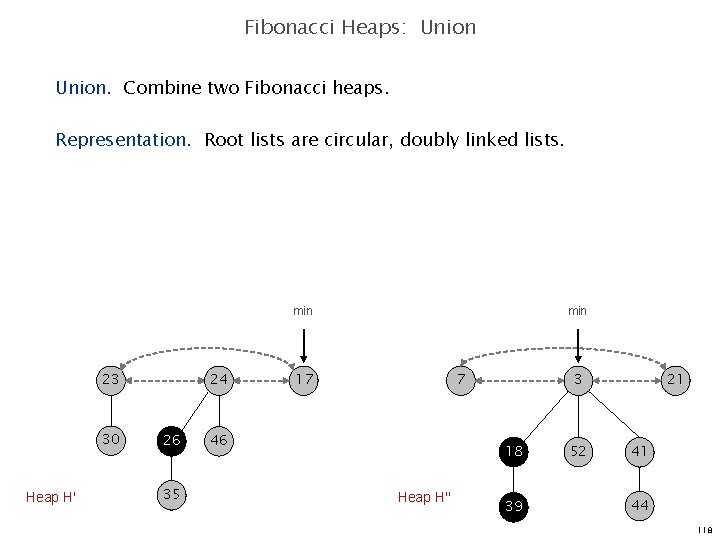
Fibonacci Heaps: Union. Combine two Fibonacci heaps. Representation. Root lists are circular, doubly linked lists. min 23 30 Heap H' 24 26 35 min 17 7 46 3 18 Heap H'' 39 52 21 41 44 118
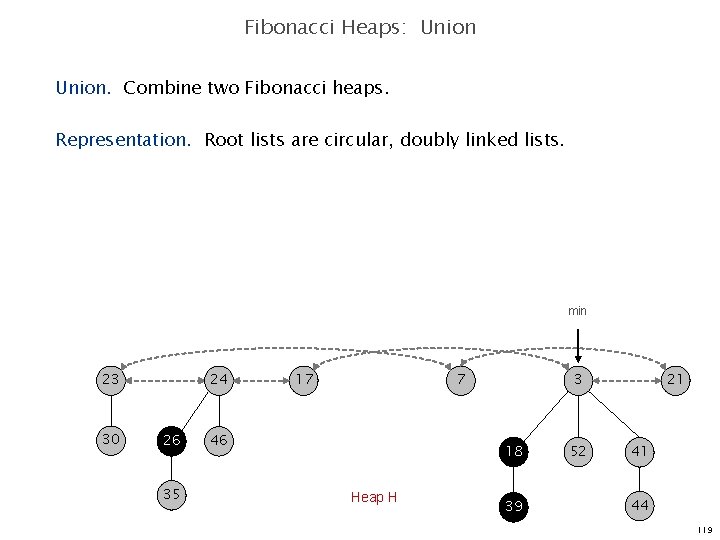
Fibonacci Heaps: Union. Combine two Fibonacci heaps. Representation. Root lists are circular, doubly linked lists. min 23 30 24 26 35 17 7 46 3 18 Heap H 39 52 21 41 44 119
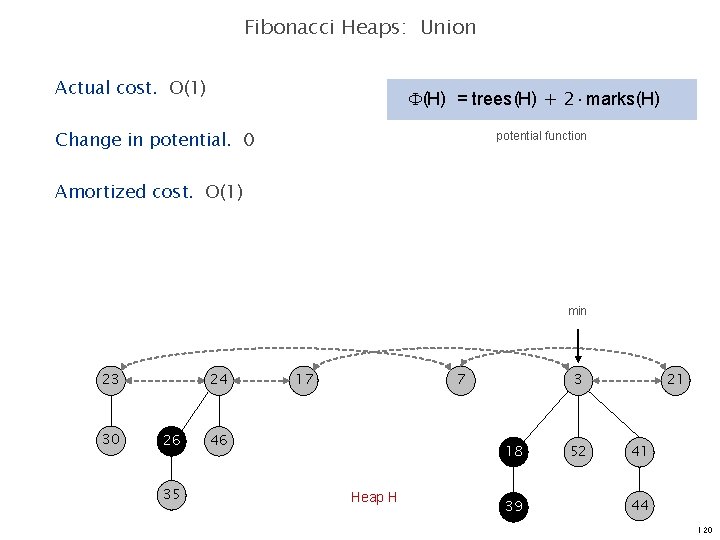
Fibonacci Heaps: Union Actual cost. O(1) (H) = trees(H) + 2 marks(H) Change in potential. 0 potential function Amortized cost. O(1) min 23 30 24 26 35 17 7 46 3 18 Heap H 39 52 21 41 44 120
Delete 121
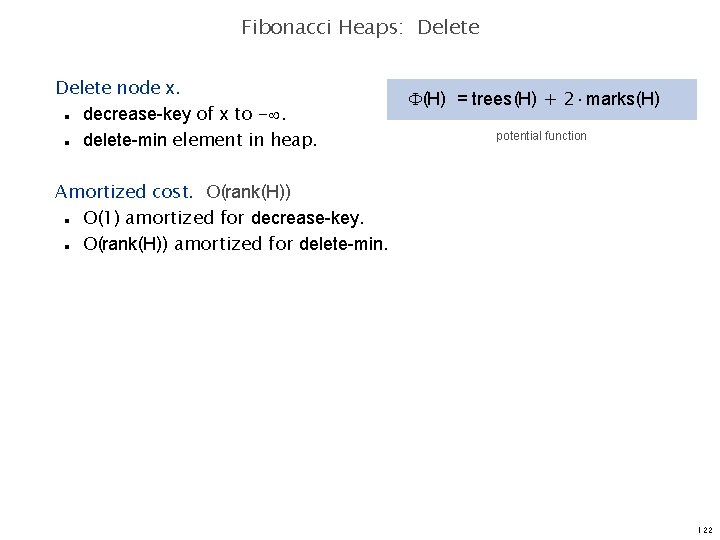
Fibonacci Heaps: Delete node x. decrease-key of x to -. delete-min element in heap. (H) = trees(H) + 2 marks(H) n n potential function Amortized cost. O(rank(H)) O(1) amortized for decrease-key. O(rank(H)) amortized for delete-min. n n 122
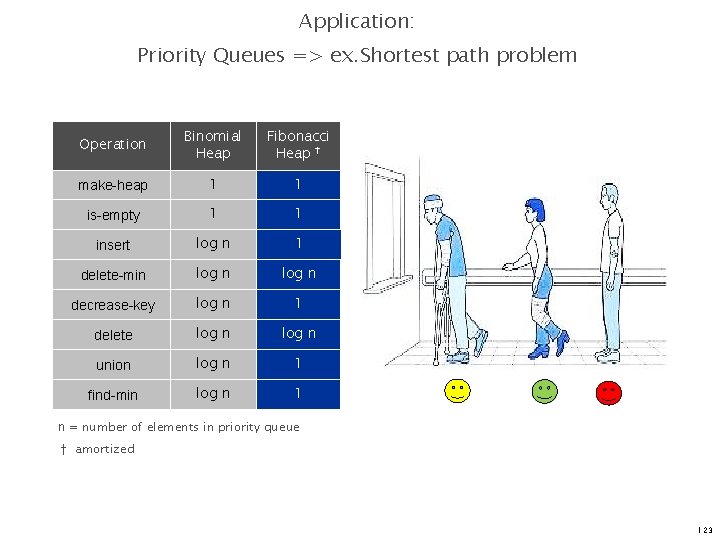
Application: Priority Queues => ex. Shortest path problem Operation Binomial Heap Fibonacci Heap † make-heap 1 1 is-empty 1 1 insert log n 1 delete-min log n decrease-key log n 1 delete log n union log n 1 find-min log n 1 n = number of elements in priority queue † amortized 123
Persistent Data Structures Li Furong Song Chonggang CS 6234 Advanced Algorithms
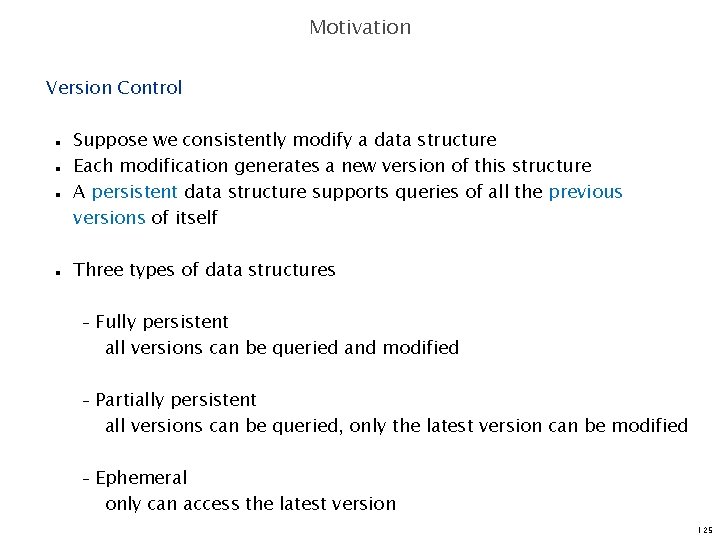
Motivation Version Control n n Suppose we consistently modify a data structure Each modification generates a new version of this structure A persistent data structure supports queries of all the previous versions of itself Three types of data structures – Fully persistent all versions can be queried and modified – Partially persistent all versions can be queried, only the latest version can be modified – Ephemeral only can access the latest version 125
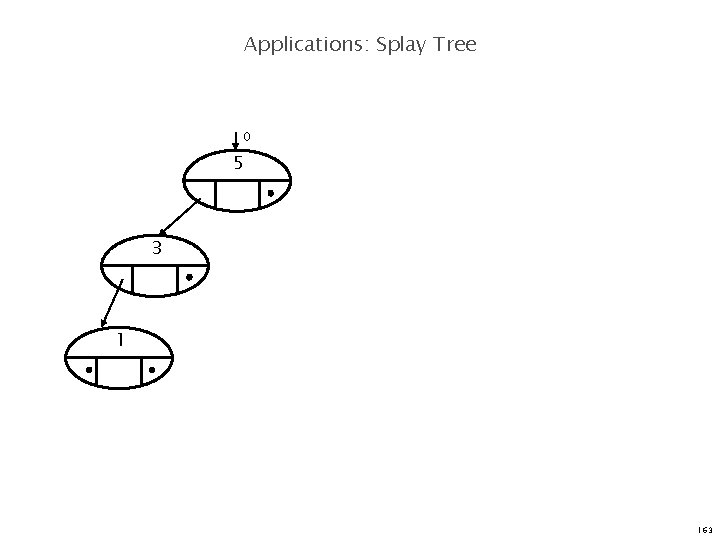
Making Data Structures Persistent In the following talk, we will n n Make pointer-based data structures persistent, e. g. , tree Discussions are limited to partial persistence Three methods n n n Fat nodes Path copying Node Copying (Sleator, Tarjan et al. ) 126
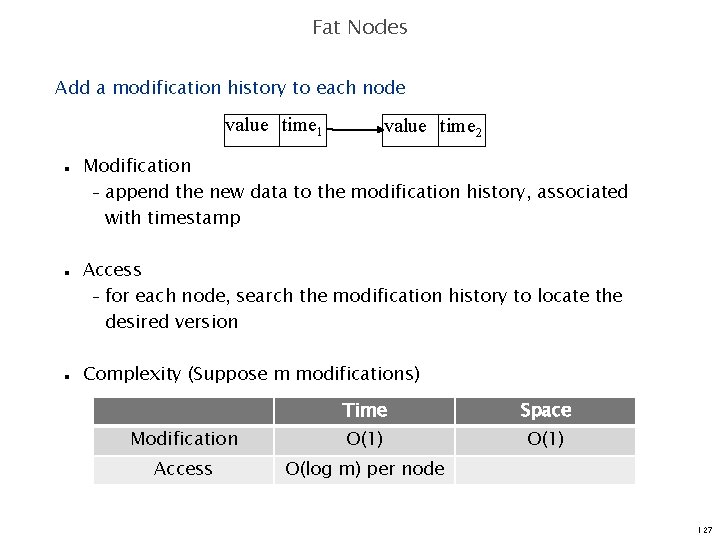
Fat Nodes Add a modification history to each node value time 1 n n n value time 2 Modification – append the new data to the modification history, associated with timestamp Access – for each node, search the modification history to locate the desired version Complexity (Suppose m modifications) Time Space Modification O(1) Access O(log m) per node 127
Path Copying Copy the node before changing it Cascade the change back until root is reached 128
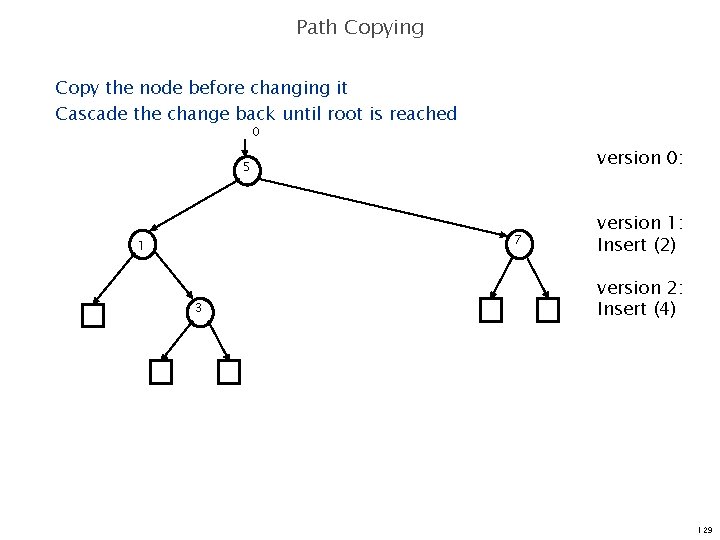
Path Copying Copy the node before changing it Cascade the change back until root is reached 0 version 0: 5 7 1 3 version 1: Insert (2) version 2: Insert (4) 129
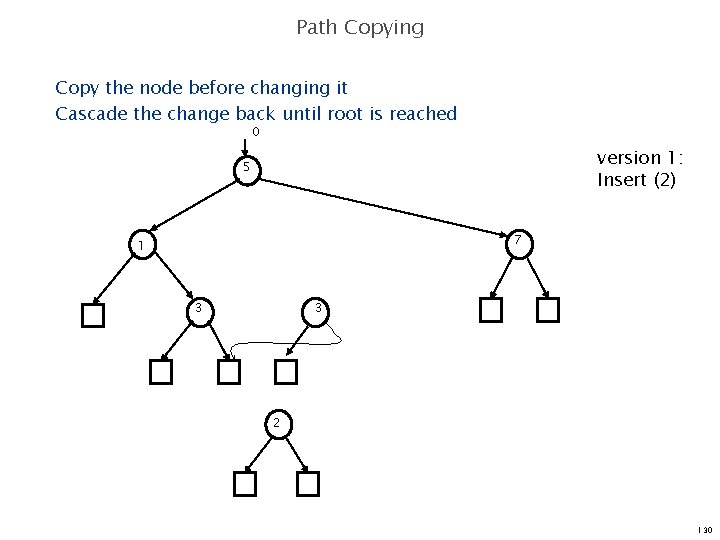
Path Copying Copy the node before changing it Cascade the change back until root is reached 0 version 1: Insert (2) 5 7 1 3 3 2 130
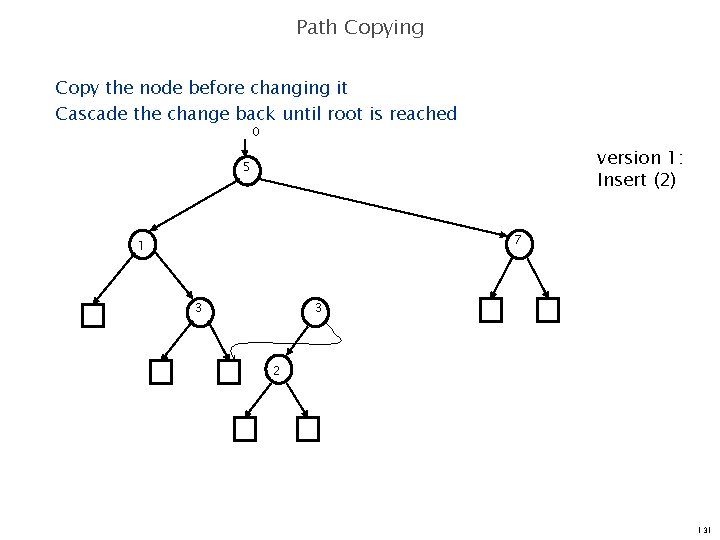
Path Copying Copy the node before changing it Cascade the change back until root is reached 0 version 1: Insert (2) 5 7 1 3 3 2 131
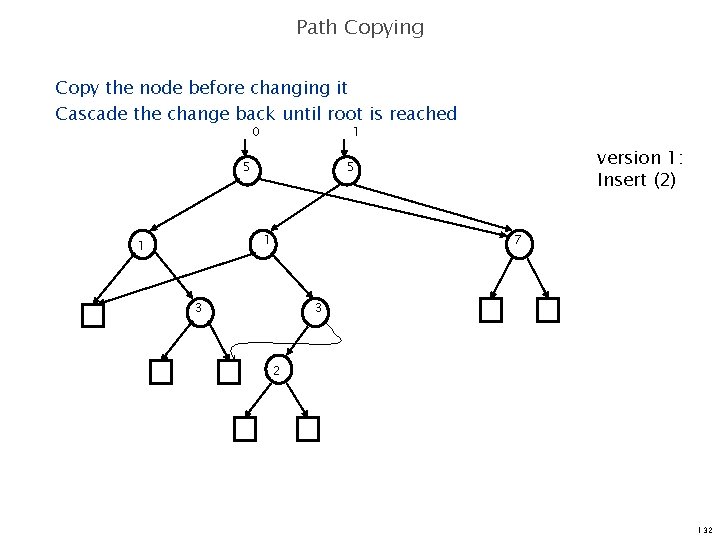
Path Copying Copy the node before changing it Cascade the change back until root is reached 0 1 5 1 1 version 1: Insert (2) 5 7 3 3 2 132
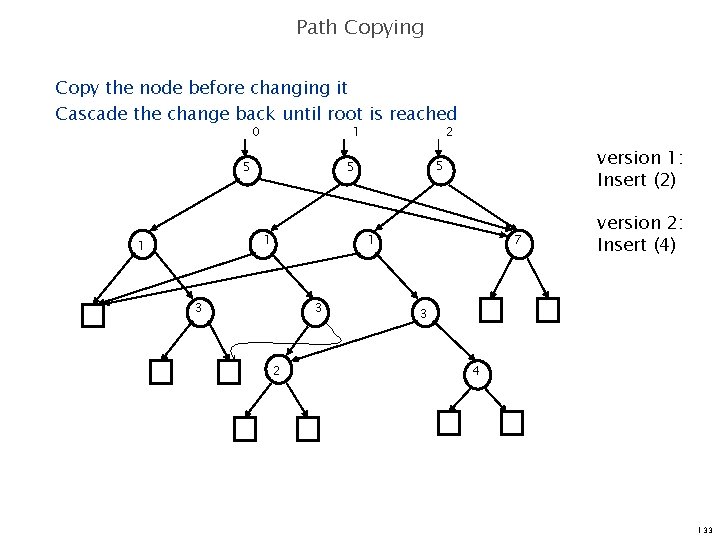
Path Copying Copy the node before changing it Cascade the change back until root is reached 0 1 5 version 1: Insert (2) 5 5 1 1 2 1 3 3 2 7 version 2: Insert (4) 3 4 133
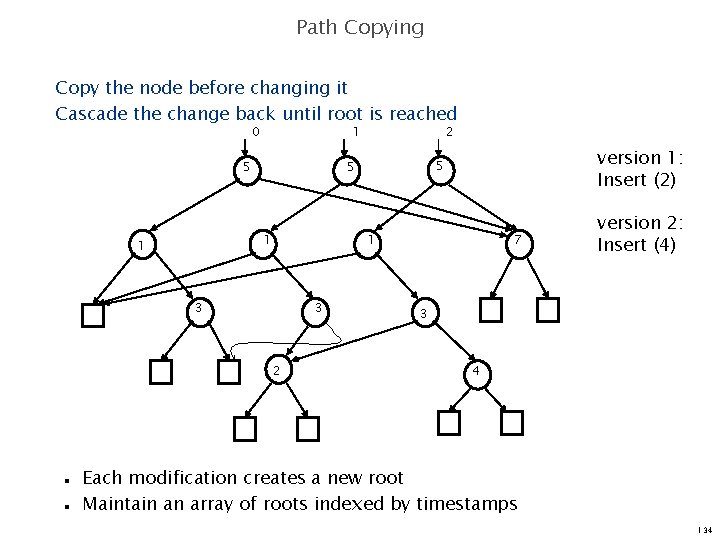
Path Copying Copy the node before changing it Cascade the change back until root is reached 0 1 5 1 3 3 2 n n version 1: Insert (2) 5 5 1 1 2 7 version 2: Insert (4) 3 4 Each modification creates a new root Maintain an array of roots indexed by timestamps 134
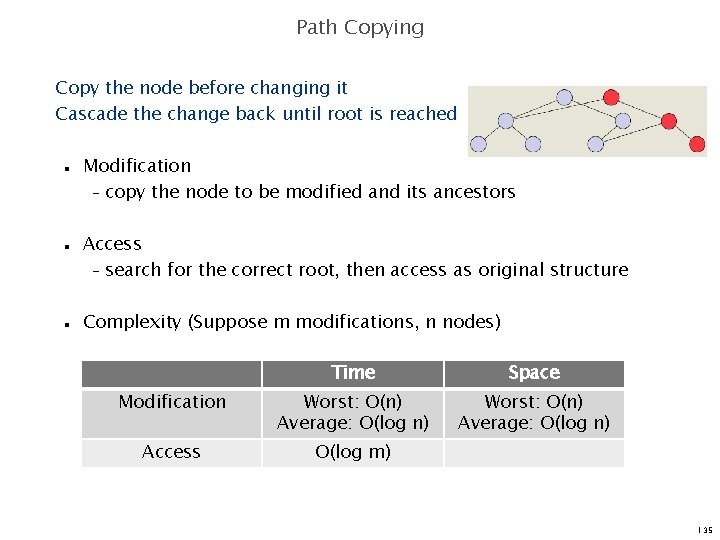
Path Copying Copy the node before changing it Cascade the change back until root is reached n n n Modification – copy the node to be modified and its ancestors Access – search for the correct root, then access as original structure Complexity (Suppose m modifications, n nodes) Time Space Modification Worst: O(n) Average: O(log n) Access O(log m) 135
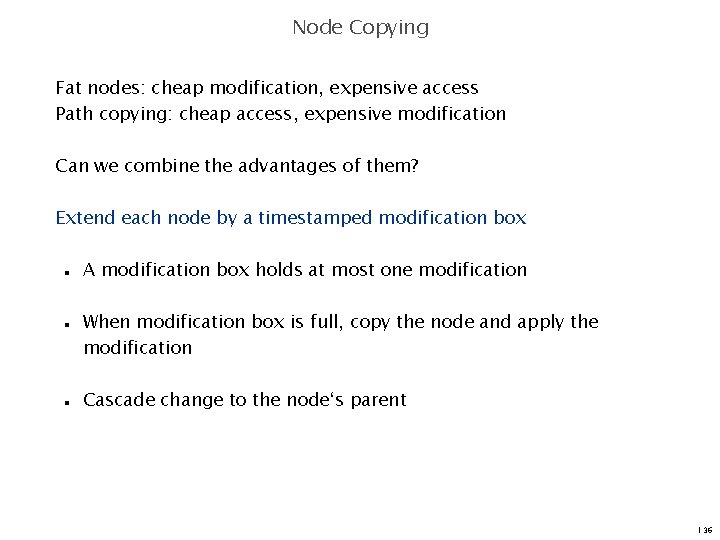
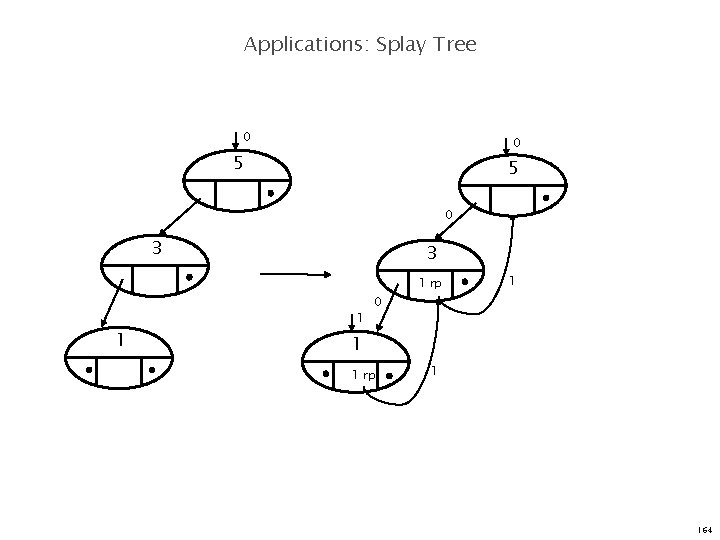
Node Copying Fat nodes: cheap modification, expensive access Path copying: cheap access, expensive modification Can we combine the advantages of them? Extend each node by a timestamped modification box n n n A modification box holds at most one modification When modification box is full, copy the node and apply the modification Cascade change to the node‘s parent 136
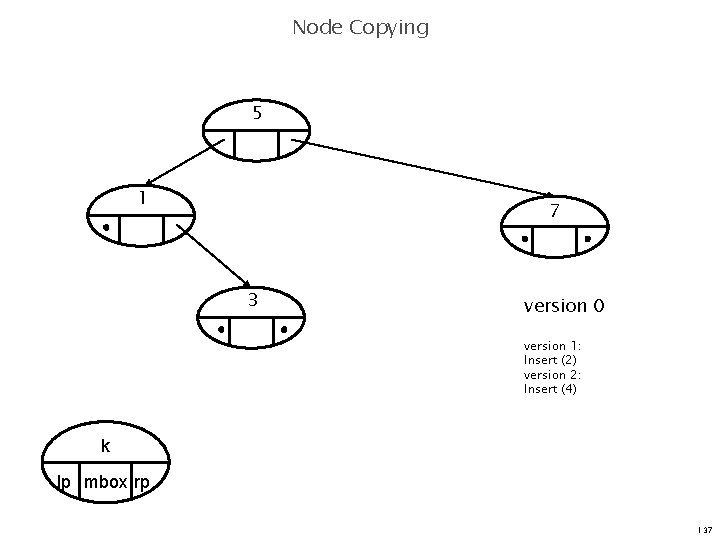
Node Copying 5 1 7 3 version 0 version 1: Insert (2) version 2: Insert (4) k lp mbox rp 137
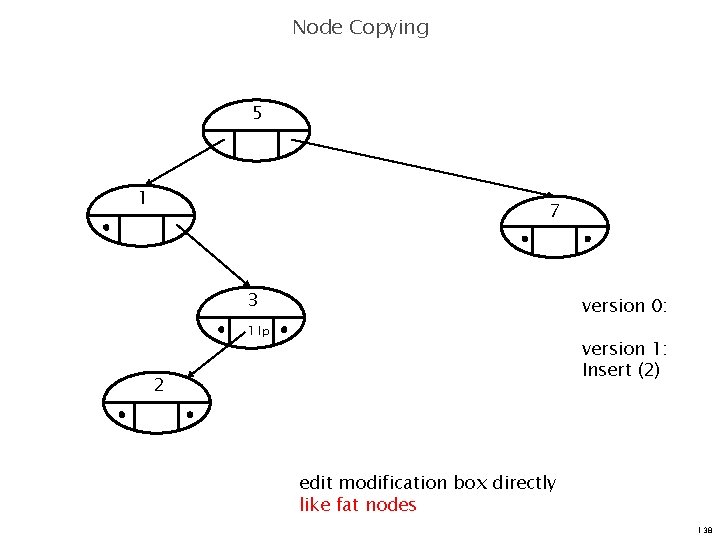
Node Copying 5 1 7 3 version 0: 1 lp version 1: Insert (2) 2 edit modification box directly like fat nodes 138
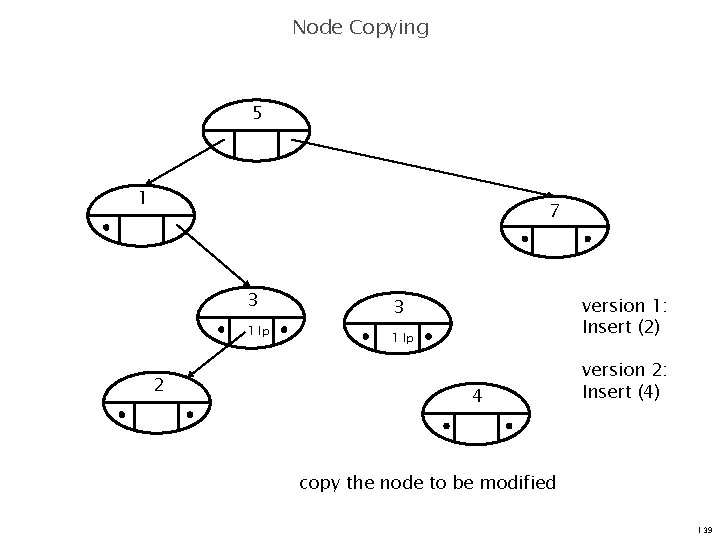
Node Copying 5 1 7 3 1 lp 2 version 1: Insert (2) 3 1 lp 4 version 2: Insert (4) copy the node to be modified 139
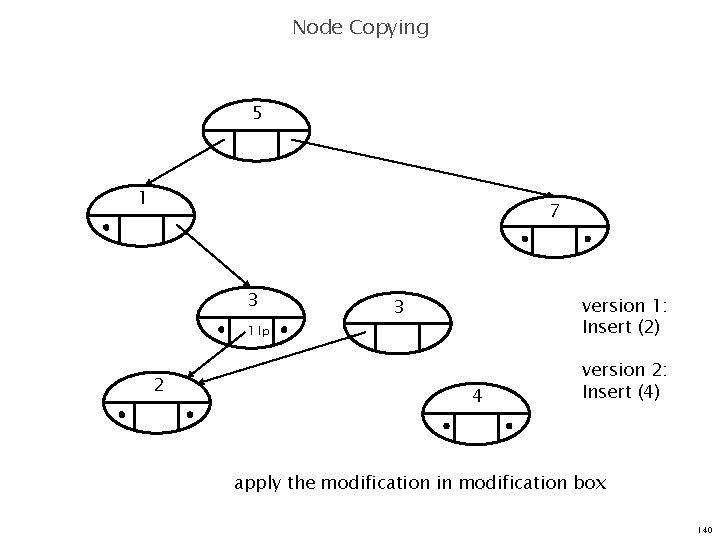
Node Copying 5 1 7 3 version 1: Insert (2) 3 1 lp 2 4 version 2: Insert (4) apply the modification in modification box 140
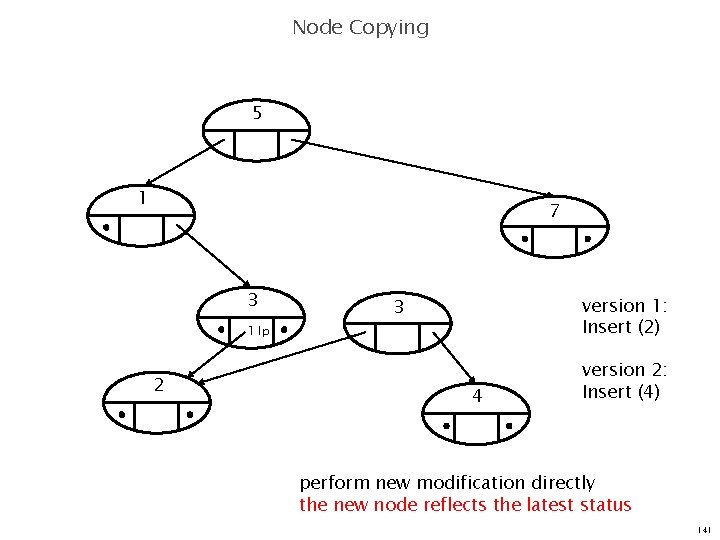
Node Copying 5 1 7 3 version 1: Insert (2) 3 1 lp 2 4 version 2: Insert (4) perform new modification directly the new node reflects the latest status 141
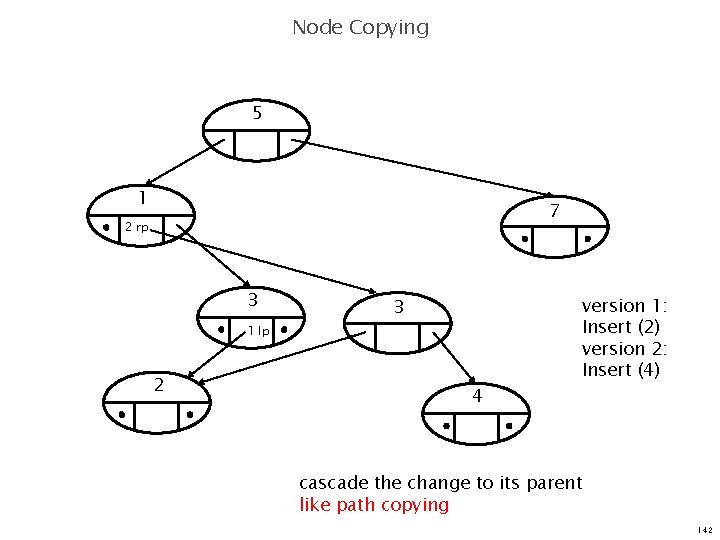
Node Copying 5 1 7 2 rp 3 3 1 lp 2 4 version 1: Insert (2) version 2: Insert (4) cascade the change to its parent like path copying 142
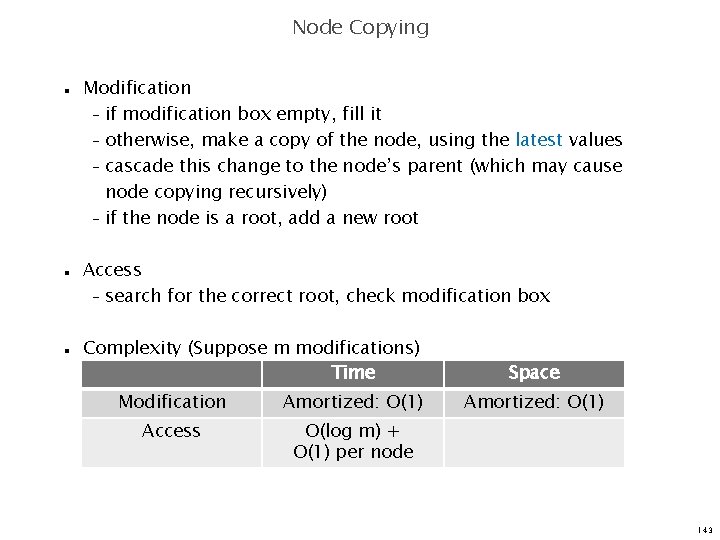
Node Copying n n n Modification – if modification box empty, fill it – otherwise, make a copy of the node, using the latest values – cascade this change to the node’s parent (which may cause node copying recursively) – if the node is a root, add a new root Access – search for the correct root, check modification box Complexity (Suppose m modifications) Time Modification Amortized: O(1) Access O(log m) + O(1) per node Space Amortized: O(1) 143
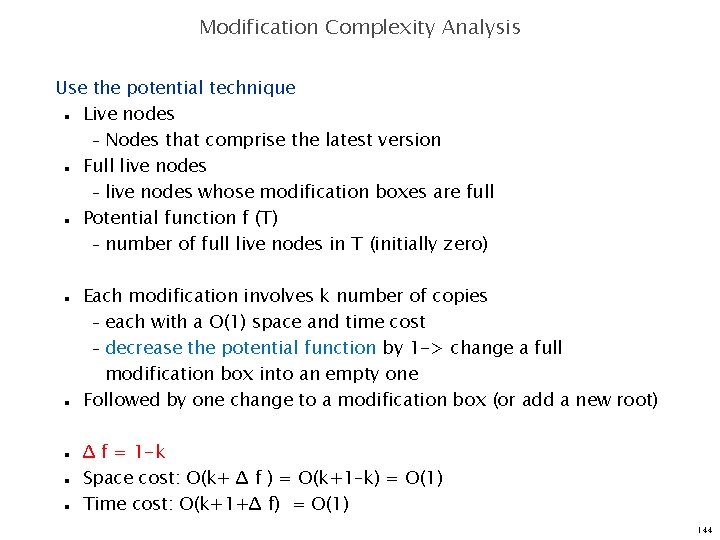
Modification Complexity Analysis Use the potential technique Live nodes – Nodes that comprise the latest version Full live nodes – live nodes whose modification boxes are full Potential function f (T) – number of full live nodes in T (initially zero) n n n n Each modification involves k number of copies – each with a O(1) space and time cost – decrease the potential function by 1 -> change a full modification box into an empty one Followed by one change to a modification box (or add a new root) Δ f = 1 -k Space cost: O(k+ Δ f ) = O(k+1–k) = O(1) Time cost: O(k+1+Δ f) = O(1) 144
Applications n n n Grounded 2 -Dimensional Range Searching Planar Point Location Persistent Splay Tree 145
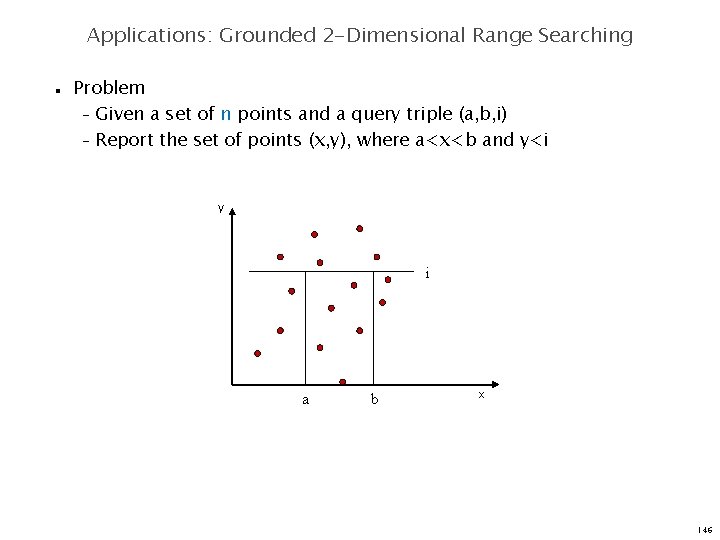
Applications: Grounded 2 -Dimensional Range Searching n Problem – Given a set of n points and a query triple (a, b, i) – Report the set of points (x, y), where a<x<b and y<i y i a b x 146
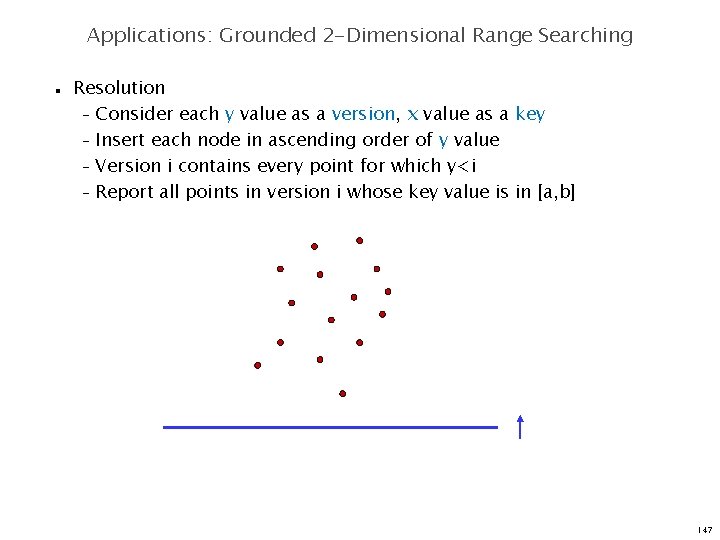
Applications: Grounded 2 -Dimensional Range Searching n Resolution – Consider each y value as a version, x value as a key – Insert each node in ascending order of y value – Version i contains every point for which y<i – Report all points in version i whose key value is in [a, b] 147
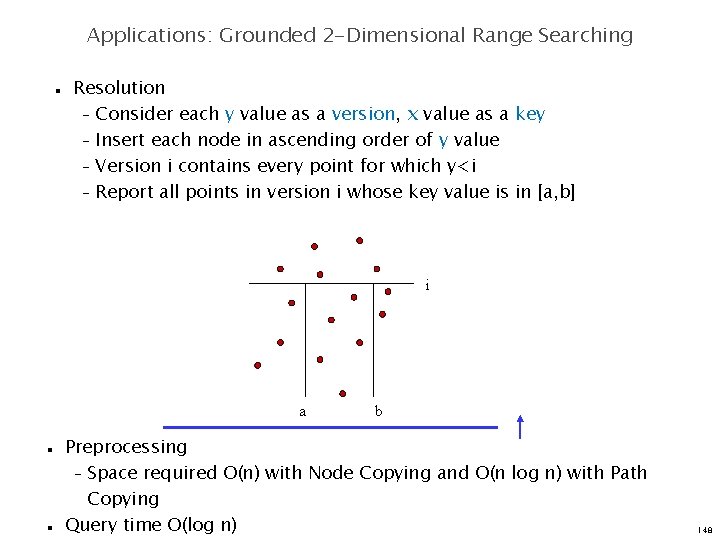
Applications: Grounded 2 -Dimensional Range Searching n Resolution – Consider each y value as a version, x value as a key – Insert each node in ascending order of y value – Version i contains every point for which y<i – Report all points in version i whose key value is in [a, b] i a n n b Preprocessing – Space required O(n) with Node Copying and O(n log n) with Path Copying Query time O(log n) 148
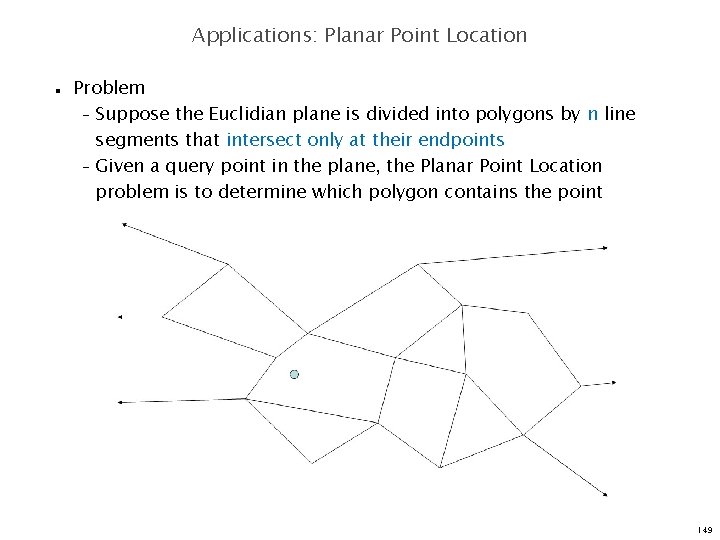
Applications: Planar Point Location n Problem – Suppose the Euclidian plane is divided into polygons by n line segments that intersect only at their endpoints – Given a query point in the plane, the Planar Point Location problem is to determine which polygon contains the point 149
Applications: Planar Point Location n Solution – Partition the plane into vertical slabs by drawing a vertical line through each endpoint – Within each slab, the lines are ordered Allocate a search tree on the x-coordinates of the vertical lines – Allocate a search tree per slab containing the lines and with each line associate the polygon above it – 150
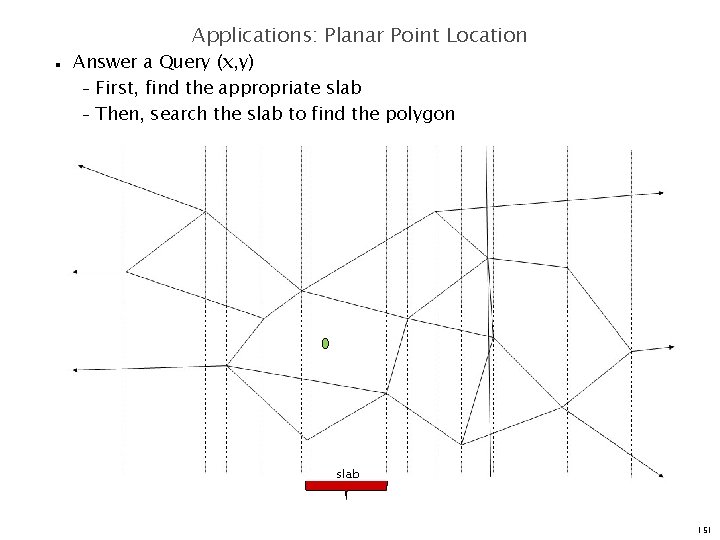
Applications: Planar Point Location n Answer a Query (x, y) – First, find the appropriate slab – Then, search the slab to find the polygon slab 151
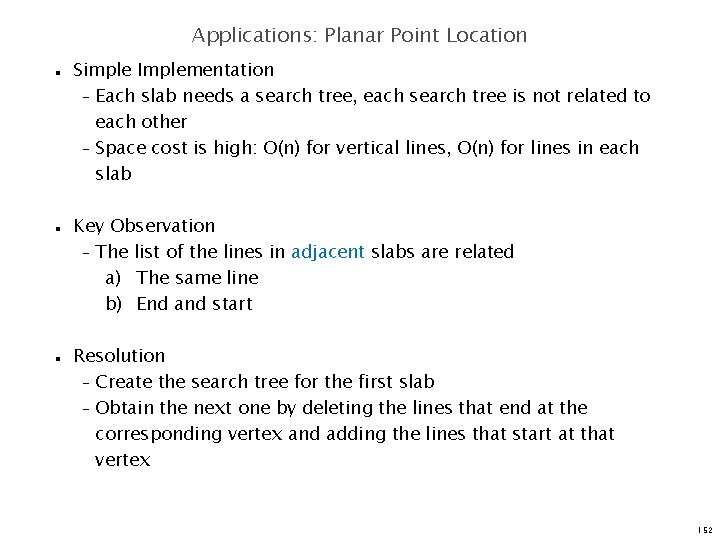
Applications: Planar Point Location n Simple Implementation – Each slab needs a search tree, each search tree is not related to each other – Space cost is high: O(n) for vertical lines, O(n) for lines in each slab Key Observation – The list of the lines in adjacent slabs are related a) The same line b) End and start Resolution – Create the search tree for the first slab – Obtain the next one by deleting the lines that end at the corresponding vertex and adding the lines that start at that vertex 152
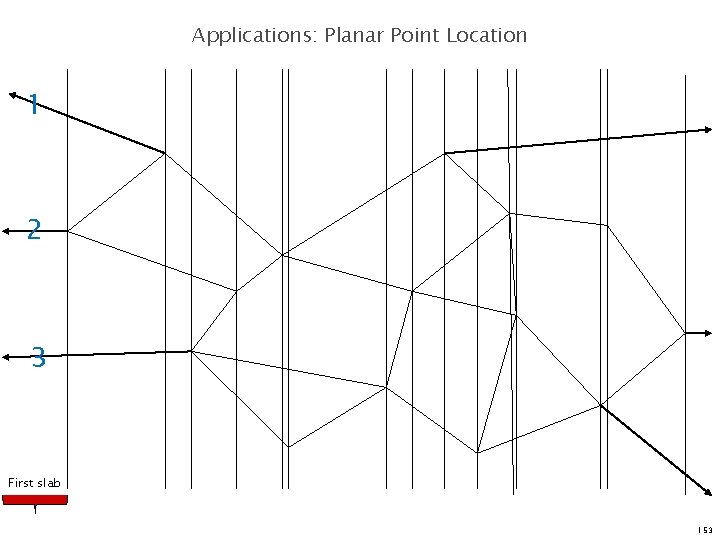
Applications: Planar Point Location 1 2 3 First slab 153
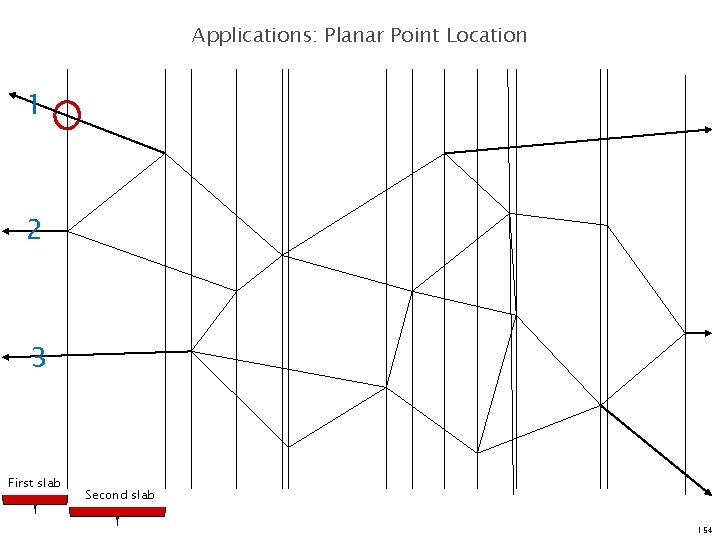
Applications: Planar Point Location 1 2 3 First slab Second slab 154
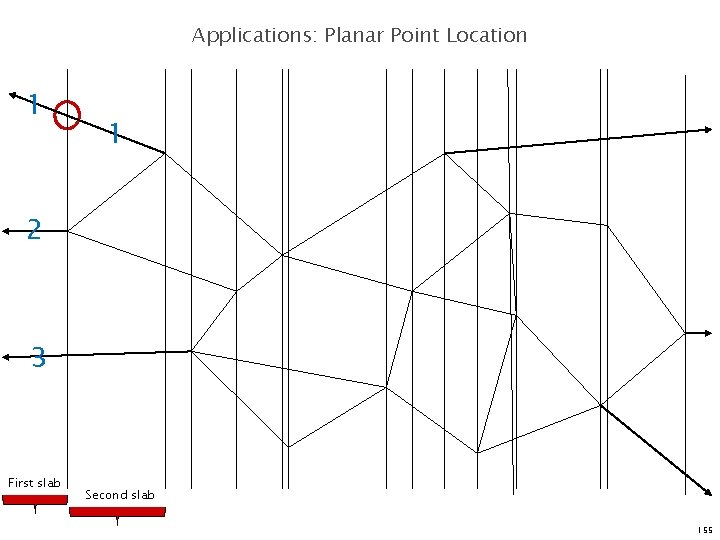
Applications: Planar Point Location 1 1 2 3 First slab Second slab 155
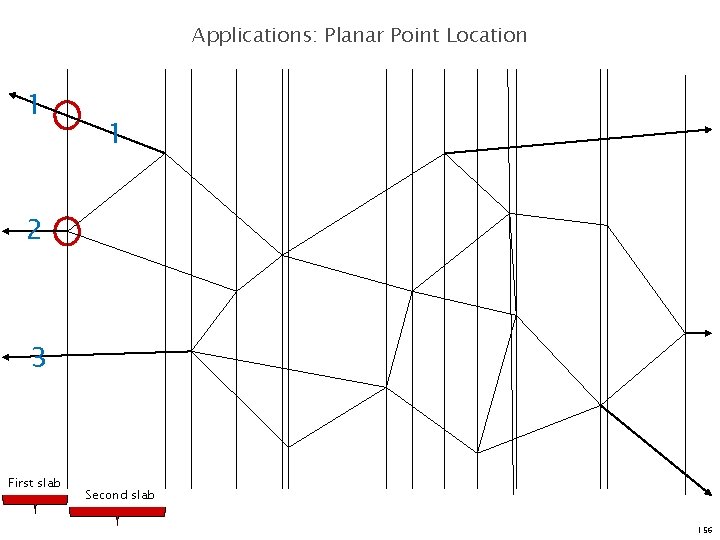
Applications: Planar Point Location 1 1 2 3 First slab Second slab 156
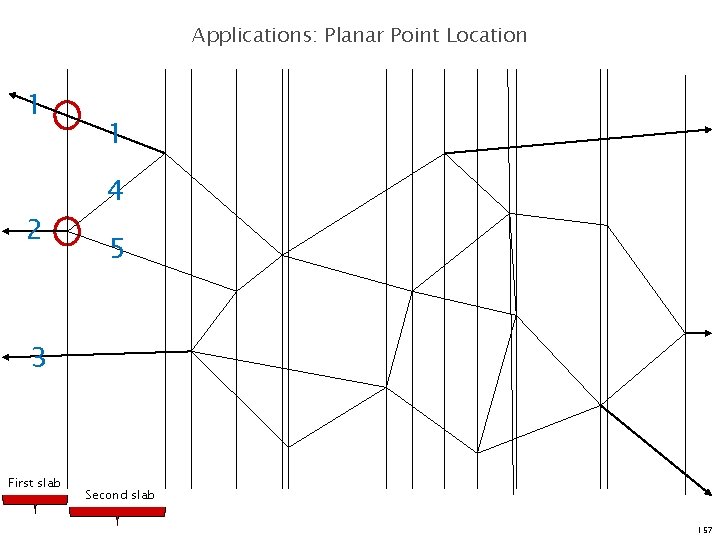
Applications: Planar Point Location 1 2 1 4 5 3 First slab Second slab 157
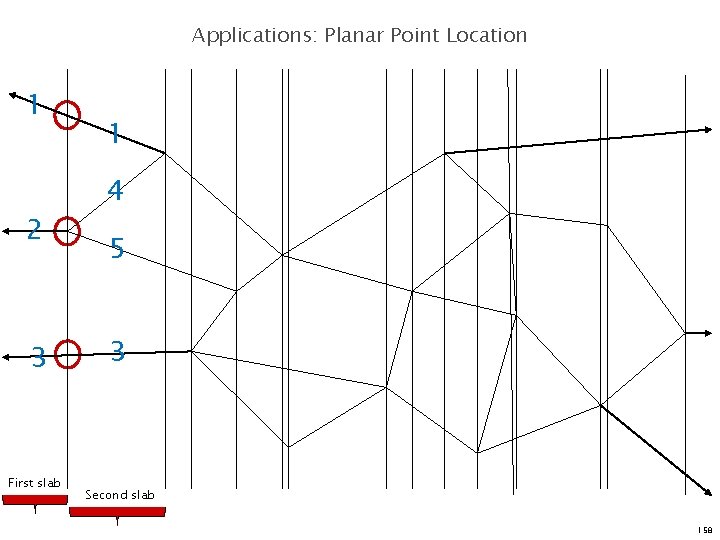
Applications: Planar Point Location 1 2 3 First slab 1 4 5 3 Second slab 158
Applications: Planar Point Location n n Preprocessing – 2 n insertions and deletions – Time cost O(n) with Node Copying, O(n log n) with Path Copying Space cost O(n) with Node Copying, O(n log n) with Path Copying 159
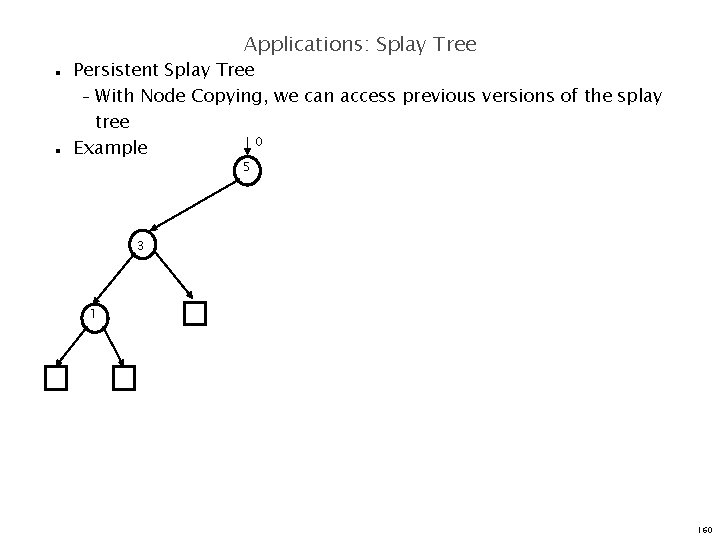
Applications: Splay Tree n n Persistent Splay Tree – With Node Copying, we can access previous versions of the splay tree 0 Example 5 3 1 160
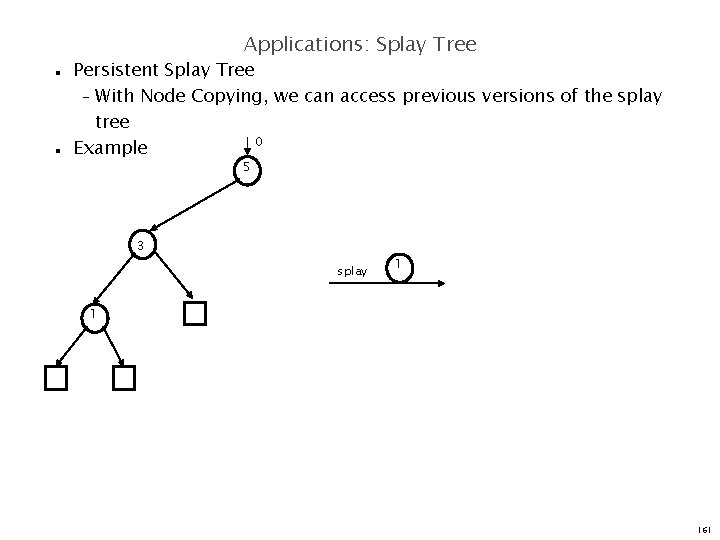
Applications: Splay Tree n n Persistent Splay Tree – With Node Copying, we can access previous versions of the splay tree 0 Example 5 3 splay 1 1 161
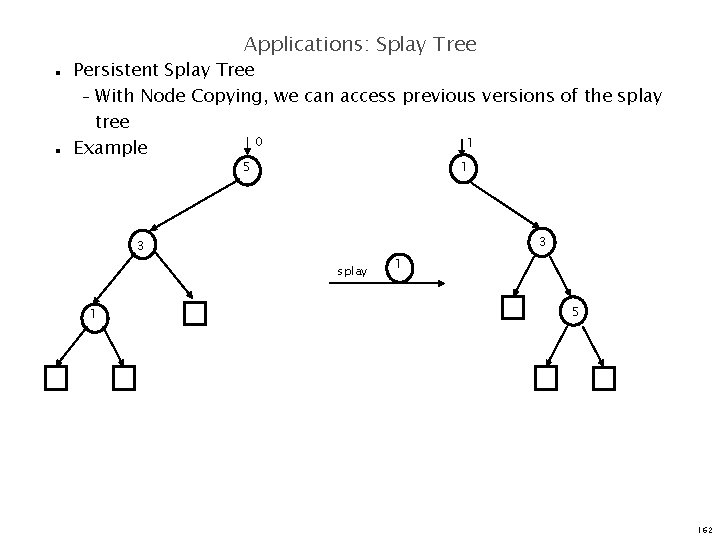
Applications: Splay Tree n n Persistent Splay Tree – With Node Copying, we can access previous versions of the splay tree 0 1 Example 5 1 3 3 splay 1 1 5 162
Applications: Splay Tree 0 5 3 1 163
Applications: Splay Tree 0 0 5 5 0 3 3 1 rp 1 1 1 0 1 1 rp 1 164
Summary Hong Hande CS 6234 Advanced Algorithms
Splay tree n n Advantage – Simplementation – Comparable performance – Small memory footprint – Self-optimizing Disadvantage – Worst case for single operation can be O(n) – Extra management in a multi-threaded environment 166
Fibonacci Heap n Advantage – Better amortized running time than a binomial heap – n Lazily defer consolidation until next delete-min Disadvantage – Delete and delete minimum have linear running time in the worst case – Not appropriate for real-time systems 167
Persistent Data Structure n n n Concept – A persistent data structure supports queries of all the previous versions of itself Three methods – Fat nodes – Path copying – Node Copying (Sleator, Tarjan et al. ) Good performance in multi-threaded environments. 168
Key Word to Remember n n n Splay Tree --- Self-optimizing AVL tree Fibonacci Heap --- Lazy version of Binomial Heap Persistent Data Structure --- Extra space for previous version Thank you! Q&A 169
- Slides: 160