
CS 6220 DATA MINING TECHNIQUES Chapter 7 Advanced

- Slides: 62
CS 6220: DATA MINING TECHNIQUES Chapter 7: Advanced Pattern Mining Instructor: Yizhou Sun yzsun@ccs. neu. edu February 28, 2021
Chapter 7: Advanced Pattern Mining • Pattern Mining: A Road Map • Pattern Mining in Multi-Level, Multi-Dimensional Space • Constraint-Based Frequent Pattern Mining • Mining Colossal Patterns • Mining Compressed or Approximate Patterns • Summary 2
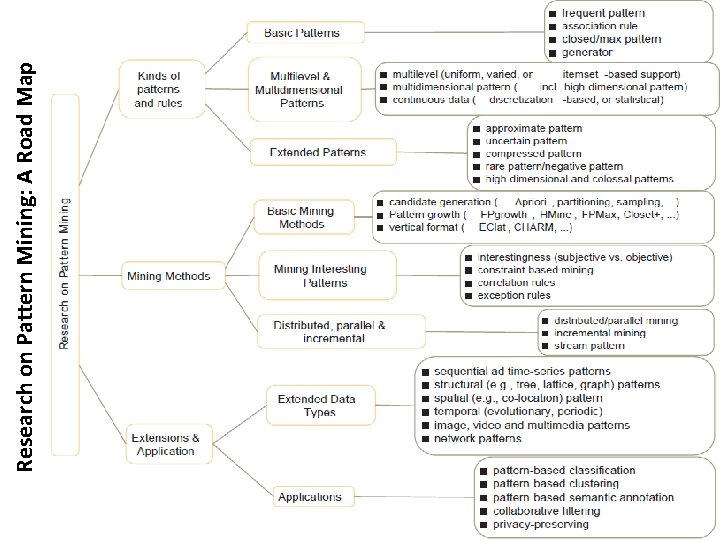
3 Research on Pattern Mining: A Road Map
Chapter 7: Advanced Pattern Mining • Pattern Mining: A Road Map • Pattern Mining in Multi-Level, Multi-Dimensional Space • • Mining Multi-Level Association Mining Multi-Dimensional Association Mining Quantitative Association Rules Mining Rare Patterns and Negative Patterns • Constraint-Based Frequent Pattern Mining • Mining Colossal Patterns • Mining Compressed or Approximate Patterns • Summary 4
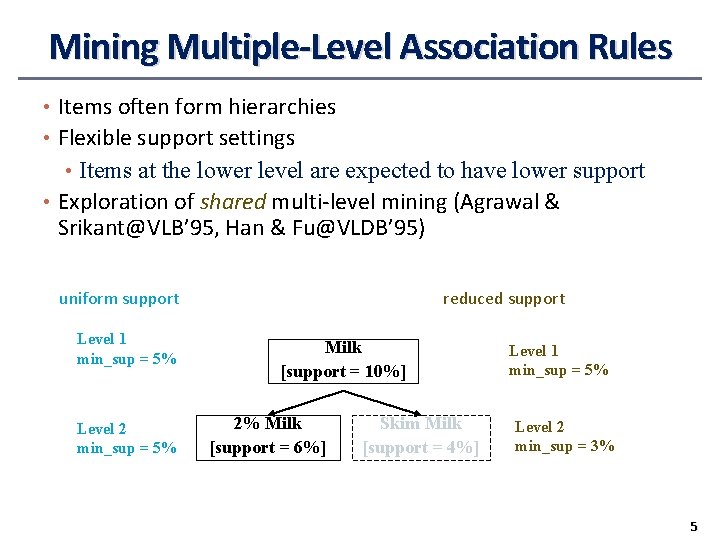
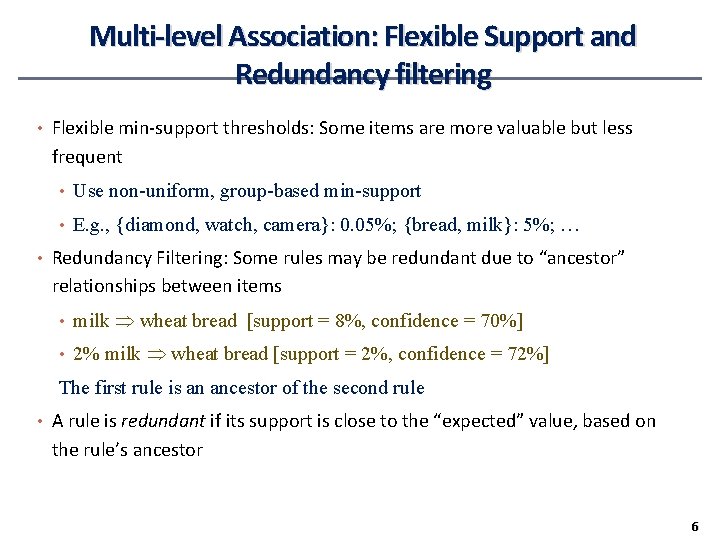
Mining Multiple-Level Association Rules • Items often form hierarchies • Flexible support settings • Items at the lower level are expected to have lower support • Exploration of shared multi-level mining (Agrawal & Srikant@VLB’ 95, Han & Fu@VLDB’ 95) uniform support Level 1 min_sup = 5% Level 2 min_sup = 5% reduced support Milk [support = 10%] 2% Milk [support = 6%] Skim Milk [support = 4%] Level 1 min_sup = 5% Level 2 min_sup = 3% 5
Multi-level Association: Flexible Support and Redundancy filtering • Flexible min-support thresholds: Some items are more valuable but less frequent • Use non-uniform, group-based min-support • E. g. , {diamond, watch, camera}: 0. 05%; {bread, milk}: 5%; … • Redundancy Filtering: Some rules may be redundant due to “ancestor” relationships between items • milk wheat bread [support = 8%, confidence = 70%] • 2% milk wheat bread [support = 2%, confidence = 72%] The first rule is an ancestor of the second rule • A rule is redundant if its support is close to the “expected” value, based on the rule’s ancestor 6
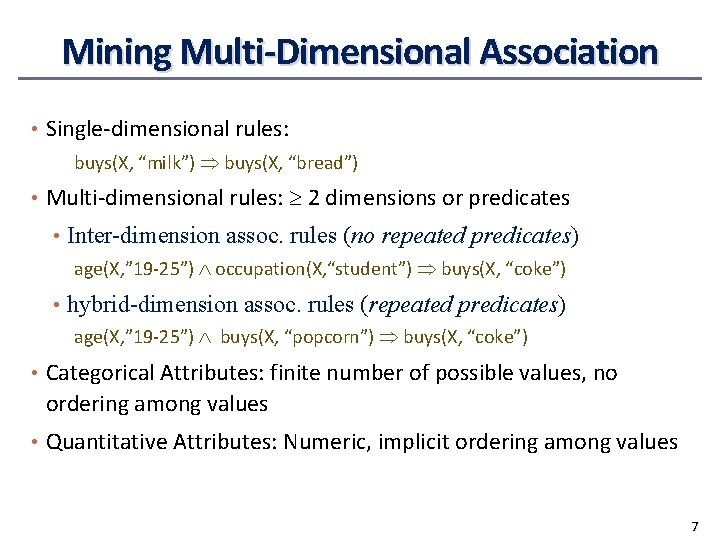
Mining Multi-Dimensional Association • Single-dimensional rules: buys(X, “milk”) buys(X, “bread”) • Multi-dimensional rules: 2 dimensions or predicates • Inter-dimension assoc. rules (no repeated predicates) age(X, ” 19 -25”) occupation(X, “student”) buys(X, “coke”) • hybrid-dimension assoc. rules (repeated predicates) age(X, ” 19 -25”) buys(X, “popcorn”) buys(X, “coke”) • Categorical Attributes: finite number of possible values, no ordering among values • Quantitative Attributes: Numeric, implicit ordering among values 7
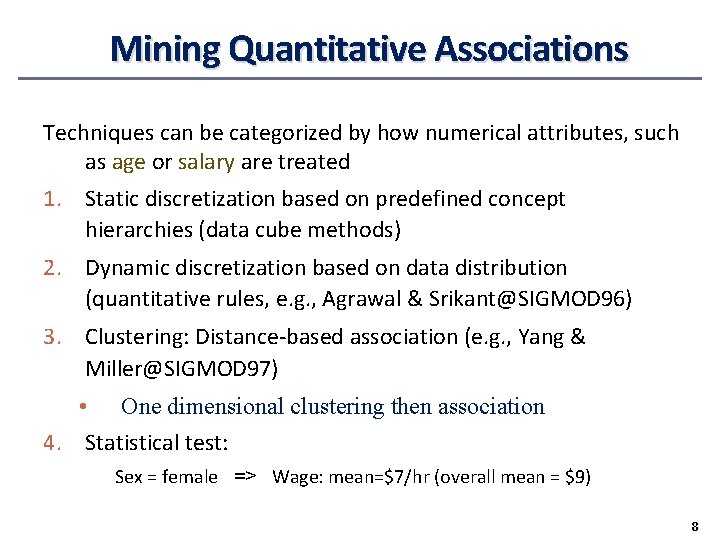
Mining Quantitative Associations Techniques can be categorized by how numerical attributes, such as age or salary are treated 1. Static discretization based on predefined concept hierarchies (data cube methods) 2. Dynamic discretization based on data distribution (quantitative rules, e. g. , Agrawal & Srikant@SIGMOD 96) 3. Clustering: Distance-based association (e. g. , Yang & Miller@SIGMOD 97) • One dimensional clustering then association 4. Statistical test: Sex = female => Wage: mean=$7/hr (overall mean = $9) 8
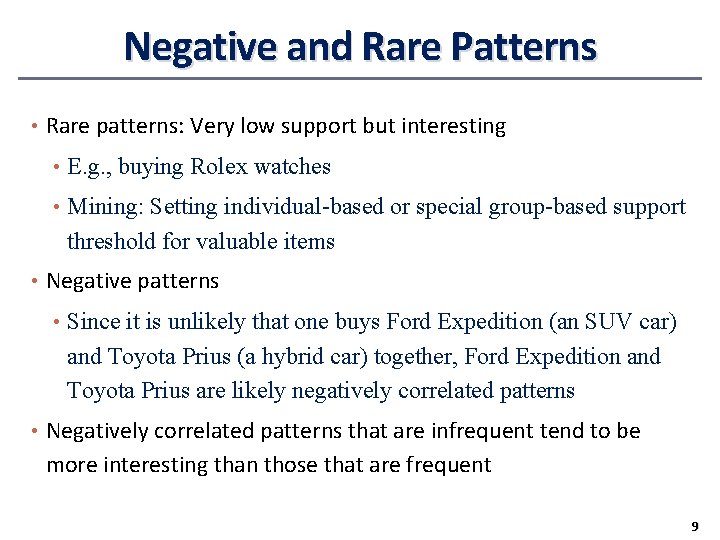
Negative and Rare Patterns • Rare patterns: Very low support but interesting • E. g. , buying Rolex watches • Mining: Setting individual-based or special group-based support threshold for valuable items • Negative patterns • Since it is unlikely that one buys Ford Expedition (an SUV car) and Toyota Prius (a hybrid car) together, Ford Expedition and Toyota Prius are likely negatively correlated patterns • Negatively correlated patterns that are infrequent tend to be more interesting than those that are frequent 9
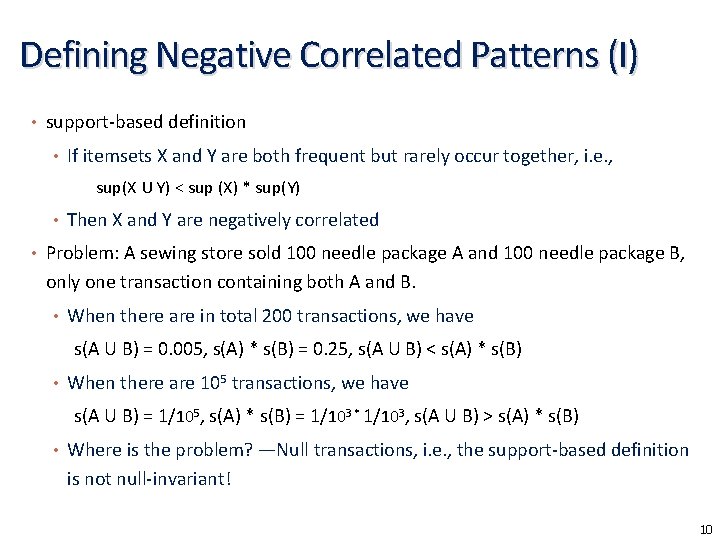
Defining Negative Correlated Patterns (I) • support-based definition • If itemsets X and Y are both frequent but rarely occur together, i. e. , sup(X U Y) < sup (X) * sup(Y) • Then X and Y are negatively correlated • Problem: A sewing store sold 100 needle package A and 100 needle package B, only one transaction containing both A and B. • When there are in total 200 transactions, we have s(A U B) = 0. 005, s(A) * s(B) = 0. 25, s(A U B) < s(A) * s(B) • When there are 105 transactions, we have s(A U B) = 1/105, s(A) * s(B) = 1/103 * 1/103, s(A U B) > s(A) * s(B) • Where is the problem? —Null transactions, i. e. , the support-based definition is not null-invariant! 10
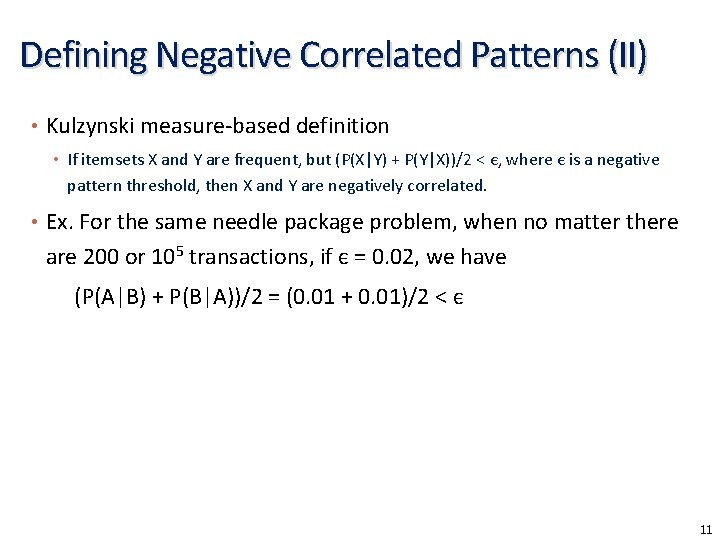
Defining Negative Correlated Patterns (II) • Kulzynski measure-based definition • If itemsets X and Y are frequent, but (P(X|Y) + P(Y|X))/2 < є, where є is a negative pattern threshold, then X and Y are negatively correlated. • Ex. For the same needle package problem, when no matter there are 200 or 105 transactions, if є = 0. 02, we have (P(A|B) + P(B|A))/2 = (0. 01 + 0. 01)/2 < є 11
Chapter 7: Advanced Pattern Mining • Pattern Mining: A Road Map • Pattern Mining in Multi-Level, Multi-Dimensional Space • Constraint-Based Frequent Pattern Mining • Mining Colossal Patterns • Mining Compressed or Approximate Patterns • Summary 12
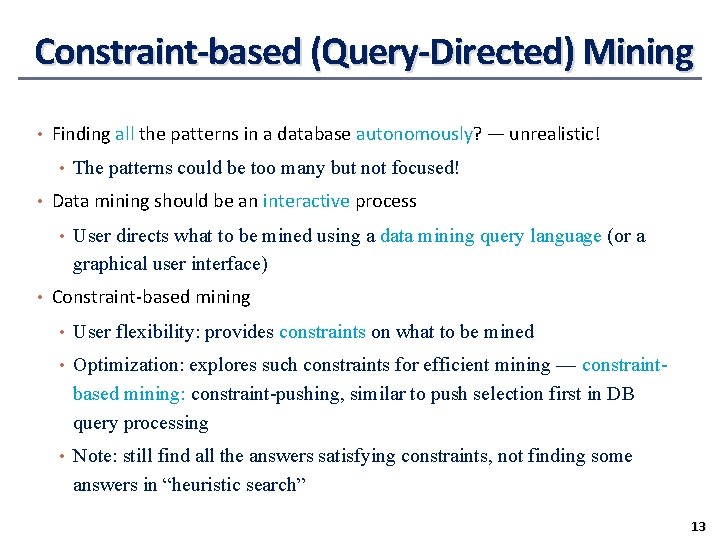
Constraint-based (Query-Directed) Mining • Finding all the patterns in a database autonomously? — unrealistic! • The patterns could be too many but not focused! • Data mining should be an interactive process • User directs what to be mined using a data mining query language (or a graphical user interface) • Constraint-based mining • User flexibility: provides constraints on what to be mined • Optimization: explores such constraints for efficient mining — constraint- based mining: constraint-pushing, similar to push selection first in DB query processing • Note: still find all the answers satisfying constraints, not finding some answers in “heuristic search” 13
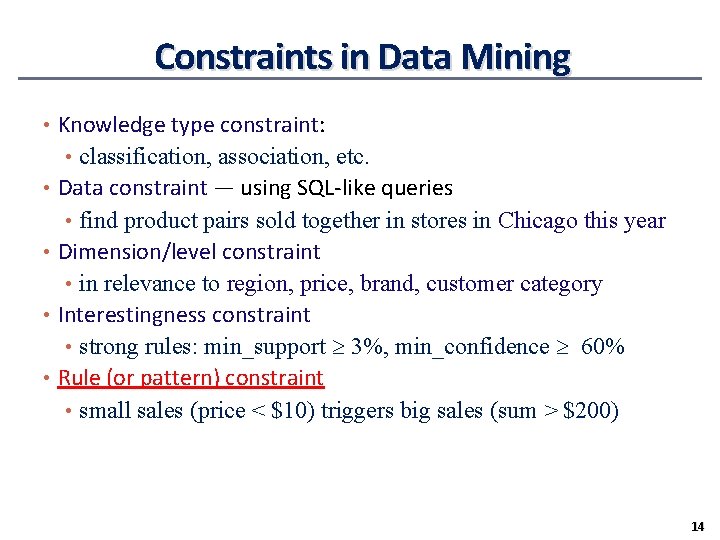
Constraints in Data Mining • Knowledge type constraint: • classification, association, etc. • Data constraint — using SQL-like queries • find product pairs sold together in stores in Chicago this year • Dimension/level constraint • in relevance to region, price, brand, customer category • Interestingness constraint • strong rules: min_support 3%, min_confidence 60% • Rule (or pattern) constraint • small sales (price < $10) triggers big sales (sum > $200) 14
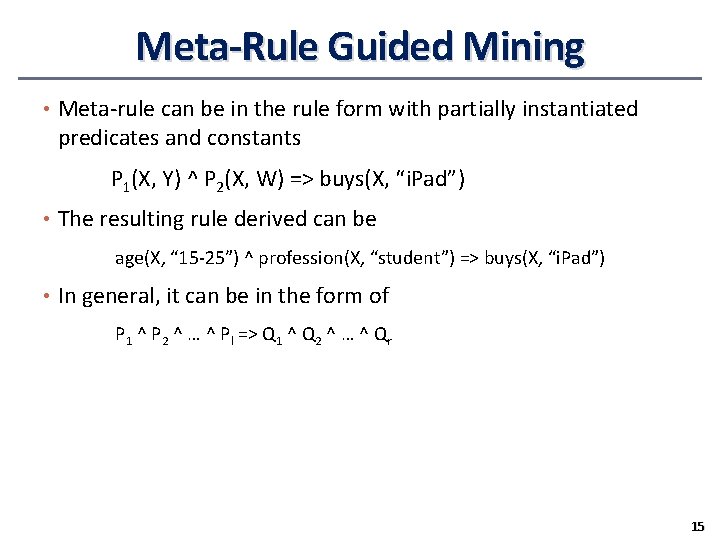
Meta-Rule Guided Mining • Meta-rule can be in the rule form with partially instantiated predicates and constants P 1(X, Y) ^ P 2(X, W) => buys(X, “i. Pad”) • The resulting rule derived can be age(X, “ 15 -25”) ^ profession(X, “student”) => buys(X, “i. Pad”) • In general, it can be in the form of P 1 ^ P 2 ^ … ^ Pl => Q 1 ^ Q 2 ^ … ^ Qr 15
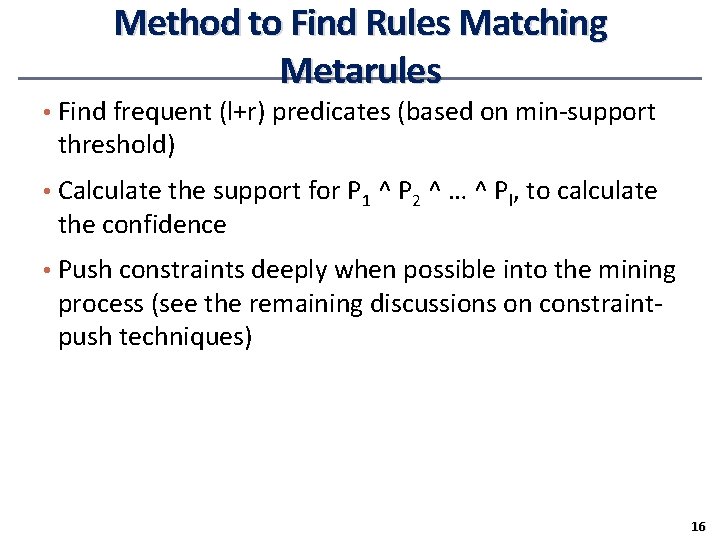
Method to Find Rules Matching Metarules • Find frequent (l+r) predicates (based on min-support threshold) • Calculate the support for P 1 ^ P 2 ^ … ^ Pl, to calculate the confidence • Push constraints deeply when possible into the mining process (see the remaining discussions on constraintpush techniques) 16
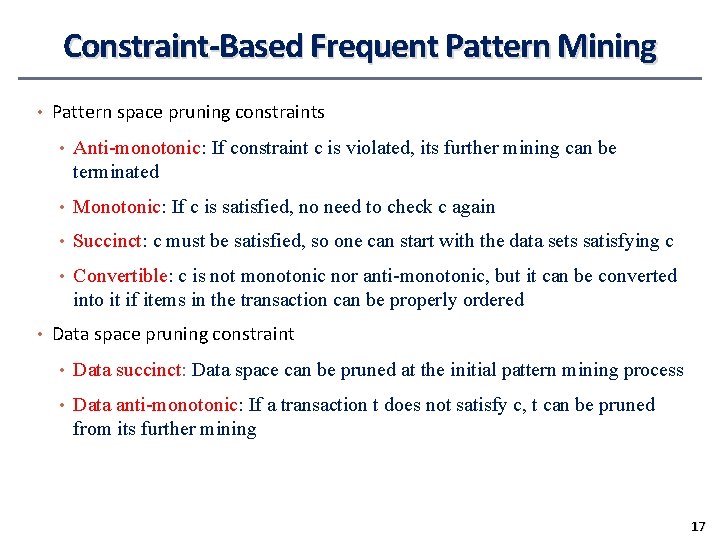
Constraint-Based Frequent Pattern Mining • Pattern space pruning constraints • Anti-monotonic: If constraint c is violated, its further mining can be terminated • Monotonic: If c is satisfied, no need to check c again • Succinct: c must be satisfied, so one can start with the data sets satisfying c • Convertible: c is not monotonic nor anti-monotonic, but it can be converted into it if items in the transaction can be properly ordered • Data space pruning constraint • Data succinct: Data space can be pruned at the initial pattern mining process • Data anti-monotonic: If a transaction t does not satisfy c, t can be pruned from its further mining 17
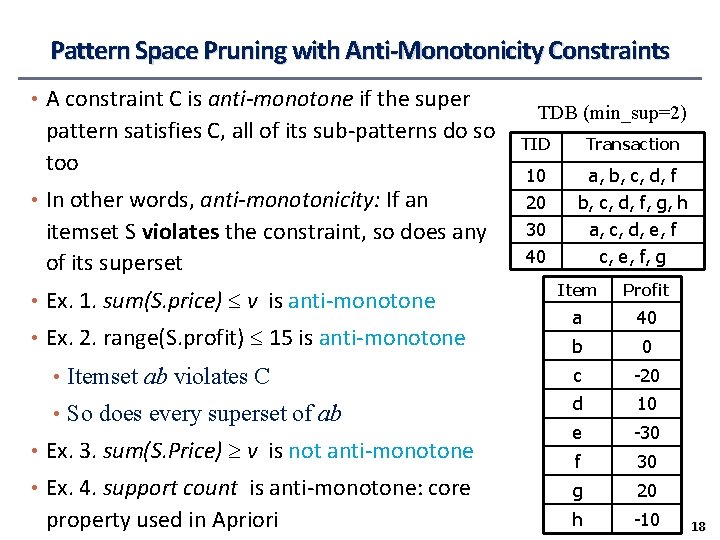
Pattern Space Pruning with Anti-Monotonicity Constraints • A constraint C is anti-monotone if the super pattern satisfies C, all of its sub-patterns do so too • In other words, anti-monotonicity: If an itemset S violates the constraint, so does any of its superset TDB (min_sup=2) TID Transaction 10 a, b, c, d, f 20 30 40 b, c, d, f, g, h a, c, d, e, f c, e, f, g Item Profit a 40 b 0 • Itemset ab violates C c -20 • So does every superset of ab d 10 e -30 f 30 g 20 h -10 • Ex. 1. sum(S. price) v is anti-monotone • Ex. 2. range(S. profit) 15 is anti-monotone • Ex. 3. sum(S. Price) v is not anti-monotone • Ex. 4. support count is anti-monotone: core property used in Apriori 18
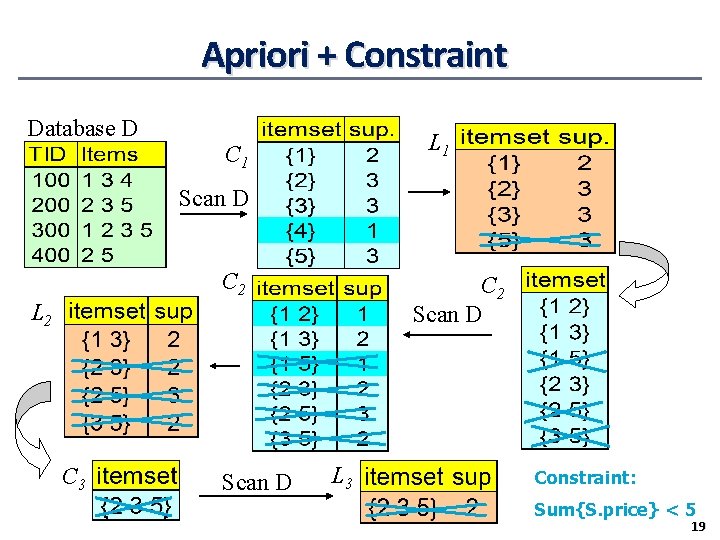
Apriori + Constraint Database D L 1 C 1 Scan D C 2 Scan D L 2 C 3 Scan D L 3 Constraint: Sum{S. price} < 5 19
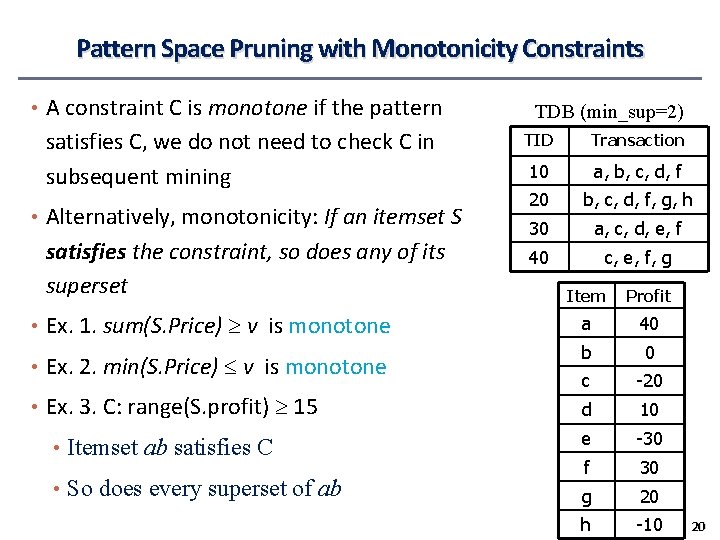
Pattern Space Pruning with Monotonicity Constraints • A constraint C is monotone if the pattern satisfies C, we do not need to check C in subsequent mining • Alternatively, monotonicity: If an itemset S satisfies the constraint, so does any of its superset TDB (min_sup=2) TID Transaction 10 a, b, c, d, f 20 b, c, d, f, g, h 30 a, c, d, e, f 40 c, e, f, g Item Profit • Ex. 1. sum(S. Price) v is monotone a 40 • Ex. 2. min(S. Price) v is monotone b 0 c -20 • Ex. 3. C: range(S. profit) 15 d 10 e -30 f 30 g 20 h -10 • Itemset ab satisfies C • So does every superset of ab 20
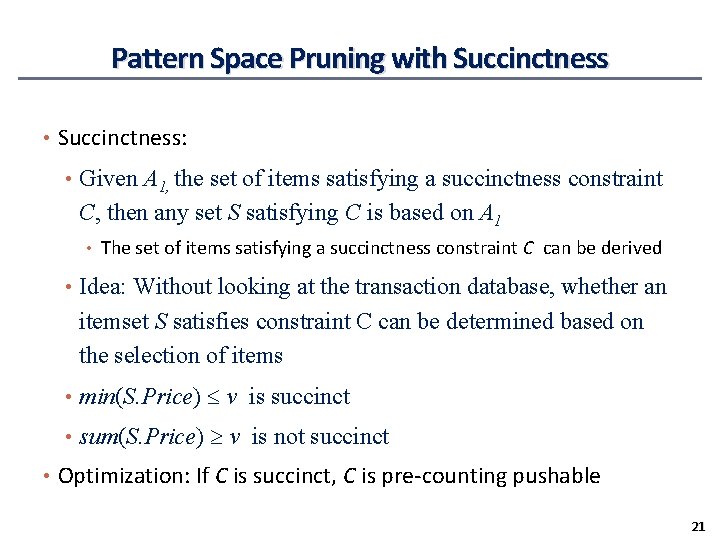
Pattern Space Pruning with Succinctness • Succinctness: • Given A 1, the set of items satisfying a succinctness constraint C, then any set S satisfying C is based on A 1 • The set of items satisfying a succinctness constraint C can be derived • Idea: Without looking at the transaction database, whether an itemset S satisfies constraint C can be determined based on the selection of items • min(S. Price) v is succinct • sum(S. Price) v is not succinct • Optimization: If C is succinct, C is pre-counting pushable 21
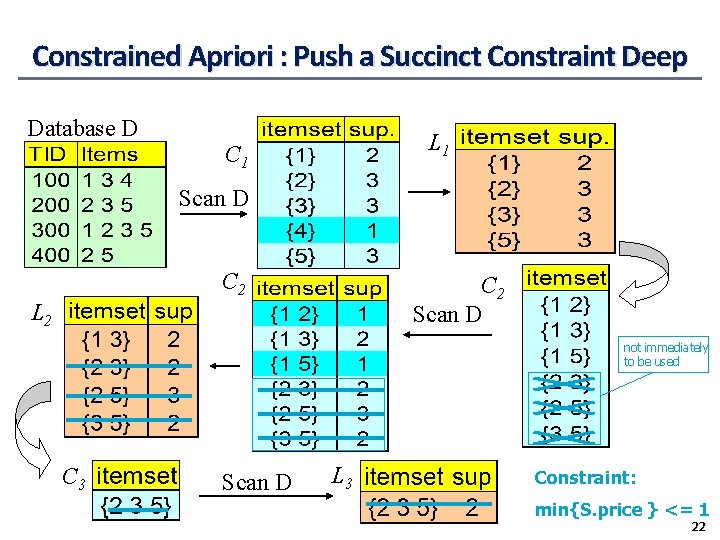
Constrained Apriori : Push a Succinct Constraint Deep Database D L 1 C 1 Scan D C 2 Scan D L 2 not immediately to be used C 3 Scan D L 3 Constraint: min{S. price } <= 1 22
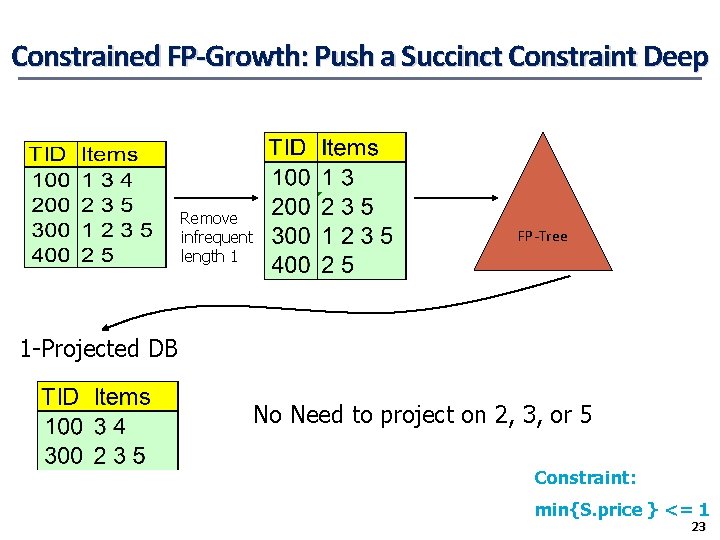
Constrained FP-Growth: Push a Succinct Constraint Deep Remove infrequent length 1 FP-Tree 1 -Projected DB No Need to project on 2, 3, or 5 Constraint: min{S. price } <= 1 23
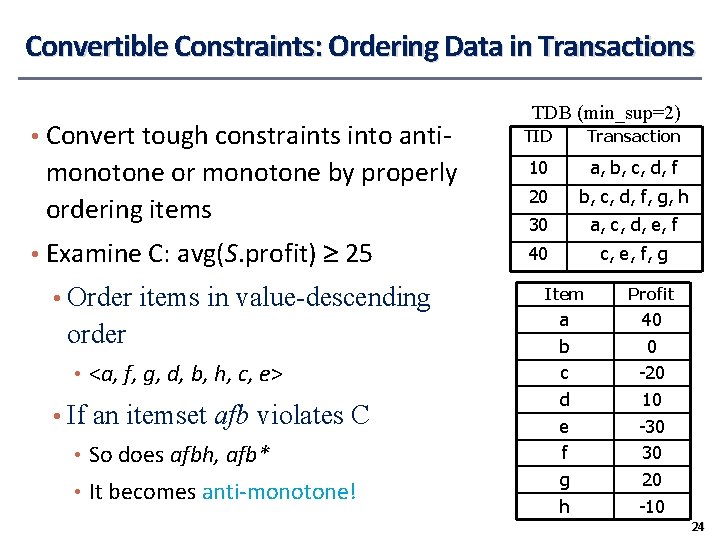
Convertible Constraints: Ordering Data in Transactions • Convert tough constraints into anti- monotone or monotone by properly ordering items • Examine C: avg(S. profit) 25 • Order items in value-descending order • <a, f, g, d, b, h, c, e> • If an itemset afb violates C • So does afbh, afb* • It becomes anti-monotone! TDB (min_sup=2) TID Transaction 10 a, b, c, d, f 20 b, c, d, f, g, h 30 a, c, d, e, f 40 c, e, f, g Item Profit a b c d e f g h 40 0 -20 10 -30 30 20 -10 24
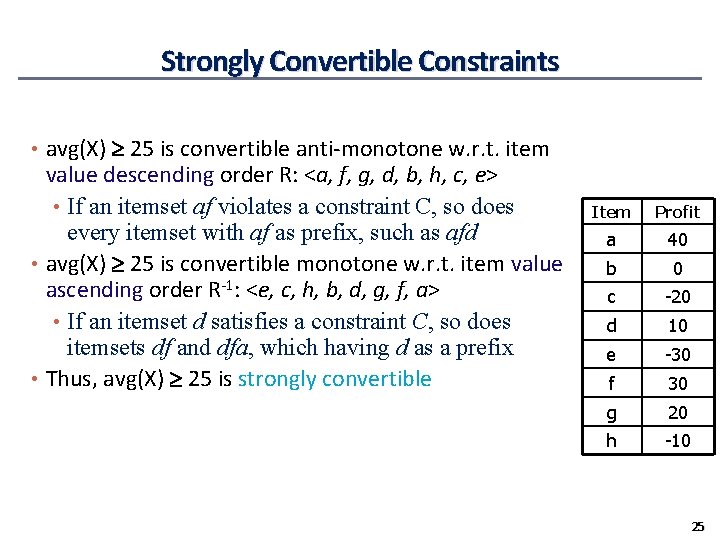
Strongly Convertible Constraints • avg(X) 25 is convertible anti-monotone w. r. t. item value descending order R: <a, f, g, d, b, h, c, e> • If an itemset af violates a constraint C, so does every itemset with af as prefix, such as afd • avg(X) 25 is convertible monotone w. r. t. item value ascending order R-1: <e, c, h, b, d, g, f, a> • If an itemset d satisfies a constraint C, so does itemsets df and dfa, which having d as a prefix • Thus, avg(X) 25 is strongly convertible Item Profit a 40 b 0 c -20 d 10 e -30 f 30 g 20 h -10 25
Data Space Pruning with Data-Succinct • 26
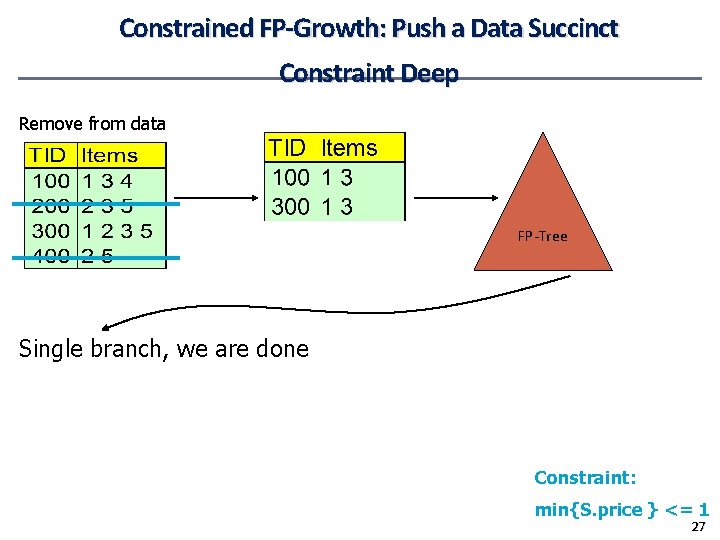
Constrained FP-Growth: Push a Data Succinct Constraint Deep Remove from data FP-Tree Single branch, we are done Constraint: min{S. price } <= 1 27
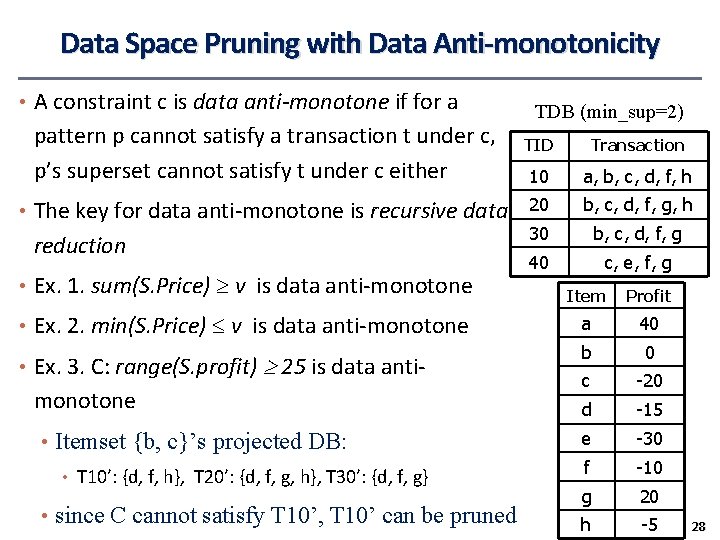
Data Space Pruning with Data Anti-monotonicity • A constraint c is data anti-monotone if for a pattern p cannot satisfy a transaction t under c, p’s superset cannot satisfy t under c either • The key for data anti-monotone is recursive data reduction • Ex. 1. sum(S. Price) v is data anti-monotone TDB (min_sup=2) TID Transaction 10 a, b, c, d, f, h 20 b, c, d, f, g, h 30 b, c, d, f, g 40 c, e, f, g Item Profit • Ex. 2. min(S. Price) v is data anti-monotone a 40 • Ex. 3. C: range(S. profit) 25 is data anti- b 0 c -20 d -15 e -30 f -10 g 20 h -5 monotone • Itemset {b, c}’s projected DB: • T 10’: {d, f, h}, T 20’: {d, f, g, h}, T 30’: {d, f, g} • since C cannot satisfy T 10’, T 10’ can be pruned 28
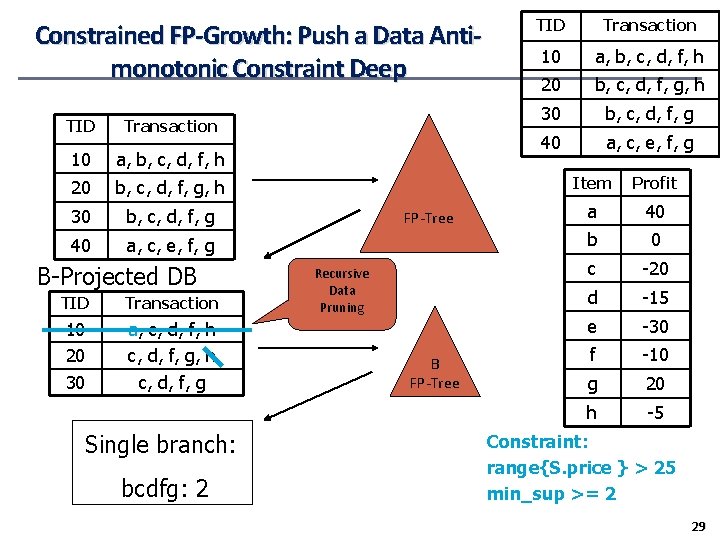
Constrained FP-Growth: Push a Data Antimonotonic Constraint Deep TID Transaction 10 a, b, c, d, f, h 20 b, c, d, f, g, h 30 b, c, d, f, g 40 a, c, e, f, g B-Projected DB TID Transaction 10 20 30 a, c, d, f, h c, d, f, g Single branch: bcdfg: 2 FP-Tree Recursive Data Pruning B FP-Tree TID Transaction 10 a, b, c, d, f, h 20 b, c, d, f, g, h 30 b, c, d, f, g 40 a, c, e, f, g Item Profit a 40 b 0 c -20 d -15 e -30 f -10 g 20 h -5 Constraint: range{S. price } > 25 min_sup >= 2 29
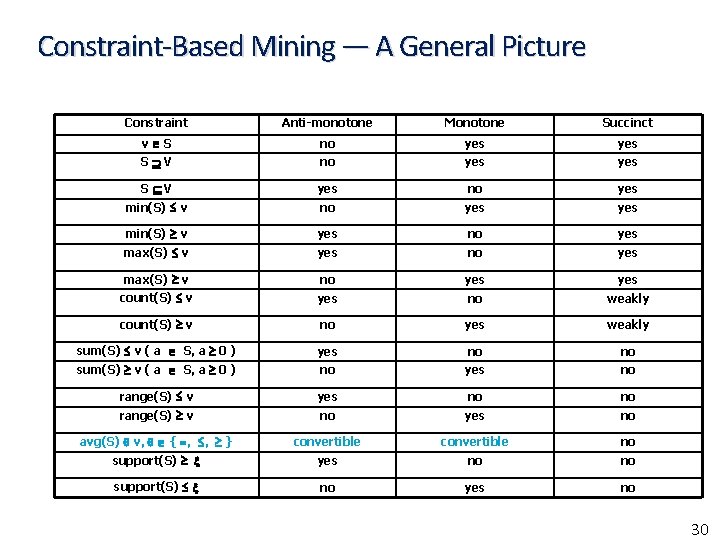
Constraint-Based Mining — A General Picture Constraint Anti-monotone Monotone Succinct v S no yes yes S V yes no yes min(S) v yes no yes max(S) v no yes count(S) v yes no weakly count(S) v no yes weakly sum(S) v ( a S, a 0 ) yes no no sum(S) v ( a S, a 0 ) no yes no range(S) v yes no no range(S) v no yes no avg(S) v, { , , } convertible no support(S) yes no no support(S) no yes no 30
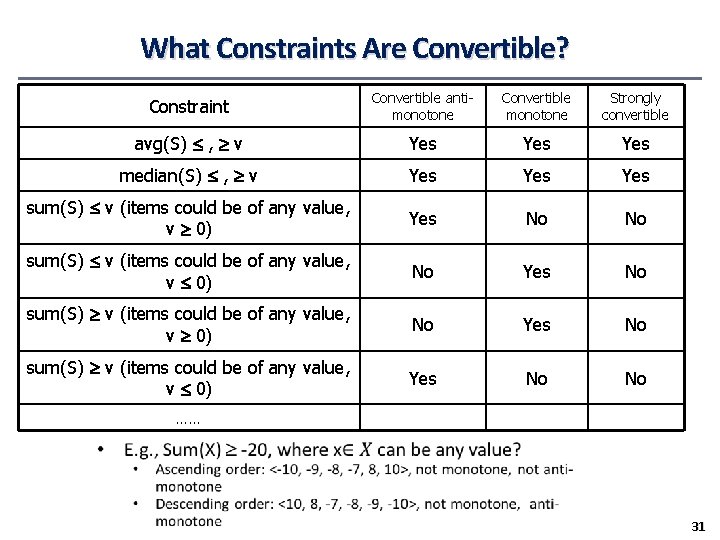
What Constraints Are Convertible? Constraint Convertible antimonotone Convertible monotone Strongly convertible avg(S) , v Yes Yes median(S) , v Yes Yes sum(S) v (items could be of any value, v 0) Yes No No sum(S) v (items could be of any value, v 0) No Yes No sum(S) v (items could be of any value, v 0) Yes No No …… 31
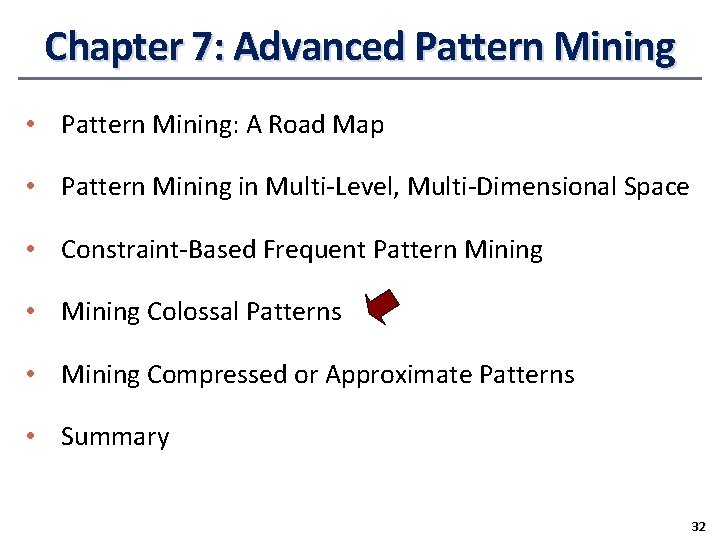
Chapter 7: Advanced Pattern Mining • Pattern Mining: A Road Map • Pattern Mining in Multi-Level, Multi-Dimensional Space • Constraint-Based Frequent Pattern Mining • Mining Colossal Patterns • Mining Compressed or Approximate Patterns • Summary 32
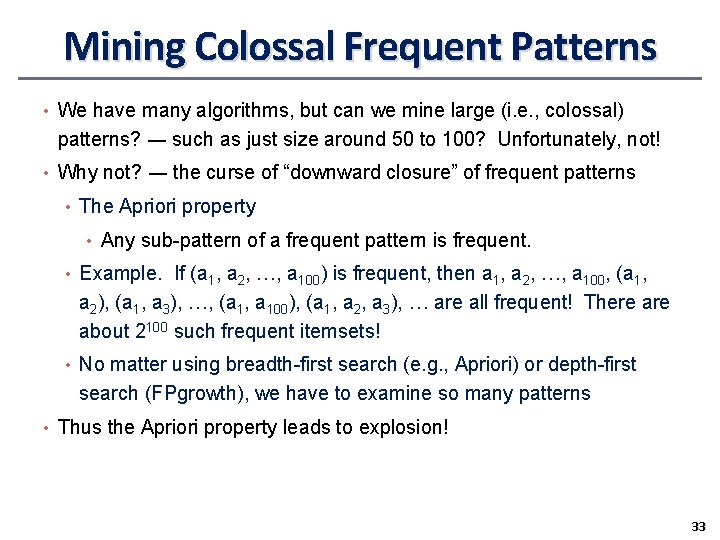
Mining Colossal Frequent Patterns • We have many algorithms, but can we mine large (i. e. , colossal) patterns? ― such as just size around 50 to 100? Unfortunately, not! • Why not? ― the curse of “downward closure” of frequent patterns • The Apriori property • Any sub-pattern of a frequent pattern is frequent. • Example. If (a 1, a 2, …, a 100) is frequent, then a 1, a 2, …, a 100, (a 1, a 2), (a 1, a 3), …, (a 1, a 100), (a 1, a 2, a 3), … are all frequent! There about 2100 such frequent itemsets! • No matter using breadth-first search (e. g. , Apriori) or depth-first search (FPgrowth), we have to examine so many patterns • Thus the Apriori property leads to explosion! 33
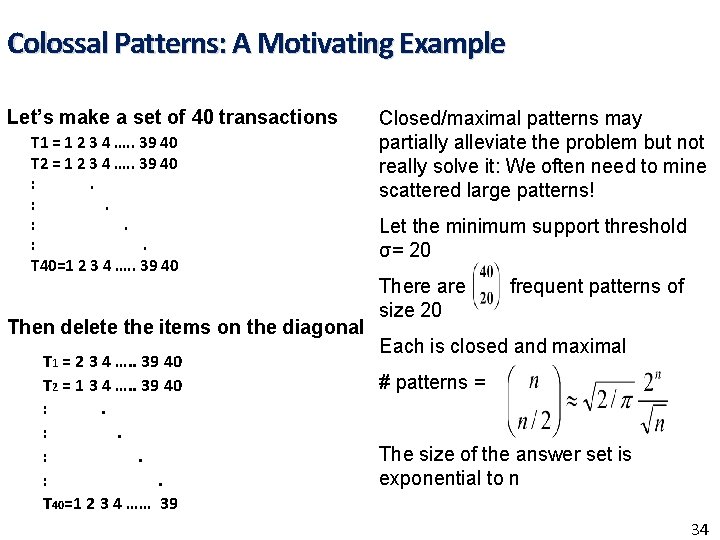
Colossal Patterns: A Motivating Example Let’s make a set of 40 transactions T 1 = 1 2 3 4 …. . 39 40 T 2 = 1 2 3 4 …. . 39 40 : . : . T 40=1 2 3 4 …. . 39 40 Then delete the items on the diagonal T 1 = 2 3 4 …. . 39 40 T 2 = 1 3 4 …. . 39 40 : . : . T 40=1 2 3 4 …… 39 Closed/maximal patterns may partially alleviate the problem but not really solve it: We often need to mine scattered large patterns! Let the minimum support threshold σ= 20 There are size 20 frequent patterns of Each is closed and maximal # patterns = The size of the answer set is exponential to n 34
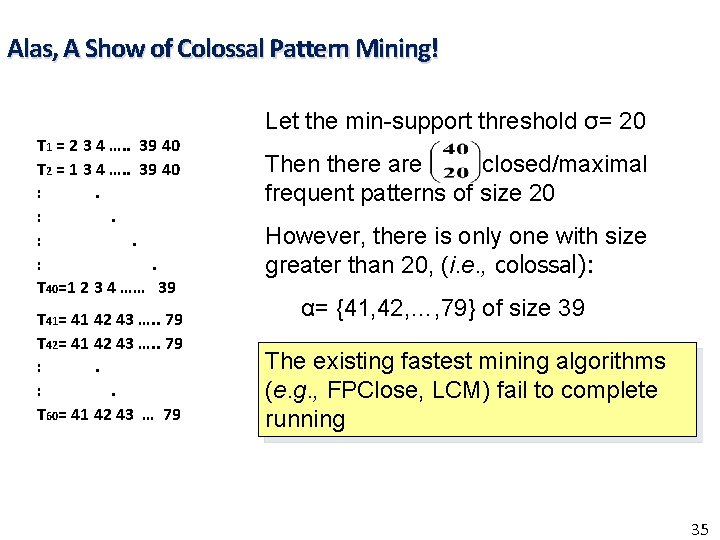
Alas, A Show of Colossal Pattern Mining! T 1 = 2 3 4 …. . 39 40 T 2 = 1 3 4 …. . 39 40 : . : . T 40=1 2 3 4 …… 39 T 41= 41 42 43 …. . 79 T 42= 41 42 43 …. . 79 : . T 60= 41 42 43 … 79 Let the min-support threshold σ= 20 Then there are closed/maximal frequent patterns of size 20 However, there is only one with size greater than 20, (i. e. , colossal): α= {41, 42, …, 79} of size 39 The existing fastest mining algorithms (e. g. , FPClose, LCM) fail to complete running 35
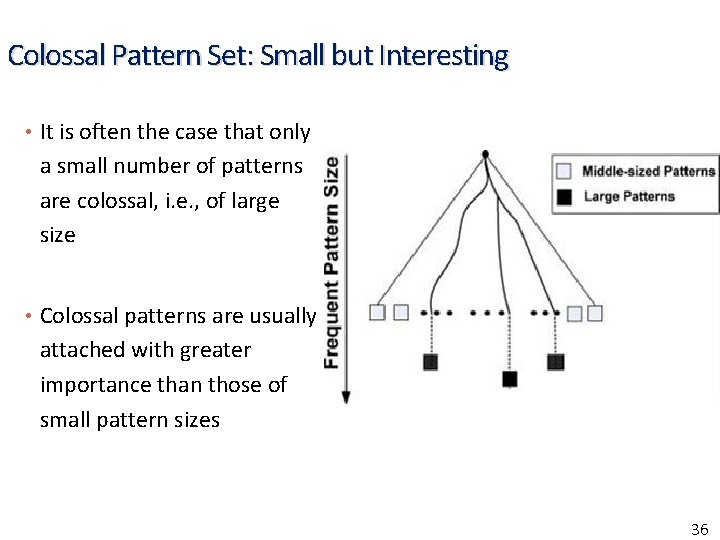
Colossal Pattern Set: Small but Interesting • It is often the case that only a small number of patterns are colossal, i. e. , of large size • Colossal patterns are usually attached with greater importance than those of small pattern sizes 36
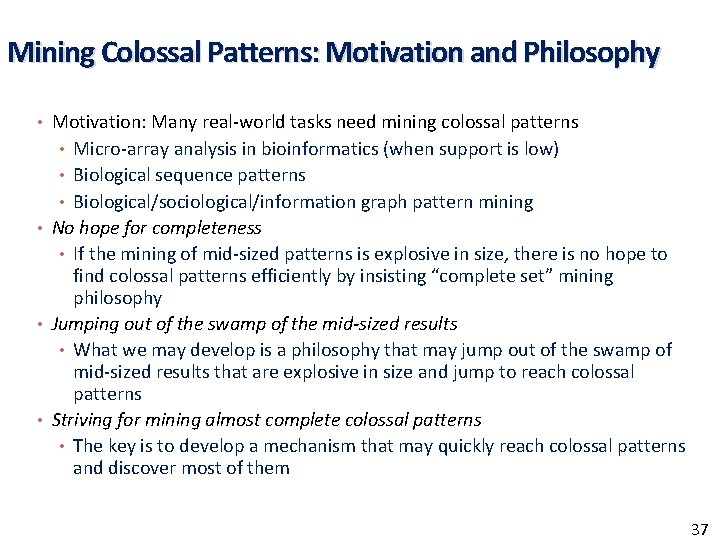
Mining Colossal Patterns: Motivation and Philosophy • Motivation: Many real-world tasks need mining colossal patterns • Micro-array analysis in bioinformatics (when support is low) • Biological sequence patterns • Biological/sociological/information graph pattern mining • No hope for completeness • If the mining of mid-sized patterns is explosive in size, there is no hope to find colossal patterns efficiently by insisting “complete set” mining philosophy • Jumping out of the swamp of the mid-sized results • What we may develop is a philosophy that may jump out of the swamp of mid-sized results that are explosive in size and jump to reach colossal patterns • Striving for mining almost complete colossal patterns • The key is to develop a mechanism that may quickly reach colossal patterns and discover most of them 37
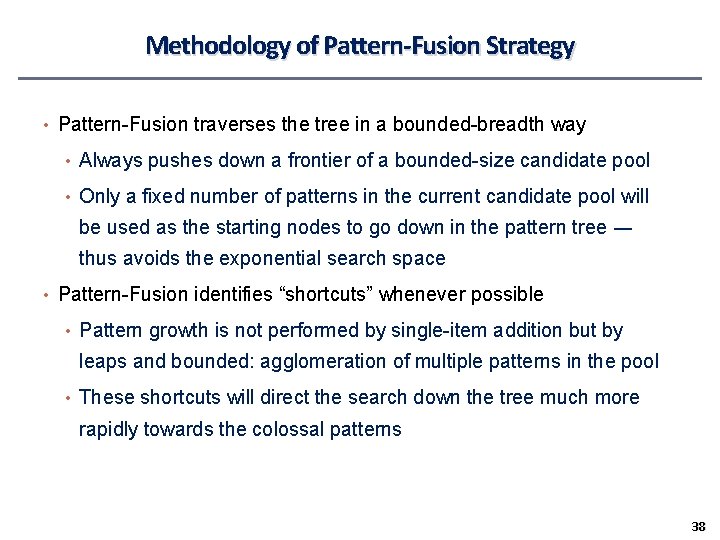
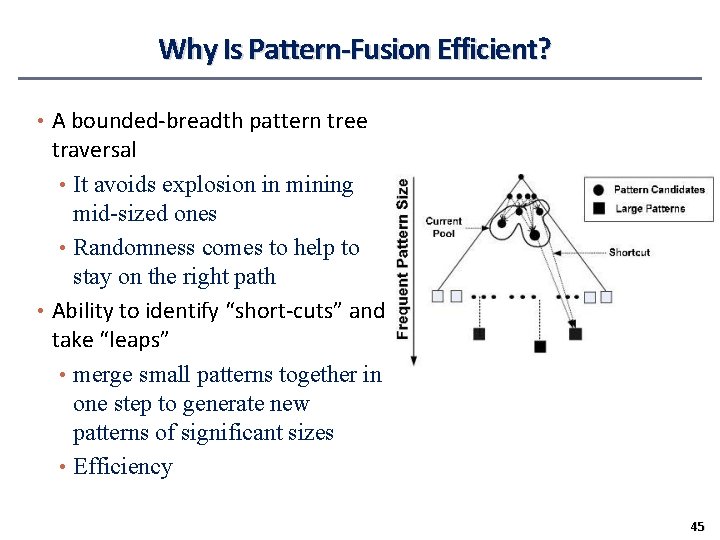
Methodology of Pattern-Fusion Strategy • Pattern-Fusion traverses the tree in a bounded-breadth way • Always pushes down a frontier of a bounded-size candidate pool • Only a fixed number of patterns in the current candidate pool will be used as the starting nodes to go down in the pattern tree ― thus avoids the exponential search space • Pattern-Fusion identifies “shortcuts” whenever possible • Pattern growth is not performed by single-item addition but by leaps and bounded: agglomeration of multiple patterns in the pool • These shortcuts will direct the search down the tree much more rapidly towards the colossal patterns 38
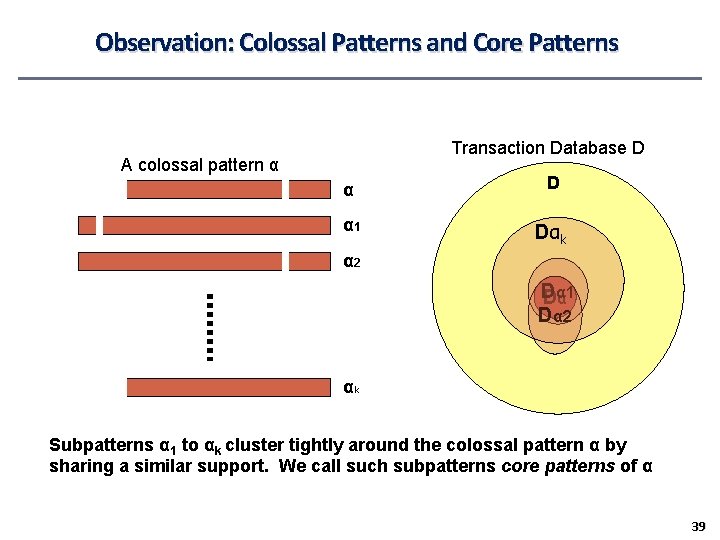
Observation: Colossal Patterns and Core Patterns Transaction Database D A colossal pattern α α D α 1 Dαk α 2 D Dα 1 α Dα 2 αk Subpatterns α 1 to αk cluster tightly around the colossal pattern α by sharing a similar support. We call such subpatterns core patterns of α 39
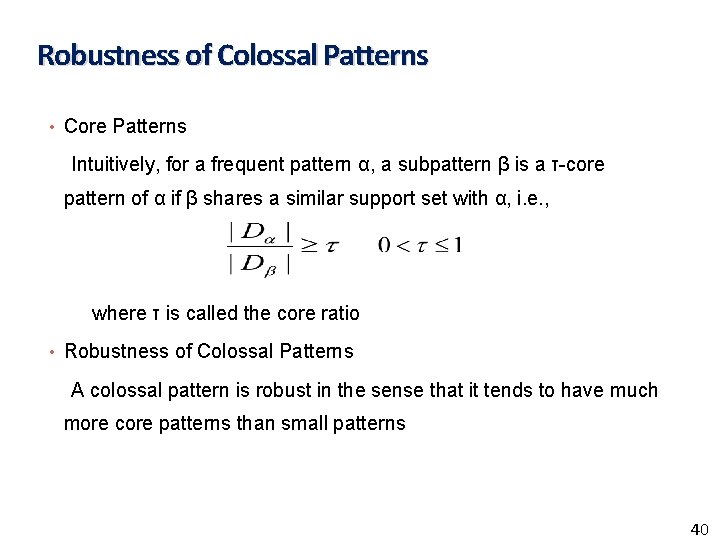
Robustness of Colossal Patterns • Core Patterns Intuitively, for a frequent pattern α, a subpattern β is a τ-core pattern of α if β shares a similar support set with α, i. e. , where τ is called the core ratio • Robustness of Colossal Patterns A colossal pattern is robust in the sense that it tends to have much more core patterns than small patterns 40
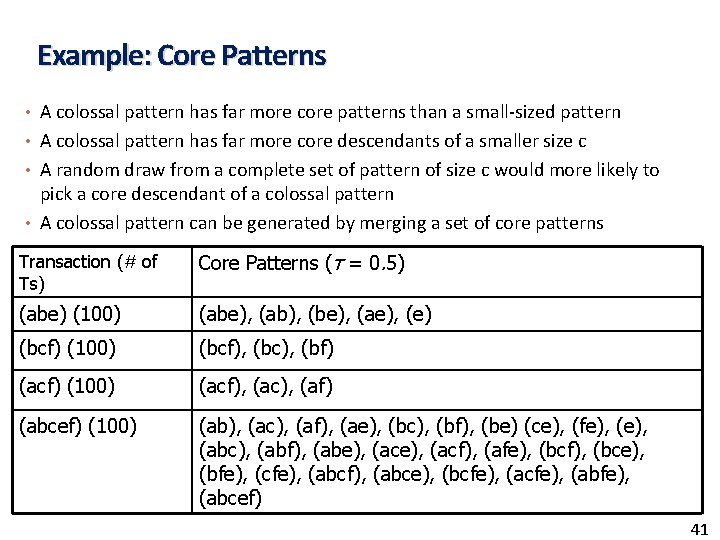
Example: Core Patterns • A colossal pattern has far more core patterns than a small-sized pattern • A colossal pattern has far more core descendants of a smaller size c • A random draw from a complete set of pattern of size c would more likely to pick a core descendant of a colossal pattern • A colossal pattern can be generated by merging a set of core patterns Transaction (# of Ts) Core Patterns (τ = 0. 5) (abe) (100) (abe), (ab), (be), (ae), (e) (bcf) (100) (bcf), (bc), (bf) (acf) (100) (acf), (ac), (af) (abcef) (100) (ab), (ac), (af), (ae), (bc), (bf), (be) (ce), (fe), (abc), (abf), (abe), (acf), (afe), (bcf), (bce), (bfe), (cfe), (abcf), (abce), (bcfe), (abfe), (abcef) 41
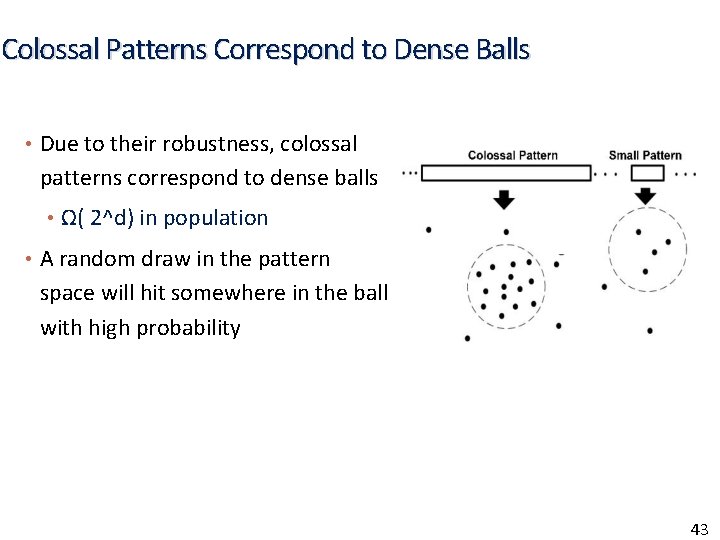
Colossal Patterns Correspond to Dense Balls • Due to their robustness, colossal patterns correspond to dense balls • Ω( 2^d) in population • A random draw in the pattern space will hit somewhere in the ball with high probability 43
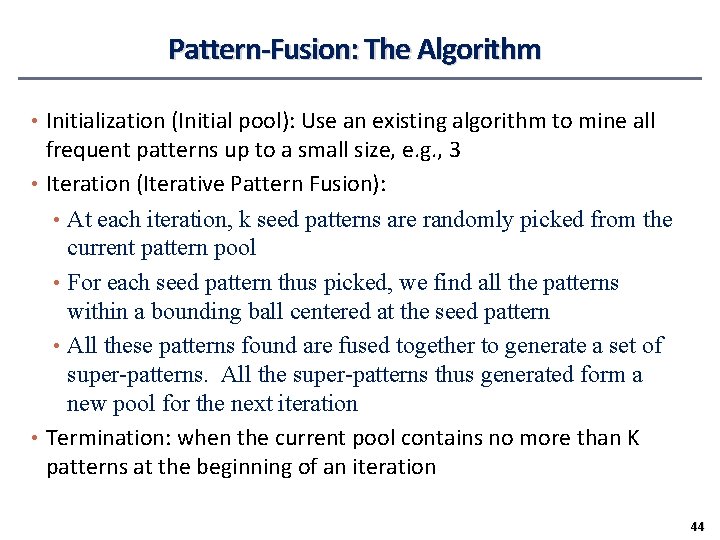
Pattern-Fusion: The Algorithm • Initialization (Initial pool): Use an existing algorithm to mine all frequent patterns up to a small size, e. g. , 3 • Iteration (Iterative Pattern Fusion): • At each iteration, k seed patterns are randomly picked from the current pattern pool • For each seed pattern thus picked, we find all the patterns within a bounding ball centered at the seed pattern • All these patterns found are fused together to generate a set of super-patterns. All the super-patterns thus generated form a new pool for the next iteration • Termination: when the current pool contains no more than K patterns at the beginning of an iteration 44
Why Is Pattern-Fusion Efficient? • A bounded-breadth pattern tree traversal • It avoids explosion in mining mid-sized ones • Randomness comes to help to stay on the right path • Ability to identify “short-cuts” and take “leaps” • merge small patterns together in one step to generate new patterns of significant sizes • Efficiency 45
Pattern-Fusion Leads to Good Approximation • Gearing toward colossal patterns • The larger the pattern, the greater the chance it will be generated • Catching outliers • The more distinct the pattern, the greater the chance it will be generated 46
Chapter 7: Advanced Pattern Mining • Pattern Mining: A Road Map • Pattern Mining in Multi-Level, Multi-Dimensional Space • Constraint-Based Frequent Pattern Mining • Mining Colossal Patterns • Mining Compressed or Approximate Patterns • Summary 47
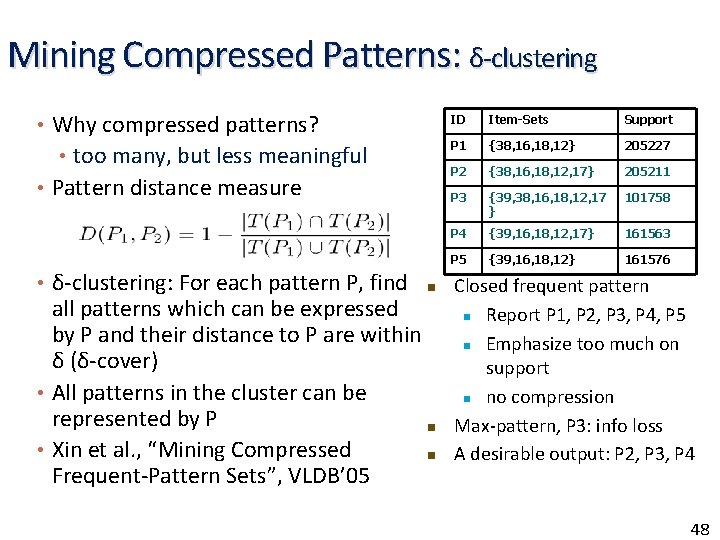
Mining Compressed Patterns: δ-clustering • Why compressed patterns? • too many, but less meaningful • Pattern distance measure • δ-clustering: For each pattern P, find n all patterns which can be expressed by P and their distance to P are within δ (δ-cover) • All patterns in the cluster can be represented by P n • Xin et al. , “Mining Compressed n Frequent-Pattern Sets”, VLDB’ 05 ID Item-Sets Support P 1 {38, 16, 18, 12} 205227 P 2 {38, 16, 18, 12, 17} 205211 P 3 {39, 38, 16, 18, 12, 17 } 101758 P 4 {39, 16, 18, 12, 17} 161563 P 5 {39, 16, 18, 12} 161576 Closed frequent pattern n Report P 1, P 2, P 3, P 4, P 5 n Emphasize too much on support n no compression Max-pattern, P 3: info loss A desirable output: P 2, P 3, P 4 48
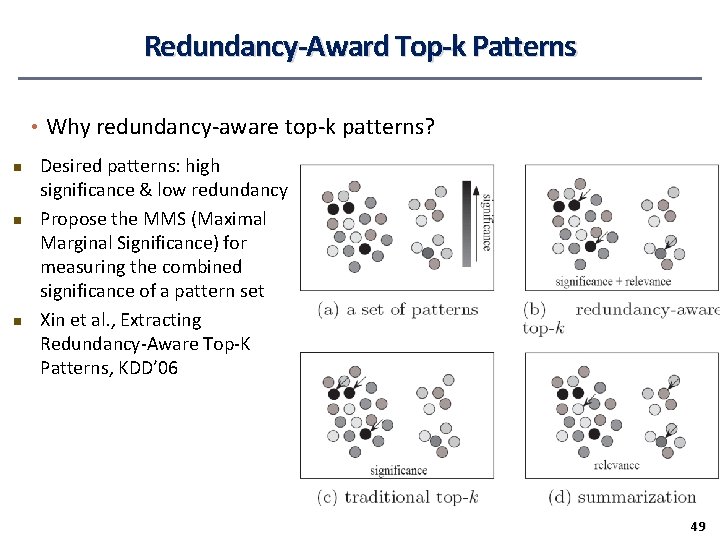
Redundancy-Award Top-k Patterns • Why redundancy-aware top-k patterns? n n n Desired patterns: high significance & low redundancy Propose the MMS (Maximal Marginal Significance) for measuring the combined significance of a pattern set Xin et al. , Extracting Redundancy-Aware Top-K Patterns, KDD’ 06 49
Chapter 7: Advanced Pattern Mining • Pattern Mining: A Road Map • Pattern Mining in Multi-Level, Multi-Dimensional Space • Constraint-Based Frequent Pattern Mining • Mining Colossal Patterns • Mining Compressed or Approximate Patterns • Summary 50
Summary • Roadmap: Many aspects & extensions on pattern mining • Mining patterns in multi-level, multi dimensional space, Mining rare and negative patterns • Constraint-based pattern mining • Specialized methods for mining colossal patterns • Mining compressed or approximate patterns 51
Ref: Mining Multi-Level and Quantitative Rules • • R. Srikant and R. Agrawal. Mining generalized association rules. VLDB'95. J. Han and Y. Fu. Discovery of multiple-level association rules from large databases. VLDB'95. R. Srikant and R. Agrawal. Mining quantitative association rules in large relational tables. SIGMOD'96. T. Fukuda, Y. Morimoto, S. Morishita, and T. Tokuyama. Data mining using two-dimensional optimized association rules: Scheme, algorithms, and visualization. SIGMOD'96. K. Yoda, T. Fukuda, Y. Morimoto, S. Morishita, and T. Tokuyama. Computing optimized rectilinear regions for association rules. KDD'97. R. J. Miller and Y. Yang. Association rules over interval data. SIGMOD'97. Y. Aumann and Y. Lindell. A Statistical Theory for Quantitative Association Rules KDD'99. 52
Ref: Mining Other Kinds of Rules • R. Meo, G. Psaila, and S. Ceri. A new SQL-like operator for mining association rules. VLDB'96. • B. Lent, A. Swami, and J. Widom. Clustering association rules. ICDE'97. • A. Savasere, E. Omiecinski, and S. Navathe. Mining for strong negative associations in a large database of customer transactions. ICDE'98. • D. Tsur, J. D. Ullman, S. Abitboul, C. Clifton, R. Motwani, and S. Nestorov. Query flocks: A generalization of association-rule mining. SIGMOD'98. • F. Korn, A. Labrinidis, Y. Kotidis, and C. Faloutsos. Ratio rules: A new paradigm for fast, quantifiable data mining. VLDB'98. • F. Zhu, X. Yan, J. Han, P. S. Yu, and H. Cheng, “Mining Colossal Frequent Patterns by Core Pattern Fusion”, ICDE'07. 53
Ref: Constraint-Based Pattern Mining • R. Srikant, Q. Vu, and R. Agrawal. Mining association rules with item constraints. KDD'97 • R. Ng, L. V. S. Lakshmanan, J. Han & A. Pang. Exploratory mining and pruning optimizations of constrained association rules. SIGMOD’ 98 • G. Grahne, L. Lakshmanan, and X. Wang. Efficient mining of constrained correlated sets. ICDE'00 • J. Pei, J. Han, and L. V. S. Lakshmanan. Mining Frequent Itemsets with Convertible Constraints. ICDE'01 • J. Pei, J. Han, and W. Wang, Mining Sequential Patterns with Constraints in Large Databases, CIKM'02 • F. Bonchi, F. Giannotti, A. Mazzanti, and D. Pedreschi. Ex. Ante: Anticipated Data Reduction in Constrained Pattern Mining, PKDD'03 • F. Zhu, X. Yan, J. Han, and P. S. Yu, “g. Prune: A Constraint Pushing Framework for Graph Pattern Mining”, PAKDD'07 54
Ref: Mining Sequential and Structured Patterns • R. Srikant and R. Agrawal. Mining sequential patterns: Generalizations and performance improvements. EDBT’ 96. • H. Mannila, H Toivonen, and A. I. Verkamo. Discovery of frequent episodes in event sequences. DAMI: 97. • M. Zaki. SPADE: An Efficient Algorithm for Mining Frequent Sequences. Machine Learning: 01. • J. Pei, J. Han, H. Pinto, Q. Chen, U. Dayal, and M. -C. Hsu. Prefix. Span: Mining Sequential Patterns Efficiently by Prefix-Projected Pattern Growth. ICDE'01. • M. Kuramochi and G. Karypis. Frequent Subgraph Discovery. ICDM'01. • X. Yan, J. Han, and R. Afshar. Clo. Span: Mining Closed Sequential Patterns in Large Datasets. SDM'03. • X. Yan and J. Han. Close. Graph: Mining Closed Frequent Graph Patterns. KDD'03. 55
Ref: Mining Spatial, Multimedia, and Web Data • K. Koperski and J. Han, Discovery of Spatial Association Rules in Geographic Information Databases, SSD’ 95. • O. R. Zaiane, M. Xin, J. Han, Discovering Web Access Patterns and Trends by Applying OLAP and Data Mining Technology on Web Logs. ADL'98. • O. R. Zaiane, J. Han, and H. Zhu, Mining Recurrent Items in Multimedia with Progressive Resolution Refinement. ICDE'00. • D. Gunopulos and I. Tsoukatos. Efficient Mining of Spatiotemporal Patterns. SSTD'01. 56
Ref: Mining Frequent Patterns in Time-Series Data • B. Ozden, S. Ramaswamy, and A. Silberschatz. Cyclic association rules. ICDE'98. • J. Han, G. Dong and Y. Yin, Efficient Mining of Partial Periodic Patterns in Time Series Database, ICDE'99. • H. Lu, L. Feng, and J. Han. Beyond Intra-Transaction Association Analysis: Mining Multi-Dimensional Inter-Transaction Association Rules. TOIS: 00. • B. -K. Yi, N. Sidiropoulos, T. Johnson, H. V. Jagadish, C. Faloutsos, and A. Biliris. Online Data Mining for Co-Evolving Time Sequences. ICDE'00. • W. Wang, J. Yang, R. Muntz. TAR: Temporal Association Rules on Evolving Numerical Attributes. ICDE’ 01. • J. Yang, W. Wang, P. S. Yu. Mining Asynchronous Periodic Patterns in Time Series Data. TKDE’ 03. 57
Ref: FP for Classification and Clustering • G. Dong and J. Li. Efficient mining of emerging patterns: Discovering trends and differences. KDD'99. • B. Liu, W. Hsu, Y. Ma. Integrating Classification and Association Rule Mining. KDD’ 98. • W. Li, J. Han, and J. Pei. CMAR: Accurate and Efficient Classification Based on Multiple Class-Association Rules. ICDM'01. • H. Wang, W. Wang, J. Yang, and P. S. Yu. Clustering by pattern similarity in large data sets. SIGMOD’ 02. • J. Yang and W. Wang. CLUSEQ: efficient and effective sequence clustering. ICDE’ 03. • X. Yin and J. Han. CPAR: Classification based on Predictive Association Rules. SDM'03. • H. Cheng, X. Yan, J. Han, and C. -W. Hsu, Discriminative Frequent Pattern Analysis for Effective Classification”, ICDE'07. 58
Ref: Stream and Privacy-Preserving FP Mining • A. Evfimievski, R. Srikant, R. Agrawal, J. Gehrke. Privacy Preserving Mining of Association Rules. KDD’ 02. • J. Vaidya and C. Clifton. Privacy Preserving Association Rule Mining in Vertically Partitioned Data. KDD’ 02. • G. Manku and R. Motwani. Approximate Frequency Counts over Data Streams. VLDB’ 02. • Y. Chen, G. Dong, J. Han, B. W. Wah, and J. Wang. Multi-Dimensional Regression Analysis of Time-Series Data Streams. VLDB'02. • C. Giannella, J. Han, J. Pei, X. Yan and P. S. Yu. Mining Frequent Patterns in Data Streams at Multiple Time Granularities, Next Generation Data Mining: 03. • A. Evfimievski, J. Gehrke, and R. Srikant. Limiting Privacy Breaches in Privacy Preserving Data Mining. PODS’ 03. 59
Ref: Other Freq. Pattern Mining Applications • Y. Huhtala, J. Kärkkäinen, P. Porkka, H. Toivonen. Efficient Discovery of Functional and Approximate Dependencies Using Partitions. ICDE’ 98. • H. V. Jagadish, J. Madar, and R. Ng. Semantic Compression and Pattern Extraction with Fascicles. VLDB'99. • T. Dasu, T. Johnson, S. Muthukrishnan, and V. Shkapenyuk. Mining Database Structure; or How to Build a Data Quality Browser. SIGMOD'02. • K. Wang, S. Zhou, J. Han. Profit Mining: From Patterns to Actions. EDBT’ 02. 60
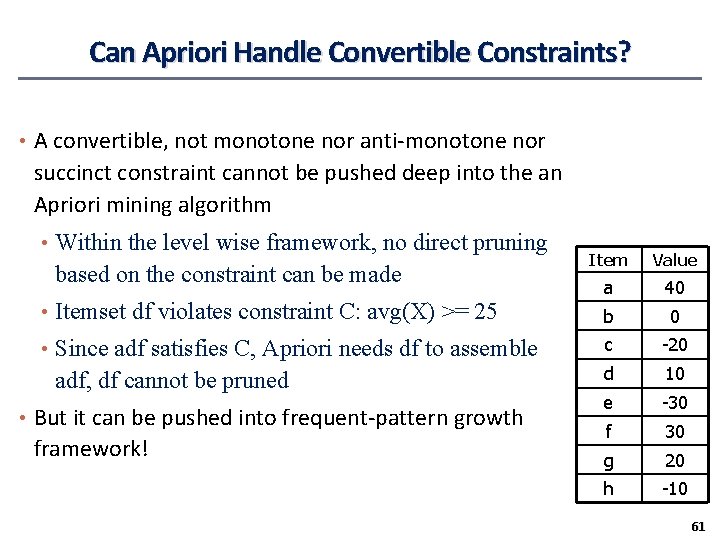
Can Apriori Handle Convertible Constraints? • A convertible, not monotone nor anti-monotone nor succinct constraint cannot be pushed deep into the an Apriori mining algorithm • Within the level wise framework, no direct pruning Item Value a 40 • Itemset df violates constraint C: avg(X) >= 25 b 0 • Since adf satisfies C, Apriori needs df to assemble c -20 d 10 e -30 f 30 g 20 h -10 based on the constraint can be made adf, df cannot be pruned • But it can be pushed into frequent-pattern growth framework! 61
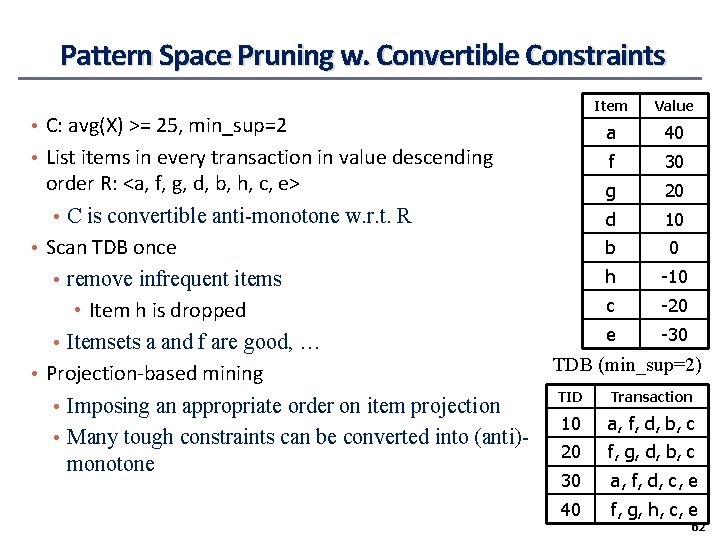
Pattern Space Pruning w. Convertible Constraints • C: avg(X) >= 25, min_sup=2 • List items in every transaction in value descending order R: <a, f, g, d, b, h, c, e> • C is convertible anti-monotone w. r. t. R • Scan TDB once • remove infrequent items • Item h is dropped • Itemsets a and f are good, … • Projection-based mining • Imposing an appropriate order on item projection • Many tough constraints can be converted into (anti)monotone Item Value a 40 f 30 g 20 d 10 b 0 h -10 c -20 e -30 TDB (min_sup=2) TID Transaction 10 a, f, d, b, c 20 f, g, d, b, c 30 a, f, d, c, e 40 f, g, h, c, e 62
Handling Multiple Constraints • Different constraints may require different or even conflicting item-ordering • If there exists an order R s. t. both C 1 and C 2 are convertible w. r. t. R, then there is no conflict between the two convertible constraints • If there exists conflict on order of items • Try to satisfy one constraint first • Then using the order for the other constraint to mine frequent itemsets in the corresponding projected database 63