
CS 621 Artificial Intelligence Pushpak Bhattacharyya CSE Dept
CS 621: Artificial Intelligence Pushpak Bhattacharyya CSE Dept. , IIT Bombay Lecture 21– Predicate Calculus and Knowledge Representation 7 th September, 2010
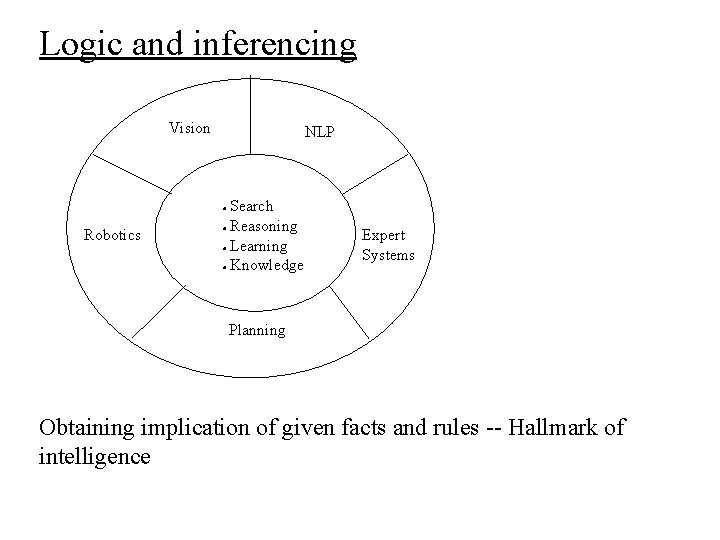
Logic and inferencing Vision NLP Search Reasoning Learning Knowledge Robotics Expert Systems Planning Obtaining implication of given facts and rules -- Hallmark of intelligence
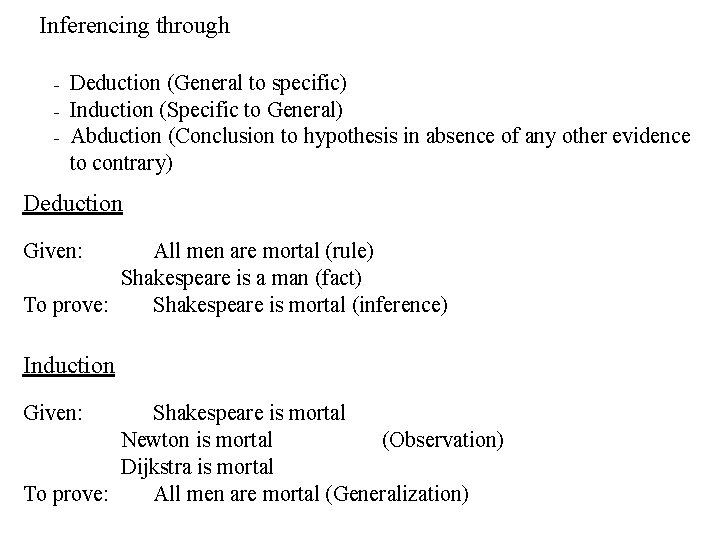
Inferencing through − − − Deduction (General to specific) Induction (Specific to General) Abduction (Conclusion to hypothesis in absence of any other evidence to contrary) Deduction Given: All men are mortal (rule) Shakespeare is a man (fact) To prove: Shakespeare is mortal (inference) Induction Given: Shakespeare is mortal Newton is mortal (Observation) Dijkstra is mortal To prove: All men are mortal (Generalization)
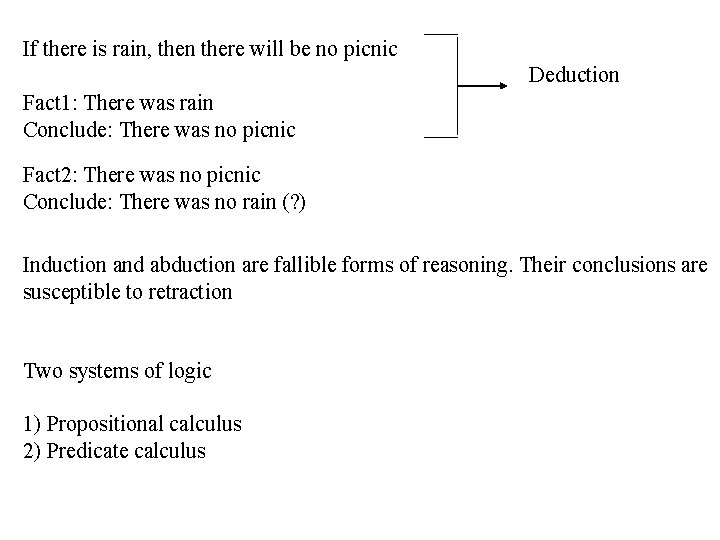
If there is rain, then there will be no picnic Deduction Fact 1: There was rain Conclude: There was no picnic Fact 2: There was no picnic Conclude: There was no rain (? ) Induction and abduction are fallible forms of reasoning. Their conclusions are susceptible to retraction Two systems of logic 1) Propositional calculus 2) Predicate calculus
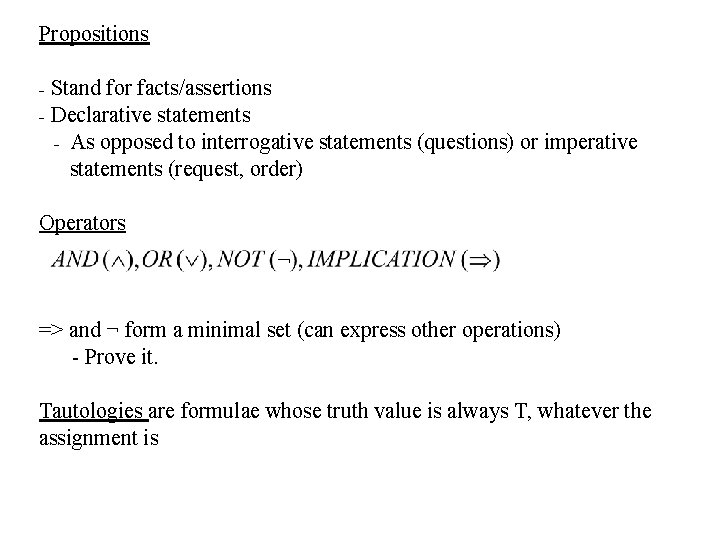
Propositions Stand for facts/assertions − Declarative statements − As opposed to interrogative statements (questions) or imperative statements (request, order) − Operators => and ¬ form a minimal set (can express other operations) - Prove it. Tautologies are formulae whose truth value is always T, whatever the assignment is
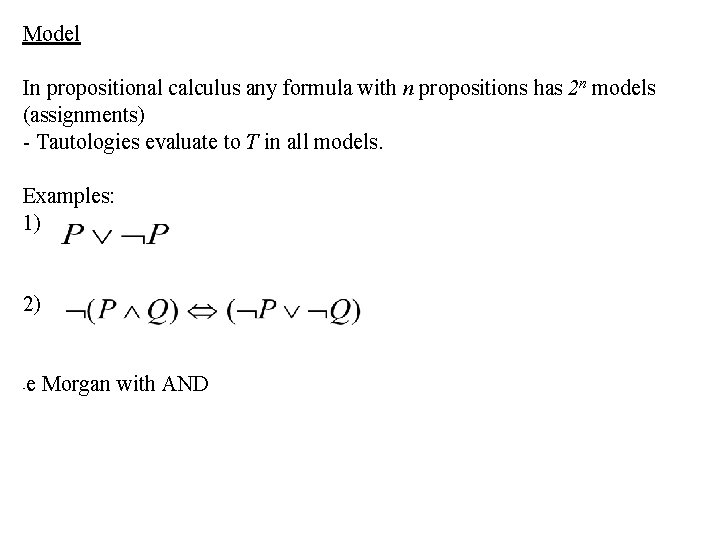
Model In propositional calculus any formula with n propositions has 2 n models (assignments) - Tautologies evaluate to T in all models. Examples: 1) 2) - e Morgan with AND
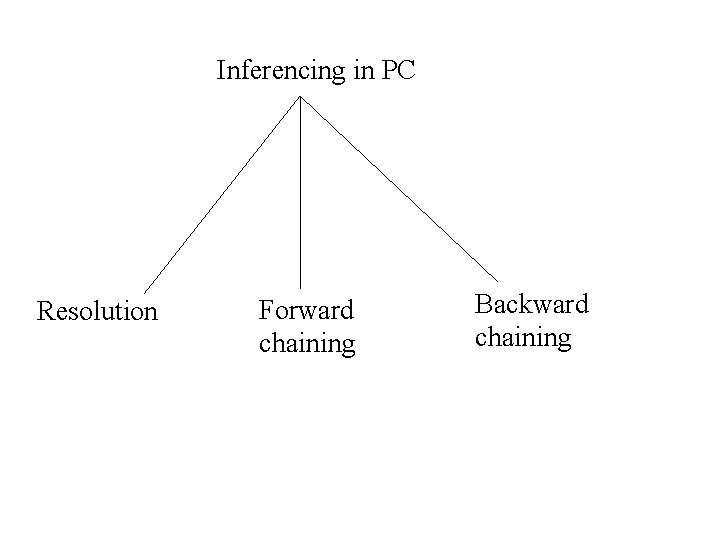
Inferencing in PC Resolution Forward chaining Backward chaining
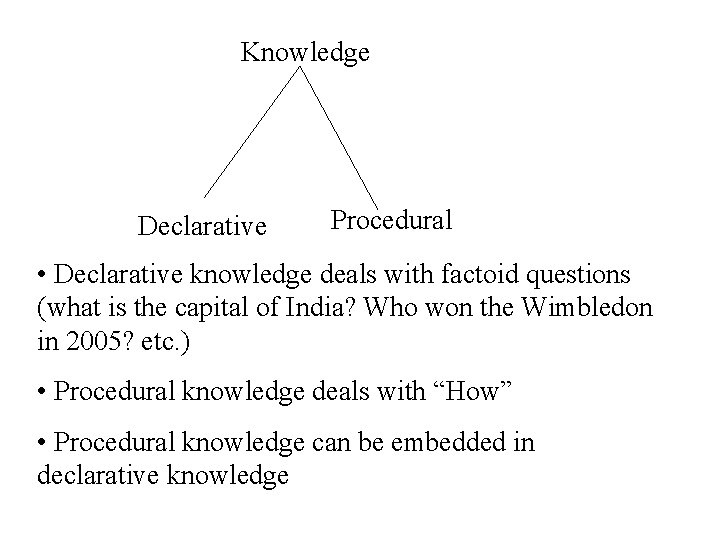
Knowledge Declarative Procedural • Declarative knowledge deals with factoid questions (what is the capital of India? Who won the Wimbledon in 2005? etc. ) • Procedural knowledge deals with “How” • Procedural knowledge can be embedded in declarative knowledge
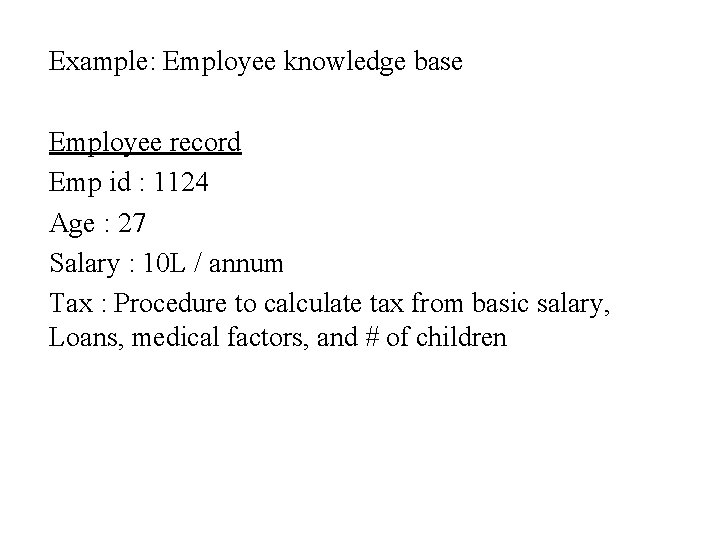
Example: Employee knowledge base Employee record Emp id : 1124 Age : 27 Salary : 10 L / annum Tax : Procedure to calculate tax from basic salary, Loans, medical factors, and # of children
Predicate Calculus
![Predicate Calculus: well known examples n Man is mortal : rule ∀x[man(x) → mortal(x)]](http://slidetodoc.com/presentation_image_h2/1e06c10749f8ab336d2d4aa0e1ba05b8/image-11.jpg "Predicate Calculus: well known examples n Man is mortal : rule ∀x[man(x) → mortal(x)]")
Predicate Calculus: well known examples n Man is mortal : rule ∀x[man(x) → mortal(x)] n n shakespeare is a man(shakespeare) To infer shakespeare is mortal(shakespeare)
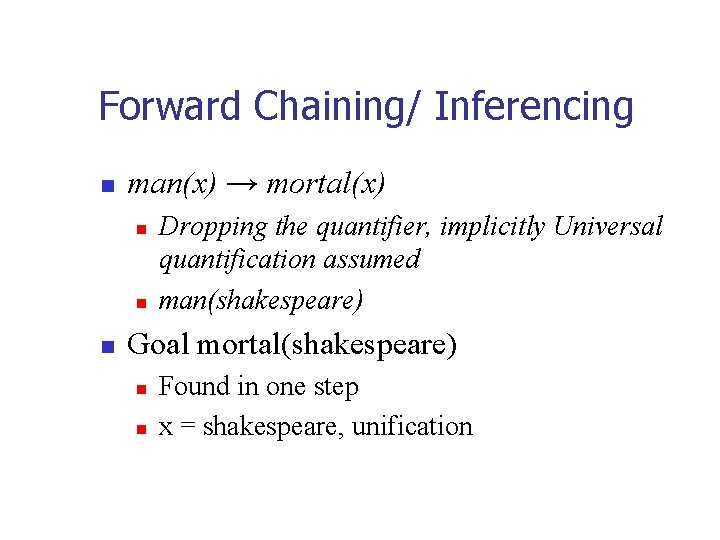
Forward Chaining/ Inferencing n man(x) → mortal(x) n n n Dropping the quantifier, implicitly Universal quantification assumed man(shakespeare) Goal mortal(shakespeare) n n Found in one step x = shakespeare, unification
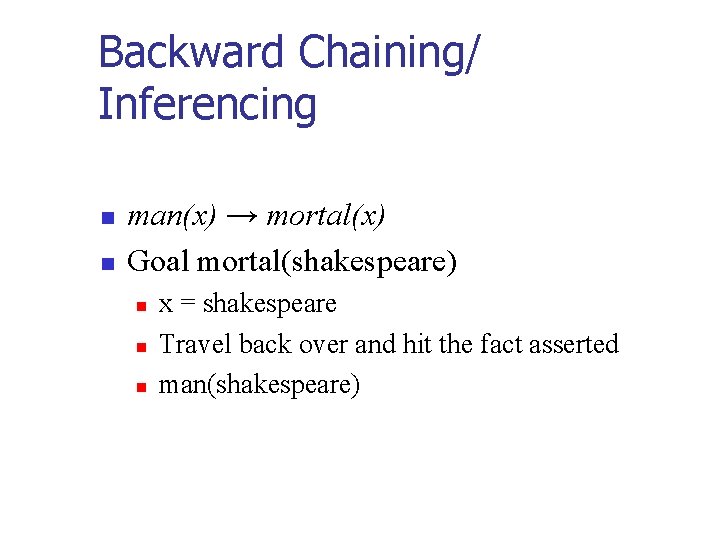
Backward Chaining/ Inferencing n n man(x) → mortal(x) Goal mortal(shakespeare) n n n x = shakespeare Travel back over and hit the fact asserted man(shakespeare)
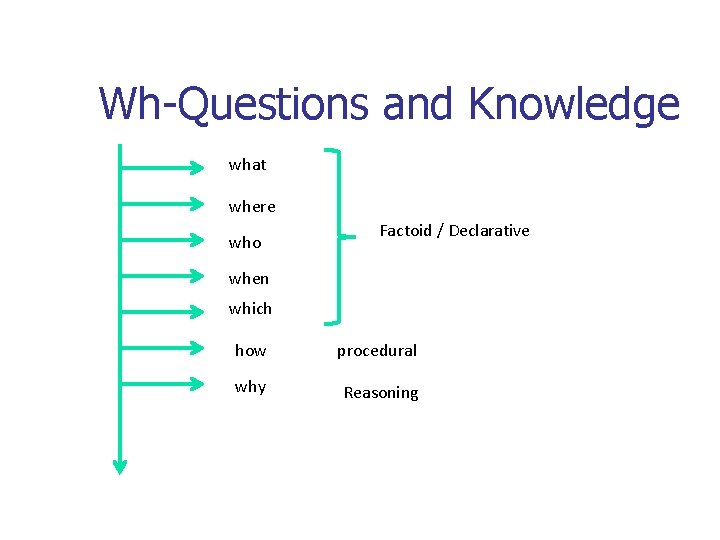
Wh-Questions and Knowledge what where who Factoid / Declarative when which how procedural why Reasoning
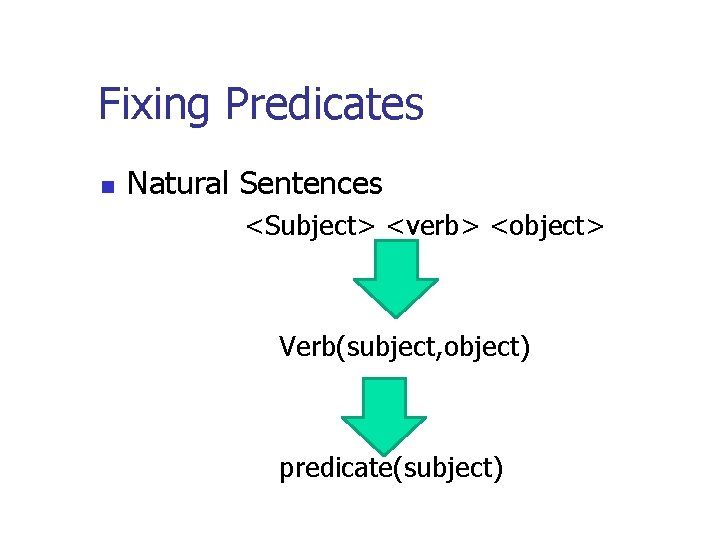
Fixing Predicates n Natural Sentences <Subject> <verb> <object> Verb(subject, object) predicate(subject)
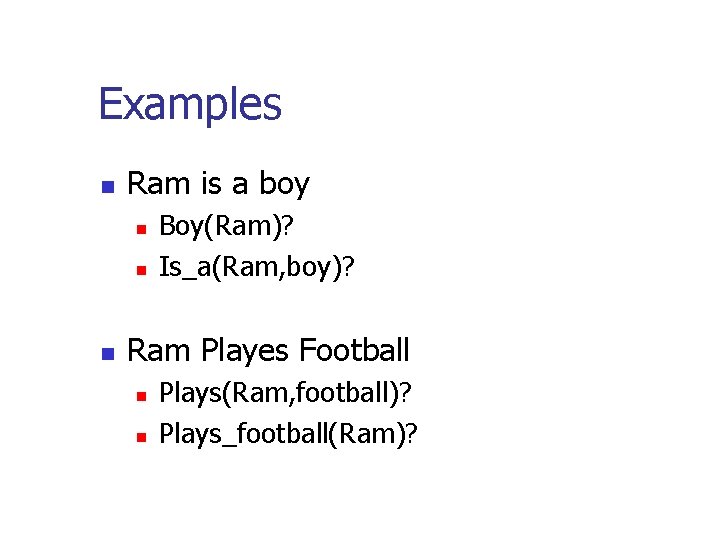
Examples n Ram is a boy n n n Boy(Ram)? Is_a(Ram, boy)? Ram Playes Football n n Plays(Ram, football)? Plays_football(Ram)?
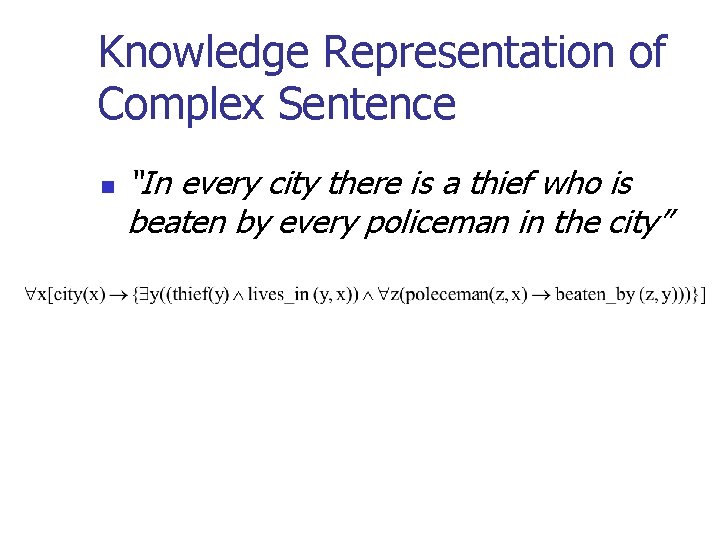
Knowledge Representation of Complex Sentence n “In every city there is a thief who is beaten by every policeman in the city”
Himalayan Club example
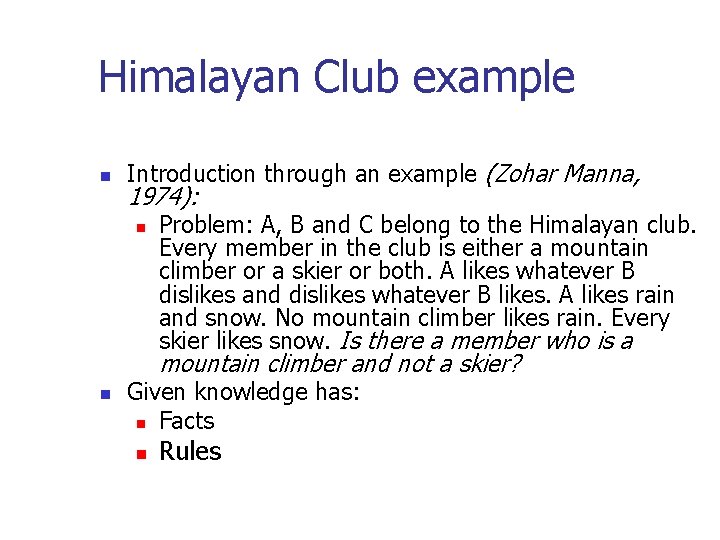
Himalayan Club example n Introduction through an example (Zohar Manna, 1974): n Problem: A, B and C belong to the Himalayan club. Every member in the club is either a mountain climber or a skier or both. A likes whatever B dislikes and dislikes whatever B likes. A likes rain and snow. No mountain climber likes rain. Every skier likes snow. Is there a member who is a mountain climber and not a skier? n Given knowledge has: n Facts n Rules
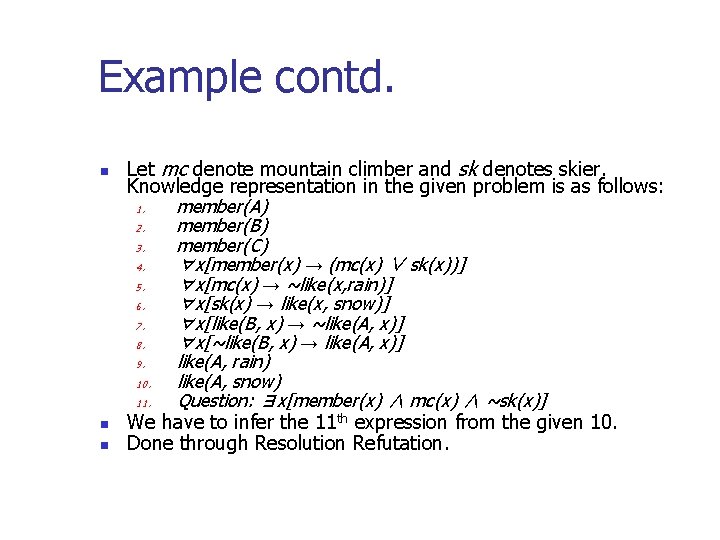
Example contd. n n n Let mc denote mountain climber and sk denotes skier. Knowledge representation in the given problem is as follows: 1. member(A) 2. member(B) 3. member(C) 4. ∀x[member(x) → (mc(x) ∨ sk(x))] 5. ∀x[mc(x) → ~like(x, rain)] 6. ∀x[sk(x) → like(x, snow)] 7. ∀x[like(B, x) → ~like(A, x)] 8. ∀x[~like(B, x) → like(A, x)] 9. like(A, rain) 10. like(A, snow) 11. Question: ∃x[member(x) ∧ mc(x) ∧ ~sk(x)] We have to infer the 11 th expression from the given 10. Done through Resolution Refutation.
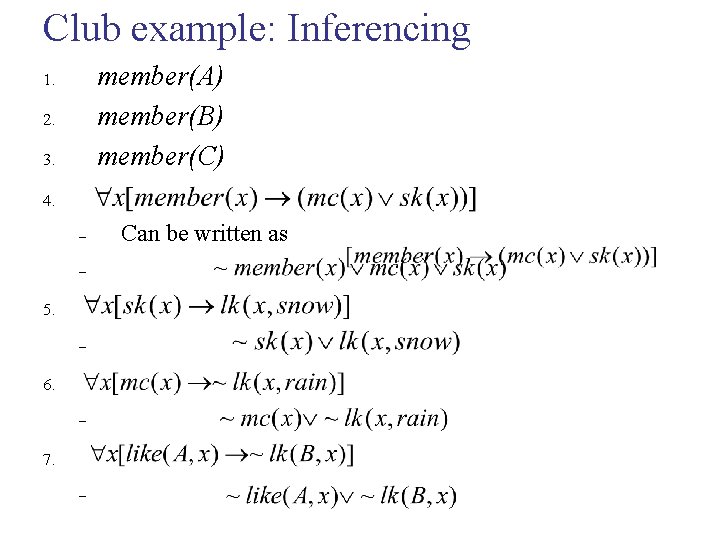
Club example: Inferencing member(A) member(B) member(C) 1. 2. 3. 4. – – 5. – 6. – 7. – Can be written as
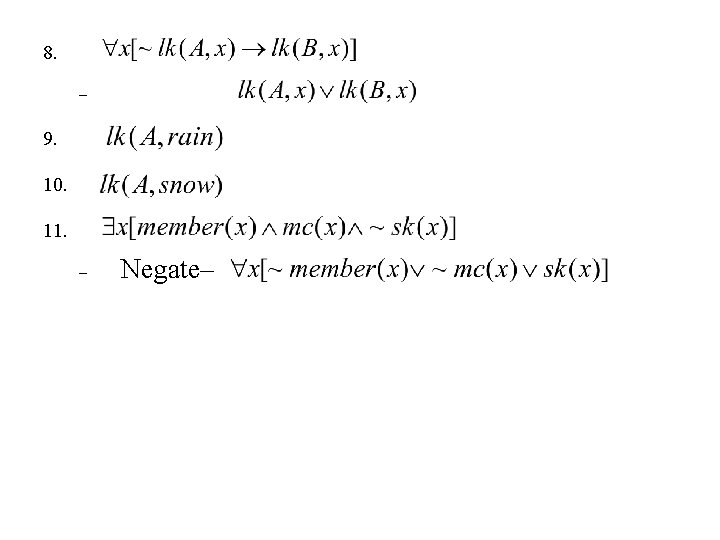
8. – 9. 10. 11. – Negate–
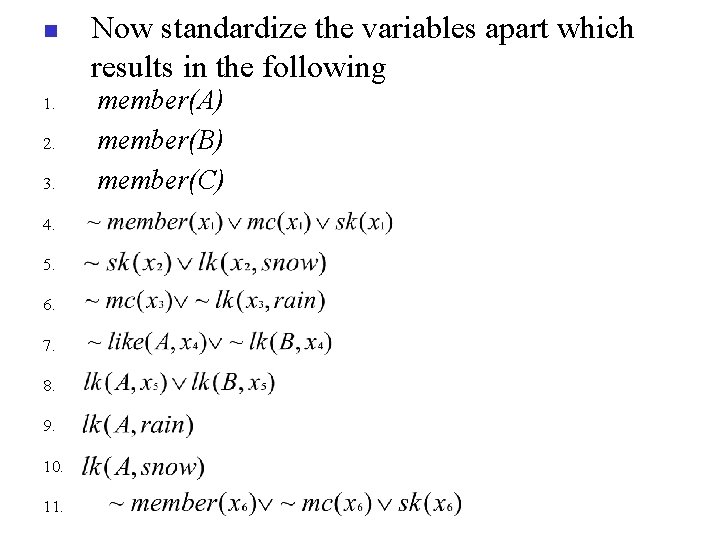
n 1. 2. 3. 4. 5. 6. 7. 8. 9. 10. 11. Now standardize the variables apart which results in the following member(A) member(B) member(C)
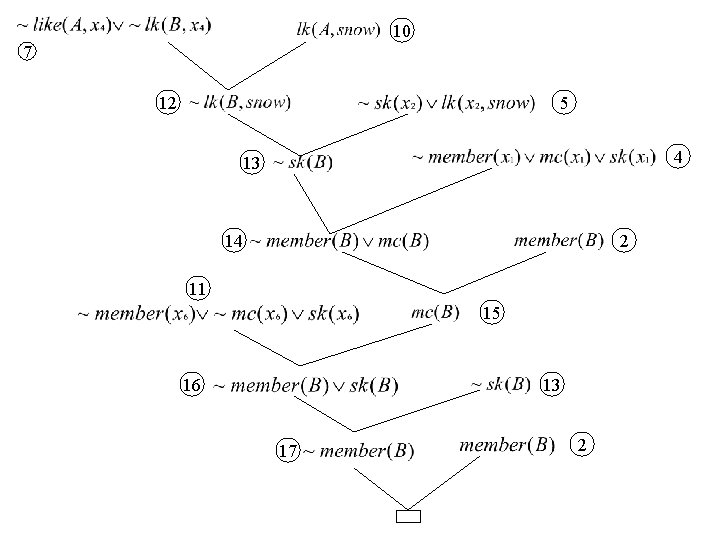
10 7 12 5 4 13 14 2 11 15 16 13 17 2
- Slides: 24