
CS 61 C Machine Structures Lecture 5 1

![CL: ALU for MIPS-lite (1/4) • Addition, subtraction, logical OR, ==: ADDU R[rd] =](https://slidetodoc.com/presentation_image_h2/0a98ec32d75243eb3478ef66bd84faab/image-19.jpg "CL: ALU for MIPS-lite (1/4) • Addition, subtraction, logical OR, ==: ADDU R[rd] =")
![CL: ALU (3/4) reg [31: 0] result, C; always @ (A or B or](https://slidetodoc.com/presentation_image_h2/0a98ec32d75243eb3478ef66bd84faab/image-21.jpg "CL: ALU (3/4) reg [31: 0] result, C; always @ (A or B or")
![Why is it “mem. Array[address[9: 2]]”? • Our memory is always byte-addressed • We](https://slidetodoc.com/presentation_image_h2/0a98ec32d75243eb3478ef66bd84faab/image-27.jpg "Why is it “mem. Array[address[9: 2]]”? • Our memory is always byte-addressed • We")
- Slides: 30
CS 61 C : Machine Structures Lecture 5. 1. 1 CPU Design I 2004 -07 -19 Kurt Meinz inst. eecs. berkeley. edu/~cs 61 c CS 61 C L 5. 1. 1 CPU Design I (1) K. Meinz, Summer 2004 © UCB
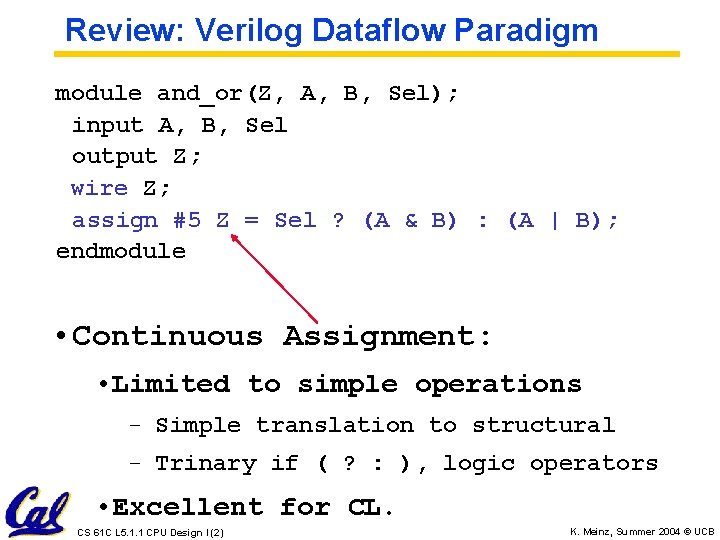
Review: Verilog Dataflow Paradigm module and_or(Z, A, B, Sel); input A, B, Sel output Z; wire Z; assign #5 Z = Sel ? (A & B) : (A | B); endmodule • Continuous Assignment: • Limited to simple operations - Simple translation to structural - Trinary if ( ? : ), logic operators • Excellent for CL. CS 61 C L 5. 1. 1 CPU Design I (2) K. Meinz, Summer 2004 © UCB
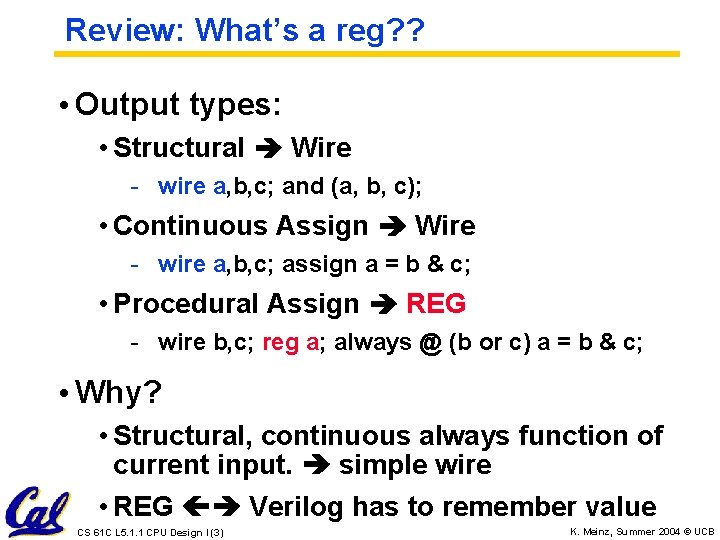
Review: What’s a reg? ? • Output types: • Structural Wire - wire a, b, c; and (a, b, c); • Continuous Assign Wire - wire a, b, c; assign a = b & c; • Procedural Assign REG - wire b, c; reg a; always @ (b or c) a = b & c; • Why? • Structural, continuous always function of current input. simple wire • REG Verilog has to remember value CS 61 C L 5. 1. 1 CPU Design I (3) K. Meinz, Summer 2004 © UCB
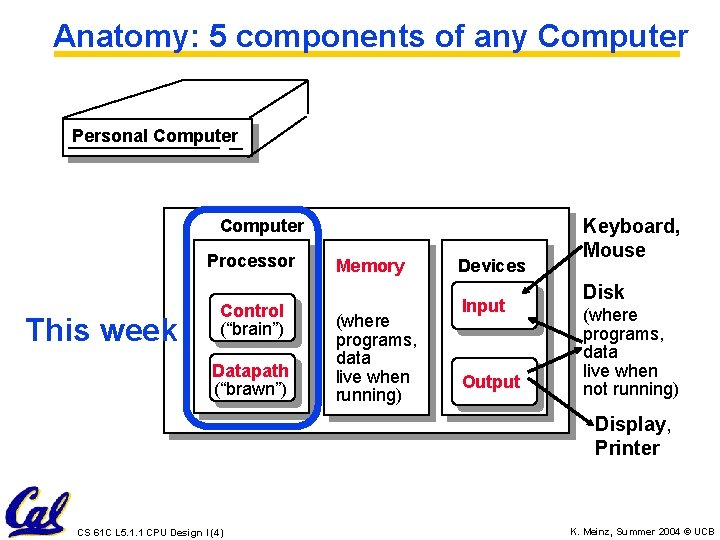
Anatomy: 5 components of any Computer Personal Computer Processor This week Control (“brain”) Datapath (“brawn”) Memory (where programs, data live when running) Devices Input Output Keyboard, Mouse Disk (where programs, data live when not running) Display, Printer CS 61 C L 5. 1. 1 CPU Design I (4) K. Meinz, Summer 2004 © UCB
Outline • Design a processor: step-by-step • Requirements of the Instruction Set • Hardware components that match the instruction set requirements CS 61 C L 5. 1. 1 CPU Design I (5) K. Meinz, Summer 2004 © UCB
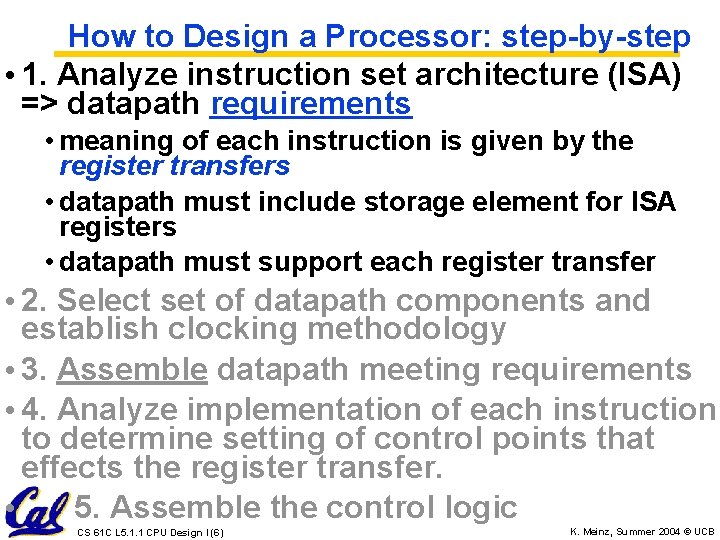
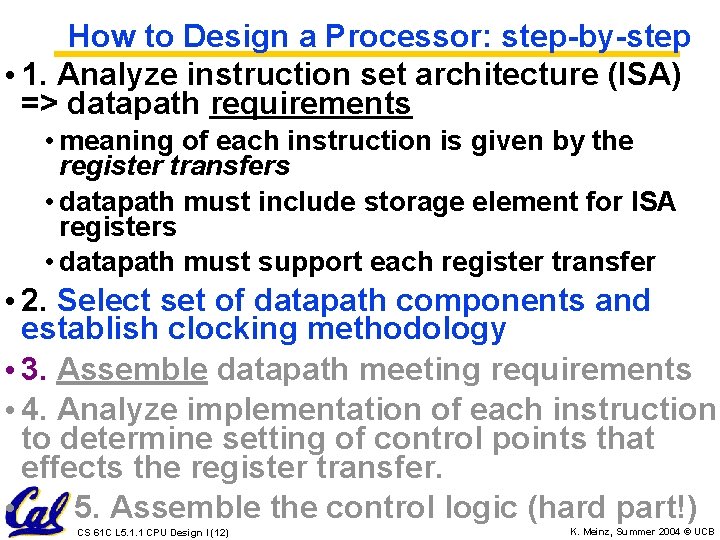
How to Design a Processor: step-by-step • 1. Analyze instruction set architecture (ISA) => datapath requirements • meaning of each instruction is given by the register transfers • datapath must include storage element for ISA registers • datapath must support each register transfer • 2. Select set of datapath components and establish clocking methodology • 3. Assemble datapath meeting requirements • 4. Analyze implementation of each instruction to determine setting of control points that effects the register transfer. • 5. Assemble the control logic CS 61 C L 5. 1. 1 CPU Design I (6) K. Meinz, Summer 2004 © UCB
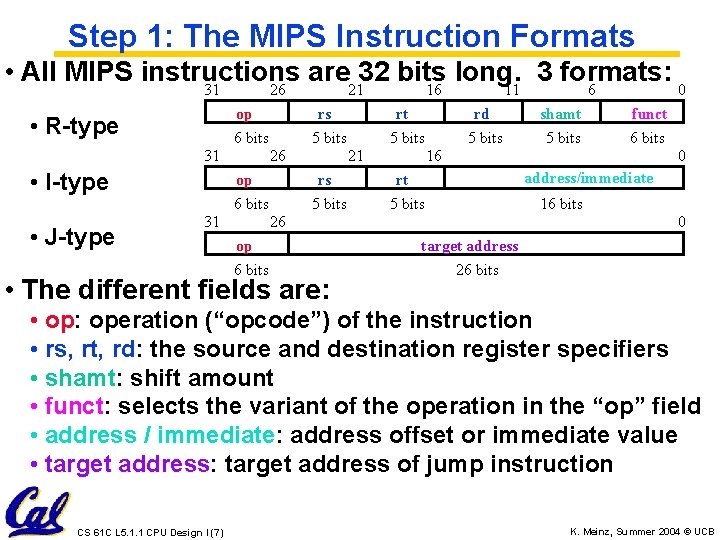
Step 1: The MIPS Instruction Formats • All MIPS instructions are 2132 bits long. 3 formats: 31 26 16 11 6 0 op • R-type 6 bits 31 • I-type • J-type rs 5 bits 26 op 6 bits 31 rt 5 bits 21 rs 5 bits rd shamt funct 5 bits 6 bits 16 rt 5 bits 26 op 6 bits • The different fields are: 0 address/immediate 16 bits 0 target address 26 bits • op: operation (“opcode”) of the instruction • rs, rt, rd: the source and destination register specifiers • shamt: shift amount • funct: selects the variant of the operation in the “op” field • address / immediate: address offset or immediate value • target address: target address of jump instruction CS 61 C L 5. 1. 1 CPU Design I (7) K. Meinz, Summer 2004 © UCB
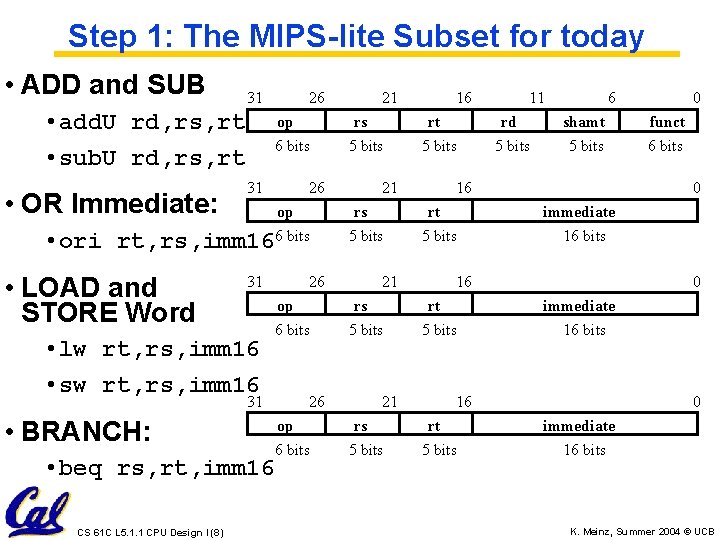
Step 1: The MIPS-lite Subset for today • ADD and SUB 31 • add. U rd, rs, rt • sub. U rd, rs, rt • OR Immediate: • ori 26 op 6 bits 31 31 31 • BRANCH: 26 op 6 bits • beq rs, rt, imm 16 CS 61 C L 5. 1. 1 CPU Design I (8) rs 5 bits rt 5 bits 21 rs 5 bits rd 5 bits 6 shamt 5 bits funct 6 bits immediate 16 bits 0 immediate 16 bits 16 rt 5 bits 0 0 16 rt 5 bits 11 16 21 rs 6 bits 16 21 26 op • lw rt, rs, imm 16 • sw rt, rs, imm 16 rs 5 bits 26 op rt, rs, imm 166 bits • LOAD and STORE Word 21 0 immediate 16 bits K. Meinz, Summer 2004 © UCB
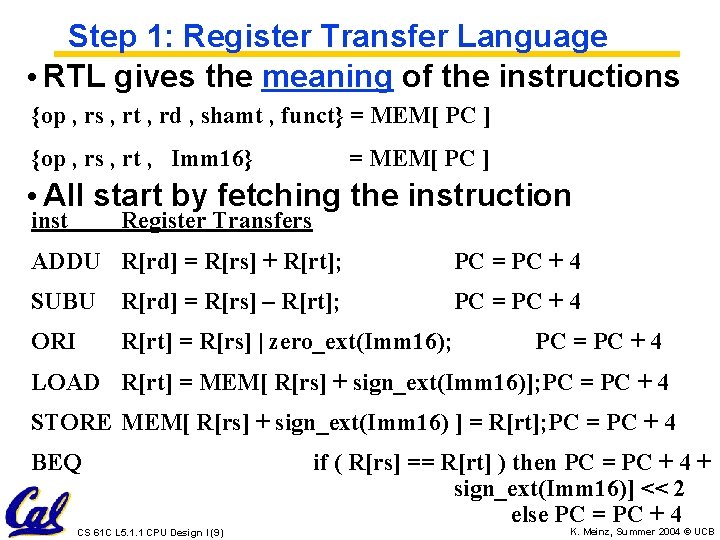
Step 1: Register Transfer Language • RTL gives the meaning of the instructions {op , rs , rt , rd , shamt , funct} = MEM[ PC ] {op , rs , rt , Imm 16} = MEM[ PC ] • All start by fetching the instruction inst Register Transfers ADDU R[rd] = R[rs] + R[rt]; PC = PC + 4 SUBU R[rd] = R[rs] – R[rt]; PC = PC + 4 ORI R[rt] = R[rs] | zero_ext(Imm 16); PC = PC + 4 LOAD R[rt] = MEM[ R[rs] + sign_ext(Imm 16)]; PC = PC + 4 STORE MEM[ R[rs] + sign_ext(Imm 16) ] = R[rt]; PC = PC + 4 BEQ CS 61 C L 5. 1. 1 CPU Design I (9) if ( R[rs] == R[rt] ) then PC = PC + 4 + sign_ext(Imm 16)] << 2 else PC = PC + 4 K. Meinz, Summer 2004 © UCB
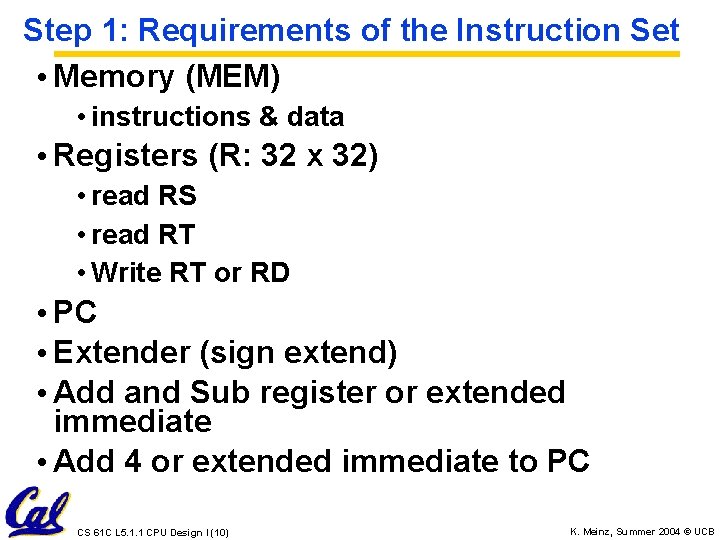
Step 1: Requirements of the Instruction Set • Memory (MEM) • instructions & data • Registers (R: 32 x 32) • read RS • read RT • Write RT or RD • PC • Extender (sign extend) • Add and Sub register or extended immediate • Add 4 or extended immediate to PC CS 61 C L 5. 1. 1 CPU Design I (10) K. Meinz, Summer 2004 © UCB
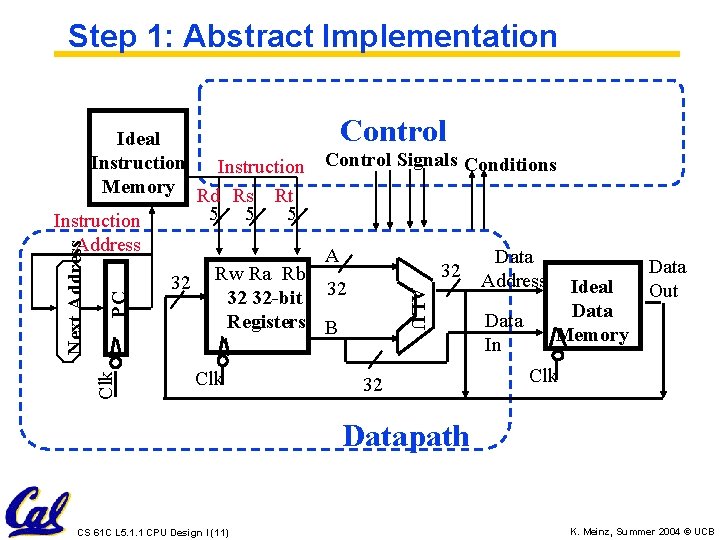
Step 1: Abstract Implementation Control PC Clk Next Address ALU Ideal Instruction Control Signals Conditions Memory Rd Rs Rt 5 5 5 Instruction Address A Data 32 Address Rw Ra Rb 32 Ideal Out 32 32 -bit 32 Data Registers B Memory In Clk 32 Clk Datapath CS 61 C L 5. 1. 1 CPU Design I (11) K. Meinz, Summer 2004 © UCB
How to Design a Processor: step-by-step • 1. Analyze instruction set architecture (ISA) => datapath requirements • meaning of each instruction is given by the register transfers • datapath must include storage element for ISA registers • datapath must support each register transfer • 2. Select set of datapath components and establish clocking methodology • 3. Assemble datapath meeting requirements • 4. Analyze implementation of each instruction to determine setting of control points that effects the register transfer. • 5. Assemble the control logic (hard part!) CS 61 C L 5. 1. 1 CPU Design I (12) K. Meinz, Summer 2004 © UCB
Step 2 a: Components of the Datapath • Combinational Elements • Storage Elements • Clocking methodology CS 61 C L 5. 1. 1 CPU Design I (13) K. Meinz, Summer 2004 © UCB
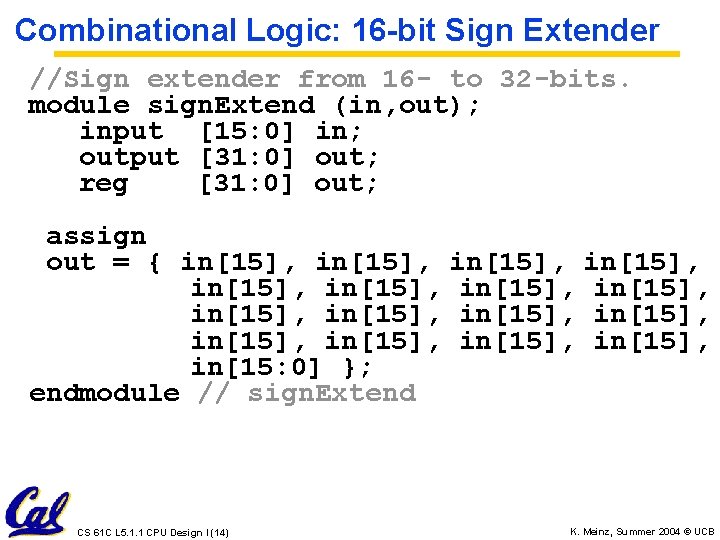
Combinational Logic: 16 -bit Sign Extender //Sign extender from 16 - to 32 -bits. module sign. Extend (in, out); input [15: 0] in; output [31: 0] out; reg [31: 0] out; assign out = { in[15], in[15], in[15], in[15], in[15: 0] }; endmodule // sign. Extend CS 61 C L 5. 1. 1 CPU Design I (14) K. Meinz, Summer 2004 © UCB
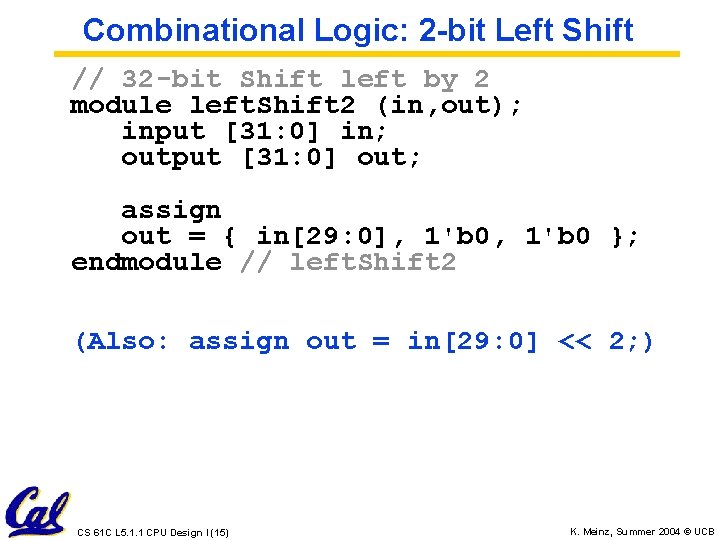
Combinational Logic: 2 -bit Left Shift // 32 -bit Shift left by 2 module left. Shift 2 (in, out); input [31: 0] in; output [31: 0] out; assign out = { in[29: 0], 1'b 0 }; endmodule // left. Shift 2 (Also: assign out = in[29: 0] << 2; ) CS 61 C L 5. 1. 1 CPU Design I (15) K. Meinz, Summer 2004 © UCB
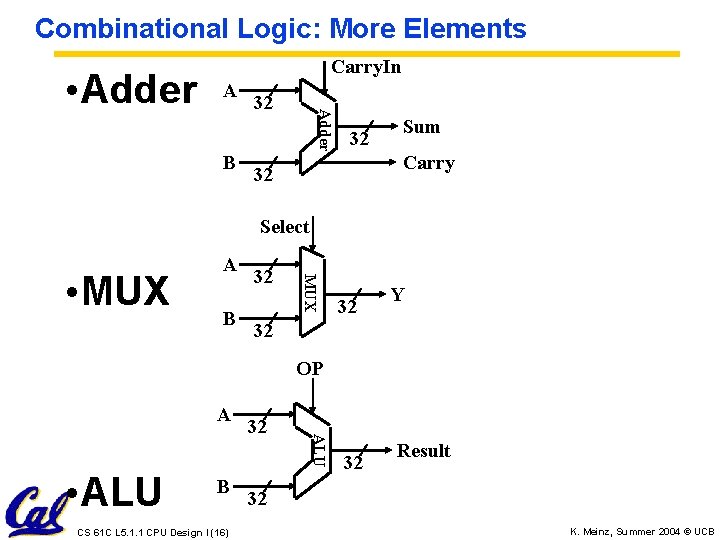
Combinational Logic: More Elements A B 32 Adder • Adder Carry. In 32 Sum Carry 32 Select B 32 MUX • MUX A 32 Y 32 OP A B CS 61 C L 5. 1. 1 CPU Design I (16) ALU • ALU 32 32 Result 32 K. Meinz, Summer 2004 © UCB
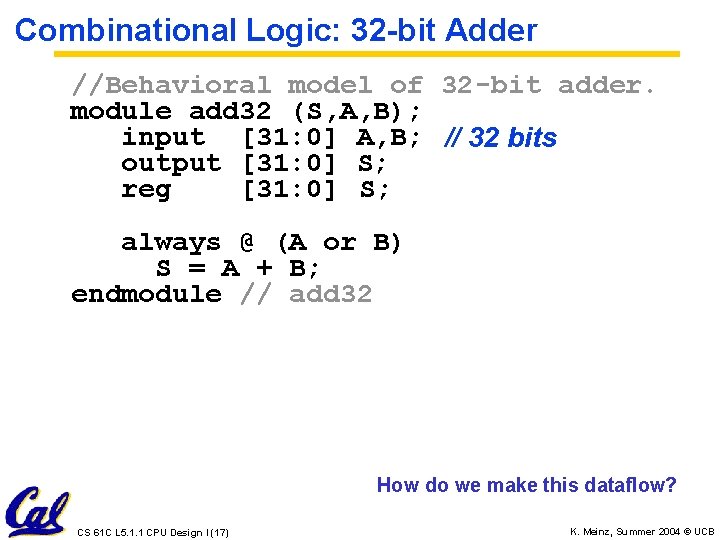
Combinational Logic: 32 -bit Adder //Behavioral model of 32 -bit adder. module add 32 (S, A, B); input [31: 0] A, B; // 32 bits output [31: 0] S; reg [31: 0] S; always @ (A or B) S = A + B; endmodule // add 32 How do we make this dataflow? CS 61 C L 5. 1. 1 CPU Design I (17) K. Meinz, Summer 2004 © UCB
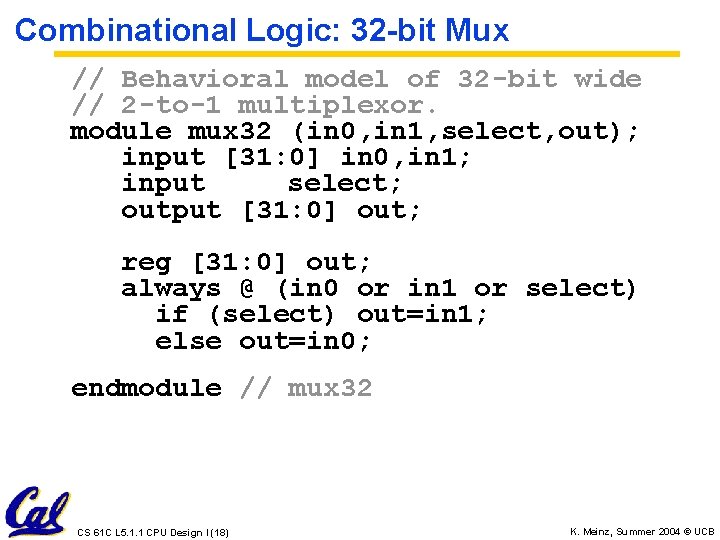
Combinational Logic: 32 -bit Mux // Behavioral model of 32 -bit wide // 2 -to-1 multiplexor. module mux 32 (in 0, in 1, select, out); input [31: 0] in 0, in 1; input select; output [31: 0] out; reg [31: 0] out; always @ (in 0 or in 1 or select) if (select) out=in 1; else out=in 0; endmodule // mux 32 CS 61 C L 5. 1. 1 CPU Design I (18) K. Meinz, Summer 2004 © UCB
CL: ALU for MIPS-lite (1/4) • Addition, subtraction, logical OR, ==: ADDU R[rd] = R[rs] + R[rt]; . . . SUBU R[rd] = R[rs] – R[rt]; . . . ORI R[rt] = R[rs] | zero_ext(Imm 16). . . BEQ if ( R[rs] == R[rt] ). . . • Test to see if output == 0 for any ALU operation gives == test. How? • P&H Section 4. 5 also adds AND, Set Less Than (1 if A < B, 0 otherwise) • Behavioral ALU follows sec 4. 5 CS 61 C L 5. 1. 1 CPU Design I (19) K. Meinz, Summer 2004 © UCB
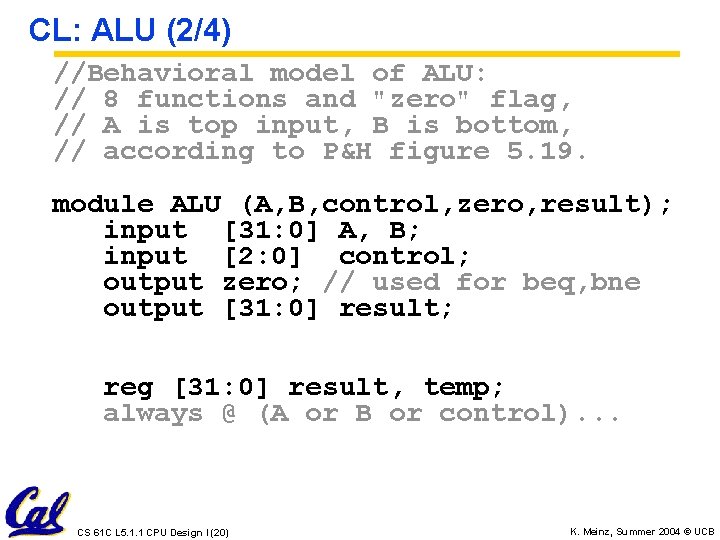
CL: ALU (2/4) //Behavioral model of ALU: // 8 functions and "zero" flag, // A is top input, B is bottom, // according to P&H figure 5. 19. module ALU (A, B, control, zero, result); input [31: 0] A, B; input [2: 0] control; output zero; // used for beq, bne output [31: 0] result; reg [31: 0] result, temp; always @ (A or B or control). . . CS 61 C L 5. 1. 1 CPU Design I (20) K. Meinz, Summer 2004 © UCB
CL: ALU (3/4) reg [31: 0] result, C; always @ (A or B or control) begin case (control) 3'b 000: // AND result=A&B; 3'b 001: // OR result=A|B; 3'b 010: // add result=A+B; 3'b 110: // subtract result=A-B; 3'b 111: // slt result=(A<B)? 1 : 0; endcase // case(control) end // always @ (A or B or control) assign zero = (result==0); endmodule // ALU LUnsigned compare! Can you fix it? CS 61 C L 5. 1. 1 CPU Design I (21) K. Meinz, Summer 2004 © UCB
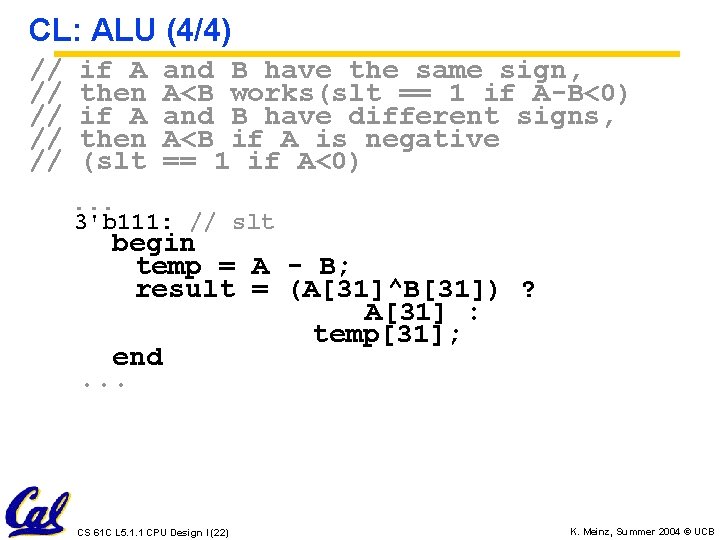
CL: ALU (4/4) // // // if A then (slt and B have the same sign, A<B works(slt == 1 if A-B<0) and B have different signs, A<B if A is negative == 1 if A<0) . . . 3'b 111: // slt begin temp = A - B; result = (A[31]^B[31]) ? A[31] : temp[31]; end. . . CS 61 C L 5. 1. 1 CPU Design I (22) K. Meinz, Summer 2004 © UCB
Step 2 b: Components of the Datapath • Combinational Elements • Storage Elements • Clocking methodology CS 61 C L 5. 1. 1 CPU Design I (23) K. Meinz, Summer 2004 © UCB
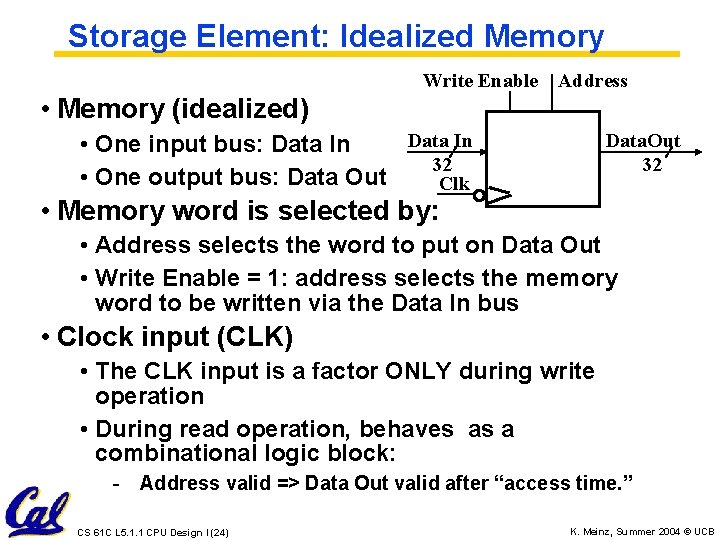
Storage Element: Idealized Memory Write Enable Address • Memory (idealized) Data In • One input bus: Data In 32 • One output bus: Data Out Clk Data. Out 32 • Memory word is selected by: • Address selects the word to put on Data Out • Write Enable = 1: address selects the memory word to be written via the Data In bus • Clock input (CLK) • The CLK input is a factor ONLY during write operation • During read operation, behaves as a combinational logic block: - Address valid => Data Out valid after “access time. ” CS 61 C L 5. 1. 1 CPU Design I (24) K. Meinz, Summer 2004 © UCB
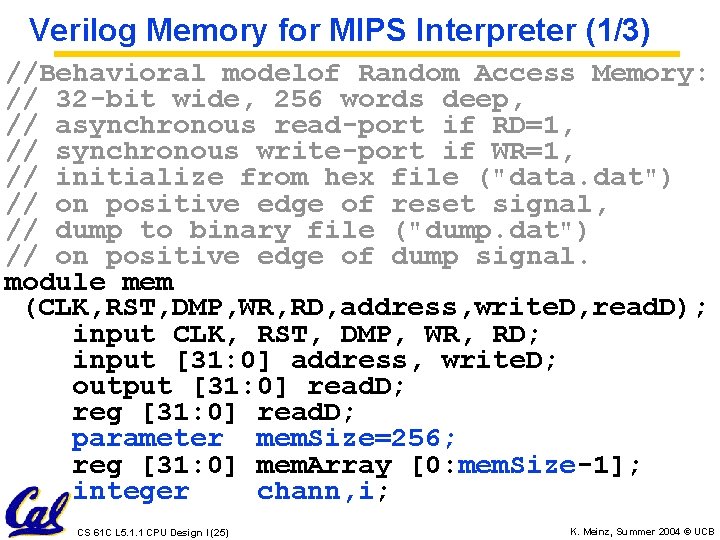
Verilog Memory for MIPS Interpreter (1/3) //Behavioral modelof Random Access Memory: // 32 -bit wide, 256 words deep, // asynchronous read-port if RD=1, // synchronous write-port if WR=1, // initialize from hex file ("data. dat") // on positive edge of reset signal, // dump to binary file ("dump. dat") // on positive edge of dump signal. module mem (CLK, RST, DMP, WR, RD, address, write. D, read. D); input CLK, RST, DMP, WR, RD; input [31: 0] address, write. D; output [31: 0] read. D; reg [31: 0] read. D; parameter mem. Size=256; reg [31: 0] mem. Array [0: mem. Size-1]; integer chann, i; CS 61 C L 5. 1. 1 CPU Design I (25) K. Meinz, Summer 2004 © UCB
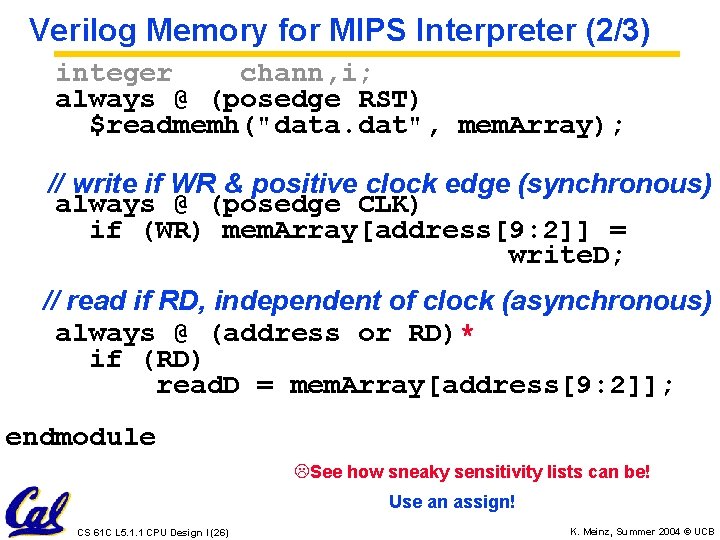
Verilog Memory for MIPS Interpreter (2/3) integer chann, i; always @ (posedge RST) $readmemh("data. dat", mem. Array); // write if WR & positive clock edge (synchronous) always @ (posedge CLK) if (WR) mem. Array[address[9: 2]] = write. D; // read if RD, independent of clock (asynchronous) always @ (address or RD)* if (RD) read. D = mem. Array[address[9: 2]]; endmodule LSee how sneaky sensitivity lists can be! Use an assign! CS 61 C L 5. 1. 1 CPU Design I (26) K. Meinz, Summer 2004 © UCB
Why is it “mem. Array[address[9: 2]]”? • Our memory is always byte-addressed • We can lb from 0 x 0, 0 x 1, 0 x 2, 0 x 3, … • lw only reads word-aligned requests • We only call lw with 0 x 0, 0 x 4, 0 x 8, 0 x. C, … • I. e. , the last two bits are always 0 • mem. Array is a word wide and 28 deep • reg [31: 0] mem. Array [0: 256 -1]; • Size = 4 Bytes/row * 256 rows = 1024 B • If we’re simulating lw/sw, we R/W words • What bits select the first 256 words? [9: 2]! • 1 st word = 0 x 0 = 0 b 000 = mem. Array[0]; nd 2 word = 0 x 4 = 0 b 100 = mem. Array[1], etc. CS 61 C L 5. 1. 1 CPU Design I (27) K. Meinz, Summer 2004 © UCB
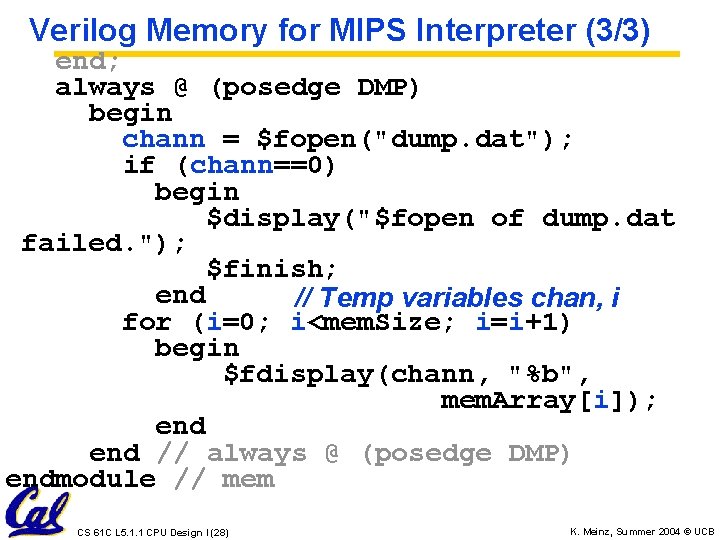
Verilog Memory for MIPS Interpreter (3/3) end; always @ (posedge DMP) begin chann = $fopen("dump. dat"); if (chann==0) begin $display("$fopen of dump. dat failed. "); $finish; end // Temp variables chan, i for (i=0; i<mem. Size; i=i+1) begin $fdisplay(chann, "%b", mem. Array[i]); end // always @ (posedge DMP) endmodule // mem CS 61 C L 5. 1. 1 CPU Design I (28) K. Meinz, Summer 2004 © UCB
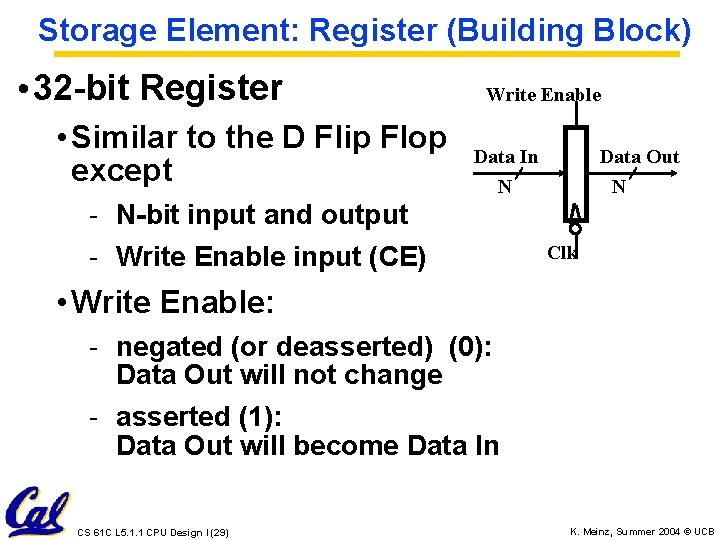
Storage Element: Register (Building Block) • 32 -bit Register • Similar to the D Flip Flop except Write Enable Data In N - N-bit input and output - Write Enable input (CE) Data Out N Clk • Write Enable: - negated (or deasserted) (0): Data Out will not change - asserted (1): Data Out will become Data In CS 61 C L 5. 1. 1 CPU Design I (29) K. Meinz, Summer 2004 © UCB
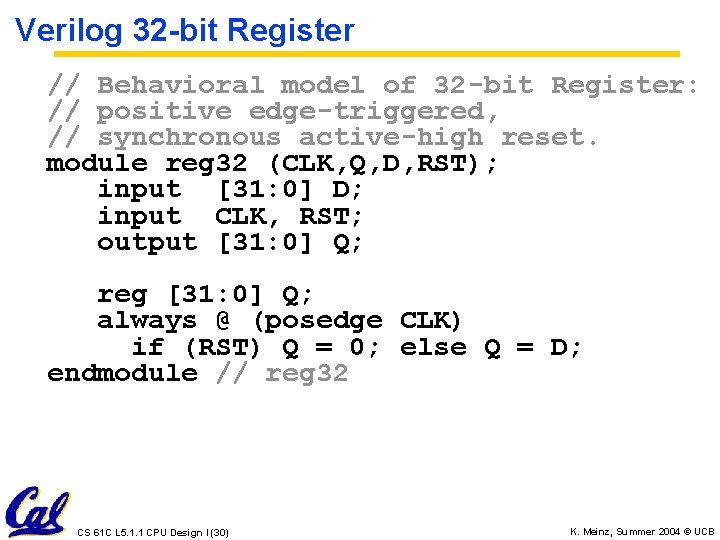
Verilog 32 -bit Register // Behavioral model of 32 -bit Register: // positive edge-triggered, // synchronous active-high reset. module reg 32 (CLK, Q, D, RST); input [31: 0] D; input CLK, RST; output [31: 0] Q; reg [31: 0] Q; always @ (posedge CLK) if (RST) Q = 0; else Q = D; endmodule // reg 32 CS 61 C L 5. 1. 1 CPU Design I (30) K. Meinz, Summer 2004 © UCB