
CS 61 C Machine Structures Lecture 18 Caches








- Slides: 42
CS 61 C - Machine Structures Lecture 18 - Caches, Part II November 1, 2000 David Patterson http: //www-inst. eecs. berkeley. edu/~cs 61 c/ 1/10/2022 1
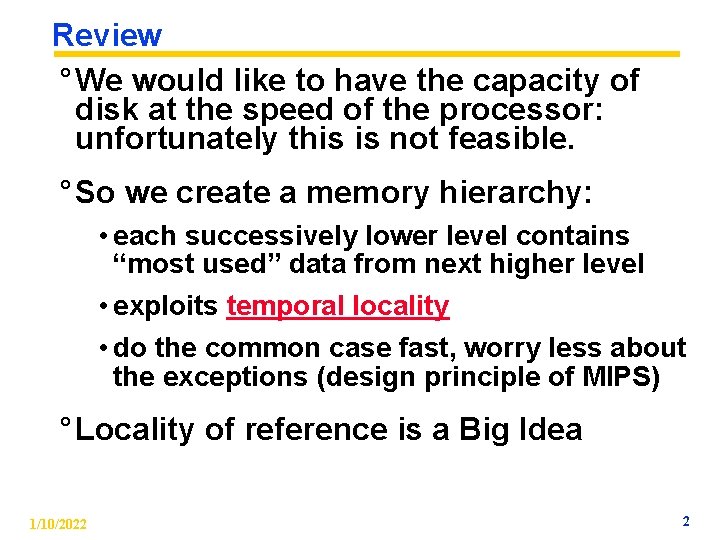
Review ° We would like to have the capacity of disk at the speed of the processor: unfortunately this is not feasible. ° So we create a memory hierarchy: • each successively lower level contains “most used” data from next higher level • exploits temporal locality • do the common case fast, worry less about the exceptions (design principle of MIPS) ° Locality of reference is a Big Idea 1/10/2022 2
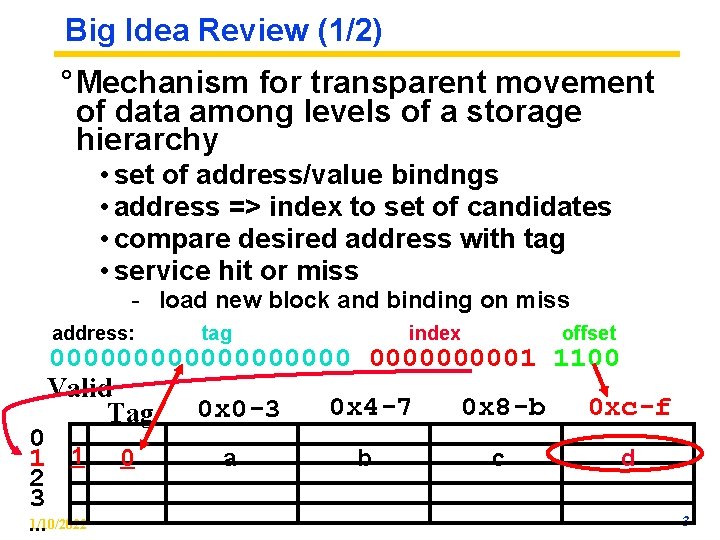
Big Idea Review (1/2) ° Mechanism for transparent movement of data among levels of a storage hierarchy • set of address/value bindngs • address => index to set of candidates • compare desired address with tag • service hit or miss - load new block and binding on miss address: tag index offset 0000000001 1100 Valid 0 x 4 -7 0 x 8 -b 0 xc-f 0 x 0 -3 Tag 0 1 1 2 3 1/10/2022. . . 0 a b c d 3
Outline ° Block Size Tradeoff ° Types of Cache Misses ° Fully Associative Cache ° Course Advice ° N-Way Associative Cache ° Block Replacement Policy ° Multilevel Caches (if time) ° Cache write policy (if time) 1/10/2022 4
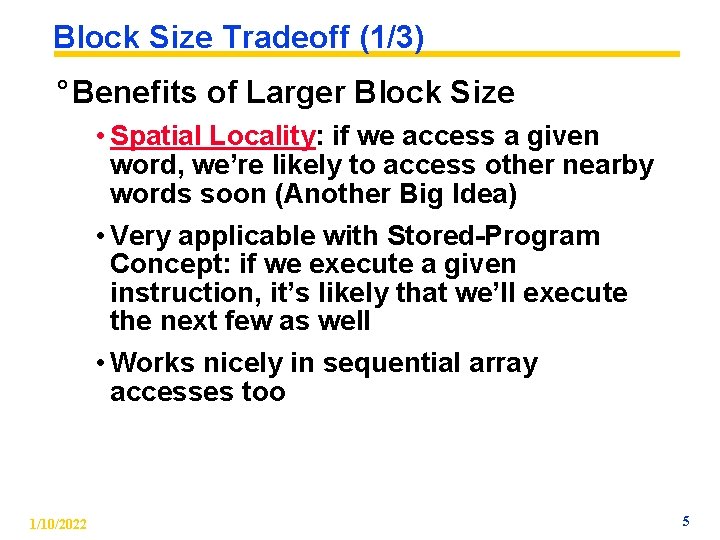
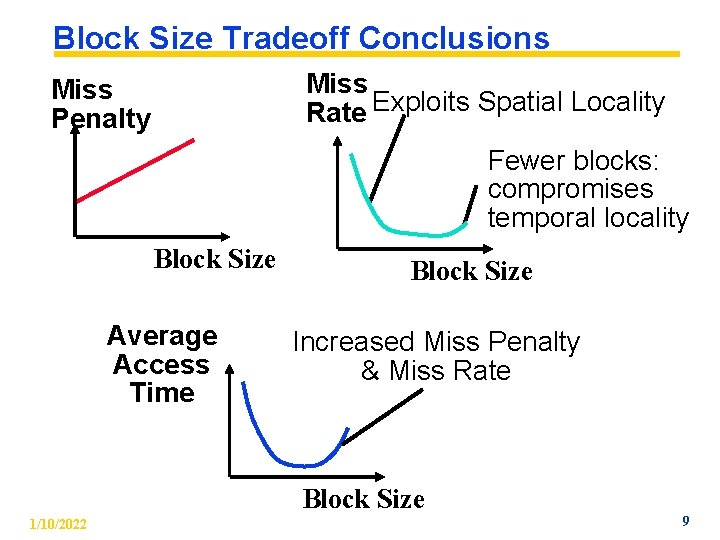
Block Size Tradeoff (1/3) ° Benefits of Larger Block Size • Spatial Locality: if we access a given word, we’re likely to access other nearby words soon (Another Big Idea) • Very applicable with Stored-Program Concept: if we execute a given instruction, it’s likely that we’ll execute the next few as well • Works nicely in sequential array accesses too 1/10/2022 5
Block Size Tradeoff (2/3) ° Drawbacks of Larger Block Size • Larger block size means larger miss penalty - on a miss, takes longer time to load a new block from next level • If block size is too big relative to cache size, then there are too few blocks - Result: miss rate goes up ° In general, minimize Average Access Time = Hit Time x Hit Rate + Miss Penalty x Miss Rate 1/10/2022 6
Block Size Tradeoff (3/3) ° Hit Time = time to find and retrieve data from current level cache ° Miss Penalty = average time to retrieve data on a current level miss (includes the possibility of misses on successive levels of memory hierarchy) ° Hit Rate = % of requests that are found in current level cache ° Miss Rate = 1 - Hit Rate 1/10/2022 7
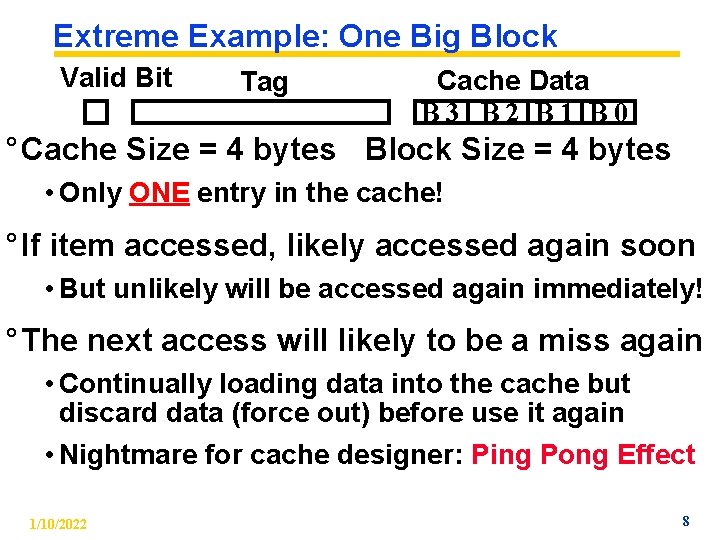
Extreme Example: One Big Block Valid Bit Tag Cache Data B 3 B 2 B 1 B 0 ° Cache Size = 4 bytes Block Size = 4 bytes • Only ONE entry in the cache! ° If item accessed, likely accessed again soon • But unlikely will be accessed again immediately! ° The next access will likely to be a miss again • Continually loading data into the cache but discard data (force out) before use it again • Nightmare for cache designer: Ping Pong Effect 1/10/2022 8
Block Size Tradeoff Conclusions Miss Rate Exploits Spatial Locality Miss Penalty Fewer blocks: compromises temporal locality Block Size Average Access Time Block Size Increased Miss Penalty & Miss Rate Block Size 1/10/2022 9
Types of Cache Misses (1/2) ° Compulsory Misses • occur when a program is first started • cache does not contain any of that program’s data yet, so misses are bound to occur • can’t be avoided easily, so won’t focus on these in this course 1/10/2022 10
Types of Cache Misses (2/2) ° Conflict Misses • miss that occurs because two distinct memory addresses map to the same cache location • two blocks (which happen to map to the same location) can keep overwriting each other • big problem in direct-mapped caches • how do we lessen the effect of these? 1/10/2022 11
Dealing with Conflict Misses ° Solution 1: Make the cache size bigger • fails at some point ° Solution 2: Multiple distinct blocks can fit in the same Cache Index? 1/10/2022 12
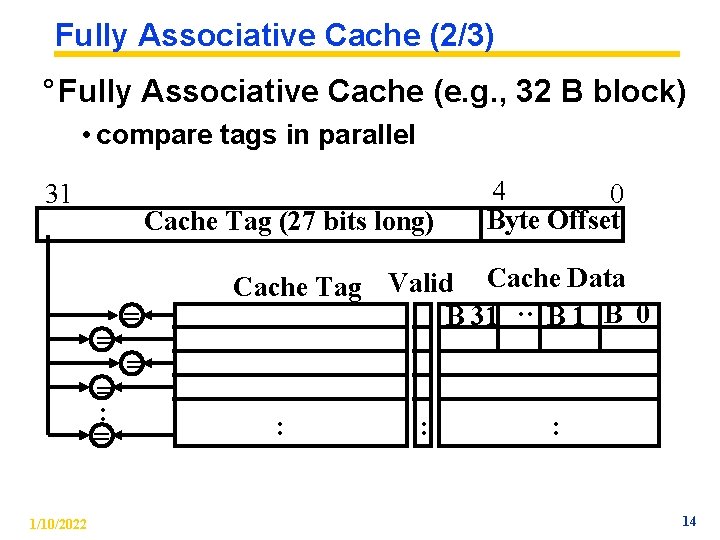
Fully Associative Cache (1/3) ° Memory address fields: • Tag: same as before • Offset: same as before • Index: non-existent ° What does this mean? • no “rows”: any block can go anywhere in the cache • must compare with all tags in entire cache to see if data is there 1/10/2022 13
Fully Associative Cache (2/3) ° Fully Associative Cache (e. g. , 32 B block) • compare tags in parallel 31 Cache Tag (27 bits long) = = : = 1/10/2022 Cache Tag Valid Cache Data B 31 B 0 : = 4 0 Byte Offset = : : : 14
Fully Associative Cache (3/3) ° Benefit of Fully Assoc Cache • no Conflict Misses (since data can go anywhere) ° Drawbacks of Fully Assoc Cache • need hardware comparator for every single entry: if we have a 64 KB of data in cache with 4 B entries, we need 16 K comparators: infeasible 1/10/2022 15
Third Type of Cache Miss ° Capacity Misses • miss that occurs because the cache has a limited size • miss that would not occur if we increase the size of the cache • sketchy definition, so just get the general idea ° This is the primary type of miss for Fully Associate caches. 1/10/2022 16
Administrivia: General Course Philosophy ° Take variety of undergrad courses now to get introduction to areas • Can learn advanced material on own later once know vocabulary ° Who knows what you will work on over a 40 year career? 1/10/2022 17
Administrivia: Courses for Telebears ° General Philosophy • Take courses from great teachers! • HKN ratings; >= 6 very good, < 5 not good • www-hkn. eecs/student/coursesurveys. shtml ° Top Faculty / CS Course (may teach soon) • CS 70 Discrete Math Papadami. 6. 3 S 00 • CS 150 Logic design Katz (DTA)6. 3 F 92 • CS 152 Computer. Kubiatowicz 6. 7 F 99 • CS 160 User Interface Rowe 6. 0 F 99 • CS 164 Compilers Aiken 6. 1 S 00 • CS 169 SW engin. Brewer 6. 3 F 99 • CS 174 Combinatori Sinclair 6. 0 F 97 • CS 184 Graphics Sequin 6. 1 S 99 • CS 188 Artfic. Intel. Rusell 6. 0 F 97 1/10/2022 18
Administrivia: Courses for Telebears ° General Philosophy • Take courses from great teachers! ° Top Faculty / EE Course (may teach soon) • EE 105 Micro. Devices Howe 6. 2 • EE 120 Signal, System Kahn 6. 0 F 99 • EE 121 Noise Analysis Tse 6. 8 S 00 • EE 130 I. C. Devices Hu (DTA) 6. 6 • EE 140 Linear I. C. s Brodersen 6. 2 • EE 141 Digital I. C. s Rabaey 6. 4 • EE 142 I. C. for Comm. Meyer 6. 2 • EE 143 Process I. C. s Cheung 6. 0 • EE 192 Mechatronics Fearing 6. 1 1/10/2022 S 98 F 99 F 98 S 00 19
If many good teachers: My recommendations ° CS 169 Software Engineering • Everyone writes programs, even HW designers • Often programs are written in groups learn skill now in school (before it counts) ° CS 162 Operating Systems • All special-purpose HW will run a layer of SW that uses processes and concurrent programming; CS 162 is the closest thing ° EE 122 Introduction to Communication Networks • World is getting connected; communications must play major role 1/10/2022 20
If many good teachers: Courses to consider ° E 190 Technical Communication • Talent in writing and speaking critical for success • Now required for EECS majors ° CS 150 Lab Hardware Design • Hands on HW design ° CS 152 Design a Computer ° CS 186 Understand databases • Information more important now than computation? 1/10/2022 21
Administrivia: Courses for Telebears ° Remember: ° Teacher quality more important to learning experience than official course content ° Take courses from great teachers! ° Distinguished Teaching Award: www. uga. berkeley. edu/sled/dta-dept. html ° HKN Evaluations: www-hkn. eecs. berkeley. edu/student/coursesurveys. shtml 1/10/2022 22
N-Way Set Associative Cache (1/4) ° Memory address fields: • Tag: same as before • Offset: same as before • Index: points us to the correct “row” (called a set in this case) ° So what’s the difference? • each set contains multiple blocks • once we’ve found correct set, must compare with all tags in that set to find our data 1/10/2022 23
N-Way Set Associative Cache (2/4) ° Summary: • cache is direct-mapped with respect to sets • each set is fully associative • basically N direct-mapped caches working in parallel: each has its own valid bit and data 1/10/2022 24
N-Way Set Associative Cache (3/4) ° Given memory address: • Find correct set using Index value. • Compare Tag with all Tag values in the determined set. • If a match occurs, it’s a hit, otherwise a miss. • Finally, use the offset field as usual to find the desired data within the desired block. 1/10/2022 25
N-Way Set Associative Cache (4/4) ° What’s so great about this? • even a 2 -way set assoc cache avoids a lot of conflict misses • hardware cost isn’t that bad: only need N comparators ° In fact, for a cache with M blocks, • it’s Direct-Mapped if it’s 1 -way set assoc • it’s Fully Assoc if it’s M-way set assoc • so these two are just special cases of the more general set associative desgin 1/10/2022 26
Block Replacement Policy (1/2) ° Direct-Mapped Cache: index completely specifies position which position a block can go in on a miss ° N-Way Set Assoc (N > 1): index specifies a set, but block can occupy any position within the set on a miss ° Fully Associative: block can be written into any position ° Question: if we have the choice, where should we write an incoming block? 1/10/2022 27
Block Replacement Policy (2/2) ° Solution: • If there any locations with valid bit off (empty), then usually write the new block into the first one. • If all possible locations already have a valid block, we must pick a replacement policy: rule by which we determine which block gets “cached out” on a miss. 1/10/2022 28
Block Replacement Policy: LRU ° LRU (Least Recently Used) • Idea: cache out block which has been accessed (read or write) least recently • Pro: temporal locality => recent past use implies likely future use: in fact, this is a very effective policy • Con: with 2 -way set assoc, easy to keep track (one LRU bit); with 4 -way or greater, requires complicated hardware and much time to keep track of this 1/10/2022 29
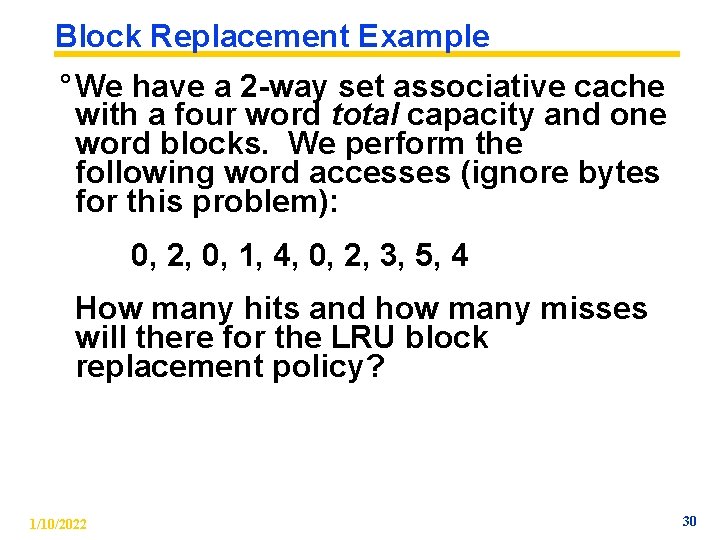
Block Replacement Example ° We have a 2 -way set associative cache with a four word total capacity and one word blocks. We perform the following word accesses (ignore bytes for this problem): 0, 2, 0, 1, 4, 0, 2, 3, 5, 4 How many hits and how many misses will there for the LRU block replacement policy? 1/10/2022 30
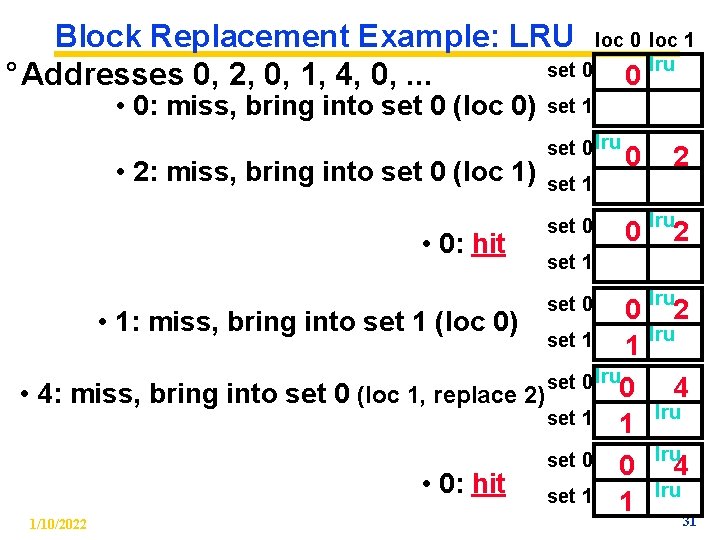
Block Replacement Example: LRU loc 0 loc 1 lru set 0 0 ° Addresses 0, 2, 0, 1, 4, 0, . . . • 0: miss, bring into set 0 (loc 0) • 2: miss, bring into set 0 (loc 1) set 1 set 0 lru 0 2 set 1 0 lru 0 • 1: miss, bring into set 1 (loc 0) set 1 1 set 0 lru 0 • 4: miss, bring into set 0 (loc 1, replace 2) set 1 1 lru • 0: hit set 0 set 1 set 0 • 0: hit 1/10/2022 2 set 0 set 1 0 1 2 lru 4 lru 31
Ways to reduce miss rate ° Larger cache • limited by cost and technology • hit time of first level cache < cycle time ° More places in the cache to put each block of memory - associativity • fully-associative - any block any line • k-way set associated - k places for each block - direct map: k=1 1/10/2022 32
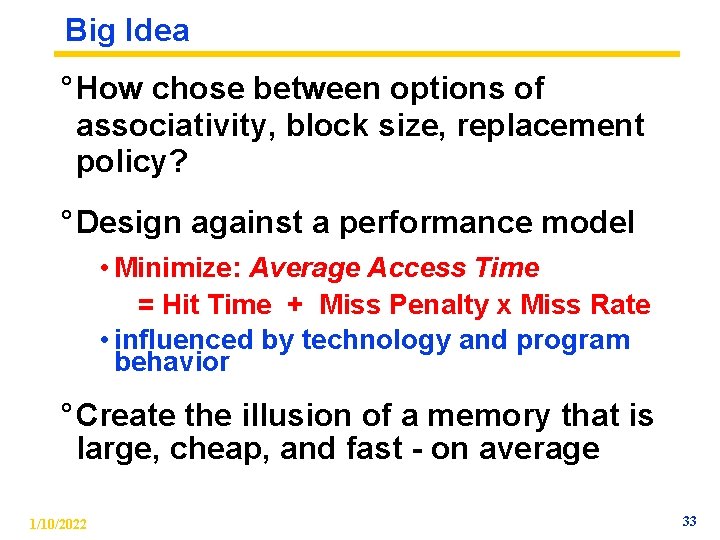
Big Idea ° How chose between options of associativity, block size, replacement policy? ° Design against a performance model • Minimize: Average Access Time = Hit Time + Miss Penalty x Miss Rate • influenced by technology and program behavior ° Create the illusion of a memory that is large, cheap, and fast - on average 1/10/2022 33
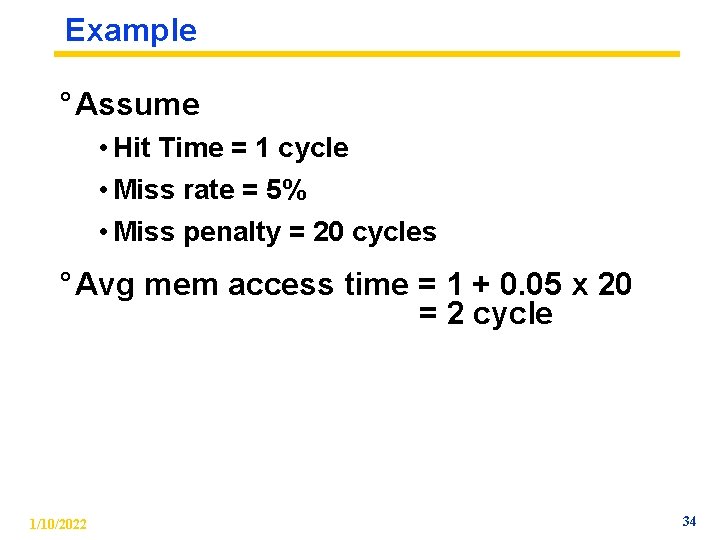
Example ° Assume • Hit Time = 1 cycle • Miss rate = 5% • Miss penalty = 20 cycles ° Avg mem access time = 1 + 0. 05 x 20 = 2 cycle 1/10/2022 34
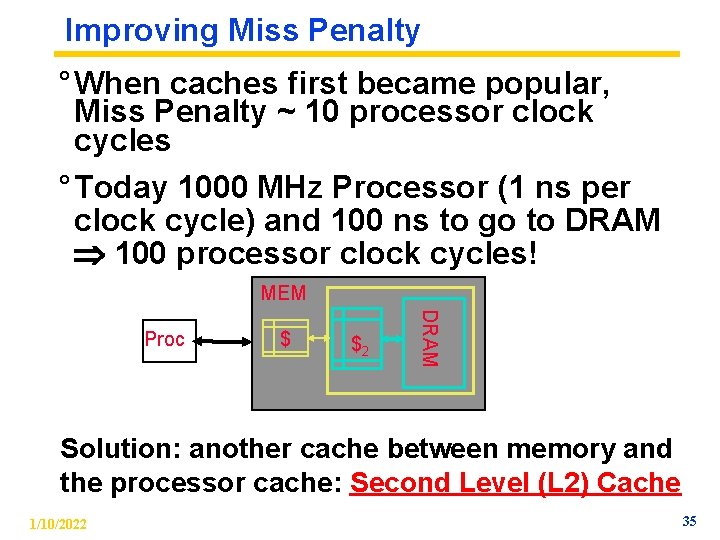
Improving Miss Penalty ° When caches first became popular, Miss Penalty ~ 10 processor clock cycles ° Today 1000 MHz Processor (1 ns per clock cycle) and 100 ns to go to DRAM 100 processor clock cycles! MEM $ $2 DRAM Proc Solution: another cache between memory and the processor cache: Second Level (L 2) Cache 1/10/2022 35
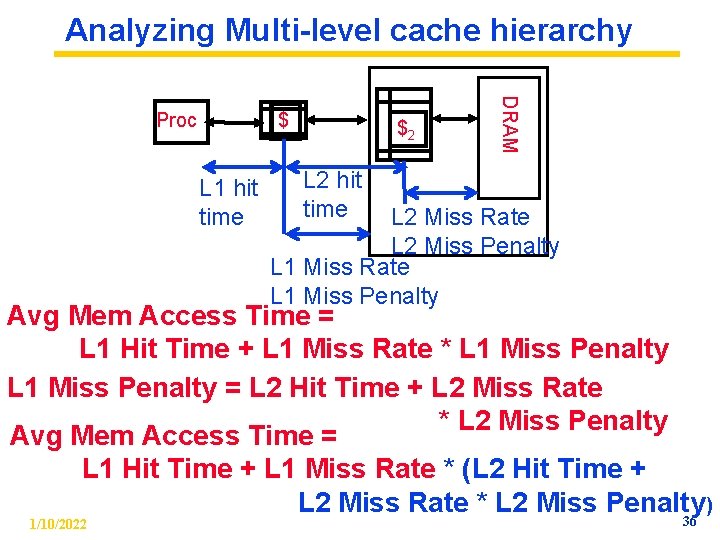
Analyzing Multi-level cache hierarchy $ L 1 hit time $2 DRAM Proc L 2 hit time L 2 Miss Rate L 2 Miss Penalty L 1 Miss Rate L 1 Miss Penalty Avg Mem Access Time = L 1 Hit Time + L 1 Miss Rate * L 1 Miss Penalty = L 2 Hit Time + L 2 Miss Rate * L 2 Miss Penalty Avg Mem Access Time = L 1 Hit Time + L 1 Miss Rate * (L 2 Hit Time + L 2 Miss Rate * L 2 Miss Penalty ) 36 1/10/2022
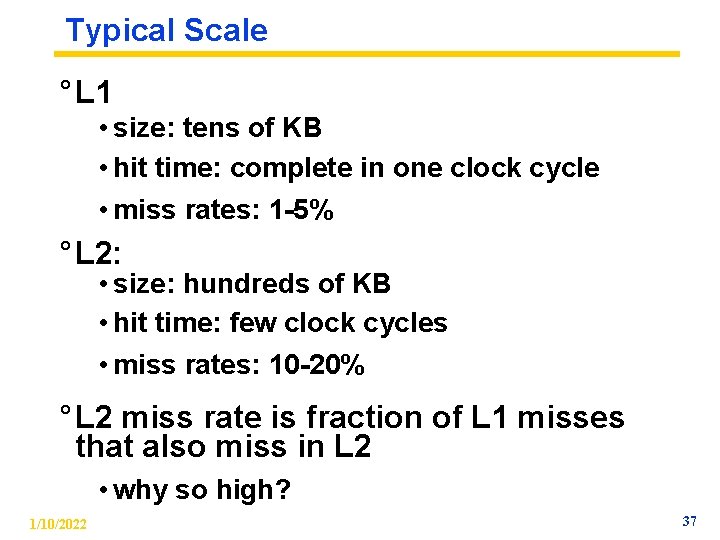
Typical Scale ° L 1 • size: tens of KB • hit time: complete in one clock cycle • miss rates: 1 -5% ° L 2: • size: hundreds of KB • hit time: few clock cycles • miss rates: 10 -20% ° L 2 miss rate is fraction of L 1 misses that also miss in L 2 • why so high? 1/10/2022 37
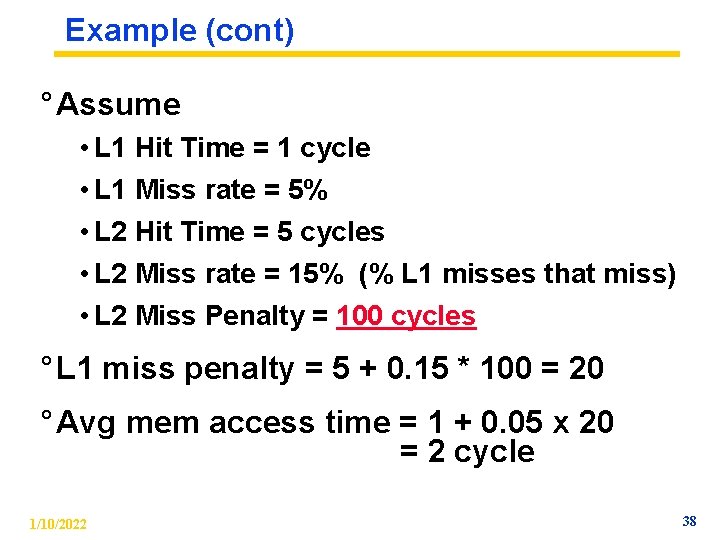
Example (cont) ° Assume • L 1 Hit Time = 1 cycle • L 1 Miss rate = 5% • L 2 Hit Time = 5 cycles • L 2 Miss rate = 15% (% L 1 misses that miss) • L 2 Miss Penalty = 100 cycles ° L 1 miss penalty = 5 + 0. 15 * 100 = 20 ° Avg mem access time = 1 + 0. 05 x 20 = 2 cycle 1/10/2022 38
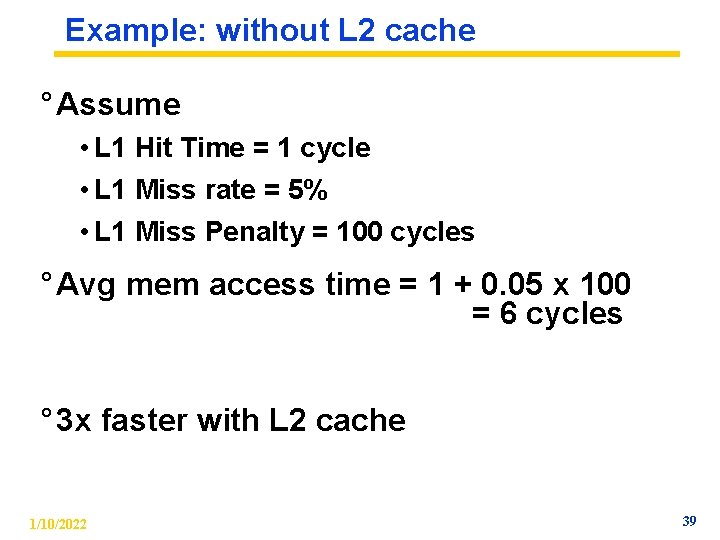
Example: without L 2 cache ° Assume • L 1 Hit Time = 1 cycle • L 1 Miss rate = 5% • L 1 Miss Penalty = 100 cycles ° Avg mem access time = 1 + 0. 05 x 100 = 6 cycles ° 3 x faster with L 2 cache 1/10/2022 39
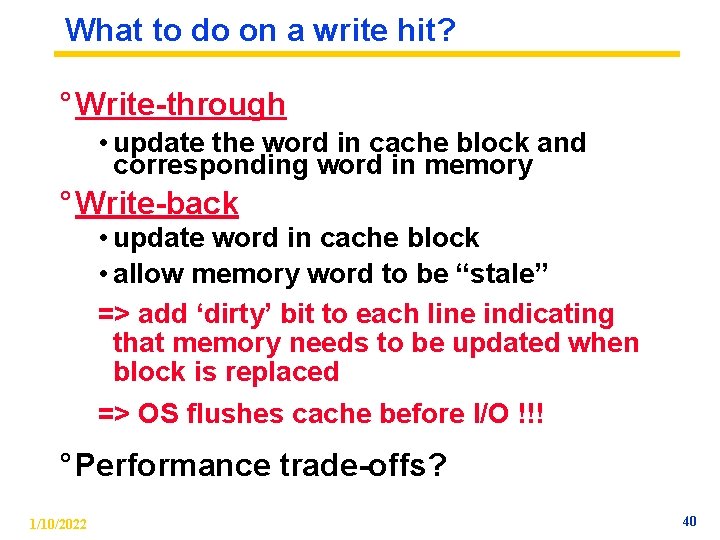
What to do on a write hit? ° Write-through • update the word in cache block and corresponding word in memory ° Write-back • update word in cache block • allow memory word to be “stale” => add ‘dirty’ bit to each line indicating that memory needs to be updated when block is replaced => OS flushes cache before I/O !!! ° Performance trade-offs? 1/10/2022 40
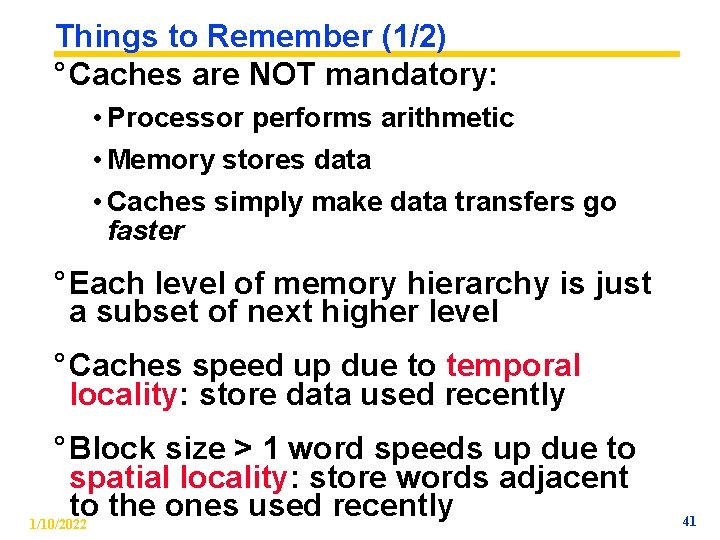
Things to Remember (1/2) ° Caches are NOT mandatory: • Processor performs arithmetic • Memory stores data • Caches simply make data transfers go faster ° Each level of memory hierarchy is just a subset of next higher level ° Caches speed up due to temporal locality: store data used recently ° Block size > 1 word speeds up due to spatial locality: store words adjacent to the ones used recently 1/10/2022 41
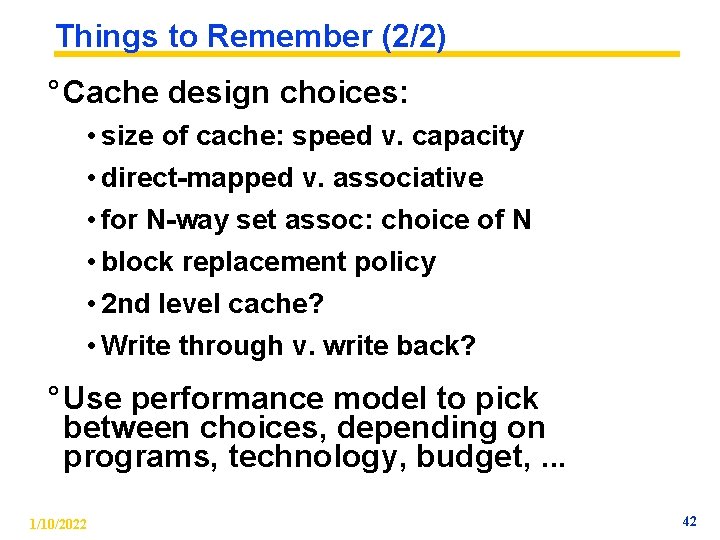
Things to Remember (2/2) ° Cache design choices: • size of cache: speed v. capacity • direct-mapped v. associative • for N-way set assoc: choice of N • block replacement policy • 2 nd level cache? • Write through v. write back? ° Use performance model to pick between choices, depending on programs, technology, budget, . . . 1/10/2022 42