
CS 61 C Great Ideas in Computer Architecture


- Slides: 43
CS 61 C: Great Ideas in Computer Architecture (Machine Structures) Caches Part 1 Instructors: Bernhard Boser & Randy H. Katz http: //inst. eecs. berkeley. edu/~cs 61 c/ 1/21/2022 Fall 2016 - Lecture #14 1
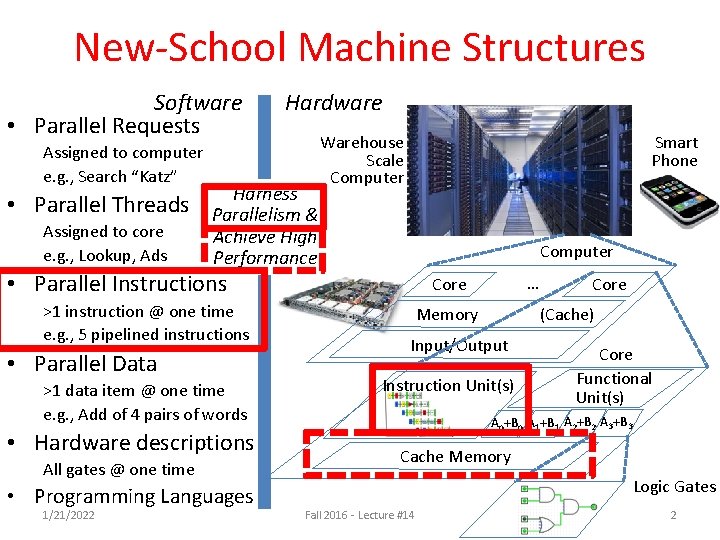
New-School Machine Structures Software • Parallel Requests Assigned to computer e. g. , Search “Katz” • Parallel Threads Assigned to core e. g. , Lookup, Ads Hardware Harness Parallelism & Achieve High Performance Smart Phone Warehouse Scale Computer • Parallel Instructions >1 instruction @ one time e. g. , 5 pipelined instructions • Parallel Data >1 data item @ one time e. g. , Add of 4 pairs of words • Hardware descriptions All gates @ one time • Programming Languages 1/21/2022 … Core Memory Core (Cache) Input/Output Instruction Unit(s) Core Functional Unit(s) A 0+B 0 A 1+B 1 A 2+B 2 A 3+B 3 Cache Memory Logic Gates Fall 2016 - Lecture #14 2
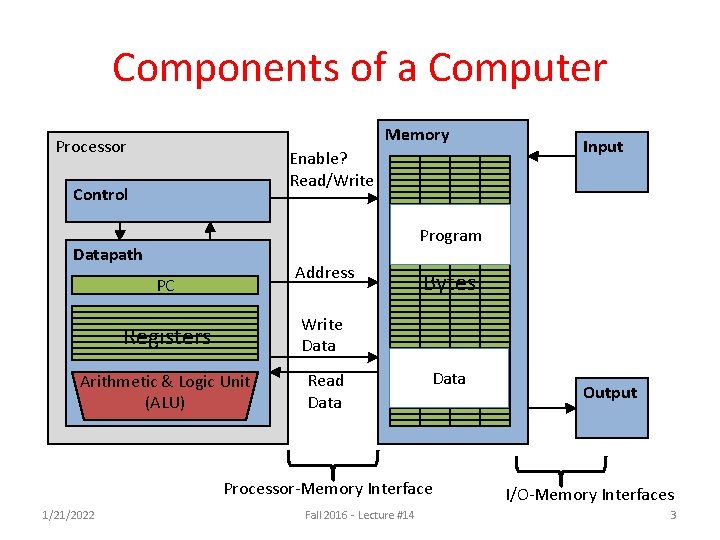
Components of a Computer Memory Processor Enable? Read/Write Control Program Datapath Address PC Registers Write Data Arithmetic & Logic Unit (ALU) Read Data Bytes Data Processor-Memory Interface 1/21/2022 Input Fall 2016 - Lecture #14 Output I/O-Memory Interfaces 3
Outline • • • Memory Hierarchy and Latency Caches Principles Basic Cache Organization Different Kinds of Caches Write Back vs. Write Through And in Conclusion … 1/21/2022 Fall 2016 – Lecture #14 4
Outline • • • Memory Hierarchy and Latency Caches Principles Basic Cache Organization Different Kinds of Caches Write Back vs. Write Through And in Conclusion … 1/21/2022 Fall 2016 – Lecture #14 5
Why are Large Memories Slow? Library Analogy • Time to find a book in a large library – Search a large card catalog – (mapping title/author to index number) – Round-trip time to walk to the stacks and retrieve the desired book • Larger libraries worsen both delays • Electronic memories have same issue, plus the technologies used to store a bit slow down as density increases (e. g. , SRAM vs. Disk) However what we want is a large yet fast memory! 1/21/2022 Fall 2016 - Lecture #14 6
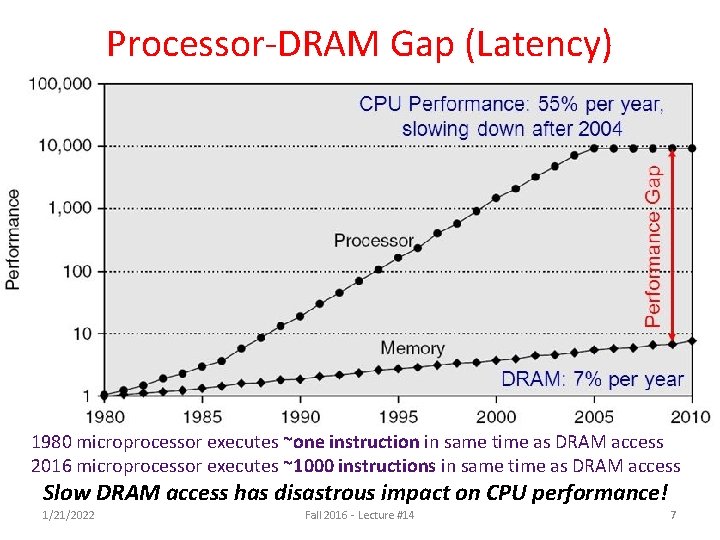
Processor-DRAM Gap (Latency) 1980 microprocessor executes ~one instruction in same time as DRAM access 2016 microprocessor executes ~1000 instructions in same time as DRAM access Slow DRAM access has disastrous impact on CPU performance! 1/21/2022 Fall 2016 - Lecture #14 7
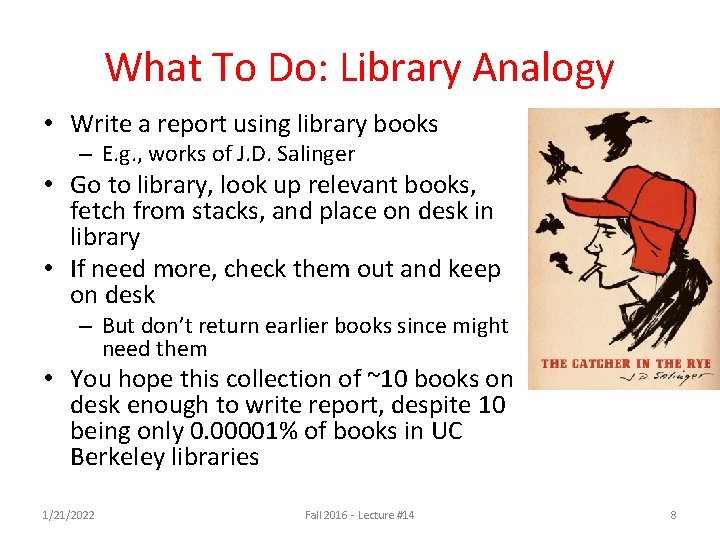
What To Do: Library Analogy • Write a report using library books – E. g. , works of J. D. Salinger • Go to library, look up relevant books, fetch from stacks, and place on desk in library • If need more, check them out and keep on desk – But don’t return earlier books since might need them • You hope this collection of ~10 books on desk enough to write report, despite 10 being only 0. 00001% of books in UC Berkeley libraries 1/21/2022 Fall 2016 - Lecture #14 8
Outline • • • Memory Hierarchy and Latency Caches Principles Basic Cache Organization Different Kinds of Caches Write Back vs. Write Through And in Conclusion … 1/21/2022 Fall 2016 – Lecture #14 9
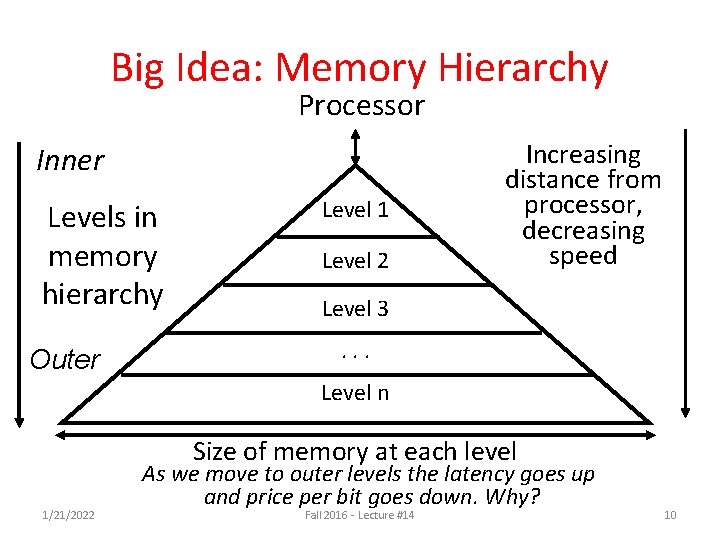
Big Idea: Memory Hierarchy Processor Inner Levels in memory hierarchy Outer Level 1 Level 2 Increasing distance from processor, decreasing speed Level 3. . . Level n Size of memory at each level 1/21/2022 As we move to outer levels the latency goes up and price per bit goes down. Why? Fall 2016 - Lecture #14 10
Big Idea: Locality • Temporal Locality (locality in time) – Go back to same book on desk multiple times – If a memory location is referenced, then it will tend to be referenced again soon • Spatial Locality (locality in space) – When go to book shelf, pick up multiple books on J. D. Salinger since library stores related books together – If a memory location is referenced, the locations with nearby addresses will tend to be referenced soon 1/21/2022 Fall 2016 - Lecture #14 11
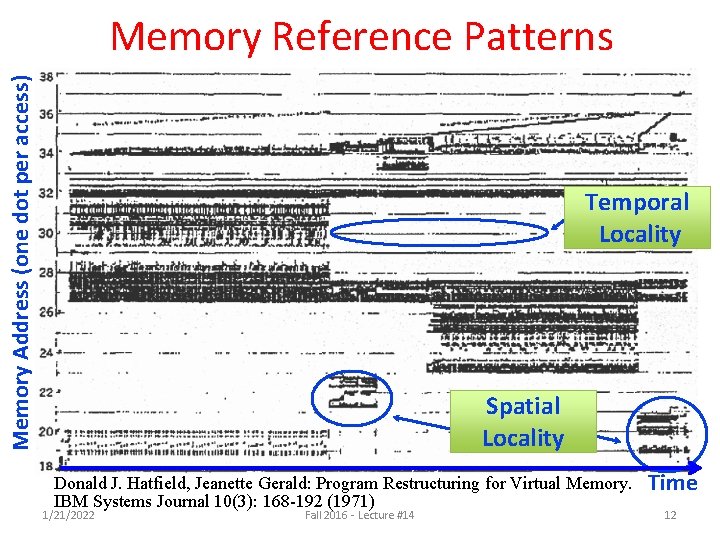
Memory Address (one dot per access) Memory Reference Patterns Temporal Locality Spatial Locality Donald J. Hatfield, Jeanette Gerald: Program Restructuring for Virtual Memory. IBM Systems Journal 10(3): 168 -192 (1971) 1/21/2022 Fall 2016 - Lecture #14 Time 12
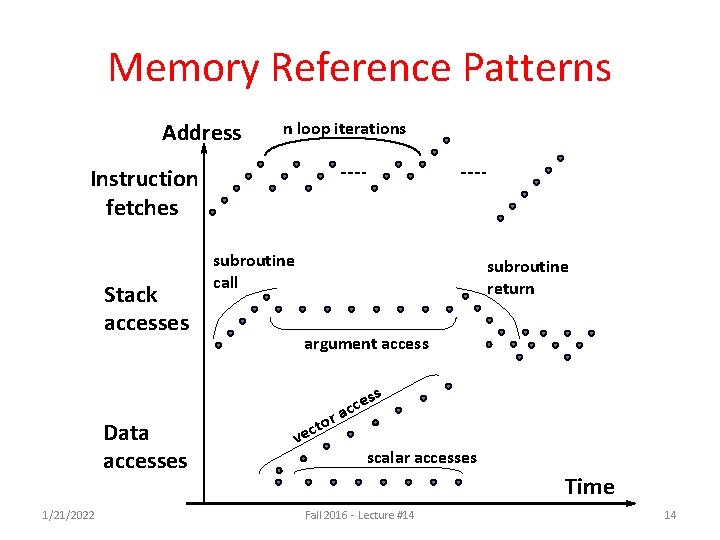
Principle of Locality • Principle of Locality: Programs access small portion of address space at any instant of time (spatial locality) and repeatedly access that portion (temporal locality) • What program structures lead to temporal and spatial locality in instruction accesses? • In data accesses? 1/21/2022 Fall 2016 - Lecture #14 13
Memory Reference Patterns Address n loop iterations Instruction fetches Stack accesses subroutine call subroutine return argument access s Data accesses 1/21/2022 r to c e v es c c a scalar accesses Time Fall 2016 - Lecture #14 14
1/21/2022 Fall 2016 - Lecture #14 15
Cache Philosophy • Programmer-invisible hardware mechanism gives illusion of speed of fastest memory with size of largest memory – Works even if you have no idea what a cache is – Performance-oriented programmers sometimes “reverse engineer” cache organization to design data structures and access patterns optimized for a specific cache design – You are going to do that in Project #4! 1/21/2022 Fall 2016 - Lecture #14 16
Outline • • • Memory Hierarchy and Latency Caches Principles Basic Cache Organization Different Kinds of Caches Write Back vs. Write Through And in Conclusion … 1/21/2022 Fall 2016 – Lecture #14 17
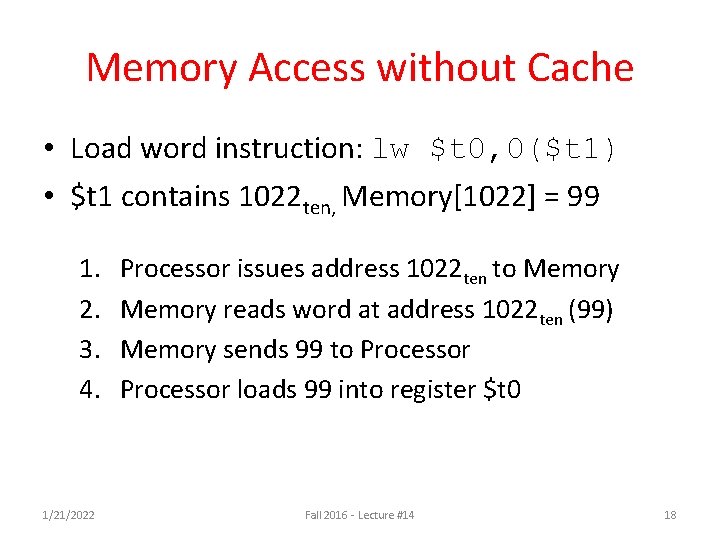
Memory Access without Cache • Load word instruction: lw $t 0, 0($t 1) • $t 1 contains 1022 ten, Memory[1022] = 99 1. 2. 3. 4. 1/21/2022 Processor issues address 1022 ten to Memory reads word at address 1022 ten (99) Memory sends 99 to Processor loads 99 into register $t 0 Fall 2016 - Lecture #14 18
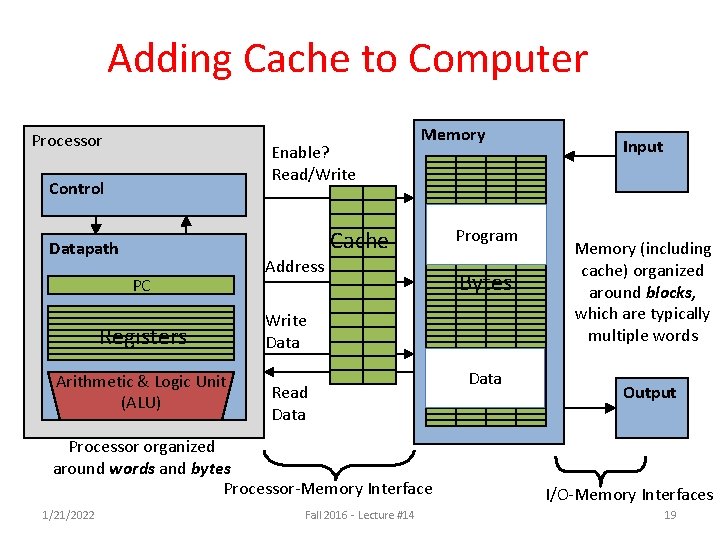
Adding Cache to Computer Processor Enable? Read/Write Control Memory Cache Datapath PC Registers Arithmetic & Logic Unit (ALU) Address Bytes Write Data Read Data Processor organized around words and bytes Processor-Memory Interface 1/21/2022 Program Fall 2016 - Lecture #14 Data Input Memory (including cache) organized around blocks, which are typically multiple words Output I/O-Memory Interfaces 19
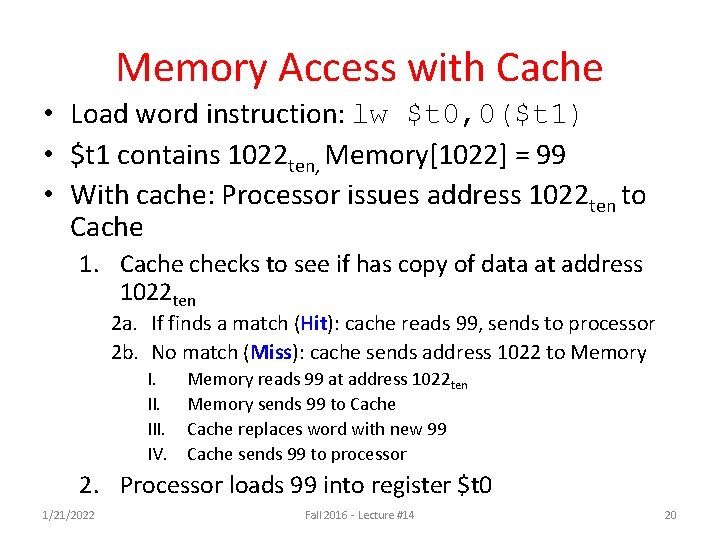
Memory Access with Cache • Load word instruction: lw $t 0, 0($t 1) • $t 1 contains 1022 ten, Memory[1022] = 99 • With cache: Processor issues address 1022 ten to Cache 1. Cache checks to see if has copy of data at address 1022 ten 2 a. If finds a match (Hit): cache reads 99, sends to processor 2 b. No match (Miss): cache sends address 1022 to Memory I. III. IV. Memory reads 99 at address 1022 ten Memory sends 99 to Cache replaces word with new 99 Cache sends 99 to processor 2. Processor loads 99 into register $t 0 1/21/2022 Fall 2016 - Lecture #14 20
Administrivia • Project 3 -1 Released tonight! • Midterm #2 2. 5 weeks away! November 1! – In class! 3: 40 -5 PM – Focus on Pipelines and Caches – ONE Double sided Crib sheet – Review Session, Sunday, 10/30, 1 -3 PM, 10 Evans 1/21/2022 Fall 2016 - Lecture #14 21
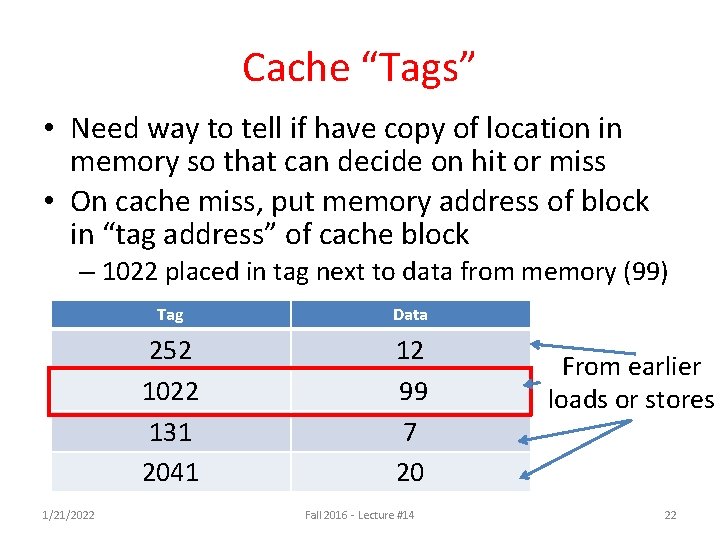
Cache “Tags” • Need way to tell if have copy of location in memory so that can decide on hit or miss • On cache miss, put memory address of block in “tag address” of cache block – 1022 placed in tag next to data from memory (99) 1/21/2022 Tag Data 252 1022 131 2041 12 99 7 20 Fall 2016 - Lecture #14 From earlier loads or stores 22
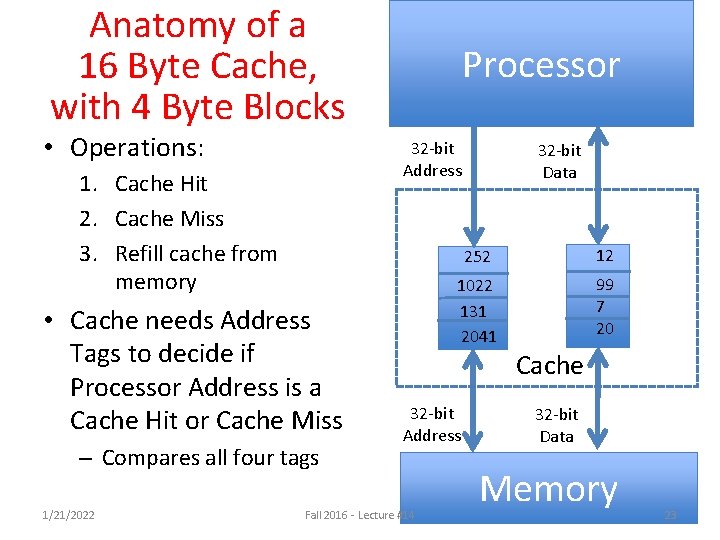
Anatomy of a 16 Byte Cache, with 4 Byte Blocks • Operations: 32 -bit Address 1. Cache Hit 2. Cache Miss 3. Refill cache from memory • Cache needs Address Tags to decide if Processor Address is a Cache Hit or Cache Miss – Compares all four tags 1/21/2022 Processor 252 12 1022 131 2041 99 7 20 32 -bit Address Fall 2016 - Lecture #14 32 -bit Data Cache 32 -bit Data Memory 23
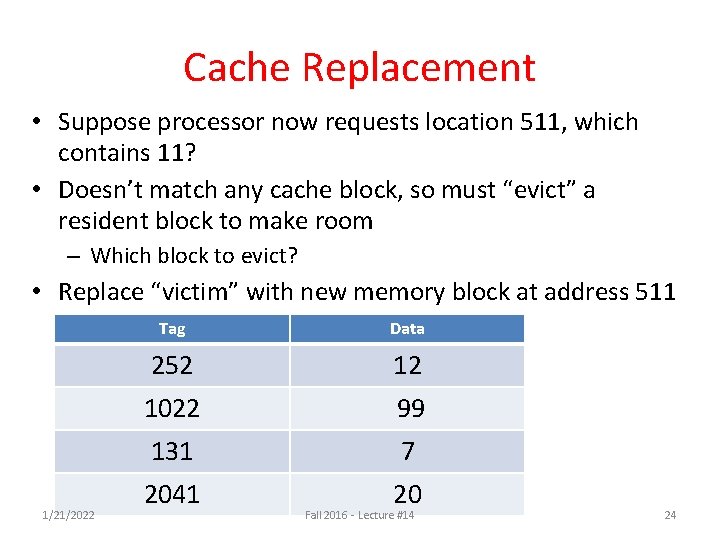
Cache Replacement • Suppose processor now requests location 511, which contains 11? • Doesn’t match any cache block, so must “evict” a resident block to make room – Which block to evict? • Replace “victim” with new memory block at address 511 1/21/2022 Tag Data 252 12 1022 99 131 7 2041 20 Fall 2016 - Lecture #14 24
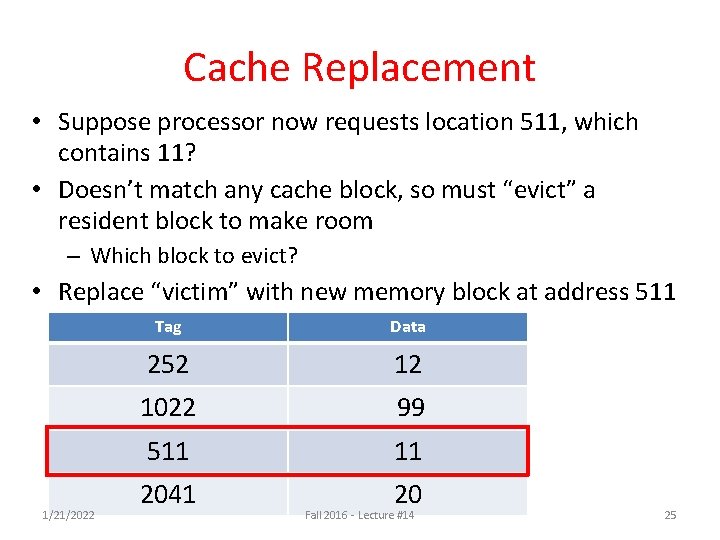
Cache Replacement • Suppose processor now requests location 511, which contains 11? • Doesn’t match any cache block, so must “evict” a resident block to make room – Which block to evict? • Replace “victim” with new memory block at address 511 1/21/2022 Tag Data 252 12 1022 99 511 11 2041 20 Fall 2016 - Lecture #14 25
Block Must be Aligned in Memory • Word blocks are aligned, so binary address of all words in cache always ends in 00 two • How to take advantage of this to save hardware and energy? • Don’t need to compare last 2 bits of 32 -bit byte address (comparator can be narrower) – Don’t need to store last 2 bits of 32 -bit byte address in Cache Tag (Tag can be narrower) 1/21/2022 Fall 2016 - Lecture #14 26
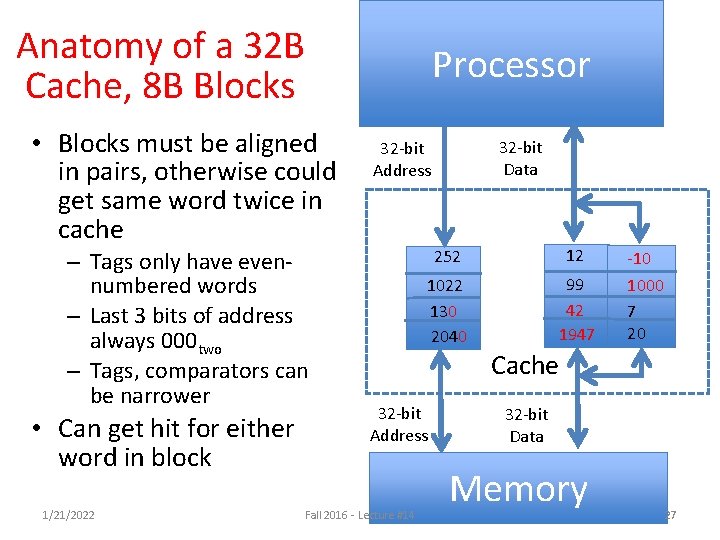
Anatomy of a 32 B Cache, 8 B Blocks • Blocks must be aligned in pairs, otherwise could get same word twice in cache – Tags only have evennumbered words – Last 3 bits of address always 000 two – Tags, comparators can be narrower • Can get hit for either word in block 1/21/2022 Processor 32 -bit Data 32 -bit Address 252 12 1022 130 2040 99 42 1947 32 -bit Address Fall 2016 - Lecture #14 -10 1000 7 20 Cache 32 -bit Data Memory 27
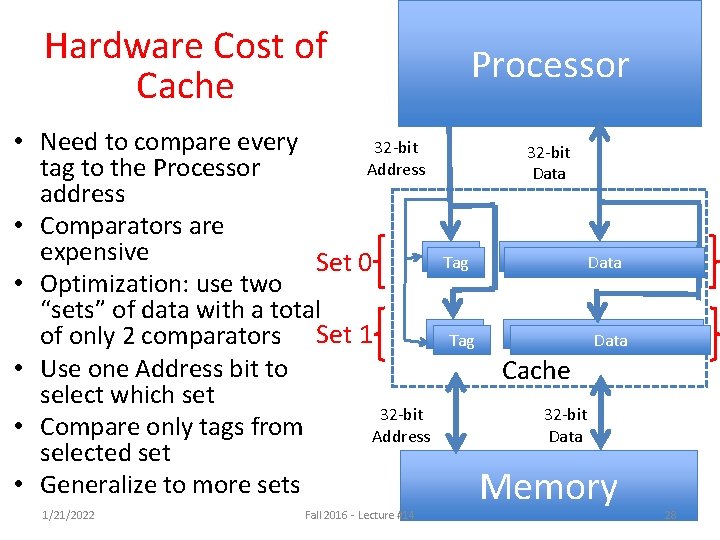
Hardware Cost of Cache Processor • Need to compare every 32 -bit Address tag to the Processor Data address • Comparators are expensive Tag Data Set 0 • Optimization: use two “sets” of data with a total Tag Data of only 2 comparators Set 1 Tag Data • Use one Address bit to Cache select which set 32 -bit • Compare only tags from Address Data selected set • Generalize to more sets Memory 1/21/2022 Fall 2016 - Lecture #14 28
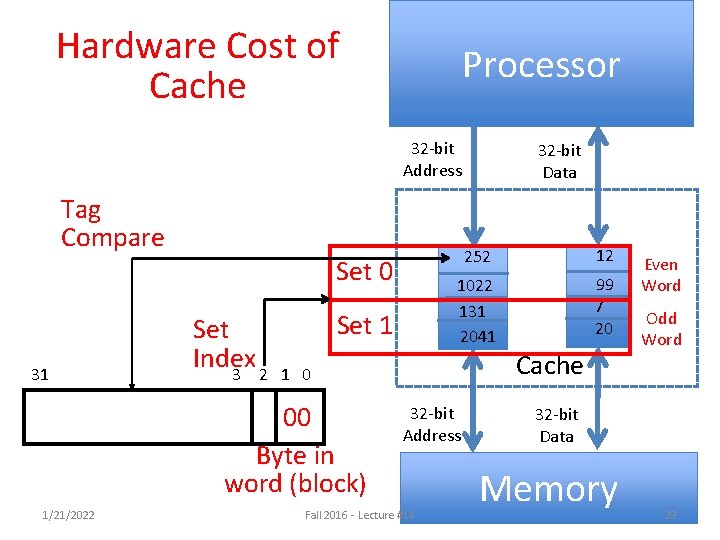
Hardware Cost of Cache Processor 32 -bit Address Tag Compare 31 Set 0 Set Index 3 2 Set 1 1/21/2022 252 12 1022 131 2041 99 7 20 1 0 00 Byte in word (block) 32 -bit Address Fall 2016 - Lecture #14 32 -bit Data Cache Even Word Odd Word 32 -bit Data Memory 29
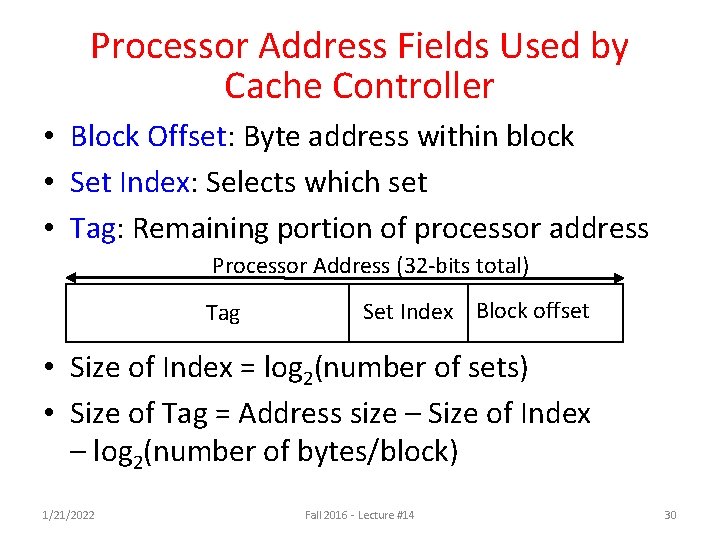
Processor Address Fields Used by Cache Controller • Block Offset: Byte address within block • Set Index: Selects which set • Tag: Remaining portion of processor address Processor Address (32 -bits total) Tag Set Index Block offset • Size of Index = log 2(number of sets) • Size of Tag = Address size – Size of Index – log 2(number of bytes/block) 1/21/2022 Fall 2016 - Lecture #14 30
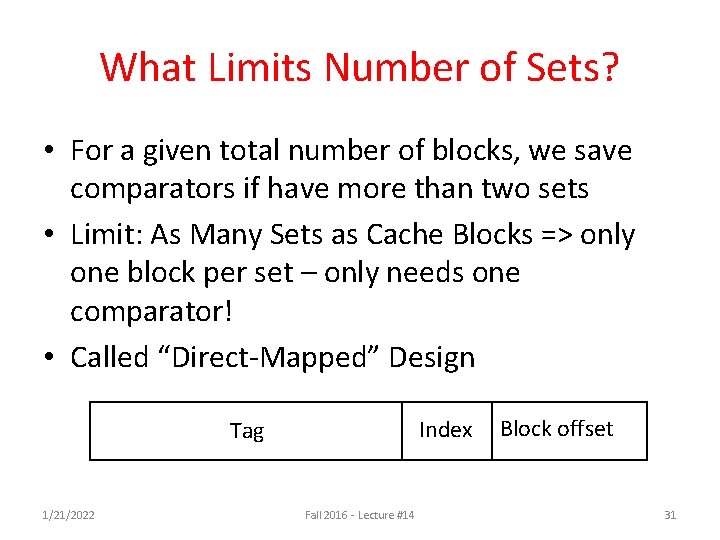
What Limits Number of Sets? • For a given total number of blocks, we save comparators if have more than two sets • Limit: As Many Sets as Cache Blocks => only one block per set – only needs one comparator! • Called “Direct-Mapped” Design Index Tag 1/21/2022 Fall 2016 - Lecture #14 Block offset 31
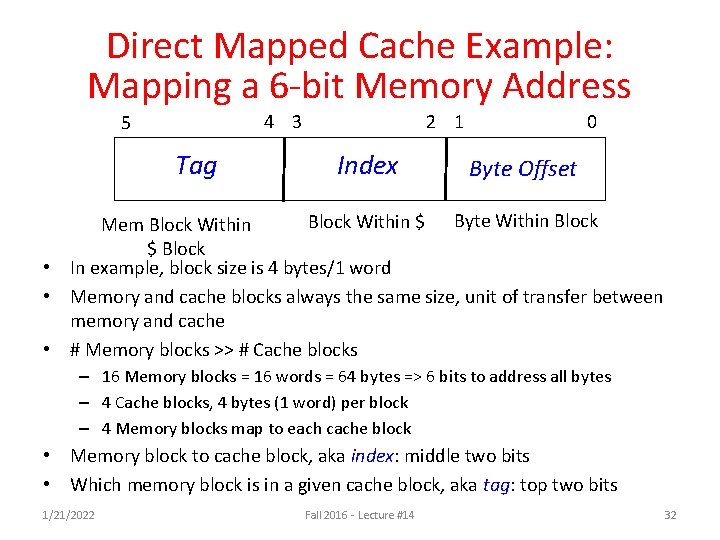
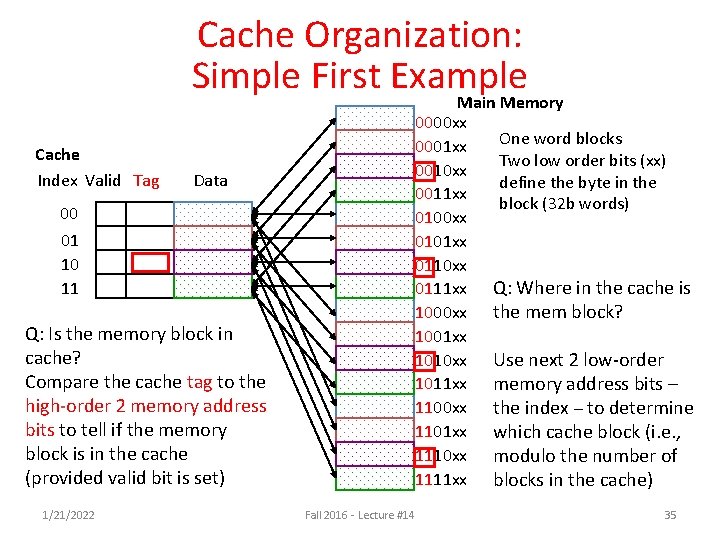
Direct Mapped Cache Example: Mapping a 6 -bit Memory Address 4 3 5 Tag 2 1 Index 0 Byte Offset Block Within $ Byte Within Block Mem Block Within $ Block • In example, block size is 4 bytes/1 word • Memory and cache blocks always the same size, unit of transfer between memory and cache • # Memory blocks >> # Cache blocks – 16 Memory blocks = 16 words = 64 bytes => 6 bits to address all bytes – 4 Cache blocks, 4 bytes (1 word) per block – 4 Memory blocks map to each cache block • Memory block to cache block, aka index: middle two bits • Which memory block is in a given cache block, aka tag: top two bits 1/21/2022 Fall 2016 - Lecture #14 32
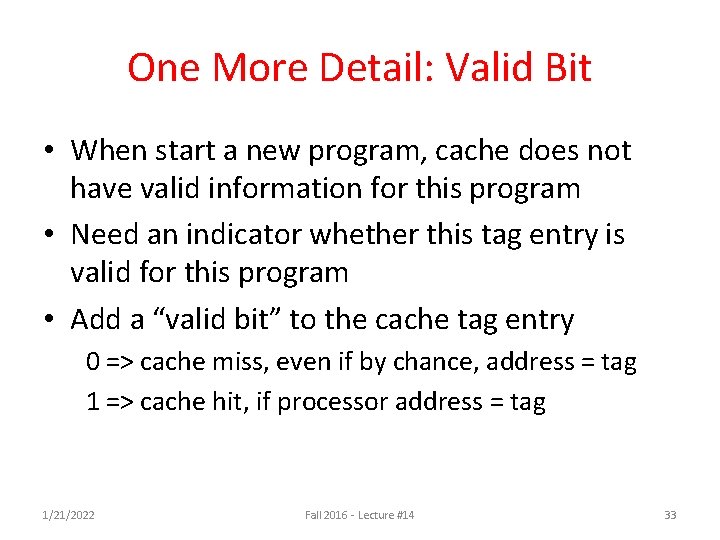
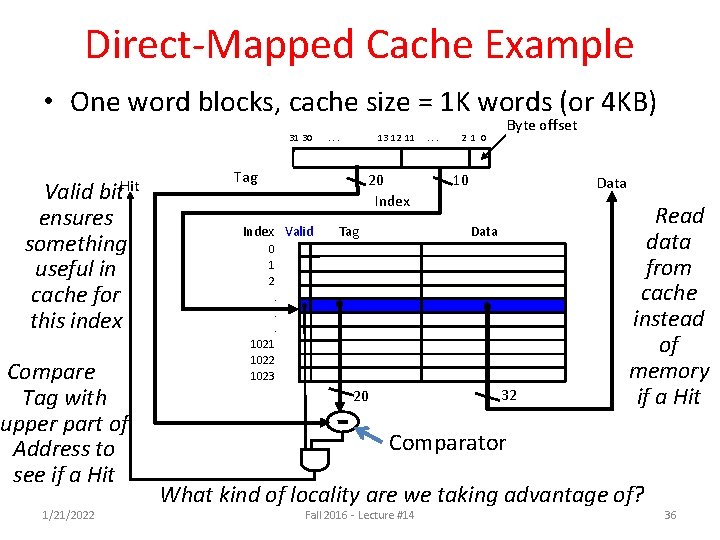
One More Detail: Valid Bit • When start a new program, cache does not have valid information for this program • Need an indicator whether this tag entry is valid for this program • Add a “valid bit” to the cache tag entry 0 => cache miss, even if by chance, address = tag 1 => cache hit, if processor address = tag 1/21/2022 Fall 2016 - Lecture #14 33
Outline • • • Memory Hierarchy and Latency Caches Principles Basic Cache Organization Different Kinds of Caches Write Back vs. Write Through And in Conclusion … 1/21/2022 Fall 2016 – Lecture #14 34
Cache Organization: Simple First Example Cache Index Valid Tag Main Memory 0000 xx One word blocks 0001 xx Two low order bits (xx) 0010 xx define the byte in the 0011 xx block (32 b words) 0100 xx 0101 xx 0110 xx 0111 xx Q: Where in the cache is 1000 xx the mem block? 1001 xx 1010 xx Use next 2 low-order 1011 xx memory address bits – 1100 xx the index – to determine 1101 xx which cache block (i. e. , 1110 xx modulo the number of 1111 xx blocks in the cache) Data 00 01 10 11 Q: Is the memory block in cache? Compare the cache tag to the high-order 2 memory address bits to tell if the memory block is in the cache (provided valid bit is set) 1/21/2022 Fall 2016 - Lecture #14 35
Direct-Mapped Cache Example • One word blocks, cache size = 1 K words (or 4 KB) 31 30 Hit Valid bit ensures something useful in cache for this index Compare Tag with upper part of Address to see if a Hit 1/21/2022 . . . 13 12 11 Tag 20 Index Valid Tag . . . Byte offset 2 1 0 10 Data 0 1 2. . . 1021 1022 1023 32 20 Read data from cache instead of memory if a Hit Comparator What kind of locality are we taking advantage of? Fall 2016 - Lecture #14 36
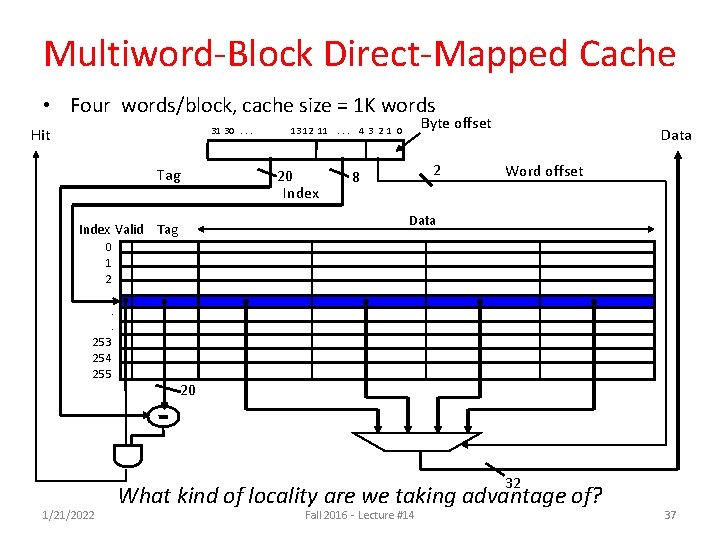
Multiword-Block Direct-Mapped Cache • Four words/block, cache size = 1 K words Hit 31 30. . . Tag Byte offset 13 12 11. . . 4 3 2 1 0 20 Index 2 8 Data Word offset Data Index Valid Tag 0 1 2. . . 253 254 255 20 32 1/21/2022 What kind of locality are we taking advantage of? Fall 2016 - Lecture #14 37
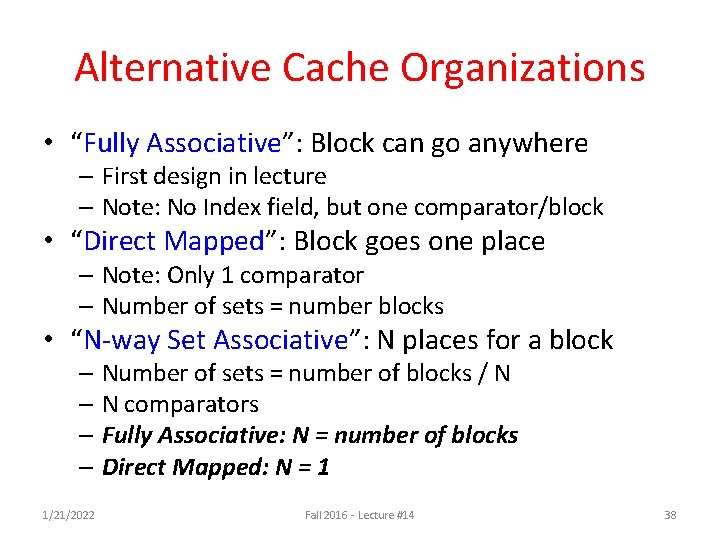
Alternative Cache Organizations • “Fully Associative”: Block can go anywhere – First design in lecture – Note: No Index field, but one comparator/block • “Direct Mapped”: Block goes one place – Note: Only 1 comparator – Number of sets = number blocks • “N-way Set Associative”: N places for a block – Number of sets = number of blocks / N – N comparators – Fully Associative: N = number of blocks – Direct Mapped: N = 1 1/21/2022 Fall 2016 - Lecture #14 38
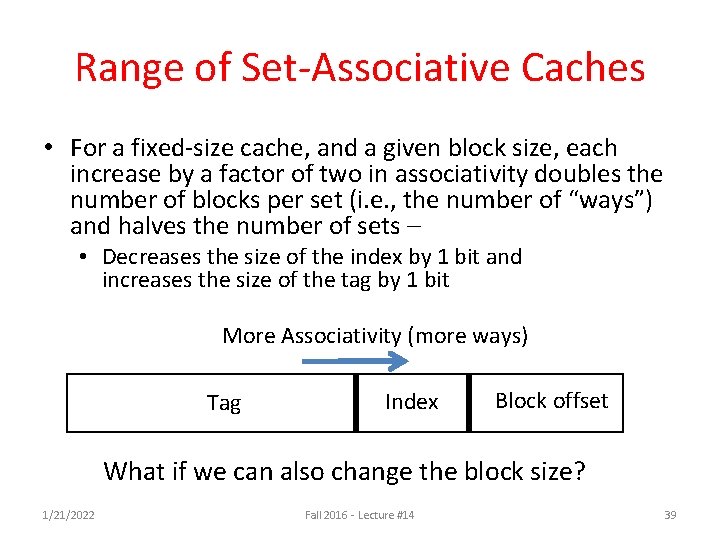
Range of Set-Associative Caches • For a fixed-size cache, and a given block size, each increase by a factor of two in associativity doubles the number of blocks per set (i. e. , the number of “ways”) and halves the number of sets – • Decreases the size of the index by 1 bit and increases the size of the tag by 1 bit More Associativity (more ways) Tag Index Block offset What if we can also change the block size? 1/21/2022 Fall 2016 - Lecture #14 39
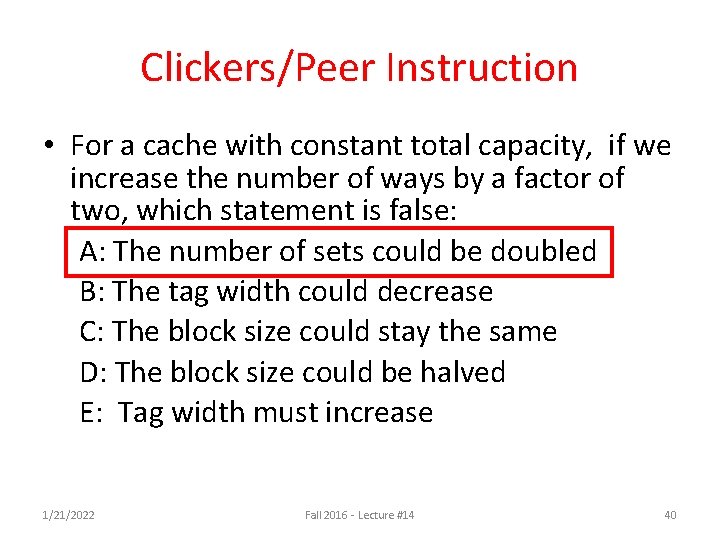
Clickers/Peer Instruction • For a cache with constant total capacity, if we increase the number of ways by a factor of two, which statement is false: A: The number of sets could be doubled B: The tag width could decrease C: The block size could stay the same D: The block size could be halved E: Tag width must increase 1/21/2022 Fall 2016 - Lecture #14 40
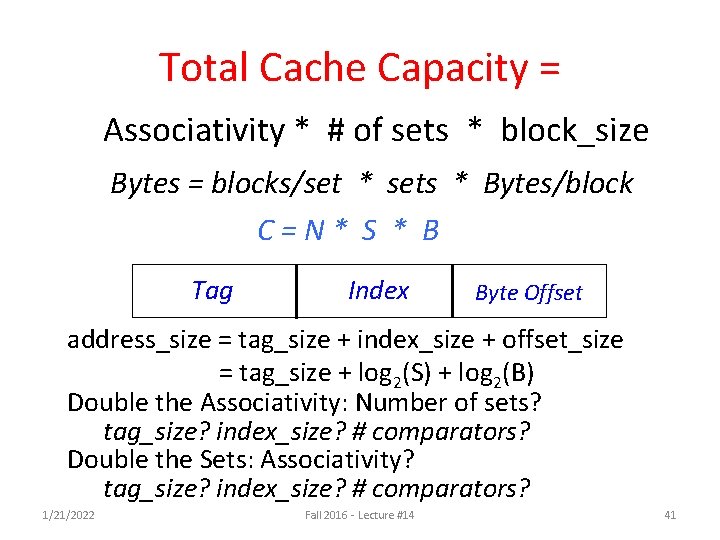
Total Cache Capacity = Associativity * # of sets * block_size Bytes = blocks/set * sets * Bytes/block C=N* S * B Tag Index Byte Offset address_size = tag_size + index_size + offset_size = tag_size + log 2(S) + log 2(B) Double the Associativity: Number of sets? tag_size? index_size? # comparators? Double the Sets: Associativity? tag_size? index_size? # comparators? 1/21/2022 Fall 2016 - Lecture #14 41
Outline • • • Memory Hierarchy and Latency Caches Principles Basic Cache Organization Different Kinds of Caches Write Back vs. Write Through And in Conclusion … 1/21/2022 Fall 2016 – Lecture #14 42
And In Conclusion, … • Principle of Locality for Libraries /Computer Memory • Hierarchy of Memories (speed/size/cost per bit) to Exploit Locality • Cache – copy of data lower level in memory hierarchy • Direct Mapped to find block in cache using Tag field and Valid bit for Hit • Cache design choice: − Write-Through vs. Write-Back 1/21/2022 Fall 2016 - Lecture #14 43