
CS 61 C Great Ideas in Computer Architecture

![Building Block: for loop for (i=0; i<max; i++) zero[i] = 0; • Breaks for](https://slidetodoc.com/presentation_image_h2/1229ed95130a6b145c15d7e1ae8a6df6/image-11.jpg "Building Block: for loop for (i=0; i<max; i++) zero[i] = 0; • Breaks for")
![Parallel for pragma #pragma omp parallel for (i=0; i<max; i++) zero[i] = 0; •](https://slidetodoc.com/presentation_image_h2/1229ed95130a6b145c15d7e1ae8a6df6/image-12.jpg "Parallel for pragma #pragma omp parallel for (i=0; i<max; i++) zero[i] = 0; •")
![Matrix Multiply in Open. MP // C[M][N] = A[M][P] × B[P][N] start_time = omp_get_wtime();](https://slidetodoc.com/presentation_image_h2/1229ed95130a6b145c15d7e1ae8a6df6/image-14.jpg "Matrix Multiply in Open. MP // C[M][N] = A[M][P] × B[P][N] start_time = omp_get_wtime();")
![Open. MP Reduction double avg, sum=0. 0, A[MAX]; int i; #pragma omp parallel for](https://slidetodoc.com/presentation_image_h2/1229ed95130a6b145c15d7e1ae8a6df6/image-16.jpg "Open. MP Reduction double avg, sum=0. 0, A[MAX]; int i; #pragma omp parallel for")
![Shared Memory and Caches • What if? – Processors 1 and 2 read Memory[1000]](https://slidetodoc.com/presentation_image_h2/1229ed95130a6b145c15d7e1ae8a6df6/image-22.jpg "Shared Memory and Caches • What if? – Processors 1 and 2 read Memory[1000]")
![Shared Memory and Caches • Now: – Processor 0 writes Memory[1000] with 40 1000](https://slidetodoc.com/presentation_image_h2/1229ed95130a6b145c15d7e1ae8a6df6/image-23.jpg "Shared Memory and Caches • Now: – Processor 0 writes Memory[1000] with 40 1000")
- Slides: 31
CS 61 C: Great Ideas in Computer Architecture (Machine Structures) Thread-Level Parallelism (TLP) and Open. MP Instructors: John Wawrzynek & Vladimir Stojanovic http: //inst. eecs. berkeley. edu/~cs 61 c/
Review • Sequential software is slow software – SIMD and MIMD are paths to higher performance • MIMD thru: multithreading processor cores (increases utilization), Multicore processors (more cores per chip) • Synchronization – coordination among threads – MIPS: atomic read-modify-write using loadlinked/store-conditional • Open. MP as simple parallel extension to C – Pragmas forking multiple Threads – ≈ C: small so easy to learn, but not very high level and it’s easy to get into trouble 2
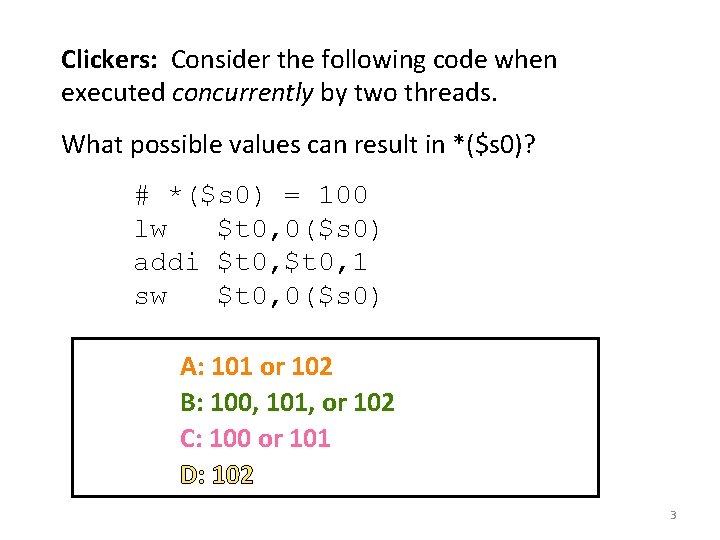
Clickers: Consider the following code when executed concurrently by two threads. What possible values can result in *($s 0)? # *($s 0) = 100 lw $t 0, 0($s 0) addi $t 0, 1 sw $t 0, 0($s 0) A: 101 or 102 B: 100, 101, or 102 C: 100 or 101 D: 102 3
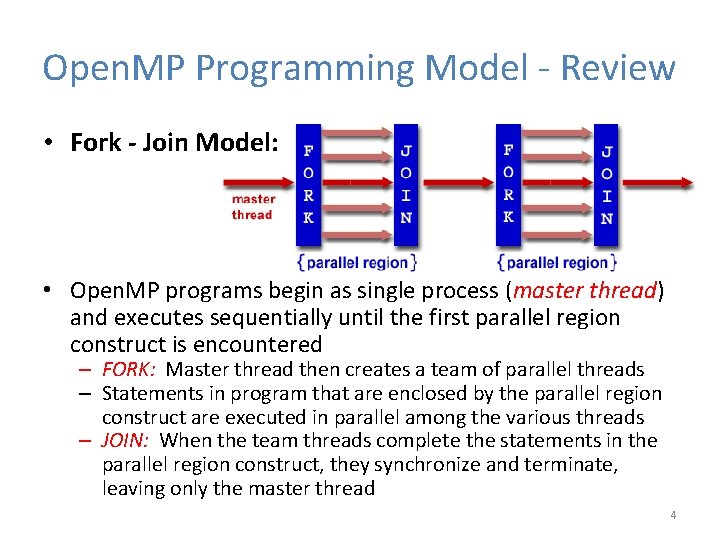
Open. MP Programming Model - Review • Fork - Join Model: • Open. MP programs begin as single process (master thread) and executes sequentially until the first parallel region construct is encountered – FORK: Master thread then creates a team of parallel threads – Statements in program that are enclosed by the parallel region construct are executed in parallel among the various threads – JOIN: When the team threads complete the statements in the parallel region construct, they synchronize and terminate, leaving only the master thread 4
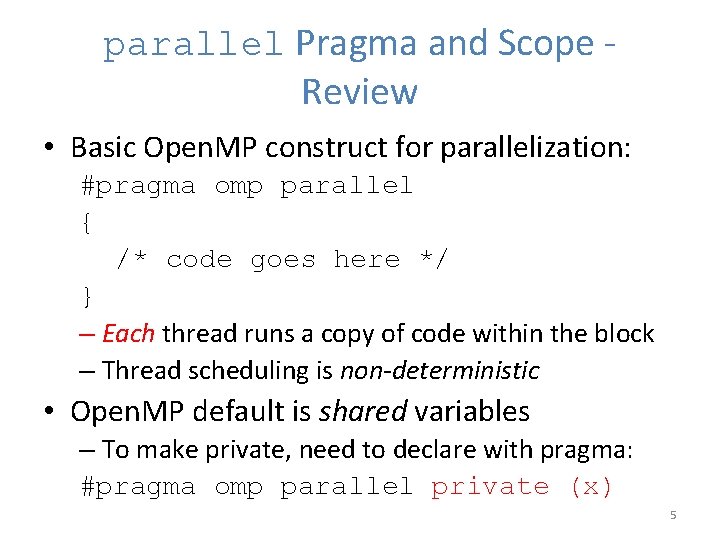
parallel Pragma and Scope - Review • Basic Open. MP construct for parallelization: #pragma omp parallel { /* code goes here */ } – Each thread runs a copy of code within the block – Thread scheduling is non-deterministic • Open. MP default is shared variables – To make private, need to declare with pragma: #pragma omp parallel private (x) 5
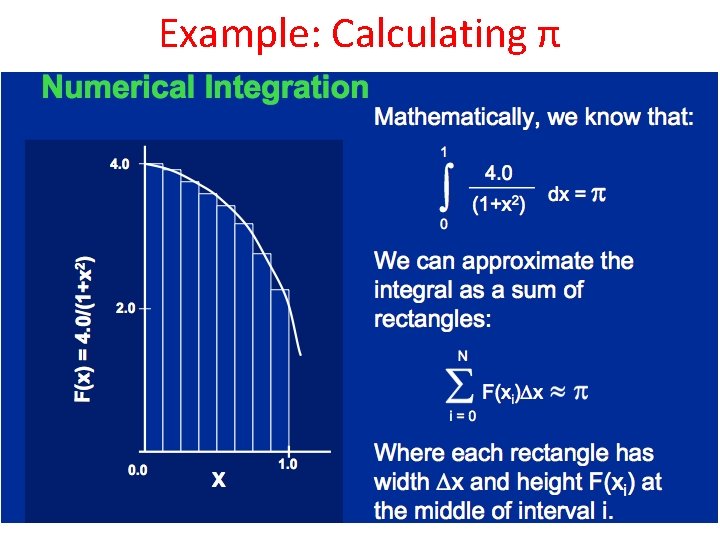
Example: Calculating π 6
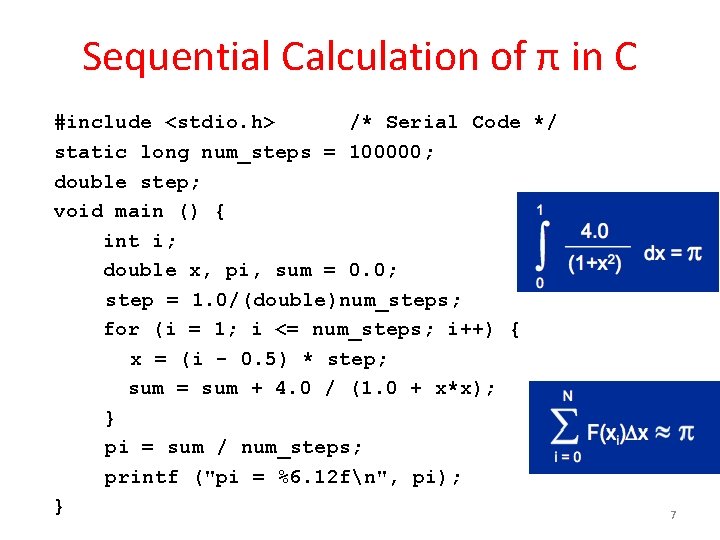
Sequential Calculation of π in C #include <stdio. h> /* Serial Code */ static long num_steps = 100000; double step; void main () { int i; double x, pi, sum = 0. 0; step = 1. 0/(double)num_steps; for (i = 1; i <= num_steps; i++) { x = (i - 0. 5) * step; sum = sum + 4. 0 / (1. 0 + x*x); } pi = sum / num_steps; printf ("pi = %6. 12 fn", pi); } 7
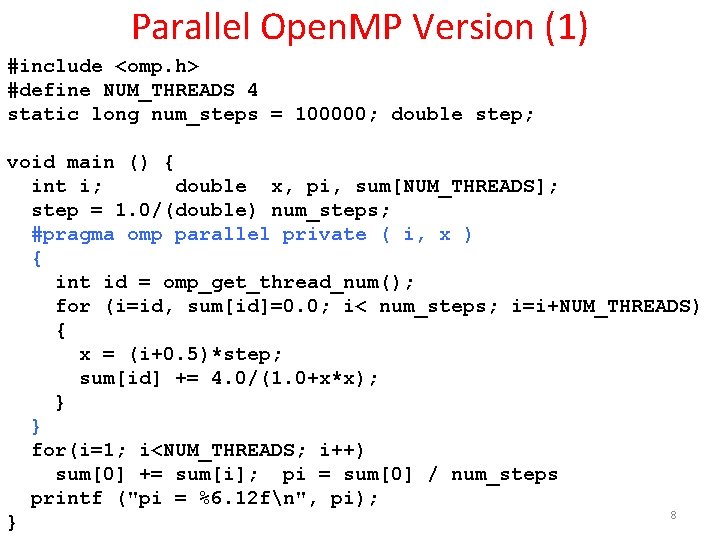
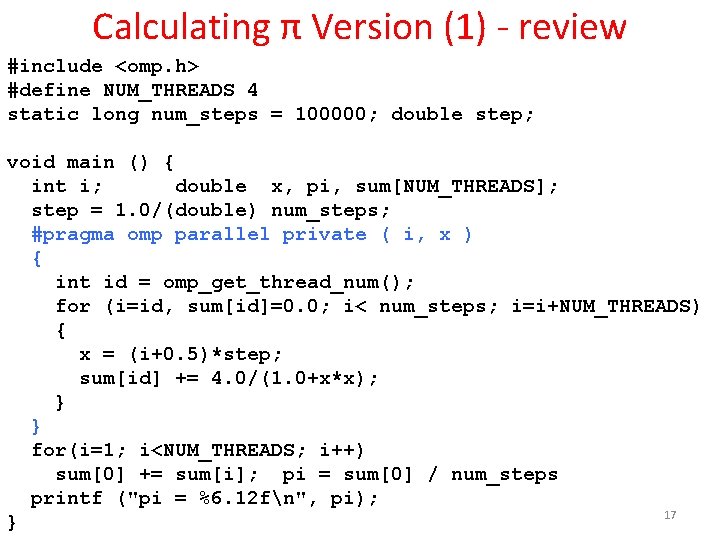
Parallel Open. MP Version (1) #include <omp. h> #define NUM_THREADS 4 static long num_steps = 100000; double step; void main () { int i; double x, pi, sum[NUM_THREADS]; step = 1. 0/(double) num_steps; #pragma omp parallel private ( i, x ) { int id = omp_get_thread_num(); for (i=id, sum[id]=0. 0; i< num_steps; i=i+NUM_THREADS) { x = (i+0. 5)*step; sum[id] += 4. 0/(1. 0+x*x); } } for(i=1; i<NUM_THREADS; i++) sum[0] += sum[i]; pi = sum[0] / num_steps printf ("pi = %6. 12 fn", pi); 8 }
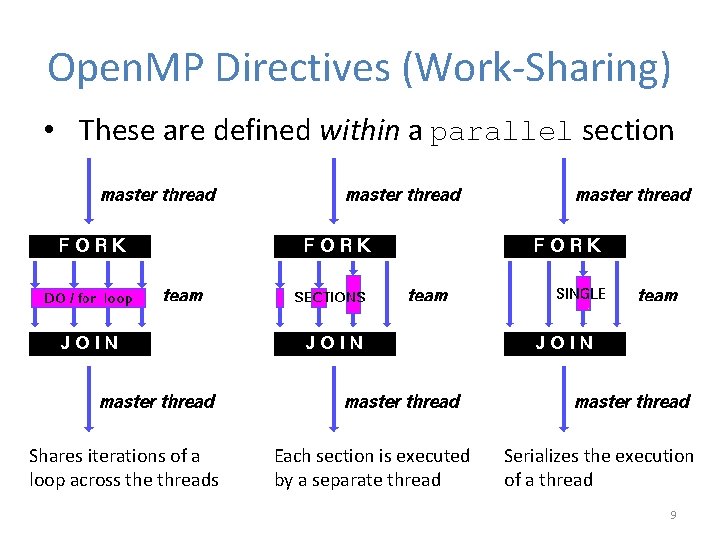
Open. MP Directives (Work-Sharing) • These are defined within a parallel section Shares iterations of a loop across the threads Each section is executed by a separate thread Serializes the execution of a thread 9
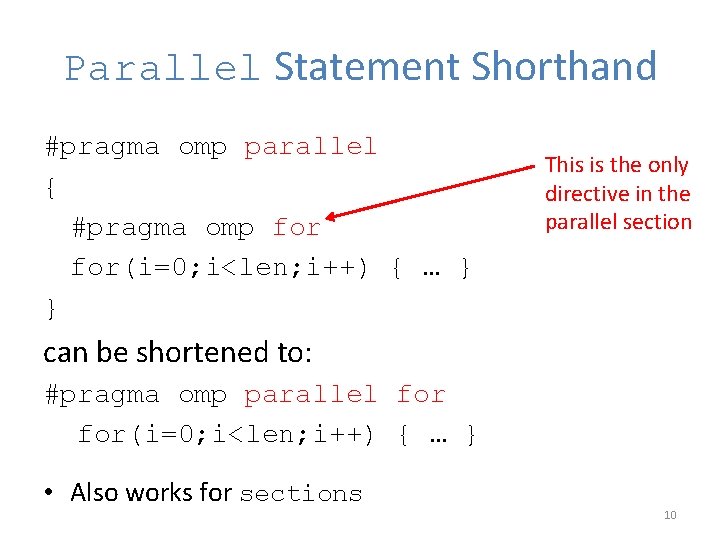
Parallel Statement Shorthand #pragma omp parallel { #pragma omp for(i=0; i<len; i++) { … } } This is the only directive in the parallel section can be shortened to: #pragma omp parallel for(i=0; i<len; i++) { … } • Also works for sections 10
Building Block: for loop for (i=0; i<max; i++) zero[i] = 0; • Breaks for loop into chunks, and allocate each to a separate thread – e. g. if max = 100 with 2 threads: assign 0 -49 to thread 0, and 50 -99 to thread 1 • Must have relatively simple “shape” for an Open. MPaware compiler to be able to parallelize it – Necessary for the run-time system to be able to determine how many of the loop iterations to assign to each thread • No premature exits from the loop allowed – i. e. No break, return, exit, goto statements In general, don’t jump outside of any pragma block 11
Parallel for pragma #pragma omp parallel for (i=0; i<max; i++) zero[i] = 0; • Master thread creates additional threads, each with a separate execution context • All variables declared outside for loop are shared by default, except for loop index which is private per thread (Why? ) • Implicit “barrier” synchronization at end of for loop • Divide index regions sequentially per thread – Thread 0 gets 0, 1, …, (max/n)-1; – Thread 1 gets max/n, max/n+1, …, 2*(max/n)-1 – Why? 12
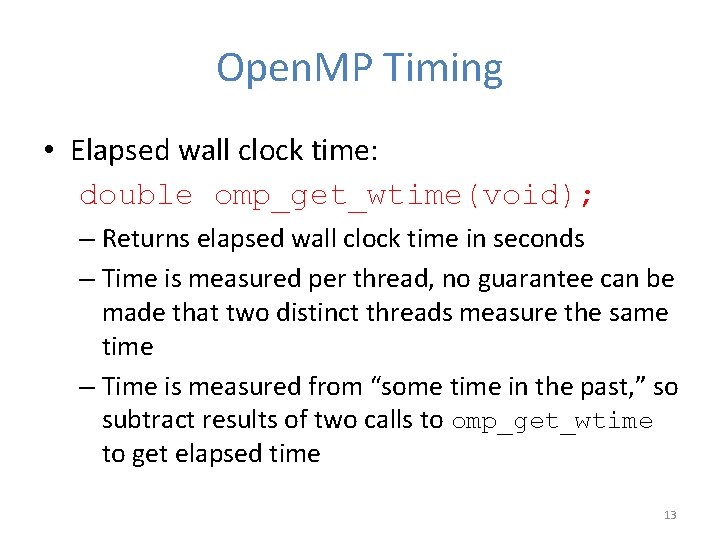
Open. MP Timing • Elapsed wall clock time: double omp_get_wtime(void); – Returns elapsed wall clock time in seconds – Time is measured per thread, no guarantee can be made that two distinct threads measure the same time – Time is measured from “some time in the past, ” so subtract results of two calls to omp_get_wtime to get elapsed time 13
Matrix Multiply in Open. MP // C[M][N] = A[M][P] × B[P][N] start_time = omp_get_wtime(); #pragma omp parallel for private(tmp, j, k) Outer loop spread across N for (i=0; i<M; i++){ threads; for (j=0; j<N; j++){ inner loops inside a single tmp = 0. 0; thread for( k=0; k<P; k++){ /* C(i, j) = sum(over k) A(i, k) * B(k, j)*/ tmp += A[i][k] * B[k][j]; } C[i][j] = tmp; } } run_time = omp_get_wtime() - start_time; 14
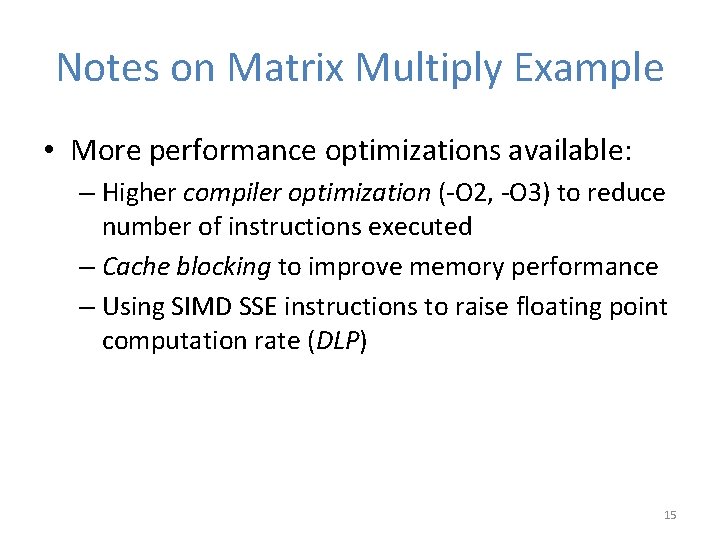
Notes on Matrix Multiply Example • More performance optimizations available: – Higher compiler optimization (-O 2, -O 3) to reduce number of instructions executed – Cache blocking to improve memory performance – Using SIMD SSE instructions to raise floating point computation rate (DLP) 15
Open. MP Reduction double avg, sum=0. 0, A[MAX]; int i; #pragma omp parallel for private ( sum ) for (i = 0; i <= MAX ; i++) sum += A[i]; avg = sum/MAX; // bug • Problem is that we really want sum over all threads! • Reduction: specifies that 1 or more variables that are private to each thread are subject of reduction operation at end of parallel region: reduction(operation: var) where – Operation: operator to perform on the variables (var) at the end of the parallel region – Var: One or more variables on which to perform scalar reduction. double avg, sum=0. 0, A[MAX]; int i; #pragma omp for reduction(+ : sum) for (i = 0; i <= MAX ; i++) sum += A[i]; avg = sum/MAX; 16
Calculating π Version (1) - review #include <omp. h> #define NUM_THREADS 4 static long num_steps = 100000; double step; void main () { int i; double x, pi, sum[NUM_THREADS]; step = 1. 0/(double) num_steps; #pragma omp parallel private ( i, x ) { int id = omp_get_thread_num(); for (i=id, sum[id]=0. 0; i< num_steps; i=i+NUM_THREADS) { x = (i+0. 5)*step; sum[id] += 4. 0/(1. 0+x*x); } } for(i=1; i<NUM_THREADS; i++) sum[0] += sum[i]; pi = sum[0] / num_steps printf ("pi = %6. 12 fn", pi); 17 }
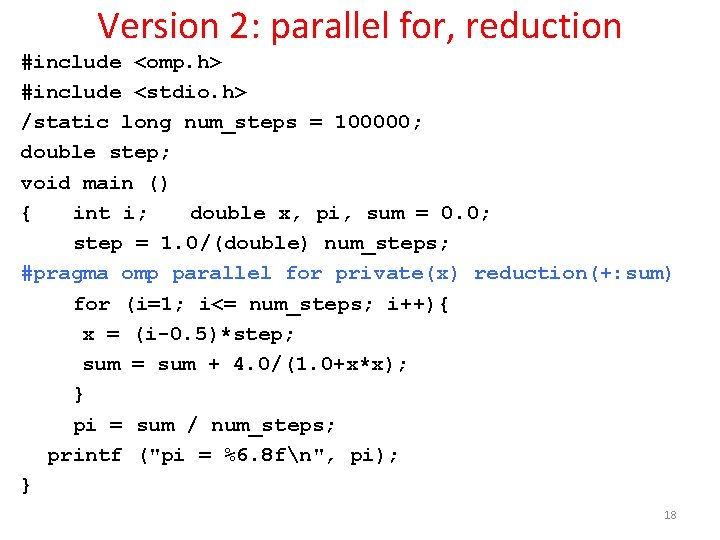
Version 2: parallel for, reduction #include <omp. h> #include <stdio. h> /static long num_steps = 100000; double step; void main () { int i; double x, pi, sum = 0. 0; step = 1. 0/(double) num_steps; #pragma omp parallel for private(x) reduction(+: sum) for (i=1; i<= num_steps; i++){ x = (i-0. 5)*step; sum = sum + 4. 0/(1. 0+x*x); } pi = sum / num_steps; printf ("pi = %6. 8 fn", pi); } 18
Administrivia • MT 2 is Tuesday, November 10 th: – Covers lecture material up till 10/29 lecture – TWO cheat sheets, 8. 5”x 11” • TA Review Session: Sunday 11/08, 5 -7 PM, 10 Evans • MT 2 Room Assignments – If your login is in [aaa-acz], go to 306 Soda – Else if you are in DSP, email Fred back – Else, go to Wheeler Auditorium 19
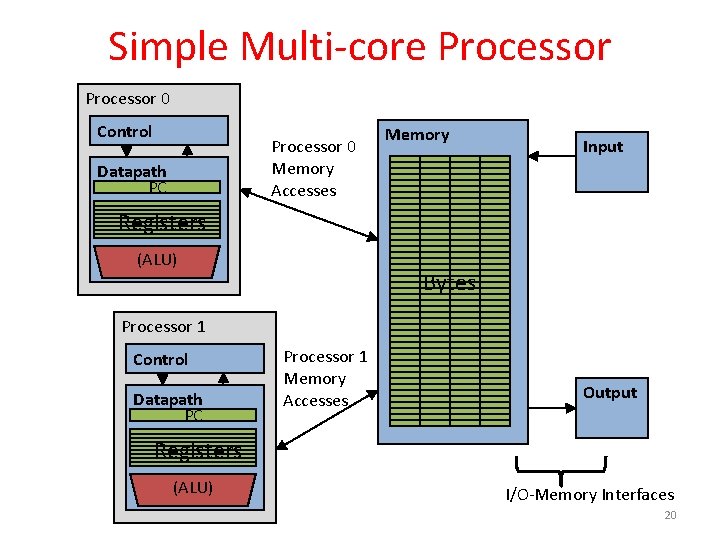
Simple Multi-core Processor 0 Control Processor 0 Memory Accesses Datapath PC Memory Input Registers (ALU) Bytes Processor 1 Control Datapath PC Processor 1 Memory Accesses Output Registers (ALU) I/O-Memory Interfaces 20
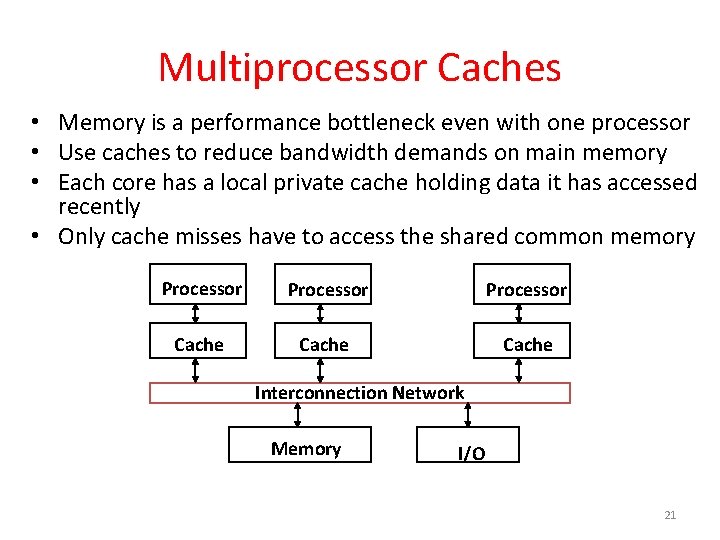
Multiprocessor Caches • Memory is a performance bottleneck even with one processor • Use caches to reduce bandwidth demands on main memory • Each core has a local private cache holding data it has accessed recently • Only cache misses have to access the shared common memory Processor Cache Interconnection Network Memory I/O 21
Shared Memory and Caches • What if? – Processors 1 and 2 read Memory[1000] (value 20) Processor 0 Cache Processor 1 Processor 2 1000 Cache 1000 Interconnection Network Memory 2020 I/O 22
Shared Memory and Caches • Now: – Processor 0 writes Memory[1000] with 40 1000 Processor 1 Processor 2 1000 Cache 40 Cache 20 1000 Interconnection Network Memory 1000 40 I/O Problem? 23
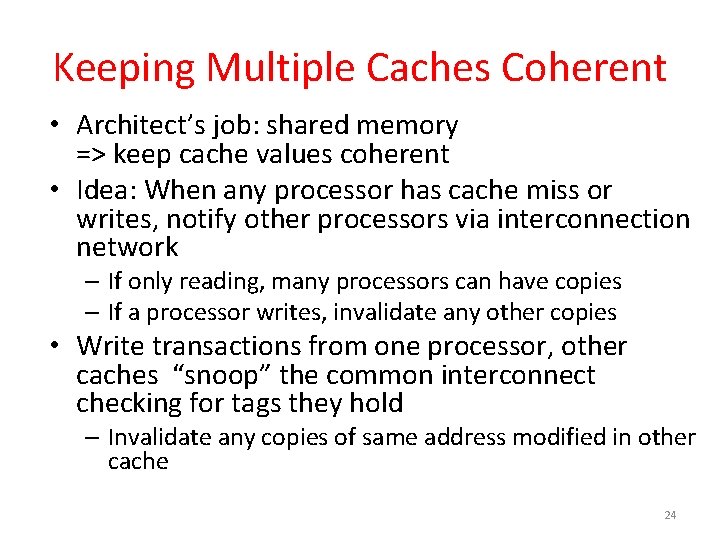
Keeping Multiple Caches Coherent • Architect’s job: shared memory => keep cache values coherent • Idea: When any processor has cache miss or writes, notify other processors via interconnection network – If only reading, many processors can have copies – If a processor writes, invalidate any other copies • Write transactions from one processor, other caches “snoop” the common interconnect checking for tags they hold – Invalidate any copies of same address modified in other cache 24
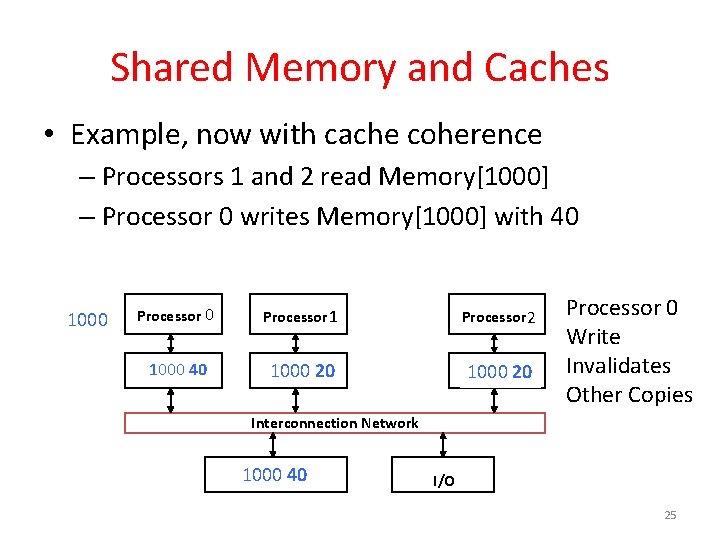
Shared Memory and Caches • Example, now with cache coherence – Processors 1 and 2 read Memory[1000] – Processor 0 writes Memory[1000] with 40 1000 Processor 1 Processor 2 1000 Cache 40 Cache 20 1000 Processor 0 Write Invalidates Other Copies Interconnection Network Memory 1000 40 I/O 25
Clickers/Peer Instruction: Which statement is true? • A: Using write-through caches removes the need for cache coherence • B: Every processor store instruction must check contents of other caches • C: Most processor load and store accesses only need to check in local private cache • D: Only one processor can cache any memory location at one time 26
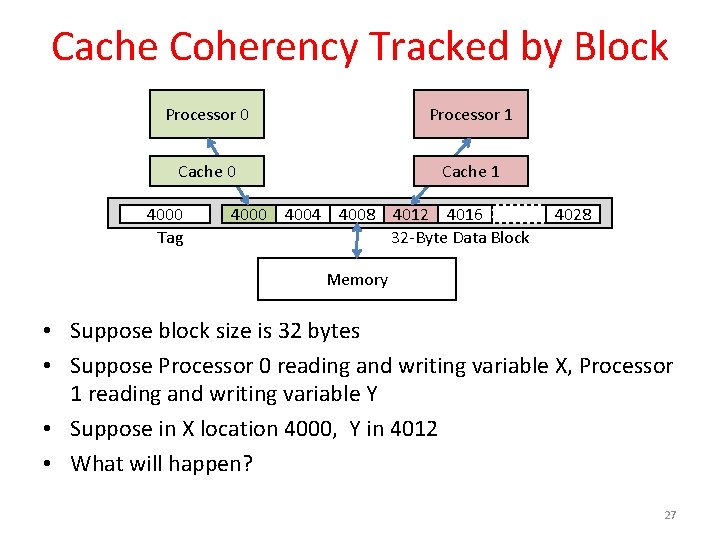
Cache Coherency Tracked by Block Processor 0 Processor 1 Cache 0 Cache 1 4000 Tag 4000 4004 4008 4012 4016 32 -Byte Data Block 4028 Memory • Suppose block size is 32 bytes • Suppose Processor 0 reading and writing variable X, Processor 1 reading and writing variable Y • Suppose in X location 4000, Y in 4012 • What will happen? 27
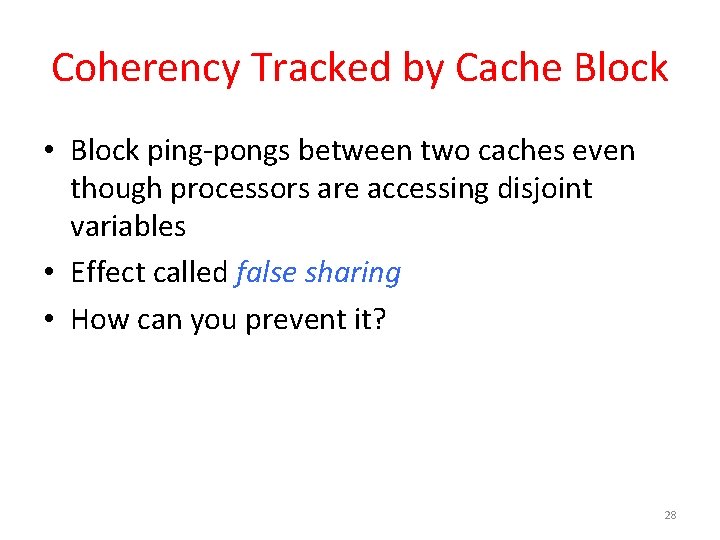
Coherency Tracked by Cache Block • Block ping-pongs between two caches even though processors are accessing disjoint variables • Effect called false sharing • How can you prevent it? 28
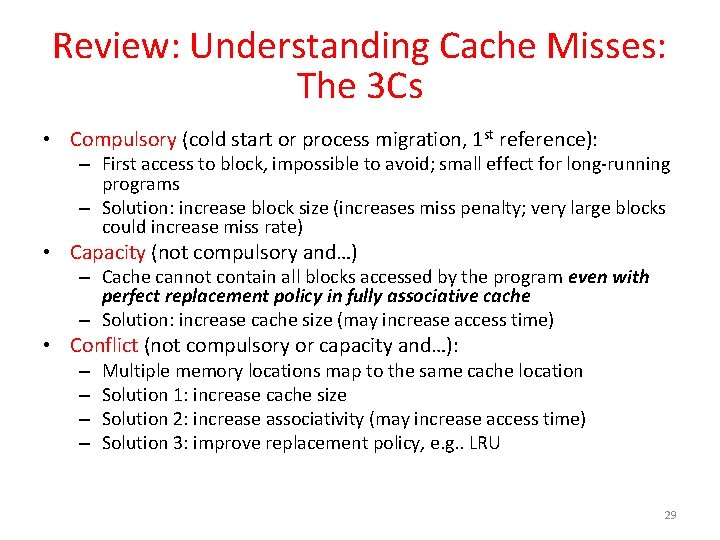
Review: Understanding Cache Misses: The 3 Cs • Compulsory (cold start or process migration, 1 st reference): – First access to block, impossible to avoid; small effect for long-running programs – Solution: increase block size (increases miss penalty; very large blocks could increase miss rate) • Capacity (not compulsory and…) – Cache cannot contain all blocks accessed by the program even with perfect replacement policy in fully associative cache – Solution: increase cache size (may increase access time) • Conflict (not compulsory or capacity and…): – – Multiple memory locations map to the same cache location Solution 1: increase cache size Solution 2: increase associativity (may increase access time) Solution 3: improve replacement policy, e. g. . LRU 29
Fourth “C” of Cache Misses: Coherence Misses • Misses caused by coherence traffic with other processor • Also known as communication misses because represents data moving between processors working together on a parallel program • For some parallel programs, coherence misses can dominate total misses 30
And in Conclusion, … • Multiprocessor/Multicore uses Shared Memory – Cache coherency implements shared memory even with multiple copies in multiple caches – False sharing a concern; watch block size! • Open. MP as simple parallel extension to C – Threads, Parallel for, private, reductions … – ≈ C: small so easy to learn, but not very high level and it’s easy to get into trouble – Much we didn’t cover – including other synchronization mechanisms (locks, etc. ) 31