
CS 61 C Great Ideas in Computer Architecture
![C Arrays • Declaration: Type − // allocate space // random content int a[5];](https://slidetodoc.com/presentation_image_h2/f983011ff07357cc5581eb6426c3158b/image-16.jpg "C Arrays • Declaration: Type − // allocate space // random content int a[5];")
![Beware: no array bound checking! Output: a[0] = 1 a[1] = 2 a[2] =](https://slidetodoc.com/presentation_image_h2/f983011ff07357cc5581eb6426c3158b/image-17.jpg "Beware: no array bound checking! Output: a[0] = 1 a[1] = 2 a[2] =")

![Arrays and Pointers int foo(int array[], unsigned int size) { … printf(“%dn”, sizeof(array)); }](https://slidetodoc.com/presentation_image_h2/f983011ff07357cc5581eb6426c3158b/image-33.jpg "Arrays and Pointers int foo(int array[], unsigned int size) { … printf(“%dn”, sizeof(array)); }")
![Arrays and Pointers These code sequences have the same effect: int i; array[5]; Name](https://slidetodoc.com/presentation_image_h2/f983011ff07357cc5581eb6426c3158b/image-34.jpg "Arrays and Pointers These code sequences have the same effect: int i; array[5]; Name")
![Your Turn … int x[] = { 2, 4, 6, 8, 10 }; int](https://slidetodoc.com/presentation_image_h2/f983011ff07357cc5581eb6426c3158b/image-37.jpg "Your Turn … int x[] = { 2, 4, 6, 8, 10 }; int")
- Slides: 47
CS 61 C: Great Ideas in Computer Architecture Lecture 3: Pointers Bernhard Boser & Randy Katz http: //inst. eecs. berkeley. edu/~cs 61 c
Agenda • Pointers in C • Arrays in C • This is not on the test • Pointer arithmetic • Strings, main • And in Conclusion, … CS 61 c Lecture 3: Pointers 2
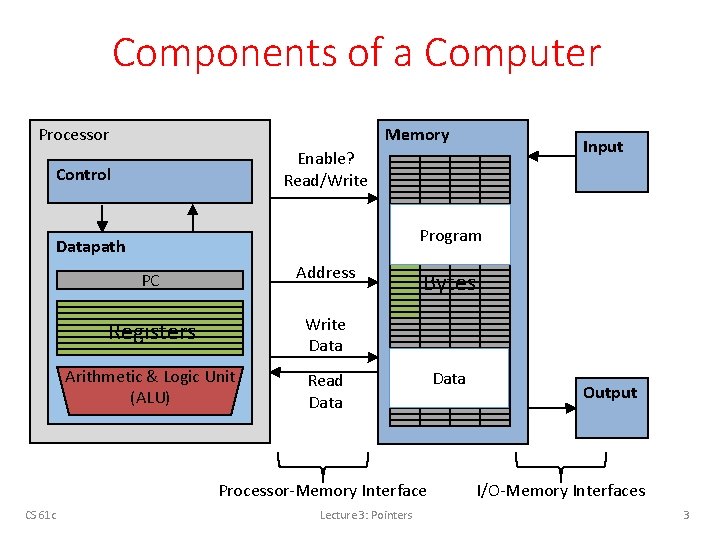
Components of a Computer Processor Memory Control Program Datapath PC Address Registers Write Data Arithmetic & Logic Unit (ALU) Read Data Bytes Processor-Memory Interface CS 61 c Input Enable? Read/Write Lecture 3: Pointers Data Output I/O-Memory Interfaces 3
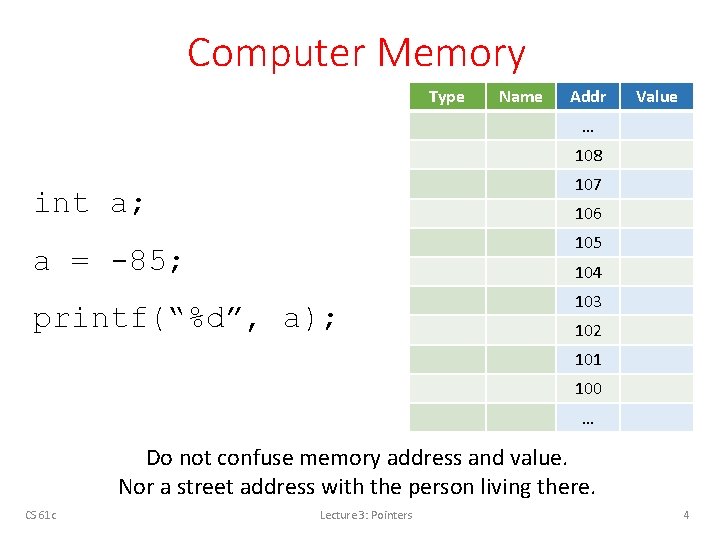
Computer Memory Type Name Addr Value … 108 107 int a; 106 105 a = -85; 104 printf(“%d”, a); 103 102 101 100 … Do not confuse memory address and value. Nor a street address with the person living there. CS 61 c Lecture 3: Pointers 4
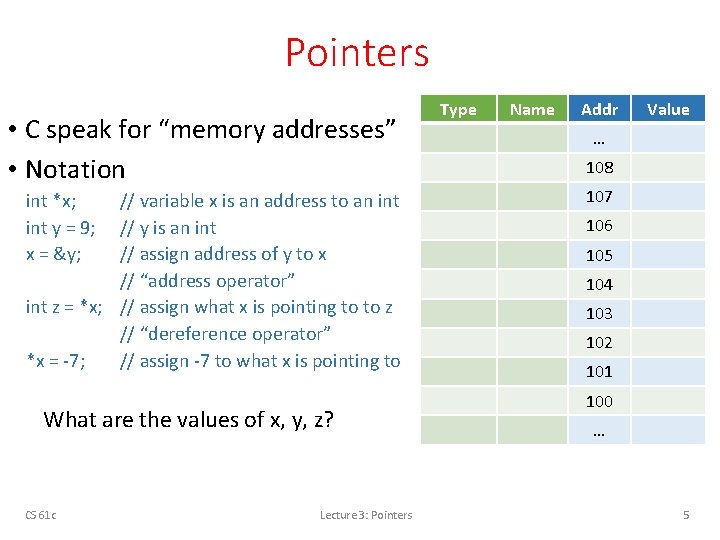
Pointers • C speak for “memory addresses” • Notation int *x; int y = 9; x = &y; // variable x is an address to an int // y is an int // assign address of y to x // “address operator” int z = *x; // assign what x is pointing to to z // “dereference operator” *x = -7; // assign -7 to what x is pointing to What are the values of x, y, z? CS 61 c Lecture 3: Pointers Type Name Addr Value … 108 107 106 105 104 103 102 101 100 … 5
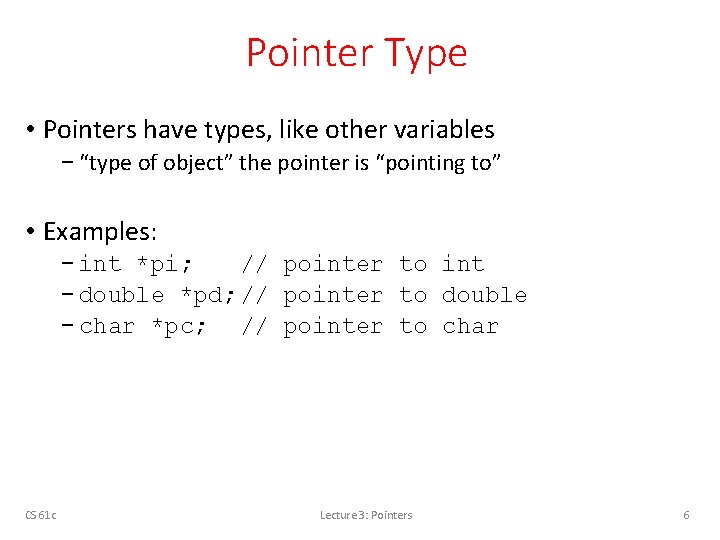
Pointer Type • Pointers have types, like other variables − “type of object” the pointer is “pointing to” • Examples: − int *pi; // pointer to int − double *pd; // pointer to double − char *pc; // pointer to char CS 61 c Lecture 3: Pointers 6
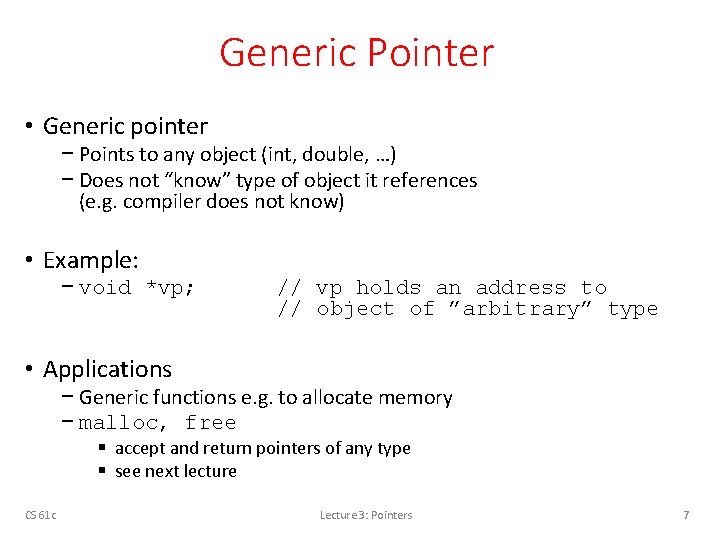
Generic Pointer • Generic pointer − Points to any object (int, double, …) − Does not “know” type of object it references (e. g. compiler does not know) • Example: − void *vp; // vp holds an address to // object of ”arbitrary” type • Applications − Generic functions e. g. to allocate memory − malloc, free § accept and return pointers of any type § see next lecture CS 61 c Lecture 3: Pointers 7
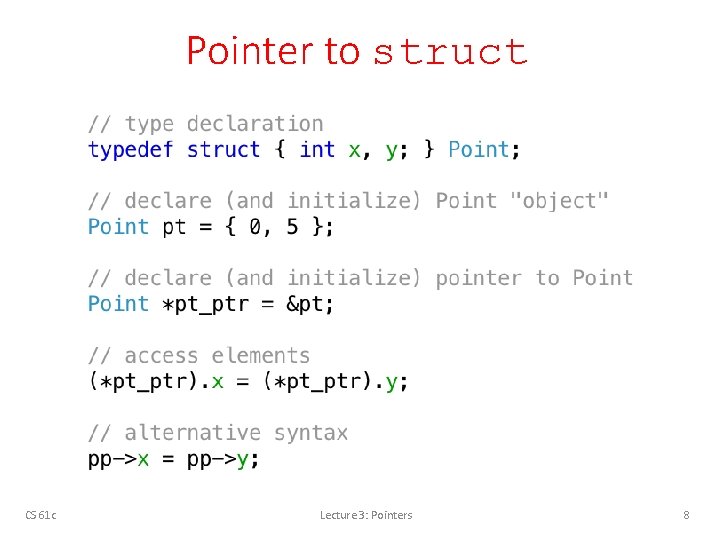
Pointer to struct CS 61 c Lecture 3: Pointers 8
i. Clickers • We’ll start using them today − Please get a clicker by Thursday, 9/8/2016 • You may also submit answers by internet (REEF polling) − Please get your 2 week trial right away to track down problems before you pay • Register your clicker on bcourses • Instructions: https: //www. ets. berkeley. edu/di scover-services/clickers/studentsgetting-started CS 61 c Lecture 3: Pointers 9
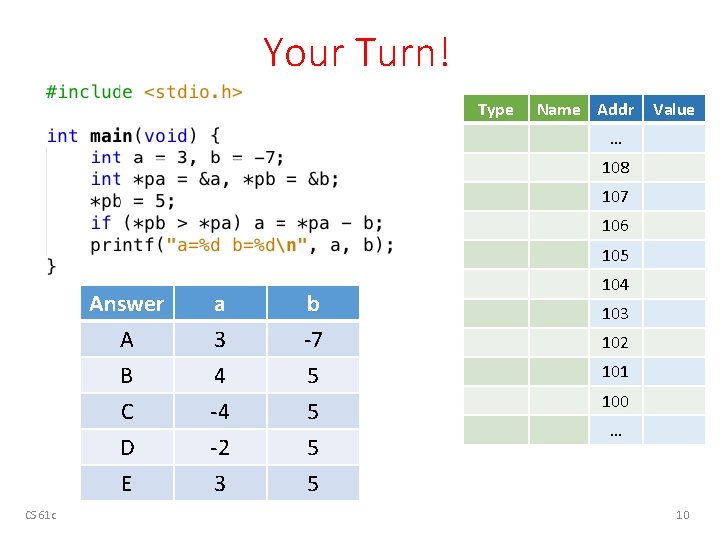
Your Turn! Type Name Addr Value … 108 107 106 105 CS 61 c Answer A B C a 3 4 -4 b -7 5 5 D E -2 3 5 5 104 103 102 101 100 … 10
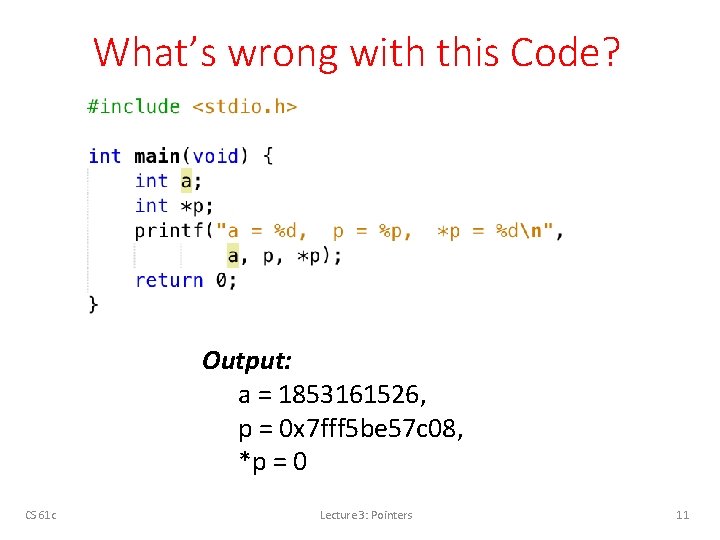
What’s wrong with this Code? Output: a = 1853161526, p = 0 x 7 fff 5 be 57 c 08, *p = 0 CS 61 c Lecture 3: Pointers 11
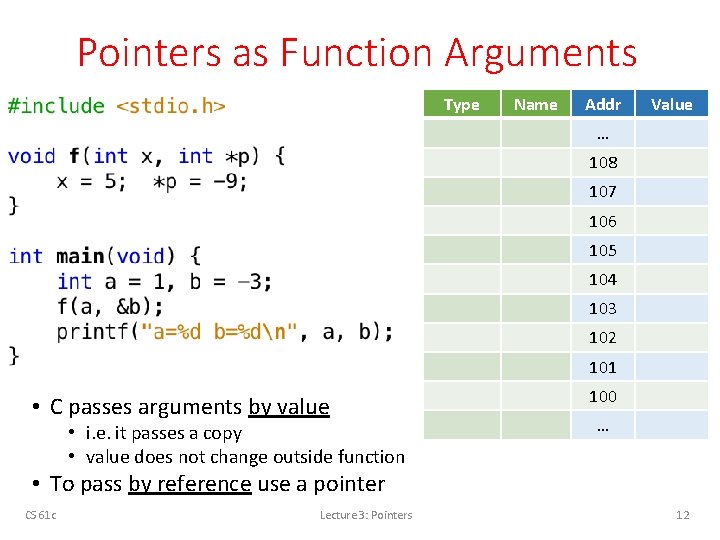
Pointers as Function Arguments Type Name Addr Value … 108 107 106 105 104 103 102 101 • C passes arguments by value • i. e. it passes a copy • value does not change outside function 100 … • To pass by reference use a pointer CS 61 c Lecture 3: Pointers 12
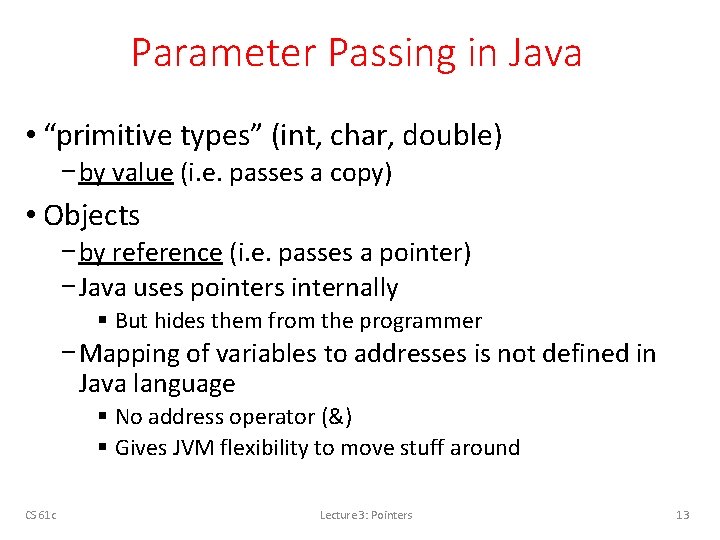
Parameter Passing in Java • “primitive types” (int, char, double) − by value (i. e. passes a copy) • Objects − by reference (i. e. passes a pointer) − Java uses pointers internally § But hides them from the programmer − Mapping of variables to addresses is not defined in Java language § No address operator (&) § Gives JVM flexibility to move stuff around CS 61 c Lecture 3: Pointers 13
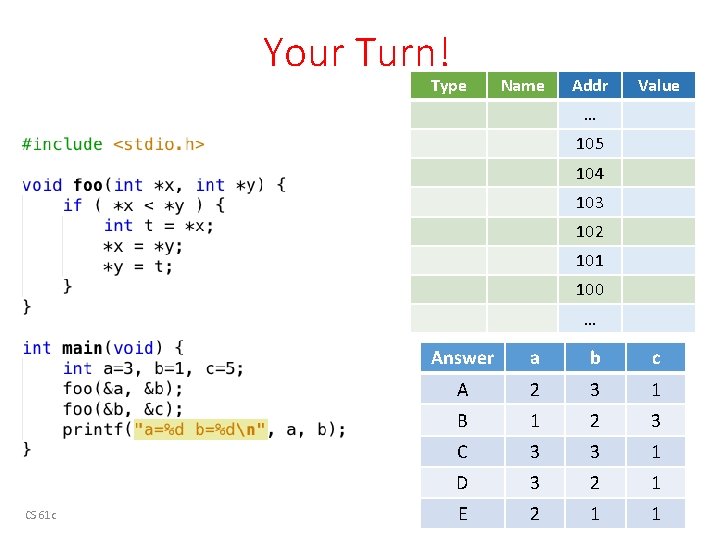
Your Turn! Type Name Addr Value … 105 104 103 102 101 100 … CS 61 c Answer a b c A 2 3 1 B 1 2 3 C 3 3 1 D 3 2 1 E 2 1 1
Agenda • Pointers in C • Arrays in C • This is not on the test • Pointer arithmetic • Strings, main • And in Conclusion, … CS 61 c Lecture 3: Pointers 15
C Arrays • Declaration: Type − // allocate space // random content int a[5]; Name Addr Value … 108 107 106 − // allocate & initialize int b = { 3, 2, 1 }; 104 103 • Element access: 102 − b[1]; − a[2] = 7; 101 100 • Index of first element: 0 CS 61 c 105 … Lecture 3: Pointers 16
Beware: no array bound checking! Output: a[0] = 1 a[1] = 2 a[2] = 3 a[3] = -1870523725 CS 61 c Often the result is much worse: • • erratic behavior segmentation fault, etc. C does not know array length! Pass as argument into functions Lecture 3: Pointers 17
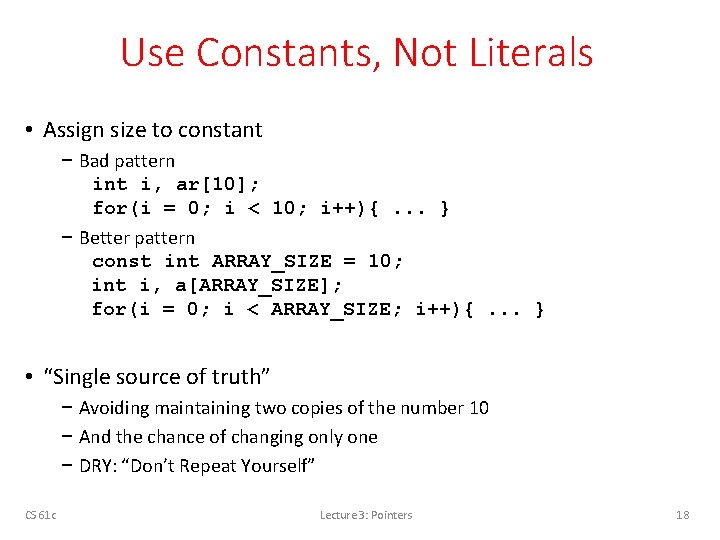
Use Constants, Not Literals • Assign size to constant − Bad pattern int i, ar[10]; for(i = 0; i < 10; i++){. . . } − Better pattern const int ARRAY_SIZE = 10; int i, a[ARRAY_SIZE]; for(i = 0; i < ARRAY_SIZE; i++){. . . } • “Single source of truth” − Avoiding maintaining two copies of the number 10 − And the chance of changing only one − DRY: “Don’t Repeat Yourself” CS 61 c Lecture 3: Pointers 18
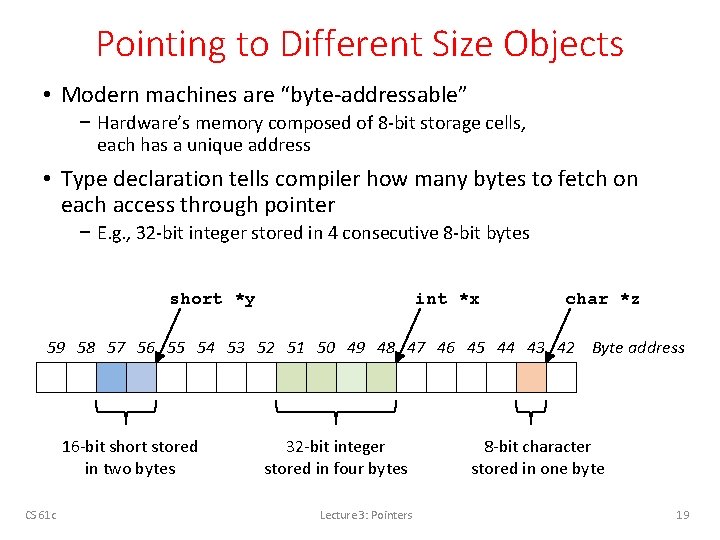
Pointing to Different Size Objects • Modern machines are “byte-addressable” − Hardware’s memory composed of 8 -bit storage cells, each has a unique address • Type declaration tells compiler how many bytes to fetch on each access through pointer − E. g. , 32 -bit integer stored in 4 consecutive 8 -bit bytes short *y int *x char *z 59 58 57 56 55 54 53 52 51 50 49 48 47 46 45 44 43 42 Byte address 16 -bit short stored in two bytes CS 61 c 32 -bit integer stored in four bytes Lecture 3: Pointers 8 -bit character stored in one byte 19
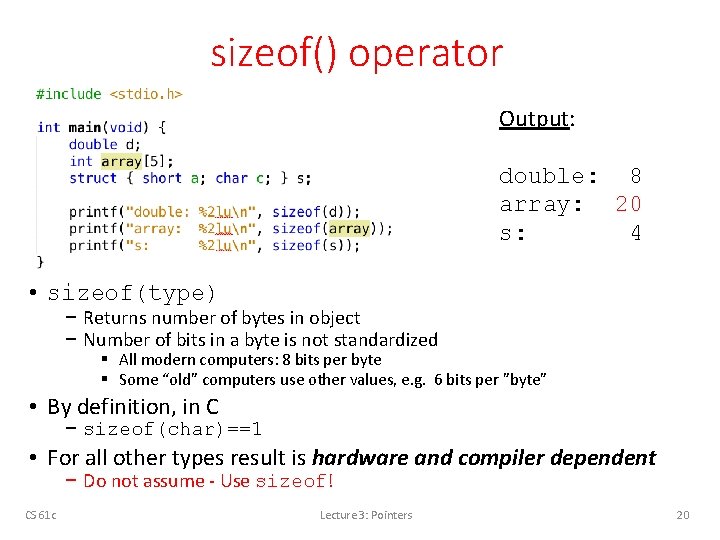
sizeof() operator Output: double: 8 array: 20 s: 4 • sizeof(type) − Returns number of bytes in object − Number of bits in a byte is not standardized § All modern computers: 8 bits per byte § Some “old” computers use other values, e. g. 6 bits per ”byte” • By definition, in C − sizeof(char)==1 • For all other types result is hardware and compiler dependent − Do not assume - Use sizeof! CS 61 c Lecture 3: Pointers 20
Agenda • Pointers in C • Arrays in C • This is not on the test • Pointer arithmetic • Strings, main • And in Conclusion, … CS 61 c Lecture 3: Pointers 21
Be Considerate • Chairs very noise when people get up • Please: −Do not leave now −Do not leave during last 5 minutes of class CS 61 c Lecture 3: Pointers 22
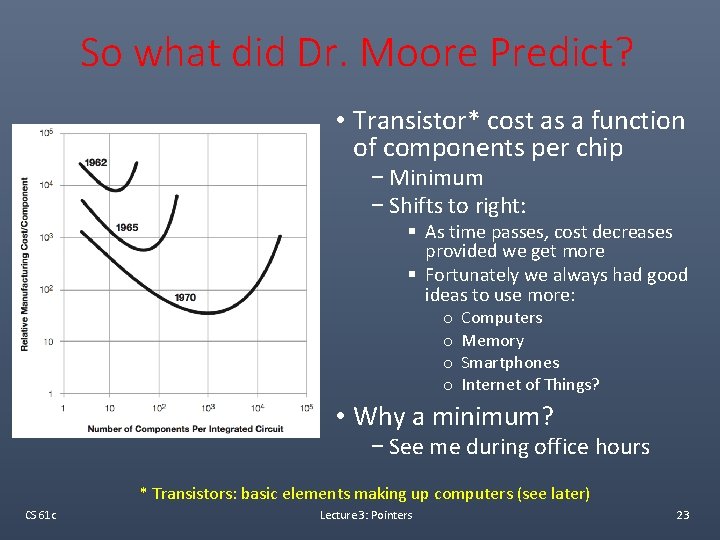
So what did Dr. Moore Predict? • Transistor* cost as a function of components per chip − Minimum − Shifts to right: § As time passes, cost decreases provided we get more § Fortunately we always had good ideas to use more: o o Computers Memory Smartphones Internet of Things? • Why a minimum? − See me during office hours * Transistors: basic elements making up computers (see later) CS 61 c Lecture 3: Pointers 23
Dr. Moore’s Vision (in 1965) • Something useful that is getting always better and less expensive is good for − Society − Business CS 61 c Lecture 3: Pointers 24
Benefits and Drawbacks of Moore’s Law … next time! CS 61 c Lecture 3: Pointers 25
Agenda • Pointers in C • Arrays in C • This is not on the test • Pointer arithmetic • Strings, main • And in Conclusion, … CS 61 c Lecture 3: Pointers 26
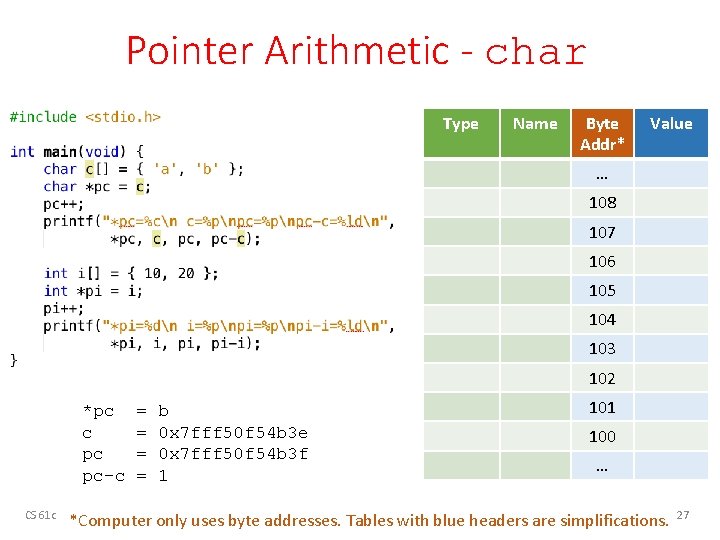
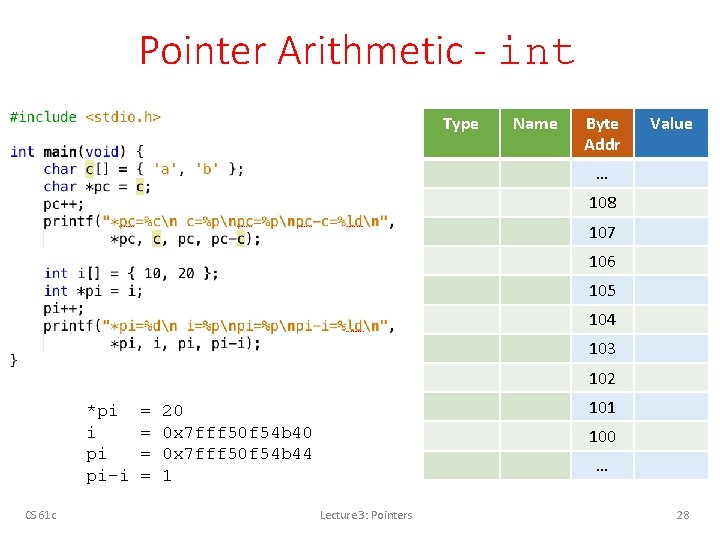
Pointer Arithmetic - char Type Name Byte Addr* Value … 108 107 106 105 104 103 102 *pc c pc pc-c CS 61 c = = b 0 x 7 fff 50 f 54 b 3 e 0 x 7 fff 50 f 54 b 3 f 1 100 … *Computer only uses byte addresses. Tables with blue headers are simplifications. 27
Pointer Arithmetic - int Type Name Byte Addr Value … 108 107 106 105 104 103 102 *pi i pi pi-i CS 61 c = = 101 20 0 x 7 fff 50 f 54 b 44 1 100 … Lecture 3: Pointers 28
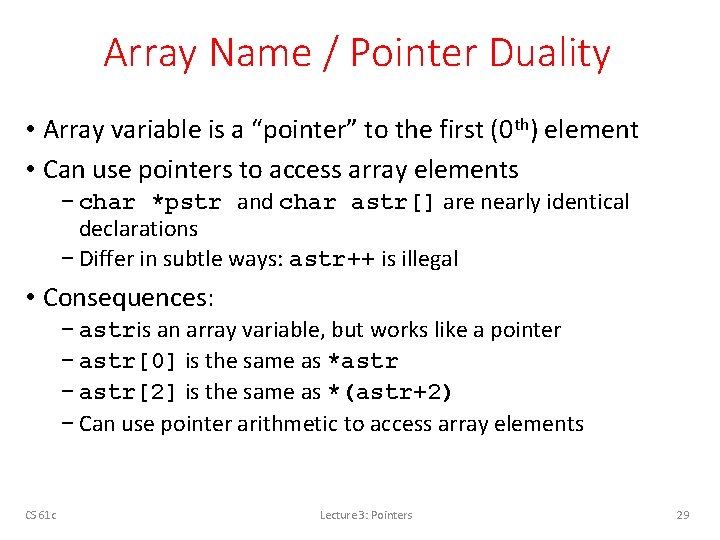
Array Name / Pointer Duality • Array variable is a “pointer” to the first (0 th) element • Can use pointers to access array elements − char *pstr and char astr[] are nearly identical declarations − Differ in subtle ways: astr++ is illegal • Consequences: − astris an array variable, but works like a pointer − astr[0] is the same as *astr − astr[2] is the same as *(astr+2) − Can use pointer arithmetic to access array elements CS 61 c Lecture 3: Pointers 29
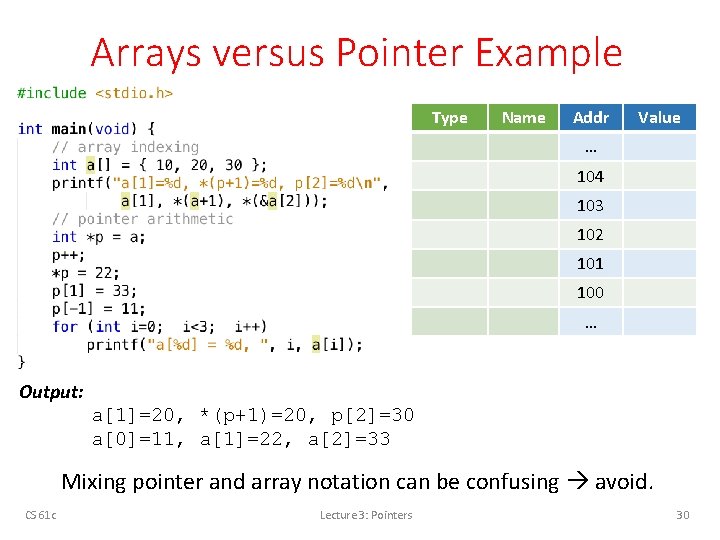
Arrays versus Pointer Example Type Name Addr Value … 104 103 102 101 100 … Output: a[1]=20, *(p+1)=20, p[2]=30 a[0]=11, a[1]=22, a[2]=33 Mixing pointer and array notation can be confusing avoid. CS 61 c Lecture 3: Pointers 30
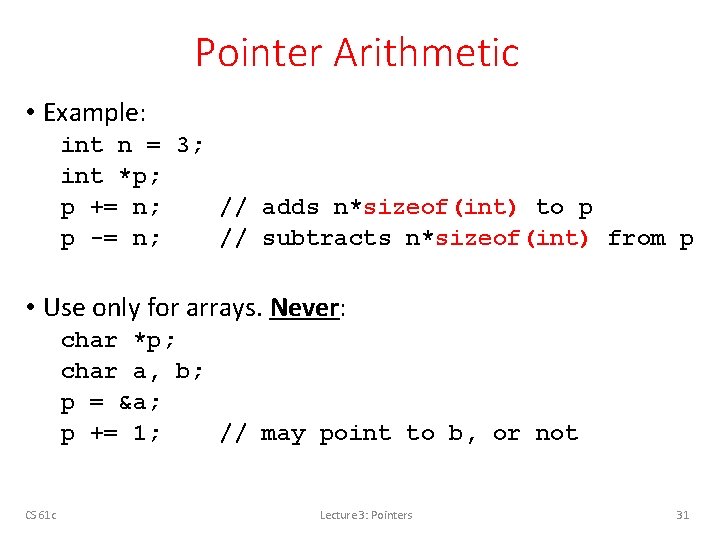
Pointer Arithmetic • Example: int n = 3; int *p; p += n; // adds n*sizeof(int) to p p -= n; // subtracts n*sizeof(int) from p • Use only for arrays. Never: char *p; char a, b; p = &a; p += 1; // may point to b, or not CS 61 c Lecture 3: Pointers 31
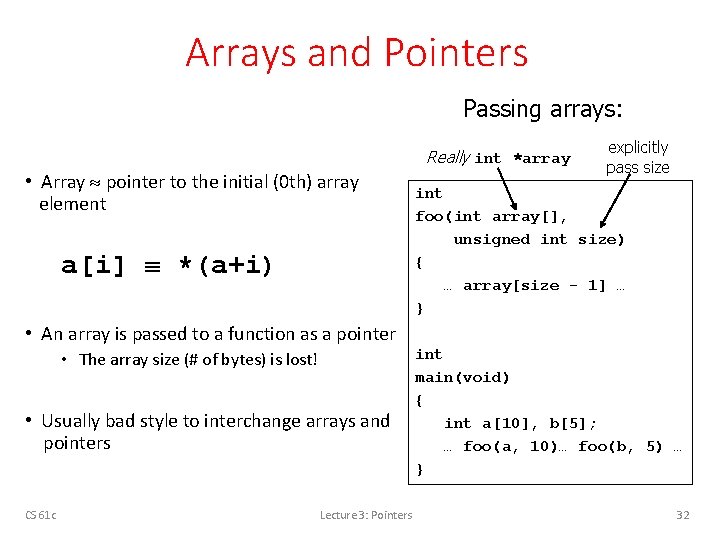
Arrays and Pointers Passing arrays: Really int *array • Array pointer to the initial (0 th) array element a[i] *(a+i) explicitly pass size int foo(int array[], unsigned int size) { … array[size - 1] … } • An array is passed to a function as a pointer • The array size (# of bytes) is lost! • Usually bad style to interchange arrays and pointers CS 61 c Lecture 3: Pointers int main(void) { int a[10], b[5]; … foo(a, 10)… foo(b, 5) … } 32
Arrays and Pointers int foo(int array[], unsigned int size) { … printf(“%dn”, sizeof(array)); } int main(void) { int a[10], b[5]; … foo(a, 10)… foo(b, 5) … printf(“%dn”, sizeof(a)); } CS 61 c Lecture 3: Pointers What does this print? 8 . . . because array is really a pointer (and a pointer is architecture dependent, but likely to be 8 on modern “ 64 bit” machines!) What does this print? 40 (provided sizeof(int)==4) 33
Arrays and Pointers These code sequences have the same effect: int i; array[5]; Name Type Addr Value … for (i = 0; i < 5; i++) { array[i] = …; } 106 105 104 103 int *p; int array[5]; 102 for (p = array; p < &array[5]; p++) { *p = …; } 100 CS 61 c 101 Lecture 3: Pointers … 34
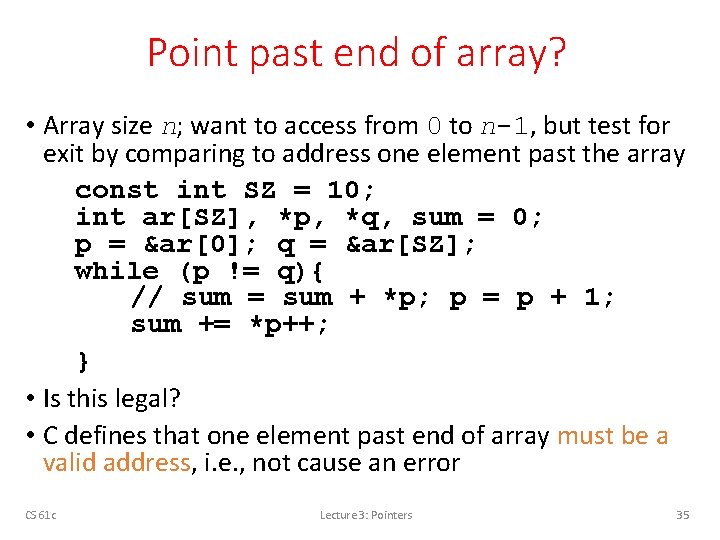
Point past end of array? • Array size n; want to access from 0 to n-1, but test for exit by comparing to address one element past the array const int SZ = 10; int ar[SZ], *p, *q, sum = 0; p = &ar[0]; q = &ar[SZ]; while (p != q){ // sum = sum + *p; p = p + 1; sum += *p++; } • Is this legal? • C defines that one element past end of array must be a valid address, i. e. , not cause an error CS 61 c Lecture 3: Pointers 35
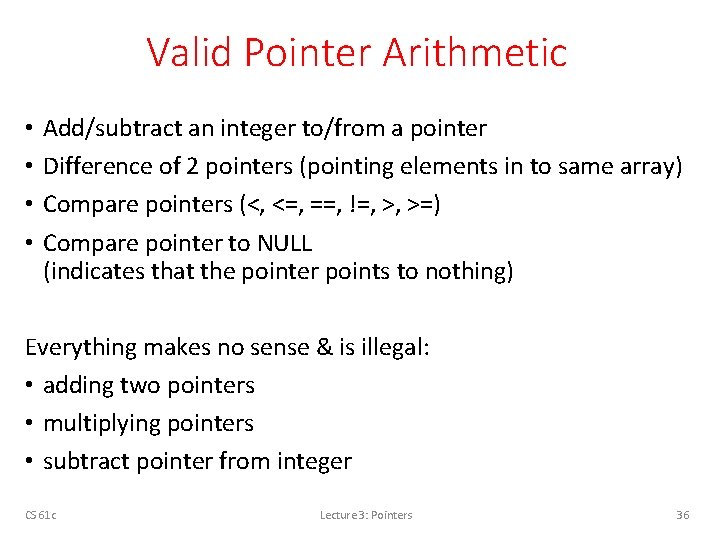
Valid Pointer Arithmetic • • Add/subtract an integer to/from a pointer Difference of 2 pointers (pointing elements in to same array) Compare pointers (<, <=, ==, !=, >, >=) Compare pointer to NULL (indicates that the pointer points to nothing) Everything makes no sense & is illegal: • adding two pointers • multiplying pointers • subtract pointer from integer CS 61 c Lecture 3: Pointers 36
Your Turn … int x[] = { 2, 4, 6, 8, 10 }; int *p = x; int **pp = &p; Name Type (*pp)++; (*(*pp))++; printf("%dn", *p); Output is: A: 2 B: 3 C: 4 D: 5 E: None of the above Addr Value … 106 105 104 103 102 101 100 … 37
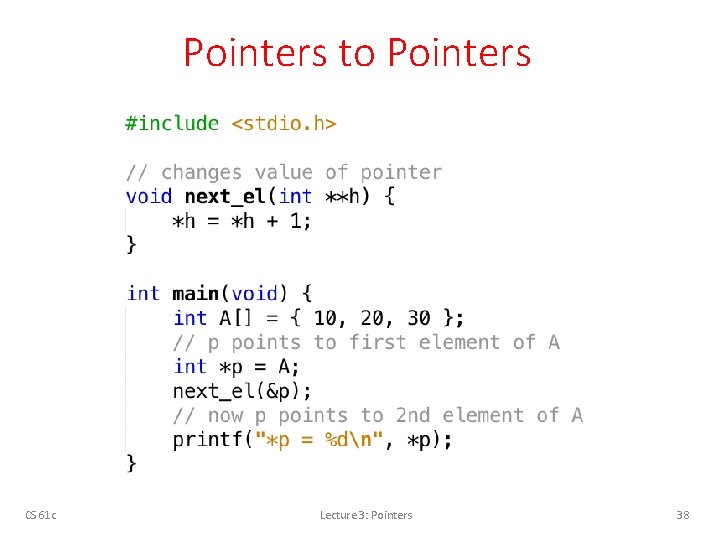
Pointers to Pointers CS 61 c Lecture 3: Pointers 38
Agenda • Pointers in C • Arrays in C • This is not on the test • Pointer arithmetic • Strings, main • And in Conclusion, … CS 61 c Lecture 3: Pointers 39
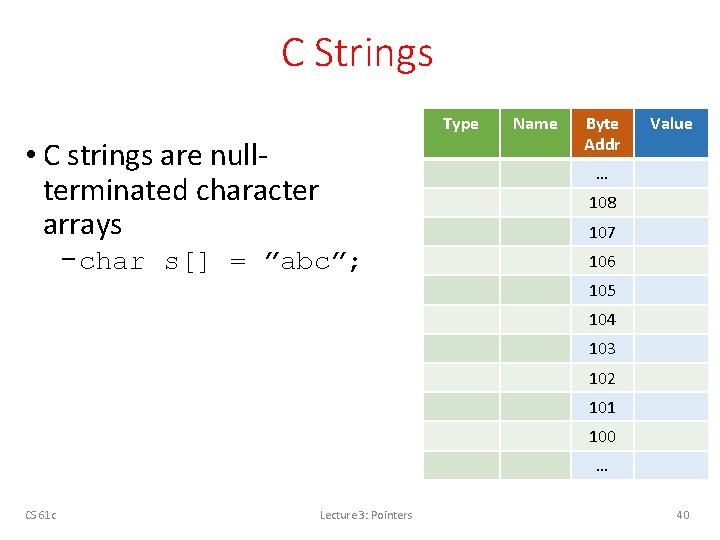
C Strings Type • C strings are nullterminated character arrays Name Byte Addr Value … 108 107 − char s[] = ”abc”; 106 105 104 103 102 101 100 … CS 61 c Lecture 3: Pointers 40
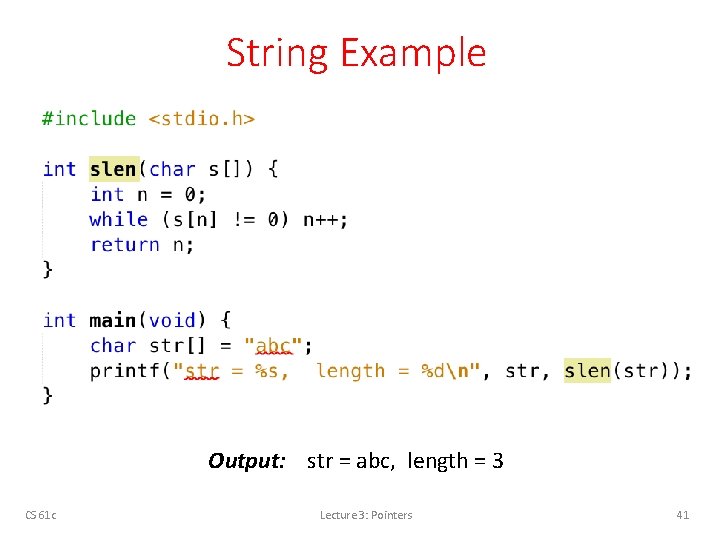
String Example Output: str = abc, length = 3 CS 61 c Lecture 3: Pointers 41
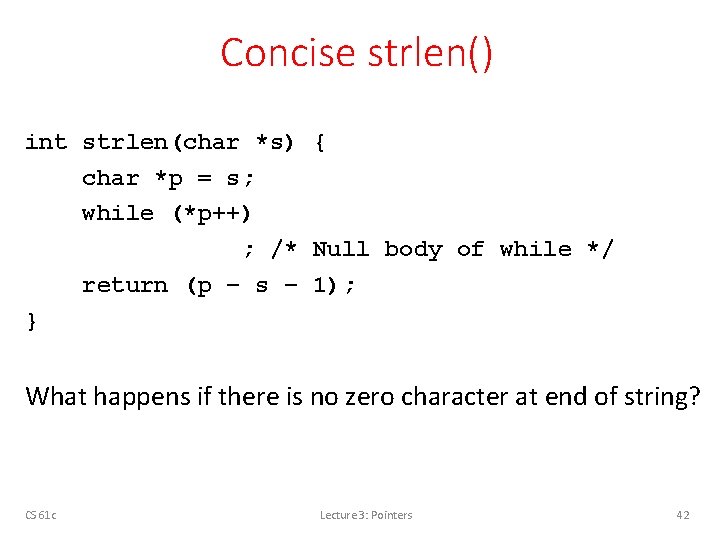
Concise strlen() int strlen(char *s) { char *p = s; while (*p++) ; /* Null body of while */ return (p – s – 1); } What happens if there is no zero character at end of string? CS 61 c Lecture 3: Pointers 42
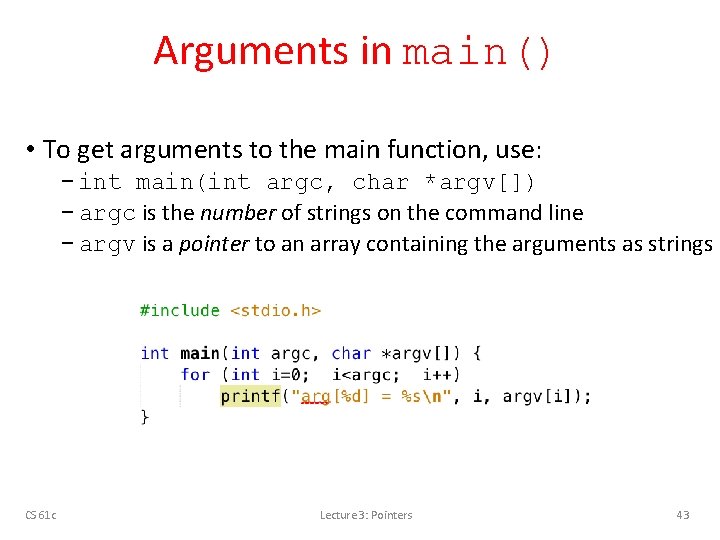
Arguments in main() • To get arguments to the main function, use: − int main(int argc, char *argv[]) − argc is the number of strings on the command line − argv is a pointer to an array containing the arguments as strings CS 61 c Lecture 3: Pointers 43
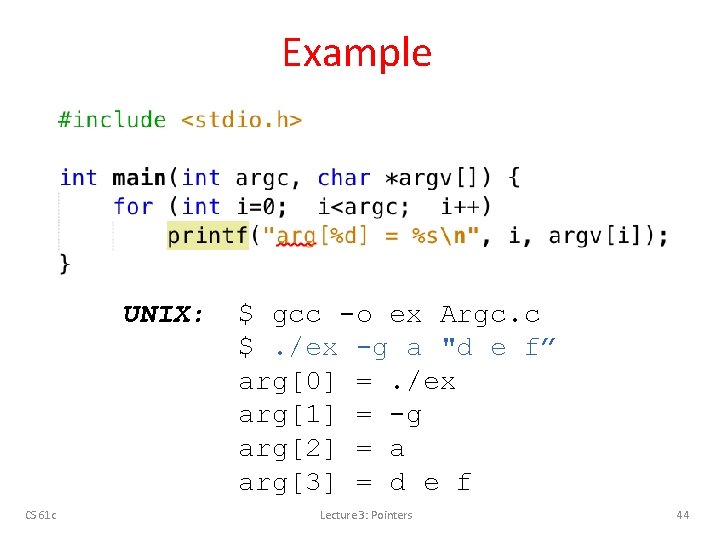
Example UNIX: CS 61 c $ gcc -o ex Argc. c $. /ex -g a "d e f” arg[0] =. /ex arg[1] = -g arg[2] = a arg[3] = d e f Lecture 3: Pointers 44
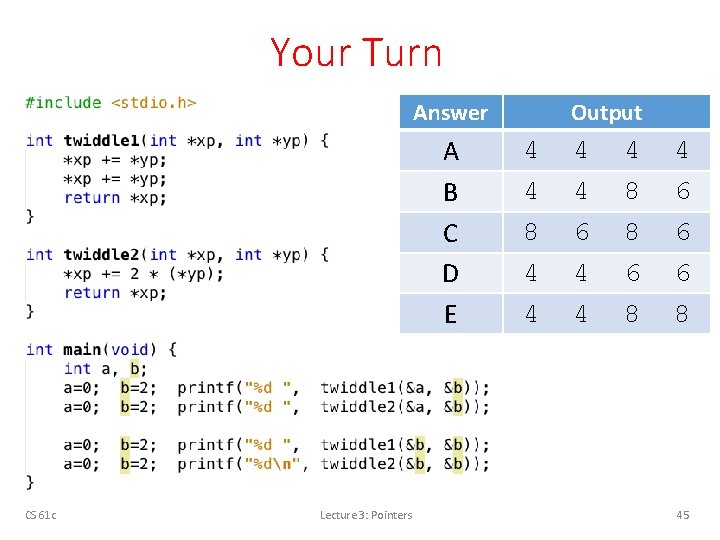
Your Turn Answer A B C D E CS 61 c Lecture 3: Pointers Output 4 4 8 4 4 6 4 4 4 8 8 6 8 4 6 6 6 8 45
Agenda • Pointers in C • Arrays in C • This is not on the test • Pointer arithmetic • Strings, main • And in Conclusion, … CS 61 c Lecture 3: Pointers 46
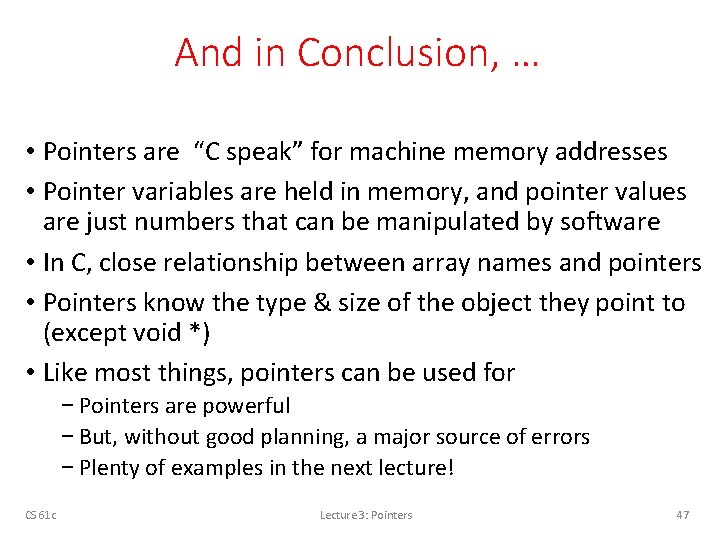
And in Conclusion, … • Pointers are “C speak” for machine memory addresses • Pointer variables are held in memory, and pointer values are just numbers that can be manipulated by software • In C, close relationship between array names and pointers • Pointers know the type & size of the object they point to (except void *) • Like most things, pointers can be used for − Pointers are powerful − But, without good planning, a major source of errors − Plenty of examples in the next lecture! CS 61 c Lecture 3: Pointers 47